From Surf Wiki (app.surf) — the open knowledge base
France national football team
Men's association football team
Men's association football team
| Field | Value |
|---|---|
| Name | France |
| Badge | France national football team seal.svg |
| Badge_size | 150 |
| FIFA Trigramme | FRA |
| Nickname | Les Bleus (The Blues) |
| Association | Fédération Française de Football (FFF) |
| Confederation | UEFA (Europe) |
| Coach | Didier Deschamps |
| Captain | Kylian Mbappé |
| Most caps | Hugo Lloris (145) |
| Top scorer | Olivier Giroud (57) |
| Home Stadium | Stade de France |
| FIFA Rank | |
| FIFA max | 1 |
| FIFA max date | May 2001 – May 2002, August–September 2018 |
| FIFA min | 26 |
| FIFA min date | September 2010 |
| Elo Rank | |
| Elo max | 1 |
| Elo max date | 1984–1985, 1986, 1998–1999, 2000–2002, 2003–2004, 2006, 2007, 2018 |
| Elo min | 40 |
| Elo min date | March–July 1930 |
| pattern_la1 | _fra24h |
| pattern_b1 | _fra24h |
| pattern_ra1 | _fra24h |
| pattern_sh1 | _fra24h |
| pattern_so1 | _fra24h |
| leftarm1 | 1F14DE |
| body1 | 1F14DE |
| rightarm1 | 1F14DE |
| shorts1 | FFFFFF |
| socks1 | FF0000 |
| pattern_la2 | _fra24a |
| pattern_b2 | _fra24a |
| pattern_ra2 | _fra24a |
| pattern_sh2 | _fra24a |
| pattern_so2 | _fra24a |
| leftarm2 | FFFFFF |
| body2 | FFFFFF |
| rightarm2 | FFFFFF |
| shorts2 | FFFFFF |
| socks2 | FFFFFF |
| First game | 3–3 |
| (Uccle, Belgium; 1 May 1904) | |
| Largest win | 14–0 |
| (Nice, France; 18 November 2023) | |
| Largest loss | 17–1 |
| (London, England; 22 October 1908) | |
| World cup apps | 16 |
| World cup first | 1930 |
| World cup best | **Champions** ([1998](1998-fifa-world-cup), [2018](2018-fifa-world-cup)) |
| Regional name | European Championship |
| Regional cup apps | 11 |
| Regional cup first | [1960](1960-european-nations-cup) |
| Regional cup best | **Champions** (1984, 2000) |
| 2ndRegional name | Nations League Finals |
| 2ndRegional cup apps | 2 |
| 2ndRegional cup first | [2021](2021-uefa-nations-league-finals) |
| 2ndRegional cup best | **Champions** ([2021](2021-uefa-nations-league-finals)) |
| Confederations cup apps | 2 |
| Confederations cup first | [2001](2001-fifa-confederations-cup) |
| Confederations cup best | **Champions** ([2001](2001-fifa-confederations-cup), [2003](2003-fifa-confederations-cup)) |
| 3rdRegional name | CONMEBOL–UEFA Cup of Champions |
| 3rdRegional cup apps | 1 |
| 3rdRegional cup first | 1985 |
| 3rdRegional cup best | **Champions** (1985) |
the men's team
(Uccle, Belgium; 1 May 1904) (Nice, France; 18 November 2023) (London, England; 22 October 1908)
The France national football team () represents France in men's international football. It is controlled by the French Football Federation (FFF; Fédération française de football), the governing body for football in France. It is a member of UEFA in Europe and FIFA in global competitions. The team's colours and imagery reference two national symbols: the French blue-white-red tricolour and Gallic rooster (coq gaulois). The team is colloquially known as Les Bleus (The Blues). They play home matches at the Stade de France in Saint-Denis and train at Centre National du Football in Clairefontaine-en-Yvelines.
Founded in 1904, the team has won two FIFA World Cups, two UEFA European Championships, one CONMEBOL–UEFA Cup of Champions, two FIFA Confederations Cups and one UEFA Nations League title. France was one of the four European teams that participated in the first World Cup in 1930. Twenty-eight years later, the team led by Raymond Kopa and Just Fontaine finished in third place at the 1958 World Cup. France experienced much of its success in three different eras: in the 1980s, the late 1990s to early 2000s, and the late 2010s to early 2020s.
In 1984, under the leadership of the three-time Ballon d'Or winner Michel Platini, France won Euro 1984 (its first official title), a CONMEBOL–UEFA Cup (1985), and reached two World Cup semi-finals (1982 and 1986). During the captaincy of Didier Deschamps, with Zinedine Zidane being the star player, Les Bleus won the 1998 World Cup and Euro 2000. They also won the Confederations Cup in 2001 and 2003. Three years later, France made it to the final of the 2006 World Cup, losing 5–3 on penalties to Italy. A decade later, the team reached the final of Euro 2016, where they lost 1–0 to Portugal in extra time. Two years after that, France won the 2018 World Cup, its second title in that competition. After winning the 2021 Nations League, they became the first, and so far, the only European national team to have won every senior FIFA and UEFA competition. In 2022, France reached a second consecutive World Cup final, but lost 4–2 on penalties to Argentina.
France is also one of only two countries, the other being Brazil, to have won all men's FIFA 11-player competitions at all age levels, having claimed both the FIFA World Cup, FIFA U-20 World Cup, FIFA U-17 World Cup, the now-defunct FIFA Confederations Cup, and Olympic title, as well as the first to complete the collection, after the U-20 national team captured the first U-20 World Cup title in 2013. The CONMEBOL-UEFA Cup of Champions is missing for Brazil, and the FIFA U-17 World Cup is missing for Argentina.
France has footballing rivalries with Belgium, England, Germany, Italy, Portugal, and Spain. A bitter rivalry with Argentina also developed and intensified in the early 2020s.
History
Main article: History of the France national football team
Early years (1900–1930s)
The France national football team was created in 1904, around the time of FIFA's foundation. The team competed in its first official international match on 1 May 1904 against Belgium in Brussels, ending in a 3–3 draw. The following year, on 12 February 1905, France contested their first-ever home match against Switzerland. The match was played at the Parc des Princes in front of 500 supporters. France won the match 1–0 with the only goal coming from Gaston Cyprès. Due to disagreements between FIFA and the Union des Sociétés Françaises de Sports Athlétiques (USFSA), the country's sports union, France struggled to establish an identity. On 9 May 1908, the French Interfederal Committee (CFI), a rival organization to the USFSA, ruled that FIFA would now be responsible for the club's appearances in forthcoming Olympic Games and not the USFSA. In 1919, the CFI transformed themselves into the French Football Federation (FFF). In 1921, the USFSA finally merged with the FFF.
In July 1930, France appeared in the inaugural FIFA World Cup, held in Uruguay. In their first-ever World Cup match, France defeated Mexico 4–1 at the Estadio Pocitos in Montevideo. Lucien Laurent scored the first goal in World Cup history. Conversely, France also became the first team to not score in a World Cup match after losing 1–0 to group stage opponents Argentina. Another loss to Chile resulted in the team bowing out in the group stage. The following year saw the first selection of a black player to the national team. Raoul Diagne, who was of Senegalese descent, earned his first cap on 15 February in a 2–1 defeat to Czechoslovakia. Diagne later played with the team at the 1938 World Cup, alongside Larbi Benbarek, who was one of the first players of North African origin to play for the national team. At the 1934 World Cup, France suffered elimination in the opening round, losing 3–2 to Austria. On the team's return to Paris, they were greeted as heroes by a crowd of over 4,000 supporters. France hosted the 1938 World Cup and reached the quarterfinals, losing 3–1 to defending champions (and eventual 1938 winners) Italy.
1950s–1980s
France's first 'Golden Generation' in the late 1950s comprised players such as Just Fontaine, Raymond Kopa, Jean Vincent, Robert Jonquet, Maryan Wisnieski, Thadée Cisowski, and Armand Penverne. At the 1958 World Cup, France reached the semi-finals where they lost to Brazil. In the third-place match, France defeated West Germany 6–3 with Fontaine recording four goals, which brought his goal tally in the competition to 13, a World Cup record that still stands today. France hosted the inaugural UEFA European Football Championship in 1960. For the second straight international tournament, the team reached the semi-finals, but were defeated 5–4 by Yugoslavia despite being up 4–2 heading into the 75th minute. In the third-place match, France was defeated 2–0 by Czechoslovakia.
The 1960s and 1970s saw France decline significantly playing under several managers and failing to qualify for numerous international tournaments. On 25 April 1962, Henri Guérin was officially installed as the team's first manager. Under Guérin, France failed to qualify for the 1962 World Cup and the 1964 European Nations' Cup. The team returned to major tournament play by qualifying for the 1966 World Cup, but did not make it past the group stage phase of the tournament. Guérin was fired following the World Cup. He was replaced by José Arribas and Jean Snella, who worked as caretaker managers in dual roles. The two only lasted four matches and were replaced by former international Just Fontaine, who in turn was only in charge for two matches. Louis Dugauguez succeeded Fontaine and following his early struggles in qualification for the 1970 World Cup, was fired and replaced by Georges Boulogne, who could not get the team to the competition. Boulogne was later fired following his failure to qualify for the 1974 World Cup and was replaced by the Romanian Ștefan Kovács, who became the only international manager to ever manage the national team. Under the management of Kovács, France failed to qualify for UEFA Euro 1976. After two years in charge, he was sacked and replaced by Michel Hidalgo.
Under Hidalgo, France flourished, mainly due to players such as defenders Marius Trésor and Maxime Bossis, striker Dominique Rocheteau and midfielder Michel Platini. These players, alongside Jean Tigana, Alain Giresse and Luis Fernández, formed the "carré magique" ("Magic Square"), which would haunt opposing defenses beginning at the 1982 World Cup. France reached the semi-finals losing on penalties to West Germany. The semi-final match-up is considered one of the greatest matches in World Cup history and was marked by controversy. France finished fourth overall, losing the third-place playoff 3–2 to Poland. France earned their first major international honor two years later, winning Euro 1984, which they hosted. Under the leadership of Platini, who scored a tournament-high nine goals, France defeated Spain 2–0 in the final. Platini and Bruno Bellone scored, before Hidalgo departed the team in order for Henri Michel to take over. France subsequently won gold at the 1984 Summer Olympics football tournament and, a year later, defeated Uruguay 2–0 to win the Artemio Franchi Trophy, an early precursor to the FIFA Confederations Cup. In a span of a year, France were holders of three of the four major international trophies. At the 1986 World Cup, France reached the semi-finals, losing a rematch to West Germany, but achieved third place with a 4–2 victory over Belgium.
In 1988, the FFF opened the Clairefontaine National Football Institute. Its opening ceremony was attended by then-President of France, François Mitterrand. Five months after Clairefontaine's opening, manager Henri Michel was fired and was replaced by Michel Platini, who failed to get the team to the 1990 World Cup.
Zidane era and World Champions (1995–2006)
Under Gerard Houllier, France and its supporters experienced a major disappointment in failing to qualify for the 1994 World Cup. With two matches to play, qualification had been all but secured with matches remaining against last-placed Israel and in-contention Bulgaria. However, France was upset at home by Israel 3–2 after leading 2–1 late in the match and, against Bulgaria, conceded a 90th-minute goal for a 2–1 defeat. The subsequent blame and public outcry led to the firing of Houllier and departure of several players, from the national team fold. Houllier's assistant Aimé Jacquet was appointed as manager.
Under Jacquet, the national team achieved multiple successes. The squad comprised some experienced players from the group that had failed to reach the 1994 World Cup as well as some talented younger players, such as Zinedine Zidane. The team reached the semi-finals of Euro 1996, where they lost 6–5 on penalties to the Czech Republic. The team's next major tournament was the 1998 World Cup, which France hosted. France went through the tournament undefeated and became the seventh nation to win the World Cup, defeating Brazil 3–0 in the final at the Stade de France in Paris. Jacquet stepped down after the country's World Cup triumph and was succeeded by assistant Roger Lemerre who guided them through Euro 2000. Led by FIFA World Player of the Year Zidane, France defeated Italy 2–1 in the final. David Trezeguet scored the golden goal in extra time. The victory gave the team the distinction of holding both the World Cup and Euro titles, a feat first achieved by West Germany in 1974; this was also the first time that a reigning World Cup winner went on to capture the Euro. Following the result, the France national team was accorded the number one spot in the FIFA World Rankings. In the following year, the team won the 2001 FIFA Confederations Cup.
After this period of achievement, France were much less successful in subsequent tournaments, and failed to make it past the group stage at the 2002 World Cup. One of the greatest shocks in World Cup history saw France defeated 1–0 by debutantes Senegal in the opening game of the tournament. France became only the second nation to be eliminated in the first round as World Cup holders, the first being Brazil in 1966. After the 2010, 2014, and 2018 World Cups, Italy, Spain, and Germany were also added to this list. After France finished bottom of the group, Lemerre was dismissed and was replaced by Jacques Santini. A full-strength team started out strongly at Euro 2004, but they were upset in the quarter-finals by the eventual winners Greece. Santini resigned as coach and Raymond Domenech was picked as his replacement. France struggled in the early qualifiers for the 2006 World Cup. This prompted Domenech to persuade several past members out of international retirement to help the national team qualify, which they accomplished following a convincing 4–0 win over Cyprus on the final day of qualifying.
In the 2006 World Cup final stages, France finished undefeated in their group and advanced to the final, defeating Spain, Brazil, and Portugal in the knockout matches. France played Italy in the final, with the match finishing 1–1 after extra time. Zinedine Zidane had given France an early lead through a Panenka penalty which hit the crossbar before bouncing past the goal line, however Italy defender Marco Materazzi equalised from a header seven minutes later. Italy ended up winning 5–3 on penalties. The match featured an incident during extra time between Zidane and Materazzi in which Zidane headbutted Materazzi on the chest and was sent off. This was Zidane's last appearance in a football match as he announced previously that he would retire from football after the 2006 World Cup.
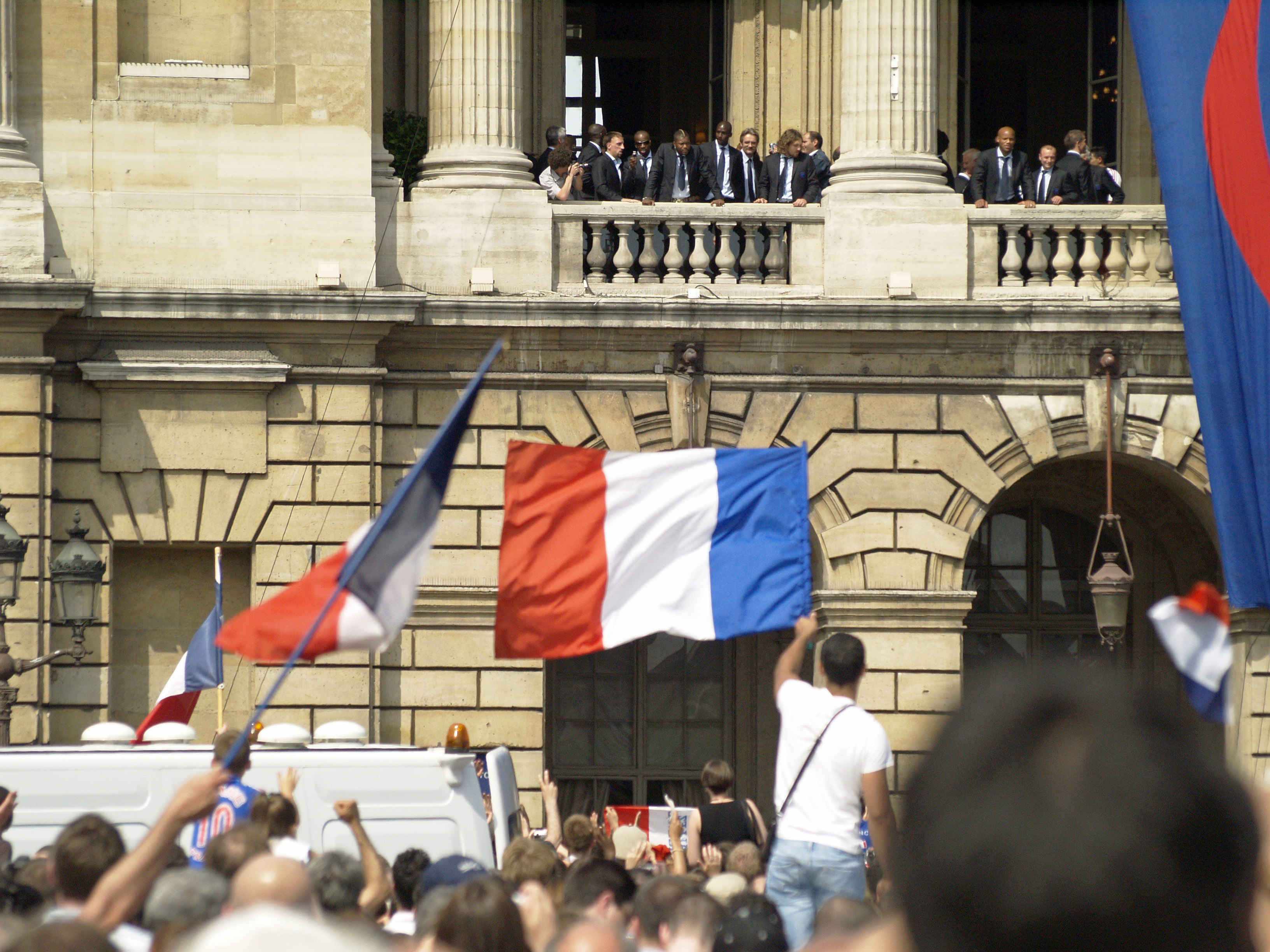
Decline and rebuild (2007–2015)
France started its qualifying round for Euro 2008 strong and qualified for the tournament, despite two defeats to Scotland. After the performance in the qualifiers, France performed poorly at the final tournament, ending in last place of their group, behind Netherlands, Italy and Romania, obtaining just one point after a 0–0 draw with the Romanian side. Just like the team's previous World Cup qualifying campaign, the 2010 campaign got off to a disappointing start with France suffering disastrous losses and earning uninspired victories. France eventually finished second in the group and earned a spot in the UEFA play-offs against the Republic of Ireland for a place in South Africa. In the first leg, France defeated the Irish 1–0 and in the second leg procured a 1–1 draw, via a controversial act by France forward Thierry Henry, to qualify for the World Cup.
At the finals in South Africa, the team continued to underperform and were eliminated in the group stage, while the negative publicity the national team received during the competition led to further repercussions back in France. Midway through the competition, striker Nicolas Anelka was dismissed from the national team after reportedly having a dispute, in which obscenities were passed, with team manager Raymond Domenech during half-time of the team's loss to Mexico. The resulting disagreement over Anelka's expulsion between the players, the coaching staff and FFF officials resulted in the players boycotting training before their third game. In response to the training boycott, Sports Minister Roselyne Bachelot lectured the players and "reduced France's disgraced World Cup stars to tears with an emotional speech on the eve of their final group A match". France then lost their final game 2–1 to hosts South Africa and failed to advance to the knockout stage. The day after the team's elimination, it was reported by numerous media outlets that then President of France Nicolas Sarkozy would meet with team captain Thierry Henry to discuss the issues associated with the team's meltdown at the World Cup, at Henry's request. Following the completion of the World Cup tournament, Federation President Jean-Pierre Escalettes resigned from his position.
Domenech, whose contract had expired, was succeeded as head coach by former international Laurent Blanc. On 23 July 2010, at the request of Blanc, the FFF suspended all 23 players in the World Cup squad for the team's friendly match against Norway after the World Cup. On 6 August, five players who were deemed to have played a major role in the training boycott were disciplined for their roles, and Nicolas Anelka also received an 18-match ban, effectively ending the forward's international career.
At Euro 2012 in Poland and Ukraine, France reached the quarter-finals, where they were beaten by eventual champions Spain. Following the tournament, coach Laurent Blanc resigned and was succeeded by Didier Deschamps, who captained France to glory in the 1998 World Cup and Euro 2000. His team qualified for the 2014 World Cup by beating Ukraine in the play-offs. At the 2014 World Cup, France lost to eventual champions Germany in the quarter-finals courtesy of an early goal by Mats Hummels.
Renewed success (2016–present)
France automatically qualified as hosts for UEFA Euro 2016, advancing to the knockout stages, where they defeated the Republic of Ireland and Iceland. In the semi-final, France defeated Germany 2–0, marking their first win over Germany at a major tournament since 1958. France, however, were beaten by Portugal 1–0 in the final courtesy of an extra-time goal by Eder.
At the 2018 World Cup, France finished top of their group to advance to the last 16. They subsequently defeated Argentina 4–3 in a thrilling match in the round of 16 and then Uruguay 2–0 to qualify for the semi-final stage, where they beat Belgium 1–0 courtesy of a goal from defender Samuel Umtiti. On 15 July, France beat Croatia in the final 4–2 to win the World Cup for the second time.
UEFA Euro 2020 was postponed until 2021 due to the COVID-19 pandemic. At Euro 2020, France finished top of a group containing Germany, Portugal and Hungary, which was described by pundits as the "group of death". However, they were eliminated by Switzerland in the round of 16. The Swiss had held France to a 3–3 draw in normal time before winning on penalties. France would go on to win the 2020–21 edition of the UEFA Nations League, after winning advancement to the final tournament from a group consisting of inaugural champions Portugal. France defeated Spain 2–1 in the final for their first title.
At the 2022 FIFA World Cup, France looked to defend their title in Qatar. After finishing top of their group, France did manage to reach a second successive World Cup final, defeating Poland, England and Morocco in the knockout stages. However, they were defeated on penalties by Argentina after a thrilling 3–3 draw.
France qualified for UEFA Euro 2024 in Germany, where they finished second in the group stage following a victory over Austria 1–0 and two draws against Netherlands (0–0) and Poland (1–1), therefore advancing to the knockout stage. They defeated Belgium 1–0 in the round of 16 and later advanced to the semi-finals after defeating Portugal in penalties following a 0–0 draw. France were later defeated by Spain 2–1 in the semi-finals, with this becoming their first defeat in regular time since losing to Germany at the 2014 World Cup.
In 2025, Didier Deschamps has confirmed he will leave when his contract expires after the 2026 World Cup.
Home stadium
Main article: Stade de France, Parc des Princes, INF Clairefontaine
During France's early years, the team's national stadium alternated between the Parc des Princes in Paris and the Stade Olympique Yves-du-Manoir in Colombes. France also hosted matches at the Stade Pershing, Stade de Paris, and the Stade Buffalo, but to a minimal degree. As time passed, France began hosting matches outside the city of Paris at such venues as the Stade Marcel Saupin in Nantes, the Stade Vélodrome in Marseille, the Stade de Gerland in Lyon, and the Stade de la Meinau in Strasbourg.

Following the renovation of the Parc des Princes in 1972, which gave the stadium the largest capacity in Paris, France moved into the venue permanently. The team still hosted friendly matches and minor World Cup and UEFA Euro qualification matches at other venues. France have played home matches in a French overseas department twice – in 2005 against Costa Rica in Fort-de-France (Martinique) and in 2010 against China in Saint Pierre (Réunion). Both matches were friendlies.
In 1998, the Stade de France was inaugurated as France's national stadium ahead of the 1998 World Cup. Located in Saint-Denis, a Parisian suburb, the stadium has an all-seater capacity of 81,338. France's first match at the stadium was played on 28 January 1998 against Spain. France won the match 1–0, with Zinedine Zidane scoring the goal. Since that match, France has used the stadium for almost every major home game, including the 1998 World Cup final.
Prior to matches, home or away, the national team trains at the INF Clairefontaine academy in Clairefontaine-en-Yvelines. Clairefontaine is the national association football centre and is among 12 élite academies throughout the country. The centre was inaugurated in 1976 by former FFF president Fernand Sastre and opened in 1988. The center drew media spotlight following its usage as a base camp by the team that won the 1998 World Cup.
In the 20th and 23rd minute of an international friendly on 13 November 2015, against Germany, three groups of terrorists attempted to detonate bomb vests, at three entrances of Stade de France, and two explosions occurred. Play would continue, until the 94th minute, in order to keep the crowd from panicking. Consequently, the stadium was evacuated through the unaffected gates of the stadium away from the players benches. Due to the blocked exits, spectators who could not leave the stadium had to go down to the pitch and wait until it was safer. As a result of the attacks, both teams would remain in the stadium until the day after.
Team image
Media coverage
The national team has a broadcasting agreement with TF1 Group, who the Federal Council of the FFF agreed to extend its exclusive broadcasting agreement with the channel. The new deal grants the channel exclusive broadcast rights for the matches of national team, which include friendlies and international games for the next four seasons beginning in August 2010 and ending in June 2014. TF1 will also have extended rights, notably on the Internet, and may also broadcast images of the national team in its weekly program, Téléfoot. The FFF will receive €45 million a season, a €10 million decrease from the €55 million they received from the previous agreement reached in 2006.
After France won their second World Cup in 2018, M6 together with TF1 broadcast all international fixtures featuring France respectively until 2022.
Friendlies and qualifiers
| Television channel | Period |
|---|---|
| ORTF | 1954–1974 |
| Antenne 2 | 1975–1984 |
| TF1 | 1984–2026 |
| M6 | 2009–2022 |
| TMC (friendly match only) | 2018–2022 |
| L'Équipe (UEFA Nations League match on rebroadcast) | 2018–2023 |
Finals tournament
| Television channel | Period | FIFA World Cup | UEFA European Championship |
|---|---|---|---|
| ORTF | 1954, 1958, 1966 | ||
| TF1 | 1978–1986, 1998–2022 | ||
| France Télévisions | 1978–1986 (Antenne 2), 1998 | ||
| M6 | 2026 | ||
| ORTF | 1960 | ||
| TF1 | 1984, 1992–2024 | ||
| France Télévisions | 1984, 1992 (Antenne 2), 1996–2004 | ||
| M6 | 2008–2024 |
Kits and crest
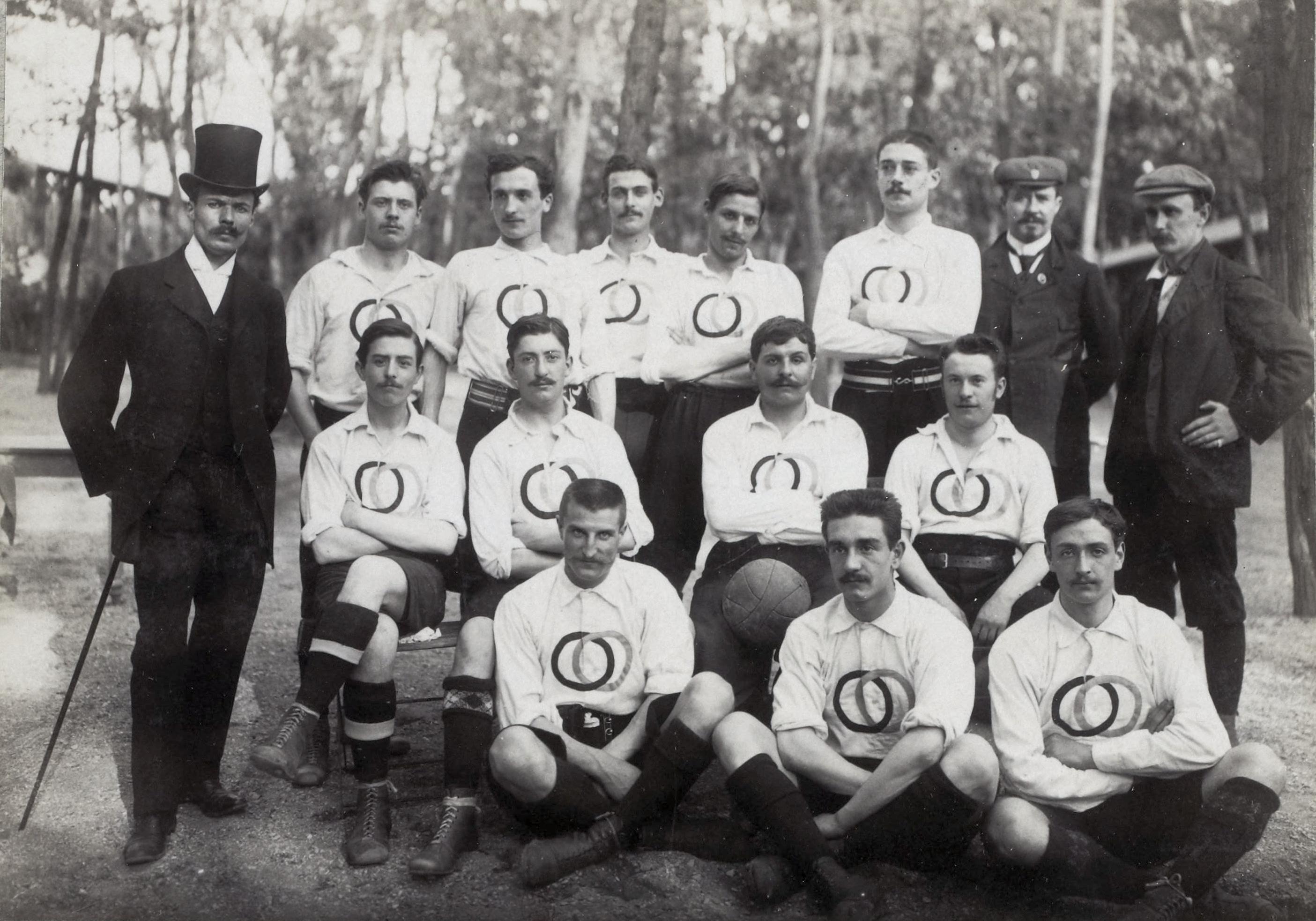
The France national team utilizes a three colour system composed of blue, white, and red. The team's three colours originate from the national flag of France, known as the tricolore. Nevertheless, the first France shirt (as seen in their first official international match against Belgium in 1904) was white, with the two interlinked rings emblem of USFSA –the body that controlled sport in France by then– on the left.
France normally wear blue shirts, white shorts, and red socks at home, while, when on the road, the team utilizes an all-white combination or white shirts and socks with blue shorts. Between 1909 and 1914, France wore a white shirt with blue stripes, white shorts, and red socks. In a 1978 World Cup match against Hungary in Mar del Plata, both teams arrived at Estadio José María Minella with white kits, so France played in green-and-white striped shirts borrowed from Club Atlético Kimberley.
Beginning in 1966, France had its shirts made by Le Coq Sportif until 1971. In 1972, France reached an agreement with German sports apparel manufacturer Adidas to be the team's kit provider. Over the next 38 years, the two would maintain a healthy relationship with France winning Euro 1984, the 1998 World Cup and Euro 2000 while wearing Adidas' famous tricolour three stripes. During the 2006 World Cup, France wore an all-white change strip in all four of its knockout matches, including the final. On 22 February 2008, the FFF announced that they were ending their partnership with Adidas and signing with Nike, effective 1 January 2011. The deal was valued at €320 million over seven years (1 January 2011 – 9 July 2018), making France's blue shirt the most expensive sponsorship in the history of football.
The first France kit worn in a major tournament produced by Nike was the Euro 2012 strip, which was all dark blue and used gold as an accent colour. In February 2013, Nike revealed an all baby blue change strip.
In advance of France's hosting of Euro 2016, Nike unveiled a new, unconventional kit set: blue shirts and shorts with red socks at home, white shirts and shorts and with blue socks away. The away shirt as worn in pre-Euro friendlies and released to the public also featured one blue sleeve and one red sleeve in reference to the "tricolore". However, due to UEFA regulations, France was forced to wear a modified version with the sleeve colours almost desaturated in their Euro 2016 group stage game against Switzerland, which continued to be worn during 2018 World Cup qualifying.
Kit sponsorship
| Kit supplier | Period | Notes |
|---|---|---|
| FRA Allen Sport | 19381966 | |
| FRA Le Coq Sportif | 1966–1971 | |
| GER Adidas | 1972–2010 | |
| USA Nike | 2011–present |
Kit deals
| Kit supplier | Period | Contract | ||
|---|---|---|---|---|
| announcement | Contract | |||
| duration | Value | Notes | ||
| USA Nike | 2011–present | 2011–2018 (7 years) | Total €340.8 million | |
| (€42.6 million per year) | ||||
| 2018–2026 (8 years) | Total €450 million | |||
| (€50 million per year) |
Nickname
France is often referred to by the media and supporters as Les Bleus (The Blues), which is the nickname associated with all of France's international sporting teams due to the blue shirts each team incorporates. The team is also referred to as Les Tricolores or L'Equipe Tricolore (The Tri-color Team) due to the team's utilization of the country's national colors: blue, white, and red. During the 1980s, France earned the nickname the "Brazilians of Europe" mainly due to the accolades of the "carré magique" ("Magic Square"), who were anchored by Michel Platini. Led by coach Michel Hidalgo, France exhibited an inspiring, elegant, skillful and technically advanced offensive style of football, which was strikingly similar to their South American counterparts. Despite being offence oriented, France's defence is considered one of the best in world for their aggression and technicality. Their defence played a vital role in winning the 2018 FIFA World Cup and had earned them the title of "Mur de fer" ("The Iron Wall").
Results and fixtures
Main article: France national football team results (disambiguation){{!}}France national football team results
The following is a list of match results from the last 12 months, as well as any future matches that have been scheduled.
2025
- Budimir
- Perišić
- Olise
- Dembélé
- Mbappé
- Tchouaméni
- Koundé
- Kolo Muani
- Hernández
- Doué
- Upamecano
- Baturina
- Moro
- Ivanović
- Pašalić
- Jakić
- Ćaleta-Car
- Stanišić
- Williams
- Merino
- Yamal
- Pedri
- Mbappé
- Cherki
- Vivian
- Kolo Muani
- Mbappé
- Olise
- Olise
- Mbappé
- Mbappé
- Barcola
- A. Guðjohnsen
- Mbappé
- Rabiot
- Thauvin
- Pálsson
- Hlynsson
- Nkunku
- Mateta
- Mbappé
- Olise
- Ekitike
- Dadaşov
- Mateta
- Akliouche
- Magomedaliyev
2026
Coaching staff
:As of March 2024.
| Position | Name |
|---|---|
| Head coach | FRA Didier Deschamps |
| Assistant coach | FRA Guy Stéphan |
| Goalkeeper coach | FRA Franck Raviot |
| Fitness coach | FRA Cyril Moine |
| Doctor | FRA Franck Le Gall |
| Video analysts | FRA Thierry MarszalekFRA Eric Dubray |
| Osteopath | FRA Jean-Yves Vandewalle |
| Physiotherapists | FRA Clément HazardFRA Denis MorcelFRA Alexandre GermainFRA Guillaume Vassout |
| Team Manager | FRA Philippe Brocherieux |
| Kit Manager | FRA Nicolas Piry |
| Chef | FRA Xavier Rousseau |
| Security officer | FRA Mohamed Sanhadji |
| Steward | FRA Bachir NeharFRA Johan Perez |
| Media officer | FRA Raphaël Raymond |
| Media reporter | FRA Guillaume Bigot |
Coaching history
Main article: France national football team manager
:Managers in italics were hired as caretakers.
| Manager | France career | Pld | W | D | L | Win % |
|---|---|---|---|---|---|---|
| France | 1964–1966 | 5 | 4 | 6}} | ||
| *Spain **France * | 1966 | 2 | 0 | 2}} | ||
| *France * | 1967 | 0 | 0 | 2}} | ||
| France | 1967–1968 | 2 | 3 | 4}} | ||
| France | 1969–1973 | 15 | 5 | 11}} | ||
| Romania | 1973–1975 | 6 | 4 | 5}} | ||
| France | 1976–1984 | 41 | 16 | 18}} | ||
| France | 1984–1988 | 16 | 12 | 8}} | ||
| France | 1988–1992 | 16 | 8 | 5}} | ||
| France | 1992–1993 | 7 | 1 | 4}} | ||
| France | 1993–1998 | 34 | 16 | 3}} | ||
| France | 1998–2002 | 34 | 11 | 8}} | ||
| France | 2002–2004 | 22 | 4 | 2}} | ||
| France | 2004–2010 | 41 | 24 | 14}} | ||
| France | 2010–2012 | 16 | 7 | 4}} | ||
| France **** | 2012–*present* | 112 | 35 | 28}} |
Players
Current squad
The following 24 players were called up for 2026 FIFA World Cup qualification matches against Ukraine and Azerbaijan on 13 and 16 November 2025, respectively. On 10 November, Randal Kolo Muani withdrew due to injury and was replaced by Florian Thauvin.
Caps and goals as of 16 November 2025, after the match against Azerbaijan.
Recent call-ups
The following players have also been called up within the past twelve months. ;Notes
- INJ = Withdrew due to injury
- PRE = Preliminary squad
- RET = Retired from the national team
- SUS = Serving suspension
Player of the Year
Player records
Main article: List of France international footballers, France national football team records and statistics
|- |2 |142 |2
| 1994–2008 |
|---|
| 57 |
| 2011–2024 |
| - |
| 44 |
| 2014–2024 |
| - |
| 5 |
| 123 |
| 51 |
| 1997–2010 |
| - |
| 6 |
| 116 |
| 3 |
| 1993–2004 |
| - |
| 7 |
| 108 |
| 31 |
| 1994–2006 |
| - |
| 8 |
| 107 |
| 6 |
| 1997–2009 |
| - |
| 9 |
| 103 |
| 4 |
| 1989–2000 |
| - |
| 37 |
| 2007–2022 |
| - |
| 16 |
| 1989–2000 |
| - |
| 2 |
| 1992–2004 |
| } |
Top goalscorers
_(cropped).jpg)
| Rank | Player | Goals | Caps | Average | Career |
|---|---|---|---|---|---|
| 1 | Olivier Giroud (list) | **57** | 137 | 2011–2024 | |
| 2 | **Kylian Mbappé** (list) | **55** | 94 | 2017–*present* | |
| 3 | Thierry Henry (list) | **51** | 123 | 1997–2010 | |
| 4 | Antoine Griezmann | **44** | 137 | 2014–2024 | |
| 5 | Michel Platini | **41** | 72 | 1976–1987 | |
| 6 | Karim Benzema | **37** | 97 | 2007–2022 | |
| 7 | David Trezeguet | **34** | 71 | 1998–2008 | |
| 8 | Zinedine Zidane | **31** | 108 | 1994–2006 | |
| 9 | Just Fontaine | **30** | 21 | 1953–1960 | |
| Jean-Pierre Papin | 54 | 1986–1995 |
Competitive record
Main article: France national football team all-time record
Champions Runners-up Third place Tournament played on home soil
FIFA World Cup
Main article: France at the FIFA World Cup
France was one of the four European teams that participated at the inaugural World Cup in 1930 and have appeared in sixteen FIFA World Cups as of 2022. The national team is one of eight sides to have won the World Cup. France won their first World Cup title in 1998 on home soil by defeating Brazil 3–0 in the final match.
In 2006, France finished as runners-up losing 5–3 on penalties to Italy. The team has also finished in third place on two occasions in 1958 and 1986 and in fourth place once in 1982. The team's worst results in the competition were first round eliminations in 2002 and 2010. In 2002, the team suffered an unexpected loss to Senegal and departed the tournament without scoring a goal, while in 2010, a French team torn apart by conflict between the players and staff lost two of three matches and drew the other.
In 2014, France advanced to the quarter-finals before losing 1–0 to eventual champions Germany. Four years later, France defeated Croatia 4–2 in the final match and won the World Cup for the second time. In 2022, France finished runners-up to Argentina, losing 4–2 on penalties.
| FIFA World Cup record | Qualification record | Year | Round | Position | Pld | W | D* | L | GF | GA | Squad | Pld | W | D | L | GF | GA | — | Total | 2 Titles | 17/23 | 73 | 39 | 14 | 20 | 136 | 85 | — | 125 | 75 | 27 | 23 | 250 | 95 | — | |
|---|---|---|---|---|---|---|---|---|---|---|---|---|---|---|---|---|---|---|---|---|---|---|---|---|---|---|---|---|---|---|---|---|---|---|---|---|
| Uruguay [1930](1930-fifa-world-cup) | Group stage | 7th | 3 | 1 | 0 | 2 | 4 | 3 | [Squad](1930-fifa-world-cup-squads-france) | *Qualified as invitees* | ||||||||||||||||||||||||||
| Italy [1934](1934-fifa-world-cup) | Round of 16 | 9th | 1 | 0 | 0 | 1 | 2 | 3 | [Squad](1934-fifa-world-cup-squads-france) | 1 | 1 | 0 | 0 | 6 | 1 | [1934](1934-fifa-world-cup-qualification) | ||||||||||||||||||||
| France [1938](1938-fifa-world-cup) | Quarter-finals | 6th | 2 | 1 | 0 | 1 | 4 | 4 | [Squad](1938-fifa-world-cup-squads-france) | *Qualified as hosts* | [1938](1938-fifa-world-cup-qualification) | |||||||||||||||||||||||||
| Brazil [1950](1950-fifa-world-cup) | *Originally did not qualify, then invited, later withdrew* | 3 | 0 | 2 | 1 | 4 | 5 | [1950](1950-fifa-world-cup-qualification) | ||||||||||||||||||||||||||||
| Switzerland [1954](1954-fifa-world-cup) | Group stage | 11th | 2 | 1 | 0 | 1 | 3 | 3 | [Squad](1954-fifa-world-cup-squads-france) | 4 | 4 | 0 | 0 | 20 | 4 | [1954](1954-fifa-world-cup-qualification) | ||||||||||||||||||||
| Sweden [1958](1958-fifa-world-cup) | **Third place** | **3rd** | **6** | **4** | **0** | **2** | **23** | **15** | **[Squad](1958-fifa-world-cup-squads-france)** | 4 | 3 | 1 | 0 | 19 | 4 | [1958](1958-fifa-world-cup-qualification-uefa) | ||||||||||||||||||||
| Chile [1962](1962-fifa-world-cup) | *Did not qualify* | 5 | 3 | 0 | 2 | 10 | 4 | [1962](1962-fifa-world-cup-qualification-uefa) | ||||||||||||||||||||||||||||
| England [1966](1966-fifa-world-cup) | Group stage | 13th | 3 | 0 | 1 | 2 | 2 | 5 | [Squad](1966-fifa-world-cup-squads-france) | 6 | 5 | 0 | 1 | 9 | 2 | [1966](1966-fifa-world-cup-qualification-uefa) | ||||||||||||||||||||
| Mexico [1970](1970-fifa-world-cup) | *Did not qualify* | 4 | 2 | 0 | 2 | 6 | 4 | [1970](1970-fifa-world-cup-qualification-uefa) | ||||||||||||||||||||||||||||
| West Germany [1974](1974-fifa-world-cup) | 4 | 1 | 1 | 2 | 3 | 5 | [1974](1974-fifa-world-cup-qualification-uefa) | |||||||||||||||||||||||||||||
| Argentina [1978](1978-fifa-world-cup) | Group stage | 12th | 3 | 1 | 0 | 2 | 5 | 5 | [Squad](1978-fifa-world-cup-squads-france) | 4 | 2 | 1 | 1 | 7 | 4 | [1978](1978-fifa-world-cup-qualification-uefa) | ||||||||||||||||||||
| Spain [1982](1982-fifa-world-cup) | Fourth place | 4th | 7 | 3 | 2 | 2 | 16 | 12 | [Squad](1982-fifa-world-cup-squads-france) | 8 | 5 | 0 | 3 | 20 | 8 | [1982](1982-fifa-world-cup-qualification-uefa) | ||||||||||||||||||||
| Mexico [1986](1986-fifa-world-cup) | **Third place** | **3rd** | **7** | **4** | **2** | **1** | **12** | **6** | **[Squad](1986-fifa-world-cup-squads-france)** | 8 | 5 | 1 | 2 | 15 | 4 | [1986](1986-fifa-world-cup-qualification-uefa) | ||||||||||||||||||||
| Italy [1990](1990-fifa-world-cup) | *Did not qualify* | 8 | 3 | 3 | 2 | 10 | 7 | [1990](1990-fifa-world-cup-qualification-uefa) | ||||||||||||||||||||||||||||
| United States [1994](1994-fifa-world-cup) | 10 | 6 | 1 | 3 | 17 | 10 | [1994](1994-fifa-world-cup-qualification-uefa) | |||||||||||||||||||||||||||||
| France [1998](1998-fifa-world-cup) | **[Champions](1998-fifa-world-cup-final)** | **1st** | **7** | **6** | **1** | **0** | **15** | **2** | **[Squad](1998-fifa-world-cup-squads-france)** | *Qualified as hosts* | [1998](1998-fifa-world-cup-qualification-uefa) | |||||||||||||||||||||||||
| South Korea Japan [2002](2002-fifa-world-cup) | Group stage | 28th | 3 | 0 | 1 | 2 | 0 | 3 | [Squad](2002-fifa-world-cup-squads-france) | *Qualified as defending champions* | [2002](2002-fifa-world-cup-qualification-uefa) | |||||||||||||||||||||||||
| Germany [2006](2006-fifa-world-cup) | **[Runners-up](2006-fifa-world-cup-final)** | **2nd** | **7** | **4** | **3** | **0** | **9** | **3** | **[Squad](2006-fifa-world-cup-squads-france)** | 10 | 5 | 5 | 0 | 14 | 2 | [2006](2006-fifa-world-cup-qualification-uefa) | ||||||||||||||||||||
| South Africa [2010](2010-fifa-world-cup) | Group stage | 29th | 3 | 0 | 1 | 2 | 1 | 4 | [Squad](2010-fifa-world-cup-squads-france) | 12 | 7 | 4 | 1 | 20 | 10 | [2010](2010-fifa-world-cup-qualification-uefa) | ||||||||||||||||||||
| Brazil [2014](2014-fifa-world-cup) | Quarter-finals | 7th | 5 | 3 | 1 | 1 | 10 | 3 | [Squad](2014-fifa-world-cup-squads-france) | 10 | 6 | 2 | 2 | 18 | 8 | [2014](2014-fifa-world-cup-qualification-uefa) | ||||||||||||||||||||
| Russia [2018](2018-fifa-world-cup) | **[Champions](2018-fifa-world-cup-final)** | **1st** | **7** | **6** | **1** | **0** | **14** | **6** | **[Squad](2018-fifa-world-cup-squads-france)** | 10 | 7 | 2 | 1 | 18 | 6 | [2018](2018-fifa-world-cup-qualification-uefa) | ||||||||||||||||||||
| Qatar [2022](2022-fifa-world-cup) | **[Runners-up](2022-fifa-world-cup-final)** | **2nd** | **7** | **5** | **1** | **1** | **16** | **8** | **[Squad](2022-fifa-world-cup-squads-france)** | 8 | 5 | 3 | 0 | 18 | 3 | [2022](2022-fifa-world-cup-qualification-uefa) | ||||||||||||||||||||
| Canada Mexico United States [2026](2026-fifa-world-cup) | *Qualified* | 6 | 5 | 1 | 0 | 16 | 4 | [2026](2026-fifa-world-cup-qualification-uefa) | ||||||||||||||||||||||||||||
| Morocco Portugal Spain [2030](2030-fifa-world-cup) | *To be determined* | * To be determined* | [2030](2030-fifa-world-cup-qualification-uefa) | |||||||||||||||||||||||||||||||||
| Saudi Arabia [2034](2034-fifa-world-cup) | [2034](2034-fifa-world-cup-qualification-uefa) |
:*Draws include knockout matches decided via penalty shoot-out. :**Red border indicates tournament was held on home soil.
UEFA European Championship
Main article: France at the UEFA European Championship
France is one of the most successful nations at the UEFA European Championship having won two titles in 1984 and 2000. The team is just below Spain with four titles and Germany with three. France hosted the inaugural competition in 1960 and have appeared in eleven UEFA European Championship tournaments, tied for fourth-best. The team won their first title on home soil in 1984 and were led by Ballon d'Or winner Michel Platini. In 2000, the team, led by FIFA World Player of the Year Zinedine Zidane, won its second title in Belgium and the Netherlands. The team's worst result in the competition was a first-round elimination in 1992 and 2008.
| UEFA European Championship record | Qualifying record | Year | Round | Position | Pld | W | D* | L | GF | GA | Squad | Pld | W | D | L | GF | GA | — | Total | 2 Titles | 11/17 | 49 | 23 | 15 | 11 | 73 | 53 | — | 120 | 74 | 28 | 18 | 260 | 94 | — | |
|---|---|---|---|---|---|---|---|---|---|---|---|---|---|---|---|---|---|---|---|---|---|---|---|---|---|---|---|---|---|---|---|---|---|---|---|---|
| France [1960](1960-european-nations-cup) | Fourth place | 4th | 2 | 0 | 0 | 2 | 4 | 7 | [Squad](1960-european-nations-cup-squads-france) | 4 | 3 | 1 | 0 | 17 | 6 | [1960](1960-european-nations-cup-qualifying) | ||||||||||||||||||||
| Spain [1964](1964-european-nations-cup) | *Did not qualify* | 6 | 2 | 1 | 3 | 11 | 10 | [1964](1964-european-nations-cup-qualifying) | ||||||||||||||||||||||||||||
| Italy 1968 | 8 | 4 | 2 | 2 | 16 | 12 | 1968 | |||||||||||||||||||||||||||||
| Belgium 1972 | 6 | 3 | 1 | 2 | 10 | 8 | 1972 | |||||||||||||||||||||||||||||
| Yugoslavia 1976 | 6 | 1 | 3 | 2 | 7 | 6 | 1976 | |||||||||||||||||||||||||||||
| Italy 1980 | 6 | 4 | 1 | 1 | 13 | 7 | 1980 | |||||||||||||||||||||||||||||
| France 1984 | **Champions** | **1st** | **5** | **5** | **0** | **0** | **14** | **4** | **Squad** | *Qualified as hosts* | 1984 | |||||||||||||||||||||||||
| West Germany 1988 | *Did not qualify* | 8 | 1 | 4 | 3 | 4 | 7 | 1988 | ||||||||||||||||||||||||||||
| Sweden 1992 | Group stage | 6th | 3 | 0 | 2 | 1 | 2 | 3 | Squad | 8 | 8 | 0 | 0 | 20 | 6 | 1992 | ||||||||||||||||||||
| England 1996 | Semi-finals | 3rd | 5 | 2 | 3 | 0 | 5 | 2 | Squad | 10 | 5 | 5 | 0 | 22 | 2 | 1996 | ||||||||||||||||||||
| Belgium Netherlands 2000 | **Champions** | **1st** | **6** | **5** | **0** | **1** | **13** | **7** | **Squad** | 10 | 6 | 3 | 1 | 17 | 10 | 2000 | ||||||||||||||||||||
| Portugal 2004 | Quarter-finals | 6th | 4 | 2 | 1 | 1 | 7 | 5 | Squad | 8 | 8 | 0 | 0 | 29 | 2 | 2004 | ||||||||||||||||||||
| Austria Switzerland 2008 | Group stage | 15th | 3 | 0 | 1 | 2 | 1 | 6 | Squad | 12 | 8 | 2 | 2 | 25 | 5 | 2008 | ||||||||||||||||||||
| Poland Ukraine 2012 | Quarter-finals | 8th | 4 | 1 | 1 | 2 | 3 | 5 | Squad | 10 | 6 | 3 | 1 | 15 | 4 | 2012 | ||||||||||||||||||||
| France 2016 | **Runners-up** | **2nd** | **7** | **5** | **1** | **1** | **13** | **5** | **Squad** | *Qualified as hosts* | 2016 | |||||||||||||||||||||||||
| Europe 2020 | Round of 16 | 11th | 4 | 1 | 3 | 0 | 7 | 6 | Squad | 10 | 8 | 1 | 1 | 25 | 6 | 2020 | ||||||||||||||||||||
| Germany 2024 | Semi-finals | 3rd | 6 | 2 | 3 | 1 | 4 | 3 | Squad | 8 | 7 | 1 | 0 | 29 | 3 | 2024 | ||||||||||||||||||||
| United Kingdom Republic of Ireland 2028 | *To be determined* | *To be determined* | 2028 | |||||||||||||||||||||||||||||||||
| Italy Turkey 2032 | 2032 |
:*Draws include knockout matches decided via penalty shoot-out.
UEFA Nations League
Main article: France in the UEFA Nations League
| UEFA Nations League record | League phase / quarter-finals | Finals | Season | LG | Grp | Pos | Pld | W | D | L | GF | GA | P/R | IR | Year | Pld | W | D* | L | GF | GA | Squad | OR | Total | 24 | 13 | 5 | 6 | 35 | 24 | — | Total | 4 | 3 | 0 | 1 | 11 | 8 | — | 1 Title | |
|---|---|---|---|---|---|---|---|---|---|---|---|---|---|---|---|---|---|---|---|---|---|---|---|---|---|---|---|---|---|---|---|---|---|---|---|---|---|---|---|---|---|
| [2018–19](2018-19-uefa-nations-league) | [A](2018-19-uefa-nations-league-a) | [1](2018-19-uefa-nations-league-a-group-1) | 2nd | 4 | 2 | 1 | 1 | 4 | 4 | 6th | POR [2019](2019-uefa-nations-league-finals) | *Did not qualify* | 6th | ||||||||||||||||||||||||||||
| [2020–21](2020-21-uefa-nations-league) | [A](2020-21-uefa-nations-league-a) | [3](2020-21-uefa-nations-league-a-group-3) | 1st | 6 | 5 | 1 | 0 | 12 | 5 | 1st | ITA [2021](2021-uefa-nations-league-finals) | **2** | **2** | **0** | **0** | **5** | **3** | **[Squad](2021-uefa-nations-league-finals-squads-france)** | **[1st](2021-uefa-nations-league-final)** | ||||||||||||||||||||||
| [2022–23](2022-23-uefa-nations-league) | [A](2022-23-uefa-nations-league-a) | [1](2022-23-uefa-nations-league-a-group-1) | 3rd | 6 | 1 | 2 | 3 | 5 | 7 | 12th | NED [2023](2023-uefa-nations-league-finals) | *Did not qualify* | 12th | ||||||||||||||||||||||||||||
| [2024–25](2024-25-uefa-nations-league) | [A](2024-25-uefa-nations-league-a) | [2](2024-25-uefa-nations-league-a-group-2) | 1st | 8 | 5 | 1 | 2 | 14 | 8 | 4th | GER [2025](2025-uefa-nations-league-finals) | **2** | **1** | **0** | **1** | **6** | **5** | **[Squad](2025-uefa-nations-league-finals-squads-france)** | **3rd** |
:*Draws include knockout matches decided via penalty shoot-out. :***Group stage and quarter-finals played home and away. Flag shown represents host nation for the finals stage. *
FIFA Confederations Cup
Main article: France at the FIFA Confederations Cup
France have appeared in two of the eight FIFA Confederations Cups contested and won the competition on both appearances. The team's two titles place in second place only trailing Brazil who have won four. France won their first Confederations Cup in 2001 having appeared in the competition as a result of winning the FIFA World Cup in 1998. The team defeated Japan 1–0 in the final match. In the following Confederations Cup in 2003, France, appearing in the competition as the host country, won the competition beating Cameroon 1–0 after extra time.
| FIFA Confederations Cup record | Year | Round | Position | Pld | W | D* | L | GF | GA | Squad | Total | 2 Titles | 2/10 | 10 | 9 | 0 | 1 | 24 | 5 | — |
|---|---|---|---|---|---|---|---|---|---|---|---|---|---|---|---|---|---|---|---|---|
| Saudi Arabia [1992](1992-king-fahd-cup) | *Did not qualify* | |||||||||||||||||||
| Saudi Arabia [1995](1995-king-fahd-cup) | ||||||||||||||||||||
| Saudi Arabia [1997](1997-fifa-confederations-cup) | ||||||||||||||||||||
| Mexico [1999](1999-fifa-confederations-cup) | ||||||||||||||||||||
| South Korea Japan [2001](2001-fifa-confederations-cup) | **[Champions](2001-fifa-confederations-cup-final)** | **1st** | **5** | **4** | **0** | **1** | **12** | **2** | **[Squad](2001-fifa-confederations-cup-squads-france)** | |||||||||||
| France [2003](2003-fifa-confederations-cup) | **[Champions](2003-fifa-confederations-cup-final)** | **1st** | **5** | **5** | **0** | **0** | **12** | **3** | **[Squad](2003-fifa-confederations-cup-squads-france)** | |||||||||||
| Germany [2005](2005-fifa-confederations-cup) | *Did not qualify* | |||||||||||||||||||
| South Africa [2009](2009-fifa-confederations-cup) | ||||||||||||||||||||
| Brazil [2013](2013-fifa-confederations-cup) | ||||||||||||||||||||
| Russia [2017](2017-fifa-confederations-cup) |
CONMEBOL–UEFA Cup of Champions
| CONMEBOL–UEFA Cup of Champions record | Year | Round | Position | Pld | W | D* | L | GF | GA | Total | 1 Title | 1/3 | 1 | 1 | 0 | 0 | 2 | 0 |
|---|---|---|---|---|---|---|---|---|---|---|---|---|---|---|---|---|---|---|
| France [1985](1985-artemio-franchi-cup) | **[Champions](1985-artemio-franchi-cup)** | **1st** | **1** | **1** | **0** | **0** | **2** | **0** | ||||||||||
| Argentina [1993](1993-artemio-franchi-cup) | *Did not qualify* | |||||||||||||||||
| England [2022](2022-finalissima) | ||||||||||||||||||
| Qatar [2026](2026-finalissima) |
Honours

Global
- FIFA World Cup
- FIFA Confederations Cup
- Olympic Games
- Gold medal (1): 19841
- Silver medal (1): 19002
Continental
- UEFA European Championship
- Champions (2): 1984, 2000
- Runners-up (1): 2016
- UEFA Nations League
Intercontinental
- CONMEBOL-UEFA Cup of Champions
- Champions (1): 1985
Awards
- FIFA Team of the Year: 2001
- Laureus World Team of the Year: 2001, 2019
- World Soccer Team of the Year: 1984, 1991, 1998, 2000, 2018
- Gazzetta Sports World Team of the Year: 1998, 2000, 2018
- Guerin Sportivo Team of the Year: 1984
- FIFA World Cup Fair Play Trophy: 1998
- FIFA World Cup Most Entertaining Team: 1998
Summary
| Competition | Total | Total | 8 | 3 | 3 | 14 |
|---|---|---|---|---|---|---|
| FIFA World Cup | 2 | 2 | 2 | 6 | ||
| FIFA Confederations Cup | 2 | 0 | 0 | 2 | ||
| UEFA European Championship | 2 | 1 | 0 | 3 | ||
| UEFA Nations League | 1 | 0 | 1 | 2 | ||
| CONMEBOL–UEFA Cup of Champions | 1 | 0 | 0 | 1 |
;Notes:
- The France Olympic football team participated, officially not recognized by FIFA in the senior team records.
- Demonstration matches played by club teams, officially not recognized by FIFA. The Club Français participated.
Notes
References
References
- (February 17, 2017). "Brief history of Les Bleus is real coq and ball story".
- "– France on". FIFA.
- "– Tournaments". FIFA.
- (7 October 2022). "How many times has France won the World Cup? History, wins, titles for Les Blues in men's FIFA football tournament".
- (30 June 2003). "France wins FIFA Confederations Cup".
- (30 September 2016). "October 1, 2001: France wins under-17 World Cup".
- (28 June 2023). "France adds Olympic gold to European title".
- (13 July 2013). "France capture U-20 World Cup title".
- (30 December 2018). "France & Belgium, rivals on top of the world".
- Falconer, Diane. (10 December 2022). "France fans savour 'brilliant' World Cup win over England".
- Douglas, Steve. (3 July 2014). "France, Germany renew rivalry at World Cup". Gainesville Times.
- (14 November 2012). "Storia recente di Italia-Francia". Fanta Gazzetta.
- (5 July 2024). "From Xavier to Batta: how controversy shaped Portugal v France rivalry". [[The Guardian]].
- Okwonga, Musa. (11 October 2021). "France's Win Over Spain Was a Prelude to an Epic Rivalry in the Making".
- [https://apnews.com/article/olympics-2024-france-argentina-racism-d60172722edd3b9d976d7bc62b8c484f Le Clash: Bitter soccer rivals France and Argentina meet in Olympic quarterfinals amid a racism spat] Associated Press. 1 August 2024. Retrieved 3 August 2024.
- "Our history".
- "France v. Belgium 1904 Match Report". French Football Federation.
- "France v. Germany 1982 Match Report". French Football Federation.
- Lawrence, Amy. (17 September 2024). "Welcome to Clairefontaine, the French footballing wonderland that helped nurture Kylian Mbappe". The New York Times.
- Hussey, Andrew. (2008-10-25). "This man can save English football". The Observer.
- Rob Smyth. (2012-02-15). "The forgotten story of … 17 November 1993".
- Grez, Matias. (2018-06-08). "France's 'Rainbow Team' looks back at historic World Cup triumph".
- Murray, Scott. "Golden goal, golden summer: The story of Euro 2000".
- "Remembering the 2001 FIFA Confederations Cup".
- Krishnan, Joe. (18 June 2014). "World Cup 2014: Spain and the World Cup holders who crashed out at the group stage". The Independent.
- Smith, Peter. (22 November 2022). "The World Cup champions' curse: Will France continue long line of title holders from Europe to crash out in first round?". Sky Sports News.
- Ronay, Barney. (2020-05-07). "World Cup questions: what did Zidane's head-butt in Berlin mean?". The Guardian.
- "History of the World Cup: 2006 – Italy does it again".
- (9 June 2008). "Romania 0–0 France: France failed to score in their opening Euro 2008 game against Romania which could leave them with an uphill task to qualify from Group C.".
- (17 June 2008). "France 0–2 Italy & Netherlands 2–0 Romania". [[BBC]].
- (18 November 2009). "Hand of Henry Sends France to South Africa". [[The New York Times]].
- (19 June 2010). "Communiqué de la Fédération". fff.fr.
- (19 June 2010). "World Cup 2010: Nicolas Anelka sent home after bust-up". The Guardian.
- (20 June 2010). "French football in chaos after players' mutiny". Agence France Press.
- (20 June 2010). "Brazil advances, Italy held to another WCup draw".
- (20 June 2010). "Communiqué de la FFF". [[France Football Federation]].
- "Bachelot reduces French World Cup players to tears - USATODAY.com".
- Chris Bevan. (22 June 2010). "France 1–2 South Africa". BBC Sport.
- Kim Willsher. (23 June 2010). "Sarkozy to quiz Thierry Henry over French World Cup fiasco". The Guardian.
- Patrick Vignal. (28 June 2010). "French soccer chief resigns after fiasco". Reuters.
- (2 July 2010). "Laurent Blanc appointed new manager of France". BBC Sport.
- (23 July 2010). "France World Cup squad suspended for Norway friendly". BBC Sport.
- (18 August 2010). "Nicolas Anelka laughs at 'nonsense' 18-match French ban". BBC Sport.
- Davies, Lizzy. (17 August 2010). "Nicolas Anelka suspended for 18 matches by France over World Cup revolt". The Guardian.
- "UEFA EURO 2012 - History - Standings".
- (23 June 2012). "Spain 2–0 France". BBC Sport.
- (8 July 2012). "Didier Deschamps appointed new France manager". BBC Sport.
- "Deschamps appointed France coach". CNN.
- (19 November 2013). "France 3–0 Ukraine (agg 3–2)". BBC Sport.
- Hytner, David. (4 July 2014). "France 0–1 Germany: World Cup quarter-final match report".
- "France chosen to host EURO 2016".
- Karel Stokkermans. "European Championship 2016". RSSSF.
- "Germany 0–2 France: Antoine Griezmann's double sees Didier Deschamps' side into Euro 2016 final". Sky Sports.
- Bakowski, Gregg. (7 July 2016). "Germany 0–2 France: Euro 2016 semi-final – as it happened". The Guardian.
- Smyth, Rob. (2016-07-10). "Portugal 1-0 France: Euro 2016 final – as it happened". the Guardian.
- Rarel Stokkermans. "World Cup 2018".
- Neil Morrison. "World Cup 2018 Match details". RSSSF.
- Phil McNulty. (15 July 2018). "World Cup 2018: France beat Croatia 4–2 in World Cup final". BBC Sport.
- (18 March 2020). "Euro 2020 postponed until next summer". BBC Sport.
- "European Championship 2021". RSSSF.
- (24 June 2021). "Euro 2020 group F: results and final table". The Week.
- (2021-10-11). "France fights back to win Nations League with late goal from Mbappe". ABC News.
- Nils Adler. (19 November 2022). "Can France defend their World Cup title in Qatar?". AlJazeera.
- Roberto Di Maggi. "World Cup 2022". RSSSF.
- Phil McNulty. (18 December 2022). "World Cup final: Argentina beat France on penalties in dramatic final". BBC Sport.
- (2024-07-09). "France crash out of Euro 2024, Spain goes through to final".
- (2024-07-10). "Espagne-France : cela faisait dix ans que les Bleus n'avaient pas été éliminés dans le temps réglementaire".
- (2025-01-08). "Didier Deschamps to leave as France coach after 2026 World Cup". The Guardian.
- Hills, David. (2015-11-14). "France players praised for staying with Germany team in Stade de France". The Observer.
- (18 December 2009). "TF1, diffuseur exclusif des matches de l'Equi...". Investegate.
- (18 December 2009). "TF1 restera le diffuseur de l'équipe de France de football entre 2010 et 2014.". Sport24.
- Sacha Nokovitch. "TF1 confirme le partage des Bleus avec M6". L'ÉQUIPE.
- [https://www.rsssf.org/tablesf/franchamp.html Origins of the French League] {{Webarchive. link. (25 July 2017 by François Mazet and Frédéric Pauron on the RSSSF)
- "Née le 1er mai 1904" on ''[[L'Équipe]]'', 23 December 2003, page 7
- Murray, Scott. (21 May 2010). "The Joy of Six: Things we miss about the World Cup". The Guardian.
- "FIFA World Cup 2006 Knock Out Stages". Historical Football Kits.
- (22 February 2008). "Nike prochain équipementier". L'Equipe.
- (22 February 2008). "You Are All Invited to the France-Nike Wedding, the Couple is Registered for €320m". Soccer Lens.
- "2012 UEFA European Football Championship". Historical Football Kits.
- (10 October 2016). "France Back in Infamous Euro 2016 Away Kit vs Netherlands". Footy Headlines.
- (8 July 2016). "Collection de Maillots de L'Equipe de France de Football de 1950 à 2003".
- "The Football Gallery LLC.".
- "Nike, nouveau sponsor des Bleus".
- (9 December 2016). "Nike extends kit sponsorship of France national football team in record deal".
- (30 April 2008). "One-On-One: Michel Platini". FourFourTwo.
- (25 February 2022). "Decisions from today's extraordinary UEFA Executive Committee meeting". Union of European Football Associations.
- "Staff Équipe de France". [[French Football Federation]].
- "La dernière sélection". [[French Football Federation]].
- "France - Record International Players".
- James Dall. (7 June 2018). "World Cups remembered: Uruguay 1930". Sky Sports.
- Charlotte Edmonds. (17 November 2022). "Brazil, Germany Lead Countries With Most World Cup Appearances". NBC Los Angeles.
- Aarish Ansari. (18 December 2022). "Most FIFA World Cup wins: Brazil lead men's winners list; USA dominate women's roll of honour". Olympics.
- Jacob Steinberg. (8 May 2018). "World Cup stunning moments: Ronaldo falters as France win". The Guardian.
- Jonathan Stevenson. (9 July 2006). "Italy 1–1 France (aet)". BBC Sport.
- (31 May 2002). "Senegal stun France". British Broadcasting Corporation.
- (22 June 2010). "Dismal France eliminated from World Cup". Cable News Network.
- Butterworth, Liam. (15 July 2018). "World Cup: France beats Croatia 4–2 to become world champion for a second time". [[ABC News (Australia).
This article was imported from Wikipedia and is available under the Creative Commons Attribution-ShareAlike 4.0 License. Content has been adapted to SurfDoc format. Original contributors can be found on the article history page.
Ask Mako anything about France national football team — get instant answers, deeper analysis, and related topics.
Research with MakoFree with your Surf account
Create a free account to save articles, ask Mako questions, and organize your research.
Sign up freeThis content may have been generated or modified by AI. CloudSurf Software LLC is not responsible for the accuracy, completeness, or reliability of AI-generated content. Always verify important information from primary sources.
Report