From Surf Wiki (app.surf) — the open knowledge base
1970 FIFA World Cup
Association football tournament in Mexico

Association football tournament in Mexico
| Field | Value |
|---|---|
| tourney_name | FIFA World Cup |
| year | 1970 |
| other_titles | es |
| image | 1970 FIFA World Cup.svg |
| size | 150px |
| caption | The logo of the tournament. Note: the wordmark below is similar to the one used in the [1968 Summer Olympics](1968-summer-olympics) that happened 2 years earlier in the same country. |
| country | Mexico |
| dates | 31 May – 21 June |
| confederations | 5 |
| num_teams | 16 |
| venues | 5 |
| cities | 5 |
| champion | Brazil |
| champion-flagvar | 1968 |
| count | 3 |
| second | Italy |
| second-flagvar | 1946 |
| third | West Germany |
| fourth | Uruguay |
| matches | 32 |
| goals | 95 |
| attendance | |
| player | Pelé |
| top_scorer | Gerd Müller (10 goals) |
| young_player | Teófilo Cubillas |
| fair_play | |
| prevseason | [1966](1966-fifa-world-cup) |
| nextseason | [1974](1974-fifa-world-cup) |
| champion-flagvar= 1968 | second-flagvar= 1946
The 1970 FIFA World Cup was the ninth edition of the FIFA World Cup, the quadrennial international football championship for men's senior national teams. Held from 31 May to 21 June in Mexico, it was the first World Cup tournament held outside Europe and South America, and also the first held in North America. Teams representing 75 nations from all six populated continents entered the competition, and its qualification rounds began in May 1968. Fourteen teams qualified from this process to join host nation Mexico and defending champions England in the 16-team final tournament. El Salvador, Israel and Morocco made their debut appearances at the final stage.
In the tournament final, Brazil won 4–1 against Italy, another FIFA two-time champion (and UEFA Euro 1968 winner). Brazil also overcame another two-time champion and South American champions Uruguay, by 3–1 in the semi-final, and defending champions England 1–0 in the group stage as they were also eliminated by West Germany in the quarter-finals. This is currently the only time that the winning team defeated the European and South American champions alongside the tournament's defending champions.
The win gave Brazil its third World Cup title, which allowed them to permanently keep the Jules Rimet Trophy, and a new trophy was introduced in 1974. The victorious team, led by Carlos Alberto and featuring players such as Pelé, Gérson, Jairzinho, Rivellino and Tostão, is often cited as the greatest football team of all time. They achieved a perfect record of wins in all six games in the finals, as well as winning all their qualifying fixtures.
Despite the issues of altitude and high temperature, the finals largely produced attacking football which created an average goals per game record not since bettered by any subsequent World Cup Finals. With the advancements in satellite communications, the 1970 Finals attracted a new record television audience for the FIFA World Cup as games were broadcast live around the world and, in a few cases, in colour—the first time that that was the case.
Host selection
Mexico was chosen as the host nation on 8 October 1964 vote at the FIFA congress in Tokyo, where the only other bid submitted was by Argentina, who would go on to host the 1978 World Cup. The 1970 selection of Mexico as host would mark several distinctions. It was the first World Cup that was staged in North America and the first to be staged outside of South America and Europe. Further distinction would come to Mexico at the 1986 World Cup when it became the first country to host the FIFA World Cup twice after stepping in as a substitute for Colombia, which was struggling financially.
Qualification
Main article: 1970 FIFA World Cup qualification
A total of 75 teams entered the 1970 FIFA World Cup, and 73 were required to qualify. Due to rejected entries and withdrawals, 68 teams eventually participated in the qualifying stages, including eight for the first time. Mexico as the host nation and England as reigning World Cup champions were granted automatic qualification, with the remaining 14 finals places divided among the continental confederations.
Eight places were available to teams from UEFA (Europe), three for CONMEBOL (South America), one for CAF (Africa), one for a team from either the AFC or the OFC (Asia/Oceania), and one for CONCACAF (North and Central America and Caribbean).
A place in the finals for an African team was guaranteed for the first time: this came in response to the events of 1966, where all 15 entered African nations boycotted the qualifying in protest after FIFA - who had combined the qualifying for Africa, Asia and Oceania into one group for only one place at the finals - declined CAF's requests to change the qualifying format and the allocation of places, citing competitive and logistical issues. Thus, while Morocco was the first African team to qualify for the World Cup since Egypt in 1934, they were the first to be assured qualification via their own continental zone, since Egypt had to play against the British-occupied Palestine to qualify for the 1934 tournament.
The draw for the qualifying stages was conducted on 1 February 1968, with matches beginning in May 1968 and the final fixtures being concluded in December 1969. North Korea, quarter-finalists at the previous tournament, were disqualified during the process after refusing to play in Israel for political reasons. El Salvador qualified for the finals after beating Honduras in a play-off match, which was the catalyst for a four-day conflict in July 1969 known as the Football War.
Half of the eventual qualifying teams had also been present at the previous World Cup, but three teams qualified for the first time: El Salvador, Israel and Morocco, while Peru, Romania, Belgium and Sweden made their first World Cup appearances since 1930, 1938, 1954 and 1958 respectively. Czechoslovakia returned to the World Cup stage after missing out in 1966.
List of qualified teams
The following 16 teams qualified for the final tournament. ;AFC (1)
;UEFA (9)
- (holders)
Venues
Five stadiums in five cities were selected to host the World Cup matches. Alternative venues in Hidalgo state and the port city of Veracruz were also considered. Each group was based solely in one city with exception of Group 2, which was staged in both Puebla and Toluca. Aside from the Estadio Luis Dosal, all the stadia had only been constructed during the 1960s, as Mexico prepared to host both the World Cup and the 1968 Summer Olympics. The stadium construction cost for the four smaller venues were around US$11 million, while the final stadium in Mexico City cost US$20 million.
The altitude of the venues varied and the importance of acclimatisation was strongly considered by all the participating teams. As a result, in contrast to the previous tournament staged in England, most teams arrived in the region well in advance of their opening fixtures to prepare for this factor. Some teams had already experienced the local conditions when competing in the football competition at 1968 Summer Olympics. At an elevation in excess of 2660 m above sea level, Toluca was the highest of the venues; Guadalajara was the lowest at 1500 m. In addition to the altitude, all five locations had hot and rainy weather where temperatures would regularly go past 32 °C (90 °F).
Of the five stadia used for the 32 matches played, the largest and most utilised venue was the Azteca Stadium in Mexico City, which hosted 10 total matches including the final and third place matches, and all of Group 1's matches (which included all of host Mexico's matches). The Jalisco Stadium in Guadalajara hosted eight matches including all of Group 3's matches and a semi-final. The Nou Camp Stadium in Leon hosted seven matches, which consisted of all of Group 4's matches and a quarter-final match. The Luis Dosal stadium in Toluca hosted four matches, and Cuauhtémoc stadium in Puebla hosted three matches and was the only stadium of the five used for this tournament not to host any knockout rounds.
| Mexico City, Federal District | Guadalajara, Jalisco | Puebla City, Puebla | Toluca, State of Mexico | León, Guanajuato | {{Location map+ | Mexico | width=600 | float=center | places= | ||
|---|---|---|---|---|---|---|---|---|---|---|---|
| Estadio Azteca | Estadio Jalisco | Estadio Cuauhtémoc | Estadio Luis Dosal | Estadio Nou Camp | |||||||
| Capacity: **107,247** | Capacity: **71,100** | Capacity: **35,563** | Capacity: **26,900** | Capacity: **23,609** | |||||||
| [[File:Estadio Azteca 07a.jpg | alt= | 200x200px]] | [[File:Estadio jalisco.jpg | 200px]] | [[File:Puebla FC vs León FC.jpg | 200px]] | [[File:Nemesio diez.JPG | 200px]] | [[File:EstadioLeon.jpg | 200px]] | |
| caption=}} |
Format
The 16 qualified teams were divided into four groups of four. Each group was played as a single round-robin in which each team would play each of the others in their group once. Teams were ranked by the number of points earned from their matches (two points were awarded for a win and one for a draw), and goal difference was used as the primary tie-breaker; if two teams finished level on both points and goal difference, lots were drawn to separate them. This method was used to separate the top two teams in Group 1 (Soviet Union and Mexico), but it was not used to separate Bulgaria and Morocco in Group 4, despite them finishing level on points and goal difference, as their final positions did not have any implications for the knockout stage.
The top two teams from each group progressed to the knockout stage. In all knockout matches, extra time was played if the teams were drawn after 90 minutes. If teams were still tied after extra-time, drawing of lots would have been used in all matches other than the final. FIFA did not announce in advance what would happen if the final itself were to be drawn after extra time. In the event, all knockout matches were decided in either regular time or extra time.
Final draw
Although it was reported in the build-up to the final draw that seedings would be used, as had been the case at the previous two World Cup Finals, the FIFA Organising Committee ultimately announced on the same day of the draw, that there would be no seeding of teams due to failed attempts to reach a compromise for the seeding criteria. Instead, the 16 qualified teams were divided into four pots comprising 'geographical groupings' decided by a vote of the FIFA Organising Committee, which for the composition of pot 1, 3 and 4 also took into account the teams' strengths and even political considerations. The tournament structure ensured that teams grouped within the same pot would not meet each other before the quarter-finals at the earliest. The system of politically decided pots hereby ensured that Israel and Morocco would not be drawn to face each other after Morocco had earlier threatened to withdraw from the tournament, as they had done from the Olympic football tournament two years earlier, if that were the case.
| Pot 1: European I | Pot 2: Americas | Pot 3: European II | Pot 4: Rest of the World |
|---|
The draw was staged in Mexico City, Mexico on 10 January 1970 in the Maria Isabel Hotel, which served as FIFA's headquarters during the competition. The teams were drawn into the four groups, which had their locations defined in advance: Group 1 being staged in Mexico City, Group 2 in Puebla and Toluca, Group 3 in Guadalajara and Group 4 in León. Ahead of the draw, the FIFA regulations had predetermined that the hosts Mexico would be in Group 1 and so based in the capital city, and that England as holders would be based together with Group 3 in Guadalajara, the tournament's second largest stadium. Keeping the defending champion (holders) apart from meeting the hosts in the group stage either by seeding or predetermined group positions, was a practiced tradition throughout the history of the FIFA World Cup, with 1934 and 1954 being the only two exceptions.
The 10-year-old daughter of Guillermo Cañedo, president of the Mexican Football Federation and chief of the FIFA Organising Committee, drew out the teams from four silver cups, so that each of the four groups featured one drawn team respectively from pot 1, pot 2, pot 3 and pot 4.
Match officials
AFC
- Abraham Klein
CAF
- Seyoum Tarekegn
- Ali Kandil
CONCACAF
- Werner Winsemann
- Abel Aguilar Elizalde
- Diego De Leo
- Arturo Yamasaki
- Henry Landauer CONMEBOL
- Ángel Norberto Coerezza
- Antônio de Moraês
- Rafael Hormázabal
- Ramón Barreto
UEFA
- Ferdinand Marschall
- Vital Loraux
- Rudi Glöckner
- Jack Taylor
- Roger Machin
- Antonio Sbardella
- Laurens van Ravens
- Antonio Ribeiro Saldanha
- Andrei Rădulescu
- Bob Davidson
- Ortiz de Mendíbil
- Tofik Bakhramov
- Rudolf Scheurer
- Kurt Tschenscher
Squads
Main article: 1970 FIFA World Cup squads
A tournament squad was limited to no more than 22 players; Morocco named only 19 players in their squad.
Tournament review

Group stage
Following the opening ceremony host nation Mexico faced the Soviet Union; this was the last time until the 2006 World Cup that the host nation's first match rather than the World Cup holders' began the tournament. Both this opening match of Group 1 and many others during the competition kicked off at noon for the benefit of European television schedules, meaning play under the midday sun. The match produced a goalless draw, prompting some media to predict the entire tournament would be played at the slow tempo that featured in this game given the conditions involved. Following the half-time interval Anatoliy Puzach became the first substitute to be used in FIFA World Cup history as the Soviets made use of the new competition rule. Both teams won their remaining two games to progress from the group at the expense of Belgium and World Cup debutants El Salvador.
Group 2 was the lowest-scoring of the groups with only six goals in its six matches as Uruguay, reigning South America champions, and Italy, the reigning European champions, edged past Sweden and Israel. Sweden would have progressed if they had produced a two-goal victory against Uruguay in their final game, but it was not until the final minute that they scored the only goal of the game. Hours before the game FIFA elected to replace the scheduled referee after bribery rumours – later dismissed by FIFA – arose in Mexico. The 1–0 result meant Uruguay advanced, to be joined by Italy after they avoided defeat in the group finale against Israel.
Owing to the lack of a seeding system, Group 3 allowed the reigning World Cup holders England to be paired together with the two-time former champion Brazil, considered by many the pre-tournament favourites for the trophy. England's preparations were hampered by the arrest of their captain Bobby Moore in Colombia for allegedly stealing a bracelet from a jeweller's shop; the charges were later dropped. The attitude of their manager Alf Ramsey and the English media in general was perceived by many locals as unfriendly and xenophobic toward Mexico's hosting of the competition, which meant the English team received a largely hostile response during the competition.
With both having won their opening games – against Czechoslovakia and Romania, respectively – Brazil met England in the group's most famed match. Although Gordon Banks in the English goal denied Pelé from close range with a reflex save that Pelé himself cited as the greatest of his career, a second half goal from Jairzinho won the match for Brazil, after which England squandered several excellent opportunities to equalise. Both teams then won their final group games to progress to the knockout stage.
Play in Group 4 began with Bulgaria taking a two-goal lead against Peru, but a second half comeback gave the South Americans a 3–2 victory. Morocco, the first African World Cup representatives since 1934, also began strongly by taking the lead against the 1966 runners-up West Germany, but the Germans came back to win 2–1. West Germany also went behind against Bulgaria in their second match, but a Gerd Müller hat-trick helped them recover and win 5–2; the eventual Golden Boot winner Müller hit another hat-trick – the only hat-tricks of the entire tournament. – to win the group against Peru.
Knockout stage
Quarter-finals
Mexico and the Soviet Union had finished tied at the top of Group 1 on both points and goal difference, meaning that the drawing of lots was required to rank them. On 12 June, the draw allocated the Soviet Union the group winners' berth, meaning that they would face Uruguay at the Estadio Azteca, while the host nation were paired against Italy in the smaller Toluca venue. Mexican officials unsuccessfully appealed to FIFA to stage their game in the capital to avoid traffic problems. The hosts took the lead against Italy with a José Luis González goal, but his teammate Javier Guzmán equalised with an own goal before half-time. Italy then dominated the second half to progress to the semi-finals with a 4–1 win. The Soviet Union were also eliminated in their quarter-final when a Víctor Espárrago header three minutes from the end of extra-time sent Uruguay through. The Soviets had stopped play during Uruguay's attack leading to the goal, believing that the ball had crossed the touchline.

The all-South America tie in Guadalajara was the highest-scoring of the four quarter-finals as Brazil recorded a 4–2 triumph over Peru. The match is considered to be one of the most entertaining matches in World Cup history: Brazil shot 27 times; Peru, 22. Next came a rematch of the previous World Cup final between England and West Germany that took place in León. The reigning champions took a two-goal lead, but Franz Beckenbauer halved the deficit when his low shot beat England's second-choice goalkeeper Peter Bonetti, who was playing after Gordon Banks suffered food poisoning the day before. Eight minutes from time, an Uwe Seeler header levelled the score. England's Geoff Hurst then had an apparently legitimate goal ruled out for offside. An extra-time goal from Gerd Müller brought (West) Germany's first-ever competitive victory over England.
Semi-finals
All four of the semi-finalists were former world champions, with the line-up guaranteeing a final between Europe and South America. In the all-South American tie, controversially switched from the capital to the lower altitude of Guadalajara, Brazil came from behind to defeat Uruguay 3–1 and earn the right to contest their fourth World Cup Final. Two Brazilian goals in the final 15 minutes decided a match that had been evenly-matched until that point. The all-European meeting between Italy and West Germany produced a match regarded by many as one of the greatest World Cup games of all time. Having led from the eighth minute through Roberto Boninsegna's strike, Italy were pegged back in injury time when sweeper Karl-Heinz Schnellinger scored his only international goal. Extra-time brought five more goals as the lead swung between the two sides until Gianni Rivera gave the Azzurri a decisive 4–3 lead. The match subsequently became known as the "Game of the Century", and today has a plaque outside the Estadio Azteca to commemorate it. West Germany went on to defeat Uruguay 1–0 in the third-place match.
Final
In the final, Brazil opened the scoring when Pelé headed in a cross from Rivellino in the 18th minute, but Roberto Boninsegna equalised for Italy after a series of blunders in the Brazilian defence. The match remained level until the 65th minute when a powerful shot from Gérson restored the Brazilians' lead. Further goals from Jairzinho and Carlos Alberto rewarded Brazil's attacking play and secured a 4–1 victory and a record third World Cup triumph, which earned them the right to permanently keep the Jules Rimet Trophy.
Legacy
Both the Brazilian team that were crowned champions of the 1970 World Cup and the tournament itself have become regarded as among the very finest in the history of the FIFA World Cup. In contrast to the more physical style of play that had dominated the previous two tournaments, the 1970 Finals are noted for the attacking play adopted by most teams.
For the first time at a World Cup Finals, referees could issue yellow and red cards (a system that is now commonplace at every level of football worldwide), yet, in contrast to the previous tournaments (besides the 1950 edition) and all subsequent tournaments to date, no player was expelled from play. The officiating of the opening match, commentated by some media as overly strict, set a standard of discipline that instead helped protect skillful players in accordance with FIFA's stated wish.
The eventual champions Brazil, led by Carlos Alberto, and featuring Pelé, Clodoaldo, Gérson, Jairzinho, Rivellino, and Tostão, is often cited as the greatest-ever World Cup team. They won all of their six games on the way to the title, and had also won every one of their qualifying fixtures. Jairzinho's feat of scoring in every finals match likewise has yet to be equalled. Coach Mário Zagallo became the first man to win the World Cup as both a player (1958, 1962) and coach.
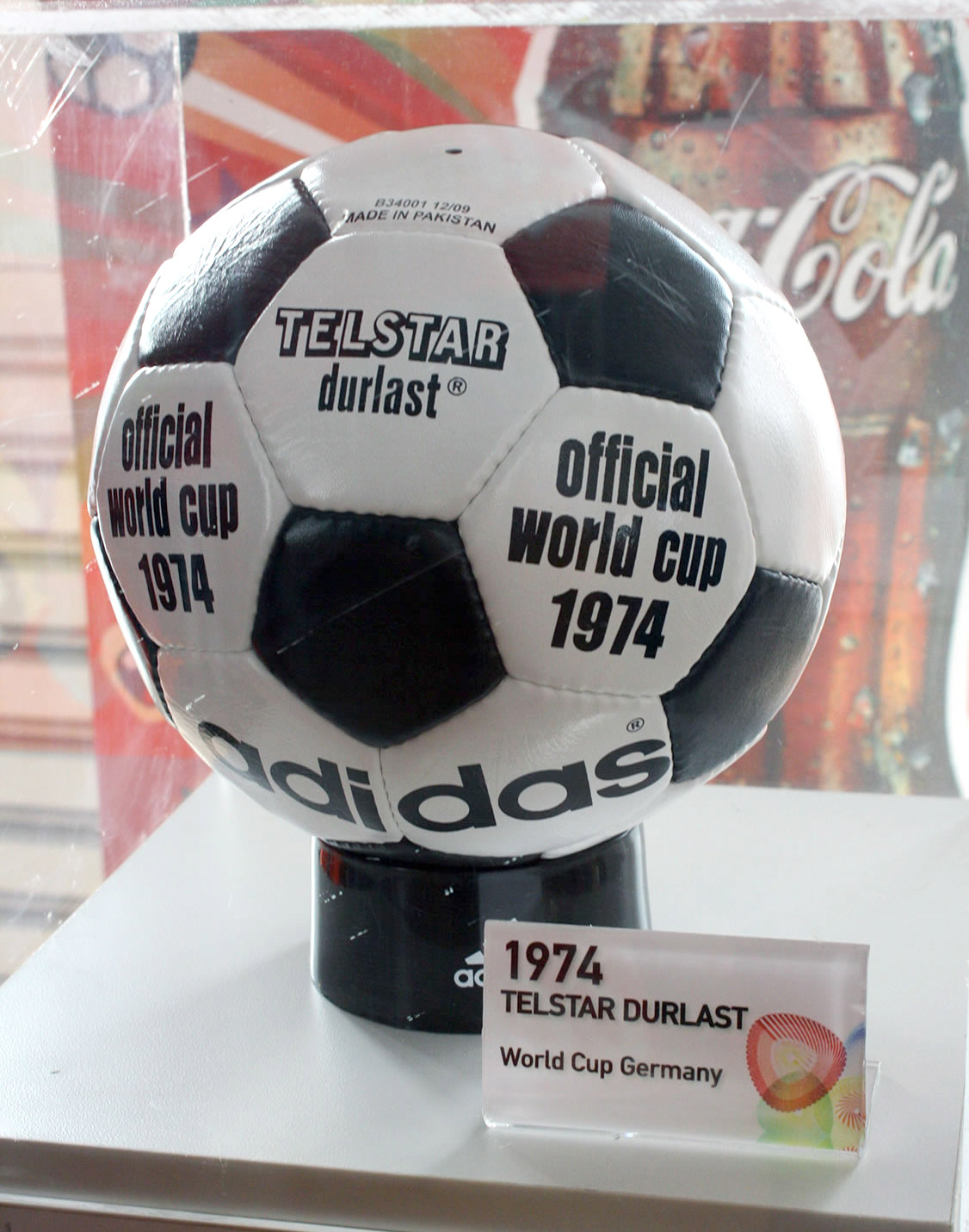
This was the first World Cup to use the Telstar ball from Adidas (who have supplied every World Cup match ball to date), introduced as the "Telstar Erlast" for the 1968 European Football Championship. The Telstar was the first World Cup ball to use the now-familiar truncated icosahedron for its design, consisting of 12 black pentagonal and 20 white hexagonal panels. The 32-panel configuration had been introduced in 1962 by Select Sport, and was also used in the official logo for the 1970 World Cup. The black-and-white pattern, to aid visibility on black and white television broadcasts (which was still commonplace then, as colour television was rare in many parts of the world), was also well established before the Telstar.See Getty Images photos:
- #53324431 1965 European Cup Final
- #3376509 Terry Venables in 1965
- #81398917 New York Champions Cup 1966
- #2887049 1967 European Cup Winners' Cup Final The name came from the Telstar communications satellite, which was roughly spherical and dotted with solar panels, somewhat similar in appearance to the football.
Merchandise
Forming a partnership with FIFA in 1970, Panini published its first FIFA World Cup sticker album for the 1970 World Cup, initiating a global craze for collecting and trading stickers. In 2017, a complete 1970 World Cup Panini sticker album signed by Pelé sold for a record £10,450.
Group stage

The first round, or group stage, saw the 16 teams divided into four groups of four teams. Each group was a round-robin of six games, where each team played one match against each of the other teams in the same group. Teams were awarded two points for a win, one point for a draw and none for a defeat. The teams finishing first and second in each group qualified for the quarter-finals, while the bottom two teams in each group were eliminated from the tournament.
Tie-breaking criteria
- Greater number of points in all group matches
- Goal difference in all group matches (replacing the previous usage of goal average)
- Drawing of lots by the FIFA Organising Committee
Group 1
Main article: 1970 FIFA World Cup Group 1
Lambert
Asatiani Khmelnytskyi
Fragoso Basaguren
Group 2
Main article: 1970 FIFA World Cup Group 2
Mujica
Group 3
Main article: 1970 FIFA World Cup Group 3
Pelé Jairzinho
Dumitrache
Jairzinho Dembrovschi
Group 4
Main article: 1970 FIFA World Cup Group 4
Chumpitaz Cubillas Bonev
Müller
Challe
Müller Seeler Kolev
Knockout stage
Main article: 1970 FIFA World Cup knockout stage
The eight teams that had advanced from the group stage entered a single-elimination style tournament, which also featured a third place play-off contested between the two losing semi-finalists. In this knockout stage (including the final), if a match was level at the end of 90 minutes, extra time of two periods (15 minutes each) would be played. In matches prior to the final, if the score was still level after extra time then a coin toss by the referee would determine the winner. If the final was still level after 120 minutes' play then the match would instead be replayed at a later date. |14 June – Mexico City||0|**** |1 |14 June – Guadalajara||4||2 |14 June – Toluca||4||1 |14 June – León|**** |3||2 |17 June – Guadalajara||1||3 |17 June – Mexico City| |4||3 |21 June – Mexico City||4||1 |20 June – Mexico City||0||1
All times listed local (UTC−6)
Quarter-finals
Riva Rivera
Tostão Jairzinho Cubillas
Seeler Müller Peters
Semi-finals
Jairzinho Rivellino
Main article: Italy v West Germany (1970 FIFA World Cup)
Burgnich Riva Rivera Müller
Match for third place
Final
Main article: 1970 FIFA World Cup final
Gérson Jairzinho Carlos Alberto
Statistics
Goalscorers
With 10 goals, Gerd Müller was the top scorer in the tournament. In total, 95 goals were scored by 55 players, with only one of them credited as own goal.
10 goals
- FRG Gerd Müller
7 goals
- BRA Jairzinho
5 goals
- PER Teófilo Cubillas
4 goals
- BRA Pelé
- URS Anatoliy Byshovets
3 goals
- BRA Rivellino
- ITA Gigi Riva
- FRG Uwe Seeler
2 goals
- BEL Raoul Lambert
- BEL Wilfried Van Moer
- BRA Tostão
- TCH Ladislav Petráš
- ITA Roberto Boninsegna
- ITA Gianni Rivera
- MEX Javier Valdivia
- PER Alberto Gallardo
- ROU Florea Dumitrache
1 goal
- BRA Carlos Alberto
- BRA Clodoaldo
- BRA Gérson
- BUL Hristo Bonev
- BUL Dinko Dermendzhiev
- BUL Todor Kolev
- BUL Asparuh Nikodimov
- BUL Dobromir Zhechev
- ENG Allan Clarke
- ENG Geoff Hurst
- ENG Alan Mullery
- ENG Martin Peters
- ISR Mordechai Spiegler
- ITA Tarcisio Burgnich
- ITA Angelo Domenghini
- MAR Maouhoub Ghazouani
- MAR Houmane Jarir
- MEX Juan Ignacio Basaguren
- MEX Javier Fragoso
- MEX José Luis González
- MEX Gustavo Peña
- PER Roberto Challe
- PER Héctor Chumpitaz
- ROU Emerich Dembrovschi
- ROU Alexandru Neagu
- URS Kakhi Asatiani
- URS Vitaliy Khmelnytskyi
- SWE Ove Grahn
- SWE Tom Turesson
- URU Luis Cubilla
- URU Víctor Espárrago
- URU Ildo Maneiro
- URU Juan Mujica
- FRG Franz Beckenbauer
- FRG Reinhard Libuda
- FRG Wolfgang Overath
- FRG Karl-Heinz Schnellinger
1 own goal
- MEX Javier Guzmán (playing against Italy)
Awards
- Golden Ball (awarded retrospectively): BRA Pelé (Brazil)
- Golden Boot: GER Gerd Müller (West Germany)
- Best Young Player (awarded retrospectively): PER Teófilo Cubillas (Peru)
- FIFA Fair Play Trophy: PER Peru
FIFA retrospective ranking
In 1986, FIFA published a report that ranked all teams in each World Cup up to and including 1986, based on progress in the competition, overall results and quality of the opposition. The rankings for the 1970 tournament were as follows:
| R | Team | G | P | W | D | L | GF | GA | GD | Pts. | Eliminated in the quarter-finals | Eliminated in the group stage |
|---|---|---|---|---|---|---|---|---|---|---|---|---|
| 1 | [3](1970-fifa-world-cup-group-3) | 6 | 6 | 0 | 0 | 19 | 7 | +12 | 12 | |||
| 2 | [2](1970-fifa-world-cup-group-2) | 6 | 3 | 2 | 1 | 10 | 8 | +2 | 8 | |||
| 3 | [4](1970-fifa-world-cup-group-4) | 6 | 5 | 0 | 1 | 17 | 10 | +7 | 10 | |||
| 4 | [2](1970-fifa-world-cup-group-2) | 6 | 2 | 1 | 3 | 4 | 5 | −1 | 5 | |||
| 5 | [1](1970-fifa-world-cup-group-1) | 4 | 2 | 1 | 1 | 6 | 2 | +4 | 5 | |||
| 6 | [1](1970-fifa-world-cup-group-1) | 4 | 2 | 1 | 1 | 6 | 4 | +2 | 5 | |||
| 7 | [4](1970-fifa-world-cup-group-4) | 4 | 2 | 0 | 2 | 9 | 9 | 0 | 4 | |||
| 8 | [3](1970-fifa-world-cup-group-3) | 4 | 2 | 0 | 2 | 4 | 4 | 0 | 4 | |||
| 9 | [2](1970-fifa-world-cup-group-2) | 3 | 1 | 1 | 1 | 2 | 2 | 0 | 3 | |||
| 10 | [1](1970-fifa-world-cup-group-1) | 3 | 1 | 0 | 2 | 4 | 5 | −1 | 2 | |||
| [3](1970-fifa-world-cup-group-3) | 3 | 1 | 0 | 2 | 4 | 5 | −1 | 2 | ||||
| 12 | * | [2](1970-fifa-world-cup-group-2) | 3 | 0 | 2 | 1 | 1 | 3 | −2 | 2 | ||
| 13 | ** | [4](1970-fifa-world-cup-group-4) | 3 | 0 | 1 | 2 | 5 | 9 | −4 | 1 | ||
| 14 | [4](1970-fifa-world-cup-group-4) | 3 | 0 | 1 | 2 | 2 | 6 | −4 | 1 | |||
| 15 | [3](1970-fifa-world-cup-group-3) | 3 | 0 | 0 | 3 | 2 | 7 | −5 | 0 | |||
| 16 | [1](1970-fifa-world-cup-group-1) | 3 | 0 | 0 | 3 | 0 | 9 | −9 | 0 |
- Listed as #13 in one of the sources
** Listed as #12 in one of the sources
References
References
- (12 May 2010). "The Story of the 1970 World Cup". [[BBC]].
- (9 July 2007). "Brazil's 1970 winning team voted best of all time". [[Reuters]].
- (10 April 2010). "The Boys from Brazil: On the trail of football's dream team". [[The Independent]].
- (7 July 2010). "Netherlands' perfect winning streak can match historic feat of Brazil 1970". Goal.com.
- (2 June 1970). "Soccer play in Mexico stirs altitude controversy". Free-Lance Star.
- "Castrol index tournament legends". [[Castrol Performance Index]].
- "Perfect farewell to Pelé's last appearance in a World Cup". Brasil 2014: World Cup Portal.
- "World Championship – Jules Rimet 1970 Cup Technical study". FIFA.
- Dunmore, Tom. (2011). "Historical Dictionary of Soccer". Scarecrow Press.
- "1970 FIFA World Cup Mexico". FIFA.
- "40 years since first World Cup in colour". TVlicensing.co.uk.
- (2 December 2010). "Host Announcement Decision". FIFA.
- (November 2009). "Preliminary Competition: History by year". FIFA.
- (2 August 2011). "Preliminary Draw Statistical kit". FIFA.
- (26 April 2002). "Africa's missing World Cup years". [[BBC Sport]].
- (2 February 1968). "Tough tasks for British". The Times.
- (31 May 2010). "Boycott! When Africa & Asia said "Enough"". Twohundredpercent.net.
- (5 July 1969). "North Korea out". The Times.
- Glanville, Brian. (2010). "The Story of the World Cup". Faber and Faber.
- Anderson, Thomas P.. (1981). "The War of the Dispossessed: Honduras and El Salvador 1969". University of Nebraska Press.
- (26 March 2013). "FIFA World Cup: Milestones, facts & figures. Statistical Kit 7". FIFA.
- [https://web.archive.org/web/20170714110540/http://www.fifa.com/worldcup/archive/mexico1970/matches/preliminaries/europe/index.html 1970 FIFA World Cup Mexico - Qualifiers - Europe - FIFA.com]
- (30 June 1967). "Del 31 de mayo al 21 de junio de 1970". [[La Nación]].
- (19 October 1967). "Building for the future". [[The Christian Science Monitor]].
- Fett, Matthias. (2020-07-02). "The game has changed – a systematic approach to classify FIFA World Cups". International Journal of Sport Policy and Politics.
- (2 June 1970). "Altitude bugs soccer players". [[Meriden Journal]].
- (2 June 1970). "Problem of altitude". [[Ottawa Citizen]].
- (1970-06-13). "Soviet Union wins toss in World Cup". Miami News.
- (1970-05-26). "Drawing of lots -- that's how teams will be parted". Evening Standard.
- (19 December 1969). "Ability and politics govern the draw". The Times.
- (8 January 1970). "Top teams to be seeded". The Times.
- (November 2009). "FIFA World Cup: Seeded teams 1930–2010". FIFA.
- (10 January 1970). "Brasil, Alemanha e Italia querem o Grupo Dois". [[Jornal do Brasil]].
- "Football at the 1968 Ciudad de México Summer Games: Men's Football". Sports-reference.com.
- (2 December 2009). "Africa in the FIFA World Cup: Part 3 – The Seventies". Currybet.net.
- (November 2009). "The FIFA World Cup Final Draw history". FIFA.
- (10 January 1970). "SYND 12/1/70 draw for the World Cup in Mexico City". AP.
- Dawson, Jeff. (2001). "Back Home: England and the 1970 World Cup". Orion.
- (12 January 1970). "Draw for finals of World Cup". The Times.
- (11 January 1970). "Mexico duels Russians in World Cup". [[Toledo Blade]].
- "Planet World Cup - 1970 - Squads - Morocco".
- (11 June 2010). "The FIFA World Cup Opening Day Match History, Facts and Winners". [[Yahoo]].
- (2 June 1970). "Big yawn as World Cup rivals draw". [[The Age]].
- (1 June 1970). "World Cup slowdown bores fans". [[The Pittsburgh Press]].
- (11 June 1970). "Pele keeps Brazilians on right track". [[The Vancouver Sun]].
- (13 June 1970). "Mexico draws tiny stadium". [[The Bulletin (Bend).
- (11 June 1970). "Bribe rumours stir soccer". [[Reading Eagle]].
- (12 June 1970). "Mexico, England, Italy in quarter-finals". [[The Gazette (Montreal)]].
- (27 May 1970). "England soccer captain held for shop-lifting". [[The Indian Express]].
- (20 August 1970). "1970: Bobby Moore cleared of stealing". [[BBC]].
- (13 June 1970). "England lose popularity contest". [[The Herald (Glasgow).
- (2 June 1970). "English win first World Cup match". [[The Spokesman-Review]].
- (2 June 1970). "British take villain role in World Cup". [[Pittsburgh Press]].
- (14 May 1970). "Young Mexicans jeer England". The Times.
- (9 June 1970). "Pele and other top Brazilians may miss Romanian game". [[The Herald (Glasgow).
- (23 June 1970). "World Cup Review: Firm authority respected". The Times.
- (4 June 1970). "Brazil hit back against Czechs". [[The Herald (Glasgow).
- (3 June 1970). "Fans whistles and boos as England wins, 1–0". [[Ottawa Citizen]].
- "The Final that never was". FIFA.
- "Gordon Banks: The keeper who stunned the King". FIFA.
- (7 February 2013). "Brazil mix enough method to their magic". [[ESPN]].
- (8 June 1970). "Fireworks erupt after Brazilian goal beats England lose popularity contest". [[Ottawa Citizen]].
- (8 June 1970). "Back to school for England after World Cup Soccer loss". [[Beaver County Times]].
- (11 June 1970). "England rides boot of Clarke to eights". [[The Leader-Post]].
- (3 June 1970). "Peru's comeback". [[Ottawa Citizen]].
- "FIFA World Cup goals". FIFA.
- (11 June 1970). "Germany, Brazil lead World Cup". [[The St. Petersburg Times (Russia).
- (13 June 1970). "Mexico travel to play Italy". [[The Herald (Glasgow).
- (15 June 1970). "Italy crush Mexico". The Times.
- (15 June 1970). "Well-timed winner". The Times.
- (15 June 1970). "Defending champs knocked out". [[The Vancouver Sun]].
- (13 June 2010). "Robert Green, I know how you feel, says ex-England keeper Peter Bonetti". [[The Daily Telegraph]].
- (4 April 2002). "Germans turn tide against England". BBC Sport.
- England: The Official F.A History, Niall Edworthy, Virgin Publishers, 1997, {{ISBN. 1-85227-699-1.
- (9 June 2013). "Bundesliga 50 – The birth of Germany's Professional Game". Football Republik.
- Downing, David. (2001). "The Best of Enemies: England v Germany". Bloomsbury Publishing.
- (16 June 1970). "Italy favored to win cup". [[The Leader-Post]].
- (19 June 1970). "Italy meets Brazilians on Sunday". [[The Spokesman-Review]].
- "Players Info: Schnellinger". [[German Football Association]].
- (18 June 1970). "World Cup Soccer Finalists". [[Reading Eagle]].
- "A test of endurance and will". FIFA.
- (20 June 1970). "West Germany conquers Uruguay, 1–0, for Third Place in World Cup Soccer". The New York Times.
- "Sizzling Brazil stun the Azteca". FIFA.
- Lisi, Clemente Angelo. (2007). "A History of the World Cup: 1930–2010". Scarecrow Press.
- (17 November 2012). "The 1970 World Cup is recalled fondly, and in glorious technicolour". [[The Herald (Glasgow).
- (14 March 2009). "1970: The definitive World Cup...". [[Four Four Two]].
- (15 January 2002). "Ken Aston – the inventor of yellow and red cards". FIFA.
- (10 November 2009). "World Cup History 1970". [[ESPN]].
- (2 June 1970). "England begins soccer defence today". [[The Gazette (Montreal)]].
- (7 June 1970). "Mexican standoff?". [[The New York Times]].
- (26 September 1970). "Strict control needed in combustible situation". The Times.
- (1 June 1970). "Clean, dull soccer start". [[Ottawa Citizen]].
- (30 May 1970). "Officials determined to police World Soccer Championships". [[Eugene Register-Guard]].
- "Jairzinho: The Hurricane that never blew out". FIFA.
- "Mario Zagallo: None hungrier than Brazil's lone wolf". FIFA.
- "1970 Mexico". FIFA.
- "The History of the Official World Cup Match Balls". Rig-Tech Inc.
- "The Story of Select". Select Sport.
- Bernsen, Jens. (1992). "Vi er røde, vi er hvide". Dansk Design Centre.
- "1970 FIFA World Cup Mexico". FIFA.
- "Brand collaborations". FIFA.
- "Panini World Cup sticker book". The Guardian.
- [https://www.si.com/soccer/2018/06/06/panini-world-cup-sticker-album-history-tradition "The Magic, Global Craze and Tradition of Panini's World Cup Sticker Albums"]. ''Sports Illustrated''. Retrieved 2 September 2018
- "Panini 1970 World Cup album signed by Pele auctions for £10,450". ESPN.
- "The world's most expensive Panini album, signed by Brazilian legend Pele, has been auctioned off for £10,450". Irish Mirror.
- "FIFA World Cup Awards - All-time". FIFA.
- "1970 FIFA World Cup Mexico". FIFA.
- "Permanent Table".
This article was imported from Wikipedia and is available under the Creative Commons Attribution-ShareAlike 4.0 License. Content has been adapted to SurfDoc format. Original contributors can be found on the article history page.
Ask Mako anything about 1970 FIFA World Cup — get instant answers, deeper analysis, and related topics.
Research with MakoFree with your Surf account
Create a free account to save articles, ask Mako questions, and organize your research.
Sign up freeThis content may have been generated or modified by AI. CloudSurf Software LLC is not responsible for the accuracy, completeness, or reliability of AI-generated content. Always verify important information from primary sources.
Report