From Surf Wiki (app.surf) — the open knowledge base
1938 FIFA World Cup
Association football tournament in France
Association football tournament in France
| Field | Value |
|---|---|
| tourney_name | FIFA World Cup |
| year | 1938 |
| other_titles | fr |
| image | 1938 fifa worldcup poster.jpg |
| size | 200px |
| caption | Official poster |
| country | France |
| dates | 4–19 June |
| confederations | 4 |
| num_teams | 15 |
| venues | 10 |
| cities | 9 |
| champion | Italy |
| champion-flagvar | 1861 |
| count | 2 |
| second | Hungary |
| second-flagvar | 1920 |
| third | Brazil |
| third-flagvar | 1889 |
| fourth | Sweden |
| matches | 18 |
| goals | 84 |
| attendance | 374835 |
| top_scorer | Leônidas (7 goals) |
| prevseason | [1934](1934-fifa-world-cup) |
| nextseason | [1950](1950-fifa-world-cup) |
| champion-flagvar = 1861 | second-flagvar = 1920 | third-flagvar = 1889 The 1938 FIFA World Cup was the 3rd edition of the World Cup, the quadrennial international football championship for senior men's national teams. It was held in France from 4 to 19 June 1938. Italy defended its title in the final, beating Hungary 4–2. Italy's 1934 and 1938 teams hold the distinction of being the only men's national team to win the World Cup multiple times under the same coach, Vittorio Pozzo. It would be the last World Cup until 1950 as the 1942 and 1946 World Cups were cancelled due to World War II.
Host selection
Main article: FIFA World Cup hosts
France was chosen as host nation by FIFA in Berlin on 13 August 1936. France was chosen over Argentina and Germany in the first round of voting. The decision to hold a second consecutive tournament in Europe (after Italy in 1934) caused outrage in South America, where it was believed that the venue should alternate between the two continents. This was the last World Cup to be staged before the outbreak of the Second World War.
Qualification
Main article: 1938 FIFA World Cup qualification
Because of the decision to hold a second successive World Cup in Europe, many teams from the Americas did not join the competition or withdrew after an initial application. Most of the South American teams, including Uruguay and Argentina, declined to take part in the competition after the controversy of the Peru v Austria match at the Football tournament of the 1936 Summer Olympics. The United States and Mexico joined the qualifying rounds but eventually withdrew. Argentina submitted a late application (which was accepted), before a definitive withdrawal due to disagreements between the National Federation and the local clubs. Spain meanwhile could not participate due to the ongoing Spanish Civil War.
It was the first time that the hosts, France, and the title holders, Italy, qualified automatically. Title holders were given an automatic entry into the World Cup from 1938 until 2002.
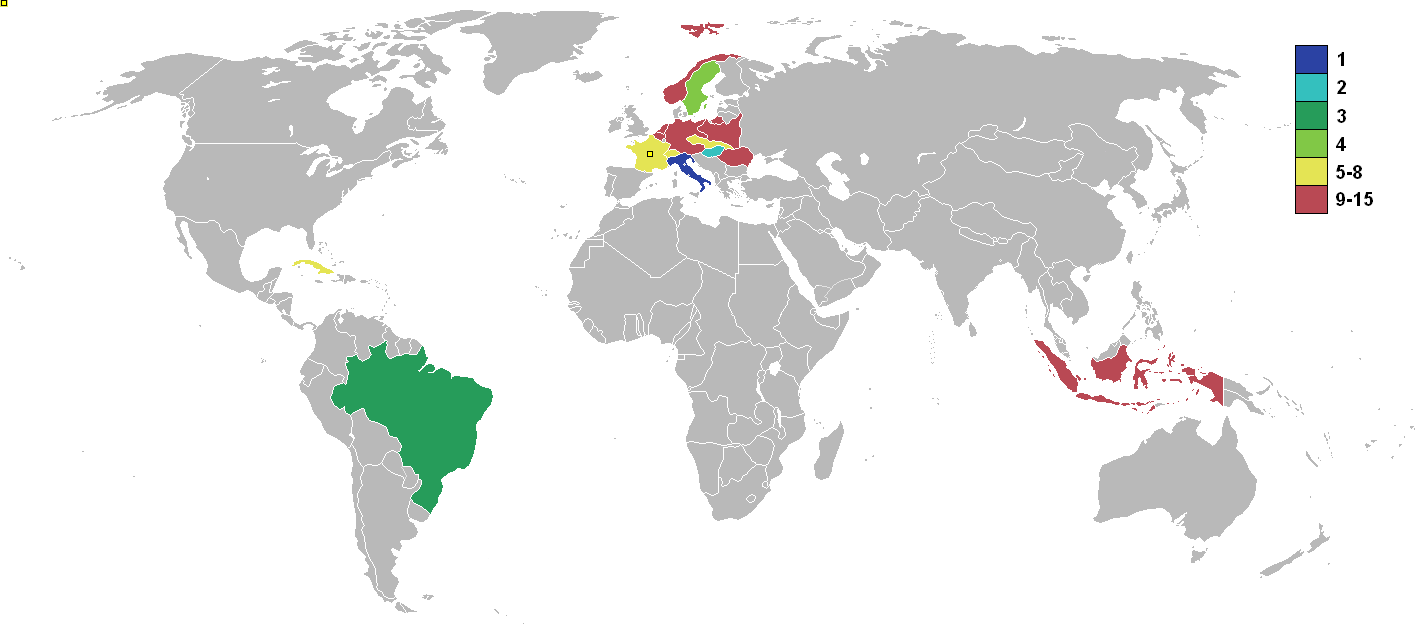
Of the 14 remaining places, eleven were allocated to Europe, two to the Americas, and one to Asia. As a result, only three non-European nations took part: Brazil, Cuba (making their debut) and Dutch East Indies (now Indonesia, also making their debut), the latter being the first Asian country to participate in a FIFA World Cup. This is the smallest ever number of teams from outside the host continent to compete at a FIFA World Cup.
Austria qualified for the World Cup, but after qualification was complete, the Anschluss united Austria with Germany. Austria subsequently did not take part to the tournament, with some Austrian players joining the German squad, although not including Austrian star player Matthias Sindelar, who refused to play for the unified team. Austria's place remained empty and Sweden, which would have been Austria's initial opponent, progressed directly to the second-round by default.
Other teams to make their World Cup debuts included Poland and Norway.
List of qualified teams
The following 16 teams originally qualified for the final tournament. However, 15 teams participated after Austria's withdrawal due to the Anschluss. Asia (1)
- (debut) Africa (0)
- None qualified North, Central America and Caribbean (1)
- (debut) South America (1)
Europe (12)
- AUT Austria (withdrew)
- (hosts)
- (1934 champions)
- (debut)
- (debut)
Format
The knockout format from 1934 was retained. If a match was tied after 90 minutes, then 30 minutes of extra time were played. If the score was still tied after extra time, the match would be replayed. This was the last World Cup tournament that used a straight knockout format.
Final draw
The draw was staged in Paris on 5 March 1938. As the qualifying process was still ongoing, many paper slips reported the names of two Teams, which were both in competition to qualify.
The FIFA committee identified eight seeded teams, irrespective of their current qualification. The seeded teams were: Argentina, Austria, Brazil, Czechoslovakia, France, Germany, Hungary and Italy, so six European teams and two South-American.
The whole table was drawn the same day: Round of 16, Quarter-finals, Semi-finals. The Teams were drawn in the following order:
Round of 16
A. Germany vs. Switzerland or Portugal
B. Austria vs. Sweden
C. Hungary or Greece vs. USA or Dutch East Indies
D. France vs. Belgium or Luxembourg
E. Argentina or Central America vs. Romania
F. Czechoslovakia or Bulgaria vs. Netherlands or Luxembourg
G. Brazil vs. Poland or Yugoslavia
H. Italy vs. Norway
Quarter-finals
-
Winner B vs. Winner E
-
Winner A vs. Winner C
-
Winner D vs. Winner H
-
Winner F vs. Winner G
Semi-finals
Winner 4 vs. Winner 3
Winner 2 vs. Winner 1
On 15 March 1938, Austria was invaded by Nazi Germany and the Austria national team disappeared.
Argentina withdrew from the tournament after disagreements between the clubs and the National Federations so two of the original seeded teams did not take part to the final competition.
Summary
Sweden was given a bye due to Austria's withdrawal.
Five of the seven first round matches required extra time to break the deadlock; two games still went to a replay. In one replay, Cuba advanced to the next round at the expense of Romania. In the other replay, Germany, which had led 1–0 in the first game against Switzerland, led 2–0 but eventually was beaten 2–4. This loss, which took place in front of a hostile, bottle-throwing crowd in Paris, was blamed by German coach Sepp Herberger on a defeatist attitude from the five Austrian players he had been forced to include; a German journalist later commented that "Germans and Austrians prefer to play against each other even when they're in the same team". Until they were knocked out in the group stage in 2018, this was the only time Germany had failed to advance past the first round, and until their penalty shoot-out victory over France in the round of 16 of UEFA Euro 2020, this would be the last time Switzerland advanced past the first knockout game of a tournament.
Sweden advanced directly to the quarter-finals as a result of Austria's withdrawal, and they proceeded to beat Cuba 8–0. The hosts, France, were beaten by the holders, Italy, and Switzerland were seen off by Hungary. Czechoslovakia took Brazil to extra time in a notoriously feisty match in Bordeaux before succumbing in a replay; the South Americans proved too strong for the depleted Czechoslovak side (both Oldřich Nejedlý and František Plánička had suffered broken bones in the first game) and won 2–1. This was the last match to be replayed in a World Cup.
Hungary destroyed Sweden in one of the semi-finals 5–1, while Italy and Brazil had the first of their many important World Cup clashes in the other. The Brazilians were without their star player Leônidas, who was injured, and the Italians won 2–1. Brazil topped Sweden 4–2 for third place.
Rumour has it, before the finals Benito Mussolini was to have sent a telegram to the team, saying "Vincere o morire!" (literally translated as "Win or die!"). This should not have been meant as a literal threat, but instead just an encouragement to win. However, no record remains of such a telegram, and World Cup player Pietro Rava said, when interviewed in 2001, "No, no, no, that's not true. He sent a telegram wishing us well, but no never 'win or die'."
The final itself took place at the Stade Olympique de Colombes in Paris. Vittorio Pozzo's Italian side took the lead early, but Hungary equalised within two minutes. The Italians took the lead again shortly after, and by the end of the first half were leading the Hungarians 3–1. Hungary never really got back into the game. With the final score favouring the Italians 4–2, Italy became the first team to successfully defend the title and were once more crowned World Cup winners.
Because of World War II, the World Cup would not be held for next 12 years, until 1950. As a result, Italy were the reigning World Cup holders for a record 16 years, from 1934 to 1950. The Italian Vice-president of FIFA, Dr. Ottorino Barassi, hid the trophy in a shoe-box under his bed throughout the Second World War and thus saved it from falling into the hands of occupying troops.
Venues
Eleven venues in ten cities were planned to host the tournament; of these, all hosted matches except the Stade de Gerland in Lyon, which did not due to Austria's withdrawal.
| Colombes | ||||||||||||||
|---|---|---|---|---|---|---|---|---|---|---|---|---|---|---|
| (Paris area) | Marseille | Paris | Bordeaux | Strasbourg | {{Location map+ | France | width=400 | float=center | places= | Le Havre | Reims | Toulouse | Lille | Antibes |
| Stade Olympique de Colombes | Stade Vélodrome | Parc des Princes | Parc Lescure | |||||||||||
| Capacity: **60,000** | Capacity: **48,000** | Capacity: **40,000** | Capacity: **34,694** | |||||||||||
| [[File:StadeolympiqueColombesJO1924.jpg | 200px]] | [[File:Le Stade vélodrome de Marseille, le 13 juin 1937.jpg | 200px]] | [[File:1932 Le parc des princes v1.jpg | 200px]] | [[File:Le Stade municipal de Bordeaux en 1938.jpg | 200px]] | |||||||
| Stade de la Meinau | Stade Municipal | |||||||||||||
| Capacity: **30,000** | Capacity: **22,000** | |||||||||||||
| [[File:RC Strasbourg-FC Mulhouse, 4.11.1934, Stade de la Meinau.png | 200px]] | [[File:Stade municipal du Havre - Wedstrijd Nederland-Tsjechoslowakije, WK 1938.jpg | 200px]] | |||||||||||
| Vélodrome Municipal | Stade du T.O.E.C. | Stade Victor Boucquey | Stade du Fort Carré | |||||||||||
| Capacity: **21,684** | Capacity: **15,000** | Capacity: **15,000** | Capacity: **7,000** | |||||||||||
| [[File:Stade Auguste-Delaune 2 Tribünen.JPG | 200px]] | [[File:Le Parc des Sports du T.O.E.C., en 1934.jpg | 200px]] | [[File:LilleOM-1937.jpg | 200px]] | [[File:Suède-Cuba de la Coupe du monde 1938 à Antibes (France).jpg | 200px]] |
Squads
For a list of all squads that appeared in the final tournament, see 1938 FIFA World Cup squads.
Final tournament
Main article: 1938 FIFA World Cup final tournament
Bracket
Round of 16
Main article: Brazil v Poland (1938 FIFA World Cup)
Replays
Quarter-finals
Main article: Battle of Bordeaux (1938 FIFA World Cup)
Replay
Semi-finals
Third place play-off
Final
Main article: 1938 FIFA World Cup final
Goalscorers
With seven goals, Leônidas was the top scorer in the tournament. In total, 84 goals were scored by 42 players, with two of them credited as own goals.
;7 goals
- BRA Leônidas
;5 goals
- HUN György Sárosi
- HUN Gyula Zsengellér
- ITA Silvio Piola
;4 goals
- ITA Gino Colaussi
- POL Ernest Wilimowski
;3 goals
- BRA Perácio
- BRA Romeu
- CUB Héctor Socorro
- SWE Harry Andersson
- SWE Arne Nyberg
- SWE Gustav Wetterström
- SUI André Abegglen
;2 goals
- TCH Oldřich Nejedlý
- FRA Jean Nicolas
- HUN Pál Titkos
- ROU Ștefan Dobay
;1 goal
- BEL Henri Isemborghs
- BRA Roberto
- CUB Tomás Fernández
- CUB José Magriñá
- TCH Vlastimil Kopecký
- TCH Josef Košťálek
- TCH Josef Zeman
- FRA Oscar Heisserer
- FRA Émile Veinante
- GER Josef Gauchel
- GER Wilhelm Hahnemann
- HUN Vilmos Kohut
- HUN Géza Toldi
- ITA Pietro Ferraris
- ITA Giuseppe Meazza
- NOR Arne Brustad
- POL Fryderyk Scherfke
- ROU Iuliu Barátky
- ROU Silviu Bindea
- SWE Tore Keller
- SWE Sven Jonasson
- SUI Alfred Bickel
- SUI Eugen Walaschek
;1 own goal
- SWE Sven Jacobsson (playing against Hungary)
- SUI Ernst Lörtscher (playing against Germany)
FIFA retrospective ranking

In 1986, FIFA published a report that ranked all teams in each World Cup up to and including 1986, based on progress in the competition, overall results and quality of the opposition. The rankings for the 1938 tournament were as follows:
| R | Team | P | W | D | L | GF | GA | GD | Pts. |
|---|---|---|---|---|---|---|---|---|---|
| 1 | 4 | 4 | 0 | 0 | 11 | 5 | +6 | 8 | |
| 2 | 4 | 3 | 0 | 1 | 15 | 5 | +10 | 6 | |
| 3 | 5 | 3 | 1 | 1 | 14 | 11 | +3 | 7 | |
| 4 | 3 | 1 | 0 | 2 | 11 | 9 | +2 | 2 | |
| **Eliminated in the quarter-finals** | |||||||||
| 5 | 3 | 1 | 1 | 1 | 5 | 3 | +2 | 3 | |
| 6 | 3 | 1 | 1 | 1 | 5 | 5 | 0 | 3 | |
| 7 | 3 | 1 | 1 | 1 | 5 | 12 | −7 | 3 | |
| 8 | 2 | 1 | 0 | 1 | 4 | 4 | 0 | 2 | |
| **Eliminated in the round of 16** | |||||||||
| 9 | 2 | 0 | 1 | 1 | 4 | 5 | -1 | 1 | |
| 10 | 2 | 0 | 1 | 1 | 3 | 5 | –2 | 1 | |
| 11 | 1 | 0 | 0 | 1 | 5 | 6 | −1 | 0 | |
| 12 | 1 | 0 | 0 | 1 | 1 | 2 | −1 | 0 | |
| 13 | 1 | 0 | 0 | 1 | 1 | 3 | −2 | 0 | |
| 14 | 1 | 0 | 0 | 1 | 0 | 3 | −3 | 0 | |
| 15 | 1 | 0 | 0 | 1 | 0 | 6 | −6 | 0 | |
| 16 | Austria Austria | Withdrew |
Footnotes
References
References
- (9 November 1937). "C'est un télégramme de la Confédération sud-américaine qui a motivé mon intervention". [[L'Auto]].
- (27 March 1938). "Pas d'argent! Pas de Coupe du Monde pour l'Argentine!...". [[L'Auto]].
- (2 March 2023). "Did you know Dutch East Indies, erstwhile Indonesia, were the first flagbearers of Asia in FIFA World Cup?".
- Ashdown, John. (22 April 2014). "World Cup: 25 stunning moments … No11: Austria's Wunderteam". The Guardian.
- (6 March 1938). "On a tiré au sort les rencontres de la Coupe du Monde". [[L'Auto]].
- "History of the World Cup Final Draw".
- Hesse-Lichtenberger, Ulrich. (2003). "Tor!: The Story of German Football". WSC Books.
- Steinberg, Jacob. (27 June 2018). "Germany crashed out of the World Cup group stages and finished bottom of Group F after defeat to South Korea".
- Gehringer, Max. (November 2005). "Faltaram os papéis". [[Editora Abril]].
- Martin, Simon. (5 April 2018). "World Cup stunning moments: Mussolini's blackshirts' 1938 win".
- "History".
- "Mexico 1986". FIFA.
- (26 March 2013). "FIFA World Cup: Milestones, facts & figures. Statistical Kit 7". [[FIFA]].
This article was imported from Wikipedia and is available under the Creative Commons Attribution-ShareAlike 4.0 License. Content has been adapted to SurfDoc format. Original contributors can be found on the article history page.
Ask Mako anything about 1938 FIFA World Cup — get instant answers, deeper analysis, and related topics.
Research with MakoFree with your Surf account
Create a free account to save articles, ask Mako questions, and organize your research.
Sign up freeThis content may have been generated or modified by AI. CloudSurf Software LLC is not responsible for the accuracy, completeness, or reliability of AI-generated content. Always verify important information from primary sources.
Report