From Surf Wiki (app.surf) — the open knowledge base
2014 FIFA World Cup
Association football tournament in Brazil
Association football tournament in Brazil
| Field | Value |
|---|---|
| tourney_name | FIFA World Cup |
| year | 2014 |
| other_titles | pt-br |
| image | 2014 FIFA World Cup.svg |
| size | |
| caption | Juntos num só ritmo |
| () | |
| country | Brazil |
| dates | 12 June – 13 July |
| confederations | 5 |
| num_teams | 32 |
| venues | 12 |
| cities | 12 |
| champion | Germany |
| count | 4 |
| second | Argentina |
| third | Netherlands |
| fourth | Brazil |
| matches | 64 |
| goals | 171 |
| attendance | |
| player | Lionel Messi |
| top_scorer | James Rodríguez |
| (6 goals) | |
| young_player | Paul Pogba |
| goalkeeper | Manuel Neuer |
| fair_play | |
| prevseason | [2010](2010-fifa-world-cup) |
| nextseason | [2018](2018-fifa-world-cup) |
() (6 goals)
The 2014 FIFA World Cup was the 20th FIFA World Cup, the quadrennial world championship for men's national football teams organised by FIFA. It took place in Brazil from 12 June to 13 July 2014, after the country was awarded the hosting rights in 2007. It was the second time that Brazil staged the competition, the first being in 1950, and the fifth time that it was held in South America.
31 national teams advanced through qualification competitions to join the host nation in the final tournament (with Bosnia and Herzegovina as the only debutant). A total of 64 matches were played in 12 venues located in as many host cities across Brazil. For the first time at a World Cup finals, match officials used goal-line technology, as well as vanishing spray for free kicks. FIFA Fan Fests in each host city gathered a total of 5 million people, and the country received 1 million visitors from 202 countries. Spain, the defending champions, were eliminated at the group stage. Host nation Brazil, who had won the 2013 FIFA Confederations Cup, lost to Germany 7–1 in the semi-finals and eventually finished in fourth place.
In the final, Germany defeated Argentina 1–0 after extra time following a half-volley goal by Mario Götze in the 113th minute of the final to win the tournament and secure the country's fourth world title, the first after German reunification in 1990, when as West Germany they also beat Argentina by the same score in 90 minutes in the World Cup final. It was Germany's first major tournament win since UEFA Euro 1996. Germany became the first European team to win a World Cup staged in the Americas, and this result marked the third consecutive title won by a European team, after Italy in 2006 and Spain in 2010, - a record-breaking streak by the teams from the same continent continued by France four years later.
This is currently the most recent World Cup to feature all eight teams that had previously won the tournament (Brazil, Germany, Italy, Argentina, France, Uruguay, England and Spain).
Host selection
Main article: 2014 FIFA World Cup bids
In March 2003, FIFA announced that the tournament would be held in South America for the first time since 1978, in line with its policy at the time of rotating the right to host the World Cup among different confederations. With the 2010 FIFA World Cup hosted in South Africa, it would be the second consecutive World Cup outside Europe, which was a first for the tournament. It was also sixth time (second consecutive) in the Southern Hemisphere. Only Brazil and Colombia formally declared their candidacy but, after the withdrawal of the latter from the process, Brazil was officially elected as host nation unopposed on 30 October 2007.
Participating teams and officials
Qualification
Main article: 2014 FIFA World Cup qualification
Qualification was held between June 2011 and November 2013. Twenty-four of the 32 qualifiers were returning participants from the 2010 World Cup.
- Bosnia and Herzegovina were the only team with no previous appearance at the World Cup finals.
- Colombia qualified for the World Cup after 16 years of absence.
- Belgium and Russia both returned after 12 years.
- This was also the first World Cup for 32 years that did not feature a representative from the Nordic countries.
- Iran, Costa Rica, Ecuador, and Croatia returned to the tournament after missing the 2010 tournament.
- The highest ranked team not to qualify was Ukraine (ranked 16th), while the lowest ranked team that did qualify was Australia (ranked 62nd).
The following 32 teams – shown with their last pre-tournament FIFA world ranking – qualified for the final tournament.
;AFC (4)
- (62)
- (43)
- (46)
- (57)
;CAF (5)
- (22)
- (56)
- (37)
- (23)
- (44)
;OFC (0)
- None qualified ;CONCACAF (4)
- (28)
- (33)
- (20)
- (13)
;CONMEBOL (6)
- (5)
- (3) (hosts)
- (14)
- (8)
- (26)
- (7) ;UEFA (13)
- (11)
- (21) (debut)
- (18)
- (10)
- (17)
- (2)
- (12)
- (9)
- (15)
- (4)
- (19)
- (1)
- (6)

]]
As of 2025, this was the last time Chile, Greece, Italy and Honduras qualified for the World Cup finals, the only time Bosnia and Herzegovina have qualified, and the last time Saudi Arabia, Morocco, Tunisia, Senegal, Denmark, and Poland failed to qualify. With Italy failing to qualify for 2018 and 2022, this is also currently the most recent World Cup finals to feature every previous winner.
Final draw
Main article: 2014 FIFA World Cup seeding
The draw took place on 6 December 2013 at the Costa do Sauípe resort in Bahia, during which the teams were drawn by various past World Cup-winning players. Hosted by TV presentators Fernanda Lima and Tadeu Schmidt and conducted by the FIFA general secretary Jérôme Valcke, the draw featured football celebrities from all FIFA World Cup champion countries such as Cafu (Brazil), Fabio Cannavaro (Italy), Lothar Matthäus (Germany), Zinédine Zidane (France), Mario Alberto Kempes (Argentina), Fernando Hierro (Spain), Geoff Hurst (England) and Alcides Ghiggia (Uruguay).
The 32 participating teams were drawn into eight groups. In preparation for this, the teams were organised into four pots with the seven highest-ranked teams joining host nation Brazil in the seeded pot. As with the previous tournaments, FIFA aimed to create groups which maximised geographic separation and therefore the unseeded teams were arranged into pots based on geographic considerations. Under the draw procedure, one randomly drawn team – Italy – was firstly relocated from Pot 4 to Pot 2 to create four equal pots of eight teams.
| [Group A](2014-fifa-world-cup-group-a) | [Group B](2014-fifa-world-cup-group-b) | [Group C](2014-fifa-world-cup-group-c) | [Group D](2014-fifa-world-cup-group-d) | [Group E](2014-fifa-world-cup-group-e) | [Group F](2014-fifa-world-cup-group-f) | [Group G](2014-fifa-world-cup-group-g) | [Group H](2014-fifa-world-cup-group-h) |
|---|---|---|---|---|---|---|---|
| ** |
Officials
Main article: 2014 FIFA World Cup officials
In March 2013, FIFA published a list of 52 prospective referees, each paired, on the basis of nationality, with two assistant referees, from all six football confederations for the tournament. On 14 January 2014, the FIFA Referees Committee appointed 25 referee trios and eight support duos representing 43 countries for the tournament. Yuichi Nishimura from Japan acted as referee in the opening match whereas Nicola Rizzoli from Italy acted as referee in the final.
| List of officials | Confederation | Referee | Assistants | Support (referee/assist) | |
|---|---|---|---|---|---|
| AFC | Ravshan Irmatov (Uzbekistan) | Abdukhamidullo Rasulov (Uzbekistan) | Bakhadyr Kochkarov (Kyrgyzstan) | Alireza Faghani (Iran) / Hassan Kamranifar (Iran) | |
| Yuichi Nishimura (Japan) | Toru Sagara (Japan) | Toshiyuki Nagi (Japan) | |||
| Nawaf Shukralla (Bahrain) | Yaser Tulefat (Bahrain) | Ebrahim Saleh (Bahrain) | |||
| Ben Williams (Australia) | Matthew Cream (Australia) | Hakan Anaz (Australia) | |||
| CAF | Noumandiez Doué (Ivory Coast) | Songuifolo Yeo (Ivory Coast) | Jean-Claude Birumushahu (Burundi) | Néant Alioum (Cameroon) / Djibril Camara (Senegal) | |
| Bakary Gassama (Gambia) | Evarist Menkouande (Cameroon) | Félicien Kabanda (Rwanda) | |||
| Djamel Haimoudi (Algeria) | Redouane Achik (Morocco) | Abdelhak Etchiali (Algeria) | |||
| CONCACAF | Joel Aguilar (El Salvador) | William Torres (El Salvador) | Juan Zumba (El Salvador) | Roberto Moreno (Panama) / Eric Boria (United States) | |
| Walter López (Guatemala) / Leonel Leal (Costa Rica) | |||||
| Mark Geiger (United States) | Mark Hurd (United States) | Joe Fletcher (Canada) | |||
| Marco Rodríguez (Mexico) | Marvin Torrentera (Mexico) | Marcos Quintero (Mexico) | |||
| CONMEBOL | Néstor Pitana (Argentina) | Hernán Maidana (Argentina) | Juan Pablo Belatti (Argentina) | Víctor Hugo Carrillo (Peru) / Rodney Aquino (Paraguay) | |
| Sandro Ricci (Brazil) | Emerson De Carvalho (Brazil) | Marcelo Van Gasse (Brazil) | |||
| Enrique Osses (Chile) | Carlos Astroza (Chile) | Sergio Román (Chile) | |||
| Wilmar Roldán (Colombia) | Humberto Clavijo (Colombia) | Eduardo Díaz (Colombia) | |||
| Carlos Vera (Ecuador) | Christian Lescano (Ecuador) | Byron Romero (Ecuador) | |||
| OFC | Peter O'Leary (New Zealand) | Jan Hendrik Hintz (New Zealand) | Mark Rule (New Zealand) | Norbert Hauata (Tahiti) / Aden Marwa (Kenya) | |
| UEFA | Felix Brych (Germany) | Mark Borsch (Germany) | Stefan Lupp (Germany) | Svein Oddvar Moen (Norway) / Kim Haglund (Norway) | |
| Cüneyt Çakır (Turkey) | Bahattin Duran (Turkey) | Tarık Ongun (Turkey) | |||
| Jonas Eriksson (Sweden) | Mathias Klasenius (Sweden) | Daniel Wärnmark (Sweden) | |||
| Björn Kuipers (Netherlands) | Sander van Roekel (Netherlands) | Erwin Zeinstra (Netherlands) | |||
| Milorad Mažić (Serbia) | Milovan Ristić (Serbia) | Dalibor Đurđević (Serbia) | |||
| Pedro Proença (Portugal) | Bertino Miranda (Portugal) | Tiago Trigo (Portugal) | |||
| Nicola Rizzoli (Italy) | Renato Faverani (Italy) | Andrea Stefani (Italy) | |||
| Carlos Velasco Carballo (Spain) | Roberto Alonso Fernández (Spain) | Juan Carlos Yuste Jiménez (Spain) | |||
| Howard Webb (England) | Michael Mullarkey (England) | Darren Cann (England) |
Squads
Main article: 2014 FIFA World Cup squads
As with the 2010 tournament, each team's squad consisted of 23 players (three of whom must be goalkeepers). Each participating national association had to confirm their final 23-player squad no later than 10 days before the start of the tournament. Teams were permitted to make late replacements in the event of serious injury, at any time up to 24 hours before their first game. During a match, all remaining squad members not named in the starting team were available to be one of the three permitted substitutions (provided the player was not serving a suspension).
Venues
Main article: 2014 FIFA World Cup venues
12 venues (seven new and five renovated) in twelve cities were selected for the tournament. The venues covered all the main regions of Brazil and created more evenly distributed hosting than the 1950 finals in Brazil. Consequently, the tournament required long-distance travel for teams. While all six host cities from the 1950 tournament were among the 12 chosen, the Maracanã was the only stadium common to both tournaments. During the World Cup, Brazilian cities were also home to the participating teams at 32 separate base camps, as well as staging official fan fests where supporters could view the games.
The Maracanã Stadium in Rio de Janeiro was the only stadium to previously have hosted the 1950 FIFA World Cup. The most used stadiums were the Maracanã and the new Estádio Nacional in Brasília, which hosted seven matches each. The least-used venues were in Cuiabá, Manaus, Natal, and Curitiba, which hosted four matches each; as the four smallest stadiums in use at the tournament, they did not host any knockout round matches.
| Rio de Janeiro | Brasília | São Paulo | Fortaleza | Belo Horizonte | Salvador | Porto Alegre | Recife | Cuiabá | Manaus | Natal | Curitiba | |||||
|---|---|---|---|---|---|---|---|---|---|---|---|---|---|---|---|---|
| Estádio do Maracanã | Estádio Nacional | Arena Corinthians | ||||||||||||||
| **(Arena de São Paulo)** | Estádio Castelão | |||||||||||||||
| Capacity: **74,738** | The average attendance at this stadium was 68,317.}} | The average attendance at this stadium was 62,599.}} | The average attendance at this stadium was 59,483.}} | |||||||||||||
| [[File:Maracana 2022.jpg | 200x200px]] | [[File:Brasilia aerea estadio nacional.jpg | 200x200px]] | [[File:ARENA CORINTHIANS.jpg | 200x200px]] | [[File:Fortaleza Arena on March 2014..jpg | 200x200px]] | |||||||||
| {{location map+ | float=center | Brazil | width=420 | caption=Location of the host cities of the 2014 FIFA World Cup. | places= | |||||||||||
| Estádio Mineirão | Arena Fonte Nova | |||||||||||||||
| The average attendance at this stadium was 57,558.}} | The average attendance at this stadium was 50,112.}} | |||||||||||||||
| [[File:Mineirão_(Top_View).jpg | 200px]] | [[File:Aerea Fontenova.jpg | 200px]] | |||||||||||||
| Estádio Beira-Rio | Arena Pernambuco | |||||||||||||||
| The average attendance at this stadium was 42,994.}} | The average attendance at this stadium was 40,976.}} | |||||||||||||||
| [[File:Vista_Aérea_Beira-Rio.jpg | 200px]] | [[File:Arena Pernambuco Recife.jpg | 200x200px]] | |||||||||||||
| Arena Pantanal | Arena da Amazônia | Arena das Dunas | Arena da Baixada | |||||||||||||
| The average attendance at this stadium was 39,679.}} | The average attendance at this stadium was 40,057.}} | The average attendance at this stadium was 39,542.}} | The average attendance at this stadium was 39,248.}} | |||||||||||||
| [[File:Cuiaba Arena.jpg | 200px]] | [[File:Arena da Amazônia (Aerial View).jpg | 200px]] | [[File:Natal, Brazil - Arena das Dunas.jpg | 200x200px]] | [[File:Arena Baixada.jpg | 200x200px]] |
Team base camps
Base camps were used by the 32 national squads to stay and train before and during the World Cup tournament. On 31 January 2014, FIFA announced the base camps for each participating team, Most teams opted to stay in the Southeast Region of Brazil, with only eight teams choosing other regions; five teams (Croatia, Germany, Ghana, Greece and Switzerland) opted to stay in the Northeast Region and three teams (Ecuador, South Korea and Spain) opted to stay in the South Region. None opted to stay in the North Region or the Central-West Region. Campo Bahia, the base camp of the eventual champion Germany, attracted much interest.
| Team | City |
|---|---|
| Algeria | Sorocaba, SP |
| Argentina | Vespasiano, MG |
| Australia | Vitória, ES |
| Belgium | Mogi das Cruzes, SP |
| Bosnia and Herzegovina | Guarujá, SP |
| Brazil | Teresópolis, RJ |
| Cameroon | Vitória, ES |
| Chile | Belo Horizonte, MG |
| Colombia | Cotia, SP |
| Costa Rica | Santos, SP |
| Croatia | Mata de São João, BA |
| Ecuador | Viamão, RS |
| England | Rio de Janeiro, RJ |
| France | Ribeirão Preto, SP |
| Germany | Campo Bahia, BA |
| Ghana | Maceió, AL |
| Team | City |
|---|---|
| Greece | Aracaju, SE |
| Honduras | Porto Feliz, SP |
| Iran | Guarulhos, SP |
| Italy | Mangaratiba, RJ |
| Ivory Coast | Águas de Lindoia, SP |
| Japan | Itu, SP |
| South Korea | Foz do Iguaçu, PR |
| Mexico | Santos, SP |
| Netherlands | Rio de Janeiro, RJ |
| Nigeria | Campinas, SP |
| Portugal | Campinas, SP |
| Russia | Itu, SP |
| Spain | Curitiba, PR |
| Switzerland | Porto Seguro, BA |
| United States | São Paulo, SP |
| Uruguay | Sete Lagoas, MG |
|}
FIFA Fan Fests
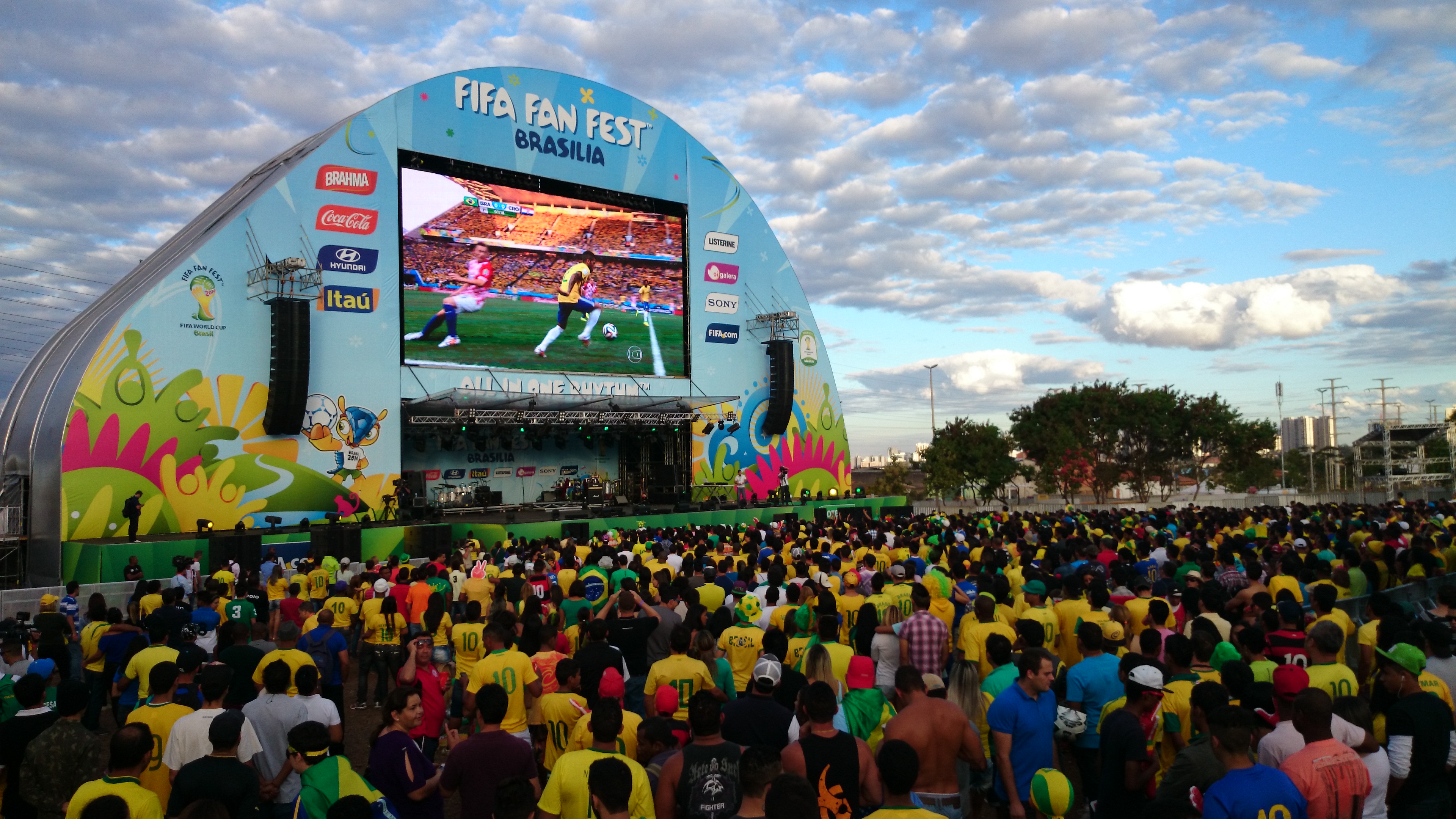
For a third consecutive World Cup tournament, FIFA staged FIFA Fan Fests in each of the 12 host cities throughout the competition. Prominent examples were the Copacabana Beach in Rio de Janeiro, which already held a Fan Fest in 2010, and São Paulo's Vale do Anhangabaú. The first official event took place on Iracema Beach, in Fortaleza, on 8 June 2014.
Innovations
Technologies
_(cropped).jpg)
In order to avoid ghost goals, the 2014 World Cup introduced goal-line technology following successful trials at, among other competitions, the 2013 Confederations Cup. The chosen Goal Control system featured 14 high speed cameras, 7 directed to each of the goals. Data were sent to the central image-processing centre, where a virtual representation of the ball was output on a widescreen to confirm the goal. The referee was equipped with a watch which vibrated and displayed a signal upon a goal. France's second goal in their group game against Honduras was the first time goal-line technology was needed to confirm that a goal should be given.
Following successful trials, FIFA approved the use of vanishing spray by the referees for the first time at a World Cup Finals. The water-based spray, which disappears within minutes of application, can be used to mark a ten-yard line for the defending team during a free kick and also to draw where the ball is to be placed for a free kick.
The Adidas Brazuca was the official match ball of the 2014 FIFA World Cup and was supplied by Forward Sports of Sialkot, Pakistan. Adidas created a new design of ball after criticisms of the Adidas Jabulani used in the previous World Cup. The number of panels was reduced to six, with the panels being thermally bonded. This created a ball with increased consistency and aerodynamics compared to its predecessor. Furthermore, Adidas underwent an extensive testing process lasting more than two years to produce a ball that would meet the approval of football professionals.
Cooling breaks
Due to the relatively high ambient temperatures in Brazil, particularly at the northern venues, cooling breaks for the players were introduced. Breaks could take place at the referee's discretion after the 30th minute of each half if the Wet Bulb Globe Temperature exceeded 32 C; the breaks would last 3 minutes, with this time made up by an extended period of stoppage time at the end of the half.
The first cooling break in a World Cup play took place during the 32nd minute of the match between the Netherlands and Mexico in the round of 16. At the start of the match, FIFA listed the temperature at 32 C with 68% humidity.
Anti-doping
The biological passport was introduced in the FIFA World Cup starting in 2014. Blood and urine samples collected from all players before the competition, and from two players per team per match, were analysed by the Swiss Laboratory for Doping Analyses. FIFA reported that 91.5% of the players taking part in the tournament were tested before the start of the competition and none tested positive. However, FIFA was criticised for how it conducted doping tests.
Format
Tie-breaking_criteria The first round, or group stage, was a competition between the 32 teams divided among eight groups of four, where each group engaged in a round-robin tournament within itself. The two highest ranked teams in each group advanced to the knockout stage. Teams were awarded three points for a win and one for a draw. When comparing teams in a group over-all result came before head-to-head.
| Tie-breaking criteria for group play |
|---|
| The ranking of teams in each group was based on the following criteria: |
In the knockout stage there were four rounds (round of 16, quarter-finals, semi-finals, and the final), with each eliminating the losers. The two semi-final losers competed in a third place play-off. For any match in the knockout stage, a draw after 90 minutes of regulation time was followed by two 15 minute periods of extra time to determine a winner. If the teams were still tied, a penalty shoot-out was held to determine a winner.
The match schedule was announced on 20 October 2011 with the kick-off times being confirmed on 27 September 2012; after the final draw, the kick-off times of seven matches were adjusted by FIFA. The competition was organised so that teams that played each other in the group stage could not meet again during the knockout phase until the final (or the 3rd place match). The group stage began on 12 June, with the host nation competing in the opening game as has been the format since the 2006 tournament. The opening game was preceded by an opening ceremony that began at 15:15 local time.
Opening ceremony
Main article: 2014 FIFA World Cup opening ceremony
On 12 June 2014, the 20th edition of the FIFA World Cup began with the opening ceremony at Arena de São Paulo, São Paulo, Brazil. The event saw 660 dancers take to the stadium and perform in a ceremony which celebrated the nature of the country and its love of football. Following the dancers native singer Claudia Leitte emerged on centre stage to perform for the crowd. She was later joined by Cuban-American rapper Pitbull, and American singer Jennifer Lopez to perform the tournament's official song "We Are One (Ole Ola)" which had been released as an official single on 8 April 2014. Following the ceremony, the opening match was played, which saw the hosts come from behind to beat Croatia 3–1.
Group stage
The group stage of the cup took place in Brazil from 12 June 2014 to 26 June 2014: each team played three games. The group stage was notable for a scarcity of draws and a large number of goals. The first drawn (and goalless) match did not occur until the 13th match of the tournament, between Iran and Nigeria: a drought longer than any World Cup since 1930. The group stage produced a total of 136 goals (an average of 2.83 goals per match), nine fewer than were scored during the entire 2010 tournament. This is the largest number of goals in the group stage since the 32-team system was implemented in 1998 and the largest average in a group stage since 1958. World Cup holders Spain were eliminated after only two games, the quickest exit for the defending champions since Italy's from the 1950 tournament. Spain also became the fourth nation to be eliminated in the first round while holding the World Cup crown, the first one being Italy in 1950 (and again in 2010), Brazil in 1966, and France in 2002. For the first time, two teams from Africa advanced to the second round, a feat that would be repeated in the 2022 tournament.
Group A
Main article: 2014 FIFA World Cup Group A
Group B
Main article: 2014 FIFA World Cup Group B
Group C
Main article: 2014 FIFA World Cup Group C
Group D
Main article: 2014 FIFA World Cup Group D
Group E
Main article: 2014 FIFA World Cup Group E
Group F
Main article: 2014 FIFA World Cup Group F
Group G
Main article: 2014 FIFA World Cup Group G
Group H
Main article: 2014 FIFA World Cup Group H
Knockout stage
Main article: 2014 FIFA World Cup knockout stage
Bracket
Results decided after extra time are indicated by (a.e.t.), and results decided via a penalty shoot-out are indicated by (p).
Round of 16
All the group winners advanced into the quarter-finals. They included four teams from UEFA, three from CONMEBOL, and one from CONCACAF. Of the eight matches, five required extra-time, and two of these required penalty shoot-outs; this was the first time penalty shoot-outs occurred in more than one game in a round of 16. The goal average per game in the round of 16 was 2.25, a drop of 0.58 goals per game from the group stage. The eight teams to win in the round of 16 included four former champions (Brazil, Germany, Argentina and France), a three-time runner-up (Netherlands), and two first-time quarter-finalists (Colombia and Costa Rica). Belgium reached the quarter-finals for the first time since 1986.
All times listed below are at local time (UTC−3)
Quarter-finals
With a 1–0 victory over France, Germany set a World Cup record with four consecutive semi-final appearances. Brazil beat Colombia 2–1, but Brazil's Neymar was injured and missed the rest of the competition. Argentina reached the final four for the first time since 1990 after a 1–0 win over Belgium. The Netherlands reached the semi-finals for the second consecutive tournament, after overcoming Costa Rica in a penalty shoot-out following a 0–0 draw at the end of extra time, with goalkeeper Tim Krul having been substituted on for the shoot-out and saving two penalties.
Semi-finals
Germany qualified for the final for the eighth time with a historic 7–1 win over Brazil – the biggest defeat in Brazilian football since 1920. Miroslav Klose's goal in this match was his 16th throughout all World Cups, breaking the record he had previously shared with Ronaldo. Klose set another record by becoming the first player to appear in four World Cup semi-finals. Argentina reached their first final since 1990, and their fifth overall, after overcoming the Netherlands in a penalty shoot-out following a 0–0 draw at the end of extra time.
Main article: Brazil v Germany (2014 FIFA World Cup)
Third place play-off
The Netherlands defeated Brazil 3–0 to secure third place, the first for the Dutch team in their history. Overall, Brazil conceded 14 goals in the tournament; this was the most by a team at any single World Cup since 1986, and the most by a host nation in history, although their fourth-place finish still represented Brazil's best result in a World Cup since their last win in 2002.
Final
Main article: 2014 FIFA World Cup final
The final featured Germany against Argentina for a record third time after 1986 and 1990.
This marked the first time that teams from the same continent had won three consecutive World Cups (following Italy in 2006 and Spain in 2010). It was also the first time that a European nation had won the World Cup in the Americas. On aggregate Europe then had eleven victories, to South America's nine.
Statistics
Goalscorers
In total, 171 goals were scored by a record 121 players, with five credited as own goals. Goals scored from penalty shoot-outs are not counted. James Rodríguez was awarded the Golden Boot for scoring six goals, the first time that a Colombian player received the award.
;6 goals
- James Rodríguez ;5 goals
- Thomas Müller ;4 goals
- Lionel Messi
- Neymar
- Robin van Persie
;3 goals
- Enner Valencia
- Karim Benzema
- André Schürrle
- Arjen Robben
- Xherdan Shaqiri
;2 goals
- Abdelmoumene Djabou
- Islam Slimani
- Tim Cahill
- David Luiz
- Oscar
- Alexis Sánchez
- Jackson Martínez
- Bryan Ruiz
- Mario Mandžukić
- Ivan Perišić
- Mario Götze
- Mats Hummels
- Miroslav Klose
- Toni Kroos
- André Ayew
- Asamoah Gyan
- Wilfried Bony
- Gervinho
- Memphis Depay
- Ahmed Musa
- Clint Dempsey
- Luis Suárez
;1 goal
- Yacine Brahimi
- Sofiane Feghouli
- Rafik Halliche
- Ángel Di María
- Gonzalo Higuaín
- Marcos Rojo
- Mile Jedinak
- Kevin De Bruyne
- Marouane Fellaini
- Romelu Lukaku
- Dries Mertens
- Divock Origi
- Jan Vertonghen
- Edin Džeko
- Vedad Ibišević
- Miralem Pjanić
- Avdija Vršajević
- Fernandinho
- Fred
- Thiago Silva
- Joël Matip
- Charles Aránguiz
- Jean Beausejour
- Jorge Valdivia
- Eduardo Vargas
- Pablo Armero
- Juan Cuadrado
- Teófilo Gutiérrez
- Juan Quintero
- Joel Campbell
- Óscar Duarte
- Marco Ureña
- Ivica Olić
- Wayne Rooney
- Daniel Sturridge
- Olivier Giroud
- Blaise Matuidi
- Paul Pogba
- Moussa Sissoko
- Mathieu Valbuena
- Sami Khedira
- Mesut Özil
- Sokratis Papastathopoulos
- Georgios Samaras
- Andreas Samaris
- Carlo Costly
- Reza Ghoochannejhad
- Mario Balotelli
- Claudio Marchisio
- Keisuke Honda
- Shinji Okazaki
- Giovani dos Santos
- Andrés Guardado
- Javier Hernández
- Rafael Márquez
- Oribe Peralta
- Daley Blind
- Stefan de Vrij
- Leroy Fer
- Klaas-Jan Huntelaar
- Wesley Sneijder
- Georginio Wijnaldum
- Peter Odemwingie
- Cristiano Ronaldo
- Nani
- Silvestre Varela
- Aleksandr Kerzhakov
- Aleksandr Kokorin
- Koo Ja-cheol
- Lee Keun-ho
- Son Heung-min
- Xabi Alonso
- Juan Mata
- Fernando Torres
- David Villa
- Blerim Džemaili
- Admir Mehmedi
- Haris Seferovic
- Granit Xhaka
- John Brooks
- Julian Green
- Jermaine Jones
- Edinson Cavani
- Diego Godín
;Own goals
- Sead Kolašinac (against Argentina)
- Marcelo (against Croatia)
- John Boye (against Portugal)
- Noel Valladares (against France)
- Joseph Yobo (against France)
Source: FIFA
Discipline
The most notable disciplinary case was that of Uruguayan striker Luis Suárez, who was suspended for nine international matches and banned from taking part in any football-related activity (including entering any stadium) for four months, following a biting incident on Italian defender Giorgio Chiellini. He was also fined CHF100,000. After an appeal to the Court of Arbitration for Sport, Suárez was later allowed to participate in training and friendly matches with new club Barcelona.
A player is automatically suspended for the next match for the following offences:
- Receiving a red card (red card suspensions may be extended for serious offences)
- Receiving two yellow cards in two matches; yellow cards expire after the completion of the quarter-finals (yellow card suspensions are not carried forward to any other future international matches)
The following suspensions were served during the tournament:
| Player | Offence(s) | Suspension(s) |
|---|---|---|
| Maxi Pereira | in [Group D](2014-fifa-world-cup-group-d-uruguay-vs-costa-rica) vs Costa Rica (matchday 1; 14 June) | [Group D](2014-fifa-world-cup-group-d-uruguay-vs-england) vs England (matchday 2; 19 June) |
| Wilson Palacios | in [Group E](2014-fifa-world-cup-group-e-france-vs-honduras) vs France (matchday 1; 15 June) | [Group E](2014-fifa-world-cup-group-e-honduras-vs-ecuador) vs Ecuador (matchday 2; 20 June) |
| Pepe | in [Group G](2014-fifa-world-cup-group-g-portugal-vs-germany) vs Germany (matchday 1; 16 June) | [Group G](2014-fifa-world-cup-group-g-portugal-vs-united-states) vs United States (matchday 2; 22 June) |
| Tim Cahill | in [Group B](2014-fifa-world-cup-group-b-australia-vs-chile) vs Chile (matchday 1; 13 June) | |
| in [Group B](2014-fifa-world-cup-group-b-australia-vs-netherlands) vs Netherlands (matchday 2; 18 June) | [Group B](2014-fifa-world-cup-group-b-australia-vs-spain) vs Spain (matchday 3; 23 June) | |
| Robin van Persie | in [Group B](2014-fifa-world-cup-group-b-netherlands-vs-spain) vs Spain (matchday 1; 13 June) | |
| in [Group B](2014-fifa-world-cup-group-b-netherlands-vs-australia) vs Australia (matchday 2; 18 June) | [Group B](2014-fifa-world-cup-group-b-netherlands-vs-chile) vs Chile (matchday 3; 23 June) | |
| Alex Song | in [Group A](2014-fifa-world-cup-group-a-cameroon-vs-croatia) vs Croatia (matchday 2; 18 June) | [Group A](2014-fifa-world-cup-group-a-cameroon-vs-brazil) vs Brazil (matchday 3; 23 June) |
| Didier Zokora | in [Group C](2014-fifa-world-cup-group-c-ivory-coast-vs-japan) vs Japan (matchday 1; 14 June) | |
| in [Group C](2014-fifa-world-cup-group-c-ivory-coast-vs-colombia) vs Colombia (matchday 2; 19 June) | [Group C](2014-fifa-world-cup-group-c-ivory-coast-vs-greece) vs Greece (matchday 3; 24 June) | |
| Kostas Katsouranis | in [Group C](2014-fifa-world-cup-group-c-greece-vs-japan) vs Japan (matchday 2; 19 June) | [Group C](2014-fifa-world-cup-group-c-greece-vs-ivory-coast) vs Ivory Coast (matchday 3; 24 June) |
| Yohan Cabaye | in [Group E](2014-fifa-world-cup-group-e-france-vs-honduras) vs Honduras (matchday 1; 15 June) | |
| in [Group E](2014-fifa-world-cup-group-e-france-vs-switzerland) vs Switzerland (matchday 2; 20 June) | [Group E](2014-fifa-world-cup-group-e-france-vs-ecuador) vs Ecuador (matchday 3; 25 June) | |
| Sulley Muntari | in [Group G](2014-fifa-world-cup-group-g-ghana-vs-united-states) vs United States (matchday 1; 16 June) | |
| in [Group G](2014-fifa-world-cup-group-g-ghana-vs-germany) vs Germany (matchday 2; 21 June) | [Group G](2014-fifa-world-cup-group-g-ghana-vs-portugal) vs Portugal (matchday 3; 26 June) | |
| Mile Jedinak | in [Group B](2014-fifa-world-cup-group-b-australia-vs-chile) vs Chile (matchday 1; 13 June) | |
| in [Group B](2014-fifa-world-cup-group-b-australia-vs-spain) vs Spain (matchday 3; 23 June) | *Suspension served outside tournament* | |
| José Juan Vázquez | in [Group A](2014-fifa-world-cup-group-a-mexico-vs-brazil) vs Brazil (matchday 2; 17 June) | |
| in [Group A](2014-fifa-world-cup-group-a-mexico-vs-croatia) vs Croatia (matchday 3; 23 June) | [Round of 16](2014-fifa-world-cup-knockout-stage-mexico-vs-netherlands) vs Netherlands (29 June) | |
| Ante Rebić | in [Group A](2014-fifa-world-cup-group-a-croatia-vs-mexico) vs Mexico (matchday 3; 23 June) | *Suspension served outside tournament* |
| Mario Balotelli | in [Group D](2014-fifa-world-cup-group-d-italy-vs-costa-rica) vs Costa Rica (matchday 2; 20 June) | |
| in [Group D](2014-fifa-world-cup-group-d-italy-vs-uruguay) vs Uruguay (matchday 3; 24 June) | *Suspension served outside tournament* | |
| Claudio Marchisio | in [Group D](2014-fifa-world-cup-group-d-italy-vs-uruguay) vs Uruguay (matchday 3; 24 June) | *Suspension served outside tournament* |
| Antonio Valencia | in [Group E](2014-fifa-world-cup-group-e-ecuador-vs-france) vs France (matchday 3; 25 June) | *Suspension served outside tournament* |
| Steven Defour | in [Group H](2014-fifa-world-cup-group-h-belgium-vs-south-korea) vs South Korea (matchday 3; 26 June) | [Round of 16](2014-fifa-world-cup-knockout-stage-belgium-vs-united-states) vs United States (1 July) |
| Eugenio Mena | in [Group B](2014-fifa-world-cup-group-b-chile-vs-spain) vs Spain (matchday 2; 18 June) | |
| in [Round of 16](2014-fifa-world-cup-knockout-stage-chile-vs-brazil) vs Brazil (28 June) | *Suspension served outside tournament* | |
| Francisco Silva | in [Group B](2014-fifa-world-cup-group-b-chile-vs-netherlands) vs Netherlands (matchday 3; 23 June) | |
| in [Round of 16](2014-fifa-world-cup-knockout-stage-chile-vs-brazil) vs Brazil (28 June) | *Suspension served outside tournament* | |
| Luiz Gustavo | in [Group A](2014-fifa-world-cup-group-a-brazil-vs-croatia) vs Croatia (matchday 1; 12 June) | |
| in [Round of 16](2014-fifa-world-cup-knockout-stage-brazil-vs-chile) vs Chile (28 June) | [Quarter-finals](2014-fifa-world-cup-knockout-stage-brazil-vs-colombia) vs Colombia (4 July) | |
| Diego Lugano | in [Group D](2014-fifa-world-cup-group-d-uruguay-vs-costa-rica) vs Costa Rica (matchday 1; 14 June) | |
| in [Round of 16](2014-fifa-world-cup-knockout-stage-uruguay-vs-colombia) vs Colombia (28 June) | *Suspension served outside tournament* | |
| Paul Aguilar | in [Group A](2014-fifa-world-cup-group-a-mexico-vs-brazil) vs Brazil (matchday 2; 17 June) | |
| in [Round of 16](2014-fifa-world-cup-knockout-stage-mexico-vs-netherlands) vs Netherlands (29 June) | *Suspension served outside tournament* | |
| Rafael Márquez | in [Group A](2014-fifa-world-cup-group-a-mexico-vs-croatia) vs Croatia (matchday 3; 23 June) | |
| in [Round of 16](2014-fifa-world-cup-knockout-stage-mexico-vs-netherlands) vs Netherlands (29 June) | *Suspension served outside tournament* | |
| Óscar Duarte | in [Round of 16](2014-fifa-world-cup-knockout-stage-costa-rica-vs-greece) vs Greece (29 June) | [Quarter-finals](2014-fifa-world-cup-knockout-stage-costa-rica-vs-netherlands) vs Netherlands (5 July) |
| Marcos Rojo | in [Group F](2014-fifa-world-cup-group-f-argentina-vs-bosnia-and-herzegovina) vs Bosnia and Herzegovina (matchday 1; 15 June) | |
| in [Round of 16](2014-fifa-world-cup-knockout-stage-argentina-vs-switzerland) vs Switzerland (1 July) | [Quarter-finals](2014-fifa-world-cup-knockout-stage-argentina-vs-belgium) vs Belgium (5 July) | |
| Thiago Silva | in [Group A](2014-fifa-world-cup-group-a-brazil-vs-mexico) vs Mexico (matchday 2; 17 June) | |
| in [Quarter-finals](2014-fifa-world-cup-knockout-stage-brazil-vs-colombia) vs Colombia (4 July) | [Semi-finals](2014-fifa-world-cup-knockout-stage-brazil-vs-germany) vs Germany (8 July) | |
| Toby Alderweireld | in [Group H](2014-fifa-world-cup-group-h-belgium-vs-russia) vs Russia (matchday 2; 22 June) | |
| in [Quarter-finals](2014-fifa-world-cup-knockout-stage-belgium-vs-argentina) vs Argentina (5 July) | *Suspension served outside tournament* | |
| Giancarlo González | in [Group D](2014-fifa-world-cup-group-d-costa-rica-vs-england) vs England (matchday 3; 24 June) | |
| in [Quarter-finals](2014-fifa-world-cup-knockout-stage-costa-rica-vs-netherlands) vs Netherlands (5 July) | *Suspension served outside tournament* |
Man of the match
| Stage | Team 1 | Result | Team 2 | Man of the Match | Group stage matches | Knock-out stage matches |
|---|---|---|---|---|---|---|
| Group A | **3-1** | Neymar | ||||
| **1-0** | Giovani dos Santos | |||||
| Group B | **1-5** | NED Robin van Persie | ||||
| **3-1** | CHI Alexis Sánchez | |||||
| Group C | **3-0** | COL James Rodríguez | ||||
| Group D | **1-3** | CRI Joel Campbell | ||||
| **1-2** | ITA Mario Balotelli | |||||
| Group C | **2-1** | CIV Yaya Touré | ||||
| Group E | **2-1** | SUI Xherdan Shaqiri | ||||
| **3-0** | FRA Karim Benzema | |||||
| Group F | **2-1** | ARG Lionel Messi | ||||
| Group G | **4-0** | GER Thomas Müller | ||||
| Group F | **0-0** | NGA John Obi Mikel | ||||
| Group G | **1-2** | USA Clint Dempsey | ||||
| Group H | **2-1** | BEL Kevin De Bruyne | ||||
| Group A | **0-0** | MEX Guillermo Ochoa | ||||
| Group H | **1-1** | ROK Son Heung-min | ||||
| Group B | **2-3** | NED Arjen Robben | ||||
| **0-2** | CHI Eduardo Vargas | |||||
| Group A | **0-4** | CRO Mario Mandžukić | ||||
| Group C | **2-1** | COL James Rodríguez | ||||
| Group D | **2-1** | URU Luis Suárez | ||||
| Group C | **0-0** | JAP Keisuke Honda | ||||
| Group D | **0-1** | CRI Bryan Ruiz | ||||
| Group E | **2-5** | FRA Karim Benzema | ||||
| **1-2** | ECU Enner Valencia | |||||
| Group F | **1-0** | ARG Lionel Messi | ||||
| Group G | **2-2** | GER Mario Götze | ||||
| Group F | **1-0** | NGA Peter Odemwingie | ||||
| Group H | **1-0** | BEL Eden Hazard | ||||
| **2-4** | ALG Islam Slimani | |||||
| Group G | **2-2** | USA Tim Howard | ||||
| Group B | **0-3** | SPA David Villa | ||||
| **2-0** | NED Arjen Robben | |||||
| Group A | **1-4** | BRA Neymar | ||||
| **1-3** | MEX Rafael Márquez | |||||
| Group D | **0-1** | ITA Gianluigi Buffon | ||||
| **0-0** | CRI Keylor Navas | |||||
| Group C | **1-4** | COL Jackson Martínez | ||||
| **2-1** | GRE Georgios Samaras | |||||
| Group F | **2-3** | ARG Lionel Messi | ||||
| **3-1** | BIH Edin Džeko | |||||
| Group E | **0-3** | SUI Xherdan Shaqiri | ||||
| **0-0** | ECU Alexander Domínguez | |||||
| Group G | **0-1** | GER Thomas Müller | ||||
| **2-1** | POR Cristiano Ronaldo | |||||
| Group H | **0-1** | BEL Jan Vertonghen | ||||
| **1-1** | ALG Islam Slimani | |||||
| Round of 16 | **1-1** | BRA Júlio César | ||||
| **2-0** | COL James Rodríguez | |||||
| **2-1** | MEX Guillermo Ochoa | |||||
| **1-1** | CRI Keylor Navas | |||||
| **2-0** | FRA Paul Pogba | |||||
| **2-1** | ALG Raïs M'Bolhi | |||||
| **1-0** | ARG Lionel Messi | |||||
| **2-1** | USA Tim Howard | |||||
| Quarter-finals | **0-1** | GER Mats Hummels | ||||
| **2-1** | BRA David Luiz | |||||
| **1-0** | ARG Gonzalo Higuaín | |||||
| **0-0** | CRI Keylor Navas | |||||
| Semi-finals | **1-7** | GER Toni Kroos | ||||
| **0-0** | ARG Sergio Romero | |||||
| Third place play-off | **0-3** | NED Arjen Robben | ||||
| Final | **1-0** | GER Mario Götze |
Awards
The following awards were given at the conclusion of the tournament:
| Award | Winner | Other nominees |
|---|---|---|
| Golden Ball | ||
| Golden Boot | ||
| Golden Glove | ||
| Young Player Award | ||
| FIFA Fair Play Trophy |
;Technical Study Group The members of the Technical Study Group, the committee that decided which players won the awards, were led by FIFA's head of the Technical Division Jean-Paul Brigger and featured:
- France Gérard Houllier
- Mexico Raul Arias
- Argentina Gabriel Calderón
- New Zealand Ricki Herbert
- Sudan Abdel Moneim Hussein
- Hong Kong Kwok Ka Ming
- Romania Ioan Lupescu
- Spain Ginés Meléndez
- Japan Tsuneyasu Miyamoto
- Nigeria Sunday Oliseh
- Finland Mixu Paatelainen
- El Salvador Jaime Rodríguez
- Jamaica Theodore Whitmore
There were changes to the voting procedure for awards for the 2014 edition: while in 2010 accredited media were allowed to vote for the Golden Ball award, in 2014 only the Technical Study Group could select the outcome.
All-Star Team
As was the case during the 2010 edition, FIFA released an All-Star Team based on the Castrol performance index in its official website.
| Goalkeeper | Defenders | Midfielders | Forwards |
|---|
Dream Team
FIFA also invited users of FIFA.com to elect their Dream Team.
| Goalkeeper | Defenders | Midfielders | Forwards | Manager |
|---|
Prize money
The total prize money on offer for the tournament was confirmed by FIFA as US$576 million (including payments of $70 million to domestic clubs and $100 million as player insurances), a 37 percent increase from the amount allocated in the 2010 tournament. Before the tournament, each of the 32 entrants received $1.5 million for preparation costs. At the tournament, the prize money was distributed as follows:
- $8 million – To each team eliminated at the group stage (16 teams)
- $9 million – To each team eliminated in the round of 16 (8 teams)
- $14 million – To each team eliminated in the quarter-finals (4 teams)
- $20 million – Fourth placed team
- $22 million – Third placed team
- $25 million – Runner-up
- $35 million – Winner
Final standings
Per statistical convention in football, matches decided in extra time are counted as wins and losses, while matches decided by penalty shoot-outs are counted as draws.

]]
quarter-finals round of 16 group stage
Preparations and costs
Main article: 2014 FIFA World Cup preparations
Costs of the tournament totalled $11.6 billion, making it the most expensive World Cup until it was surpassed by 2018 FIFA World Cup which cost an estimated $14.2 billion. FIFA was expected to spend US$2 billion on staging the finals, with its greatest single expense being the US$576 million prize money pot.
Although organisers originally estimated costs of US$1.1 billion, a reported US$3.6 billion was ultimately spent on stadium works. Five of the chosen host cities had brand new venues built specifically for the World Cup, while the Estádio Nacional Mané Garrincha in the capital Brasília was demolished and rebuilt, with the remaining six being extensively renovated.
An additional R$3 billion (US$1.3 billion, €960 million, £780 million at June 2014 rates) was earmarked by the Brazilian government for investment in infrastructure works and projects for use during the 2014 World Cup and beyond. However, the failed completion of many of the proposed works provoked discontent among some Brazilians.
The Brazilian government pledged US$900 million to be invested into security forces and that the tournament would be "one of the most protected sports events in history."
Marketing
Main article: 2014 FIFA World Cup marketing
The marketing of the 2014 FIFA World Cup included sale of tickets, support from sponsors and promotion through events that utilise the symbols and songs of the tournament. Popular merchandise included items featuring the official mascot as well as an official video game that has been developed by EA Sports. As a partner of the German Football Association, part of German major airline Lufthansa's fleet was branded "Fanhansa" for the time being. Branded planes flew the Germany national team, media representatives and football fans to Brazil.
The Sony Xperia Z2 was dubbed the "official smartphone of the 2014 FIFA World Cup".
Sponsorship
The sponsors of the 2014 World Cup are divided into three categories: FIFA Partners, FIFA World Cup Sponsors and National Supporters.
| FIFA partners | FIFA World Cup sponsors | National supporters |
|---|
Symbols
Mascot
Main article: Fuleco
The official mascot of this World Cup was "Fuleco"
Match ball
Main article: Adidas Brazuca
The official match ball was "Brazuca", manufactured by Adidas.
Music
Main article: One Love, One Rhythm – The 2014 FIFA World Cup Official Album
The official song of the tournament was "We Are One (Ole Ola)" with vocals from Pitbull, Jennifer Lopez and Claudia Leitte.
The official mascot song was "Tatu Bom de Bola".
The official anthem was "Dar um Jeito (We Will Find a Way)".
Media
For a fourth consecutive FIFA World Cup Finals, the coverage was provided by HBS (Host Broadcast Services), a subsidiary of Infront Sports & Media. Sony was selected as the official equipment provider and built 12 bespoke high definition production 40-foot-long containers, one for each tournament venue, to house the extensive amount of equipment required. Each match utilised 37 standard camera plans, including Aerial and Cablecam, two Ultramotion cameras and dedicated cameras for interviews. The official tournament film, as well as three matches, will be filmed with ultra high definition technology (4K resolution), following a successful trial at the 2013 FIFA Confederations Cup.
The broadcasting rights – covering television, radio, internet and mobile coverage – for the tournament were sold to media companies in each individual territory either directly by FIFA, or through licensed companies or organisations such as the European Broadcasting Union, Organización de Televisión Iberoamericana, International Media Content, Dentsu and RS International Broadcasting & Sports Management. The sale of these rights accounted for an estimated 60% of FIFA's income from staging a World Cup. The International Broadcast Centre was situated at the Riocentro in the Barra da Tijuca neighbourhood of Rio de Janeiro.
Worldwide, several games qualified as the most-watched sporting events in their country in 2014, including 42.9 million people in Brazil for the opening game between Brazil and Croatia, the 34.1 million in Japan who saw their team play Ivory Coast, and 34.7 million in Germany who saw their national team win the World Cup against Argentina, while the 24.7 million viewers during the game between the US and Portugal is joint with the 2010 final as the most-watched football game in the United States. According to FIFA, over 1 billion people tuned in worldwide to watch the final between Germany and Argentina.
Controversies
Main article: List of 2014 FIFA World Cup controversies
The 2014 FIFA World Cup generated various controversies, including demonstrations, some of which took place even before the tournament started. Furthermore, there were various issues with safety, including the death of eight workers and a fire during construction, breaches into stadiums, an unstable makeshift staircase at the Maracanã Stadium, a monorail collapse, and the collapse of an unfinished overpass in Belo Horizonte. The houses of thousands of families living in Rio de Janeiro’s slums were cleared for redevelopments for the World Cup in spite of protests and resistance. Favela do Metrô, near the Maracanã Stadium, was completely destroyed as a result, having previously housed 700 families in 2010.
Protests
Prior to the opening ceremony of the 2013 FIFA Confederations Cup staged in Brazil, demonstrations took place outside the venue, organised by people unhappy with the amount of public money spent to enable the hosting of the FIFA World Cup. Both the Brazilian president Dilma Rousseff and FIFA president Sepp Blatter were heavily booed as they were announced to give their speeches at the 2013 tournament's opening, which resulted in FIFA announcing that the 2014 FIFA World Cup opening ceremony would not feature any speeches. Further protests took place during the Confederations Cup as well as prior to and during the World Cup.
Breaches into stadiums
At the Group B match between Spain and Chile, around 100 Chilean supporters who had gathered outside Maracanã Stadium forced their way into the stadium and caused damage to the media centre. Military police reported that 85 Chileans were detained during the events, while others reached the stands. Earlier, about 20 Argentinians made a similar breach during Argentina's Group F game against Bosnia and Herzegovina at the same stadium.
Bridge collapse
Main article: Belo Horizonte overpass collapse
On 3 July 2014, an overpass under construction in Belo Horizonte as part of the World Cup infrastructure projects collapsed onto a busy carriageway below, leaving two people dead and 22 others injured.
Head injuries
During the tournament, FIFA received significant criticism for the way head injuries are handled during matches. Two incidents in particular attracted the most attention. First, in a group stage match, after Uruguayan defender Álvaro Pereira received a blow to the head, he lay unconscious. The Uruguayan doctor signalled for the player to be substituted, but he returned to the match. The incident drew criticism from the professional players' union FIFPro, and from Michel D'Hooghe, a member of the FIFA executive board and chairman of its medical committee.
Second, in the Final, German midfielder Christoph Kramer received a blow to the head from a collision in the 14th minute, but returned to the match before collapsing in the 31st minute. During that time, Kramer was disoriented and confused, and asked the referee Nicola Rizzoli whether the match he was playing was in the World Cup Final.
Notes
References
References
- Mason, Peter. (13 July 2014). "Lionel Messi wins Golden Ball award for best player of World Cup". The Guardian.
- "Players – Top goals". FIFA.com.
- "Pogba wins Hyundai Young Player Award". FIFA.com.
- (14 July 2014). "Manuel Neuer wins golden glove award". NDTV Sports.
- (14 July 2014). "Colombia national team wins FIFA's Fair Play award at 2014 World Cup". Colombia Reports.
- (19 February 2013). "FIFA launch GLT tender for Brazil 2013/14". FIFA.com.
- (14 July 2014). "Em balanço da Copa, Dilma diz que Brasil derrotou prognósticos 'terríveis'". [[Grupo Globo]].
- (June 2023). "2014 FIFA World Cup Brazil".
- (13 July 2014). "Germany beat Argentina to win World Cup final with late Mario Götze goal". The Guardian.
- (12 June 2013). "If the World Cup started tomorrow". ESPN FC.
- (14 July 2014). "Battle of the Brands: Adidas lifts the World Cup, but Nike scores most goals".
- (14 July 2014). "Numbers Game: All the stats from Germany's fourth World Cup triumph".
- (7 March 2003). "2014 FIFA World Cup to be held in South America". FIFA.com.
- (29 October 2007). "Rotation ends in 2018". FIFA.com.
- (15 May 2013). "Brazil may lose the right to hold World Cup 2014".
- (13 April 2007). "Brazil confirms bid – Colombia withdraws". FIFA.com.
- (30 October 2007). "Brazil confirmed as 2014 hosts". FIFA.com.
- (11 June 2014). "1 day to go". FIFA.com.
- (5 June 2014). "FIFA/Coca-Cola Rankings". FIFA.com.
- (6 December 2013). "Final Draw reveals intriguing groups". FIFA.com.
- (5 December 2013). "A team of stars for the draw". FIFA.com.
- (October 2021). "Welcome to FIFA.com News - Pot 1 seeds set for Brazil 2014 draws".
- "2014 FIFA World Cup - News - Draw procedures approved".
- (3 December 2013). "Final draw procedures". FIFA.com.
- (3 December 2013). "Draw procedures approved". FIFA.com.
- (15 January 2014). "Referee trios and support duos appointed for 2014 FIFA World Cup". FIFA.com.
- "Referees & assistant referees for the 2014 FIFA World Cup". FIFA.com.
- (10 June 2014). "Referee designations for matches 1–4". fifa.com.
- "2014 FIFA World Cup - Matches". FIFA.com.
- "Regulations – FIFA World Cup Brazil 2014". FIFA.com.
- "Host cities in 1950 FIFA World Cup". Colunas.globoesporte.com.
- (2 December 2013). "2014 FIFA World Cup: Luck of the draw 'an essential component'". British Broadcasting Corporation.
- (21 January 2014). "Team Base Camps for Brazil 2014 announced". FIFA.com.
- (20 January 2014). "FIFA Fan Fest locations confirmed". FIFA.com.
- (18 January 2012). "2014 FIFA World Cup Brazil Venues". FIFA.com.
- (7 November 2013). "Team Base Camps Brochure". FIFA.com.
- (1 February 2014). "Most teams pick bases in south east Brazil". British Broadcasting Corporation.
- (13 December 2013). "2014 Fifa World Cup: Germany to build training complex in Brazil". British Broadcasting Corporation.
- "World Cup 2014 FanCamps and FanFests".
- "FIFA Fan Fest locations confirmed".
- (9 June 2014). "Ronaldo kicks off FIFA Fan Fest".
- "Behind the Scenes with GoalControl".
- (12 June 2014). "World Cup 2014: Goal Control goal-line technology to be used in Brazil".
- (29 May 2014). "German firm behind goal-line technology looks beyond World Cup". [[Thomson Reuters]].
- (16 June 2014). "World Cup goalline technology: how does it work?". The Guardian.
- (21 November 2013). "Vanishing spray set for World Cup". eurosport.com.
- (11 June 2014). "World Cup 2014: Adidas "Brazuca" Ball Scores With Fans".
- "adidas Brazuca – Name of Official Match Ball decided by Brazilian fans".
- "Brazuca – an icon is born". Adidas Group.
- (3 December 2013). "adidas brings brazuca into the world".
- (7 October 2013). "FIFA approves extra breaks to help players keep their cool". Inside World Football.
- "Heat forces first cooling breaks in Brazil". British Broadcasting Corporation.
- "A cool first and a historic triumph".
- (29 June 2014). "FIFA World Cup: Netherlands 2, Mexico 1".
- FIFA World Cup 🏆. (29 June 2014). "LIVE: #MEX & #NED players take 1st cooling break at a #worldcup #NEDMEX -".
- "Match Report".
- {{in lang. link. (12 March 2017 , fifa.com (page visited on 11 June 2014).)
- (14 June 2014). "All pre-FIFA World Cup doping controls test negative". FIFA.com.
- (7 June 2014). "Doping controls at the World Cup in Brazil leave a lot to be desired – Sports News | Latest Sports Results & Fixtures | The Irish Times – Sat, Jun 07, 2014". The Irish Times.
- Rumsby, Ben. (21 June 2014). "World Cup 2014: Diego Maradona accuses Fifa of drug testing conspiracy against Costa Rica". The Telegraph.
- (20 October 2011). "Match schedule for 2014 FIFA World Cup unveiled". FIFA.com.
- (27 September 2012). "FIFA Executive Committee approves kick-off times for Brazil 2014". FIFA.com.
- (7 December 2013). "Match schedule for Brazil 2014 confirmed". FIFA.com.
- (12 June 2014). "Brazil 2014: Opening ceremony". FIFA.com.
- (12 June 2014). "World Cup 2014 kicks off with colourful ceremony". BBC Sport.
- Tyers, Alan. (12 June 2014). "World Cup 2014 opening ceremony: live".
- (12 June 2014). "World Cup 2014 opening ceremony – as it happened". The Guardian.
- "Iran 0-0 Nigeria". BBC Sport.
- (26 June 2014). "Group stage goal glut brightens World Cup". Deutsche Welle.
- (27 June 2014). "World Cup 2014: Statistical XI versus your tournament XI". British Broadcasting Corporation.
- (27 June 2014). "Statistically the greatest World Cup?". British Broadcasting Corporation.
- (21 June 2014). "Spain aims to avoid worst ever World Cup defense". USA Today.
- Krishnan, Joe. (18 June 2014). "World Cup 2014: Spain and the World Cup holders who crashed out at the group stage". The Independent.
- Hicks, Brandon. (1 July 2014). "World Cup Round of 16: By the numbers". CBC News.
- (28 June 2014). "Colombia topples Uruguay to reach first World Cup quarterfinals".
- Pye, John. (29 June 2014). "Costa Rica Beats Greece 5-3 to Advance to Their First Ever World Cup Quarterfinal".
- Agence France-Presse. (1 July 2014). "World Cup 2014: Belgium Beat USA to Set Up Quarterfinal Clash vs Argentina". NDTVSports.com.
- Starcevic, Nesha. "Klose Sets Record That Compounds Brazil's Defeat". American Broadcasting Company.
- "Klose travels anomalous path to become all-time top World Cup scorer". www.leaderpost.com.
- (13 July 2014). "World Cup 2014: Netherlands pile more misery on Brazil in third place play-off". The Sydney Morning Herald.
- (13 July 2014). "World Cup 2014: James Rodriguez wins Golden Boot".
- "FIFA World Cup 2014 Player Statistics".
- "adidas Golden Boot". FIFA.com (Fédération Internationale de Football Association).
- (26 June 2014). "Luis Suárez suspended for nine matches and banned for four months from any football-related activity". FIFA.com.
- De Menezes, Jack. (26 June 2014). "Luis Suarez banned: Fifa hand striker record nine-game ban AND a four month football ban for biting Giorgio Chiellini in biggest ever World Cup suspension". The Independent.
- (26 June 2014). "Luis Suárez banned for four months for biting in World Cup game". The Guardian.
- Orr, James. (14 August 2014). "Luis Suarez biting appeal: CAS uphold ban, but striker can make Barcelona debut on Monday and train with new team-mates". The Independent.
- "2014 FIFA World Cup – Awards". FIFA.com.
- (13 July 2014). "Messi heralded as Brazil 2014's best". FIFA.com.
- (11 July 2014). "adidas Golden Ball candidates announced". FIFA.com.
- (13 July 2014). "Messi, Neuer heralded as Brazil 2014's best". FIFA.com.
- (11 July 2014). "Finalists in contention for Golden Glove". FIFA.com.
- (11 July 2014). "Depay, Pogba and Varane make up Hyundai Young Player Award shortlist". FIFA.com.
- (9 June 2014). "Technical Study Group". FIFA.com.
- (9 July 2010). "Latest News". FIFA.com.
- (30 May 2014). "adidas Golden Ball". FIFA.com.
- "Castrol Index Top 11". Fédération Internationale de Football Association.
- "2014 FIFA World Cup Dream Team".
- (23 July 2014). "FIFA Announces 2014 World Cup 'Dream Team' as Voted On by Fans". Bleacher Report.
- (5 December 2013). "World Cup money pot increased to $576m". reuters.com.
- "2014 FIFA World Cup Brazil Technical Report and Statistics". FIFA.com.
- link. (16 June 2018 08 ИЮН, 07:01, RBC)
- (23 May 2014). "World Cup set to be most lucrative ever". ESPN FC.
- Dunbar, Graham. (22 May 2014). "Record World Cup numbers game for FIFA, Brazil". USA Today.
- "FIFA's Inspection Report".
- (23 May 2014). "Corruption to blame for some Brazil World Cup cost rises". Bloomberg.
- (3 April 2012). "Brazil World Cup stadiums on track, but costs soar". Reuters.
- (3 December 2013). "2014 Fifa World Cup: Where are the 12 host stadiums in Brazil?". British Broadcasting Corporation.
- (22 July 2009). "FIFA World Cup 2014 host cities to receive US$ 1.5 billion". Brazil-Arab News Agency.
- (8 April 2014). "Less than half of Brazilians favor hosting World Cup, poll shows". Reuters.
- (6 June 2013). "The social cost of Brazil hosting World Cup 2014". Bleacher Report.
- (30 May 2014). "Fifa concern about three Brazil stadiums". British Broadcasting Corporation.
- (5 December 2013). "Brazil boosts World Cup security budget as crime rises". CNN.
- (6 February 2014). "EA Announces EA SPORTS 2014 FIFA World Cup Brazil".
- (13 May 2014). "Lufthansa to rename 8 aircraft "Fanhansa" for the 2014 FIFA World Cup".
- Kee, Edwin. (June 10, 2014). "Sony Xperia Z2 Is Official 2014 FIFA World Cup Phone". Ubergizmo.
- "2014 FIFA World Cup Brazil official partners". FIFA.com.
- [https://web.archive.org/web/20200731052422/https://www.fifa.com/who-we-are/news/the-fifa-world-cuptm-mascots-517089 The FIFA World Cup Mascots]
- [https://web.archive.org/web/20151003074950/http://www.fifa.com/worldcup/photos/galleries/y=2009/m=12/gallery=official-match-balls-the-fifa-world-cuptm-1143505.html Official match balls of the FIFA World Cup]
- (23 January 2014). "Brazilian star Claudia Leitte to perform with Pitbull and Jennifer Lopez on the official song for the 2014 FIFA World Cup". FIFA.com.
- "Host Broadcasting". FIFA.com.
- (13 September 2012). "Sony Professional awarded 2014 FIFA World Cup Broadcast Production Contract". Live-production.tv.
- (22 May 2014). "Sony's astonishing World Cup statistics". RedShark News.
- (3 April 2014). "Sony and FIFA announce further 4K coverage of the 2014 FIFA World Cup". FIFA.com.
- (7 November 2013). "2014 FIFA World Cup Brazil Media Rights Licensees". FIFA.com.
- (17 May 2013). "FIFA revenue estimated to be 4 billion dollars at the close of the 2014 World Cup". CONMEBOL.com.
- (27 May 2011). "International Broadcast Centre to be hosted in Rio de Janeiro". FIFA.com.
- (2 June 2014). "Nerve centre for World Cup TV production opens in Rio". FIFA.com.
- (14 July 2014). "WM: Die Top-10-Quoten aller Zeiten im deutschen Fernsehen". Focus Online.
- (24 June 2014). "USA vs. Portugal World Cup Match Most Watched Soccer Game In U.S. History". Fox News.
- (16 December 2015). "2014 FIFA World Cup reached 3.2 billion viewers, one billion watched final". FIFA.com.
- (15 February 2014). "Factbox: Timeline of deaths, accidents at Brazil's World Cup stadiums". Reuters.
- (29 March 2014). "Brazil World Cup: seventh worker dies on stadium construction". Guardian (UK).
- Davies, Wyre. (9 May 2014). "Brazil World Cup 2014: Eighth death at football stadiums". British Broadcasting Corporation.
- (25 October 2013). "Soccer-Cuiaba fire adds to Brazil's World Cup woes". Yahoo Sports.
- (9 June 2014). "Fatal accident on flagship Sao Paulo monorail". [[BBC News]].
- Gibson, Owen & Watts, Jonathan (5 December 2013). [https://www.theguardian.com/world/2013/dec/05/world-cup-favelas-socially-cleansed-olympics World Cup: Rio favelas being 'socially cleansed' in runup to sporting events] {{Webarchive. link. (3 December 2016 . ''Guardian''. Retrieved on 3 March 2015.)
- Phillips, Tom (26 April 2011). [https://www.theguardian.com/world/2011/apr/26/favela-ghost-town-rio-world-cup Rio World Cup demolitions leave favela families trapped in ghost town] {{Webarchive. link. (29 October 2016 . ''The Guardian''. Retrieved on 3 March 2015.)
- link. (2 April 2015 . Rio On Watch. Retrieved on 3 March 2015.)
- (15 June 2013). "Brazil Beats Japan, Protests Spoil Confederations Cup Opening Day". [[Federal government of the United States]].
- Peck, Brooks. (29 May 2013). "Sepp Blatter, Brazil president Dilma booed at Confederations Cup opening ceremony". Sports.yahoo.com.
- (12 March 2014). "Fifa scraps speeches to avoid protest". British Broadcasting Corporation.
- (17 June 2013). "Confed Cup protests continue". ESPN.
- (1 July 2013). "Police clashes at start of Brazil Confederations Cup final". British Broadcasting Corporation.
- (16 May 2014). "Strikes, violent protests hit Brazil ahead of World Cup". CNN.
- (16 June 2014). "17 Pictures Of Shocking Violence As Police 'Open Live Fire' On Anti-Fifa Protesters". Huffington Post.
- (12 June 2014). "Brazilian police fire tear gas at World Cup protesters; CNN employees injured by anti-riot weapons". CNN.
- Wilson, Jonathan. (18 June 2014). "World Cup 2014: Chile fans invade Maracanã before Spain game". The Guardian.
- (19 June 2014). "World Cup Chile Fans Storm Rio Stadium And 85 Detained". Bloomberg.
- (4 July 2014). "Flyover collapses in Brazil World Cup host city". [[BBC News]].
- Cawthorne, Andrew. (3 July 2014). "Overpass collapses in World Cup city, crushes vehicles". [[Reuters]].
- Decent, Tom. (20 June 2014). "Alvaro Pereira, knocked out then raring to go". The Sydney Morning Herald.
- (13 July 2014). "Kramer head injury revives concussion concern".
- (17 July 2014). "Referee: Christoph Kramer didn't know it was World Cup final after head blow".
This article was imported from Wikipedia and is available under the Creative Commons Attribution-ShareAlike 4.0 License. Content has been adapted to SurfDoc format. Original contributors can be found on the article history page.
Ask Mako anything about 2014 FIFA World Cup — get instant answers, deeper analysis, and related topics.
Research with MakoFree with your Surf account
Create a free account to save articles, ask Mako questions, and organize your research.
Sign up freeThis content may have been generated or modified by AI. CloudSurf Software LLC is not responsible for the accuracy, completeness, or reliability of AI-generated content. Always verify important information from primary sources.
Report