From Surf Wiki (app.surf) — the open knowledge base
Los Angeles
Most populous city in California, United States
Most populous city in California, United States
| Field | Value | |
|---|---|---|
| settlement_type | City | |
| name | Los Angeles | |
| native_name | es | |
| image_skyline | {{multiple image | |
| border | infobox | |
| total_width | 290 | |
| image_style | border:1; | |
| perrow | 1/2/2/2 | |
| caption_align | center | |
| image1 | Los Angeles with Mount Baldy.jpg | |
| caption1 | Skyline of downtown Los Angeles | |
| image2 | Hollywood Sign (Zuschnitt).jpg | |
| caption2 | Hollywood Sign | |
| image3 | Echo Park Lake.jpg | |
| caption3 | Echo Park | |
| image4 | Olvera st los angeles (cropped2).jpg | |
| caption4 | Olvera Street | |
| image5 | Los Angeles City Hall 2013 (cropped).jpg | |
| caption5 | Los Angeles City Hall | |
| image6 | Griffith observatory 2006.jpg | |
| caption6 | Griffith Observatory | |
| image7 | Venice Beach, Los Angeles, CA 01 (cropped2).jpg | |
| caption7 | Venice Beach | |
| image_flag | Flag of Los Angeles, California.svg | |
| flag_size | 110px | |
| image_seal | Seal of Los Angeles.svg | |
| seal_size | 90px | |
| seal_link | Seal of Los Angeles | |
| image_shield | Coat of arms of Los Angeles.svg | |
| shield_size | 75px | |
| image_blank_emblem | Wordmark of Los Angeles, California.svg | |
| blank_emblem_type | Wordmark | |
| blank_emblem_size | 125px | |
| blank_emblem_alt | L.A. city seal next to LACITY.GOV | |
| blank_emblem_link | Seal of Los Angeles | |
| nicknames | L.A., City of Angels, La-la-land, Tinseltown | |
| image_map | LA County Incorporated Areas Los Angeles highlighted.svg | |
| map_caption | Location in Los Angeles County & the state of California | |
| pushpin_map | USA | |
| pushpin_relief | yes | |
| pushpin_label | Los Angeles | |
| pushpin_map_caption | Location in the United States | |
| coordinates | ||
| subdivision_type | Country | |
| subdivision_name | United States | |
| subdivision_type1 | State | |
| subdivision_type2 | County | |
| subdivision_name1 | California | |
| subdivision_name2 | Los Angeles | |
| subdivision_type3 | Region | |
| subdivision_type4 | CSA | |
| subdivision_type5 | MSA | |
| subdivision_name3 | Southern California | |
| subdivision_name4 | Los Angeles-Long Beach | |
| subdivision_name5 | Los Angeles-Long Beach-Anaheim | |
| established_title | Pueblo | |
| established_date | September 4, 1781 | |
| established_title1 | City status | |
| established_date1 | May 23, 1835 | |
| established_title2 | Incorporated | |
| established_date2 | April 4, 1850 | |
| named_for | Our Lady, Queen of the Angels | |
| <!-- Government -----------> | government_type | Mayor-council |
| governing_body | Los Angeles City Council | |
| leader_title | Mayor | |
| leader_name | Karen Bass (D) | |
| leader_title1 | City Attorney | |
| leader_name1 | Hydee Feldstein Soto (D) | |
| total_type | Total | |
| unit_pref | Imperial | |
| area_footnotes | ||
| area_total_sq_mi | 498.3 | |
| area_total_km2 | 1290.6 | |
| area_land_sq_mi | 469.1 | |
| area_land_km2 | 1214.9 | |
| area_water_sq_mi | 29.2 | |
| area_water_km2 | 75.7 | |
| elevation_m | 71 | |
| elevation_ft | 233 | |
| elevation_min_ft | 0 | |
| elevation_min_point | Pacific Ocean | |
| elevation_max_m | 1547 | |
| elevation_max_ft | 5075 | |
| elevation_max_point | Mount Lukens | |
| population_total | 3898747 | |
| population_as_of | [2020](2020-united-states-census) | |
| population_footnotes | ||
| pop_est_footnotes | ||
| population_est | 3,878,704 | |
| pop_est_as_of | 2024 | |
| population_rank | 3rd in North America | |
| 2nd in the United States | ||
| 1st in California | ||
| population_density_sq_mi | 8,205 | |
| population_density_km2 | 3,168 | |
| population_urban_footnotes | ||
| population_urban | 12,237,376 (US: 2nd) | |
| population_metro_footnotes | ||
| population_metro | 12,927,614 (US: 2nd) | |
| population_blank1_title | CSA | |
| population_blank1 | 18316743 (US: 2nd) | |
| population_blank1_footnotes | ||
| population_demonyms | Angeleno, Angelino, Angeleño | |
| demographics_type2 | GDP | |
| demographics2_footnotes | ||
| demographics2_title1 | Metro | |
| demographics2_info1 | $1.295 trillion (2023) | |
| demographics2_title2 | CSA | |
| demographics2_info2 | $1.618 trillion (2023) | |
| postal_code_type | ZIP Codes | |
| postal_code | ||
| area_code | 213, 323, 310, 424, 818, 747, 626 | |
| area_code_type | Area codes | |
| blank_name_sec1 | FIPS code | |
| blank_info_sec1 | ||
| blank1_name_sec1 | GNIS feature IDs | |
| blank1_info_sec1 | , | |
| blank_name_sec2 | Climate | |
| blank_info_sec2 | Hot semi-arid climate (Bsh) | |
| website | ||
| leader_title2 | City Controller | |
| leader_name2 | Kenneth Mejia (D) | |
| timezone | PST | |
| utc_offset | −08:00 | |
| timezone_DST | PDT | |
| utc_offset_DST | −07:00 |
2nd in the United States 1st in California
Los Angeles (informally known by its initials, LA) is the most populous city in the U.S. state of California, and the commercial, financial, and cultural center of Southern California. With an estimated 3.88 million residents within the city limits , it is the second-most populous city in the United States, behind New York City, and the largest city in the Western United States. The city has an ethnically and culturally diverse population, and is the principal city of a metropolitan area of 12.9 million people (2024). Greater Los Angeles, a combined statistical area that includes the Los Angeles and Riverside–San Bernardino metropolitan areas, is a sprawling metropolis of over 18.5 million residents.
The majority of the city proper lies in the Los Angeles Basin adjacent to the Pacific Ocean in the west and extending partly through the Santa Monica Mountains and north into the San Fernando Valley, with the city bordering the San Gabriel Valley to its east. It covers about 469 sqmi, and is the county seat and most populated city of Los Angeles County, which is the most populous county in the United States with an estimated 9.86 million residents . It is the third-most visited city in the U.S. with over 2.7 million visitors as of 2023.
The area that became Los Angeles was originally inhabited by the indigenous Tongva people and later claimed by Juan Rodríguez Cabrillo for Spain in 1542. The city was founded on September 4, 1781, under Spanish governor Felipe de Neve, on the village of Yaanga. It became a part of the First Mexican Empire in 1821 following the Mexican War of Independence. In 1848, at the end of the Mexican–American War, Los Angeles and the rest of California were purchased as part of the Treaty of Guadalupe Hidalgo and became part of the United States. Los Angeles was incorporated as a municipality on April 4, 1850, five months before California achieved statehood. The discovery of oil in the 1890s brought rapid growth to the city. The city was further expanded with the completion of the Los Angeles Aqueduct in 1913, which delivers water from Eastern California.
Los Angeles has a diverse economy with a broad range of industries. It is the global hub of film and television production, though its share has suffered historic declines since the COVID-19 pandemic. It has one of the busiest container ports in the Americas, and despite a business exodus from downtown Los Angeles, the city's urban core is evolving as a cultural center with the world's largest showcase of architecture designed by Frank Gehry. In 2024, the Los Angeles metropolitan area had a gross metropolitan product of over $1.295 trillion, making it the city with the third-largest GDP in the world, after New York and Tokyo. Los Angeles hosted the Summer Olympics in 1932 and 1984, and will also host in 2028.
Toponymy
On September 4, 1781, a group of 44 settlers known as "Los Pobladores" founded the pueblo (town) they called . The original name of the settlement is disputed; the Guinness Book of World Records rendered it as "El Pueblo de Nuestra Señora la Reina de los Ángeles del Río Porciúncula"; other sources have shortened or alternate versions of the longer name.
The local English pronunciation of the name of the city has varied over time. A 1953 article in the journal of the American Name Society asserts that the pronunciation was established following the 1850 incorporation of the city and that since the 1880s the pronunciation emerged from a trend in California to give places Spanish, or Spanish-sounding, names and pronunciations. In 1908, librarian Charles Fletcher Lummis, who argued for the name's pronunciation with a hard g (), reported that there were at least 12 pronunciation variants. In the early 1900s, the Los Angeles Times advocated for pronouncing it Loce AHNG-hayl-ais (), approximating Spanish , by printing the respelling under its masthead for several years. This did not find favor.
Since the 1930s, has been most common. In 1934, the United States Board on Geographic Names decreed that this pronunciation be used by the federal government. This was also endorsed in 1952 by a "jury" appointed by Mayor Fletcher Bowron to devise an official pronunciation.
Common pronunciations in the United Kingdom include . Phonetician Jack Windsor Lewis described the most common one, , as a spelling pronunciation based on analogy to Greek words ending in -es, "reflecting a time when the classics were familiar if Spanish was not".
History
Main article: History of Los Angeles
Indigenous history
The settlement of Indigenous Californians in the modern Los Angeles Basin and the San Fernando Valley was dominated by the Tongva (now also known as the Gabrieleño since the era of Spanish colonization). The historic center of Tongva power in the region was the settlement of Yaanga (Tongva: Iyáangẚ), meaning "place of the poison oak", which would one day be the site where the Spanish founded the Pueblo de Los Ángeles. Iyáangẚ has also been translated as "the valley of smoke".
Spanish rule
Maritime explorer Juan Rodríguez Cabrillo claimed the area of southern California for the Spanish Empire in 1542, while on an official military exploring expedition, as he was moving northward along the Pacific coast from earlier colonizing bases of New Spain in Central and South America. Gaspar de Portolà and Franciscan missionary Juan Crespí reached the present site of Los Angeles on August 2, 1769.
In 1771, Franciscan friar Junípero Serra directed the building of the Mission San Gabriel Arcángel, the first mission in the area. On September 4, 1781, a group of 44 settlers known as "Los Pobladores" founded the pueblo (town) they called . The present-day city has the largest Roman Catholic archdiocese in the United States. Two-thirds of the Mexican or (New Spain) settlers were mestizo or mulatto, a mixture of African, indigenous, and European ancestry. The settlement remained a small ranch town for decades, but by 1820, the population had increased to about 650 residents. Today, the pueblo is commemorated in the historic district of Los Angeles Pueblo Plaza and Olvera Street, the oldest part of Los Angeles.
Mexican rule
New Spain achieved its independence from the Spanish Empire in 1821, and the pueblo now existed within the new Mexican Republic. During Mexican rule, Governor Pío Pico made Los Angeles the regional capital of Alta California. By this time, the new republic introduced more secularization acts within the Los Angeles region. In 1846, during the wider Mexican–American War, marines from the United States occupied the pueblo. This resulted in the siege of Los Angeles, where 150 Mexican militias fought the occupiers, who eventually surrendered.
Mexican rule ended following the American Conquest of California, part of the larger Mexican-American War. Americans took control from the Californios after a series of battles, culminating with the signing of the Treaty of Cahuenga on January 13, 1847. The Mexican Cession was formalized in the Treaty of Guadalupe Hidalgo in 1848, which ceded Los Angeles and the rest of Alta California to the United States.
Post-Conquest era
Railroads arrived with the completion of the transcontinental Southern Pacific line from New Orleans to Los Angeles in 1876 and the Santa Fe Railroad in 1885. Petroleum was discovered in the city and surrounding area in 1892, and by 1923, the discoveries had helped California become the country's largest oil producer, accounting for about one-quarter of the world's petroleum output.
By 1900, the population had grown to more than 102,000, putting pressure on the city's water supply. The completion of the Los Angeles Aqueduct in 1913, under the supervision of William Mulholland, ensured the continued growth of the city. Because of clauses in the city's charter that prevented the City of Los Angeles from selling or providing water from the aqueduct to any area outside its borders, many adjacent cities and communities felt compelled to join Los Angeles.
Los Angeles created the first municipal zoning ordinance in the United States. On September 14, 1908, the Los Angeles City Council promulgated residential and industrial land use zones. The new ordinance established three residential zones of a single type, where industrial uses were prohibited. The proscriptions included barns, lumber yards, and any industrial land use employing machine-powered equipment. These laws were enforced against industrial properties after the fact. These prohibitions were in addition to existing activities that were already regulated as nuisances. These included explosives warehousing, gas works, oil drilling, slaughterhouses, and tanneries. The Los Angeles City Council also designated seven industrial zones within the city. However, between 1908 and 1915, the Los Angeles City Council created various exceptions to the broad proscriptions that applied to these three residential zones, and as a consequence, some industrial uses emerged within them. There are two differences between the 1908 Residence District Ordinance and later zoning laws in the United States. First, the 1908 laws did not establish a comprehensive zoning map as the 1916 New York City Zoning Ordinance did. Second, the residential zones did not distinguish types of housing; they treated apartments, hotels, and detached single-family housing equally.
In 1910, Hollywood merged into Los Angeles, with 10 movie companies already operating in the city at the time. By 1921, more than 80 percent of the world's film industry was concentrated in L.A. The money generated by the industry kept the city insulated from much of the economic loss suffered by the rest of the country during the Great Depression. By 1930, the population surpassed one million. In 1932, the city hosted the Summer Olympics.
Post-WWII
During World War II, Los Angeles was a major center of wartime manufacturing, such as shipbuilding and aircraft. Calship built hundreds of Liberty Ships and Victory Ships on Terminal Island, and the Los Angeles area was the headquarters of six of the country's major aircraft manufacturers (Douglas Aircraft Company, Hughes Aircraft, Lockheed, North American Aviation, Northrop Corporation, and Vultee). During the war, more aircraft were produced in one year than in all the pre-war years since the Wright brothers flew the first airplane in 1903, combined. Manufacturing in Los Angeles skyrocketed, and as William S. Knudsen, of the National Defense Advisory Commission, put it, "We won because we smothered the enemy in an avalanche of production, the like of which he had never seen, nor dreamed possible."
After the end of World War II Los Angeles grew more rapidly than ever, sprawling into the San Fernando Valley. The expansion of the state owned Interstate Highway System during the 1950s and 1960s helped propel suburban growth and signaled the demise of the city's privately owned electrified rail system, once the world's largest. As a consequence of World War II, suburban growth, and population density, many amusement parks were built and operated in this area. An example is Beverly Park, which was located at the corner of Beverly Boulevard and La Cienega before being closed and substituted by the Beverly Center.
In the second half of the 20th century, Los Angeles substantially reduced the amount of housing that could be built by drastically downzoning the city. In 1960, the city had a total zoned capacity for approximately 10 million people. By 1990, that capacity had fallen to 4.5 million as a result of policy decisions to ban housing through zoning.
Racial tensions led to the Watts riots in 1965, resulting in 34 deaths and over 1,000 injuries.
In 1969, California became the birthplace of the Internet, as the first ARPANET transmission was sent from the University of California, Los Angeles (UCLA) to the Stanford Research Institute in Menlo Park.
In 1973, Tom Bradley was elected as the city's first African American mayor, serving for five terms until retiring in 1993. Other events in the city during the 1970s included the Symbionese Liberation Army's South Central standoff in 1974 and the Hillside Stranglers murder cases in 1977–1978.
In early 1984, the city surpassed Chicago in population, thus becoming the second-largest city in the United States.
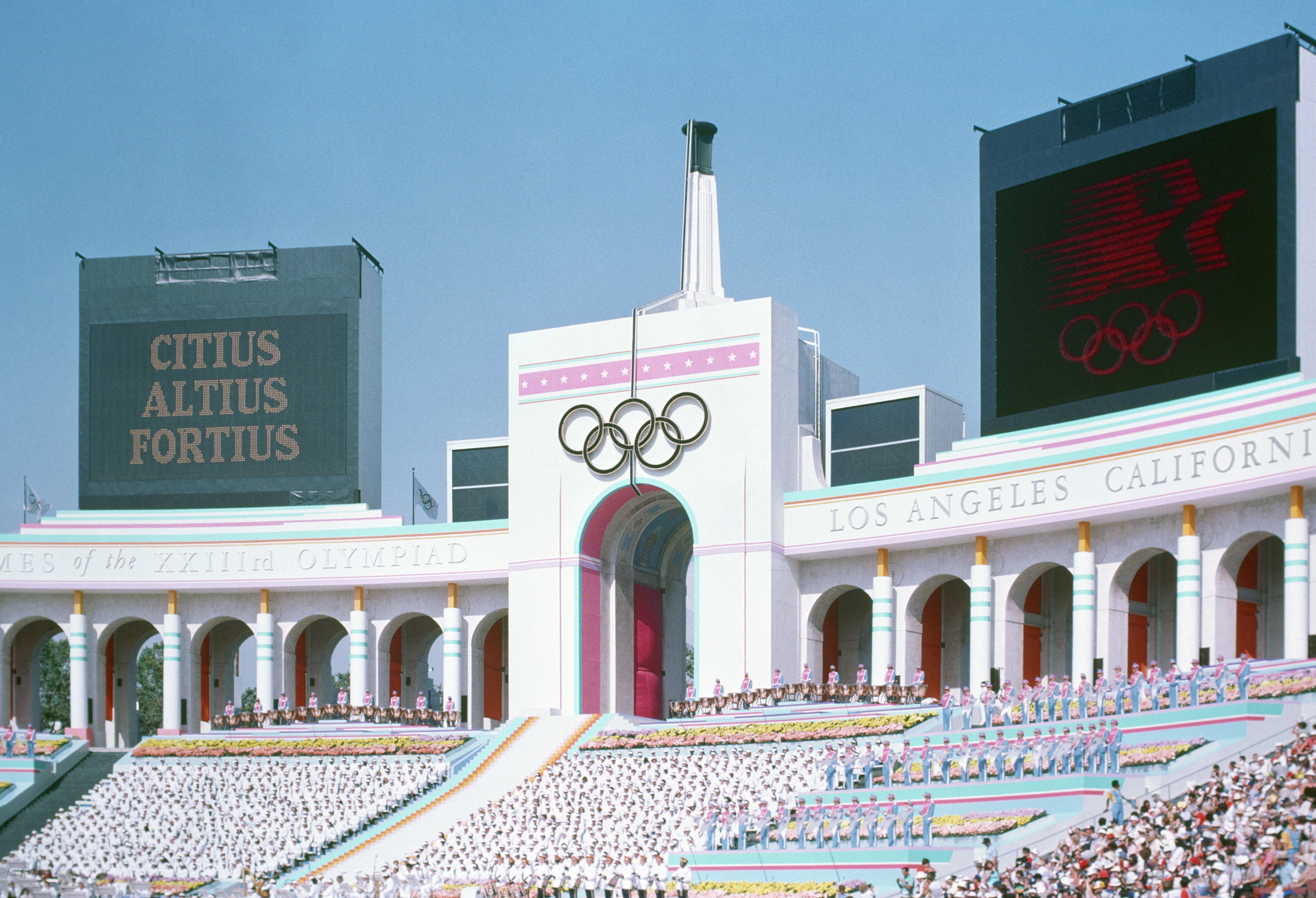
In 1984, the city hosted the Summer Olympic Games for the second time. Despite being boycotted by 14 Communist countries, the 1984 Olympics became more financially successful than any previous, and the second Olympics to turn a profit; the other, according to an analysis of contemporary newspaper reports, was the 1932 Summer Olympics, also held in Los Angeles.
Racial tensions erupted on April 29, 1992, with the acquittal by a Simi Valley jury of four Los Angeles Police Department (LAPD) officers captured on videotape beating Rodney King, culminating in large-scale riots.
In 1994, the magnitude 6.7 Northridge earthquake shook the city, causing $12.5 billion in damage and 72 deaths. The century ended with the Rampart scandal, one of the most extensive documented cases of police misconduct in American history.
21st century
In 2002, Mayor James Hahn led the campaign against secession, resulting in voters defeating efforts by the San Fernando Valley and Hollywood to secede from the city.
In 2022, Karen Bass became the city's first female mayor, making Los Angeles the largest U.S. city to have ever had a woman as mayor.
In January 2025, a series of devastating wildfires caused by severe winds swept through Southern California, with the Pacific Palisades fire causing widespread destruction in Los Angeles's northwestern community of Pacific Palisades, with many calling it the most destructive in the history of the city of Los Angeles.
In June 2025, the city experienced protests and riots following raids by Immigration and Customs Enforcement (ICE). Los Angeles is being targeted by the Trump administration over its sanctuary city status sending in hundred of federal agents to target the immigrant community of the city. Trump sent in the Army National Guard and US Marines without the consent of local governments.
Los Angeles will host the 2028 Summer Olympics and Paralympic Games, making Los Angeles the third city to host the Olympics three times.
Geography
Topography

The city of Los Angeles covers a total area of 502.7 sqmi, comprising 468.7 sqmi of land and 34.0 sqmi of water. The city extends for 44 mi from north to south and for 29 mi from east to west. The perimeter of the city is 342 mi.
Los Angeles is both flat and hilly. The highest point in the city proper is Mount Lukens at 5074 ft, located in the foothills of the San Gabriel Mountains at the north extent of the Crescenta Valley. The eastern end of the Santa Monica Mountains stretches from Downtown to the Pacific Ocean and separates the Los Angeles Basin from the San Fernando Valley. Other hilly parts of Los Angeles include the Mt. Washington area north of Downtown, eastern parts such as Boyle Heights, the Crenshaw district around the Baldwin Hills, and the San Pedro district.
Surrounding the city are much higher mountains. Immediately to the north lie the San Gabriel Mountains, which is a popular recreation area for Angelenos. Its high point is Mount San Antonio, locally known as Mount Baldy, which reaches 10064 ft. Further afield, the highest point in southern California is San Gorgonio Mountain, 81 mi east of downtown Los Angeles, with a height of 11503 ft.
The Los Angeles River, which is largely seasonal, is the primary drainage channel. It was straightened and lined in 51 mi of concrete by the Army Corps of Engineers to act as a flood control channel. The river begins in the Canoga Park district of the city, flows east from the San Fernando Valley along the north edge of the Santa Monica Mountains, and turns south through the city center, flowing to its mouth in the Port of Long Beach at the Pacific Ocean. The smaller Ballona Creek flows into the Santa Monica Bay at Playa del Rey.
Vegetation
Los Angeles is rich in native plant species partly because of its diversity of habitats, including beaches, wetlands, and mountains. The most prevalent plant communities are coastal sage scrub, chaparral shrubland, and riparian woodland. Native plants include: the California poppy, matilija poppy, toyon, Ceanothus, Chamise, Coast Live Oak, sycamore, willow and Giant Wildrye. Many of these native species, such as the Los Angeles sunflower, have become so rare as to be considered endangered. Mexican Fan Palms, Canary Island Palms, Queen Palms, Date Palms, and California Fan Palms are common in the Los Angeles area, although only the last is native to California, though still not native to the City of Los Angeles.
Los Angeles has several official flora:
- the official tree of Los Angeles is the Coral Tree (Erythrina afra)
- the official flower is the Bird of Paradise (Strelitzia reginae)
- the official plant is toyon (Heteromeles arbutifolia)
Fauna
The city has an urban population of bobcats (Lynx rufus). Mange is a common problem in this population. Although Serieys et al. 2014 find selection of immune genetics at several loci they do not demonstrate that this produces a real difference which helps the bobcats to survive future mange outbreaks.
Bats, coyotes, raccoons, opossums, skunks, snakes, and squirrels are wild animals commonly found in the Los Angeles area. Mountain lions, mule deer, and other wild animals are also commonly spotted in Southern California.
Geology
Los Angeles is subject to earthquakes because of its location on the Pacific Ring of Fire. The geologic instability has produced numerous faults, which cause approximately 10,000 earthquakes annually in Southern California, though most of them are too small to be felt. The strike-slip San Andreas Fault system, which sits at the boundary between the Pacific Plate and the North American Plate, passes through the Los Angeles metropolitan area. The segment of the fault passing through Southern California experiences a major earthquake roughly every 110 to 140 years, and seismologists have warned about the next "big one", as the last major earthquake was the 1857 Fort Tejon earthquake. The Los Angeles basin and metropolitan area are also at risk from blind thrust earthquakes. Major earthquakes that have hit the Los Angeles area include the 1933 Long Beach, 1971 San Fernando, 1987 Whittier Narrows, and the 1994 Northridge events. All but a few are of low intensity and are not felt. The USGS has released the UCERF California earthquake forecast, which models earthquake occurrence in California. Parts of the city are also vulnerable to tsunamis; harbor areas were damaged by waves from Aleutian Islands earthquake in 1946, Valdivia earthquake in 1960, Alaska earthquake in 1964, Chile earthquake in 2010 and Japan earthquake in 2011.
Cityscape
Main article: List of districts and neighborhoods in Los Angeles
The city is divided into many different districts and neighborhoods, some of which had been separately incorporated cities that eventually merged with Los Angeles. These neighborhoods were developed piecemeal, and are well-defined enough that the city has signage which marks nearly all of them.
Overview
The city's street patterns generally follow a grid plan, with uniform block lengths and occasional roads that cut across blocks. However, this is complicated by rugged terrain, which has necessitated having different grids for each of the valleys that Los Angeles covers. Major streets are designed to move large volumes of traffic through many parts of the city, many of which are extremely long; Sepulveda Boulevard is 43 mi long, while Foothill Boulevard is over 60 mi long, reaching as far east as San Bernardino. Drivers in Los Angeles suffer from one of the worst rush hour periods in the world, according to an annual traffic index by navigation system maker, TomTom. LA drivers spend an additional 92 hours in traffic each year. During the peak rush hour, there is 80% congestion, according to the index.
Los Angeles is often characterized by the presence of low-rise buildings, in contrast to New York City. Outside of a few centers such as downtown, Warner Center, Century City, Koreatown, Miracle Mile, Hollywood, and Westwood, skyscrapers and high-rise buildings are not common in Los Angeles. However, downtown Los Angeles has many buildings over 30 stories, with fourteen over 50 stories, and two over 70 stories, the tallest of which is the Wilshire Grand Center.
Climate
Main article: Climate of Los Angeles
| Los Angeles (Downtown) |48.9|68.0|3.29 |50.0|68.0|3.64 |52.4|69.9|2.23 |54.8|72.4|0.69 |58.1|73.7|0.32 |61.4|77.2|0.09 |64.7|82.0|0.02 |65.4|84.0|0.00 |64.2|83.0|0.13 |59.9|78.6|0.58 |53.1|72.9|0.78 |48.2|67.4|2.48 Los Angeles has a two-season semi-arid climate (Köppen: BSh) with dry summers and very mild winters, but it receives more annual precipitation than most semi-arid climates, narrowly missing the boundary of a Mediterranean climate (Köppen: Csb on the coast, Csa otherwise). Daytime temperatures are generally temperate all year round. In winter, they average around 68 F. Autumn months tend to be hot, with major heat waves a common occurrence in September and October, while the spring months tend to be cooler and experience more precipitation. Los Angeles has plenty of sunshine throughout the year, with an average of only 35 days with measurable precipitation annually.
Temperatures in the coastal basin exceed 90 F on a dozen or so days in the year, from one day a month in April, May, June and November to three days a month in July, August, October and to five days in September. Temperatures in the San Fernando and San Gabriel Valleys are considerably warmer. Temperatures are subject to substantial daily swings; in inland areas, the difference between the average daily low and the average daily high is over 30 F-change. The average annual temperature of the sea is 63 F, from 58 F in January to 68 F in August. Hours of sunshine total more than 3,000 per year, from an average of 7 hours of sunshine per day in December to an average of 12 in July.
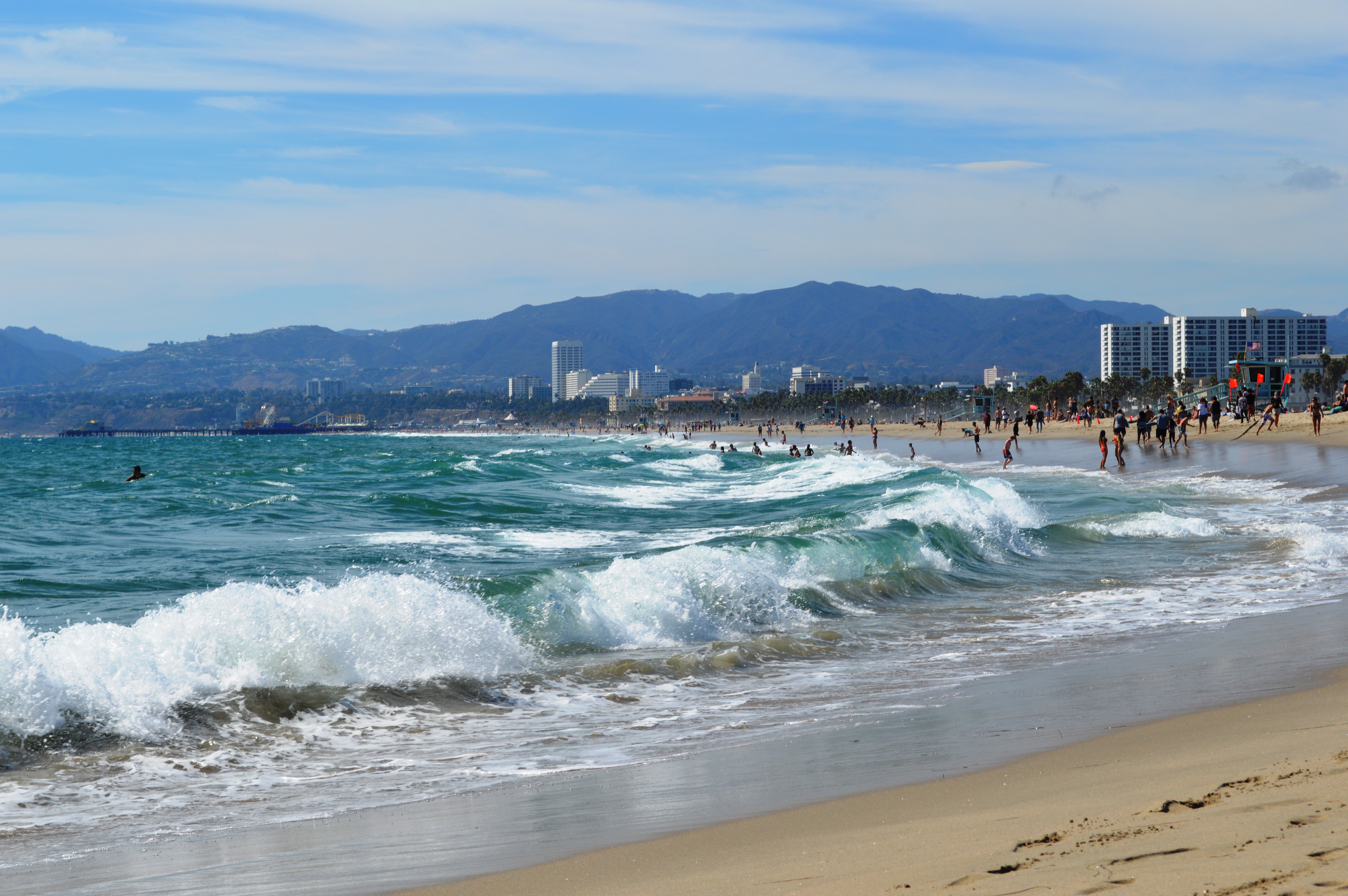
Due to the mountainous terrain of the surrounding region, the Los Angeles area contains a large number of distinct microclimates, causing extreme variations in temperature in close physical proximity to each other. For example, the average July maximum temperature at the Santa Monica Pier is 70 F whereas it is 95 F in Canoga Park, 15 mi away. The city, like much of the Southern Californian coast, is subject to a late spring/early summer weather phenomenon called "June Gloom". This involves overcast or foggy skies in the morning that yield to sun by early afternoon.
More recently, statewide droughts in California have further strained the city's water security. Downtown Los Angeles averages 14.67 in of precipitation annually, mainly occurring between November and March, generally in the form of moderate rain showers, but sometimes as heavy rainfall during winter storms. Rainfall is usually higher in the hills and coastal slopes of the mountains because of orographic uplift. Summer days are usually rainless. Rarely, an incursion of moist air from the south or east can bring brief thunderstorms in late summer, especially to the mountains. The coast gets slightly less rainfall, while the inland and mountain areas get considerably more. Years of average rainfall are rare. The usual pattern is a year-to-year variability, with a short string of dry years of 5 – rainfall, followed by one or two wet years with more than 20 in. Wet years are usually associated with warm water El Niño conditions in the Pacific, dry years with cooler water La Niña episodes. A series of rainy days can bring floods to the lowlands and mudslides to the hills, especially after wildfires have denuded the slopes.
Both freezing temperatures and snowfall are extremely rare in the city basin and along the coast, with the last occurrence of a 32 F reading at the downtown station being January 29, 1979; freezing temperatures occur nearly every year in valley locations, while the mountains within city limits typically receive snowfall every winter. The greatest snowfall recorded in downtown Los Angeles was 2.0 in on January 15, 1932. While the most recent snowfall occurred in February 2019, the first snowfall since 1962, with snow falling in areas adjacent to Los Angeles as recently as January 2021. Brief, localized instances of hail can occur on rare occasions, but are more common than snowfall. At the official downtown station, the highest recorded temperature is 113 F on September 27, 2010, while the lowest is 28 F, on January 4, 1949. Within the City of Los Angeles, the highest temperature ever officially recorded is 121 F, on September 6, 2020, at the weather station at Pierce College in the San Fernando Valley neighborhood of Woodland Hills. During autumn and winter, Santa Ana winds sometimes bring much warmer and drier conditions to Los Angeles, and raise wildfire risk.
Environmental issues
Owing to geography, heavy reliance on automobiles, and the Los Angeles/Long Beach port complex, Los Angeles suffers from air pollution in the form of smog. The Los Angeles Basin and the San Fernando Valley are susceptible to atmospheric inversion, which holds in the exhaust from road vehicles, airplanes, locomotives, shipping, manufacturing, and other sources.
.jpg)
The smog season lasts from approximately May to October. While other large cities rely on rain to clear smog, Los Angeles gets only 15 in of rain each year: pollution accumulates over many consecutive days. Issues of air quality in Los Angeles and other major cities led to the passage of early national environmental legislation, including the Clean Air Act. When the act was passed, California was unable to create a State Implementation Plan that would enable it to meet the new air quality standards, largely because of the level of pollution in Los Angeles generated by older vehicles. More recently, the state of California has led the nation in working to limit pollution by mandating low-emission vehicles. Smog is expected to continue to drop in the coming years because of aggressive steps to reduce it, which include electric and hybrid cars, improvements in mass transit, and other measures.
The number of Stage 1 smog alerts in Los Angeles has declined from over 100 per year in the 1970s to almost zero in the new millennium. Despite improvement, the 2006 and 2007 annual reports of the American Lung Association ranked the city as the most polluted in the country with short-term particle pollution and year-round particle pollution. In 2008, the city was ranked the second most polluted and again had the highest year-round particulate pollution. The city met its goal of providing 20 percent of the city's power from renewable sources in 2010. The American Lung Association's 2013 survey ranks the metro area as having the nation's worst smog, and fourth in both short-term and year-round pollution amounts.
Los Angeles is also home to the nation's largest urban oil field. There are more than 700 active oil wells within 1500 ft of homes, churches, schools, and hospitals in the city, a situation about which the EPA has voiced serious concerns.
Demographics
Main article: Demographics of Los Angeles
| align-fn = center 1850–1870 1880–1890 1900 1910 1920 1930 1940 1950 1960 1970 1980 1990 2000 2010
Total population, age, and sex
The 2020 U.S. census reported Los Angeles had a population of 3,898,747. The population density was 8,304.2 people per square mile (3,168 people per square kilometer). 5.2% of the total population is under 5 years old, 19.5% under 18 and 13.8% 65 years old and over. Females make up 50.2% of the total population.
Housing and families
Owner-occupied housing units make up 36.3% of the total Los Angeles housing units, and they cost $879,500 on average. (2019–2023) With a mortgage, the median selected monthly owner costs are $3,399, and without a mortgage $950. (2019–2023) Median gross rent is $1,879. (2019–2023) There are 1,419,663 households in Los Angeles, with an average of 2.64 people being part of them. (2019–2023).
Economy
Race and ethnicity

According to data in 2023 from the United States Census Bureau Los Angeles's population is 47.2% Hispanic or Latino, 28.3% non-Hispanic White, 8.5% Black, 12.0% Asian, 1.2% Native American and 0.1% Pacific Islander. Ethnic enclaves like Chinatown, Historic Filipinotown, Koreatown, Little Armenia, Little Ethiopia, Tehrangeles, Little Tokyo, Little Bangladesh, and Thai Town provide examples of the polyglot character of Los Angeles. Mexican ancestry makes up the largest origin among descendants of American countries other than the United States at 31.9% of the city's population, followed by those of Salvadoran (6.0%) and Guatemalan (3.6%) heritage. Descendants of Mexicans and Central Americans have long-established communities in Los Angeles and are spread throughout the entire city and its metropolitan area. It is most heavily concentrated in regions around Downtown, such as East Los Angeles, Northeast Los Angeles and Westlake.
The largest Asian ethnic groups are Filipinos (3.2%) and Koreans (2.9%), which have their own established ethnic enclaves—Koreatown in the Wilshire Center and Historic Filipinotown. Chinese people, which make up 1.8% of Los Angeles's population, reside mostly outside of Los Angeles city limits, in the San Gabriel Valley of eastern Los Angeles County, but make a sizable presence in the city, notably in Chinatown. Chinatown and Thaitown are also home to many Thais and Cambodians, which make up 0.3% and 0.1% of Los Angeles's population, respectively. The Japanese comprise 0.9% of the city's population and have an established Little Tokyo in the city's downtown, and another significant community of Japanese Americans is in the Sawtelle district of West Los Angeles. Indians make up 0.9% of the city's population. Vietnamese make up 0.5% of Los Angeles's population.
Los Angeles is also home to Caucasian and Middle Eastern communities, such as Armenians, Assyrians, and Iranians, many of whom live in enclaves like Little Armenia and Tehrangeles.
African Americans have been the predominant ethnic group in South Los Angeles, which has emerged as the largest African-American community in the western United States since the 1960s. The neighborhoods of South Los Angeles with highest concentration of African Americans include Crenshaw, Baldwin Hills, Leimert Park, Hyde Park, Gramercy Park, Manchester Square and Watts. Since the 1990s, the growing cost of living in the city has most impacted the African American population. African Americans are the fastest declining population in the city, and many of the formerly predominantly African American neighborhoods have become much more diverse. There is also a sizable Eritrean and Ethiopian community in the Fairfax region.
Los Angeles has the second-largest Mexican, Armenian, Salvadoran, Filipino, and Guatemalan populations by city in the world, the third-largest Canadian population in the world, and has the largest Japanese, Iranian/Persian, Cambodian, and Romani (Gypsy) populations in the country. The Italian community is concentrated in San Pedro.
Most of Los Angeles's foreign-born population were born in Mexico, El Salvador, Guatemala, the Philippines and South Korea.
Religion
According to a 2014 study by the Pew Research Center, Christianity is the most prevalently practiced religion in Los Angeles (65%). The Roman Catholic Archdiocese of Los Angeles is the largest archdiocese in the country. Cardinal Roger Mahony, as the archbishop, oversaw construction of the Cathedral of Our Lady of the Angels, which opened in September 2002 in downtown Los Angeles.
In 2011, the once common, but ultimately lapsed, custom of conducting a procession and Mass in honor of Nuestra Señora de los Ángeles, in commemoration of the founding of the City of Los Angeles in 1781, was revived by the Queen of Angels Foundation and its founder Mark Albert, with the support of the Archdiocese of Los Angeles as well as several civic leaders. The recently revived custom is a continuation of the original processions and Masses that commenced on the first anniversary of the founding of Los Angeles in 1782 and continued for nearly a century thereafter.
With 621,000 Jews in the metropolitan area, the region has the second-largest population of Jews in the United States, after New York City. Many of Los Angeles's Jews now live on the Westside and in the San Fernando Valley, though Boyle Heights once had a large Jewish population before World War II due to restrictive housing covenants. Major Orthodox Jewish neighborhoods include Hancock Park, Pico-Robertson, and Valley Village, while Jewish Israelis are well represented in the Encino and Tarzana neighborhoods, and Persian Jews in Beverly Hills. Many varieties of Judaism are represented in the greater Los Angeles area, including Reform, Conservative, Orthodox, and Reconstructionist. The Breed Street Shul in East Los Angeles, built in 1923, was the largest synagogue west of Chicago in its early decades; it is no longer in daily use as a synagogue and is being converted to a museum and community center. The Kabbalah Centre also has a presence in the city.
The International Church of the Foursquare Gospel was founded in Los Angeles by Aimee Semple McPherson in 1923 and remains headquartered there to this day. For many years, the church convened at Angelus Temple, which, at its construction, was one of the largest churches in the country.
Los Angeles has had a rich and influential Protestant tradition. The first Protestant service in Los Angeles was a Methodist meeting held in a private home in 1850, and the oldest Protestant church still operating, First Congregational Church, was founded in 1867. In the early 1900s the Bible Institute Of Los Angeles published the founding documents of the Christian Fundamentalist movement and the Azusa Street Revival launched Pentecostalism. The Metropolitan Community Church also had its origins in the Los Angeles area. Important churches in the city include First Presbyterian Church of Hollywood, Bel Air Presbyterian Church, First African Methodist Episcopal Church of Los Angeles, West Angeles Church of God in Christ, Second Baptist Church, Crenshaw Christian Center, McCarty Memorial Christian Church, and First Congregational Church.

The Hollywood region of Los Angeles also has several significant headquarters, churches, including the Celebrity Center of the Church of Scientology.
Because of Los Angeles's large multi-ethnic population, a wide variety of faiths are practiced, including Buddhism, Hinduism, Islam, Zoroastrianism, Sikhism, Baháʼí, various Eastern Orthodox Churches, Sufism, Shintoism, Taoism, Confucianism, Chinese folk religion and countless others. Immigrants from Asia, for example, have formed several significant Buddhist congregations, making the city home to the greatest variety of Buddhists in the world. The first Buddhist joss house was founded in the city in 1875. Atheism and other secular beliefs are also common, as the city is the largest in the Western U.S. Unchurched Belt.
Homelessness
Main article: Homelessness in Los Angeles
As of January 2024, there are 45,252 homeless people in the City of Los Angeles, comprising roughly 60% of the homeless population of LA County. This is a 2.2% decrease from the previous year (with a 0.3% decrease in the overall homeless population of LA County). The epicenter of homelessness in Los Angeles is the Skid Row neighborhood, which contains 8,000 homeless people, one of the largest stable populations of homeless people in the United States. The increased homeless population in Los Angeles has been attributed to lack of housing affordability and to substance abuse. Almost 60 percent of the 82,955 people who became newly homeless in 2019 said their homelessness was because of economic hardship. In Los Angeles, black people are roughly four times more likely to experience homelessness.
Economy
The economy of Los Angeles is driven by international trade, entertainment (television, motion pictures, video games, music recording, and production), aerospace, technology, petroleum, fashion, apparel, and tourism. Other significant industries include finance, telecommunications, law, healthcare, and transportation. In the 2017 Global Financial Centres Index, Los Angeles was ranked the 19th most competitive financial center in the world and sixth most competitive in the U.S. after New York City, San Francisco, Chicago, Boston, and Washington, D.C. Although many businesses have left downtown Los Angeles following the COVID-19 pandemic, efforts are underway to re-invent the neighborhood as a cultural center with a large architectural showcase in Bunker Hill designed by Frank Gehry.
Of the five major film studios, only Paramount Pictures is within Los Angeles's city limits; it is located in the so-called Thirty-Mile Zone of entertainment headquarters in Southern California. Their parent company Paramount Skydance Corporation has had its corporate headquarters in Los Angeles since 2025.
Los Angeles is still the largest manufacturing center in the United States by employment, but now second after the New York metropolitan area by dollar value of goods manufactured. Disadvantages of manufacturing production in Los Angeles are its relative geographical isolation from most major North American markets, lack of a reliable water supply, and lack of an adequate skilled labor force, in addition to a significantly complex regulatory environment. The contiguous ports of Los Angeles and Long Beach together comprise the busiest port in the United States by some measures and the fifth busiest port in the world, vital to trade within the Pacific Rim.
The Los Angeles metropolitan area has a gross metropolitan product of over $1.0 trillion (), making it the third-largest economic metropolitan area in the world, after New York and Tokyo.
, Los Angeles is home to three Fortune 500 companies: AECOM, CBRE Group, and Reliance Steel & Aluminum Co. Other companies headquartered in Los Angeles and the surrounding metropolitan area include The Aerospace Corporation, California Pizza Kitchen, Capital Group Companies, Deluxe Entertainment Services Group, Dine Brands Global, DreamWorks Animation, Dollar Shave Club, Fandango Media, Farmers Insurance Group, Forever 21, Hulu, Panda Express, SpaceX, Ubisoft Film & Television, The Walt Disney Company, Universal Pictures, Warner Bros., Warner Music Group, and Trader Joe's.
At the end of the second quarter of 2024, Los Angeles saw an office space vacancy rate of 31.5%, a 33.5% increase year-over-year Retail vacancy stood at 8.6%, a 15% increase year-over-year.
| Largest non-government employers in Los Angeles County, June 2023 | Rank | Employer | Employees |
|---|---|---|---|
| 1 | Kaiser Permanente | 44,769 | |
| 2 | University of Southern California | 23,227 | |
| 3 | Northrop Grumman Corp. | 18,000 | |
| 4 | Cedars-Sinai Medical Center | 16,730 | |
| 5 | Allied Universal | 15,326 | |
| 6 | Target Corp. | 15,000 | |
| 7 | Providence Health and Services Southern California | 14,395 | |
| 8 | Ralphs/Food 4 Less (Kroger Co. Division) | 14,000 | |
| 9 | Walt Disney Co. | 12,200 | |
| 10 | Boeing Co. | 12,005 |
Arts and culture
Main article: Culture of Los Angeles
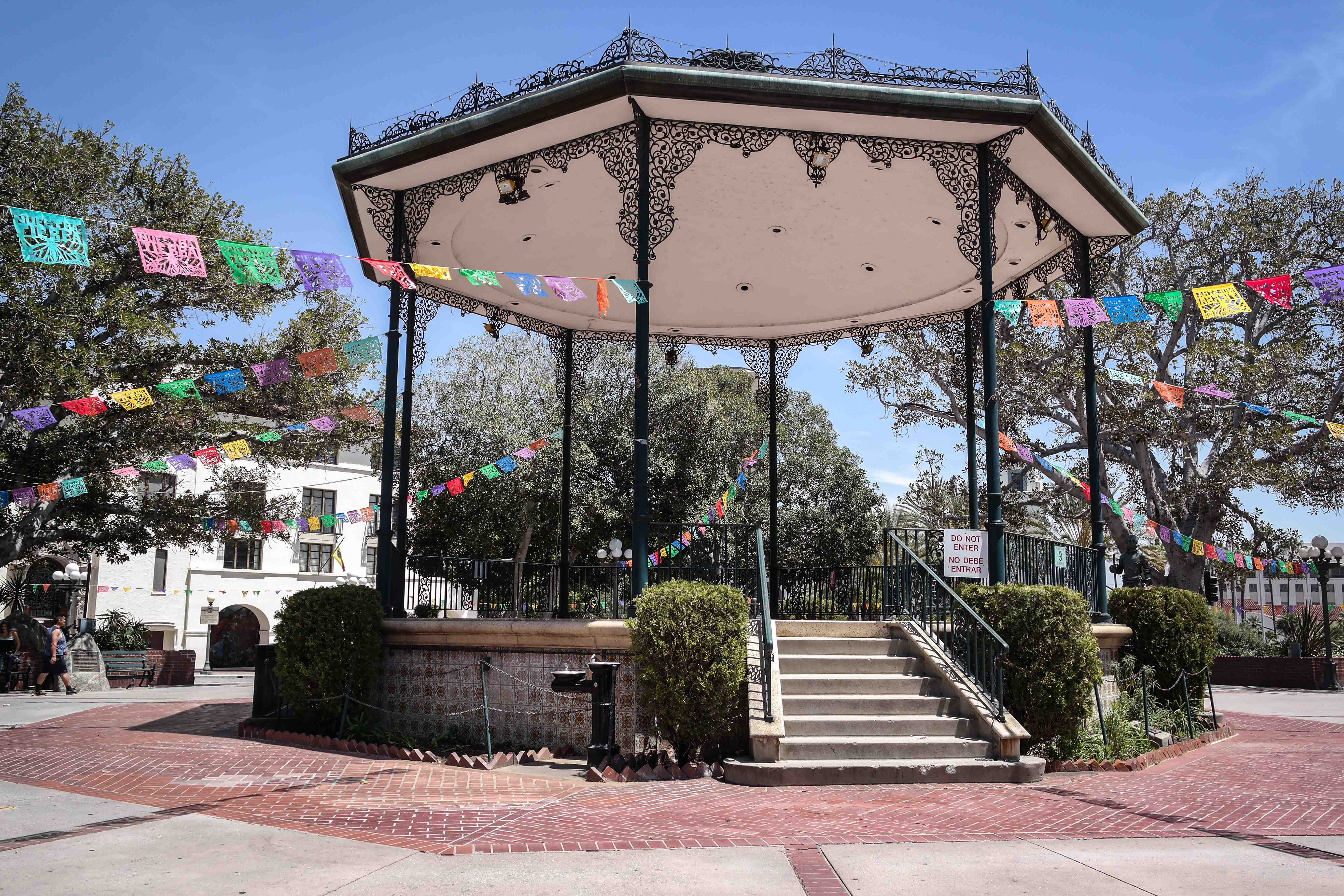
Los Angeles is often billed as the creative capital of the world because one in every six of its residents works in a creative industry and there are more artists, writers, filmmakers, actors, dancers and musicians living and working in Los Angeles than any other city at any other time in world history. Los Angeles is strongly influenced by Mexican American culture due to California formerly being part of Mexico and, previously, the Spanish Empire. The city is also known for its prolific murals.
Landmarks
The architecture of Los Angeles is influenced by its Spanish, Mexican, and American roots. Popular styles in the city include Spanish Colonial Revival style, Mission Revival style, California Churrigueresque style, Mediterranean Revival style, Art Deco style, and Mid-Century Modern style, among others.
Important landmarks in Los Angeles include the Hollywood Sign, Walt Disney Concert Hall, Capitol Records Building, the Cathedral of Our Lady of the Angels, Angels Flight, Grauman's Chinese Theatre, Dolby Theatre, Griffith Observatory, Getty Center, Getty Villa, Stahl House, the Los Angeles Memorial Coliseum, L.A. Live, the Los Angeles County Museum of Art, the Venice Canal Historic District and boardwalk, Theme Building, Bradbury Building, U.S. Bank Tower, Wilshire Grand Center, Hollywood Boulevard, Los Angeles City Hall, Hollywood Bowl, battleship , Watts Towers, Crypto.com Arena, Dodger Stadium, and Olvera Street.
Movies and the performing arts
The performing arts play a major role in Los Angeles's cultural identity. According to the USC Stevens Institute for Innovation, "there are more than 1,100 annual theatrical productions and 21 openings every week." The Los Angeles Music Center is "one of the three largest performing arts centers in the nation", with more than 1.3 million visitors per year. The Walt Disney Concert Hall, centerpiece of the Music Center, is home to the prestigious Los Angeles Philharmonic. Notable organizations such as Center Theatre Group, the Los Angeles Master Chorale, and the Los Angeles Opera are also resident companies of the Music Center. Talent is locally cultivated at premier institutions such as the Colburn School and the USC Thornton School of Music.
The city's Hollywood neighborhood has been recognized as the center of the motion picture industry, having held this distinction since the early 20th century, and the Los Angeles area is also associated with being the center of the television industry. The city is home to major film studios as well as major record labels. Los Angeles plays host to the annual Academy Awards, the Primetime Emmy Awards, the Grammy Awards, as well as many other entertainment industry awards shows. Los Angeles is the site of the USC School of Cinematic Arts which is the oldest film school in the United States.
Museums and galleries
There are 841 museums and art galleries in Los Angeles County, including many in the city of Los Angeles, more museums per capita than any other city in the U.S. Some of the notable museums are the Los Angeles County Museum of Art (the largest art museum in the Western United States), the Getty Center (part of the J. Paul Getty Trust, the world's wealthiest art institution), the Petersen Automotive Museum, the Huntington Library, the Natural History Museum, the Battleship Iowa, The Broad, which houses over 2,000 works of contemporary art and the Museum of Contemporary Art. A significant number of art galleries are on Gallery Row, and tens of thousands attend the monthly Downtown Art Walk there.
Libraries
The Los Angeles Public Library system operates 72 public libraries in the city. Enclaves of unincorporated areas are served by branches of the County of Los Angeles Public Library, many of which are within walking distance to residents.
Cuisine
Los Angeles's food culture is a fusion of global cuisine brought on by the city's rich immigrant history and population. As of 2025, the Michelin Guide recognized 20 starred restaurants including 2 restaurants Providence and Somni which earned 3 Michelin stars.
Latin American immigrants, particularly Mexican immigrants, brought tacos, burritos, quesadillas, tortas, tamales, and enchiladas served from food trucks and stands, taquerias, and cafés. Asian restaurants, many immigrant-owned, exist throughout the city with hotspots in Chinatown, Koreatown, and Little Tokyo. Los Angeles also carries an outsized offering of vegan, vegetarian, and plant-based options.
Sports
Main article: Sports in Los Angeles
.png)
Los Angeles and its metropolitan area are the home of eleven top-level professional sports teams, several of which play in neighboring communities but use Los Angeles in their name. These teams include the Los Angeles Dodgers and Los Angeles Angels of Major League Baseball (MLB), the Los Angeles Rams and Los Angeles Chargers of the National Football League (NFL), the Los Angeles Lakers and Los Angeles Clippers of the National Basketball Association (NBA), the Los Angeles Kings and Anaheim Ducks of the National Hockey League (NHL), the Los Angeles Galaxy and Los Angeles FC of Major League Soccer (MLS), the Los Angeles Sparks of the Women's National Basketball Association (WNBA), the SoCal Lashings of Minor League Cricket (MiLC) and the Los Angeles Knight Riders of Major League Cricket (MLC).
Other notable sports teams include the UCLA Bruins and the USC Trojans in the National Collegiate Athletic Association (NCAA), both of which are Division I teams in the Big Ten Conference.
Los Angeles is the second-largest city in the United States but hosted no NFL team between 1995 and 2015. At one time, the Los Angeles area hosted two NFL teams: the Rams and the Raiders. Both left the city in 1995, with the Rams moving to St. Louis, and the Raiders moving back to their original home of Oakland. After 21 seasons in St. Louis, on January 12, 2016, the NFL announced the Rams would be moving back to Los Angeles for the 2016 NFL season with its home games played at the Los Angeles Memorial Coliseum for four seasons. Before 1995, the Rams played their home games in the Coliseum from 1946 to 1979 which made them the first professional sports team to play in Los Angeles, and then moved to Anaheim Stadium from 1980 until 1994. The San Diego Chargers announced on January 12, 2017, that they would also relocate back to Los Angeles (the first since its inaugural season in 1960) and become the Los Angeles Chargers beginning in the 2017 NFL season and played at Dignity Health Sports Park in Carson, California, for three seasons. The Rams and the Chargers would soon move to the newly built SoFi Stadium, located in nearby Inglewood during the 2020 season.
Los Angeles boasts a number of sports venues, including Dodger Stadium, the Los Angeles Memorial Coliseum, BMO Stadium and Crypto.com Arena. The Kia Forum, SoFi Stadium, Dignity Health Sports Park, the Rose Bowl, Angel Stadium, Honda Center, and Intuit Dome are also in adjacent cities and cities in Los Angeles's metropolitan area.
Los Angeles has twice hosted the Summer Olympic Games: in 1932 and in 1984, and will host the games for a third time in 2028. Los Angeles will be the third city after London (1908, 1948 and 2012) and Paris (1900, 1924 and 2024) to host the Olympic Games three times. Los Angeles has submitted 10 bids to host Olympic events to the International Olympic Committee, more than any other city in the world. When the tenth Olympic Games were hosted in 1932, the former 10th Street was renamed Olympic Blvd. Los Angeles also hosted the Deaflympics in 1985 and Special Olympics World Summer Games in 2015.
Eight NFL Super Bowls have also been held in the city and its surrounding areas - two at the Memorial Coliseum (the first Super Bowl, I and VII), five at the Rose Bowl in suburban Pasadena (XI, XIV, XVII, XXI, and XXVII), and one at the suburban Inglewood (LVI). The Rose Bowl also hosts an annual and highly prestigious NCAA college football game called the Rose Bowl, which happens every New Year's Day.
Los Angeles also hosted eight FIFA World Cup soccer games at the Rose Bowl in 1994, including the final, where Brazil won. The Rose Bowl also hosted four matches in the 1999 FIFA Women's World Cup, including the final, where the United States won against China on penalty kicks. This was the game where Brandi Chastain took her shirt off after she scored the tournament-winning penalty kick, creating an iconic image. Los Angeles will be one of eleven U.S. host cities for the 2026 FIFA World Cup with matches set to be held at SoFi Stadium.
Los Angeles is one of six North American cities to have won championships in all five of its major leagues (MLB, NFL, NHL, NBA, and MLS), having completed the feat with the Kings' 2012 Stanley Cup title.
Government
Main article: Government of Los Angeles
Los Angeles is a charter city as opposed to a general law city. The current charter was adopted on June 8, 1999, and has been amended many times. The elected government consists of the Los Angeles City Council and the mayor of Los Angeles, which operate under a mayor–council government, as well as the city attorney (not to be confused with the district attorney, a county office) and controller. The mayor is Karen Bass. There are 15 city council districts.
The city has many departments and appointed officers, including the Los Angeles Police Department (LAPD), the Los Angeles Board of Police Commissioners, the Los Angeles Fire Department (LAFD), the Housing Authority of the City of Los Angeles (HACLA), the Los Angeles Department of Transportation (LADOT), and the Los Angeles Public Library (LAPL).
The charter of the City of Los Angeles, ratified by voters in 1999, created a system of advisory neighborhood councils that would represent the diversity of stakeholders, defined as those who live, work, or own property in the neighborhood. The neighborhood councils are relatively autonomous and spontaneous in that they identify their own boundaries, establish their own bylaws, and elect their own officers. There are about 90 neighborhood councils.
Residents of Los Angeles elect supervisors for the 1st, 2nd, 3rd, and 4th supervisorial districts.
Federal and state representation
In the California State Assembly, Los Angeles is split between fourteen districts. In the California State Senate, the city is split between eight districts. In the United States House of Representatives, it is split among nine congressional districts.
Politics
Los Angeles City Presidential Election Results
| Year | Democratic | Republican | Third Parties |
|---|---|---|---|
| [2024](2024-united-states-presidential-election-in-california) | **70.10%** *976,658* | 26.50% *369,586* | 3.40% *46,865* |
| [2020](2020-united-states-presidential-election-in-california) | **76.58%** *1,223,368* | 21.40% *341,804* | 2.02% *32,238* |
| [2016](2016-united-states-presidential-election-in-california) | **78.48%** *1,016,070* | 16.34% *211,561* | 5.18% *67,132* |
| [2012](2012-united-states-presidential-election-in-california) | **76.32%** *892,672* | 21.05% *246,202* | 2.63% *30,778* |
| [2008](2008-united-states-presidential-election-in-california) | **76.25%** *903,651* | 21.86% *259,031* | 1.89% *22,436* |
| [2004](2004-united-states-presidential-election-in-california) | **72.93%** *626,345* | 25.82% *221,797* | 1.25% *10,709* |
Crime
Main article: Crime in Los Angeles
In 1992, the city of Los Angeles recorded 1,092 murders. Los Angeles experienced a significant decline in crime in the 1990s and late 2000s and reached a 50-year low in 2009 with 314 homicides. This is a rate of 7.8 per 100,000—down from 1980, when it was 34.2. In 2021, murders rose to their highest rate (8.5) since 2008, although by 2024 (6.1), the spike had receded.
In 2015, it was revealed that the LAPD had been under-reporting a category of crime between 2005 and 2012, making the rate in the city appear lower than it was for that period.
The Dragna crime family and Mickey Cohen dominated organized crime in the city during the Prohibition era and reached its peak during the 1940s and 1950s with the "Battle of Sunset Strip" as part of the American Mafia, but has gradually declined since then with the rise of various black and Hispanic gangs in the late 1960s and early 1970s.
According to the Los Angeles Police Department, the city is home to 45,000 gang members, organized into 450 gangs. Among them are the Crips and Bloods, which are both African American street gangs that originated in the South Los Angeles region. Latino street gangs such as the Sureños, a Mexican American street gang, and Mara Salvatrucha, which has mainly members of Salvadoran descent, as well as other Central American descendants, all originated in Los Angeles. This has led to the city being referred to as the "Gang Capital of America".
Education
Colleges and universities
.JPG)
.jpg)
.jpg)
There are three public universities within the city limits: California State University, Los Angeles (CSULA), California State University, Northridge (CSUN) and University of California, Los Angeles (UCLA).
Private colleges in the city include:
- American Film Institute Conservatory
- Alliant International University
- American Academy of Dramatic Arts (Los Angeles Campus)
- American Jewish University
- Abraham Lincoln University
- The American Musical and Dramatic Academy – Los Angeles campus
- Antioch University's Los Angeles campus
- Charles R. Drew University of Medicine and Science
- Colburn School
- Columbia College Hollywood
- Emerson College (Los Angeles Campus)
- Emperor's College
- Fashion Institute of Design & Merchandising's Los Angeles campus (FIDM)
- Los Angeles Film School
- Loyola Marymount University (LMU is also the parent university of Loyola Law School in Los Angeles)
- Mount St. Mary's College
- National University of California
- Occidental College ("Oxy")
- Otis College of Art and Design (Otis)
- Southern California Institute of Architecture (SCI-Arc)
- Southwestern Law School
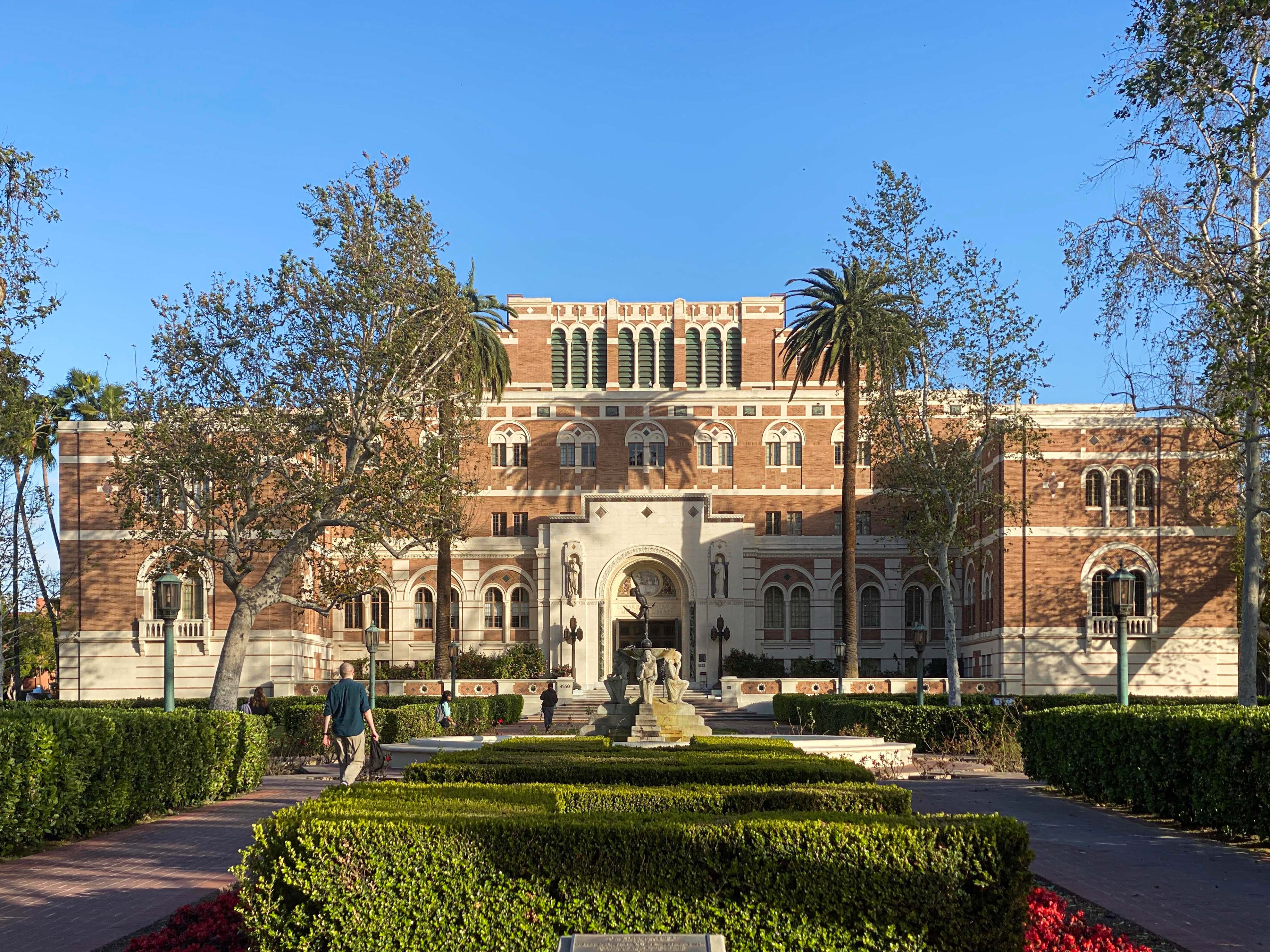
- University of Southern California (USC)
- Woodbury University The community college system consists of nine campuses governed by the trustees of the Los Angeles Community College District:
- East Los Angeles College (ELAC)
- Los Angeles City College (LACC)
- Los Angeles Harbor College
- Los Angeles Mission College
- Los Angeles Pierce College
- Los Angeles Valley College (LAVC)
- Los Angeles Southwest College
- Los Angeles Trade-Technical College
- West Los Angeles College
There are numerous additional colleges and universities outside the city limits in the Greater Los Angeles area, including the Claremont Colleges consortium, which includes the most selective liberal arts colleges in the U.S., and the California Institute of Technology (Caltech), one of the top STEM-focused research institutions in the world.
Schools
Los Angeles Unified School District serves almost all of the city of Los Angeles, as well as several surrounding communities, with a student population of around 800,000. After Proposition 13 was approved in 1978, urban school districts had considerable trouble with funding. LAUSD has become known for its underfunded, overcrowded, and poorly maintained campuses, although its 162 Magnet schools help compete with local private schools.
Several small sections of Los Angeles are in the Inglewood Unified School District, and the Las Virgenes Unified School District. The Los Angeles County Office of Education operates the Los Angeles County High School for the Arts.
Media
Main article: Media in Los Angeles
The Los Angeles metro area is the second-largest broadcast designated market area in the U.S. (after New York) with 5,431,140 homes (4.956% of the U.S.), which is served by a wide variety of local AM and FM radio and television stations. Los Angeles and New York City are the only two media markets to have seven VHF allocations assigned to them.
The major daily English-language newspaper in the area is the Los Angeles Times. La Opinión is the city's major daily Spanish-language paper. The Korea Times is the city's major daily Korean-language paper while The World Journal is the city and county's major Chinese newspaper. The Los Angeles Sentinel is the city's major African-American weekly paper, boasting the largest African-American readership in the Western United States. Investor's Business Daily is distributed from its LA corporate offices, which are headquartered in Playa del Rey.
As part of the region's aforementioned creative industry, the Big Five major broadcast television networks, ABC, CBS, FOX, NBC, and The CW, all have production facilities and offices throughout various areas of Los Angeles. All four major broadcast television networks, plus major Spanish-language networks Telemundo and Univision, also own and operate stations that both serve the Los Angeles market and serve as each network's West Coast flagship station: ABC's KABC-TV (Channel 7), CBS's KCBS-TV (Channel 2), Fox's KTTV-TV (Channel 11), NBC's KNBC-TV (Channel 4), The CW's KTLA-TV (Channel 5), MyNetworkTV's KCOP-TV (Channel 13), Telemundo's KVEA-TV (Channel 52), and Univision's KMEX-TV (Channel 34). The region also has four PBS member stations, with KCET re-joining the network as a secondary affiliate in August 2019, after spending the previous eight years as the nation's largest independent public television station. KTBN (Channel 40) is the flagship station of the religious Trinity Broadcasting Network, based out of Santa Ana. A variety of independent television stations, such as KCAL-TV (Channel 9), also operate in the area.
There are also a number of smaller regional newspapers, alternative weeklies and magazines, including the Los Angeles Register, Los Angeles Community News, (which focuses on coverage of the greater Los Angeles area), Los Angeles Daily News (which focuses coverage on the San Fernando Valley), LA Weekly, L.A. Record (which focuses coverage on the music scene in the Greater Los Angeles Area), Los Angeles Magazine, the Los Angeles Business Journal, the Los Angeles Daily Journal (legal industry paper), The Hollywood Reporter, Variety (both entertainment industry papers), and Los Angeles Downtown News. In addition to the major papers, numerous local periodicals serve immigrant communities in their native languages, including Armenian, English, Korean, Persian, Russian, Chinese, Japanese, Hebrew, and Arabic. Many cities adjacent to Los Angeles also have their own daily newspapers whose coverage and availability overlap with certain Los Angeles neighborhoods. Examples include The Daily Breeze (serving the South Bay), and The Long Beach Press-Telegram.
Los Angeles arts, culture and nightlife news is also covered by a number of local and national online guides, including Time Out Los Angeles, Thrillist, Kristin's List, DailyCandy, Diversity News Magazine, LAist, and Flavorpill.
Infrastructure
Transportation
Main article: Transportation in Los Angeles
Freeways
Main article: Southern California freeways
.JPG)
The city and the rest of the Los Angeles metropolitan area are served by an extensive network of freeways and highways. Texas Transportation Institute's annual Urban Mobility Report ranked Los Angeles area roads the most congested in the United States in 2019, as measured by annual delay per traveler, area residents experiencing a cumulative average of 119 hours waiting in traffic that year. Los Angeles was followed by San Francisco/Oakland, Washington, D.C., and Miami. Despite the congestion in the city, the mean daily travel time for commuters in Los Angeles is shorter than in other major cities, including New York City, Philadelphia, and Chicago. Los Angeles's mean travel time for work commutes in 2006 was 29.2 minutes, similar to those of San Francisco and Washington, D.C.
The major highways that connect LA to the rest of the nation include I-5, which runs south through San Diego to the Mexican border and north through Sacramento, Portland, and Seattle to the Canadian border; I-10, the southernmost east–west, coast-to-coast interstate highway in the United States, going to Jacksonville; and US 101, which heads to the California Central Coast, San Francisco, the Redwood Empire, and the Oregon and Washington coasts.
Buses
Main article: Los Angeles Metro
The Los Angeles Metro and other regional agencies provide a comprehensive bus system that covers Los Angeles County. While the Los Angeles Department of Transportation is responsible for contracting local and commuter bus services primarily within the city limits of Los Angeles and several immediate neighboring municipalities in southwest Los Angeles County, the largest bus system in the city is operated by Metro. Called Los Angeles Metro Bus, the system consists of 117 routes (excluding Metro Busway) throughout Los Angeles and neighboring cities primarily in southwestern Los Angeles County, with most routes following along a particular street in the city's street grid and run to or through downtown Los Angeles. As of the third quarter of 2023, the system had an average ridership of approximately 692,500 per weekday, with a total of 197,950,700 riders in 2022. Metro also runs two Metro Busway lines, the G and J lines, which are bus rapid transit lines with stops and frequencies similar to those of Los Angeles's light rail system.
There are also smaller regional public transit systems that mainly serve specific cities or regions in Los Angeles County. For example, the Big Blue Bus provides extensive bus service in Santa Monica and western Los Angeles County, while Foothill Transit focuses on routes in the San Gabriel Valley in southeast Los Angeles County, although it operates the Silver Streak bus rapid transit into downtown Los Angeles. Los Angeles World Airports also runs two frequent FlyAway express bus routes (via freeways) from Los Angeles Union Station and Van Nuys to Los Angeles International Airport.
While cash is accepted on all buses, the primary payment method for Los Angeles Metro Bus, Metro Busway, and 27 other regional bus agencies is a TAP card, a contactless stored-value card. According to the 2016 American Community Survey, 9.2% of working Los Angeles (city) residents made the journey to work via public transportation.
Rail
Main article: Los Angeles Metro Rail, Metrolink (California)

The Los Angeles County Metropolitan Transportation Authority also operates a subway and light rail system across Los Angeles and its county. The system is called Los Angeles Metro Rail and consists of the B and D subway lines, as well as the A, C, E, and K light rail lines. TAP cards are required for all Metro Rail trips. As of the third quarter of 2023, the city's subway system is the ninth busiest in the United States, and its light rail system is the country's second busiest. In 2022, the system had a ridership of 57,299,800, or about 189,200 per weekday, in the third quarter of 2023.
Since the opening of the first line, the A Line, in 1990, the system has been extended significantly, with more extensions currently in progress. Today, the system serves numerous areas across the county on 107.4 mi of rail, including Long Beach, Pasadena, Santa Monica, Norwalk, El Segundo, North Hollywood, Inglewood, and downtown Los Angeles. As of 2023, there are 101 stations in the Metro Rail system.
Los Angeles is also the center of its county's commuter rail system, Metrolink, which links Los Angeles to Ventura, Orange, Riverside, San Bernardino, and San Diego Counties. The system consists of eight lines and 69 stations operating on 545.6 mi of track. Metrolink averages 42,600 trips per weekday, the busiest line being the San Bernardino Line. Apart from Metrolink, Los Angeles is also connected to other cities by intercity passenger trains from Amtrak on five different lines. One of the lines is the Pacific Surfliner route which operates multiple daily round trips between San Diego and San Luis Obispo, California through Union Station. It is Amtrak's busiest line outside the Northeast Corridor.[[File:Los Angeles Union Station 22.jpg|thumb|right|[[Union Station (Los Angeles)|Union Station]] is served by [[Amtrak California]], [[Metrolink (California)|Metrolink]], and [[Los Angeles Metro Rail|Metro Rail]].]]The main rail station in the city is Union Station which opened in 1939, and it is the largest passenger rail terminal in the Western United States. The station is a major regional train station for Amtrak, Metrolink and Metro Rail. The station is Amtrak's fifth busiest station, having 1.4 million Amtrak boardings and de-boardings in 2019. Union Station also offers access to Metro Bus, Greyhound, LAX FlyAway, and other buses from different agencies.
Airports
Main article: List of airports in the Los Angeles area
The main international and domestic airport serving Los Angeles is Los Angeles International Airport, commonly referred to by its airport code, LAX. It is located on the Westside of Los Angeles near the Sofi Stadium in Inglewood.
Other major nearby commercial airports include:
- Ontario International Airport, owned by the city of Ontario, serves the Inland Empire.
- Hollywood Burbank Airport, jointly owned by the cities of Burbank, Glendale, and Pasadena. Formerly known as Bob Hope Airport and Burbank Airport, it is the closest airport to downtown Los Angeles and serves the San Fernando, San Gabriel, and Antelope Valleys.
- Long Beach Airport serves the Long Beach/Harbor area.
- John Wayne Airport of Orange County.
One of the world's busiest general-aviation airports is also in Los Angeles: Van Nuys Airport.
Seaports
The Port of Los Angeles is in San Pedro Bay in the San Pedro neighborhood, approximately 20 mi south of downtown. Also called Los Angeles Harbor and WORLDPORT LA, the port complex occupies 7500 acre of land and water along 43 mi of waterfront. It adjoins the separate Port of Long Beach.
The sea ports of the Port of Los Angeles and Port of Long Beach together make up the Los Angeles/Long Beach Harbor. Together, both ports are the fifth busiest container port in the world, with a trade volume of over 14.2 million TEU's in 2008. Singly, the Port of Los Angeles is the busiest container port in the United States and the largest cruise ship center on the West Coast of the United States – The Port of Los Angeles's World Cruise Center served about 590,000 passengers in 2014.
There are also smaller, non-industrial harbors along Los Angeles's coastline. The port includes four bridges: the Vincent Thomas Bridge, Henry Ford Bridge, Long Beach International Gateway Bridge, and Commodore Schuyler F. Heim Bridge. Passenger ferry service from San Pedro to the city of Avalon (and Two Harbors) on Santa Catalina Island is provided by Catalina Express.
Notable people
Main article: List of people from Los Angeles
Sister cities
- IMPORTANT***
- Please do not add or remove sister cities unless you provide a reliable *
- source. This list is verified by http://sistercities.lacity.org/, *
- which lists 25 sister cities. If you make changes to this list without *
- citing a source, your edits will be reverted. * --
Los Angeles has 25 sister cities, listed chronologically by year joined:
- ISR Eilat, Israel (1959)
- JPN Nagoya, Japan (1959)
- BRA Salvador, Brazil (1962)
- FRA Bordeaux, France (1964)
- DEU Berlin, Germany (1967)
- ZMB Lusaka, Zambia (1968)
- MEX Mexico City, Mexico (1969)
- NZL Auckland, New Zealand (1971)
- ROK Busan, South Korea (1971)
- IND Mumbai, India (1972)
- IRN Tehran, Iran (1972)
- ROC Taipei, Taiwan (1979)
- PRC Guangzhou, China (1981)
- GRC Athens, Greece (1984)
- RUS Saint Petersburg, Russia (1984)
- CAN Vancouver, Canada (1986)
- EGY Giza, Egypt (1989)
- IDN Jakarta, Indonesia (1990)
- LTU Kaunas, Lithuania (1991)
- PHL Makati, Philippines (1992)
- CRO Split, Croatia (1993)
- SLV San Salvador, El Salvador (2005)
- LBN Beirut, Lebanon (2006)
- ITA Ischia, Campania, Italy (2006)
- ARM Yerevan, Armenia (2007) In addition, Los Angeles has the following "friendship cities":
- POL Łódź, Poland
- AUS City of Melbourne, Australia
- UK Manchester, United Kingdom
- ISR Tel Aviv, Israel
Notes
References
References
- (April 18, 2013). "Nicknames for Los Angeles". [[Voice of America]].
- Barrows, H.D.. (1899). "Historical Society of Southern California Quarterly".
- (April 2016). "This 1835 Decree Made the Pueblo of Los Angeles a Ciudad – And California's Capital". [[KCET]].
- link. "California Cities by Incorporation Date". California Association of [[Local Agency Formation Commission]]s
- link. "About the City Government". City of Los Angeles
- "2021 U.S. Gazetteer Files". link. United States Census Bureau
- "US Census Bureau".
- "QuickFacts: Los Angeles city, California". link. U.S. Census Bureau
- link. "List of 2020 Census Urban Areas". United States Census Bureau
- (March 14, 2024). "Metropolitan and Micropolitan Statistical Areas Population Totals: 2020-2023". [[United States Census Bureau]], Population Division.
- link. "Angelino, Angeleno, and Angeleño". (January 10, 2011)
- link. "Definition of Angeleno". (May 16, 2023)
- "Total Gross Domestic Product for Los Angeles-Long Beach-Anaheim, CA (MSA)". link
- "Total Gross Domestic Product for Riverside-San Bernardino-Ontario, CA (MSA)". link
- "Total Gross Domestic Product for Oxnard-Thousand Oaks-Ventura, CA (MSA)".
- [https://media.metro.net/about_us/pla/images/lazipcodes.pdf Zip Codes Within the City of Los Angeles] {{Webarchive. link. (July 13, 2017 – LAHD)
- (May 2, 2022). "Slowing State Population Decline puts Latest Population at 39,185,000". State of California.
- [https://www.worldatlas.com/cities/america-s-10-most-visited-cities.html "America's 10 most visited cities"], World Atlas, September 23, 2021. {{Webarchive. link. (June 14, 2023 .)
- Estrada, William David. (2009). "The Los Angeles Plaza: Sacred and Contested Space". University of Texas Press.
- (July 16, 2013). "Subterranean L.A.: The Urban Oil Fields".
- "Los Angeles Remains Top Filming Site as Global Production Volume Shrinks". Variety.
- Josh Rottenberg. (June 24, 2024). "Hollywood's exodus: Why film and TV workers are leaving Los Angeles". Los Angeles Times.
- LaRocco, Lori Ann. (September 24, 2022). "New York is now the nation's busiest port in a historic tipping point for U.S.-bound trade".
- "Port of NYNJ Beats West Coast Rivals with Highest 2023 Volumes".
- (December 28, 2022). "Port of New York and New Jersey Remains US' Top Container Port".
- Roger Vincent. (April 12, 2024). "Downtown L.A. is hurting. Frank Gehry thinks arts can lead a revival". Los Angeles Times.
- "Gross Domestic Product by County and Metropolitan Area". Federal Reserve Bank of St Louis.
- "Settlement of Los Angeles".
- (December 12, 1991). "Ooh L.A. L.A.".
- Pool, Bob. (March 26, 2005). "City of Angels' First Name Still Bedevils Historians".
- Stein, David Allen. (1953). "Los Angeles: A Noble Fight Nobly Lost". [[Names (journal).
- Masters, Nathan. (February 24, 2011). "The Crusader in Corduroy, the Land of Soundest Philosophy, and the 'G' That Shall Not Be Jellified". Public Media Group of Southern California.
- Masters, Nathan. (May 6, 2016). "How to Pronounce "Los Angeles," According to Charles Lummis". Public Media Group of Southern California.
- Lummis, Charles Fletcher. (June 29, 1908). "This Is the Way to Pronounce Los Angeles". Nebraska State Journal.
- Harvey, Steve. (June 26, 2011). "Devil of a time with City of Angels' name". [[Los Angeles Times]].
- (1944). "A Pronouncing Dictionary of American English". G. & C. Merriam.
- Buntin, John. (2009). "L.A. Noir: The Struggle for the Soul of America's Most Seductive City". Harmony Books.
- {{Cite EPD. 18
- Windsor Lewis, Jack. (1990). "Studies in the Pronunciation of English: A Commemorative Volume in Honour of A.C. Gimson". Routledge.
- Bowman, Chris. (July 8, 2008). "Smoke is Normal – for 1800". [[The Sacramento Bee]].
- Gordon J. MacDonald. "Environment: Evolution of a Concept".
- Bright, William. (1998). "Fifteen Hundred California Place Names". University of California Press.
- Sullivan, Ron. (December 7, 2002). "Roots of native names". [[San Francisco Chronicle]].
- Willard, Charles Dwight. (1901). "The Herald's History of Los Angeles". Kingsley-Barnes & Neuner.
- "Portola Expedition 1769 Diaries". Pacifica Historical Society.
- (November 4, 2005). "California missions and presidios". Voyageur Press.
- (March 2001). "Seeking El Dorado: African Americans in California". University of Washington Press.
- Guinn, James Miller. (1902). "Historical and biographical record of southern California: containing a history of southern California from its earliest settlement to the opening year of the twentieth century". Chapman pub. co..
- Estrada, William D.. (2006). "Los Angeles's Olvera Street". Arcadia Publishing.
- "Pio Pico, Afro Mexican Governor of Mexican California".
- "Monterey County Historical Society, Local History Pages--Secularization and the Ranchos, 1826-1846".
- Bauer, K. Jack. (1993). "The Mexican War, 1846-1848". University of Nebraska Press.
- Guinn, James Miller. (1902). "Historical and biographical record of southern California: containing a history of southern California from its earliest settlement to the opening year of the twentieth century". Chapman pub. co..
- Mulholland, Catherine. (2002). "William Mulholland and the Rise of Los Angeles". University of California Press.
- Kipen, David. (2011). "Los Angeles in the 1930s: The WPA Guide to the City of Angels". University of California Press.
- (June 15, 1998). "Population of the 100 Largest Urban Places: 1900". [[United States Census Bureau]].
- "The Los Angeles Aqueduct and the Owens and Mono Lakes (MONO Case)". [[American University]].
- Reisner, Marc. (1993). "Cadillac desert: the American West and its disappearing water". Penguin.
- Basiago, Andrew D.. (February 7, 1988). "Water For Los Angeles – Sam Nelson Interview". The Regents of the University of California.
- "Annexation and Detachment Map". City of Los Angeles Bureau of Engineering.
- Creason, Glen. (September 26, 2013). "CityDig: L.A.'s 20th Century Land Grab". Los Angeles Magazine.
- Weiss, Marc A. (1987). "The Rise of the Community Builders: The American Real Estate Industry and Urban Land Planning". Columbia University Press.
- Buntin, John. (April 6, 2010). "L.A. Noir: The Struggle for the Soul of America's Most Seductive City". Random House Digital, Inc..
- (March 2007). "The Great Depression in America: a cultural encyclopedia". Greenwood Publishing Group.
- (June 15, 1998). "Population of the 100 Largest Urban Places: 1930". [[United States Census Bureau]].
- Parker, Dana T. ''Building Victory: Aircraft Manufacturing in the Los Angeles Area in World War II'', pp.5–8, 14, 26, 36, 50, 60, 78, 94, 108, 122, Cypress, CA, 2013. {{ISBN. 978-0-9897906-0-4.
- Bruegmann, Robert. (November 1, 2006). "Sprawl: A Compact History". University of Chicago Press.
- "The economic impact of theme parks on regions".
- (February 26, 2021). "Beverly Park: L.A.'s Kiddieland, 1943–74". Independently published.
- (2024). "Built out cities? A new approach to measuring land use regulation". Journal of Housing Economics.
- (2016). "From the War on Poverty to the War on Crime: The Making of Mass Incarceration in America". Harvard University Press.
- (August 1, 1999). "Where Wizards Stay Up Late: The Origins Of The Internet". Simon and Schuster.
- Vronsky, Peter. (2004). "Serial Killers: The Method and Madness of Monsters". Penguin.
- Ap. (1984-04-08). "LOS ANGELES REPLACES CHICAGO AS SECOND CITY". The New York Times.
- Woo, Elaine. (June 30, 2004). "Rodney W. Rood, 88; Played Key Role in 1984 Olympics, Built Support for Metro Rail". [[Los Angeles Times]].
- Zarnowski, C. Frank. (Summer 1992). "A Look at Olympic Costs". Citius, Altius, Fortius.
- (2007). "Encyclopedia of American race riots". Greenwood Publishing Group.
- Wilson, Stan. (April 25, 2012). "Riot anniversary tour surveys progress and economic challenges in Los Angeles". [[CNN]].
- Reich, Kenneth. (December 20, 1995). "Study Raises Northridge Quake Death Toll to 72". [[Los Angeles Times]].
- "Rampart Scandal Timeline". [[Frontline (U.S. TV series).
- Orlov, Rick. (November 3, 2012). "Secession drive changed San Fernando Valley, Los Angeles". [[Los Angeles Daily News]].
- (November 16, 2022). "Karen Bass elected mayor, becoming first woman to lead L.A.".
- (2025-01-09). "Worst fire in LA's history leaves entire neighbourhoods in ruins". The Telegraph.
- (2025-06-09). "Everything we know about the LA protests".
- (June 21, 2025). "Trump Got the Fight He Wanted. Did It Turn Out the Way He Expected?". The New York Times.
- (June 7, 2025). "Los Angeles Democrats clash with Trump administration amid ICE crackdown".
- Horowitz, Julia. (August 1, 2017). "Los Angeles will host 2028 Olympics".
- "Cities Which Have Hosted Multiple Summer Olympic Games".
- {{Cite US Gazetteer. 2010. places. CA
- "Elevations of the 50 Largest Cities (by population, 1980 Census)". [[United States Geological Survey]].
- "Mount Lukens Guide". [[Sierra Club]] Angeles Chapter.
- "Google Maps".
- Gumprecht, Blake. (March 2001). "The Los Angeles River: Its Life, Death, and Possible Rebirth". JHU Press.
- Miller, George Oxford. (January 15, 2008). "Landscaping with Native Plants of Southern California". Voyageur Press.
- National Research Council (U.S.). Advisory Committee on Technology Innovation. (1979). "Tropical legumes: resources for the future: report of an ad hoc panel of the Advisory Committee on Technology Innovation, Board on Science and Technology for International Development, Commission on International Relations, National Research Council". National Academies.
- (April 2003). "Los Angeles Magazine". Emmis Communications.
- Schreiner, Casey. (December 29, 2022). "In 2023, let's add toyon to our native plant gardens and put an urban legend to rest".
- (December 2, 2014). "Adaptive Evolution in Cities: Progress and Misconceptions". [[Cell Press]].
- admin. (2021-12-01). "Common Wild Animals Found in Los Angeles".
- Fonseca, Ryan. (2019-07-22). "A field guide to SoCal's iconic wildlife (and where to find them)".
- admin. (2022-10-24). "Learn about the incredible wildlife of Southern California".
- "Earthquake Facts". [[United States Geological Survey]].
- (May 28, 2015). "What Will Really Happen When San Andreas Unleashes the Big One?".
- (March 5, 1999). "An Elusive Blind-Thrust Fault Beneath Metropolitan Los Angeles". Science.
- "World's Largest Recorded Earthquake". Geology.com.
- "Mapping L.A. Neighborhoods".
- "Los Angeles CA Zip Code Map".
- Abu-Lughod, Janet L.. (1999). "New York, Chicago, Los Angeles: America's global cities". U of Minnesota Press.
- "Neighborhood signs".
- (April 1, 2015). "Los Angeles tops worst cities for traffic in USA".
- (2007). "Updated world map of the Köppen−Geiger climate classification". Hydrol. Earth Syst. Sci..
- (May 22, 2017). "The Myth of a Desert Metropolis: Los Angeles was not built in a desert, but are we making it one?".
- "Historical Weather for Los Angeles, California, United States of America". Weatherbase.
- (2004). "Climatography of the United States No. 20 (1971–2000)". [[National Oceanic and Atmospheric Administration]].
- "Pacific Ocean Temperatures on California Coast". beachcalifornia.com.
- "Los Angeles Climate Guide". weather2travel.com.
- "Climate of California". Western Regional Climate Center.
- Poole, Matthew R.. (September 22, 2010). "Frommer's Los Angeles 2011". John Wiley & Sons.
- Smith, Hayley. (March 1, 2022). "California drought continues after state has its driest January and February on record".
- "Los Angeles Almanac – seasonal average rainfall".
- (June 26, 2007). "Extreme weather: a guide & record book". W. W. Norton & Company.
- Frazin, Rachel. (February 21, 2019). "Los Angeles sees first snow in years". Capitol Hill Publishing Corp..
- (February 22, 2019). "Snow falling in Los Angeles, Pasadena and California's coastal cities". NBC Universal.
- (January 25, 2021). "Snow in Malibu? Weather provides surprise in Southern California".
- (September 27, 2010). "L.A.'s hottest day ever". [[Los Angeles Times]].
- "Los Angeles/Oxnard".
- Stimson, Thomas E.. (July 1955). "What can we do about smog?". [[Popular Mechanics]].
- (August 11, 1983). "Smog Hangs Over Olympic Athletes". New Scientist.
- link. (April 12, 2019 (see p7,10). July 12, 2016.)
- (March 4, 2015). "L.A.'s Environmental Success Story: Cleaner Air, Healthier Kids".
- "Most Polluted Cities". [[American Lung Association]].
- (May 4, 2008). "Pittsburgh and Los Angeles the most polluted US cities". citymayors.com.
- (January 14, 2011). "Los Angeles meets 20 percent renewable energy goal". [[Bloomberg News]].
- "American Lung Association State of the Air 2013 – Los Angeles-Long Beach-Riverside, CA". American Lung Association State of the Air 2013.
- (November 9, 2013). "EPA officers sickened by fumes at South L.A. oil field".
- (2024-07-01). "U.S. Census Bureau QuickFacts: Los Angeles city, California".
- "Decennial Census by Decade".
- "1870 Census of Population - Population of Civil Divisions less than Counties - California - Almeda County to Sutter County".
- "1870 Census of Population - Population of Civil Divisions less than Counties - California - Tehama County to Yuba County".
- "1890 Census of Population - Population of California by Minor Civil Divisions".
- "1900 Census of Population - Population of California by Counties and Minor Civil Divisions".
- "1910 Census of Population - Supplement for California".
- "1920 Census of Population - Number of Inhabitants - California".
- "1930 Census of Population - Number and Distribution of Inhabitants - California".
- "1940 Census of Population - Number of Inhabitants - California".
- "1950 Census of Population - Number of Inhabitants - California".
- "1960 Census of Population - General population Characteristics - California".
- "1970 Census of Population - Number of Inhabitants - California".
- "1980 Census of Population - Number of Inhabitants - California".
- "1990 Census of Population - Population and Housing Unit Counts - California".
- "2000 Census of Population - Population and Housing Unit Counts - California".
- "2010 Census of Population - Population and Housing Unit Counts - California".
- (February 11, 2025). "U.S. Census Bureau QuickFacts: Los Angeles city, California".
- "QuickFacts Los Angeles city, California". [[United States Census Bureau]].
- "Neighborhood Wellbeing and Environmental Quality for Latino/a Communities in Southeast Los Angeles – Neighborhood Data for Social Change".
- Shyong, Frank. (January 6, 2020). "Here's how HIFI, or Historic Filipinotown got its name".
- "Welcome to Los Angeles Chinatown".
- Najafi, Leila. (2021-10-23). "A Guide to Tehrangeles, Los Angeles's Pocket of Iranian Culture".
- Eater Staff. (2016-08-17). "Where to Eat Armenian Food in L.A. {{!}} MOFAD City".
- Ray, MaryEllen Bell. (1985). "The City of Watts, California: 1907 to 1926". Rising Pub..
- (January 30, 2024). "Do you want to sell your house? In historically Black Leimert Park, the question triggers fear and anger".
- "This Is a Black Neighborhood. You Aren't Black. | There Goes the Neighborhood".
- (January 17, 2013). "Immigrants in American History: Arrival, Adaptation, and Integration". Abc-Clio.
- (February 24, 1997). "The Power of Place: Urban Landscapes as Public History". MIT Press.
- (2007). "Italians in Los Angeles". Arcadia.
- "Los Angeles".
- (2014). "Religious Landscape Study: Adults in the Los Angeles Metro Area". [[Pew Research Center]].
- (May 12, 2015). "America's Changing Religious Landscape". [[Pew Research Center]]: Religion & Public Life.
- Pomfret, John. (April 2, 2006). "Cardinal Puts Church in Fight for Immigration Rights". [[Washington Post]].
- (September 4, 2002). "Pomp Past, Masses Flock to Cathedral". [[Los Angeles Times]].
- Dellinger, Robert. (September 6, 2011). "2011 'Grand Procession' revives founding of L.A. Marian devotion". The Tidings Online.
- "World Jewish Population". SimpleToRemember.com.
- (March 1997). "Washington Symposium and Exhibition Highlight Restoration and Adaptive Reuse of American Synagogues". Jewish Heritage Report.
- (Spring–Summer 1998). "Los Angeles's Breed Street Shul Saved by Politicians". Jewish Heritage Report.
- Luscombe, Belinda. (August 6, 2006). "Madonna Finds A Cause". [[Time Magazine]].
- Edith Waldvogel Blumhofer, ''Aimee Semple McPherson: everybody's sister'', Wm. B. Eerdmans Publishing, USA, 1993, page 246–247
- Clifton L. Holland. "n Overview of Religion in Los Angeles from 1850 to 1930".
- "History of MCC – Metropolitan Community Churches".
- Miller, Daniel. (July 21, 2011). "Scientology's Hollywood Real Estate Empire". [[The Hollywood Reporter]].
- "2024 Greater Los Angeles Homeless Count Results (Long Version)".
- Cowan, Jill. (June 12, 2020). "What Los Angeles's Homeless Count Results Tell Us". [[The New York Times]].
- Cowan, Jill. (June 5, 2019). "Homeless Populations Are Surging in Los Angeles. Here's Why.". [[The New York Times]].
- (May 29, 2019). "L.A. agrees to let homeless people keep skid row property — and some in downtown aren't happy". [[Los Angeles Times]].
- Cristi, Chris. (June 13, 2019). "LA's homeless: Aerial view tour of Skid Row, epicenter of crisis". ABC7.
- (October 7, 2019). "Are many homeless people in L.A. mentally ill? New findings back the public's perception". [[Los Angeles Times]].
- "2823 – Report And Recommendations Of The Ad Hoc Committee On Black People Experiencing Homelessness".
- (2018). "Does Employee Stock Ownership Work? Evidence from Publicly-Traded Firms in Japan". SSRN Electronic Journal.
- (March 2017). "The Global Financial Centres Index 21". Long Finance.
- Slide, Anthony. (February 25, 2014). "The New Historical Dictionary of the American Film Industry". Routledge.
- (August 8, 2025). "Paramount Shifting Its Corporate Headquarters To L.A., Keeping Skydance Base In Santa Monica".
- (2016-10-28). "Los Angeles is still the largest manufacturing hub in the country, but it lacks a skilled labor force".
- Magli, Dom. (2024-01-17). "Port of Los Angeles ends 2023 as nation's busiest port".
- (2018). "Table 3.1. GDP & Personal Income". U.S. Bureau of Economic Analysis.
- "The World According to GaWC 2012". [[Loughborough University]].
- "Fortune 500 Companies 2018: Who Made The List". [[Meredith Corporation]].
- "Our Company: From a legendary pizza to a global brand".
- Zak, Kennedy. (2024-09-30). "Wedbush Moves Its HQ".
- Isabel, Sammi. (2024-08-14). "Vacancy rises in Downtown L.A. retail market despite slate of openings".
- (June 30, 2023). "City of Los Angeles' Annual Comprehensive Financial Report".
- (November 19, 2009). "Is Los Angeles really the creative capital of the world? Report says yes". SmartPlanet.
- "Only In LA: Tapping L.A. Innovation". [[University of Southern California]].
- Hayoun, Massoud. "Mexican LA: History, culture and resistance".
- Shatkin, Elina. (August 28, 2013). "Let the Renaissance Begin: L.A. Votes to Lift Mural Ban". Los Angeles Magazine.
- "The Hollywood Sign, Official website for one of the most iconic landmarks in the world".
- "The Capitol Records Building: The Story of an L.A. Icon – Discover Los Angeles".
- "Cathedral of our lady of the angels – Los Angeles, CA".
- "Angels Flight Railway: Los Angeles Landmark since 1901".
- Gilchrist, Todd. (May 18, 2022). "Hollywood's iconic TCL Chinese Theatre Celebrates 95 Years of Premieres and Stars".
- "The Dolby Theatre".
- "Griffith Observatory: A Symbol of Los Angeles, A Leader in Public Observing".
- "Getty Center homepage".
- "Visit the Getty Villa Museum".
- "The Stahl House – About us".
- "About L.A. Live".
- "The Hollywood Bowl – Discover Los Angeles".
- Reynolds, Christopher. (December 24, 2021). "Watts Towers at 100: Junk turned into art still casts a spell".
- "Discover Olvera Street And Historic El Pueblo De Los Angeles".
- "Explore the Center". Music Center of Los Angeles County.
- "About Walt Disney Concert Hall".
- "LA Opera – Los Angeles".
- "Our History – Center Theatre Group".
- "Los Angeles Chorale Official Homepage".
- Morrison, Pat. (March 9, 2021). "What city do you live in? Don't say Hollywood".
- Waxman, Sharon. (January 31, 2006). "At U.S.C., a Practical Emphasis in Film". [[The New York Times]].
- (May 5, 2008). "The Los Angeles Region". [[Loyola Marymount University]].
- "Overview". [[Los Angeles County Museum of Art]].
- Boehm, Mike. (March 16, 2009). "Getty slashes operating budget after severe investment losses". [[Los Angeles Times]].
- "Welcome to the Petersen Automotive Museum".
- "About the Huntington".
- "Natural History Museum of Los Angeles".
- "Battleship USS Iowa Official website".
- (November 8, 2022). "Modern Architecture in Los Angeles".
- "Welcome to the Museum of Contemporary Art".
- Mather, Kate. (August 5, 2011). "Downtown L.A. Art Walk safety changes planned". [[Los Angeles Times]].
- "Los Angeles Public Library Branches". [[Los Angeles Public Library]].
- "LA County Library".
- "Los Angeles Michelin Restaurants".
- "The Guide to Chinatown in Los Angeles". Discover Los Angeles.
- "The Guide to Koreantown in Los Angeles".
- "A Walking Tour of Little Tokyo".
- "Dodgers Franchise Timeline".
- "Angels History".
- "Los Angeles Rams website".
- "History of the Lakers".
- Treat, Jeremy. (April 15, 2016). "A Mini History of the L.A. Clippers". Lamag - Culture, Food, Fashion, News & Los Angeles.
- "Official Los Angeles Kings Website".
- "Official Anaheim Ducks Website".
- "LA Galaxy Homepage".
- "Los Angeles Football Club Homepage".
- "The Official website of the Los Angeles Sparks". WNBA Media Ventures LLC.
- "Los Angeles Knight Riders – Official Website".
- Thamel, Pete. (June 30, 2022). "USC, UCLA moving from Pac-12 to Big Ten in 2024".
- Hanzus, Dan. (January 12, 2016). "Rams to relocate to L.A.; Chargers first option to join". National Football League.
- (January 12, 2016). "Rams to Return to Los Angeles". St. Louis Rams.
- Maske, Mark. (January 12, 2016). "NFL returns to Los Angeles: Owners approve move by Rams; Chargers with option to join". [[The Washington Post]].
- Belson, Ken. (January 11, 2017). "Chargers are said to be moving to Los Angeles for next season".
- Barrabi, Thomas. (September 8, 2020). "Rams, Chargers unveil $5 billion SoFi Stadium at virtual ceremony ahead of NFL kickoff".
- "Dodger Stadium".
- "Los Angeles Coliseum: Coliseum History".
- "Banc of California Stadium: Stadium Info".
- "Crypto.com Arena: About Us".
- "XFL.com – Official home of the XFL".
- (July 31, 2017). "Los Angeles Makes Deal to Host the 2028 Summer Olympics". [[The New York Times]].
- [https://olympstats.com/2014/12/15/us-cities-bidding-for-the-olympics/ "US Cities Bidding for the Olympics"], OlympStats, December 15, 2014. Retrieved October 26, 2025.
- "Games – Deaflympics". deaflympics.com.
- (September 14, 2011). "Los Angeles To Host 2015 Special Olympics World Summer Games". [[Special Olympics]].
- (February 9, 2021). "Los Angeles to host Super Bowl LVI in Feb. 2022 at SoFi Stadium". [[National Football League]].
- (June 16, 2022). "World Cup 2026 host cities include Los Angeles, Miami, New York, Toronto, and Dallas".
- Mukherjee, Rahul. (October 27, 2020). "Only 10 cities have won multiple titles in a year, Los Angeles now tied for the most".
- "Los Angeles, California Code Resources". American Legal Publishing.
- "About Mayor Karen Bass".
- "Los Angeles Police Department".
- "Police Commission – LAPD Online".
- "Los Angeles Fire Department".
- "Housing Authority of the City of Los Angeles – Services Locator lacounty.gov".
- "LADOT: Welcome – Los Angeles".
- "Los Angeles Public Library Website".
- "Communities of Interest — City". California Citizens Redistricting Commission.
- "Communities of Interest — City". California Citizens Redistricting Commission.
- "City of Los Angeles Hub".
- "DRA 2020".
- Miller, Colin. "Sign In {{!}} Redistricter".
- (April 26, 2012). "LA riots: 20 years later, a facelift for the police but scars for South Central". The Guardian.
- Powell, Amy. (January 6, 2010). "Los Angeles crime rates hit 50-year lows". [[KABC-TV]].
- "LAPD year-end crime statistics". [[Los Angeles Police Department]].
- "Uniform Crime Reports of Los Angelesand Index from 1985 to 2005".
- "LAPD Online Crime Rates". [[Los Angeles Police Department]].
- Bonta, Rob. "Homicide in California, 2024". California Department of Justice.
- (October 15, 2015). "Los Angeles Police Underreported Crime Stats for 8 Years".
- (November 6, 2017). "LAPD captain accuses department of twisting crime statistics to make city seem safer". Los Angeles Times.
- DeVico, Peter. (2007). "The Mafia Made Easy: The Anatomy and Culture of La Cosa Nostra". Tate Publishing.
- "Gangs". [[Los Angeles Police Department]].
- Serjeant, Jill. (February 8, 2007). "Police target 11 worst Los Angeles street gangs". [[Reuters]].
- "UCLA's Story". [[University of California Los Angeles]].
- "Official website of American Film Institute".
- "Alliant International University – Los Angeles Campus".
- "American Academy of Dramatic Arts – Los Angeles Campus Overview".
- "American Jewish University – About AJU".
- "History of ALU".
- (October 18, 2016). "Antioch University Los Angeles".
- "Charles R. Drew University: homepage".
- "Colburn".
- "Columbia College Hollywood – Explore your dreams".
- "Emerson Los Angeles".
- (April 9, 2010). "Discover Emporor's".
- "The Los Angeles Film School".
- "Loyola Marymount: Our History".
- "Mount St. Mary's: Fast Facts".
- "National University – Los Angeles, California".
- "About Oxy – Occidental College".
- "Otis College of Art & Design website".
- "Southern California Institute of Architecture: A School of Architectural Thinking".
- "Southwestern Law school – Los Angeles".
- "About USC". [[University of Southern California]].
- (October 14, 2016). "Los Angeles – Woodbury University".
- "East Los Angeles College".
- "Los Angeles City College".
- "Los Angeles Harbor College".
- "Los Angeles Mission College".
- "Los Angeles Pierce College".
- "Los Angeles Valley College".
- "L.A. Southwest College".
- "Los Angeles Trade-Technical College".
- "West Los Angeles College homepage".
- "US Census, District information". [[United States Census Bureau]].
- (May 9, 2022 }}, [https://planning.lacity.org/odocument/0541e9db-ddb3-4279-a1d8-a271048fcc9d See map of Los Angeles city boundary] {{Webarchive). "2020 census – school district reference map: Los Angeles County, CA". [[U.S. Census Bureau]].
- (May 9, 2022 }}, [https://planning.lacity.org/odocument/0541e9db-ddb3-4279-a1d8-a271048fcc9d See map of Los Angeles city boundary] {{Webarchive). "2020 census – school district reference map: Los Angeles County, CA". [[U.S. Census Bureau]].
- "Allocation". [[Museum of Broadcast Communications]].
- "About the Los Angeles Times".
- "LA Opinión website".
- "About Us: Los Angeles Sentinel".
- "Investors Business Daily: Stock News and Stock Market Analysis".
- "Los Angeles and Southern California News, Weather, Sports".
- "FOX 11 Los Angeles".
- "NBC Los Angeles".
- "Los Angeles Downtown News – History".
- "Flavorpill".
- "Welcome to LAist: About Us".
- "Time Out Los Angeles: The L.A. guide for things to do, restaurants, bars, movies, shopping, events and more".
- "Thrillist Official website".
- (June 2021). "2021 Urban Mobility Report". Texas Transportation Institute.
- (July 31, 2010). "American Community Survey 2006, Table S0802". [[United States Census Bureau]].
- "LADOT Transit - DASH, Commuter Express, Cityride".
- "Los Angeles Metro Service in Pasadena".
- "Schedules - LA Metro".
- "LAX Official Site {{!}} Traffic and Ground Transportation - FlyAway Bus".
- TAP. "TAP Overview".
- "Means of Transportation to Work by Age". Census Reporter.
- "How to Pay - LA Metro".
- "24-0782_map_GM_Master_Dec2023_DCR_Final.pdf".
- "Welcome to Metrolink".
- "Transit Ridership Report". [[American Public Transportation Association]].
- "Amtrak Routes & Stations".
- "Explore the SoCal Coast by Train {{!}} Pacific Surfliner".
- (November 27, 2023). "Amtrak Fiscal Year 2023 Ridership".
- . (May 4, 1939). ["Ontario's Mule, Gravity Car in Parade at L. A."](https://www.newspapers.com/article/the-san-bernardino-county-sun-ontarios/162312884/). *San Bernardino Daily Sun*.
- "Top 25 Busiest Amtrak Stations: 2019". [[United States Department of Transportation]].
- "Union Station Los Angeles".
- "Office website of the Los Angeles International Airport".
- "Airport Information".
- "History & Facts of Burbank Airport".
- "Long Beach Airport Directory".
- "Van Nuys Airport General Description". [[Los Angeles World Airports]].
- "Port of Los Angeles, the nations #1 container port and global model for sustainability, security, and social responsibility".
- "Los Angeles/Long Beach Harbor Safety Committee".
- "Los Angeles/Long Beach Harbor Employers Association". Harboremployers.com.
- "AAPA World Port Rankings 2008".
- "Cruise Passenger and Ferry Terminals". [[Port of Los Angeles]].
- "Sister Cities of Los Angeles". [[Government of Los Angeles.
- "Bordeaux– Rayonnement européen et mondial". Mairie de Bordeaux.
- "Bordeaux-Atlas français de la coopération décentralisée et des autres actions extérieures". Délégation pour l'Action Extérieure des Collectivités Territoriales (Ministère des Affaires étrangères).
- (February 16, 2012). "Berlin City Partnerships". Der Regierende Bürgermeister Berlin.
- "Guangzhou Sister Cities". Guangzhou Foreign Affairs Office.
- "Vancouver Twinning Relationships". City of Vancouver.
- "Gradovi prijatelji Splita". Grad Split [Split Official City Website].
- "Yerevan Twin Towns & Sister Cities". Yerevan Municipality Official Website.
- (July 27, 2009). "Twinning link with LA". [[Manchester Evening News]].
- (2007). "Tel Aviv/Los Angeles Partnership". The Jewish Federation of Greater Los Angeles.
This article was imported from Wikipedia and is available under the Creative Commons Attribution-ShareAlike 4.0 License. Content has been adapted to SurfDoc format. Original contributors can be found on the article history page.
Ask Mako anything about Los Angeles — get instant answers, deeper analysis, and related topics.
Research with MakoFree with your Surf account
Create a free account to save articles, ask Mako questions, and organize your research.
Sign up freeThis content may have been generated or modified by AI. CloudSurf Software LLC is not responsible for the accuracy, completeness, or reliability of AI-generated content. Always verify important information from primary sources.
Report