From Surf Wiki (app.surf) — the open knowledge base
1924 Summer Olympics
Multi-sport event in Paris, France

Multi-sport event in Paris, France
| Field | Value | ||
|---|---|---|---|
| image | [[File:1924 Summer Olympics logo.svg | 280px | class=skin-invert]] |
| image_size | 280 | ||
| caption | Emblem of the 1924 Summer Olympics | ||
| host_city | Paris, France | ||
| nations | 44 | ||
| athletes | 3,089 (2,954 men, 135 women) | ||
| events | 126 in 17 sports (23 disciplines) | ||
| opening | 5 July 1924 | ||
| closing | 27 July 1924 | ||
| opened_by | President Gaston Doumergue | ||
| stadium | Stade Olympique Yves-du-Manoir | ||
| summer_prev | [Antwerp 1920](1920-summer-olympics) | ||
| summer_next | [Amsterdam 1928](1928-summer-olympics) | ||
| winter_prev | [Chamonix 1924](1924-winter-olympics) | ||
| winter_next | [St Moritz 1928](1928-winter-olympics) |
The 1924 Summer Olympics (), officially the Games of the VIII Olympiad () and officially branded as Paris 1924, were an international multi-sport event held in Paris, France. The opening ceremony was held on 5 July, but some competitions had already started on 4 May. The Games were the second to be hosted by Paris (after 1900), making it the first city to host the Olympics twice.
The selection process for the 1924 Summer Olympics consisted of six bids, and Paris was selected ahead of Amsterdam, Barcelona, Los Angeles, Prague, and Rome. The selection was made at the 20th IOC Session in Lausanne in 1921. The cost of these Games was estimated to be 10,000,000 F (equivalent to in ). With total receipts at 5,496,610 F (equivalent to in ), the Olympics resulted in a hefty loss despite daily crowds of up to 60,000. The United States won the most gold and overall medals, having 229 athletes competing compared to France's 401.
Highlights
- The Uruguay national football team won the gold medal in football, which was recognized as a world championship by FIFA.
- The opening ceremony and several sporting events took place in the Olympic Stadium of Colombes, which had a capacity of 45,000 in 1924.
- This VIII Olympiad was the last one organized under the presidency of Pierre de Coubertin.
- The "Flying Finns" dominated the long-distance running, while the British and Americans dominated the shorter events. Paavo Nurmi won the 1500 m and 5,000 m (which were held with only an hour between them) and the cross-country run. Ville Ritola won the 10,000 m and the 3,000 m steeplechase while finishing second to Nurmi in the 5,000 m and cross country. Albin Stenroos won the marathon, while the Finnish team (with Nurmi and Ritola) was victorious in the 3,000 m and cross-country team events.
- The British runners Harold Abrahams and Eric Liddell won the 100 m and the 400 m events, respectively. Liddell refused to compete in the 100-metre sprint because it was held on a Sunday, and he was an observant Christian. Their stories were depicted in the 1981 film Chariots of Fire. In addition, Douglas Lowe won the 800-metre competition.
- DeHart Hubbard became the first African-American to win an individual gold medal in the Long jump.
- The marathon distance was fixed at 42.195 km, from the distance run at the 1908 Summer Olympics in London.
- The 1924 Olympics were the first to use the standard 50 m pool with marked lanes.
- Dual-sport athlete Johnny Weissmuller won three gold medals in swimming and one bronze in water polo.
- Harold Osborn won gold medals and set Olympic records in the high jump and the 1924 Olympic decathlon. His 6' 6" high jump remained the Olympic record for 12 years, while his decathlon score of 7,710.775 points also set a world record and resulted in worldwide press coverage recognizing him as the "world's greatest athlete."
- Fencer Roger Ducret of France won five medals, of which three were gold.
- In gymnastics, 24 men scored a perfect 10. Twenty-three scored it in the now-discontinued rope climbing event. Albert Seguin scored a ten here and a perfect ten on the side vault.
- The Olympic motto Citius, Altius, Fortius (Faster, Higher, Stronger) was used for the first time at the Olympics. It had been used before by the Union des Sociétés Françaises de Sports Athlétiques, a French sporting federation whose founding members included Pierre de Coubertin. De Coubertin took the motto from his friend Henri Didon, a Dominican priest who had coined the phrase during a speech before a Paris youth gathering of 1891.
- Ireland was given formal recognition as an independent nation in the Olympic Movement in Paris in 1924, and it was at these games that Ireland made its first appearance in the Olympic Games as an independent nation.
- Originally called Semaine des Sports d'Hiver ("Week of Winter Sports") and held in association with the 1924 Summer Olympics, the sports competitions held in Chamonix between 25 January and 5 February 1924 were later designated by the International Olympic Committee (IOC) as the I Olympic Winter Games. (1924 Winter Olympics)
- These were the first Games to have an Olympic Village.
- The Art competitions at the 1924 Summer Olympics were the first time that the Olympic Art competitions were contested seriously, with 193 entries in five categories. A total of 14 medals were awarded, though none were given in the music category.
Sports
126 events in 23 disciplines, comprising 17 sports, were part of the Olympic program in 1924. The number of events in each discipline is noted in parentheses.
Aquatics
- Road (2)
- Track (4)
- Dressage (1)
- Eventing (2)
- Show jumping (2)
- Freestyle (7)
- Greco-Roman (6)
Demonstration sports
- [[File:Fencing pictogram.svg|20px|class=skin-invert]] La canne
Jeux de L’Enfance
The Jeux de L’Enfance, a program of youth sports competitions and activities, were held by Olympic organizers alongside the Games in cooperation with the YMCA. The following future Olympic sports were exhibited:
Venues
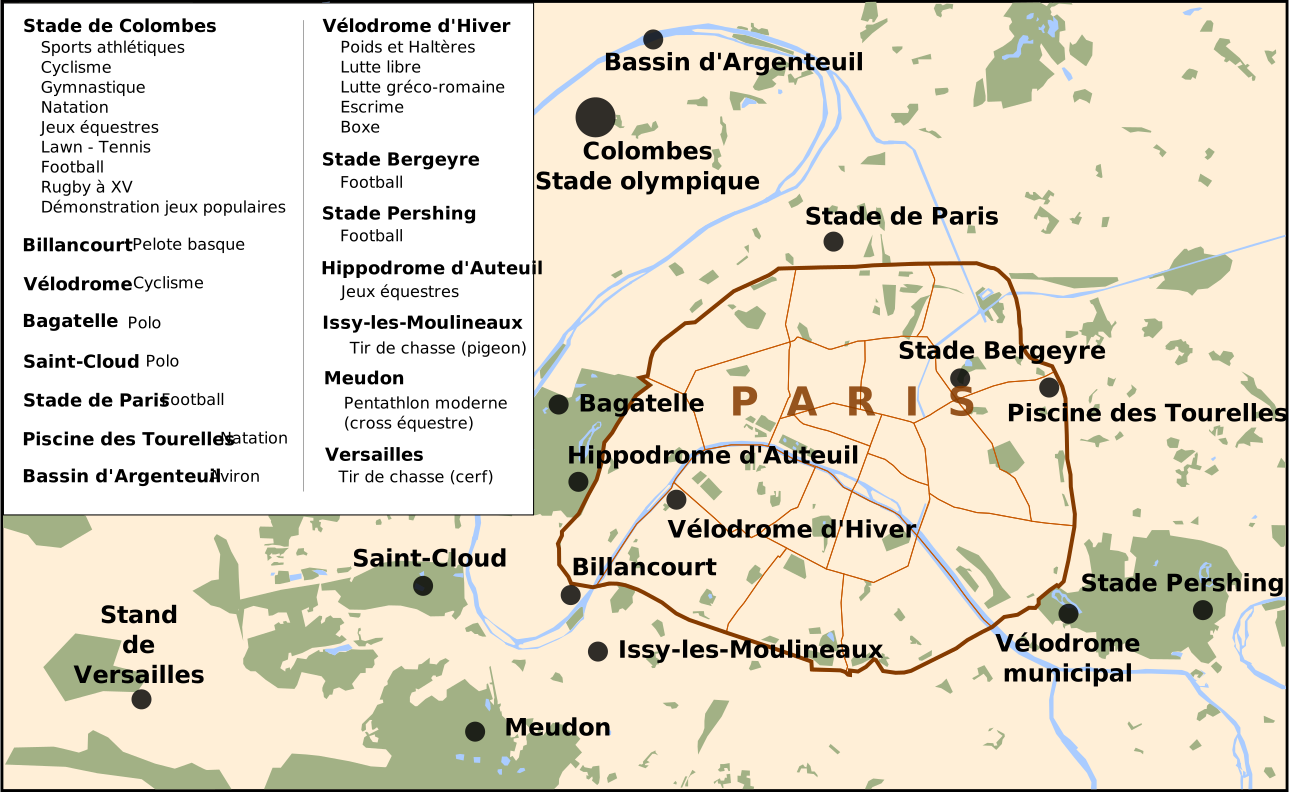
Seventeen sports venues were used in the 1924 Summer Olympics. Stade de Colombes served as the final venue for the 1938 FIFA World Cup between Italy and Hungary.
| Venue | Sports | Capacity | Ref. | |
|---|---|---|---|---|
| Bagatelle | Polo | 598 | ||
| Bassin d'Argenteuil | Rowing | 2,216 | ||
| Camp de Châlons | Shooting (600 m free rifle individual and team) | 395 | ||
| Fontainebleau | Modern pentathlon (riding) | Not listed. | ||
| Hippodrome d'Auteuil | Equestrian | 8,922 | ||
| Issy-les-Moulineaux | Shooting (trap shooting, including team event) | 41 | ||
| Le Havre | Sailing | 541 | ||
| Le Stade Olympique de Reims | Shooting (trap shooting, running target) | 420 | ||
| Le Stand de Tir de Versailles | Modern pentathlon (shooting), Shooting (25 m rapid fire pistol, running deer) | 82 | ||
| Meulan-en-Yvelines | Sailing | 389 | ||
| Piscine des Tourelles | Diving, Modern pentathlon (swimming), Swimming, Water polo | 8,023 | ||
| Saint-Cloud | Polo | 7,836 | ||
| Stade Bergeyre | Football | 10,455 | ||
| Stade de Colombes | Athletics, Cycling (road), Equestrian, Fencing, Football (final), Gymnastics, Modern pentathlon (fencing, running), Rugby union, Tennis | 60,000 | ||
| Stade de Paris | Football | 5,145 | ||
| Stade Pershing | Football | 8,110 | ||
| Vélodrome d'hiver | Boxing, Fencing, Weightlifting, Wrestling | 10,884 | ||
| Vélodrome de Vincennes | Cycling (track) | 12,750 |
Participating nations


A total of 44 nations were represented at the 1924 Games. Germany was still absent, having not been invited by the Organizing Committee. China (although it did not compete), Ecuador, Ireland, Lithuania, and Uruguay attended the Olympic Games for the first time, while the Philippines competed for first time in an Olympic Games as a nation (though it first participated in the 1900 Summer Olympic Games). Latvia and Poland also attended the Summer Olympic Games for the first time (having both appeared earlier at the 1924 Winter Olympics in Chamonix).
The 1924 Olympics saw a return of the following nations: Austria, Bulgaria, Cuba, Haiti, Hungary, Mexico, Romania and Turkey.
At the time, Australia, New Zealand, Canada, South Africa and Ireland were all dominions of the British Empire. India was also part of British Empire, but was not a dominion. For other sovereign states (i.e. United States, France, Brazil, Japan, etc) and the international community as a whole (i.e League of Nations) the term dominion, used internally in the British Empire, was very ambiguous, meaning "something between a colony and state". It was only years later with the Statute of Westminster 1931 that this ambiguity would be dispelled.
And Philippines was an unincorporated territory and commonwealth of the United States.
| Participating National Olympic Committees |
|---|
- Republic of China (1912–1949) China also took part in the Opening Ceremony, but its four athletes (all tennis players) withdrew from competition.
Number of athletes by National Olympic Committees
| Country | Athletes |
|---|---|
| FRA | 401 |
| GBR | 239 |
| USA | 229 |
| ITA | 200 |
| BEL | 172 |
| NED | 153 |
| ESP | 129 |
| SWE | 108 |
| FIN | 90 |
| DEN | 89 |
| HUN | 89 |
| ARG | 77 |
| SUI | 75 |
| TCH | 70 |
| CAN | 65 |
| POL | 65 |
| NOR | 62 |
| ROM | 51 |
| AUT | 49 |
| EST | 44 |
| LAT | 41 |
| IRL | 39 |
| YUG | 37 |
| AUS | 36 |
| EGY | 33 |
| TUR | 31 |
| URU | 31 |
| POR | 30 |
| RSA | 30 |
| GRE | 26 |
| BUL | 24 |
| LUX | 22 |
| LTU | 13 |
| MEX | 13 |
| BRA | 12 |
| CHI | 11 |
| CUB | 9 |
| JPN | 9 |
| HAI | 8 |
| IND | 7 |
| MON | 7 |
| ROC | 4 |
| NZL | 4 |
| ECU | 3 |
| PHI | 1 |
| **Total** | **3,089** |
Medal count
Main article: 1924 Summer Olympics medal table, List of 1924 Summer Olympics medal winners
These are the nations that won medals the 1924 Games.
Legacy
The 1924 Summer Olympics was the second edition of the Summer Olympics to be held in Paris. 100 years later, the city has hosted the games once again with the 2024 Summer Olympics, marking its third time, becoming the second city ever to host the Summer Olympics three times (after London, which hosted the 1908, 1948, and 2012 Games). Paris 2024 also marks the centenary of Chamonix 1924, which in turn marks the centenary of the Winter Olympics; making Paris 2024 the sixth Olympic Games hosted by France (three Summer Olympics and three Winter Olympics), and the first French Olympics since the 1992 Winter Games in Albertville.
Notable debuts of participating countries for the Paris 1924 Olympics include Ireland, Latvia, Lithuania, Philippines, Poland, Romania, and Uruguay; all of which celebrated their centenary participation at the 2024 Summer Olympics back in Paris.
One venue from the 1924 Games was used in the 2024 Games. The extensively renovated and downsized main stadium, known since 1928 as Stade Olympique Yves-du-Manoir, hosted field hockey.
The last surviving competitor of the 1924 Summer Olympics was Croatian swimmer Ivo Pavelić, who died on 22 February 2011 at the age of 103; he competed for Yugoslavia, which Croatia was part of at the time.
Continuation of Jeux de L’Enfance, games for youth sports and competition, from the Paris 1924 was embodied through the creation of Youth Olympics Games inaugurating in Singapore with the 2010 Summer Youth Olympics with 3,600 athletes aged 14–18 from 204 nations competing in 201 events in 26 sports.
Notes
References
- (13 September 2013). "Factsheet - Opening Ceremony of the Games f the Olympiad". International Olympic Committee.
- "Past Olympic host city election results". [[GamesBids]].
- Zarnowski, C. Frank. (Summer 1992). "A Look at Olympic Costs". Citius, Altius, Fortius.
- '' The Official History of the Olympic Games and the IOC- Athens to Beijing, 1894–2008'': David Miller (2008)
- (2002). "Opening Ceremony". International Olympic Committee.
- M. Avé, Comité Olympique Français, pp. 601–612
- (2024-01-19). "Demonstration sports : history at the Olympic Summer Games / The Olympic Studies Centre".
- Barker, Philip. (2015-03-03). "Did the first Youth Olympics really take place in Paris 100 years ago?".
- [http://www.la84foundation.org/6oic/OfficialReports/1924/1924.pdf 1924 Olympics official report.] {{webarchive. link. (5 May 2011 pp. 628. {{in lang). fr
- [http://www.la84foundation.org/6oic/OfficialReports/1924/1924.pdf 1924 Olympics official report.] {{webarchive. link. (5 May 2011 pp. 528-9. {{in lang). fr
- [http://www.la84foundation.org/6oic/OfficialReports/1924/1924.pdf 1924 Olympics official report.] {{webarchive. link. (5 May 2011 pp. 165-7. {{in lang). fr
- [http://www.la84foundation.org/6oic/OfficialReports/1924/1924.pdf 1924 Olympics official report.] {{webarchive. link. (5 May 2011 pp. 565-6. {{in lang). fr
- [http://www.la84foundation.org/6oic/OfficialReports/1924/1924.pdf 1924 Olympics official report.] {{webarchive. link. (5 May 2011 pp. 501-3. {{in lang). fr
- [http://www.la84foundation.org/6oic/OfficialReports/1924/1924.pdf 1924 Olympics official report.] {{webarchive. link. (5 May 2011 pp. 222-3. {{in lang). fr
- [http://www.la84foundation.org/6oic/OfficialReports/1924/1924.pdf 1924 Olympics official report.] {{webarchive. link. (5 May 2011 pp. 544-6, 549. {{in lang). fr
- [http://www.la84foundation.org/6oic/OfficialReports/1924/1924.pdf 1924 Olympics official report.] {{webarchive. link. (5 May 2011 pp. 584, 587. {{in lang). fr
- [http://www.la84foundation.org/6oic/OfficialReports/1924/1924.pdf 1924 Olympics official report.] {{webarchive. link. (5 May 2011 pp. 563-5, 568. {{in lang). fr
- [http://www.la84foundation.org/6oic/OfficialReports/1924/1924.pdf 1924 Olympics official report.] {{webarchive. link. (5 May 2011 pp. 489, 548-9.)
- [http://www.la84foundation.org/6oic/OfficialReports/1924/1924.pdf 1924 Olympics official report.] {{webarchive. link. (5 May 2011 pp. 582-3, 587. {{in lang). fr
- [http://www.la84foundation.org/6oic/OfficialReports/1924/1924.pdf 1924 Olympic official report.] {{webarchive. link. (5 May 2011 pp. 438-40, 443-4, 499 {{in lang). fr.
- [http://www.la84foundation.org/6oic/OfficialReports/1924/1924.pdf 1924 Summer Olympics official report.] {{webarchive. link. (5 May 2011 pp. 318, 320. {{in lang). fr
- [http://www.la84foundation.org/6oic/OfficialReports/1924/1924.pdf 1924 Olympics official report.] {{webarchive. link. (5 May 2011 pp. 50-5, 96-7, 121, 152, 216, 222, 238, 248, 265, 318, 339, 375, 499, 503, 536. {{in lang). fr
- [http://www.la84foundation.org/6oic/OfficialReports/1924/1924.pdf 1924 Summer Olympics official report.] {{webarchive. link. (5 May 2011 pp. 318, 321. {{in lang). fr
- [http://www.la84foundation.org/6oic/OfficialReports/1924/1924.pdf 1924 Summer Olympics official report.] {{webarchive. link. (5 May 2011 pp. 318, 322. {{in lang). fr.
- [http://www.la84foundation.org/6oic/OfficialReports/1924/1924.pdf 1924 Olympics official report.] {{webarchive. link. (5 May 2011 pp. 182-3, 203-4, 255, 266, 400, 425, 507. {{in lang). fr
- [http://www.la84foundation.org/6oic/OfficialReports/1924/1924.pdf 1924 Olympics official report.] {{webarchive. link. (5 May 2011 pp. 200-217. {{in lang). fr
- Guttmann, Allen. (1992). "The Olympics: A History of the Modern Games". University of Illinois Press.
- "Les Jeux de la VIIIe Olympiade Paris 1924 – Rapport Officiel". Librairie de France.
- "Ivo Pavelić". Olympedia.
This article was imported from Wikipedia and is available under the Creative Commons Attribution-ShareAlike 4.0 License. Content has been adapted to SurfDoc format. Original contributors can be found on the article history page.
Ask Mako anything about 1924 Summer Olympics — get instant answers, deeper analysis, and related topics.
Research with MakoFree with your Surf account
Create a free account to save articles, ask Mako questions, and organize your research.
Sign up freeThis content may have been generated or modified by AI. CloudSurf Software LLC is not responsible for the accuracy, completeness, or reliability of AI-generated content. Always verify important information from primary sources.
Report