From Surf Wiki (app.surf) — the open knowledge base
Netherlands national football team
Men's association football team

Men's association football team
| Field | Value |
|---|---|
| Name | Netherlands |
| Nickname | Oranje |
| Holland | |
| Clockwork Orange | |
| The Flying Dutchmen | |
| Badge | Netherlands national football team logo.svg |
| Badge_size | 170px |
| Association | Koninklijke Nederlandse Voetbalbond (KNVB) |
| Confederation | UEFA (Europe) |
| Coach | Ronald Koeman |
| Captain | Virgil van Dijk |
| Most caps | Wesley Sneijder (134) |
| Top scorer | Memphis Depay (55) |
| Home Stadium | Various |
| FIFA Trigramme | NED |
| FIFA Rank | |
| FIFA max | 1 |
| FIFA max date | August 2011 |
| FIFA min | 36 |
| FIFA min date | August 2017 |
| Elo Rank | |
| Elo max | 1 |
| Elo max date | 1978, 1988–1990, 1992, 2002, 2003, 2005, 2008, 2010, 2014 |
| Elo min | 49 |
| Elo min date | October 1954 |
| pattern_la1 | _ned24h |
| pattern_b1 | _ned24h |
| pattern_ra1 | _ned24h |
| pattern_sh1 | _ned24h |
| pattern_so1 | _ned24h |
| leftarm1 | fa772f |
| body1 | fa772f |
| rightarm1 | fa772f |
| shorts1 | fa772f |
| socks1 | fa772f |
| pattern_la2 | _ned24a |
| pattern_b2 | _ned24a |
| pattern_ra2 | _ned24a |
| pattern_sh2 | _ned24a |
| pattern_so2 | _ned24a |
| leftarm2 | 5d9cd2 |
| body2 | 5d9cd2 |
| rightarm2 | 5d9cd2 |
| shorts2 | 5d9cd2 |
| First game | 1–4 |
| (Antwerp, Belgium; 30 April 1905) | |
| Largest win | 11–0 |
| (Eindhoven, Netherlands; 2 September 2011) | |
| Largest loss | |
| (Darlington, England; 21 December 1907) | |
| World cup apps | 11 |
| World cup first | 1934 |
| World cup best | Runners-up (1974, 1978, 2010) |
| Regional name | European Championship |
| Regional cup apps | 11 |
| Regional cup first | 1976 |
| Regional cup best | Champions (1988) |
| 2ndRegional name | Nations League Finals |
| 2ndRegional cup apps | 2 |
| 2ndRegional cup first | 2019 |
| 2ndRegional cup best | Runners-up (2019) |
| website |
the men's team
Holland Clockwork Orange The Flying Dutchmen (Antwerp, Belgium; 30 April 1905) (Eindhoven, Netherlands; 2 September 2011) (Darlington, England; 21 December 1907)
The Netherlands national football team ( or simply Het Nederlands elftal) has represented the Netherlands in international men's football matches since 1905. The men's national team is controlled by the Royal Dutch Football Association (KNVB), the governing body for football in the Netherlands, which is a part of UEFA, under the jurisdiction of FIFA. Most of the Netherlands home matches are played at the Johan Cruyff Arena, De Kuip, Philips Stadion and De Grolsch Veste.
The team is colloquially referred to as Het Nederlands Elftal (The Dutch Eleven) or Oranje, after the House of Orange-Nassau and their distinctive orange jerseys. Informally the team, like the country itself, is referred to as Holland. Additionally, their fan club is known as Het Oranje Legioen (The Orange Legion).
The Netherlands has competed in eleven FIFA World Cups, appearing in the final three times (in 1974, 1978 and 2010), finishing as runners-up on all three occasions. They have also appeared in eleven UEFA European Championships, winning the 1988 tournament in West Germany. Additionally, the team has won bronze medals at three Olympic football tournaments, in 1908, 1912 and 1920. The Netherlands has long-standing football rivalries with neighbours Belgium and Germany as well as the South American country of Argentina.
History
Main article: History of the Netherlands national football team
Beginnings: 1905–1969
The Netherlands played their first international match in Antwerp against Belgium on 30 April 1905, with the players selected by a five-member commission from the Dutch Football Association. After 90 minutes, the score was tied at 1–1. Since the match was for the Coupe van den Abeele, it went into extra time, during which Eddy de Neve scored three times, making the score 4–1 for the Netherlands. Some historians, however, attribute one of the goals scored to Willem Hesselink.
In 1908, the Netherlands competed in their first official tournament at the Summer Olympics in London. They received a bronze medal after losing to Great Britain in the semi-finals, before defeating Sweden in the bronze medal match 2–0. At the Olympic Games in 1912 and 1920, the Netherlands finished with the bronze medal as they lost to Denmark and Belgium in the respective tournament.
The Netherlands reached the semi-finals at the 1924 Summer Olympics in Paris after winning against Romania and Ireland. In the semi-finals, they gave up a one-goal lead, scored by Kees Pijl, and lost 2–1 against Uruguay, ending up in the third place play-off for the fourth time, losing to Sweden in a replay.
After being eliminated in the first round at the 1928 Summer Olympics on home turf, they skipped the first World Cup in 1930 due to the cost of travel from Europe to South America. The team made their first appearance at a FIFA World Cup in 1934 where they took on Switzerland. Kick Smit was the first goalscorer for the Netherlands in a World Cup. The team was eliminated in the opening round by Switzerland 3–2. A second appearance at the 1938 World Cup resulted in a first-round elimination against Czechoslovakia.
After the Second World War, the Netherlands qualified for only two international tournaments before the 1970s: the 1948 Summer Olympics in Great Britain and the 1952 Summer Olympics in Finland. They suffered early elimination, losing to the hosts in 1948 and to Brazil in 1952.
Total football in the 1970s and first golden generation
During the 1970s, the team adopted the Total Football () strategy pioneered by Ajax, and led by playmaker Johan Cruyff and national team head coach Rinus Michels. The Netherlands made significant strides, qualifying for two World Cup finals in the decade. Carlos Alberto, captain of the Brazilian team that won the 1970 FIFA World Cup said: "The only team I've seen that did things differently was Holland at the 1974 World Cup in West Germany. Since then everything looks more or less the same to me ... Their 'carousel' style of play was amazing to watch and marvelous for the game."

In 1974, the Netherlands beat both Brazil and Argentina in the second group stage, reaching the final for the first time in their history. However, they lost to West Germany in the final in Munich, after having gone up 1–0 through Johan Neeskens' early penalty kick before a German had even touched the ball. However, a penalty by Paul Breitner and the winner from Gerd Müller, led to a victory for the Germans.
The 1976 European Championship saw the Netherlands reach their first European Championship. Czechoslovakia defeated the Netherlands in extra time. The Netherlands finished in third place after defeating hosts Yugoslavia in extra time.
In 1978, the Netherlands qualified for the World Cup in Argentina. Johan Cruyff chose not to participate in the competition after a kidnapping attempt targeting him and his family in their Barcelona home, prioritising his family's safety and well-being over playing football. Willem van Hanegem also declined to play after his AZ teammate Hugo Hovenkamp had to pull out and after he had fallen out with the Dutch coach, Ernst Happel. The squad still had players like Jan Jongbloed, Rob Rensenbrink, Johan Neeskens, Wim Suurbier and Ruud Krol from the previous World Cup. After finishing runners-up in Group 4 behind Peru, they recorded wins against Austria and Italy to set up a final with Argentina. After a controversial start, with Argentina questioning the plaster cast on René van de Kerkhof's wrist, the match headed to extra time where the Netherlands lost 3–1 after two goals from Mario Kempes and Daniel Bertoni.
1980s: Decline before European champions
Euro 1980 was the last tournament for which the Total Football team qualified. Despite the tournament format being expanded that year they did not advance past the group stage as they finished behind Czechoslovakia by goal difference.
Veterans such as Krol and Rensenbrink retired soon afterwards and the Netherlands hit a low point in their history: they missed the 1982 World Cup in Spain, Euro 1984 in France, and the 1986 World Cup in Mexico; they missed the French tournament by virtue of goals scored when Spain scored twelve in the final game against Malta. While both teams had the same goal difference (+16), Spain qualified having scored two more goals than the Netherlands. During the qualification stage for the 1986 World Cup the Netherlands finished in second place and advanced to the play-offs against neighbours Belgium. After losing the first leg 1–0 in Brussels, they held a 2–0 lead at Rotterdam with a few minutes remaining. Georges Grün's header in the 84th minute resulted in the Netherlands' elimination as Belgium advanced to the World Cup on away goals.
.jpg)
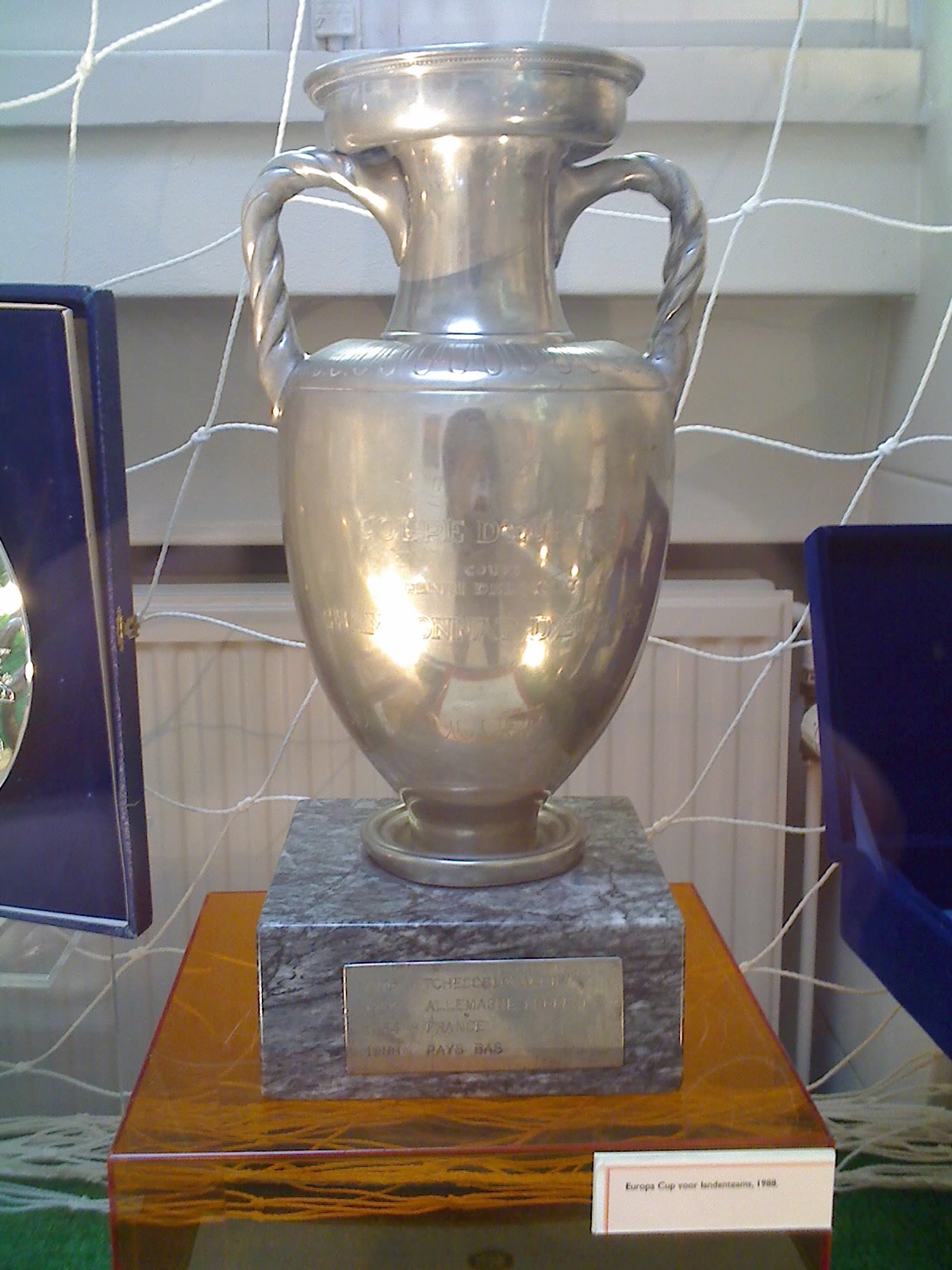
Rinus Michels returned, with his technical assistant Nol de Ruiter, to coach the team for Euro 1988 in West Germany. After losing the first group match against the Soviet Union 1–0, the Netherlands qualified for the semi-finals by defeating England 3–1 (with a hat-trick by Marco van Basten), and the Republic of Ireland 1–0. Van Basten scored against the hosts in the 89th minute to sink the German side. The Netherlands won the final with a victory over the USSR with a header by Ruud Gullit and a volley by Van Basten. This was the national team's first major tournament win.
The Netherlands was one of the favourites for the 1990 World Cup tournament in Italy, but they scored only two goals in the group stage which featured England, Egypt and the Republic of Ireland. After finishing the group stage with identical records, the Netherlands and the Republic of Ireland drew lots to determine which team would finish second. The Netherlands had the tougher draw against West Germany, while the Republic of Ireland faced Romania. The match against West Germany is mostly remembered for the spitting incident involving Frank Rijkaard and Rudi Völler as the Netherlands were defeated 2–1.
The team reached the semi-finals in the Euro 1992 in Sweden. They were eliminated by eventual champions Denmark when Peter Schmeichel saved Van Basten's kick in the penalty shootout. This was Van Basten's last major tournament as he suffered a serious ankle injury shortly after, and eventually retired at age 30 in 1995. It was also the last hurrah for Rinus Michels, who returned for one final spell in charge of the team before retiring for good after the tournament ended.
Dick Advocaat took over from Michels on the understanding that he would be replaced by Johan Cruyff the following year. After talks between Cruyff and the KNVB broke down, Advocaat remained in charge of the national team for the 1994 World Cup in the United States. In the World Cup, Van Basten and striker Ruud Gullit were injured; Dennis Bergkamp led the team with three goals and the Netherlands advanced to the quarter-finals, where they lost 3–2 to eventual champions Brazil.
Second golden generation: 1996–2014
With Guus Hiddink as manager, Oranje went to Euro 1996. After finishing second in their group, they played France in the quarter-finals. With the score 0–0, the match went to penalties. Clarence Seedorf's shot in the fourth round was stopped by French goalkeeper Bernard Lama, and the penalty by Laurent Blanc eliminated the Netherlands. After they finished top of the qualifying group, they were drawn in Group E of the 1998 World Cup. With the Netherlands team featuring Dennis Bergkamp, Marc Overmars, Phillip Cocu, Edgar Davids, Frank de Boer, Ronald de Boer and Patrick Kluivert, they reached the semi-finals where they again lost on penalties, this time to Brazil. They then lost the third place play-off to Croatia. Soon afterwards, Hiddink resigned, to be replaced by Frank Rijkaard. The Netherlands co-hosted Euro 2000 with Belgium and won all three games in the group stage and then defeated FR Yugoslavia 6–1 in the quarter-finals. In the semi-finals, Italian goalkeeper Francesco Toldo made two penalty shootout saves to eliminate the Netherlands. The team failed to qualify for the 2002 World Cup after crucial losses to Portugal and the Republic of Ireland, prompting manager Louis van Gaal to resign.

Dick Advocaat became the national coach of the Netherlands for the second time in January 2002. They qualified for UEFA Euro 2004 after beating Scotland in emphatic fashion in the play-offs. The tournament saw the Netherlands reach the semi-finals where they lost to hosts Portugal. Advocaat resigned following criticism of his leadership in July 2004.
The Netherlands qualified for the 2006 World Cup under new manager Marco van Basten. They were eliminated in the second round after losing 1–0 to Portugal. The match produced 16 yellow cards, matching the World Cup record for most cautions in one game set in 2002, and set a new World Cup record of four red cards, two per side; it was nicknamed "the Battle of Nuremberg" by the press. Despite criticism surrounding his selection decisions and the lack of attacking football from his team, Van Basten was offered a two-year extension to his contract by the KNVB. This allowed him to serve as national coach during Euro 2008 and the 2010 World Cup. The Netherlands qualified for Euro 2008, where they were drawn in the "Group of Death", together with France, Italy and Romania. They began with a 3–0 win over world champions Italy in Bern, their first victory over the Italians since 1978. They then beat France by 4–1 to qualify for the second round, and went on winning the group on nine points after beating Romania 2–0. However, they then lost in the quarter-finals to Guus Hiddink's Russia 3–1, with Ruud van Nistelrooy scoring an 86th-minute equaliser to force extra time, where the Russians scored twice through Andrey Arshavin. Following the tournament, Van Basten resigned having accepted the role at Ajax.


Under new coach Bert van Marwijk, the Netherlands went on to secure a 100% record in their World Cup 2010 qualification campaign, winning all their eight games to qualify for the World Cup. After they had comfortably qualified with maximum points in Group E and Slovakia in the round of 16, they took on Brazil in the quarter-finals. After trailing 1–0 at half-time, Wesley Sneijder scored two goals in the second half to advance the team to the semi-finals where they beat Uruguay 3–2. They advanced to their first World Cup final since 1978 but fell to Spain 1–0 after midfielder Andrés Iniesta scored in extra time. From August to September 2011, the team was ranked number one in the FIFA World Ranking, becoming the second national football team, after Spain, to top the ranking without previously winning a World Cup.
For Euro 2012, the Netherlands were placed in Group B with Germany, Portugal and Denmark, dubbed the tournament "Group of Death". The Netherlands lost all three of their group matches in a tournament for the first time in their history. Manager Bert van Marwijk resigned after the disappointment.
Louis van Gaal became the manager for the second time. In the 2014 World Cup UEFA qualifying round, the Netherlands won nine games and drew one, topping the group and earning automatic qualification. They were drawn into Group B, alongside Spain, Chile and Australia. The team avenged their 2010 defeat by defeating title holders Spain 5–1 in their opening match.

After finishing top of Group B, the Netherlands defeated Mexico 2–1 in the round of 16, with Wesley Sneijder equalising late in the match and Klaas-Jan Huntelaar scoring a penalty. In the quarter-finals, where they faced Costa Rica. After a 0–0 draw, the Netherlands won the ensuing penalty shootout 4–3. Backup goalkeeper Tim Krul was brought on just before the end of extra time and made two saves in the shootout.
In the semi-final against Argentina, the Netherlands were eliminated 4–2 on penalties. The Netherlands won the third place match against hosts Brazil. Van Gaal, who successfully motivated the team after their semi-final elimination, received praise for getting more out of the young and inexperienced Netherlands squad than many expected.
Decline and recovery: 2014–present
Guus Hiddink followed Van Gaal as manager for the Euro 2016 qualifying campaign. On 29 June 2015, Hiddink resigned and was succeeded by his assistant Danny Blind. The Netherlands finished fourth in their group, failing to qualify for the European Championship for the first time since 1984, and missing a major tournament for the first time since 2002. The team's poor form continued into the 2018 World Cup qualifiers, eventually resulting in Blind being dismissed after a 2–0 defeat to Bulgaria in March 2017. After the return of Dick Advocaat as coach, the Netherlands failed to qualify for the 2018 World Cup, finishing third in Group A behind France and Sweden.
In February 2018, Advocaat was replaced by Ronald Koeman, on a contract until the summer of 2022. The Netherlands qualified for League A in the UEFA Nations League which they would win to qualify for the final four after drawing with Germany on the last match day, beating France on the head-to-head record. The Netherlands beat England in the semi-finals of the Nations League, but lost 1–0 in the final against Portugal.
The Netherlands qualified for UEFA Euro 2020, however following the qualification, Ronald Koeman resigned from the team to coach Barcelona, eventually to be succeeded by Frank de Boer. With the coronavirus pandemic postponing Euro 2020 to 2021, the Netherlands played their group matches at home at the Johan Cruyff Arena in Amsterdam, beating Ukraine 3–2, Austria 2–0 and North Macedonia 3–0. However, the tournament ended in disappointment for the Netherlands once more, as they were beaten 2–0 by the Czech Republic in their round of 16 tie in Budapest. Two days later, De Boer left his position. He was replaced by Louis van Gaal, who came out of retirement to return for a third spell in charge of the side. On 16 November 2021, the Netherlands qualified for the 2022 World Cup after beating Norway 2–0 and topping their qualification group on the final day. In the 2022 World Cup, the Netherlands topped their group with 7 points. They progressed to the quarter-finals where they eventually lost to Argentina on penalties. The tournament was a farewell to manager Louis Van Gaal. He had come out of retirement, despite suffering from prostate cancer and promising his wife he was done with football. According to Dutch media, Van Gaal hid his health struggles from the Dutch team in the build up to the World Cup, even attending training with a catheter in.
At UEFA Euro 2024, the Netherlands qualified from the group stage as one of the best third place teams after a win against Poland, a draw with France and a defeat to Austria. In the round of 16, the Netherlands won 3–0 against Romania. In the quarter-final, they faced Turkey who initially took the lead before Stefan de Vrij equalised for the Netherlands. The comeback was completed with an own goal by Mert Müldür meaning that the Netherlands qualified for the semi-finals for the first time since UEFA Euro 2004 and the 2014 FIFA World Cup. In the semi-final, they were eliminated by England after a late goal.
Team image
Kits and crest
The Netherlands national football team famously plays in bright orange shirts. Orange is the historic national colour of the Netherlands, originating from one of the many title of the ruling head of state, Prince of Orange. The current Netherlands away shirt is blue. The lion on the crest is the Netherlands' national and royal animal and has been on the crest since 1907 when they won 3–1 over Belgium. It is different from the women's team logo, which sports a lioness.
Nike is the national team's kit provider, a sponsorship that began in 1996 and is contracted to continue until at least 2026. Before that the team was supplied by Adidas and Lotto.
Kit suppliers
| Kit supplier | Period | Notes |
|---|---|---|
| NED Tweka | 1938–1966 | |
| ENG Umbro | 1966–1969 | |
| NED Jansen & Tilanus | 1969–1974 | |
| GER Adidas | 1974–1990 | |
| ITA Lotto | 1991–1996 | |
| USA Nike | 1996–present |
Rivalries
Main article: Germany–Netherlands football rivalry, Low Countries derby
Deeply rooted in anti-German sentiment due to the occupation of the Netherlands by Germany during World War II, the Netherlands' long-time football rival is Germany. Beginning in 1974, when the Netherlands lost the 1974 World Cup to West Germany in the final, the rivalry between the two nations has become one of the best-known in international football.
To a lesser extent, the Netherlands maintains a rivalry with their other neighbour, Belgium; a Belgium–Netherlands fixture is referred to as a Low Countries derby. They have played in 129 matches with the two competing against each other regularly between 1905 and 1964. This has diminished due to the rise of semi-professional football.
In recent years, the Netherlands has also developed a intercontinental rivalry with Argentina. Recently known from the 2022 World Cup quarter-final match in Qatar, the match became known as the Battle of Lusail.
Another rivalry that has been developing in recent times is against Spain. Although not seen as intense by both sides in the past, matches like the 2010 FIFA World Cup, 2014 FIFA World Cup, and Nations League have helped make this rivalry grow.
Media coverage
The Netherlands are broadcast on Nederlandse Omroep Stichting which includes all friendlies, Nations League matches and World Cup qualifiers. The newest contract is a seven-year deal until 2027.
Home stadium
The Netherlands national team does not have a national stadium but plays mostly at the Johan Cruyff Arena in Amsterdam. It played host to its first competitive Netherlands international match back in 1997, a 1998 World Cup qualification match against San Marino which the Netherlands won 4–0, after hosting a friendly match between The Netherlands and Brazil in 1996, which ended in a 2-2 draw. The stadium was formally called the Amsterdam Arena until 2018 when it was renamed in memory of Johan Cruyff.
Over the last few years, De Kuip in Rotterdam has hosted matches regularly and historically very often. Occasionally, matches take place at Philips Stadion in Eindhoven and also sometimes at the De Grolsch Veste in Enschede.
Results and fixtures
Main article: Netherlands national football team results
The following is a list of match results in the last 12 months, as well as any future matches that have been scheduled.
2025
- Gakpo
- Reijnders
- Williams
- Merino
- Oyarzabal
- Yamal
- Depay
- Maatsen
- Simons
- Merino
- Torres
- García
- Yamal
- Baena
- Pedri
- Van Dijk
- Koopmeiners
- Simons
- Lang
- Taylor
- Malen
- Depay
- Dumfries
- Depay
- Van Dijk
- Simons
- Malen
- Lang
- Van de Ven
- Dumfries
- Cash
- Gineitis
- Girdvainis
- Depay
- Q. Timber
- Gakpo
- Reijnders
- Depay
- Malen
- Van Dijk
- Depay
- Gakpo
- Kamiński
- Depay
- Reijnders
- Gakpo
- Simons
- Malen
2026
Coaching staff
| Position | Name |
|---|---|
| Head coach | NED Ronald Koeman |
| Assistant coaches | NED Erwin KoemanNED Wim Jonk |
| Goalkeeping coach | NED Patrick Lodewijks |
| Fitness coaches | NED Jan KluitenbergNED Martin Cruijff |
| Team manager | NED Cor Asp |
| Sports Scientist | NED David van Maurik |
| Physiotherapist(s) | NED Ricardo de SandersNED Gert-Jan GoudswaardNED Luc van Agt |
| Doctor(s) | NED Edwin GoedhartNED Rien Heijboer |
| Masseurs | NED Rob Koster |
| Analyst(s) | NED Cees LokNED Gert AandewielNED Dennis Demmers |
Coaching history
Main article: List of Netherlands national football team managers
Players
Current squad
The following 25 players were included in the squad for the 2026 FIFA World Cup qualification matches against Poland and Lithuania on 14 and 17 November 2025; respectively. On 10 November, Denzel Dumfries withdrew due to fitness issue and was replaced by Emmanuel Emegha. On 13 November, Quilindschy Hartman withdrew from the squad due to illness.
Caps and goals are correct as of 17 November 2025, after the match against Lithuania.
Recent call-ups
The following players have also been called up for the team in the last twelve months.
INJ INJ Player withdrew from the squad due to an injury.
FIT Player withdrew from the squad due to fitness concerns.
PRE Preliminary squad.
RET Player had announced retirement from national team.
SUS Player is serving a suspension.
PRI Player absent due to private circumstances.
Individual statistics
Player records
Main article: Netherlands national football team records and statistics
| 2013–present |
|---|
| 2 |
| 50 |
| 102 |
|
| 2005–2017 |
|---|
| 3 |
| 42 |
| 76 |
|
| 2006–2015 |
|---|
| 4 |
| 40 |
| 79 |
|
| 1994–2004 |
|---|
| 37 |
| 79 |
|
| 1990–2000 |
|---|
| 37 |
| 96 |
|
| 2003–2017 |
|---|
| 35 |
| 38 |
|
| 1946–1961 |
|---|
| 35 |
| 70 |
|
| 1998–2011 |
|---|
| 33 |
| 47 |
|
| 1940–1959 |
|---|
| 33 |
| 48 |
| |1966–1977 |}
Manager records
Main article: List of Netherlands national football team managers
- Most wins: Louis van Gaal, 40 wins
- Longest reign: Bob Glendenning, 15 years
- Most tenures: Rinus Michels, 4 tenures
Team records
Main article: Netherlands national football team records and statistics
- Biggest win:
- 11–0 (Eindhoven, Netherlands; 2 September 2011)
- Biggest defeat:
- 12–2 (Darlington, England; 21 December 1907)
Competitive record
FIFA World Cup
Main article: Netherlands at the FIFA World Cup
The Netherlands' first two tournament appearances at the 1934 and the 1938 editions saw them lose their first round matches to Switzerland (1934) and Czechoslovakia (1938).
After not qualifying for the next six World Cups, they qualified for the 1974 FIFA World Cup in West Germany. They lost 2–1 in the final, with Gerd Müller scoring the winning goal for the Germans, that year's hosts. The Netherlands once again made the 1978 FIFA World Cup final with the team finishing second in the group behind Peru. After finishing top of the all-European group in the second round, they met Argentina in the final. Argentina protested René van de Kerkhof's forearm plaster cast. After that protest, the game went to extra time where Argentina won 3–1 after scoring two goals in extra time.
The 1990 edition saw the Netherlands not win a single game throughout the tournament, scoring only two goals in the group stage. 1994 saw the Netherlands knocked out in the quarter-final stage as they lost to eventual champions Brazil with Branco's brutal free-kick sending them out.
In 2006, the Netherlands made it to the round of 16 where, in what was called the "Battle of Nuremberg" they lost by a single goal to Portugal. The Netherlands were given seven yellow cards. In the final, they took on Spain, with La Roja scoring the winning goal in the 116th minute.
In 2014, the Netherlands finished atop Group B with wins over Spain, Australia and Chile. The Netherlands took bronze in the tournament after defeating host nation Brazil 3–0 in the third place playoff.
With the Netherlands having failed to qualify for the 2018 World Cup, falling behind France and Sweden in the qualifying group stage, they qualified for the 2022 World Cup. They defeated Senegal in the group stage, followed by a draw against Ecuador, and a win over hosts Qatar. In the Round of 16 the Netherlands defeated the United States 3-1, only to lose to eventual champions Argentina in the Quarter Finals in a penalty shootout after 2-2.
| a | black | 2px}}" colspan=2 | Netherlands' World Cup history | a | #FF5F00 | 2px}} | First Match | a | #FF5F00 | 2px}} | Biggest Win | a | #FF5F00 | 2px}} | Biggest Defeat | a | #FF5F00 | 2px}} | Best Result | a | #FF5F00 | 2px}} | Worst Result |
|---|---|---|---|---|---|---|---|---|---|---|---|---|---|---|---|---|---|---|---|---|---|---|---|
| 3–2 | |||||||||||||||||||||||
| (27 May 1934; Milan, Italy) | |||||||||||||||||||||||
| 5–0 | |||||||||||||||||||||||
| (20 June 1998; Marseille, France) | |||||||||||||||||||||||
| 3–0 | |||||||||||||||||||||||
| (5 June 1938; Le Havre, France) | |||||||||||||||||||||||
| Runners-up in 1974, 1978, 2010 | |||||||||||||||||||||||
| Round of 16 in 1934, 1938, 1990, 2006 |
UEFA European Championship
Main article: Netherlands at the UEFA European Championship
Olympic Games
| [](football-at-the-summer-olympics) record | Year | Round | Pld | W | D | L | GF | GA | Squad | Total | 8/17 | 23 | 9 | 1 | 9 | 46 | 41 | — |
|---|---|---|---|---|---|---|---|---|---|---|---|---|---|---|---|---|---|---|
| United Kingdom 1908 | Bronze medal | 2 | 1 | 0 | 1 | 2 | 4 | Squad | ||||||||||
| Sweden 1912 | Bronze medal | 4 | 3 | 0 | 1 | 17 | 8 | Squad | ||||||||||
| Belgium 1920 | Bronze medal | 4 | 2 | 0 | 2 | 9 | 10 | Squad | ||||||||||
| France 1924 | Fourth place | 5 | 2 | 1 | 2 | 11 | 7 | Squad | ||||||||||
| Netherlands 1928 | Round of 16 | 1 | 0 | 0 | 1 | 0 | 2 | Squad | ||||||||||
| Nazi Germany 1936 | Did not enter | |||||||||||||||||
| United Kingdom 1948 | Round of 16 | 2 | 1 | 0 | 1 | 6 | 5 | Squad | ||||||||||
| Finland 1952 | Round of 16 | 1 | 0 | 0 | 1 | 1 | 5 | Squad | ||||||||||
| Australia 1956 | Did not enter | |||||||||||||||||
| Italy 1960 | ||||||||||||||||||
| Japan 1964 | ||||||||||||||||||
| Mexico 1968 | ||||||||||||||||||
| West Germany 1972 | ||||||||||||||||||
| Canada 1976 | ||||||||||||||||||
| Soviet Union 1980 | ||||||||||||||||||
| United States 1984 | Did not qualify | |||||||||||||||||
| South Korea 1988 | ||||||||||||||||||
| Since 1992 | See Netherlands national under-21 football team |
Since 1992, the Olympic Games has been an under-23 tournament (with three players of over 23 years of age allowed in the squad).
UEFA Nations League
| [](uefa-nations-league) record | League phase / quarter-finals | Finals | RK | Season | LG | Grp | Pos | Pld | W | D | L | GF | GA | P/R | RK | Year | Round | Pld | W | D | L | GF | GA | Squad | Total | 24 | 12 | 9 | 3 | 47 | 26 | N/A | Total | 4 | 1 | 0 | 3 | 7 | 9 | — | 2nd |
|---|---|---|---|---|---|---|---|---|---|---|---|---|---|---|---|---|---|---|---|---|---|---|---|---|---|---|---|---|---|---|---|---|---|---|---|---|---|---|---|---|---|
| 2018–19 | A | 1 | 1st | 4 | 2 | 1 | 1 | 8 | 4 | 3rd | Portugal 2019 | Runners-up | 2 | 1 | 0 | 1 | 3 | 2 | Squad | 2nd | |||||||||||||||||||||
| 2020–21 | A | 1 | 2nd | 6 | 3 | 2 | 1 | 7 | 4 | 6th | Italy 2021 | Did not qualify | 6th | ||||||||||||||||||||||||||||
| 2022–23 | A | 4 | 1st | 6 | 5 | 1 | 0 | 14 | 6 | 1st | NED 2023 | Fourth place | 2 | 0 | 0 | 2 | 4 | 7 | Squad | 4th | |||||||||||||||||||||
| 2024–25 | A | 3 | 2nd | 8 | 2 | 5 | 1 | 18 | 12 | 6th | Germany 2025 | Did not qualify | 6th |
FIFA Ranking
Last update was on 21 December 2023. Source: The FIFA/Coca-Cola World Ranking - Associations - Netherlands - Men's 1994, 1995, 1996, 1997, 1998, 1999, 2000, 2001, 2002, 2003, 2004, 2005, 2006, 2007, 2008, 2009, 2010, 2011, 2012, 2013, 2014, 2015, 2016, 2017, 2018, 2019, 2020, 2021, 2023 2, 5, 6, 4, 6, 8, 8, 7, 6, 4, 4, 2, 3, 5, 3, 2, 2, 1, 2, 5, 3, 5, 14, 20, 14, 12, 13, 10, 7
11, 17, 13, 22, 25, 19, 21, 10, 15, 7, 6, 7, 6, 9, 10, 3, 4, 2, 8, 9, 15, 16, 26, 36, 21, 16, 15, 16
Worst Ranking Best Ranking Worst Mover Best Mover
| [](fifa-world-ranking) | Rank | Year | Games | |||||||||
|---|---|---|---|---|---|---|---|---|---|---|---|---|
| played | Won | Drawn | Lost | Best | Worst | Rank | Move | Rank | Move | |||
| 7 | 1993 | 7 | 5 | 1 | 2 | 2 | 5 | 16 | 9 | |||
| 6 | 1994 | 15 | 9 | 3 | 3 | 2 | 9 | 11 | 6 | |||
| 6 | 1995 | 9 | 5 | 0 | 4 | 5 | 12 | 17 | 9 | |||
| 9 | 1996 | 11 | 6 | 3 | 2 | 6 | 7 | 13 | 5 | |||
| 22 | 1997 | 7 | 4 | 1 | 2 | 4 | 4 | 22 | 10 | |||
| 11 | 1998 | 15 | 8 | 5 | 2 | 6 | 19 | 25 | 11 | |||
| 19 | 1999 | 9 | 0 | 7 | 2 | 8 | 3 | 19 | 3 | |||
| 8 | 2000 | 14 | 9 | 4 | 1 | 8 | 13 | 21 | 2 | |||
| 8 | 2001 | 10 | 6 | 3 | 1 | 7 | 2 | 10 | 1 | |||
| 6 | 2002 | 7 | 6 | 1 | 0 | 6 | 4 | 15 | 6 | |||
| 4 | 2003 | 11 | 6 | 3 | 2 | 4 | 2 | 7 | 3 | |||
| 6 | 2004 | 17 | 8 | 5 | 4 | 4 | 1 | 6 | 1 | |||
| 3 | 2005 | 11 | 7 | 3 | 1 | 2 | 2 | 7 | 1 | |||
| 7 | 2006 | 14 | 6 | 4 | 4 | 3 | 0 | 6 | 3 | |||
| 9 | 2007 | 12 | 7 | 3 | 2 | 5 | 2 | 9 | 3 | |||
| 3 | 2008 | 15 | 6 | 3 | 6 | 3 | 5 | 10 | 1 | |||
| 3 | 2009 | 11 | 5 | 3 | 3 | 2 | 1 | 3 | 1 | |||
| 2 | 2010 | 17 | 15 | 1 | 1 | 2 | 2 | 4 | 1 | |||
| 2 | 2011 | 11 | 6 | 2 | 2 | 1 | 1 | 2 | 1 | |||
| 8 | 2012 | 13 | 7 | 1 | 6 | 2 | 2 | 8 | 4 | |||
| 9 | 2013 | 12 | 7 | 5 | 0 | 5 | 4 | 9 | 4 | |||
| 5 | 2014 | 17 | 9 | 3 | 5 | 3 | 12 | 15 | 4 | |||
| 14 | 2015 | 9 | 4 | 1 | 4 | 5 | 2 | 16 | 7 | |||
| 22 | 2016 | 11 | 5 | 3 | 3 | 14 | 4 | 26 | 12 | |||
| 20 | 2017 | 11 | 8 | 0 | 3 | 20 | 9 | 36 | 11 | |||
| 14 | 2018 | 10 | 4 | 4 | 2 | 14 | 2 | 21 | 1 | |||
| 14 | 2019 | 10 | 7 | 1 | 2 | 12 | 1 | 16 | 2 | |||
| 14 | 2020 | 8 | 3 | 3 | 2 | 13 | 1 | 15 | 2 | |||
| 10 | 2021 | 16 | 11 | 3 | 2 | 10 | 1 | 16 | 2 | |||
| 6 | 2023 | 10 | 6 | 0 | 4 | 6 | 4 | 7 | 1 |
Honours
Global
- FIFA World Cup
- Olympic Games
- Bronze medal (3): 1908, 1912, 1920
Continental
- UEFA European Championship
- Champions (1): 1988
- Third place (1): 1976
- UEFA Nations League
- Runners-up (1): 2019
Awards
- World Soccer Team of the Year: 1988
Summary
| Competition | Total | Total | 1 | 4 | 5 | 10 |
|---|---|---|---|---|---|---|
| FIFA World Cup | 0 | 3 | 1 | 4 | ||
| Olympic Games | 0 | 0 | 3 | 3 | ||
| UEFA European Championship | 1 | 0 | 1 | 2 | ||
| UEFA Nations League | 0 | 1 | 0 | 1 |
Notes
References
References
- (17 December 2011). "Holland's media-friendly football pros". [[Radio Netherlands Worldwide]].
- "The FIFA/Coca-Cola World Ranking - Ranking Table".
- "The FIFA/Coca-Cola World Ranking - Ranking Table".
- "Interlands Nederlands Eiftal en 1907". www.voetbalstats.nl.
- "International football | KNVB".
- "Netherlands: Full "A" internationals (1905–1910)". [[International Federation of Football History & Statistics]].
- Joshua, Rick. (21 September 2017). "Willem Hesselink: The original "Mr. Bayern"".
- "The fourth Olympiad London 1908".
- Aarhus, Lars. (26 June 2008). "Games of the V. Olympiad".
- (29 October 2015). "Games of the VII. Olympiad".
- "Netherlands – Uruguay". [[FIFA]].
- (20 October 2015). "Games of the VIII. Olympiad".
- (20 October 2015). "Games of the IX. Olympiad".
- "FIFA World Cup – Classic Moments from FIFA World Cup History". FIFA.
- Fielder, Robert. (2018). "The Complete History of the World Cup". Kindle Edition.
- "Czechoslovakia – Netherlands". [[FIFA]].
- Aarhus, Lars. (6 April 2011). "Games of the XIV. Olympiad".
- Aarhus, Lars. (26 July 2012). "Games of the XV. Olympiad".
- (14 July 2010). "Tactics: Were Holland 1974 the last true innovators?". Football Further.
- (6 June 2014). "The greatest World Cup tragedies: Holland 1974". The Score.
- (3 October 2003). "Czechoslovakia rain on Dutch parade".
- (3 October 2003). "Dutch edge third-place thriller".
- Doyle, Paul. (16 April 2008). "Kidnappers made Cruyff miss World Cup". [[The Guardian]].
- "The Squad".
- Hersey, Will. (14 June 2018). "Remembering Argentina 1978: The Dirtiest World Cup Of All Time".
- Barreca, Vincenzo. (December 1999). "La storia degli Europei – 1980 Germania Ovest". Action Group.
- (21 December 2013). "Spain's top newspaper recalls 12–1 victory over Malta 30 years ago today".
- "World Cup 1986 qualifications".
- Pye, Steven. (19 November 2013). "How Belgium's last-gasp goal kept Holland out of the 1986 World Cup".
- (14 June 2004). "Cheeseheads vs Krauts": 30 Years of Enmity".
- (5 October 2003). "Van Basten ends Dutch wait".
- (1 June 1990). "WORLD CUP NOTES".
- Belam, Martin. (27 June 2018). "The six oddest tie-breaking rules in World Cup history". The Guardian.
- (5 October 2003). "Schmeichel helps Denmark down Netherlands".
- Lovejoy, Joe. (9 October 1993). "Football: Dutchman for whom winning is losing: If Dick Advocaat's team beat England in Wednesday's World Cup tie he will still lose his job. Joe Lovejoy met him". [[The Independent]].
- Goff, Steven. (24 January 1994). "Some Dutch Unhappy Cruyff Out of Picture". [[The Washington Post]].
- (11 October 2012). "Ten international player v manager bust-ups".
- Bevan, Chris. (27 May 2010). "The story of the 1994 World Cup". [[BBC]].
- (6 October 2003). "France reach last four after shoot-out success".
- (7 July 1998). "Orange crushed".
- (12 July 1998). "Croatia goes home satisfied".
- (18 November 2011). "The Joy of Six: Republic of Ireland football moments". The Guardian.
- Pierson, Mark. (26 January 2002). "Advocaat stays at Rangers but takes Dutch job". [[The Independent]].
- Sanderson, Pete. (20 November 2003). "Dutch find winning formula".
- Szreter, Adam. (1 July 2004). "Maniche has final say against Oranje".
- Groves, Nancy. (7 July 2004). "Advocaat quits Holland". [[The Daily Telegraph]].
- (8 July 2006). "Fair play takes a dive". [[ABC Sport]].
- Watt, Stuart. (26 June 2006). "Portugal wins battle of Nuremberg". [[Australian Broadcasting Corporation]].
- (27 June 2006). "Van Basten on right track". Football.co.uk.
- (2 December 2007). "Italy and France in Euro 2008 'group of death'". ESPN.
- (22 February 2008). "Van Basten takes Ajax role". Sky Sports.
- (25 June 2010). "Dutch comfort, Japanese firecrackers".
- (28 June 2010). "Returning Robben helps sink Slovakia". FIFA.
- (2 July 2010). "Dutch fightback buries Brazil". FIFA.
- (11 July 2010). "Iniesta puts Spain on top of the world". FIFA.
- (12 August 2011). "FIFA Ranking: Netherlands dethrone Spain". Football-Rankings.info.
- Asante, Angela. (2 December 2011). "UEFA Euro 2012 Group of Death: Germany with Portugal & Holland. Who'll be doomed?". Livesoccertv.
- (27 June 2012). "Euro 2012: Bert van Marwijk quits as Netherlands coach". BBC News.
- Wilson, Paul. (14 June 2014). "Spain humiliated as rampant Holland blast five in World Cup shock". [[The Guardian]].
- Lowe, Sid. (30 June 2014). "Holland come from behind to snatch last-gasp victory against Mexico". [[The Guardian]].
- "Tenacity triumphs as last four completed". FIFA.
- (10 July 2014). "Oranje ten onder na strafschoppen".
- Hayward, Ben. (13 July 2014). "Van Gaal: We showed how good we are".
- MacAree, Graham. (13 July 2014). "Brazil Turn Up At Their Own Funeral".
- Kappel, David. (14 July 2014). "Mourinho: Van Gaal Best Coach At World Cup". Soccer Laduma.
- (13 October 2015). "Holland 2 Czech Republic 3". BBC Sport.
- (11 October 2017). "A win for the Netherlands, but not enough to secure World Cup qualification". Sydney Morning Herald.
- (5 February 2018). "Ronald Koeman appointed as Netherlands manager". The Guardian.
- (19 November 2018). "The Dutch Rally to Reach the UEFA Nations League Final Four". The New York Times.
- (9 June 2019). "Portugal 1 Holland 0". BBC Sport.
- (16 November 2019). "Northern Ireland suffer penalty heartbreak as Germany, Netherlands qualify for Euro 2020".
- (29 June 2021). "Frank de Boer stapt per direct op als bondscoach van het Nederlands elftal".
- (4 August 2021). "Louis van Gaal named as Netherlands manager for third time". The Guardian.
- (9 December 2022). "Netherlands vs. Argentina highlights: Argentina wins in dramatic PKs".
- "Poland v. Netherlands - UEFA Euro 2024".
- "Netherlands v. France - UEFA Euro 2024".
- "Netherlands v. Austria - UEFA Euro 2024".
- (2 July 2024). "How the Netherlands cruised past Romania with Cody Gakpo starring in the 3–0 last-16 win".
- "Netherlands v. Turkey – BBC Sport".
- "England 2–1 Netherlands, Ollie Watkins scores as England reach the Euro finale".
- Coerts, Stefan. "Why Netherlands fans dress up as orange lions". goal.com.
- (20 June 2014). "Dutch National Team and Nike Renew Partnership". Nike.
- Devlin, John. (17 May 2018). "International Football Kits (True Colours): The Illustrated Guide". Bloomsbury.
- "500 wedstrijdgedragen Oranje-shirts".
- "Voetbalshirts #3: Nederlands Elftal [podcast]".
- Jordan, Andrew. (16 October 2009). "10 best rivalries in international football".
- Miller, Nick. (9 October 2015). "The 10 greatest rivalries in international football".
- Stokkermans, Karel. (6 March 2014). "The "Derby der Lage Landen"".
- (17 July 2018). "Het Nederlands elftal blijft bij de NOS".
- (13 February 2019). "DE HISTORIE VAN DE AMSTERDAM ARENA".
- "Netherlands vs Brazil international football match report".
- (5 April 2018). "Amsterdam ArenA wordt officieel Johan Cruijff ArenA". Amsterdam Arena.
- "Venues prepare for summer drama". Union of European Football Associations.
- (6 November 2025). "Luciano Valente debuteert in Oranjeselectie". Koninklijke Nederlandse Voetbalbond.
- "Most Netherlands Caps".
- "Netherlands - International Players Records".
- "World Cup 1934 finals".
- "1938 FIFA World Cup France". [[FIFA]].
- "World Cup 1990 finals".
- (1 May 2014). "World Cup History: 1998". [[ESPN]].
- Bevan, Chris. (6 July 2010). "Uruguay 2–3 Netherlands". BBC Sport.
- (15 July 2010). "2010 FIFA World Cup Final: Spain vs. Netherlands. Spain Wins Andres Iniesta Goal". Barcelona Reporter.
- Morrison, Neil. (24 July 2014). "World Cup 2014 – Match Details".
- (10 July 2014). "Defeated Dutch take stock for future days". FIFA.
- "FIFA-ranking".
This article was imported from Wikipedia and is available under the Creative Commons Attribution-ShareAlike 4.0 License. Content has been adapted to SurfDoc format. Original contributors can be found on the article history page.
Ask Mako anything about Netherlands national football team — get instant answers, deeper analysis, and related topics.
Research with MakoFree with your Surf account
Create a free account to save articles, ask Mako questions, and organize your research.
Sign up freeThis content may have been generated or modified by AI. CloudSurf Software LLC is not responsible for the accuracy, completeness, or reliability of AI-generated content. Always verify important information from primary sources.
Report