From Surf Wiki (app.surf) — the open knowledge base
1984 United States presidential election
none
none
| Field | Value | |
|---|---|---|
| election_name | 1984 United States presidential election | |
| country | United States | |
| flag_year | 1960 | |
| type | presidential | |
| ongoing | no | |
| opinion_polls | Historical polling for United States presidential elections#1984 United States presidential election | |
| previous_election | 1980 United States presidential election | |
| previous_year | 1980 | |
| election_date | November 6, 1984 | |
| next_election | 1988 United States presidential election | |
| next_year | 1988 | |
| votes_for_election | 538 members of the Electoral College | |
| needed_votes | 270 electoral | |
| turnout | 55.2% 1.0 pp | |
| image_size | x200px | |
| <!--Ronald Reagan --> | nominee1 | **Ronald Reagan** |
| image1 | Ronald Reagan 1985 presidential portrait (4x5 cropped).jpg | |
| party1 | Republican Party (United States) | |
| home_state1 | California | |
| running_mate1 | **George H. W. Bush** | |
| electoral_vote1 | **525** | |
| states_carried1 | **49 ** | |
| popular_vote1 | **54,455,472** | |
| percentage1 | **** | |
| <!-- Walter Mondale --> | nominee2 | Walter Mondale |
| image2 | File:Walter Mondale 1977 vice presidential portrait (cropped3).jpg | |
| party2 | Democratic Party (United States) | |
| home_state2 | Minnesota | |
| running_mate2 | Geraldine Ferraro | |
| electoral_vote2 | 13 | |
| states_carried2 | 1 + DC | |
| popular_vote2 | 37,577,352 | |
| percentage2 | ||
| map_image | ||
| map_size | 350px | |
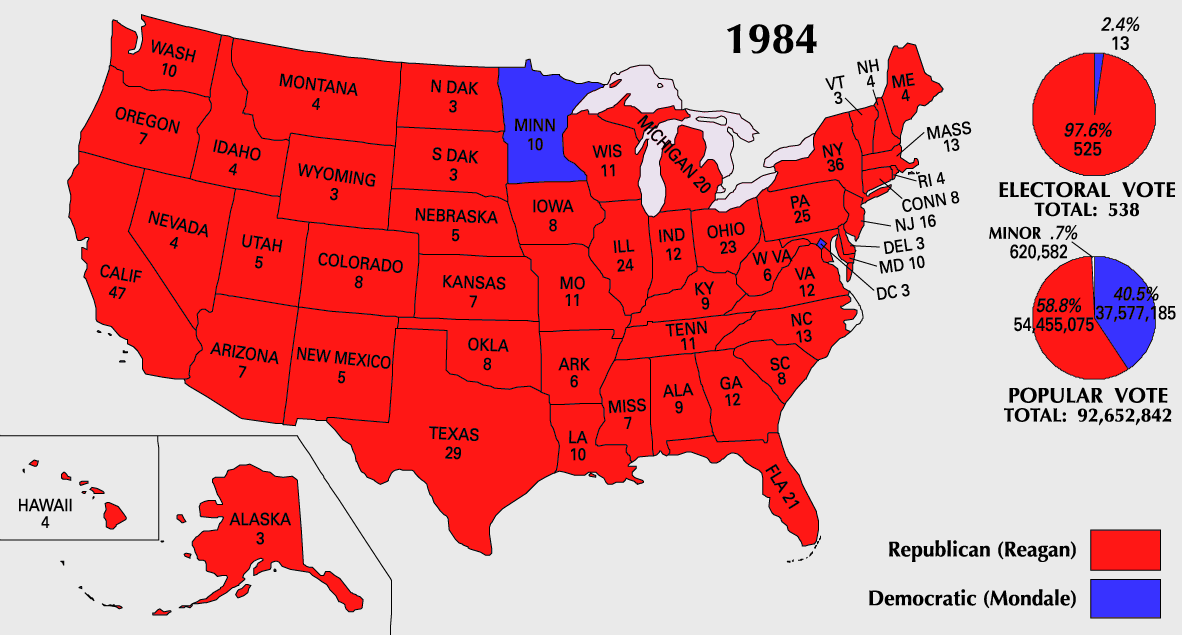
| map_caption | Presidential election results map. Red denotes states won by Reagan/Bush and blue denotes those won by Mondale/Ferraro. Numbers indicate electoral votes cast by each state and the District of Columbia. | |
| title | President | |
| before_election | Ronald Reagan | |
| before_party | Republican Party (United States) | |
| after_election | Ronald Reagan | |
| after_party | Republican Party (United States) |
| Presidential elections were held in the United States on November 6, 1984. Incumbent Republican president Ronald Reagan and his running mate, incumbent vice president George H. W. Bush, were elected to a second term in a landslide. They defeated the Democratic ticket of former vice president Walter Mondale and Congresswoman Geraldine Ferraro.
Reagan and Bush faced only token opposition in their bid for re-nomination. Mondale faced a competitive field in his bid, defeating Colorado senator Gary Hart, activist Jesse Jackson, and several other candidates in the Democratic primaries. He eventually chose New York representative Geraldine Ferraro as his running mate, the first woman to be on a major party's presidential ticket.
Reagan touted a strong economic recovery from the 1970s stagflation and the 1981–1982 recession, and the widespread perception that his presidency had overseen a revival of national confidence and prestige. At 73, Reagan was the oldest person to be nominated by a major party for president, a record that stood until 2020, when both major-party candidates were older. The Reagan campaign produced effective television advertising and deftly neutralized concerns regarding Reagan's age. Mondale criticized Reagan's supply-side economics and budget deficits. He called for the reduction of U.S. public debt, a nuclear freeze, and ratification of the Equal Rights Amendment.
Reagan won re-election in a landslide victory, carrying 525 electoral votes, 49 states, and 58.8% of the popular vote. Mondale won 13 electoral votes: 10 from his home state of Minnesota, which he won by a narrow margin of 0.18% (3,761 votes), and 3 from the District of Columbia, which has always voted overwhelmingly for the Democratic candidate. Reagan won the second-largest share of the Electoral College since 1820 (second only to Franklin D. Roosevelt in 1936 and the largest for a Republican), and the most raw electoral votes ever received by a candidate. As of 2025, Reagan is the last Republican to sweep all of New England and the only presidential nominee to win all the New England and Southern states since the effectively uncontested election of 1820. This is the most recent election in which any candidate won the popular vote by double digits and more than 500 electoral votes. It is also the most recent election in which a major party candidate failed to win at least 100 electoral votes. At the time, Reagan received the most popular votes in history and the most ever for a re-elected incumbent president until both records would be broken in 2004.
Background
Ronald Reagan entered the presidency with an unemployment rate of 7.3% and it peaked at 10.6% in December 1982. The United States had a negative gross domestic product growth in 1982. The Republicans performed poorly in the 1982 elections. Dwight D. Eisenhower, John F. Kennedy, Richard Nixon, and Jimmy Carter lost an average of 12 seats in the United States House of Representatives in their first midterm. The Republicans lost 26 seats in the House elections. The Republicans lost seven governorships as well. Reagan's approval rating fell to 35% by January 1983. Polling showed him losing to Democratic candidates, including Walter Mondale and John Glenn; however, unemployment fell to 7.7% by March 1984, and Reagan's approval rating was at 54% in January 1984. His approval rating was aided by the 1983 Beirut barracks bombings and the invasion of Grenada. Polling by CBS News and The New York Times in January 1984 showed him leading Mondale by 16%.
Nominations
Republican Party candidates
Main article: 1984 Republican Party presidential primaries
| [](ronald-reagan) | [](george-h-w-bush) | ||||
|---|---|---|---|---|---|
| ***for President*** | ***for Vice President*** | ||||
| [[File:Ronald Reagan 1985 presidential portrait (cropped).jpg | center | 200x200px]] | [[File:George H. W. Bush White House photo.jpg | center | 191x191px]] |
| 40th | |||||
| President of the United States | |||||
| (1981–1989) | 43rd | ||||
| Vice President of the United States | |||||
| (1981–1989) | |||||
| **Campaign** | |||||
| [[File:Reagan Bush '84.svg | center | 200x200px]] |
Primaries
Reagan-Bush '84, under the leadership of Ed Rollins, was organized on October 17, 1983. Reagan delayed his campaign announcement as not running would make him a lame duck whereas running would make everything he did be viewed as part of his campaign. He announced that he would seek reelection on January 29, 1984.
Vice President George H. W. Bush and U.S. Senate Majority Leader Howard Baker were considered as possible candidates only if Reagan did not run. Reagan was the first incumbent president since Richard Nixon in 1972 to face no significant opposition for renomination. The popular vote from the Republican primaries was as follows:
- Ronald Reagan (inc.): 6,484,987 (98.6%)
- Unpledged delegates: 41,411 (0.6%)
- Others: 21,643 (0.3%)
- "Ronald Reagan No": 14,047 (0.2%)
- Harold E. Stassen: 12,749 (0.2%)
- David Kelly: 360
- Gary Arnold: 252
- Benjamin Fernandez: 202
Endorsements
Reagan had received endorsements from: ;Celebrities
- Morey Amsterdam
- Pat Boone
- Ron Ely
- Cary Grant
- Charlton Heston
- Fred MacMurray
- Hugh O'Brian
- Jerry Reed
- Joan Rivers
- Arnold Schwarzenegger
- Frank Sinatra
- Jaclyn Smith
- Robert Stack
- James Stewart
- Stephanie Zimbalist
Reagan was renominated by a vote of 2,233 delegates (two delegates abstained). For the only time in American history, the vice presidential roll call was taken concurrently with the presidential roll call. Vice President George H. W. Bush was overwhelmingly renominated. This was the last time in the 20th century that the vice-presidential candidate of either major party was nominated by roll call vote.
| Presidential ballot | Vice presidential ballot | Ronald Reagan | 2,233 | George H. W. Bush | 2,231 | Abstaining | 2 | Abstaining | 2 | Jack Kemp | 1 | Jeane Kirkpatrick | 1 |
|---|
Democratic Party candidates
Main article: 1984 Democratic Party presidential primaries

| [](walter-mondale) | [](geraldine-ferraro) | ||||
|---|---|---|---|---|---|
| ***for President*** | ***for Vice President*** | ||||
| [[File:Walter Mondale 1977 vice presidential portrait (cropped).jpg | center | 200x200px]] | [[File:Geraldine Ferraro on the House Floor 1984.jpg | center | 200x200px]] |
| 42nd | |||||
| Vice President of the United States | |||||
| (1977–1981) | U.S. Representative | ||||
| from New York | |||||
| (1979–1985) | |||||
| **Campaign** | |||||
| [[File:Mondale Ferraro.svg | center | 200x200px]] |
| Gary Hart | Jesse Jackson | John Glenn | George McGovern | Reubin Askew | Fritz Hollings | Alan Cranston | ||||||||||||||
|---|---|---|---|---|---|---|---|---|---|---|---|---|---|---|---|---|---|---|---|---|
| [[File:Gary Hart 1984 (cropped).jpg | center | 120x120px]] | [[File:Jesse Jackson portrait.jpg | center | 120x120px]] | [[File:Sen. John Glenn (cropped).jpg | center | 120x120px]] | [[File:George McGovern 1970s.png | center | 120x120px]] | [[File:ReubinAskew.JPG | center | 120x120px]] | [[File:FritzHollings.jpg | center | 120x120px]] | [[File:Walter Mondale with Senator Alan Cranston - NARA - 176249 (crop 2).jpg | center | 120x120px]] |
| U.S. Senator | ||||||||||||||||||||
| from Colorado | ||||||||||||||||||||
| (1975–1987) | President of the Rainbow Coalition | |||||||||||||||||||
| from Illinois | ||||||||||||||||||||
| (1983–2023) | U.S. Senator | |||||||||||||||||||
| from Ohio | ||||||||||||||||||||
| (1974–1999) | U.S. Senator | |||||||||||||||||||
| from South Dakota | ||||||||||||||||||||
| (1963–1981) | Governor | |||||||||||||||||||
| of Florida | ||||||||||||||||||||
| (1971–1979) | U.S. Senator | |||||||||||||||||||
| from South Carolina | ||||||||||||||||||||
| (1966–2005) | U.S. Senator | |||||||||||||||||||
| from California | ||||||||||||||||||||
| (1969–1993) | ||||||||||||||||||||
| [[File:Gary Hart logo.png | frameless | 150x150px]] | [[File:Jackson 1984 campaign logo.svg | frameless | 150x150px]] | [[File:Johnglenn1984 (1).gif | frameless | 150x150px]] | [[File:McGovern1984CampaignLogo.png | frameless | 150x150px]] | [[File:Askew1984CampaignLogo.png | frameless | 150x150px]] | [[File:Hollings1984CampaignLogo.png | frameless | 150x150px]] | [[File:Cranston84Logo.png | frameless | 150x150px]] |
| Campaign | Campaign | Campaign | Campaign | Campaign | Campaign | Campaign | ||||||||||||||
| **Eliminated at Convention:** | ||||||||||||||||||||
| July 18, 1984 | ||||||||||||||||||||
| **Endorsed Mondale:** | ||||||||||||||||||||
| July 19, 1984 | ||||||||||||||||||||
| **6,504,842 votes** | **Eliminated at Convention:** | |||||||||||||||||||
| July 18, 1984 | ||||||||||||||||||||
| **Endorsed Mondale:** | ||||||||||||||||||||
| August 28, 1984 | ||||||||||||||||||||
| **3,282,431 votes** | **Withdrew:** | |||||||||||||||||||
| March 16, 1984 | ||||||||||||||||||||
| **Endorsed Mondale:** | ||||||||||||||||||||
| July 18, 1984 | ||||||||||||||||||||
| **617,909 votes** | **Withdrew:** | |||||||||||||||||||
| March 14, 1984 | ||||||||||||||||||||
| **Endorsed Mondale:** | ||||||||||||||||||||
| June 13, 1984 | ||||||||||||||||||||
| **334,801 votes** | **Withdrew:** | |||||||||||||||||||
| March 1, 1984 | ||||||||||||||||||||
| **Endorsed Mondale:** | ||||||||||||||||||||
| July 18, 1984 | ||||||||||||||||||||
| **52,759 votes** | **Withdrew:** | |||||||||||||||||||
| March 1, 1984 | ||||||||||||||||||||
| **Endorsed Hart:** | ||||||||||||||||||||
| March 9, 1984 | ||||||||||||||||||||
| **33,684 votes** | **Withdrew:** | |||||||||||||||||||
| February 29, 1984 | ||||||||||||||||||||
| **Endorsed Mondale:** | ||||||||||||||||||||
| July 18, 1984 | ||||||||||||||||||||
| **51,437 votes** |
Primaries
Only three Democratic candidates won any state primaries: Mondale, Hart, and Jackson. Initially, Massachusetts Senator Ted Kennedy, after a failed bid to win the 1980 Democratic nomination for president, was considered the de facto front-runner of the 1984 primary. However, Kennedy announced in December 1982 that he did not intend to run. Former Vice President Mondale was then viewed as the favorite to win the Democratic nomination. Mondale had the largest number of party leaders supporting him, and he had raised more money than any other candidate. However, both Jackson and Hart emerged as surprising, and troublesome, opponents.
South Carolina Senator Ernest Hollings's wit, experience, and call for a budget freeze all won him some positive attention, but his relatively conservative record alienated liberal Democrats, and he was never really noticed in a field dominated by Mondale, John Glenn, and Gary Hart. Hollings dropped out two days after losing badly in New Hampshire and endorsed Hart a week later. His disdain for his competitors was at times showcased in his comments. He notably referred to Mondale as a "lapdog", and to former astronaut Glenn as "Sky King" who was "confused in his capsule."
California Senator Alan Cranston hoped to galvanize supporters of the nuclear freeze movement that had called on the United States to halt the deployment of existing nuclear weapons and the development of new ones. Glenn and Askew hoped to capture the support of moderate and conservative Democrats. None of them shared Mondale's fundraising prowess nor Hart's or Jackson's grassroots support, however, and none won any contests.
Jackson was the second African-American (after Shirley Chisholm) to mount a nationwide campaign for the presidency, and he was the first black candidate to contend seriously. He got 3.5 million votes during the primaries, third behind Hart and Mondale. He won the primaries in Virginia, South Carolina, and Louisiana, and split Mississippi, where there were two separate contests for Democratic delegates. Through the primaries, Jackson helped confirm the black electorate's importance to the Democratic Party in the South at the time. During the campaign, however, Jackson made an off-the-cuff reference to Jews as "Hymies" and New York City as "Hymietown", for which he later apologized. Nonetheless, the remark was widely publicized, and derailed his campaign for the nomination. Jackson ended up winning 21% of the national primary vote but received only 8% of the delegates to the national convention, and he initially charged that his campaign was hurt by the same party rules that allowed Mondale to win. He also poured scorn on Mondale, saying that Hubert Humphrey was the "last significant politician out of the St. Paul-Minneapolis" area.
Hart, from Colorado, was a more serious threat to Mondale, and after winning several early primaries it looked as if he might take the nomination away from Mondale. Hart finished a surprising second in the Iowa caucuses, with 16.5% of the vote. This established him as the main rival to Mondale, effectively eliminating John Glenn, Ernest Hollings and Alan Cranston as alternatives. Hart criticized Mondale as an "old-fashioned" Great Society Democrat who symbolized "failed policies" of the past. Hart positioned himself (just as Bill Clinton would eight years later) as a younger, fresher, and more moderate Democrat who could appeal to younger voters. He emerged as a formidable candidate, winning the key New Hampshire, Ohio, and California primaries as well as several others, especially in the West. However, Hart could not overcome Mondale's financial and organizational advantages, especially among labor union leaders in the Midwest and industrial Northeast.
Hart was also badly hurt in a televised debate with Mondale during the primaries, when the former vice president used a popular television commercial slogan to ridicule Hart's vague "New Ideas" platform. Turning to Hart on camera, Mondale told Hart that whenever he heard Hart talk about his "New Ideas", he was reminded of the Wendy's fast-food slogan "Where's the beef?" The remark drew loud laughter and applause from the viewing audience and caught Hart off-guard. Hart never fully recovered from Mondale's charge that his "New Ideas" were shallow and lacking in specifics.
At a roundtable debate between the three remaining Democratic candidates moderated by Phil Donahue, Mondale and Hart got into such a heated argument over the issue of U.S. policy in Central America that Jackson had to tap his water glass on the table to help get them to stop.
Mondale gradually pulled away from Hart in the delegate count, but, as Time reported in late May, "Mondale ... has a wide lead in total delegates (1,564 to 941) ... because of his victories in the big industrial states, his support from the Democratic Establishment and the arcane provisions of delegate-selection rules that his vanguard helped draft two years ago." After the final primary in California, on June 5, which Hart won, Mondale was about 40 delegates short of the total he needed for the nomination. However, at the Democratic National Convention in San Francisco on July 16, Mondale received the overwhelming support of the unelected superdelegates from the party establishment to win the nomination.
Mondale's nomination marked the second time since the nomination of former governor of Georgia Jimmy Carter in 1976, and the fourth time since the nomination of former Representative John W. Davis in 1924, that the Democratic Party nominated a private citizen for president (i.e., someone not serving in an official governmental role at the time of the nomination and election). Mondale was the last private citizen to be nominated for president by the Democratic Party until former Secretary of State Hillary Clinton in 2016. He was also the last former vice president to be nominated for president until Joe Biden in 2020.
This race for the Democratic Party presidential nomination was the closest in two generations, and, as of 2024, it was the last occasion that a major party's race for the presidential nomination went all the way to its convention.
Endorsements
Note: These are only those endorsements that occurred during or before the primary race. Mondale had received endorsements from: ;United States House of Representatives
- Representative Jim Bates of California
- Representative Edward Boland of Massachusetts
- Representative Rick Boucher of Virginia
- Representative Joseph D. Early of Massachusetts
- Representative Barney Frank of Massachusetts
- Representative Robert García of New York
- Representative Sam Gejdenson of Connecticut
- Representative Tom Harkin of Iowa
- Representative Joe Moakley of Massachusetts
- Representative Charles B. Rangel of New York
- Representative William R. Ratchford of Connecticut
- Representative James Michael Shannon of Massachusetts ;Governors and State Constitutional officers
- New York Attorney General Robert Abrams
- Governor Mario Cuomo of New York
- Lieutenant Governor Zell Miller of Georgia ;Former officeholders
- Former President Jimmy Carter of Georgia ;Former diplomats, board members and other officials
- Former Secretary of State Dean Rusk of Georgia ;Organizations and unions
- AFL–CIO
- Alabama Democratic Conference
- National Education Association
- National Organization for Women ;Current and former state and local officials and party officeholders :Alabama
- Mayor Richard Arrington, Jr. of Birmingham :California
- Mayor and 1982 Democratic Gubernatorial nominee Tom Bradley of Los Angeles :Georgia
- State Senator Julian Bond :Illinois
- Former Alderman, President of the City Council, 1983 mayoral candidate, and Cook County Democratic Party Chairman Edward Vrdolyak of Chicago :Michigan
- Mayor Coleman Young of Detroit Hart had received endorsements from: ;United States House of Representatives
- Representative Patricia Schroeder of Colorado
- Representative Chuck Schumer of New York
- Representative and 1976 Democratic presidential candidate Mo Udall of Arizona
- Representative Henry A. Waxman of California ;Celebrities, political activists, and political commentators
- Actor and director Warren Beatty Jackson had received endorsements from: ;United States House of Representatives
- Delegate Walter E. Fauntroy of Washington, D.C. ;Former officeholders
- Former Representative and 1972 Democratic presidential candidate Shirley Chisholm of New York
- Former Governor Orval E. Faubus of Arkansas ;Current and former state and local officials and party officeholders :Alabama
- State Senator Michael Figures
- Mayor Johnny Ford of Tuskegee
- State Senator Earl Hilliard
- State Senator Hank Sanders :Georgia
- State Representative Tyrone Brookes :Illinois
- Mayor Carl Officer of East St. Louis :Indiana
- Mayor Richard G. Hatcher of Gary :Washington, D.C.
- Mayor Marion Barry of Washington, D.C. ;Organizations and unions
- Church of God in Christ
- Nation of Islam
- National Baptist Convention of America, Inc.
- National Baptist Convention, USA, Inc.
- National Farmers Alliance
- National Hispanic Leadership Conference ;Celebrities, political activists, and political commentators
- Muhammad Ali
- 1980 presidential nominee of the Citizens Party Barry Commoner Hollings had received endorsements from: ;United States Senate
- Former U.S. Senator Birch Bayh of Indiana
- Former U.S. Senator William B. Spong, Jr. of Virginia ;State Constitutional officers
- Lieutenant Governor Martha Griffiths of Michigan
- State Senator Anna Belle Clement O'Brien of Tennessee
- Lieutenant Governor Nancy Stevenson of South Carolina Glenn had received endorsements from: ;United States Senate
- Senator Sam Nunn of Georgia
- Senator Jim Sasser of Tennessee
- Senator Paul Tsongas of Massachusetts ;United States House of Representatives
- Representative Jerry Huckaby of Louisiana ;Governors and State Constitutional officers
- Lieutenant Governor Bill Baxley of Alabama
- Governor Chuck Robb of Virginia ;Current and former state and local officials and party officeholders :Georgia
- Commissioner of Agriculture Tommy Irvin :Texas
- State Representative Larry Walker ;Celebrities
- Actor and director Warren Beatty Cranston had received endorsements from: ;United States House of Representatives
- Representative William Lehman of Florida Askew had received endorsements from: ;United States Senate
- Senator Lawton Chiles of Florida ;United States House of Representatives
- Representative William V. Chappell, Jr. of Florida
- Representative Dante Fascell of Florida
- Representative Sam Gibbons of Florida
- Representative Dan Mica of Florida ;Governors and State Constitutional officers
- Governor Bob Graham of Florida ;Current and former state and local officials and party officeholders :Florida
- Mayor Eva Mack of West Palm Beach
Convention
This was the convention's nomination tally:
| Presidential ballot | Vice presidential ballot | Walter F. Mondale | 2,191 | Geraldine A. Ferraro | 3,920 | Gary W. Hart | 1,200.5 | Shirley Chisholm | 3 | Jesse L. Jackson | 465.5 | Thomas F. Eagleton | 18 | George S. McGovern | 4 | John H. Glenn | 2 | Joe Biden | 1 | Lane Kirkland | 1 |
|---|
When he made his acceptance speech at the Democratic Convention, Mondale said: "Let's tell the truth. Mr. Reagan will raise taxes, and so will I. He won't tell you. I just did." Although Mondale intended to expose Reagan as hypocritical and position himself as the honest candidate, the choice of raising taxes as a discussion point likely damaged his electoral chances.
Vice-presidential nominee
Mondale wanted to establish a highly visible precedent with his vice presidential candidate. Mondale chose U.S. Rep. Geraldine A. Ferraro from New York as his running mate, making her the first woman nominated for that position by a major party. Another reason for the nominee to "go for broke" instead of balancing the ticket was Reagan's lead in the polls. Mondale hoped to appeal to women, who were the majority of voters by 1980. In a "much criticized parade of possible Veep candidates" to his home in Minnesota, Mondale considered San Francisco Mayor Dianne Feinstein and Kentucky Governor Martha Layne Collins, also female; Los Angeles Mayor Tom Bradley, an African American; and San Antonio Mayor Henry Cisneros, a Hispanic, as other finalists for the nomination. In addition to her sex, Mondale chose Ferraro because he hoped she would attract ethnic voters with her personal background. Unsuccessful nomination candidate Jesse Jackson derided Mondale's vice-presidential screening process as a "P.R. parade of personalities", but praised Mondale for his choice, having himself pledged to name a woman to the ticket in the event he was nominated.
Mondale had wanted to choose New York Governor Mario Cuomo as his running mate, but Cuomo declined and recommended Ferraro, his protégée. Mondale might have named Massachusetts Governor Michael Dukakis as his running mate had he wanted to make a "safe" choice", while others preferred Senator Lloyd Bentsen because he would appeal to more conservative Southern voters. Nomination rival Gary Hart stated before Ferraro's selection that he would accept an invitation to run with Mondale; Hart's supporters claimed he would do better than Mondale against President Reagan, an argument undercut by a June 1984 Gallup poll that showed both men nine points behind the president.
Other parties
National Unity Party nomination
The National Unity Party was an outgrowth of John B. Anderson's presidential campaign from 1980. Anderson hoped that the party would be able to challenge the "two old parties", which he viewed as being tied to various special interest groups and incapable of responsible fiscal reform. The intention was to organize the new party in California, Oregon, Washington, Illinois, the New England states, and others where his previous candidacy had proven to have experienced the most success. The party was also eligible for $5.8 million in Federal election funds, but its qualification depended on it being on the ballot in at least ten states; however, it remained unclear if National Unity or Anderson personally was eligible to obtain the funds.
At first, Anderson opposed running, hoping that another notable politico would take the party into the 1984 election, and feared that his own candidacy might result in the party being labeled a "personality cult". However, no candidate came forward, resulting in Anderson becoming the nominee in waiting. While Anderson had found similar levels of support from the Republicans and Democrats in the 1980 election, the grand majority of the former had since switched back, resulting in the new party being supported principally by those who normally would vote Democratic, which it was feared might make him a spoiler candidate. In light of this, in addition to difficulties in getting on the ballot in his targeted states (Utah and Kentucky were the only two, neither among those he intended to prominently campaign in), Anderson ultimately declined to run.
Anderson announced that he would not run on April 26, 1984. He later endorsed Mondale and a survey of National Unity members showed that they supported his action. Anderson had hoped that the party would continue to grow and field candidates in 1986, and later a presidential candidate in 1988.
Libertarian Party nomination
- David Bergland, Party Chairman from California
- Gene Burns, talk radio host from Florida (withdrew – August 26, 1983)
- Tonie Nathan, 1972 vice presidential nominee from Oregon (declined to contest)
- Earl Ravenal, foreign policy analyst, academic, and writer from Washington, D.C.
- Mary Ruwart, research scientist from Texas
Burns was the initial frontrunner for the nomination, but withdrew, citing concerns that the party would not be able to properly finance a campaign. The remaining candidates were Bergland; Ravenal, who had worked in the Department of Defense under Robert McNamara and Clark Clifford; and Ruwart. Bergland narrowly won the presidential nomination over Ravenal. His running mate was James A. Lewis. The ticket appeared on 39 state ballots.
Citizens Party nomination
Sonia Johnson ran in the 1984 presidential election, as the presidential candidate of the Citizens Party, Pennsylvania's Consumer Party and California's Peace and Freedom Party. Johnson received 72,161 votes (0.1%) finishing fifth. Her running mate for the Citizens Party was Richard Walton and for the Peace and Freedom Party Emma Wong Mar. One of her campaign managers, Mark Dunlea, later wrote a novel about a first female president, Madame President.
Communist Party nomination
The Communist Party USA ran Gus Hall for president and Angela Davis for vice president.
General election
Polling aggregation
The following graph depicts the standing of each candidate in the poll aggregators from July 1983 to Election Day.

Polling
| Poll source | Date(s) | |||||
|---|---|---|---|---|---|---|
| administered | Ronald | |||||
| Reagan (R) | Walter | |||||
| Mondale (D) | Other | Undecided | **Election Results** | |||
| ABC-Washington Post | September 9-13, 1982 | **45%** | 38% | - | 17% | |
| Gallup | December 10-13, 1982 | 40% | **52%** | - | 8% | |
| Harris | January 2-5, 1983 | 44% | **53%** | - | 3% | |
| Gallup | February 25-28, 1983 | 41% | **47%** | 3% | 12% | |
| Harris | Mar. 17-Apr. 10, 1983 | **48%** | 46% | - | 6% | |
| ABC-Washington Post | April 8-12, 1983 | **46%** | 45% | - | 9% | |
| Gallup | Apr. 29-May 2, 1983 | 42% | **49%** | - | 9% | |
| Los Angeles Times | May 8-12, 1983 | **48%** | 40% | - | 12% | |
| ABC-Washington Post | May 11-15, 1983 | **47%** | 42% | - | 11% | |
| Gallup | May 13-16, 1983 | 42% | **47%** | - | 11% | |
| Harris | June 1-11, 1983 | **50%** | 45% | - | 5% | |
| Gallup | June 10-13, 1983 | 41% | **50%** | 3% | 6% | |
| Harris | July 14-18, 1983 | **49%** | 46% | - | 5% | |
| ABC-Washington Post | Jul. 28-Aug. 1, 1983 | 47% | **48%** | - | 5% | |
| Gallup | Jul. 29-Aug. 1, 1983 | **44%** | 42% | - | 14% | |
| Gallup | August 12-15, 1983 | **44%** | 43% | - | 13% | |
| Gallup | September 16-19, 1983 | **48%** | 44% | - | 8% | |
| ABC-Washington Post | September 22-26, 1983 | 46% | **48%** | - | 6% | |
| Gallup | October 7-10, 1983 | 44% | **50%** | - | 6% | |
| Harris | November 9-12, 1983 | **51%** | 45% | - | 4% | |
| Gallup | December 9-12, 1983 | **51%** | 44% | - | 5% | |
| ABC-Washington Post | December 9-13, 1983 | **48%** | 47% | - | 5% | |
| Gallup | January 13-16, 1984 | **48%** | 47% | - | 5% | |
| CBS/New York Times | January 14-21, 1984 | **46%** | 41% | - | 13% | |
| Gallup | February 10-13, 1984 | **53%** | 43% | - | 10% | |
| Gallup | February 10-13, 1984 | **52%** | 42% | - | 10% | |
| ABC-Washington Post | February 13-15, 1984 | **50%** | 45% | - | 5% | |
| Gallup | March 1-2, 1984 | **54%** | 42% | - | 4% | |
| Harris | March 1-3, 1984 | **55%** | 41% | - | 4% | |
| Gallup | March 2-6, 1984 | **50%** | 45% | - | 5% | |
| Harris | March 15-17, 1984 | **57%** | 37% | - | 6% | |
| Gallup | March 16-19, 1984 | **52%** | 44% | - | 4% | |
| Gallup | April 11-15, 1984 | **52%** | 44% | - | 4% | |
| Gallup | May 3-5, 1984 | **50%** | 46% | - | 4% | |
| Gallup | May 18-21, 1984 | **53%** | 43% | - | 4% | |
| Gallup | June 6-8, 1984 | **53%** | 44% | - | 3% | |
| Harris | June 7-11, 1984 | **56%** | 41% | - | 3% | |
| Gallup | June 22-25, 1984 | **56%** | 38% | - | 6% | |
| CBS/New York Times | June 23-28, 1984 | **50%** | 35% | - | 15% | |
| Gallup | Jun. 29-Jul. 2, 1984 | **51%** | 43% | - | 6% | |
| Harris | July 2-7, 1984 | **51%** | 45% | - | 4% | |
| ABC-Washington Post | July 5-8, 1984 | **51%** | 44% | - | 5% | |
| CBS/New York Times | July 12, 1984 | **53%** | 38% | - | 9% | |
| Gallup | July 13-16, 1984 | **52%** | 39% | - | 8% | |
| **July 16: Democratic Convention Begins** | ||||||
| **July 19: Democratic Convention Ends** | ||||||
| Gallup | July 19-20, 1984 | 46% | **48%** | - | 6% | |
| Harris | July 20-24, 1984 | **50%** | 48% | - | 2% | |
| Gallup | July 27-29, 1984 | **52%** | 42% | - | 6% | |
| Gallup | July 27-30, 1984 | **53%** | 41% | - | 6% | |
| ABC-Washington Post | Jul. 28-Aug. 1, 1983 | 47% | **48%** | - | 5% | |
| CBS/New York Times | August 5-9, 1984 | **49%** | 34% | - | 17% | |
| Harris | August 5-9, 1984 | **54%** | 42% | - | 6% | |
| Gallup | August 10-13, 1984 | **52%** | 41% | - | 7% | |
| **August 20: Republican Convention Begins** | ||||||
| **August 23: Republican Convention Ends** | ||||||
| Harris | August 24-25, 1984 | **55%** | 40% | - | 5% | |
| Harris | September 5-9, 1984 | **55%** | 42% | - | 3% | |
| Gallup | September 7-10, 1984 | **56%** | 37% | - | 7% | |
| ABC-Washington Post | September 6-11, 1984 | **56%** | 40% | - | 4% | |
| Gallup | September 21-24, 1984 | **58%** | 37% | - | 5% | |
| Harris | September 21-25, 1984 | **55%** | 42% | - | 3% | |
| Gallup | Sep. 28-Oct. 1, 1984 | **55%** | 39% | - | 6% | |
| CBS/New York Times | Sep. 30-Oct. 4, 1984 | **59%** | 33% | - | 7% | |
| ABC-Washington Post | October 8-9, 1984 | **56%** | 41% | - | 3% | |
| Harris | October 8-9, 1984 | **54%** | 42% | - | 4% | |
| Harris | October 13-15, 1984 | **53%** | 44% | - | 3% | |
| ABC-Washington Post | October 12-16, 1984 | **54%** | 42% | - | 4% | |
| Gallup | October 15-17, 1984 | **58%** | 38% | - | 4% | |
| Harris | October 22-23, 1984 | **56%** | 42% | - | 2% | |
| Harris | October 26-28, 1984 | **58%** | 41% | - | 1% | |
| Gallup | October 26-29, 1984 | **56%** | 39% | - | 5% | |
| Harris | October 26-29, 1984 | **58%** | 40% | - | 1% | |
| ABC/Washington Post | Oct. 29-Nov. 1, 1984 | **57%** | 39% | - | 4% | |
| Harris | Oct, 26-Nov. 1, 1984 | **57%** | 41% | - | 2% | |
| CBS/New York Times | Oct. 29-Nov. 1, 1984 | **58%** | 37% | - | 5% | |
| ABC-Washington Post | November 2-3, 1984 | **54%** | 40% | - | 6% | |
| Gallup | November 2-3, 1984 | **57%** | 39% | - | 4% | |
| Harris | November 2-3, 1984 | **55%** | 43% | - | 2% | |
| Roper | Oct. 27-Nov. 3, 1984 | **52.5%** | 42.5% | - | 5% | |
| Nov. 6, 1984 | **58.77%** | 40.56% | 0.67% | - |
Campaign

Mondale unsuccessfully tried to replace Charles Manatt with Bert Lance as chair of the DNC. Mondale made Lance the chair of his presidential campaign. However, Lance had to be removed due to controversy over his tenure as director of the Office of Management and Budget.
Reagan's lead in polling declined after the Republican convention due to its strong right-wing stances. Reagan was also criticized for a joke about bombing the Soviet Union. However, polls showed that voters believed Mondale was "too cautious and vague" and was trying to appeal to too many special interest groups.
Roger Stone and other strategists working for Reagan viewed Ohio, where unemployment was 10%, as his most vulnerable state.
Reagan made appeals to Evangelical voters during the campaign. He declared January 22, 1984, to be National Sanctity of Human Life Day. The American Coalition for Traditional Values (ACTV), under the leadership of Tim LaHaye, was tasked with maintaining Evangelical support. The ACTV planned on registering 2.5 million voters. LaHaye sent a letter to 45,000 ministers in sixteen states, under the title of the Christian Voter Program, asking for them to support Reagan's campaign and register voters.
Mondale ran a liberal campaign, supporting a nuclear freeze and the Equal Rights Amendment (ERA). He spoke against what he considered to be unfairness in Reagan's economic policies and the need to reduce federal budget deficits.
While Ferraro's choice was popular among Democratic activists, polls immediately after the announcement showed that only 22% of women were pleased about her selection, versus 18% who agreed that it was a bad idea. 60% of all voters thought that pressure from women's groups had led to Mondale's decision, versus 22% who believed that he had chosen the best available candidate. Some members of the hierarchy of the Roman Catholic Church criticized the Catholic Ferraro for being pro-choice on abortion. Already fighting an uphill battle with voters, Ferraro also faced a slew of allegations, mid-campaign, directed toward her husband, John Zaccaro. These allegations included Zaccaro's possible past involvement in organized crime, pornography distribution, and campaign contribution violations. Ferraro responded to these allegations against her husband by releasing her family tax returns to the media on August 21, 1984. However, the damage to the campaign was already done.
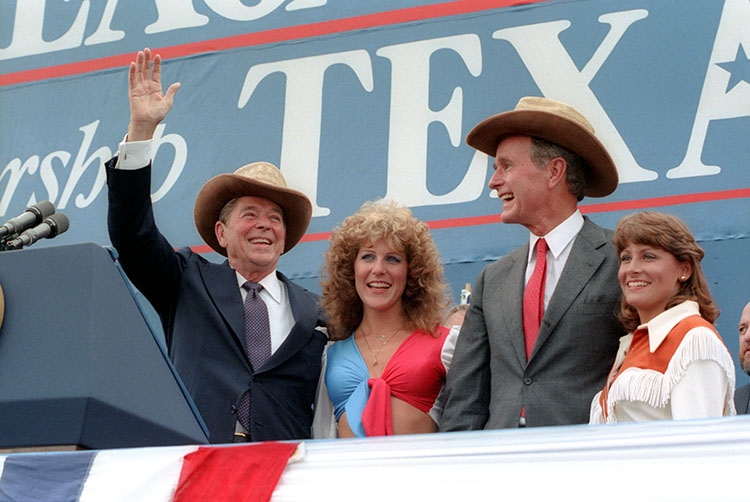
At a campaign stop in Hammonton, New Jersey, Reagan said, "America's future rests in a thousand dreams inside your hearts. It rests in the message of hope in songs of a man so many young Americans admire, New Jersey's Bruce Springsteen." The Reagan campaign briefly used "Born in the U.S.A.", a song criticizing the treatment of Vietnam War veterans (which they mistakenly thought was devoid of anti-war content and a very jingoistic patriotic rock song), as a campaign song, without permission, until Springsteen, a lifelong Democrat, requested that they stop. Two of the more memorable Reagan campaign ads were commonly known as "Morning in America" and, after the difficult first debate for the president, "Bear in the woods".
Reagan was the oldest president to have served to that time (at 73) and there were questions about his capacity to endure the grueling demands of the presidency, particularly after Reagan had a poor showing in the first 1984 United States presidential debates with Mondale on October 7. He referred to having started going to church "here in Washington", although the debate was in Louisville, Kentucky, referred to military uniforms as "wardrobe", and admitted to being "confused", among other mistakes.{{Cite episode| title=1984 Presidential Candidate Debate: President Reagan and Walter Mondale – 10/7/84
Presidential debates
Main article: 1984 United States presidential debates
There were two presidential debates and one vice presidential debate during the 1984 general election.
| No. | Date | Host | Location | Panelists | Moderator | Participants | Viewership |
|---|---|---|---|---|---|---|---|
| (millions) | |||||||
| P1 | Sunday, October 7, 1984 | The Kentucky Center | Louisville, Kentucky | James Wieghart | |||
| Diane Sawyer | |||||||
| Fred Barnes | Barbara Walters | President Ronald Reagan | |||||
| Vice President Walter Mondale | 65.1 | ||||||
| VP | Thursday, October 11, 1984 | Philadelphia Civic Center | Philadelphia | John Bashek | |||
| Jack White | |||||||
| Robert Boyd | Sander Vanocur | Vice President George H. W. Bush | |||||
| Congresswoman Geraldine Ferraro | 56.7 | ||||||
| P2 | Sunday, October 21, 1984 | Municipal Auditorium (Kansas City, Missouri) | Kansas City, Missouri | Georgie Anne Geyer | |||
| Marvin Kalb | |||||||
| Morton Kondracke | Edwin Newman | President Ronald Reagan | |||||
| Vice President Walter Mondale | 67.3 |
Results
This was the first time since 1960 that the voter turnout percentage rose relative to its predecessor. Reagan was re-elected in the November 6 election in an electoral and popular vote landslide, winning 49 states by the time the ballots were finished counting on election night at 11:34 PM in Iowa. He won a record 525 electoral votes total (of 538 possible), and received 58.8% of the popular vote; despite Ferraro's selection, 55% of women who voted did so for Reagan, and his 54 to 61% of the Catholic vote was the highest for a Republican candidate in history. Mondale's 13 electoral college votes marked the lowest total of any major presidential candidate since Alf Landon's 1936 loss to Franklin D. Roosevelt, and the fewest of any Democrat since Stephen A. Douglas claimed 12 in the 1860 election, as well as the worst for a Democrat in a two-way race. However, Democrats Alton B. Parker, James M. Cox, John W. Davis, and George McGovern did worse in the popular vote. This was the second-largest share of the Electoral College any president won since 1820, when James Monroe won a near unanimous electoral victory, and the most raw electoral votes received by a candidate. This is the last time any candidate won the popular vote by double digits.
When Reagan was asked in December 1984 what he wanted for Christmas he joked, "Well, Minnesota would have been nice". Reagan became the first Republican to ever win two terms in the White House without carrying Minnesota at least once, a feat later duplicated by George W. Bush and Donald Trump.
The election was the most recent in which the Republican candidate won every state in the Northeastern, Southern, and Pacific regions of the United States, and won at least one county in every state. The 525 electoral votes received by Reagan – the most received by a nominee in one election – added to the 489 electoral votes he achieved in 1980, and the 1 electoral vote he received in 1976, gave him the second highest total electoral votes received by any candidate who was elected to the office of president twice (1,015), and the third highest number of electoral votes received by any candidate who was elected to the office of president behind Richard Nixon's 1,040 and Franklin D. Roosevelt's 1,876 total electoral votes.
Statistical analysis
Reagan's landslide victory resulted in him winning 97.6% of electoral votes, behind only Franklin D. Roosevelt's 98.5% in 1936. However, Reagan's popular vote share was below those of elected presidents Warren G. Harding in 1920, Franklin D. Roosevelt in 1936, Lyndon B. Johnson in 1964, and Richard Nixon in 1972. His margin of victory was also lower than those for elected presidents Theodore Roosevelt in 1904, Harding in 1920, Calvin Coolidge in 1924, Franklin D. Roosevelt in 1936, Johnson in 1964, or Nixon in 1972. Reagan's percentage in each state rose from 1980, with his best performances occurring in the South and states with high third-party votes. Mondale improved upon Carter's 1980 results in 28 states, but performed worse in 22 states, 15 of which were in the South. Mondale's share of the popular vote was 0.4 percentage points lower than Carter's.
The Republicans gained seats in the concurrent U.S. House of Representatives elections and lost two seats in the concurrent U.S. Senate elections, but overall control of both chambers remained the same. Reagan underperformed Republican senatorial candidates in Alaska, Colorado, Kansas, Maine, Minnesota, New Mexico, Oregon, South Carolina, South Dakota, Virginia, and Wyoming. Jesse Helms of North Carolina and Mitch McConnell of Kentucky were the only Republican senatorial candidates who could have benefited from the coattails effect.
Psephologists attributed a factor of the Republican victory to "Reagan Democrats", millions of Democrats who voted for Reagan, as in 1980. They characterized such Reagan Democrats as southern whites and northern blue-collar workers who voted for Reagan because they credited him with the economic recovery, saw him as strong on national security issues, and perceived the Democrats as supporting the poor and minorities at the expense of the middle class. The Democratic National Committee commissioned a study after the election that came to these conclusions, but destroyed all copies of the final report, afraid that it would offend the party's key voters.
The percentage of Democrats who voted for Reagan ranged from 16 to 26% while Republicans voting for Mondale ranged from 3 to 7% according to exit polls by the Los Angeles Times, NBC, ABC/The Washington Post, and CBS News/The New York Times. One-third of people who supported Hart during the Democratic primary voted for Reagan. Polling by CBS News and The New York Times reported that 66% of Anderson voters supported Mondale while 27% supported Reagan and 61% of Carter voters supported Mondale while 25% supported Reagan. Twenty-two percent of those who did not vote in 1980 supported Reagan while 18% supported Mondale.
Reagan also benefited from a near-total collapse in the third-party vote, which dropped to just 0.67% of the popular vote, its lowest level since 1964; Bergland's campaign alone accounted for over a third of this number, while none of the other third-party candidates exceeded 0.1% of the popular vote. Reagan, who won 63% of white evangelical voters in 1980, received 80% of their votes against Mondale.
As of 2024, this marked the last election where the Republican nominee won Hawaii, Massachusetts, New York, Oregon, Rhode Island, and Washington. It was also the last election where the Republican nominee won Wisconsin until 2016, Iowa until 2004, West Virginia until 2000, the last election in which the winning candidate won by a double-digit margin in the percentage of the popular vote, and the last election where the winning candidate won by an eight-digit margin in total popular votes (10 million or more). This is the last time that the tipping point state (in this case, Michigan) was decided by a double-digit margin.
At age 73, Reagan was the oldest U.S. president to win a presidential election. Thirty-six years later, in 2020, Joe Biden surpassed this record at age 77, as did Donald Trump in 2024 at age 78. However, Reagan remains the oldest incumbent president to win a presidential election.
Electoral results
Source for the popular vote:
Source for the electoral vote:
File:1984Mov.png|Results by margin, shaded according to winning candidate's percentage of the vote File:The 1984 Presidential Election, Results by Congressional District.png|Results by congressional district, shaded according to winning candidate's percentage of the vote File:1984 United States presidential election results map by county.svg|Results by county, shaded according to winning candidate's percentage of the vote
Results by state
Sources:
| † | At-large results (Maine used the Congressional District Method) |
|---|
| Ronald Reagan | |||||||||||||||||||||||||||||||||||
|---|---|---|---|---|---|---|---|---|---|---|---|---|---|---|---|---|---|---|---|---|---|---|---|---|---|---|---|---|---|---|---|---|---|---|---|
| Republican | Walter Mondale | ||||||||||||||||||||||||||||||||||
| Democratic | David Bergland | ||||||||||||||||||||||||||||||||||
| Libertarian | Margin | Margin Swing | State total | State | electoral | ||||||||||||||||||||||||||||||
| votes | # | % | electoral | ||||||||||||||||||||||||||||||||
| votes | # | % | electoral | ||||||||||||||||||||||||||||||||
| votes | # | % | electoral | ||||||||||||||||||||||||||||||||
| votes | # | % | % | # | TOTALS: | 538 | 54,455,472 | 58.77 | 525 | 37,577,352 | 40.56 | 13 | 228,111 | 0.25 | – | 16,878,120 | 18.22 | 8.48 | 92,653,233 | ||||||||||||||||
| [Alabama](1984-united-states-presidential-election-in-alabama) | 9 | 872,849 | 60.54 | 9 | 551,899 | 38.28 | – | 9,504 | 0.66 | – | 320,950 | 22.26 | 20.96 | 1,441,713 | AL | ||||||||||||||||||||
| [Alaska](1984-united-states-presidential-election-in-alaska) | 3 | 138,377 | 66.65 | 3 | 62,007 | 29.87 | – | 6,378 | 3.07 | – | 76,370 | 36.79 | 8.85 | 207,605 | AK | ||||||||||||||||||||
| [Arizona](1984-united-states-presidential-election-in-arizona) | 7 | 681,416 | 66.42 | 7 | 333,854 | 32.54 | – | 10,585 | 1.03 | – | 347,562 | 33.88 | 1.52 | 1,025,897 | AZ | ||||||||||||||||||||
| [Arkansas](1984-united-states-presidential-election-in-arkansas) | 6 | 534,774 | 60.47 | 6 | 338,646 | 38.29 | – | 2,221 | 0.25 | – | 196,128 | 22.18 | 21.57 | 884,406 | AR | ||||||||||||||||||||
| [California](1984-united-states-presidential-election-in-california) | 47 | 5,467,009 | 57.51 | 47 | 3,922,519 | 41.27 | – | 49,951 | 0.53 | – | 1,544,490 | 16.25 | −0.53 | 9,505,423 | CA | ||||||||||||||||||||
| [Colorado](1984-united-states-presidential-election-in-colorado) | 8 | 821,818 | 63.44 | 8 | 454,974 | 35.12 | – | 11,257 | 0.87 | – | 366,844 | 28.32 | 4.32 | 1,295,381 | CO | ||||||||||||||||||||
| [Connecticut](1984-united-states-presidential-election-in-connecticut) | 8 | 890,877 | 60.73 | 8 | 569,597 | 38.83 | – | – | – | – | 321,280 | 21.90 | 12.27 | 1,466,900 | CT | ||||||||||||||||||||
| [Delaware](1984-united-states-presidential-election-in-delaware) | 3 | 152,190 | 59.78 | 3 | 101,656 | 39.93 | – | 268 | 0.11 | – | 50,534 | 19.85 | 17.52 | 254,572 | DE | ||||||||||||||||||||
| [D.C.](1984-united-states-presidential-election-in-the-district-of-columbia) | 3 | 29,009 | 13.73 | – | 180,408 | 85.38 | 3 | 279 | 0.13 | – | −151,399 | −71.66 | −10.17 | 211,288 | DC | ||||||||||||||||||||
| [Florida](1984-united-states-presidential-election-in-florida) | 21 | 2,730,350 | 65.32 | 21 | 1,448,816 | 34.66 | – | 754 | 0.02 | – | 1,281,534 | 30.66 | 13.64 | 4,180,051 | FL | ||||||||||||||||||||
| [Georgia](1984-united-states-presidential-election-in-georgia) | 12 | 1,068,722 | 60.17 | 12 | 706,628 | 39.79 | – | 151 | 0.01 | – | 362,094 | 20.39 | 35.20 | 1,776,093 | GA | ||||||||||||||||||||
| [Hawaii](1984-united-states-presidential-election-in-hawaii) | 4 | 185,050 | 55.10 | 4 | 147,154 | 43.82 | – | 2,167 | 0.65 | – | 37,896 | 11.28 | 13.18 | 335,846 | HI | ||||||||||||||||||||
| [Idaho](1984-united-states-presidential-election-in-idaho) | 4 | 297,523 | 72.36 | 4 | 108,510 | 26.39 | – | 2,823 | 0.69 | – | 189,013 | 45.97 | 4.70 | 411,144 | ID | ||||||||||||||||||||
| [Illinois](1984-united-states-presidential-election-in-illinois) | 24 | 2,707,103 | 56.17 | 24 | 2,086,499 | 43.30 | – | 10,086 | 0.21 | – | 620,604 | 12.88 | 4.95 | 4,819,088 | IL | ||||||||||||||||||||
| [Indiana](1984-united-states-presidential-election-in-indiana) | 12 | 1,377,230 | 61.67 | 12 | 841,481 | 37.68 | – | 6,741 | 0.30 | – | 535,749 | 23.99 | 5.64 | 2,233,069 | IN | ||||||||||||||||||||
| [Iowa](1984-united-states-presidential-election-in-iowa) | 8 | 703,088 | 53.27 | 8 | 605,620 | 45.89 | – | 1,844 | 0.14 | – | 97,468 | 7.39 | −5.31 | 1,319,805 | IA | ||||||||||||||||||||
| [Kansas](1984-united-states-presidential-election-in-kansas) | 7 | 677,296 | 66.27 | 7 | 333,149 | 32.60 | – | 3,329 | 0.33 | – | 344,147 | 33.67 | 9.11 | 1,021,991 | KS | ||||||||||||||||||||
| [Kentucky](1984-united-states-presidential-election-in-kentucky) | 9 | 822,782 | 60.04 | 9 | 539,589 | 39.37 | – | – | – | – | 283,193 | 20.66 | 19.20 | 1,370,461 | KY | ||||||||||||||||||||
| [Louisiana](1984-united-states-presidential-election-in-louisiana) | 10 | 1,037,299 | 60.77 | 10 | 651,586 | 38.18 | – | 1,876 | 0.11 | – | 385,713 | 22.60 | 17.15 | 1,706,822 | LA | ||||||||||||||||||||
| [Maine †](1984-united-states-presidential-election-in-maine) | 2 | 336,500 | 60.83 | 2 | 214,515 | 38.78 | – | – | – | – | 121,985 | 22.05 | 18.69 | 553,144 | ME | ||||||||||||||||||||
| [*Maine-1*](1984-united-states-presidential-election-in-maine) | *1* | *175,472* | *59.90* | *1* | *117,450* | *40.10* | – | – | – | – | *58,022* | *19.81* | *16.66* | *292,922* | *ME1* | ||||||||||||||||||||
| [*Maine-2*](1984-united-states-presidential-election-in-maine) | *1* | *161,028* | *62.39* | *1* | *97,065* | *37.61* | – | – | – | – | *63,963* | *24.78* | *21.05* | *258,093* | *ME2* | ||||||||||||||||||||
| [Maryland](1984-united-states-presidential-election-in-maryland) | 10 | 879,918 | 52.51 | 10 | 787,935 | 47.02 | – | 5,721 | 0.34 | – | 91,983 | 5.49 | 8.45 | 1,675,873 | MD | ||||||||||||||||||||
| [Massachusetts](1984-united-states-presidential-election-in-massachusetts) | 13 | 1,310,936 | 51.22 | 13 | 1,239,606 | 48.43 | – | – | – | – | 71,330 | 2.79 | 2.64 | 2,559,453 | MA | ||||||||||||||||||||
| [Michigan](1984-united-states-presidential-election-in-michigan) | 20 | 2,251,571 | 59.23 | 20 | 1,529,638 | 40.24 | – | 10,055 | 0.26 | – | 721,933 | 18.99 | 12.50 | 3,801,658 | MI | ||||||||||||||||||||
| [Minnesota](1984-united-states-presidential-election-in-minnesota) | 10 | 1,032,603 | 49.54 | – | 1,036,364 | 49.72 | 10 | 2,996 | 0.14 | – | −3,761 | −0.18 | 3.76 | 2,084,449 | MN | ||||||||||||||||||||
| [Mississippi](1984-united-states-presidential-election-in-mississippi) | 7 | 581,477 | 61.85 | 7 | 352,192 | 37.46 | – | 2,336 | 0.25 | – | 229,285 | 24.39 | 23.07 | 940,192 | MS | ||||||||||||||||||||
| [Missouri](1984-united-states-presidential-election-in-missouri) | 11 | 1,274,188 | 60.02 | 11 | 848,583 | 39.98 | – | – | – | – | 425,605 | 20.05 | 13.24 | 2,122,771 | MO | ||||||||||||||||||||
| [Montana](1984-united-states-presidential-election-in-montana) | 4 | 232,450 | 60.47 | 4 | 146,742 | 38.18 | – | 5,185 | 1.35 | – | 85,708 | 22.30 | −2.09 | 384,377 | MT | ||||||||||||||||||||
| [Nebraska](1984-united-states-presidential-election-in-nebraska) | 5 | 460,054 | 70.55 | 5 | 187,866 | 28.81 | – | 2,079 | 0.32 | – | 272,188 | 41.74 | 2.25 | 652,090 | NE | ||||||||||||||||||||
| [Nevada](1984-united-states-presidential-election-in-nevada) | 4 | 188,770 | 65.85 | 4 | 91,655 | 31.97 | – | 2,292 | 0.80 | – | 97,115 | 33.88 | −2.26 | 286,667 | NV | ||||||||||||||||||||
| [New Hampshire](1984-united-states-presidential-election-in-new-hampshire) | 4 | 267,051 | 68.66 | 4 | 120,395 | 30.95 | – | 735 | 0.19 | – | 146,656 | 37.71 | 8.32 | 388,954 | NH | ||||||||||||||||||||
| [New Jersey](1984-united-states-presidential-election-in-new-jersey) | 16 | 1,933,630 | 60.09 | 16 | 1,261,323 | 39.20 | – | 6,416 | 0.20 | – | 672,307 | 20.89 | 7.47 | 3,217,862 | NJ | ||||||||||||||||||||
| [New Mexico](1984-united-states-presidential-election-in-new-mexico) | 5 | 307,101 | 59.70 | 5 | 201,769 | 39.23 | – | 4,459 | 0.87 | – | 105,332 | 20.48 | 2.30 | 514,370 | NM | ||||||||||||||||||||
| [New York](1984-united-states-presidential-election-in-new-york) | 36 | 3,664,763 | 53.84 | 36 | 3,119,609 | 45.83 | – | 11,949 | 0.18 | – | 545,154 | 8.01 | 5.34 | 6,806,810 | NY | ||||||||||||||||||||
| [North Carolina](1984-united-states-presidential-election-in-north-carolina) | 13 | 1,346,481 | 61.90 | 13 | 824,287 | 37.89 | – | 3,794 | 0.17 | – | 522,194 | 24.00 | 21.88 | 2,175,361 | NC | ||||||||||||||||||||
| [North Dakota](1984-united-states-presidential-election-in-north-dakota) | 3 | 200,336 | 64.84 | 3 | 104,429 | 33.80 | – | 703 | 0.23 | – | 95,907 | 31.04 | −6.93 | 308,971 | ND | ||||||||||||||||||||
| [Ohio](1984-united-states-presidential-election-in-ohio) | 23 | 2,678,560 | 58.90 | 23 | 1,825,440 | 40.14 | – | 5,886 | 0.13 | – | 853,120 | 18.76 | 8.16 | 4,547,619 | OH | ||||||||||||||||||||
| [Oklahoma](1984-united-states-presidential-election-in-oklahoma) | 8 | 861,530 | 68.61 | 8 | 385,080 | 30.67 | – | 9,066 | 0.72 | – | 476,450 | 37.94 | 12.41 | 1,255,676 | OK | ||||||||||||||||||||
| [Oregon](1984-united-states-presidential-election-in-oregon) | 7 | 685,700 | 55.91 | 7 | 536,479 | 43.74 | – | – | – | – | 149,221 | 12.17 | 2.51 | 1,226,527 | OR | ||||||||||||||||||||
| [Pennsylvania](1984-united-states-presidential-election-in-pennsylvania) | 25 | 2,584,323 | 53.34 | 25 | 2,228,131 | 45.99 | – | 6,982 | 0.14 | – | 356,192 | 7.35 | 0.24 | 4,844,903 | PA | ||||||||||||||||||||
| [Rhode Island](1984-united-states-presidential-election-in-rhode-island) | 4 | 212,080 | 51.66 | 4 | 197,106 | 48.02 | – | 277 | 0.07 | – | 14,974 | 3.65 | 14.12 | 410,492 | RI | ||||||||||||||||||||
| [South Carolina](1984-united-states-presidential-election-in-south-carolina) | 8 | 615,539 | 63.55 | 8 | 344,470 | 35.57 | – | 4,360 | 0.45 | – | 271,069 | 27.99 | 26.46 | 968,540 | SC | ||||||||||||||||||||
| [South Dakota](1984-united-states-presidential-election-in-south-dakota) | 3 | 200,267 | 63.00 | 3 | 116,113 | 36.53 | – | – | – | – | 84,154 | 26.47 | −2.36 | 317,867 | SD | ||||||||||||||||||||
| [Tennessee](1984-united-states-presidential-election-in-tennessee) | 11 | 990,212 | 57.84 | 11 | 711,714 | 41.57 | – | 3,072 | 0.18 | – | 278,498 | 16.27 | 15.98 | 1,711,993 | TN | ||||||||||||||||||||
| [Texas](1984-united-states-presidential-election-in-texas) | 29 | 3,433,428 | 63.61 | 29 | 1,949,276 | 36.11 | – | – | – | – | 1,484,152 | 27.50 | 13.64 | 5,397,571 | TX | ||||||||||||||||||||
| [Utah](1984-united-states-presidential-election-in-utah) | 5 | 469,105 | 74.50 | 5 | 155,369 | 24.68 | – | 2,447 | 0.39 | – | 313,736 | 49.83 | −2.37 | 629,656 | UT | ||||||||||||||||||||
| [Vermont](1984-united-states-presidential-election-in-vermont) | 3 | 135,865 | 57.92 | 3 | 95,730 | 40.81 | – | 1,002 | 0.43 | – | 40,135 | 17.11 | 11.15 | 234,561 | VT | ||||||||||||||||||||
| [Virginia](1984-united-states-presidential-election-in-virginia) | 12 | 1,337,078 | 62.29 | 12 | 796,250 | 37.09 | – | – | – | – | 540,828 | 25.19 | 12.47 | 2,146,635 | VA | ||||||||||||||||||||
| [Washington](1984-united-states-presidential-election-in-washington-state) | 10 | 1,051,670 | 55.82 | 10 | 807,352 | 42.86 | – | 8,844 | 0.47 | – | 244,318 | 12.97 | 0.63 | 1,883,910 | WA | ||||||||||||||||||||
| [West Virginia](1984-united-states-presidential-election-in-west-virginia) | 6 | 405,483 | 55.11 | 6 | 328,125 | 44.60 | – | – | – | – | 77,358 | 10.51 | 15.02 | 735,742 | WV | ||||||||||||||||||||
| [Wisconsin](1984-united-states-presidential-election-in-wisconsin) | 11 | 1,198,800 | 54.19 | 11 | 995,847 | 45.02 | – | 4,884 | 0.22 | – | 202,953 | 9.18 | 4.46 | 2,212,016 | WI | ||||||||||||||||||||
| [Wyoming](1984-united-states-presidential-election-in-wyoming) | 3 | 133,241 | 70.51 | 3 | 53,370 | 28.24 | – | 2,357 | 1.25 | – | 79,871 | 42.27 | 7.60 | 188,968 | WY | ||||||||||||||||||||
| US |
Maine allowed its electoral votes to be split between candidates. Two electoral votes were awarded to the winner of the statewide race and one electoral vote to the winner of each congressional district. Reagan won all four votes.
States that flipped from Democratic to Republican
- Georgia
- Hawaii
- Maryland
- Rhode Island
- West Virginia
Close states
Margin of victory less than 1% (10 electoral votes):
- Minnesota, 0.18% (3,761 votes)
Margin of victory more than 1%, but less than 5% (17 electoral votes):
- Massachusetts, 2.79% (71,330 votes)
- Rhode Island, 3.65% (14,974 votes)
Margin of victory more than 5%, but less than 10% (90 electoral votes):
- Maryland, 5.49% (91,983 votes)
- Pennsylvania, 7.35% (356,192 votes)
- Iowa, 7.38% (97,468 votes)
- New York, 8.01% (545,154 votes)
- Wisconsin, 9.17% (202,953 votes)
Tipping point:
- Michigan, 18.99% (721,933 votes)
Counties
Counties with highest percent of vote (Republican)
- Madison County, Idaho 92.88%
- Hansford County, Texas 89.38%
- Ochiltree County, Texas 89.15%
- Grant County, Nebraska 88.45%
- Blaine County, Nebraska 88.32%
Counties with highest percent of vote (Democratic)
- Washington, D.C. 85.38%
- Macon County, Alabama 82.71%
- Shannon County, South Dakota 81.41%
- Jefferson County, Mississippi 77.94%
- Hancock County, Georgia 76.61%
Voter demographics
| The 1984 presidential vote by demographic subgroup | Demographic subgroup | Mondale | Reagan | % of | ||||||||
|---|---|---|---|---|---|---|---|---|---|---|---|---|
| total vote | Ideology | Party | Gender | Race | Age | Family income | Region | Union households | ||||
| Total vote | 41 | 59 | 100 | |||||||||
| Moderates | 46 | 54 | 42 | |||||||||
| Liberals | 71 | 29 | 16 | |||||||||
| Conservatives | 18 | 82 | 33 | |||||||||
| Democrats | 74 | 26 | 38 | |||||||||
| Republicans | 7 | 93 | 35 | |||||||||
| Independents | 36 | 62 | 26 | |||||||||
| Men | 38 | 62 | 47 | |||||||||
| Women | 42 | 58 | 53 | |||||||||
| White | 34 | 66 | 86 | |||||||||
| Black | 91 | 9 | 10 | |||||||||
| Hispanic | 66 | 34 | 3 | |||||||||
| 18–24 years old | 39 | 61 | 11 | |||||||||
| 25–29 years old | 43 | 57 | 12 | |||||||||
| 30–49 years old | 42 | 58 | 34 | |||||||||
| 50–64 years old | 39 | 61 | 23 | |||||||||
| 65 and older | 36 | 64 | 19 | |||||||||
| Under $12,500 | 54 | 46 | 15 | |||||||||
| $12,500–25,000 | 42 | 58 | 27 | |||||||||
| $25,000–35,000 | 40 | 60 | 20 | |||||||||
| $35,000–50,000 | 32 | 68 | 17 | |||||||||
| Over $50,000 | 31 | 69 | 12 | |||||||||
| East | 46 | 53 | 26 | |||||||||
| Midwest | 39 | 61 | 30 | |||||||||
| South | 37 | 63 | 27 | |||||||||
| West | 38 | 62 | 17 | |||||||||
| Union | 54 | 46 | 26 |
Source: CBS News and The New York Times exit poll from the Roper Center for Public Opinion Research (9,174 surveyed)
| The 1984 presidential vote by important political issues | Important | Mondale | Reagan | % of | |||||||
|---|---|---|---|---|---|---|---|---|---|---|---|
| checked | Economy | Arms control | Defense | Federal deficit reduction | Fairness towards poor | Abortion | Policy towards Central America | ||||
| Yes | 25 | 75 | 40 | ||||||||
| No | 53 | 47 | 60 | ||||||||
| Yes | 65 | 35 | 29 | ||||||||
| No | 33 | 67 | 71 | ||||||||
| Yes | 8 | 92 | 25 | ||||||||
| No | 53 | 47 | 75 | ||||||||
| Yes | 47 | 53 | 23 | ||||||||
| No | 40 | 60 | 77 | ||||||||
| Yes | 82 | 18 | 21 | ||||||||
| No | 31 | 69 | 79 | ||||||||
| Yes | 27 | 73 | 7 | ||||||||
| No | 43 | 57 | 93 | ||||||||
| Yes | 61 | 39 | 4 | ||||||||
| No | 41 | 59 | 96 |
Notable expressions and phrases
- Where's the beef?: A slogan used by Wendy's to suggest that their competitors have smaller portions of meat in their sandwiches, but used in the Democratic primaries by Mondale to criticize Gary Hart's positions as lacking substance.
- Morning in America: Slogan used by the Reagan campaign.
References
Notes
Works cited
Books
Journals
References
- "National General Election VEP Turnout Rates, 1789-Present". [[CQ Press]].
- Raines, Howell. (November 7, 1984). "Reagan Wins By a Landslide, Sweeping at Least 48 States; G.O.P. Gains Strength in House". [[The New York Times]].
- Cannon, Lou. (October 4, 2016). "Ronald Reagan: Campaigns and Elections". [[Miller Center of Public Affairs]].
- Murse, Tom. (January 28, 2019). "The Most Lopsided Presidential Elections in U.S. History: How a Landslide is Measured". ThoughtCo.
- (2010). "Guide to U.S. Elections". [[CQ Press]].
- (August 8, 1984). "Campaign '84;NEWLN:Conservative stars come out of the closet for Reagan".
- (July 20, 1984). "Hart Promises Mondale Full Support". Oakland Tribune.
- (August 29, 1984). "Jesse Jackson Endorses Mondale; Maynard Jackson will be adviser". The Atlanta Constitution.
- (July 19, 1984). "Glenn, Luken Cast Votes For Mondale". The Cincinnati Enquirer.
- (June 14, 1984). "McGovern Backs Mondale". Argus-Leader.
- (July 19, 1984). "'Different Democrat' Hears Last Hurrah Of Campaign". The Miami Herald.
- (March 10, 1984). "'A New Sense of Direction'". The Greenville News.
- (July 19, 1984). "Hart Picked Up Early California Support". The Napa Valley Register.
- (December 1, 1982). "KENNEDY REPORTED DECLINING TO SEEK PRESIDENCY IN 1984". [[The New York Times]].
- Morganthau, Tom. (December 12, 1982). "Why Kennedy Withdrew From 1984 Race".
- Skipper, John C.. (January 13, 2010). "The Iowa Caucuses: First Tests of Presidential Aspiration, 1972–2008". McFarland.
- Larry J. Sabato's Feeding Frenzy. (July 21, 1998). "Jesse Jackson's 'Hymietown' Remark – 1984". Washington Post.
- (July 2, 1984). "Trying to Win the Peace". Time Magazine.
- Butterfield, Fox. (February 22, 1984). "HART, AFTER IOWA, SEES A 2-MAN RACE (Published 1984)". The New York Times.
- (May 16, 2008). "A Wild Ride to the End – TIME".
- Marcus, Ruth. (January 16, 2008). "Ruth Marcus – Parsing Tsunami Tuesday". [[The Washington Post]].
- (March 3, 1984). "Six California House Members Switch: Cranston To Mondale". The Napa Valley Register.
- (March 27, 1984). "No winner in Lee, WIse caucuses". Kingsport Times-News.
- Lynn, Frank. (January 15, 1984). "State Drawing Presidential Hopefuls State". [[The New York Times]].
- (January 24, 1984). "Democrats Choose Delegates". [[The New York Times]].
- Hyde, John. (January 26, 1984). "Harkin, Bedell, Smith win seats at convention". [[The Des Moines Register]].
- Moses, Charles T.. (April 1, 1984). "Primary Called Test of Black Voting Power". Newsday (Suffolk Edition).
- Raines, Howell. (January 29, 1984). "Southern Primaries Could Spell Trouble For Glenn". The New York Times.
- Raines, Howell. (October 20, 1983). "Democrats Pursue Southern Support". The New York Times.
- Boyd, Gerald M.. (December 11, 1983). "Alabama Blacks' Group Decides To Back Mondale-Jackson Ticket". The New York Times.
- Raines, Howell. (December 12, 1983). "Mondale had good '83 – now the real test begins". The New York Times.
- Smith, Hedrick. (February 25, 1984). "Experts Say The South Looks Blead For Glenn". The New York Times.
- HOWELL RAINES. (November 4, 1983). "A Provocative Candidate". The New York Times.
- Gailey, Phil. (December 5, 1983). "Political Potholes Ahead For Traveling Democrats". The New York Times.
- Raines, Howell. (October 19, 1983). "Politics – Hart'S Tactics Askew'S Train And Film Anxieties". The New York Times.
- Rainie, Harrison. (June 7, 1984). "Urge Hart to pack it in for unity". Daily News.
- HOWELL RAINES. (February 26, 1984). "8 DEMOCRATS GIRD FOR KEY PRIMARY IN NEW HAMPSHIRE". The New York Times.
- (March 8, 1984). "Senator Accuses Reagan of Using Divisive Issues". [[The Los Angeles Times]].
- Plotz, David. (August 20, 1999). "Warren Beatty".
- Smothers, Ronald. (November 1, 1983). "Democratic Candidates Welcome Jackson Bid For Nomination". The New York Times.
- Smothers, Ronald. (November 4, 1983). "Jackson Declares Formal Candidacy". The New York Times.
- (March 10, 1984). "Orval Faubus Supporting Jackson". The Charlotte Observer.
- Smothers, Ronald. (December 28, 1983). "Jackson Wins Attention But Strength Is Unclear". The New York Times.
- Ronald Smothers. (March 12, 1984). "Alabama Black Leaders Are Urging Pragmatism In Supporting Mondale". The New York Times.
- Smothers, Ronald. (January 15, 1984). "Jackson Attracts Crowds, But Planning Is Erratic". The New York Times.
- Canerdy, Beverly. (March 12, 1984). "D.C. mayor stumps for Jackson". Clarion-Ledger.
- Boyd, Gerald M.. (February 14, 1984). "Black Churches A Mainspring Of Jackson's Efforts". The New York Times.
- Raines, Howell. (December 2, 1983). "Jackson Gets Support, Apparently Without Poll Of The Group". The New York Times.
- (October 3, 1984). "CAMPAIGN NOTES; Muhammad Ali Switches His Support to Reagan". The New York Times.
- (August 30, 1983). "Barry Commoner Vows To Back Jesse Jackson". [[The New York Times]].
- "South Carolina Political Collections – University Libraries | University of South Carolina".
- Tom Sherwood. (December 15, 1983). "Del. Pickett to Head Mondale's Va. Race". [[The Washington Post]].
- (February 10, 1984). "Winchester Star Newspaper Archives February 10, 1984 Page 18".
- "Anna Belle Clement O'Brien passes away at 86".
- (March 11, 1984). "Glenn camp can't afford loss in South". The Morning Call.
- Robinson, Walter V.. (January 21, 1984). "Glenn says a Mondale comment 'goes too far'". [[The Boston Globe]].
- (June 15, 1983). "Glenn seeking to turn a hero's image into votes". [[The New York Times]].
- (August 26, 1984). "Ferraro collects pledges of support from state's major political groups". The Montgomery Advertiser.
- (September 25, 1984). "Durrette criticizes Robb for endorsing Mondale". Kingsport Times-News.
- (March 2, 1984). "Askew Ends Presidential Campaign". [[The Miami Herald]].
- (February 7, 1984). "ASKEW TELLS MOBILE HE 'FEELS GOOD' ABOUT RACE". [[The New York Times]].
- Howell Raines. (July 20, 1984). "Party Nominates Rep. Ferraro; Mondale, in Acceptance, Vows Fair Policies and Deficit Cut". [[The New York Times]].
- (July 23, 1984). "Geraldine Ferraro: A Break with Tradition".
- Blumenthal, Ralph. (September 8, 2008). "When the Press Vetted Geraldine Ferraro". The New York Times.
- Buckley, Cara. (March 28, 2011). "Of Ferraro's Roles in Many Arenas, a Favorite: Gerry From Queens". The New York Times.
- ''The New York Times'', June 11, 1983
- ''The New York Times'', November 9, 1983
- ''The New York Times'', April 20, 1984
- ''The New York Times'', April 27, 1984
- ''The New York Times'', May 4, 1984
- ''The New York Times'', August 28, 1984
- "Former Congressman John Anderson Runs for President Again in 1984". Archives.nbclearn.com.
- (April 27, 1984). "Anderson Won't Join Race for Presidency". [[The Burlington Free Press]].
- (October 31, 1984). "Anderson in New YorkTo Support Mondale". [[The New York Times]].
- Broder, David. (August 27, 1984). "Anderson To Endorse Mondale". [[The Washington Post]].
- (August 27, 1983). "Candidate withdraws from Race".
- (September 17, 1982). "Reagan Should Not Seek Second Term, Majority Believes". The Washington Post.
- Gallup, George. (1983). "The Gallup Poll: Public Opinion, 1983".
- (Jan 24, 1983). "Survey Indicated Mondale Led Reagan In 1984 Preference Test". Omaha World-Herald.
- Gallup, George. (1983). "The Gallup Poll: Public Opinion, 1983".
- (April 28, 1983). "Poll: President Pulls Even With Mondale, Glenn". The Lincoln Star.
- (April 15, 1983). "Reagan Gaining In The Polls". Bennington Banner.
- Gallup, George. (1983). "The Gallup Poll: Public Opinion, 1983".
- (May 19, 1983). "Glenn Eclipses Mondale In Gallup Survey". The Los Angeles Times.
- Gallup, George. (1983). "The Gallup Poll: Public Opinion, 1983".
- (July 11, 1983). "Voters In Poll Split On Reagan Running In 1984". Omaha World-Herald.
- Gallup, George. (1983). "The Gallup Poll: Public Opinion, 1983".
- (August 1, 1983). "Poll: Reagan Vs. Mondale, Glenn 'Too Close To Call'". Omaha World-Herald.
- (August 8, 1983). "Polls Show Glenn Tops Reagan, Mondale Close". The Knoxville News-Sentinel.
- Gallup, George. (1983). "The Gallup Poll: Public Opinion, 1983".
- Gallup, George. (1983). "The Gallup Poll: Public Opinion, 1983".
- Gallup, George. (1983). "The Gallup Poll: Public Opinion, 1983".
- (September 29, 1983). "McGovern's Entry Aids Glenn, Harms Mondale". The Washington Post.
- (December 15, 1983). "Anderson Candidacy Helps Reagan's Chances". The Californian.
- Gallup, George. (1984). "The Gallup Poll: Public Opinion, 1984".
- (December 17, 1983). "Reagan, Mondale Now Tied". The Atlanta Constitution.
- Gallup, George. (1984). "The Gallup Poll: Public Opinion, 1984".
- (January 25, 1984). "Reagan, Mondale Get Support; Glenn Slips In Poll". The Idaho Statesman.
- Gallup, George. (1984). "The Gallup Poll: Public Opinion, 1984".
- Gallup, George. (1984). "The Gallup Poll: Public Opinion, 1984".
- (February 17, 1984). "Majority of Democrats Back Mondale in Poll". The Washington Post.
- Gallup, George. (1984). "The Gallup Poll: Public Opinion, 1984".
- (March 5, 1984). "Hart Moves Ahead In Preference Poll". Fremont Tribune.
- Gallup, George. (1984). "The Gallup Poll: Public Opinion, 1984".
- (March 22, 1984). "Poll: Hart Has Best Chance Against Reagan". The Atlanta Journal.
- Gallup, George. (1984). "The Gallup Poll: Public Opinion, 1984".
- Gallup, George. (1984). "The Gallup Poll: Public Opinion, 1984".
- Gallup, George. (1984). "The Gallup Poll: Public Opinion, 1984".
- (June 17, 1984). "Hart Leads Reagan, Reagan Leads Mondale". Pacific Daily News.
- (July 3, 1984). "Poll Shows Democrats Favor Hart For Running Mate". The Columbian.
- Gallup, George. (1984). "The Gallup Poll: Public Opinion, 1984".
- (June 17, 1984). "Early Survey Shows Ferraro Helps Mondale". Poughkeepsie Journal.
- (July 11, 1984). "Reagan's Lead Cut". The Washington Post.
- (July 14, 1984). "Public Unsure Of Ms. Ferraro, Poll Says". The Daily Progress.
- Gallup, George. (1984). "The Gallup Poll: Public Opinion, 1984".
- (July 31, 1984). "Harris Poll: Reagan's Lead Shrinks". The Pensacola News.
- Gallup, George. (1984). "The Gallup Poll: Public Opinion, 1984".
- (August 8, 1983). "Perceptions". The Washington Post.
- (August 14, 1984). "Poll: Ferraro Fails To Boost Mondale". The Orlando Sentinel.
- (August 16, 1984). "Reagan Has Recaptured Solid Lead Over Mondale". News Herald.
- Gallup, George. (1984). "The Gallup Poll: Public Opinion, 1984".
- (August 28, 1984). "Convention No Big Boost For Reagan's Campaign". Chillicothe Gazette.
- (September 13, 1984). "Latest Harris Poll Shows Reagan Holding His Lead". Wausau Daily Herald.
- Gallup, George. (1984). "The Gallup Poll: Public Opinion, 1984".
- (September 12, 1984). "Poll Shows Reagan Now Leads Mondale By 16 Points, 56-40". The Washington Post.
- Gallup, George. (1984). "The Gallup Poll: Public Opinion, 1984".
- (October 2, 1984). "Reagan Keeps 13-Point Lead On Mondale". News Herald.
- Gallup, George. (1984). "The Gallup Poll: Public Opinion, 1984".
- (October 7, 1984). "Reagan Leads, 54-31, In Survey". The Boston Globe.
- (October 10, 1984). "Mondale's Ratings Improve". The Washington Post.
- (October 13, 1984). "Mondale Creeps To Within 12 Points Of Reagan". The Californian.
- (October 13, 1984). "Reagan, Mondale Look Toward Debate". The Marshall News Messenger.
- (October 24, 1984). "Few Votes Shift After 2nd Debate". The Washington Post.
- Gallup, George. (1984). "The Gallup Poll: Public Opinion, 1984".
- (October 25, 1984). "Reagan's Lead Climbs". Poughkeepsie Journal.
- (October 29, 1984). "Reagan Leads In Polls". Lancaster New Era.
- Gallup, George. (1984). "The Gallup Poll: Public Opinion, 1984".
- (October 29, 1984). "Harris Poll Shows Big Reagan Lead". The Boston Globe.
- (November 5, 1984). "Polls Give Reagan At Least 12-Point Lead Day Before". Longview News-Journal.
- (November 2, 1984). "Poll: Reagan's Big Lead Narrows". The Journal Times.
- (September 17, 1983). "Mondale Improves Standing in Polls". The Washington Post.
- Gallup, George. (1984). "The Gallup Poll: Public Opinion, 1984".
- Chao, Eveline. (July 8, 2015). "35 Musicians Who Told Politicians to Stop Using Their Songs".
- [[Peter Baker (journalist). Baker, Peter]] and [[Susan Glasser]], ''The Man Who Ran Washington: The Life and Times of James A. Baker III'' (Doubleday, NY: 2020), pp. 238-243.
- (April 27, 2009). "1984 Presidential Candidate Debate: President Reagan and Walter Mondale – 10/21/84". The Ronald Reagan Presidential Foundation.
- Mondale, Walter. "1984: There You Go Again... Again / Debating Our Destiny Transcript". PBS Newshour.
- "CPD: 1984 Debates".
- Martin, Douglas. (March 27, 2011). "Geraldine A. Ferraro, First Woman on Major Party Ticket, Dies at 75". The New York Times.
- Prendergast, William B.. (1999). "The Catholic vote in American politics". Georgetown University Press.
- (December 4, 1984). "Minnesota heads Reagan's wish list". The Tuscaloosa News.
- "Historical U.S. Presidential Elections 1789–2016".
- {{Leip PV source 2. (1984)
- {{National Archives EV source. (1984)
- "1984 Presidential General Election Data – National".
- (September 1, 1989). "The Almanac of American Politics". Collier Books.
- "POPULAR VOTE AND ELECTORAL COLLEGE VOTE BY STATE". Psephos.adam-carr.net.
- "Dave Leip's Atlas of U.S. Presidential Elections – County Data". Uselectionatlas.org.
- "How Groups Voted in 1984".
This article was imported from Wikipedia and is available under the Creative Commons Attribution-ShareAlike 4.0 License. Content has been adapted to SurfDoc format. Original contributors can be found on the article history page.
Ask Mako anything about 1984 United States presidential election — get instant answers, deeper analysis, and related topics.
Research with MakoFree with your Surf account
Create a free account to save articles, ask Mako questions, and organize your research.
Sign up freeThis content may have been generated or modified by AI. CloudSurf Software LLC is not responsible for the accuracy, completeness, or reliability of AI-generated content. Always verify important information from primary sources.
Report