From Surf Wiki (app.surf) — the open knowledge base
1972 United States presidential election
none

none
| Field | Value |
|---|---|
| election_name | 1972 United States presidential election |
| country | United States |
| flag_year | 1961 |
| type | presidential |
| opinion_polls | Nationwide opinion polling for the 1972 United States presidential election |
| previous_election | 1968 United States presidential election |
| previous_year | 1968 |
| election_date | November 7, 1972 |
| next_election | 1976 United States presidential election |
| next_year | 1976 |
| votes_for_election | 538 members of the Electoral College |
| needed_votes | 270 electoral |
| turnout | 56.2% 6.3 pp |
| image_size | 200x200px |
| image1 | Richard_Nixon_presidential_portrait_(1).jpg |
| nominee1 | **Richard Nixon** |
| party1 | Republican Party (United States) |
| home_state1 | California |
| running_mate1 | **Spiro Agnew** |
| electoral_vote1 | **520** |
| states_carried1 | **49** |
| popular_vote1 | **47,168,711** |
| percentage1 | **** |
| image2 | George McGovern (D-SD) (3x4-1).jpg |
| nominee2 | George McGovern |
| party2 | Democratic Party (United States) |
| home_state2 | South Dakota |
| running_mate2 | Sargent Shriver |
| (replacing Thomas Eagleton) | |
| electoral_vote2 | 17 |
| states_carried2 | 1 + DC |
| popular_vote2 | 29,173,222 |
| percentage2 | |
| map_size | 350px |
| map | |
| map_caption | Presidential election results map. Red denotes states won by Nixon/Agnew and blue denotes those won by McGovern/Shriver. Gold represents the sole electoral vote for Hospers/Nathan by a Virginia faithless elector. Numbers indicate electoral votes cast by each state and the District of Columbia. |
| title | President |
| before_election | Richard Nixon |
| before_party | Republican Party (United States) |
| after_election | Richard Nixon |
| after_party | Republican Party (United States) |
(replacing Thomas Eagleton) Presidential elections were held in the United States on November 7, 1972. Incumbent Republican President Richard Nixon and his running mate, incumbent Vice President Spiro Agnew, were elected to a second term in a landslide. They defeated the Democratic ticket of Senator George McGovern and former ambassador to France Sargent Shriver. With 60.7% of the popular vote, Nixon won the largest share of the popular vote for the Republican Party in any presidential election.
Nixon swept aside challenges from two Republican representatives in the Republican primaries to win renomination. McGovern, who had played a significant role in changing the Democratic nomination system after the 1968 U.S. presidential election, mobilized the anti-Vietnam War movement and other liberal supporters to win the Democratic nomination. Among the candidates he defeated were early front-runner Edmund Muskie, 1968 nominee Hubert Humphrey, governor George Wallace, and representative Shirley Chisholm.
Nixon emphasized the strong economy and his success in foreign affairs, while McGovern ran on a platform calling for an immediate end to the Vietnam War and the institution of a guaranteed minimum income. Nixon maintained a large lead in polling. McGovern's general election campaign was damaged by the perception that his platform was radical, and by revelations that his initial running mate, Thomas Eagleton, had undergone electroconvulsive therapy as a treatment for depression; Eagleton was replaced by Sargent Shriver after only nineteen days on the ticket. In June, Nixon's reelection committee broke into the Watergate complex to wiretap the Democratic National Committee's headquarters; early news of the incident had little impact on the success of Nixon's campaign, but further damaging revelations in the ensuing Watergate scandal soon engulfed his second term.
Nixon won the election in a landslide victory, taking 60.7% of the popular vote, carrying 49 states and becoming the first Republican to sweep the South, whereas McGovern took just 37.5% of the popular vote. This marked the most recent time that the Republican nominee carried Minnesota in a presidential election; it also made Nixon the only two-term vice president to be elected president twice. The 1972 election was the first since the ratification of the 26th Amendment, which lowered the voting age from 21 to 18, further expanding the electorate.
Republican nomination
Main article: 1972 Republican Party presidential primaries
Republican candidates:
- Richard Nixon, President of the United States from California
- Pete McCloskey, Representative from California
- John M. Ashbrook, Representative from Ohio
| [](richard-nixon) | [](spiro-agnew) | ||||
|---|---|---|---|---|---|
| ***for President*** | ***for Vice President*** | ||||
| [[File:Richard Nixon presidential portrait (1).jpg | center | 200x200px]] | [[File:Spiro Agnew.jpg | center | 200x200px]] |
| 37th | |||||
| President of the United States | |||||
| (1969–1974) | 39th | ||||
| Vice President of the United States | |||||
| (1969–1973) | |||||
| **Campaign** | |||||
| [[File:Nixon Agnew 1972 campaign logo.svg | 200x200px]] |
Primaries
Nixon was a popular incumbent president in 1972, as he was credited with opening the People's Republic of China as a result of his visit that year, and achieving détente with the Soviet Union. Polls showed that Nixon held a strong lead in the Republican primaries. He was challenged by two candidates: liberal Pete McCloskey from California, and conservative John Ashbrook from Ohio. McCloskey ran as an anti-war candidate, while Ashbrook opposed Nixon's détente policies towards China and the Soviet Union. In the New Hampshire primary, McCloskey garnered 19.8% of the vote to Nixon's 67.6%, with Ashbrook receiving 9.7%. Nixon won 1323 of the 1324 delegates to the Republican convention, with McCloskey receiving the vote of one delegate from New Mexico. Vice President Spiro Agnew was re-nominated by acclamation; while both the party's moderate wing and Nixon himself had wanted to replace him with a new running-mate (the moderates favoring Nelson Rockefeller, and Nixon favoring John Connally), it was ultimately concluded that such action would incur too great a risk of losing Agnew's base of conservative supporters.
Primary results
Convention
Seven members of Vietnam Veterans Against the War were brought on federal charges for conspiring to disrupt the Republican convention. They were acquitted by a federal jury in Gainesville, Florida.
Democratic nomination
Main article: 1972 Democratic Party presidential primaries
| [](george-mcgovern) | [](sargent-shriver) | ||||
|---|---|---|---|---|---|
| ***for President*** | ***for Vice President*** | ||||
| [[File:George McGovern (D-SD) (3x4-1).jpg | center | 201x201px]] | [[File:Sargent Shriver 1961 (cropped 3x4).jpg | center | 201x201px]] |
| U.S. Senator | |||||
| from South Dakota | |||||
| (1963–1981) | 21st | ||||
| U.S. Ambassador to France | |||||
| (1968–1970) | |||||
| **Campaign** | |||||
| [[File:McGovern Shriver 1972 campaign logo.svg | 200x200px]] |
| Hubert Humphrey | George Wallace | Edmund Muskie | Henry M. Jackson | Wilbur Mills | Shirley Chisholm | Terry Sanford | John Lindsay | Eugene McCarthy | Sam Yorty | Vance Hartke | Patsy Mink | Fred R. Harris | ||||||||||||||
|---|---|---|---|---|---|---|---|---|---|---|---|---|---|---|---|---|---|---|---|---|---|---|---|---|---|---|
| [[File:Hubert Humphrey in New York, 1968 (3x4 crop).jpg | center | 128x128px]] | [[File:George Wallace (D-AL) (3x4).jpg | center | 119x119px]] | [[File:Edmund Muskie.jpg | center | 120x120px]] | [[File:HenryJackson.jpg | center | 120x120px]] | [[File:WilburMills.jpg | center | 120x120px]] | [[File:Shirley Chisholm.jpg | center | 120x120px]] | [[File:Terry Sanford, 1961-1965 (8408755490).jpg | center | 120x120px]] | ||||||
| U.S. Vice President | ||||||||||||||||||||||||||
| from Minnesota | ||||||||||||||||||||||||||
| (1965–1969) | Governor of Alabama | |||||||||||||||||||||||||
| (1961–1967; 1971–*1979*) | U.S. Senator | |||||||||||||||||||||||||
| from Maine | ||||||||||||||||||||||||||
| (1959–*1980*) | U.S. Senator | |||||||||||||||||||||||||
| from Washington | ||||||||||||||||||||||||||
| (1953–*1983*) | U.S. Representative | |||||||||||||||||||||||||
| from Arkansas | ||||||||||||||||||||||||||
| (1939–*1977*) | U.S. Representative | |||||||||||||||||||||||||
| from New York | ||||||||||||||||||||||||||
| (1969–*1983*) | Governor of North Carolina | |||||||||||||||||||||||||
| (1961–1965) | ||||||||||||||||||||||||||
| [[File:Humphrey1972.gif | center | 120x120px]] | [[File:Wallace 1972 campaign logo.svg | center | 120x120px]] | [[File:Edmuskie1972.gif | center | 120x120px]] | [[File:Scoop Jackson 1972 bumper sticker 02.jpg | center | 120x120px]] | [[File:Wilburmills1972.gif | center | 120x120px]] | [[File:Chisholm 20170804 065501.png | center | 120x120px]] | [[File:Terry Sanford presidential campaign, 1972 2014BSRockefellerClick-1x5.jpg | center | 120x120px]] | ||||||
| Campaign | Campaign | Campaign | Campaign | Campaign | Campaign | Campaign | ||||||||||||||||||||
| *AC: January 10, 1972* | ||||||||||||||||||||||||||
| **4,119,230 votes** | ||||||||||||||||||||||||||
| **386.30 PD** | *AC: January 13, 1972* | |||||||||||||||||||||||||
| **3,755,424 votes** | ||||||||||||||||||||||||||
| **377.00 PD** | *AC: January 4, 1972* | |||||||||||||||||||||||||
| *SC: April 27, 1972* | ||||||||||||||||||||||||||
| **1,838,314 votes** | ||||||||||||||||||||||||||
| **209.10 PD** | *AC: November 19, 1971* | |||||||||||||||||||||||||
| *SC: May 2, 1972* | ||||||||||||||||||||||||||
| **504,596 votes** | ||||||||||||||||||||||||||
| **53.75 PD** | *AC: February 11, 1972* | |||||||||||||||||||||||||
| **37,401 votes** | ||||||||||||||||||||||||||
| **30.55 PD** | *AC: January 25, 1972* | |||||||||||||||||||||||||
| **430,733 votes** | ||||||||||||||||||||||||||
| **28.65 PD** | *AC: March 8, 1972* | |||||||||||||||||||||||||
| **331,415 votes** | ||||||||||||||||||||||||||
| **27 PD** | ||||||||||||||||||||||||||
| url=https://timesmachine.nytimes.com/timesmachine/1972/01/26/81892474.html?pdf_redirect=true&site=false | title=NEW HAT IN RING: MRS. CHISHOLM'S; Representative Is Seeking Presidency as Democrat Mrs. Chisholm Joins Presidential Race | via=TimesMachine}} | ||||||||||||||||||||||||
| [[File:John Lindsay NYWTS 1 (cropped).jpg | center | 120x120px]] | [[File:EugeneMcCarthy.jpg | center | 120x120px]] | [[File:Sam Yorty, 1973.jpg | center | 120x120px]] | [[File:Vance Hartke.jpg | center | 120x120px]] | [[File:Patsy Mink 1970s.jpg | center | 120x120px]] | [[File:FredRoyHarris.jpg | center | 120x120px]] | |||||||||
| Mayor of New York | ||||||||||||||||||||||||||
| from New York | ||||||||||||||||||||||||||
| (1966–*1973*) | U.S. Senator | |||||||||||||||||||||||||
| from Minnesota | ||||||||||||||||||||||||||
| (1959–1971) | Mayor of Los Angeles | |||||||||||||||||||||||||
| from California | ||||||||||||||||||||||||||
| (1961–*1973*) | U.S. Senator | |||||||||||||||||||||||||
| from Indiana | ||||||||||||||||||||||||||
| (1959–*1977*) | U.S. Representative | |||||||||||||||||||||||||
| from Hawaii | ||||||||||||||||||||||||||
| (1965–*1977*) | U.S. Senator | |||||||||||||||||||||||||
| from Oklahoma | ||||||||||||||||||||||||||
| (1964–*1973*) | ||||||||||||||||||||||||||
| [[File:Lindsay 72.png | center | 120x120px]] | [[File:Eugene McCarthy bumper sticker 1.jpg | center | 120x120px]] | [[File:Samyorty1972.gif | center | 120x120px]] | [[File:Hartke logo.png | center | 120x120px]] | [[File:Fredharris1972.gif | center | 120x120px]] | ||||||||||||
| Campaign | Campaign | Campaign | Campaign | Campaign | Campaign | |||||||||||||||||||||
| *AC: December 28, 1971* | ||||||||||||||||||||||||||
| *W: April 4, 1972* | ||||||||||||||||||||||||||
| **196,406 votes** | ||||||||||||||||||||||||||
| **6 PD** | *AC: December 17, 1971* | |||||||||||||||||||||||||
| **553,352 votes** | *AC: November 16, 1971* | |||||||||||||||||||||||||
| *W: June 5, 1972* | ||||||||||||||||||||||||||
| *E-HH: June 5, 1972* | ||||||||||||||||||||||||||
| **79,446 votes** | *AC: January 3, 1972* | |||||||||||||||||||||||||
| *W: March 26, 1972* | ||||||||||||||||||||||||||
| *E-HH: March 26, 1972* | ||||||||||||||||||||||||||
| **11,798 votes** | *W: May 24, 1972* | |||||||||||||||||||||||||
| **8,286 votes** | *AC: September 24, 1971* | |||||||||||||||||||||||||
| *W: November 10, 1971* |
Primaries
Senate Majority Whip Ted Kennedy, the youngest brother of former president John F. Kennedy and former senator Robert F. Kennedy, both of whom were assassinated in the 1960s, was the favorite to win the 1972 nomination, but he announced he would not be a candidate. The favorite for the Democratic nomination then became Maine Senator Ed Muskie, the 1968 vice-presidential nominee. Muskie's momentum collapsed just prior to the New Hampshire primary, when the "Canuck letter" was published in the Manchester Union-Leader. The letter, actually a forgery from Nixon's "dirty tricks" unit, claimed that Muskie had made disparaging remarks about French-Canadians – a remark likely to injure Muskie's support among the French-American population in northern New England. Subsequently, the paper published an attack on the character of Muskie's wife Jane, reporting that she drank and used off-color language during the campaign. Muskie made an emotional defense of his wife in a speech outside the newspaper's offices during a snowstorm. Though Muskie later stated that what had appeared to the press as tears were actually melted snowflakes, the press reported that Muskie broke down and cried, shattering the candidate's image as calm and reasoned.
Nearly two years before the election, South Dakota Senator George McGovern entered the race as an anti-war, progressive candidate. McGovern was able to pull together support from the anti-war movement and other grassroots support to win the nomination in a primary system he had played a significant part in designing. On January 25, 1972, New York Representative Shirley Chisholm announced she would run, and became the first African-American woman to run for a major-party presidential nomination. Hawaii Representative Patsy Mink also announced she would run, and became the first Asian American person to run for the Democratic presidential nomination. On April 25, George McGovern won the Massachusetts primary. Two days later, journalist Robert Novak quoted a "Democratic senator", later revealed to be Thomas Eagleton, as saying: "The people don't know McGovern is for amnesty, abortion, and legalization of pot. Once middle America – Catholic middle America, in particular – finds this out, he's dead." The label stuck, and McGovern became known as the candidate of "amnesty, abortion, and acid". It became Humphrey's battle cry to stop McGovern—especially in the Nebraska primary.
Alabama Governor George Wallace, an infamous segregationist who ran on a third-party ticket in 1968, did well in the Southern United States (winning nearly every county in the Florida primary) and among alienated and dissatisfied voters in the North. What might have become a forceful campaign was cut short when Wallace was shot in an assassination attempt by Arthur Bremer on May 15. Wallace was struck by five bullets and left paralyzed from the waist down. The day after the assassination attempt, Wallace won the Michigan and Maryland primaries, but the shooting effectively ended his campaign, and he pulled out in July. In the end, McGovern won the nomination by winning primaries through grassroots support, in spite of establishment opposition. McGovern had led a commission to re-design the Democratic nomination system after the divisive nomination struggle and convention of 1968. However, the new rules angered many prominent Democrats whose influence was marginalized, and those politicians refused to support McGovern's campaign (some even supporting Nixon instead), leaving the McGovern campaign at a significant disadvantage in funding, compared to Nixon. Some of the principles of the McGovern Commission have lasted throughout every subsequent nomination contest, but the Hunt Commission instituted the selection of superdelegates a decade later, in order to reduce the nomination chances of outsiders such as McGovern and Jimmy Carter.
Primary results
]]
Notable endorsements
Edmund Muskie
- Former Governor of New York and U.S. Secretary of Commerce W. Averell Harriman
- Senator Harold Hughes from Iowa
- Senator Birch Bayh from Indiana
- Senator Adlai Stevenson III from Illinois
- Senator Mike Gravel of Alaska
- Former Senator Stephen M. Young from Ohio
- Governor Milton Shapp of Pennsylvania
- Former Governor Michael DiSalle of Ohio
- Ohio State Treasurer Gertrude W. Donahey
- Astronaut John Glenn from Ohio
George McGovern
- Senator Frank Church from Idaho
George Wallace
- Former Governor Lester Maddox of Georgia
Shirley Chisholm
- Representative Ron Dellums from California
- Feminist leader and author Betty Friedan
- Feminist leader, journalist, and DNC official Gloria Steinem
Terry Sanford
- Former President Lyndon B. Johnson from Texas
Henry M. Jackson
- Governor Jimmy Carter of Georgia
1972 Democratic National Convention
Main article: 1972 Democratic National Convention
Results:
- George McGovern – 1864.95
- Henry M. Jackson – 525
- George Wallace – 381.7
- Shirley Chisholm – 151.95
- Terry Sanford – 77.5
- Hubert Humphrey – 66.7
- Wilbur Mills – 33.8
- Edmund Muskie – 24.3
- Ted Kennedy – 12.7
- Sam Yorty – 10
- Wayne Hays – 5
- John Lindsay – 5
- Fred Harris – 2
- Eugene McCarthy – 2
- Walter Mondale – 2
- Ramsey Clark – 1
- Walter Fauntroy – 1
- Vance Hartke – 1
- Harold Hughes – 1
- Patsy Mink – 1
Vice presidential vote
Most polls showed McGovern running well behind incumbent President Richard Nixon, except when McGovern was paired with Massachusetts Senator Ted Kennedy. McGovern and his campaign brain trust lobbied Kennedy heavily to accept the bid to be McGovern's running mate, but he continually refused their advances, and instead suggested U.S. Representative (and House Ways and Means Committee chairman) Wilbur Mills from Arkansas and Boston mayor Kevin White. Offers were then made to Hubert Humphrey, Connecticut Senator Abraham Ribicoff, and Minnesota Senator Walter Mondale, all of whom turned it down. Finally, the vice presidential slot was offered to Senator Thomas Eagleton from Missouri, who accepted the offer. With hundreds of delegates displeased with McGovern, the vote to ratify Eagleton's candidacy was chaotic, with at least three other candidates having their names put into nomination and votes scattered over 70 candidates. A grassroots attempt to displace Eagleton in favor of Texas state representative Frances Farenthold gained significant traction, though was ultimately unable to change the outcome of the vote.
The vice-presidential balloting went on so long that McGovern and Eagleton were forced to begin making their acceptance speeches at around 2 am, local time. After the convention ended, it was discovered that Eagleton had undergone psychiatric electroshock therapy for depression and had concealed this information from McGovern. A Time magazine poll taken at the time found that 77 percent of the respondents said, "Eagleton's medical record would not affect their vote." Nonetheless, the press made frequent references to his "shock therapy", and McGovern feared that this would detract from his campaign platform. McGovern subsequently consulted confidentially with pre-eminent psychiatrists, including Eagleton's own doctors, who advised him that a recurrence of Eagleton's depression was possible and could endanger the country, should Eagleton become president.
McGovern had initially claimed that he would back Eagleton "1000 percent", only to ask Eagleton to withdraw three days later. This perceived lack of conviction in sticking with his running mate was disastrous for the McGovern campaign. McGovern later approached six prominent Democrats to run for vice president: Ted Kennedy, Edmund Muskie, Hubert Humphrey, Abraham Ribicoff, Larry O'Brien, and Reubin Askew. All six declined. Sargent Shriver, brother-in-law to John, Robert, and Ted Kennedy, former Ambassador to France, and former Director of the Peace Corps, later accepted. He was officially nominated by a special session of the Democratic National Committee. By this time, McGovern's poll ratings had plunged from 41 to 24 percent.
Third parties
| American Independent Party}}; width:200px;" | [](john-g-schmitz) | American Independent Party}}; width:200px;" | [](thomas-j-anderson-author) | ||
|---|---|---|---|---|---|
| ***for President*** | ***for Vice President*** | ||||
| [[File:John G. Schmitz.jpg | center | 200x200px]] | [[File:Thomas J. Anderson.jpg | center | 200x200px]] |
| U.S. Representative from California's 35th district | |||||
| (1970–1973) | Magazine publisher; conservative speaker | ||||
| **Campaign** | |||||
| [[File:John G. Schmitz 1972 bumper sticker.jpg | 200x200px]] |
| Lester Maddox | Thomas J. Anderson | George Wallace | ||||||
|---|---|---|---|---|---|---|---|---|
| [[File:Lester Maddox.jpg | center | 120x120px]] | [[File:Thomas J. Anderson.jpg | center | 120x120px]] | [[File:George Wallace (D-AL) (3x4).jpg | center | 107x107px]] |
| Lieutenant Governor of Georgia | ||||||||
| (1971–1975) | ||||||||
| Governor of Georgia | ||||||||
| (1967–1971) | Magazine publisher; conservative speaker | Governor of Alabama | ||||||
| (1963–1967, 1971–1979) | ||||||||
| 1968 AIP Presidential Nominee | ||||||||
| Campaign | Campaign | Campaign | ||||||
| **56** votes | **24** votes | **8** votes |
The only major third party candidate in the 1972 election was conservative Republican Representative John G. Schmitz, who ran on the American Independent Party ticket (the party on whose ballot George Wallace ran in 1968). He was on the ballot in 32 states and received 1,099,482 votes. Unlike Wallace, however, he did not win a majority of votes cast in any state, and received no electoral votes, although he did finish ahead of McGovern in four of the most conservative Idaho counties. Schmitz's performance in archconservative Jefferson County was the best by a third-party Presidential candidate in any free or postbellum state county since 1936 when William Lemke reached over twenty-eight percent of the vote in the North Dakota counties of Burke, Sheridan and Hettinger. Schmitz was endorsed by fellow John Birch Society member Walter Brennan, who also served as finance chairman for his campaign.
John Hospers and Theodora "Tonie" Nathan of the newly formed Libertarian Party were on the ballot only in Colorado and Washington, but were official write-in candidates in four others, and received 3,674 votes, winning no states. However, they did receive one Electoral College vote from Virginia from a Republican faithless elector (see below). The Libertarian vice-presidential nominee Tonie Nathan became the first Jew and the first woman in U.S. history to receive an Electoral College vote. Linda Jenness was nominated by the Socialist Workers Party, with Andrew Pulley as her running-mate. Benjamin Spock and Julius Hobson were nominated for president and vice-president, respectively, by the People's Party.
General election
Polling aggregation
The following graph depicts the standing of each candidate in the poll aggregators from February 1972 to Election Day.

Polling
| Poll source | Date(s) | |||||||
|---|---|---|---|---|---|---|---|---|
| administered | Richard | |||||||
| Nixon (R) | George | |||||||
| McGovern (D) | George | |||||||
| Wallace (AI) | Other | Undecided | Margin | **Election Results** | ||||
| November 7, 1972 | **60.67%** | 37.52% | - | 1.81% | - | **23.15** | ||
| Harris | November 2–4, 1972 | **59%** | 35% | - | - | 6% | **24** | |
| Gallup | November 2-4, 1972 | **61%** | 35% | - | 1% | 3% | **26** | |
| Harris | October 24–26, 1972 | **60%** | 32% | - | - | 8% | **28** | |
| Harris | October 17–19, 1972 | **59%** | 34% | - | - | 7% | **25** | |
| Gallup | October 13-16, 1972 | **59%** | 36% | - | - | 5% | **23** | |
| Gallup | Sep. 29-Oct. 9, 1972 | **60%** | 34% | - | 1% | 5% | **26** | |
| Harris | October 3–5, 1972 | **60%** | 33% | - | - | 7% | **27** | |
| Gallup | September 22-25, 1972 | **61%** | 33% | - | 1% | 5% | **28** | |
| Harris | September 19–21, 1972 | **59%** | 31% | - | - | 10% | **28** | |
| Harris | Aug. 30–Sep. 1, 1972 | **63%** | 29% | - | - | 8% | **34** | |
| Gallup | August 25-28, 1972 | **61%** | 36% | - | - | 3% | **25** | |
| Gallup | August 26-27, 1972 | **64%** | 30% | - | - | 6% | **34** | |
| **August 21–23: Republican National Convention** | ||||||||
| Gallup | August 4-7, 1972 | **57%** | 31% | - | - | 12% | **26** | |
| Harris | August 2–3, 1972 | **57%** | 34% | - | - | 9% | **23** | |
| Gallup | July 14-17, 1972 | **56%** | 37% | - | - | 7% | **19** | |
| **July 10–13: Democratic National Convention** | ||||||||
| Harris | July 1–6, 1972 | **55%** | 35% | - | - | 10% | **20** | |
| Gallup | June 16-19, 1972 | **45%** | 32% | 18% | - | 5% | **13** | |
| **53%** | 37% | - | - | 10% | **16** | |||
| Harris | June 7–10, 1972 | **45%** | 33% | 17% | - | 5% | **12** | |
| **54%** | 38% | - | - | 8% | **16** | |||
| Gallup | May 26-29, 1972 | **43%** | 30% | 19% | - | 8% | **13** | |
| **53%** | 34% | - | - | 13% | **19** | |||
| Harris | May 9–10, 1972 | **40%** | 35% | 17% | - | 8% | **5** | |
| **48%** | 41% | - | - | 11% | **7** | |||
| Gallup | Apr. 28-May 1, 1972 | **43%** | 35% | 15% | - | 7% | **8** | |
| **49%** | 39% | - | - | 12% | **10** | |||
| Gallup | April 21-24, 1972 | **45%** | 32% | 16% | - | 7% | **13** | |
| Gallup | April 14-17, 1972 | **46%** | 31% | 15% | - | 8% | **15** | |
| Harris | April 1–7, 1972 | **47%** | 29% | 16% | - | 8% | **18** | |
| **54%** | 34% | - | - | 12% | **20** | |||
| Harris | Feb. 28 – Mar. 7, 1972 | **53%** | 28% | 13% | - | 6% | **25** | |
| **59%** | 32% | - | - | 9% | **27** | |||
| Gallup | February 4-7, 1972 | **49%** | 34% | 11% | - | 6% | **15** | |
| Harris | November, 1971 | **49%** | 31% | 12% | - | 8% | **18** | |
| Harris | August 24-27, 1971 | **48%** | 33% | 13% | - | 6% | **15** | |
| Harris | May, 1971 | **47%** | 33% | 11% | - | 9% | **14** | |
| Harris | April, 1971 | **46%** | 36% | 13% | - | 5% | **10** | |
| Harris | February, 1971 | **45%** | 34% | 12% | - | 9% | **11** |
Campaign


McGovern ran on a platform of immediately ending the Vietnam War and instituting a guaranteed minimum income for the nation's poor. His campaign was harmed by his views during the primaries, which alienated many powerful Democrats, the perception that his foreign policy was too extreme, and the Eagleton debacle. With McGovern's campaign weakened by these factors, with the Republicans portraying McGovern as a radical left-wing extremist, Nixon led in the polls by large margins throughout the entire campaign. With an enormous fundraising advantage and a comfortable lead in the polls, Nixon concentrated on large rallies and focused speeches to closed and select audiences, leaving much of the retail campaigning to surrogates like Vice President Agnew. Nixon did not try by design to extend his coattails to Republican congressional or gubernatorial candidates, preferring to pad his own margin of victory.
Results

]]
This presidential election was the first since 1808 in which New York did not have the largest number of electors in the Electoral College, having fallen to 41 electors versus California's 45.
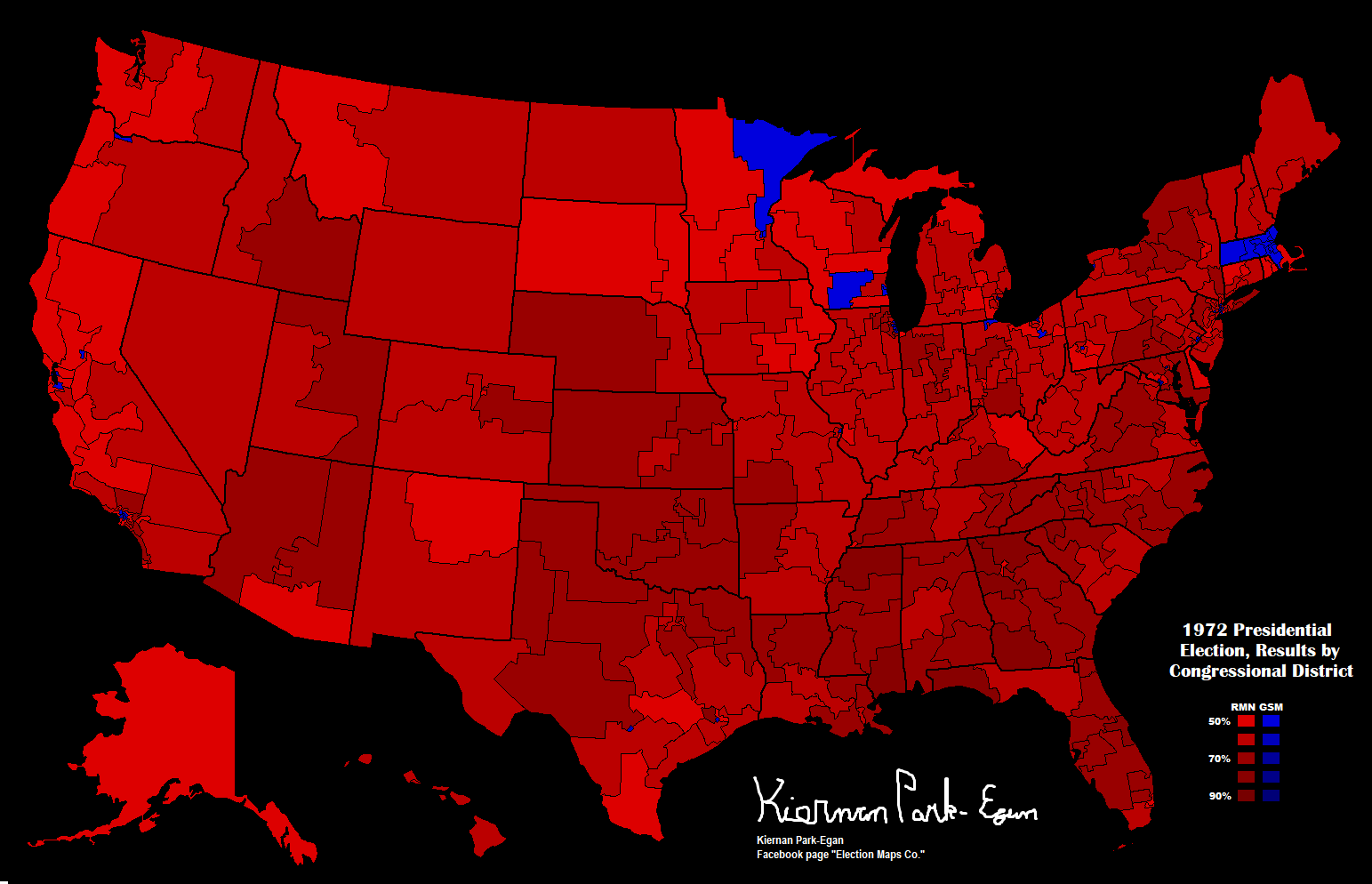
Nixon's percentage of the popular vote was only marginally less than Lyndon B. Johnson's record in 1964, and his margin of victory was slightly larger. Nixon won a majority vote in 49 states, including McGovern's home state of South Dakota. Only Massachusetts and the District of Columbia voted for the challenger, resulting in an even more lopsided Electoral College tally. McGovern garnered only 37.5 percent of the national popular vote, the lowest share received by a Democratic Party nominee since John W. Davis won only 28.8 percent of the vote in 1924. The only major party candidate since 1972 to receive less than 40 percent of the vote was Republican incumbent President George H. W. Bush who won 37.4 percent of the vote in 1992, an election that, as in 1924, was affected by a strong third-party vote. Nixon received the highest share of the popular vote for a Republican in history.
Although the McGovern campaign believed that its man had a better chance of defeating Nixon because of the new Twenty-sixth Amendment to the United States Constitution that lowered the national voting age to 18 from 21, most of the youth vote went to Nixon. This was the first election in American history in which a Republican candidate carried every single Southern state, continuing the region's transformation from a Democratic bastion (Solid South) into a Republican stronghold as President Nixon became the first Republican presidential candidate in a century to carry Arkansas. By this time, all the Southern states, except Arkansas and Texas, had been carried by a Republican in either the previous election or that of 1964, although Republican candidates carried Texas in 1928, 1952, and 1956. As a result of this election, Massachusetts became the only state that Nixon did not carry in any of the three presidential elections in which he was a candidate. Nixon became the first Republican to ever win two terms in the White House without carrying Massachusetts at least once, a feat later duplicated by George W. Bush and Donald Trump. Additionally, this remains the last one in which the Republican candidate carried Minnesota.
McGovern won a mere 130 counties, plus the District of Columbia and four county-equivalents in Alaska, easily the fewest counties won by any major-party presidential nominee since the advent of popular presidential elections, surpassing the previous lowest figures that had been recorded by Republicans William Howard Taft in 1912, and Herbert Hoover in 1932 in failed bids for re-election as president (Taft's total of 232 counties was the lowest recorded overall by a major-party candidate, and Hoover's 374 was the lowest earned by a candidate who finished in second place). In nineteen states, McGovern failed to carry a single county; he carried a mere one county-equivalent in a further nine states. In contrast to Walter Mondale's narrow 1984 win in Minnesota, McGovern comfortably won Massachusetts but lost every other state by at least five percentage points, as well as 45 states by more than ten percentage points (all but Massachusetts, Minnesota, Rhode Island, Wisconsin, and his home state of South Dakota). This also made Nixon the second former vice president in American history, after Thomas Jefferson (in 1800 and 1804), and the only two-term Vice President to be elected President twice. Since McGovern carried only one state, bumper stickers reading "Nixon49 America1", "Don't Blame Me, I'm From Massachusetts", and "Massachusetts: The One And Only" were popular for a short time in Massachusetts. Nixon managed to win 18% of the African American vote (Gerald Ford would get 16% in 1976).
The Wallace vote had been crucial to Nixon being able to sweep the states that had narrowly held out against him in 1968 (Maryland, Texas, and West Virginia), as well as the states Wallace won himself (Alabama, Arkansas, Georgia, Louisiana, and Mississippi). The pro-Wallace group of voters had given AIP nominee John Schmitz a mere 2.4% of its support, while 19.1% backed McGovern, and the majority 78.5% broke for Nixon. Nixon, who became term-limited under the provisions of the Twenty-second Amendment as a result of his victory, became the first presidential candidate to win a significant number of electoral votes in three presidential elections since the ratification of that Amendment; only Trump has done the same. As of 2024, Nixon was the seventh of eight presidential nominees to win a significant number of electoral votes in at least three elections, the others being Jefferson, Andrew Jackson, Henry Clay, Grover Cleveland, William Jennings Bryan, Franklin D. Roosevelt, and Trump. The 520 electoral votes received by Nixon, added to the 301 electoral votes he received in 1968 and the 219 electoral votes he received in 1960, gave him 1,040 electoral votes, the second most received by any presidential candidate (after Franklin D. Roosevelt's 1,876 total electoral votes).

Image:1972 United States presidential election results map by county.svg|Results by county, shaded according to winning candidate's percentage of the vote
Results by state
| † | At-large results (for Maine, which split electoral votes) |
|---|
| stp=1 | State or | ||||||||||||||||||||||||||||||||||||||
|---|---|---|---|---|---|---|---|---|---|---|---|---|---|---|---|---|---|---|---|---|---|---|---|---|---|---|---|---|---|---|---|---|---|---|---|---|---|---|---|
| district}} | Nixon/Agnew | ||||||||||||||||||||||||||||||||||||||
| Republican | McGovern/Shriver | ||||||||||||||||||||||||||||||||||||||
| Democratic | Schmitz/Anderson | ||||||||||||||||||||||||||||||||||||||
| American Independent | Hospers/Nathan | ||||||||||||||||||||||||||||||||||||||
| Libertarian | Margin | Total votes | Votes | % | stp=1 | va=middle | EV}} | Votes | % | stp=1 | va=middle | EV}} | Votes | % | stp=1 | va=middle | EV}} | Votes | % | stp=1 | va=middle | EV}} | Votes | Total | 47,168,710 | 60.67 | 520 | 29,173,222 | 37.52 | 17 | 1,100,868 | 1.42 | 0 | 3,674 | 0.00 | 1 | 17,995,488 | 23.15 | 77,744,027 |
| [Alabama](1972-united-states-presidential-election-in-alabama) | **728,701** | **72.43** | 9 | 256,923 | 25.54 | – | 11,918 | 1.18 | – | – | – | – | 471,778 | 46.89 | 1,006,093 | ||||||||||||||||||||||||
| [Alaska](1972-united-states-presidential-election-in-alaska) | **55,349** | **58.13** | 3 | 32,967 | 34.62 | – | 6,903 | 7.25 | – | – | – | – | 22,382 | 23.51 | 95,219 | ||||||||||||||||||||||||
| [Arizona](1972-united-states-presidential-election-in-arizona) | **402,812** | **61.64** | 6 | 198,540 | 30.38 | – | 21,208 | 3.25 | – | – | – | – | 204,272 | 31.26 | 653,505 | ||||||||||||||||||||||||
| [Arkansas](1972-united-states-presidential-election-in-arkansas) | **445,751** | **68.82** | 6 | 198,899 | 30.71 | – | 3,016 | 0.47 | – | – | – | – | 246,852 | 38.11 | 647,666 | ||||||||||||||||||||||||
| [California](1972-united-states-presidential-election-in-california) | **4,602,096** | **55.00** | 45 | 3,475,847 | 41.54 | – | 232,554 | 2.78 | – | 980 | 0.01 | – | 1,126,249 | 13.46 | 8,367,862 | ||||||||||||||||||||||||
| [Colorado](1972-united-states-presidential-election-in-colorado) | **597,189** | **62.61** | 7 | 329,980 | 34.59 | – | 17,269 | 1.81 | – | 1,111 | 0.12 | – | 267,209 | 28.01 | 953,884 | ||||||||||||||||||||||||
| [Connecticut](1972-united-states-presidential-election-in-connecticut) | **810,763** | **58.57** | 8 | 555,498 | 40.13 | – | 17,239 | 1.25 | – | – | – | – | 255,265 | 18.44 | 1,384,277 | ||||||||||||||||||||||||
| [Delaware](1972-united-states-presidential-election-in-delaware) | **140,357** | **59.60** | 3 | 92,283 | 39.18 | – | 2,638 | 1.12 | – | – | – | – | 48,074 | 20.41 | 235,516 | ||||||||||||||||||||||||
| [District of Columbia](1972-united-states-presidential-election-in-the-district-of-columbia) | 35,226 | 21.56 | – | **127,627** | **78.10** | 3 | – | – | – | – | – | – | −92,401 | −56.54 | 163,421 | ||||||||||||||||||||||||
| [Florida](1972-united-states-presidential-election-in-florida) | **1,857,759** | **71.91** | 17 | 718,117 | 27.80 | – | – | – | – | – | – | – | 1,139,642 | 44.12 | 2,583,283 | ||||||||||||||||||||||||
| [Georgia](1972-united-states-presidential-election-in-georgia) | **881,496** | **75.04** | 12 | 289,529 | 24.65 | – | 812 | 0.07 | – | – | – | – | 591,967 | 50.39 | 1,174,772 | ||||||||||||||||||||||||
| [Hawaii](1972-united-states-presidential-election-in-hawaii) | **168,865** | **62.48** | 4 | 101,409 | 37.52 | – | – | – | – | – | – | – | 67,456 | 24.96 | 270,274 | ||||||||||||||||||||||||
| [Idaho](1972-united-states-presidential-election-in-idaho) | **199,384** | **64.24** | 4 | 80,826 | 26.04 | – | 28,869 | 9.30 | – | – | – | – | 118,558 | 38.20 | 310,379 | ||||||||||||||||||||||||
| [Illinois](1972-united-states-presidential-election-in-illinois) | **2,788,179** | **59.03** | 26 | 1,913,472 | 40.51 | – | 2,471 | 0.05 | – | – | – | – | 874,707 | 18.52 | 4,723,236 | ||||||||||||||||||||||||
| [Indiana](1972-united-states-presidential-election-in-indiana) | **1,405,154** | **66.11** | 13 | 708,568 | 33.34 | – | – | – | – | – | – | – | 696,586 | 32.77 | 2,125,529 | ||||||||||||||||||||||||
| [Iowa](1972-united-states-presidential-election-in-iowa) | **706,207** | **57.61** | 8 | 496,206 | 40.48 | – | 22,056 | 1.80 | – | – | – | – | 210,001 | 17.13 | 1,225,944 | ||||||||||||||||||||||||
| [Kansas](1972-united-states-presidential-election-in-kansas) | **619,812** | **67.66** | 7 | 270,287 | 29.50 | – | 21,808 | 2.38 | – | – | – | – | 349,525 | 38.15 | 916,095 | ||||||||||||||||||||||||
| [Kentucky](1972-united-states-presidential-election-in-kentucky) | **676,446** | **63.37** | 9 | 371,159 | 34.77 | – | 17,627 | 1.65 | – | – | – | – | 305,287 | 28.60 | 1,067,499 | ||||||||||||||||||||||||
| [Louisiana](1972-united-states-presidential-election-in-louisiana) | **686,852** | **65.32** | 10 | 298,142 | 28.35 | – | 52,099 | 4.95 | – | – | – | – | 388,710 | 36.97 | 1,051,491 | ||||||||||||||||||||||||
| [Maine](1972-united-states-presidential-election-in-maine) † | **256,458** | **61.46** | 2 | 160,584 | 38.48 | – | 117 | 0.03 | – | 1 | 0.00 | – | 95,874 | 22.98 | 417,271 | ||||||||||||||||||||||||
| **135,388** | **61.42** | 1 | 85,028 | 38.58 | – | *Unknown* | *Unknown* | – | *Unknown* | *Unknown* | – | 50,360 | 22.85 | 220,416 | |||||||||||||||||||||||||
| **121,120** | **61.58** | 1 | 75,556 | 38.42 | – | *Unknown* | *Unknown* | – | *Unknown* | *Unknown* | – | 45,564 | 23.17 | 196,676 | |||||||||||||||||||||||||
| [Maryland](1972-united-states-presidential-election-in-maryland) | **829,305** | **61.26** | 10 | 505,781 | 37.36 | – | 18,726 | 1.38 | – | – | – | – | 323,524 | 23.90 | 1,353,812 | ||||||||||||||||||||||||
| [Massachusetts](1972-united-states-presidential-election-in-massachusetts) | 1,112,078 | 45.23 | – | **1,332,540** | **54.20** | 14 | 2,877 | 0.12 | – | 43 | 0.00 | – | −220,462 | −8.97 | 2,458,756 | ||||||||||||||||||||||||
| [Michigan](1972-united-states-presidential-election-in-michigan) | **1,961,721** | **56.20** | 21 | 1,459,435 | 41.81 | – | 63,321 | 1.81 | – | – | – | – | 502,286 | 14.39 | 3,490,325 | ||||||||||||||||||||||||
| [Minnesota](1972-united-states-presidential-election-in-minnesota) | **898,269** | **51.58** | 10 | 802,346 | 46.07 | – | 31,407 | 1.80 | – | – | – | – | 95,923 | 5.51 | 1,741,652 | ||||||||||||||||||||||||
| [Mississippi](1972-united-states-presidential-election-in-mississippi) | **505,125** | **78.20** | 7 | 126,782 | 19.63 | – | 11,598 | 1.80 | – | – | – | – | 378,343 | 58.57 | 645,963 | ||||||||||||||||||||||||
| [Missouri](1972-united-states-presidential-election-in-missouri) | **1,154,058** | **62.29** | 12 | 698,531 | 37.71 | – | – | – | – | – | – | – | 455,527 | 24.59 | 1,852,589 | ||||||||||||||||||||||||
| [Montana](1972-united-states-presidential-election-in-montana) | **183,976** | **57.93** | 4 | 120,197 | 37.85 | – | 13,430 | 4.23 | – | – | – | – | 63,779 | 20.08 | 317,603 | ||||||||||||||||||||||||
| [Nebraska](1972-united-states-presidential-election-in-nebraska) | **406,298** | **70.50** | 5 | 169,991 | 29.50 | – | – | – | – | – | – | – | 236,307 | 41.00 | 576,289 | ||||||||||||||||||||||||
| [Nevada](1972-united-states-presidential-election-in-nevada) | **115,750** | **63.68** | 3 | 66,016 | 36.32 | – | – | – | – | – | – | – | 49,734 | 27.36 | 181,766 | ||||||||||||||||||||||||
| [New Hampshire](1972-united-states-presidential-election-in-new-hampshire) | **213,724** | **63.98** | 4 | 116,435 | 34.86 | – | 3,386 | 1.01 | – | – | – | – | 97,289 | 29.12 | 334,055 | ||||||||||||||||||||||||
| [New Jersey](1972-united-states-presidential-election-in-new-jersey) | **1,845,502** | **61.57** | 17 | 1,102,211 | 36.77 | – | 34,378 | 1.15 | – | – | – | – | 743,291 | 24.80 | 2,997,229 | ||||||||||||||||||||||||
| [New Mexico](1972-united-states-presidential-election-in-new-mexico) | **235,606** | **61.05** | 4 | 141,084 | 36.56 | – | 8,767 | 2.27 | – | – | – | – | 94,522 | 24.49 | 385,931 | ||||||||||||||||||||||||
| [New York](1972-united-states-presidential-election-in-new-york) | **4,192,778** | **58.54** | 41 | 2,951,084 | 41.21 | – | – | – | – | – | – | – | 1,241,694 | 17.34 | 7,161,830 | ||||||||||||||||||||||||
| [North Carolina](1972-united-states-presidential-election-in-north-carolina) | **1,054,889** | **69.46** | 13 | 438,705 | 28.89 | – | 25,018 | 1.65 | – | – | – | – | 616,184 | 40.58 | 1,518,612 | ||||||||||||||||||||||||
| [North Dakota](1972-united-states-presidential-election-in-north-dakota) | 174,109 | 62.07 | 3 | 100,384 | 35.79 | – | 5,646 | 2.01 | – | – | – | – | 73,725 | 26.28 | 280,514 | ||||||||||||||||||||||||
| [Ohio](1972-united-states-presidential-election-in-ohio) | **2,441,827** | **59.63** | 25 | 1,558,889 | 38.07 | – | 80,067 | 1.96 | – | – | – | – | 882,938 | 21.56 | 4,094,787 | ||||||||||||||||||||||||
| [Oklahoma](1972-united-states-presidential-election-in-oklahoma) | **759,025** | **73.70** | 8 | 247,147 | 24.00 | – | 23,728 | 2.30 | – | – | – | – | 511,878 | 49.70 | 1,029,900 | ||||||||||||||||||||||||
| [Oregon](1972-united-states-presidential-election-in-oregon) | **486,686** | **52.45** | 6 | 392,760 | 42.33 | – | 46,211 | 4.98 | – | – | – | – | 93,926 | 10.12 | 927,946 | ||||||||||||||||||||||||
| [Pennsylvania](1972-united-states-presidential-election-in-pennsylvania) | **2,714,521** | **59.11** | 27 | 1,796,951 | 39.13 | – | 70,593 | 1.54 | – | – | – | – | 917,570 | 19.98 | 4,592,105 | ||||||||||||||||||||||||
| [Rhode Island](1972-united-states-presidential-election-in-rhode-island) | **220,383** | **53.00** | 4 | 194,645 | 46.81 | – | 25 | 0.01 | – | 2 | 0.00 | – | 25,738 | 6.19 | 415,808 | ||||||||||||||||||||||||
| [South Carolina](1972-united-states-presidential-election-in-south-carolina) | **478,427** | **70.58** | 8 | 189,270 | 27.92 | – | 10,166 | 1.50 | – | – | – | – | 289,157 | 42.66 | 677,880 | ||||||||||||||||||||||||
| [South Dakota](1972-united-states-presidential-election-in-south-dakota) | **166,476** | **54.15** | 4 | 139,945 | 45.52 | – | – | – | – | – | – | – | 26,531 | 8.63 | 307,415 | ||||||||||||||||||||||||
| [Tennessee](1972-united-states-presidential-election-in-tennessee) | **813,147** | **67.70** | 10 | 357,293 | 29.75 | – | 30,373 | 2.53 | – | – | – | – | 455,854 | 37.95 | 1,201,182 | ||||||||||||||||||||||||
| [Texas](1972-united-states-presidential-election-in-texas) | **2,298,896** | **66.20** | 26 | 1,154,291 | 33.24 | – | 7,098 | 0.20 | – | – | – | – | 1,144,605 | 32.96 | 3,472,714 | ||||||||||||||||||||||||
| [Utah](1972-united-states-presidential-election-in-utah) | **323,643** | **67.64** | 4 | 126,284 | 26.39 | – | 28,549 | 5.97 | – | – | – | – | 197,359 | 41.25 | 478,476 | ||||||||||||||||||||||||
| [Vermont](1972-united-states-presidential-election-in-vermont) | **117,149** | **62.66** | 3 | 68,174 | 36.47 | – | – | – | – | – | – | – | 48,975 | 26.20 | 186,947 | ||||||||||||||||||||||||
| [Virginia](1972-united-states-presidential-election-in-virginia) | **988,493** | **67.84** | 11 | 438,887 | 30.12 | – | 19,721 | 1.35 | – | – | – | 1 | 549,606 | 37.72 | 1,457,019 | ||||||||||||||||||||||||
| [Washington](1972-united-states-presidential-election-in-washington-state) | **837,135** | **56.92** | 9 | 568,334 | 38.64 | – | 58,906 | 4.00 | – | 1,537 | 0.10 | – | 268,801 | 18.28 | 1,470,847 | ||||||||||||||||||||||||
| [West Virginia](1972-united-states-presidential-election-in-west-virginia) | **484,964** | **63.61** | 6 | 277,435 | 36.39 | – | – | – | – | – | – | – | 207,529 | 27.22 | 762,399 | ||||||||||||||||||||||||
| [Wisconsin](1972-united-states-presidential-election-in-wisconsin) | **989,430** | **53.40** | 11 | 810,174 | 43.72 | – | 47,525 | 2.56 | – | – | – | – | 179,256 | 9.67 | 1,852,890 | ||||||||||||||||||||||||
| [Wyoming](1972-united-states-presidential-election-in-wyoming) | **100,464** | **69.01** | 3 | 44,358 | 30.47 | – | 748 | 0.51 | – | – | – | – | 56,106 | 38.54 | 145,570 |
For the first time since 1828, Maine allowed its electoral votes to be split between candidates. Two electoral votes were awarded to the winner of the statewide race and one electoral vote to the winner of each congressional district. This was the first time the Congressional District Method had been used since Michigan used it in 1892. Nixon won all four votes.
States that flipped from Democratic to Republican
- Connecticut
- Hawaii
- Maine
- Maryland
- Michigan
- Minnesota
- New York
- Pennsylvania
- Rhode Island
- Texas
- Washington
- West Virginia
States that flipped from American Independent to Republican
- Georgia
- Louisiana
- Alabama
- Mississippi
- Arkansas
Close states
States where margin of victory was more than 5 percentage points, but less than 15 percentage points (115 electoral votes):
- Minnesota, 5.51% (95,923 votes)
- Rhode Island, 6.19% (25,738 votes)
- South Dakota, 8.63% (26,531 votes)
- Massachusetts, 8.97% (220,462 votes)
- Wisconsin, 9.67% (179,256 votes)
- Oregon, 10.12% (93,926 votes)
- California, 13.46% (1,126,249 votes)
- Michigan, 14.39% (502,286 votes)
Tipping point states:
- Ohio, 21.56% (882,938 votes) (tipping point for a Nixon victory)
- Maine-1, 22.85% (50,360 votes) (tipping point for a McGovern victory)
Statistics
Counties with highest percentage of the vote (Republican)
- Dade County, Georgia 93.45%
- Glascock County, Georgia 93.38%
- George County, Mississippi 92.90%
- Holmes County, Florida 92.51%
- Smith County, Mississippi 92.35%
Counties with highest percentage of the vote (Democratic)
- Duval County, Texas 85.68%
- Washington, D. C. 78.10%
- Shannon County, South Dakota 77.34%
- Greene County, Alabama 68.32%
- Charles City County, Virginia 67.84%
Counties with highest percentage of the vote (Other)
- Jefferson County, Idaho 27.51%
- Lemhi County, Idaho 19.77%
- Fremont County, Idaho 19.32%
- Bonneville County, Idaho 18.97%
- Madison County, Idaho 17.04%
Voter demographics
| **The 1972 presidential vote by demographic subgroup** | McGovern | Nixon | Gender | **Age** | Race | Religion | Education | Occupation | Party ID | Region | Union Status | |
|---|---|---|---|---|---|---|---|---|---|---|---|---|
| Men | 37 | **63** | ||||||||||
| Women | 38 | **62** | ||||||||||
| Under 30 | 48 | **52** | ||||||||||
| 30-49 | 33 | **67** | ||||||||||
| 50 or Older | 36 | **64** | ||||||||||
| White | 32 | **68** | ||||||||||
| Non-White | **87** | 13 | ||||||||||
| Protestant | 30 | **70** | ||||||||||
| Catholic | 48 | **52** | ||||||||||
| College | 37 | **63** | ||||||||||
| High School | 34 | **66** | ||||||||||
| Grade School | 49 | **51** | ||||||||||
| Business | 31 | **69** | ||||||||||
| White Collar | 36 | **64** | ||||||||||
| Manual | 43 | **57** | ||||||||||
| Republican | 5 | **95** | ||||||||||
| Democrat | **67** | 33 | ||||||||||
| Independent | 31 | **69** | ||||||||||
| East | 42 | **58** | ||||||||||
| Midwest | 40 | **60** | ||||||||||
| South | 29 | **71** | ||||||||||
| West | 41 | **59** | ||||||||||
| Union Family | 46 | **54** |
Nixon won 36 percent of the Democratic vote, according to an exit poll conducted for CBS News by George Fine Research, Inc. This represents more than twice the percentage of voters who typically defect from their party in presidential elections. Nixon also became the first Republican presidential candidate in American history to win the Roman Catholic vote (53–46), and the first in recent history to win the blue-collar vote, which he won by a 5-to-4 margin. McGovern narrowly won the union vote (50–48), although this difference was within the survey's margin of error of 2 percentage points. McGovern also narrowly won the youth vote (i. e. those aged 18 to 24) 52–46, a narrower margin than many of his strategists had predicted. This was the first presidential election held after the ratification of the 26th Amendment, lowering the minimum voting age to 18. Early on, the McGovern campaign also significantly over-estimated the number of young people who would vote in the election; they predicted that 18 million would have voted in total but exit polls indicate that the actual number was about 12 million. McGovern comfortably won among both African-American and Jewish voters but by somewhat smaller margins than usual for a Democratic candidate. McGovern won the African American vote by 87% to Nixon's 13%.
Aftermath
Main article: Watergate scandal
On June 17, 1972, five months before election day, five men broke into the Democratic National Committee headquarters at the Watergate Hotel at the Watergate complex in Washington, D.C.. The resulting investigation led to the revelation of attempted cover-ups of the break-in within the Nixon administration. What became known as the Watergate scandal eroded President Nixon's public and political support in his second term, and he resigned on August 9, 1974, in the face of probable impeachment by the House of Representatives and removal from office by the Senate. As part of the continuing Watergate investigation in 1974–1975, federal prosecutors offered companies that had given illegal campaign contributions to President Nixon's re-election campaign lenient sentences if they came forward. Many companies complied, including Northrop Grumman, 3M, American Airlines, and Braniff Airlines. By 1976, prosecutors had convicted 18 American corporations of contributing illegally to Nixon's campaign. Despite this election delivering Nixon's greatest electoral triumph, Nixon later wrote in his memoirs that "it was one of the most frustrating and in many ways the least satisfying of all".
Vice President Agnew also resigned in 1973, following an investigation of corruption in Maryland during Agnew's governorship and an ensuing controversy around Agnew's tax returns. He was replaced by Nixon (with Congressional confirmation) with Gerald Ford, who ascended to the Presidency after Nixon's own resignation.
Explanatory notes
Citations
References
- "National General Election VEP Turnout Rates, 1789-Present". [[CQ Press]].
- "New Hampshire Primary historical past election results. 2008 Democrat & Republican past results. John McCain, Hillary Clinton winners". Primarynewhampshire.com.
- (2010). "Guide to U.S. Elections". [[CQ Press]].
- "Humphrey Joins the Race; Asks U.S. to End War Now; Humphrey in Race; Urges War End Now".
- "Wallace Joins Florida Race as Democrat; Wallace Enters Primary In Florida as a Democrat".
- "Muskie Formally in Race; Pledges 'a New Beginning'; Muskie Formally in Nomination Race".
- "Admits Strategy Failed; Muskie Abandons Primary Contention".
- "Jackson Cites Lack of Funds in Quitting".
- "Jackson in Race; He Asserts Nixon Fails to Win Trust; Jackson in Race for President; Says Nixon Fails to Win Trust".
- "Rep. Mills Officially Enters Race For the Democratic Nomination; MILLS JOINS RACE FOR NOMINATION".
- "NEW HAT IN RING: MRS. CHISHOLM'S; Representative Is Seeking Presidency as Democrat Mrs. Chisholm Joins Presidential Race".
- "Sanford, Ex-Governor, Runs In Carolina for White House".
- "LINDSAY, IN RACE, SCORES HIS RIVALS; In Miami, He Also Attacks Nixon -- Says Washington Ignores Cities' Problems Lindsay, in Race, Attacks Nixon And Rivals in Democratic Party".
- "MAYORS RUNS SIXTH; Says Returns Indicate He Cannot Continue as a Candidate Lindsay Quits the Race After Sixth-Place Finish".
- "McCarthy Withdraws From California Race".
- "McCarthy, Casually, Enters the '72 Race; A Casual McCarthy Enters 1972 Race".
- "Yorty Enters Race; Eyes 2 Primaries; Yorty Enters Race; Eyes Two Primaries".
- "Minnesotan Won't Quit; Humphrey Concedes Loss In California Voting Today".
- "Petitions Raise Hartke Hopes".
- "Rep. Mink Withdraws From President Race".
- "Harris in Race for Presidency, The Second Democrat to Declare; Harris in Race for Presidency, The Second Democrat to Declare".
- "Harris, Declaring 'I Am Broke,' Withdraws From '72 Contention; $40,000 in Debt, Oklahoman Abandons a Short Campaign Based on 'New Populism'".
- Jack Anderson. (June 4, 1971). "Don't count out Ted Kennedy". [[The Free Lance–Star]].
- "Muskie, Edmund Sixtus, (1914–1996)". [[United States Congress]].
- (February 9, 2020). "The Democrat who cried (maybe) in New Hampshire and lost the presidential nomination". [[The Washington Post]].
- (1996-03-26). "REMEMBERING ED MUSKIE".
- [[R. W. Apple, Jr.]]. (January 18, 1971). "McGovern Enters '72 Race, Pledging Troop Withdrawal". [[The New York Times]].
- Jo Freeman. (February 2005). "Shirley Chisholm's 1972 Presidential Campaign". University of Illinois at Chicago Women's History Project.
- Robert D. Novak. (2008). "The Prince of Darkness: 50 Years Reporting in Washington". Random House Digital, Inc..
- Nancy L. Cohen. (2012). "Delirium: The Politics of Sex in America". Counterpoint Press.
- "United States presidential election of 1972".
- Byrd, Lee. (April 28, 1972). "Bland, Crybaby Roles Cost Muskie His Lead". Lansing State Journal.
- Risser, James. (June 9, 1972). "Hughes Stands By Muskie". [[The Des Moines Register]].
- (March 17, 1972). "Bayh Endorses Sen. Muskie". The Logansport Press.
- (January 11, 1972). "Adlai Stevenson III Endorses Sen. Muskie". Tampa Bay Times.
- (January 15, 1972). "More Muskie Support". New York Times.
- (April 27, 1972). "Sticking by Muskie, Gilligan declares". [[The Cincinnati Post]].
- (January 26, 1972). "News Capsule: In the nation". [[The Baltimore Sun]].
- (January 12, 1972). "Muskie, HHH calling in Ohio". The Journal Herald.
- (August 3, 1972). "McGovern Picking Second V.P. Candidate Same Way He Picked First". Ironwood Daily Globe.
- (July 14, 1972). "Maddox Against Demo Nominees". The Knoxville News-Sentinel.
- (September 14, 2020). ""Catalyst for Change": The 1972 Presidential Campaign of Representative Shirley Chisholm".
- (August 1, 2006). "Life So Far: A Memoir – Google Books". Simon and Schuster.
- "POV – Chisholm '72 . Video: Gloria Steinem reflects on Chisholm's legacy". PBS.
- (1999). "Terry Sanford: politics, progress ... – Google Books". Duke University Press.
- (July 12, 1972). "Convention Briefs: Endorses Jackson". Wisconsin State Journal.
- (July 24, 1972). "Introducing... the McGovern Machine". Time Magazine.
- "All The Votes...Really". CNN.
- "A Guide to the Frances Tarlton Farenthold Papers, 1913–2013". Dolph Briscoe Center for American History, The University of Texas at Austin.
- Garofoli, Joe. (March 26, 2008). "Obama bounces back – speech seemed to help". SFGATE.
- McGovern, George S., ''Grassroots: The Autobiography of George McGovern'', New York: Random House, 1977, pp. 214–215
- McGovern, George S., ''Terry: My Daughter's Life-and-Death Struggle with Alcoholism'', New York: Random House, 1996, pp. 97
- Marano, Richard Michael, ''Vote Your Conscience: The Last Campaign of George McGovern'', Praeger Publishers, 2003, pp. 7
- ''The Washington Post'', "George McGovern & the Coldest Plunge", [[Paul Hendrickson]], September 28, 1983
- ''The New York Times'', "'Trashing' Candidates" (op-ed), George McGovern, May 11, 1983
- (July 21, 2016). "'I'm Behind Him 1000%'".
- (2003). "Richard Nixon, Watergate, and the Press: A Historical Retrospective". Greenwood Publishing Group.
- Menendez, Albert J.; ''The Geography of Presidential Elections in the United States, 1868–2004'', p. 100 {{ISBN. 0786422173
- Scammon, Richard M. (compiler); ''America at the Polls: A Handbook of Presidential Election Statistics 1920–1964''; pp. 339, 343 {{ISBN. 0405077114
- Actor to Aid Schmitz; The New York Times, August 9, 1972
- (December 30, 1973). "Libertarians trying to escape obscurity". [[Eugene Register-Guard]].
- "McGovern Is Gaining - A Little". Chicago Tribune.
- Gallup, George. (1978). "The 1972-1977 Gallup Poll Public Opinion, Volume I".
- "Nixon Gets Bigger Lead". The Decatur Daily Review.
- Gallup, George. (1978). "The 1972-1977 Gallup Poll Public Opinion, Volume I".
- Gallup, George. (1978). "The 1972-1977 Gallup Poll Public Opinion, Volume I".
- "McGovern Failing To Tighten Margin". Chicago Tribune.
- Gallup, George. (1978). "The 1972-1977 Gallup Poll Public Opinion, Volume I".
- "McGovern Gaining, Poll Shows". Chicago Tribune.
- "President Widens His Lead". Chicago Tribune.
- Gallup, George. (1978). "The 1972-1977 Gallup Poll Public Opinion, Volume I".
- Gallup, George. (1978). "The 1972-1977 Gallup Poll Public Opinion, Volume I".
- Gallup, George. (1978). "The 1972-1977 Gallup Poll Public Opinion, Volume I".
- Gallup, George. (1978). "The 1972-1977 Gallup Poll Public Opinion, Volume I".
- "McGovern Falls Even Further". Chicago Tribune.
- Gallup, George. (1978). "The 1972-1977 Gallup Poll Public Opinion, Volume I".
- "Survey Shows Kennedy Rates Best Chance Against Nixon". The Sacramento Bee.
- Gallup, George. (1978). "The 1972-1977 Gallup Poll Public Opinion, Volume I".
- "McGovern Appears To Have Chance Against President". News-Journal.
- Gallup, George. (1978). "The 1972-1977 Gallup Poll Public Opinion, Volume I".
- "McGovern Strong As HHH Against Nixon". Press and Sun-Bulletin.
- Gallup, George. (1978). "The 1972-1977 Gallup Poll Public Opinion, Volume I".
- "Poll Gives Nixon Handy Margin In April". Fort Lauderdale News.
- Gallup, George. (1978). "The 1972-1977 Gallup Poll Public Opinion, Volume I".
- "Sen. McGovern Steadily Losing Ground". Alton Evening Telegraph.
- "Muskie Widens Margin". Chicago Tribune.
- Feinman, Ronald. (September 2, 2016). "Donald Trump Could Be On Way To Worst Major Party Candidate Popular Vote Percentage Since William Howard Taft In 1912 And John W. Davis In 1924!". The Progressive Professor.
- [[Jesse Walker]]. (July 2008). "The Age of Nixon: Rick Perlstein on the left, the right, the '60s, and the illusion of consensus". Reason.
- Sullivan, Robert David; [http://www.americamagazine.org/content/unconventional-wisdom/how-red-and-blue-map-evolved-over-past-century 'How the Red and Blue Map Evolved Over the Past Century'] {{Webarchive. link. (November 16, 2016 ; ''America Magazine'' in ''The National Catholic Review''; June 29, 2016)
- Menendez, Albert J.; ''The Geography of Presidential Elections in the United States, 1868–2004'', p. 98 {{ISBN. 0786422173
- (1973-08-27). "New York Intelligencer". New York Media, LLC.
- Lukas, J. Anthony. (1973-01-14). "As Massachusetts went—". The New York Times.
- "Exit Polls – Election Results 2008". The New York Times.
- Bump, Philip. (December 20, 2016). "Donald Trump is 27th on the all-time list of electoral votes received by an individual". The Washington Post.
- {{Leip PV source 2. (1972)
- {{National Archives EV source. (1972)
- Seeley, John. (2000-11-22). "Early and Often".
- "1972 Presidential General Election Data — National".
- (1973). "The Almanac of American Politics, 1974". [[Gambit Publications]].
- Leip, David [https://web.archive.org/web/20120825102042/http://www.mit.edu/~mi22295/elections.html#1972 "How close were U.S. Presidential Elections?"], ''[[Dave Leip's Atlas of U.S. Presidential Elections]]''. Retrieved: January 24, 2013.
- (2010-07-21). "Election Polls -- Vote by Groups, 1968-1972".
- Rosenthal, Jack. (1972-11-09). "Desertion Rate Doubles". [[The New York Times]].
- (November 12, 1972). "Survey Reports McGovern Got 87% of the Black Vote". The New York Times.
- Emig, David. (November 7, 2009). "My Morris Moment »".
This article was imported from Wikipedia and is available under the Creative Commons Attribution-ShareAlike 4.0 License. Content has been adapted to SurfDoc format. Original contributors can be found on the article history page.
Ask Mako anything about 1972 United States presidential election — get instant answers, deeper analysis, and related topics.
Research with MakoFree with your Surf account
Create a free account to save articles, ask Mako questions, and organize your research.
Sign up freeThis content may have been generated or modified by AI. CloudSurf Software LLC is not responsible for the accuracy, completeness, or reliability of AI-generated content. Always verify important information from primary sources.
Report