From Surf Wiki (app.surf) — the open knowledge base
Vietnam War
War in Southeast Asia from 1955 to 1975
War in Southeast Asia from 1955 to 1975
| Field | Value | ||||||||||||
|---|---|---|---|---|---|---|---|---|---|---|---|---|---|
| conflict | Vietnam War | ||||||||||||
| partof | the Indochina Wars and the Cold War in Asia | ||||||||||||
| image | {{multiple image | border=infobox | perrow=2/2/2 | total_width=300 | |||||||||
| image1 | U.S. Army UH-1H Hueys insert ARVN troops at Khâm Đức, Vietnam, 12 July 1970 (79431435).jpg | ||||||||||||
| image2 | Pavnbattle.jpg | ||||||||||||
| image3 | Hue Massacre Interment.jpg | ||||||||||||
| image4 | Flame Thrower. Operation New Castle. - NARA - 532488.tif | ||||||||||||
| image5 | A-4E Skyhawk of VA-56 drops bomb over Vietnam c1966.jpg | ||||||||||||
| image6 | Saigon Execution.jpg | ||||||||||||
| date | 1 November 195530 April 1975 | ||||||||||||
| () | |||||||||||||
| place | {{flatlist | ||||||||||||
| territory | |||||||||||||
| result | North Vietnamese victory | ||||||||||||
| combatant2 | |||||||||||||
| combatant1 | |||||||||||||
| strength1 | **≈860,000 (1967)** | ||||||||||||
| * North Vietnam:<br />690,000 (1966, including PAVN and Viet Cong){{Refn | group | "A" | According to Hanoi's official history, the Viet Cong was a branch of the People's Army of Vietnam.}} | ||||||||||
| * Viet Cong:<br />~200,000 (estimated, 1968)<ref>{{Cite book | last1 | Doyle | first1=Edward | title=The Vietnam Experience The North | last2=Lipsman | first2=Samuel | last3=Maitland | first3=Terence | publisher=Time Life Education | year=1986 | isbn=978-0-939526-21-5 | pages=45–49}} | |
| * China:<br />170,000 (1968)<br />320,000 total<ref name | "Toledo Blade 320,000 Chinese troops" | ||||||||||||
| * Khmer Rouge:<br />70,000 (1972)<ref name | "Tucker" | ||||||||||||
| * Pathet Lao:<br />48,000 (1970)<ref>{{Cite web | title | Area Handbook Series Laos | url=http://www.country-data.com/frd/cs/laos/la_glos.html#Lao | access-date=1 November 2019 | archive-date=7 March 2016 | archive-url=https://web.archive.org/web/20160307033933/http://www.country-data.com/frd/cs/laos/la_glos.html#Lao | url-status=live }} | ||||||
| * Soviet Union: ~3,000<ref>{{Cite book | last | O'Ballance | first=Edgar | title=Tracks of the bear: Soviet imprints in the seventies | publisher=Presidio | year=1982 | isbn=978-0-89141-133-8 | page=171}} | |||||
| * North Korea: 200<ref>{{Cite news | last | Pham Thi Thu Thuy | date=1 August 2013 | title=The colorful history of North Korea-Vietnam relations | work=NK News | url=https://www.nknews.org/2013/08/the-colorful-history-of-north-korea-vietnam-relations/ | access-date=3 October 2016 | archiveurl=https://web.archive.org/web/20150424055821/http://www.nknews.org/2013/08/the-colorful-history-of-north-korea-vietnam-relations/ | archive-date=April 24, 2015}} | ||||
| strength2 | **≈1,420,000 (1968)** | ||||||||||||
| * South Vietnam:<br />850,000 (1968)<br />1,500,000 (1974–1975)<ref>{{Cite book | last | Le Gro | first=William | url=https://history.army.mil/html/books/090/90-29/CMH_Pub_90-29.pdf | title=Vietnam from ceasefire to capitulation | publisher=US Army Center of Military History | year=1985 | isbn=978-1-4102-2542-9 | page=28 | archiveurl=https://web.archive.org/web/20230202012033/https://history.army.mil/html/books/090/90-29/CMH_Pub_90-29.pdf | archive-date=February 2, 2023}} | ||
| * United States:<br />2,709,918 serving in Vietnam total<br />Peak: 543,400 (April 1969)<ref name | Tucker/ | ||||||||||||
| * Khmer Republic:<br />200,000 (1973){{Citation needed | date | November 2022}} | |||||||||||
| * Laos:<br />72,000 (Royal Army and Hmong militia)<ref>{{Cite web | title | The rise of Communism | url=http://www.footprinttravelguides.com/c/4999/the-rise-of-communism | url-status=dead | archive-url=https://web.archive.org/web/20101117114707/http://footprinttravelguides.com/c/4999/the-rise-of-communism/ | archive-date=17 November 2010 | access-date=31 May 2018 | website=www.footprinttravelguides.com}} | |||||
| * Thailand: 32,000 per year (1965–1973)<br />(in Vietnam<ref>{{Cite web | title | Vietnam War Allied Troop Levels 1960–73 | url=http://www.americanwarlibrary.com/vietnam/vwatl.htm | url-status=dead | archive-url=https://web.archive.org/web/20160802134052/http://www.americanwarlibrary.com/vietnam/vwatl.htm | archive-date=2 August 2016 | access-date=2 August 2016}}, accessed 7 November 2017 and Laos) | ||||||
| * Australia: 50,190 total<br />(Peak: 8,300 combat troops)<ref>{{Cite web | last1 | Doyle | first1=Jeff | last2=Grey | first2=Jeffrey | last3=Pierce | first3=Peter | date=2002 | title=Australia's Vietnam War – A Select Chronology of Australian Involvement in the Vietnam War | url=https://researchonline.jcu.edu.au/14206/3/14206_Doyle_et_al_2002_Back_Pages.pdf | publisher=Texas A&M University Press | archiveurl=https://web.archive.org/web/20221110165929/https://researchonline.jcu.edu.au/14206/3/14206_Doyle_et_al_2002_Back_Pages.pdf | archive-date=November 10, 2022}} |
| * New Zealand: Peak: 552 in 1968<ref name | Blackburn | ||||||||||||
| commander1 | |||||||||||||
| commander2 | |||||||||||||
| * Ngô Đình Diệm{{Refn | 1955–1963 | group | "A"}} | ||||||||||
| * Lyndon B. Johnson{{Refn | 1963–1969 | group | "A"}} | ||||||||||
| * William Westmoreland{{Refn | 1964–1968 | group | "A"}} | ||||||||||
| casualties1 | |||||||||||||
| * North Vietnam and Viet Cong:<br />30,000–182,000 civilian dead<ref name | Tucker/ | ||||||||||||
| 849,018 military dead (per Vietnam; 1/3 non-combat deaths) | |||||||||||||
| 666,000–950,765 dead | |||||||||||||
| (US estimated 1964–1974){{Refn | Upper figure initial estimate, later thought to be inflated by at least 30% (lower figure) | ||||||||||||
| 600,000+ military wounded | |||||||||||||
| * : ~1,100 dead and 4,200 wounded<ref name | Womack/ | ||||||||||||
| * : 16 dead<ref>{{Cite book | last1 | James F. Dunnigan | title=Dirty Little Secrets of the Vietnam War: Military Information You're Not Supposed to Know | last2=Albert A. Nofi | publisher=Macmillan | year=2000 | isbn=978-0-312-25282-3 | author-link2=Albert A. Nofi}} | |||||
| * : 14 dead<ref>{{Cite news | date | 31 March 2000 | title=North Korea fought in Vietnam War | work=BBC News Online | url=https://news.bbc.co.uk/2/hi/asia-pacific/696970.stm | access-date=18 October 2015 | url-status=live | archive-url=https://web.archive.org/web/20230312063506/http://news.bbc.co.uk/2/hi/asia-pacific/696970.stm | archive-date=March 12, 2023}} | ||||
| casualties2 | |||||||||||||
| * :<br />195,000–430,000 civilian dead<ref name | Hirschman/ | ||||||||||||
| Military dead: 313,000 (total) | |||||||||||||
| 1,170,000 military wounded<ref name | Tucker/ | ||||||||||||
| ≈1,000,000 captured | |||||||||||||
| * :<br />58,281 dead<ref name | "2new" (47,434 from combat) | ||||||||||||
| 303,644 wounded (including 150,341 not requiring hospital care) | |||||||||||||
| * : 15,000 army dead<ref>{{cite book | last1 | Lomperis | first1=Timothy J. | title=From People's War to People's Rule: Insurgency, Intervention, and the Lessons of Vietnam | date=1996 | publisher=University of North Carolina Press | isbn=978-0-8078-2273-9 }} | ||||||
| * : 526 dead; 3,129 wounded<ref>{{cite web | url | https://www.dva.gov.au/news/latest-stories/remembering-those-who-served-in-the-vietnam-war | title=Remembering those who served in the Vietnam War | access-date=2025-08-18 | year=2025 | publisher=Australian Government - Department of Veterans' Affairs}} | |||||||
| * : 351 dead<ref name | Tucker/ | ||||||||||||
| * : 37 dead<ref>{{Cite web | date | 16 July 1965 | title=Overview of the war in Vietnam | url=http://vietnamwar.govt.nz/resources | url-status=dead | archive-url=https://web.archive.org/web/20130726010609/http://vietnamwar.govt.nz/resources | archive-date=26 July 2013 | access-date=29 June 2013 | publisher=New Zealand and the Vietnam War}} | ||||
| * : 25 dead;<ref>{{Cite web | date | 2 October 2013 | title=America Wasn't the Only Foreign Power in the Vietnam War | url=http://militaryhistorynow.com/2013/10/02/the-international-vietnam-war-the-other-world-powers-that-fought-in-south-east-asia/ | access-date=10 June 2017 | archiveurl=https://web.archive.org/web/20230418045659/http://militaryhistorynow.com/2013/10/02/the-international-vietnam-war-the-other-world-powers-that-fought-in-south-east-asia/ | archive-date=April 18, 2023}} | ||||||
| 17 captured | |||||||||||||
| * Philippines: 9 dead;<ref>{{cite book | last1 | Larsen | first1=Stanley Robert | last2=Collins, Jr. | first2=James Lawton | title=Allied Participation in Vietnam | date=2005 | url=https://history.army.mil/Portals/143/Images/Publications/Publication%20By%20Title%20Images/A%20Titles%20PDF/CMH_Pub_90-5-1.pdf?ver=kNA54nobZmjnmnuA6dNRng%3d%3d }} 64 wounded | |||||
| Total military dead:<br />333,625 (1960–1974) – 392,369 (total)<br />Total military wounded:<br />≈1,340,000+<ref name | Tucker/ | ||||||||||||
| (excluding FARK and FANK) | |||||||||||||
| **Total military captured: | |||||||||||||
| 1,000,000+** | |||||||||||||
| casualties3 | |||||||||||||
| * Vietnamese civilian dead: 405,000–2,000,000<ref name | Lewy/ | ||||||||||||
| * Vietnamese total dead: 966,000<ref name | Hirschman/–3,010,000 | ||||||||||||
| * Cambodian Civil War dead: 275,000–310,000<ref name | "Heuveline" | ||||||||||||
| * Laotian Civil War dead: 20,000–62,000<ref name | Obermeyer/ | ||||||||||||
| notes | Flag of FULRO.svg FULRO fought an insurgency against both South Vietnam and North Vietnam with the Viet Cong, and was supported by Cambodia for much of the war. | ||||||||||||
| campaignbox |
- American Huey helicopters inserting South Vietnamese ARVN troops, 1970
- North Vietnamese PAVN troops in action,
- American marines using a flamethrower, 1967
- South Vietnamese general Nguyễn Ngọc Loan summarily executing Viet Cong officer Nguyễn Văn Lém during the Tet Offensive, 1968
- US Navy A-4 Skyhawk on a bombing run, 1966
- Burial of civilians killed in the Massacre at Huế, 1968 ()
- South Vietnam
- North Vietnam
- Laos
- Cambodia
- South China Sea
- Gulf of Thailand (spillover conflict in Thailand and China)}}
- South Vietnam
- United States
- Third Republic of Korea
- Australia
- New Zealand
- Kingdom of Laos (from 1959)
- Khmer Republic
- Thailand
- Fourth Philippine Republic
- Taiwan
- North Vietnam
- Viet Cong and PRG
- Laos Pathet Lao
- Cambodia Khmer Rouge
- Cambodia GRUNK
- China
- Soviet Union
- North Korea
- North Vietnam North Vietnam: 690,000 (1966, including PAVN and Viet Cong)
- Republic of South Vietnam Viet Cong: ~200,000 (estimated, 1968)
- China China: 170,000 (1968) 320,000 total
- Cambodia Khmer Rouge: 70,000 (1972)
- Laos Pathet Lao: 48,000 (1970)
- Soviet Union Soviet Union: ~3,000
- North Korea North Korea: 200
- South Vietnam South Vietnam: 850,000 (1968) 1,500,000 (1974–1975)
- United States United States: 2,709,918 serving in Vietnam total Peak: 543,400 (April 1969)
- Cambodia Khmer Republic: 200,000 (1973)
- Laos Laos: 72,000 (Royal Army and Hmong militia)
- Third Republic of Korea South Korea: 48,000 per year (1965–1973, 320,000 total)
- Thailand Thailand: 32,000 per year (1965–1973) (in Vietnam and Laos)
- Australia Australia: 50,190 total (Peak: 8,300 combat troops)
- New Zealand New Zealand: Peak: 552 in 1968
- Fourth Philippine Republic Philippines: 2,061
- North Vietnam Hồ Chí Minh
- North Vietnam Lê Duẩn
- North Vietnam Võ Nguyên Giáp
- North Vietnam Phạm Văn Đồng
- South Vietnam Trần Văn Trà
- ...and others
- South Vietnam Ngô Đình Diệm
- South Vietnam Nguyễn Văn Thiệu
- South Vietnam Nguyễn Cao Kỳ
- US Dwight D. Eisenhower
- US John F. Kennedy X
- US Lyndon B. Johnson
- US Richard Nixon
- US Robert McNamara
- US Melvin Laird
- US William Westmoreland
- US Creighton Abrams
- ...and others
- North VietnamRepublic of South Vietnam North Vietnam and Viet Cong: 30,000–182,000 civilian dead 849,018 military dead (per Vietnam; 1/3 non-combat deaths) 666,000–950,765 dead (US estimated 1964–1974){{Refn|Upper figure initial estimate, later thought to be inflated by at least 30% (lower figure) 600,000+ military wounded
- Cambodia Khmer Rouge: unknown
- Laos Pathet Lao: unknown
- China: ~1,100 dead and 4,200 wounded
- Soviet Union: 16 dead
- North Korea: 14 dead Total military dead/missing: ≈1,100,000 Total military wounded: ≈604,200 (excluding GRUNK/Khmer Rouge and Pathet Lao)
- South Vietnam: 195,000–430,000 civilian dead Military dead: 313,000 (total) 1,170,000 military wounded
- United States: 58,281 dead (47,434 from combat) 303,644 wounded (including 150,341 not requiring hospital care)
- Laos: 15,000 army dead
- Cambodia Khmer Republic: unknown
- Third Republic of Korea South Korea: 5,099 dead; 10,962 wounded; 4 missing
- Australia: 526 dead; 3,129 wounded
- Thailand: 351 dead
- New Zealand: 37 dead
- Taiwan: 25 dead; 17 captured
- Fourth Philippine Republic Philippines: 9 dead; 64 wounded Total military dead: 333,625 (1960–1974) – 392,369 (total) Total military wounded: ≈1,340,000+ (excluding FARK and FANK) Total military captured: 1,000,000+
- Vietnamese civilian dead: 405,000–2,000,000
- Vietnamese total dead: 966,000–3,010,000
- Cambodian Civil War dead: 275,000–310,000
- Laotian Civil War dead: 20,000–62,000
- Non-Indochinese military dead: 65,494
- Total dead: 1,326,494–3,447,494
- For more information see Vietnam War casualties and Aircraft losses of the Vietnam War The Vietnam War (1 November 1955 – 30 April 1975) was an armed conflict in Vietnam, Laos, and Cambodia fought between North Vietnam (Democratic Republic of Vietnam) and South Vietnam (Republic of Vietnam) and their allies. North Vietnam was supported by the Soviet Union and China, while South Vietnam was supported by the United States and other anti-communist nations. The conflict was the second of the Indochina wars and a proxy war of the Cold War between the Soviet Union and US. The Vietnam War was one of the postcolonial wars of national liberation, a theater in the Cold War, and a civil war, with civil warfare a defining feature from the outset. Direct US military involvement escalated from 1965 until its withdrawal in 1973. The fighting spilled into the Laotian and Cambodian Civil Wars, which ended with all three countries becoming communist in 1975.
After the defeat of the French Union in the First Indochina War that began in 1946, Vietnam gained independence in the 1954 Geneva Conference but was divided in two at the 17th parallel: the Viet Minh, led by Ho Chi Minh, took control of North Vietnam, while the US assumed financial and military support for South Vietnam, led by Ngo Dinh Diem.Prior to this, the Military Assistance Advisory Group, Indochina (with an authorized strength of 128 men) was set up in September 1950 with a mission to oversee the use and distribution of US military equipment by the French and their allies. The North Vietnamese supplied and directed the Viet Cong (VC), a common front of dissidents in the south which intensified a guerrilla war from 1957. In 1958, North Vietnam invaded Laos, establishing the Ho Chi Minh trail to supply the VC. By 1963, the north had covertly sent 40,000 soldiers of its People's Army of Vietnam (PAVN), armed with Soviet and Chinese weapons, to fight in the insurgency in the south. President John F. Kennedy increased US involvement from 900 military advisors in 1960 to 16,000 in 1963 and sent more aid to the Army of the Republic of Vietnam (ARVN), which failed to produce results. In 1963, Diem was killed in a US-backed military coup, which added to the south's instability.
Following the Gulf of Tonkin incident in 1964, the US Congress passed a resolution that gave President Lyndon B. Johnson authority to increase military presence without declaring war. Johnson launched a bombing campaign of the north and sent combat troops, dramatically increasing deployment to 184,000 by 1966, and 536,000 by 1969. US forces relied on air supremacy and overwhelming firepower to conduct search and destroy operations in rural areas. In 1968, North Vietnam launched the Tet Offensive, which was a tactical defeat but convinced many Americans the war could not be won. Johnson's successor, Richard Nixon, began "Vietnamization" from 1969, which saw the conflict fought by an expanded ARVN while US forces withdrew. The 1970 Cambodian coup d'état resulted in a PAVN invasion and US–ARVN counter-invasion, escalating its civil war. US troops had mostly withdrawn from Vietnam by 1972, and the 1973 Paris Peace Accords saw the rest leave. The accords were subsequently violated by North Vietnam, and fighting continued until the 1975 spring offensive and fall of Saigon to the PAVN, marking the war's end. North and South Vietnam were reunified in 1976.
The war exacted an enormous cost: estimates of Vietnamese soldiers and civilians killed range from 970,000 to 3 million. Some 275,000–310,000 Cambodians, 20,000–62,000 Laotians, and 58,220 US service members died. Its end would precipitate the Vietnamese boat people and the larger Indochina refugee crisis, which saw millions leave Indochina, of which about 250,000 perished at sea. 20% of South Vietnam's jungle was sprayed with toxic herbicides, which led to significant health problems. The Khmer Rouge carried out the Cambodian genocide, and the Cambodian–Vietnamese War began in 1978. In response, China invaded Vietnam, with border conflicts lasting until 1991. Within the US, the war gave rise to Vietnam syndrome, an aversion to American overseas military involvement, which, with the Watergate scandal, contributed to the crisis of confidence that affected the United States throughout the 1970s.
Names
Various names have been applied and shifted over time, though the Vietnam War is the most commonly used term in English. It has also been called the Second Indochina War, as it spread to Laos and Cambodia, the Vietnam Conflict, and colloquially Nam. South Vietnam used terms such as Kháng chiến chống Cộng sản () and Cuộc chiến bảo vệ tự do (). North Vietnam at the time, and official histories produced by the Government of Vietnam today, refer to it as Kháng chiến chống Mỹ, cứu nước (), or simply the Resistance War against America. Vietnamese both within the country and overseas occasionally refer to it as Chiến tranh Việt Nam, the Vietnam War.
Background
Main article: French Indochina, Vietnamese nationalism, Communism in Vietnam
Vietnam had been under French control as part of French Indochina since the 1880s. Vietnamese independence movements, such as the Vietnamese Nationalist Party, faced suppression despite growing public support for diverse reformist and revolutionary nationalist causes. Nguyen Sinh Cung established the Indochinese Communist Party (ICP) in 1930; the Marxist–Leninist party aimed to overthrow French rule and establish a communist state.
Fractures between nationalists and communists emerged in the late 1920s, as the two groups differed in their visions for postcolonial Vietnam: republicanism for the revolutionary nationalists, and proletarian internationalism for the communists. The communists' radical push for centralized control led to a prolonged civil conflict marked by the suppression of rival nationalists, with the ICP largely responsible for initiating systemic Vietnamese-on-Vietnamese violence.
Japanese occupation of Indochina
Main article: French Indochina in World War II, 1940–1946 in French Indochina
In September 1940, Japan invaded French Indochina, following France's capitulation to Nazi Germany. By 1941, Japan had gained full military access across Indochina and established a dual colonial rule that preserved Vichy French administration while facilitating Japanese military operations. Cung, now known as Ho Chi Minh, returned from exile to establish the anti-Japanese Viet Minh movement. From 1944, the US Office of Strategic Services (O.S.S.) provided the Viet Minh with weapons and training to fight the occupying Japanese. US President Franklin D. Roosevelt supported Vietnamese resistance, and proposed Vietnam's independence be granted under an international trusteeship after the war. The Viet Minh secured their advantage by relocating their operations from southern China into Vietnam and leveraging Allied support.
In March 1945, Japan, losing the war, overthrew the French government in Indochina, established the Empire of Vietnam, and maintained Emperor Bảo Đại as a figurehead. The nationalist sentiment that had intensified during World War II paradoxically laid the groundwork for the communist-led Viet Minh, themselves cloaked in nationalism. Following the surrender of Japan, they launched the August Revolution, overthrowing the Japanese-backed state and seizing weapons from the Japanese. On 2 September, Ho Chi Minh declared the independence of the Democratic Republic of Vietnam (DRV). However, British and French forces arrived in Indochina to oversee the Japanese surrender south of the 16th parallel, while Chinese Nationalist troops did so in the north. On September 23, the British supported a French coup that overthrew the DRV government in Saigon and reinstated French control. O.S.S. forces withdrew as the French sought to reassert control in southern Indochina.
First Indochina War
Main article: Civil conflicts in Vietnam (1945–1949), War in southern Vietnam (1945–1946), First Indochina War
Beginning in August 1945, the Viet Minh sought to consolidate power by terrorizing and purging rival Vietnamese nationalist groups and Trotskyist activists. In 1946, the Franco-Chinese and Ho–Sainteny Agreements facilitated a coexistence between the DRV and French that strengthened the Viet Minh while undermining the nationalists. That summer, the Viet Minh colluded with French forces to eliminate nationalists, targeted for their ardent anti-colonialism.
With most of the nationalist partisans defeated, and negotiations broken down, tensions between the Viet Minh and French authorities erupted into full-scale war in December 1946, a conflict that would later become entangled with the Cold War. Surviving nationalist partisans and politico-religious groups rallied behind the exiled Bảo Đại to reopen negotiations with France in opposition to communist domination. While the State of Vietnam, under Bảo Đại as Chief of State, aligned with the anticommunist Western Bloc, the French exploited it to extend their colonial presence and to bolster their standing within NATO. By adhering to Marxist–Leninist principles, Vietnamese communists monopolized power through a series of radical campaigns.
The anticommunist Truman Doctrine, first announced by president Harry S. Truman in March 1947, pledged United States support to nations resisting "attempted subjugation by armed minorities or by outside pressures". In Indochina, this policy was first put into practice when in February 1950 the US recognized the French-backed State of Vietnam, based in Saigon, as the legitimate government, after communist China and the Soviet Union recognized the Democratic Republic of Vietnam the month prior.
Military advisors from China began assisting the Viet Minh in July 1950. Chinese weapons, expertise, and laborers transformed the Viet Minh from a guerrilla force into an army. In September 1950, the US created the Military Assistance Advisory Group (MAAG) to screen French aid requests, advise on strategy, and train Vietnamese soldiers. By 1954, the US had spent $1 billion in support of the French effort, shouldering 80% of the war costs.
Battle of Dien Bien Phu
Main article: Battle of Dien Bien Phu, Operation Vulture
During the Battle of Dien Bien Phu in 1954, US carriers sailed to the Gulf of Tonkin and the US conducted reconnaissance flights. France and the US discussed the use of tactical nuclear weapons, though how seriously this was considered, and by whom, is unclear.
In May 1954, the French garrison at Dien Bien Phu surrendered. This marked the end of French military involvement in Indochina. At the Geneva Conference, they negotiated a ceasefire with the Viet Minh, and the independence of Cambodia, Laos, and Vietnam was affirmed, with Vietnam placed under a temporary North–South division.
Transition period
Main article: 1954 Geneva Conference, 1954 in Vietnam, Operation Passage to Freedom, Land reform in North Vietnam
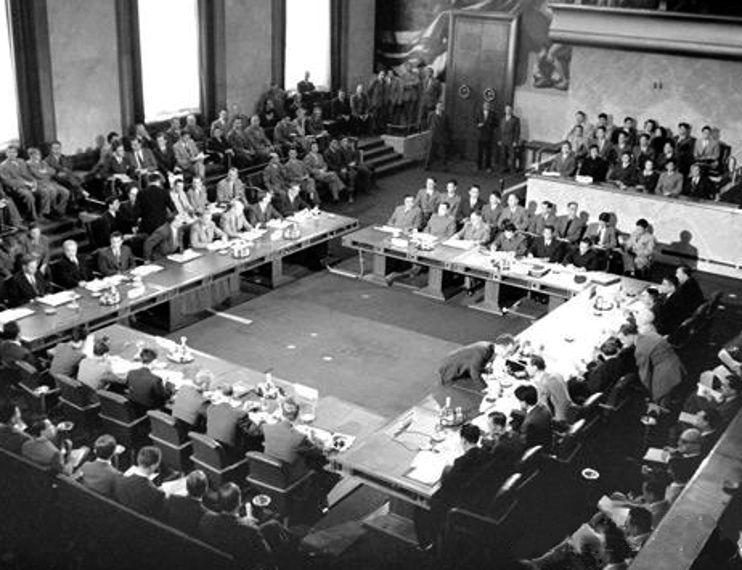
At the 1954 Geneva Conference, Vietnam was temporarily partitioned at the 17th parallel. Ho Chi Minh wished to continue war in the south, but was restrained by Chinese allies, who convinced him he could win control by electoral means. The CIA's efforts played a minimal role, as Catholic migrants were driven primarily by their own convictions and circumstances rather than external psychological operations.
During 300 days, up to one million northerners, fearing persecution by the communists, moved south, including at least 500,000 Catholics, approximately 200,000 Buddhists, and tens of thousands from ethnic minority communities. The exodus was coordinated by a U.S.-funded $93 million relocation program, which involved the French Navy and US Seventh Fleet to ferry refugees. The refugees gave the later Ngô Đình Diệm regime a strong anti-communist constituency. Over 100,000 Viet Minh fighters went north for "regroupment", expecting to return south within two years. The Viet Minh left roughly 5,000 to 10,000 cadres in the south as a base for insurgency. The last French soldiers left South Vietnam in 1956, and China withdrew from North Vietnam.
Between 1953 and 1956, the Northern government instituted agrarian reforms, including rent reduction and land reform, which resulted in political oppression. During land reform, North Vietnamese witnesses suggested a ratio of one execution for every 160 village residents, about 100,000 executions. As the campaign was mainly in the Red River Delta, 50,000 executions became accepted by scholars. However, documents from Vietnamese and Hungarian archives indicate executions were much lower, though likely greater than 14,000. In 1956, leaders in Hanoi admitted to "excesses" and restored much of the land to the original owners.
The South, meanwhile, constituted the State of Vietnam, with Bảo Đại as Emperor, and Ngô Đình Diệm as prime minister. Neither the US, nor Diệm's State of Vietnam, signed anything at the Geneva Conference. The non-communist Vietnamese delegation objected to any division of Vietnam, but lost when the French accepted the proposal of Viet Minh delegate Phạm Văn Đồng, who proposed Vietnam be united by elections under the supervision of "local commissions". The US countered with the "American Plan", with the support of South Vietnam and the UK. It provided for unification elections under UN supervision, but was rejected by the Soviets. The US said: "With respect to the statement made by the representative of the State of Vietnam, the United States reiterates its traditional position that peoples are entitled to determine their own future and that it will not join in any arrangement which would hinder this". Eisenhower wrote in 1954:
According to the Pentagon Papers, Diệm would have been a more popular candidate than Bảo Đại against Hồ, stating: "It is almost certain that by 1956 the proportion which might have voted for Ho – in a free election against Diem – would have been much smaller than 80%." In 1957, independent observers from India, Poland, and Canada representing the International Control Commission (ICC) stated that fair elections were impossible, reporting that neither South nor North had honored the armistice agreement.
From April to June 1955, Diệm eliminated political opposition in the south by launching operations against religious groups: the Cao Đài and Hòa Hảo of Ba Cụt. The campaign attacked the Bình Xuyên organized crime group, which was allied with members of the communist party secret police and had military elements. The group was defeated in April following a battle in Saigon. As broad opposition to his harsh tactics mounted, Diệm sought to blame the communists.
In a referendum on the future of the State of Vietnam in October 1955, Diệm rigged the poll supervised by his brother Ngô Đình Nhu and was credited with 98%, including 133% in Saigon. His American advisors had recommended a more modest winning margin of 60–70%. Diệm, however, viewed the election as a test of authority. He declared South Vietnam to be an independent state under the name Republic of Vietnam (ROV), with him as president. Likewise, Ho Chi Minh and other communists won 99% of the vote in North Vietnamese elections.
The domino theory, which argued that if a country fell to communism, surrounding countries would follow, was first proposed by the Eisenhower administration.
Diệm era, 1954–63
Main article: Ngo Dinh Diem, War in Vietnam (1954–1959)
Rule
A devout Catholic, Diệm was fervently anti-communist, nationalist, and socially conservative. "Diệm represented narrow and extremist nationalism coupled with autocracy and nepotism." Most Vietnamese were Buddhist, and alarmed by Diệm's actions, like his dedication of the country to the Virgin Mary.
In 1955, Diệm launched the "Denounce the Communists" campaign, during which suspected communists and other anti-government elements were imprisoned, tortured, or executed. He instituted the death penalty in 1956 against activity deemed communist. The North Vietnamese government claimed that, by November 1957, over 65,000 were imprisoned and 2,148 killed. 40,000 political prisoners were jailed by 1959.
In May 1957, Diệm undertook a 10-day state visit to the US. Eisenhower pledged his continued support, and a parade was held in Diệm's honor. But Secretary of State Dulles privately conceded Diệm had to be backed because they could find no better alternative.
Insurgency in the South, 1954–60
Main article: Viet Cong, War in Vietnam (1959–1963)
Between 1954 and 1957, the Diệm government succeeded in preventing large-scale unrest in the countryside. In April 1957, insurgents launched an assassination campaign, referred to as "extermination of traitors". 17 people were killed in the Châu Đốc massacre at a bar in July. By early 1959, Diệm had come to regard the violence as an organized campaign and implemented Law 10/59, which made political violence punishable by death. There had been division among former Viet Minh, whose main goal was to hold elections promised in the Geneva Accords, leading to activities separate from the other communists and anti-GVN (Government of the Republic of Vietnam) activists. Douglas Pike estimated that insurgents carried out 2,000 abductions, and 1,700 assassinations of officials, village chiefs, hospital workers and teachers from 1957 to 1960.
In September 1960, COSVN, North Vietnam's southern headquarters, ordered a coordinated uprising in South Vietnam and a third of the population was soon living in areas of communist control. In December, North Vietnam formally created the Viet Cong (VC) with the intent of uniting all anti-GVN insurgents, including non-communists. It was formed in Memot, Cambodia, and directed through COSVN. The VC placed "emphasis on the withdrawal of American advisors and influence, on land reform and liberalization of the GVN, on coalition government and the neutralization of Vietnam." Identities of the leaders were often kept secret.
Support for the VC was driven by resentment of Diem's reversal of Viet Minh land reforms. The Viet Minh had confiscated large private landholdings, reduced rents and debts, and leased communal lands to poorer peasants. Diem brought the landlords back, and people who had been farming land for years had to return it and pay years of back rent. According to Marilyn B. Young: "The divisions within villages reproduced those that had existed against the French: 75% support for the NLF, 20% trying to remain neutral and 5% firmly pro-government".
North Vietnamese involvement
In March 1956, southern communist leader Lê Duẩn presented a plan to revive the insurgency entitled "The Road to the South", to the Politburo in Hanoi. However, as China and the Soviets opposed confrontation, his plan was rejected.
The North Vietnamese Communist Party approved a "people's war" on the South in January 1959, About 500 of the "regroupees" of 1954 were sent south on the trail during its first year of operation. The first arms delivery was completed in August 1959. In April 1960, North Vietnam imposed military conscription for men. About 40,000 communist soldiers infiltrated the south between 1961 and 1963.
Kennedy's escalation, 1961–63
Main article: War in Vietnam (1959–1963), Strategic Hamlet Program

In the 1960 U.S. presidential election, John F. Kennedy defeated Richard Nixon. Although Eisenhower warned Kennedy about Laos and Vietnam, Europe and Latin America "loomed larger than Asia on his sights."
Kennedy remained committed to the Cold War foreign policy inherited from the Truman and Eisenhower administrations. In 1961, the US had 50,000 troops based in South Korea, and Kennedy faced four crisis situations: the failure of the Bay of Pigs Invasion he had approved in April, settlement negotiations between the pro-Western government of Laos and the Pathet Lao communist movement in May, construction of the Berlin Wall in August, and the Cuban Missile Crisis in October. Kennedy believed another failure to stop communist expansion would irreparably damage US credibility. He was determined to "draw a line in the sand" and prevent a communist victory in Vietnam. He told The New York Times after the Vienna summit with Khrushchev, "Now we have a problem making our power credible and Vietnam looks like the place."
Kennedy's policy toward South Vietnam assumed Diệm and his forces had to defeat the guerrillas on their own. He was against the deployment of American combat troops and observed "to introduce U.S. forces in large numbers there today, while it might have an initially favorable military impact, would almost certainly lead to adverse political and, in the long run, adverse military consequences." The quality of the South Vietnamese military, however, remained poor. Poor leadership, corruption, and political promotions weakened the ARVN. The frequency of guerrilla attacks rose as the insurgency gathered steam. While Hanoi's support for the VC played a role, South Vietnamese governmental incompetence was at the core of the crisis.
A major issue Kennedy raised was whether the Soviet space and missile programs had surpassed those of the US. Although Kennedy stressed long-range missile parity with the Soviets, he was interested in using special forces for counterinsurgency warfare in Third World countries threatened by communist insurgencies. Although they were intended for use behind front lines after a conventional Soviet invasion of Europe, Kennedy believed guerrilla tactics employed by special forces, would be effective in a "brush fire" war in Vietnam.
Kennedy advisors Maxwell Taylor and Walt Rostow recommended US troops be sent to South Vietnam disguised as flood relief workers. Kennedy rejected the idea but increased military assistance. In April 1962, John Kenneth Galbraith warned Kennedy of the "danger we shall replace the French as a colonial force...and bleed as the French did." Eisenhower put 900 advisors in Vietnam, and by November 1963, Kennedy had put 16,000.
The Strategic Hamlet Program was initiated in late 1961. This joint U.S.–South Vietnamese program attempted to resettle the rural population into fortified villages. It was implemented in early 1962 and involved forced relocation and segregation of rural South Vietnamese, into new communities where the peasantry would be isolated from the VC. It was hoped these new communities would provide security for the peasants and strengthen the tie between them and central government. However, by November 1963 the program had waned, and it ended in 1964. In July 1962, 14 nations, including China, South Vietnam, the Soviet Union, North Vietnam, and the US, signed the International Agreement on the Neutrality of Laos.
Ousting and assassination of Ngô Đình Diệm
Main article: Arrest and assassination of Ngô Đình Diệm
The inept performance of the ARVN was exemplified by failed actions such as the Battle of Ap Bac in January 1963, in which the VC won a battle against a much larger and better-equipped South Vietnamese force, many of whose officers seemed reluctant to engage. The ARVN lost 83 soldiers and 5 US helicopters, serving to ferry troops shot down by VC forces, while the VC lost only 18 soldiers. The ARVN forces were led by Diệm's most trusted general, Huỳnh Văn Cao. Cao was a Catholic, promoted due to religion and fidelity rather than skill, and his main role was to preserve his forces to stave off coups. Washington policymaker concluded Diệm was incapable of defeating the communists and might even make a deal with Ho Chi Minh. He seemed concerned only with fending off coups and had become paranoid after attempts in 1960 and 1962, which he partly attributed to US encouragement. Robert F. Kennedy noted, "Diệm wouldn't make even the slightest concessions. He was difficult to reason with..." Historian James Gibson summed up the situation:
Discontent with Diệm's policies exploded in May 1963, following the Huế Phật Đản shootings of 9 Buddhists protesting the ban on displaying the Buddhist flag on Vesak. This resulted in mass protests—the Buddhist crisis—against discriminatory policies that gave privileges to Catholics over the Buddhist majority. Ngô Đình Thục, Diệm's elder brother and the Archbishop of Huế, held his anniversary celebrations shortly before Vesak; they were bankrolled by the government, and Catholic flags were prominently displayed. Diệm refused to make concessions to the Buddhists or take responsibility for the deaths. In August 1963, the ARVN Special Forces of Colonel Lê Quang Tung, loyal to Diệm's brother Ngô Đình Nhu, raided pagodas, causing destruction and hundreds of deaths. The Republic of Vietnam sought to harness religious nationalism by promoting spiritual values in opposition to communism's atheism; this approach amplified religious consciousness that challenged the state's authority.

US officials began discussing regime change during 1963. The United States Department of State wanted to encourage a coup, while the Pentagon favored Diệm. Chief among the proposed changes was removal of Diệm's brother Nhu, who controlled the secret police and special forces, and was seen as being behind Buddhist repression and the Ngô family's rule. This proposal was conveyed to the US embassy in Saigon in Cable 243. The CIA contacted generals planning to remove Diệm, and told them the US would not oppose this, nor punish them by cutting off aid. Diệm was overthrown and executed, along with his brother, on 2 November 1963. When Kennedy was informed, Maxwell Taylor remembered he "rushed from the room with a look of shock and dismay on his face." Kennedy had not anticipated Diệm's murder. The U.S. ambassador Henry Cabot Lodge, invited coup leaders to the embassy and congratulated them. Lodge informed Kennedy that "the prospects now are for a shorter war". Kennedy wrote to Lodge congratulating him for "a fine job".
Following the coup, chaos ensued. Hanoi took advantage and increased its support for the VC. South Vietnam entered political instability, as one military government toppled another. Each new regime was viewed by the communists as a puppet of the Americans; whatever the failings of Diệm, his credentials as a nationalist had been impeccable. – and "winning the hearts and minds" of the population. Military leadership in Washington, however, was hostile to any role for U.S. advisors other than troop training. General Paul Harkins, the commander of U.S. forces in South Vietnam, confidently predicted victory by Christmas 1963.
Paramilitary officers from the CIA's Special Activities Division trained and led Hmong tribesmen in Laos and into Vietnam. The indigenous forces were in the tens of thousands and conducted direct action missions, led by paramilitary officers, against the Communist Pathet Lao forces and their North Vietnamese supporters. The CIA ran the Phoenix Program and participated in the Military Assistance Command, Vietnam – Studies and Observations Group (MAC-V SOG).
Gulf of Tonkin and Johnson's escalation, 1963–69
Main article: Joint warfare in South Vietnam, 1963–1969
Kennedy was assassinated on 22 November 1963. Vice President Lyndon B. Johnson had not been heavily involved with policy toward Vietnam; however he immediately focused on it. On 24 November, he said, "the battle against communism... must be joined... with strength and determination." Johnson knew he had inherited a deteriorating situation, but adhered to the widely accepted domino argument for defending the South: Should they retreat or appease, either action would imperil other nations. Findings from RAND's Viet Cong Motivation and Morale Project bolstered his confidence that an air war would weaken the insurgency. Some argue the policy of North Vietnam was not to topple other non-communist governments in South East Asia.
The military revolutionary council, meeting in lieu of a strong South Vietnamese leader, had 12 members. It was headed by General Dương Văn Minh, whom journalist Stanley Karnow, recalled as "a model of lethargy". Lodge cabled home about Minh: "Will he be strong enough to get on top of things?" Minh's regime was overthrown in January 1964 by General Nguyễn Khánh. There was persistent instability in the military: several coups—not all successful—occurred in a short period of time.
Gulf of Tonkin incident
Main article: Gulf of Tonkin incident
On 2 August 1964, , on an intelligence mission along North Vietnam's coast, fired upon and damaged torpedo boats approaching it in the Gulf of Tonkin. An NSA publication declassified in 2005 revealed there was no attack on 4 August. The second "attack" led to retaliatory airstrikes, and prompted Congress to approve the Gulf of Tonkin Resolution on 7 August. This granted the president power "to take all necessary measures to repel any armed attack against the forces of the United States and to prevent further aggression" and Johnson relied on this as giving him authority to expand the war. Johnson pledged he was not "committing American boys to fighting a war that I think ought to be fought by the boys of Asia to help protect their own land".
The National Security Council recommended an escalation of the bombing of North Vietnam. Following an attack on a U.S. Army base in February 1965, airstrikes were initiated, while Soviet Premier Alexei Kosygin was on a state visit to North Vietnam. Operation Rolling Thunder and Operation Arc Light expanded aerial bombardment and ground support operations. The bombing campaign, which lasted three years, was intended to force North Vietnam to cease support for the VC by threatening to destroy North Vietnamese air defenses and infrastructure. It was additionally aimed at bolstering South Vietnamese morale. Between 1965 and 1968, Rolling Thunder deluged the north with a million tons of missiles, rockets and bombs.
Bombing of Laos
Main article: Laotian Civil War
Bombing was not restricted to North Vietnam. Aerial campaigns targeted different parts of the VC and PAVN infrastructure. These included the Ho Chi Minh Trail through Laos and Cambodia. The ostensibly neutral Laos had become the scene of a civil war, pitting the Laotian government backed by the US, against the Pathet Lao and its North Vietnamese allies.
Aerial bombardment against the Pathet Lao and PAVN forces was undertaken by the US to prevent the collapse of the government, and deny use of the Ho Chi Minh Trail. Between 1964 and 1973, the US dropped two million tons of bombs on Laos, similar to the 2.1 million tons of bombs it dropped on Europe and Asia during World War II, making Laos the most heavily bombed country in history.
The objective of stopping North Vietnam and the VC was never reached. The Chief of Staff of the United States Air Force Curtis LeMay, however, had long advocated saturation bombing in Vietnam and wrote of the communists that "we're going to bomb them back into the Stone Age".
The 1964 offensive
Following the Tonkin Resolution, Hanoi anticipated the arrival of US troops and expanded the VC, as well as sending PAVN personnel southwards. They were outfitting the VC forces and standardizing their equipment with AK-47 rifles and other supplies, as well as forming the 9th Division. "From a strength of approximately 5,000 at the start of 1959 the Viet Cong's ranks grew to about 100,000 at the end of 1964... Between 1961-64 the Army's strength rose from about 850,000 to nearly a million men." US troop numbers deployed were much lower: 2,000 in 1961, rising to 16,500 in 1964. The use of captured equipment decreased, while more ammunition and supplies were required to maintain regular units. Group 559 was tasked with expanding the Ho Chi Minh Trail, in light of US bombardment. The war had shifted into the final, conventional phase of Hanoi's three-stage protracted warfare model. The VC was tasked with destroying the ARVN, and capturing and holding areas; however, it was not yet strong enough to assault towns and cities.
In December 1964, ARVN forces suffered losses at the Battle of Bình Giã, in a battle both sides viewed as a watershed. Previously, the VC had utilized hit-and-run guerrilla tactics. At Binh Gia, they defeated a strong ARVN force in a conventional battle and remained in the field for four days. Tellingly, South Vietnamese forces were again defeated in June 1965 at the Battle of Đồng Xoài.
American ground war
On 8 March 1965, 3,500 U.S. Marines were landed near Da Nang, South Vietnam. The Marines' initial assignment was defense of Da Nang Air Base. The first deployment was increased to nearly 200,000 by December. US military had been schooled in offensive warfare. Regardless of policy, US commanders were institutionally and psychologically unsuited to defensive missions.
General William Westmoreland informed Admiral U. S. Grant Sharp Jr., commander of US Pacific forces, that the situation was critical, With this recommendation, Westmoreland advocated an aggressive departure from America's defensive posture and sidelining of the South Vietnamese. By ignoring ARVN units, the US commitment became open-ended. Westmoreland outlined a three-point plan to win:
- Phase 1. Commitment of US and allied forces necessary to halt the losing trend by the end of 1965.
- Phase 2. US and allied forces mount major offensive actions to seize the initiative to destroy guerrilla and organized enemy forces. This phase would end when the enemy had been worn down and driven back from major populated areas.
- Phase 3. If the enemy persisted, a period of 12–18 months following Phase 2 would be required for final destruction of forces remaining in remote base areas.
The plan was approved by Johnson and marked a profound departure from the insistence that South Vietnam was responsible for defeating the VC. Westmoreland predicted victory by December 1967. Johnson did not communicate this change to the media, instead he emphasized continuity. The change in policy depended on matching the North Vietnamese and VC in a contest of attrition and morale. The opponents were locked in an escalation cycle. Westmoreland and McNamara touted the body count system for gauging victory, a metric that proved flawed.

The American buildup transformed the South Vietnamese economy and profoundly effected society. South Vietnam was inundated with manufactured goods. Washington encouraged its SEATO allies to contribute troops; Australia, New Zealand, Thailand and the Philippines agreed. South Korea asked to join the Many Flags program in return for economic compensation. Major allies, however, notably Canada and the UK, declined troop requests.
The US and allies mounted complex search and destroy operations. In November 1965, the US engaged in its first major battle with the PAVN, the Battle of Ia Drang. The operation was the first large scale helicopter air assault by the US, and first to employ Boeing B-52 Stratofortress bombers. the largest search and destroy operation to that point. Operation Masher had negligible impact however, as the PAVN/VC returned to the province just four months afterwards. Despite major operations, which the VC and PAVN would evade, the war was characterized by smaller-unit engagements. The VC and PAVN would initiate 90% of large firefights, and thus the PAVN/VC would retain strategic initiative despite overwhelming US force and firepower deployment. The PAVN and Viet Cong had developed strategies capable of countering US doctrines and tactics: see NLF and PAVN battle tactics.
Meanwhile, South Vietnamese politics began to stabilize with the arrival of prime minister Air Marshal Nguyễn Cao Kỳ and figurehead chief of state, General Nguyễn Văn Thiệu, in mid-1965. In 1967, Thieu became president with Ky as his deputy, after rigged elections. Though nominally a civilian government, Kỳ was supposed to maintain real power through a behind-the-scenes military body. However, Thiệu outmanoeuvred and sidelined Kỳ. Thiệu was accused of murdering Kỳ loyalists through contrived military accidents. Thiệu remained president until 1975, having won a one-candidate election in 1971.
Johnson employed a "policy of minimum candor" with the media. Military information officers sought to manage coverage by emphasizing stories that portrayed progress. This damaged public trust in official pronouncements. As coverage of the war and the Pentagon diverged, a credibility gap developed. Despite Johnson and Westmoreland proclaiming victory and Westmoreland stating the "end is coming into view", internal reports in the Pentagon Papers indicate VC forces retained strategic initiative and controlled their losses. VC attacks against static US positions accounted for 30% of engagements, VC/PAVN ambushes and encirclements for 23%, American ambushes against VC/PAVN forces for 9%, and American forces attacking VC emplacements only 5%.
Tet Offensive and its aftermath
Main article: Tet Offensive, United States news media and the Vietnam War

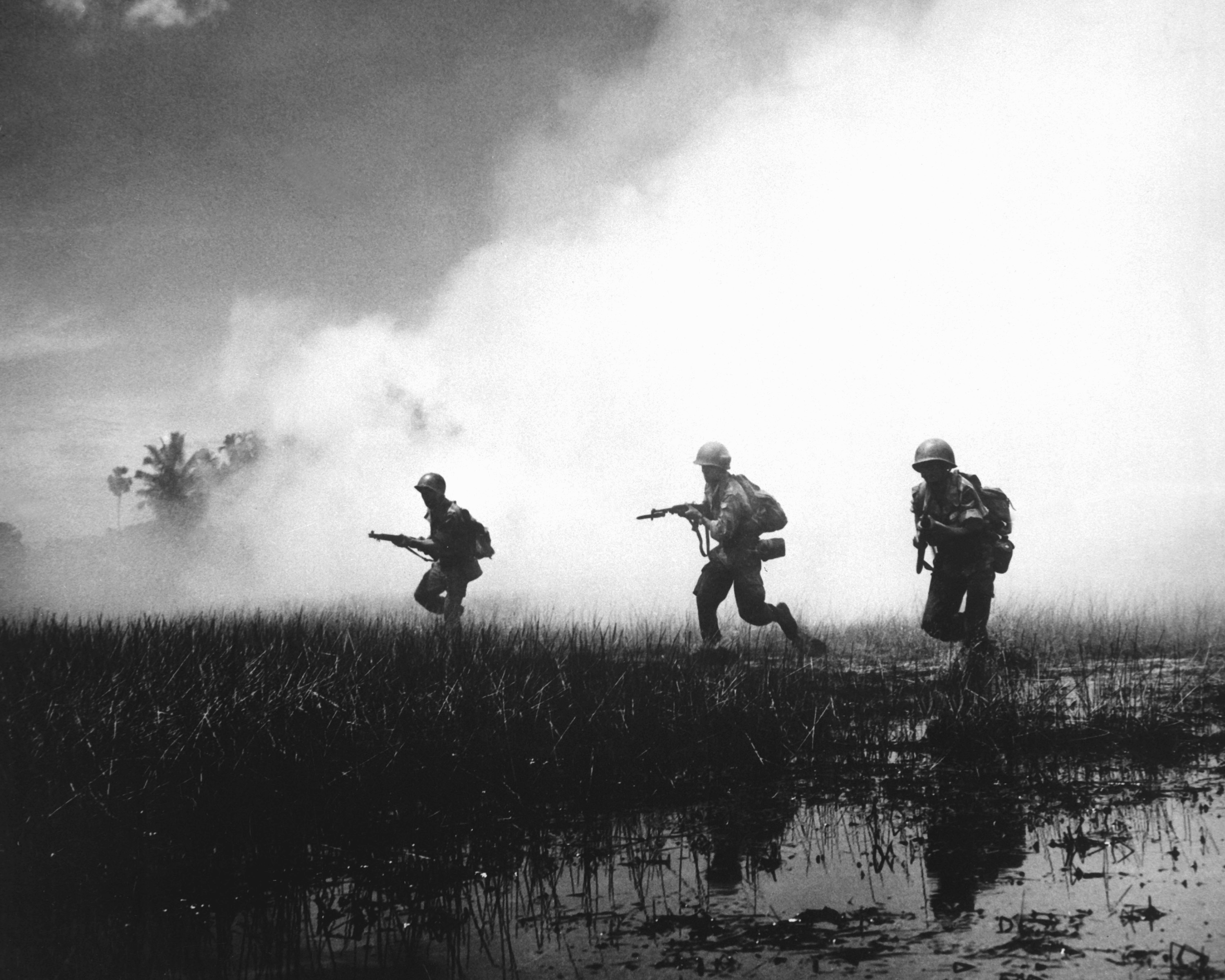
In late 1967, the PAVN lured American forces into the hinterlands at Đắk Tô and at the Marine Khe Sanh combat base, where the US fought The Hill Fights. These were part of a diversionary strategy to draw US forces towards the Central Highlands. Preparations were underway for the Tet Offensive, with the intention of Văn Tiến Dũng forces to launch "direct attacks on the American and puppet nerve centers—Saigon, Huế, Danang, all the cities, towns and main bases [...]". Le Duan sought to placate critics of the stalemate by a decisive victory. He reasoned this could be achieved through sparking an uprising in the towns and cities,
The Tet Offensive began in January 1968, as over 100 cities were attacked by over 85,000 VC/PAVN troops, including assaults on military installations, headquarters, and government buildings, including the US Embassy in Saigon. In the Battle of Huế American forces employed massive firepower that left 80% of the city in ruins. In Saigon, VC/PAVN fighters had captured areas in and around the city, attacking key installations before US and ARVN forces dislodged them.
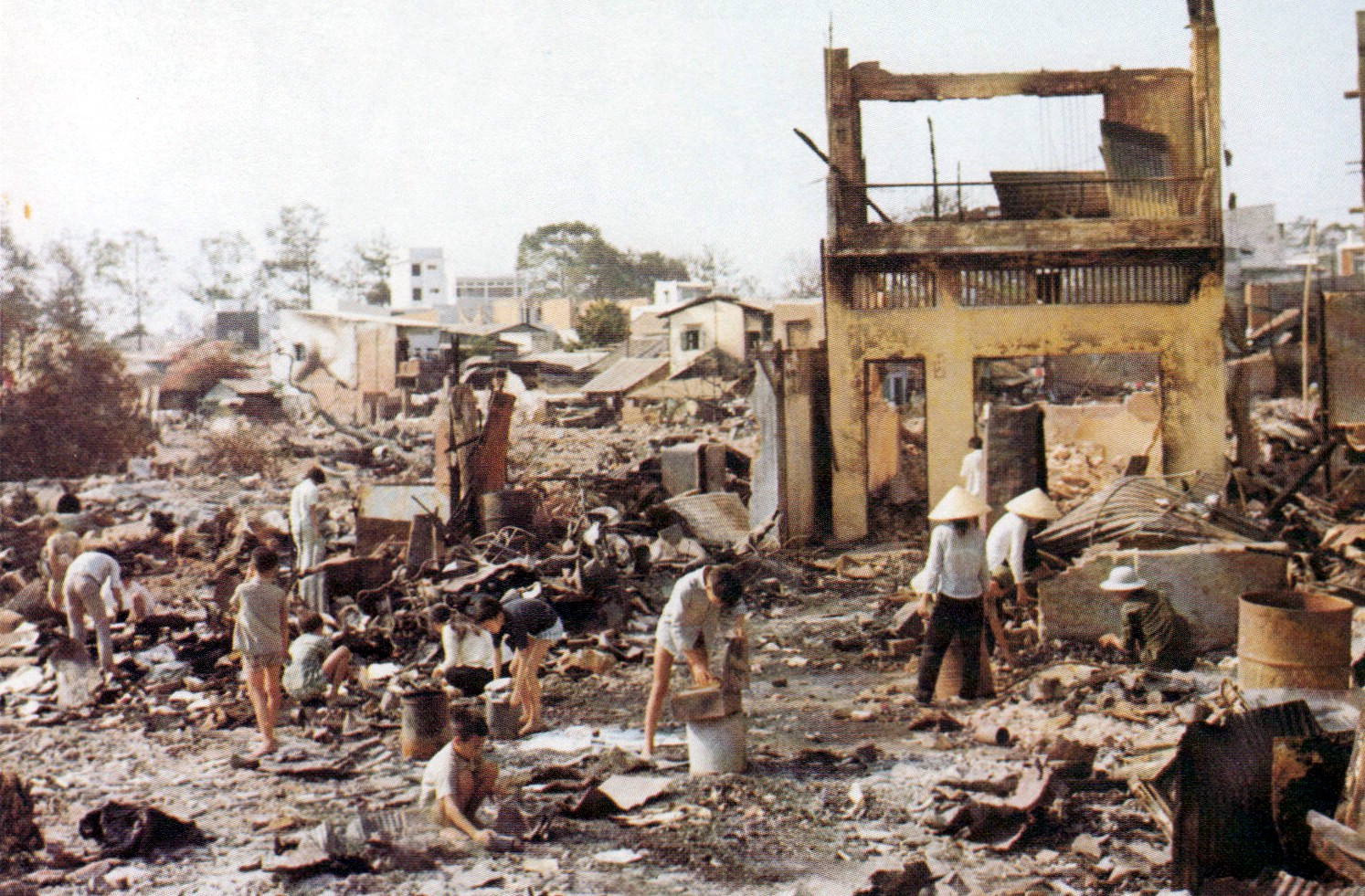
During the first month of Tet, 1,100 American and allied troops, 2,100 ARVN and 14,000 civilians were killed. After two months, 5,000 ARVN and 4,000 US forces had been killed and 46,000 wounded. It had become the bloodiest year up to then. The failure to spark a general uprising and lack of defections among the ARVN units meant Hanoi's goals had failed at enormous cost.
Prior to Tet, in November 1967, Westmoreland had spearheaded a public relations drive for the Johnson administration to bolster flagging public support. In a speech to the National Press Club he said "the end comes into view". Thus, the public was shocked and confused by the Tet Offensive. Public approval of his performance dropped from 48% to 36%, and endorsement for the war fell from 40% to 26%. The public turned against Johnson as the offensives contradicted claims of progress.
During 1968, Westmoreland considered the use of nuclear weapons in a contingency plan codenamed Fracture Jaw, which was abandoned when it became known to the White House. Westmoreland and Chairman of the Joint Chiefs of Staff General Earle Wheeler requested more than 200,000 additional troops. This quickly leaked to the media, and the fallout combined with intelligence failures caused Westmoreland to be removed in March 1968, succeeded by his deputy Creighton Abrams.
On 10 May 1968, peace talks began between the US and North Vietnam in Paris. Negotiations stagnated for five months, until Johnson halted the bombing of North Vietnam. Hanoi realized it could not achieve a "total victory" and employed a strategy known as "talking while fighting, fighting while talking", in which offensives occurred concurrently with negotiations.
Johnson declined to run for re-election as his approval rating slumped from 48% to 36%. This was misleading. He was increasing the military pressure on enemy forces, trying to ensure that if the negotiations produced an agreement, it would be one representing a defeat for Hanoi.
Johnson did not make the huge increase in US troop strength that Generals Westmoreland and Wheeler had requested a few weeks earlier, but he did send significant reinforcements. There were about 515,000 US military personnel in Vietnam at the time of his speech. There were 536,000 two months later. He narrowed the area of North Vietnam on which US bombs fell, but in April 1968, the first month in which bombing was limited to the southern part of North Vietnam, the United States dropped almost twice as many tons of bombs there as had been dropped on the whole of North Vietnam in March. More importantly, US bombing of Indochina as a whole was increasing. The most the US had dropped in Indochina in any month before Johnson's speech had been about 98,000 tons. In April 1968, the month after his speech, the figure rose to almost 113,000 tons.
Vietnam was a major issue during the United States presidential election in 1968. The election was won by Republican Richard Nixon who claimed to have a secret plan to end the war.
Vietnamization, 1969–72
Nuclear threats and diplomacy
Nixon began troop withdrawals in 1969. His plan to build up the ARVN so it could take over defense of South Vietnam became known as "Vietnamization". As the PAVN/VC recovered from their 1968 losses and avoided contact, Abrams conducted operations aimed at disrupting logistics, with better use of firepower and more cooperation with the ARVN. Nixon had sought détente with the Soviet Union and rapprochement with China, which decreased tensions and led to nuclear arms reductions. However, the Soviets continued to supply North Vietnam.
Hanoi's war strategy
On 2 September 1969, Ho Chi Minh died. The failure of the Tet Offensive to spark an uprising in the south caused a shift in Hanoi's war strategy, and the Giáp-Chinh "Northern-First" faction regained control over military affairs from the Lê Duẩn-Hoàng Văn Thái "Southern-First" faction. An unconventional victory was sidelined in favor of conventional through conquest. Large-scale offensives were rolled back in favor of small-unit and sapper attacks as well as targeting the pacification and Vietnamization strategy. Following Tet, the PAVN had transformed from a light-infantry, limited mobility force into high-mobility and mechanized combined arms.
U.S. domestic controversies
The anti-war movement was gaining strength in the US. Nixon appealed to the "silent majority" who he said supported the war. But revelations of the 1968 My Lai massacre, of a suspected double agent, provoked outrage.
In 1971, the Pentagon Papers were leaked to The New York Times. The secret history of US involvement, commissioned by the Department of Defense, detailed public deceptions by the government. The Supreme Court ruled publication legal.
Collapsing U.S. morale
Following Tet and decreasing public support, US forces began a period of morale collapse, and disobedience. At home, desertion rates quadrupled from 1966 levels. Among the enlisted, only 2.5% chose infantry between 1969 and 1970. and a low of 33,220 in 1974, depriving the US of much-needed military leadership.
Refusal to engage in patrols or carry out orders emerged, with a case of an entire company refusing orders. Unit cohesion began to dissipate and focused on minimizing contact with the PAVN/VC. 900 fragging (killing a fellow officer, usually superior) and suspected fragging incidents were investigated, most occurring between 1969 and 1971. In 1969, field-performance was characterized by low morale and poor leadership. The decline in morale was demonstrated by the Battle of FSB Mary Ann in 1971, in which a sapper attack inflicted serious losses on US defenders. Westmoreland, no longer in command but tasked with investigation of the failure, cited dereliction of duty, lax defensive postures and lack of officers in charge.
On the collapse of morale, Shelby Stanton wrote:
ARVN taking the lead and U.S. ground force withdrawal

Beginning in 1969, American troops were withdrawn from border areas where most of the fighting took place and redeployed along the coast and interior. US casualties in 1970 were less than half of 1969, after being relegated to less active combat. While US forces were redeployed, the ARVN took over combat operations, with casualties double US ones in 1969, and triple in 1970. Post-Tet, membership in the South Vietnamese Regional Forces and Popular Force militias grew, and they could now provide village security, which the Americans had not accomplished.
In 1970, Nixon announced the withdrawal of an additional 150,000 American troops, reducing US numbers to 265,500. Between 1969 and 1971 the VC and some PAVN units had reverted to small unit tactics, instead of nationwide offensives.
Cambodia
Main article: Operation Menu, Operation Freedom Deal

Prince Norodom Sihanouk had proclaimed Cambodia neutral since 1955, but permitted the PAVN/VC to use the port of Sihanoukville and Sihanouk Trail. In March 1969 Nixon launched a secret bombing campaign, called Operation Menu, against communist sanctuaries along the Cambodia/Vietnam border. Only five congressional officials were informed.
In March 1970, Sihanouk was deposed by his pro-American prime minister Lon Nol, who demanded North Vietnamese troops leave Cambodia or face military action. Nol began rounding up Vietnamese civilians in Cambodia and massacring them, provoking reactions from the North and South Vietnamese governments. In April–May 1970, North Vietnam invaded Cambodia at the request of the Khmer Rouge, following negotiations with deputy leader Nuon Chea. Nguyen Co Thach recalls: "Nuon Chea has asked for help and we have liberated five provinces of Cambodia in ten days." US and ARVN forces launched the Cambodian campaign in May to attack PAVN/VC bases. A counter-offensive in 1971, as part of Operation Chenla II by the PAVN, recaptured most border areas and decimated Nol's forces.
The US incursion into Cambodia sparked U.S. protests as Nixon had promised to deescalate involvement. Students were killed by National Guardsmen in May 1970 at a Kent State University protest, which provoked further outrage. The administration's reaction was seen as callous, reinvigorating the anti-war movement. The US continued to bomb Cambodia as part of Operation Freedom Deal.
Laos
Building on the success of ARVN units in Cambodia, and further testing the Vietnamization program, the ARVN was tasked with Operation Lam Son 719 in February 1971, the first major ground operation to attack the Ho Chi Minh Trail. This was the first time the PAVN would field-test its combined arms force. The first few days were a success, but momentum slowed after fierce resistance. Thiệu had halted the general advance, leaving PAVN armored divisions able to surround them.
Thieu ordered air assault troops to capture the Tchepone crossroad and withdraw, despite facing four-times larger numbers. During the withdrawal, the PAVN counterattack had forced a panicked rout. Half of the ARVN troops were either captured or killed, half the ARVN/US support helicopters were downed and the operation was a fiasco, demonstrating operational deficiencies within the ARVN. Nixon and Thieu had sought a showcase victory simply by capturing Tchepone, and it was spun off as an "operational success".
Easter Offensive and Paris Peace Accords, 1972
.jpg)
Vietnamization was again tested by the Easter Offensive of 1972, a conventional PAVN invasion of South Vietnam. The PAVN overran the northern provinces and attacked from Cambodia, threatening to cut the country in half. US troop withdrawals continued, but American airpower responded, beginning Operation Linebacker, and the offensive was halted.
The war was central to the 1972 U.S. presidential election as Nixon's opponent, George McGovern, campaigned on immediate withdrawal. Nixon's Security Advisor, Henry Kissinger, had continued secret negotiations with North Vietnam's Lê Đức Thọ and in October 1972 reached an agreement. Thiệu demanded changes to the peace accord upon its discovery, and when North Vietnam went public with the details, the Nixon administration claimed they were attempting to embarrass the president. The negotiations became deadlocked when Hanoi demanded changes. To show his support for South Vietnam and force Hanoi back to the negotiating table, Nixon ordered Operation Linebacker II, a bombing of Hanoi and Haiphong in December.
On 15 January 1973, all US combat activities were suspended. Lê Đức Thọ and Henry Kissinger, along with the PRG Foreign Minister Nguyễn Thị Bình and a reluctant Thiệu, signed the Paris Peace Accords on 27 January. All US forces personnel were withdrawn by March.
U.S. exit and final campaigns, 1973–75

In the lead-up to the ceasefire on 28 January, both sides attempted to maximize land and population under their control in a campaign known as the War of the Flags. Fighting continued after the ceasefire, without US participation, and throughout the year. North Vietnam was allowed to continue supplying troops in the South, but only to replace expended material. The Nobel Peace Prize was awarded to Kissinger and Thọ, but Thọ declined saying peace did not yet exist.
On 15 March 1973, Nixon implied the US would intervene militarily if the North launched a full offensive, and Defense Secretary Schlesinger re-affirmed this during his confirmation hearings. Public and congressional reaction was unfavorable, prompting the Senate to pass the Case–Church Amendment to prohibit intervention.
Northern leaders expected the ceasefire terms would favor their side, but Saigon, bolstered by a surge of US aid just before the ceasefire, began to roll them back. The North responded with a new strategy developed in March 1973, according to Trần Văn Trà. With US bombings suspended, work on the Ho Chi Minh Trail and other logistical structures could proceed. Logistics would be upgraded until the North was in a position to launch a massive invasion of the South, projected for the 1975–76 dry season. Trà calculated this would be Hanoi's last opportunity to strike, before Saigon's army could be fully trained. The PAVN resumed offensive operations when the dry season began in 1973, and by January 1974 had recaptured territory lost during the previous dry season.
In South Vietnam, the US departure, and recession after the 1973 oil crisis, hurt an economy dependent on US support and troop presence. After clashes that left 55 ARVN soldiers dead, Thiệu announced in January 1974, that the war had restarted and the Peace Accords were no longer in effect. There were over 25,000 South Vietnamese casualties during the ceasefire period. Gerald Ford took over as US president in August 1974, and Congress cut financial aid to South Vietnam from $1 billion a year to $700 million. Congress voted funding restrictions to be phased in through 1975 and total cutoff in 1976.
The success of the 1973–74 dry season offensive inspired Trà to return to Hanoi in October 1974 and plead for a larger offensive the next dry season. This time, Trà could travel on a drivable highway with fueling stops, a vast change from when the Ho Chi Minh Trail was a dangerous mountain trek. Giáp, the North Vietnamese defense minister, was reluctant to approve Trà's plan since a large offensive might provoke US reaction and interfere with the big push planned for 1976. Trà appealed to Giáp's superior, Lê Duẩn, who approved it. Trà's plan called for a limited offensive from Cambodia into Phước Long province. The strike was designed to solve logistical problems, gauge the reaction of South Vietnamese forces, and determine whether the US would return. On 13 December 1974, PAVN forces attacked Phước Long. Phuoc Binh fell on 6 January 1975. Ford desperately asked Congress for funds to assist and re-supply the South before it was overrun. Congress refused. The fall of Phuoc Binh and lack of American response left the South Vietnamese elite demoralized.
The speed of this success led the Politburo to reassess. It decided operations in the Central Highlands would be turned over to General Văn Tiến Dũng and Pleiku should be seized, if possible. Dũng said to Lê Duẩn: "Never have we had military and political conditions so perfect or a strategic advantage as great as we have now." At the start of 1975, the South Vietnamese had three times as much artillery and twice as many tanks and armored vehicles as the PAVN. However, heightened oil prices meant many assets could not be used. Moreover, the rushed nature of Vietnamization, intended to cover US retreat, resulted in lack of spare parts, ground-crew, and maintenance personnel, which rendered most of it inoperable.
Campaign 275

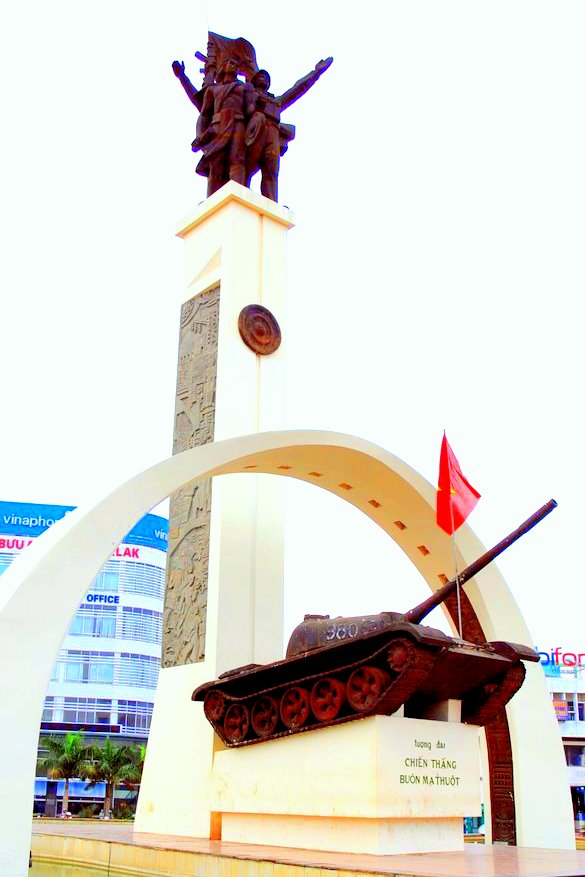
On 10 March 1975, Dũng launched Campaign 275, a limited offensive into the Central Highlands, supported by tanks and heavy artillery. The target was Ban Ma Thuột; if the town could be taken, the provincial capital Pleiku and the road to the coast, would be exposed for a campaign in 1976. The ARVN proved incapable of resisting, its forces collapsed. Again, Hanoi was surprised by the speed of its success. Dung urged the Politburo to allow him to seize Pleiku immediately and turn his attention to Kon Tum. He argued that with two months of good weather until the monsoon, it would be irresponsible not to take advantage.
Thiệu ordered the abandonment of the Central Highlands and less defensible positions in a rushed policy described as "light at the top, heavy at the bottom". While most ARVN forces attempted to flee, isolated units fought desperately. ARVN general Phu abandoned Pleiku and Kon Tum and retreated toward the coast, in the "convoy of tears". On 20 March, Thiệu reversed himself and ordered Huế, Vietnam's third-largest city, held at all costs, and then changed policy several times. As the PAVN attacked, panic set in, and ARVN resistance withered. On 22 March, the PAVN attacked Huế. Civilians flooded the airport and docks hoping to escape. As resistance in Huế collapsed, PAVN rockets rained down on Da Nang and its airport. By 28 March 35,000 PAVN troops were poised to attack the suburbs. By 30 March 100,000 leaderless ARVN troops surrendered as the PAVN marched through Da Nang. With the fall of the city, the defense of the Central Highlands and Northern provinces ended.
Final North Vietnamese offensive
With the north half of the country under their control, the Politburo ordered Dũng to launch the final offensive. The operational plan for the Ho Chi Minh Campaign called for Saigon's capture before 1 May. Hanoi wished to avoid the monsoon and prevent redeployment of ARVN forces defending the capital. PAVN forces, their morale boosted by recent victories, rolled on, taking Nha Trang, Cam Ranh and Da Lat.
On 7 April, three PAVN divisions attacked Xuân Lộc, 40 mi northeast of Saigon. Fighting raged as the ARVN defenders made a last stand to block PAVN advance. On 21 April however, the exhausted garrison was ordered to withdraw towards Saigon.
By the end of April, the ARVN had collapsed except in the Mekong Delta. Refugees streamed southward, ahead of the PAVN onslaught. By 27 April, 100,000 PAVN troops encircled Saigon. The city was defended by about 30,000 ARVN troops. To hasten a collapse and foment panic, the PAVN shelled Tan Son Nhut Airport and forced its closure. Large numbers of civilians had no way out.
Fall of Saigon
Main article: Fall of Saigon, Operation Frequent Wind

Chaos and panic broke out as South Vietnamese officials and civilians scrambled to leave. Martial law was declared. American helicopters began evacuating South Vietnamese, US and foreign nationals from Tan Son Nhut and the embassy compound. Operation Frequent Wind had been delayed until the last possible moment, because of Ambassador Graham Martin's belief Saigon could be held and a political settlement reached. Frequent Wind was the largest helicopter evacuation in history. It began on 29 April, in an atmosphere of desperation, as hysterical crowds of Vietnamese vied for limited space. Frequent Wind continued round the clock, as PAVN tanks breached defenses near Saigon. In the morning of 30 April, the last US Marines evacuated the embassy by helicopter, as civilians swamped the perimeter and poured into the grounds.
PAVN troops entered Saigon and overcame all resistance, capturing key buildings and installations. Tanks from the 2nd Corps crashed through the gates of the Independence Palace and the VC flag was raised above it. President Dương Văn Minh, who had succeeded Huong two days earlier, surrendered to Lieutenant colonel Bùi Văn Tùng, political commissar of the 203rd Tank Brigade. Minh was escorted to Radio Saigon to announce the surrender. The statement was on air at 2:30 pm.
Opposition to US involvement
Main article: Opposition to United States involvement in the Vietnam War, Protests of 1968
During the war a large segment of Americans became opposed to US involvement. In January 1967, 32% of Americans thought the US had made a mistake in sending troops. Opinion steadily turned following 1967 and by 1970 60% believed the US had made a mistake.
Early opposition drew its inspiration from the Geneva Conference. American support of Diệm in refusing elections was seen as thwarting the democracy that the United States claimed to support. Kennedy, while senator, opposed involvement. and for those involved with the New Left. Others, such as Stephen Spiro, opposed the war based on the theory of Just War. Some wanted to show solidarity with the Vietnamese, such as Norman Morrison emulating Thích Quảng Đức.
High-profile opposition increasingly turned to mass protests to shift opinion. Riots broke out at the 1968 Democratic National Convention. The fatal shooting of students at Kent State University in 1970 led to nationwide university protests. Anti-war protests declined after the Paris Peace Accords and the end of the draft in 1973, and the withdrawal of troops.
Involvement of other countries
Main article: International participation in the Vietnam War
Pro-Hanoi
China
China provided significant support for North Vietnam when the US started to intervene, including finance and hundreds of thousands of military support personnel. China said its military and economic aid to North Vietnam totaled $160 billion (adjusted for 2022 prices); included were 5 million tons of food (equivalent to a year's production), accounting for 10–15% of the North's food supply by the 1970s.
In summer 1962, Mao Zedong agreed to supply Hanoi with 90,000 rifles and guns free of charge, and starting in 1965, China began sending anti-aircraft units and engineering battalions, to repair damage caused by American bombing. They helped man anti-aircraft batteries, rebuild roads and railroads, transport supplies, and perform other engineering works. This freed PAVN units for combat. China sent 320,000 troops and annual arms shipments worth $180 million. China claims to have caused 38% of American air losses.
Soviet Union
For further reading, see Bibliography of the post-Stalinist Soviet Union
The Soviet Union supplied North Vietnam with medical supplies, arms, tanks, planes, helicopters, artillery, anti-aircraft missiles and other military equipment. Soviet crews fired Soviet-made surface-to-air missiles at US aircraft in 1965. Following the dissolution of the Soviet Union in 1991, Russia acknowledged that the USSR had stationed up to 3,000 troops in Vietnam. 16 Soviet military personnel were killed in action during the war.
Between 1953 and 1991, the hardware donated by the Soviet Union included: 2,000 tanks; 1,700 APCs; 7,000 artillery guns; over 5,000 anti-aircraft guns; 158 surface-to-air missile launchers; and 120 helicopters. The Soviets sent North Vietnam annual arms shipments worth $450 million. From 1965 to 1974, fighting in Vietnam was observed by 11,000 military personnel of the Soviet Armed Forces. The KGB helped develop the signals intelligence capabilities of the North Vietnamese.
Pro-Saigon
As South Vietnam was formally part of a military alliance with the US, Australia, New Zealand, France, the UK, Pakistan, Thailand and the Philippines, the alliance was invoked during the war. The UK, France and Pakistan declined to participate, and South Korea, Taiwan, and Spain were non-treaty participants.
United Front for the Liberation of Oppressed Races
Main article: United Front for the Liberation of Oppressed Races, FULRO insurgency
The ethnic minorities of South Vietnam, like the Montagnards in the Central Highlands, the Hindu and Muslim Cham, and the Buddhist Khmer Krom, were actively recruited in the war. There was a strategy of recruitment and favorable treatment of Montagnard tribes by the VC, as they were pivotal for control of infiltration routes. Some groups split off and formed the United Front for the Liberation of Oppressed Races (FULRO) to fight for autonomy or independence. FULRO fought against the South Vietnamese and VC, later fighting against the unified Socialist Republic of Vietnam, after the fall of South Vietnam.
South Vietnam president Diem began a program to settle ethnic Vietnamese Kinh on Montagnard lands in the Central Highlands region. This provoked a backlash from the Montagnards, with some joining the VC. The Cambodians under pro-China Sihanouk and pro-American Lon Nol, supported their fellow Khmer Krom in South Vietnam, following an anti-ethnic Vietnamese policy. Following Vietnamization, many Montagnard groups and fighters were incorporated into the Vietnamese Rangers as border sentries.
War crimes
Main article: List of war crimes#1955–1975: Vietnam War, List of massacres in Vietnam
War crimes took place, by both sides, including: rape, massacres of civilians, bombings of civilian targets, terrorism, torture, and murder of prisoners of war. Common crimes included theft, arson, and the destruction of property not warranted by military necessity.
South Vietnamese, Korean and American{{Anchor|War crimes committed by US forces}}

In 1966, the Russell Tribunal was organized by public figures opposed to the war led by Bertrand Russell, to apply the precepts of international law. The tribunal found the US and allies guilty of acts of aggression, use of weapons forbidden by the laws of war, bombardment of targets of a purely civilian character, mistreatment of prisoners, and genocide. Though the tribunal's lack of juridical authority meant findings were ignored by the US and other governments, the hearings contributed to growing evidence which established the factual basis for a counter-narrative to US justifications for the war and inspired hearings, tribunals and legal investigations.
In 1968, the Vietnam War Crimes Working Group (VWCWG) was established by the Pentagon task force set up in the wake of the My Lai massacre, to ascertain the veracity of claims of US war crimes. Of the crimes reported to military authorities, sworn statements by witnesses and status reports indicated 320 incidents had a factual basis. The substantiated cases included seven massacres between 1967 and 1971 in which at least 137 civilians were killed; 78 further attacks targeting non-combatants resulting in at 57 deaths and 15 sexually assaulted; and 141 cases of US soldiers torturing civilian detainees, or prisoners of war, with fists, sticks, bats, water or electric shock. Journalists have documented uninvestigated war crimes, involving every active army division, including atrocities committed by Tiger Force. R. J. Rummel estimated that American forces committed around 5,500 democidal killings between 1960 and 1972.
US forces established free-fire zones to prevent VC fighters from sheltering in South Vietnamese villages. Such practice, which involved the assumption that anyone appearing in the designated zones was an enemy that could be freely targeted, was regarded as "a severe violation of the laws of war". Nick Turse argues that a drive toward higher body counts, widespread use of free-fire zones, rules of engagement where civilians who ran from soldiers or helicopters could be viewed as VC and disdain for civilians, led to massive civilian casualties and war crimes. An example cited by Turse is Operation Speedy Express, described by John Paul Vann as "many Mỹ Lais".
Rummel estimated 39,000 were killed by South Vietnam during the Diem-era in democide; for 1964–75, Rummel estimated 50,000 people were killed in democide. Thus, the total for 1954-75 is about 80,000 deaths caused by South Vietnam. Benjamin Valentino estimates 110,000–310,000 deaths as a "possible case" of "counter-guerrilla mass killings" by US and South Vietnamese forces. The Phoenix Program, coordinated by the CIA, was aimed at destroying the political infrastructure of the VC. The program killed 26,000-41,000 people, an unknown number were innocent civilians.
Torture and ill-treatment were frequently applied by the South Vietnamese to POWs, as well as civilian prisoners. During their visit to the Con Son Prison in 1970, congressmen Augustus Hawkins and William R. Anderson witnessed detainees either confined in minute "tiger cages" or chained to their cells, and provided with poor-quality food. American doctors found inmates suffering symptoms resulting from torture. Unlike massacres such as My Lai, media reports of torture of POWs by South Vietnamese and US forces did not generate significant public outcry in the US.
South Korean forces were accused of war crimes. One event was the 1968 Phong Nhị and Phong Nhất massacre where the 2nd Marine Brigade reportedly killed about 70 civilians. South Korean forces are accused of perpetrating the Bình Hòa massacre, Binh Tai massacre and Hà My massacre.
North Vietnamese and Viet Cong
Main article: Viet Cong and People's Army of Vietnam use of terror in the Vietnam War

"The overall volume and lethality of Viet Cong terrorism rivals or exceeds all but a handful of terrorist campaigns waged over the last third of the twentieth century", based on the definition of terrorists as a non-state actor, and examining targeted killings and civilian deaths which are estimated at over 18,000 from 1966 to 1969. The Pentagon estimates the VC/PAVN conducted 36,000 murders and 58,000 kidnappings from 1967 to 1972, . Benjamin Valentino attributes 45,000–80,000 "terrorist mass killings" to the VC. Statistics for 1968–72 suggest "about 80 percent of the terrorist victims were ordinary civilians and only about 20 percent were government officials, policemen, members of the self-defence forces or pacification cadres." VC tactics included frequent mortaring of civilians in refugee camps, and placing of mines on highways frequented by villagers taking goods to urban markets. Some mines were set only to go off after heavy vehicle passage, causing slaughter aboard packed buses.
Notable VC atrocities include the massacre of over 3,000 unarmed civilians at Huế and killing 252 civilians during the Đắk Sơn massacre. 155,000 refugees fleeing the North Vietnamese Spring Offensive were reported to have been killed, or abducted, on the road to Tuy Hòa in 1975. PAVN/VC troops killed 164,000 civilians in democide between 1954 and 1975 in South Vietnam. North Vietnam was known for its abusive treatment of American POWs, most notably in Hỏa Lò Prison (the Hanoi Hilton), where torture was employed to extract confessions.
Women
Main article: Women in the Vietnam War

Women were active in a variety of roles, making significant impacts and the war having significant impacts on them. Several million Vietnamese women served in the military and militias, particularly in the VC, with the slogan "when war comes, even the women must fight" widely used. These women made vital contributions on the Ho Chi Minh Trail, espionage, medical care, logistical and administrative work, and direct combat. Women took on more roles in the economy and Vietnam saw an increase in women's rights. Women emerged as leaders of anti-war campaigns and made significant contributions to war journalism.
Women still faced discrimination, and were targets of sexual violence and war crimes. Post-war, Vietnamese women veterans faced difficulty reintegrating into society and having their contributions recognised, as well as advances in rights failing to be sustained. Portrayals of the war have been criticised for their depictions of women, for overlooking the role women played and reducing Vietnamese women to racist stereotypes. Women are at the forefront of campaigns to deal with the war's aftermath, such as the effect of Agent Orange use and the Lai Đại Hàn.
Black servicemen
Main article: Military history of African Americans in the Vietnam War
The experience of African-American military personnel has received significant attention. Wallace Terry's work includes observations about the impacts on black servicemen. He notes the higher proportion of combat casualties among African-American servicemen, the shift toward and different attitudes of black military volunteers and conscripts, the discrimination encountered "on the battlefield, in decorations, promotion and duty assignments", as well as having to endure "the racial insults, cross-burnings and Confederate flags of their white comrades"—and the experiences faced by black soldiers stateside, during the war and afterwards.
Civil rights leaders protested the disproportionate casualties and overrepresentation in hazardous duty experienced by black servicemen, prompting reforms implemented from 1967. As a result, by the war's completion, black casualties had declined to 13% of combat deaths, about equal to the share of draft-eligible black men, though slightly higher than the 10% who served.
Weapons
Main article: List of weapons of the Vietnam War

Nearly all US-allied forces were armed with US weapons including the M1 Garand, M1 carbine, M14 rifle, and M16 rifle. The Australian and New Zealand forces employed the 7.62 mm L1A1 Self-Loading Rifle, with occasional use of the M16 rifle.
The PAVN/VC, although having inherited US, French, and Japanese weapons from World War II and the First Indochina War, were largely armed and supplied by China, the Soviet Union, and its Warsaw Pact allies. Some weapons—notably anti-personnel explosives, the K-50M, and "home-made" versions of the RPG-2—were manufactured in North Vietnam. By 1969 the US Army had identified 40 rifle/carbine types, 22 machine gun types, 17 types of mortar, 20 recoilless rifle or rocket launcher types, nine types of antitank weapons, and 14 anti-aircraft artillery weapons used by ground troops on all sides. Also in use, mostly by anti-communist forces, were 24 types of armored vehicles and self-propelled artillery, and 26 types of field artillery and rocket launchers.
Casualties
Main article: Vietnam War casualties
| Year | US | South Vietnam | Total | 58,220 | 254,256 | ||||
|---|---|---|---|---|---|---|---|---|---|
| 1956–1959 | 4 | ||||||||
| 1960 | 5 | ||||||||
| 1961 | 16 | ||||||||
| 1962 | 53 | ||||||||
| 1963 | 122 | ||||||||
| 1964 | 216 | ||||||||
| 1965 | 1,928 | ||||||||
| 1966 | 6,350 | ||||||||
| 1967 | 11,363 | ||||||||
| 1968 | 16,899 | ||||||||
| 1969 | 11,780 | ||||||||
| 1970 | 6,173 | ||||||||
| 1971 | 2,414 | ||||||||
| 1972 | 759 | ||||||||
| 1973 | 68 | ||||||||
| 1974 | 1 | ||||||||
| 1975 | 62 | ||||||||
| After 1975 | 7 |
Casualty estimates vary, with one source suggesting up to 3.8 million violent war deaths in Vietnam between 1955 and 2002. A demographic study calculated 791,000–1,141,000 war-related deaths for all Vietnam, military and civilians. Between 195,000 and 430,000 South Vietnamese civilians died. Guenter Lewy estimated 65,000 North Vietnamese civilians died. Estimates of civilian deaths caused by American bombing of North Vietnam range from 30,000 to 182,000. A 1975 US Senate subcommittee estimated 1.4 million South Vietnamese civilians casualties, including 415,000 deaths. The military of South Vietnam suffered an estimated 254,000 killed between 1960 and 1974, and additional deaths between 1954 and 1959, and in 1975. Other estimates point to higher figures of 313,000 casualties.
The US Department of Defense figure for PAVN/VC killed from 1965 to 1974 was 950,765. Officials believed these need to be deflated by 30 percent. Lewy asserts that one-third of the reported "enemy" killed may have been civilians, concluding the figure was closer to 440,000.
According to Vietnamese government figures, there were 849,018 confirmed military deaths on the PAVN/VC side, for the more lengthy period of 1955–75. This includes battle deaths of Vietnamese soldiers in the Laotian and Cambodian Civil Wars, in which the PAVN was a participant. Non-combat deaths account for 30-40%. However, the figures exclude deaths of South Vietnamese and allied soldiers, and the estimated 300,000–500,000 PAVN/VC missing in action. Vietnamese government figures estimate 1.1 million dead and 300,000 missing from 1945 to 1979, with approximately 849,000 dead and 232,000 missing from 1960 to 1975.
US reports of "enemy KIA", referred to as body count, were subject to "falsification and glorification", and a true estimate of PAVN/VC combat deaths is difficult to assess, as US victories were assessed by having a "greater kill ratio". It was difficult to distinguish between civilians and military personnel in the VC, as many were part-time guerrillas or impressed laborers who did not wear uniforms and civilians killed were sometimes written off as enemy killed, because high enemy casualties was directly tied to promotions and commendation.
Between 275,000 20,000–62,000 Laotians died,
Aftermath
In Southeast Asia
In Vietnam
In July 1976, North and South Vietnam were merged to form the Socialist Republic of Vietnam. Despite speculation the victorious North Vietnamese would, in Nixon's words, "massacre the civilians there [South Vietnam] by the millions," no mass executions happened.

However many South Vietnamese were sent to re-education camps where they endured torture, starvation, and disease while forced to perform hard labor. The number involved varied depending on different observers: "..."50,000 to 80,000" (Le Monde, 1978), "150,000 to 200,000" (The Washington Post, 1978), and "300,000" (Agence France Presse from Hanoi, 1978)." Such variations are because "Some estimates may include not only detainees but also people sent from the cities to the countryside." According to a native observer, 443,360 people had to register for a period in re-education camps in Saigon alone, and while some were released after a few days, others stayed for more than a decade. Between 1975 and 1980, more than 1 million northerners migrated south, to regions formerly in the Republic of Vietnam, while, as part of the New Economic Zones program, around 750,000 to over 1 million southerners were moved to mountainous forested areas. Gabriel García Márquez described South Vietnam as a "False paradise" when he visited in 1980: The US used its security council veto to block Vietnam's UN recognition three times, an obstacle to it receiving aid.
Laos and Cambodia
By 1975, the North Vietnamese had lost influence over the Khmer Rouge.
The relationship between Vietnam and Democratic Kampuchea (Cambodia) deteriorated. In response to the Khmer Rouge taking Phu Quoc and Tho Chu, and the belief they were responsible for the disappearance of 500 Vietnamese natives on Tho Chu, Vietnam launched a counterattack to recover the islands. After failed attempts to negotiate, Vietnam invaded Democratic Kampuchea in 1978 and ousted the Khmer Rouge, in the Cambodian–Vietnamese War. In response, China invaded Vietnam in 1979. The two countries fought the Sino-Vietnamese War. From 1978 to 1979, some 450,000 ethnic Chinese left Vietnam by boat as refugees, or were deported.
The Pathet Lao overthrew the monarchy of Laos in 1975, establishing the Lao People's Democratic Republic. The change in regime was "quite peaceful, a sort of Asiatic 'velvet revolution'"—although 30,000 former officials were sent to reeducation camps, often enduring harsh conditions.
Unexploded ordnance
The US dropped over 7 million tons of bombs on Indochina during the war, more than triple the 2.1 million tons it dropped on Europe and Asia during World War II, and ten times the amount during the Korean War. 500 thousand tons were dropped on Cambodia, 1 million tons on North Vietnam, and 4 million tons on South Vietnam. On a per person basis, the 2 million tons dropped on Laos make it the most heavily bombed country in history, "nearly a ton for every person in Laos."
Former US Air Force official Earl Tilford recounted "repeated bombing runs of a lake in central Cambodia. The B-52s literally dropped their payloads in the lake." The Air Force ran many missions like this to secure additional funding during budget negotiations, so the tonnage expended does not directly correlate with the resulting damage.
Unexploded ordnance, mostly from US bombing, continues to kill, and has rendered much land hazardous and impossible to cultivate. Ordnance has killed 42,000 people since the war. In Laos, 80 million unexploded bombs remain. Unexploded ordnance has killed or injured over 20,000 Laotians and about 50 people are killed or maimed annually. It is estimated the explosives will not be removed entirely for centuries.
Refugee crisis
Main article: Indochina refugee crisis, Vietnamese boat people
Over 3 million people left Vietnam, Laos, and Cambodia in the Indochina refugee crisis after 1975. Most Asian countries were unwilling to accept them, many led by boat and were known as boat people. Between 1975 and 1998, an estimated 1.2 million refugees from Vietnam and other Southeast Asian countries resettled in the US, while Canada, Australia, and France resettled over 500,000, China accepted 250,000. Laos experienced the largest flight proportionally, 300,000 out of a population of 3 million crossed the border into Thailand. Included among them were "about 90%" of Laos' "intellectuals, technicians, and officials."
In the United States
Main article: United States in the Vietnam War
Failure of US goals is placed at different institutions and levels. Some have suggested it was due to failure of leadership. Others point to military doctrine. Secretary of Defense Robert McNamara stated that "the achievement of a military victory by U.S. forces...was indeed a dangerous illusion." General William Westmoreland admitted bombing had been ineffective, saying he doubted "that the North Vietnamese would have relented." Kissinger wrote to President Ford that "in terms of military tactics ... our armed forces are not suited to this kind of war. Even the Special Forces who had been designed for it could not prevail." Hanoi persistently sought unification, and the effects of US bombing had negligible impact on North Vietnam's goals. US bombing mobilized people throughout North Vietnam and internationally, due to a superpower attempting to bomb a society into submission.
Americans struggled to absorb the lessons of the military intervention. President Ronald Reagan coined the term "Vietnam syndrome" to describe the reluctance of the public and politicians to support military interventions abroad. US polling in 1978 revealed nearly 72% of Americans believed the war was "fundamentally wrong and immoral." Six months after the beginning of Operation Rolling Thunder, Gallup, Inc. found 60% did not believe sending troops was a mistake in September 1965, and only 24% believed it was. Polling did not find a plurality believed it was a mistake until October 1967, and did not find a majority believing it was until August 1968, during the third phase of the Tet Offensive. Thereafter, Gallup found majorities believing it was a mistake through the signing of the Peace Accords in 1973, when 60% believed it was a mistake, and polls between 1990 and 2000, found 70% of Americans believed it was a mistake. The Vietnam War POW/MIA issue, concerning the fate of US service personnel missing in action, persisted. The costs loom large in American consciousness; a 1990 poll showed the public incorrectly believed more Americans died in Vietnam than World War II.
Financial cost
| Military costs | Military aid | Economic aid | Total | Total (2015 dollars) | ||||
|---|---|---|---|---|---|---|---|---|
| $111 billion |
Between 1953 and 1975, the US was estimated to have spent $168 billion on the war (equivalent to $ trillion in ). This resulted in a large budget deficit. Other figures point to $139 billion from 1965 to 1974 (not inflation-adjusted), 10 times education spending, and 50 times more than housing and community development. It was stated that war-spending could have paid every mortgage in the US, with money leftover.
Impact on the U.S. military
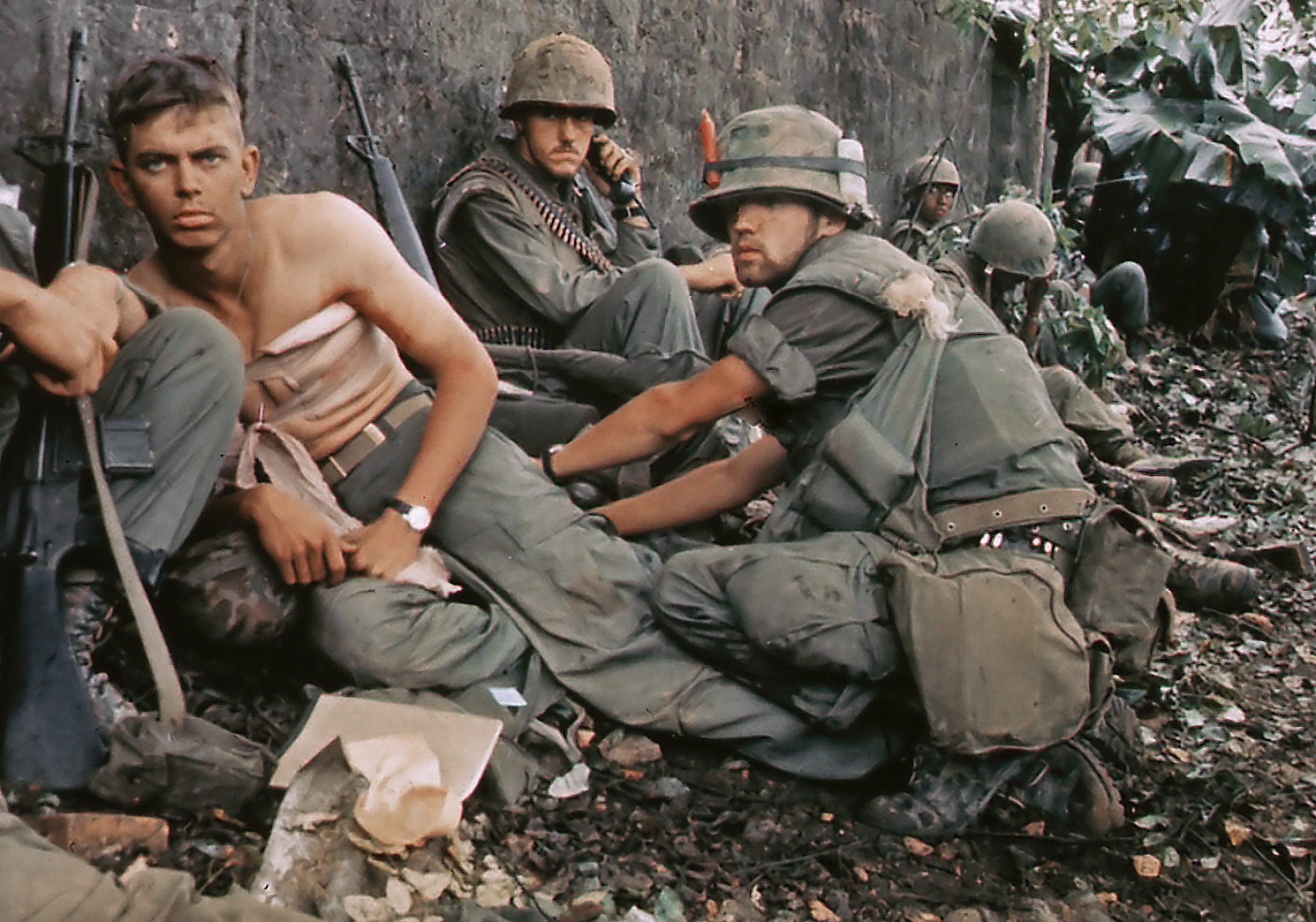
More than 3 million Americans served, 1.5 million saw combat. "At the height of American involvement in 1968, for example, 543,400 American military personnel were stationed in Vietnam, but only 80,000 were...combat troops." Conscription existed since World War II, but ended in 1973.
58,220 American soldiers were killed, 150,000 wounded, and at least 21,000 permanently disabled. The average age of troops killed was 23. Approximately 830,000 veterans, 15%, suffered posttraumatic stress disorder. Drug use, racial tensions, and fragging—attempts to kill officers—created problems for the military and impacted its capability. 125,000 Americans left for Canada to avoid the draft, and approximately 50,000 servicemen deserted. In 1977, President Jimmy Carter granted an unconditional pardon to Vietnam draft evaders with Proclamation 4483.
The war called into question army doctrine. Marine general Victor H. Krulak criticized Westmoreland's attrition strategy, calling it "wasteful of American lives... with small likelihood of a successful outcome."
Effects of U.S. chemical defoliation
Another controversial aspect of the US effort was use of chemical defoliants between 1961 and 1971. 20 million gallons of toxic herbicides, like Agent Orange, were sprayed on 6 million acres of forests and crops. They were used to defoliate parts of the countryside to prevent the VC from hiding weaponry and encampments, and deprive them of food. Defoliation was used to clear sensitive areas, including base perimeters and ambush sites along roads and canals. including suppressing the growth of some plants and crops and proceeding into the sediment, affecting fish and other species. US records have listed figures including the destruction of 20% of the jungles of South Vietnam and 20-36% of the mangrove forests. The environmental destruction caused was described by Swedish Prime Minister Olof Palme, lawyers, and academics as an ecocide.
The chemicals in Agent Orange pose health hazards, such as immune system disorders, developmental abnormalities, and issues with the reproductive system. Agent Orange and similar substances have caused many health issues for Vietnamese people and the US crews that handled them. Reports concluded that refugees exposed to sprays continued to experience pain in the eyes, skin and gastrointestinal upsets. In one study, 92% of participants suffered incessant fatigue; others reported monstrous births. Analysis has found significant correlation between having a parent who was exposed to Agent Orange with the likelihood of possessing or acting as a carrier of birth defects. The most common deformity appears to be spina bifida. There is substantial evidence defects carry on for three generations or more. In 2012, the US and Vietnam cooperated in cleaning toxic chemicals on Da Nang International Airport, marking the first time Washington has been involved in cleaning up Agent Orange in Vietnam. In 2018, Vietnam treated 150,000 cubic meters of contaminated soil.
Vietnamese victims attempted a class action lawsuit against Dow Chemical and other US chemical manufacturers, but a US District Court dismissed their case. , the Vietnamese government estimated there were over 4,000,000 victims of dioxin poisoning in Vietnam, while the Vietnamese Red Cross estimates up to one million people have health problems or disabilities as a result of Agent Orange. The US has described these figures as unreliable, and denied conclusive scientific links between Agent Orange and Vietnamese victims of dioxin poisoning. In parts of southern Vietnam, dioxin levels remain at over 100 times the accepted international standard.
The US Veterans Administration has listed prostate cancer, respiratory cancers, multiple myeloma, type 2 diabetes, B-cell lymphomas, soft-tissue sarcoma, chloracne, porphyria cutanea tarda, peripheral neuropathy as, "presumptive diseases associated with exposure to Agent Orange or other herbicides during military service." Spina bifida is the sole birth defect in children of veterans recognized as caused by exposure to Agent Orange.
In popular culture
Main article: List of Vietnam War films
The war has featured extensively in television, film, video games, music and literature. In Vietnam, the Girl from Hanoi (1974) was a film set during Operation Linebacker II, depicting wartime life. Another notable work was the diary of Đặng Thùy Trâm, a doctor who enlisted in the Southern battlefield, and was killed aged 27 by US forces. Her diaries were published in Vietnam as Đặng Thùy Trâm's Diary (Last Night I Dreamed of Peace), where it became a bestseller and was made into a film Don't Burn. The diary has been compared to The Diary of Anne Frank, and used in education.
The first major film on the war was John Wayne's pro-war The Green Berets (1968). Further films were released, the most noteworthy examples being Michael Cimino's The Deer Hunter (1978), Francis Ford Coppola's Apocalypse Now (1979), Oliver Stone's Platoon (1986) and Stanley Kubrick's Full Metal Jacket (1987). Other films include Good Morning, Vietnam (1987), Casualties of War (1989), and Born on the Fourth of July (1989).
The war influenced a generation of musicians and songwriters, pro/anti-war and pro/anti-communist. The Vietnam War Song Project has identified 5,000+ songs referencing the conflict. Country Joe and the Fish recorded The "Fish" Cheer/I-Feel-Like-I'm-Fixin'-to-Die Rag in 1965, and it became one of the most influential protest anthems.
Myths====
Myths play a role in the historiography of the war, and have become part of the culture of the United States. Discussion of myth has focused on US experiences, but changing myths have played a role in Vietnamese and Australian historiography. Scholarship has focused on "myth-busting", attacking orthodox and revisionist schools of historiography, and challenging myths about American society and soldiery in the war.
Kuzmarov in The Myth of the Addicted Army: Vietnam and the Modern War on Drugs challenges the popular and Hollywood narrative that US soldiers were heavy drug users, in particular the notion that the My Lai massacre was caused by drug use. According to Kuzmarov, Nixon is primarily responsible for creating the drug myth. Michael Allen accuses Nixon of mythmaking, by exploiting the plight of the National League of POW/MIA Families to allow the government to appear caring, as the war was increasingly considered lost. Allen's analysis ties the position of potential missing Americans, or prisoners into post-war politics and presidential elections, including the Swift boat controversy.
Annotations
References
Citations
Works cited
References
- {{Harvnb. Military History Institute of Vietnam. 2002
- (1986). "The Vietnam Experience The North". Time Life Education.
- (16 May 1989). "China admits 320,000 troops fought in Vietnam". Toledo Blade.
- Roy, Denny. (1998). "China's Foreign Relations". Rowman & Littlefield.
- Womack, Brantly. (2006). "China and Vietnam". Cambridge University Press.
- Tucker, Spencer C. (2011). "The Encyclopedia of the Vietnam War: A Political, Social, and Military History". ABC-CLIO.
- "Area Handbook Series Laos".
- O'Ballance, Edgar. (1982). "Tracks of the bear: Soviet imprints in the seventies". Presidio.
- Pham Thi Thu Thuy. (1 August 2013). "The colorful history of North Korea-Vietnam relations". [[NK News]].
- Le Gro, William. (1985). "Vietnam from ceasefire to capitulation". US Army Center of Military History.
- "The rise of Communism".
- "Hmong rebellion in Laos".
- "Vietnam War Allied Troop Levels 1960–73".
- (2002). "Australia's Vietnam War – A Select Chronology of Australian Involvement in the Vietnam War". [[Texas A&M University Press]].
- Blackburn, Robert M.. (1994). "Mercenaries and Lyndon Johnson's "More Flage": The Hiring of Korean, Filipino, and Thai Soldiers in the Vietnam War". McFarland.
- (1995). "Vietnamese Casualties During the American War: A New Estimate". Population and Development Review.
- "Battlefield:Vietnam – Timeline". [[PBS]].
- "Chuyên đề 4 CÔNG TÁC TÌM KIẾM, QUY TẬP HÀI CỐT LIỆT SĨ TỪ NAY ĐẾN NĂM 2020 VÀ NHỮNG NĂM TIẾP THEO".
- "Công tác tìm kiếm, quy tập hài cốt liệt sĩ từ nay đến năm 2020 và những năn tiếp theo". [[Ministry of Defence (Vietnam).
- 450–453
- Joseph Babcock. (29 April 2019). "Lost Souls: The Search for Vietnam's 300,000 or More MIAs".
- Hastings, Max. (2018). "Vietnam an epic tragedy, 1945–1975". Harper Collins.
- (2000). "Dirty Little Secrets of the Vietnam War: Military Information You're Not Supposed to Know". Macmillan.
- (31 March 2000). "North Korea fought in Vietnam War". [[BBC News Online]].
- Pribbenow, Merle. (November 2011). "North Korean Pilots in the Skies over Vietnam". [[Woodrow Wilson International Center for Scholars]].
- Rummel, R. J.. (1997). "Vietnam Democide". Freedom, Democracy, Peace; Power, Democide, and War, University of Hawaii System.
- Clarke, Jeffrey J.. (1988). "United States Army in Vietnam: Advice and Support: The Final Years, 1965–1973". Center of Military History, United States Army.
- Vietnam Veterans Memorial Fund. (4 May 2021). "2021 NAME ADDITIONS AND STATUS CHANGES ON THE VIETNAM VETERANS MEMORIAL".
- (15 August 2016). "National Archives–Vietnam War US Military Fatal Casualties".
- [https://www.archives.gov/research/military/vietnam-war/casualty-statistics#hostile "Vietnam War U.S. Military Fatal Casualty Statistics: HOSTILE OR NON-HOSTILE DEATH INDICATOR."] {{Webarchive. link. (26 May 2020 US National Archives. 29 April 2008. Accessed 13 July 2019.)
- (1996). "From People's War to People's Rule: Insurgency, Intervention, and the Lessons of Vietnam". University of North Carolina Press.
- (2025). "Remembering those who served in the Vietnam War". Australian Government - Department of Veterans' Affairs.
- "Australian casualties in the Vietnam War, 1962–72". Australian War Memorial.
- (16 July 1965). "Overview of the war in Vietnam". New Zealand and the Vietnam War.
- (2 October 2013). "America Wasn't the Only Foreign Power in the Vietnam War".
- (13 July 1964). "Vietnam Reds Said to Hold 17 From Taiwan as Spies". The New York Times.
- (2005). ["Allied Participation in Vietnam"](https://history.army.mil/Portals/143/Images/Publications/Publication%20By%20Title%20Images/A%20Titles%20PDF/CMH_Pub_90-5-1.pdf?ver=kNA54nobZmjnmnuA6dNRng%3d%3d }}{{page needed).
- (March 1970). "Asian Allies in Vietnam". Embassy of South Vietnam.
- (23 April 2008). "Fifty years of violent war deaths from Vietnam to Bosnia: analysis of data from the world health survey programme". [[British Medical Journal]].
- Heuveline, Patrick. (2001). "Forced Migration and Mortality". [[National Academies Press]].
- (1993). "Genocide and Democracy in Cambodia: The Khmer Rouge, the United Nations and the International Community". Yale University Southeast Asia Studies.
- Sliwinski, Marek. (1995). "Le Génocide Khmer Rouge: Une Analyse Démographique". [[L'Harmattan]].
- "Name of Technical Sergeant Richard B. Fitzgibbon to be added to the Vietnam Veterans Memorial". [[United States Department of Defense.
- Lawrence, A.T.. (2009). "Crucible Vietnam: Memoir of an Infantry Lieutenant". McFarland.
- (1971). "The Pentagon Papers (Gravel Edition), Volume 1". Beacon Press.
- Miller, Edward. (2024). "The Cambridge History of the Vietnam War, Volume I: Origins". Cambridge University Press.
- (May 2010). "America's Wars". Department of Veterans Affairs.
- (26 February 2010). "American War and Military Operations: Casualties: Lists and Statistics". Congressional Research Service.
- "Heart of Darkness: The Vietnam War Chronicles 1945–1975". Koch Vision.
- Kolko, Gabriel. (1985). "Anatomy of a War: Vietnam, the United States, and the Modern Historical Experience". Pantheon Books.
- Westing, Arthur H.. (1984). "Herbicides in War: The Long-term Ecological and Human Consequences". Taylor & Francis.
- Kalb, Marvin. (22 January 2013). "It's Called the Vietnam Syndrome, and It's Back". Brookings Institution.
- Horne, Alistair. (2010). "Kissinger's Year: 1973". Phoenix.
- Factasy. "The Vietnam War or Second Indochina War". PRLog.
- (15 August 2016). "The National Archives – Vietnam Conflict Extract Data File".
- Marlatt, Greta E.. "Research Guides: Vietnam Conflict: Maps".
- (1966). "Thành tích Hoạt động của Nội các Chiến tranh: từ 19-6-1965 đến 19-6-1966". Nội các Chiến tranh, Việt Nam Cộng hòa.
- (14 April 2024). "Chiến tranh Việt Nam trong cục diện tam giác Mỹ - Trung - Xô (1954- 1975)".
- Miller, Edward. "Vietnam War perspective: the unreconciled conflict".
- Umair Mirza. (2017-04-01). "The Vietnam War The Definitive Illustrated History".
- Reilly, Brett. (2017). "Before the First Indochina War: Redefining the Origin of Vietnam's Civil War".
- (2022). "Building a Republican Nation in Vietnam, 1920–1963". University of Hawaiʻi Press.
- Vu, Tuong. (2019). "In the Service of World Revolution: Vietnamese Communists' Radical Ambitions through the Three Indochina Wars". Journal of Cold War Studies.
- Asselin, Pierre. (2023). "The Indochinese Communist Party's Unfinished Revolution of 1945 and the Origins of Vietnam's 30-Year Civil War". Journal of Cold War Studies.
- (2022). "French Decolonisation and Civil War: The Dynamics of Violence in the Early Phases of Anticolonial War in Vietnam and Algeria, 1940–1956". Journal of Modern European History.
- Jennings, Eric T.. (2024). "The Cambridge History of the Vietnam War, Volume I: Origins". Cambridge University Press.
- (2020-07-15). "The OSS in Vietnam, 1945: A War of Missed Opportunities by Dixee Bartholomew-Feis".
- (1972). "Franklin Roosevelt and Indochina". The Journal of American History.
- (September 1978). "The Japanese Period in Indochina and the Coup of 9 March 1945". Journal of Southeast Asian Studies.
- Guillemot, François. (2019). "The Lessons of Yên Bái, or the "Fascist" Temptation: How the Đại Việt Parties Rethought Anticolonial Nationalist Revolutionary Action, 1932–1945". Journal of Vietnamese Studies.
- "UQAM | Guerre d'Indochine | 23 SEPTEMBER 1945".
- (September 2006). "A 'Post-war' War: The British Occupation of French-Indochina, September 1945–March 1946". Small Wars & Insurgencies.
- Guillemot, François. (2004). "Naissance d'un État-Parti: Le Viêt Nam depuis 1945". Les Indes savantes.
- (2013). "Vietnam: State, War, and Revolution (1945–1946)". University of California Press.
- (2018). "The Origins of the Vietnamese Civil War and the State of Vietnam". University of Wisconsin–Madison.
- (2023). "Denouncing the 'Việt Cộng': Tales of revolution and betrayal in the Republic of Vietnam". Journal of Southeast Asian Studies.
- McHale, Shawn. (2004). "Naissance d'un État-Parti: Le Viêt Nam depuis 1945". Les Indes savantes.
- (2009). "'It's time for the Indochinese Revolution to show its true colours': The radical turn of Vietnamese politics in 1948". Journal of Southeast Asian Studies.
- Hoang, Tuan. (2009). "Dynamics of the Cold War in Asia: Ideology, Identity, and Culture". Palgrave Macmillan.
- Administration, United States National Archives and Records. (2006-07-04). "Our Documents: 100 Milestone Documents from the National Archives". Oxford University Press, USA.
- (1999). "Argument Without End: In Search of Answers to the Vietnam Tragedy". [[PublicAffairs]].
- (2012-08-03). "McCarthyism, Korea and the Cold War".
- Ang, Cheng Guan. (2002). "The Vietnam War from the Other Side". Routledge.
- Herring, George C.. (2001). "America's Longest War: The United States and Vietnam, 1950–1975 (4th ed.)". McGraw-Hill.
- Maclear, Michael. (1981). "The Ten Thousand Day War: Vietnam 1945–1975". Thames.
- (2011). "Geneva Accords". NIAS Press.
- "Geneva Accords {{!}} history of Indochina {{!}} Britannica".
- (1 January 2001). "China Contributed Substantially to Vietnam War Victory, Claims Scholar". Wilson Center.
- Patrick, Johnson, David. (2009). "Selling "Operation Passage to Freedom": Dr. Thomas Dooley and the Religious Overtones of Early American Involvement in Vietnam". University of New Orleans.
- Hansen, Peter. (2009). "Bắc Di Cư: Catholic Refugees from the North of Vietnam, and Their Role in the Southern Republic, 1954–1959". University of California Press.
- Murti, B.S.N.. (1964). "Vietnam Divided". Asian Publishing House.
- Turner, Robert F.. (1975). "Vietnamese Communism: Its Origins and Development". Hoover Institution Press.
- Gittinger, J. Price. (1959). "Communist Land Policy in North Viet Nam". Far Eastern Survey.
- (1997). "The Black Book of Communism". [[Harvard University Press]].
- Dommen, Arthur J.. (2001). "The Indochinese Experience of the French and the Americans". Indiana University Press.
- Vu, Tuong. (25 May 2007). "Newly released documents on the land reform". [[Cambridge University Press]].
- (1971). "The Pentagon Papers (Gravel Edition), Volume 3". Beacon Press.
- (January 15, 1969). "Evolution of the War. Origins of the Insurgency".
- {{Harvnb. Woodruff. 2005
- "America's Stakes in Vietnam Speech to the American Friends of Vietnam, June 1956". JFK Library.
- (2025-01-13). "Some Clarifications on Lịch sử Nam bộ kháng chiến {{!}} Wilson Center".
- Turner, Robert F.. (1975). "Vietnamese Communism: Its Origins and Development". [[Hoover Institution]] Publications.
- (1984). "The Vietnam Experience, a Collision of Cultures". Boston Publishing Company.
- (1999). "Argument Without End". [[PublicAffairs]].
- "Excerpts from Law 10/59, 6 May 1959".
- Young, Marilyn. (1991). "The Vietnam Wars: 1945–1990". Harper Perennial.
- Prados, John. (1999). "The Blood Road: The Ho Chi Minh Trail and the Vietnam War". Wiley.
- Prados, John. (2006). "Rolling Thunder in a Gentle Land". Osprey Publishing.
- (12 May 2015). "It's Time to Stop Saying that JFK Inherited the Bay of Pigs Operation from Ike". History News Network.
- (1994). "Idealism and Pragmatism in American Foreign Policy Rhetoric: The Case of John F. Kennedy and Vietnam". Presidential Studies Quarterly.
- (2001). "A Grand Delusion: America's Descent Into Vietnam". Basic Books.
- Vietnam Task Force. (1969). "Report of the Office of the Secretary of Defense Vietnam Task Force". [[Office of the Secretary of Defense]].
- Stavins, Ralph L.. (22 July 1971). "A Special Supplement: Kennedy's Private War". The New York Review of Books.
- Galbraith, John Kenneth. (1971). "The Pentagon Papers (Gravel Edition), Volume 2". Beacon Press.
- Sheehan, Neil. (1989). "A Bright Shining Lie – John Paul Vann and the American War in Vietnam". Vintage.
- Live interview by [[John Bartlow Martin]]. ''Was Kennedy Planning to Pull out of Vietnam?'' New York City. John F. Kennedy Library, 1964, Tape V, Reel 1.
- Gibson, James. (1986). "The Perfect War: Technowar in Vietnam". The Atlantic Monthly Press.
- Nguyen, Phi-Vân. (2018). "A Secular State for a Religious Nation: The Republic of Vietnam and Religious Nationalism, 1946–1963". The Journal of Asian Studies.
- "Foreign Relations of the United States, 1961–1963, Volume IV, Vietnam, August–December 1963".
- "Pacification".
- Blaufarb, Douglas S.. (1977). "The Counterinsurgency Era: U.S. Doctrine and Performance, 1950 to the Present". Free Press.
- Schandler, Herbert Y.. (2009). "America in Vietnam: The War That Couldn't Be Won". Rowman & Littlefield.
- (2002). "U.S. Special Forces: A Guide to America's Special Operations Units: the World's Most Elite Fighting Force". Da Capo Press.
- Warner, Roger. (1996). "Shooting at the Moon The story of America's clandestine war in Laos". Steerforth Press.
- {{Harvnb. Karnow. 1997
- VanDeMark, Brian. (1995). "Into the Quagmire". Oxford University Press.
- {{Harvnb. Karnow. 1997
- {{Harvnb. Karnow. 1997
- Hunt, Michael. (2016). "The World Transformed – 1945 to the Present". Oxford.
- (2001). "Skunks, Bogies, Silent Hounds, and the Flying Fish". [[National Security Agency]].
- Moïse, Edwin E.. (2019). "Tonkin Gulf and the Escalation of the Vietnam War". Naval Institute Press.
- Simon, Dennis M.. (August 2002). "The War in Vietnam, 1965–1968".
- Tilford, Earl L.. (1991). "Setup: What the Air Force did in Vietnam and Why". Air University Press.
- (26 April 2015). "Making More Enemies than We Kill? Calculating U.S. Bomb Tonnages Dropped on Laos and Cambodia, and Weighing Their Implications". The Asia-Pacific Journal.
- (1967). "The United States in Vietnam: An analysis in depth of the history of America's involvement in Vietnam". Delta Books.
- Moyar, Mark. (2006). "Triumph Forsaken: The Vietnam War, 1954–1965". Cambridge University Press.
- McNeill, Ian. (1993). "To Long Tan: The Australian Army and the Vietnam War 1950–1966". Allen & Unwin.
- United States – Vietnam Relations, 1945–1967: A Study Prepared by the Department of Defense, vol. 5, pp. 8–9.
- United States – Vietnam Relations, 1945–1967: A Study Prepared by the Department of Defense, vol. 4, pp. 117–19. and vol. 5, pp. 8–12.
- ''Public Papers of the Presidents, 1965.'' Washington, DC Government Printing Office, 1966, vol. 2, pp. 794–99.
- Mohr, Charles. (16 May 1984). "McNamara on Record, Reluctantly, on Vietnam". The New York Times.
- Church, Peter. (2006). "A Short History of South-East Asia". John Wiley & Sons.
- Galloway, Joseph. (18 October 2010). "Ia Drang – The Battle That Convinced Ho Chi Minh He Could Win". Historynet.
- (2017). "The Vietnam War: An Intimate History". Alfred A. Knopf.
- "The Pentagon Papers (Gravel Edition), Volume 4".
- "TWE Remembers: General Westmoreland Says the "End Begins to Come Into View" in Vietnam". Council on Foreign Relations.
- (12 June 2006). "Interview with NVA General Tran Van Tra {{!}} HistoryNet".
- (20 October 2014). "The Urban Movement and the Planning and Execution of the Tet Offensive". Wilson Center.
- Nguyen, Lien-Hang T.. (2012). "Hanoi's War: An International History of the War for Peace in Vietnam". Univ of North Carolina Press.
- Wiest, Andrew. (1 March 2018). "Opinion {{!}} The Tet Offensive Was Not About Americans". The New York Times.
- Ankony, Robert C.. (2009). "Lurps: A Ranger's Diary of Tet, Khe Sanh, A Shau, and Quang Tri". Rowman & Littlefield Publishing Group.
- Weinraub, Bernard. (8 February 1968). "Survivors Hunt Dead of Bentre, Turned to Rubble in Allied Raids". The New York Times.
- Triều, Họ Trung. (5 June 2017). "Lực lượng chính trị và đấu tranh chính trị ở thị xã Nha Trang trong cuộc Tổng tiến công và nổi dậy Tết Mậu Thân 1968". Hue University Journal of Science: Social Sciences and Humanities.
- "Tết Mậu Thân 1968 qua những số liệu".
- Eyraud, Henri. (March 1987). "Anatomy of a War: Vietnam, the United States, and the Modern Historical Experience. By Kolko Gabriel. [New York: Pantheon Books, 1985. 628 pp.]". The China Quarterly.
- Witz. (1994). "The Tet Offensive: Intelligence Failure in War". Cornell University Press.
- Berman, Larry. (1991). "Lyndon Johnson's War". W.W. Norton.
- Sanger, David E.. (6 October 2018). "U.S. General Considered Nuclear Response in Vietnam War, Cables Show". The New York Times.
- Sheehan, Neil. (1971). "The Pentagon Papers as Published by the New York Times". Bantam.
- Sorley, Lewis. (1999). "A Better War: The Unexamined Victories and Final Tragedy of America's Last Years in Vietnam". Harvest.
- (16 April 2012). "North Vietnam's "Talk-Fight" Strategy and the 1968 Peace Negotiations with the United States". Wilson Center.
- (1972). "The Air War in Indochina". Beacon Press.
- (1974). "Statement of Information, Book XI, Bombing of Cambodia". U.S. Government Printing Office.
- Evans, Michael. "Nixon's Nuclear Ploy".
- "Foundations of Foreign Policy, 1969-1972". U.S. Department of State.
- Van Ness, Peter. (December 1986). "Richard Nixon, the Vietnam War, and the American Accommodation with China: A Review Article". Contemporary Southeast Asia.
- (4 September 1969). "Ho Chi Minh Dies of Heart Attack in Hanoi". The Times.
- Currey, Cecil B.. (2005). "Victory at Any Cost: The Genius of Viet Nam's Gen. Vo Nguyen Giap". Potomac Books, Inc..
- Bob Seals. (2007). "The "Green Beret Affair": A Brief Introduction".
- [[USA.gov]]. (February 1997). "The Pentagon Papers Case". eJournal USA.
- Stewart, Richard. (2005). "American Military History, Volume II, The United States Army in a Global Era, 1917–2003". [[United States Army Center of Military History]].
- Daddis, Gregory A.. (2017). "Withdrawal: Reassessing America's Final Years in Vietnam". Oxford University Press.
- Heinl, Robert D. Jr.. (7 June 1971). "The Collapse of the Armed Forces". Armed Forces Journal.
- Sevy, Grace. (1991). "The American Experience in Vietnam: A Reader". University of Oklahoma Press.
- Richard Halloran. (12 August 1984). "R.O.T.C. Booming as Memories of Vietnam Fade". The New York Times.
- (23 March 1971). "General Won't Punish G.I.'s for Refusing Orders". The New York Times.
- (1984). "Vietnam: An Infantryman's View of Our Failure". Military Affairs.
- Stanton, Shelby L.. (2007). "The Rise and Fall of an American Army: U.S. Ground Forces in Vietnam, 1963–1973". Random House Publishing Group.
- "Vietnamization: 1970 Year in Review".
- Wiest, Andrew. (2007). "Vietnam's Forgotten Army: Heroism and Betrayal in the ARVN". NYU Press.
- Porter, Gareth. (1993). "Vietnam: The Politics of Bureaucratic Socialism". Cornell University Press.
- (2010). "Facts about the Vietnam Veterans memorial collection". [[National Park Service]].
- (1958). "Cambodia Neutral: The Dictate of Necessity". Foreign Affairs.
- Sutsakhan, S.. (1987). "The Khmer Republic at War and the Final Collapse". United States Army Center of Military History.
- (1983). "The Vietnam Experience Fighting for time". Boston Publishing Company.
- (2017). "Genocide in Cambodia and Rwanda".
- Church, Peter. (2006). "A Short History of South-East Asia". John Wiley & Sons.
- "This Day in History 1974: Thieu announces war has resumed". History.com.
- "Ford asks for additional aid". history.com.
- (1985). "The Vietnam Experience The Fall of the South". Boston Publishing Company.
- "Transcript of speech by President Gerald R. Ford - April 23, 1975". Tulane University.
- (April 1998). "The Paris Agreement on Vietnam: Twenty-five Years Later". The Nixon Center.
- Thai Binh Department of Information and Communications. (30 July 2020). "Soldier from Thai Binh who put flag on the roof of Independence Palace". Thai Binh Provincial Portal.
- (28 April 2020). "Reunion of the Veterans organization of Tank Amour force in the South Vietnam".
- Leong, Ernest. (31 October 2009). "Vietnam Tries to Create New Image 30 Years After End of War". Voice of America.
- Terzani, Tiziano. (1976). "Giai Phong! The Fall and Liberation of Saigon". Angus & Robertson (U.K.) Ltd.
- Bui, Tin. (1999). "Following Ho Chi Minh: The Memoirs of a North Vietnamese Colonel". University of Hawaii Press.
- (28 January 2018). "CBS News Poll: U.S. involvement in Vietnam". CBS News.
- Lunch, W. & Sperlich, P. (1979). The Western Political Quarterly. 32(1). pp. 21–44
- Hagopain, Patrick. (2009). "The Vietnam War in American Memory". University of Massachusetts Press.
- Zimmer, Louis B.. (2011). "The Vietnam War Debate". Lexington Books.
- Bob Fink. "Vietnam – A View from the Walls: a History of the Vietnam Anti-War Movement". Greenwich Publishing.
- Qiang, Zhai. (2000). "China and the Vietnam Wars, 1950–1975". University of North Carolina Press.
- Bezlova, Antoaneta. (21 February 2009). "China haunted by Khmer Rouge links". Asia Times.
- (14 April 1989). "Russians Acknowledge a Combat Role in Vietnam". The New York Times.
- "Soviet Involvement in the Vietnam War". historicaltextarchive.com.
- (1999). "Dirty Little Secrets of the Vietnam War". St. Martin's Press.
- (1996). "Alien Wars: The Soviet Union's Aggressions Against the World, 1919 to 1989". Presidio Press.
- "Soviet rocketeer: After our arrival in Vietnam, American pilots refused to fly". rus.ruvr.
- Pribbenow, Merle. (December 2014). "The Soviet-Vietnamese Intelligence Relationship during the Vietnam War: Cooperation and Conflict".
- (2016). "Nationalism and Imperialism in South and Southeast Asia: Essays Presented to Damodar R.SarDesai". Routledge.
- Solis, Gary D.. (2010). "The Law of Armed Conflict: International Humanitarian Law in War". Cambridge University Press.
- Tulli, Umberto. (2021-06-01). "Wielding the human rights weapon against the American empire: the second Russell Tribunal and human rights in transatlantic relations". Journal of Transatlantic Studies.
- (6 August 2006). "Civilian Killings Went Unpunished".
- Sallah, Michael. (2006). "Tiger Force: a true story of men and war". Little, Brown.
- "Free Fire Zone – The Vietnam War". The Vietnam War.
- Lewis M. Simons. "Free Fire Zones". Crimes of War.
- Turse, Nick. (2013). "Kill Anything That Moves: The Real American War in Vietnam". Metropolitan Books.
- Kevin Buckley. (19 June 1972). "Pacification's Deadly Price".
- Valentino, Benjamin. (2005). "Final Solutions: Mass Killing and Genocide in the 20th Century". [[Cornell University Press]].
- Otterman, Michael. (2007). "American Torture: From the Cold War to Abu Ghraib and Beyond". [[Melbourne University Publishing]].
- Hersh, Seymour. (15 December 2003). "Moving Targets".
- McCoy, Alfred. (2006). "A question of torture: CIA interrogation, from the Cold War to the War on Terror". Macmillan.
- Greiner, Bernd. (2010). "War Without Fronts: The USA in Vietnam". Vintage Books.
- (15 December 2014). "Torture: What the Vietcong Learned and the CIA Didn't". Newsweek.
- "The Man in the Snow White Cell". Central Intelligence Agency.
- (2 October 2024). "Unheard voices: foreign journalists' coverage of Vietnamese prisoners during the American War in Vietnam". Small Wars & Insurgencies.
- Go Gyeong-tae. (15 November 2000). [[Hankyoreh]]. link
- Pedahzur, Ami. (2006). "Root Causes of Suicide Terrorism: The Globalization of Martyrdom". Taylor & Francis.
- (2008). "Inside the VC and the NVA: The Real Story of North Vietnam's Armed Forces". Texas A&M University Press.
- Kiernan, Ben. (2017). "Viet Nam: A History from Earliest Times to the Present". [[Oxford University Press]].
- Pike, Douglas. (1996). "PAVN: People's Army of Vietnam". Presidio Press.
- Wiesner, Louis. (1988). "Victims and Survivors: Displaced Persons and Other War Victims in Viet-Nam, 1954–1975". Greenwood Press.
- (4 November 2015). "From hidden resistance to peace talks: Women in the Vietnam War".
- (8 April 2015). "Exhibition honors Vietnamese female soldiers in Vietnam War".
- "Vietnamese women in wartime – Press Photos – Femmes et guerres".
- Windschuttle, Elizabeth. (February 15, 1976). "Women in the Vietnam War". Australian Left Review.
- (2021-03-09). "Portraits of Vietnamese Women At War".
- Springer, James. (2020-05-22). "Women in combat, from World War II anti-Nazi Greek resistance to Viet Cong to Syrian Kurdish militia".
- (1981). "Women, Socialism, and the Economy of Wartime North Vietnam". Studies in Comparative Communism.
- Margaret Sullivan. (March 28, 2021). "Three groundbreaking journalists saw the Vietnam War differently. It's no coincidence they were women.". Washington Post.
- Turse, Nick. (2013-03-19). "Rape Was Rampant During the Vietnam War. Why Doesn't US History Remember This?".
- (10 January 2003). "Vietnam's Women of War".
- (2006). "Laments of warriors' wives: Re-gendering the war in Vietnamese cinema". South East Asia Research.
- (2017). "(Im)possible Futures: Liberal Capitalism, Vietnamese Sniper Women, and Queer Asian Possibility". Feminist Formations.
- Sara Pike. (2008). "Racism at the Movies: Vietnam War Films, 1968-2002". University of Vermont.
- (16 March 2021). "The Victims of Agent Orange the U.S. Has Never Acknowledged". The New York Times.
- (13 May 2011). "Is Time Running Out to Find Soldiers' Remains in Vietnam?".
- (27 April 2020). "Vietnamese woman sues Seoul for 'wartime massacre'".
- "Fully Integrated".
- Appy, Christian. (1993). "Working-class War: American Combat Soldiers and Vietnam". The University of North Carolina Press.
- (30 April 2019). "Vietnam War U.S. Military Fatal Casualty Statistics, Electronic Records Reference Report". U.S. National Archives.
- (23 April 2008). "fifty years of violent war deaths: data analysis from the world health survey program: BMJ".
- Lind, Michael. (1999). "Vietnam, The Necessary War: A Reinterpretation of America's Most Disastrous Military Conflict". The New York Times.
- Friedman, Herbert. "Allies of the Republic of Vietnam".
- Kempster, Norman. (31 January 1991). "In This War, Body Count Is Ruled Out: Casualties: Gen. Schwarzkopf makes it clear he's not repeating a blunder made in Vietnam.". Los Angeles Times.
- Aman, Mohammed M.. (April 1993). "General H. Norman Schwarzkopf: The Autobiography: It Doesn't Take a Hero; H. Norman Schwarzkopf with Peter Petre". Digest of Middle East Studies.
- [[Rand Corporation]] [http://apps.dtic.mil/dtic/tr/fulltext/u2/a032189.pdf "Some Impressions of Viet Cong Vulnerabilities, an Interim Report"] {{Webarchive. link. (16 February 2017 1965)
- (1989). "Crimes of Obedience: Towards a Social Psychology of Authority and Responsibility". Yale University Press.
- "Declassification of the BDM Study, "The Strategic Lessons Learned in Vietnam"". Defense Technical Center.
- Kiernan, Ben. (2004). "How Pol Pot Came to Power: Colonialism, Nationalism, and Communism in Cambodia, 1930–1975". [[Yale University Press]].
- (1 March 2021). "Vietnam-era unaccounted for statistical report".
- Robbers, Gerhard. (2007). "Encyclopedia of world constitutions". [[Infobase Publishing]].
- Elliot, Duong Van Mai. (2010). "RAND in Southeast Asia: A History of the Vietnam War Era". RAND Corporation.
- Elliot, Duong Van Mai. (Summer 1988). "RAND in Southeast Asia: A History of the Vietnam War Era". RAND Corporation.
- (26 July 1977). "Human Rights in Vietnam: Hearings Before the Subcommittee on International Organizations of the Committee on International Relations: House of Representatives, Ninety-Fifth Congress, First Session". U.S. Government Printing Office.
- (October–November 1982). "Re-education in Unliberated Vietnam: Loneliness, Suffering and Death".
- Nghia, M. Vo. (2004). "The Bamboo Gulag: Political Imprisonment in Communist Vietnam". McFarland.
- (1979). "Amnesty International Report, 1979". Amnesty International.
- ''Huy, Đức. Bên Thắng Cuộc. OsinBook.''
- Desbarats, Jacqueline. (1987). "Repression in the Socialist Republic of Vietnam: Executions and Population Relocation". Executive Publications.
- Chapman, William. (17 August 1979). "Hanoi Rebuts Refugees on 'Economic Zones'". [[The Washington Post]].
- "Read Gabriel García Márquez's Moving Vietnam Piece".
- (21 September 1977). "Vietnam Is Admitted to the U.N. As 32d General Assembly Opens". The New York Times.
- (2013). "Counting Civilian Casualties: An Introduction to Recording and Estimating Nonmilitary Deaths in Conflict". [[Oxford University Press]].
- Kiernan, Ben. (December 2003). "The Demography of Genocide in Southeast Asia: The Death Tolls in Cambodia, 1975–79, and East Timor, 1975–80". Critical Asian Studies.
- Farrell, Epsey Cooke. (1998). "The Socialist Republic of Vietnam and the law of the sea: an analysis of Vietnamese behavior within the emerging international oceans regime". Martinus Nijhoff Publishers.
- (November 2011). "Disarmament". United Nations.
- Greenberg, Jon. (11 September 2014). "Kissinger: Drones have killed more civilians than the bombing of Cambodia in the Vietnam War".
- (3 December 2012). "Vietnam War Bomb Explodes Killing Four Children".
- "Vietnam war shell explodes, kills two fishermen".
- Wright, Rebecca. (6 September 2016). "'My friends were afraid of me': What 80 million unexploded US bombs did to Laos". CNN.
- "Lao PDR - Casualties and Victim Assistance".
- (10 July 2009). "Migration in the Asia-Pacific Region". Migration Policy Institute.
- Robinson, William. (1998). "Terms of refuge: the Indochinese exodus & the international response". Zed Books.
- Vo, Nghia M.. (2015). "The Vietnamese Boat People, 1954 and 1975-1992". [[McFarland & Company]].
- Henningfeld, Diane A.. (2023). "Indo-Chinese Boat People Begin Fleeing Vietnam".
- Lippman, Thomas W.. (9 April 1995). "McNamara Writes Vietnam Mea Culpa". The Washington Post.
- (August 24, 2005). "Iraq Versus Vietnam: A Comparison of Public Opinion". Gallup, Inc..
- (8 May 2001). "Victory in Europe 56 Years Ago". Gallup News Service.
- Dacy, Douglas. (1986). "Foreign aid, war, and economic development: South Vietnam 1955–1975". Cambridge University Press.
- (22 January 2014). "How Much Did The Vietnam War Cost?". The Vietnam War.
- "CQ Almanac Online Edition".
- (20 March 2013). "US still making payments to relatives of Civil War veterans, analysis finds". Fox News.
- Jim Lobe. (30 March 2013). "Iraq, Afghanistan Wars Will Cost U.S. 4–6 Trillion Dollars: Report".
- "Echoes of Combat: The Vietnam War in American Memory". Stanford University.
- (January 27, 1973). "Military draft system stopped". The Bulletin.
- (January 27, 1973). "Military draft ended by Laird". The Times-News.
- "The War's Costs". Digital History.
- Combat Area Casualty File, November 1993. (The CACF is the basis for the Vietnam Veterans Memorial, i.e. The Wall), Center for Electronic Records, National Archives, Washington, DC
- Kueter, Dale. (2007). "Vietnam Sons: For Some, the War Never Ended". AuthorHouse.
- (8 April 2016). "The Drugs That Built a Super Soldier: During the Vietnam War, the U.S. Military Plied Its Servicemen with Speed, Steroids, and Painkillers to Help Them Handle Extended Combat".
- Lepre, George. (2011). "Fragging: Why U.S. Soldiers Assaulted their Officers in Vietnam". Texas Tech University Press.
- (19 November 2005). "War Resisters Remain in Canada with No Regrets". ABC News.
- (28 June 2005). "Vietnam War Resisters in Canada Open Arms to U.S. Military Deserters". Pacific News Service.
- (21 January 1977). "Proclamation 4483: Granting Pardon for Violations of the Selective Service Act, August 4, 1964 To March 38, 1973".
- Scheer, Robert. (8 July 2009). "McNamara's Evil Lives On".
- (1994). "Veterans and Agent Orange: Health Effects of Herbicides Used in Vietnam". National Academies Press (US).
- Peeples, Lynne. (10 July 2013). "Veterans Sick From Agent Orange-Poisoned Planes Still Seek Justice". [[The Huffington Post]].
- "Toxic byproducts of Agent Orange continue to pollute Vietnam environment, study says | College of Agricultural, Consumer & Environmental Sciences | Illinois".
- Fox, Diane N.. (2003). "Synthetic Planet: Chemical Politics and the Hazards of Modern Life". Routledge Press.
- Zierler, David. (2011). "The invention of ecocide: agent orange, Vietnam, and the scientists who changed the way we think about the environment". Univ. of Georgia Press.
- (2022-12-18). "How Imperative Is It To Consider Ecocide As An International Crime?".
- Falk, Richard A.. (1973). "Environmental Warfare and Ecocide — Facts, Appraisal, and Proposals". Bulletin of Peace Proposals.
- Cassandra, Bianca. (17 February 2022). "Industrial disasters from Bhopal to present day: why the proposal to make 'ecocide' an international offence is persuasive".
- Chiarini, Giovanni. (1 April 2022). "Ecocide: From the Vietnam War to International Criminal Jurisdiction? Procedural Issues In-Between Environmental Science, Climate Change, and Law". Cork Online Law Review.
- (2021-04-07). "'Ecocide' movement pushes for a new international crime: Environmental destruction".
- "Facts About Herbicides".
- (2020). "Textbook of Natural Medicine".
- (25 August 1972). "Chemical Spraying as Reported by Refugees from South Vietnam". Science.
- (13 February 2006). "Association between Agent Orange and Birth Defects: Systematic Review and Meta-analysis". Oxford University Press.
- (16 December 2016). "The Children of Agent Orange".
- (9 August 2012). "U.S. starts its first Agent Orange cleanup in Vietnam". Reuters.
- (28 April 2025). "50 years later, Vietnam's environment still bears the scars of war – and signals a dark future for Gaza and Ukraine".
- {{Harvnb. Roberts. 2005
- {{Harvnb. Crook. 2008
- King, Jessica. (2012-08-10). "U.S. in first effort to clean up Agent Orange in Vietnam". [[CNN]].
- Faiola, Anthony. (13 November 2006). "In Vietnam, Old Foes Take Aim at War's Toxic Legacy". [[The Washington Post]].
- Administration, US Department of Veterans Affairs, Veterans Health. "VA.gov {{!}} Veterans Affairs".
- "Veterans' Diseases Associated with Agent Orange". [[United States Department of Veterans Affairs]].
- (10 December 2014). "Amsterdam Mayor visits Hanoi-Amsterdam High School". VOV Online Newspaper.
- Brummer, Justin. "The Vietnam War: A History in Song".
- Milam, Ron. (2009). "Not A Gentleman's War: An Inside View of Junior Officers in the Vietnam War". University of North Carolina Press.
- Kuzmarov, Jeremy. (2009). "The Myth of the Addicted Army: Vietnam and the Modern War on Drugs". Univ of Massachusetts Press.

This article was imported from Wikipedia and is available under the Creative Commons Attribution-ShareAlike 4.0 License. Content has been adapted to SurfDoc format. Original contributors can be found on the article history page.
Ask Mako anything about Vietnam War — get instant answers, deeper analysis, and related topics.
Research with MakoFree with your Surf account
Create a free account to save articles, ask Mako questions, and organize your research.
Sign up freeThis content may have been generated or modified by AI. CloudSurf Software LLC is not responsible for the accuracy, completeness, or reliability of AI-generated content. Always verify important information from primary sources.
Report