From Surf Wiki (app.surf) — the open knowledge base
1962 South Vietnamese Independence Palace bombing
Assassination attempt on the president
Assassination attempt on the president
| Field | Value |
|---|---|
| title | 1962 South Vietnamese Independence Palace bombing |
| partof | the War in Vietnam (1959–1963) in the Vietnam War |
| image | File:USN 16-1001-004.jpg |
| caption | Independence Palace before the bombing |
| location | Independence Palace, Saigon |
| target | Ngô Đình Diệm |
| date | 27 February 1962 |
| type | Airstrike |
| injuries | 3 killed, 30 injured |
| perp | Nguyễn Văn Cử |
| Phạm Phú Quốc | |
| weapons | 2 A-1 Skyraiders |
| time-begin = | time-end = Phạm Phú Quốc
On 27 February 1962, the Independence Palace in Saigon, South Vietnam, was bombed by two dissident Republic of Vietnam Air Force pilots, Second Lieutenant Nguyễn Văn Cử and First Lieutenant Phạm Phú Quốc. The pilots targeted the building, the official residence of the President of South Vietnam, with the aim of assassinating President Ngô Đình Diệm and his immediate family, who acted as political advisors.
The pilots later said they attempted the assassination in response to Diệm's autocratic rule, in which he focused more on remaining in power than on confronting the Viet Cong (VC), a Marxist–Leninist guerilla army who were threatening to overthrow the South Vietnamese government. Cử and Quốc hoped that the airstrike would expose Diệm's vulnerability and trigger a general uprising, but this failed to materialize.
One bomb penetrated a room in the western wing where Diệm was reading but failed to detonate, leading the president to claim that he had "divine" protection. Except for Diệm's sister-in-law Madame Nhu, who suffered minor injuries, the Ngô family was unscathed. Three palace staff died, and 30 were injured. Afterward, Cử escaped to Cambodia, but Quốc was arrested and imprisoned.
In the wake of the airstrike, Diệm became hostile towards the American presence in South Vietnam. Diệm claimed that the American media was seeking to bring him down, and he introduced new restrictions on press freedom and political association. The media speculated that the United States would use the incident to justify the deployment of combat troops to South Vietnam; in the event, the U.S. remained circumspect. Domestically, the incident was reported to have increased plotting against Diệm by his officers.
Planning
Cử was the second son of Nguyễn Văn Lực, a leader of the VNQDD (), which opposed the Diệm regime. In 1960, Diệm had jailed Lực for one month for engaging in "anti-government activities". The VNQDD planned that Cử and Quốc, another pilot from the same squadron, would attack the Independence Palace on 27 February. Quốc had recently been personally commended by Diệm for his achievements in combat, having been honoured as one of the best pilots in the Republic of Vietnam Air Force (RVNAF).
Quốc had more subordinates but was unsure of their loyalty, so he did not try to recruit them for the attack on the palace. Years later, Cử blamed Diệm's treatment of opposition parties as the motivation for his attack. He believed that Diệm had prioritized remaining in power over fighting the Vietcong and that, for six years, Cử had been denied promotion because of Diệm's obsession with hindering political opponents. Cử criticized the Americans for having supported Diệm, saying: "the Americans had slammed the door on those of us who really wanted the fight against the communists".
Attack
Quốc and Cử, who were trained in France and the United States, respectively, were given orders to fly their A-1H/AD-6 Skyraider ground attack planes from Bien Hoa Air Base outside Saigon to the Mekong Delta in an early morning mission against the VC. The VC had been involved in attacks on Army of the Republic of Vietnam (ARVN) units 60 km south of the capital and had inflicted heavy damage. Instead of proceeding south from Bien Hoa Air Base as ordered, they changed course to attack the Independence Palace, the official presidential residence. This meant that two VC guerrilla companies could retreat after their attack without counter-attack.
At around 07:00, the deer on the expansive lawns of the French colonial-era palace were frightened off as Quốc, and Cử's planes flew low over their target to inspect the ruling family's residence.
The first 500 lb bomb penetrated a room in the western wing where Diệm was reading a biography of George Washington. The bomb failed to detonate, which gave Diệm enough time to seek shelter in a cellar in the eastern wing. He was joined there by his elder brother Archbishop Pierre Martin Ngô Đình Thục, younger brother Ngô Đình Nhu, Madame Nhu—who sustained an arm fracture while running toward the cellar—and their children. Elsewhere within the palace, three servants and guards were killed, and about thirty more staff were injured. Outside the palace grounds, an American contractor died after falling from a rooftop where he had been watching the bombing. Despite the confusion, most of the city's inhabitants went about their usual business, indifferent to the chaos. The attack lasted 30 minutes, and although they carried enough bombs to level the palace, the pilots did not expend all their munitions. Quốc's aircraft was damaged by fire from a minesweeper, forcing him to eject over the Saigon River and land in Nhà Bè, suffering minor facial injuries in the landing. He was arrested by a nearby naval patrol and, before being taken away for interrogation, reportedly asked, "did I kill that filthy character?" Cử believed the attack had been successful and managed to flee to Cambodia safely. Commenting on the attack, a US Air Force officer opined: "with that weather, they did a hell of a job".
Aftermath
In a brief radio address, after order had been restored, Diệm dismissed the attack as an "isolated act" and attributed his escape to "divine protection". He visited the soldiers wounded in the attacks and also promised the rebel pilots' colleagues that they would not bear any responsibility for the bombing. American President John F. Kennedy promptly sent a message denouncing the attack as a "destructive and vicious act" and expressed relief that Diệm was "safe and unharmed". US ambassador Frederick Nolting determined that the attack had been the result of "two isolated cases" and opined that the incident did not represent widespread dissatisfaction with the regime. The absence of a VC reaction led Nolting to label the bombing as a "limited scope, anti-Communist assassination attempt". Diệm was praised for outwardly projecting a calm demeanor following the attack, and he moved to temporary government accommodation usually used for foreign dignitaries and visited Bien Hoa Air Base.
The National Assembly, Diệm's rubber stamp legislative body, urged the president to "take drastic measures against irresponsible elements". The day after the attack, the National Assembly's Steering Committee passed a resolution calling on Diệm to end "the policy of clemency" against dissidents and to "continue the struggle to protect the nation's destiny". They also called for punishments to be handed out to people who took advantage of the disorder by hoarding goods or speculating on food.
General Duong Van Minh, the presidential military advisor, attributed the assault to "disgruntled pilots" and noted that no hostile troop movements had occurred. The Civil Guard had remained loyal, and its commander ordered his airborne forces to take over Tan Son Nhut Air Base. A spokesperson for Diệm also denied that napalm had been used against the palace. This was widely believed to be because the government was sensitive to the ramifications of the RVNAF being revealed to have such weapons in their stocks. He claimed the situation was under "complete control".
The RVNAF reacted to the two pilots' actions by sending a resolution to Diệm, saying that the attack was an "absolutely isolated and foolish" event that "impaired the prestige of the air force" and was "detrimental to the national effort in the present struggle and is profitable to the Communists in their work of subversion".
The National Revolutionary Movement, an organization used by the Ngô family to stage orchestrated mass demonstrations in support of themselves, called for the death penalty against the two pilots and further asked Diệm to enact the "strictest measures to insure discipline in the military".
As a result of the attack, Diệm ordered that all RVNAF aircraft be grounded and all aerial combat missions be suspended. At the same time, his security officials investigated fighter pilots for any possible anti-regime tendencies. This was achieved by placing tanks on the Bien Hoa Air Base runway. Without assistance from accompanying fighter craft, it was deemed too risky for American helicopters to operate in the jungles against the VC. On 2 March, three days after the attack, Diệm allowed the air force to resume combat operations,
Quốc was imprisoned for his actions, while Cử remained in exile in Cambodia, where he worked as a language teacher. As a result, Sihanouk routinely gave asylum to political refugees who had tried to depose or kill Diệm. In November 1960, he granted asylum to a group of paratroopers who tried to depose Diệm.
In the meantime, Diệm's police sought to track down Cử's father, who had gone into hiding following the assassination attempt. Quốc advanced to the rank of lieutenant colonel in 18 months before being killed in an air raid over North Vietnam on 20 April 1965.
Diệm reaction
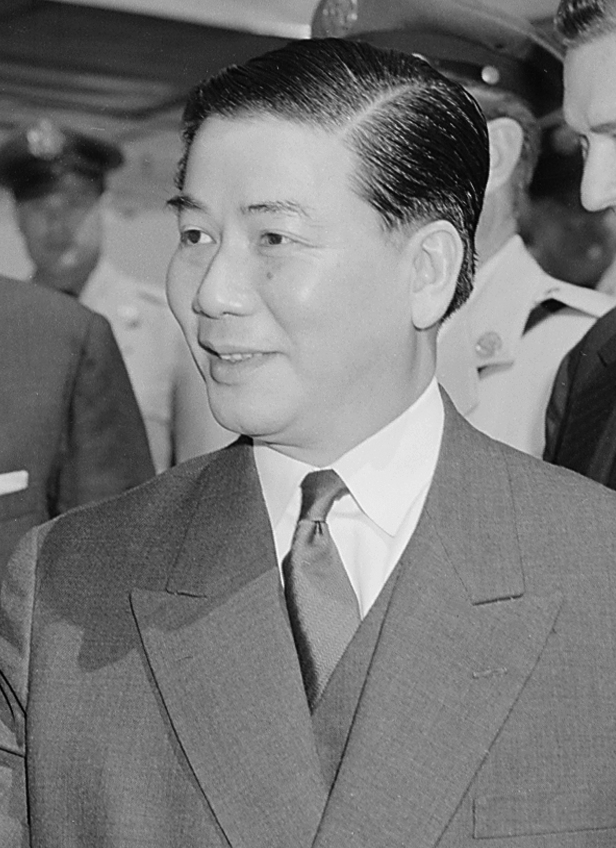
On 4 March, Diệm held a review of the RVNAF in central Saigon. Large crowds flocked to the Saigon River's banks to watch RVNAF aircraft formations on aerial parade. However, every day civilians were not allowed within a block of the presidential box, where Diệm was accompanied by Nolting and General Paul D. Harkins, commander of Military Assistance Command, Vietnam. The display included 29 A-1 aircraft, the type used in the attack on the Independence Palace. Diệm spoke about the events of 27 February and noted that he was "not unaware" of the supportive reaction of the various segments of society to "the foolish act perpetrated by some treacherous elements" that had "tried to rouse bloody troubles which would have profited only enemies of the fatherland".
During Nolting's first meeting with Diệm after the assassination attempt, the president adamantly asserted that the media was responsible for the bombing. He pointed to the Newsweek article and other "derogatory articles in the press", using them to justify his claim that "the Americans were supporting the revolution". Diệm declared that while some journalists were portraying the bombing as a wake-up call, he saw it as "a warning to them—an indicator of the danger of their irresponsibility in fomenting disorder".
In a later meeting with Harkins, Diệm joked: "I shouldn't have put him in the air force, because I had put his father in jail years ago". Diệm predicted that "sometime I'm going to get shot right in the back of the neck. Sometime they'll get me that way". (He and Nhu were deposed and shot dead during the November 1963 coup.) Diệm reacted to the assassination attempt by cracking down on political dissidents and further tightening press control. Off the record, one official admitted that "We don't even talk about freedom of the press or ask for other liberties anymore ... Diệm had completely surrounded himself in a protective oligarchy". Nhu justified further anti-opposition restrictions, remarking that "There's always going to be an opposition. If we take these people in, there will be another opposition springing up, because they are controversial men." Madame Nhu added, "You open a window to let in light and air, not bullets. We want freedom, but we don't want to be exploited by it."
U.S. reaction
The attack sparked conjecture that the United States might deploy combat troops in South Vietnam, even though, at the time, US military personnel were officially serving in solely advisory roles. In response to media concerns about the stability of the Diệm government, US Secretary of State Dean Rusk denied that the US had plans to deploy combat forces. He also ruled out negotiations with the VC, saying "the root of the trouble" was communist violations of the Geneva Accords.
United States Ambassador to India John Kenneth Galbraith lobbied Kennedy against the deployment of combat troops, believing that it would lead to endless South Vietnamese requests for more troops. Galbraith further thought that wasting US resources in the jungles of Vietnam would be playing into the hands of the Soviet Union. According to one US observer, the palace bombing provoked "full scale plotting against Diệm". Galbraith noted that "When the man in power is on the way down, anything is better" and considered that any change in South Vietnamese leadership would bring an improvement.
Notes
References
References
- Karnow, pp. 280–281.
- Tucker, p. 302.
- Langguth, pp. 163–164.
- (9 March 1962). "Durable Diem".
- Bigart, Homer. (3 March 1962). "Vietnamese win in stab at reds". [[The New York Times]].
- Quốc had relatives who were involved with the VNQDD. Cử recruited Quốc by claiming the [[Republic of Vietnam Armed Forces]] and the United States were aware of the plot, showing him a ''[[Newsweek]]'' article critical of Diệm as evidence.Langguth, p. 99.
-
- m. ft
- Hammer, p. 137.
- Bigart, Homer. (2 March 1962). "Vietnam's planes return to battle". [[The New York Times]].
- Cử told reporters in Cambodia that he was a nationalist, not a communist, and predicted that attacks against the ruling family would continue. Cử cited the regime's policies, rather than the president as a person, as the motivation for his attack. He said that "It is less Ngô Đình Diệm—sometimes well intentioned toward the population—than his family and supporters, who are hated by the army and the population". Diệm asked Cambodia to extradite Cử, but this request was refused. Cambodia's Prince [[Norodom Sihanouk]] and Diệm had extremely hostile relations, and the Ngô family had tried to depose him in the past by funding coup attempts. In 1959, Nhu tried assassinating Sihanouk by sending him a parcel bomb.Osborne, pp. 106–112.
- Hammer, pp. 128–132.
- (17 November 1963). "Unsuccessful foes of Diệm end exile". [[The New York Times]].
- Langguth, Jack. (21 April 1965). "U.S. bombs roads in North Vietnam". [[The New York Times]].
- Bigart, Homer. (5 March 1962). "Diem Hails Fliers After Air Review". [[The New York Times]].
- Jacobs, pp. 131–132.
- Tucker, p. 405.
- Warner, p. 92.
This article was imported from Wikipedia and is available under the Creative Commons Attribution-ShareAlike 4.0 License. Content has been adapted to SurfDoc format. Original contributors can be found on the article history page.
Ask Mako anything about 1962 South Vietnamese Independence Palace bombing — get instant answers, deeper analysis, and related topics.
Research with MakoFree with your Surf account
Create a free account to save articles, ask Mako questions, and organize your research.
Sign up freeThis content may have been generated or modified by AI. CloudSurf Software LLC is not responsible for the accuracy, completeness, or reliability of AI-generated content. Always verify important information from primary sources.
Report