From Surf Wiki (app.surf) — the open knowledge base
Romanian language
Eastern Romance language
Eastern Romance language
| Field | Value |
|---|---|
| name | Romanian |
| altname | Daco-Romanian |
| nativename | limba română, românește, română |
| pronunciation | |
| states | Romania, Moldova |
| region | Southeastern Europe |
| Eastern Europe | |
| Central Europe | |
| ethnicity | |
| speakers | million |
| date | 2020 |
| ref | e27 |
| familycolor | Indo-European |
| fam2 | Italic |
| fam3 | Latino-Faliscan |
| fam4 | Latin |
| fam5 | Romance |
| fam6 | Eastern |
| fam7 | Northern Romanian? |
| fam8 | Eastern Romanian? |
| dia1 | Transylvanian |
| dia2 | Crișana |
| dia3 | Moldavian |
| dia4 | Banat |
| dia5 | Wallachian |
| dia6 | Maramureș |
| dia7 | Bukovinian |
| dia8 | Oltenian |
| ancestor | Proto-Indo-European |
| ancestor2 | Proto-Italic |
| ancestor3 | Old Latin |
| ancestor4 | Vulgar Latin |
| ancestor5 | Proto-Romance |
| ancestor6 | Common Romanian |
| script | *Latin (Romanian alphabet) |
| nation | |
| minority | |
| agency | Romanian Academy |
| iso1 | ro |
| iso2b | rum |
| iso2t | ron |
| iso3 | ron |
| lingua | 51-AAD-c (varieties: 51-AAD-ca to -ck) |
| map | Map Roumanophone World.png |
| mapcaption | Blue: region where Romanian is the dominant language. Cyan: areas with a notable minority of Romanian speakers. |
| map2 | Idioma rumano.PNG |
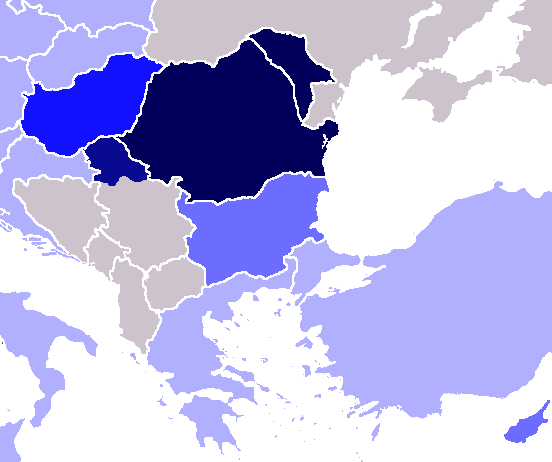
| mapcaption2 | Distribution of the Romanian language in Romania, Moldova and surroundings |
| notice | IPA |
| glotto | roma1327 |
| glottorefname | Romanian |
Eastern Europe Central Europe
- Cyrillic
- Moldovan Cyrillic alphabet (Transnistria only)
- Romanian Cyrillic alphabet (historical)
- Romanian Braille
Romanian (obsolete spelling: Roumanian; , or românește , ) is the official and main language of Romania and Moldova. Romanian is part of the Eastern Romance sub-branch of Romance languages, a linguistic group that evolved from several dialects of Vulgar Latin which separated from the Western Romance languages in the course of the period from the 5th to the 8th centuries. To distinguish it within the Eastern Romance languages, in comparative linguistics it is called Daco-Romanian as opposed to its closest relatives, Aromanian, Megleno-Romanian, and Istro-Romanian. It is also spoken as a minority language by stable communities in the countries surrounding Romania (Bulgaria, Hungary, Serbia and Ukraine), and by the large Romanian diaspora. In total, it is spoken by 25 million people as a first language.
Romanian was also known as Moldovan in Moldova, although the Constitutional Court of Moldova ruled in 2013 that "the official language of Moldova is Romanian". On 16 March 2023, the Moldovan Parliament approved a law on referring to the national language as Romanian in all legislative texts and the constitution. On 22 March, the president of Moldova, Maia Sandu, promulgated the law.
Overview
The history of the Romanian language started in the Roman provinces north of the Jireček Line in Classical antiquity but there are three main hypotheses about its exact territory: the autochthony thesis (it developed in left-Danube Dacia only), the discontinuation thesis (it developed in right-Danube provinces only), and the "as-well-as" thesis that supports the language development on both sides of the Danube. Between the 6th and 8th century, following the accumulated tendencies inherited from the vernacular spoken in this large area and, to a much smaller degree, the influences from native dialects, and in the context of a lessened power of the Roman central authority the language evolved into Common Romanian. This proto-language then came into close contact with the Slavic languages and subsequently divided into Aromanian, Megleno-Romanian, Istro-Romanian, and Daco-Romanian. Due to limited attestation between the 6th and 16th century, entire stages from its history are re-constructed by researchers, often with proposed relative chronologies and loose limits.
From the 12th or 13th century, official documents and religious texts were written in Old Church Slavonic, a language that had a similar role to Medieval Latin in Western Europe. The oldest dated text in Romanian is a letter written in 1521 with Cyrillic letters, and until late 18th century, including during the development of printing, the same alphabet was used. The period after 1780, starting with the writing of its first grammar books, represents the modern age of the language, during which time the Latin alphabet became official, the literary language was standardized, and a large number of words from Modern Latin and other Romance languages entered the lexis.
In the process of language evolution from fewer than 2500 attested words from Late Antiquity to a lexicon of over 150,000 words in its contemporary form, Romanian showed a high degree of lexical permeability, reflecting contact with Thraco-Dacian, Slavic languages (including Old Slavic, Serbian, Bulgarian, Ukrainian, and Russian), Greek, Hungarian, German, Turkish, and to languages that served as cultural models during and after the Age of Enlightenment, in particular French. This lexical permeability is continuing today with the introduction of English words.
Yet while the overall lexis was enriched with foreign words and internal constructs, in accordance with the history and development of the society and the diversification in semantic fields, the fundamental lexicon—the core vocabulary used in everyday conversation—remains governed by inherited elements from the Latin spoken in the Roman provinces bordering Danube, without which no coherent sentence can be made.
History
Main article: History of the Romanian language
Common Romanian
Main article: Proto-Romanian language
Romanian descended from the Latin spoken in the Roman provinces of Southeastern Europe north of the Jireček Line (a hypothetical boundary between the dominance of Latin and Greek influences).
Most scholars agree that two major dialects had developed from Common Romanian by the 10th century. Daco-Romanian (the official language of Romania and Moldova) and Istro-Romanian (a language spoken today by no more than 2,000 people in Istria) descended from the northern dialect. Two other languages, Aromanian and Megleno-Romanian, developed from the southern version of Common Romanian. These two languages are now spoken in lands to the south of the Jireček Line.
Of the features that individualize Common Romanian, inherited from Latin or subsequently developed, of particular importance are:
- appearance of schwa (written as ă in Romanian) vowel;
- growth of the plural inflectional ending -uri for the neuter gender;
- analytic present conditional (ex: Daco-Romanian aș cânta);
- analytic future with an auxiliary derived from Latin volo (ex: Aromanian va s-cântu);
- enclisis of the definite article (ex. Istro-Romanian câre – cârele);
- nominal declension with two case forms in the singular feminine.
Old Romanian
Main article: Old Romanian
The use of the denomination Romanian (română) for the language and use of the demonym Romanians (Români) for speakers of this language predate the foundation of the modern Romanian state. Romanians always used the general term rumân/român or regional terms such as ardeleni (or ungureni), moldoveni or munteni to designate themselves. Both the name of rumână or rumâniască for the Romanian language and the self-designation rumân/român are attested as early as the 16th century, by various foreign travelers into the Carpathian Romance-speaking space, as well as in other historical documents written in Romanian at that time such as (The Chronicles of the land of Moldova) by Grigore Ureche.
The few allusions to the use of Romanian in writing as well as common words, anthroponyms and toponyms preserved in the Old Church Slavonic religious writings and chancellery documents, attested prior to the 16th century, along with the analysis of graphemes show that the writing of Romanian with the Cyrillic alphabet started in the second half of the 15th century.
The Hurmuzaki Psalter (Psaltirea Hurmuzaki) is the oldest writing in Romanian, dated on the basis of watermarks between 1491–1504. It is a copy of an older, fifteenth-century translation of the Psalter, which was bilingual (written in Church Slavonic, with Romanian translation after each verse). The oldest Romanian document precisely dated is Neacșu's letter (1521) and was written using the Romanian Cyrillic alphabet, which was used until the late 19th century. The letter is the oldest testimony of Romanian epistolary style and uses a prevalent lexis of Latin origin. The slow process of Romanian establishing itself as an official language, used in the public sphere, in literature and ecclesiastically, began in the late 15th century and ended in the early decades of the 18th century, by which time Romanian had begun to be regularly used by the Church. The oldest Romanian texts of a literary nature are liturgical texts of the Eastern Orthodox Church: Psalter (Hurmuzaki Psalter, Scheian Psalter, Psalter of Voroneț) and Apostolos lectionary (Bratu's Codex, Codex of Voroneț). Their origins go back to the 15th century. The fact that they are bilingual writings or descend from bilingual writings shows that the initiative to translate them was prompted by the need to facilitate access to the Church Slavonic liturgical text.
The language spoken during this period had a phonological system of seven vowels and twenty-nine consonants. Particular to Old Romanian are the distribution of /z/, as the allophone of /dz/ from Common Romanian, in the Wallachian and south-east Transylvanian varieties, the presence of palatal sonorants /ʎ/ and /ɲ/, nowadays preserved only regionally in Banat and Oltenia, and the beginning of devoicing of asyllabic [u] after consonants. Text analysis revealed words that are now lost from modern vocabulary or used only in local varieties. These words were of various provenience for example: Latin (cure – to run, mâneca- to leave), Old Church Slavonic (drăghicame – gem, precious stone, prilăsti – to trick, to cheat), Hungarian (bizăntui – to bear witness).
Modern Romanian
Main article: Modern Romanian
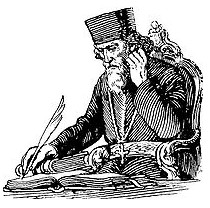
The modern age of Romanian starts in 1780 with the printing in Vienna of a very important grammar book titled Elementa linguae daco-romanae sive valachicae. The author of the book, Samuil Micu-Klein, and the revisor, Gheorghe Șincai, both members of the Transylvanian School, chose to use Latin as the language of the text and presented the phonological and grammatical features of Romanian in comparison to its ancestor. The Modern age of Romanian language can be further divided into three phases: pre-modern or modernizing between 1780 and 1830, modern phase between 1831 and 1880, and contemporary from 1880 onwards.
Pre-modern period
Beginning with the printing in 1780 of Elementa linguae daco-romanae sive valachicae, the pre-modern phase was characterized by the publishing of school textbooks, appearance of first normative works in Romanian, numerous translations, and the beginning of a conscious stage of re-latinization of the language. Notable contributions, besides that of the Transylvanian School, are the activities of Gheorghe Lazăr, founder of the first Romanian school, and Ion Heliade Rădulescu. The end of this period is marked by the first printing of magazines and newspapers in Romanian, in particular Curierul Românesc and Albina Românească.

Modern period
Starting from 1831 and lasting until 1880 the modern phase is characterized by the development of literary styles: scientific, administrative, and belletristic. It quickly reached a high point with the printing of Dacia Literară, a journal founded by Mihail Kogălniceanu and representing a literary society, which together with other publications like Propășirea and Gazeta de Transilvania spread the ideas of Romantic nationalism and later contributed to the formation of other societies that took part in the Revolutions of 1848. Their members and those that shared their views are collectively known in Romania as "of '48"(pașoptiști), a name that was extended to the literature and writers around this time such as Vasile Alecsandri, Grigore Alexandrescu, Nicolae Bălcescu, Timotei Cipariu.
Between 1830 and 1860 "transitional alphabets" were used, adding Latin letters to the Romanian Cyrillic alphabet. The Latin alphabet became official at different dates in Wallachia and Transylvania1860, and Moldova1862.
Following the unification of Moldavia and Wallachia further studies on the language were made, culminating with the founding of on 1 April 1866 on the initiative of C. A. Rosetti, an academic society that had the purpose of standardizing the orthography, formalizing the grammar and (via a dictionary) vocabulary of the language, and promoting literary and scientific publications. This institution later became the Romanian Academy.

Contemporary period
The third phase of the modern age of Romanian language, starting from 1880 and continuing to this day, is characterized by the prevalence of the supradialectal form of the language, standardized with the express contribution of the school system and Romanian Academy, bringing a close to the process of literary language modernization and development of literary styles. It is distinguished by the activity of Romanian literature classics in its early decades: Mihai Eminescu, Ion Luca Caragiale, Ion Creangă, Ioan Slavici.
The current orthography, with minor reforms to this day and using Latin letters, was fully implemented in 1881, regulated by the Romanian Academy on a fundamentally phonological principle, with few morpho-syntactic exceptions.
Modern history of Romanian in Bessarabia
The first Romanian grammar was published in Vienna in 1780. Following the annexation of Bessarabia by Russia in 1812, Moldavian was established as an official language in the governmental institutions of Bessarabia, used along with Russian, The publishing works established by Archbishop Gavril Bănulescu-Bodoni were able to produce books and liturgical works in Moldavian between 1815 and 1820.
Bessarabia during the 1812–1918 era witnessed the gradual development of bilingualism. Russian continued to develop as the official language of privilege, whereas Romanian remained the principal vernacular.
The period from 1905 to 1917 was one of increasing linguistic conflict spurred by an increase in Romanian nationalism. In 1905 and 1906, the Bessarabian zemstva asked for the re-introduction of Romanian in schools as a "compulsory language", and the "liberty to teach in the mother language (Romanian language)". At the same time, Romanian-language newspapers and journals began to appear, such as Basarabia (1906), Viața Basarabiei (1907), Moldovanul (1907), Luminătorul (1908), Cuvînt moldovenesc (1913), Glasul Basarabiei (1913). From 1913, the synod permitted that "the churches in Bessarabia use the Romanian language". Romanian finally became the official language with the Constitution of 1923.
Historical grammar
Romanian has preserved a part of the Latin declension. However, while Latin had six cases, from a morphological viewpoint, Romanian has only three: the nominative/accusative, genitive/dative, and marginally the vocative. Romanian nouns also preserve the neuter gender, although instead of functioning as a separate gender with its own forms in adjectives, the Romanian neuter became a mixture of masculine and feminine. The verb morphology of Romanian has shown the same move towards a compound perfect and future tense as the other Romance languages. Compared with the other Romance languages, during its evolution, Romanian simplified the original Latin tense system.
Geographic distribution
Romanian is spoken mostly in Central, South-Eastern, and Eastern Europe, although speakers of the language can be found all over the world, mostly due to emigration of Romanian nationals and the return of immigrants to Romania back to their original countries. Romanian speakers account for 0.5% of the world's population, and 4% of the Romance-speaking population of the world.
Romanian is the single official and national language in Romania and Moldova, although it shares the official status at regional level with other languages in the Moldovan autonomies of Gagauzia and Transnistria. Romanian is also an official language of the Autonomous Province of Vojvodina in Serbia along with five other languages. Romanian minorities are encountered in Serbia (Timok Valley), Ukraine (Chernivtsi and Odesa oblasts), and Hungary (Gyula). Large immigrant communities are found in Italy, Spain, France, and Portugal.
In 1995, the largest Romanian-speaking community in the Middle East was found in Israel, where Romanian was spoken by 5% of the population. Romanian is also spoken as a second language by people from Arabic-speaking countries who have studied in Romania. It is estimated that almost half a million Middle Eastern Arabs studied in Romania during the 1980s. Small Romanian-speaking communities are to be found in Kazakhstan and Russia. Romanian is also spoken within communities of Romanian and Moldovan immigrants in the United States, Canada and Australia, although they do not make up a large homogeneous community statewide.
| Country | Speakers | ||||||||||
|---|---|---|---|---|---|---|---|---|---|---|---|
| (%) | Speakers | ||||||||||
| (native) | Country Population | World | Countries where Romanian is an official language | Other neighboring European states (except for CIS countries where Romanian is not official) | CIS countries where Romanian is not official | Asia (excluding CIS countries) | The Americas | Oceania | Africa | ||
| World | 0.33% | **23,623,890** | 7,035,000,000 | ||||||||
| Romania | 90.65% | 17,263,561 | 19,043,767 | ||||||||
| Moldova 2 | 82.1% | 2,184,065 | 2,681,735 | ||||||||
| Transnistria (Moldova)3 | 33.0% | 156,600 | 475,665 | ||||||||
| Vojvodina (Serbia) | 1.04% | 18,038 | 1,740,230 | ||||||||
| Ukraine 5 | 0.8% | 327,703 | 48,457,000 | ||||||||
| Hungary | 0.14% | 13,886 | 9,937,628 | ||||||||
| Timok Valley (Serbia) | 0.39% | 25,702 | 6,664,007 | ||||||||
| Bulgaria | 0.06% | 4,575 | 7,364,570 | ||||||||
| Russia 1 | 0.06% | 92,675 | 142,856,536 | ||||||||
| Kazakhstan 1 | 0.1% | 14,666 | 14,953,126 | ||||||||
| Israel | 1.11% | ~82,300 | 7,412,200 | ||||||||
| UAE | 0.1% | 5,000 | 4,106,427 | ||||||||
| Singapore | 0.02% | 1,400 | 5,535,000 | ||||||||
| Japan | 0.002% | 2,185 | 126,659,683 | ||||||||
| South Korea | 0.0006% | 300 | 50,004,441 | ||||||||
| China | 0.0008% | 12,000 | 1,376,049,000 | ||||||||
| United States | 0.049% | 154,625 | 315,091,138 | ||||||||
| Canada | 0.289% | 100,610 | 34,767,250 | ||||||||
| Argentina | 0.03% | 13,000 | 40,117,096 | ||||||||
| Venezuela | 0.036% | 10,000 | 27,150,095 | ||||||||
| Brazil | 0.002% | 4,000 | 190,732,694 | ||||||||
| Australia | 0.046% | 12,251 | 26,482,413 | ||||||||
| New Zealand | 0.08% | 3,100 | 4,027,947 | ||||||||
| South Africa | 0.007% | 3,000 | 44,819,778 |
Legal status
In Romania
According to the Constitution of Romania of 1991, as revised in 2003, Romanian is the official language of the Republic.
Romania mandates the use of Romanian in official government publications, public education and legal contracts. Advertisements as well as other public messages must bear a translation of foreign words, while trade signs and logos shall be written predominantly in Romanian.
The Romanian Language Institute (Institutul Limbii Române), established by the Ministry of Education of Romania, promotes Romanian and supports people willing to study the language, working together with the Ministry of Foreign Affairs' Department for Romanians Abroad.
Since 2013, the Romanian Language Day is celebrated on every 31 August.
In Moldova
Main article: Moldovan language
Romanian is the official language of the Republic of Moldova. The 1991 Declaration of Independence named the official language Romanian, and the Constitution of Moldova as originally adopted in 1994 named the state language of the country Moldovan. In December 2013, a decision of the Constitutional Court of Moldova ruled that the Declaration of Independence took precedence over the Constitution and the state language should be called Romanian. In 2023, the Moldovan parliament passed a law officially adopting the designation "Romanian" in all legal instruments, implementing the 2013 court decision.
Scholars agree that Moldovan and Romanian are the same language, with the glottonym "Moldovan" used in certain political contexts. It has been the sole official language since the adoption of the Law on State Language of the Moldavian SSR in 1989. This law mandates the use of Moldovan in all the political, economic, cultural and social spheres, as well as asserting the existence of a "linguistic Moldo-Romanian identity". It is also used in schools, mass media, education and in the colloquial speech and writing. Outside the political arena the language is most often called "Romanian". In the breakaway territory of Transnistria, it is co-official with Ukrainian and Russian.
In the 2014 census, out of the 2,804,801 people living in Moldova, 24% (652,394) stated Romanian as their most common language, whereas 56% stated Moldovan. While in the urban centers speakers are split evenly between the two names (with the capital Chișinău showing a strong preference for the name "Romanian", i.e. 3:2), in the countryside hardly a quarter of Romanian/Moldovan speakers indicated Romanian as their native language. Unofficial results of this census first showed a stronger preference for the name Romanian, however the initial reports were later dismissed by the Institute for Statistics, which led to speculations in the media regarding the forgery of the census results.
Of the total population that declared its mother tongue in the 2024 Moldovan census, 49.2% declared Moldovan and 31.3% declared Romanian. The share of the population that declared Romanian as its mother tongue increased by 8.1% compared to the 2014 census (23.2%), and the share that declared Moldovan decreased by 7.8% (56.9% in the 2014 census). The proportion of the population who declared its mother tongue to be Romanian was higher among younger age groups, and it actually predominated in the 20-29 age group (88.785 who declared their "language to be Romanian, and 88,737 who declared it to be Moldovan.
In contrast, regarding the usually spoken language in the 2024 Moldovan census, 46.0% declared it to be Moldovan and 33.2% declared it to be Romanian. The two had together an increase of 0.5% compared to the 2014 census, and there was a significant increase in the share of self-declared speakers of Romanian as their usually spoken language, of 9.5%, as well as a decrease in the share of the self-declared speakers of Moldovan as their usually spoken language, of 9%, compared to the 2014 census. The proportion of the population who declared its usually spoken language to be Romanian was higher among younger age groups for which data is available, and it actually predominated in the 3-29 age group (319,303 who declared their "language to be Romanian, and 289,517 who declared it to be Moldovan).
In Serbia
Main article: Romanian language in Serbia
Vojvodina
The Constitution of the Republic of Serbia determines that in the regions of the Republic of Serbia inhabited by national minorities, their own languages and scripts shall be officially used as well, in the manner established by law.
The Statute of the Autonomous Province of Vojvodina determines that, together with the Serbian language and the Cyrillic script, and the Latin script as stipulated by the law, the Croat, Hungarian, Slovak, Romanian and Rusyn languages and their scripts, as well as languages and scripts of other nationalities, shall simultaneously be officially used in the work of the bodies of the Autonomous Province of Vojvodina, in the manner established by the law. The bodies of the Autonomous Province of Vojvodina are: the Assembly, the Executive Council and the provincial administrative bodies.
The Romanian language and script are officially used in eight municipalities: Alibunar, Bela Crkva (Biserica Albă), Žitište (Sângeorgiu de Bega), Zrenjanin (Becicherecu Mare), Kovačica (Covăcița), Kovin (Cuvin), Plandište (Plandiște) and Sečanj (Seceani). In the municipality of Vršac (Vârșeț), Romanian is official only in the villages of Vojvodinci (Voivodinț), Markovac (Marcovăț), Straža (Straja), Mali Žam (Jamu Mic), Malo Središte (Srediștea Mică), Mesić (Mesici), Jablanka (Iablanca), Sočica (Sălcița), Ritiševo (Râtișor), Orešac (Oreșaț) and Kuštilj (Coștei).
In the 2002 Census, the last carried out in Serbia, 1.5% of Vojvodinians stated Romanian as their native language.
Timok Valley
The Vlachs of Serbia are considered to speak Romanian as well.
Regional language status in Ukraine
In parts of Ukraine where Romanians constitute a significant share of the local population (districts in Chernivtsi, Odesa and Zakarpattia oblasts) Romanian is taught in schools as a primary language and there are Romanian-language newspapers, TV, and radio broadcasting.
The University of Chernivtsi in western Ukraine trains teachers for Romanian schools in the fields of Romanian philology, mathematics and physics.
In Hertsa Raion of Ukraine as well as in other villages of Chernivtsi Oblast and Zakarpattia Oblast, Romanian has been declared a "regional language" alongside Ukrainian as per the 2012 legislation on languages in Ukraine.
In other countries and organizations
Romanian is an official or administrative language in various communities and organisations, such as the Latin Union and the European Union. Romanian is also one of the five languages in which religious services are performed in the autonomous monastic state of Mount Athos, spoken in the monastic communities of Prodromos and Lakkoskiti. In the unrecognised state of Transnistria, Moldovan is one of the official languages. However, unlike all other dialects of Romanian, this variety of Moldovan is written in Cyrillic script.
As a second and foreign language
Romanian is taught in some areas that have Romanian minority communities, such as Vojvodina in Serbia, Bulgaria, Ukraine and Hungary. The Romanian Cultural Institute (ICR) has since 1992 organised summer courses in Romanian for language teachers. There are also non-Romanians who study Romanian as a foreign language, for example the Nicolae Bălcescu High-school in Gyula, Hungary.
Romanian is taught as a foreign language in tertiary institutions, mostly in European countries such as Germany, France and Italy, and the Netherlands, as well as in the United States. Overall, it is taught as a foreign language in 43 countries around the world.
]]
Popular culture
Romanian has become popular in other countries through movies and songs performed in the Romanian language. Examples of Romanian acts that had a great success in non-Romanophone countries are the bands O-Zone (with their No. 1 single Dragostea Din Tei, also known as Numa Numa, across the world in 2003–2004), Akcent (popular in the Netherlands, Poland and other European countries), Activ (successful in some Eastern European countries), DJ Project (popular as clubbing music) SunStroke Project (known by viral video "Epic Sax Guy") and Alexandra Stan (worldwide no.1 hit with "Mr. Saxobeat") and Inna as well as high-rated movies like 4 Months, 3 Weeks and 2 Days, The Death of Mr. Lazarescu, 12:08 East of Bucharest or California Dreamin' (all of them with awards at the Cannes Film Festival).
Also some artists wrote songs dedicated to the Romanian language. The multi-platinum pop trio O-Zone (originally from Moldova) released a song called ("I won't forsake our language"). The final verse of this song, , is translated in English as "I won't forsake our language, our Romanian language". Also, the Moldovan musicians Doina and Ion Aldea Teodorovici performed a song called "The Romanian language".
Dialects
Main article: Romanian dialects
Romanian is also called Daco-Romanian in comparative linguistics to distinguish from the other dialects of Common Romanian: Aromanian, Megleno-Romanian, and Istro-Romanian. The origin of the term "Daco-Romanian" can be traced back to the first printed book of Romanian grammar in 1780, by Samuil Micu and Gheorghe Șincai. There, the Romanian dialect spoken north of the Danube is called lingua Daco-Romana to emphasize its origin and its area of use, which includes the former Roman province of Dacia, although it is spoken also south of the Danube, in Dobruja, the Timok Valley and northern Bulgaria.
This article deals with the Romanian (i.e. Daco-Romanian) language, and thus only its dialectal variations are discussed here. The differences between the regional varieties are small, limited to regular phonetic changes, few grammar aspects, and lexical particularities. There is a single written and spoken standard (literary) Romanian language used by all speakers, regardless of region. Like most natural languages, Romanian dialects are part of a dialect continuum. The dialects of Romanian are also referred to as 'sub-dialects' and are distinguished primarily by phonetic differences. Romanians themselves speak of the differences as 'accents' or 'speeches' (in Romanian: accent or grai).
Depending on the criteria used for classifying these dialects, fewer or more are found, ranging from 2 to 20, although the most widespread approaches give a number of five dialects. These are grouped into two main types, southern and northern, further divided as follows:
- The southern type has only one member:
- the Wallachian dialect, spoken in the southern part of Romania, in the historical regions of Muntenia, Oltenia and the southern part of Northern Dobruja, but also extending in the southern parts of Transylvania.
- The northern type consists of several dialects:
- the Moldavian dialect, spoken in the historical region of Moldavia, now split among Romania, the Republic of Moldova, and Ukraine (Bukovina and Bessarabia), as well as northern part of Northern Dobruja;
- the Banat dialect, spoken in the historical region of Banat, including parts of Serbia;
- a group of finely divided and transition-like Transylvanian varieties, among which two are most often distinguished, those of Crișana and Maramureș.
Over the last century, however, regional accents have been weakened due to mass communication and greater mobility.
Some argots and speech forms have also arisen from the Romanian language. Examples are the Gumuțeasca, spoken in Mărgău, and the Totoiana, an inverted "version" of Romanian spoken in Totoi.
Classification
Romance language
Romanian is a Romance language, belonging to the Italic branch of the Indo-European language family, having much in common with languages such as Italian, Spanish, French and Portuguese.
The closest relative of Romanian among the Romance languages is Italian.
Compared to some other Romance languages such as Italian, Romanian reflects greater foreign influence in areas such as vocabulary. The Romanian vocabulary became predominantly influenced by French and, to a lesser extent, Italian in the nineteenth and early twentieth centuries.
A 1949 study by the Italian-American linguist Mario Pei, analyzing the degree to which seven Romance languages diverged from Classical Latin with respect to their accent vocalization, yielded the following measurements of divergence (with higher percentages indicating greater divergence from the stressed vowels of Classical Latin):
- Logudorese Sardinian: 8%
- Italian: 12%
- Spanish: 20%
- Romanian: 23.5%
- Occitan: 25%
- Portuguese: 31%
- French: 44%
The study emphasized, however, that it represented only "a very elementary, incomplete and tentative demonstration" of how statistical methods could measure linguistic change, assigned "frankly arbitrary" point values to various types of change, and did not compare languages in the sample with respect to any characteristics or forms of divergence other than stressed vowels, among other caveats.
Balkan language area
While most of Romanian grammar and morphology are based on Latin, there are some features that are shared only with other languages of the Balkans and not found in other Romance languages. The shared features of Romanian and the other languages of the Balkan language area (Bulgarian, Macedonian, Albanian, Greek, and Serbo-Croatian) include a suffixed definite article, the syncretism of genitive and dative case and the formation of the future and the alternation of infinitive with subjunctive constructions. According to a well-established scholarly theory, most Balkanisms could be traced back to the development of the Balkan Romance languages; these features were adopted by other languages due to language shift.
Slavic influence
Main article: Slavic influence on Romanian
Slavic influence on Romanian is especially noticeable in its vocabulary, with words of Slavic origin constituting about 10–15% of modern Romanian lexicon, and with further influences in its phonetics, morphology and syntax. The greater part of its Slavic vocabulary comes from Old Church Slavonic, which was the official written language of Wallachia and Moldavia from the 14th to the 18th century (although not understood by most people), as well as the liturgical language of the Romanian Orthodox Church. As a result, much Romanian vocabulary dealing with religion, ritual, and hierarchy is Slavic. The number of high-frequency Slavic-derived words is also believed to indicate contact or cohabitation with South Slavic tribes from around the 6th century, though it is disputed where this took place (see Origin of the Romanians). Words borrowed in this way tend to be more vernacular (compare sfârși, "to end", with săvârși, "to commit"). It has also been argued that Slavic borrowing was a key factor in the development of (î and â) as a separate phoneme.
Other influences
Even before the 19th century, Romanian came in contact with several other languages. Notable examples of lexical borrowings include:
- German: cartof Furthermore, during the Habsburg and, later on, Austrian rule of Banat, Transylvania, and Bukovina, a large number of words were borrowed from Austrian High German, in particular in fields such as the military, administration, social welfare, economy, etc. Subsequently, German terms have been taken out of science and technics, like: șină
- Greek: folos
- Hungarian: a cheltui
- Turkish: papuc
- Additionally, the Romani language has provided a series of slang words to Romanian such as: mișto "good, beautiful, cool"
French, Italian, and English loanwords
Since the 19th century, many literary or learned words were borrowed from the other Romance languages, especially from French and Italian (for example: birou "desk, office", avion "airplane", exploata "exploit"). It was estimated that about 38% of words in Romanian are of French and/or Italian origin (in many cases both languages); and adding this to Romanian's native stock, about 75%–85% of Romanian words can be traced to Latin. The use of these Romanianized French and Italian learned loans has tended to increase at the expense of previous loanwords, many of which have become rare or fallen out of use. As second or third languages, French and Italian themselves are better known in Romania than in Romania's neighbors. Along with the switch to the Latin alphabet in Moldova, the re-latinization of the vocabulary has tended to reinforce the Latin character of the language.
In the process of lexical modernization, much of the native Latin stock have acquired doublets from other Romance languages, thus forming a further and more modern and literary lexical layer. Typically, the native word is a noun and the learned loan is an adjective. Some examples of doublets:
| Latin | Native stock | Learned loan | 'quick’ | , | 'cold' (adj.) |
|---|---|---|---|---|---|
| 'astute’ | 'agile' ( | ||||
| 'water’ | 'aquatic' ( | ||||
| 'tooth’ | 'dentist' ( | ||||
| 'straight; right’ | 'direct' ( | ||||
| 'cold' (noun) | 'frigid' ( | ||||
| 'quick’ | 'quick' ( |
In the 20th century, an increasing number of English words have been borrowed (such as: gem
In some cases, there are multiple variants of loanwords, such as maus/mauși (masculine) and mouse/mouse-uri (neuter).
Lexis
Main article: Romanian lexis
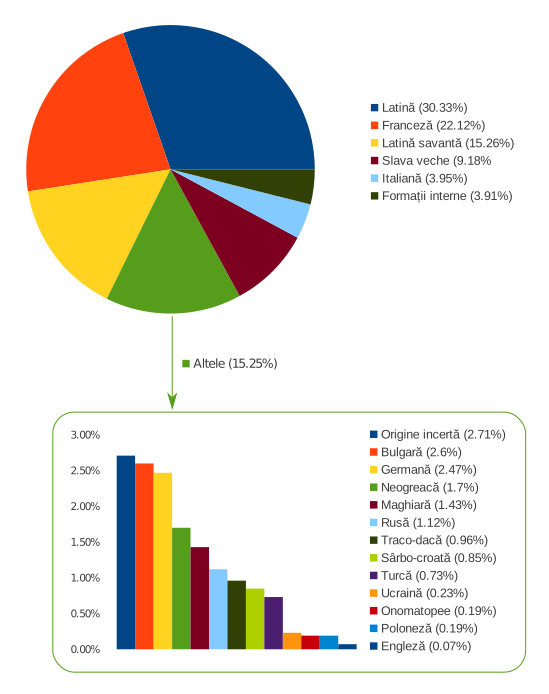
A 1988 statistic by Marius Sala is based on 2,581 words chosen on the criteria of frequency, semantic richness and productivity, which also contain words formed on the territory of the Romanian language. This statistic gives the percentages below:
- 30.33% – words inherited from Latin;
- 15.26% – academic loanwords from Latin;
- 22.12% – French loans;
- 9.18% – loans from Old Church Slavonic;
- 3.95% – loans from Italian;
- 3.91% – words formed in Romanian;
- 2.71% – words of uncertain origin;
- 2.6% – loans from Bulgarian;
- 2.47% – loans from German (including Austrian High German);
- 1.7% – loans from Greek;
- 1.43% – loans from Hungarian;
- 1.12% – loans from Russian;
- 0.96% – words inherited from the Thraco-Dacian substratum;
- 0.85% – loans from Serbian;
- 0.73% – loans from Turkish
If the analysis is restricted to a core vocabulary of 2,500 frequent, semantically rich and productive words, then the Latin inheritance comes first, followed by Romance and classical Latin neologisms, whereas the Slavic borrowings come third.
Although they are rarely used nowadays, the Romanian calendar used to have the traditional Romanian month names, unique to the language.
The longest word in Romanian is pneumonoultramicroscopicsilicovolcaniconioză, with 44 letters, but the longest one admitted by the Dicționarul explicativ al limbii române ("Explanatory Dictionary of the Romanian Language", DEX) is electroglotospectrografie, with 25 letters.
Grammar
Main article: Romanian grammar
Romanian nouns are characterized by gender (feminine, masculine, and neuter), and declined by number (singular and plural) and case (nominative/accusative, dative/genitive and vocative). The articles, as well as most adjectives and pronouns, agree in gender, number and case with the noun they modify.
Romanian is the only major Romance language where definite articles are enclitic: that is, attached to the end of the noun (as in the Scandinavian Languages, Bulgarian and Albanian), instead of in front (proclitic). They were formed, as in other Romance languages, from the Latin demonstrative pronouns.
As in all Romance languages, Romanian verbs are highly inflected for person, number, tense, mood, and voice. The usual word order in sentences is subject–verb–object (SVO). Romanian has four verbal conjugations which further split into ten conjugation patterns. Romanian verbs are conjugated for five moods (indicative, conditional/optative, imperative, subjunctive, and presumptive) and four non-finite forms (infinitive, gerund, supine, and participle).
Phonology
Main article: Romanian phonology}}{{unref section
Romanian has seven vowels: , , , , , and . Additionally, and may appear in some borrowed words. Arguably, the diphthongs and are also part of the phoneme set. There are twenty-two consonants. The two approximants and can appear before or after any vowel, creating a large number of glide-vowel sequences which are, strictly speaking, not diphthongs.
In final positions after consonants, a short can be deleted, surfacing only as the palatalization of the preceding consonant (e.g., ). Similarly, a deleted may prompt labialization of a preceding consonant, though this has ceased to carry any morphological meaning.
Phonetic changes
Main article: Latin-to-Romanian sound changes
Owing to its isolation from the other Romance languages, the phonetic evolution of Romanian was quite different, but the language does share a few changes with Italian, such as → (Lat. clarus → Rom. chiàr, Ital. chiaro, Lat. clamare → Rom. chemare, Ital. chiamare) and → (Lat. glacia (glacies) → Rom. ghéață, Ital. ghiaccia, ghiaccio, Lat. *ungla (ungula) → Rom. unghie, Ital. unghi*a), although this did not go as far as it did in Italian with other similar clusters (Rom. plàce, Ital. piace).
Another similarity with Italian is the change from or to or (Lat. pax, pacem → Rom. and Ital. pace, Lat. dulcem → Rom. dulce, Ital. dolce, Lat. circus → Rom. cerc, Ital. circo) and or to or (Lat. gelu → Rom. gèr, Ital. gelo, Lat. marginem → Rom. and Ital. margine, Lat. gemere → Rom. gèm (gemere), Ital. gemere).
There are also a few changes shared with Dalmatian, such as (probably phonetically ) → (Lat. cognatus → Rom. cumnat, Dalm. comnut) and → in some situations (Lat. coxa → Rom. cópsă, Dalm. copsa).
Among the notable phonetic changes are:
- diphthongization of e and o → ea and oa, before ă (or e as well, in the case of o) in the next syllable: :* Lat. cera → Rom. céră (wax) :* Lat. sole → Rom. sóre (sun)
- iotation → in the beginning of the word :* Lat. herba → Rom. ĭarbă (grass, herb)
- velar → labial before alveolar consonants and (e.g. ngu → mb): :* Lat. octo → Rom. opt (eight) :* Lat. lingua → Rom. lìmbă (tongue, language) :* Lat. signum → Rom. sèmn (sign) :* Lat. coxa → Rom. cópsă (thigh) :* Lat. aqua → Rom. apă (water)
- rhotacism → between vowels :* Lat. caelum → Rom. cèr (sky)
- Alveolars assibilated to when before short or long :* Lat. deus → Rom. ḑèŭ → zèŭ (god) :* Lat. tenem → Rom. ține (hold)
Romanian has entirely lost Latin (qu), turning it either into (Lat. quattuor → Rom. pàtru, "four"; cf. It. quattro) or (Lat. quando → Rom. când, "when"; Lat. quale → Rom. càre, "which").
Writing system
The first written record about a Romance language spoken in the Middle Ages in the Balkans is from 587. A Vlach muleteer accompanying the Byzantine army noticed that the load was falling from one of the animals and shouted to a companion Torna, torna, fratre! (meaning "Return, return, brother!"). Theophanes Confessor recorded it as part of a 6th-century military expedition by Comentiolus and Priscus against the Avars and Slovenes.
The oldest surviving written text in Romanian is a letter from late June 1521, in which Neacșu of Câmpulung wrote to the mayor of Brașov about an imminent attack of the Turks. It was written using the Cyrillic alphabet, like most early Romanian writings. The earliest surviving writing in Latin script was a late 16th-century Transylvanian text which was written with the Hungarian alphabet conventions.
In the 18th century, Transylvanian scholars noted the Latin origin of Romanian and adapted the Latin alphabet to the Romanian language, using some orthographic rules from Italian, recognized as Romanian's closest relative. The Cyrillic alphabet remained in (gradually decreasing) use until 1860, when Romanian writing was first officially regulated.
In the Soviet Republic of Moldova, the Russian-derived Moldovan Cyrillic alphabet was used until 1989, when the Romanian Latin alphabet was introduced; in the breakaway territory of Transnistria the Cyrillic alphabet remains in use.
Romanian alphabet
Main article: Romanian alphabet, Romanian braille}}{{unref section
The Romanian alphabet is as follows: :{|class="center wikitable" style="border-collapse:collapse" |- !colspan="31"| Capital letters |- | A | Ă | Â | B | C | D | E | F | G | H | I | Î | J | K | L | M | N | O | P | Q | R | S | Ș | T | Ț | U | V | W | X | Y
| | | | | ,
| | , ,
| | ,
| , mute | , ,
| | | | | | | ,
| | | | | | | | ,
| | , ,
| | ,
| |} K, Q, W and Y, are not part of the native alphabet; they were officially introduced in the Romanian alphabet in 1982 and are mostly used to write loanwords like kilogram, quasar, watt, and yoga.
The Romanian alphabet is based on the Latin script with five additional letters Ă, Â, Î, Ș, Ț. Formerly, there were as many as 12 additional letters, but some of them were abolished in subsequent reforms. Also, until the early 20th century, a breve marker was used, which survives only in ă.
Today the Romanian alphabet is largely phonemic. However, the letters â and î both represent the same close central unrounded vowel . Â is used only inside words; î is used at the beginning or the end of non-compound words and in the middle of compound words. Another exception from a completely phonetic writing system is the fact that vowels and their respective semivowels are not distinguished in writing. In dictionaries the distinction is marked by separating the entry word into syllables for words containing a hiatus.
Stressed vowels also are not marked in writing, except very rarely in cases where by misplacing the stress a word might change its meaning and if the meaning is not obvious from the context. For example, trei copíi means "three children" while trei cópii means "three copies".
Pronunciation

- h is not silent like in other Romance languages such as Spanish, Italian, Portuguese, Catalan and French, but represents the phoneme , except in the digraphs ch /k/ and gh /g/ (see below)
- j represents , as in French, Catalan or Portuguese (the sound spelled with s in the English words "vision, pleasure, treasure").
- There are two letters with a comma below, Ș and Ț, which represent the sounds and . However, the allographs with a cedilla instead of a comma, Ş and Ţ, became widespread when pre-Unicode and early Unicode character sets did not include the standard form.
- ă represents the schwa, .
- î and â both represent the sound . In rapid speech (for example in the name of the country) the â sound may sound similar to a casual listener to the short schwa sound ă (in fact, Aromanian does merge the two, writing them ã) but careful speakers will distinguish the sound. The nearest equivalent is the vowel in the last syllable of the word roses for some English dialects which distinguish it from Rosa's (e.g. /ˈroʊzɪz/ vs /ˈroʊzəz/). It is also roughly equivalent to European Portuguese , the Polish y or the Russian ы.
- The letter e generally represents the mid front unrounded vowel , somewhat like in the English word set. However, the letter e is pronounced as ([j] sounds like 'y' in 'you') when it is the first letter of any form of the verb a fi "to be", or of a personal pronoun, for instance este "is" and el "he". This addition of the semivowel does not occur in more recent loans and their derivatives, such as eră "era", electric "electric" etc. Some words (such as iepure "hare", formerly spelled epure) are now written with the initial i to indicate the semivowel.
- x represents either the phoneme sequence as in expresie = expression, or as in exemplu = example, as in English.
- As in Italian, the letters c and g represent the affricates and before i and e, and and elsewhere. When and are followed by vowels and (or their corresponding semivowels or the final ) the digraphs ch and gh are used instead of c and g, as shown in the table below. Unlike Italian, however, Romanian uses ce- and ge- to write and before a central vowel instead of ci- and gi-.
| Group | Phoneme | Pronunciation | Examples | |
|---|---|---|---|---|
| ce, ci | *ch* in **chest**, **cheek** | cerc (circle), ceașcă (cup), cercel (earring), cină (dinner), ciocan (hammer) | ||
| che, chi | *k* in **kettle**, **kiss** | cheie (key), chelner (waiter), chioșc (kiosk), chitară (guitar), ureche (ear) | ||
| ge, gi | *j* in **jelly**, **jigsaw** | ger (frost), gimnast (gymnast), gem (jam), girafă (giraffe), geantă (bag) | ||
| ghe, ghi | *g* in **get**, **give** | ghețar (glacier), ghid (guide), ghindă (acorn), ghidon (handle bar), stingher (lonely) |
Punctuation and capitalization
Uses of punctuation peculiar to Romanian are:
- Quotation marks use one of the Polish quotation formats, specifically „quote «inside» quote”, that is, „…” for a normal quotation, and «…» for a quotation inside a quotation.
- Proper quotations which span multiple paragraphs do not start each paragraph with quotation marks; quotation marks are placed only at the beginning and the end of the entire quotation, regardless of how many paragraphs it contains.
- Dialogues use quotation dashes.
- The Oxford comma before "and" is considered incorrect ("red, yellow and blue" is the proper format).
- Punctuation signs which follow a text in parentheses always follow the final bracket.
- In titles, only the first letter of the first word is capitalized, the rest of the title using sentence capitalization (with all its rules: proper names are capitalized as usual, etc.).
- Names of months and days are not capitalized (ianuarie "January", joi "Thursday").
- Adjectives derived from proper names are not capitalized (Germania "Germany", but german "German").
Academy spelling recommendations
In 1993, new spelling rules were proposed by the Romanian Academy. In 2000, the Moldovan Academy recommended adopting the same spelling rules, and in 2010 the Academy launched a schedule for the transition to the new rules that was intended to be completed by publications in 2011.
On 17 October 2016, the Moldovan minister of education signed Order No. 872, adopting the revised spelling rules as recommended by the Moldovan Academy of Sciences, and giving the following two school years as a transition period. Thus the spelling used by institutions under Moldova's ministry of education has been brought in line with the Romanian Academy's 1993 recommendation. This order, however, did not apply to other government institutions, and Law 3462 of 1989 (which provided for the means of transliterating Cyrillic to Latin) has not been amended to reflect the ministry of education's changes either; thus, most Moldovan government institutions, along with most Moldovans, prefer to use the spelling adopted in 1989 (when the use of Latin script became official).
Examples of Romanian text
: All human beings are born free and equal in dignity and rights. They are endowed with reason and conscience and should act towards one another in a spirit of brotherhood. ::(Universal Declaration of Human Rights) The sentence in contemporary Romanian. Words inherited directly from Latin are highlighted: : Toate ființele umane se nasc libere și egale în demnitate și în drepturi. Ele sunt înzestrate cu rațiune și conștiință și trebuie să se comporte unele față de altele în spiritul fraternității. The same sentence, with French and Italian loanwords highlighted instead: : Toate ființele umane se nasc libere și egale în demnitate și în drepturi. Ele sunt înzestrate cu rațiune și conștiință și trebuie să se comporte unele față de altele în spiritul fraternității. The sentence rewritten to exclude French and Italian loanwords. Slavic loanwords are highlighted: : Toate ființele omenești se nasc slobode și deopotrivă în destoinicie și în drepturi. Ele sunt înzestrate cu înțelegere și cuget și trebuie să se poarte unele față de altele în duh de frățietate. The sentence rewritten to exclude all loanwords. The meaning is unchanged: : Toate ființele omenești se nasc nesupuse și asemenea în prețuire și în drepturi. Ele sunt înzestrate cu înțelegere și cuget și se cuvine să se poarte unele față de altele frățește.
Notes
References
Bibliography
References
- (2023-07-10). "Glottolog 4.8 – Eastern Romance". [[Max Planck Institute for Evolutionary Anthropology]].
- "ARTICOLUL 13 – Constitutia României".
- (30 March 2023). "Modificat și în Constituție: "Limba de stat a Republicii Moldova este limba română" – FOTO". [[ProTV Chișinău]].
- Untila, Stela. (14 July 2021). ""Cât există Transnistria, va exista "limba moldovenească". Krasnoselski, despre posibile divergențe cu Chișinăul". NewsMaker.
- "Official use of languages and scripts in the Autonomous Province of Vojvodina". Provincial Secretariat for Regulations, Administration and National Minorities.
- "The Commission's use of languages".
- "Hungary needs to strengthen use of and access to minority languages". [[Council of Europe]].
- "Latest Council of Europe report on regional or minority Languages in Serbia published". The Network to Promote Linguistic Diversity.
- Savin, Mircea. (3 December 2025). ""Corectăm o inexactitate istorică!" – Parlamentul Ucrainei a eliminat "limba moldovenească" și a consfințit protejarea Limbii Române / Limba rusă, "retrogradată"". Cotidianul.md.
- "Istoria limbii române" ("History of the Romanian Language"), II, Academia Română, Bucharest, 1969
- (May 2024). "Președinta Maia Sandu a promulgat Legea care confirmă că limba de stat a Republicii Moldova este cea română". Presidency of the Republic of Moldova.
- Breu, Walter. (23 March 2022). "Romance in Contact with Slavic in Southern and South-Eastern Europe".
- Sala, Marius. (2012). "De la Latină la Română]". Editura Pro Universitaria.
- Brâncuș, Grigore. (2005). "Introducere în istoria limbii române]". Editura Fundației România de Mâine.
- [[Gabriela Pană Dindelegan
- Sala, Marius. (2012). "De la Latină la Română]". Editura Pro Universitaria.
- Schulte, Kim. (2009). "Loanwords in the World's Languages: A Comparative Handbook". De Gruyter Mouton.
- Pană Dindelegan, Gabriela, [https://books.google.com/books?id=DlrPPUCQmk4C ''The Grammar of Romanian''], Oxford, Oxford University Press, 2013, ISBN 978-0-19-964492-6, page 5
- Sala, Marius. (2012). "De la Latină la Română". Editura Pro Universitaria.
- Pană Dindelegan, Gabriela, [https://books.google.com/books?id=DlrPPUCQmk4C ''The Grammar of Romanian''], Oxford, Oxford University Press, 2013, ISBN 978-0-19-964492-6, page 4
- Ștefan Pascu, ''Documente străine despre români'', ed. Arhivelor statului, București 1992, {{ISBN. 973-95711-2-3
- (3 March 2016). "The Syntax of Old Romanian – Introduction".
- Camară, Iosif. (2024). "Zamfirei Mihail: Omagiu". Scriptor & Mega.
- (2016-06-30). "The Oxford Guide to the Romance Languages". Oxford University PressOxford.
- Camară, Iosif. (2024). "Originea celui mai vechi text românesc". Receptarea Sfintei Scripturi: între filologie, hermeneutică şi traductologie.
- (12 February 2016). "Romanian letter-writing: a cultural-rhetorical perspective (I)". Diacronia.
- Vîrban, Floarea. (2015). "Aspecte privind structura vocabularului în cel mai vechi octoih în limba română".
- "N. Felecan – Considerations on the First Books of Romanian Grammar".
- (24 October 2013). "The Book: A Global History". OUP Oxford.
- Sala, Marius. (2012). "De la Latină la Română]". Editura Pro Universitaria.
- (2016-06-30). "The Oxford Guide to the Romance Languages". Oxford University PressOxford.
- {{lang. ro. [https://acad.ro/institutia/istoric.html History of Romanian Academy]
- Sala, Marius. (2012). "De la Latină la Română]". Editura Pro Universitaria.
- Pană Dindelegan, Gabriela, [https://books.google.com/books?id=DlrPPUCQmk4C ''The Grammar of Romanian''], Oxford: Oxford University Press, 2013, ISBN 978-0-19-964492-6, page 5
- {{in lang. ru''Charter for the organization of the Bessarabian Oblast'', 29 April 1818, in "Печатается по изданию: Полное собрание законов Российской империи. Собрание первое.", Vol 35. ''1818'', [[Sankt Petersburg]], 1830, pg. 222–227. Available online at [http://www.hrono.info/dokum/moldav1818.html hrono.info] {{Webarchive. link. (24 September 2012)
- King, Charles. (2000). "The Moldovans: Romania, Russia, and the Politics of Culture". Hoover Institution Press.
- (2004). "Balkan Syntax and Semantics". John Benjamins Publishing.
- "Latin Union – Languages and cultures online 2005". Dtil.unilat.org.
- "Languages Spoken by More Than 10 Million People".
- According to the 1993 ''Statistical Abstract of Israel'' there were 250,000 Romanian speakers in Israel, of a population of 5,548,523 in 1995 (census).
- "Reports of about 300,000 Jews that left the country after WW2". Eurojewcong.org.
- Laslau, Andi. (27 April 2005). "Arabii din Romania, radiografie completa".
- "Tab5. Populatia stabila dupa principalele limbi materne la recensamantul din anul 2011 – rezultate preliminar".
- "Dissemination database search".
- "Hungarian Census 2011".
- "Матерњи језик, вероисповест и национална припадност {{!}} О ПОПИСУ СТАНОВНИШТВА".
- Ethnologue.com
- [https://www.gks.ru/free_doc/new_site/perepis2010/croc/Documents/Vol4/pub-04-08.pdf 2010 Russia Census] {{Webarchive. link. (22 April 2021 Perepis 2010)
- "Jews, by Country of Origin(1) and Age". [[Israel Central Bureau of Statistics]].
- "Detailed Languages Spoken at Home and Ability to Speak English for the Population 5 Years and Over: 2009–2013".
- Government of Canada, Statistics Canada. (2017-08-02). "Mother Tongue (263), Single and Multiple Mother Tongue Responses (3), Age (7) and Sex (3) for the Population Excluding Institutional Residents of Canada, Provinces and Territories, Census Divisions and Census Subdivisions, 2016 Census – 100% Data".
- "Redirect to Census data page".
- link. (22 March 2008)
- "Constitution of Romania". Cdep.ro.
- Legea "[[George Pruteanu. Pruteanu]]": [http://www.cdep.ro/proiecte/2001/500/80/5/leg_pl585_01.pdf 500/2004 – Law on the Protection of the Romanian Language] {{Webarchive. link. (12 November 2011)
- Art. 27 (3), Legea nr. 26/1990 privind Registrul Comerțului
- "Ministry of Education of Romania".
- (31 August 2020). "31 august – Ziua Limbii Române". [[Agerpres]].
- (31 August 2020). "De ce este sărbătorită Ziua Limbii Române la 31 august". Historia.
- "Declarația de independența a Republicii Moldova, Moldova Suverană". Moldova-suverana.md.
- "A Field Guide to the Main Languages of Europe – Spot that language and how to tell them apart". European Commission.
- (2015-03-25). "Moldovan Court Rules Official Language is 'Romanian', Replacing Soviet-Flavored 'Moldovan'". Fox News.
- "Moldovan president promulgates law replacing name of state language in country's constitution with 'Romanian'".
- "Marian Lupu: Româna și moldoveneasca sunt aceeași limbă". Realitatea .NET.
- Dalby, Andrew. (1998). "Dictionary of Languages". Bloomsbury Publishing.
- [http://www.iatp.md/ladom/downloads/M3.doc Legea cu privire la functionarea limbilor vorbite pe teritoriul RSS Moldovenesti Nr.3465-XI din 01.09.89 Vestile nr.9/217, 1989] {{webarchive. link. (19 February 2006 (Law regarding the usage of languages spoken on the territory of the Republic of Moldova): "Moldavian RSS supports the desire of the Moldavian that live across the borders of the Republic, and – considering the existing Moldo-Romanian linguistic identity – of the Romanians that live on the territory of the USSR, of doing their studies and satisfying their cultural needs in their maternal language.")
- link. (30 October 2017)
- (2017-03-29). "Biroul Național de Statistică, acuzat că a falsificat rezultatele recensământului". Independent.
- Rezultatele finale ale Recensământului Populației și Locuințelor 2024, at https://statistica.gov.md/ro/statistic_indicator_details/60#excel_tables_pages , table 5.11, Populația după limba maternă, pe grupe de vârstă, la recensământul din 2024.
- Rezultatele finale ale Recensământului Populației și Locuințelor 2024, at https://statistica.gov.md/ro/statistic_indicator_details/60#excel_tables_pages , table 5.11, Populația după limba maternă, pe grupe de vârstă, la recensământul din 2024.
- Rezultatele finale ale Recensământului Populației și Locuințelor 2024, at https://statistica.gov.md/ro/statistic_indicator_details/60#excel_tables_pages , table 5.18, Populația în vârstă de 3 ani și peste după limba vorbită de obicei, pe grupe de vârstă, la recensământul din 2024.
- Rezultatele finale ale Recensământului Populației și Locuințelor 2024, at https://statistica.gov.md/ro/statistic_indicator_details/60#excel_tables_pages , table 5.18, Populația în vârstă de 3 ani și peste după limba vorbită de obicei, pe grupe de vârstă, la recensământul din 2024.
- Official Gazette of Republic of Serbia, No.1/90
- link. (19 October 2017 , published in the ''Official Gazette of AP Vojvodina'' No.20/2014)
- "Official Use of Languages and Scripts in the AP Vojvodina".
- Provincial Secretariat for Regulations, Administration and National Minorities: [http://www.puma.vojvodina.gov.rs/dokumenti/sljezik.xls "Official use of the Romanian language in the Autonomous Province of Vojvodina (APV)"] {{Webarchive. link. (11 November 2011)
- (2018). "Pluricentric Languages and Non-Dominant Varieties Worldwide: New Pluricentric Languages – Old Problems". Peter Lang Verlag.
- "Internetový časopis človek a spoločnosť".
- Kramar Andriy. "University of Chernivtsi". Chnu.cv.ua.
- link. (25 February 2007 , ''[[Ziua]]'', 19 August 2005)
- link. (7 December 2010 , Romanian Language Institute.)
- (1780). "Elementa linguae daco-romanae sive valachicae".
- Delyusto, Maryna. (2016). "Mul'tilingval'nyy atlas mezhdurech'ya Dnestra i Dunaya: Istochniki i priyemy sozdaniya". Journal of Danubian Studies and Research.
- Arjocu, Florin. (29 June 2020). "Satul din România unde se vorbește o limbă secretă. Tălăuzești gumuțeasca?". Știri România.
- Florea, Sorin. (1 June 2020). "Care este satul din România unde se vorbește o limbă secretă?". Shtiu.
- (19 January 2009). "În localitatea Totoi, județul Alba, se vorbește o limbă specifică locului". [[Realitatea TV]].
- Arsenie, Dan. (9 December 2011). "Totoiana – messengerul de pe uliță. Povestea unei limbi inventate de români". GreatNews.ro.
- (2 November 2009). "'Limba intoarsă' vorbită în Totoi". Ziare.com.
- Stoica, Vasile. (1919). "The Roumanian Question: The Roumanians and their Lands". Pittsburgh Printing Company.
- The [[lexical similarity]] of Romanian with Italian has been estimated at 77%, followed by French at 75%, Sardinian at 74%, Catalan at 73%, Portuguese and [[Rhaeto-Romance languages. Rhaeto-Romance]] at 72%, and Spanish at 71%.Ethnologue, [http://www.ethnologue.com/language/ron Romanian] {{Webarchive. link. (25 May 2020)
- Sandiuc, Corina. (1 November 2014). "Languages and cultures in contact: The French language and the maritime terminology". Diversitate Si Identitate Culturala in Europa.
- Pei, Mario. (1949). "A New Methodology for Romance Classification". WORD.
- Mišeska Tomić, Olga. (2006). "Balkan Sprachbund Morpho-Syntactic Features". Springer.
- Schulte, Kim. (2009). "Loanwords in the World's Languages: A Comparative Handbook". De Gruyter Mouton.
- Lindstedt, J.. (2000). "Languages in Contact". Rodopi.
- (October 2019}}, published in {{Cite book). "Loanwords in Romanian }}{{dead link". Walter de Gruyter.
- Macrea, Dimitrie. (1961). "Probleme de lingvistică română". Editura Științifică.
- (2013). "The Grammar of Romanian". Oxford University Press.
- (2016). "Verb Movement and Clause Structure in Old Romanian". Oxford University Press.
- Bernard Comrie. (13 January 2009). "The World's Major Languages". Routledge.
- Keith Hitchins. (20 February 2014). "A Concise History of Romania". Cambridge University Press.
- Margaret E. L. Renwick. (2014). "The Phonetics and Phonology of Contrast: The Case of the Romanian Vowel System". De Gruyter.
- Dama, Hans. (2006). "Lexikale Einflüsse im Rumänischen aus dem österreichischen Deutsch". Philologica Jassyensia.
- Zafiu, Rodica. (2009). "Mișto și legenda bastonului".
- Marius Sala (coord), Mihaela Bîrlădeanu, Maria Iliescu, Liliana Macarie, Ioana Nichita, Mariana Ploae-Hanganu, Maria Theban, Ioana Vintilă-Rădulescu, ''Vocabularul reprezentativ al limbilor romanice'' (VRLR) (Bucharest: Editura Științifică și Enciclopedică, 1988).
- Vocabularul reprezentativ diferă de vocabularul fundamental (VF) și de fondul principal lexical (FP). Cf. SCL (Studii și cercetări lingvistice), an XXVII (1976), nr. 1, p. 61-66 și SCL (1974) nr. 3, p. 247. Cf. Theodor Hristea, "Structura generală a lexicului românesc", ''Sinteze de limba română'', eds., Theodor Hristea (coord.), Mioara Avram, Grigore Brâncuș, Gheorghe Bulgăr, Georgeta Ciompec, Ion Diaconescu, Rodica Bogza-Irimie & Flora Șuteu (Bucharest: 1984), 13.
- *''[[Dicționarul explicativ al limbii române]]'', [[Romanian Academy. Academia Română]], Institutul de Lingvistică "Iorgu Iordan", Editura Univers Enciclopedic, 1998
- Bălhuc, Paul. (15 January 2017). "Câte litere are cel mai lung cuvânt din limba română și care este singurul termen ce conține toate vocalele". [[Adevărul]].
- "Electroglotospectrografie".
- (2 December 2020). "Curiozități lingvistice: cele mai lungi cuvinte din limba română".
- Săvescu, Oana. (2012). "When Syncretism Meets Word Order. On Clitic Order in Romanian". Probus.
- (1898). "Vlachs". Adam and Charles Black.
- Sarlin, Mika. (2014). "Romanian Grammar". Books on Demand.
- Dyer, Donald L.. (1999). "Some Influences of Russian on the Romanian of Moldova during the Soviet Period". The Slavic and East European Journal.
- {{in lang. link. (26 December 2007 and in some forms of the verb ''a fi'' (''to be''): [http://dexonline.ro/search.php?cuv=fi ''este'', ''eram'', etc.] {{Webarchive). link. (27 July 2009)
- {{in lang
- The new edition of "Dicționarul ortografic al limbii române (ortoepic, morfologic, cu norme de punctuație)" – introduced by the [[Academy of Sciences of Moldova]] and recommended for publishing following a conference on 15 November 2000 – applies the decision of the General Meeting of the [[Romanian Academy]] from 17 February 1993, regarding the reintroduction to "â" and "sunt" in the orthography of the Romanian language. ([[:ro:Imagine:Asm lbro3.jpg. Introduction, Institute of Linguistics of the Academy of Sciences of Moldova]])
- (4 June 2010). "Gheorghe Duca: Trebuie schimbată atitudinea de sorginte proletară față de savanți și în genere față de intelectuali". Allmoldova.
This article was imported from Wikipedia and is available under the Creative Commons Attribution-ShareAlike 4.0 License. Content has been adapted to SurfDoc format. Original contributors can be found on the article history page.
Ask Mako anything about Romanian language — get instant answers, deeper analysis, and related topics.
Research with MakoFree with your Surf account
Create a free account to save articles, ask Mako questions, and organize your research.
Sign up freeThis content may have been generated or modified by AI. CloudSurf Software LLC is not responsible for the accuracy, completeness, or reliability of AI-generated content. Always verify important information from primary sources.
Report