From Surf Wiki (app.surf) — the open knowledge base
Q
Seventeenth letter of the Latin alphabet

Seventeenth letter of the Latin alphabet
| Field | Value | |||
|---|---|---|---|---|
| name | Q | |||
| letter | Q q | |||
| script | Latin script | |||
| type | Alphabet | |||
| typedesc | ic and logographic | |||
| language | Greek language | |||
| Latin language | ||||
| phonemes | (Table) | |||
| [] [] | ||||
| unicode | U+0051, U+0071 | |||
| alphanumber | 17 | |||
| fam1 | O34V24 | |||
| fam2 | [[File:Proto-semiticQ-01.svg | class=skin-invert-image | 20px | Proto-Sinaitic Qup]] |
| fam3 | [[File:Protoquf.svg | class=skin-invert-image | 20px]] | |
| fam4 | [[File:Phoenician_qoph.svg | class=skin-invert-image | 20px | Phoenician Qoph]] |
| fam5 | [𐌒](q) | |||
| usageperiod | Unknown to present | |||
| children | Ƣ | |||
| [Ɋ](q) | ||||
| [℺](q) | ||||
| [Ԛ](q) | ||||
| sisters | Φ | |||
| [Ф](f) | ||||
| ק | ||||
| ق | ||||
| ܩ | ||||
| [ࠒ](q) | ||||
| [𐎖](q) | ||||
| ቀ | ||||
| Փ փ | ||||
| Ֆ ֆ | ||||
| associates | q(x) | |||
| direction | Left-to-right | |||
| image | File:Latin_letter_Q.svg | |||
| imageclass | skin-invert-image |
the letter
Latin language [] [] Ɋ ℺ Ԛ Ф ק ق ܩ ࠒ 𐎖 ቀ Փ փ Ֆ ֆ
Q, or q, is the seventeenth letter of the Latin alphabet, used in the modern English alphabet, the alphabets of other western European languages and others worldwide. Its name in English is pronounced , most commonly spelled cue, but also kew, kue, and que.
History
| Egyptian hieroglyph | |||||||||||||
|---|---|---|---|---|---|---|---|---|---|---|---|---|---|
| wḏ | Phoenician | ||||||||||||
| Qoph | Western Greek | ||||||||||||
| Koppa | Etruscan | ||||||||||||
| Q | Latin | ||||||||||||
| Q | |||||||||||||
| V24 | [[Image:PhoenicianQ-01.svg | class=skin-invert-image | x30px]] | [[Image:Greek Koppa normal.svg | class=skin-invert-image | x30px]] | [[Image:EtruscanQ-01.svg | class=skin-invert-image | x30px]] | [[File:Capitalis monumentalis Q.SVG | class=skin-invert-image | x30px | Latin Q]] |
The Semitic sound value of Qôp was (voiceless uvular stop), and the form of the letter could have been based on the eye of a needle, a knot, or even a monkey with its tail hanging down. is a sound common to Semitic languages, but not found in many European languages. In common with other glyphs derived from the Proto-Sinaitic script, the letter has been suggested to have its roots in Egyptian hieroglyphs.
In an early form of Ancient Greek, qoppa (Ϙ) probably came to represent several labialized velar stops, among them and . As a result of later sound shifts, these sounds in Greek changed to and respectively. Therefore, qoppa was transformed into two letters: qoppa, which stood for the number 90, and phi (Φ), which stood for the aspirated sound that came to be pronounced in Modern Greek.
The Etruscans used Q in conjunction with V to represent , and this usage was copied by the Romans with the rest of their alphabet. In the earliest Latin inscriptions, the letters C, K and Q were all used to represent the two sounds and , which were not differentiated in writing. Of these, Q was used before a rounded vowel (e.g. 'ego'), K before (e.g. 'calendis'), and C elsewhere. Later, the use of C (and its variant G) replaced most usages of K and Q: Q survived only to represent when immediately followed by a sound.{{citation |access-date=2015-12-24 |archive-date=2016-11-09 |archive-url=https://web.archive.org/web/20161109231225/https://books.google.com/books?id=IeHmqKY2BqoC |url-status=live
In Turkey between 1928 and 2013 the use of the letter Q, alongside X and W, was banned from official government documents, such as street signs and brochures. The letter forms part of the Kurdish alphabet but is not present in Turkish.
Typographic variants
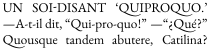
Uppercase "Q"
Depending on the typeface used to typeset the letter Q, the letter's tail may either bisect its bowl as in Helvetica, meet the bowl as in Univers, or lie completely outside the bowl as in PT Sans. In writing block letters, bisecting tails are the fastest to write, as they require less precision. All three styles are considered equally valid, with most serif typefaces having a Q with a tail that meets the circle, while sans-serif typefaces are more equally split between those with bisecting tails and those without. Typefaces with a disconnected Q tail, while uncommon, have existed since at least 1529. A common method among type designers to create the shape of the Q is by simply adding a tail to the letter O.
Old-style serif fonts, such as Garamond, may contain two uppercase Qs: one with a short tail to be used in short words, and another with a long tail to be used in long words. Some early metal type fonts included up to 3 different Qs: a short-tailed Q, a long-tailed Q, and a long-tailed Q-u ligature. This print tradition was alive and well until the 19th century, when long-tailed Qs fell out of favor; even recreations of classic typefaces such as Caslon began being distributed with only short Q tails. American typographer D. B. Updike, who was known to disapprove of the long-tailed Q, celebrated their demise in his 1922 book Printing Types, claiming that Renaissance printers made their Q tails longer and longer simply to "outdo each other". Latin-language words, which are much more likely than English words to contain "Q" as their first letter, have also been cited as the reason for their existence. The long-tailed Q had fallen out of use with the advent of early digital typography, as many early digital fonts could not choose different glyphs based on the word that the glyph was in, but it has seen something of a comeback with the advent of OpenType fonts and LaTeX, both of which can automatically typeset the long-tailed Q when it is called for and the short-tailed Q when it is not.
Owing to the allowable variation between letters, Q, like , is often cited as a letter that gives type designers a greater opportunity for self-expression. Identifont is an automatic typeface identification service that identifies typefaces by asking questions about their appearance and later asks about the Q tail if the "sans-serif" option is chosen. In the Identifont database, the distribution of Q tails is:
| Q tail type | Serif | Sans-serif | Total |
|---|---|---|---|
| Bisecting | 1461 | 2719 | |
| Meets bowl | 3363 | 4521 | |
| Outside bowl | 271 | 397 | |
| "2" shape (\mathcal{Q}) | 304 | 428 | |
| Inside bowl | 129 | 220 | |
| 5528 | 8285 |
Some type designers prefer one "Q" design over another: Adrian Frutiger, famous for the airport typeface that bears his name, remarked that most of his typefaces feature a Q tail that meets the bowl and then extends horizontally. Frutiger considered such Qs to make for more "harmonious" and "gentle" typefaces. "Q" often makes the list of their favorite letters; for example, Sophie Elinor Brown, designer of Strato, has listed "Q" as being her favorite letter.
Lowercase "q"

The lowercase "q" is usually seen as a lowercase "o" or "c" with a descender (i.e., downward vertical tail) extending from the right side of the bowl, with or without a swash (i.e., flourish), or even a reversed lowercase p. The "q"'s descender is usually typed without a swash due to the major style difference typically seen between the descenders of the "g" (a loop) and "q" (vertical). When handwritten, or as part of a handwriting font, the descender of the "q" sometimes finishes with a rightward swash to distinguish it from the letter "g" (or, particularly in mathematics, from the digit "9").
Use in writing systems
| Orthography | Spelling | Phonemes | Afar | Albanian | Azeri | Catalan | (Pinyin) | English | Fijian | French | Galician | German | Hadza | Indonesian | Italian | K'iche | Khmer romanization | Kiowa | Kurdish | Maltese | Menominee | Mi'kmaq | Mohegan-Pequot | Nuxalk | Portuguese | Sasak | Somali | Sotho | Spanish | Swedish | Uzbek | Vietnamese | Võro | Wolof | Xhosa | Zulu |
|---|---|---|---|---|---|---|---|---|---|---|---|---|---|---|---|---|---|---|---|---|---|---|---|---|---|---|---|---|---|---|---|---|---|---|---|---|
| // or | ||||||||||||||||||||||||||||||||||||
| // | ||||||||||||||||||||||||||||||||||||
| // | ||||||||||||||||||||||||||||||||||||
| // | ||||||||||||||||||||||||||||||||||||
| // | ||||||||||||||||||||||||||||||||||||
| //~// | ||||||||||||||||||||||||||||||||||||
| // | ||||||||||||||||||||||||||||||||||||
| // or | ||||||||||||||||||||||||||||||||||||
| ~ | ||||||||||||||||||||||||||||||||||||
| // | ||||||||||||||||||||||||||||||||||||
| // (pre-1900 spelling, still survives in proper names) | ||||||||||||||||||||||||||||||||||||
| // |
English
In English, the digraph most often denotes the cluster ; however, in borrowings from French, it represents , as in 'plaque'. See the list of English words containing Q not followed by U. Q is the second least frequently used letter in the English language (after Z), with a frequency of just 0.1% in words. Q has the fourth fewest English words where it is the first letter, after X, Z, and Y.
Other languages
In most European languages written in the Latin script, such as Romance and Germanic languages, appears almost exclusively in the digraph . In French, Occitan, Catalan, and Portuguese, represents or ; in Spanish, it represents . replaces for before front vowels and , since in those languages represents a fricative or affricate before front vowels. In Italian, represents (where is the semivowel allophone of ). In Albanian, Q represents , as in Shqip.
The letter is often not used often or at all in other languages, The letter is not officially part of the Cornish (Standard Written Form), Estonian, Icelandic, Irish, Latvian, Lithuanian, Polish, Serbo-Croatian, Scottish Gaelic, Slovenian, Turkish, or Welsh alphabets. However, in some of them, it may be found in borrowings.
has a wide variety of other pronunciations in some European languages and in non-European languages that have adopted the Latin alphabet.
Other systems
The International Phonetic Alphabet uses for the voiceless uvular stop.
Other uses
Main article: Q (disambiguation)
- The capital letter Q is used as the currency symbol for the Guatemalan quetzal.
- The Roman numeral Q is sometimes used to represent the number 500,000.
Other representations
Computing
Other
Notes
References
References
- "Q", ''Oxford English Dictionary,'' 2nd edition (1989).
''Merriam-Webster's Third New International Dictionary of the English Language, Unabridged'' (1993) lists "cue" and "kue" as current. [[James Joyce]] used "kew"; it and "que" remain in use. - link. (2017-02-04 . The meaning is doubtful. "Eye of a needle" has been suggested, and also "knot" Harvard Studies in Classical Philology vol. 45.)
- Isaac Taylor, ''History of the Alphabet: Semitic Alphabets, Part 1'', 2003: "The old explanation, which has again been revived by Halévy, is that it denotes an 'ape,' the character ''Q'' being taken to represent an ape with its tail hanging down. It may also be referred to a Talmudic root which would signify an 'aperture' of some kind, as the 'eye of a needle,' ... Lenormant adopts the more usual explanation that the word means a 'knot'.
- (1851). "Elements of Latin Pronunciation: For the Use of Students in Language, Law, Medicine, Zoology, Botany, and the Sciences Generally in which Latin Words are Used". J.B. Lippincott.
- (2006). "The Origins of the West Semitic Alphabet in Egyptian Scripts". [[Catholic Biblical Association of America]].
- (2014-03-24). "The Textualization of the Greek Alphabet". Cambridge University Press.
- Noyer, Rolf. "Principal Sound Changes from PIE to Greek".
- Boeree, C. George. "The Origin of the Alphabet". [[Shippensburg University of Pennsylvania]].
- Arvaniti, Amalia. (1999). "Standard Modern Greek". [[Journal of the International Phonetic Association]].
- Miller, D. Gary. (1994-09-06). "Ancient Scripts and Phonological Knowledge". [[John Benjamins Publishing]].
- Bispham, Edward. (2010-03-01). "Edinburgh Companion to Ancient Greece and Rome". [[Edinburgh University Press]].
- (27 September 2013). "Ban on Kurdish letters to be lifted with democracy package - Turkey News".
- (2011-08-31). "The Fundamentals of Typography: Second Edition". [[A & C Black]].
- (2009-09-23). "Lettering & Type: Creating Letters and Designing Typefaces". Princeton Architectural Press.
- Vervliet, Hendrik D. L.. (2008-01-01). "The Palaeotypography of the French Renaissance: Selected Papers on Sixteenth-century Typefaces". [[Brill Publishers.
- Rabinowitz, Tova. (2015-01-01). "Exploring Typography". Cengage Learning.
- (2014-05-08). "Adrian Frutiger – Typefaces: The Complete Works". Walter de Gruyter.
- Updike, Daniel Berkeley. (1922). "Printing types, their history, forms, and use; a study in survivals". [[Harvard University Press]].
- Loxley, Simon. (2006-03-31). "Type: The Secret History of Letters". I.B.Tauris.
- Fischer, Ulrike. (2014-11-02). "How to force a long-tailed Q in EB Garamond".
- "What are "Stylistic Sets?"". Hoefler & Co..
- Bosler, Denise. (2012-05-16). "Mastering Type: The Essential Guide to Typography for Print and Web Design". F+W Media, Inc..
- Haley, Allan. "The Letter Q". [[Monotype Imaging.
- "2: Q Shape".
- "3: $ style".
- Hughes, Kerrie. (2014-09-02). "Font of the day: Strato". [[Future plc]].
- Heller, Stephen. (2016-01-07). "We asked 15 typographers to describe their favorite letterforms. Here's what they told us.". [[Wired (magazine)#Website.
- Phillips, Nicole Arnett. (2016-01-27). "Wired asked 15 Typographers to introduce us to their favorite glyphs.". Typograph.Her.
- Gordon, Arthur E.. (1983). "Illustrated Introduction to Latin Epigraphy". [[University of California Press]].
- Barmeier, Severin. (2015-10-10). "L2/15-241: Proposal to encode Latin small capital letter Q".
- (2020-09-25). "L2/20-251: Unicode request for modifier Latin capital letters".
- (2020-11-08). "L2/20-252R: Unicode request for IPA modifier-letters (a), pulmonic".
- (2006-01-30). "L2/06-027: Proposal to add Medievalist characters to the UCS".
This article was imported from Wikipedia and is available under the Creative Commons Attribution-ShareAlike 4.0 License. Content has been adapted to SurfDoc format. Original contributors can be found on the article history page.
Ask Mako anything about Q — get instant answers, deeper analysis, and related topics.
Research with MakoFree with your Surf account
Create a free account to save articles, ask Mako questions, and organize your research.
Sign up freeThis content may have been generated or modified by AI. CloudSurf Software LLC is not responsible for the accuracy, completeness, or reliability of AI-generated content. Always verify important information from primary sources.
Report