From Surf Wiki (app.surf) — the open knowledge base
Ribosome
Macromolecular machine that synthesizes proteins in cells
Macromolecular machine that synthesizes proteins in cells
| Field | Value |
|---|---|
| Name | Ribosome |
| Image | Ribosome shape.png |
| Caption | Large (red) and small (blue) subunits of a ribosome |
| PartOf | Cell (biology) |
A ribosome () is a ribonucleoprotein particle found in all cells, both prokaryotic and eukaryotic, responsible for the synthesis of proteins. A ribosome functions as a molecular machine in the translation of strands of messenger RNA (mRNA) and production of a protein. A ribosome links amino acids together in the order specified by the codons of mRNA molecules to form polypeptide chains. A ribosome is made up of a large and a small subunit, each consisting of one or more ribosomal RNA molecules and many ribosomal proteins. The ribosomes and associated molecules are also known as the translational apparatus.
Ribosome biogenesis is the process of making ribosomes. This is an energy consuming, dynamic process, requiring the synthesis of around 200 proteins in the processing of ribosomal RNAs and assembling them with ribosomal proteins to make the ribosomes subunits.
Overview
The sequence of DNA that encodes the sequence of the amino acids in a protein is transcribed into a messenger RNA (mRNA) chain. Ribosomes bind to the messenger RNA molecules and use the RNA's sequence of nucleotides to determine the sequence of amino acids needed to generate a protein. Amino acids are selected and carried to the ribosome by transfer RNA (tRNA) molecules, which enter the ribosome and bind to the messenger RNA chain via an anticodon stem loop. For each coding triplet (codon) in the messenger RNA, there is a unique transfer RNA that must have the exact anti-codon match, and carries the correct amino acid for incorporating into a growing polypeptide chain. Once the protein is produced, it can then fold to produce a functional three-dimensional structure.
During translation the synthesis of proteins from their building blocks takes place in four stages: initiation, elongation, termination, and ribosome recycling. The start codon in all mRNA molecules has the sequence AUG. The stop codon is one of UAA, UAG, or UGA; since there are no tRNA molecules that recognize these codons, the ribosome recognizes that translation is complete. When a ribosome finishes reading an mRNA molecule, the two subunits separate and are usually broken up but can be reused. Ribosomes are a kind of enzyme, called ribozymes because the catalytic peptidyl transferase activity that links amino acids together is performed by the ribosomal RNA.
Ribosomes from bacteria, archaea, and eukaryotes (in the three-domain system) resemble each other to a remarkable degree, evidence of a common origin. They differ in their size, sequence, structure, and the ratio of protein to RNA. The differences in structure allow some antibiotics to kill bacteria by inhibiting their ribosomes while leaving human ribosomes unaffected. In all domains, a polysome of two or more ribosomes may move along a single mRNA chain at one time, each reading a specific sequence and producing a corresponding protein molecule.
The mitochondrial ribosomes (mitoribosomes) of eukaryotic cells are distinct from the other ribosomes. They functionally resemble those in bacteria, reflecting the evolutionary origin of mitochondria as endosymbiotic bacteria.
Discovery
Ribosomes were first observed in the mid-1950s as dense particles or granules by Romanian-American cell biologist George Emil Palade, using an electron microscope. They were initially called Palade granules due to their granular structure. The term "ribosome" was proposed in 1958 by Howard M. Dintzis:
Albert Claude, Christian de Duve, and George Emil Palade were jointly awarded the Nobel Prize in Physiology or Medicine, in 1974, for the discovery of the ribosome. The Nobel Prize in Chemistry 2009 was awarded to Venkatraman Ramakrishnan, Thomas A. Steitz and Ada E. Yonath for determining the detailed structure and mechanism of the ribosome.
Structure
A ribosome is a ribonucleoprotein particle made from complexes of ribosomal RNAs and proteins, arranged into two ribosomal subunits, one large and the other small. Ribosomes are complex molecular machines present in all cells both prokaryotic, and eukaryotic. The ribosomal subunits of prokaryotes and eukaryotes are quite similar.
A ribosome is largely made up of specialized non-coding ribosomal RNA (rRNA) as well as dozens of distinct ribosomal proteins (the number varies slightly between species). The ribosomal proteins and rRNAs are arranged into two distinct ribosomal subunits one large and one small. The subunits fit together locking around a strand of mRNA, and work as one to translate the mRNA into a polypeptide chain during protein synthesis.
Prokaryotic
Bacteria
Bacterial ribosomes are around 20 nm (200 Å) in diameter and are composed of 65% rRNA and 35% ribosomal proteins. Eukaryotic ribosomes are between 25 and 30 nm (250–300 Å) in diameter with an rRNA-to-protein ratio that is close to 1. Crystallographic work has shown that there are no ribosomal proteins close to the reaction site for polypeptide synthesis. This suggests that the protein components of ribosomes do not directly participate in peptide bond formation catalysis, but rather that these proteins act as a scaffold that may enhance the ability of rRNA to synthesize protein
The unit of measurement used to describe the ribosomal subunits and the rRNA fragments is the Svedberg unit, a measure of the rate of sedimentation in centrifugation rather than size. This accounts for why fragment names do not add up: for example, bacterial 70S ribosomes are made of 50S and 30S subunits.
Prokaryotes have 70S ribosomes, each consisting of a small (30S) and a large (50S) subunit. E. coli, for example, has a 16S RNA subunit (consisting of 1540 nucleotides) that is bound to 21 proteins. The large subunit is composed of a 5S RNA subunit (120 nucleotides), a 23S RNA subunit (2900 nucleotides) and 31 proteins.
:{| class="wikitable float-right" style="text-align:center"
| + Ribosome of E. coli (a bacterium) |
|---|
| ! width="25%" |
| ! width="25%" |
| ! width="25%" |
| ! width="25%" |
| - |
| - |
| 5S (120 nt) |
| - |
| 30S |
| } |
Affinity label for the tRNA binding sites on the E. coli ribosome allowed the identification of A and P site proteins most likely associated with the peptidyltransferase activity; labelled proteins are L27, L14, L15, L16, L2; at least L27 is located at the donor site, as shown by E. Collatz and A.P. Czernilofsky. Additional research has demonstrated that the S1 and S21 proteins, in association with the 3′-end of 16S ribosomal RNA, are involved in the initiation of translation.
Archaea
Archaeal ribosomes are conventionally quoted as having similar sizes as the bacterial ribosome, being a 70S ribosome made up from a 50S large subunit and a 30S small subunit. The rRNA chains are similarly commonly called 16S, 23S, and 5S, though again few (if any) recent sources have truly measured their sedimentation coefficients. However, on the sequence and structual levels, they are much closer to eukaryotic ones than to bacterial ones. Every extra ribosomal protein archaea have compared to bacteria has a eukaryotic counterpart, while no such relation applies between archaea and bacteria.
:{| class="wikitable float-right" style="text-align:center"
| + Ribosome of Pyrococcus furiosus (an archaeon) |
|---|
| ! width="25%" |
| ! width="25%" |
| ! width="25%" |
| ! width="25%" |
| - |
| - |
| 5S (120 nt) |
| - |
| 30S |
| } |
Eukaryote
Main article: Eukaryotic ribosome
Eukaryotic cells have 80S ribosomes located in their cytosol, each consisting of a small (40S) and large (60S) subunit. Their 40S subunit has an 18S RNA (1900 nucleotides) and 33 proteins. The large subunit is composed of a 5S RNA (120 nucleotides), 28S RNA (4700 nucleotides), a 5.8S RNA (160 nucleotides) subunits and 49 proteins.
:{| class="wikitable float-right" style="text-align:center"
| + eukaryotic cytosolic ribosomes (R. norvegicus) |
|---|
| ! width="25%" |
| ! width="25%" |
| ! width="25%" |
| ! width="25%" |
| - |
| - |
| 5.8S (160 nt) |
| - |
| 5S (120 nt) |
| - |
| 40S |
| } |
During 1977, Czernilofsky published research that used affinity labeling to identify tRNA-binding sites on rat liver ribosomes. Several proteins, including L32/33, L36, L21, L23, L28/29 and L13 were implicated as being at or near the peptidyl transferase center.
Plastoribosomes and mitoribosomes
Main article: Mitochondrial ribosome, Chloroplast#Chloroplast ribosomes
In eukaryotes, ribosomes are present in mitochondria (sometimes called mitoribosomes) and in plastids such as chloroplasts (also called plastoribosomes). They also consist of large and small subunits bound together with proteins into one 70S particle. These ribosomes are similar to those of bacteria and these organelles are thought to have originated as symbiotic bacteria. Of the two, chloroplastic ribosomes are closer to bacterial ones than mitochondrial ones are. Many pieces of ribosomal RNA in the mitochondria are shortened, and in the case of 5S rRNA, replaced by other structures in animals and fungi. In particular, Leishmania tarentolae has a minimalized set of mitochondrial rRNA. In contrast, plant mitoribosomes have both extended rRNA and additional proteins as compared to bacteria, in particular, many pentatricopetide repeat proteins.
The cryptomonad and chlorarachniophyte algae may contain a nucleomorph that resembles a vestigial eukaryotic nucleus. Eukaryotic 80S ribosomes may be present in the compartment containing the nucleomorph.
Making use of the differences
The differences between the bacterial and eukaryotic ribosomes are exploited by pharmaceutical chemists to create antibiotics that can destroy a bacterial infection without harming the cells of the infected person. Due to the differences in their structures, the bacterial 70S ribosomes are vulnerable to these antibiotics while the eukaryotic 80S ribosomes are not. Even though mitochondria possess ribosomes similar to the bacterial ones, mitochondria are not affected by these antibiotics because they are surrounded by a double membrane that does not easily admit these antibiotics into the organelle. A noteworthy counterexample is the antineoplastic antibiotic chloramphenicol, which inhibits bacterial 50S and eukaryotic mitochondrial 50S ribosomes. Ribosomes in chloroplasts, however, are different: Antibiotic resistance in chloroplast ribosomal proteins is a trait that has to be introduced as a marker, with genetic engineering.
Common properties
The various ribosomes share a core structure, which is quite similar despite the large differences in size. Much of the RNA is highly organized into various tertiary structural motifs, for example pseudoknots that exhibit coaxial stacking. The extra RNA in the larger ribosomes is in several long continuous insertions, such that they form loops out of the core structure without disrupting or changing it. All of the catalytic activity of the ribosome is carried out by the RNA; the proteins reside on the surface and seem to stabilize the structure.
High-resolution structure

The general molecular structure of the ribosome has been known since the early 1970s. In the early 2000s, the structure has been achieved at high resolutions, of the order of a few ångströms.
The first papers giving the structure of the ribosome at atomic resolution were published almost simultaneously in late 2000. The 50S (large prokaryotic) subunit was determined from the archaeon Haloarcula marismortui and the bacterium Deinococcus radiodurans, and the structure of the 30S subunit was determined from the bacterium Thermus thermophilus. These structural studies were awarded the Nobel Prize in Chemistry in 2009. In May 2001 these coordinates were used to reconstruct the entire T. thermophilus 70S particle at 5.5 Å resolution.
Two papers were published in November 2005 with structures of the Escherichia coli 70S ribosome. The structures of a vacant ribosome were determined at 3.5 Å resolution using X-ray crystallography. Then, two weeks later, a structure based on cryo-electron microscopy was published, which depicts the ribosome at 11–15 Å resolution in the act of passing a newly synthesized protein strand into the protein-conducting channel.
The first atomic structures of the ribosome complexed with tRNA and mRNA molecules were solved by using X-ray crystallography by two groups independently, at 2.8 Å and at 3.7 Å. These structures allow one to see the details of interactions of the Thermus thermophilus ribosome with mRNA and with tRNAs bound at classical ribosomal sites. Interactions of the ribosome with long mRNAs containing Shine-Dalgarno sequences were visualized soon after that at 4.5–5.5 Å resolution. In 2023, a cryo-electron microscopy study reported a 1.55 Å structure of the Escherichia coli 70S ribosome in the translating state, providing near-atomic detail of rRNA modifications, tRNA-mRNA interactions, and ion coordination. The high-resolution map enabled identification of ribosomal polymorphism sites and visualization of transient chimeric hybrid states associated with tRNA translocation at approximately 2 Å resolution. These findings improved structural understanding of the ribosome's functional regions and offered valuable insights for antibiotic design.
In 2011, the first complete atomic structure of the eukaryotic 80S ribosome from the yeast Saccharomyces cerevisiae was obtained by crystallography. The model reveals the architecture of eukaryote-specific elements and their interaction with the universally conserved core. At the same time, the complete model of a eukaryotic 40S ribosomal structure in Tetrahymena thermophila was published and described the structure of the 40S subunit, as well as much about the 40S subunit's interaction with eIF1 during translation initiation. Similarly, the eukaryotic 60S subunit structure was also determined from Tetrahymena thermophila in complex with eIF6. In addition, high-resolution cryo-EM structures of a thermophilic eukaryotic 80S ribosome captured in two rotational states at ~2.9 Å and ~3.0 Å resolution revealed atomistic details of the eukaryotic translocation mechanism and conformational dynamics of eEF2 during GTP hydrolysis.
Function
Ribosomes are minute particles consisting of RNA and associated proteins that function to synthesize proteins. Proteins are needed for many cellular functions, such as repairing damage or directing chemical processes. Ribosomes can be either free, floating within the cytoplasm or attached to the rough endoplasmic reticulum. Their main function is to convert genetic code into an amino acid sequence and to build protein polymers from amino acid monomers.
Ribosomes act as catalysts in two extremely important biological processes called peptidyl transfer and peptidyl hydrolysis. The "PT center is responsible for producing protein bonds during protein elongation".
In summary, ribosomes have two main functions: Decoding the message, and the formation of peptide bonds. These two functions reside in the ribosomal subunits. Each subunit is made of one or more rRNAs and many r-proteins. The small subunit (30S in bacteria and archaea, 40S in eukaryotes) has the decoding function, whereas the large subunit (50S in bacteria and archaea, 60S in eukaryotes) catalyzes the formation of peptide bonds, referred to as the peptidyl-transferase activity. The bacterial (and archaeal) small subunit contains the 16S rRNA and 21 r-proteins (Escherichia coli), whereas the eukaryotic small subunit contains the 18S rRNA and 32 r-proteins (Saccharomyces cerevisiae, although the numbers vary between species). The bacterial large subunit contains the 5S and 23S rRNAs and 34 r-proteins (E. coli), with the eukaryotic large subunit containing the 5S, 5.8S, and 25S/28S rRNAs and 46 r-proteins (S. cerevisiae; again, the exact numbers vary between species).
Translation
Main article: Translation (biology)
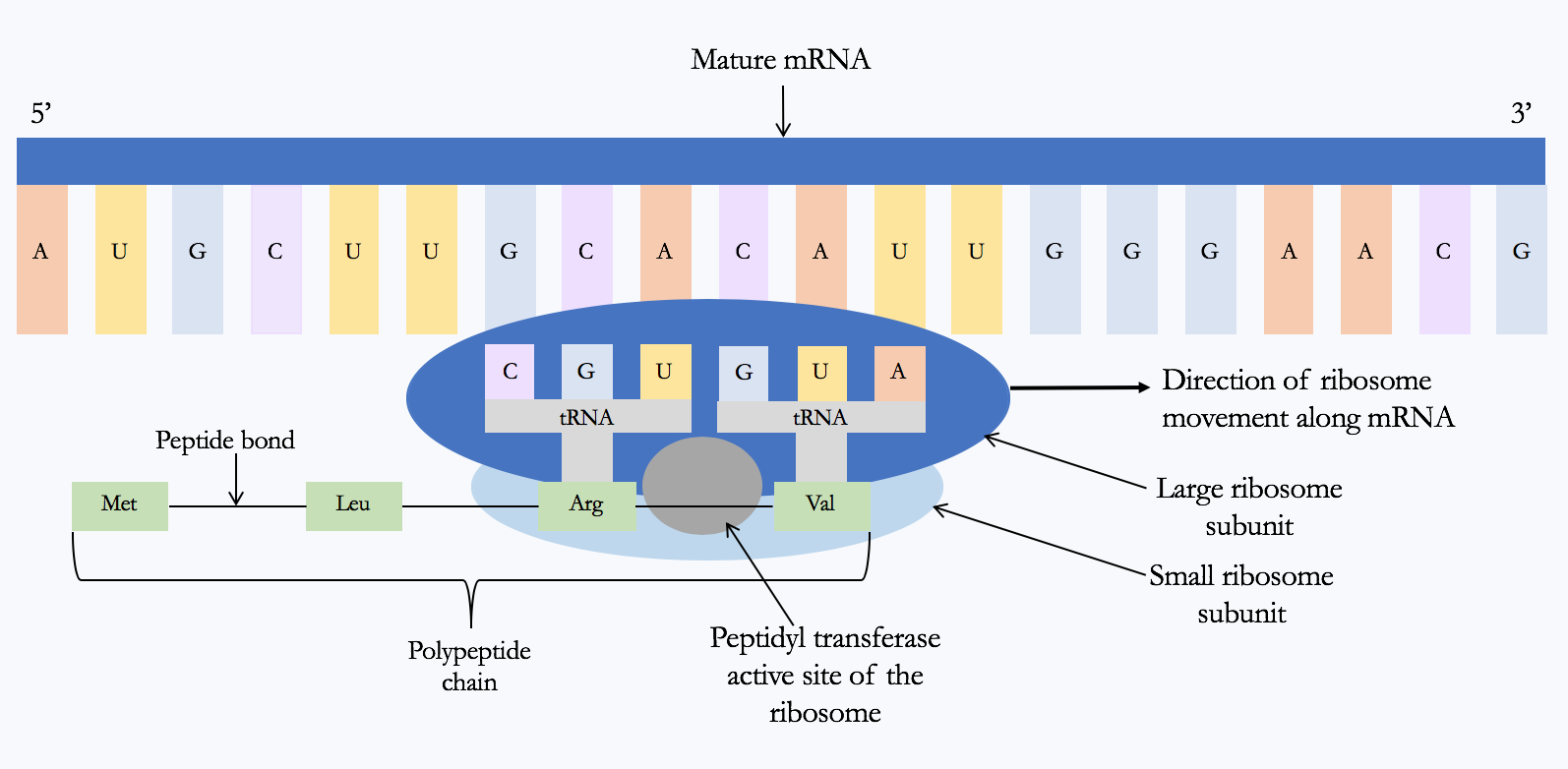
Ribosomes are the workplaces of protein biosynthesis, the process of translating mRNA into protein. The mRNA comprises a series of codons which are decoded by the ribosome to make the protein. Using the mRNA as a template, the ribosome traverses each codon (3 nucleotides) of the mRNA, pairing it with the appropriate amino acid provided by an aminoacyl-tRNA. Aminoacyl-tRNA contains a complementary anticodon on one end and the appropriate amino acid on the other. For fast and accurate recognition of the appropriate tRNA, the ribosome utilizes large conformational changes (conformational proofreading). The small ribosomal subunit, typically bound to an aminoacyl-tRNA containing the first amino acid methionine, binds to an AUG codon on the mRNA and recruits the large ribosomal subunit. The ribosome contains three RNA binding sites, designated A, P, and E. The A-site binds an aminoacyl-tRNA or termination release factors; the P-site binds a peptidyl-tRNA (a tRNA bound to the poly-peptide chain); and the E-site (exit) binds a free tRNA. Protein synthesis begins at a start codon AUG near the 5′-end of the mRNA. mRNA binds to the P site of the ribosome first. The ribosome recognizes the start codon by using the Shine-Dalgarno sequence of the mRNA in prokaryotes and Kozak box in eukaryotes.
Although catalysis of the peptide bond involves the C2 hydroxyl of RNA's P-site adenosine in a proton shuttle mechanism, other steps in protein synthesis (such as translocation) are caused by changes in protein conformations. Since their catalytic core is made of RNA, ribosomes are classified as "ribozymes," and it is thought that they might be remnants of the RNA world.

In Figure 5, both ribosomal subunits (small and large) assemble at the start codon (towards the 5' end of the mRNA). The ribosome uses tRNA that matches the current codon (triplet) on the mRNA to append an amino acid to the polypeptide chain. This is done for each triplet on the mRNA, while the ribosome moves towards the 3' end of the mRNA. Usually in bacterial cells, several ribosomes are working parallel on a single mRNA, forming what is called a polyribosome or polysome.
Cotranslational folding
The ribosome is known to actively participate in the protein folding. The structures obtained in this way are usually identical to the ones obtained during protein chemical refolding; however, the pathways leading to the final product may be different. In some cases, the ribosome is crucial in obtaining the functional protein form. For example, one of the possible mechanisms of folding of the deeply knotted proteins relies on the ribosome pushing the chain through the attached loop.
Addition of translation-independent amino acids
Presence of a ribosome quality control protein Rqc2 is associated with mRNA-independent protein elongation. This elongation is a result of ribosomal addition (via tRNAs brought by Rqc2) of *CAT' tails: ribosomes extend the C-terminus of a stalled protein with random, translation-independent sequences of alanines and ***t'''''hreonines.
Ribosome locations
Ribosomes are classified as being either "free" or "membrane-bound". Free and membrane-bound ribosomes differ only in their spatial distribution; they are identical in structure. Whether the ribosome exists in a free or membrane-bound state depends on the presence of an ER-targeting signal sequence on the protein being synthesized, so an individual ribosome might be membrane-bound when it is making one protein, but free in the cytosol when it makes another protein.
Ribosomes are sometimes referred to as organelles, but the use of the term organelle is often restricted to describing sub-cellular components that include a phospholipid membrane, which ribosomes, being entirely particulate, do not. For this reason, ribosomes may sometimes be described as "non-membranous organelles".
Free ribosomes
Free ribosomes can move about anywhere in the cytosol, but are excluded from the cell nucleus and other organelles. Proteins that are formed from free ribosomes are released into the cytosol and used within the cell. Since the cytosol contains high concentrations of glutathione and is, therefore, a reducing environment, proteins containing disulfide bonds, which are formed from oxidized cysteine residues, cannot be produced within it.
Membrane-bound ribosomes
When a ribosome begins to synthesize proteins needed in certain organelles, the ribosome making this protein can become "membrane-bound". In eukaryotic cells this happens in a region of the endoplasmic reticulum (ER) called the "rough ER". The newly produced polypeptide chains are inserted directly into the ER by the ribosome undertaking vectorial synthesis and are then transported to their destinations, through the secretory pathway. Bound ribosomes usually produce proteins that are used within the plasma membrane or are expelled from the cell via exocytosis.
Biogenesis
Main article: Ribosome biogenesis
In bacterial cells, ribosomes are synthesized in the cytoplasm through the transcription of multiple ribosome gene operons. In eukaryotes, the process takes place both in the cell cytoplasm and in the nucleolus, which is a region within the cell nucleus. The assembly process involves the coordinated function of over 200 proteins in the synthesis and processing of the four rRNAs, as well as assembly of those rRNAs with the ribosomal proteins.
Origin
The ribosome may have first originated as a protoribosome, possibly containing a peptidyl transferase centre (PTC), in an RNA world, appearing as a self-replicating complex that only later evolved the ability to synthesize proteins when amino acids began to appear. Studies suggest that ancient ribosomes constructed solely of rRNA could have developed the ability to synthesize peptide bonds. In addition, evidence strongly points to ancient ribosomes as self-replicating complexes, where the rRNA in the ribosomes had informational, structural, and catalytic purposes because it could have coded for tRNAs and proteins needed for ribosomal self-replication. Hypothetical cellular organisms with self-replicating RNA but without DNA are called ribocytes (or ribocells).
As amino acids gradually appeared in the RNA world under prebiotic conditions, their interactions with catalytic RNA would increase both the range and efficiency of function of catalytic RNA molecules. Thus, the driving force for the evolution of the ribosome from an ancient self-replicating machine into its current form as a translational machine may have been the selective pressure to incorporate proteins into the ribosome's self-replicating mechanisms, so as to increase its capacity for self-replication.
Heterogeneous ribosomes
In 1958, Francis Crick famously proposed the "one gene-one ribosome-one protein hypothesis," where each ribosome carries the genetic information required to encode a single protein. Although discredited at that time, from the discovery of the first ribosomopathy Diamond–Blackfan Anemia in 1999, the ribosome has transitioned from a passive molecular machine to a dynamic macromolecular machine.Ribosomes are compositionally heterogeneous between species and even within the same cell, as evidenced by the existence of cytoplasmic and mitochondria ribosomes within the same eukaryotic cells. Certain researchers have suggested that heterogeneity in the composition of ribosomal proteins in mammals is important for gene regulation, i.e., the specialized ribosome hypothesis. However, this hypothesis is controversial and the topic of ongoing research.
Heterogeneity in ribosome composition was first proposed to be involved in translational control of protein synthesis by Vince Mauro and Gerald Edelman. They proposed the ribosome filter hypothesis to explain the regulatory functions of ribosomes. Evidence has suggested that specialized ribosomes specific to different cell populations may affect how genes are translated. Some ribosomal proteins exchange from the assembled complex with cytosolic copies suggesting that the structure of the in vivo ribosome can be modified without synthesizing an entire new ribosome.
Certain ribosomal proteins are absolutely critical for cellular life while others are not. In budding yeast, 14/78 ribosomal proteins are non-essential for growth, while in humans this depends on the cell of study. Other forms of heterogeneity include post-translational modifications to ribosomal proteins such as acetylation, methylation, and phosphorylation. Arabidopsis, Viral internal ribosome entry sites (IRESs) may mediate translations by compositionally distinct ribosomes. For example, 40S ribosomal units without eS25 in yeast and mammalian cells are unable to recruit the CrPV IGR IRES.
Heterogeneity of ribosomal RNA modifications plays a significant role in structural maintenance and/or function and most mRNA modifications are found in highly conserved regions. The most common rRNA modifications are pseudouridylation and 2'-O-methylation of ribose.
References
References
- (January 2003). "Structural basis of the ribosomal machinery for peptide bond formation, translocation, and nascent chain progression". Molecular Cell.
- (April 2019). "The small and large ribosomal subunits depend on each other for stability and accumulation". Life Science Alliance.
- (August 2018). "Roadblocks and resolutions in eukaryotic translation". Nat Rev Mol Cell Biol.
- "Scitable by nature translation / RNA translation".
- (November 2021). "The Peptidyl Transferase Center: a Window to the Past". Microbiol Mol Biol Rev.
- (1987). "Evolution of the mitochondrial protein synthetic machinery". Bio Systems.
- "Ribosomes".
- (January 1955). "A small particulate component of the cytoplasm". The Journal of Biophysical and Biochemical Cytology.
- (September 2022). "A Brief History of Protein Biosynthesis and Ribosome Research".
- (1958). "Microsomal Particles and Protein Synthesis". Pergamon Press, Inc..
- "The Nobel Prize in Physiology or Medicine 1974". The Nobel Foundation.
- "2009 Nobel Prize in Chemistry". The Nobel Foundation.
- (2002). "Molecular Biology of the Cell". Garland Science.
- "Ribosome".
- (1960). "Molecular characterization of ribonucleic acid from Escherichia coli ribosomes". Journal of Molecular Biology.
- (May 2012). "The structure and function of the eukaryotic ribosome". Cold Spring Harbor Perspectives in Biology.
- (August 2000). "The structural basis of ribosome activity in peptide bond synthesis". Science.
- (2005). "The Ribosomal Peptidyl Transferase Center: Structure, Function, Evolution, Inhibition". Critical Reviews in Biochemistry and Molecular Biology.
- (April 1976). "The site of reaction on ribosomal protein L27 with an affinity label derivative of tRNA Met f". FEBS Letters.
- (January 1974). "Proteins at the tRNA binding sites of Escherichia coli ribosomes". Proceedings of the National Academy of Sciences of the United States of America.
- (October 1975). "30S ribosomal proteins associated with the 3'-terminus of 16S RNA". FEBS Letters.
- (11 January 2025). "Novel archaeal ribosome dimerization factor facilitating unique 30S-30S dimerization.". Nucleic acids research.
- (January 1991). "Archaeal rRNA operons.". Trends in biochemical sciences.
- (2009). "Encyclopedia of Life Science". Facts On File.
- (November 2021). "Net Charges of the Ribosomal Proteins of the ''S10'' and ''spc'' Clusters of Halophiles Are Inversely Related to the Degree of Halotolerance". Microbiol. Spectr..
- (28 April 2009). "Many nonuniversal archaeal ribosomal proteins are found in conserved gene clusters". Archaea.
- (January 2013). "Promiscuous behaviour of archaeal ribosomal proteins: implications for eukaryotic ribosome evolution.". Nucleic acids research.
- "Genome annotation search: Pyrococcus furiosus DSM 3638 genome assembly ASM730v1, Type: rRNA".
- (December 2011). "The structure of the eukaryotic ribosome at 3.0 Å resolution". Science.
- (February 2011). "Crystal structure of the eukaryotic 40S ribosomal subunit in complex with initiation factor 1". Science.
- (November 2011). "Crystal structure of the eukaryotic 60S ribosomal subunit in complex with initiation factor 6". Science.
- (2009). "Biochemistry". Cengage Learning Services.
- (1977). "Identification of proteins at the peptidyl-tRNA binding site of rat liver ribosomes". Molecular & General Genetics.
- (December 2012). "Structural aspects of mitochondrial translational apparatus". Current Opinion in Structural Biology.
- (June 2009). "Structure of a mitochondrial ribosome with minimal RNA". Proceedings of the National Academy of Sciences of the United States of America.
- (January 2019). "Small is big in Arabidopsis mitochondrial ribosome". Nature Plants.
- (2009). "Going, going, not quite gone: nucleomorphs as a case study in nuclear genome reduction". The Journal of Heredity.
- "Specialized Internal Structures of Prokaryotes {{!}} Boundless Microbiology".
- (June 1999). "Basis for prokaryotic specificity of action of aminoglycoside antibiotics". The EMBO Journal.
- (May 1971). "The general occurrence of 55 S ribosomes in mammalian liver mitochondria". The Journal of Biological Chemistry.
- (1970-08-17). "Chloramphenicol-lnduced Bone Marrow Suppression". JAMA.
- (December 1990). "Transformation of chloroplast ribosomal RNA genes in Chlamydomonas: molecular and genetic characterization of integration events". Genetics.
- (August 2020). "Supersized ribosomal RNA expansion segments in Asgard archaea". Genome Biology and Evolution.
- (August 2000). "The complete atomic structure of the large ribosomal subunit at 2.4 A resolution". Science.
- (September 2000). "Structure of the 30S ribosomal subunit". Nature.
- (September 2000). "Structure of functionally activated small ribosomal subunit at 3.3 angstroms resolution". Cell.
- (May 2001). "Crystal structure of the ribosome at 5.5 A resolution". Science.
- (November 2005). "Structures of the bacterial ribosome at 3.5 A resolution". Science.
- (November 2005). "Structure of the E. coli protein-conducting channel bound to a translating ribosome". Nature.
- (September 2006). "Structure of the 70S ribosome complexed with mRNA and tRNA". Science.
- (September 2006). "Crystal structure of a 70S ribosome-tRNA complex reveals functional interactions and rearrangements". Cell.
- (November 2006). "Structural basis for messenger RNA movement on the ribosome". Nature.
- (2023-02-25). "The translating bacterial ribosome at 1.55 Å resolution generated by cryo-EM imaging services". Nature Communications.
- (2022-01-25). "High-resolution structures of a thermophilic eukaryotic 80S ribosome reveal atomistic details of translocation". Nature Communications.
- "Specialized Internal Structures of Prokaryotes".
- (2001). "The function and synthesis of ribosomes". Nat Rev Mol Cell Biol.
- (April 2013). "The ribosome as an optimal decoder: A lesson in molecular recognition". Cell.
- (September 2017). "''Escherichia coli''". The Journal of Biological Chemistry.
- (January 2004). "Purine bases at position 37 of tRNA stabilize codon-anticodon interaction in the ribosomal A site by stacking and {{nobr". RNA.
- (January 2007). "How ribosomes make peptide bonds". Trends in Biochemical Sciences.
- Cech, T.R.. (August 2000). "Structural biology. The ribosome is a ribozyme". Science.
- (October 2014). "Protein folding activity of the ribosome (PFAR) – a target for antiprion compounds". Viruses.
- (December 1997). "Cotranslational protein folding". The Journal of Biological Chemistry.
- (June 1975). "Intermediates in protein folding reactions and the mechanism of protein folding". Annual Review of Biochemistry.
- (August 2008). "Role of the ribosome in protein folding". Biotechnology Journal.
- (December 2018). "Protein knotting by active threading of nascent polypeptide chain exiting from the ribosome exit channel". The Journal of Physical Chemistry B.
- (November 2012). "A ribosome-bound quality control complex triggers degradation of nascent peptides and signals translation stress". Cell.
- (March 2013). "Cdc48-associated complex bound to 60S particles is required for the clearance of aberrant translation products". Proceedings of the National Academy of Sciences of the United States of America.
- (January 2015). "Protein synthesis. Rqc2p and 60S ribosomal subunits mediate mRNA-independent elongation of nascent chains". Science.
- (2015-01-02). "Ribosome studies turn up new mechanism of protein synthesis". [[Howard Hughes Medical Institute]].
- (August 1976). "Free ribosomes in physiologically nondividing cells. Human peripheral lymphocytes". J Biol Chem.
- (2002). "Molecular Biology of the Cell". Garland Science.
- (2009). "Driving ribosome assembly". Biochimica et Biophysica Acta (BBA) - Molecular Cell Research.
- Dance, Amber. (28 February 2023). "How did life begin? One key ingredient is coming into view - A Nobel-prizewinning scientist's team has taken a big step forward in its quest to reconstruct an early-Earth RNA capable of building proteins.". [[Nature (journal).
- (April 2012). "Evolution of protein synthesis from an RNA world". Cold Spring Harbor Perspectives in Biology.
- (1986). "Mutant studies on the prokaryotic ribosome.". Springer-Verlag.
- (June 1992). "Unusual resistance of peptidyl transferase to protein extraction procedures". Science.
- (1969). "Structure and function of ribosomes and their molecular components". Cold Spring Harbor Symposia on Quantitative Biology.
- (Oct 2011). "A vestige of a prebiotic bonding machine is functioning within the contemporary ribosome". Phil. Trans. R. Soc. B.
- (Feb 2022). "Origin of life: protoribosome forms peptide bonds and links RNA and protein dominated worlds". Nucleic Acids Res.
- (February 2015). "The ribosome as a missing link in the evolution of life". Journal of Theoretical Biology.
- (2002). "Primordial genetics: phenotype of the ribocyte". Annual Review of Genetics.
- (2012). "Viruses: Essential Agents of Life".
- (2013). "The coevolutionary roots of biochemistry and cellular organization challenge the RNA world paradigm". Journal of Molecular Microbiology and Biotechnology.
- (August 2012). "Genetics first or metabolism first? The formamide clue". Chemical Society Reviews.
- (September 2010). "Origin and Evolution of the Ribosome". Cold Spring Harb Perspect Biol.
- (2016). "Evolution of the Protein Synthesis Machinery and Its Regulation". Springer, Cham.
- Crick, F. H.. (1958). "On protein synthesis". Symposia of the Society for Experimental Biology.
- (February 1999). "The gene encoding ribosomal protein S19 is mutated in Diamond-Blackfan anaemia". Nature Genetics.
- (July 2017). "Heterogeneous Ribosomes Preferentially Translate Distinct Subpools of mRNAs Genome-wide". Elsevier BV.
- (May 2012). "Specialized ribosomes: a new frontier in gene regulation and organismal biology". Springer Science and Business Media LLC.
- (May 2019). "Does functional specialization of ribosomes really exist?". Cold Spring Harbor Laboratory.
- (October 2019). "Ribosomopathies: Old Concepts, New Controversies". Elsevier BV.
- (September 2002). "The ribosome filter hypothesis". Proceedings of the National Academy of Sciences of the United States of America.
- (May 2012). "Specialized ribosomes: a new frontier in gene regulation and organismal biology". Nature Reviews. Molecular Cell Biology.
- (February 2017). "Mechanisms of In Vivo Ribosome Maintenance Change in Response to Nutrient Signals". Molecular & Cellular Proteomics.
- (May 2012). "Ribosome deficiency protects against ER stress in Saccharomyces cerevisiae". Genetics Society of America.
- (April 2002). "Direct mass spectrometric analysis of intact proteins of the yeast large ribosomal subunit using capillary LC/FTICR". Proceedings of the National Academy of Sciences of the United States of America.
- (February 2008). "Analysis of the Arabidopsis cytosolic ribosome proteome provides detailed insights into its components and their post-translational modification". Molecular & Cellular Proteomics.
- (April 2003). "Characterization and analysis of posttranslational modifications of the human large cytoplasmic ribosomal subunit proteins by mass spectrometry and Edman sequencing". Journal of Protein Chemistry.
- (June 2005). "Mass spectrometric analysis of the human 40S ribosomal subunit: native and HCV IRES-bound complexes". Protein Science.
- (June 2010). "O-GlcNAc cycling enzymes associate with the translational machinery and modify core ribosomal proteins". Molecular Biology of the Cell.
- (December 2009). "RPS25 is essential for translation initiation by the Dicistroviridae and hepatitis C viral IRESs". Genes & Development.
- (July 2002). "rRNA modifications and ribosome function". Trends in Biochemical Sciences.
- (November 2017). "Visualization of chemical modifications in the human 80S ribosome structure". Nature.
- (August 2018). "Specialized ribosomes and the control of translation". Biochemical Society Transactions.
This article was imported from Wikipedia and is available under the Creative Commons Attribution-ShareAlike 4.0 License. Content has been adapted to SurfDoc format. Original contributors can be found on the article history page.
Ask Mako anything about Ribosome — get instant answers, deeper analysis, and related topics.
Research with MakoFree with your Surf account
Create a free account to save articles, ask Mako questions, and organize your research.
Sign up freeThis content may have been generated or modified by AI. CloudSurf Software LLC is not responsible for the accuracy, completeness, or reliability of AI-generated content. Always verify important information from primary sources.
Report