From Surf Wiki (app.surf) — the open knowledge base
16S ribosomal RNA
RNA component
RNA component
| Field | Value |
|---|---|
| Name | Bacterial small subunit ribosomal RNA |
| image | File:16S.svg |
| caption | SSU Ribosomal RNA, bacteria and archaea. From Woese 1987. |
| RNA_type | Gene; rRNA |
| Symbol | SSU_rRNA_bacteria |
| Rfam | RF00177 |
| Tax_domain | Bacteria |
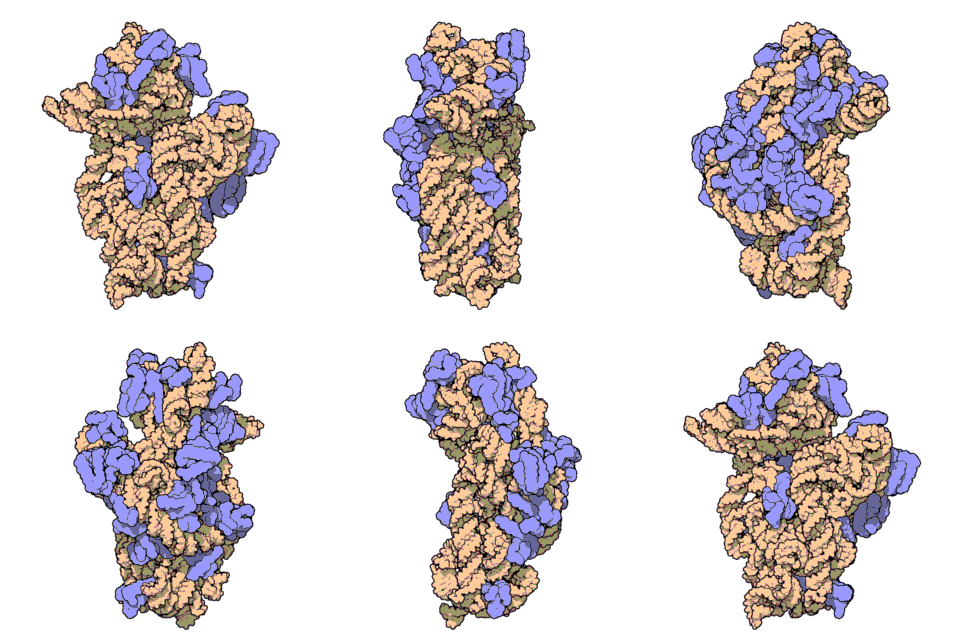
16S ribosomal RNA (or 16S rRNA) is the RNA component of the 30S subunit of a prokaryotic ribosome (SSU rRNA). It binds to the Shine-Dalgarno sequence and provides most of the SSU structure.
The genes coding for it are referred to as 16S rRNA genes and are used in reconstructing phylogenies, due to the slow rates of evolution of this region of the gene. Carl Woese and George E. Fox were two of the people who pioneered the use of 16S rRNA in phylogenetics in 1977. Multiple sequences of the 16S rRNA gene can exist within a single bacterium.
Terminology
The descriptor 16S refers to the size of these ribosomal subunits as reflected indirectly by the speed at which they sediment when samples are centrifuged. Thus 16S means 16 Svedberg units.
Functions
- Like the large (23S) ribosomal RNA, it has a structural role, acting as a scaffold defining the positions of the ribosomal proteins.
- The 3-end contains the anti-Shine-Dalgarno sequence, which binds upstream to the AUG start codon on the mRNA. The 3-end of 16S RNA binds to the proteins S1 and S21 which are known to be involved in initiation of protein synthesis
- Interacts with 23S, aiding in the binding of the two ribosomal subunits (50S and 30S)
- Stabilizes correct codon-anticodon pairing in the A-site by forming a hydrogen bond between the N1 atom of adenine residues 1492 and 1493 and the 2OH group of the mRNA backbone.
Universal primers
The 16S rRNA gene is used for phylogenetic studies as it is highly conserved between different species of bacteria and archaea. Carl Woese pioneered this use of 16S rRNA in 1977. It is suggested that 16S rRNA gene can be used as a reliable molecular clock because 16S rRNA sequences from distantly related bacterial lineages are shown to have similar functionalities. Some thermophilic archaea (e.g. order Thermoproteales) contain 16S rRNA gene introns that are located in highly conserved regions and can impact the annealing of "universal" primers. Mitochondrial and chloroplastic rRNA are also amplified.
The most common primer pair was devised by Weisburg et al. (1991) and is currently referred to as 27F and 1492R; however, for some applications shorter amplicons may be necessary, for example for 454 sequencing with titanium chemistry the primer pair 27F-534R covering V1 to V3. Often 8F is used rather than 27F. The two primers are almost identical, but 27F has an M instead of a C. AGAGTTTGATCMTGGCTCAG compared with 8F.
| Primer name | Sequence (5–3) | Ref. | ||||||||||||||
|---|---|---|---|---|---|---|---|---|---|---|---|---|---|---|---|---|
| 8F | AGA GTT TGA TCC TGG CTC AG | vauthors = Eden PA, Schmidt TM, Blakemore RP, Pace NR | title = Phylogenetic analysis of Aquaspirillum magnetotacticum using polymerase chain reaction-amplified 16S rRNA-specific DNA | journal = International Journal of Systematic Bacteriology | volume = 41 | issue = 2 | pages = 324–325 | date = April 1991 | pmid = 1854644 | doi = 10.1099/00207713-41-2-324 | doi-access = free }} | |||||
| 27F | AGA GTT TGA TC**M** TGG CTC AG | |||||||||||||||
| 336R | ACT GCT GCS YCC CGT AGG AGT CT | |||||||||||||||
| 337F | GAC TCC TAC GGG AGG CWG CAG | |||||||||||||||
| 518R | GTA TTA CCG CGG CTG CTG G | |||||||||||||||
| 533F | GTG CCA GCM GCC GCG GTA A | |||||||||||||||
| 785F | GGA TTA GAT ACC CTG GTA | |||||||||||||||
| 806R | GGA CTA CVS GGG TAT CTA AT | |||||||||||||||
| 907R | CCG TCA ATT CCT TTR AGT TT | |||||||||||||||
| 928F | TAA AAC TYA AAK GAA TTG ACG GG | vauthors = Weidner S, Arnold W, Puhler A | title = Diversity of uncultured microorganisms associated with the seagrass Halophila stipulacea estimated by restriction fragment length polymorphism analysis of PCR-amplified 16S rRNA genes | journal = Applied and Environmental Microbiology | volume = 62 | issue = 3 | pages = 766–771 | url=http://aem.asm.org/cgi/reprint/62/3/766.pdf | date = March 1996 | pmid = 8975607 | pmc = 167844 | doi = 10.1128/AEM.62.3.766-771.1996 | url-status = live | bibcode = 1996ApEnM..62..766W | archive-url = http://archive.wikiwix.com/cache/20110715015952/http://aem.asm.org/cgi/reprint/62/3/766.pdf | archive-date = 2011-07-15 }} |
| 1100F | YAA CGA GCG CAA CCC | |||||||||||||||
| 1100R | GGG TTG CGC TCG TTG | |||||||||||||||
| U1492R | GGT TAC CTT GTT ACG ACT T | |||||||||||||||
| 1492R | CGG TTA CCT TGT TAC GAC TT | vauthors = Jiang H, Dong H, Zhang G, Yu B, Chapman LR, Fields MW | title = Microbial diversity in water and sediment of Lake Chaka, an athalassohaline lake in northwestern China | journal = Applied and Environmental Microbiology | volume = 72 | issue = 6 | pages = 3832–3845 | date = June 2006 | pmid = 16751487 | pmc = 1489620 | doi = 10.1128/AEM.02869-05 | bibcode = 2006ApEnM..72.3832J }} |
PCR and NGS applications
In addition to highly conserved primer binding sites, 16S rRNA gene sequences contain hypervariable regions that can provide species-specific signature sequences useful for identification of bacteria. As a result, 16S rRNA gene sequencing has become prevalent in medical microbiology as a rapid and cheap alternative to phenotypic methods of bacterial identification. Although it was originally used to identify bacteria, 16S sequencing was subsequently found to be capable of reclassifying bacteria into completely new species, or even genera. It has also been used to describe new species that have never been successfully cultured. With third-generation sequencing coming to many labs, simultaneous identification of thousands of 16S rRNA sequences is possible within hours, allowing metagenomic studies, for example of gut flora. In samples collected from patients with confirmed infections, 16S rRNA next-generation sequencing (NGS) demonstrated enhanced detection in 40% of cases compared to traditional culture methods; moreover, pre-sampling antibiotic consumption did not significantly affect the sensitivity of 16S NGS.
Hypervariable regions
The bacterial 16S gene contains nine hypervariable regions (V1–V9), ranging from about 30 to 100 base pairs long, that are involved in the secondary structure of the small ribosomal subunit. The degree of conservation varies widely between hypervariable regions, with more conserved regions correlating to higher-level taxonomy and less conserved regions to lower levels, such as genus and species. While the entire 16S sequence allows for comparison of all hypervariable regions, at approximately 1,500 base pairs long it can be prohibitively expensive for studies seeking to identify or characterize diverse bacterial communities. These studies commonly utilize the Illumina platform, which produces reads at rates 50-fold and 12,000-fold less expensive than 454 pyrosequencing and Sanger sequencing, respectively. While cheaper and allowing for deeper community coverage, Illumina sequencing only produces reads 75–250 base pairs long (up to 300 base pairs with Illumina MiSeq), and has no established protocol for reliably assembling the full gene in community samples. Full hypervariable regions can be assembled from a single Illumina run, however, making them ideal targets for the platform.
While 16S hypervariable regions can vary dramatically between bacteria, the 16S gene as a whole maintains greater length homogeneity than its eukaryotic counterpart (18S ribosomal RNA), which can make alignments easier. Additionally, the 16S gene contains highly conserved sequences between hypervariable regions, enabling the design of universal primers that can reliably produce the same sections of the 16S sequence across different taxa. Although no hypervariable region can accurately classify all bacteria from domain to species, some can reliably predict specific taxonomic levels. Many community studies select semi-conserved hypervariable regions like the V4 for this reason, as it can provide resolution at the phylum level as accurately as the full 16S gene. While lesser-conserved regions struggle to classify new species when higher order taxonomy is unknown, they are often used to detect the presence of specific pathogens. In one study by Chakravorty et al. in 2007, the authors characterized the V1–V8 regions of a variety of pathogens in order to determine which hypervariable regions would be most useful to include for disease-specific and broad assays. Amongst other findings, they noted that the V3 region was best at identifying the genus for all pathogens tested, and that V6 was the most accurate at differentiating species between all CDC-watched pathogens tested, including anthrax.
While 16S hypervariable region analysis is a powerful tool for bacterial taxonomic studies, it struggles to differentiate between closely related species. In the families Enterobacteriaceae, Clostridiaceae, and Peptostreptococcaceae, species can share up to 99% sequence similarity across the full 16S gene. As a result, the V4 sequences can differ by only a few nucleotides, leaving reference databases unable to reliably classify these bacteria at lower taxonomic levels. By limiting 16S analysis to select hypervariable regions, these studies can fail to observe differences in closely related taxa and group them into single taxonomic units, therefore underestimating the total diversity of the sample. Furthermore, bacterial genomes can house multiple 16S genes, with the V1, V2, and V6 regions containing the greatest intraspecies diversity. While not the most precise method of classifying bacterial species, analysis of the hypervariable regions remains one of the most useful tools available to bacterial community studies.
Promiscuity of 16S rRNA genes
Under the assumption that evolution is driven by vertical transmission, 16S rRNA genes have long been believed to be species-specific, and infallible as genetic markers inferring phylogenetic relationships among prokaryotes. However, a growing number of observations suggest the occurrence of horizontal transfer of these genes. In addition to observations of natural occurrence, transferability of these genes is supported experimentally using a specialized Escherichia coli genetic system. Using a null mutant of E. coli as host, growth of the mutant strain was shown to be complemented by foreign 16S rRNA genes that were phylogenetically distinct from E. coli at the phylum level. Such functional compatibility was also seen in Thermus thermophilus. Furthermore, in T. thermophilus, both complete and partial gene transfer was observed. Partial transfer resulted in spontaneous generation of apparently random chimera between host and foreign bacterial genes. Thus, 16S rRNA genes may have evolved through multiple mechanisms, including vertical inheritance and horizontal gene transfer; the frequency of the latter may be much higher than previously thought.
16S ribosomal databases
The 16S rRNA gene is used as the standard for classification and identification of microbes, because it is present in most microbes and shows proper changes. Type strains of 16S rRNA gene sequences for most bacteria and archaea are available on public databases, such as NCBI. However, the quality of the sequences found on these databases is often not validated. Therefore, secondary databases that collect only 16S rRNA sequences are widely used.
SILVA
SILVA provides comprehensive, quality checked and regularly updated datasets of aligned small (16S/18S, SSU) and large subunit (23S/28S, LSU) ribosomal RNA (rRNA) sequences for all three domains of life as well as a suite of search, primer-design and alignment tools (Bacteria, Archaea and Eukarya).
GreenGenes
GreenGenes is a quality controlled, comprehensive 16S rRNA gene reference database and taxonomy based on a de novo phylogeny that provides standard operational taxonomic unit sets. In 2023, GreenGenes2 was released.
EzBioCloud
EzBioCloud database, formerly known as EzTaxon, consists of a complete hierarchical taxonomic system containing 62,988 bacteria and archaea species/phylotypes which includes 15,290 valid published names as of September 2018. Based on the phylogenetic relationship such as maximum-likelihood and OrthoANI, all species/subspecies are represented by at least one 16S rRNA gene sequence. The EzBioCloud database is systematically curated and updated regularly which also includes novel candidate species. Moreover, the website provides bioinformatics tools such as ANI calculator, ContEst16S and 16S rRNA DB for QIIME and Mothur pipeline.
MIMt
MIMt is a compact non-redundant 16S database for a rapid metagenomic samples identification. It is composed of 48,749 full 16S sequences belonging to 24,626 well classified bacteria and archaea species. All sequences were obtained from complete genomes deposited in NCBI and for each of the sequences full taxonomic hierarchy is provided. It contains no redundancy, so only one representative for each species was considered avoiding same sequences from different strains, isolates or pathovars resulting in a very fast tool for microorganisms identification, compatible with any classification software (QIIME, Mothur, DADA, etc).
Ribosomal Database Project
The Ribosomal Database Project (RDP) was a curated database that offers ribosome data along with related programs and services. The offerings included phylogenetically ordered alignments of ribosomal RNA (rRNA) sequences, derived phylogenetic trees, rRNA secondary structure diagrams and various software packages for handling, analyzing and displaying alignments and trees. Due to its large size the RDP database is often used as the basis for bioinformatic tool development and creating manually curated databases. The RDP server was taken offline in 2023, but the software is still available for download.
References
References
- (June 1987). "Bacterial evolution". Microbiological Reviews.
- (September 2000). "Structure of functionally activated small ribosomal subunit at 3.3 angstroms resolution". Cell.
- (November 1977). "Phylogenetic structure of the prokaryotic domain: the primary kingdoms". Proceedings of the National Academy of Sciences of the United States of America.
- (June 1990). "Towards a natural system of organisms: proposal for the domains Archaea, Bacteria, and Eucarya". Proceedings of the National Academy of Sciences of the United States of America.
- (January 2007). "Use of 16S rRNA and rpoB genes as molecular markers for microbial ecology studies". Applied and Environmental Microbiology.
- (October 1975). "30S ribosomal proteins associated with the 3'-terminus of 16S RNA". FEBS Letters.
- (January 1991). "16S ribosomal DNA amplification for phylogenetic study". Journal of Bacteriology.
- (November 2003). "Intragenomic heterogeneity between multiple 16S ribosomal RNA operons in sequenced bacterial genomes". FEMS Microbiology Letters.
- (August 2017). "Comparative RNA function analysis reveals high functional similarity between distantly related bacterial 16 S rRNAs". Scientific Reports.
- (July 2015). "The distribution, diversity, and importance of 16S rRNA gene introns in the order Thermoproteales". Biology Direct.
- (2020-10-01). "Non-specific amplification of human DNA is a major challenge for 16S rRNA gene sequence analysis". Scientific Reports.
- "Human Microbiome Project DACC - Home".
- "Primers, 16S ribosomal DNA - François Lutzoni's Lab".
- (April 1991). "Phylogenetic analysis of Aquaspirillum magnetotacticum using polymerase chain reaction-amplified 16S rRNA-specific DNA". International Journal of Systematic Bacteriology.
- James, Greg. (15 May 2018). "PCR for Clinical Microbiology". Springer, Dordrecht.
- (2021). "Comparison of 16S rRNA Gene Based Microbial Profiling Using Five Next-Generation Sequencers and Various Primers". Frontiers in Microbiology.
- (February 2016). "Metagenomics uncovers gaps in amplicon-based detection of microbial diversity". Nature Microbiology.
- (July 2011). "The under-recognized dominance of Verrucomicrobia in soil bacterial communities". Soil Biology & Biochemistry.
- (March 1996). "Diversity of uncultured microorganisms associated with the seagrass Halophila stipulacea estimated by restriction fragment length polymorphism analysis of PCR-amplified 16S rRNA genes". Applied and Environmental Microbiology.
- (June 2006). "Microbial diversity in water and sediment of Lake Chaka, an athalassohaline lake in northwestern China". Applied and Environmental Microbiology.
- (December 2010). "Identification of species by multiplex analysis of variable-length sequences". Nucleic Acids Research.
- (June 1999). "Ribosomal DNA sequencing as a tool for identification of bacterial pathogens". Current Opinion in Microbiology.
- (October 2004). "Impact of 16S rRNA gene sequence analysis for identification of bacteria on clinical microbiology and infectious diseases". Clinical Microbiology Reviews.
- (July 2009). "Reverse transcription of 16S rRNA to monitor ribosome-synthesizing bacterial populations in the environment". Applied and Environmental Microbiology.
- (January 1998). "Burkholderia thailandensis sp. nov., a Burkholderia pseudomallei-like species". International Journal of Systematic Bacteriology.
- (1994). "Bacterial Pathogenesis Part A: Identification and Regulation of Virulence Factors".
- (November 1996). "Phylogenetic analysis of the bacterial communities in marine sediments". Applied and Environmental Microbiology.
- (August 2014). "Next-generation sequencing of 16S ribosomal RNA gene amplicons". Journal of Visualized Experiments.
- (2024-06-21). "Performance of 16S rRNA Gene Next-Generation Sequencing and the Culture Method in the Detection of Bacteria in Clinical Specimens". Diagnostics.
- (July 1984). "On the evolutionary descent of organisms and organelles: a global phylogeny based on a highly conserved structural core in small subunit ribosomal RNA". Nucleic Acids Research.
- (March 2016). "Sensitivity and correlation of hypervariable regions in 16S rRNA genes in phylogenetic analysis". BMC Bioinformatics.
- (June 2011). "Generation of multimillion-sequence 16S rRNA gene libraries from complex microbial communities by assembling paired-end illumina reads". Applied and Environmental Microbiology.
- (2016-09-20). "A method for high precision sequencing of near full-length 16S rRNA genes on an Illumina MiSeq". PeerJ.
- (September 1996). "A quantitative map of nucleotide substitution rates in bacterial rRNA". Nucleic Acids Research.
- (2013-02-27). "The variability of the 16S rRNA gene in bacterial genomes and its consequences for bacterial community analyses". PLOS ONE.
- (May 2007). "A detailed analysis of 16S ribosomal RNA gene segments for the diagnosis of pathogenic bacteria". Journal of Microbiological Methods.
- (2016-01-01). "Characterization of the Gut Microbiome Using 16S or Shotgun Metagenomics". Frontiers in Microbiology.
- (November 2012). "Mutational robustness of 16S ribosomal RNA, shown by experimental horizontal gene transfer in Escherichia coli". Proceedings of the National Academy of Sciences of the United States of America.
- (August 2017). "Comparative RNA function analysis reveals high functional similarity between distantly related bacterial 16 S rRNAs". Scientific Reports.
- (August 2019). "Occurrence of randomly recombined functional 16S rRNA genes in Thermus thermophilus suggests genetic interoperability and promiscuity of bacterial 16S rRNAs". Scientific Reports.
- (2019-08-02). "Occurrence of randomly recombined functional 16S rRNA genes in Thermus thermophilus suggests genetic interoperability and promiscuity of bacterial 16S rRNAs". Scientific Reports.
- (September 2014). "Uniting the classification of cultured and uncultured bacteria and archaea using 16S rRNA gene sequences". Nature Reviews. Microbiology.
- Elmar Pruesse, Christian Quast, Katrin Knittel, Bernhard M. Fuchs, Wolfgang Ludwig, Jörg Peplies, Frank Oliver Glöckner (2007) Nucleic Acids Res. SILVA: a comprehensive online resource for quality checked and aligned ribosomal RNA sequence data compatible with ARB. December; 35(21): 7188–7196.
- (July 2006). "Greengenes, a chimera-checked 16S rRNA gene database and workbench compatible with ARB". Applied and Environmental Microbiology.
- (March 2012). "An improved Greengenes taxonomy with explicit ranks for ecological and evolutionary analyses of bacteria and archaea". The ISME Journal.
- (July 2023). "Greengenes2 unifies microbial data in a single reference tree". Nature Biotechnology.
- Yoon, S. H., Ha, S. M., Kwon, S., Lim, J., Kim, Y., Seo, H. and Chun, J. (2017). Introducing EzBioCloud: A taxonomically united database of 16S rRNA and whole genome assemblies. Int J Syst Evol Microbiol. 67:1613–1617
- "MIMt - (Mass Identification of Metagenomics tests)".
- (July 1993). "The ribosomal database project". Nucleic Acids Res..
- (October 2015). "SPINGO: A rapid species-classifier for microbial amplicon sequences". BMC Bioinformatics.
- The RDP Classifier is available as a stand-alone tool at [https://sourceforge.net/projects/rdp-classifier/ https://sourceforge.net/projects/rdp-classifier/]. It is written in Java and so will run on any computer that has Java installed. The RDPTools are available on GitHub and as a Docker image. See installation instructions at [https://john-quensen.com/tutorials/tutorial-1/ https://john-quensen.com/tutorials/tutorial-1/] and [https://jfq3.gitbook.io/rdptools-docker/rdptools-docker/readme https://jfq3.gitbook.io/rdptools-docker/rdptools-docker/readme]. Instructions for downloading a SeqMatch database and running it from the command line are available at [https://john-quensen.com/tutorials/seqmatch/ https://john-quensen.com/tutorials/seqmatch/].
This article was imported from Wikipedia and is available under the Creative Commons Attribution-ShareAlike 4.0 License. Content has been adapted to SurfDoc format. Original contributors can be found on the article history page.
Ask Mako anything about 16S ribosomal RNA — get instant answers, deeper analysis, and related topics.
Research with MakoFree with your Surf account
Create a free account to save articles, ask Mako questions, and organize your research.
Sign up freeThis content may have been generated or modified by AI. CloudSurf Software LLC is not responsible for the accuracy, completeness, or reliability of AI-generated content. Always verify important information from primary sources.
Report