From Surf Wiki (app.surf) — the open knowledge base
Fifth Avenue
North-south avenue in Manhattan, New York

North-south avenue in Manhattan, New York
| Field | Value |
|---|---|
| name | Fifth Avenue |
| image | Photograph of Fifth Avenue from the Metropolitan—New York City.jpg |
| image_size | 350px |
| caption | Fifth Avenue spanning Museum Mile on the Upper East Side of Manhattan in March 2008 |
| mapframe | no |
| other_name | Museum Mile |
| owner | City of New York |
| maint | NYCDOT |
| length_mi | 6.197 |
| length_ref | |
| location | Manhattan, New York City |
| direction_a | South |
| terminus_a | Washington Square North in Greenwich Village |
| junction | Madison Square in Flatiron |
| Grand Army Plaza in Midtown | |
| Duke Ellington Circle in East Harlem | |
| Marcus Garvey Park in Harlem | |
| Madison Avenue Bridge in Harlem | |
| in Harlem | |
| direction_b | North |
| terminus_b | in Harlem |
| commissioning_date | March 1811 |
| inauguration_date | |
| east | University Place (south of 14th) |
| Broadway (14th to 23rd) | |
| Madison Avenue (north of 23rd) | |
| west | Sixth Avenue (south of 59th) |
| Central Park-East Drive (59th to 110th) | |
| Lenox Avenue (north of 110th) |
Grand Army Plaza in Midtown Duke Ellington Circle in East Harlem Marcus Garvey Park in Harlem Madison Avenue Bridge in Harlem in Harlem Broadway (14th to 23rd) Madison Avenue (north of 23rd) Central Park-East Drive (59th to 110th) Lenox Avenue (north of 110th)
Fifth Avenue is a major thoroughfare in the borough of Manhattan in New York City. The avenue runs south from West 143rd Street in Harlem to Washington Square Park in Greenwich Village. The section in Midtown Manhattan is one of the most expensive shopping streets in the world.
Fifth Avenue carries two-way traffic between 143rd and 135th Streets, and one-way traffic southbound for the rest of its route. The entire avenue carried two-way traffic until 1966. From 124th to 120th Streets, Fifth Avenue is interrupted by Marcus Garvey Park, with southbound traffic diverted around the park via Mount Morris Park West and northbound to Madison Avenue. Most of the avenue has a bus lane, but no bike lane. Fifth Avenue is the traditional route for many celebratory parades in New York City and is closed to automobile traffic on several Sundays each year.
Fifth Avenue was originally a narrower thoroughfare, but the section south of Central Park was widened in 1908. The Midtown blocks between 34th and 59th Streets were mostly residential until the early 20th century, when they were developed for commercial use. The section of Fifth Avenue in the 50s is consistently ranked among the most expensive shopping streets in the world. The stretch between 59th and 96th Streets along Central Park was once known as "Millionaire's Row" because of its high concentration of mansions. The portion between 82nd and 110th Streets, also along Central Park, is nicknamed Museum Mile for its many museums.
History
Early history
Fifth Avenue between 42nd Street and Central Park South (59th Street) was relatively undeveloped through the late 19th century. The surrounding area was once part of the common lands of the city of New York, which was allocated "all the waste, vacant, unpatented, and unappropriated lands" as a result of the 1686 Dongan Charter. The city's Common Council came to own a large amount of land, primarily in the middle of the island away from the Hudson and East Rivers, as a result of grants by the Dutch provincial government to the colony of New Amsterdam. Although originally more extensive, by 1785 the council held approximately 1300 acres, or about 9 percent of the island.
The lots along what is now Fifth Avenue were laid out in the late 18th century following the American Revolutionary War. The city's Common Council had, starting in June 1785, attempted to raise money by selling property. The land that the Council owned was not suitable for farming or residential estates, and it was also far away from any roads or waterways. To divide the common lands into sellable lots, and to lay out roads to service them, the Council hired Casimir Goerck to survey them. Goerck was instructed to make lots of about 5 acre each and to lay out roads to access the lots. He completed his task in December 1785, creating 140 lots of varying sizes, oriented with the east–west axis longer than the north–south axis. As part of the plan, Goerck drew up a street called Middle Road, which eventually became Fifth Avenue.
The topography of the lots contributed to the public's reluctance to buy the lots. By 1794, with the city growing ever more populated and the inhabited area constantly moving north towards the Common Lands, the Council decided to try again, hiring Goerck once more to re-survey and map the area. He was instructed to make the lots more uniform and rectangular and to lay out roads to the west and east of Middle Road, as well as to lay out east–west streets of 60 ft each. Goerck's East and West Roads later became Fourth and Sixth Avenues, while Goerck's cross streets became the modern-day numbered east–west streets. Goerck took two years to survey the 212 lots which encompassed the entire Common Lands. The Commissioners' Plan of 1811, which prescribed the street plan for Manhattan, was heavily inspired from Goerck's two surveys.
19th century
From the early 19th century, some plots on Fifth Avenue in Midtown were acquired by the wealthy and by institutions. In the mid-19th century, Fifth Avenue between 40th and 59th Streets was home to several institutions such as the Colored Orphan Asylum, the Deaf and Dumb Asylum, the Roman Catholic Orphan Asylum, and St. Luke's Hospital. Other uses such as a cattle farm remained until the 1860s. One of the first large houses to be built on Fifth Avenue was Henry J. Brevoort's three-story residence at Ninth Street, which was completed in 1834. Subsequently, other farm owners decided to build houses along Fifth Avenue and its cross-streets.
The portion of Fifth Avenue in Midtown became an upscale residential area following the American Civil War. Among the first people to develop such structures was Mary Mason Jones, who built the "Marble Row" on the eastern side of Fifth Avenue from 57th to 58th Streets between 1868 and 1870. Her sister Rebecca Colford Jones erected ornate houses of her own one block south. Further development came in the late 1870s with the construction of three Vanderbilt family residences along Fifth Avenue between 51st and 59th Streets (the William H., William K., and Cornelius II mansions). In the 1880s and 1890s, the ten blocks of Fifth Avenue south of Central Park (at 59th Street) were known as "Vanderbilt Row".
The Vanderbilts' relocation prompted many business owners on Fifth Avenue between Madison Square and 34th Street to move uptown. The upper section of Fifth Avenue on the Upper East Side, facing the newly created Central Park, was not developed at that time because of what the Real Estate Record and Guide described as the presence of "no opposite neighbors", as the Upper West Side was not yet developed. Wealthy New Yorkers were buying land between 50th and 80th Streets and developing houses there in the 1880s. By 1915, the mansions on Fifth Avenue stretched all the way to 96th Street.
Early 20th century
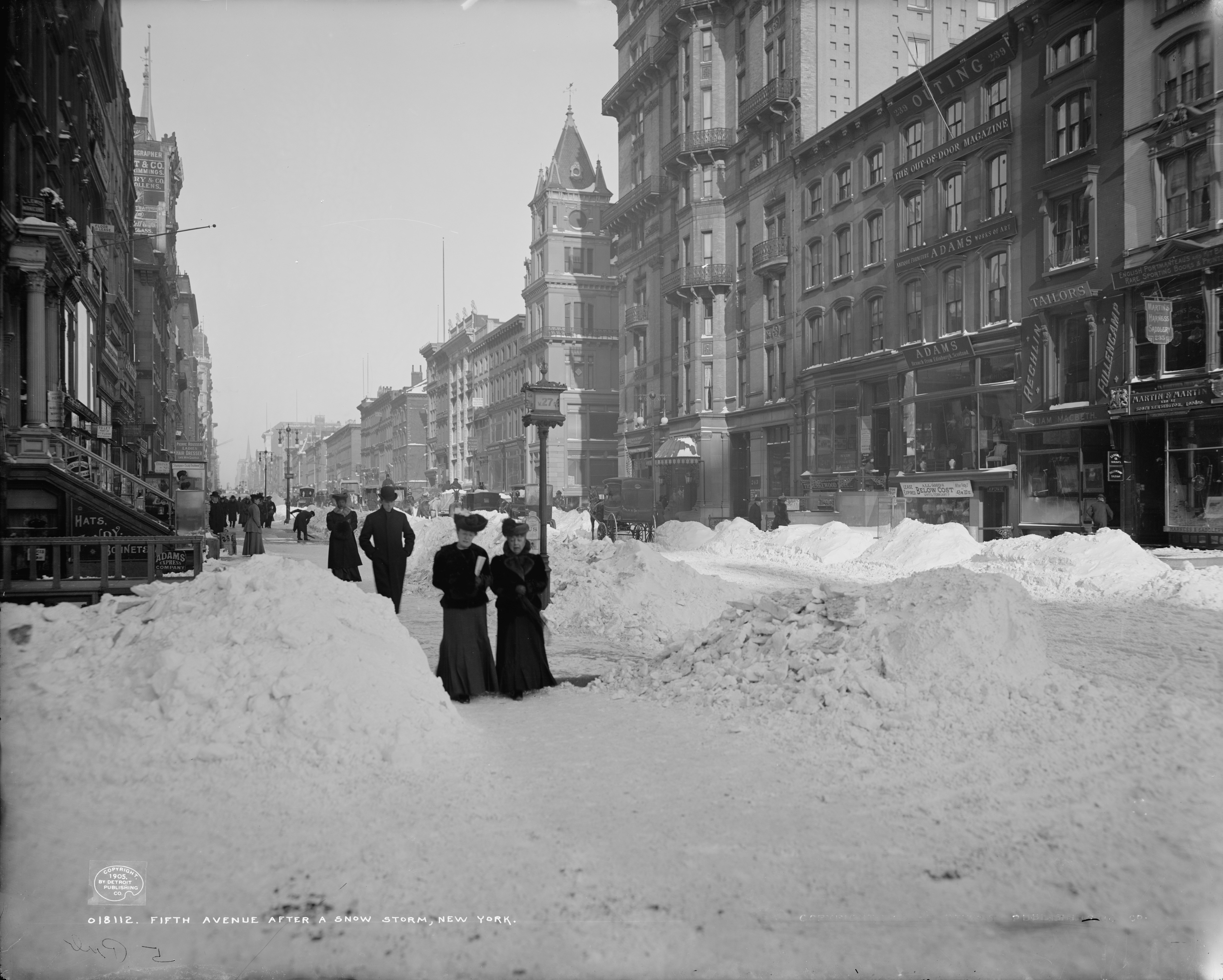
Midtown Fifth Avenue remained primarily residential until the early 20th century, when commercial development intensified. Rising traffic by 1900 led to proposals to limit vehicle access.
In 1908, the section south of Central Park was widened to accommodate growing traffic. This involved removing stoops and other sidewalk encroachments, including those at the Waldorf–Astoria Hotel. By early 1911, widening had reached south of 47th Street, and later that year, the stretch between 47th and 59th Streets underwent similar changes. Many mansions were truncated or demolished, while the facades of St. Patrick's Cathedral and Fifth Avenue Presbyterian Church were shifted back. Gardens at the St. Regis and Gotham hotels were also removed.
The first commercial building on Fifth Avenue was developed by Benjamin Altman, who acquired the northeast corner of 34th Street in 1896. The resulting B. Altman and Company Building, completed between 1906 and 1914, spanned the entire block front. This helped establish a high-end shopping district catering to fashionable clientele. In 1914, the Lord & Taylor Building was constructed at Fifth Avenue and 38th Street, followed by the Saks Fifth Avenue Building between 49th and 50th Streets in 1924, and the Bergdorf Goodman Building between 57th and 58th Streets in 1928–29.
By the 1920s, Fifth Avenue was the most active development corridor in Midtown. Developers expanded north of 45th Street, previously seen as the limit for viable construction. In 1926 alone, thirty office buildings rose on Fifth Avenue. The two-block-wide area between Fifth and Park Avenues, just 8% of Manhattan’s land, accounted for 25% of all developments initiated between 1924 and 1926. On the Upper East Side, many Fifth Avenue mansions were replaced by luxury apartment buildings, as upkeep became too costly for private owners.
Traffic control innovations also emerged in this period. Patrolmen were first deployed in 1914 to direct vehicles at key intersections. The first traffic towers were installed in 1920 as a gift from Dr. John A. Harriss at key junctions such as 34th, 38th, and 42nd Streets. In 1922, the Fifth Avenue Association funded seven 23 ft bronze towers designed by Joseph H. Freedlander, spanning from 14th to 57th Streets. These towers cut travel time between 34th and 57th Streets from 40 minutes to 15.
Freedlander's towers were removed in 1929. They were replaced by corner-mounted bronze signals topped with statues of Mercury, which remained in place until 1964; and several statues were restored in 1971.
Mid- and late 20th century
In 1954, rising traffic led to a proposal to limit use of the avenue to buses and taxis only. On January 14, 1966, Fifth Avenue below 135th Street was changed to carry only one-way traffic southbound, and Madison Avenue was changed to one-way northbound. Both avenues had previously carried bidirectional traffic.
Through the late 1960s and early 1970s, many of the upscale retailers that once lined Fifth Avenue's midtown section moved away or closed altogether. According to a 1971 survey of the avenue, conducted by the Office of Midtown Planning under the leadership of Jaquelin T. Robertson, only 57 percent of building frontages between 34th and 57th Street were used as stores. The remaining frontage, including was used for companies such as banks and airline ticket offices. The section between 34th and 42nd Street, once the main shopping district on Fifth Avenue, was identified in the survey as being in decline. The section between 42nd and 50th Street was characterized as having almost no ground-level retail. The section between 50th Street and Grand Army Plaza was identified as having a robust retail corridor that was starting to decay.
In February 1971, New York City mayor John Lindsay proposed a special zoning district to preserve the retail character of Fifth Avenue's midtown section. The legislation prescribed a minimum percentage of retail space for new buildings on Fifth Avenue, but it also provided "bonuses", such as additional floor area, for buildings that had more than the minimum amount of retail. The legislation also encouraged the construction of several mixed-use buildings with retail at the lowest stories, offices at the middle stories, and apartments at the top stories. The types of retail included in this legislation were strictly defined; for example, airline ticket offices and banks did not count toward the retail space. Furthermore, new skyscrapers on the eastern side of the avenue were allowed to be built up to the boundary of the sidewalk. To align with the buildings of Rockefeller Center, new buildings on the western side had to contain a setback at least 50 ft deep at a height of 85 ft or lower. The New York City Planning Commission approved this legislation in March 1971. The legislation was adopted that April. Just before the legislation was enacted, American Airlines leased a ground-level storefront on the corner of Fifth Avenue and 53rd Street; Robertson initially disputed the move, even though it had been finalized before the legislation was proposed. As part of an experiment in 1970, Lindsay closed Fifth Avenue between 42nd and 57th Street to vehicular traffic for seven hours on Saturdays.
In 1997, a midblock crosswalk was installed south of the intersection of Fifth Avenue and 50th Street, part of an experiment to allow vehicular traffic to turn without conflicting with pedestrians. The former southern crosswalk at Fifth Avenue and 50th Street was fenced off; the relocated crosswalk was one of a few midblock crosswalks in the city. A similar crosswalk was later installed south of 49th Street. Both of the recessed crosswalks were removed in 2018.
21st century
In June 2020, mayor Bill de Blasio announced that the city would test out busways on Fifth Avenue from 57th to 34th Street, banning through traffic from private vehicles. Despite an October 2020 deadline, the Fifth Avenue busway was not in place at that time. Due to opposition from local business owners, the busway was ultimately downsized.
In December 2022, Mayor Eric Adams proposed rebuilding the midtown section of Fifth Avenue, and the NYCDOT temporarily closed Fifth Avenue between 48th and 57th Streets to all vehicular traffic for three weekends. Excluding special events such as parades, this was the first time since the 1970s that the midtown section of Fifth Avenue was closed to vehicular traffic. In October 2024, Adams and the Future of Fifth Partnership proposed redesigning Fifth Avenue between 60th and 40th Streets. The proposal would cost $230 million and would include widening sidewalks from 23 to; removing two of the five traffic lanes; and adding benches, planters, and 230 trees. The plans did not include a bike lane for the avenue, as previous proposals had entailed; instead, an existing bike lane on Sixth Avenue would be widened for two-way bike traffic. If the plans received final approval, the avenue could be rebuilt starting in 2028. Adams announced in December 2024 that the city government would spend at least $150 million rebuilding Fifth Avenue in midtown. , the project was expected to begin in 2028 and cost about $400 million.
Description
Fifth Avenue originates at Washington Square Park in Greenwich Village and runs northwards through the heart of Midtown, along the eastern side of Central Park, where it forms the boundary of the Upper East Side and through Harlem, where it terminates at the Harlem River at 142nd Street. Traffic crosses the river on the Madison Avenue Bridge.
Fifth Avenue serves as the dividing line for house numbering and west–east streets in Manhattan; for example, it separates East 59th Street from West 59th Street. Higher-numbered avenues such as Sixth Avenue are to the west of Fifth Avenue, while lower-numbered avenues such as Third Avenue are to the east. Address numbers on west–east streets increase in both directions as one moves away from Fifth Avenue. A hundred street address numbers were provided for every block to the east or west of Fifth Avenue; for instance, the addresses on West 50th Street between Fifth and Sixth Avenues were numbered 1–99 West 50th Street, and between Sixth and Seventh Avenues 100–199 West 50th Street. The building lot numbering system worked similarly on the East Side before Madison and Lexington Avenues were added to the street grid laid out in the Commissioners' Plan of 1811. Unlike at other avenues, west–east street addresses do not increment to the next hundred to the east of Madison and Lexington Avenues.
The "most expensive street in the world" moniker changes depending on currency fluctuations and local economic conditions from year to year. For several years starting in the mid-1990s, the shopping district between 49th and 57th Streets was ranked as having the world's most expensive retail spaces on a cost per square foot basis. In 2008, Forbes magazine ranked Fifth Avenue as being the most expensive street in the world. Some of the most coveted real estate on Fifth Avenue are the penthouses perched atop the buildings.
The American Planning Association (APA) compiled a list of "2012 Great Places in America" and declared Fifth Avenue to be one of the greatest streets to visit in America. This historic street has many world-renowned museums, businesses and stores, parks, luxury apartments, and historical landmarks that are reminiscent of its history and vision for the future.
Traffic pattern
,_at_the_244th_Annual_NYC_St._Patrick's_Day_parade.jpg)
Fifth Avenue from 142nd Street to 135th Street carries two-way traffic. Fifth Avenue carries one-way traffic southbound from 143rd Street to 142nd Street and from 135th Street to Washington Square North. The changeover to one-way traffic south of 135th Street took place on January 14, 1966, at which time Madison Avenue was changed to one way uptown (northbound). From 124th Street to 120th Street, Fifth Avenue is cut off by Marcus Garvey Park, with southbound traffic diverted around the park via Mount Morris Park West.
Parade route
Fifth Avenue is the traditional route for many celebratory parades in New York City; thus, it is closed to traffic on numerous Sundays in warm weather. The longest running parade is the annual St. Patrick's Day Parade. Parades held are distinct from the ticker-tape parades held on the "Canyon of Heroes" on lower Broadway, and the Macy's Thanksgiving Day Parade held on Broadway from the Upper West Side downtown to Herald Square. Fifth Avenue parades usually proceed from south to north, with the exception of the LGBT Pride March, which goes north to south to end in Greenwich Village. The Latino literary classic by New Yorker Giannina Braschi, entitled "Empire of Dreams", takes place on the Puerto Rican Day Parade on Fifth Avenue.
Bicycling route
Bicycling on Fifth Avenue ranges from segregated with a bike lane south of 23rd Street, to scenic along Central Park, to dangerous through Midtown with very heavy traffic during rush hours. There is no dedicated bike lane along most of Fifth Avenue. A protected bike lane south of 23rd Street was added in 2017, and another protected lane for bidirectional bike traffic between 110th and 120th Streets was announced in 2020.
In July 1987, New York City Mayor Ed Koch proposed banning bicycling on Fifth, Park, and Madison Avenues during weekdays, but many bicyclists protested and had the ban overturned. When the trial was started on August 24, 1987, for 90 days to ban bicyclists from these three avenues from 31st Street to 59th Street between 10 a.m. and 4 p.m. on weekdays, mopeds would not be banned. On August 31, 1987, a state appeals court judge halted the ban for at least a week pending a ruling after opponents against the ban brought a lawsuit. A bike lane on Fifth Avenue between 59th and 42nd Streets was proposed in late 2022.
Public transportation
Bus
Fifth Avenue is one of the few major streets in Manhattan along which streetcars did not operate. Instead, transportation along Fifth Avenue was initially provided by the Fifth Avenue Transportation Company, which provided horse-drawn service from 1885 to 1896. It was replaced by Fifth Avenue Coach, which continued to offer bus service. Double-decker buses were operated by the Fifth Avenue Coach Company until 1953 and again by MTA Regional Bus Operations from 1976 to 1978.
A bus lane for Fifth Avenue within Midtown was announced in 1982. Initially it ran from 59th to 34th Streets. The bus lane opened in June 1983 and was restricted to buses on weekdays from 7 a.m. to 7 p.m. Today, local bus service along Fifth Avenue is provided by the following routes downtown. Uptown service runs on the parallel Madison Avenue unless specified below. All crosstown service is westbound:
- The M1, M2 and M3 buses run from the Duke Ellington Circle to East 8th Street. M1 service originates at West 139th Street, runs in both directions north of West 135th Street, and uses Mount Morris Park West to get around Marcus Garvey Park.
- The M4 and Q32 run to East 32nd Street in Midtown from West 110th and East 60th Streets, respectively.
- The runs from West 59th to West 31st Streets and the M55 from West 44th to East 8th Streets. Uptown buses use 6th Avenue.
- The runs from East 106th Street to the 97th Street Transverse.
- The runs from East 86th to East 85th Streets.
- The run to East 66th Street from East 72nd and East 67th Streets, respectively.
Numerous express buses from Brooklyn, the Bronx, and Staten Island also run along Fifth Avenue.
Subway
The New York City Subway has never built a line underneath Fifth Avenue, likely because wealthy Fifth Avenue residents would have objected to any such line. However, there are several subway stations along streets that cross Fifth Avenue:
- at
- at
- at Fifth Avenue and 42nd Street
- at Fifth Avenue and 23rd Street
Nicknames

Upper Fifth Avenue/Millionaire's Row
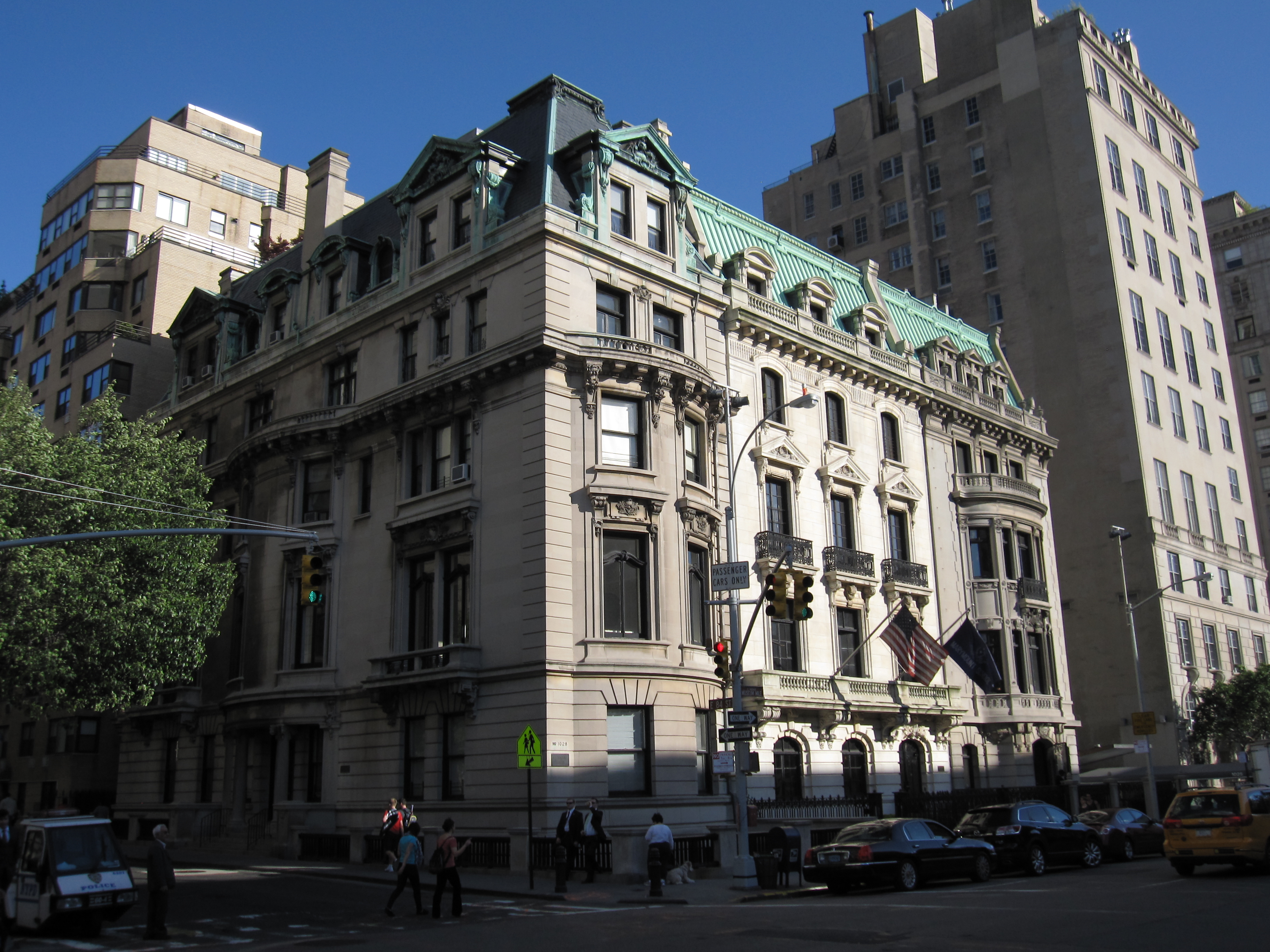
In the late 19th century, the very rich of New York began building mansions along the stretch of Fifth Avenue between 59th Street and 96th Street, looking onto Central Park. By the early 20th century, the portion of Fifth Avenue between 59th and 96th Streets had been nicknamed "Millionaire's Row", with mansions such as the Mrs. William B. Astor House and William A. Clark House. Entries to Central Park along this stretch include Inventor's Gate at 72nd Street, which gave access to the park's carriage drives, and Engineers' Gate at 90th Street, used by equestrians.
A milestone change for Fifth Avenue came in 1916, when the grand corner mansion at 72nd Street and Fifth Avenue that James A. Burden Jr. had erected in 1893 became the first private mansion on Fifth Avenue above 59th Street to be demolished to make way for a grand apartment house. The building at 907 Fifth Avenue began a trend, with its 12 stories around a central court, with two apartments to a floor. Its strong cornice above the fourth floor, just at the eaves height of its neighbors, was intended to soften its presence.
In January 1922, the city reacted to complaints about the ongoing replacement of Fifth Avenue's mansions by apartment buildings by restricting the height of future structures to 75 ft, about half the height of a ten-story apartment building. Architect J. E. R. Carpenter brought suit, and won a verdict overturning the height restriction in 1923. Carpenter argued that "the avenue would be greatly improved in appearance when deluxe apartments would replace the old-style mansions." Led by real estate investors Benjamin Winter, Sr. and Frederick Brown, the old mansions were quickly torn down and replaced with apartment buildings.
This area contains many notable apartment buildings, including 810 Fifth Avenue and the Park Cinq, many of them built in the 1920s by architects such as Rosario Candela and J. E. R. Carpenter. A very few post-World War II structures break the unified limestone frontage, notably the Solomon R. Guggenheim Museum between 88th and 89th Streets.
Museum Mile
Museum Mile is the name for a section of Fifth Avenue running from 82nd to 110th streets on the Upper East Side, in an area sometimes called Upper Carnegie Hill. The Mile, which contains one of the densest displays of culture in the world, is actually three blocks longer than one mile (1.6 km). Nine museums occupy the length of this section of Fifth Avenue. A ninth museum, the Museum for African Art, joined the ensemble in 2009; its museum at 110th Street, the first new museum constructed on the Mile since the Guggenheim in 1959, opened in late 2012.
In addition to other programming, the museums collaborate for the annual Museum Mile Festival to promote the museums and increase visitation. The Museum Mile Festival traditionally takes place here on the second Tuesday in June from 6 – 9 p.m. It was established in 1979 by Lisa Taylor to increase public awareness of its member institutions and promote public support of the arts in New York City. The first festival was held on June 26, 1979. The nine museums are open free that evening to the public. Several of the participating museums offer outdoor art activities for children, live music and street performers. During the event, Fifth Avenue is closed to traffic.
Museums on the mile include:
- 110th Street – The Africa Center
- 105th Street – El Museo del Barrio
- 103rd Street – Museum of the City of New York
- 92nd Street – The Jewish Museum
- 91st Street – Cooper Hewitt, Smithsonian Design Museum (part of the Smithsonian Institution)
- 89th Street – National Academy Museum and School of Fine Arts
- 88th Street – Solomon R. Guggenheim Museum
- 86th Street – Neue Galerie New York
- 82nd Street – The Metropolitan Museum of Art
Further south, on the corner of Fifth Avenue and 70th Street, lies the Henry Clay Frick House, which houses the Frick Collection.
Historical landmarks
Buildings on Fifth Avenue can have one of several types of official landmark designations:
- The New York City Landmarks Preservation Commission is the New York City agency that is responsible for identifying and designating the city's landmarks and the buildings in the city's historic districts. New York City landmarks (NYCL) can be categorized into one of several groups: individual (exterior), interior, and scenic landmarks.
- The National Register of Historic Places (NRHP) is the United States federal government's official list of districts, sites, buildings, structures and objects deemed worthy of preservation for their historical significance.
- The National Historic Landmark (NHL) focuses on places of significance in American history, architecture, engineering, or culture; all NHL sites are also on the NRHP.
- World Heritage Sites are designated by UNESCO as having cultural, historical, scientific or other form of significance, and are legally protected by international treaties.
Individual landmarks
Below is a list of historic sites on Fifth Avenue, from north to south. Historic districts are not included in this table, but are mentioned in . Buildings within historic districts, but no individual landmark designation, are not included in this table.
| Name | Image | Address | Cross-street | NHL | NRHP | NYCL | Notes | ||||||||
|---|---|---|---|---|---|---|---|---|---|---|---|---|---|---|---|
| [369th Regiment Armory](369th-regiment-armory) | [[File:369 Armory front partsun jeh.jpg | 100px]] | 2366 Fifth Avenue | 142nd–143rd Streets | 2013}} | ||||||||||
| St. Andrew's Church | [[File:St-andrews-episcopal-church-2067-fifth-ave.jpg | 100px]] | 2067 Fifth Avenue | 127th Street | url=http://s-media.nyc.gov/agencies/lpc/lp/0294.pdf | title=Saint Andrew's Church | date=April 12, 1967 | publisher=New York City Landmarks Preservation Commission | access-date=December 9, 2019}} | ||||||
| Harlem Fire Watchtower | [[File:Harlem-firetower.jpg | 100px]] | Marcus Garvey Park | 122nd Street | url=http://s-media.nyc.gov/agencies/lpc/lp/0313.pdf | title=Watch Tower | date=July 12, 1967 | publisher=New York City Landmarks Preservation Commission | access-date=December 6, 2019}} | ||||||
| Central Park | [[File:Central Park - The Pond (48377220157).jpg | 100px]] | 60th–110th Streets | url=http://s-media.nyc.gov/agencies/lpc/lp/0851.pdf | title=Central Park | date=April 16, 1974 | publisher=New York City Landmarks Preservation Commission | access-date=December 9, 2019}} | |||||||
| Museum of the City of New York | [[File:Museum of the City of New York 1220 Fifth Avenue from west.jpg | 100px]] | 1220–1227 Fifth Avenue | 103rd–104th Streets | url=http://s-media.nyc.gov/agencies/lpc/lp/0440.pdf | title=Willard and Dorothy Whitney Straight House | date=May 15, 1968 | publisher=New York City Landmarks Preservation Commission | access-date=December 6, 2019}} | ||||||
| Willard D. Straight House | [[File:1130 Fifth Avenue.jpg | 100px]] | 1130 Fifth Avenue | 94th Street | |||||||||||
| Felix M. Warburg House | [[File:Felix Warburg Mansio.jpg | 100px]] | 1109 Fifth Avenue | 92nd Street | url=http://s-media.nyc.gov/agencies/lpc/lp/1116.pdf | title=Felix M. Warburg House | date=November 24, 1981 | publisher=New York City Landmarks Preservation Commission | access-date=December 6, 2019}} | ||||||
| Otto H. Kahn House | [[File:Otto Kahn Mansion 010 stitched.jpg | 100px]] | 1100 Fifth Avenue (corner of) | 1 East 91st Street | |||||||||||
| Andrew Carnegie Mansion | [[File:Cooper-hewitt 90 jeh.JPG | 100px]] | 2 East 91st Street | 91st Street | url=http://s-media.nyc.gov/agencies/lpc/lp/0674.pdf | title=Andrew and Louise Carnegie House | date=February 19, 1974 | publisher=New York City Landmarks Preservation Commission | access-date=December 6, 2019}} | ||||||
| Solomon R. Guggenheim Museum | [[File:NYC - Guggenheim Museum.jpg | 100px]] | 1009 Fifth Avenue | 82nd Street | Also designated as WHS | ||||||||||
| Duke Residence | [[File:1009 Fifth Avenue 004 crop.JPG | 100px]] | 1009 Fifth Avenue | 82nd Street | url=http://s-media.nyc.gov/agencies/lpc/lp/0805.pdf | title=1009 Fifth Avenue House | date=February 19, 1974 | publisher=New York City Landmarks Preservation Commission | access-date=December 6, 2019}} | ||||||
| Metropolitan Museum of Art | [[File:Metropolitan Museum of Art entrance NYC.JPG | 100px]] | 1000 Fifth Avenue | 80th–84th Streets | url=http://s-media.nyc.gov/agencies/lpc/lp/0410.pdf | title=Metropolitan Museum of Art | date=June 9, 1967 | publisher=New York City Landmarks Preservation Commission | access-date=July 28, 2019}} | ||||||
| [998 Fifth Avenue](998-fifth-avenue) | [[File:998 5th Ave.jpg | 100px]] | 998 Fifth Avenue | 81st Street | |||||||||||
| Harry F. Sinclair House | [[File:Harry F Sinclair House 9730.JPG | 100px]] | 2 East 79th Street | 79th Street | |||||||||||
| Payne Whitney House | [[File:Payne Whitney House 003.JPG | 100px]] | 972 Fifth Avenue | 78th–79th Streets, midblock | |||||||||||
| James B. Duke House | [[File:James B Duke House 001.JPG | 100px]] | 1 East 78th Street | 78th Street | url=http://s-media.nyc.gov/agencies/lpc/lp/0668.pdf | title=James B. and Nanaline Duke House | date=September 15, 1970 | publisher=New York City Landmarks Preservation Commission | access-date=December 6, 2019}} | ||||||
| Edward S. Harkness House | [[File:Harkness House, 1908.jpg | 100px]] | 1 East 75th Street | 75th Street | |||||||||||
| Henry Clay Frick House | [[File:Henry C Frick House 001.JPG | 100px]] | 1 East 70th Street | 70th Street | url=http://s-media.nyc.gov/agencies/lpc/lp/0667.pdf | title=Henry Clay and Adelaide Childs Frick House | date=March 20, 1973 | publisher=New York City Landmarks Preservation Commission | access-date=December 6, 2019}} | ||||||
| Robert Livingston Beeckman House | [[File:Serbian Mission, 854 Fifth Avenue.jpg | 100px]] | 854 Fifth Avenue | 66th–67th Streets, midblock | |||||||||||
| Knickerbocker Club | [[File:Knickerbocker Club.JPG | 100px]] | 2 East 62nd Street | 62nd Street | |||||||||||
| The Metropolitan Club | [[File:Metro Club 5 Av jeh.jpg | 100px]] | 2 East 60th Street | 60th Street | |||||||||||
| Grand Army Plaza | [[File:Sherman gilded jeh.JPG | 100px]] | 58th–60th Streets | ||||||||||||
| The Sherry-Netherland Sidewalk Clock | [[File:Sherry-clock.jpg | 100px]] | 783 Fifth Avenue | 59th Street | |||||||||||
| Plaza Hotel | [[File:New York - Manhattan - Plaza Hotel.jpg | 100px]] | 768 Fifth Avenue | 58th–59th Streets | url=http://s-media.nyc.gov/agencies/lpc/lp/0265.pdf | title=Plaza Hotel | date=December 9, 1969 | publisher=New York City Landmarks Preservation Commission | access-date=December 6, 2019}} | ||||||
| Bergdorf Goodman Building | [[File:Original Store -Bergdorf Goodman (48064048193).jpg | 100px]] | 754 Fifth Avenue | 57th–58th Streets | url=http://s-media.nyc.gov/agencies/lpc/lp/0735.pdf | title=Bergdorf Goodman | date=December 13, 2016 | publisher=New York City Landmarks Preservation Commission | access-date=December 6, 2019}} | ||||||
| Crown Building | [[File:Crown Building New York.jpg | 100px]] | 730 Fifth Avenue | 56th–57th Streets | url=https://s-media.nyc.gov/agencies/lpc/lp/2678.pdf | title=Heckscher Building (now the Crown Building) | date=May 14, 2024 | publisher=New York City Landmarks Preservation Commission | access-date=December 6, 2019}} | ||||||
| Coty Building | [[File:Coty building, No. 714 Fifth Avenue, Manhattan.jpg | 100px]] | 714 Fifth Avenue | 55th–56th Streets, midblock | |||||||||||
| [712 Fifth Avenue](712-fifth-avenue) | [[File:712FifthNYC.jpg | 100px]] | 712 Fifth Avenue | 55th–56th Streets, midblock | |||||||||||
| The Peninsula New York | [[File:The Peninsula New York Entrance.jpg | 100px]] | 696 Fifth Avenue | 55th Street | |||||||||||
| St. Regis New York | [[File:St.RegisNYC.jpg | 100px]] | 693 Fifth Avenue | 55th Street | |||||||||||
| [Aeolian Building](689-fifth-avenue) | [[File:AeolianCorner.jpg | 100px]] | 689 Fifth Avenue | 54th Street | |||||||||||
| University Club of New York | [[File:University Club of New York jeh.jpg | 100px]] | 1 West 54th Street | 54th Street | |||||||||||
| Saint Thomas Church | [[File:New York - Manhattan - Saint Thomas Church.jpg | 100px]] | Corner | 1 West 53rd Street | |||||||||||
| Morton F. Plant & Edward Holbrook House | [[File:Cartier-ny1.jpg | 100px]] | 653 Fifth Avenue | 52nd Street | url=http://s-media.nyc.gov/agencies/lpc/lp/0271.pdf | title=Morton and Nellie Plant House and Edward and Frances Holbrook House | date=July 14, 1970 | publisher=New York City Landmarks Preservation Commission | access-date=December 6, 2019}} | ||||||
| [George W. Vanderbilt Residence](647-fifth-avenue) | [[File:Cartier-ny1.jpg | 100px]] | 647 Fifth Avenue | 52nd Street | url=http://s-media.nyc.gov/agencies/lpc/lp/0954.pdf | title=George W. Vanderbilt Residence | date=March 22, 1977 | publisher=New York City Landmarks Preservation Commission | access-date=December 6, 2019}} | ||||||
| Rockefeller Center (including British Empire Building, La Maison Francaise, International Building) | [[File:GE Building by David Shankbone.JPG | 100px]] | 1–75 Rockefeller Plaza | 49th–51st Streets | url=http://s-media.nyc.gov/agencies/lpc/lp/1446.pdf | title=Rockefeller Center | date=April 23, 1985 | publisher=New York City Landmarks Preservation Commission | access-date=December 6, 2019}} | ||||||
| St. Patrick's Cathedral | [[File:StPatCathExt1.jpg | 100px]] | 460 Madison Avenue | 50th–51st Streets | url=http://s-media.nyc.gov/agencies/lpc/lp/0267.pdf | title=Saint Patrick's Cathedral Complex | date=October 19, 1966 | publisher=New York City Landmarks Preservation Commission | access-date=December 6, 2019}} | ||||||
| Saks Fifth Avenue Building | [[File:Saks Fifth Avenue (48155562261).jpg | 100px]] | 611 Fifth Avenue | 49th–50th Streets | |||||||||||
| [Goelet (Swiss Center) Building](608-fifth-avenue) | [[File:The Goelet Building (8191418358).jpg | 100px]] | 608 Fifth Avenue | 49th–50th Streets | |||||||||||
| Charles Scribner's Sons Building | [[File:Scribner1.jpg | 100px]] | 597 Fifth Avenue | 48th Street | |||||||||||
| Fred F. French Building | [[File:Fred-f-french.jpg | 100px]] | 551 Fifth Avenue | 45th Street | url=http://s-media.nyc.gov/agencies/lpc/lp/1415.pdf | title=Fred F. French Building | date=March 18, 1986 | publisher=New York City Landmarks Preservation Commission | access-date=December 6, 2019}} | ||||||
| Sidewalk Clock, 522 Fifth Avenue | [[File:Sidewalk Clock, 522 Fifth Avenue 2024.jpg | 100px]] | 522 Fifth Avenue | 44th Street | url=http://s-media.nyc.gov/agencies/lpc/lp/1171.pdf | title=Sidewalk Clock, 522 Fifth Avenue | date=August 25, 1981 | publisher=New York City Landmarks Preservation Commission | access-date=December 6, 2019}} | ||||||
| Manufacturers Trust Company Building | [[File:Manufacturers Trust Company Building 510 Fifth Avenue.jpg | 100px]] | 510 Fifth Avenue | 43rd Street | |||||||||||
| [500 Fifth Avenue](500-fifth-avenue) | [[File:500 Fifth Avenue Panorama.jpg | 100px]] | 500 Fifth Avenue | 42nd Street | |||||||||||
| New York Public Library Main Branch | [[File:New York Public Library May 2011.JPG | 100px]] | 476 Fifth Avenue | 40th–42nd Streets | title = New York Public Library | url = http://www.neighborhoodpreservationcenter.org/db/bb_files/NY-PUBLIC-LIBRARY-5TH-AVE.pdf | publisher = New York City Landmarks Preservation Commission | date = January 11, 1967 | access-date = December 6, 2019 | archive-date = January 7, 2017 | archive-url = https://web.archive.org/web/20170107055059/http://www.neighborhoodpreservationcenter.org/db/bb_files/NY-PUBLIC-LIBRARY-5TH-AVE.pdf | url-status = dead }} | |||
| Knox Building | [[File:Knox-building.jpg | 100px]] | 452 Fifth Avenue | 40th Street | url=http://s-media.nyc.gov/agencies/lpc/lp/1091.pdf | title=Knox Building | date=September 23, 1980 | publisher=New York City Landmarks Preservation Commission | access-date=December 6, 2019}} | ||||||
| Lord & Taylor Building | [[File:Lord and Taylor jeh.JPG | 100px]] | 424 Fifth Avenue | 38th Street | |||||||||||
| Stewart & Company Building | [[File:Stewart 404 5th jeh.JPG | 100px]] | 402 Fifth Avenue | 37th Street | |||||||||||
| Tiffany and Company Building | [[File:Tiffany-lower.jpg | 100px]] | 401 Fifth Avenue | 37th Street | url=http://s-media.nyc.gov/agencies/lpc/lp/1624.pdf | title=Tiffany & Company Building | date=February 16, 1988 | publisher=New York City Landmarks Preservation Commission | access-date=December 6, 2019}} | ||||||
| [390 Fifth Avenue](390-fifth-avenue) | [[File:Gorham 390 5th jeh.JPG | 100px]] | 390 Fifth Avenue | 36th Street | |||||||||||
| B. Altman and Company Building | [[File:CUNY Graduate Center by David Shankbone.jpg | 100px]] | 355–371 Fifth Avenue | 34th–35th Streets | |||||||||||
| Empire State Building | [[File:Empire State Building (aerial view).jpg | 100px]] | 350 Fifth Avenue | 33rd–34th Streets | url=http://s-media.nyc.gov/agencies/lpc/lp/2000.pdf | title=Empire State Building | date=May 19, 1981 | publisher=New York City Landmarks Preservation Commission | access-date=December 6, 2019}} | ||||||
| The Wilbraham | [[File:Wilbraham 284 Fifth Avenue.jpg | 100px]] | 284 Fifth Avenue | 30th Street | url=http://s-media.nyc.gov/agencies/lpc/lp/2153.pdf | title=The Wilbraham | date=June 8, 2004 | publisher=New York City Landmarks Preservation Commission | access-date=December 6, 2019}} | ||||||
| Marble Collegiate Church | [[File:Marble Church NYC.jpg | 100px]] | 272 Fifth Avenue | 29th Street | url=http://s-media.nyc.gov/agencies/lpc/lp/0234.pdf | title=Marble Collegiate Church | date=January 11, 1967 | publisher=New York City Landmarks Preservation Commission | access-date=December 6, 2019}} | ||||||
| Sidewalk Clock, 200 Fifth Avenue | [[File:Clock 200 Fifth Av jeh.JPG | 100px]] | 200 Fifth Avenue | 24th Street | url=http://s-media.nyc.gov/agencies/lpc/lp/1172.pdf | title=Sidewalk Clock, 200 Fifth Avenue | date=August 25, 1981 | publisher=New York City Landmarks Preservation Commission | access-date=December 6, 2019}} | ||||||
| Flatiron Building | [[File:Edificio Fuller (Flatiron) en 2010 desde el Empire State crop boxin.jpg | 100px]] | 173–185 Fifth Avenue | 22nd–23rd Streets | url=http://s-media.nyc.gov/agencies/lpc/lp/0219.pdf | title=Flatiron Building | date=September 29, 1966 | publisher=New York City Landmarks Preservation Commission | access-date=December 6, 2019}} | ||||||
| Scribner Building | [[File:Scribner-building.jpg | 100px]] | 153–157 Fifth Avenue | 21st–22nd Streets, midblock | url=http://s-media.nyc.gov/agencies/lpc/lp/0935.pdf | title=Scribner Building | date=September 14, 1976 | publisher=New York City Landmarks Preservation Commission | access-date=December 6, 2019}} | ||||||
| Salmagundi Club | [[File:Salmagundi-club-47-5th-avenue.JPG | 100px]] | 47 Fifth Avenue | 11th–12th Streets, midblock | url=http://s-media.nyc.gov/agencies/lpc/lp/0009.pdf | title=Irad Hawley House | date=September 9, 1969 | publisher=New York City Landmarks Preservation Commission | access-date=December 6, 2019}} |
Historic districts
There are numerous historic districts through which Fifth Avenue passes. Buildings in these districts with individual landmark designations are described in . From north to south, the districts are:
- The Carnegie Hill Historic District, a city landmark district, which covers 400 buildings, primarily along Fifth Avenue from 86th to 98th Street, as well as on side streets extending east to Madison, Park, and Lexington Avenues.
- The Metropolitan Museum Historic District, a city landmark district, which consists of properties on Fifth Avenue between 79th and 86th Streets, outside the Metropolitan Museum of Art, as well as properties on several side streets.
- The Upper East Side Historic District, a city and NRHP district. The city district runs from 59th to 78th Streets along Fifth Avenue, and up to Third Avenue at some points.
- The Madison Square North Historic District, a city landmark district, which covers 96 buildings from 25th to 29th Streets around Broadway, Fifth Avenue, and side streets.
- The Ladies' Mile Historic District, a city landmark district, which covers 440 buildings from roughly 15th Street to 24th Street and from Park Avenue South to west of Sixth Avenue.
- The Greenwich Village Historic District, a city landmark district, which covers much of Greenwich Village and includes almost all buildings on Fifth Avenue south of 12th Street.
In the 1980s, there was also a proposal for a historic district on Fifth Avenue between 48th and 58th Streets. At the time, St. Patrick's Cathedral, St. Thomas Church, the Cartier Building at number 651, the University Club, the Rizzoli Building at number 712, and the Coty Building at number 714 were official city landmarks. However, other structures on that strip had no protection yet, including Rockefeller Center, the Elizabeth Arden Building at 689 Fifth Avenue, the St. Regis Hotel, the Peninsula Hotel, and the Bergdorf Goodman Building.
Other
In addition, the cooperative apartment building at 2 Fifth Avenue was named a New York cultural landmark on December 12, 2013, by the Historic Landmark Preservation Center, as the last residence of former New York City Mayor Ed Koch.
Economy
Between 49th Street and 60th Street, Fifth Avenue is lined with prestigious boutiques and flagship stores and is consistently ranked the most expensive shopping street in the world.
Many luxury goods, fashion, and sport brand boutiques are located on Fifth Avenue, including Louis Vuitton, Tiffany & Co. (whose flagship is at 57th Street), Gucci, Prada, Armani, Tommy Hilfiger, Cartier, Omega, Chanel, Harry Winston, Salvatore Ferragamo, Nike, Escada, Rolex, Bvlgari, Emilio Pucci, Ermenegildo Zegna, Abercrombie & Fitch, Hollister Co., De Beers, Emanuel Ungaro, Gap, Versace, Lindt Chocolate Shop, Henri Bendel, NBA Store, Oxxford Clothes, Microsoft Store, Sephora, Tourneau, and Wempe. Luxury department stores include Saks Fifth Avenue and Bergdorf Goodman. Fifth Avenue also is home to an Apple Store.
Many airlines in the pre-internet era at one time had ticketing offices along Fifth Avenue. With the advent of the internet and online ticketing, these ticketing offices were ultimately replaced by other businesses on Fifth Avenue. Pan American World Airways went out of business, while Air France, Finnair, and KLM moved their ticket offices to other areas in Midtown Manhattan.
Gallery
File:(King1893NYC) pg319 BIRD'S-EYE VIEW OF FIFTH AVENUE; NORTH OF 51ST STREET.jpg|Bird's-eye view looking north from 51st St. File:New York NY 5th Ave Presby PHS821.jpg|Street view looking north from 51st St. c. 1895 File:5 Av 51 St North March 2015b jeh.jpg|The same shot in March 2015 File:Christmasonfifthavenue 1896.jpg|Christmas on Fifth Avenue in 1896 File:5thavenue1.jpg|Fifth Avenue, 1918 File:Washington Square by Matthew Bisanz.JPG|Fifth Avenue begins at the Washington Square Arch in Washington Square Park File:Manhattan Central Park Richard Morris Hunt Memorial.JPG|Memorial to New York architect Richard Morris Hunt, Fifth Avenue between 70th and 71st Streets File:Plaza Hotel.jpg| The Plaza Hotel, c. 1907
References
Notes
Further reading
- (Note: Erroneously states the northern boundary of Museum Mile is East 104th Street.)
References
- "Fifth Avenue (south of 120th Street)".
- "Fifth Avenue (north of 124th Street)".
- (June 23, 2009). "John Peirce Residence". [[New York City Landmarks Preservation Commission]].
- Stokes, Isaac Newton Phelps. (1915). "The Iconography of Manhattan Island, 1498–1909". Robert H. Dodd.
- {{cite citygrid
- Bridges, William. (1811). "Map of the City of New York and Island of Manhattan: With Explanatory Remarks and References". author.
- Reps, John W.. "1811 COMMISSIONERS PLAN FOR NEW YORK".
- Maurice, Arthur Bartlett. (1918). "Fifth Avenue". Dodd, Mead.
- Bagli, Charles V.. (November 5, 2024). "Fifth Avenue: The 'Street of Dreams' for Over a Century".
- Gray, Christopher. (July 6, 2012). "A Woman With an Architectural Appetite". The New York Times.
- {{cite NY1880
- Gray, Christopher. (April 9, 1995). "Streetscapes/647 Fifth Avenue; A Versace Restoration for a Vanderbilt Town House". The New York Times.
- (November 18, 1876). "Central Park Lots". The Real Estate Record: Real Estate Record and Builders' Guide.
- Wist, Ronda. (1992). "On Fifth Avenue: Then and Now". Carol Publishing Group.
- (April 6, 1907). "Mr. Edward Harriman...". The Real Estate Record: Real Estate Record and Builders' Guide.
- (February 9, 1900). "Fifth Avenue Traffic Bill; Mr. Weekes Introduces the Bill to Bar Wagons During Certain Hours". The New York Times.
- (February 7, 1908). "Fifth Av. Buildings Must Be Trimmed; City Orders the Removal of Stoops and Vaults That Are Encroachments". The New York Times.
- (March 26, 1911). "Thoroughfares Are Now Being Widened; The Waldorf-Astoria's Fancy Entrance at 34th Street Will Soon Be Torn Down.". The New York Times.
- (August 13, 1911). "Upper Fifth Avenue in Wreckers' Hands; New York's Most Famous Mansions Have Their Facades Cut Back to Widen Thoroughfare.". The New York Times.
- (December 11, 1904). "Altman Firm to Build a Fifth Avenue Store; New Establishment to Be Opposite Waldorf-Astoria.". The New York Times.
- {{cite aia5
- (February 22, 1914). "Fifth Avenue's Wonderful Evolution as Shopping Centre". The New York Times.
- (September 7, 1924). "Saks New Store Opens Tomorrow; Marks Another Milestone in the Development of Fifth Avenue". The New York Times.
- (December 19, 2003). "Fred F. French Building". [[National Register of Historic Places]], [[National Park Service]].
- Robinson, Cervin. (1975). "Skyscraper style : art deco, New York". Oxford University Press.
- (July 25, 1926). "Millions of Dollars for New Buildings Invested in the Fifth Avenue Area: Steady Increase Shown in Real Estate Values". The New York Times.
- Taylor, S. W.. (August 3, 1914). "Fifth Avenue Traffic; Plan for Policeman in "Crow's Nest" Is Proposed". The New York Times.
- Gray, Christopher. (February 2, 1997). "Mystery of 104 Bronze Statues of Mercury". The New York Times.
- (June 20, 1922). "Start New Towers for 5th Av. Traffic". The New York Times.
- Gray, Christopher. (May 16, 2014). "A History of New York Traffic Lights". The New York Times.
- (February 2, 1929). "Signal Towers to Go as 5th Av. Obstacles". The New York Times.
- (May 13, 1971). "Statuettes of Mercury Restored to Fifth Ave". The New York Times.
- Sershen, John. (December 22, 1954). "Restricted Fifth Avenue Traffic". The New York Times.
- {{cite NY1960
- Barmash, Isadore. (October 3, 1970). "Best & Co. Is Expected to Close, Speeding Evolution of fifth Ave.". The New York Times.
- (February 10, 1971). "New York Proposes Zoning Law to Save Fifth Avenue Shops: Special Zoning District Would Require Ground-Floor Retail Outlets in All New Buildings". The Wall Street Journal.
- Stern, Michael. (February 10, 1971). "A Plan to 'Save' 5th Ave.". The New York Times.
- Weisman, Steven B.. (March 4, 1971). "Planners Vote Zone Plan To Save Fifth Ave. Stores". The New York Times.
- Scott, Gil. (April 20, 1971). "New York's 'Fifth' may glow at night, too: Bonuses offered Restrictions seen Gallery-like setting? Apartments valued". The Hartford Courant.
- Whitehouse, Franklin. (April 4, 1971). "City and American Airlines at Odds Over Ticket Office in Old Georg Jensen Building on Fifth Avenue". The New York Times.
- Schumach, Murray. (July 12, 1970). "Crowds Stroll in Fifth Avenue". The New York Times.
- Newman, Andy. (December 31, 1997). "Another Week For Barriers In Midtown".
- Haberman, Clyde. (April 14, 1998). "NYC; If Barricades Help Traffic, Proof Is Secret". The New York Times.
- Bonanos, Christopher. (October 17, 2024). "It'll Be a Whole New Fifth Avenue".
- Newman, Andy. (April 11, 1998). "Barricade-Weary Pedestrians Welcome New Midblock Crosswalks". The New York Times.
- Gardner, Ralph Jr. (May 14, 2010). "New York City's Great Barrier Grief". The Wall Street Journal.
- Gartland, Michael. (June 8, 2020). "De Blasio announces 20 miles of new express MTA busways as NYC begins to reopen".
- (June 8, 2020). "Better Buses Restart: Mayor de Blasio Announces Major Projects to Speed Buses During City's Phased Reopening".
- Guse, Clayton. (December 7, 2020). "De Blasio's plan to add new 'busways' in NYC for essential workers falls short".
- (October 26, 2021). "Faster Buses on 5th Avenue? Not if Business Leaders Get Their Way.".
- Duggan, Kevin. (August 4, 2021). "DOT rolls back traffic restrictions on delayed Fifth Avenue busway after backlash".
- Hu, Winnie. (October 17, 2024). "Can a $350 Million Plan Transform 5th Avenue Into a Grand Boulevard?".
- (December 18, 2022). "Adams unveils plan to reimagine Bryant Park, Central Park".
- Wachs, Audrey. (December 20, 2022). "Fifth Avenue redesign gives pedestrians free reign[sic] over one of the city's busiest streets".
- (December 2, 2022). "Iconic 5th Avenue Stretch Is Only for Pedestrians This Month".
- Manna, Victoria. (December 4, 2022). "Fifth Avenue closed to traffic for the first time".
- Lazar, David. (November 22, 2022). "Fifth Avenue will go car-free for three December Sundays".
- Adcroft, Patrick. (October 17, 2024). "City unveils pedestrian-centered redesign of Fifth Avenue corridor".
- (October 17, 2024). "NYC's 5th Avenue is about to be transformed. See the renderings".
- Lane, Charles. (October 17, 2024). "NYC reaches deal with 5th Avenue merchants to redesign busy shopping corridor".
- Russo-Lennon, Barbara. (December 8, 2024). "Walk this way: Fifth Avenue to become a pedestrian paradise in $150 million+ redesign plan".
- Corso, Phil. (December 9, 2024). "Mayor Adams unveils $150M plan to transform 5th Avenue into pedestrian-centered boulevard".
- Spivack, Caroline. (May 21, 2025). "Take a sneak peek at Fifth Avenue's proposed $402M transformation".
- Daly, Adam. (May 21, 2025). "Pedestrian paradise: $400M 5th Avenue redesign to begin in 2028".
- Williams, Keith. (September 15, 2017). "Manhattan's Confusing Avenue Addresses (Published 2017)". The New York Times.
- Foderaro, Lisa W. [https://query.nytimes.com/gst/fullpage.html?res=9E01EEDF1331F93AA15757C0A961958260 "Survey Reaffirms 5th Ave. at Top of the Retail Rent Heap"], ''[[The New York Times]]'', April 29, 1997. Retrieved February 5, 2008.
- "- Manhattan NYC New York Penthouses for Sale and Rent. Manhattan Penthouse Apartments".
- [http://www.planning.org/greatplaces/ Great Places in America]. Planning.org (February 24, 2011). Retrieved July 19, 2013.
- Kihss, Peter. (January 12, 1966). "5th and Madison Avenues Become One-Way Friday; Change to Come 7 Weeks Ahead of Schedule to Ease Strike Traffic 5th and Madison to Be Made One-Way Friday". The New York Times.
- (2012). "Giannina Braschi". Library of Congress.
- (2010). "New/Nueva York in Giannina Braschi's 'Poetic Egg': Fragile Identity, Postmodernism, and Globalization". The Global South.
- (2019). "NYC DOT – Bicycle Maps". [[New York City Department of Transportation]].
- McCarthy, Ciara. (July 13, 2017). "Here Are The Changes Coming To The Fifth Avenue Bike Lane".
- Offenhartz, Jake. (February 19, 2020). "Here Are The New Protected Bike Lanes Coming To Manhattan In 2020".
- Dunham, Mary Frances. "Bicycle Blueprint – Fifth, Park and Madison".
- Komanoff, Charles. (August 7, 2012). "The Bicycle Uprising: Remembering the Midtown Bike Ban 25 Years Later".
- (August 25, 1987). "Ban on Bikes Could Bring More Mopeds". The New York Times.
- (September 4, 1987). "Bike Messengers: Life in Tight Lane". The New York Times.
- Chang, Rachel. (December 20, 2022). "NYC's Famed Fifth Avenue to Get a Major Revamp".
- Reale, Nicholas. (July 14, 2014). "Where the Subway Won't Go: A Brief Transit History of Fifth Avenue, New York City".
- (1910). "Report of the Public Service Commission for the First District of the State of New York". J.B. Lyon Company, printers.
- Neuman, William. (May 23, 2008). "Step to the Rear of the Bus, Please, or Take a Seat Upstairs". The New York Times.
- Goldman, Ari L.. (September 7, 1982). "5th Ave. To Get Bus Lane Along Midtown Stretch". The New York Times.
- Blair, William G.. (June 17, 1983). "Koch Opens Bus Lane on 5th and Hails City Traffic Efforts". The New York Times.
- {{cite NYC bus map. M
- See: {{bulleted list. {{cite NYC bus map. B. {{cite NYC bus map. Bx2. {{cite NYC bus map. S
- {{NYCS const. map
- The smallest apartment was a half-floor, of 12 rooms; [http://www.thecityreview.com/ues/fifave/fif907.htm 907 Fifth Avenue].
- Gray, Cristopher. (August 26, 2007). "J. E. R. Carpenter, The Architect Who Shaped Upper Fifth Avenue". The New York Times.
- Miller, Donald. (November 3, 2014). "Built for Business: Midtown Manhattan in the 1920s".
- Ng, Diana. "Museum Mile" in {{cite enc-nyc2, p.867
- Street signs saying "Museum Mile" actually extend to 80th Street. [https://www.google.com/maps/@40.7776203,-73.9632579,3a,37.5y,107.57h,90t/data=!3m6!1e1!3m4!1s7GYgDe4LxlZ8GGacHsNuhA!2e0!7i13312!8i6656!6m1!1e1 "Street View: 80th Street and Fifth Avenue, New York"] Google Maps
- Kusisto, Laura. (October 21, 2011). "Reaching High on Upper 5th Avenue". [[The Wall Street Journal]].
- "Museums on the Mile".
- Chan, Sewell. (February 9, 2007). "Museum for African Art Finds its Place". [[The New York Times]].
- (June 27, 1979). "New Drive Promoting 5th Ave.'s 'Museum Mile'". [[The New York Times]].
- "Museum Mile Festival held in New York" ''UPI NewsTrack'' (June 8, 2004.)
- (April 27, 1991). "Lisa Taylor, former museum head, dies".
- New drive promoting Fifth Avenue's 'Museum Mile', ''[[The New York Times]]'', June 27, 1979.
- (June 11, 2000). "Talking to the Streets for Art". [[The New York Times]].
- Catton, Pia. (June 14, 2011). "Another Delay for Museum of African Art". The Wall Street Journal.
- "The Frick Collection and Frick Art Reference Library Building". National Park Service.
- "Landmark Types and Criteria – LPC".
- (November 26, 2019). "How to List a Property".
- (August 29, 2018). "Eligibility".
- UNESCO World Heritage Centre. (October 11, 2017). "The Criteria for Selection".
- "Discover New York City Landmarks". New York City Landmarks Preservation Commission.
- "National Historic Landmarks Program".
- {{NRISref. 2013
- (May 14, 1985). "369th Regiment Armory". [[New York City Landmarks Preservation Commission]].
- (April 12, 1967). "Saint Andrew's Church". [[New York City Landmarks Preservation Commission]].
- (July 12, 1967). "Watch Tower". [[New York City Landmarks Preservation Commission]].
- (April 16, 1974). "Central Park". [[New York City Landmarks Preservation Commission]].
- (May 15, 1968). "Willard and Dorothy Whitney Straight House". [[New York City Landmarks Preservation Commission]].
- (November 24, 1981). "Felix M. Warburg House". [[New York City Landmarks Preservation Commission]].
- (February 19, 1974). "Otto and Addie Kahn House". [[New York City Landmarks Preservation Commission]].
- (February 19, 1974). "Andrew and Louise Carnegie House". [[New York City Landmarks Preservation Commission]].
- "The 20th-Century Architecture of Frank Lloyd Wright". UNESCO World Heritage Centre.
- (February 19, 1974). "1009 Fifth Avenue House". [[New York City Landmarks Preservation Commission]].
- (February 19, 1974). "998 Fifth Avenue Apartment House". [[New York City Landmarks Preservation Commission]].
- (June 1977). [""Harry F. Sinclair–Augustus Van Horne Stuyvesant Jr. House" (National Register of Historic Places Inventory-Nomination)"]({{NHLS url). [[National Park Service]].
- (September 15, 1970). "Payne and Helen Hay Whitney House". [[New York City Landmarks Preservation Commission]].
- (September 15, 1970). "James B. and Nanaline Duke House". [[New York City Landmarks Preservation Commission]].
- (January 25, 1975). "Edward S. and Mary Stillman Harkness House". [[New York City Landmarks Preservation Commission]].
- (March 20, 1973). "Henry Clay and Adelaide Childs Frick House". [[New York City Landmarks Preservation Commission]].
- (January 14, 1969). "R. Livingston and Eleanor T. Beeckman House". [[New York City Landmarks Preservation Commission]].
- (September 11, 1979). "Knickerbocker Club Building". [[New York City Landmarks Preservation Commission]].
- (September 11, 1979). "Metropolitan Club Building". [[New York City Landmarks Preservation Commission]].
- (December 13, 2016). "Bergdorf Goodman". [[New York City Landmarks Preservation Commission]].
- (May 14, 2024). "Heckscher Building (now the Crown Building)". [[New York City Landmarks Preservation Commission]].
- (January 29, 1985). "Coty Building". [[New York City Landmarks Preservation Commission]].
- (January 29, 1985). "712 Fifth Avenue Building". [[New York City Landmarks Preservation Commission]].
- (June 6, 1989). "Gotham Hotel". [[New York City Landmarks Preservation Commission]].
- (November 1, 1988). "St. Regis Hotel". [[New York City Landmarks Preservation Commission]].
- (December 10, 2002). "Aeolian Building". [[New York City Landmarks Preservation Commission]].
- (January 11, 1967). "University Club". [[New York City Landmarks Preservation Commission]].
- (October 19, 1966). "Saint Thomas Church and Parish House". [[New York City Landmarks Preservation Commission]].
- (July 14, 1970). "Morton and Nellie Plant House and Edward and Frances Holbrook House". [[New York City Landmarks Preservation Commission]].
- (March 22, 1977). "George W. Vanderbilt Residence". [[New York City Landmarks Preservation Commission]].
- (April 23, 1985). "Rockefeller Center". [[New York City Landmarks Preservation Commission]].
- (October 19, 1966). "Saint Patrick's Cathedral Complex". [[New York City Landmarks Preservation Commission]].
- (December 20, 1984). "Saks Fifth Avenue". [[New York City Landmarks Preservation Commission]].
- (January 14, 1992). "Goelet Building". [[New York City Landmarks Preservation Commission]].
- (January 14, 1992). "Goelet Building (Interior)". [[New York City Landmarks Preservation Commission]].
- (March 18, 1986). "Fred F. French Building". [[New York City Landmarks Preservation Commission]].
- (March 18, 1986). "Fred F. French Building [Interior]". [[New York City Landmarks Preservation Commission]].
- (August 25, 1981). "Sidewalk Clock, 522 Fifth Avenue". [[New York City Landmarks Preservation Commission]].
- (December 14, 2010). "500 Fifth Avenue Building". [[New York City Landmarks Preservation Commission]].
- (September 23, 1980). "Knox Building". [[New York City Landmarks Preservation Commission]].
- (October 30, 2007). "Lord & Taylor Building". [[New York City Landmarks Preservation Commission]].
- (April 18, 2006). "Stewart & Company Building". [[New York City Landmarks Preservation Commission]].
- (February 16, 1988). "Tiffany & Company Building". [[New York City Landmarks Preservation Commission]].
- (December 15, 1998). "Gorham Building". [[New York City Landmarks Preservation Commission]].
- (March 12, 1985). "B. Altman and Company Department Store". [[New York City Landmarks Preservation Commission]].
- (June 8, 2004). "The Wilbraham". [[New York City Landmarks Preservation Commission]].
- (January 11, 1967). "Marble Collegiate Church". [[New York City Landmarks Preservation Commission]].
- (August 25, 1981). "Sidewalk Clock, 200 Fifth Avenue". [[New York City Landmarks Preservation Commission]].
- (September 29, 1966). "Flatiron Building". [[New York City Landmarks Preservation Commission]].
- (September 14, 1976). "Scribner Building". [[New York City Landmarks Preservation Commission]].
- (September 9, 1969). "Irad Hawley House". [[New York City Landmarks Preservation Commission]].
- (December 21, 1993). "Expanded Carnegie Hill Historic District". [[New York City Landmarks Preservation Commission]].
- (September 20, 1977). "Metropolitan Museum Historic District". [[New York City Landmarks Preservation Commission]].
- (May 19, 1981). "Upper East Side Historic District". [[New York City Landmarks Preservation Commission]].
- (March 23, 2010). "Upper East Side Historic District Extension". [[New York City Landmarks Preservation Commission]].
- (June 26, 2001). "Madison Square North Historic District". [[New York City Landmarks Preservation Commission]].
- (May 2, 1989). "Ladies' Mile Historic District". [[New York City Landmarks Preservation Commission]].
- (April 29, 1969). "Greenwich Village Historic District". [[New York City Landmarks Preservation Commission]].
- Shepard, Joan. (February 13, 1985). "Developers' lust decried". New York Daily News.
- Roberts, Sam. (December 12, 2013). "Koch's Last Residence Is Named a Cultural Landmark". The New York Times.
- (November 20, 2023). "New York's Fifth Avenue Retains its Top Ranking as the World's Most Expensive Retail Destination". Cushman & Wakefield.
- (31 October 2024). "Louis Vuitton dresses New York flagship like luxury luggage trunks ahead of Halloween". [[The Architect's Newspaper]].
- "[https://www.nytimes.com/1992/05/24/realestate/postings-air-france-takes-flight-au-revoir-fifth-avenue.html?pagewanted=1 POSTINGS: Air France Takes Flight; Au Revoir, Fifth Avenue]." ''[[The New York Times]]''. May 24, 1992. Page 101, New York Edition. Retrieved February 13, 2010.
This article was imported from Wikipedia and is available under the Creative Commons Attribution-ShareAlike 4.0 License. Content has been adapted to SurfDoc format. Original contributors can be found on the article history page.
Ask Mako anything about Fifth Avenue — get instant answers, deeper analysis, and related topics.
Research with MakoFree with your Surf account
Create a free account to save articles, ask Mako questions, and organize your research.
Sign up freeThis content may have been generated or modified by AI. CloudSurf Software LLC is not responsible for the accuracy, completeness, or reliability of AI-generated content. Always verify important information from primary sources.
Report