From Surf Wiki (app.surf) — the open knowledge base
110th Street (Manhattan)
West-east street in Manhattan, New York
West-east street in Manhattan, New York
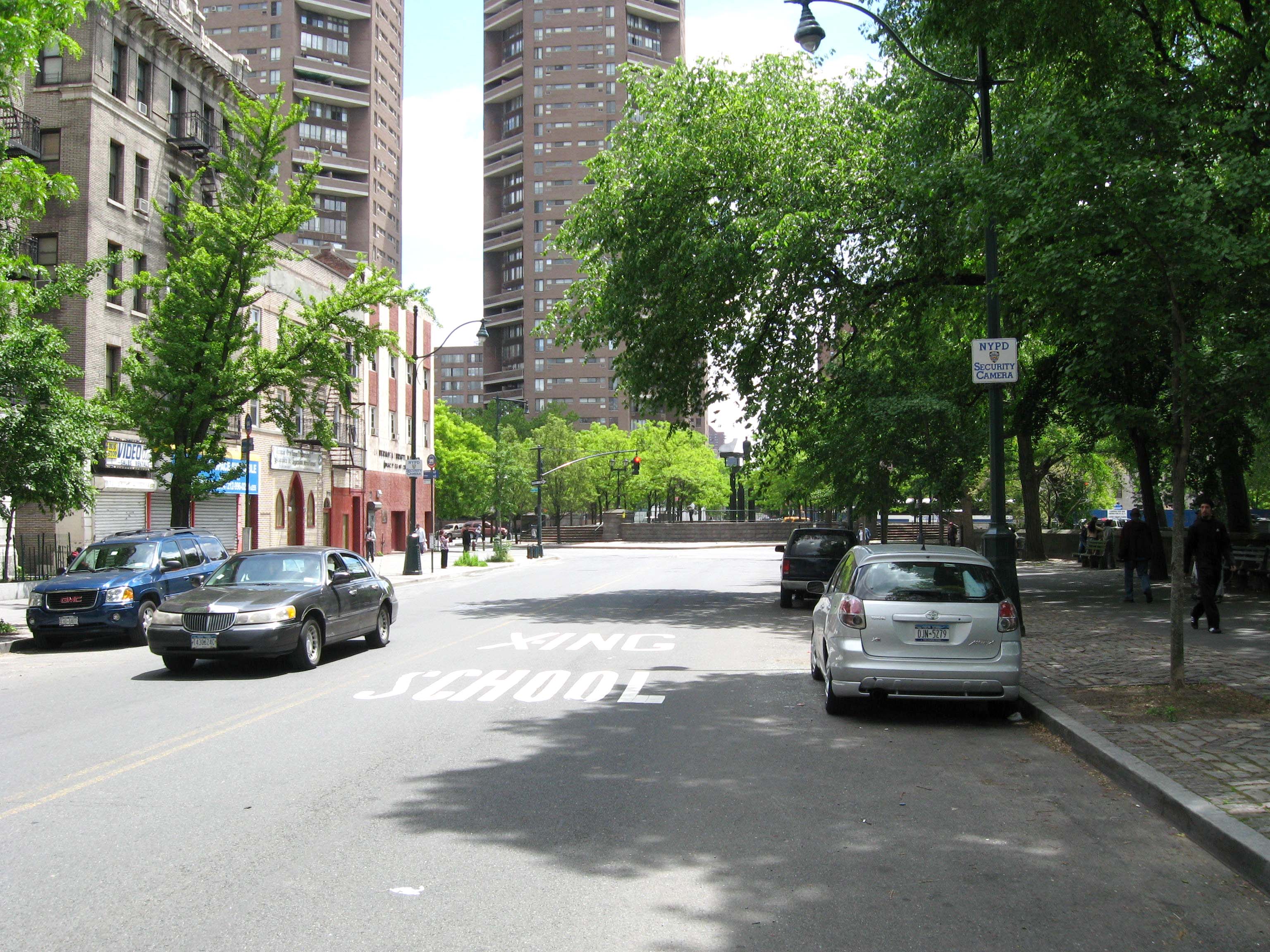

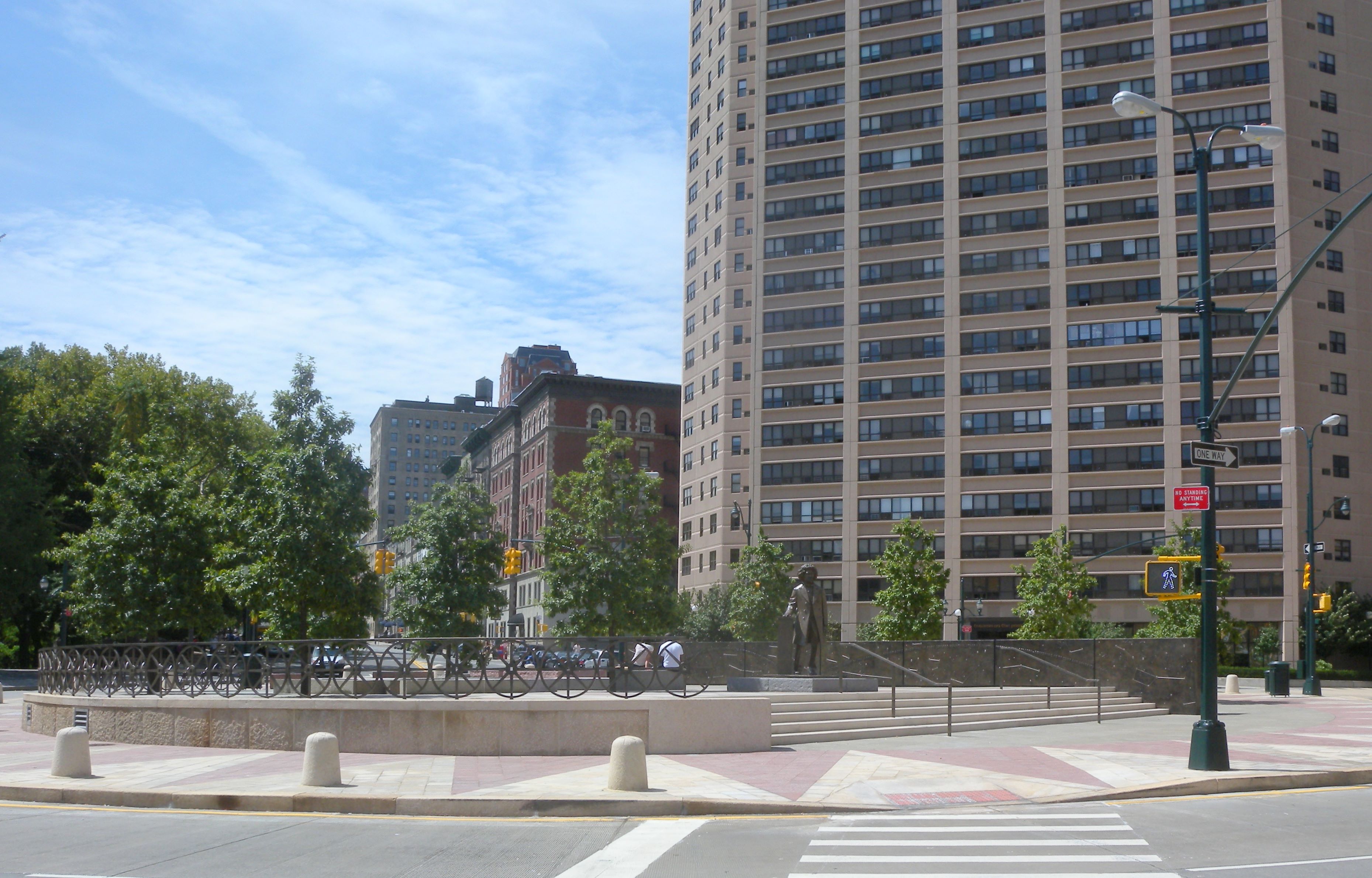


110th Street is a street in the New York City borough of Manhattan. It is also known as Central Park North. In the west, between Central Park West/Frederick Douglass Boulevard and Riverside Drive, it is also known as Cathedral Parkway.
Route
110th Street is an eastbound street between First Avenue and Madison Avenue. The small portion between Madison Avenue and Fifth Avenue is westbound. West of Fifth Avenue, the road widens to accommodate two-way traffic.
The Duke Ellington Memorial, a statue of Duke Ellington, stands in Duke Ellington Circle, a shallow amphitheater at 110th Street and Fifth Avenue, at the northeast corner of Central Park. Unveiled in 1997, the statue, by sculptor Robert Graham, is 25 ft tall, and depicts the Muses—nine nude caryatids—supporting a grand piano and Duke Ellington on their heads. Duke Ellington Circle is also the site of the future Museum for African Art.
110th Street crosses Central Park West and Frederick Douglass Boulevard at the northwest corner of Central Park, Frederick Douglass Circle. West of there it is also called Cathedral Parkway after the Cathedral of St. John the Divine.
The Parkway forms the south edge of Morningside Park between Manhattan Avenue and Morningside Drive. It forms the south edge of the Cathedral Close of St. John the Divine between Morningside Drive and Amsterdam Avenue, and ends at Riverside Drive before Riverside Park.
Central Park North
Central Park North is a section of West 110th Street. As the name implies, it lies at the northern end of Central Park. It is bounded by Central Park West on the west and Fifth Avenue on the east. It is notable for its incongruities; the Lincoln Correctional Facility—originally constructed in 1914 for the Young Women's Hebrew Association—stands a few blocks away from new luxury condo developments.
The Central Park North section has three of the original gates of Central Park. Farmers Gate is located at the southern end of Lenox Avenue/Malcolm X Boulevard, while Warriors Gate is located at the southern end of Seventh Avenue/Adam Clayton Powell Jr Boulevard. Pioneers Gate is at Fifth Avenue (Duke Ellington Circle).
The original Polo Grounds was located along West 110th Street / Central Park North, between Fifth and Sixth avenues. Originally hosting polo, it was the home for the New York Metropolitans baseball club from 1880 to 1886 and for the New York Gothams—subsequently the Giants—from 1883 to 1888.
In the first decade of the 21st century, there was significant real estate development on properties with a view of Central Park. In 2003, Manhattan-based developer Athena headed by Louis Dubin bought a property on this street. The building was pitched as "an opportunity for New Yorkers to be on the park at roughly half the price of Central Park South." The rebirth of Harlem along Central Park north had attracted celebrities such as Marcia Gay Harden, Maya Angelou, and Kareem Abdul-Jabbar. The finished building was 20 stories tall with 48 residential units, 9,500 of ground floor retail space, 48 parking spaces, and each unit had a view of Central Park.
Notable places
- Congregation Ramath Orah
- The Africa Center
- Duke Ellington Circle
- Frederick Douglass Circle
- Avalon Morningside Park
- Cathedral of St. John the Divine
Transportation
The elevated IRT Ninth Avenue Line used to reach a great height at its 110th Street station, before its demolition in 1940; it was infamous as a suicide location. Today, there are four New York City Subway stations on 110th Street:
- Cathedral Parkway–110th Street at Broadway serving the
- Cathedral Parkway–110th Street at Central Park West serving the
- 110th Street–Malcolm X Plaza at Lenox Avenue serving the
- 110th Street at Lexington Avenue serving the
110th Street is served by the following New York City Bus routes, all heading west from Madison Avenue or east until Fifth Avenue:
- The heads north on Adam Clayton Powell Jr. Boulevard.
- The heads north on Manhattan Avenue.
- The heads north on Broadway. It is the primary server of 110th Street.
Additional service is provided by the downtown , running east from Amsterdam to Columbus Avenues.
The New York Central Railroad's 110th Street station previously existed on Park Avenue, which now carries the Park Avenue main line of the Metro-North Railroad. The station opened in 1876 and closed in 1906.
West 110th Street is the southern boundary of the area where boro cabs may be hailed by passengers.
Notable people
George Gershwin lived in 501 West 110th Street, on the northwest corner of 110th and Amsterdam, where he composed his seminal piece Rhapsody in Blue. He and his brother Ira lived there from 1924 to 1929. Arthur Miller lived in 45 West 110th Street as a child.
In popular culture
- The street is known from the Bobby Womack song "Across 110th Street", which describes prostitution and drug dealing in the area, and from the 1972 movie of the same title (starring Yaphet Kotto and Anthony Quinn).
- The Thad Jones/Mel Lewis Big Band released a highly regarded jazz album in 1969 entitled Central Park North.
- It was the billed hometown of professional wrestling tag team Harlem Heat.
References
Note
References
- [http://www.artnet.com/magazine/news/robinson/robinson7-1-97.asp Duke Ellington Memorial Dedicated in Harlem], artnet. Accessed September 16, 2007.
- Johnson, Kirk. (1985-05-05). "Rediscovering Cathedral Parkway". The New York Times.
- [http://www.nycgovparks.org/parks/morningsidepark Morningside Park], [[New York City Department of Parks and Recreation]]. Accessed August 3, 2008.
- Taylor, Candace. (July 10, 2008). "Gourmet Market's Opening Signals Shift in East Harlem". The New York Sun.
- (February 2007). "Keeping Up with the New York Region's Leading Developers". New York Construction.
- Keil, Braden. (July 16, 2004). "Harlem High-Rise Planned". Wired New York.
- Schoeneman, Deborah. (May 21, 2005). "Above It All–Central Park North always had great views—and few takers. But the secret is finally getting out.".
- Stoler, Michael. (December 4, 2006). "The Tale of Three Harlems". The New York Sun.
- Douglas, George H. (2004): ''Skyscrapers: A Social History of the Very Tall Building in America''. McFarland & Company, {{ISBN. 0-7864-2030-8. (110th St station popular for suicides: p. 170).
- (1927-01-31). "Merchants Complain Suicides Hurt Business; Seek Way to Guard 100th St. Elevated Station". The New York Times.
- {{Cite NYC bus map. M
- (May 12, 1876). "Partial Rapid Transit: From The Grand Central Depot. Arrangements For Quick Trains On The Harlem Road Trains To Run Next Monday Fares, Time, Rates of Communication". The New York Times.
- (April 13, 1876). "Rapid Transit To And From Harlem". The New York Times.
- (June 13, 1906). "N. Y. Central Closes 110th Street Station". Buffalo Evening News.
- "Taxis · NYC311". Portal.311.nyc.gov.
- Pollack, Howard. (2006). "George Gershwin: His Life and Work". University of California Press.
- Meyers, Jeffrey. (2012). "The Genius and the Goddess: Arthur Miller and Marilyn Monroe". University of Illinois Press.
This article was imported from Wikipedia and is available under the Creative Commons Attribution-ShareAlike 4.0 License. Content has been adapted to SurfDoc format. Original contributors can be found on the article history page.
Ask Mako anything about 110th Street (Manhattan) — get instant answers, deeper analysis, and related topics.
Research with MakoFree with your Surf account
Create a free account to save articles, ask Mako questions, and organize your research.
Sign up freeThis content may have been generated or modified by AI. CloudSurf Software LLC is not responsible for the accuracy, completeness, or reliability of AI-generated content. Always verify important information from primary sources.
Report