From Surf Wiki (app.surf) — the open knowledge base
42nd Street (Manhattan)
West-east street in Manhattan, New York
West-east street in Manhattan, New York
| Field | Value |
|---|---|
| name | 42nd Street |
| image | 42nd Street in New York.jpg |
| caption | Looking west between Seventh and Eighth Avenue |
| image_size | 325px |
| image_map | |
| other_name | Lincoln Highway (west of Broadway) |
| New 42nd Street (8th to 7th Avenues) | |
| postal_code | 10036, 10018, 10017, 10168 |
| length_mi | 2.0 |
| length_ref | |
| location | Manhattan, New York City |
| maint | NYCDOT |
| direction_a | West |
| terminus_a | / West Side Highway in Hell's Kitchen |
| direction_b | East |
| terminus_b | in Murray Hill / Midtown East |
| commissioning_date | March 1811 |
| north | [43rd Street](43rd-street-manhattan) (west of 1st Avenue) |
| [48th Street](48th-street-manhattan) (east of 1st Avenue) | |
| south | [41st Street](41st-street-manhattan) (west of 6th Avenue) |
| [40th Street](40th-street-manhattan) (6th to 5th Avenues) | |
| 41st Street (east of 5th Avenue) |
New 42nd Street (8th to 7th Avenues) 48th Street (east of 1st Avenue) 40th Street (6th to 5th Avenues) 41st Street (east of 5th Avenue)
42nd Street is a major crosstown street in the New York City borough of Manhattan, spanning the entire breadth of Midtown Manhattan, from Turtle Bay at the East River, to Hell's Kitchen at the Hudson River on the West Side. The street has several major landmarks, including (from east to west) the headquarters of the United Nations, the Chrysler Building, Grand Central Terminal, the New York Public Library Main Branch, Times Square, and the Port Authority Bus Terminal.
The street is known for its theaters, especially near the intersection with Broadway at Times Square, and as such is also the name of the region of the theater district (and, at times, the red-light district) near that intersection. The street also has a section of off-Broadway theaters known as Theatre Row.
History
Early history
During the American Revolutionary War, a cornfield near 42nd Street and Fifth Avenue was where General George Washington angrily attempted to rally his troops after the British landing at Kip's Bay, which scattered many of the American militiamen. Washington's attempt put him in danger of being captured, and his officers had to persuade him to leave. The rout eventually subsided into an orderly retreat.
John Jacob Astor purchased a 70 acre farm in 1803 that ran from 42nd Street to 46th Street west of Broadway to the Hudson River.
19th century
The street was designated by the Commissioners' Plan of 1811 that established the Manhattan street grid as one of 15 crosstown (east-west) streets that would be 100 ft in width, while other streets were designated as 60 ft in width.
In 1835, the city's Street Committee, after receiving numerous complaints about lack of access for development above 14th Street, decided to open up all lots which had already been plotted on the city grid up to 42nd Street, which thus became – for a time – the northern boundary of the city.
Cornelius Vanderbilt began the construction of Grand Central Depot in 1869 on 42nd Street at Fourth Avenue as the terminal for his Central, Hudson, Harlem and New Haven commuter rail lines, because city regulations required that trains be pulled by horse below 42nd Street. The Depot, which opened in 1871, was replaced by Grand Central Terminal in 1913.
Between the 1870s and 1890s, 42nd Street became the uptown boundary of the mainstream theater district, which started around 23rd Street, as the entertainment district of the Tenderloin gradually moved northward.
Early 20th century
42nd Street was developed relatively late compared to other crosstown thoroughfares such as 14th Street and 23rd Street, which had grown during the American Civil War, and 57th Street, which became prominent in the 1890s. It was only after the beginning of the 20th century that the street saw entertainment venues being developed around Times Square and upscale office space around Grand Central Terminal. In the first two decades of the 20th century, eleven venues for legitimate theater were built within one block of West 42nd Street between Seventh and Eighth Avenues.
The corner of 42nd Street and Broadway, at the southeast corner of Times Square, is the eastern terminus of the Lincoln Highway, the first road across the United States, which was conceived and mapped in 1913.
An elevated railroad line, running above East 42nd Street from Third Avenue to the Grand Central station, was closed in 1923, leading to the development of such structures as the Chanin Building and 110 East 42nd Street west of Lexington Avenue. The street east of Lexington Avenue continued to be made up of mostly low-rise buildings; these blocks were adjacent to the elevated IRT Second Avenue Line and IRT Third Avenue Line, and accordingly, initially considered unattractive for major development. By the 1920s, The New York Times reported that several high-rise developments were "radically changing the old-time conditions" along East 42nd Street, including the Chanin, Lincoln, Chrysler, and Daily News Buildings, as well as Tudor City.
The block of 42nd Street between Second and First Avenues was originally only 40 ft wide, passing through a steep bluff known as Prospect Hill. On either side of the street, 30 ft service roads ascended to Tudor City Place, which crossed over 42nd Street. To improve access to the newly developed United Nations headquarters, in 1948, the city government proposed widening that block of 42nd Street, eliminating the service roads, and constructing a viaduct to carry Tudor City Place over 42nd Street. Despite opposition from Tudor City residents, city officials said the street widening was necessary because 42nd Street already carried high amounts of vehicular traffic to and from the nearby FDR Drive. The New York City Planning Commission approved the plans in September 1948, and the Board of Estimate approved $1.848 million for the project that December. The board provisionally authorized the street widening in June 1949, and Manhattan's borough president announced in December 1949 that work would commence shortly. The neighboring stretch of 42nd Street was temporarily closed from February 1951 to October 1952 while the widening was underway.
Theatrical decline
West 42nd Street, meanwhile, prospered as a theater and entertainment district until World War II. According to historian Robert A. M. Stern, West 42nd Street's decline started in 1946, when the streetcars on 42nd Street were replaced by less efficient buses.
Lloyd Bacon and Busby Berkeley's 1933 film musical 42nd Street, starring 30s heartthrobs Dick Powell and Ruby Keeler, displays the bawdy and colorful mixture of Broadway denizens and lowlifes in Manhattan during the Depression. In 1980, it was turned into a successful Broadway musical which ran until 1989, and which was revived for a four-year run in 2001. In the words of the Al Dubin and Harry Warren title song, on 42nd Street one could find:
Little nifties from the Fifties, innocent and sweet, Sexy ladies from the Eighties who are indiscreet, They're side by side, they're glorified, Where the underworld can meet the elite Naughty, gawdy, bawdy, sporty, Forty-second Street!
From the late 1950s until the late 1980s, 42nd Street, nicknamed the "Deuce", was the cultural center of American grindhouse theaters, which spawned an entire subculture. The book Sleazoid Express, a travelogue of the 42nd Street grindhouses and the films they showed, describes the unique blend of people who made up the theater-goers:
depressives hiding from jobs, sexual obsessives, inner-city people seeking cheap diversions, teenagers skipping school, adventurous couples on dates, couples-chasers peeking on them, people getting high, homeless people sleeping, pickpockets...
While the street outside the theaters was populated with:
phony drug salesman ... low-level drug dealers, chain snatchers ... [j]unkies alone in their heroin/cocaine dreamworld ... predatory chickenhawks spying on underage trade looking for pickups ... male prostitutes of all ages ... [t]ranssexuals, hustlers, and closety gays with a fetishistic homo- or heterosexual itch to scratch ... It was common to see porn stars whose films were playing at the adult houses promenade down the block. ... Were you a freak? Not when you stepped onto the Deuce. Being a freak there would get you money, attention, entertainment, a starring part in a movie. Or maybe a robbery and a beating.
For much of the mid and late 20th century, the area of 42nd Street near Times Square was home to activities often considered unsavory, including peep shows.
East 42nd Street was, for some time, spared from similar decline, especially east of Third Avenue, where the development of the United Nations supported a thriving business district and prompted the widening of that section of 42nd Street. The demolition of the Second and Third Avenue elevated lines by the 1950s led to increased development on East 42nd Street, such as annexes to the Chrysler and Daily News Buildings, as well as the construction of the Socony–Mobil and Ford Foundation Buildings. By the 1960s, East 42nd Street between Park and Second Avenues contained more headquarters of industries than any other place in the United States except Chicago or Pittsburgh. During this time, there was much development outside the rundown entertainment district of Times Square, somewhat offsetting the perception of that part of 42nd Street.
Revitalization
In the early 1990s, the city government encouraged a cleanup of the Times Square area. In 1990, the city government took over six of the historic theaters on the block of 42nd Street between Seventh and Eighth Avenues, and New 42nd Street, a not-for-profit organization, was formed to oversee their renovation and reuse, as well as to construct new theaters and a rehearsal space. In 1993, Disney Theatrical Productions bought the New Amsterdam Theatre, which it renovated a few years later. Since the mid-1990s, the block has again become home to mainstream theaters and several multi-screen mainstream movie theaters, along with shops, restaurants, hotels, and attractions such as Madame Tussauds wax museum and Ripley's Believe It or Not that draw millions to the city every year. This area is now co-signed as "New 42nd Street" to signify this change.
In the 1990s, the renovation of Bryant Park between Fifth and Sixth Avenues, as well as the renovations of Times Square and Grand Central Terminal, led to increases in office occupancy along both sections of 42nd Street.
In 2025, the New York City Department of Transportation announced that the block of 42nd Street between Seventh and Eighth Avenues would be upgraded to protect it from terrorist attacks. The project, budgeted at $57 million, would include adding steel bollards, installing sewage pipes, and widening the sidewalks and bus lanes.
Notable places
(from East to West):
- Headquarters of the United Nations, First Avenue
- Tudor City apartments, First Avenue
- Ford Foundation Building, between First and Second Avenues, former site of the Hospital for the Ruptured and Crippled (now known as the Hospital for Special Surgery)
- Church of the Covenant, between First and Second Avenues
- Daily News Building, Second Avenue
- Pfizer Building, Second Avenue
- Socony–Mobil Building, between Third and Lexington Avenues
- Chrysler Building, Lexington Avenue
- Chanin Building, Lexington Avenue
- 110 East 42nd Street (formerly Bowery Savings Bank Building, now Cipriani S.A.), between Lexington and Park Avenues
- Pershing Square Building, Park Avenue
- Pershing Square, Park Avenue
- Grand Central Terminal, Park Avenue
- One Grand Central Place, Vanderbilt Avenue
- One Vanderbilt, Vanderbilt Avenue
- 500 Fifth Avenue
- New York Public Library Main Branch, Fifth Avenue
- W. R. Grace Building, between Fifth and Sixth Avenues
- Salmon Tower Building, between Fifth and Sixth Avenues
- Aeolian Building, between Fifth and Sixth Avenues
- Bryant Park, between Fifth and Sixth Avenues
- Shayne's Emporium, west of Sixth Avenue
- Bank of America Tower, Sixth Avenue
- Bush Tower, between Sixth and Seventh Avenues
- 4 Times Square, at Broadway
- The Knickerbocker Hotel, at Broadway
- One Times Square, the building from which the ball drops on New Year's Eve, Broadway and Seventh Avenue
- Times Square Tower, Broadway and Seventh Avenue
- 3 Times Square, at Seventh Avenue
- 5 Times Square, at Seventh Avenue
- New Amsterdam Theatre, between Seventh and Eighth Avenues
- New Victory Theatre, between Seventh and Eighth Avenues
- Todd Haimes Theatre and New 42nd Street, between Seventh and Eighth Avenues
- Candler Building, between Seventh and Eighth Avenues
- Empire Theatre, between Seventh and Eighth Avenues
- Port Authority Bus Terminal, at Eighth Avenue
- Eleven Times Square, at Eighth Avenue
- 330 West 42nd Street, formerly McGraw-Hill Building, between Eighth and Ninth Avenues
- Holy Cross Church, between Eighth and Ninth Avenues
- Theatre Row, between Ninth and Eleventh Avenues
- Silver Towers apartments, at Eleventh Avenue
- Atelier Skyscraper Condominium, between Eleventh and Twelfth Avenue
- Circle Line Sightseeing Cruises ferry terminal, Twelfth Avenue
Transportation
Subway
Every New York City Subway line that crosses 42nd Street has a stop on 42nd Street:
- and ()
- ()
- ()
There are two subway lines under 42nd Street. The 42nd Street Shuttle () runs under 42nd Street between Broadway/Seventh Avenue (Times Square) and Park Avenue (Grand Central). The IRT Flushing Line () curves from Eleventh Avenue to 41st Street, under which it runs until Fifth Avenue; shifts to 42nd Street between Fifth and Madison Avenues; and continues under the East River to Queens. Each line stops at Times Square and Grand Central, though the Fifth Avenue station is also served by the .
In the past, every former IRT elevated line had a station at 42nd Street:
- 42nd Street on the IRT Second Avenue Line
- 42nd Street on the IRT Third Avenue Line
- 42nd Street on the IRT Sixth Avenue Line
- 42nd Street on the IRT Ninth Avenue Line
A fifth station extended over 42nd Street as a western spur from the Third Avenue Line to Grand Central Depot, later Grand Central Station, and finally Grand Central Terminal.
Bus
MTA Regional Bus Operations's M42 bus runs the length of 42nd Street between the Circle Line Sightseeing Cruises ferry terminal on the Hudson River and the headquarters of the United Nations on the East River. Westbound service originates at First Avenue. Its predecessor, the 42nd Street Crosstown Line streetcar, had used 42nd Street until 1946. In 2019, bus lanes were installed along the length of the street.See:
- There have also been proposals for light rail on 42nd Street over the years, such as in 2005.
42nd Street is also used by the Staten Island express buses.
In popular culture
Forty-deuce"Dorty-deuce" is street slang for Manhattan's former live peep show district on 42nd Street. The 1982 film Forty Deuce and the 2017 TV series The Deuce reference the phrase "forty-deuce".
Notable CCP Politburo Standing Committee member Wang Huning referenced 42nd Street in his book America Against America mentioning it's "pornographic culture" as an example of the "decadence of high commodification".
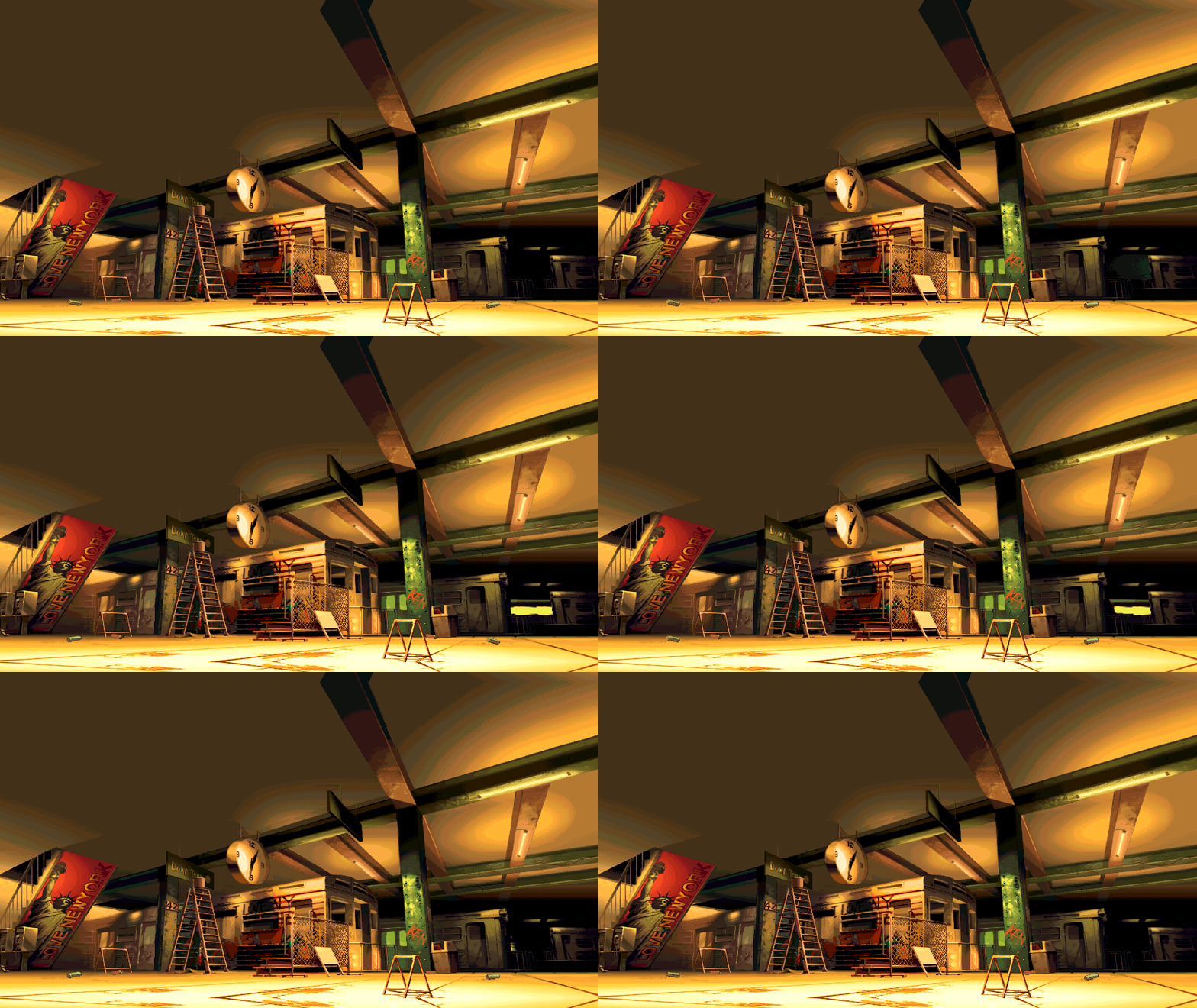

An unspecified 42nd Street Subway Station is featured in Street Fighter III: Third Strike as the stage, "Subway Station". Two versions of this stage exist for the characters Alex and Ken Masters. Alex's version is in a bright orange tint and features construction equipment, while Ken's version has a blue tint and is clear of equipment. The famous Evo Moment 37 occurred on the Subway Station stage since Ken was the challenging player.
References
Notes
Bibliography
Further reading
- Bianco, Anthony (2004). Ghosts of 42nd Street: A History of America's Most Infamous Block. New York: HarperCollins Books, . (A detailed history that focuses primarily on the Times Square Theater District from the beginning of the 20th century through its successful restoration and in the late 20th century.)
- Eliot, Marc (2001). Down 42nd Street: Sex, money, culture and politics at the crossroads of the world. New York: Warner Books, . (A detailed history that focuses on the social, political and cultural aspects of the street, primarily between 7th and 8th Avenues.)
References
- {{google maps. link
- {{harvnb. Burrows. Wallace. 1999
- {{harvnb. Burrows. Wallace. 1999
- [[Gouverneur Morris. Morris, Gouverneur]], [[Simeon De Witt. De Witt, Simeon]], and [[John Rutherfurd. Rutherford, John]] {{sic (March 1811) [https://urbanplanning.library.cornell.edu/DOCS/nyc1811.htm "Remarks Of The Commissioners For Laying Out Streets And Roads In The City Of New York, Under The Act Of April 3, 1807"] {{Webarchive. link. (October 28, 2021 , [[Cornell University Library]]. Accessed June 27, 2016. "These streets are all sixty feet wide except fifteen, which are one hundred feet wide, viz.: Numbers fourteen, twenty-three, thirty-four, forty-two, fifty-seven, seventy-two, seventy-nine, eighty-six, ninety-six, one hundred and six, one hundred and sixteen, one hundred and twenty-five, one hundred and thirty-five, one hundred and forty-five, and one hundred and fifty-five—the block or space between them being in general about two hundred feet.")
- {{harvnb. Burrows. Wallace. 1999
- {{harvnb. Burrows. Wallace. 1999
- (September 29, 1871). "Local News in Brief". [[The New York Times]].
- {{harvnb. Burrows. Wallace. 1999
- {{harvnb. Stern. Mellins. Fishman. 1995
- (October 12, 1917). "Legitimate: New York's Playhouse List Nearing Half Century Mark".
- (December 7, 1923). "42d St. Elevated Stops; Service on Spur to Grand Central Discontinued Last Midnight.". The New York Times.
- (February 25, 2003). "Socony-Mobil Building". [[New York City Landmarks Preservation Commission]].
- (October 13, 1929). "News Building; Tall East 42d Street Edifice Nearing Completion.". The New York Times.
- (February 3, 1929). "Manhattan's Building Peak Shifts to Forty-Second St; Five Buildings Cost Over $61,000,000. A Pioneer Movement. Renting From the Plans.". The New York Times.
- (December 22, 1949). "U. N. Approach to Be Beautified By Redevelopment of 42d Street". The New York Times.
- (December 17, 1948). "Tudor City Plea To Save Park Area Rebuffed: Estimate Board Also Tells 42d Street Group It Must Make Way for U.N. Plan". New York Herald Tribune.
- Yerxa, Fendall. (July 22, 1948). "Tudor City Protests City's Plans To Develop Approach to U.N. Site". New York Herald Tribune.
- (July 23, 1948). "Ramp for Hospital in U.N. Plan Likely". The New York Times.
- (September 17, 1948). "Approach to U.N. Mapped; City Planning Proposal Would Widen 42d Street to 100 Feet". The New York Times.
- (September 17, 1948). "Street Widening for U. N. Approved by City Board". New York Herald Tribune.
- (December 17, 1948). "City to Add Land for U.N. Approach; Board Votes to Take Over Strip for Widening of Street to Speed Development". The New York Times.
- (December 22, 1949). "Plan for Remodeling 42d St. As an Approach to U. N. Site". New York Herald Tribune.
- (October 2, 1952). "East 42d St. Block Reopens to Traffic". The New York Times.
- "42nd Street".
- (2002). "Sleazoid Express: A Mind-Twisting Tour Through the Grindhouse Cinema of Times Square". Simon & Schuster.
- Blumenthal, Ralph. (December 27, 1981). "A Times Square Revival?". [[The New York Times Magazine]].
- {{harvnb. Stern. Mellins. Fishman. 1995
- {{harvnb. Stern. Mellins. Fishman. 1995
- Dalton, Dudley. (January 24, 1965). "East 42d Street Home to Industry: Corporate Headquarters Are on Three-block Stretch". The New York Times.
- (November 17, 1963). "Activity Is Brisk Near the River; New Office Buildings and Motels Brighten 42d Street's Tarnished Image". The New York Times.
- Deutsch, Claudia H.. (June 2, 1996). "Commercial Property/East 42d Street;Rebirth of West 42d Street Is Spreading Eastward". The New York Times.
- Durso, Isabelle. (February 10, 2025). "NYC to Spend $57M on 42nd Street Pedestrian Safety Improvements".
- Spivack, Caroline. (February 10, 2025). "42nd Street to get $57M makeover to prevent terror attacks".
- Levine DB. (September 2007). "The hospital for the ruptured and crippled moves East on 42nd street 1912 to 1925". [[HSS Journal]].
- {{NYCS const. map
- {{Cite NYC bus map. M
- Chan, Sewell. (April 18, 2005). "Old Proposal to Build Light-Rail Line on 42nd Street Is Revisited". The New York Times.
- (1947). "Bus Transportation". McGraw-Hill.
- {{cite NYC bus map. S2
- Holden, Robert. (June 30, 1998). "Forty Deuce". Variety.
- "Total Commodification – tikhanovlibrary.com".
- "Subway Station Stage (Alex) – Street Fighter III: 3rd Strike".
- "Subway Station Stage (Ken) – Street Fighter III: 3rd Strike".
- [[:File:Evo moment 37.jpg. Evo Moment 37]]
This article was imported from Wikipedia and is available under the Creative Commons Attribution-ShareAlike 4.0 License. Content has been adapted to SurfDoc format. Original contributors can be found on the article history page.
Ask Mako anything about 42nd Street (Manhattan) — get instant answers, deeper analysis, and related topics.
Research with MakoFree with your Surf account
Create a free account to save articles, ask Mako questions, and organize your research.
Sign up freeThis content may have been generated or modified by AI. CloudSurf Software LLC is not responsible for the accuracy, completeness, or reliability of AI-generated content. Always verify important information from primary sources.
Report