From Surf Wiki (app.surf) — the open knowledge base
9 Metis
Main-belt asteroid
Main-belt asteroid
| Field | Value | ||
|---|---|---|---|
| minorplanet | yes | ||
| background | #D6D6D6 | ||
| name | 9 Metis | ||
| image | 9 Metis VLT (2021), deconvolved.pdf | ||
| symbol | [[Image:Metis symbol (bold).svg | 24px | class=skin-invert]] (historical) |
| discoverer | A. Graham | ||
| discovered | 25 April 1848 | ||
| mpc_name | (9) Metis | ||
| alt_names | |||
| pronounced | |||
| named_after | Mētis | ||
| adjectives | Metidian | ||
| mp_category | Main belt | ||
| orbit_ref | {{cite web | ||
| type | last observation: 2023-08-13 | ||
| title | JPL Small-Body Database Browser: 9 Metis | ||
| url | http://ssd.jpl.nasa.gov/sbdb.cgi?sstr=9 | ||
| access-date | 2023-09-18}} | ||
| epoch | 13 September 2023 | ||
| (JD 2460200.5) | |||
| semimajor | 2.387 AU | ||
| perihelion | 2.093 AU | ||
| time_periastron | 6 November 2023 | ||
| aphelion | 2.68 AU | ||
| eccentricity | 0.1231 | ||
| period | 3.69 yr (1346.74 d) | ||
| inclination | 5.577° | ||
| asc_node | 68.87° | ||
| arg_peri | 5.75° | ||
| mean_anomaly | 345.43° | ||
| moid | 1.1 AU | ||
| p_orbit_ref | {{cite web | ||
| title | AstDyS-2 Metis Synthetic Proper Orbital Elements | ||
| publisher | Department of Mathematics, University of Pisa, Italy | ||
| url | https://newton.spacedys.com/astdys/index.php?pc=1.1.6&n=9 | ||
| access-date | 1 October 2011}} | ||
| p_semimajor | 2.3864354 | ||
| p_eccentricity | 0.1271833 | ||
| p_inclination | 4.6853629° | ||
| p_mean_motion | 97.638314 | ||
| perihelion_rate | 38.754973 | ||
| node_rate | −41.998090 | ||
| mean_diameter | |||
| 190±? km (Dunham) | |||
| dimensions | (222 × 182 × 130) ± 12 km | ||
| flattening | 0.39 | ||
| mass | |||
| density | |||
| rotation | 0.2116 d (5.079 h) | ||
| spectral_type | S | ||
| magnitude | 8.1 to 11.83 | ||
| abs_magnitude | 6.33 | ||
| albedo | 0.18 | ||
| 0.118 | |||
| angular_size | 0.23" to 0.071" | ||
| single_temperature | *max:* 282 K (+9 °C) |
|access-date=2023-09-18}} (JD 2460200.5) |access-date=1 October 2011}} 190±? km (Dunham)
0.118
9 Metis is one of the larger main-belt asteroids. It is composed of silicates and metallic nickel-iron, and may be the core remnant of a large asteroid that was destroyed by an ancient collision.{{cite journal |access-date=13 February 2011 |archive-url=https://web.archive.org/web/20130702212735/http://home.earthlink.net/~jimbaer1/astmass.txt |archive-date=2 July 2013 |url-status=dead
Discovery and naming
Metis was discovered by Andrew Graham on 25 April 1848, at Markree Observatory in Ireland; it was his only asteroid discovery. It also has been the only asteroid to have been discovered as a result of observations from Ireland until 7 October 2008, when, 160 years later, Dave McDonald from observatory J65 discovered (281507) 2008 TM9. Its name comes from the mythological Metis, a Titaness and Oceanid, daughter of Tethys and Oceanus. The name Thetis was also considered and rejected (it would later devolve to 17 Thetis).
The historical symbol for Metis was an eye with a star above it. It was encoded in Unicode 17.0 as U+1CEC3 ([[File:Metis symbol (fixed width).svg|12px|class=skin-invert]]).{{cite web | access-date = September 9, 2025 | url-status = live
Characteristics
thumb|[[Lightcurve]]-based 3D-model of Metis Metis's direction of rotation is unknown at present, due to ambiguous data. Lightcurve analysis indicates that the Metidian pole points towards either ecliptic coordinates (β, λ) = (23°, 181°) or (9°, 359°) with a 10° uncertainty. The equivalent equatorial coordinates are (α, δ) = (12.7 h, 21°) or (23.7 h, 8°). This gives an axial tilt of 72° or 76°, respectively.
Hubble Space Telescope images and lightcurve analyses are in agreement that Metis has an irregular elongated shape with one pointed and one broad end. Radar observations suggest the presence of a significant flat area, in agreement with the shape model from lightcurves.
The Metidian surface composition has been estimated as 30–40% metal-bearing olivine and 60–70% Ni-Fe metal.
Light curve data on Metis led to an assumption that it could have a satellite. However, subsequent observations failed to confirm this. Later searches with the Hubble Space Telescope in 1993 found no satellites.
Family relationships
Metis was once considered to be a member of an asteroid family known as the Metis family, but more recent searches for prominent families did not recognize any such group, nor is a clump evident in the vicinity of Metis by visual inspection of proper orbital element diagrams.
However, a spectroscopic analysis found strong spectral similarities between Metis and 113 Amalthea, and it is suggested that these asteroids may be remnants of a very old (at least ~1 Ga) dynamical family whose smaller members have been pulverised by collisions or perturbed away from the vicinity. The putative parent body is estimated to have been 300 to 600 km in diameter (Vesta-sized) and differentiated. Metis would be the relatively intact core remnant (though smaller than 16 Psyche), and Amalthea a fragment of the mantle, with 90% of the original body unaccounted for. Coincidentally, both Metis and Amalthea have namesakes among Jupiter's inner moons.
Occultations
In 1984 an occultation of a star produced seven chords that Kristensen used to derive an ellipsoidal profile of 210×170 km.{{cite journal |access-date = 6 December 2008 |url-status = dead |archive-url = https://web.archive.org/web/20080827155624/http://occsec.wellington.net.nz/planet/2006/results/060211_Metis.htm |archive-date = 27 August 2008
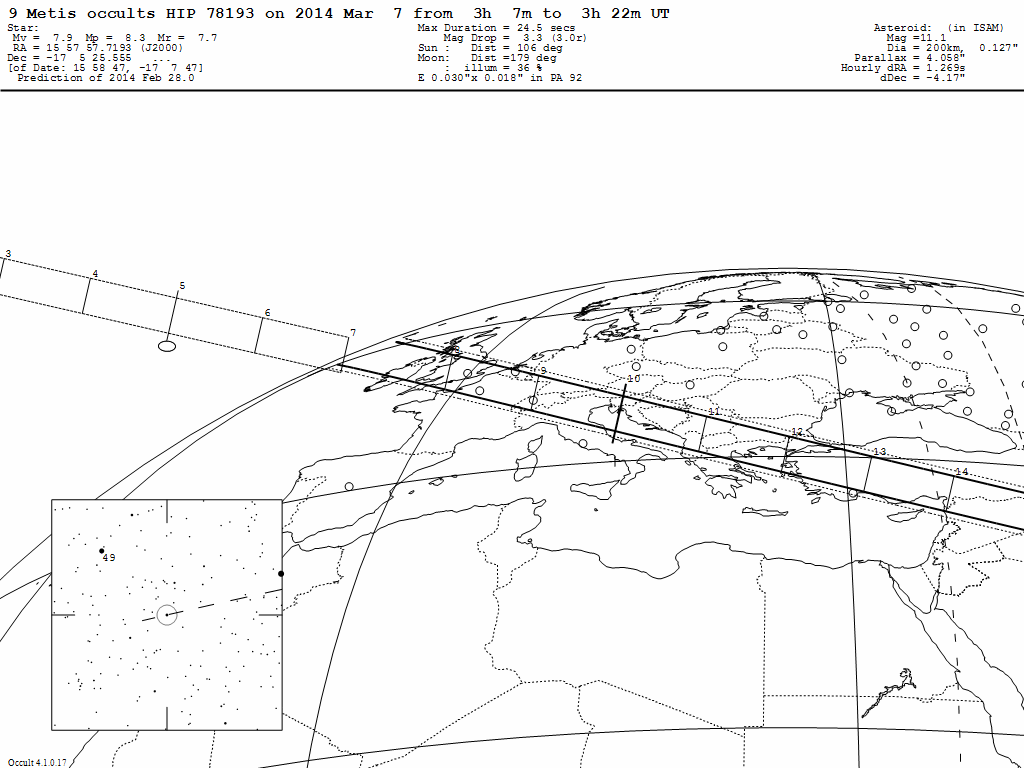
On 7 March 2014, Metis occulted the star HIP 78193 (magnitude 7.9) over parts of Europe and the Middle East.
Notes
References
References
- Noah Webster (1884) ''A Practical Dictionary of the English Language''
- P. Vernazza et al. (2021) VLT/SPHERE imaging survey of the largest main-belt asteroids: Final results and synthesis. ''Astronomy & Astrophysics'' 54, A56
{{val. 11.3. 2.2. {{val. 5.7. 1.1- [http://spiff.rit.edu/richmond/parallax/phot/LCSUMPUB.TXT asteroid lightcurve data file (March 2001)]
- Donald H. Menzel. (1983). "A Field Guide to the Stars and Planets". Houghton Mifflin.
- L. F. Lim et al., ''Thermal infrared (8–13 μm) spectra of 29 asteroids: the Cornell Mid-Infrared Asteroid Spectroscopy (MIDAS) Survey'', Icarus Vol. 173, p. 385 (2005).
- Graham, A.; [http://adsabs.harvard.edu/abs/1848MNRAS...8..146G ''New Planet''], Monthly Notices of the Royal Astronomical Society, Vol. 8, No. 6 (dated 14 April 1848!), p. 146 (signed 29 April 1848; the discovery was first announced on 27 April)
- (10 October 2008). "Amateur Astronomer Becomes Second Ever to Discover Asteroid from Ireland, After 160 Years". International Year of Astronomy in Ireland.
- Graham, A.; [http://adsabs.harvard.edu/abs/1848MNRAS...8..148. ''Metis''], Monthly Notices of the Royal Astronomical Society, Vol. 8, No. 7 (dated 12 May 1848), pp. 147–150
- (18 September 2023). "Unicode request for historical asteroid symbols". Unicode.
- J. Torppa et al., [http://www.rni.helsinki.fi/~mjk/thirty.pdf ''Shapes and rotational properties of thirty asteroids from photometric data''], Icarus Vol. 164, p. 346 (2003).
- A. D. Storrs et al., ''A closer look at main-belt asteroids 1: WF/PC images'', Icarus Vol. 173, p. 409 (2005).
- [http://web.media.mit.edu/~win/hstpub.pdf Hubble Space Telescope observations] {{webarchive. link. (30 October 2008)
- D. L. Mitchell et al., ''Radar Observations of Asteroids 7 Iris, 9 Metis, 12 Victoria, 216 Kleopatra, and 654 Zelinda'', Icarus Vol. 118, p. 105 (1995).
- [http://www.bdl.fr/observateur/binast/binary_ast.php research at IMCCE] {{webarchive. link. (12 June 2002 (in French))
- [http://www.johnstonsarchive.net/astro/asteroidmoonsq.html "other" reports of asteroid companions]
- J. G. Williams, ''Asteroid Families – An Initial Search'', Icarus Vol. 96, p. 251 (1992).
- [http://www.asteroidoccultation.com/2014_03/0307_9_32274.htm Asteroid Occulations] {{webarchive. link. (6 March 2014)
- [http://www.asteroidoccultation.com/2014_03/0307_9_32274_MapE.gif Map] {{webarchive. link. (6 March 2014)
This article was imported from Wikipedia and is available under the Creative Commons Attribution-ShareAlike 4.0 License. Content has been adapted to SurfDoc format. Original contributors can be found on the article history page.
Ask Mako anything about 9 Metis — get instant answers, deeper analysis, and related topics.
Research with MakoFree with your Surf account
Create a free account to save articles, ask Mako questions, and organize your research.
Sign up freeThis content may have been generated or modified by AI. CloudSurf Software LLC is not responsible for the accuracy, completeness, or reliability of AI-generated content. Always verify important information from primary sources.
Report