From Surf Wiki (app.surf) — the open knowledge base
16 Psyche
Metallic main-belt asteroid

Metallic main-belt asteroid
| Field | Value | ||
|---|---|---|---|
| name | 16 Psyche | ||
| background | #D6D6D6 | ||
| image | Psyche VLT.png | ||
| caption | 16 Psyche imaged by the Very Large Telescope's adaptive optics system in August 2019 | ||
| symbol | [[File:16 Psyche symbol (butterfly).svg | 24px | class=skin-invert]] (historical) |
| discoverer | Annibale de Gasparis | ||
| discovery_site | Naples Observatory | ||
| discovered | 17 March 1852 | ||
| pronounced | |||
| adjective | Psychean () | ||
| mpc_name | (16) Psyche | ||
| named_after | Psyche (Ψυχή) | ||
| mp_category | Main belt | ||
| orbit_ref | |||
| epoch | 21 November 2025 | ||
| (JD 2461000.5) | |||
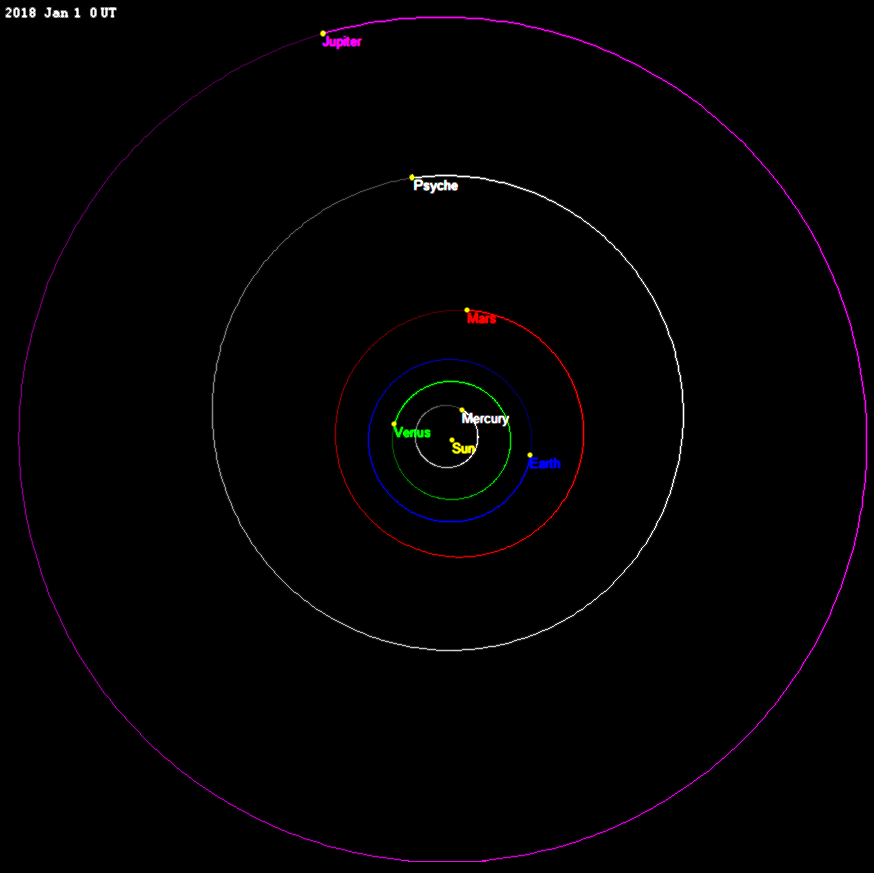
| semimajor | 2.92 AU | ||
| perihelion | 2.53 AU | ||
| time_periastron | 28 April 2025 | ||
| aphelion | 3.32 AU | ||
| eccentricity | 0.1343 | ||
| period | 4.998 yr (1825.6 d) | ||
| inclination | 3.097° | ||
| asc_node | 150.0° | ||
| arg_peri | 229.8° | ||
| mean_anomaly | 40.6° | ||
| moid | 1.53 AU | ||
| dimensions | ( × × ) km | ||
| mean_diameter | |||
| flattening | 0.41{{efn | ||
| Flattening, ,}} derived from the maximum aspect ratio (}}): <math>\ f | 1 -\frac{c}{a}\ , where c . | ||
| volume | (best fit) | ||
| mass | |||
| density | |||
| escape_velocity | ~180 m/s (~600 ft/s) | ||
| rotation | |||
| albedo | |||
| (radar) | |||
| spectral_type | Tholen M | ||
| SMASS X | |||
| Bus-DeMeo Xk | |||
| magnitude | 9.6 to 12.5 | ||
| abs_magnitude | 6.21 | ||
| surface_grav | ~ |
(JD 2461000.5)
Flattening, derived from the maximum aspect ratio (): \ f = 1 -\frac{c}{a}\ , where c . (radar) SMASS X Bus-DeMeo Xk
16 Psyche ( ) is a large M-type asteroid, which was discovered by the Italian astronomer Annibale de Gasparis, on 17 March 1852 and named after the Greek goddess Psyche.
The prefix "16" signifies that it was the sixteenth minor planet in order of discovery. It is the largest and most massive of the M-type asteroids, and one of the dozen most massive asteroids. It has a mean diameter of approximately 220 km and contains about one percent of the cumulative mass of the whole asteroid belt. It was thought to be the exposed core of a protoplanet, but recent observations cast doubt on that hypothesis.
Psyche will be explored by NASA, with a spacecraft of the same name, marking the first time a manmade object will journey to a metallic asteroid. The spacecraft was launched on 13 October 2023,
Symbol
Astronomers created icon-like symbols for the first nineteen asteroids to be discovered, as a type of shorthand notation consistent with older notation for the classical planets. Psyche was given an iconic symbol, as were a few other asteroids discovered after 16 Psyche. The symbol was a butterfly's wing topped by a star ([[File:Psyche symbol (fixed width).svg|16px|class=skin-invert|16 Psyche]] or [[File:Psyche symbol (elaborate, fixed width).svg|16px|class=skin-invert|16 Psyche]]), as the butterfly was a Greek symbol of the soul (psyche being the Greek word for both "butterfly" and "soul").{{cite web | access-date = September 9, 2025 | url-status = live
However, the iconic symbols for all asteroids were superseded before Psyche's symbol ever came into use. With more than a dozen asteroids discovered, remembering all their individual emblems became increasingly cumbersome, and, in 1851, German astronomer J.F. Encke suggested using a circled number instead: ⑯. The first asteroid designated with the new scheme was , when American astronomer J. Ferguson published his observations in 1852.
Characteristics
Size
The first size estimate of Psyche was 253 km and came from IRAS thermal infrared emission observations. This is 15% larger than the currently accepted mean value, but was later found to be an accurate estimate for the IRAS viewing aspect because Psyche was viewed pole-on at the time of the measurement.
Psyche has been observed to occult a star on nine occasions. Four of these, 2004, 2010, 2014, and 2019, generated multi-chord data sets and have been used along with adaptive optics imaging and three-dimensional modeling to estimate Psyche's mean diameter, with recent models all converging to an equivalent-volume mean diameter of km.

Mass and bulk density
Psyche is massive enough that its gravity observably perturbs other asteroids' orbits, which can be used to calculate a mass estimate. Historical values for Psyche's mass have ranged from to . However, most recent estimates have begun to converge on values near . Assuming the mean volume of , this equates to a bulk density of , which is considerably higher than most small Solar System bodies.
Shape and spin pole
The first published three-dimensional shape model for Psyche was derived from an analysis of numerous light curves. Since then, additional refinements to the shape have been made based on the inversion of lightcurves, adaptive optics observations, radar observations, thermal imaging, and occultations. The most recent models show that Psyche has a shape consistent with a Jacobi ellipsoid and dimensions within a few km of 278 km x 238 km x 171 km.
Each shape model provides an estimate of the direction of the north pole (spin axis). All recent models for Psyche suggest it rotates about a pole pointed towards the ecliptic coordinates (long, lat) , , with a 3° uncertainty. This means that it is essentially tilted toward the ecliptic, with an axial tilt of 98°.
Features
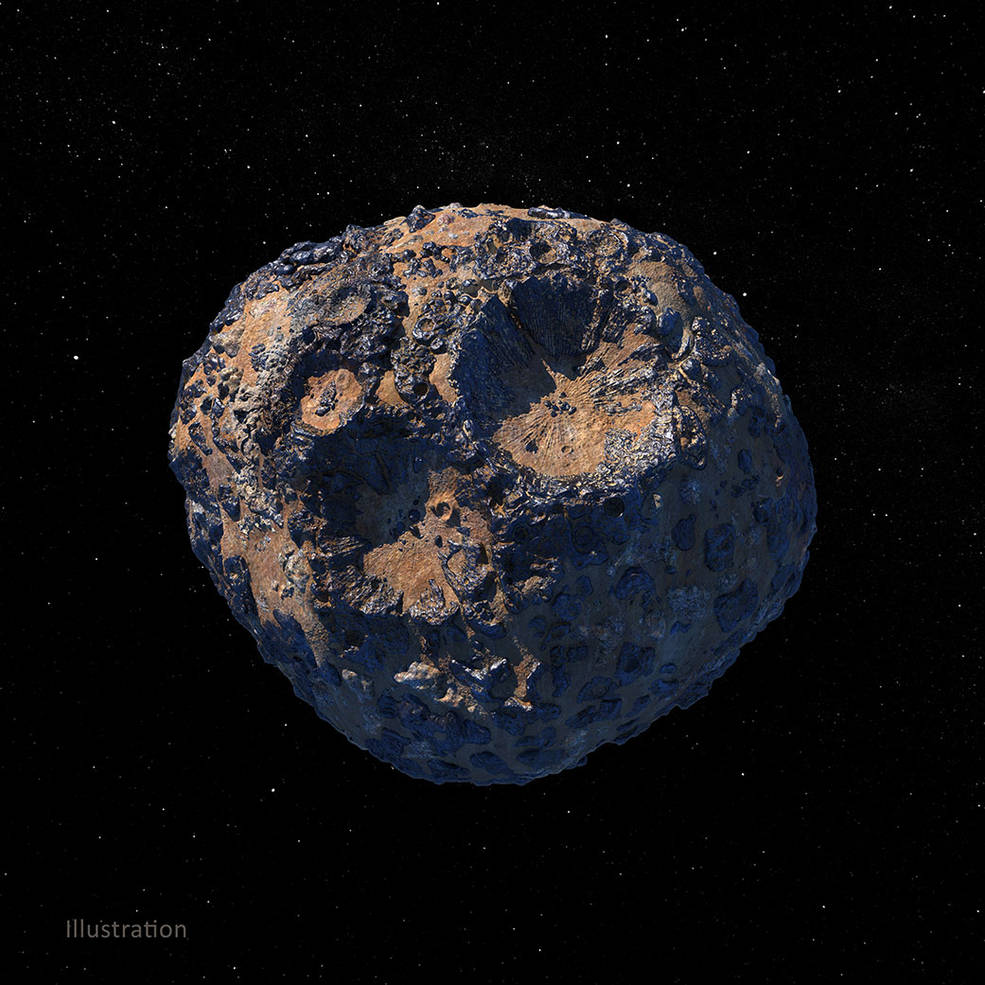
Many features have been reported on Psyche. The largest of these are regions of mass-deficits relative to its nominal ellipsoid shape and are reminiscent of the Rheasilvia basin on 4 Vesta.
In addition to the large-scale regions of mass-deficit, several apparent craters have been reported. Observers using the Very Large Telescope's adaptive optics SPHERE imager reported two large craters, on the order of 90 km across, which were provisionally named Meroe and Panthia , after the twin witches in the Roman novel Metamorphoses by Apuleius. Observers using the Arecibo Radar Telescope reported craters at the south pole (referred to as Delta), southern midlatitudes (referred to as Eros), and the north pole (referred to as Foxtrot). An analysis of the features present in several independent shape models suggests that craters Panthia and Eros are almost certainly real and Foxtrot is likely to be real. However, there is uncertainty over the existence of Meroe and Delta.
Early lightcurve studies suggested that Psyche has large variations in its surface brightness. These variations became more evident when attempts were made to invert lightcurves to generate shape models. The most recent shape models based on lightcurve inversions simultaneously solve for surface albedo variations, and the resulting maps show regions where local albedo differs from the mean albedo by more than 20% in either direction. Notably, the Meroe crater coincides with an area much darker than the mean, and the Panthia crater coincides with an area much brighter than the mean.
Radar observations with the Arecibo Radar Telescope revealed that Psyche's "background" radar albedo is \hat{\sigma}_{OC}=0.26 , comparable to other M-type asteroids like 21 Lutetia. This value is consistent with a silicate (rocky) regolith enriched in metal phases. However, in at least three locations, Psyche's radar albedo is nearly twice this value, suggesting high concentrations of metal phases in these regions. One of these locations corresponds with the optically bright Panthia crater, while the other two correspond with regions that have been reported as optically bright. This apparent correlation between optical and radar albedos on Psyche has led to the hypothesis that there is a link between the process(es) that create regions of high metal content and brighter terrain.
Composition
The bulk density of Psyche () places constraints on its overall composition. The iron-nickel found in most iron meteorites has a bulk density of . If Psyche were the remnant core of an early planetesimal, it would have to have an overall porosity of 50%. Given Psyche's size, this is considered highly improbable. However, there are other metal-rich meteorite types that have been suggested as Psyche analogs, each of which have bulk densities that are similar to Psyche's, including enstatite chondrites, bencubbinites, and mesosiderites.
Several observers have reported the presence of silicate minerals on the surface of Psyche. Spectra taken in October 2016 at the NASA Infrared Telescope Facility at the Mauna Kea Observatories showed evidence (~3 μm absorption feature) of hydroxyl ions on the asteroid that may suggest the presence of hydrated silicates. Since Psyche is thought to have formed under dry conditions without the presence of water, the hydroxyl may have reached Psyche via past impacts from smaller carbonaceous asteroids.
Psyche's radar albedo varies considerably over the surface, ranging from 0.22 to 0.52, values that are two to four times as high as most main-belt asteroids. Models of radar reflection equate this range of values with regolith bulk densities of 2.6 to 4.7 . This range is consistent with most of the metal-rich meteorite classes noted above and the spectroscopic detection of silicate minerals. It is inconsistent with a pure iron-nickel regolith unless it is highly porous.
Origin
Several possible origins have been proposed for Psyche. The earliest of these was that Psyche is an exposed metallic core resulting from a collision that stripped away the crust and mantle of an originally larger differentiated parent body some 500 kilometers in diameter. Other versions of this include the idea that it was not the result of a single large collision but multiple (more than three) relatively slow sideswipe collisions with bodies of comparable or larger size. However, this idea has fallen out of recent favor as mass and density estimates are inconsistent with a remnant core.
A second hypothesis is that Psyche was disrupted and gravitationally re-accreted into a mix of metal and silicate. In this case, it may be a candidate for the parent body of the mesosiderites, a class of stony–iron meteorites.
A third hypothesis is that Psyche may be a differentiated object, like 1 Ceres and 4 Vesta, but has experienced a type of iron volcanism, also known as ferrovolcanism, while still cooling. If true, this model predicts that metal would be highly enriched only in those regions containing (relic) volcanic centers. This view has been bolstered by recent radar observations.
Exploration
Main article: Psyche (spacecraft)

No spacecraft has visited Psyche, but a mission to Psyche was proposed to NASA in 2014. A team led by Lindy Elkins-Tanton, the director of the School for Earth and Space Exploration at Arizona State University, presented a concept for a robotic Psyche orbiter. This team argued that 16 Psyche would be a valuable object for study because it is the only metallic core-like body discovered so far.
The spacecraft would orbit Psyche for 20 months, studying its topography, surface features, gravity, magnetism, and other characteristics and would be based on current technology, avoiding high cost and the necessity to develop new technologies. On 30 September 2015, the Psyche orbiter mission was one of five Discovery Program semifinalist proposals.
The mission was approved by NASA on 4 January 2017 and was originally targeted to launch in October 2023, with an Earth gravity assist maneuver in 2024, a Mars flyby in 2025, and arriving at the asteroid in 2030.
On 28 February 2020, NASA awarded SpaceX a US$117 million contract to launch the Psyche spacecraft, and two smallsat secondary missions, on a Falcon Heavy rocket. with an expected arrival in 2029.
Asteroid Psyche has an Earth-MOID of 1.5 AU, and most recently came to opposition on 6 August 2024 when it was 1.7 AU from Earth.
Notes
References
|display-authors=etal
|access-date=5 October 2015
|archive-date=1 October 2015 |archive-url=https://web.archive.org/web/20151001105318/http://www.nasa.gov/press-release/nasa-selects-investigations-for-future-key-planetary-mission/ |url-status=live
|access-date=7 January 2017 |archive-date=7 January 2017 |archive-url=https://web.archive.org/web/20170107052013/http://www.nytimes.com/2017/01/06/science/nasa-psyche-asteroid.html |url-status=live
|access-date=26 May 2018 |url-status=dead |archive-url=https://web.archive.org/web/20180526190207/http://astro.troja.mff.cuni.cz/projects/asteroids3D/data/archive/1-1000/A109.M1806.shape.png |archive-date=26 May 2018
|name-list-style=amp
|display-authors=etal
|display-authors=etal
|display-authors=6 |book-title=LPI Contribution No. 1777 |access-date=5 October 2015
|display-authors=etal
|display-authors=6
|display-authors=6
|name-list-style=amp
|access-date=3 April 2007 |url-status=dead |archive-url=https://web.archive.org/web/20090825024347/http://aa.usno.navy.mil/faq/docs/minorplanets.php |archive-date=25 August 2009
|access-date=16 December 2025 |archive-date=23 October 2025 |archive-url=https://web.archive.org/web/20251023000005/https://ssd.jpl.nasa.gov/tools/sbdb_lookup.html#/?sstr=16 |url-status=live
|display-authors=etal |access-date=16 May 2006 |archive-url=https://web.archive.org/web/20080216072340/http://www.rni.helsinki.fi/~mjk/IcarPIII.pdf |archive-date=16 February 2008
|doi-access=free
| display-authors=etal
|access-date=24 May 2017
|archive-date=13 July 2017 |archive-url=https://web.archive.org/web/20170713111549/https://www.jpl.nasa.gov/news/news.php?release=2017-149 |url-status=live
|access-date=4 January 2017
|archive-date=17 June 2019 |archive-url=https://web.archive.org/web/20190617074931/https://www.nasa.gov/press-release/nasa-selects-two-missions-to-explore-the-early-solar-system/ |url-status=live
| display-authors= etal
|archive-date=18 September 2023 |archive-url=https://web.archive.org/web/20230918065012/https://ssd.jpl.nasa.gov/horizons_batch.cgi?batch=1&COMMAND=%2716%27&START_TIME=%272024-Jul-29%27&STOP_TIME=%272024-Aug-12%27&STEP_SIZE=%2760%27&QUANTITIES=%2720%2C23%27 |url-status=live
|access-date=16 April 2018 |url-status=dead |archive-url=https://web.archive.org/web/20151217090549/http://sbn.psi.edu/pds/asteroid/EAR_A_5_DDR_TAXONOMY_V6_0/data/taxonomy10.lbl |archive-date=17 December 2015
|access-date=26 May 2018
|archive-date=12 September 2010 |archive-url=https://web.archive.org/web/20100912112550/https://sbn.psi.edu/pds/resource/occ.html |url-status=live
|access-date=27 December 2021 |archive-date=8 December 2021 |archive-url=https://web.archive.org/web/20211208125051/https://www.asteroidoccultation.com/observations/Results/Reviewed/index2010.html |url-status=live
|access-date=27 December 2021 |archive-date=8 December 2021 |archive-url=https://web.archive.org/web/20211208122909/https://www.asteroidoccultation.com/observations/Results/Reviewed/index2019.html |url-status=live
|doi-access=free
| display-authors= etal
| doi-access=free
|display-authors=etal
|doi-access=free
|url-access=subscription
|doi-access=free }}
|access-date=14 October 2021
|display-authors=etal
|access-date=16 January 2014 |archive-date=18 January 2014 |archive-url=https://web.archive.org/web/20140118094509/http://www.space.com/24288-strange-metal-asteroid-psyche-nasa-mission.html |url-status=live
|access-date=30 September 2023 |archive-date=29 September 2023 |archive-url=https://web.archive.org/web/20230929225443/https://blogs.nasa.gov/psyche/2023/09/28/nasas-psyche-mission-targeting-oct-12-for-launch/ |url-status=live
References
- [https://ssd.jpl.nasa.gov/horizons_batch.cgi?batch=1&COMMAND=%2716%27&START_TIME=%272044-Aug-09%27&STOP_TIME=%272044-Aug-10%27&STEP_SIZE=%272%20day%27&QUANTITIES=%279,19,20,23,29%27 Perihelic opposition]
- (28 October 2022). "NASA continues Psyche asteroid mission". [[NASA]].
- (18 September 2023). "Unicode request for historical asteroid symbols". Unicode.
- (27 January 2023). "NASA to launch Psyche asteroid probe in October 2023 after delays".
- (October 13, 2023). "NASA’s Psyche Spacecraft, Optical Comms Demo En Route to Asteroid".
This article was imported from Wikipedia and is available under the Creative Commons Attribution-ShareAlike 4.0 License. Content has been adapted to SurfDoc format. Original contributors can be found on the article history page.
Ask Mako anything about 16 Psyche — get instant answers, deeper analysis, and related topics.
Research with MakoFree with your Surf account
Create a free account to save articles, ask Mako questions, and organize your research.
Sign up freeThis content may have been generated or modified by AI. CloudSurf Software LLC is not responsible for the accuracy, completeness, or reliability of AI-generated content. Always verify important information from primary sources.
Report