From Surf Wiki (app.surf) — the open knowledge base
4 Vesta
Second-largest asteroid of the main asteroid belt
Second-largest asteroid of the main asteroid belt
| Field | Value | |||
|---|---|---|---|---|
| minorplanet | yes | |||
| bgcolour | #D6D6D6 | |||
| name | 4 Vesta | |||
| symbol | [[File:Vesta symbol (bold).svg | 24px | class=skin-invert | ⚶]] (historically astronomical, now astrological) |
| image | Vesta_in_natural_color.jpg | |||
| caption | True color image of Vesta taken by *Dawn*. The massive Rheasilvia Crater dominates Vesta's south pole. | |||
| discoverer | Heinrich Wilhelm Olbers | |||
| discovered | 29 March 1807 | |||
| pronounced | ||||
| adjectives | {{Cslist | |||
| Vestian{{efn | 1 | Marc Rayman of the JPL *Dawn* team used "Vestian" (analogous to the Greek cognate *Hestian*) a few times in 2010 and early 2011 in his *Dawn Journal*, and the *Planetary Society* continued to use that form for a few more years. The word had been used elsewhere, e.g. in Tsiolkovsky (1960) *The call of the cosmos*. However, otherwise the shorter form "Vestan" has been used by JPL. Most modern print sources also use "Vestan". | ||
| Note that the related word "Vestalian" refers to people or things associated with Vesta, such as the vestal virgins, not to Vesta herself.}} | ||||
| named_after | Vesta | |||
| mp_category | Main belt (Vesta family) | |||
| mpc_name | (4) Vesta | |||
| orbit_ref | ||||
| epoch | 13 September 2023 | |||
| (JD 2453300.5) | ||||
| aphelion | 2.57 AU | |||
| perihelion | 2.15 AU | |||
| time_periastron | 26 December 2021 | |||
| semimajor | 2.36 AU | |||
| eccentricity | 0.0894 | |||
| period | 3.63 yr () | |||
| inclination | 7.1422° to ecliptic | |||
| 5.58° to invariable plane | ||||
| asc_node | 103.71° | |||
| arg_peri | 151.66° | |||
| mean_anomaly | 169.4° | |||
| avg_speed | 19.34 km/s | |||
| moid | 1.14 AU | |||
| p_orbit_ref | ||||
| p_semimajor | 2.36151 | |||
| p_eccentricity | 0.098758 | |||
| p_inclination | 6.39234° | |||
| p_mean_motion | 99.1888 | |||
| perihelion_rate | 36.8729 (2343 years) | |||
| node_rate | −39.5979 (2182 years) | |||
| satellites | None | |||
| allsatellites | yes | |||
| dimensions | ||||
| mean_diameter | ||||
| flattening | 0.2204 | |||
| surface_area | ||||
| volume | ||||
| mass | ||||
| density | ||||
| surface_grav | 0.22 m/s2 | |||
| escape_velocity | km/s | |||
| rotation | (5.342 h) | |||
| rot_velocity | 93.1 m/s | |||
| axial_tilt | 29° | |||
| right_asc_north_pole | 20h 32m | |||
| declination | 48° | |||
| spectral_type | V | |||
| magnitude | 5.1 to 8.48 | |||
| abs_magnitude | 3.20 | |||
| albedo | 0.423 | |||
| angular_size | 0.70 to 0.22 | |||
| single_temperature | *min:* 75 K (−198 °C) | |||
| *max:* 250 K (−23 °C) |
the asteroid
| Vestan | Vestian (JD 2453300.5) 5.58° to invariable plane max: 250 K (−23 °C) Vesta (minor-planet designation: 4 Vesta) is one of the largest objects in the asteroid belt, with a mean diameter of 525 km. It was discovered by the German astronomer Heinrich Wilhelm Matthias Olbers on 29 March 1807 and is named after Vesta, the virgin goddess of home and hearth from Roman mythology.
Vesta is thought to be the second-largest asteroid, both by mass and by volume, after the dwarf planet Ceres. Measurements give it a nominal volume only slightly larger than that of Pallas (about 5% greater), but it is 25% to 30% more massive. It constitutes an estimated 9% of the mass of the asteroid belt. Vesta is the only known remaining rocky protoplanet of the kind that formed the terrestrial planets. Numerous fragments of Vesta were ejected by collisions one and two billion years ago that left two enormous craters occupying much of Vesta's southern hemisphere. Debris from these events has fallen to Earth as howardite–eucrite–diogenite (HED) meteorites, which have been a rich source of information about Vesta.
Vesta is the brightest asteroid visible from Earth. It is regularly as bright as magnitude 5.1, at which times it is faintly visible to the naked eye. Its maximum distance from the Sun is slightly greater than the minimum distance of Ceres from the Sun, although its orbit lies entirely within that of Ceres.
NASA's Dawn spacecraft entered orbit around Vesta on 16 July 2011 for a one-year exploration and left the orbit of Vesta on 5 September 2012 en route to its final destination, Ceres. Researchers continue to examine data collected by Dawn for additional insights into the formation and history of Vesta.
History
Discovery
Heinrich Olbers discovered Pallas in 1802, the year after the discovery of Ceres. He proposed that the two objects were the remnants of a destroyed planet. He sent a letter with his proposal to the British astronomer William Herschel, suggesting that a search near the locations where the orbits of Ceres and Pallas intersected might reveal more fragments. These orbital intersections were located in the constellations of Cetus and Virgo. Olbers commenced his search in 1802, and on 29 March 1807 he discovered Vesta in the constellation Virgo—a coincidence, because Ceres, Pallas, and Vesta are not fragments of a larger body. Because the asteroid Juno had been discovered in 1804, this made Vesta the fourth object to be identified in the region that is now known as the asteroid belt. The discovery was announced in a letter addressed to German astronomer Johann H. Schröter dated 31 March. Because Olbers already had credit for discovering a planet (Pallas; at the time, the asteroids were considered to be planets), he gave the honor of naming his new discovery to German mathematician Carl Friedrich Gauss, whose orbital calculations had enabled astronomers to confirm the existence of Ceres, the first asteroid, and who had computed the orbit of the new planet in the remarkably short time of 10 hours. Gauss decided on the Roman virgin goddess of home and hearth, Vesta.
Name and symbol
Vesta was the fourth asteroid to be discovered, hence the number 4 in its formal designation. The name Vesta, or national variants thereof, is in international use with two exceptions: Greece and China. In Greek, the name adopted was the Hellenic equivalent of Vesta, Hestia in English, that name is used for (Greeks use the name "Hestia" for both, with the minor-planet numbers used for disambiguation). In Chinese, Vesta is called the 'hearth-god(dess) star', 灶神星 zh, naming the asteroid for Vesta's role in mythology, similar to the Chinese names of Uranus, Neptune, and Pluto.
Upon its discovery, Vesta was, like Ceres, Pallas, and Juno before it, classified as a planet and given a planetary symbol. The symbol represented the altar of Vesta with its sacred fire and was designed by Gauss.{{cite web | access-date = September 17, 2025 | url-status = live Some sources contemporaneous to Gauss invented more elaborate forms, such as [[File:Vesta symbol (old elaborate).svg|x20px|class=skin-invert|Temple form of the astronomical symbol for Vesta]] and [[File:Vesta symbol (old elaborate 2).svg|x20px|class=skin-invert|Elaborate form of the astronomical symbol for Vesta]]. never caught on. The asteroid symbols were gradually retired from astronomical use after 1852, but the symbols for the first four asteroids were resurrected for astrology in the 1970s. The abbreviated modern astrological variant of the Vesta symbol is .{{efn| This symbol can be seen in the top of the most elaborate of the earlier forms, [[File:Vesta symbol (old elaborate 2).svg|x20px|class=skin-invert|Elaborate form of the astronomical symbol for Vesta]]. It dates from 1973, at the beginning of astrological interest in asteroids.
After the discovery of Vesta, no further objects were discovered for 38 years, and during this time the Solar System was thought to have eleven planets. However, in 1845, new asteroids started being discovered at a rapid pace, and by 1851 there were fifteen, each with its own symbol, in addition to the eight major planets (Neptune had been discovered in 1846). It soon became clear that it would be impractical to continue inventing new planetary symbols indefinitely, and some of the existing ones proved difficult to draw quickly. That year, the problem was addressed by Benjamin Apthorp Gould, who suggested numbering asteroids in their order of discovery, and placing this number in a disk (circle) as the generic symbol of an asteroid. Thus, the fourth asteroid, Vesta, acquired the generic symbol ④. This was soon coupled with the name into an official number–name designation, as the number of minor planets increased. By 1858, the circle had been simplified to parentheses, which were easier to typeset. Other punctuation, such as and was also briefly used, but had more or less completely died out by 1949.
Early measurements
Photometric observations of Vesta were made at the Harvard College Observatory in 1880–1882 and at the Observatoire de Toulouse in 1909. These and other observations allowed the rotation rate of Vesta to be determined by the 1950s. However, the early estimates of the rotation rate came into question because the light curve included variations in both shape and albedo.
Early estimates of the diameter of Vesta ranged from 383 km in 1825, to 444 km. E.C. Pickering produced an estimated diameter of 513 ± in 1879, which is close to the modern value for the mean diameter, but the subsequent estimates ranged from a low of 390 km up to a high of 602 km during the next century. The measured estimates were based on photometry. In 1989, speckle interferometry was used to measure a dimension that varied between 498 and during the rotational period. In 1991, an occultation of the star SAO 93228 by Vesta was observed from multiple locations in the eastern United States and Canada. Based on observations from 14 different sites, the best fit to the data was an elliptical profile with dimensions of about 550 ×. Dawn confirmed this measurement. These measurements will help determine the thermal history, size of the core, role of water in asteroid evolution and what meteorites found on Earth come from these bodies, with the ultimate goal of understanding the conditions and processes present at the solar system's earliest epoch and the role of water content and size in planetary evolution.
Vesta became the first asteroid to have its mass determined. Every 18 years, the asteroid 197 Arete approaches within of Vesta. In 1966, based upon observations of Vesta's gravitational perturbations of Arete, Hans G. Hertz estimated the mass of Vesta at (solar masses). More refined estimates followed, and in 2001 the perturbations of 17 Thetis were used to calculate the mass of Vesta to be . Dawn determined it to be .
Orbit
Vesta orbits the Sun between Mars and Jupiter, within the asteroid belt, with a period of 3.6 Earth years, specifically in the inner asteroid belt, interior to the Kirkwood gap at 2.50 AU. Its orbit is moderately inclined (i = 7.1°, compared to 7° for Mercury and 17° for Pluto) and moderately eccentric (e = 0.09, about the same as for Mars).
True orbital resonances between asteroids are considered unlikely. Because of their small masses relative to their large separations, such relationships should be very rare. Nevertheless, Vesta is able to capture other asteroids into temporary 1:1 resonant orbital relationships (for periods up to 2 million years or more) and about forty such objects have been identified. Decameter-sized objects detected in the vicinity of Vesta by Dawn may be such quasi-satellites rather than proper satellites.
Rotation
Vesta's rotation is relatively fast for an asteroid (5.342 h) and prograde, with the north pole pointing in the direction of right ascension 20 h 32 min, declination +48° (in the constellation Cygnus) with an uncertainty of about 10°. This gives an axial tilt of 29°.
Coordinate systems
Two longitudinal coordinate systems are used for Vesta, with prime meridians separated by 150°. The IAU established a coordinate system in 1997 based on Hubble photos, with the prime meridian running through the center of Olbers Regio, a dark feature 200 km across. When Dawn arrived at Vesta, mission scientists found that the location of the pole assumed by the IAU was off by 10°, so that the IAU coordinate system drifted across the surface of Vesta at 0.06° per year, and also that Olbers Regio was not discernible from up close, and so was not adequate to define the prime meridian with the precision they needed. They corrected the pole, but also established a new prime meridian 4° from the center of Claudia, a sharply defined crater 700 m across, which they say results in a more logical set of mapping quadrangles. All NASA publications, including images and maps of Vesta, use the Claudian meridian, which is unacceptable to the IAU. The IAU Working Group on Cartographic Coordinates and Rotational Elements recommended a coordinate system, correcting the pole but rotating the Claudian longitude by 150° to coincide with Olbers Regio. It was accepted by the IAU, although it disrupts the maps prepared by the Dawn team, which had been positioned so they would not bisect any major surface features.
Physical characteristics
Vesta is the second most massive body in the asteroid belt, although it is only 28% as massive as Ceres, the most massive body. Vesta is, however, the most massive body that formed in the asteroid belt, as Ceres is believed to have formed between Jupiter and Saturn. Vesta's density is lower than those of the four terrestrial planets but is higher than those of most asteroids, as well as all of the moons in the Solar System except Io. Vesta's surface area is about the same as the land area of Pakistan, Venezuela, Tanzania, or Nigeria; slightly under 900000 km2. It has an only partially differentiated interior. Vesta is only slightly larger () than 2 Pallas () in mean diameter, but is about 25% more massive.
Vesta's shape is close to a gravitationally relaxed oblate spheroid, but the large concavity and protrusion at the southern pole (see 'Surface features' below) combined with a mass less than precluded Vesta from automatically being considered a dwarf planet under International Astronomical Union (IAU) Resolution XXVI 5. A 2012 analysis of Vesta's shape and gravity field using data gathered by the Dawn spacecraft has shown that Vesta is currently not in hydrostatic equilibrium.
Temperatures on the surface have been estimated to lie between about −20 C with the Sun overhead, dropping to about −190 C at the winter pole. Typical daytime and nighttime temperatures are −60 C and −130 C, respectively. This estimate is for 6 May 1996, very close to perihelion, although details vary somewhat with the seasons.
Surface features
Before the arrival of the Dawn spacecraft, some Vestan surface features had already been resolved using the Hubble Space Telescope and ground-based telescopes (e.g., the Keck Observatory). The arrival of Dawn in July 2011 revealed the complex surface of Vesta in detail.
Rheasilvia and Veneneia
Main article: Rheasilvia, Veneneia


The most prominent of these surface features are two enormous impact basins, the 500 km Rheasilvia, centered near the south pole; and the 400 km Veneneia. The Rheasilvia impact basin is younger and overlies the Veneneia. The Dawn science team named the younger, more prominent crater Rheasilvia, after the mother of Romulus and Remus and a mythical vestal virgin. Its width is 95% of the mean diameter of Vesta. The crater is about 19 km deep. A central peak rises 23 km above the lowest measured part of the crater floor and the highest measured part of the crater rim is 31 km above the crater floor low point. It is estimated that the impact responsible excavated about 1% of the volume of Vesta, and it is likely that the Vesta family and V-type asteroids are the products of this collision. If this is the case, then the fact that 10 km fragments have survived bombardment until the present indicates that the crater is at most only about 1 billion years old. It would also be the site of origin of the HED meteorites. All the known V-type asteroids taken together account for only about 6% of the ejected volume, with the rest presumably either in small fragments, ejected by approaching the 3:1 Kirkwood gap, or perturbed away by the Yarkovsky effect or radiation pressure. Spectroscopic analyses of the Hubble images have shown that this crater has penetrated deep through several distinct layers of the crust, and possibly into the mantle, as indicated by spectral signatures of olivine.
Subsequent analysis of data from the Dawn mission provided much greater detail on Rheasilvia's structure and composition, confirming it as one of the largest impact structures known relative to its parent body size. The impact clearly modified the pre-existing very large, Veneneia structure, indicating Rheasilvia's younger age. Rheasilvia's size makes Vesta's southern topography unique, creating a flattened southern hemisphere and contributing significantly to the asteroid's overall oblate shape. Rheasilvia's ~22 km central peak stands as one of the tallest mountains identified in the Solar System. Its base width of roughly 180 km and complex morphology distinguishes it from the simpler central peaks seen in smaller craters. Numerical modeling indicates that such a large central structure within a ~505 km diameter basin requires formation on a differentiated body with significant gravity. Scaling laws for craters on smaller asteroids fail to predict such a feature; instead, impact dynamics involving transient crater collapse and rebound of the underlying material (potentially upper mantle) are needed to explain its formation. Hydrocode simulations suggest the impactor responsible was likely 60 – across, impacting at roughly 5.4 km/s. Models of impact angle (around 30-45 degrees from vertical) better match the detailed morphology of the basin and its prominent peak. Crater density measurements on Rheasilvia's relatively unmodified floor materials and surrounding ejecta deposits, calibrated using standard lunar chronology functions adapted for Vesta's location, place the impact event at approximately 1 billion years ago. This age makes Rheasilvia a relatively young feature on a protoplanetary body formed early in Solar System history. The estimated excavation of ~1% of Vesta's volume provides a direct link to the Vesta family of asteroids (Vestoids) and the HED meteorites. Since Vesta's spectral signature matches that of the Vestoids and HEDs, this strongly indicates they are fragments ejected from Vesta most likely during the Rheasilvia impact.
The Dawn mission's VIR instrument helped to confirm the basin's deep excavation and compositional diversity. VIR mapping revealed spectral variations across the basin consistent with the mixing of different crustal layers expected in the HED meteorites. Signatures matching eucrites (shallow crustal basalts) and diogenites (deeper crustal orthopyroxenites) were identified, which usually correlate with specific morphological features like crater walls or slump blocks. The confirmed signature of olivine-rich material, which were first hinted at by Hubble observations is strongest on the flanks of the central peak and in specific patches along the basin rim and walls, suggesting it is not uniformly distributed but rather exposed in distinct outcrops. As the dominant mineral expected in Vesta's mantle beneath the HED-like crust, the presence of olivine indicates the Rheasilvia impact penetrated Vesta's entire crust (~20 – thick in the region) and excavated material from the upper mantle. Furthermore, the global stresses resulting from this massive impact are considered the likely trigger for the formation of the large trough systems, like Divalia Fossa, that encircle Vesta's equatorial regions.
Other craters

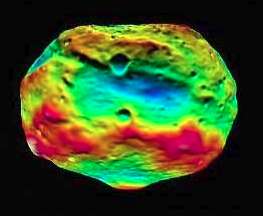
Several old, degraded craters approach Rheasilvia and Veneneia in size, although none are quite so large. They include Feralia Planitia, shown at right, which is 270 km across. More-recent, sharper craters range up to 158 km Varronilla and 196 km Postumia.
Dust fills up some craters, creating so-called dust ponds. They are a phenomenon where pockets of dust are seen in celestial bodies without a significant atmosphere. These are smooth deposits of dust accumulated in depressions on the surface of the body (like craters), contrasting from the Rocky terrain around them. On the surface of Vesta, we have identified both type 1 (formed from impact melt) and type 2 (electrostatically made) dust ponds within 0˚–30°N/S, that is, Equatorial region. 10 craters have been identified with such formations.
"Snowman craters"
The "snowman craters" are a group of three adjacent craters in Vesta's northern hemisphere. Their official names, from largest to smallest (west to east), are Marcia, Calpurnia, and Minucia. Marcia is the youngest and cross-cuts Calpurnia. Minucia is the oldest.
Troughs
The majority of the equatorial region of Vesta is sculpted by a series of parallel troughs designated Divalia Fossae; its longest trough is 10 – wide and 465 km long. Despite the fact that Vesta is a one-seventh the size of the Moon, Divalia Fossae dwarfs the Grand Canyon. A second series, inclined to the equator, is found further north. This northern trough system is named Saturnalia Fossae, with its largest trough being roughly 40 km wide and over 370 km long. These troughs are thought to be large-scale graben resulting from the impacts that created Rheasilvia and Veneneia craters, respectively. They are some of the longest chasms in the Solar System, nearly as long as Ithaca Chasma on Tethys. The troughs may be graben that formed after another asteroid collided with Vesta, a process that can happen only in a body that is differentiated, which Vesta may not fully be. Alternatively, it is proposed that the troughs may be radial sculptures created by secondary cratering from Rheasilvia.
Surface composition
Compositional information from the visible and infrared spectrometer (VIR), gamma-ray and neutron detector (GRaND), and framing camera (FC), all indicate that the majority of the surface composition of Vesta is consistent with the composition of the howardite, eucrite, and diogenite meteorites. The Rheasilvia region is richest in diogenite, consistent with the Rheasilvia-forming impact excavating material from deeper within Vesta. The presence of olivine within the Rheasilvia region would also be consistent with excavation of mantle material. However, olivine has only been detected in localized regions of the northern hemisphere, not within Rheasilvia. The origin of this olivine is currently unclear. Though olivine was expected by astronomers to have originated from Vesta's mantle prior to the arrival of the Dawn orbiter, the lack of olivine within the Rheasilvia and Veneneia impact basins complicates this view. Both impact basins excavated Vestian material down to 60–100 km, far deeper than the expected thickness of ~30–40 km for Vesta's crust. Vesta's crust may be far thicker than expected or the violent impact events that created Rheasilvia and Veneneia may have mixed material enough to obscure olivine from observations. Alternatively, Dawn observations of olivine could instead be due to delivery by olivine-rich impactors, unrelated to Vesta's internal structure.
Features associated with volatiles
Pitted terrain has been observed in four craters on Vesta: Marcia, Cornelia, Numisia and Licinia. The formation of the pitted terrain is proposed to be degassing of impact-heated volatile-bearing material. Along with the pitted terrain, curvilinear gullies are found in Marcia and Cornelia craters. The curvilinear gullies end in lobate deposits, which are sometimes covered by pitted terrain, and are proposed to form by the transient flow of liquid water after buried deposits of ice were melted by the heat of the impacts. Hydrated materials have also been detected, many of which are associated with areas of dark material. Consequently, dark material is thought to be largely composed of carbonaceous chondrite, which was deposited on the surface by impacts. Carbonaceous chondrites are comparatively rich in mineralogically bound OH.
Geology

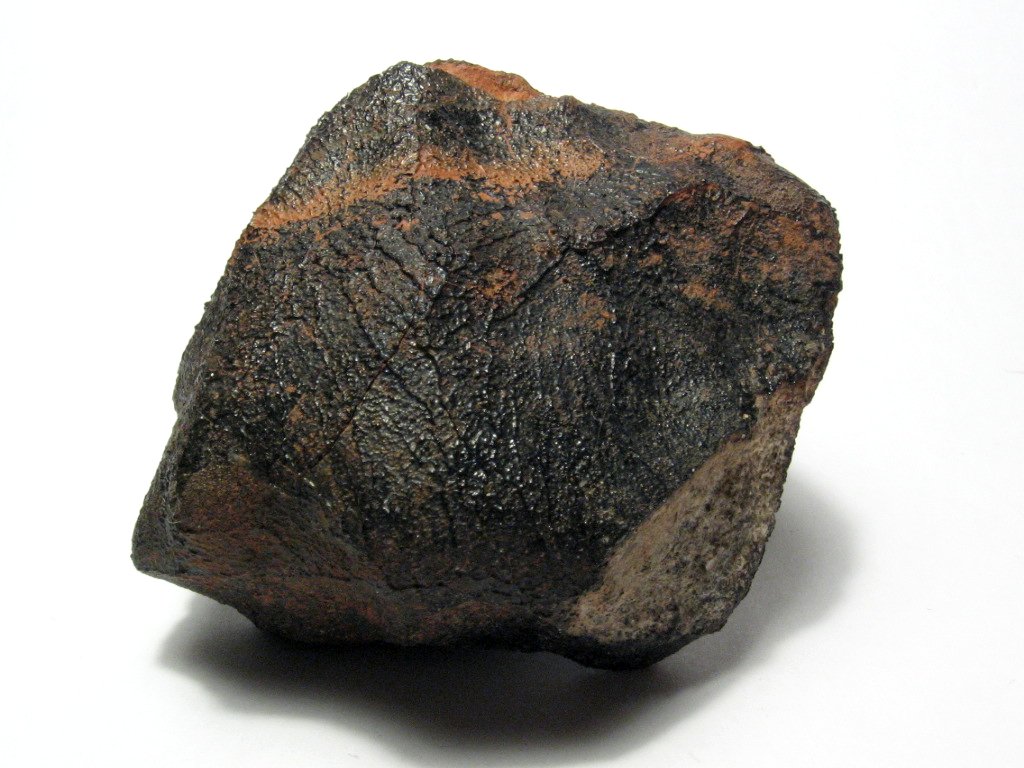
A large collection of potential samples from Vesta is accessible to scientists, in the form of over 1200 HED meteorites (Vestan achondrites), giving insight into Vesta's geologic history and structure. NASA Infrared Telescope Facility (NASA IRTF) studies of asteroid suggest that it originated from deeper within Vesta than the HED meteorites.
Vesta is thought to consist of a metallic iron–nickel core, variously estimated to be 90 km to 220 km in diameter, an overlying rocky olivine mantle, with a surface crust of similar composition to HED meteorites.
From the first appearance of calcium–aluminium-rich inclusions (the first solid matter in the Solar System, forming about 4.567 billion years ago), a likely time line is as follows:
| 2–3 million years | 4–5 million years | 6–7 million years |
|---|---|---|
| Accretion completed | ||
| Complete or almost complete melting due to radioactive decay of 26Al, leading to separation of the metal core | ||
| Progressive crystallization of a convecting molten mantle. Convection stopped when about 80% of the material had crystallized | ||
| Extrusion of the remaining molten material to form the crust, either as basaltic lavas in progressive eruptions, or possibly forming a short-lived magma ocean. | ||
| The deeper layers of the crust crystallize to form plutonic rocks, whereas older basalts are metamorphosed due to the pressure of newer surface layers. | ||
| Slow cooling of the interior |
Vesta is the only known intact asteroid that has been resurfaced in this manner. Because of this, some scientists refer to Vesta as a protoplanet.
| Plutonic rocks rich in orthopyroxene with large grain sizes, the source of diogenites. |
|---|
On the basis of the sizes of V-type asteroids (thought to be pieces of Vesta's crust ejected during large impacts), and the depth of Rheasilvia crater (see below), the crust is thought to be roughly 10 km thick. Findings from the Dawn spacecraft have found evidence that the troughs that wrap around Vesta could be graben formed by impact-induced faulting (see Troughs section above), meaning that Vesta has more complex geology than other asteroids. The impacts that created the Rheasilvia and Veneneia craters occurred when Vesta was no longer warm and plastic enough to return to an equilibrium shape, distorting its once rounded shape and prohibiting it from being classified as a dwarf planet today.
Regolith
Vesta's surface is covered by regolith distinct from that found on the Moon or asteroids such as Itokawa. This is because space weathering acts differently. Vesta's surface shows no significant trace of nanophase iron because the impact speeds on Vesta are too low to make rock melting and vaporization an appreciable process. Instead, regolith evolution is dominated by brecciation and subsequent mixing of bright and dark components. The dark component is probably due to the infall of carbonaceous material, whereas the bright component is the original Vesta basaltic soil.
Fragments
Some small Solar System bodies are suspected to be fragments of Vesta caused by impacts. The Vestian asteroids and HED meteorites are examples. The V-type asteroid 1929 Kollaa has been determined to have a composition akin to cumulate eucrite meteorites, indicating its origin deep within Vesta's crust.
Vesta is currently one of only eight identified Solar System bodies of which we have physical samples, coming from a number of meteorites suspected to be Vestan fragments. It is estimated that 1 out of 16 meteorites originated from Vesta. The other identified Solar System samples are from Earth itself, meteorites from Mars, meteorites from the Moon, and samples returned from the Moon, the comet Wild 2, and the asteroids 25143 Itokawa, 162173 Ryugu, and 101955 Bennu.
Exploration

In 1981, a proposal for an asteroid mission was submitted to the European Space Agency (ESA). Named the Asteroidal Gravity Optical and Radar Analysis (AGORA), this spacecraft was to launch some time in 1990–1994 and perform two flybys of large asteroids. The preferred target for this mission was Vesta. AGORA would reach the asteroid belt either by a gravitational slingshot trajectory past Mars or by means of a small ion engine. However, the proposal was refused by the ESA. A joint NASA–ESA asteroid mission was then drawn up for a Multiple Asteroid Orbiter with Solar Electric Propulsion (MAOSEP), with one of the mission profiles including an orbit of Vesta. NASA indicated they were not interested in an asteroid mission. Instead, the ESA set up a technological study of a spacecraft with an ion drive. Other missions to the asteroid belt were proposed in the 1980s by France, Germany, Italy and the United States, but none were approved. Exploration of Vesta by fly-by and impacting penetrator was the second main target of the first plan of the multi-aimed Soviet Vesta mission, developed in cooperation with European countries for realisation in 1991–1994 but canceled due to the dissolution of the Soviet Union.
In the early 1990s, NASA initiated the Discovery Program, which was intended to be a series of low-cost scientific missions. In 1996, the program's study team recommended a mission to explore the asteroid belt using a spacecraft with an ion engine as a high priority. Funding for this program remained problematic for several years, but by 2004 the Dawn vehicle had passed its critical design review and construction proceeded.
It launched on 27 September 2007 as the first space mission to Vesta. On 3 May 2011, Dawn acquired its first targeting image 1.2 e6km from Vesta. On 16 July 2011, NASA confirmed that it received telemetry from Dawn indicating that the spacecraft successfully entered Vesta's orbit. It was scheduled to orbit Vesta for one year, until July 2012. Dawn arrival coincided with late summer in the southern hemisphere of Vesta, with the large crater at Vesta's south pole (Rheasilvia) in sunlight. Because a season on Vesta lasts eleven months, the northern hemisphere, including anticipated compression fractures opposite the crater, would become visible to Dawn cameras before it left orbit. Dawn left orbit around Vesta on 4 September 2012 11:26 p.m. PDT to travel to Ceres.
NASA/DLR released imagery and summary information from a survey orbit, two high-altitude orbits (60–70 m/pixel) and a low-altitude mapping orbit (20 m/pixel), including digital terrain models, videos and atlases. Scientists also used Dawn to calculate Vesta's precise mass and gravity field. The subsequent determination of the J2 component yielded a core diameter estimate of about 220 km assuming a crustal density similar to that of the HED.
Dawn data can be accessed by the public at the UCLA website.
Observations from Earth orbit
File:Vesta spectral map HST1994.jpg|Albedo and spectral maps of 4 Vesta, as determined from Hubble Space Telescope images from November 1994 File:Vesta elevation map HST1996.jpg|Elevation map of 4 Vesta, as determined from Hubble Space Telescope images of May 1996 File:Vesta-Elevation.jpg|Elevation diagram of 4 Vesta (as determined from Hubble Space Telescope images of May 1996) viewed from the south-east, showing Rheasilvia crater at the south pole and Feralia Planitia near the equator File:Vesta-HST-Color.jpg|Vesta seen by the Hubble Space Telescope in May 2007 File:Iau dozen.jpg|The 2006 IAU draft proposal on the definition of a planet listed Vesta as a candidate. Vesta is shown fourth from the left along the bottom row.
Observations from ''Dawn''
Vesta comes into view as the Dawn spacecraft approaches and enters orbit: File:Vesta 20110701 cropped.jpg|Vesta from 100,000 km (1 July 2011) File:Dawn-image-070911.jpg|Vesta from 41,000 km (9 July 2011) File:Vesta from Dawn, July 17.jpg|In orbit at 16,000 km (17 July 2011) File:Vesta 4.jpg|In orbit from 10,500 km (18 July 2011) File:Vesta darkside.jpg|The northern hemisphere from 5,200 km (23 July 2011) File:Vesta Full-Frame.jpg|In orbit from 5,200 km (24 July 2011) File:Vesta 20110731.jpg|In orbit from 3,700 km (31 July 2011) File:Vesta Rotation.gif|Full rotation (1 August 2011) File:Vesta full mosaic.jpg|Composite greyscale image File:Vesta Cratered terrain with hills and ridges.jpg|Cratered terrain with hills and ridges (6 August 2011) File:Vesta densely cratered terrain near terminator.jpg|Densely cratered terrain near terminator (6 August 2011) File:Vesta Craters in various states of degradation.jpg|Vestan craters in various states of degradation, with troughs at bottom (6 August 2011) File:Central Mound at the South Pole Asteroid Vesta Hillshade.png|Hill shaded central mound at the south pole of Vesta (2 February 2015)
True-color images
Vesta in natural color.jpg Vesta-SouthPole.png Vesta 5755-728.png
Detailed images retrieved during the high-altitude (60–70 m/pixel) and low-altitude (~20 m/pixel) mapping orbits are available on the Dawn Mission website of JPL/NASA.
Visibility
Its size and unusually bright surface make Vesta the brightest asteroid, and it is occasionally visible to the naked eye from dark skies (without light pollution). In May and June 2007, Vesta reached a peak magnitude of +5.4, the brightest since 1989. At that time, opposition and perihelion were only a few weeks apart. It was brighter still at its 22 June 2018 opposition, reaching a magnitude of +5.3. Less favorable oppositions during late autumn 2008 in the Northern Hemisphere still had Vesta at a magnitude of from +6.5 to +7.3. Even when in conjunction with the Sun, Vesta will have a magnitude around +8.5; thus from a pollution-free sky it can be observed with binoculars even at elongations much smaller than near opposition.
2010–2011
In 2010, Vesta reached opposition in the constellation of Leo on the night of 17–18 February, at about magnitude 6.1, a brightness that makes it visible in binocular range but generally not for the naked eye. Under perfect dark sky conditions where all light pollution is absent it might be visible to an experienced observer without the use of a telescope or binoculars. Vesta came to opposition again on 5 August 2011, in the constellation of Capricornus at about magnitude 5.6.
2012–2013
Vesta was at opposition again on 9 December 2012. According to Sky and Telescope magazine, this year Vesta came within about 6 degrees of 1 Ceres during the winter of 2012 and spring 2013. Vesta orbits the Sun in 3.63 years and Ceres in 4.6 years, so every 17.4 years Vesta overtakes Ceres (the previous overtaking was in April 1996). On 1 December 2012, Vesta had a magnitude of 6.6, but it had decreased to 8.4 by 1 May 2013.
2014
Ceres and Vesta came within one degree of each other in the night sky in July 2014.
Notes
References
—
—
Bibliography
- The Dawn Mission to Minor Planets 4 Vesta and 1 Ceres, Christopher T. Russell and Carol A. Raymond (Editors), Springer (2011),
- Keil, K.; Geological History of Asteroid 4 Vesta: The Smallest Terrestrial Planet in Asteroids III, William Bottke, Alberto Cellino, Paolo Paolicchi, and Richard P. Binzel (editors), University of Arizona Press (2002),
References
- {{dict.com. Vesta
- E.g in ''Meteoritics & planetary science'' (volume 42, issues 6–8, 2007) and ''Origin and evolution of Earth'' (National Research Council ''et al.'', 2008).
- (10 November 2017). "In Depth - 4 Vesta". NASA Solar System Exploration.
- (18 September 2023). "Unicode request for historical asteroid symbols". [[Unicode Consortium]].
- Koch, Rudolf. (1955). "The Book of Signs". Dover.
- Bach, Eleanor. (1973). "Ephemerides of the asteroids: Ceres, Pallas, Juno, Vesta, 1900–2000". Celestial Communications.
- "New SPHERE view of Vesta".
- Other objects in the Solar system with well-defined masses within a factor of 2 of Vesta's mass are {{dp. Varda, [[Gǃkúnǁʼhòmdímà]], and {{dp. Salacia (245, 136, and 492{{e. 18 kg, respectively). No moons are in this range: the closest, [[Tethys (moon). Tethys]] {{nowrap. (Saturn III) and [[Enceladus (moon). Enceladus]] {{nowrap. (Saturn II), are over twice and less than half of Vesta's mass.
- (2013). "Rheasilvia impact basin on Vesta: Constraints on formation models from the central peak topography". Journal of Geophysical Research: Planets.
- (2013). "Numerical simulations of the Rheasilvia impact basin on Vesta". Journal of Geophysical Research: Planets.
- (2012). "The Violent Collisional History of Vesta". Science.
- (2012). "Spectroscopic Characterization of Mineralogy and Its Diversity on Vesta". Science.
- (2014). "Constraints on Vesta's crustal structure and evolution from VIR/Dawn data: Olivine detection and analysis". Icarus.
- Beatty, J. Kelly. (25 June 2004). "Eros's puzzling surface".
- (28 February 2022). "Formation of ejecta and dust pond deposits on asteroid Vesta". Journal of Geophysical Research: Planets.
- Hirata, N.. (2023). "Secondary Cratering From Rheasilvia as the Possible Origin of Vesta's Equatorial Troughs". Journal of Geophysical Research: Planets.
- Park, R. S.. (2025-04-23). "A small core in Vesta inferred from Dawn's observations". Nature Astronomy.
- (22 October 2018). "Dawn Mission website of JPL/NASA".
- Harrington, Philip S.. (21 October 2010). "Cosmic Challenge: The Ultimate Observing List for Amateurs". Cambridge University Press.
- "Search{{Snd}} Dawn Mission". JPL.
- ''Meteoritics & planetary science'', Volume 42, Issues 6–8, 2007; ''Origin and evolution of Earth'', National Research Council et al., 2008
- "Search Results". Planetary Society.
- "JPL Small-Body Database Browser: 4 Vesta".
- (July 2012). "The solar system's invariable plane". Astronomy & Astrophysics.
- "AstDyS-2 Vesta Synthetic Proper Orbital Elements". Department of Mathematics, University of Pisa, Italy.
- Russell, C. T.. (2012). "Dawn at Vesta: Testing the Protoplanetary Paradigm". Science.
- Konopliv, A. S.. (2014). "The Vesta gravity field, spin pole and rotation period, landmark positions, and ephemeris from the Dawn tracking and optical data". Icarus.
- Harris, A. W.. (2006). "Asteroid Lightcurve Derived Data. EAR-A-5-DDR-DERIVED-LIGHTCURVE-V8.0.". [[Planetary Data System.
- "Asteroid 4 Vesta". TheSkyLive.
- Neese, C.. (2005). "Asteroid Taxonomy EAR-A-5-DDR-TAXONOMY-V5.0". [[Planetary Data System.
- Menzel, Donald H.. (1983). "A Field Guide to the Stars and Planets". Houghton Mifflin.
- Tedesco, E. F.. (2004). "Infra-Red Astronomy Satellite (IRAS) Minor Planet Survey. IRAS-A-FPA-3-RDR-IMPS-V6.0.". [[Planetary Data System.
- Mueller, T. G.. (2001). "ISO and Asteroids". ESA Bulletin.
- "Dawn Mission Overview". NASA.
- Lang, Kenneth. (2011). "The Cambridge Guide to the Solar System". Cambridge University Press.
- Russell, C. T.. (2011). "Exploring the smallest terrestrial planet: Dawn at Vesta".
- Pitjeva, E. V.. (2005). "High-Precision Ephemerides of Planets—EPM and Determination of Some Astronomical Constants". Solar System Research.
- Carry, B.. (2009). "Physical properties of (2) Pallas". Icarus.
- Savage, Don. (19 April 1995). "Asteroid or Mini-Planet? Hubble Maps the Ancient Surface of Vesta". [[HubbleSite]].
- (11 May 2012). "Asteroid Vesta is 'last of a kind' rock". BBC News.
- Jutzi, M.. (14 February 2013). "The structure of the asteroid 4 Vesta as revealed by models of planet-scale". Nature.
- Cook, Jia-Rui. "Dawn Reality-Checks Telescope Studies of Asteroids".
- McSween, H. Y.. (27 November 2013). "Dawn; the Vesta-HED connection; and the geologic context for eucrite, diogenites, and howardites". Meteoritics & Planetary Science.
- Kelley, M. S.. (2003). "Quantified mineralogical evidence for a common origin of 1929 Kollaa with 4 Vesta and the HED meteorites". Icarus.
- (12 July 2011). "Vesta". NASA/JPL.
- "Ceres, Pallas, Vesta, and Hygiea". Gravity Simulator.
- "Mission > Mission Status{{Snd}} Dawn Mission". JPL.
- Cook, Jia-Rui. "It's Complicated: Dawn Spurs Rewrite of Vesta's Story".
- Littmann, Mark. (2004). "Planets Beyond: Discovering the Outer Solar System". Courier Dover Publications.
- Lynn, W. T.. (February 1907). "The discovery of Vesta". The Observatory.
- Dunnington, Guy Waldo. (2004). "Carl Friedrich Gauss: Titan of Science". The Mathematical Association of America.
- Rao, K. S.. (2003). "Gauss, Ramanujan and Hypergeometric Series Revisited". Historia Scientiarum.
- Schmadel, Lutz D.. (2003). "Dictionary of Minor Planet Names: Prepared on Behalf of Commission 20 Under the Auspices of the International Astronomical Union". Springer.
- von Zach, Franz Xaver. (1807). "Monatliche correspondenz zur beförderung der erd- und himmels-kunde".
- Carlini, Francesco. (1808). "Effemeridi astronomiche di Milano per l'anno 1809".
- Bureau des longitudes. (1807). "Annuaire pour l'an 1808".
- (1810). "Elementi di fisica matematica".
- Wells, David A.. (1851). "The Planet Hygiea". Annual of Scientific Discovery for the year 1850, quoted by spaceweather.com archives, 2006-09-13.
- Gould, B. A.. (1852). "When Did the Asteroids Become Minor Planets?". Astronomical Journal.
- McFadden, L. A.. "Photometry of 4 Vesta from its 2007 Apparition".
- Hughes, D. W.. (September 1994). "The Historical Unravelling of the Diameters of the First Four Asteroids". [[Quarterly Journal of the Royal Astronomical Society]].
- Povenmire, H.. (September 2001). "The January 4, 1991 Occultation of SAO 93228 by Asteroid (4) Vesta". Meteoritics & Planetary Science.
- "Dawn-NASA-NSSDCA-Spacecraft-Details".
- Hertz, Hans G.. (19 April 1968). "Mass of Vesta". Science.
- Kovačević, A.. (January 2005). "Determination of the mass of (4) Vesta based on new close approaches". Astronomy and Astrophysics.
- Christou, A. A.. (2000). "Co-orbital objects in the main asteroid belt". [[Astronomy and Astrophysics]].
- (January 2012). "A population of Main Belt Asteroids co-orbiting with Ceres and Vesta". Icarus.
- Thomas, P. C.. (1997). "Vesta: Spin Pole, Size, and Shape from HST Images". Icarus.
- (2012). "Space missions trigger map wars". Nature.
- (2013-11-15). "IAU WGCCRE Coordinate System for Vesta {{pipe}} USGS Astrogeology Science Center". Astrogeology.usgs.gov.
- "Body-Fixed Coordinate Systems for Asteroid (4) Vesta".
- Gingerich, Owen. (2006). "The Path to Defining Planets".
- Baer, James. (2008). "Astrometric masses of 21 asteroids, and an integrated asteroid ephemeris". Celestial Mechanics and Dynamical Astronomy.
- (August 2006). "The IAU draft definition of "planet" and "plutons"". IAU.
- Fu, R. R.. (2013). "Early Viscous Relaxation of Asteroid Vesta and Implications for Late Impact-Driven Despinning". 44th Lunar and Planetary Science Conference.
- Asmar, S. W.. (2012). "The Gravity Field of Vesta and Implications for Interior Structure". 43rd Lunar and Planetary Science Conference.
- Scully, J. E. C.. (December 2014). "Geomorphology and structural geology of Saturnalia Fossae and adjacent structures in the northern hemisphere of Vesta". Icarus.
- (December 2014). "Imprint of the Rheasilvia impact on Vesta{{Snd}} Geologic mapping of quadrangles Gegania and Lucaria". Icarus.
- (December 2014). "Morphology and formation ages of mid-sized post-Rheasilvia craters{{Snd}}Geology of quadrangle Tuccia, Vesta". Icarus.
- Zellner, N. E. B.. (2005). "Near-IR imaging of Asteroid 4 Vesta". Icarus.
- Jaumann, R.. (2012). "Vesta's Shape and Morphology". Science.
- Schenk, P.. (2012). "The Geologically Recent Giant Impact Basins at Vesta's South Pole". Science.
- (21 September 2011). "Rheasilvia{{Snd}} Super Mysterious South Pole Basin at Vesta is Named after Romulus and Remus Roman Mother". Universe Today.
- Binzel, R. P.. (1997). "Geologic Mapping of Vesta from 1994 Hubble Space Telescope Images". Icarus.
- "Nomenclature Search Results / Target: VESTA / Feature Type: Crater, craters". IAU.
- Buczkowski, D.L.. (2012). "Large-scale troughs on Vesta: A signature of planetary tectonics". Geophysical Research Letters.
- (26 September 2012). "Asteroid's troughs suggest stunted planet". American Geophysical Union.
- De Sanctis, M. C.. (2012). "Spectroscopic Characterization of Mineralogy and Its Diversity Across Vesta". Science.
- Prettyman, T. H.. (2012). "Elemental Mapping by Dawn Reveals Exogenic H in Vesta's Regolith". Science.
- Reddy, V.. (2012). "Color and Albedo Heterogeneity of Vesta from Dawn". Science.
- Ammannito, E.. (2013). "Olivine in an unexpected location on Vesta's surface". Nature.
- Denevi, B. W.. (2012). "Pitted Terrain on Vesta and Implications for the Presence of Volatiles". Science.
- De Sanctis, M. C.. (2012). "Detection of Widespread Hydrated Materials on Vesta by the vir Imaging Spectrometer on Board Thedawnmission". The Astrophysical Journal Letters.
- (6 January 2011). "A look into Vesta's interior". Max-Planck-Gesellschaft.
- Ghosh, A.. (1998). "A Thermal Model for the Differentiation of Asteroid 4 Vesta, Based on Radiogenic Heating". Icarus.
- Righter, K.. (1997). "A magma ocean on Vesta: Core formation and petrogenesis of eucrites and diogenites". Meteoritics & Planetary Science.
- Drake, M. J.. (2001). "The eucrite/Vesta story". Meteoritics & Planetary Science.
- Sahijpal, S.. (2007). "Numerical simulations of the differentiation of accreting planetesimals with 26Al and 60Fe as the heat sources". Meteoritics & Planetary Science.
- Gupta, G.. (2010). "Differentiation of Vesta and the parent bodies of other achondrites". J. Geophys. Res. Planets.
- Cook, Jia-Rui C.. (29 March 2011). "When Is an Asteroid Not an Asteroid?". NASA/JPL.
- Takeda, H.. (1997). "Mineralogical records of early planetary processes on the HED parent body with reference to Vesta". Meteoritics & Planetary Science.
- (1995). "Metamorphic History of the Eucritic Crust of 4 Vesta". Meteoritical Society.
- (2012). "Distinctive space weathering on Vesta from regolith mixing processes". Nature.
- (2012). "Dark material on Vesta from the infall of carbonaceous volatile-rich material". Nature.
- Rayman, Marc. (8 April 2015). "Now Appearing At a Dwarf Planet Near You: NASA's Dawn Mission to the Asteroid Belt".
- Ulivi, Paolo. (2008). "Robotic Exploration of the Solar System: Hiatus and Renewal, 1983–1996". Springer.
- Russell, C. T.. (October 2007). "Dawn Mission to Vesta and Ceres". Earth, Moon, and Planets.
- Cook, Jia-Rui C.. (11 May 2011). "NASA's Dawn Captures First Image of Nearing Asteroid". NASA/JPL.
- (16 July 2011). "NASA's Dawn Spacecraft Enters Orbit Around Asteroid Vesta". [[NASA]].
- [http://dawn.jpl.nasa.gov/mission/timeline.asp Dawn mission timeline] {{webarchive. link. (19 October 2013)
- Mid-continent Research for Education and Learning: McREL. (27 September 2010). "Dawn Mission: Mission". Dawn Journal.
- (5 September 2012). "Dawn has Departed the Giant Asteroid Vesta". NASA.
- Russell, C. T.. (2013). "Dawn completes its mission at 4 Vesta". Meteoritics & Planetary Science.
- Roatsch, Thomas. (2012). "High resolution Vesta High Altitude Mapping Orbit (HAMO) Atlas derived from Dawn framing camera images". Planetary and Space Science.
- Roatsch, Thomas. (2013). "High-resolution Vesta Low Altitude Mapping Orbit Atlas derived from Dawn Framing Camera images". Planetary and Space Science.
- (16 September 2011). "NASA's Journey Above Vesta". NASA.
- "DLR public Dawn products site".
- "NASA Dawn".
- "Dawn Public Data". Univ. California, Los Angeles.
- Bryant, Greg. (2007). "Sky & Telescope: See Vesta at Its Brightest!".
- "Vesta Finder". Sky & Telescope.
- James, Andrew. (2008). "Vesta". Southern Astronomical Delights.
- Yeomans, Donald K.. "Horizons Ephemeris". JPL Solar System Dynamics.
- "Elements and Ephemeris for (4) Vesta". Minor Planet Center.
- "2012 Astronomy Special". Nightskyonline.info.
- [http://www.skyandtelescope.com/observing/objects/asteroids/Ceres-and-Vesta-July-2013-148149915.html T. Flanders – '''Ceres and Vesta: July 2012 – April 2013''' – Sky & Telescope].
- "surface ellipsoid 286.3x278.6x223.2".
- "Horizons Batch for 4 Vesta on 2021-Dec-26". [[JPL Horizons On-Line Ephemeris System.
- (September 2015). "Detection of new olivine-rich locations on Vesta". Icarus.

This article was imported from Wikipedia and is available under the Creative Commons Attribution-ShareAlike 4.0 License. Content has been adapted to SurfDoc format. Original contributors can be found on the article history page.
Ask Mako anything about 4 Vesta — get instant answers, deeper analysis, and related topics.
Research with MakoFree with your Surf account
Create a free account to save articles, ask Mako questions, and organize your research.
Sign up freeThis content may have been generated or modified by AI. CloudSurf Software LLC is not responsible for the accuracy, completeness, or reliability of AI-generated content. Always verify important information from primary sources.
Report