From Surf Wiki (app.surf) — the open knowledge base
6 (New York City Subway service)
Rapid transit service
Rapid transit service
| Field | Value |
|---|---|
| service | 6 |
| diamond | yes |
| name | Lexington Avenue Local |
| Pelham Bay Park Express | |
| image1 | R62A 6 train leaving Brooklyn Bridge-City Hall.jpg |
| caption1 | Pelham Bay Park-bound 6 local train of R62As at Brooklyn Bridge-City Hall |
| image2 | File:MTA NYC Subway 6-express train passing Elder Ave.jpg |
| caption2 | Pelham Bay Park-bound 6 express train of R62As passing through Elder Avenue |
| north term | Pelham Bay Park (all times) |
| Parkchester (weekdays, peak direction) | |
| south term | Brooklyn Bridge–City Hall |
| stations | 38 (local service) |
| 29 (express service) | |
| depot | Westchester Yard |
| started | |
| map | |
| map_state | collapsed |
Pelham Bay Park Express Parkchester (weekdays, peak direction) 29 (express service)
The 6 Lexington Avenue Local and ** Pelham Bay Park Express** are two rapid transit services in the A Division of the New York City Subway. Their route emblems, or "bullets", are colored since they use the IRT Lexington Avenue Line in Manhattan. Local service is denoted by a (6) in a circular bullet, and express service is denoted by a **** in a diamond-shaped bullet. On the R62A rolling stock, this is often indicated by LEDs around the service logo to indicate local or express service to riders. The LEDs illuminate in a green circle pattern for 6 local trains and in a red diamond pattern for trains.
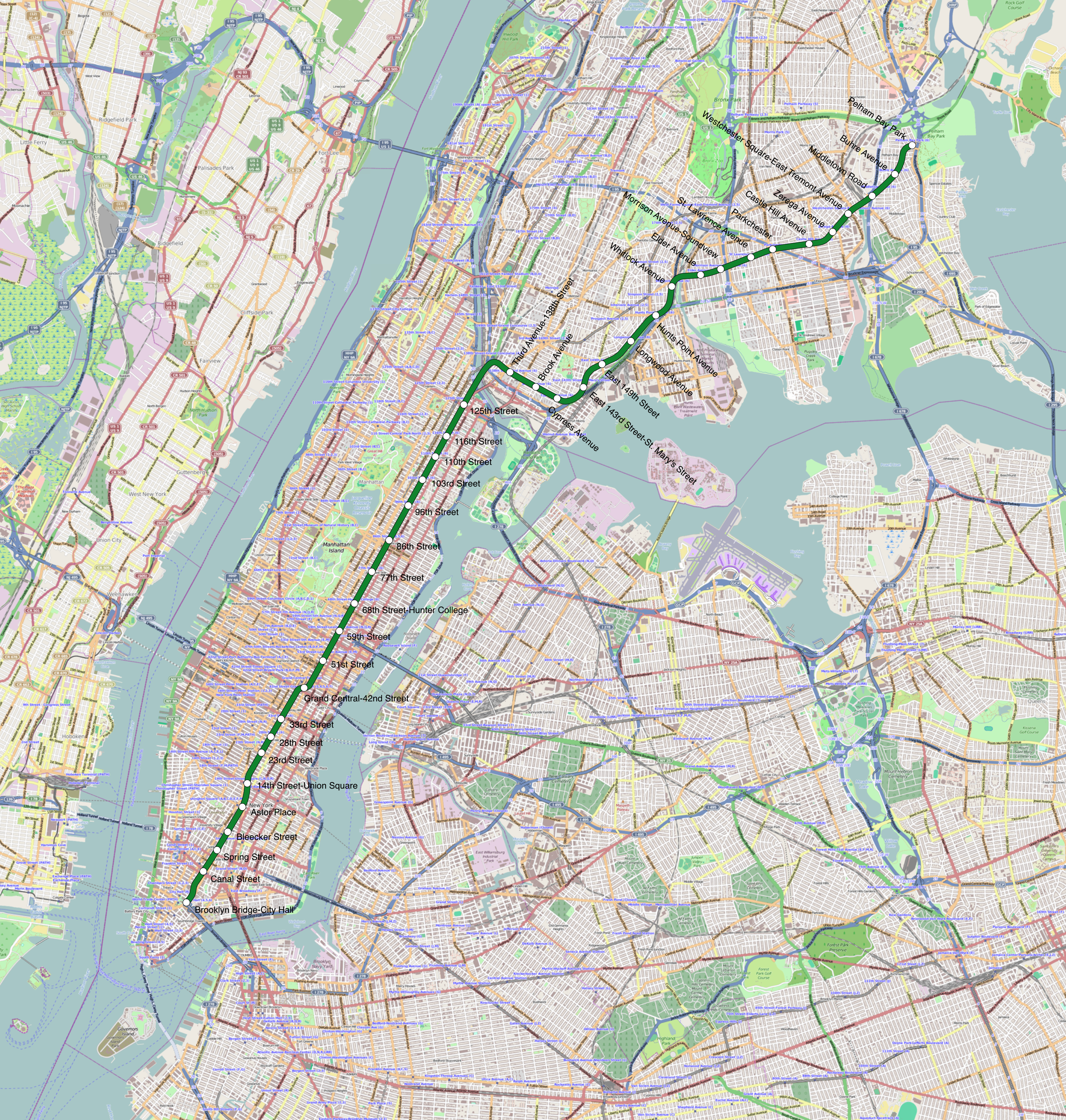
The 6 operates 24 hours daily between Pelham Bay Park in the Bronx and Brooklyn Bridge–City Hall in Lower Manhattan, making all stops in Manhattan. Additional service short turns at Parkchester in the Bronx during weekday rush hours and middays and does not operate to or from Pelham Bay Park; during this time, 6 trains that originate and terminate at Parkchester make all stops in the Bronx, while trains that serve the full route make express stops in the Bronx between Parkchester and Third Avenue–138th Street in the peak direction and are labeled as **** Express trains; when the Express is not running, 6 trains originate and terminate at Pelham Bay Park and make all stops in the Bronx.
The 6 in its current format has run since the implementation of the IRT "H" system in 1918. Since 1920, it has remained largely unchanged, running between Pelham Bay Park and City Hall with a peak-express variant in the Bronx. In 1945, the city closed the City Hall Loop station, the 6 former southern terminal in Manhattan. Since then, most 6 trains have terminated at Brooklyn Bridge, with a few exceptions in later years. , the 6 was the busiest route in the subway system, carrying around 140 million passengers in 2023 and 560,000 daily riders in 2025.
History
Under the Interborough Rapid Transit
On October 27, 1904, local and express service opened on the original subway in Manhattan, following the route of the present IRT Lexington Avenue Line from City Hall to Grand Central–42nd Street. From there, the service traveled west on 42nd Street on the route of the present 42nd Street Shuttle, and then north on the present IRT Broadway–Seventh Avenue Line to 145th Street.
The current "H" configuration, with separate services along Lexington Avenue and Broadway/Seventh Avenue, was introduced in 1917. Full Lexington Avenue local service from City Hall to 125th Street opened on July 17, 1918. Local service was extended to Third Avenue–138th Street on August 1, 1918.
On January 7, 1919, trains were extended from 138th Street to Hunts Point Avenue, and to East 177th Street on May 30, 1920. Service between Hunts Point Avenue and East 177th Street was originally served by a shuttle service operating with elevated cars.
On October 24, 1920, service was extended again to Westchester Square. On December 20, 1920, service was extended to Pelham Bay Park. Service to Pelham Bay Park was served by a mix of through and shuttle trains during the 1920s.
On December 21, 1925, the number of Manhattan-bound through trains in the morning rush hour, between 7 a.m. and 8 a.m., was increased from thirteen to eighteen; a 38 percent increase in service. The remainder of trains continued operating as a shuttle service to Hunts Point Avenue.
On January 28, 1931, two southbound morning rush hour trips began starting at Pelham Bay Park instead of Hunts Point Avenue. On April 13, 1931, service to Pelham Bay Park was increased. Two additional southbound trips were added, starting at Pelham Bay Park at 5:50 and 6:10 a.m., reducing headways from ten to five minutes. Four northbound trips that terminated at Hunts Point Avenue between 3:53 and 5:05 p.m. were extended to Pelham Bay Park, reducing headways from nine to six minutes, and four northbound trips terminating at Third Avenue-138th Street between 3:36 and 4:48 p.m. were extended to Hunts Point Avenue, reducing headways from to 3 minutes.
By 1934, service south of the City Hall station had been discontinued and late-night service ran from Pelham Bay Park to 125th Street only, being replaced by local service on the 4, which had previously run express.
Under the New York City Board of Transportation
Effective December 31, 1945, City Hall station closed with the former Brooklyn Bridge station (renamed to Brooklyn Bridge–City Hall) being the permanent southern terminal. However, the 6 train still uses the loop to get from the southbound to the northbound local track at Brooklyn Bridge–City Hall.
On May 10, 1946, late-night service was extended from 125th Street to its previous terminus at Brooklyn Bridge when late-night express service on the 4 was restored.
Beginning October 14, 1946, weekday rush and Saturday morning rush peak direction express service started, with Pelham Bay trains using the middle track between East 177th Street and Third Avenue–138th Street. This express service saved eight minutes between Third Avenue and East 177th Street. During this time, 6 trains that ran local in the Bronx when express trains operated began to terminate at East 177 Street to make room for express trains to Pelham Bay Park. On March 7, 1949, the hours of the evening Bronx-bound express service were advanced from 4:30 to 3:30 p.m., and on June 17, 1949, the hours of the morning Manhattan-bound express service were extended from 9:30 to 10:30 a.m.
On September 22, 1948, 54 additional cars were placed in service on the 6 train, increasing the lengths of trains from six cars to seven cars.
The IRT routes were given numbered designations with the introduction of "R-type" rolling stock, which contained rollsign curtains with numbered designations for each service. The first such fleet, the R12, was put into service in 1948. The Lexington–Pelham Bay route became known as the 6.
From December 15 to 22, 1950, the weekday rush hour trains from Pelham Bay Park were extended to South Ferry.
Under the New York City Transit Authority
On June 23, 1956, Saturday morning express service began operating local. On March 1, 1960, late-night express service on the 4 was suspended when the 4 and 6 ran local in Manhattan together. On April 8, 1960, late-night and weekend evening trains were extended to South Ferry. On October 17, 1965, late-night 4 service began running express once again, and weekend evening 6 service was extended to South Ferry. Trains were cut back from South Ferry to Brooklyn Bridge on May 23, 1976.
Beginning on January 13, 1980, late-night service terminated at 125th Street in Manhattan with the again making all stops south of there. This service cut affected 15,000 riders and was criticized by Manhattan Borough President Andrew Stein as no public hearing was held. On the same day, Bronx express service was expanded to operate during middays, with Pelham Bay trains running express in the peak direction to Brooklyn Bridge in the morning and to Pelham Bay Park in the afternoon.
From March to May 1985, one weekday morning rush hour train was extended to Atlantic Avenue, terminated there, and returned in service to Pelham Bay Park. This service change was made due to track reconstruction taking place at Penn Station at the time, which forced some Long Island Rail Road trains to be diverted from Penn Station to Atlantic Terminal (then known as Flatbush Avenue), disrupting service for LIRR passengers; as a result, morning rush hour service on the routes serving the Lexington Avenue Line was increased in order to transport LIRR passengers who took diverted trains to Flatbush Avenue to reach Manhattan.
From January 21 to October 5, 1990, late-night service was extended back to Brooklyn Bridge when late-night express service on the 4 was restored. But the 6 was then cut back to 125th Street for the last time when late-night express service on the 4 in Manhattan was permanently discontinued.
Effective October 3, 1999, the 4 and 6 trains once again began to operate local together in Manhattan late nights when the 6 train was permanently extended back to Brooklyn Bridge.{{multiref|
- }}
After the September 11, 2001 attacks, 6 service was cut back to Grand Central–42nd Street in the southbound direction. Southbound trains discharged at Grand Central, operated out of service to Brooklyn Bridge, and re-entered service at Brooklyn Bridge in the northbound direction. By the evening of September 12, service was restored to Spring Street, but southbound trains terminated at Bleecker Street, operated out of service to Brooklyn Bridge, and re-entered service at Spring Street. Normal 6 service was restored on September 17.
In August 2023, weekend frequencies on the 6 were increased from eight minutes to six minutes.
Until the timetable in effect on December 15, 2024, weekdays from 9:00 to 11:00 a.m., select Manhattan-bound trains ran local from Parkchester to Hunts Point Avenue while select Parkchester-bound 6 trains ran express in that section. After this date, all Manhattan-bound trains ran express and all Parkchester-bound 6 trains ran local in this section.
Route
Service pattern
The following table shows the lines used by 6 and , with shaded boxes indicating the route at the specified times:
| Line | From | To | Tracks | Times | [[File:NYCS-bull-trans-6-Std.svg | 20px | 6 service]] | [[File:NYCS-bull-trans-6d-Std.svg | 20px | 6 diamond service]] | [[File:NYCS-bull-trans-6-Std.svg | 20px | 6 service]] | weekday peak direction | all other times |
|---|---|---|---|---|---|---|---|---|---|---|---|---|---|---|---|
| IRT Pelham Line (full line) | Pelham Bay Park | Castle Hill Avenue | local | ||||||||||||
| Parkchester | Third Avenue–138th Street | express | |||||||||||||
| local | |||||||||||||||
| IRT Lexington Avenue Line | [125th Street](125th-street-station-irt-lexington-avenue-line) | Brooklyn Bridge–City Hall |
Stations
For a more detailed station listing, see the articles on the lines listed above. service is suspended during severe winter weather.
| [[File:NYCS-bull-trans-6-Std.svg | 20px | 6 service]] | [[File:NYCS-bull-trans-6d-Std.svg | 20px | 6 diamond service]] | Stations | Subway transfers | Connections/other notes |
|---|---|---|---|---|---|---|---|---|
| The Bronx | ||||||||
| Pelham Line | ||||||||
| Manhattan | ||||||||
| Lexington Avenue Line | ||||||||
| ↑ | ||||||||
| [[File:Aiga elevator.svg | 20px | alt=Elevator access to northbound platform only]] ↑ | ||||||
| (BMT Broadway Line at ) | ||||||||
| Out-of-system transfer with MetroCard/OMNY: | ||||||||
| ([63rd Street Lines](63rd-street-lines) at ) | ||||||||
| (IND Queens Boulevard Line at ) | ||||||||
| (IRT Flushing Line) | ||||||||
| ([42nd Street Shuttle](42nd-street-shuttle)) | ||||||||
| ↓ | ||||||||
| [[File:Aiga elevator.svg | 20px | alt=Elevator access to mezzanine only]] | ||||||
| (BMT Canarsie Line) | ||||||||
| (BMT Broadway Line) | ||||||||
| [[File:Aiga elevator.svg | 20px | alt=Elevator access to southbound platform only]] ↓ | ||||||
| (IND Sixth Avenue Line at ) | ||||||||
| (BMT Broadway Line) | ||||||||
| (BMT Nassau Street Line) | ||||||||
| (BMT Nassau Street Line at Chambers Street) |
References
References
- {{NYCS const. timetable. 6
- "Mta.info – Line Colors".
- (December 28, 2023). "MTA 2023 Transit Report: Busiest Borough, Subway Stop, Bathrooms Revealed".
- (January 2, 2026). "Governor Hochul Highlights Record-Breaking Year of Performance and Ridership for the MTA in 2025".
- "ASCE Metropolitan Section – First New York City Subway".
- "New Subways For New York: The Dual System of Rapid Transit – Interborough Routes and Stations". NYCSubway.org.
- (August 1, 1918). "First "H" Train to Start From Grand Central To-Night: Governor, Mayor and Others Expected To Be Guests on Maiden Trip". New-York Tribune.
- (January 9, 1919). "New Bronx Subway Extension Is Opened: Interborough Now Operating Cars to Hunt's Point Station Above 138th Street". New-York Tribune.
- (May 28, 1920). "Bronx Subway Extension Opened". The New York Times.
- (1920). "Annual Report for the Year Ending June 30, 1920". Interborough Rapid Transit Company.
- (1993). "A History of the New York City Subway System". J. Schmidt, R. Giglio, and K. Lang.
- (October 22, 1920). "Subway Extension Opens Sunday". The New York Times.
- (December 19, 1920). "Will Open Subway to Pelham Bay Park: Service Begins To-Morrow On Four Mile Extension". New York Herald.
- (1922). "State of New York Transit Commission First Annual Report (April 25, 1921 – December 31, 1921)". New York State Transit Commission.
- (December 18, 1925). "I.R.T. To Add Trains. Increases Service to Queens and the Bronx.". The New York Sun.
- (1922). "Eleventh Annual Report For The Calendar Year 1931". New York State Transit Commission.
- (January 1, 1946). "Historic Station Closed After 41 Years". The New York Times.
- (January 1, 1946). "IRT Closes Old Station". New York Daily News.
- Flegenheimer, Matt. (November 29, 2013). "In Subways, Suddenly, 2 Glimpses of History". The New York Times.
- Bolden, Eric. "NYCT Line by Line History".
- (1949). "Report for the Three and One-Half Years Ending June 30, 1949.". New York City Board of Transportation.
- (October 15, 1946). "Pelham Bay Subway Service Is Increased". The Daily Times.
- Brown, Nicole. (May 17, 2019). "How did the MTA subway lines get their letter or number? NYCurious".
- (April 1960). "A Summary of Services on the IRT Division, NYCTA". Electric Railroaders' Association.
- (January 11, 1980). "Suit Seeks to Bar Cutbacks on Lexington Ave. Subways". New York Daily News.
- (December 1979). "January 1980 IRT Service Changes". Electric Railroaders' Association.
- (June 1985). "Unusual Run — Atlantic Avenue to Pelham Bay Park". Electric Railroaders' Association, Incorporated.
- (August 1985). "Commuter Railroad Schedule Changes". Electric Railroaders' Association, Incorporated.
- (February 1990). "Service Change". Electric Railroaders' Association.
- (October 2001). "World Trade Center Destroyed". Electric Railroaders' Association.
- Brachfeld, Ben. (August 9, 2023). "MTA Expanding Subway Service on 1 and 6 Lines, Shortening Weekend Wait Times".
- Simko-Bednarski, Evan. (August 9, 2023). "MTA Adding Service on Two Subway Lines with NY State Cash Boost".
- (December 17, 2023). "MTA 6 subway timetable Effective December 17, 2023". Metropolitan Transportation Authority.
- (December 15, 2024). "MTA 6 subway timetable Effective December 15, 2024". Metropolitan Transportation Authority.
- {{NYCS const. serviceguide
- "New York City Subway Severe Winter Weather". MTA.
This article was imported from Wikipedia and is available under the Creative Commons Attribution-ShareAlike 4.0 License. Content has been adapted to SurfDoc format. Original contributors can be found on the article history page.
Ask Mako anything about 6 (New York City Subway service) — get instant answers, deeper analysis, and related topics.
Research with MakoFree with your Surf account
Create a free account to save articles, ask Mako questions, and organize your research.
Sign up freeThis content may have been generated or modified by AI. CloudSurf Software LLC is not responsible for the accuracy, completeness, or reliability of AI-generated content. Always verify important information from primary sources.
Report