From Surf Wiki (app.surf) — the open knowledge base
25 (number)
| Field | Value |
|---|---|
| number | 25 |
| divisor | 1, 5, 25 |
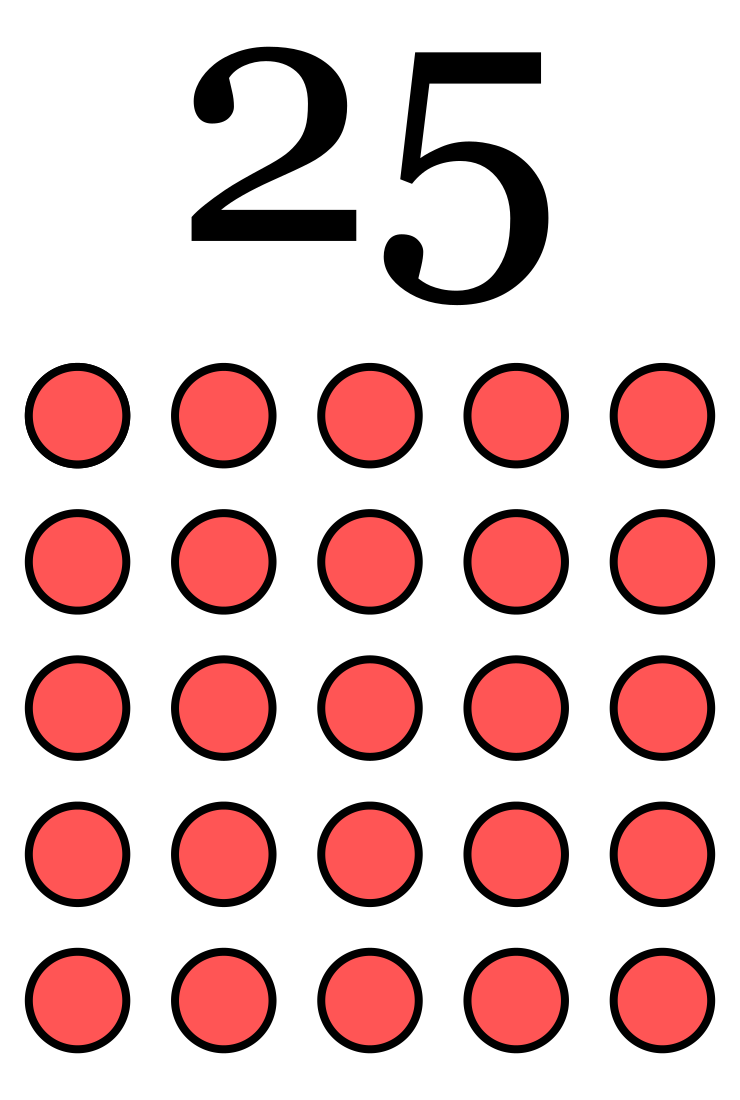
25 (twenty-five) is the natural number following 24 and preceding 26.
In mathematics
It is a square number, being 52 = 5 × 5, and hence the third non-unitary square prime of the form p2.
It is one of two two-digit numbers whose square and higher powers of the number also ends in the same last two digits, e.g., 252 = 625; the other is 76.
25 has an even aliquot sum of 6, which is itself the first even and perfect number root of an aliquot sequence; not ending in (1 and 0).
It is the smallest square that is also a sum of two (non-zero) squares: 25 = 32 + 42. Hence, it often appears in illustrations of the Pythagorean theorem.
25 is the sum of the five consecutive single-digit odd natural numbers 1, 3, 5, 7, and 9.
25 is a centered octagonal number, a centered square number, a centered octahedral number, and an automorphic number.
25 percent (%) is equal to .
It is the smallest decimal Friedman number as it can be expressed by its own digits: 52.
It is also a Cullen number and a vertically symmetrical number. 25 is the smallest pseudoprime satisfying the congruence 7n = 7 mod n.
25 is the smallest aspiring number — a composite non-sociable number whose aliquot sequence does not terminate.
According to the Shapiro inequality, 25 is the smallest odd integer n such that there exist x, x, ..., x such that
:\sum_{i=1}^{n} \frac{x_i}{x_{i+1}+x_{i+2}}
where x = x, x = x.
Within decimal, one can readily test for divisibility by 25 by seeing if the last two digits of the number match 00, 25, 50, or 75.
There are 25 primes under 100: 2, 3, 5, 7, 11, 13, 17, 19, 23, 29, 31, 37, 41, 43, 47, 53, 59, 61, 67, 71, 73, 79, 83, 89, 97.
F4, H4 symmetry and lattices Λ24, II25,1
Twenty-five 24-cells with \mathrm {F_{4}} symmetry in the fourth dimension can be arranged in two distinct manners, such that
|in a 24-cell honeycomb, twenty-four 24-cells surround a single 24-cell, and where |a faceting of the 600-cell with \mathrm {H_{4}} symmetry can otherwise also be constructed, with cells overlapping.
The 24-cell can be further generated using three copies of the 8-cell, where the 24-cell honeycomb is dual to the 16-cell honeycomb (with the tesseract the dual polytope to the 16-cell).
On the other hand, the positive unimodular lattice \mathrm {II_{25,1}} in twenty-six dimensions is constructed from the Leech lattice in twenty-four dimensions using Weyl vector
:(0,1,2,3,4,\ldots,24|70)
that features the only non-trivial solution, i.e. aside from {0, 1}, to the cannonball problem where sum of the squares of the first twenty-five natural numbers {0, 1, 2,\ldots,24} in \mathbb {N_{0}} is equal to the square of 70. The Leech lattice, meanwhile, is constructed in multiple ways, one of which is through copies of the \mathbb {E_{8}} lattice in eight dimensions isomorphic to the 600-cell, where twenty-five 24-cells fit.
In religion
- In Ezekiel's vision of a new temple: The number twenty-five is of cardinal importance in Ezekiel's Temple Vision (in the Bible, Ezekiel chapters 40–48).
In sports
- In baseball, the number 25 is typically reserved for the best slugger on the team. Examples include Mark McGwire, Barry Bonds, Jim Thome, and Mark Teixeira.
In other fields
Twenty-five is:
- The number of years of marriage marked in a silver wedding anniversary.
References
References
- {{Cite OEIS. A016754
- {{Cite OEIS. A001844. Centered square numbers
- {{cite OEIS. A001845. Centered octahedral numbers (crystal ball sequence for cubic lattice)
- {{Cite OEIS. A003226. Automorphic numbers
- {{Cite OEIS. A036057. Friedman numbers
- {{Cite OEIS. A002064. Cullen numbers
- {{Cite OEIS. A053701. Vertically symmetric numbers
- {{Cite OEIS. A063769. Aspiring numbers
- (2020). "The geometry of H4 polytopes". [[De Gruyter]].
- {{Cite OEIS. A351831. Vector in the 26-dimensional even Lorentzian unimodular lattice II_25,1 used to construct the Leech lattice.
- (1999). "Sphere packings, lattices and groups". [[Springer Science+Business Media.
- (1988). "Sphere Packings, Lattices and Groups". Springer.
- Baez, John C.. (2018). "From the Icosahedron to E8". London Mathematical Society Newsletter.
- (2023-07-21). "Number 25 meaning in the Bible".
This article was imported from Wikipedia and is available under the Creative Commons Attribution-ShareAlike 4.0 License. Content has been adapted to SurfDoc format. Original contributors can be found on the article history page.
Ask Mako anything about 25 (number) — get instant answers, deeper analysis, and related topics.
Research with MakoFree with your Surf account
Create a free account to save articles, ask Mako questions, and organize your research.
Sign up freeThis content may have been generated or modified by AI. CloudSurf Software LLC is not responsible for the accuracy, completeness, or reliability of AI-generated content. Always verify important information from primary sources.
Report