From Surf Wiki (app.surf) — the open knowledge base
2020 Pacific typhoon season
none
none
| Field | Value |
|---|---|
| Basin | WPac |
| Year | 2020 |
| First storm formed | May 8, 2020 |
| Last storm dissipated | December 29, 2020 |
| Track | 2020 Pacific typhoon season summary map.png |
| Strongest storm name | Goni |
| Strongest storm pressure | 905 |
| Strongest storm winds | 120 |
| Average wind speed | 10 |
| Total depressions | 32 |
| Total storms | 23 |
| Total hurricanes | 10 |
| Total super | 2 (unofficial) |
| Fatalities | 472 total |
| Damages | 5350 |
| five seasons | [2018](2018-pacific-typhoon-season), [2019](2019-pacific-typhoon-season), **2020**, [2021](2021-pacific-typhoon-season), [2022](2022-pacific-typhoon-season) |
| Atlantic season | 2020 Atlantic hurricane season |
| East Pacific season | 2020 Pacific hurricane season |
| North Indian season | 2020 North Indian Ocean cyclone season |
-
https://web.archive.org/web/20190716173609/https://pubfiles.pagasa.dost.gov.ph/climps/climateforum/climateoutlook.pdf (refs: 4, 5)
-
http://pubfiles.pagasa.dost.gov.ph/tamss/weather/bulletin/SWB%231.pdf (refs: 10, 95, 105)
-
https://mtarchive.geol.iastate.edu/2020/05/13/text/Severe/Severe_13.txt (refs: 16, 17)
-
https://mtarchive.geol.iastate.edu/2020/06/12/text/Severe/Severe_12.txt (refs: 27, 28)
-
https://mtarchive.geol.iastate.edu/2020/06/13/text/Severe/Severe_13.txt (refs: 30, 32, 34)
-
https://mtarchive.geol.iastate.edu/2020/06/13/text/Severe/Severe_14.txt (refs: 33, 36)
-
https://www.koreatimes.co.kr/www/nation/2020/08/113_293867.html (refs: 66, 325)
-
http://www.nmc.cn/publish/typhoon/warning.html (refs: 98, 118, 194)
-
https://web.archive.org/web/20200928152402/https://www.metoc.navy.mil/jtwc/products/wp1520web.txt (refs: 165, 166)
-
https://www.metoc.navy.mil/jtwc/products/wp1620web.txt (refs: 168, 172)
-
https://www.metoc.navy.mil/jtwc/products/wp1720web.txt (refs: 175, 178, 179)
-
https://web.archive.org/web/20201012035915/https://www.jma.go.jp/en/typh/2015.html (refs: 177, 180)
-
http://phongchongthientai.mard.gov.vn/Pages/bao-cao-nhanh-cong-tac-truc-ban-pctt-ngay-14-10-2020.aspx (refs: 181, 183)
-
https://www.metoc.navy.mil/jtwc/products/wp1820web.txt (refs: 191, 197)
-
https://web.archive.org/web/20201214073017/https://www.metoc.navy.mil/jtwc/products/wp9420web.txt (refs: 205, 206)
-
https://web.archive.org/web/20200518171103/https://www.wis-jma.go.jp/d/o/PGTW/Alphanumeric/Analysis/Miscellaneous/20200513/180000/A_ABIO10PGTW131800_C_RJTD_20200513171946_85.txt (refs: 207, 209, 253, 263, 274, 288, 309)
-
https://web.archive.org/web/20201019034850/https://www.metoc.navy.mil/jtwc/products/wp1920web.txt (refs: 212, 219)
-
https://www.metoc.navy.mil/jtwc/products/wp2020prog.txt (refs: 222, 223)
-
http://bagong.pagasa.dost.gov.ph/tropical-cyclone/severe-weather-bulletin/2 (refs: 227, 247)
-
https://web.archive.org/web/20201026114213/https://www.metoc.navy.mil/jtwc/products/wp2120web.txt (refs: 228, 229)
-
https://www.metoc.navy.mil/jtwc/products/wp2220web.txt (refs: 241, 242)
-
https://web.archive.org/web/20201028033901/https://www.metoc.navy.mil/jtwc/products/wp2220prog.txt (refs: 243, 250)
-
https://web.archive.org/web/20201108045503/https://pubfiles.pagasa.dost.gov.ph/tamss/weather/bulletin_siony.pdf (refs: 258, 259)
-
https://web.archive.org/web/20201107155448/https://pubfiles.pagasa.dost.gov.ph/tamss/weather/bulletin_tonyo.pdf (refs: 265, 267)
-
https://web.archive.org/web/20201108153708/https://pubfiles.pagasa.dost.gov.ph/tamss/weather/bulletin_ulysses.pdf (refs: 275, 277, 279, 280, 281)
-
https://web.archive.org/web/20201115102019/https://www.metoc.navy.mil/jtwc/products/wp2520web.txt (refs: 278, 285)
-
https://web.archive.org/web/20201218002234/https://pubfiles.pagasa.dost.gov.ph/tamss/weather/bulletin_vicky.pdf (refs: 287, 291, 292, 293, 296, 299)
-
https://www.dailysabah.com/world/asia-pacific/at-least-9-killed-in-floods-landslides-in-philippines (refs: 303, 341)
The 2020 Pacific typhoon season was the first of a series of four below average Pacific typhoon seasons, and became the first with below-average tropical cyclone activity since 2014, with 23 named storms, 10 of which became typhoons and only 2 became super typhoons. This low activity was a consequence of La Niña that persisted from the summer of the year. It had the seventh-latest start in the basin on record, slightly behind 1973, and was the first to start that late since 2016. The first half of the season was unusually inactive, with only four systems, two named storms and one typhoon at the end of July. Additionally, the JTWC recorded no tropical cyclone development in the month of July, the first such occurrence since reliable records began. Despite that, this season featured Typhoon Goni, which made the strongest landfall worldwide in terms of 1-minute wind speed. The season ran throughout 2020, though most tropical cyclones typically develop between May and November. The season's first named tropical cyclone, Vongfong, developed on May 8, while the season's last named tropical cyclone, Krovanh, dissipated on December 24. However, the season's last system was an unnamed tropical depression which dissipated on December 29.
The scope of this article is limited to the Pacific Ocean to the north of the equator between 100°E and 180th meridian. Within the northwestern Pacific Ocean, there are two separate agencies that assign names to tropical cyclones which can often result in a cyclone having two names. The Japan Meteorological Agency (JMA) will name a tropical cyclone should it be judged to have 10-minute sustained wind speeds of at least 65 km/h anywhere in the basin, whilst the Philippine Atmospheric, Geophysical and Astronomical Services Administration (PAGASA) assigns names to tropical cyclones which move into or form as a tropical depression in their area of responsibility located between 135°E and 115°E and between 5°N–25°N regardless of whether or not a tropical cyclone has already been given a name by the JMA. Tropical depressions that are monitored by the United States' Joint Typhoon Warning Center (JTWC) are given a number with a "W" suffix.
Seasonal forecasts
| TSR forecasts | ||||||||||||||||||||||||
|---|---|---|---|---|---|---|---|---|---|---|---|---|---|---|---|---|---|---|---|---|---|---|---|---|
| Date | Tropical | |||||||||||||||||||||||
| storms | Total | |||||||||||||||||||||||
| Typhoons | Intense | |||||||||||||||||||||||
| TCs | ACE | Ref. | Other forecasts | |||||||||||||||||||||
| Date | Forecast | |||||||||||||||||||||||
| Center | Period | Systems | Ref. | 2020 season | Forecast | |||||||||||||||||||
| Center | Tropical | |||||||||||||||||||||||
| cyclones | Tropical | |||||||||||||||||||||||
| storms | Typhoons | Ref. | ||||||||||||||||||||||
| Average (1965–2019) | 26 | 16 | 9 | 294 | date=May 21, 2020 | author2=Lea, Adam | title=Extended Range Forecast for Northwest Pacific Typhoon Activity in 2020 | publisher=Tropical Storm Risk Consortium | url=http://www.tropicalstormrisk.com/docs/TSRNWPForecastMay2020.pdf | access-date=May 21, 2020 | author=Saunders, Mark}} | |||||||||||||
| May 21, 2020 | 26 | 15 | 8 | 258 | ||||||||||||||||||||
| July 9, 2020 | 26 | 14 | 7 | 216 | date=July 9, 2020 | author2=Lea, Adam | title=July Forecast - Forecast Update for Northwest Pacific Typhoon Activity in 2020 | publisher=Tropical Storm Risk Consortium | url=http://www.tropicalstormrisk.com/docs/TSRNWPForecastJul2020.pdf | access-date=July 9, 2020 | author=Saunders, Mark}} | |||||||||||||
| August 6, 2020 | 21 | 13 | 5 | 157 | date=August 6, 2020 | author2=Lea, Adam | title=August Forecast - Forecast Update for Northwest Pacific Typhoon Activity in 2020 | publisher=Tropical Storm Risk Consortium | url=http://www.tropicalstormrisk.com/docs/TSRNWPForecastAug2020.pdf | access-date=August 6, 2020 | author=Saunders, Mark}} | |||||||||||||
| January 22, 2020 | PAGASA | January–March | 0–4 tropical cyclones | title=121st Climate Forum March–August 2020 | type=Seasonal Climate Outlook | url=http://pubfiles.pagasa.dost.gov.ph/climps/climateforum/climateoutlook.pdf | publisher=Philippine Atmospheric Geophysical and Astronomical Services Administration | date=January 22, 2020 | access-date=March 13, 2020 | url-status=dead | archive-url=https://web.archive.org/web/20190716173609/https://pubfiles.pagasa.dost.gov.ph/climps/climateforum/climateoutlook.pdf | archive-date=July 16, 2019 }} | ||||||||||||
| January 22, 2020 | PAGASA | April–June | 3–6 tropical cyclones | |||||||||||||||||||||
| March 15, 2018 | VNCHMF | January–December | 12–13 tropical cyclones | title=Central region vulnerable to typhoons in 2018 | url=http://vietnamnews.vn/society/424485/central-region-vulnerable-to-typhoons-in-2018.html#SlJvxZgh8oA5Dzpm.99 | date=March 15, 2018 | work=Vietnam News}} | |||||||||||||||||
| March 23, 2018 | HKO | January–December | 5–8 tropical cyclones | title=Director of the Hong Kong Observatory highlights Observatory's latest developments | date=March 23, 2018 | access-date=March 26, 2018 | url=http://www.hko.gov.hk/press/WP/2018/pre20180323.htm | publisher=Hong Kong Observatory | author=Chi-ming, Shun}} | |||||||||||||||
| June 24, 2020 | PAGASA | July–September | 6–12 tropical cyclones | title=125th Climate Forum July–December 2020 | type=Seasonal Climate Outlook | url=https://pubfiles.pagasa.dost.gov.ph/climps/climateforum/climateoutlook.pdf | publisher=Philippine Atmospheric Geophysical and Astronomical Services Administration | date=June 24, 2020 | access-date=June 25, 2020 | url-status=dead | archive-url=https://web.archive.org/web/20190716173609/https://pubfiles.pagasa.dost.gov.ph/climps/climateforum/climateoutlook.pdf | archive-date=July 16, 2019 }} | ||||||||||||
| June 24, 2020 | PAGASA | October–December | 4–8 tropical cyclones | |||||||||||||||||||||
| **Actual activity**: | JMA | 32 | 23 | 10 | ||||||||||||||||||||
| **Actual activity**: | JTWC | 26 | 23 | 12 | ||||||||||||||||||||
| **Actual activity**: | PAGASA | 22 | 15 | 7 |
During the year several national meteorological services and scientific agencies forecast how many tropical cyclones, tropical storms, and typhoons will form during a season and/or how many tropical cyclones will affect a particular country. These agencies include the Tropical Storm Risk (TSR) Consortium of University College London, PAGASA and Taiwan's Central Weather Bureau. The first forecast for the year was released by PAGASA on January 22 predicting the first half of 2020, within its monthly seasonal climate outlook. The PAGASA predicts that only 0–4 tropical cyclones are expected to form or enter the Philippine Area of Responsibility between January and March, while 3–6 tropical cyclones are expected to form between April and June. This was due to the fact that the El Niño–Southern Oscillation was seeing neutral conditions across the Pacific, and could persist until midyear. On May 21, the TSR issued their extended-range forecast for 2020, forecasting tropical activity below the average normal, with 26 tropical storms, 15 typhoons and 8 intense typhoons. These numbers were supported by the current values from the Indian Ocean Dipole, the Accumulated Cyclone Energy index and the sea-surface temperatures in the Niño 3.75 region, leading to a stronger than normal trade windspeed throughout much of the Western Pacific.
On June 24, the PAGASA issued a climate forecast, predicting the number of tropical cyclones for the second half of the season. They predicted that 6–12 tropical cyclones are expected to form between the months of July and September, while 4–8 tropical cyclones are expected to form between the months of October and December. On July 9, TSR issued their forecast for the season, predicting a well-below average season with 26 named storms, 14 typhoons and only 7 intense typhoons. On August 6, TSR issued their third and final forecast for the season, lowering their numbers to 21 named storms, 13 typhoons and 5 intense typhoons. They mentioned that the 2020 season is expected to be one of the "least active typhoon seasons on record", with a predicted ACE index barely half of the normal and a 96% probability of being a below-average season.
Season summary
ImageSize = width:1030 height:280 PlotArea = top:10 bottom:80 right:20 left:20 Legend = columns:2 left:30 top:58 columnwidth:270 AlignBars = early DateFormat = dd/mm/yyyy Period = from:01/05/2020 till:01/01/2021 TimeAxis = orientation:horizontal ScaleMinor = grid:black unit:month increment:1 start:01/05/2020 Colors = id:canvas value:gray(0.88) id:GP value:red id:TD value:rgb(0.43,0.76,0.92) legend:Tropical_Depression_=≤62_km/h(≤39_mph) id:TS value:rgb(0.3,1,1) legend:Tropical_Storm_=62–88_km/h(39–54_mph) id:ST value:rgb(0.75,1,0.75) legend:Severe_Tropical_Storm_=89–117_km/h(55–72_mph) id:STY value:rgb(1,0.85,0.55) legend:Typhoon_=118–156_km/h(73–96_mph) id:VSTY value:rgb(1,0.45,0.54) legend:Very_Strong_Typhoon_=157–193_km/h(97–119_mph) id:VITY value:rgb(0.55,0.46,0.90) legend:Violent_Typhoon_=≥194_km/h(≥120_mph) Backgroundcolors = canvas:canvas BarData = barset:Hurricane bar:month PlotData = barset:Hurricane width:10 align:left fontsize:S shift:(4,-4) anchor:till from:08/05/2020 till:18/05/2020 color:VSTY text:"Vongfong" from:10/06/2020 till:14/06/2020 color:TS text:"Nuri" from:11/07/2020 till:15/07/2020 color:TD text:"Carina" from:27/07/2020 till:29/07/2020 color:TD text:"TD" from:01/08/2020 till:06/08/2020 color:STY text:"Hagupit" from:01/08/2020 till:03/08/2020 color:TS text:"Sinlaku" from:06/08/2020 till:11/08/2020 color:TS text:"Jangmi" from:08/08/2020 till:13/08/2020 color:TD text:"Gener" from:09/08/2020 till:11/08/2020 color:ST text:"Mekkhala" from:16/08/2020 till:20/08/2020 color:ST text:"Higos" from:20/08/2020 till:27/08/2020 color:VSTY text:"Bavi" from:27/08/2020 till:03/09/2020 color:VSTY text:"Maysak" barset:break from:30/08/2020 till:07/09/2020 color:VITY text:"Haishen" from:10/09/2020 till:12/09/2020 color:TD text:"12W" from:15/09/2020 till:18/09/2020 color:TS text:"Noul" from:19/09/2020 till:23/09/2020 color:ST text:"Dolphin" from:25/09/2020 till:30/09/2020 color:ST text:"Kujira" from:27/09/2020 till:29/09/2020 color:TD text:"TD" from:04/10/2020 till:17/10/2020 color:STY text:"Chan-hom" from:06/10/2020 till:12/10/2020 color:TS text:"Linfa" from:11/10/2020 till:14/10/2020 color:TS text:"Nangka" from:13/10/2020 till:16/10/2020 color:TD text:"Ofel" from:18/10/2020 till:25/10/2020 color:STY text:"Saudel" from:19/10/2020 till:23/10/2020 color:TD text:"20W" barset:break from:22/10/2020 till:29/10/2020 color:VSTY text:"Molave from:26/10/2020 till:06/11/2020 color:VITY text:"Goni" from:30/10/2020 till:07/11/2020 color:ST text:"Atsani" from:06/11/2020 till:10/11/2020 color:TS text:"Etau" from:08/11/2020 till:16/11/2020 color:VSTY text:"Vamco" from:05/12/2020 till:06/12/2020 color:TD text:"TD" from:18/12/2020 till:24/12/2020 color:TS text:"Krovanh" from:29/12/2020 till:29/12/2020 color:TD text:"TD"
bar:Month width:5 align:center fontsize:S shift:(0,-20) anchor:middle color:canvas from:01/05/2020 till:01/06/2020 text:May from:01/06/2020 till:01/07/2020 text:June from:01/07/2020 till:01/08/2020 text:July from:01/08/2020 till:01/09/2020 text:August from:01/09/2020 till:01/10/2020 text:September from:01/10/2020 till:01/11/2020 text:October from:01/11/2020 till:01/12/2020 text:November from:01/12/2020 till:01/01/2021 text:December
The first few months of 2020 were inactive, with no tropical systems developing until May. On May 8, the season saw its first tropical system with the development of Tropical Depression 01W (Ambo), making it the sixth-latest starting season on record, as well as the latest since 2016. 2 days later, the system strengthened to the first officially named tropical storm of the season, Vongfong. Tropical Storm Vongfong then rapidly intensified into a significant typhoon and struck the central part of the Philippines on May 14, first making its landfall in San Policarpo, Eastern Samar, crossing 4 more islands and then hitting mainland Luzon.
After Vongfong, another month of inactivity ensued, and on June 10, a new tropical depression formed off the coast of Samar, Philippines, and was named Butchoy by the PAGASA a day later. Butchoy made landfall in the Philippines as the JTWC issued a TCFA for it. Once it exited Philippine landmass, Butchoy was upgraded into a tropical depression by the JTWC and all warnings issued by PAGASA were lifted, and Butchoy further intensified into a tropical storm in the South China Sea and was named Nuri by the Japan Meteorological Agency. After Nuri dissipated over mainland China, the basin became quiet again for more than a month with only Tropical Depression Carina forming east of Luzon; this led to the first time that no tropical storms developed within the month of July since reliable records began. The activity in the West Pacific increased somewhat with the formation of Tropical Storm Sinlaku, and the formation and intensification of Hagupit for a typhoon, ending a fast of more than 2 months without any significant typhoon. Hagupit affected China as a mid-Category 1-equivalent storm and caused US$441 million in damage. The storm then transitioned to an Extratropical cyclone and affected North Korea and Russia. A few days later, a new tropical depression formed, and then intensified into Tropical Storm Jangmi. Just southwest of Jangmi, a disorganized low-pressure area formed and would soon become Severe Tropical Storm Mekkhala, reaching China. A few days later, a new tropical depression formed in the South China Sea, and the PAGASA named the system as Helen. Shortly after, Helen intensified into a Severe Tropical Storm Higos, the 7th named storm on the 2020 typhoon season. Higos then went on to hit China. Soon after Higos dissipated, a new system formed in the east of the Philippines, and was named Igme. Igme then went on to become Tropical Storm Bavi and rapidly intensify in the coastal waters of Taiwan. In late August, Typhoon Maysak formed along with Typhoon Haishen, with both systems reaching Korean Peninsula and Japan, respectively.
September started with Maysak weakening on its way to Korea, while a new Haishen threatened the same areas that Maysak and previously Bavi affected. Typhoon Maysak made landfalls in South Korea and North Korea, while Typhoon Haishen intensified into the first super typhoon of the season. In mid-September, Tropical Storm Noul formed in the South China Sea, made landfall in Vietnam, and dissipated soon after. Later in the month, Tropical Storm Dolphin formed off the east coast of Japan and dissipated after a short life. Near the end of the month, Kujira formed and intensified into a severe tropical storm, before weakening and later becoming extratropical.
October was an extremely active month. The season started out with Typhoon Chan-hom, which lasted for 14 days before dissipating. On October 9, Tropical Storm Linfa formed, becoming the first of a train of tropical systems to affect Vietnam. Linfa killed more than 100 people and caused severe flooding in Vietnam and Cambodia. Nangka formed a few days after Linfa, though impacts were much less. A tropical depression, dubbed Ofel by the PAGASA went through the Philippines and then hit Vietnam, affecting the already flooded areas from Linfa.. After a short lull in systems, Typhoon Saudel formed on October 18, causing flooding in the Philippines. Afterwards, two very powerful typhoons formed after Saudel: Molave and Goni. The former killed 41 people throughout The Philippines, Vietnam, and Malaysia, while the latter became a Category 5-equivalent super typhoon. After Goni, Atsani formed and lashed Northern Luzon and Southern Taiwan as a tropical storm. As Atsani dissipated, another depression formed and affected Visayas as a depression, receiving the name Tonyo. The next day, it was upgraded to a tropical storm, earning the name Etau. Etau lasted from November 7 until November 11. On November 8, a depression formed in the Philippine Area of Responsibility and was given the name Ulysses. The next day, it was upgraded to a tropical storm, giving the name Vamco. Vamco strengthened into a Category 2-equivalent typhoon as it brushed the Luzon landmass. It quickly exited the Philippine Area of Responsibility the next day as the PAGASA stated that it restrengthened as a typhoon. It rapidly strengthened and reached its peak intensity as a Category 4-equivalent typhoon. It weakened until it dissipated north of Laos. At last in the month of December, three systems formed with one named as Krovanh which formed at the South China Sea. Then the season concluded on December 29 with a weak depression close to the coast of Vietnam.
Systems
Typhoon Vongfong (Ambo)
| 10-min winds = 85 | 1-min winds = 100 Main article: Typhoon Vongfong (2020)
After 4 months of lull activity, A low-pressure area was first noted on May 9 by the JTWC near Micronesia and was given a medium chance of developing into a tropical cyclone. The following day, the JMA declared that it had developed into a tropical depression to the east of Mindanao, Philippines and was expected to slowly move west. On May 10, PAGASA later followed suit and named the depression Ambo.
The system began to slowly drift westwards throughout the following days, and on the next day, the JTWC upgraded Ambo to a tropical depression, designating it as 01W. The JMA upgraded 01W to a tropical storm and assigned it the first name of the year, Vongfong. Shortly after, the JTWC followed and upgraded the system to tropical storm intensity. A well-defined eye soon emerged on microwave satellite imagery as the storm's structure became further organized The eye became increasingly pronounced and contracted to less than 10 km in diameter as the storm's evolution became suggestive of rapid intensification. The JTWC assessed 1-minute sustained winds of 195 km/h at 21:00 UTC on May 13 shortly before the onset of an eyewall replacement cycle; Vongfong made landfall with this intensity over San Policarpo, Eastern Samar, at 04:15 UTC on May 14. Vongfong made six additional landfalls as it traversed the remainder of the Visayas into Luzon: Dalupiri Island; Capul Island; Ticao Island; Burias Island; San Andres, Quezon; and Real, Quezon. The prolonged interaction with land caused Vongfong to weaken, though the storm maintained a compact circulation amid otherwise favorable atmospheric conditions. On May 15, Vongfong downgraded back into a tropical storm and later tropical depression on the following day before dissipated over Bashi Channel on May 17.
Tropical Storm Nuri (Butchoy)
| 10-min winds = 40 | 1-min winds = 35 On June 10, the JMA began monitoring on a weak tropical depression that had developed to the east of the Philippine island of Samar in Visayas. During the next day, the PAGASA began tracking the system, giving the local name Butchoy. The storm then made its first landfall in Polillo Island in Quezon at 5:30 pm PHT, and making its second landfall in Infanta, Quezon shortly thereafter. Soon after, the JTWC issued a Tropical Cyclone Formation Alert for the storm. Afterwards, the JTWC officially upgraded Butchoy to a tropical depression, and designated it as 02W. With a favorable environment with low vertical wind shear, moderate equatorial outflow and 30–31 °C sea surface temperatures, Butchoy started to intensify in the South China Sea, becoming a tropical storm and receiving the name Nuri from the JMA later on the same day. Then, PAGASA issued their final warning on Nuri as it exited the Philippine Area of Responsibility. By the next day, Nuri intensified further and subsequently peaked in intensity, with the JMA analyzing the storm's peak winds of 75 km/h. Six hours later, the JTWC upgraded Nuri to a tropical storm. However, later in the same day, the JTWC downgraded Nuri into a tropical depression, citing that the storm has drifted into high vertical wind shear. The JMA followed suit, downgrading Nuri into a depression. The JTWC issued their final warning on Nuri as the storm subsequently made landfall in Yanjiang, China. The JMA followed suit six hours later, issuing their final warning on the system.
The PAGASA issued Tropical Cyclone Signal No. 1 for western Mindanao, southern Luzon, and Visayas on June 11 as Butchoy neared the Philippines. The combination of the system and prevailing southwesterly winds brought showers and thunderstorms across the Philippines. Heavy rainfall in Albay led to the activation of disaster risk management officials and other emergency assets. The rains from the tropical depression prompted PAGASA to declare the start of the rainy season in the Philippines on June 12, 2020, which was also during the country's Independence Day. In Hong Kong, Nuri brought heavy rain. One person also drowned due to rough waters.
Tropical Depression Carina
| 10-min winds = 30 | 1-min winds = After about one month of inactivity, on July 11, the JMA designated a low-pressure area near Luzon as a tropical depression. The next day, the JTWC designated the depression as an invest and was given a low chance of developing, and later upgraded to a medium chance. On the following day, the PAGASA upgraded the low-pressure system to a tropical depression and named it Carina.
Carina moved north-northwest over an environment favorable for further development, with low vertical wind shear, established equatorial outflow and 28–29 °C sea surface temperatures. By 12:00 UTC on July 14, Carina rapidly weakened into a low-pressure area, due to an unfavorable environment with strong wind shear. PAGASA then issued their final advisory to Carina, and the remnants dissipated on July 15.
As the low-pressure system was named Carina, PAGASA immediately hoisted Signal #1, the lowest of their storm warning signals, to Batanes, Babuyan Islands and the northeastern portion of Cagayan. Heavy rainfall from Carina caused some damage on Ilocos Norte, Abra and Isabela.
Typhoon Hagupit (Dindo)
| 10-min winds = 70 | 1-min winds = 75 Main article: Typhoon Hagupit (2020)
On July 31, JMA began monitoring a weak tropical depression that had developed in the Philippine Sea. Later, PAGASA named Dindo to the storm. By the next day, the Joint Typhoon Warning Center designated Dindo as Tropical Depression 03W. With favorable conditions of low vertical wind shear, strong equatorial outflow and 31 °C sea surface temperatures, Dindo intensified into a tropical storm on midday of the same time, and the Japan Meteorological Agency named it as Hagupit. Hagupit then began intensifying in the Philippine Sea, and by August 2, Hagupit was upgraded into a typhoon by the JTWC. The JMA later upgraded Hagupit to a severe tropical storm late on August 2. As Hagupit exited the Philippine Area of Responsibility (PAR), the PAGASA issued its final bulletin on the system. Hagupit was then upgraded into typhoon status by the JMA on August 3, and will later peak in intensity with a pressure of 975 hPa. At around 19:30 UTC, Hagupit made landfall in Wenzhou, China, with winds of 85 mph and pressure of 975 mbar (hPa). After its landfall, Hagupit gradually weakened over China, and by early August 4, the JTWC downgraded the typhoon into a tropical storm. Around midday of the same day, JTWC downgraded Hagupit into a tropical depression and later issued their final advisories on the storm, but the JMA still monitored Hagupit as a tropical storm. The system later would undergo an extratropical transition, a process which got completed on August 6, and the JMA issued their final advisory on the extratropical Hagupit.
In advance of Hagupit, Chinese officials ordered the evacuation of areas vulnerable to flooding. Hagupit caused torrential rainfall over portions of China peaking at 13.11 in in the Jingshan district of Wenzhou. 15 people were reported dead across South Korea, 6 of them following a landslide in South Chungcheong Province, 11 people were reported missing, and 7 people were injured.
Tropical Storm Sinlaku
| 10-min winds = 40 | 1-min winds = 45 Main article: Tropical Storm Sinlaku (2020)
On July 29, a tropical disturbance formed and was situated a couple hundred miles east of Manila, Philippines. Struggling to consolidate, the disturbance crossed Luzon with little to no organization and began organizing in the South China Sea. Environmental conditions became conducive for development, and the JMA declared that a tropical depression had formed in the early hours of July 31. Then early on August 1, the depression intensified into Tropical Storm Sinlaku. The storm failed to intensify much afterward, and during the following day, Sinlaku made landfall on northern Vietnam. Shortly thereafter, both agencies issued final advisories on the storm.
Sinlaku produced heavy rain across central and northern Vietnam, resulting in significant flooding. Two people died, one from a collapsed embankment and the other from flash flooding. Thousands of homes were inundated and crops suffered extensive damage. Damage in the nation was about nearly 5.4 billion đồng (US$232,900). Flash floods across Thailand also killed two people.
The remnants of Sinlaku emerged in the Indian Ocean and intensified into a well marked low-pressure area between August 5–8, recreating a lot of torrential rain in portions of India.
Tropical Storm Jangmi (Enteng)
| 10-min winds = 45 | 1-min winds = 40 On August 6, the Philippine Atmospheric, Geophysical and Astronomical Services Administration started to monitor a low-pressure area that developed well east of Virac, Catanduanes. On the next day, the Japan Meteorological Agency designated the low-pressure area as a weak tropical depression. Despite a broad and elongated low-level circulation center, it gradually organized, prompting the Joint Typhoon Warning Center to issue a Tropical Cyclone Formation Alert on the depression.
Early on next day, the PAGASA upgraded it to a depression, naming it Enteng. Later around the same day, the JTWC designated the depression as 05W. But, near end on the same day, the Japan Meteorological Agency upgraded the depression to a tropical storm, receiving the name Jangmi. As such, Jangmi became the fifth named tropical storm of the 2020 typhoon season. On August 9, Jangmi was upgraded into a tropical storm by the JTWC. Despite being at favorable conditions of low vertical shear and 29–30 °C sea surface temperatures, an upper-level low present to the west of the system prohibited the broad Jangmi to organize further. Around the same time, the PAGASA dropped advisories on Jangmi as it quickly exited the Philippine Area of Responsibility. Moving northward at 23 knots, the JMA reported that Jangmi already peaked at 45 kn. Around 05:50 UTC on August 10, Jangmi made landfall on the southern tip of Geojedo, Gyeongsang Province in South Korea. The JTWC issued their final advisories on Jangmi around 15:00 UTC of the same day, and the JMA issued their final advisory early on the next day, August 11.
Jangmi dropped drenching rainfall through the Ryukyu Islands of Japan, with a peak amount of 2.2 in recorded on the island of Kumejima. In South Korea, Jangmi dropped up to 2.6 in of precipitation, in an area already hard hit by flooding in the months previous to Jangmi.
Tropical Depression 06W (Gener)
| 10-min winds = 30 | 1-min winds = 45
A hybrid system formed on August 7, to the south of Japan. It slowly moved westwards, and on August 9, it transitioned into a tropical cyclone.
Due to the fact that the disturbance already had tropical-storm-force winds, it was immediately declared a tropical storm by the JTWC on August 9. The next day, the tropical depression reached its peak intensity of 35 mph with an unusually high pressure of 1012 mbar. Soon afterwards 06W began to gradually weaken, and at 15:00 UTC on August 10, the JTWC downgraded 06W to a tropical depression.
After moving generally westward, the system began to move to the southwest and, at 20:00 UTC (4:00 am, August 13 PST), it entered the Philippine's area of responsibility and was given the name Gener by PAGASA.
Severe Tropical Storm Mekkhala (Ferdie)
| 10-min winds = 50 | 1-min winds = 70 Main article: Tropical Storm Mekkhala (2020)
Another area of persistent convection formed within the proximity of the trough that would also spawn Tropical Storm Jangmi On August 7, west of Luzon. As Jangmi became the dominant system in the area, this low-pressure area remained disorganized. However, on the next day, as Jangmi moved away from the area, the system began to organize, and on August 9, the JTWC upgraded the storm to a Tropical Depression. Soon after, at 8:00 pm. PST, the PAGASA followed and upgraded the storm and gave it the name Ferdie. At 07:30 CST on August 11 (23:30 UTC on August 10), Mekkhala made landfall at Zhangpu County in Fujian, China shortly after peak intensity.
Mekkhala forced a Signal No. 1 warning to be placed for the Ilocos region in the Philippines. Mekkhala brought monsoonal conditions to portions of Luzon, shortly after its formation. Although remain well offshore Taiwan, the storm still brought heavy rainfall to the island.
In China, local officials suspended ferry services and told ships to return to port, in preparation for Mekkhala. The China Meteorological Administration issued a Level III emergency response, while flood control workers were sent to areas which were hit by Mekkhala. Mekkhala dropped torrential rainfall over China with amounts of up to 7.874 in reported in some areas. Train services were halted and flights were canceled at local airports as Mekkhala moved onshore. In Zhangzhou, Fujian, damage from the storm reached 1.1 billion yuan (US$159 million).
Severe Tropical Storm Higos (Helen)
| 10-min winds = 55 | 1-min winds = 60 Main article: Tropical Storm Higos (2020)
A new tropical depression formed from the Intertropical Convergence Zone east of Luzon on August 16. At 15:00 UTC, the PAGASA named the system Helen and began issuing severe weather bulletins for the tropical depression, but dropped the alerts as Helen left the Philippine area of responsibility after 4 hours. The Hong Kong Observatory and Macau Meteorological and Geophysical Bureau upgraded Higos into a marginal typhoon prior to landfall, with sustained hurricane-force winds in Macau indicating such an intensity. Higos made landfall over Zhuhai, Guangdong at peak intensity at around 06:00 CST on August 19 (22:00 UTC on August 18).
In preparation for Higos, the Hong Kong Observatory raised the number 9 tropical cyclone warning signal in Hong Kong to warn of the possibility of hurricane-force winds. Winds generally reached gale to storm force over the southern part of Hong Kong under the influence of Higos' small circulation. The Macao Meteorological and Geophysical Bureau issued the number 10 signal, the highest signal, at 05:00 am local time. Over 65,000 people evacuated and schools were closed across these areas. Although heavily populated areas of China were directly hit by Higos, damage was mostly limited to downed trees and power outages. Two campers who were unaware of the approaching storm had to be rescued from Tap Mun Island after arriving on August 14. The storm also left 7 deaths and 45 billion đồng (US$2 million) in damages in Vietnam.
Typhoon Bavi (Igme)
| 10-min winds = 85 | 1-min winds = 100 Main article: Typhoon Bavi (2020)
On August 19, the JTWC began monitoring a broad area of low pressure situated a couple hundred miles northeast of the Philippine archipelago. By the next day, the system rapidly organized, and the JTWC subsequently issued a Tropical Cyclone Formation Alert (TCFA). On August 21, the area of low pressure became Tropical Depression 09W. At 15:00 UTC, the PAGASA named the system Igme and issued a severe weather bulletin for it. By the next day, Igme intensified into a tropical storm, according to the JMA and was given the name Bavi, subsequently prompting the JTWC to follow suit and upgrade 09W from a tropical depression to a tropical storm. Favorable conditions allowed Bavi to rapidly intensify, and by 12:00 UTC on August 22, the system became a severe tropical storm. As the system left the Philippine Area of Responsibility, the PAGASA stopped issuing weather bulletins for the severe tropical storm. Bavi's period of rapid intensification was brief, and it began a slow intensification phase on August 23.
On August 24, Bavi slowly intensified, and it was later upgraded by the JMA into a typhoon. Later on that day, it became a Category 2-equivalent typhoon. By the next day, Bavi intensified even more to become a Category 3-equivalent typhoon. As Bavi moved closer to the Korean peninsula, one person died in Jeju island on August 25. At around 00:30 UTC on August 27, Bavi made landfall over North Pyongan Province, North Korea. After that, Typhoon Bavi transitioned into an extratropical storm in Manchuria, China.
Typhoon Maysak (Julian)
| 10-min winds = 95 | 1-min winds = 120 Main article: Typhoon Maysak (2020)
An area of low pressure was formed in the Northern Mariana Islands. The disturbance then entered PAR on August 27, and a Tropical Cyclone Formation Alert was issued for the system. Early on August 28, PAGASA upgraded it to a tropical depression, receiving the local name Julian, JTWC later assigned the disturbance as Tropical Depression 10W, shortly before the JMA upgraded it to a tropical storm and assigned the international name Maysak. The JTWC later followed suit in upgrading into a tropical storm. A few hours later, Maysak later became a severe tropical storm despite its elongated low-level circulation center. The presence of low wind shear and warm sea temperatures allows Maysak for any rapid intensifications. On August 31, it became a Category 4-equivalent typhoon. Maysak held this intensity as it began to move into a less conducive environment for storm development within the East China Sea. Soon, Maysak began to weaken steadily as it passed the East China Sea, slowing back down to Category 3-equivalent winds.
Typhoon Maysak then made landfall near Busan, South Korea at 02:20 KST on September 3 (17:20 UTC on September 2), with 10-minute maximum sustained winds at 155 km/h and the central pressure at 950 hPa. equivalent to a Category 2 typhoon. After that, it crossed the Sea of Japan and hitting Hwadae County in North Korea into Jilin, Manchuria in China. Soon after, Typhoon Maysak degenerated into an extratropical low in northeast China.
Typhoon Haishen (Kristine)
| 10-min winds = 105 | 1-min winds = 135 Main article: Typhoon Haishen (2020)
While Typhoon Maysak is holding its peak intensity, JTWC announced another formation of a very disorganized tropical disturbance situated a couple hundred miles northeast of Guam. By the next day, the disturbance had quickly organized, and the JTWC issued a Tropical Cyclone Formation Alert (TCFA) for the low-pressure area. On the following day, the disturbance later designated as Tropical Depression 11W. Traversing generally southwestward, the depression quickly intensified into a tropical storm, with JMA gaining the name Haishen. Under very favorable conditions, Haishen is allowed to do any intensification, which resulted in upgrading into Category 3-typhoon.
PAGASA announced that Haishen entered Philippine Area of Responsibility (PAR), naming the system as Kristine. Early on September 4, the JTWC assessed that Haishen became a Category 4-equivalent super typhoon – with 1-minute sustained wind speeds of 135 kt (155 mph, with a clear, symmetrical eye visible on satellite imagery. Haishen's Haishen's latitude increased, the ocean heat content in the area decreased, resulting of weakening below super typhoon status. Later that day, the system left the PAR and PAGASA issued its last bulletin on the typhoon. As the system continued its northward track toward the Japanese archipelago, it continued to weaken and became a Category 3-equivalent typhoon, and not too long after it weakened to a Category 2-equivalent typhoon as it neared the Southern Ryukyu Islands of Japan. A mandatory evacuation order was issued for western Japan as millions of people evacuated accordingly. Haishen made landfall in Ulsan, South Korea at around 09:00 KST (00:00 UTC) on September 7.
Tropical Depression 12W
| 10-min winds = 30 | 1-min winds = 25 On September 10 at 00:00 UTC, the JMA began tracking a tropical depression. At 15:00 UTC that day, the JTWC issued a Tropical Cyclone Formation Alert on the system. On September 11 at 18:00 UTC, the JTWC upgraded the disturbance to a tropical depression, designating it as 12W; it was downgraded back to a tropical disturbance six hours later. The JMA had stopped tracking the depression by September 13.
Tropical Storm Noul (Leon)
| 10-min winds = 45 | 1-min winds = 50 Main article: Tropical Storm Noul (2020)
On September 14 at 12:00 UTC, the JMA began tracking a tropical depression. On the morning of September 15, the JTWC issued a tropical cyclone formation alert for a tropical system forming in the Philippine Sea. The JTWC later upgraded it to a tropical depression at 15:00 UTC as they issued their first warning on the system as Tropical Depression 13W. Since the depression formed inside of the Philippine Area of Responsibility (PAR), the PAGASA immediately issued a severe weather bulletin on the storm and named the system Leon. At 21:00 on September 16, the storm left the PAR and PAGASA issued its final warning on the system. At 03:00 UTC September 18, Noul made landfall between Quảng Trị and Thừa Thiên-Huế provinces. At 09:00 UTC, the JTWC issued its final warning on the system. After being downgraded to a low-pressure area (LPA), Noul followed a westward path and emerged in the Indian Ocean.
A few days before the storm hit Vietnam, the Vietnamese government closed three airports and evacuated more than one million people in the affected areas. Noul damaged homes and knocked down trees and power lines in Hue, Vietnam. Heavy precipitation amounts peaking at 310 mm fell in Da Nang. The storm caused 6 deaths and 705 billion đồng (US$30.4 million) in damage.
Severe Tropical Storm Dolphin (Marce)
| 10-min winds = 60 | 1-min winds = 55 On September 20 at 06:00 UTC, as a tropical disturbance strengthened in the extreme northeast corner of the Philippine Area of Responsibility, PAGASA upgraded the system to a tropical depression, giving it the local name Marce. At the time, the JTWC only recognized the system as an area of convection and only issued a medium level of warning for the system. The JTWC upgraded the system to a tropical storm at 12:00 UTC. On September 21 at 03:00 UTC, the system left the Philippine Area of Responsibility. The system then intensified into a tropical storm south of Japan, and was given the international name Dolphin by the JMA. After the storm transitioned into an extratropical cyclone, the JTWC issued its final warning on the system on September 24 at 03:00 UTC.
Severe Tropical Storm Kujira
| 10-min winds = 60 | 1-min winds = 65 The storm drifted north-northwestwards before recurving to the northeast while intensifying into a Category 1-equivalent typhoon early on September 29. Kujira weakened to a tropical storm 12 hours after it intensified into a typhoon due to very high wind shear and cool waters. At 21:00 UTC, the JTWC issued the last advisory for the system.
Typhoon Chan-hom
| 10-min winds = 70 | 1-min winds = 80 On October 2, the JTWC began to monitor a large area of thunderstorms in the open Pacific Ocean. The system gradually organized, and it was classified as a tropical depression on October 4. On the next day, the JMA upgraded the storm to a tropical storm and named it Chan-hom. On October 7, the system was upgraded by the JMA into a typhoon. The JMA issued their final warning on the system on October 12 at 00:45 UTC. The JTWC later followed, issuing their final warning on the system at 09:00 UTC. The JMA, however, still tracked Chan-hom as a tropical depression until it was last noted on October 16.
Tropical Storm Linfa
| 10-min winds = 45 | 1-min winds = 40 Main article: Tropical Storm Linfa
On October 9, the JTWC began tracking a tropical system east-southeast of Da Nang, Vietnam. On October 10, the system was declared as a tropical depression by the JTWC and the JMA. Later that day, the JMA upgraded the system into a tropical storm and named it Linfa. The system continued westward, making landfall on October 11 at 03:00 UTC in Vietnam. The JTWC issued their final warning on the system at 09:00 UTC that day. The JMA later followed, issuing their final warning on the system at 18:00 UTC.
Linfa brought historic amounts of rainfall to Central Vietnam, peaking at 90.16 in in A Lưới (Huế), 59.842 in in Hướng Linh (Quảng Trị).{{cite news |title=3 tỉnh xin hỗ trợ khẩn cấp thiệt hại do bão số 6, áp thấp nhiệt đới|url=https://laodong.vn/xa-hoi/3-tinh-xin-ho-tro-khan-cap-thiet-hai-do-bao-so-6-ap-thap-nhiet-doi-844158.ldo|access-date=October 14, 2020 |work=Báo Lao động
Tropical Storm Nangka (Nika)
| 10-min winds = 45 | 1-min winds = 50 Main article: Tropical Storm Nangka (2020)
On October 11, the JMA began tracking a tropical depression off the west coast of Luzon. The PAGASA declared the system as a tropical depression at 12:00 UTC, and since the storm formed inside of the Philippine Area of Responsibility (PAR) the agency named the system Nika. On the same day at 21:00, the JTWC began issuing warnings on the system. On October 12, the system was declared a tropical storm by the JMA, and was named Nangka. At 09:00 UTC, the system left the PAR and the PAGASA issued its final bulletin on the system. At 19:20 CST (11:20 UTC) on October 13, Nangka made landfall over Qionghai, Hainan.
On October 13, the storm crossed the Gulf of Tonkin and made landfall in the Nam Định, Ninh Bình, and Thanh Hóa provinces in Northern Vietnam on October 14. On the same day, both the JMA and JTWC issued their final warnings for the system. The system dissipated on October 14, 2020.
After the passage of Nangka over Hainan Island, 2 people died and 4 are missing as a result of a capsized boat. In Northern Vietnam, the storm killed 2 people in Hòa Bình, another missing in Yên Bái. Over 585 houses were destroyed, while 135,731 others across central Vietnam were flooded.
Tropical Depression Ofel
| 10-min winds = 30 | 1-min winds = A low-pressure area formed in the Philippine Sea, east of Leyte, on October 13. Soon, the PAGASA declared the newly formed system as a tropical depression and assigned it the name Ofel. The PAGASA immediately raised warning signals for the province of Sorsogon and for parts of the Samar province. On the same day at 18:30 UTC, Ofel made landfall over Can-avid, Eastern Samar. As the system entered the South China Sea in the early hours of October 15 UTC, the PAGASA lifted all tropical cyclone warning signals for Ofel. On the same day at 20:00 UTC, Ofel left the Philippine Area of Responsibility (PAR) and PAGASA issued their final bulletin for the system. While Ofel was inside the PAR, the Joint Typhoon Warning Center issued tropical cyclone formation alerts for the system, however it was canceled as the system entered a less favorable environment on October 16. The storm dissipated at 03:00 UTC on that day.
Flooding was reported due to moderate to heavy rains. According to the Department of Agriculture Regional Office 5, total damages have topped to an estimated ₱9.1 million (US$187,000).
Typhoon Saudel (Pepito)
| 10-min winds = 65 | 1-min winds = 75 Main article: Typhoon Saudel
On October 16 UTC, the JTWC began tracking an area of convection approximately 463 nmi east-southeast of Palau. On October 18 at 21:00 UTC, the PAGASA upgraded the system into a tropical depression, and named the system Pepito. A few hours later, the JMA also recognized the system into a tropical depression, and subsequently issued their first warning on the system. As the system intensified as it approached Northern Luzon, the JMA upgraded the system into a tropical storm and named the system Saudel. The PAGASA also declared the system as a tropical storm, and began issuing Signal #2 tropical cyclone warnings in preparation for its landfall. Saudel made landfall over the San Ildefonso Peninsula in Casiguran, Aurora on October 20 at 13:00 UTC (21:00 PHT) and began crossing the Luzon Island. Saudel made another landfall over Anda, Pangasinan before emerging over the South China Sea hours later. As the storm left the Philippine Area of Responsibility, the developing severe tropical storm was upgraded into a typhoon by the JMA, the JTWC, and by the PAGASA in their final bulletin for the system. As it emerged through the South China Sea, Saudel started to gradually weaken, and downgraded into a severe tropical storm. It moved westwards through the Gulf of Tonkin where increasingly unfavorable conditions made Saudel deteriorate rapidly on October 25. Saudel degenerated into a remnant low Quảng Bình Province in Vietnam.
As of October 24, the NDRRMC reported total damages of about ₱106 million (US$2.18 million).
Tropical Depression 20W
| 10-min winds = 30 | 1-min winds = 30 On October 19, both the JMA and the JTWC began tracking a tropical depression, with the JTWC designating it as 20W. 20W formed over marginally favorable conditions for development, before turning southwest after originally moving northeastward, encountering strong wind shear. On October 21, the JTWC assessed that 20W was no longer a tropical depression, also assessing that it had transitioned into an extratropical cyclone the next day.
Typhoon Molave (Quinta)
| 10-min winds = 90 | 1-min winds = 105
Main article: Typhoon Molave
On October 23, the JMA began tracking a tropical depression approximately 190 nmi north of Palau. On the same day, PAGASA followed suit as the system formed inside of the Philippine Area of Responsibility (PAR), east of Mindanao, and named the system Quinta. JTWC followed suit and recognized as Tropical Depression 21W. Now a tropical storm, the system was named Molave by the JMA. As it nears over the Bicol Region, PAGASA later upgraded Molave into a severe tropical storm on October 25. Before landfall, all agencies were later upgraded to typhoon status, which prompted the warning for the province to Signal #3 in response to the approach of the typhoon. At 18:10 PHT (10:10 UTC), Molave made its first landfall in San Miguel Island in Albay, with another in Malinao just 40 minutes later. Molave made 3 more landfalls in San Andres, Quezon, Torrijos, Marinduque and Pola, Oriental Mindoro before entering the South China Sea on October 26. On October 27 at 00:00 UTC, Molave left the PAR, with PAGASA issuing their last bulletin for the system later at 15:00. Molave continue to intensify more and peaked as a Category-3 typhoon. As the system continued westwards, the storm began to slowly weaken as it approached Vietnam. Molave made landfall on Quảng Ngãi province, Central Vietnam at 10:10 UTC+7 (03:10 UTC), October 28 with category 2 typhoon strength. The storm rapidly weakened once inland, with the JTWC issuing their final warning on the system as the storm's convection became increasingly disorganized. The storm dissipated shortly afterward, over Myanmar.
, the NDRRMC reported that 27 people were killed, 40 people were injured and four went missing after the typhoon. Damage from infrastructure and agriculture counted to be ₱1.56 billion (US$32.2 million) and ₱2.66 billion (US$55 million) respectively, with a total damage of ₱4.22 billion (US$87.2 million) nationwide.
Typhoon Goni (Rolly)
| 10-min winds = 120 | 1-min winds = 170 Main article: Typhoon Goni
After Typhoon Molave devastated the Philippines, the JMA announced the formation of a new tropical depression in the Pacific Ocean, west of the Mariana Islands, on October 27. By the next day, the JTWC had also followed and upgraded the system into a tropical depression. As the system continues to track westward under very favorable conditions, it reached tropical storm strength, naming it as Goni by the JMA. Rapid intensification was ensued and became a typhoon. On October 29, at 9:30 UTC, Goni entered the Philippine Area of Responsibility (PAR) and was named Rolly by the PAGASA. At the same day, Goni became the first Category-5 super typhoon with 10-minute winds of 220 km/h and 225 km/h, respectively, marking the second time Tropical Cyclone Wind Signal #5 was raised by PAGASA since Typhoon Haima in 2016. Goni made its first two landfalls at peak intensity over Bato, Catanduanes (20:50 UTC) and Tiwi, Albay (23:20 UTC). After that, it weakened into a strong typhoon and made a third landfall in San Narciso, Quezon. Due to three landfalls and land interaction, Goni lost its immense strength and weakened into a minimal typhoon as it made a fourth landfall in San Juan, Batangas. Before exiting the PAR, Goni slightly intensified, but further development was hampered by unfavorable conditions. The capital, Manila, experienced some tropical storm-force winds from Goni.
, the NDRRMC has reported ₱12.9 billion (US$266 million) of infrastructure damages, along with ₱5 billion (US$103 million) of agricultural damage, with a combined total of ₱17.9 billion (US$369 million), and at least 25 deaths, 399 injured and 6 missing. Goni is estimated to have caused at least ₱48.058 billion (US$1.04 billion) in damages in the Philippines.
Severe Tropical Storm Atsani (Siony)
| 10-min winds = 50 | 1-min winds = 50 On October 28, the JTWC began tracking another tropical disturbance 95 nmi south-southwest of Chuuk in the Federated States of Micronesia. This disturbance would eventually strengthen into a new tropical depression in the early hours of October 29. Later that day, the JMA upgraded the system into a tropical storm. On November 1, at 00:00 UTC, Atsani entered the PAGASA's Philippine Area of Responsibility (PAR), with the PAGASA naming the system Siony. The storm tracked northwest through the Philippine Sea, passing through the Luzon Strait on November 4. The system left the PAR on November 7 at 21:00 UTC. Shortly afterwards, the system rapidly weakened and dissipated thereafter.
Atsani downed trees, caused landslides, and damaged street lights in parts of Taiwan. Rockfalls caused some roads to close in Taitung County. 3 minor injuries were reported within Taitung County in the townships of Haiduan and Jinfeng. The storm brought heavy rains to Batanes and the Babuyan Islands in the Philippines, causing ₱4.9 million (US$102 thousand) in agricultural damage.
Tropical Storm Etau (Tonyo)
| 10-min winds = 45 | 1-min winds = 45 On November 7, the Japan Meteorological Agency (JMA) began tracking a tropical depression 460 nmi east-southeast of Manila. At 12:00 UTC on the same day, the PAGASA declared the system as a tropical depression and assigned it the name Tonyo as it formed directly over Burias Island. The Joint Typhoon Warning Center recognized the system as a tropical depression at 15:00 UTC on November 8. Etau caused rains over Calabarzon, Mimaropa, and the Bicol Region before exiting the Philippine Area of Responsibility on November 9 at 21:00 UTC. It continued its way towards Vietnam, after crossing Philippines.
Etau killed two people in Quảng Nam and Bình Định and damaged 400 houses when it made landfall in central Vietnam on November 10. The storm produced over 250 mm of rain in the provinces of Bình Định, Khánh Hòa, and Phú Yên, with peak at 858 mm in Lake Thủy Yên (Thừa Thiên Huế). The storm also caused gusty winds which uprooted trees and ripped roofs of buildings, many of which were still recovering from the adverse impacts of Typhoon Molave and the weakened Tropical Storm Goni. In addition, power outages locally affected the city of Tuy Hòa. Economic losses in Tuy An, Phú Yên were counted as 122 billion VND (US$5.26 million).
Typhoon Vamco (Ulysses)
| 10-min winds = 85 | 1-min winds = 115 Main article: Typhoon Vamco
On November 8, a tropical depression was formed around 132 nmi north-northwest of Palau. At 12:00 UTC on the same day, the PAGASA declared the system as a tropical depression inside of the Philippine Area of Responsibility and named it Ulysses. The next day at 7:15 UTC, the system strengthened into a tropical storm, with the JMA giving it the name Vamco, with the Joint Typhoon Warning Center later issuing their first warning on the system designated as Tropical Depression 25W. As the system tracked closer to southern Luzon, Vamco was upgraded into a severe tropical storm. Vamco was then upgraded into typhoon status by the JMA on November 11, followed by the JTWC and later PAGASA, as the PAGASA raised Signal #3 tropical cyclone wind signals in preparation for the storm. At 14:30 UTC and 15:20 UTC, Vamco made its first two landfalls over the island towns of Patnanungan and Burdeos, respectively, both in Quezon Province. Later at 17:40 UTC, Vamco made its third landfall over General Nakar, Quezon, in the Luzon landmass. At 00:00 UTC, the system emerged over the western seaboard of Zambales and entered the South China Sea. The system left the PAR at 01:30 UTC as the PAGASA redeclared the system as a typhoon. Vamco rapidly re-strengthened in the South China Sea and peaked as a Category 4-equivalent typhoon briefly before weakening back into a Category 3-equivalent storm heading for Vietnam. The typhoon then weakened before making another landfall as a Category 1-equivalent typhoon in Vietnam.
As of January 13, 2021, the NDRRMC reported a total of 196 casualties (Including 101 validated deaths, 85 injuries and 10 missing) caused by the typhoon, along with () worth of agriculture damages and () worth of infrastructural damages. The Cagayan Valley experienced the highest total amount of damage. At least 5,184,824 individuals were affected by the typhoon's onslaught. According to Aon, total economic losses caused by the typhoon were estimated to top ().
Tropical Storm Krovanh (Vicky)
| 10-min winds = 35 | 1-min winds = 25 Main article: Tropical Storm Krovanh (2020)
On December 17 at 21:00 UTC, the PAGASA began issuing bulletins for a system 140 nmi east-southeast of Davao. The PAGASA had already recognized the system as a tropical depression and named it Vicky, however at the time, the Japan Meteorological Agency (JMA) only recognized the system as a low-pressure area. The next day, the JMA followed suit and recognized the system as a tropical depression. At 14:00 PHT (6:00 UTC), the system made landfall in Baganga, Davao Oriental. 9 hours later, it emerged off the coast of Misamis Oriental and entered the Bohol Sea, later entering the Sulu Sea on the next day at 5:00 PHT (23:00 UTC). On December 19 at 23:00 PHT (15:00 UTC), Krovanh made its second landfall over central Palawan, emerging into the South China Sea shortly after. As the storm traversed the South China Sea, the system had strengthed into a tropical storm according to the JMA as it emerged into a region of relatively favorable atmospheric conditions, thus given the name Krovanh. On December 20 at 14:00 PHT (6:00 UTC), Krovanh left the Philippine Area of Responsibility, although storm signals were still raised for the Kalayaan Islands. The PAGASA then upgraded Krovanh into a tropical storm, and issued a Signal No. 2 warning for the Kalayaan Islands. The next day, December 21, Krovanh was downgraded into a tropical depression by both the JMA and by the PAGASA in their final advisories for the storm. The JTWC then issued their final warning on Krovanh the next day shortly after most of its central convection had dissipated due to increasingly hostile wind shear.
Large swaths of Visayas and Mindanao were placed under Signal No. 1 warnings due to Krovanh. Floods and landslides were triggered in Cebu, Agusan del Sur, Davao de Oro, and in Leyte, where two senior citizens were killed in a landslide. In Lapu-Lapu City, 300 residents were forced to evacuate after 76 houses near the shore were swept into sea. Around 6,702 individuals were affected by the storm in the Philippines, with 5,646 in evacuation centers. Damages have been estimated to total up to ₱214 million (US$4.45 million). At least nine people were killed by the effects of Krovanh.
Other systems
- Late on July 27, the JMA began to track a weak tropical depression in the open Western Pacific. Later the next day, the system would be classified as a subtropical depression by the JTWC, having been given a low chance of transitioning to a tropical cyclone. In a marginal environment with cyclonic easterly flow, moderate to strong wind shear and 28–30 °C sea surface temperatures, the system was expected to recurve poleward and be absorbed by a larger extratropical low. Instead, it dissipated on July 30.
- The JMA began monitoring a tropical depression south of Japan on September 27. The system moved generally northeastward until it was last noted on 18:00 UTC on September 29.
- On December 5, a tropical depression formed south of Japan. The depression would be short-lived, as it dissipated the next day after being embedded into a frontal zone.
- On December 29, the JMA tracked a weak tropical depression east of Vietnam.
Storm names
Within the Northwest Pacific Ocean, both the Japan Meteorological Agency (JMA) and the Philippine Atmospheric, Geophysical and Astronomical Services Administration (PAGASA) assign names to tropical cyclones that develop in the Western Pacific, which can result in a tropical cyclone having two names. The Japan Meteorological Agency's RSMC Tokyo – Typhoon Center assigns international names to tropical cyclones on behalf of the World Meteorological Organization's Typhoon Committee, should they be judged to have 10-minute sustained windspeeds of 65 km/h. PAGASA assigns names to tropical cyclones which move into or form as a tropical depression in their area of responsibility located between 135°E and 115°E and between 5°N and 25°N even if the cyclone has had an international name assigned to it. The names of significant tropical cyclones are retired, by both PAGASA and the Typhoon Committee. Should the list of names for the Philippine region be exhausted then names will be taken from an auxiliary list of which the first ten are published each season. Unused names are marked in .
International names
Main article: List of retired Pacific typhoon names
During the season, 23 tropical storms developed in the Western Pacific and each one was named by the JMA, when the system was judged to have 10-minute sustained windspeeds of 65 km/h. The JMA selected the names from a list of 140 names, that had been developed by the 14 members nations and territories of the ESCAP/WMO Typhoon Committee. During the season, the name Saudel was used for the first time after it replaced Soudelor, which was retired following the 2015 season.
Retirement
After the season, the Typhoon Committee announced that the names Vongfong, Linfa, Molave, Goni, and Vamco would be removed from the naming lists due to the damages and deaths it caused in their respective onslaughts, and they will never be used again for another typhoon name. In 2022, they were replaced by Penha, Peilou, Narra, Gaenari and Bang-Lang respectively. With five names retired, this season was tied with the 2006 and 2019 seasons for the highest number of retired storm names after a single typhoon season, a record it jointly held until it was surpassed by the 2022 season which had six retired names, and this record too would later be surpassed by the 2024 season with nine retired names.
Philippines
| Main list | Auxiliary list |
|---|---|
| Ambo | Butchoy |
| Ferdie | Gener |
| Kristine | Leon |
| Pepito | Quinta |
| Ulysses | Vicky |
Main article: List of retired Philippine typhoon names
During the season PAGASA used its own naming scheme for the 22 tropical cyclones, that either developed within or moved into their self-defined area of responsibility. This is the same list used during the 2016 season, except for the names Kristine, Leon and Nika, which replaced Karen, Lawin and Nina, respectively. All three names were used for the first time, as well as the names Pepito and Vicky (which replaced Pablo and Violeta in 2012 and 2004 respectively, but went unused in previous seasons).
Retirement
After the season, PAGASA announced that the names Ambo, Quinta, Rolly and Ulysses will be removed from its rotating naming lists due to the number of deaths and amount of damage they caused, and they will not be used again. On January 21, 2021, they were replaced with Aghon, Querubin, Romina and Upang respectively. These new names first appeared in the 2024 season.
Season effects
This table summarizes all the systems that developed within or moved into the North Pacific Ocean, to the west of the International Date Line during 2020. The tables also provide an overview of a system's intensity, duration, land areas affected and any deaths or damages associated with the system. |- | Vongfong (Ambo) || || bgcolor=#| || bgcolor=#| || bgcolor=#| || Palau, Philippines, Taiwan || || || |- | Nuri (Butchoy) || || bgcolor=#| || bgcolor=#| || bgcolor=#| || Philippines, South China || Unknown || || |- | Carina || || bgcolor=#| || bgcolor=#| || bgcolor=#| || Philippines, Taiwan || Minimal || None|| |- | TD || || bgcolor=#| || bgcolor=#| || bgcolor=#| || None || None || None || |- | Hagupit (Dindo) || || bgcolor=#| || bgcolor=#| || bgcolor=#| || Ryukyu Islands, Taiwan, East China, Korean Peninsula, Kamchatka Peninsula || || || |- | Sinlaku || || bgcolor=#| || bgcolor=#| || bgcolor=#| || South China, Vietnam, Laos, Thailand, Myanmar || || || |- | Jangmi (Enteng) || || bgcolor=#| || bgcolor=#| || bgcolor=#| ||Philippines, Ryukyu Islands, Korean Peninsula|| || None || |- | 06W (Gener) || || bgcolor=#| || bgcolor=#| || bgcolor=#| || Bonin Islands, Ryukyu Islands || None || None || |- | Mekkhala (Ferdie) || || bgcolor=#| || bgcolor=#| || bgcolor=#| || Philippines, Taiwan, East China || || None || |- | Higos (Helen) || || bgcolor=#| || bgcolor=#| || bgcolor=#| || Philippines, South China, Northern Vietnam || || || |- | Bavi (Igme) || || bgcolor=#| || bgcolor=#| || bgcolor=#| || Philippines, Ryukyu Islands, Taiwan, Korean Peninsula, North China || || || |- | Maysak (Julian) || || bgcolor=#| || bgcolor=#| || bgcolor=#| || Philippines, Japan, Korean Peninsula, Northeast China || || || |- | Haishen (Kristine) || || bgcolor=#| || bgcolor=#| || bgcolor=#| || Mariana Islands, Northeast China, Japan, Korean Peninsula || || || |- | 12W || || bgcolor=#| || bgcolor=#| || bgcolor=#| || Japan || None || None || |- | Noul (Leon)|| || bgcolor=#| || bgcolor=#| || bgcolor=#| || Laos, Thailand, Myanmar, Philippines, Vietnam, Cambodia || || || |- | Dolphin (Marce) || || bgcolor=#| || bgcolor=#| || bgcolor=#| || None || None || None || |- | Kujira || || bgcolor=#| || bgcolor=#| || bgcolor=#| || None || None || None || |- | TD || || bgcolor=#| || bgcolor=#| || bgcolor=#| || None || None || None || |- | Chan-hom || || bgcolor=#| || bgcolor=#| || bgcolor=#| || Japan || None || None || |- | Linfa || || bgcolor=#| || bgcolor=#| || bgcolor=#| || Philippines, Vietnam, Cambodia, Laos, Thailand, Myanmar || || || |- | Nangka (Nika) || || bgcolor=#| || bgcolor=#| || bgcolor=#| || Philippines, South China, Vietnam, Laos, Myanmar || || || |- | Ofel || || bgcolor=#| || bgcolor=#| || bgcolor=#| || Philippines, Vietnam, Laos || || || |- | Saudel (Pepito) || || bgcolor=#| || bgcolor=#| || bgcolor=#| || Philippines, South China, Vietnam || || None || |- | 20W || || bgcolor=#| || bgcolor=#| || bgcolor=#| || None || None || None || |- | Molave (Quinta) || || bgcolor=#| || bgcolor=#| || bgcolor=#| || Philippines, Spratly Island, Vietnam, Laos, Cambodia, Thailand, Malaysia, Myanmar || || || |- | Goni (Rolly) || || bgcolor=#| || bgcolor=#| || bgcolor=#| || Philippines, Vietnam, Cambodia, Laos || || || |- | Atsani (Siony) || || bgcolor=#| || bgcolor=#| || bgcolor=#| || Mariana Islands, Philippines, Taiwan, South China || || None || |- | Etau (Tonyo) || || bgcolor=#| || bgcolor=#| || bgcolor=#| || Philippines, Vietnam, Cambodia || || || |- | Vamco (Ulysses) || || bgcolor=#| || bgcolor=#| || bgcolor=#| || Philippines, Vietnam, Laos, Thailand || || || |- | TD || || bgcolor=#| || bgcolor=#| || bgcolor=#| || None || None || None || |- | Krovanh (Vicky) || || bgcolor=#| || bgcolor=#| || bgcolor=#| || Philippines, Malaysia, Thailand || || || |- | TD || || bgcolor=#| || bgcolor=#| || bgcolor=#| || None || None || None || |-
Notes
References
References
- Saunders, Mark. (May 21, 2020). "Extended Range Forecast for Northwest Pacific Typhoon Activity in 2020". Tropical Storm Risk Consortium.
- Saunders, Mark}}{{Dead link. (July 9, 2020). "July Forecast - Forecast Update for Northwest Pacific Typhoon Activity in 2020". Tropical Storm Risk Consortium.
- Saunders, Mark. (August 6, 2020). "August Forecast - Forecast Update for Northwest Pacific Typhoon Activity in 2020". Tropical Storm Risk Consortium.
- (January 22, 2020). "121st Climate Forum March–August 2020". Philippine Atmospheric Geophysical and Astronomical Services Administration.
- (March 15, 2018). "Central region vulnerable to typhoons in 2018". Vietnam News.
- Chi-ming, Shun. (March 23, 2018). "Director of the Hong Kong Observatory highlights Observatory's latest developments". Hong Kong Observatory.
- (June 24, 2020). "125th Climate Forum July–December 2020". Philippine Atmospheric Geophysical and Astronomical Services Administration.
- (2012-08-13). "Frequently Asked Questions". Joint Typhoon Warning Center.
- (May 9, 2020). "Significant Tropical Weather Advisory for the Western and South Pacific Oceans Reissued 090030Z-090600Z May 2020". Joint Typhoon Warning Center.
- (May 10, 2020). "Warning and Summary 100000". Japan Meteorological Agency.
- (May 10, 2020). "First storm this year to hit Mindanao, PAGASA says".
- (May 10, 2020). "Severe Weather Bulletin #1 for Tropical Depression "Ambo"".
- (June 2021). "Severe Weather Bulletin #3 for Tropical Depression "Ambo"".
- (April 12, 2020). "Tropical Depression 01W Warning Nr 1".
- (May 12, 2020). "Tropical Storm Vongfong likely to approach Taiwan over weekend: CWB". Focus Taiwan.
- (May 12, 2020). "Tropical Storm 01W (Vongfong) Warning Nr 004".
- (May 12, 2020). "Prognostic Reasoning for Tropical Storm 01W (Vongfong) Warning Nr 005". Joint Typhoon Warning Center.
- (May 13, 2020). "Prognostic Reasoning for Typhoon 01W (Vongfong) Warning NR 008". Joint Typhoon Warning Center.
- (May 13, 2020). "Prognostic Reasoning for Typhoon 01W (Vongfong) Warning NR 009". Joint Typhoon Warning Center.
- (May 14, 2020). "Severe Weather Bulletin #14 for Typhoon "Ambo" (Vongfong)".
- (May 15, 2020). "Severe Weather Bulletin #24 for Severe Tropical Storm "Ambo" (Vongfong)". hilippine Atmospheric, Geophysical and Astronomical Services Administration.
- (May 14, 2020). "Reasoning No. 13 for TY 2001 Vongfong". Japan Meteorological Agency.
- (May 16, 2020). "TD Downgraded from TS 2001 Vongfong (2001)".
- (June 10, 2020). "WWJP27 RJTD 10000". [[Japan Meteorological Agency]].
- "PAGASA-DOST on Twitter".
- (June 11, 2020). "Severe Weather Bulletin No. 1 for Tropical Depression "Butchoy"". [[National Disaster Risk Reduction and Management Council]].
- (June 11, 2020). "Severe Weather Bulletin No. 02 for Tropical Depression "BUTCHOY"". [[National Disaster Risk Reduction and Management Council]].
- (June 11, 2020). "WTPN21 PGTW 111500". [[Joint Typhoon Warning Center]].
- (June 12, 2020). "Prognostic Reasoning for Tropical Depression 02W (Two) Warning NR 001". Joint Typhoon Warning Center.
- (June 12, 2020). "TS NURI (2002) UPGRADED FROM TD".
- (June 12, 2020). "Severe Weather Bulletin No. 08 (FINAL) for Tropical Storm "BUTCHOY"". [[National Disaster Risk Reduction and Management Council]].
- (June 13, 2020). "WTPQ20 RJTD 130000".
- (June 13, 2020). "Prognostic Reasoning for Tropical Storm 02W (Nuri) NR 006". Joint Typhoon Warning Center.
- (June 13, 2020). "Prognostic Reasoning for Tropical Depression 02W (Nuri) NR 008". Joint Typhoon Warning Center.
- (June 14, 2020). "TD DOWNGRADED FROM TS NURI (2002)".
- (June 13, 2020). "Tropical Depression 02W (Nuri) NR 009". Joint Typhoon Warning Center.
- (June 14, 2020). "Nuri: China's first tropical cyclone of the year is a wet mess". [[Aljazeera.com]].
- (June 14, 2020). "WTPQ20 BABJ 140900 CA".
- (June 11, 2020). "Tropical depression Butchoy makes landfall in Quezon". CNN Philippines.
- (June 11, 2020). "LPA may become tropical depression Thursday: PAGASA". Philippine News Agency.
- Acor Arceo. (June 12, 2020). "PAGASA declares start of rainy season in the Philippines".
- Jamaine Punzalan. (June 12, 2020). "Rainy season is here, PAGASA says as 'Butchoy' dampens Independence Day".
- Maisy Mok. (June 15, 2020). "One drowning as first storm goes by". The Standard.
- (July 11, 2020). "WWJP27 RJTD 111200".
- (July 13, 2020). "Severe Weather Bulletin #1 Tropical Depression "Carina"".
- Joahna Lei Casilao. (July 14, 2020). "Carina weakens into low pressure area -PAGASA". [[GMA News and Public Affairs.
- (July 14, 2020). "Severe Weather Bulletin No. 13 ("FINAL") for Low Pressure Area (Formerly "Carina")". [[National Disaster Risk Reduction and Management Council]].
- (July 13, 2020). "LPA develops into Tropical Depression Carina; Signal No. 1 up over Batanes, Babuyan, parts of Cagayan". [[GMA News and Public Affairs.
- (July 14, 2020). "TD Carina causes damage in Ilocos Norte, Abra and Isabela". [[GMA News and Public Affairs.
- (July 31, 2020). "WWJP27 RJTD 310600". Japan Meteorological Agency.
- "PAGASA-DOST on Twitter: "At 8:00 PM today, the Low Pressure Area east of Cagayan develop into Tropical Depression #DindoPH. Severe Weather Bulletin will be issued starting at 11:00 PM tonight." / Twitter".
- (August 1, 2020). "Tropical Depression 03W (Three) Warning NR 001". Joint Typhoon Warning Center.
- (August 1, 2020). "TS 2004 HAGUPIT (2004) UPGRADED FROM TD". Japan Meteorological Agency.
- (August 3, 2020). "Typhoon 03W (Hagupit) Warning NR 010". Joint Typhoon Warning Center.
- (August 2, 2020). "STS 2004 HAGUPIT (2004) UPGRADED FROM TS". Japan Meteorological Agency.
- (August 3, 2020). "Severe Weather Bulletin No. 7 (FINAL) for Severe Tropical Storm "DINDO" (I.N. HAGUPIT)". [[National Disaster Risk Reduction and Management Council]].
- (August 3, 2020). "TY 2004 HAGUPIT (2004) UPGRADED FROM STS". Japan Meteorological Agency.
- (August 3, 2020). "TY 2004 HAGUPIT (2004)". Japan Meteorological Agency.
- (August 3, 2020). "Typhoon "Hagupit" slams into China's Zhejiang". The Watchers.
- (August 4, 2020). "Tropical Storm 03W (Hagupit) Warning NR 013". Joint Typhoon Warning Center.
- (August 4, 2020). "Tropical Depression 03W (Hagupit) Warning NR 015". Joint Typhoon Warning Center.
- (August 4, 2020). "Reasoning No.16 For TS 2004 Hagupit (2004)". Japan Meteorological Agency.
- (August 6, 2020). "DEVELOPING LOW FORMER TS 2004 HAGUPIT (2004)". Japan Meteorological Agency.
- (August 3, 2020). "Vulnerable eastern China areas evacuated ahead of Typhoon Hagupit". Fox News.
- (August 5, 2020). "Tropical storm heading away from the city". Shine.
- (August 4, 2020). "China, Korean Peninsula – Tropical Cyclone HAGUPIT update (GDACS, JTWC, DG ECHO, JMA, Floodlist, media) (ECHO Daily Flash of 05 August 2020)". European Commission's Directorate-General for European Civil Protection and Humanitarian Aid Operations.
- (August 5, 2020). "Gov't to declare heavy rain-hit regions special disaster zones". [[The Korea Times]].
- (July 31, 2020). "REASONING NO. 1 FOR TD". Japan Meteorological Agency.
- (August 1, 2020). "REASONING NO. 6 FOR TS 2003 (SINLAKU)". Japan Meteorological Agency.
- (August 3, 2020). "Sinlaku 2020 – Hurricane And Typhoon Updates".
- (August 2, 2020). "TD DOWNGRADED FROM TS 2003 SINLAKU (2003)". Japan Meteorological Agency.
- (August 2, 2020). "Tropical Storm 04W (Sinlaku) Warning NR 005". Joint Typhoon Warning Center.
- Nguyen Quy and Minh Cuong. (August 3, 2020). "Two killed as heavy rains ravage northern Vietnam". Vietnam Express.
- (August 3, 2020). "Thiệt hại do bão số 2 gây ra trên cả nước".
- (August 4, 2020). "Vietnam, Laos, Thailand – Tropical Cyclone SINLAKU update (GDACS, NOAA, Copernicus EMS, Reliefweb, Floodlist, media) (ECHO Daily Flash of 04 August 2020)". ReliefWeb.
- Taylor, Maya. (August 3, 2020). "Over 1,000 homes damaged as remnants of tropical storm Sinlaku wreaks havoc in Ranong".
- "Rainy Week Ahead for Central and Peninsular India; Coastal Maharashtra, Karnataka, Kerala and Goa Under Alert".
- (August 6, 2020). "Public Weather Forecast Issued at 4:00 pm August 06, 2020 – Youtube". Philippine Atmospheric, Geophysical and Astronomical Services Administration.
- (August 7, 2020). "WWJP27 RJTD 070000". Japan Meteorological Agency.
- (August 7, 2020). "Tropical Cyclone Formation Alert (Invest 94W)". Joint Typhoon Warning Center.
- (August 8, 2020). "LPA east of Luzon becomes TD 'Enteng'". [[Manila Bulletin]].
- (August 1, 2020). "Tropical Depression 05W (Five) Warning NR 001". Joint Typhoon Warning Center.
- "Japan Meteorological Agency{{!}}Tropical Cyclone Information".
- (August 9, 2020). "Prognostic Reasoning for Tropical Storm 05W (Jangmi) Warning NR 05". Joint Typhoon Warning Center.
- (August 9, 2020). "Severe Weather Bulletin No. 06 (FINAL) for Tropical Storm "ENTENG" (I.N. JANGMI)". [[National Disaster Risk Reduction and Management Council]].
- (August 9, 2020). "TS 2005 JANGMI (2005)". Japan Meteorological Agency.
- (August 10, 2020). "Fast-moving Typhoon "Jangmi" hits South Korea's flood-stricken region". The Watchers.
- (August 9, 2020). "Tropical Storm 05W (Jangmi) Warning NR 010". Joint Typhoon Warning Center.
- (August 11, 2020). "DEVELOPING LOW FORMER TS 2005 JANGMI (2005)". Japan Meteorological Agency.
- Courtney Spamer. (August 12, 2020). "Tropical Storm Jangmi continues flood threat for South Korea, Japan". Accuweather.
- (August 9, 2020). "South Korea floods, landslides kill dozens, displace thousands". Al Jazeera.
- "IBTrACS - International Best Track Archive for Climate Stewardship".
- (August 9, 2020). "Joint Typhoon Warning Center (JTWC)".
- (August 10, 2020). "Joint Typhoon Warning Center (JTWC)".
- Arceo, Acor. (August 13, 2020). "Tropical Depression Gener enters PAR, but not a threat".
- (June 2021). "DOST-PAGASA Severe Weather Bulletin #1 for Tropical Depression "Gener"". [[PAGASA]].
- (August 9, 2020). "Tropical Depression 07W warning NR 001".
- ABS-CBN News. (August 9, 2020). "Low-pressure area intensifies into tropical depression Ferdie".
- (August 10, 2020). "中央气象台8月11日07时30分发布台风登陆消息". [[National Meteorological Center of CMA]].
- Lalu, Gabriel Pabico. (August 10, 2020). "Signal No. 1 up over Ilocos as 'Ferdie,' monsoon bring rains, winds over Luzon".
- (August 11, 2020). "Taiwan lifts land, sea warnings for Tropical Storm Mekkhala".
- (August 10, 2020). "East China province braces for tropical storm Mekkhala".
- (August 11, 2020). "Tropical Storm Mekkhala brings rain to Taiwan, strikes China".
- (August 11, 2020). "Typhoon Mekkhala makes landfall in China's Fujian".
- (August 13, 2020). "台风"米克拉"致福建漳州损失超11亿元". China Overseas Chinese Network.
- (August 17, 2020). "Severe Weather Bulletin #1 for Tropical Depression "Helen"". PAGASA}}{{dead link.
- (August 17, 2020). "Severe Weather Bulletin #2-FINAL for Tropical Depression "Helen"". PAGASA}}{{dead link.
- (August 19, 2020). "台风"海高斯"登陆广东珠海 广东等地遭强风雨冲击". [[National Meteorological Center of CMA]].
- "Tropical Cyclone Warning Signals".
- (August 19, 2020). "Typhoon signal No.10 hoisted". Macau Business.
- (August 19, 2020). "Typhoon adds to southern China's rain and flooding woes". ABC News.
- (August 19, 2020). "Camper and 70-year-old mum rescued after being trapped on remote island while Typhoon Higos lashes Hong Kong". South China Morning Post.
- Danh Trong. (August 20, 2020). "Tropical Storm number 4 caused 7 deaths and more than 45 billion dong in damages". Tuổi Trẻ News.
- (August 21, 2020). "Tropical Cyclone Formation Alert WTPN21". [[Joint Typhoon Warning Center]].
- (August 22, 2020). "Severe Weather Bulletin #1". [[PAGASA]].
- "Japan Meteorological Agency | Tropical Cyclone Information".
- (August 22, 2020). "SEVERE WEATHER BULLETIN #4-FINAL". PAGASA}}{{dead link.
- "태풍 바비 잇단 피해..물놀이 10대 사망-하늘·바닷길 끊겨[태풍 바비 경로]".
- (August 27, 2020). "中央气象台8月27日8时30分发布台风登陆信息". National Meteorological Center of CMA.
- (August 27, 2020). "Top weather expert hopes Typhoon Maysak stays away from Taiwan". Taiwan News.
- "WWJP27 RJTD 270600". Japan Meteorological Agency.
- (August 27, 2020). "Tropical Cyclone Formation Alert (Invest 94W)". Joint Typhoon Warning Center.
- (August 28, 2020). "Severe Weather Bulletin #1 for Tropical Depression "JULIAN"". [[PAGASA.
- (August 28, 2020). "WTPQ50 RJTD 280600". Japan Meteorological Agency.
- (August 28, 2020). "Tropical Storm 10W (Maysak) Warning Nr 003". Joint Typhoon Warning Center.
- (August 28, 2020). "WTPQ50 RJTD 281800". Japan Meteorological Agency.
- (September 1, 2020). "Reasoning No. 19 for TY 2009 Maysak (2009)". Japan Meteorological Agency.
- (September 5, 2020). "Typhoon Maysak Batters South Korea". EOS Project Science Office.
- (September 2, 2020). "[기상청 속보] 2020년 9월 3일 2시 30분". Korea Meteorological Administration.
- "Typhoon Maysak hit South Korea – September 2nd, 2020".
- "Archived copy".
- (September 4, 2020). "Super Typhoon 11W (Haishen) Warning #17". [[Joint Typhoon Warning Center]].
- (August 16, 2020). "Tropical Storm 11W (Haishen), # 46 FINAL".
- (September 4, 2020). "Severe Weather Bulletin #2 – Typhoon "Kristine"". [[Philippine Atmospheric, Geophysical, and Astronomical Services Administration]].
- (September 4, 2020). "SUPER TYPHOON 11W (HAISHEN) WARNING NR 016". [[Joint Typhoon Warning Center]].
- (September 4, 2020). "Tropical Cyclone Position and Intensity – TYPHOON 11W (HAISHEN)". [[Joint Typhoon Warning Center]].
- (September 4, 2020). "Ocean Heat Content (Geo-PolarBlended SST)". [[National Oceanic and Atmospheric Administration]].
- (September 5, 2020). "Severe Weather Bulletin #4-FINAL for Typhoon "Kristine"". Philippine Atmospheric, Geophysical and Astronomical Services Administration.
- (September 7, 2020). "Typhoon Haishen batters South Korea". BBC News.
- (September 7, 2020). "Typhoon Haishen making landfall in Ulsan, disrupting flights, train services, plants". Yonhap News Agency.
- (September 10, 2020). "Warning and Summary 100000".
- (September 11, 2020). "Tropical Cyclone Formation Alert Text (Invest 97W)".
- "2020 Western North Pacific Ocean Best Track Data".
- (September 12, 2020). "Warning and Summary 121800".
- (September 13, 2020). "Warning and Summary 130000".
- (September 14, 2020). "Warning and Summary 141200".
- (September 15, 2020). "Tropical Cyclone Formation Alert (90W)".
- (September 15, 2020). "Tropical Depression 13W (Thirteen) Warning No. 1".
- "Severe Weather Bulletin #1 for Tropical Depression "Leon"".
- (September 16, 2020). "Severe Weather Bulletin #5-FINAL for Tropical Storm "Leon"".
- (September 18, 2020). "Tropical Storm 13W (Noul) Warning No. 12".
- "Bão số 5 tăng tốc, hơn 1 triệu dân phải sơ tán".
- (September 17, 2020). "Storm Noul shuts down central Vietnam airports". [[VnExpress]].
- (September 17, 2020). "Vietnam plans to evacuate 1.1 million in storm's path: Media". [[The Straits Times]].
- (September 18, 2020). "Tropical Storm Noul pounds Vietnam;one dead, dozens injured".
- Maura Kelly. (September 18, 2020). "Noul turns deadly while making landfall in Vietnam".
- (September 20, 2020). "6 người chết do bão Noul". VnExpress.
- (September 20, 2020). "Cơn lũ đi qua, vùng cao Quảng Nam bị thiệt hại gần 200 tỉ đồng". Lao Động.
- (September 22, 2020). "Vì sao hàng trăm cột điện tại Thừa Thiên Huế gãy đổ trong bão số 5?".
- (September 20, 2020). "Severe Weather Bulletin #1 on Tropical Depression Marce".
- (September 20, 2020). "Significant Tropical Weather Advisory for the Western and South Pacific Oceans".
- (September 20, 2020). "Significant Tropical Weather Advisory for the Western and South Pacific Oceans".
- (September 21, 2020). "Severe Weather Bulletin #3-FINAL for Tropical Storm "Marce"".
- (September 21, 2020). "Tropical Cyclone Information".
- (September 24, 2020). "Tropical Storm 14W (Dolphin) Warning No. 15".
- (September 29, 2020). "Tropical Storm 15W (Kujira) Warning No. 11".
- (September 29, 2020). "Tropical Storm 15W (Kujira) Warning No. 13".
- (October 4, 2020). "Tropical Cyclone Formation Alert (Invest 90W)".
- (October 4, 2020). "Tropical Depression 16W (Sixteen) Warning No. 1".
- (October 4, 2020). "Tropical Cyclone Information".
- (October 7, 2020). "Tropical Cyclone Information".
- (October 12, 2020). "Tropical Cyclone Information".
- (October 12, 2020). "Tropical Depression 16W (Chan-hom) Warning No. 31".
- (October 15, 2020). "Tropical Cyclone Information".
- (October 9, 2020). "Tropical Cyclone Formation Alert (Invest 92W)".
- (October 10, 2020). "Tropical Depression 17W (Seventeen) Warning No. 1".
- (October 10, 2020). "Tropical Cyclone Information".
- (October 10, 2020). "Tropical Cyclone Information".
- (October 11, 2020). "Tropical Storm 17W (Linfa) Warning No. 6".
- (October 11, 2020). "Tropical Storm 17W (Linfa) Warning No. 6".
- (October 11, 2020). "Tropical Cyclone Information".
- (October 14, 2020). "FLASH REPORT ON DISASTER RISK MANAGEMENT SITUATION ON 14 OCTOBER 2020". Vietnam Disaster Management Authority.
- "Báo cáo nhanh công tác trực ban PCTT ngày 14/10/2020".
- (October 17, 2020). "Mưa lũ tại miền Trung: 61 người thiệt mạng, cảnh báo sạt lở và lũ quét".
- (October 18, 2020). "Cambodia flood death toll reaches 18". The Malina Times.
- "20 killed, over 26,000 evacuated in Cambodia due to flooding: spokesman – Xinhua | English.news.cn".
- (October 12, 2020). "10 Dead, 25,000 Houses Damaged in Floods; Storm Warnings Continue".
- (October 11, 2020). "Tropical Cyclone Information".
- (October 11, 2020). "Severe Weather Bulletin #1 for Tropical Depression Nika".
- (October 11, 2020). "Tropical Depression 18W (Eighteen) Warning No. 1".
- (October 12, 2020). "Tropical Cyclone Information".
- (October 12, 2020). "Sever Weather Bulletin #3-FINAL for Tropical Storm "Nika" (Nangka)".
- (October 13, 2020). "中央气象台10月13日19时20分发布台风登陆消息". National Meteorological Center of CMA.
- (August 2021). "Bộ Tài nguyên và Môi trường – Bản tin".
- (October 14, 2020). "Tropical Cyclone Information".
- (October 14, 2020). "Tropical Storm 18W (Nangka) Warning No. 11".
- (October 14, 2020). "Vietnam, China, Laos – Tropical Storm NANGKA (DG ECHO, GDACS, JTWC, CMA, DBQG, media) (ECHO Daily Flash of 14 October 2020) – Viet Nam".
- "Báo cáo nhanh công tác trực ban PCTT ngày 17/10/2020".
- (October 14, 2020). "Mưa lũ, thiệt hại do bão số 7 tại miền Trung vô cùng nặng nề: 36 người bị chết, 12 người mất tích, miền Trung cần cứu trợ khẩn cấp.". Báo Lao động.
- (October 13, 2020). "Severe Weather Bulletin #1 for Tropical Depression "Ofel"".
- (October 14, 2020). "Severe Weather Bulletin #5 for Tropical Depression "Ofel"".
- (October 15, 2020). "Severe Weather Bulletin #14 for Tropical Depression "Ofel"".
- (October 16, 2020). "Severe Weather Bulletin #17-FINAL for Tropical Depression "Ofel"".
- (October 15, 2020). "Tropical Cyclone Formation Alert (Invest 94W)".
- (October 16, 2020). "Tropical Cyclone Formation Alert (Invest 94W) Cancellation".
- (October 16, 2020). "Significant Tropical Weather Advisory for the Western and South Pacific Oceans".
- (October 15, 2020). "Ofel damage to agriculture now at P9 million". GMA Network.
- (October 16, 2020). "Significant Tropical Weather Advisory for the Western and South Pacific Ocean".
- (October 18, 2020). "Severe Weather Bulletin on Tropical Depression "Pepito"".
- (October 19, 2020). "Tropical Cyclone Information".
- (October 19, 2020). "Tropical Depression 19W (Nineteen) Warning No. 1".
- (October 20, 2020). "Tropical Cyclone Information".
- (October 20, 2020). "Severe Weather Bulletin #8 on Tropical Storm "Pepito" (Saudel)".
- (October 21, 2020). "Severe Weather Bulletin #12 for Tropical Storm "Pepito" (Saudel)".
- (October 21, 2020). "Severe Weather Bulletin #15 for Tropical Storm "Pepito" (Saudel)".
- (October 22, 2020). "Tropical Cyclone Information".
- (October 22, 2020). "Severe Weather Bulletin #19-FINAL for Typhoon "Pepito" (Saudel)".
- {{Cite JTWC. (October 22, 2020). link
- (October 24, 2020). "SitRep no. 05 re Preparedness Measures and Effects for TY PEPITO". NDRRMC.
- (October 19, 2020). "Warning and Summary 191800".
- {{Cite JTWC. (October 20, 2020). [link](https://www.metoc.navy.mil/jtwc/products/wp2020prog.txt{{dead link). (April 2025)
- {{Cite JTWC. (October 21, 2020). [link](https://www.metoc.navy.mil/jtwc/products/wp2020prog.txt{{dead link). (April 2025)
- (October 23, 2020). "Warning and Summary 230600".
- (October 23, 2020). "Weather Maps".
- (October 23, 2020). "Severe Weather Bulletin #1 on Tropical Depression "Quinta"".
- {{Cite JTWC. (October 24, 2020). link
- {{Cite JTWC. (October 24, 2020). link
- (October 24, 2020). "Tropical Cyclone Information".
- {{Cite PAGASA. (October 24, 2020). [link](http://pubfiles.pagasa.dost.gov.ph/tamss/weather/bulletin/SWB%237.pdf{{dead link). (August 2023)
- {{Cite PAGASA. (October 25, 2020). link
- {{Cite PAGASA. (October 25, 2020). link
- {{Cite PAGASA. (October 25, 2020). link
- {{Cite PAGASA. (October 25, 2020). link
- {{Cite PAGASA. (October 26, 2020). link
- {{Cite PAGASA. (October 27, 2020). link
- (October 28, 2020). "Trực tiếp bão số 9: Molave áp sát Đà Nẵng – Quảng Ngãi, 2 người chết". baogiaothong.
- Jalad, Ricardo B.. (November 9, 2020). "SitRep No.11 re Preparedness Measures and Effects for Typhoon QUINTA". NDRRMC.
- (October 27, 2020). "Tropical Cyclone Information".
- {{Cite JTWC. (October 28, 2020). link
- {{Cite JTWC. (October 28, 2020). link
- {{Cite JTWC. (October 29, 2020). link
- (October 29, 2020). "Tropical Cyclone Information".
- {{Cite PAGASA. (October 29, 2020). link
- (November 1, 2020). "Typhoon 202019 (GONI) Detailed Wind Information (Japan Meteorological Agency Best Track Data)". [[National Institute of Informatics]].
- (November 1, 2020). "Severe Weather Bulletin #13 for Super Typhoon "Rolly"". [[PAGASA]].
- (November 1, 2020). "Severe Weather Bulletin #14 for Super Typhoon "Rolly" (Goni)". [[PAGASA]].
- {{Cite PAGASA. (2020-11-03). link
- {{Cite JTWC. (2020-11-03). link
- Jalad, Ricardo B.. (November 11, 2020). "SitRep No.12 re Preparedness Measures and Effects for Super Typhoon ROLLY". NDRRMC.
- (December 10, 2020). "Global Catastrophe Recap November 2020". Aon Benfield.
- (October 28, 2020). "Significant Tropical Weather Advisory for the Western and South Pacific Oceans".
- (October 29, 2020). "Tropical Cyclone Information".
- (October 29, 2020). "Tropical Cyclone Information".
- {{Cite PAGASA. (November 1, 2020). [link](https://pubfiles.pagasa.dost.gov.ph/tamss/weather/bulletin/SWB%231_siony.pdf{{dead link). (August 2023)
- "Tropical storm 'Siony' enters Philippines with 'Rolly' still in the country". Philstar.
- {{Cite PAGASA. (2020-11-04). link
- {{Cite PAGASA. (2020-11-07). link
- CNA. (November 7, 2020). "Tropical Storm Atsani leaves 3 people with minor injuries in Taiwan". Focus Taiwan.
- (November 7, 2020). "'Siony' leaves P4.9-M agricultural damage in Batanes". Philstar.
- (2020-11-07). "Weather Maps".
- (2020-11-07). "Significant Tropical Weather Advisory for the Western and South Pacific Oceans".
- (2020-11-07). "'Siony' on her way out of PH, but 'Tonyo' is coming".
- {{Cite PAGASA. (2020-11-07). link
- {{Cite JTWC. (2020-11-08). link
- {{Cite PAGASA. (2020-11-08). link
- (November 11, 2020). "Bão số 12 khiến 2 người tử vong, nhiều thiệt hại tại các địa phương". vietnamplus.
- "Vietnam: Tropical Storm Etau makes landfall north of Nha Trang (Khanh Hoa province) November 10 /update 2".
- (November 12, 2020). "Gia tăng thiệt hại do bão số 12: 4 người chết và mất tích, gần 400 nhà dân hư hỏng". kinhtedothi.
- VnExpress. "Storm Etau weakens, but next storm leaves assembly line – VnExpress International".
- (November 13, 2020). "Tuy An: Thiệt hại hơn 122 tỉ đồng do bão số 12 và lũ lụt". Phú Yên Local News.
- (2020-11-08). "Weather Maps".
- (2020-11-08). "Significant Tropical Weather Advisory for the Western and South Pacific Oceans". [[Joint Typhoon Warning Center]].
- {{Cite PAGASA. (2020-11-08). link
- (2020-11-08). "Tropical Cyclone Information".
- {{Cite PAGASA. (2020-11-10). link
- {{Cite JTWC. (2020-11-11). link
- {{Cite PAGASA. (2020-11-11). link
- {{Cite PAGASA. (2020-11-11). link
- {{Cite PAGASA. (2020-11-11). link
- {{Cite PAGASA. (2020-11-12). link
- {{Cite PAGASA. (2020-11-13)
- {{Cite JTWC. (2020-11-13). link
- {{Cite JTWC. (2020-11-15). link
- Jalad, Ricardo B.. (January 13, 2021). "SitRep no. 29 re Preparedness Measures and Effects for TY ULYSSES".
- {{Cite PAGASA. (2020-12-17). link
- (2020-12-17). "Significant Tropical Weather Advisory for the Western and South Pacific Oceans".
- (2020-12-17). "Weather Maps".
- (2020-12-18). "Tropical Cyclone Information".
- {{Cite PAGASA. (2020-12-18). link
- {{Cite PAGASA. (2020-12-18). link
- {{Cite PAGASA. (2020-12-19). link
- (2020-12-19). "Sitrep No. 2 re Preparedness Measures and Effects for Tropical Depression "VICKY"".
- (2020-12-20). "Tropical Cyclone Information".
- {{Cite PAGASA. (2020-12-20). link
- {{Cite PAGASA. (2020-12-20). [link](https://pubfiles.pagasa.dost.gov.ph/tamss/weather/bulletin/SWB%2320_vicky.pdf{{dead link). (August 2023)
- (2020-12-21). "Tropical Cyclone Information".
- {{Cite PAGASA. (2020-12-20). link
- (December 22, 2020). "Tropical Depression 26W (Krovanh) Warning #11".
- (December 18, 2020). "Signal No. 1 raised in some areas due to Tropical Depression Vicky". CNN Philippines.
- Nishimori, Aleta Nieva. (2020-12-19). "'Vicky' triggers floods, landslides in parts of Visayas, Mindanao; at least 2 dead".
- Agencies. (2020-12-21). "At least 9 killed in floods, landslides in Philippines".
- (July 27, 2020). "WWJP27 RJTD 271800". Japan Meteorological Agency.
- (July 29, 2020). "bwp902020.dat". National Oceanic and Atmospheric Administration.
- (September 27, 2020). "WWJP27 RJTD 271800".
- (September 29, 2020). "WWJP27 RJTD 291800".
- (2020-12-05). "Weather Maps".
- (2020-12-06). "Significant Tropical Weather Advisory for the Western and South Pacific Oceans".
- (2020-12-29). "Weather Maps".
- Padgett, Gary. "Monthly Tropical Cyclone Summary December 1999". Australian Severe Weather.
- The Typhoon Committee. (February 21, 2013). "Typhoon Committee Operational Manual 2013". World Meteorological Organization.
- (February 23, 2022). "Final Report TC54".
- (January 21, 2022). "Replacement Names of LINFA, VONGFONG, MOLAVE, GONI and VAMCO in the Tropical Cyclone Name List". [[ESCAP/WMO Typhoon Committee]].
- "Philippine Tropical Cyclone Names". Philippine Atmospheric, Geophysical and Astronomical Services Administration.
- (2020-11-13). "PAGASA to retire "Ulysses" from its list of tropical cyclone names".
- (2020-05-19). "PAGASA to retire destructive 'Ambo' from list of tropical cyclone names".
- Hallare, Katrina. (January 27, 2021). "Pagasa 'retires' names given to previous devastating typhoons".
- Dost_pagasa. (January 27, 2021). "Four tropical cyclone names from the 2020 list are now decommissioned: Ambo, Quinta, Rolly, and Ulysses. They will be replaced by Aghon, Querubin, Romina, and Upang, respectively, in the 2024 list".
- (May 27, 2020). "Sitrep No.15 re Preparedness Measures and Effects for Typhoon "AMBO" (I.N. "VONGFONG")". NDRRMC.
- (October 8, 2020). "Global Catastrophe Recap September 2020". [[Aon (company).
- (August 3, 2020). "Taiwan: Typhoon Hagupit causes casualties and damage as it intensifies on August 3". [[GardaWorld]].
- (August 5, 2020). "Typhoon exposes 'tofu-dreg project' in E. China".
- (August 5, 2020). "Gov't to declare heavy rain-hit regions special disaster zones". [[The Korea Times]].
- (August 6, 2020). "Bão số 2 làm 3 người chết, thiệt hại ít nhất 300 tỉ đồng".
- "Typhoon Haishen causes widespread damage | NHK WORLD-JAPAN News".
- (September 22, 2020). "Tropical storm Noul leaves 11 dead in Cambodia – it's havoc in South East Asia". [[The Star (Malaysia).
- "Typhoon kills 3 in central Vietnam – Xinhua | English.news.cn".
- (October 28, 2020). "Death toll from flooding in Cambodia rises to 44".
- (October 23, 2020). "Nam Định: Bão số 7 gây thiệt hại gần 68 tỉ đồng".
- (November 11, 2020). "Global Catastrophe Recap October 2020". [[Aon (company).
- (October 15, 2020). "OCD reports landslides in Marinduque due to 'Ofel,' evacuated residents begin to return as weather improves".
- "Vietnam October 2020 Recap".
- Wong, Marcus. (November 1, 2020). "Vietnam Estimates Typhoon Molave Caused $430 Million of Damage". Bloomberg.
- (6 November 2020). "Bão lũ tại miền Trung làm 242 người chết và mất tích, thiệt hại gần 29.000 tỷ đồng". ANTD.
- [http://phongchongthientai.mard.gov.vn/FileUpload/2020-11/5gAsuCxG6EWyl5MH00.%20THIET%20HAI%20NAM%202020%20update%20b%e1%ba%a3n%20chu%e1%ba%a9n.xls Vietnam November 2020 Report]
- Reuter And Ben Westcott. (November 1, 2020). "Super typhoon Goni makes two landfalls in the Philippines after mass evacuations".
- "Death toll from Typhoon Rolly rises to 20".
- "Ba người chết do mưa lũ sau bão Etau".
- Agencies. (2020-12-21). "At least 9 killed in floods, landslides in Philippines".

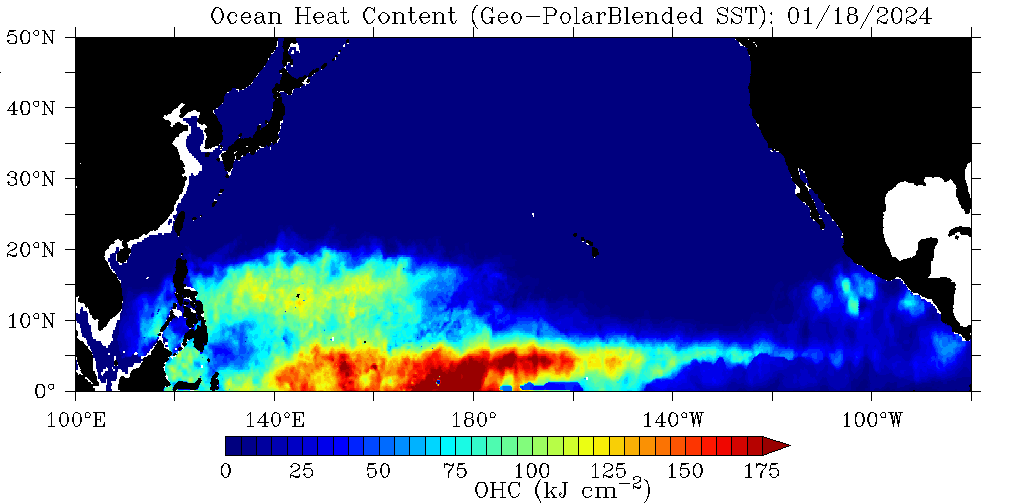
This article was imported from Wikipedia and is available under the Creative Commons Attribution-ShareAlike 4.0 License. Content has been adapted to SurfDoc format. Original contributors can be found on the article history page.
Ask Mako anything about 2020 Pacific typhoon season — get instant answers, deeper analysis, and related topics.
Research with MakoFree with your Surf account
Create a free account to save articles, ask Mako questions, and organize your research.
Sign up freeThis content may have been generated or modified by AI. CloudSurf Software LLC is not responsible for the accuracy, completeness, or reliability of AI-generated content. Always verify important information from primary sources.
Report