From Surf Wiki (app.surf) — the open knowledge base
2019 Pacific typhoon season
none
none
| Field | Value |
|---|---|
| Basin | WPac |
| Year | 2019 |
| First storm formed | |
| Last storm dissipated | |
| Track | 2019 Pacific typhoon season summary.png |
| Strongest storm name | Halong |
| Strongest storm pressure | 905 |
| Strongest storm winds | 115 |
| Average wind speed | 10 |
| Total depressions | 49 |
| Total storms | 29 |
| Total hurricanes | 17 |
| Total super | 5 (unofficial) |
| Fatalities | 453 total |
| Damages | 38540 |
| Damagespost | Costliest Pacific typhoon season on record |
| five seasons | [2017](2017-pacific-typhoon-season), [2018](2018-pacific-typhoon-season), **2019**, [2020](2020-pacific-typhoon-season), [2021](2021-pacific-typhoon-season) |
| Season timeline | Timeline of the 2019 Pacific typhoon season |
| Atlantic season | 2019 Atlantic hurricane season |
| East Pacific season | 2019 Pacific hurricane season |
| North Indian season | 2019 North Indian Ocean cyclone season |
The 2019 Pacific typhoon season was a devastating season that became the costliest on record, mainly due to the catastrophic damage wrought by typhoons Lekima, Faxai, and Hagibis. The season was the fifth and final consecutive to have above average tropical cyclone activity that produced a total of 29 named storms, 17 typhoons, and 5 super typhoons. The season ran throughout 2019, though most tropical cyclones typically develop between May and November. The season's first named storm, Pabuk, reached tropical storm status on January 1, becoming the earliest-forming tropical storm of the western Pacific Ocean on record, breaking the previous record that was held by Typhoon Alice in 1979. The season's first typhoon, Wutip, reached typhoon status on February 20. Wutip further intensified into a super typhoon on February 23, becoming the strongest February typhoon on record, and the strongest tropical cyclone recorded in February in the Northern Hemisphere. The season's last named storm, Phanfone, dissipated on December 29 after it made landfall in the Philippines.
In early August, Typhoon Lekima made landfall in China's Zhejiang province as a powerful typhoon, producing extensive rainfall and landslides that warranted over $9 billion worth of damages, making it, at the time, the second-costliest storm in Chinese history. September saw Typhoon Faxai brush Japan's Kantō region as a strong typhoon, causing extensive destruction. One month later, in early October, Typhoon Hagibis made landfall just west—at Shizuoka—as a large typhoon, causing extensive damages worth over $17 billion, making it, at that time, the costliest Pacific typhoon on record (unadjusted for inflation), until Typhoon Doksuri surpassed it four years later. The Philippines saw two destructive storms wreak havoc across the nation in December. Typhoon Kammuri made landfall in Bicol Region as a large, powerful Category 4-equivalent typhoon in early December, while Typhoon Phanfone made landfall in the central region of the country three weeks later, causing at least 50 deaths.
The scope of this article is limited to the Pacific Ocean to the north of the equator between 100°E and 180th meridian. Within the northwestern Pacific Ocean, two separate agencies assign names to tropical cyclones which can often result in a cyclone having two names. The Japan Meteorological Agency (JMA) will name a tropical cyclone should it be judged to have 10-minute sustained wind speeds of at least 65 kph anywhere in the basin, while the Philippine Atmospheric, Geophysical and Astronomical Services Administration (PAGASA) assigns names to tropical cyclones which move into or form as a tropical depression in their area of responsibility located between 135°E–115°E and between 5°N–25°N regardless of whether or not a tropical cyclone has already been given a name by the JMA. Tropical depressions that are monitored by the United States' Joint Typhoon Warning Center (JTWC) are given a number with a "W" suffix.
TOC
Seasonal forecasts
| TSR forecasts | |||||||||||||||||||||||||
|---|---|---|---|---|---|---|---|---|---|---|---|---|---|---|---|---|---|---|---|---|---|---|---|---|---|
| Date | Tropical | ||||||||||||||||||||||||
| storms | Total | ||||||||||||||||||||||||
| Typhoons | Intense | ||||||||||||||||||||||||
| TCs | ACE | Ref. | Other forecasts | ||||||||||||||||||||||
| Date | Forecast | ||||||||||||||||||||||||
| Center | Period | Systems | Ref. | 2019 season | Forecast | ||||||||||||||||||||
| Center | Tropical | ||||||||||||||||||||||||
| cyclones | Tropical | ||||||||||||||||||||||||
| storms | Typhoons | Ref. | |||||||||||||||||||||||
| Average (1965–2018) | 26 | 16 | 9 | 295 | date=May 7, 2019 | author2=Lea, Adam | title=Extended Range Forecast for Northwest Pacific Typhoon Activity in 2019 | publisher=Tropical Storm Risk Consortium | url=http://www.tropicalstormrisk.com/docs/TSRNWPForecastMay2019.pdf | access-date=May 7, 2019 | author=Saunders, Mark | archive-date=May 11, 2019 | archive-url=https://web.archive.org/web/20190511094840/http://www.tropicalstormrisk.com/docs/TSRNWPForecastMay2019.pdf | url-status=dead}} | |||||||||||
| May 7, 2019 | 27 | 17 | 10 | 354 | |||||||||||||||||||||
| July 5, 2019 | 25 | 15 | 8 | 260 | date=July 5, 2019 | author2=Lea, Adam | title=July Forecast Update for Northwest Pacific Typhoon Activity in 2019 | publisher=Tropical Storm Risk Consortium | url=http://www.tropicalstormrisk.com/docs/TSRNWPForecastJul2019.pdf | access-date=July 5, 2019 | author=Saunders, Mark}} | ||||||||||||||
| August 7, 2019 | 26 | 16 | 8 | 270 | date=August 7, 2019 | author2=Lea, Adam | title=August Forecast Update for Northwest Pacific Typhoon Activity in 2019 | publisher=Tropical Storm Risk Consortium | url=http://www.tropicalstormrisk.com/docs/TSRNWPForecastAug2019.pdf | access-date=August 7, 2019 | author=Saunders, Mark | archive-date=October 29, 2019 | archive-url=https://web.archive.org/web/20191029100619/http://tropicalstormrisk.com/docs/TSRNWPForecastAug2019.pdf | url-status=live}} | |||||||||||
| February 7, 2019 | PAGASA | January–March | 1–2 tropical cyclones | title=January–June 2019 | type=Seasonal Climate Outlook | url=https://pubfiles.pagasa.dost.gov.ph/pagasaweb/files/climate/seasonalclimateoutlook/seasonal_outlook_jan_jun_2019.pdf | date=February 7, 2019 | publisher=Philippine Atmospheric Geophysical and Astronomical Services Administration | author=Malano, Vicente B | access-date=February 7, 2019 | archive-url=https://web.archive.org/web/20190503094932/https://pubfiles.pagasa.dost.gov.ph/pagasaweb/files/climate/seasonalclimateoutlook/seasonal_outlook_jan_jun_2019.pdf | archive-date=May 3, 2019 | url-status=dead }} | ||||||||||||
| February 7, 2019 | PAGASA | April–June | 2–4 tropical cyclones | ||||||||||||||||||||||
| March 15, 2018 | VNCHMF | January–December | 12–13 tropical cyclones | title=Central region vulnerable to typhoons in 2018 | url=http://vietnamnews.vn/society/424485/central-region-vulnerable-to-typhoons-in-2018.html#SlJvxZgh8oA5Dzpm.99 | date=March 15, 2018 | publisher=Vietnam News}} | ||||||||||||||||||
| March 23, 2018 | HKO | January–December | 5–8 tropical cyclones | title=Director of the Hong Kong Observatory highlights Observatory's latest developments | date=March 23, 2018 | access-date=March 26, 2018 | url=http://www.hko.gov.hk/press/WP/2018/pre20180323.htm | publisher=Hong Kong Observatory | author=Chi-ming, Shun}} | ||||||||||||||||
| July 15, 2019 | PAGASA | July–September | 6–9 tropical cyclones | title=July–December 2019}} | |||||||||||||||||||||
| July 15, 2019 | PAGASA | October–December | 3–5 tropical cyclones | ||||||||||||||||||||||
| **Actual activity**: | JMA | 50 | 29 | 17 | |||||||||||||||||||||
| **Actual activity**: | JTWC | 30 | 29 | 18 | |||||||||||||||||||||
| **Actual activity**: | PAGASA | 21 | 15 | 7 |
During the year, several national meteorological services and scientific agencies forecast how many tropical cyclones, tropical storms, and typhoons will form during a season and/or how many tropical cyclones will affect a particular country. These agencies included the Tropical Storm Risk (TSR) Consortium of University College London, PAGASA and Taiwan's Central Weather Bureau.
The first forecast of the year was released by PAGASA on February 7, within its seasonal climate outlook for the period January–June. The outlook noted that one to two tropical cyclones were expected between January and March, while two to four were expected to develop or enter the Philippine Area of Responsibility between April and June. Moreover, PAGASA predicts an 80% chance of a weak El Niño presence during February–March–April period. On May 7, the TSR issued their first forecast for the season, predicting that the 2019 season would be a slightly above average season, producing 27 named storms, 17 typhoons, and ten intense typhoons. One of the factors behind this is due to the possible development of a moderate El Niño anticipated within the third quarter of the year.
On July 5, the TSR released their second forecast for the season, now lowering their numbers and predicting that the season would be a below-average season with 25 named storms, 15 typhoons, and eight intense typhoons. The PAGASA issued their second forecast for the season on July 15, predicting six to nine tropical cyclones expected to develop or enter their area between July and September and about three to five tropical cyclones by September to December. The agency also predicted that the weak El Niño was expected to weaken towards neutral conditions by August and September 2019. On August 7, the TSR released their final forecast for the season, predicting a near-normal season with 26 named storms, 16 typhoons and eight intense typhoons.
Season summary
ImageSize = width:1025 height:300 PlotArea = top:10 bottom:80 right:50 left:20 Legend = columns:2 left:30 top:58 columnwidth:270 AlignBars = early DateFormat = dd/mm/yyyy Period = from:31/12/2018 till:01/01/2020 TimeAxis = orientation:horizontal ScaleMinor = grid:black unit:month increment:1 start:31/12/2018 Colors = id:canvas value:gray(0.88) id:GP value:red id:TD value:rgb(0.43,0.76,0.92) legend:Tropical_Depression_=≤62_km/h(≤39_mph) id:TS value:rgb(0.3,1,1) legend:Tropical_Storm_=62–88_km/h(39–54_mph) id:ST value:rgb(0.75,1,0.75) legend:Severe_Tropical_Storm_=89–117_km/h(55–72_mph) id:STY value:rgb(1,0.85,0.55) legend:Typhoon_=118–156_km/h(73–96_mph) id:VSTY value:rgb(1,0.45,0.54) legend:Very_Strong_Typhoon_=157–193_km/h(97–119_mph) id:VITY value:rgb(0.55,0.46,0.90) legend:Violent_Typhoon_=≥194_km/h(≥120_mph) Backgroundcolors = canvas:canvas BarData = barset:Hurricane bar:month PlotData = barset:Hurricane width:10 align:left fontsize:S shift:(4,-4) anchor:till from:31/12/2018 till:04/01/2019 color:TS text:"Pabuk" from:04/01/2019 till:06/01/2019 color:TD text: barset:break barset:skip from:19/01/2019 till:22/01/2019 color:TD text:"Amang" from:18/02/2019 till:02/03/2019 color:VITY text:"Wutip" from:14/03/2019 till:19/03/2019 color:TD text:"Chedeng" from:07/05/2019 till:08/05/2019 color:TD barset:break barset:skip barset:skip barset:skip barset:skip from:10/05/2019 till:11/05/2019 color:TD text:"TD" from:07/05/2019 till:12/05/2019 color:TD barset:break barset:skip barset:skip barset:skip barset:skip barset:skip from:13/05/2019 till:15/05/2019 color:TD text:"TD" from:24/06/2019 till:28/06/2019 color:TS text:"Sepat" from:26/06/2019 till:26/06/2019 color:TD text:"TD" from:27/06/2019 till:01/07/2019 color:TD text:"Egay" from:01/07/2019 till:04/07/2019 color:TS text:"Mun" from:14/07/2019 till:21/07/2019 color:TS text:"Danas" from:17/07/2019 till:19/07/2019 color:TD text:"Goring" from:24/07/2019 till:27/07/2019 color:TS text:"Nari" from:30/07/2019 till:04/08/2019 color:TS text:"Wipha" from:01/08/2019 till:08/08/2019 color:STY text:"Francisco" barset:break from:02/08/2019 till:13/08/2019 color:VITY text:"Lekima" from:05/08/2019 till:16/08/2019 color:STY text:"Krosa" from:06/08/2019 till:08/08/2019 color:TD text:"TD" from:17/08/2019 till:18/08/2019 color:TD text:"TD" from:19/08/2019 till:21/08/2019 color:TD text:"TD" from:19/08/2019 till:26/08/2019 color:ST text:"Bailu" from:24/08/2019 till:31/08/2019 color:TS text:"Podul" from:30/08/2019 till:06/09/2019 color:TS text:"Kajiki" from:31/08/2019 till:07/09/2019 color:VSTY text:"Lingling" from:01/09/2019 till:02/09/2019 color:TD text:"TD" from:02/09/2019 till:09/09/2019 color:VSTY text:"Faxai" from:04/09/2019 till:05/09/2019 color:TD text:"TD" from:07/09/2019 till:10/09/2019 color:TD text:"TD" from:10/09/2019 till:13/09/2019 color:TD text:"Marilyn" from:12/09/2019 till:16/09/2019 color:TS text:"Peipah" barset:break from:15/09/2019 till:15/09/2019 color:TD text:"TD" from:17/09/2019 till:22/09/2019 color:STY text:"Tapah" from:17/09/2019 till:17/09/2019 color:TD text:"TD" from:24/09/2019 till:03/10/2019 color:STY text:"Mitag" from:01/10/2019 till:03/10/2019 color:TD text:"TD" from:04/10/2019 till:13/10/2019 color:VITY text:"Hagibis" from:15/10/2019 till:21/10/2019 color:STY text:"Neoguri" from:18/10/2019 till:25/10/2019 color:VSTY text:"Bualoi" from:21/10/2019 till:22/10/2019 color:TD text:"TD" from:28/10/2019 till:31/10/2019 color:ST text:"Matmo" from:01/11/2019 till:08/11/2019 color:VITY text:"Halong" from:04/11/2019 till:11/11/2019 color:STY text:"Nakri" from:09/11/2019 till:17/11/2019 color:VSTY text:"Fengshen" from:09/11/2019 till:22/11/2019 color:STY text:"Kalmaegi" from:17/11/2019 till:23/11/2019 color:ST text:"Fung-wong" barset:break from:24/11/2019 till:06/12/2019 color:VSTY text:"Kammuri" from:26/11/2019 till:28/11/2019 color:TD text:"TD" from:28/11/2019 till:01/12/2019 color:TD text:"TD" from:19/12/2019 till:29/12/2019 color:STY text:"Phanfone"
bar:Month width:5 align:center fontsize:S shift:(0,-20) anchor:middle color:canvas from:01/01/2019 till:01/02/2019 text:January from:01/02/2019 till:01/03/2019 text:February from:01/03/2019 till:01/04/2019 text:March from:01/04/2019 till:01/05/2019 text:April from:01/05/2019 till:01/06/2019 text:May from:01/06/2019 till:01/07/2019 text:June from:01/07/2019 till:01/08/2019 text:July from:01/08/2019 till:01/09/2019 text:August from:01/09/2019 till:01/10/2019 text:September from:01/10/2019 till:01/11/2019 text:October from:01/11/2019 till:01/12/2019 text:November from:01/12/2019 till:01/01/2020 text:December
2019 was a fairly-above average season. It featured 50 tropical cyclones, 29 named storms, 17 that became typhoons and five became super typhoons. Throughout the year, there were at least 389 deaths from several storms, making the season the least deadly since 2015. A record of $34.14 billion in damages were recorded, making 2019 the costliest Pacific typhoon season on record, only surpassing with the previous season. The first half of the season was considerably inactive, despite opening up with a developing area of low pressure which absorbed the remnants of Tropical Depression Usman from the 2018 season just to the south of Vietnam. The system, shortly thereafter, strengthened into Tropical Storm Pabuk, which became the first named storm of the season. Four days later, Pabuk make landfall in Thailand and exited the basin and into the Bay of Bengal. In that same month, Tropical Depression 01W (Amang) affected eastern Philippines bringing torrential rainfall. The next named storm, Typhoon Wutip, strengthened into a Category 5-equivalent super typhoon and became the most powerful February typhoon on record, surpassing Typhoon Higos in 2015. Several tropical depressions developed during the months of March and May, however none strengthened into named storms. The month of June was unusually quiet with two storms forming in total. June did include Tropical Storm Sepat, which affected mainland Japan bringing gusty winds and a tornado. Tropical Storm Sepat was only classified as a subtropical storm by the JTWC.
In July, four named storms developed and affected land: Mun, which affected South China, Danas and Nari, which affected mainland Japan, and Wipha which also affected South China. None of the storms, however, reached typhoon intensity, which is very rare for the month of July. By August, tropical activity began to increase with the development of three simultaneous typhoons. Typhoon Francisco affected Japan and the Korean Peninsula. Typhoon Lekima reached Category 4-equivalent super typhoon intensity east of Taiwan and made landfall in Zhejiang of eastern China. Lekima brought total damages of $9.28 billion, making it the fifth costliest typhoon and the costliest typhoon in China. Typhoon Krosa formed as a Category 3 typhoon and made landfall in Japan as a severe tropical storm. Tropical Storms Bailu and Podul impacted Taiwan and the Philippines respectively as well as southern China but caused minimal damage.
In September, five tropical cyclones formed, including Typhoon Faxai, which made landfall in Japan as a Category 4-equivalent typhoon on September 8 causing landslides and damage that left a total of $10 billion in damages and three fatalities. Typhoon Tapah killed three people in Japan, and damage left behind in South Korea reached a total of ₩2.96 billion (US$2.48 million) and Japan's agricultural damage was amounted to be ¥583 million (US$5.42 million). Typhoon Mitag caused havoc in Western China and Taiwan, claiming three lives. Mitag also caused fourteen fatalities as it impacted the Korean Peninsula. The typhoon caused a total of $816 million in damages. During October, four cyclones formed, including the fourth-strongest tropical cyclone worldwide in 2019, Typhoon Hagibis, formed on October 4 near the Marshall Islands, and soon became the second-strongest tropical cyclone of the season when it explosively intensified into a Category 5-equivalent super typhoon. Hagibis made landfall in Japan as a Category 2 typhoon, causing major damage in the country, killing 98 people and causing a total $18 billion in damage; making it the costliest typhoon at the time.
In the month of November, six named storms were recorded, including the most intense tropical cyclone of the season, Halong, formed on November 1 and became a Category 5 super typhoon four days later with 10-minute sustained winds of 215 km/h and with a minimum pressure of 905 millibars. In late-November, Kammuri formed and became a Category 4 typhoon on the Saffir-Simpson Wind Scale, and made landfall in the Philippines on November 30 causing 17 fatalities and dealing $130 million in damages. The month of December was quiet, however, another typhoon, Phanfone, formed on December 19. Phanfone made landfall in the Philippines on December 25 on Christmas Day as a Category 2 typhoon, the first storm to do so since Typhoon Nock-ten in 2016. Phanfone dissipated on December 29 after striking the Philippines, leaving a total of 50 people dead and causing $67.2 million in damages.
The Accumulated Cyclone Energy (ACE) index for the 2019 Pacific typhoon season as calculated by Colorado State University using data from the Joint Typhoon Warning Center was 276.8 units. Broadly speaking, ACE is a measure of the power of a tropical or subtropical storm multiplied by the length of time it existed. It is only calculated for full advisories on specific tropical and subtropical systems reaching or exceeding wind speeds of 39 mph.
Systems
Tropical Storm Pabuk
| 10-min winds = 45 | 1-min winds = 50 Main article: Tropical Storm Pabuk (2019)
A tropical disturbance formed over the southern portion of the South China Sea on December 28, 2018, which absorbed the remnants of Tropical Depression 35W (Usman) on December 30. Under high vertical wind shear, the low-pressure area remained disorganized until December 31 when it was upgraded to a tropical depression by both the JMA and the JTWC. As it was designated 36W by the JTWC, it was unofficially the last system of the 2018 typhoon season. At around 06:00 UTC on January 1, 2019, the system was upgraded to the first tropical storm of the 2019 typhoon season and named Pabuk by the JMA, surpassing Typhoon Alice in 1979 to become the earliest-forming tropical storm in the northwest Pacific Ocean on record. At that time, Pabuk was about 650 km southeast of Ho Chi Minh City, Vietnam and drifted westward slowly with a partially exposed low-level circulation center.
Under marginal conditions including warm sea surface temperatures, excellent poleward outflow but strong vertical wind shear, Pabuk struggled to intensify further for over two days until it accelerated west-northwestward and entered the Gulf of Thailand on January 3, where vertical wind shear was slightly weaker. It became the first tropical storm over the gulf since Muifa in 2004. Moreover, it tried to form an eye revealed by microwave imagery. On January 4, the Thai Meteorological Department reported that Pabuk had made landfall over Pak Phanang, Nakhon Si Thammarat at 12:45 ICT (05:45 UTC), although other agencies indicated a landfall at peak intensity between 06:00 and 12:00 UTC. Pabuk became the first tropical storm to make landfall over southern Thailand since Linda in 1997. Shortly after 12:00 UTC, the JMA issued the last full advisory for Pabuk as it exited the basin into the North Indian Ocean.
In Vietnam, Pabuk caused one death, and the losses were estimated at ₫27.87 billion (US$1.2 million). Eight people in Thailand were killed, and the losses in the country were estimated to be 3 billion bahts (US$93.8 million). Pabuk also killed one person in Malaysia.
Tropical Depression 01W (Amang)
| 10-min winds = 30 | 1-min winds = 30 Main article: Tropical Depression Amang (2019)
The JTWC upgraded a disturbance north of Bairiki to a tropical depression with the designation 01W late on January 4 and expected some intensification, but it failed to develop and the JTWC downgraded it back to a disturbance on January 6. The system continued drifting westwards for two weeks without development. On January 19, the JMA upgraded the low-pressure area to a tropical depression when it was already located about 200 km west of Palau. The tropical depression entered the Philippine Area of Responsibility, being given the name Amang by PAGASA. Amang moved west-northwestward until it made landfall over Siargao at 11:00 Philippine Standard Time (PST), January 20. Amang changed course after the landfall, turning northward the next day until weakening over Samar the same day. Amang then weakened into a low pressure area before dissipating shortly afterwards, which then PAGASA issued their final advisories.
The depression indirectly triggered landslides and flash floods in Davao Oriental and Agusan del Norte, killing 10 people. Damage in Davao were at ₱318.99 million (US$6.04 million).
Typhoon Wutip (Betty)
| 10-min winds = 105 | 1-min winds = 145 Main article: Typhoon Wutip (2019)
A low-pressure area south of the Federated States of Micronesia intensified into Tropical Depression 02W on February 18. The system was later upgraded to a tropical storm the following day after improving its deep rainbands, earning the name Wutip. On February 20, its convection rapidly deepened, attaining severe tropical storm status from the JMA, before strengthening further into a typhoon the next day. It formed a central dense overcast, and an eye was detected on satellite imagery shortly thereafter on February 22. By the next day, Wutip underwent rapid intensification, reaching 1-minute winds of 270 km/h (165 mph), becoming the most powerful February typhoon on record, surpassing Typhoon Higos of 2015. Shortly afterward, an eyewall replacement cycle occurred, weakening the storm. Upon completion on February 24, Wutip again rapidly intensified into a Category 5-equivalent super typhoon on February 25. Wutip entered a hostile environment with increased wind shear and began to weaken, concurrently making another turn westward. On February 28, Wutip weakened into a tropical depression and lost most of its convection, and was given the name "Betty" by the PAGASA as the storm entered the Philippine Sea. The storm rapidly weakened until it dissipated on March 2.
In Chuuk and Yap States, Wutip produced inundation and powerful winds that destroyed crops and damaged around 160 houses, leaving 165 people homeless. On February 23, as Wutip was approaching Guam, power outages were reported across the island, and heavy damage was dealt to infrastructure, adding to the total of over $3.3 million (2019 USD) in damages. The Northern Mariana Islands received minor impact, and there were no casualties reported in the affected areas nonetheless.
Tropical Depression 03W (Chedeng)
| 10-min winds = 30 | 1-min winds = 35 On March 14, Tropical Depression 03W formed over the Federated States of Micronesia. Over the next couple of days, the system drifted westward, while gradually organizing. Early on March 17, the tropical depression entered the PAGASA's area of responsibility in the Philippine Sea, and consequently, the agency assigned the name Chedeng to the storm, shortly before it made landfall on Palau. A few hours after the landfall in Palau, Chedeng intensified into a tropical storm; operationally, Chedeng maintained only tropical depression status by the JTWC. It then weakened due to unfavorable conditions and at 5:30 PST on March 19, Chedeng made landfall on Malita, Davao Occidental. Chedeng rapidly weakened after making landfall in the Philippines, degenerating into a remnant low on March 19. Chedeng's remnants continued weakening while moving westward, dissipating over the southern Sulu Sea on March 20.
Infrastructural damage in Davao Region were at Php1.2 million (US$23,000).
Tropical Storm Sepat (Dodong)
| 10-min winds = 40 | 1-min winds = 40 On June 24, the JMA began monitoring on a tropical depression that had formed well to the east of Luzon from the remnants of a separate system. On June 25, the system began curving towards the northeast; the PAGASA also began to issue warnings on the formative disturbance. Rounding the periphery of a subtropical ridge of high pressure, the depression tracked towards the east-northeast through the East China Sea, intensifying some as it encountered an area of high sea surface temperatures and low wind shear. On June 26, the cyclone left the PAGASA's area of responsibility. Curved banding developed later that day as the center passed east of Okinawa. Tracing the northwestern periphery of the ridge, the system curved towards the east-northeast, paralleling the southern coast of the main Japanese islands. Supported by favorable sea surface temperatures and outflow, the system was upgraded to a tropical storm at 09:00 UTC on June 27, gaining the name Sepat. A peak intensity with 75 kph 10-minute sustained winds was attained later that day while Sepat began to acquire extratropical characteristics. The next day, the storm fully transitioned into an extratropical system while accelerating eastward 580 km east of Hitachinaka, Japan. Sepat's extratropical remnants continued accelerating towards the northeast, moving into the western Bering Sea on July 1, before eventually dissipating over the Arctic Ocean early on July 5.
This system was not tracked by the JTWC; however, the agency classified the system as a subtropical storm, with 1-minute sustained winds at 75 km/h. Some ferry routes and bullet trains were suspended as the storm passed near Tokyo on June 28, dropping heavy rainfall. Evacuations were advised for most districts in Kagoshima due to an increased risk of landslides. In Hioki, Kagoshima, 164 mm of rain fell in a six-hour period on the morning of June 28; 240 mm fell in Kamikatsu, Tokushima, in a 24-hour period. An EF0 tornado damaged 17 structures in Gifu and Ginan.
Tropical Depression 04W (Egay)
| 10-min winds = 30 | 1-min winds = 35
On June 27, another tropical disturbance formed along a monsoon trough. Later that day, it was recognized as a tropical depression by the JMA, located near Yap. The next day, the JTWC would release a TCFA on what was then-Invest 95W. Following this, the PAGASA would also issue bulletins on this depression, which was locally known as 'Egay'. On 21:00 UTC of the same day, the JTWC would then follow suit to upgrade Invest 95W into a tropical depression and designate it as '04W'. Generally moving northwestward, 04W would then intensify into a tropical storm, however, the JMA and the PAGASA remained Egay as a tropical depression. Egay gradually weakened and was last noted as a tropical depression on July 1 east of Taiwan.
Signal No. 1 warnings were hoisted at some areas in Extreme Northern Luzon as Egay neared the area. Despite it not directly affecting land, it enhanced the southwest monsoon, causing light to moderate rains at some parts of the Philippines.
Tropical Storm Mun
| 10-min winds = 35 | 1-min winds = 35 Between 4:30–5:00 a.m. ICT on July 4 (21:30–22:00 UTC on July 3), Mun made landfall in Thái Bình Province in northern Vietnam.
A bridge in Tĩnh Gia District was damaged by the storm, which killed 2 people and left 3 injured. Damage of an electric pole in Trấn Yên District were at ₫5.6 billion (US$240,000).
Tropical Storm Danas (Falcon)
| 10-min winds = 45 | 1-min winds = 40
At 12:30 a.m. on July 17 (PST), PAGASA reported that Danas (Falcon) had made landfall at Gattaran, Cagayan and looped over the landmass. However, after post-analysis, Danas's center of circulation didn't made landfall. Northeasterly wind shear had displaced much of Danas' convection to the west, and an area of low pressure had formed to the east of Luzon. This led to the formation of another area of low pressure over the western Philippines. This low would later develop into Tropical Depression Goring. On July 19, the JMA reported that Danas has reached its peak intensity with winds of 85 km/h. Later that day, Danas began to weaken. On July 20, around 13:00 UTC, Danas made landfall on North Jeolla Province, South Korea, before weakening into a tropical depression soon afterward. At 12:45 UTC on July 21, Danas transitioned into an extratropical low in the Sea of Japan, and the JMA issued their final advisory on the storm.
In Philippines, four people were killed after Danas triggered flooding in the country. Agricultural damage in Negros Occidental were calculated at ₱19 million (US$372,000), while agricultural damage in Lanao Norte reached ₱277.8 million (US$5.44 million). Danas caused stormy weather across South Korea; however, its effects were relatively minor. Heavy rains amounted to 329.5 mm in Geomun-do. A man died after being swept away by strong waves in Geochang County. Damage in South Jeolla Province were at W395 million (US$336,000), while damage in Jeju Island up to W322 million (US$274,000). Additionally, Danas also triggered flash flooding in Kyushu. An 11-year-old boy was killed.
Tropical Depression Goring
| 10-min winds = 30 | 1-min winds = However, the storm made landfall on Taiwan soon afterward and weakened; as a result, the JTWC cancelled the TCFA and has lowered Goring's chance for development to 'medium'.
Tropical Storm Nari
| 10-min winds = 35 | 1-min winds = 35 At 00:00 UTC on July 24, it developed into a tropical depression to the west of the Bonin Islands. The storm gradually became more organized while moving north-northwestward. Early on July 25, the JTWC initiated advisories on the storm and gave it the identification "07W". Early on July 26, the tropical depression strengthened into a tropical storm, and the JMA named it Nari while it moved northwards. The storm approached southern Japan and as it moved inland, it weakened into a tropical depression. Several hours later, it degenerated into a remnant low. Thus, the JTWC and JMA issued their final advisories on the system.|date=August 2019}}
Tropical Storm Wipha
| 10-min winds = 45 | 1-min winds = 55 Main article: Tropical Storm Wipha (2019)
In Vietnam, at least 27 people were killed. Thanh Hóa Province was the worst hit province within the nation, with 16 deaths alone, and the losses were amounted to 1 trillion đồng (US$43.1 million). Damage in Sơn La Province reached 28 billion đồng (US$1.21 million). Damage in Hainan and Guangxi valued at ¥83.6 million (US$12 million).
Typhoon Francisco
| 10-min winds = 70 | 1-min winds = 80 Main article: Typhoon Francisco (2019)
In anticipation of coastal flooding, 20,020 people were evacuated from Kokuraminami-ku and Moji-ku. Transportation in the affected region was disrupted, with 130 flights cancelled and the Kyushu Railway Company suspending train service. Striking Kyushu as a typhoon, Francisco brought heavy rain and strong winds to much of the island. Rainfall accumulations exceeded 120 mm in Nobeoka and 110 mm in Saiki. Nobeoka observed a local hourly rainfall record of 95.5 mm. A maximum wind gust of 143 km/h was observed at Miyazaki Airport, the highest August wind gust on record for the city. One person drowned in a flooded river in Kokonoe. Two people suffered injury after being knocked over by strong winds.
Typhoon Lekima (Hanna)
| 10-min winds = 105 | 1-min winds = 135 Main article: Typhoon Lekima
Soon afterward, Lekima started to undergo an extratropical transition, with the JTWC discontinuing advisories on the storm. The remnants of Lekima made their way to the Korean Peninsula as an extratropical storm.
Though Lekima, known as Hanna in the Philippines, did not directly affect the Philippines, the storm enhanced the southwest monsoon, which caused heavy rain in the nation. Three boats sank in Guimaras Strait; 31 people died and three were missing.
Typhoon Krosa
| 10-min winds = 75 | 1-min winds = 100
The typhoon brought torrential rain to parts of Shikoku and Honshu, with accumulations peaking at 869.5 mm at Yanase in Kochi Prefecture. Wind gusts reached 151 km/h in Muroto. Rough seas produced by the storm killed two people while flooding killed one other. Fifty-five people were injured in various incidents. Damage in Japan amounted to be ¥2.177 billion (US$20.5 million).
Severe Tropical Storm Bailu (Ineng)
| 10-min winds = 50 | 1-min winds = 60 At 13:00 TST (05:00 UTC) on August 24, Bailu made landfall over Manzhou Township, Pingtung County, Taiwan.
Although Bailu did not make landfall in the Philippines, two people were killed and a state of calamity was declared in Ilocos Norte due to flooding. It also caused Php1.1 billion (US$21 million) damage in the province. Bailu killed one person, and injured nine others in Taiwan. Institutional damages were calculated to be TWD 2.31 million (US$74,000), while agricultural damage reached TWD 175 million (US$5.63 million). Damage in Fujian reached ¥10.49 million (US$1.5 million).
Tropical Storm Podul (Jenny)
| 10-min winds = 40 | 1-min winds = 40 Podul made landfall in Casiguran, Aurora at 10:40 p.m. PST (14:40 UTC).
In the Philippines, Podul left 2 dead and a damage of ₱240 million (US$4.59 million). Podul triggered tornado in Hainan, which killed eight people and left two others injured. Damage of this tornado reached ¥16.22 million (US$2.27 million). In Vietnam, the storm left six dead and two missing. Losses in Sơn La Province exceeds 1.8 billion đồng (US$77,000).
Tropical Storm Kajiki (Kabayan)
| 10-min winds = 35 | 1-min winds = 35 It passed through the Batanes Islands, and PAGASA upgraded the system to a tropical depression, naming it Kabayan; however, the system exited their area of responsibility shortly thereafter. In the same time the Joint Typhoon Warning Center issued a Tropical Cyclone Formation Alert (TCFA) for Kabayan.
Because of the slow movement over Vietnam, Kajiki brought heavy rains and triggered flooding. Rainfall were recorded to as high as 530 mm within the regions. At least six people died and nine others remained missing. Agricultural losses were estimated to be ₫300 billion (US$76.2 million).
Typhoon Lingling (Liwayway)
| 10-min winds = 95 | 1-min winds = 120 Main article: Typhoon Lingling (2019)
On August 31, three tropical depressions formed, one of which was east of Mindanao. The Joint Typhoon Warning Center then issued a Tropical Cyclone Formation Alert for the system. On September 1, the Philippines agency PAGASA upgraded the system and named it Liwayway. At 2:30 p.m. KST (05:30 UTC), Lingling made landfall in South Hwanghae Province, North Korea with winds of 130 km/h, becoming the first typhoon and the strongest storm to strike the country.
Passing east of the Philippines, Lingling caused flooding in Luzon. Agricultural damage in Pampanga were amounted to ₱5.65 million (US$108,000). Economic loss in Okinawa Prefecture were at JP¥533 million (US$4.98 million). Passing west of South Korea, Lingling killed three people and injured ten others. Wind gusts reached 196 km/h in Heuksando, the strongest wind observed in the country since Maemi in 2003. About 161,000 households had experienced power outages. Damage nationwide were amounted to ₩28.76 billion (US$24.1 million).
- In North Korea, five people were dead with three others injured. The typhoon damaged 475 houses and buildings, as well as 46200 ha of farmland. Lingling also passed through the Northeast China, damage were calculated at CN¥930 million (US$131 million). Moreover, Lingling's extratropical remnants caused flooding in the Russian Far East, with damage in the Jewish Autonomous Oblast amounting to ₽2 billion (US$30.4 million).
Typhoon Faxai
| 10-min winds = 85 | 1-min winds = 115 Main article: Typhoon Faxai
Faxai weakened slightly before making landfall in Chiba City shortly before 5:00 a.m. JST September 9.
Trains service in JR East were cancelled due to the storm. Two people died from heatstroke because of the power outage. Damage in Japan reached US$10 billion.
The name Faxai was retired and was replaced with Nongfa.
Tropical Depression Marilyn
| 10-min winds = 30 | 1-min winds = 40
Later that day, JMA cancelled the gale warning. By the next day, the JTWC issued a Tropical Cyclone Formation Alert on the system, which will later cancel the next day.
High surf from Tropical Depression Marilyn in Puerto Princesa capsized 6 boats at sea.
Tropical Storm Peipah
| 10-min winds = 35 | 1-min winds = 35
Typhoon Tapah (Nimfa)
| 10-min winds = 65 | 1-min winds = 65 Main article: Typhoon Tapah (2019)
PAGASA later named the tropical cyclone as "Nimfa", as the JTWC issued a medium warning for Nimfa. A non-warning tropical depression in the South China Sea merged with the circulation of Tapah on Thursday, September 19.
During the passage of Tapah, three people were killed in Japan, and the agricultural damage were amounted to be ¥583 million (US$5.42 million). Damage in South Korea were at ₩2.96 billion (US$2.48 million). Though three deaths were reported during the storm, officials said that they were not related to Tapah.
Typhoon Mitag (Onyok)
| 10-min winds = 75 | 1-min winds = 90 Main article: Typhoon Mitag (2019)
The PAGASA named the system "Onyok" as it entered the Philippine Area of Responsibility,
In Taiwan, 12 people were injured during the typhoon. The Nanfang'ao Bridge collapsed following the passage of Mitag, leaving six dead and 12 injured; the specific cause of the collapse is still being investigated. Agricultural damage in Yaeyama Islands were at JP¥84.41 million (US$781,000). In Zhoushan, three people were killed, and the economic loss reached CN¥1.856 billion (US$260 million). Mitag also killed 13 people and left 2 missing in South Korea. Damage nationwide were amounted to be ₩181.9 billion (US$151 million).
Typhoon Hagibis
| 10-min winds = 105 | 1-min winds = 160 Main article: Typhoon Hagibis
The National Weather Service also began issuing advisories for its areas of responsibility, with a typhoon warning issued for Saipan and Tinian, and tropical storm advisories issued for Sinapalo and Hagåtña. Hagibis passed over the Mariana Islands at 15:30 UTC on October 7 at peak intensity, with 10-minute sustained winds of 195 km/h and a central pressure of 915 hPa (27.02 inHg).
After passing the Mariana Islands, Hagibis began an eyewall replacement cycle, which caused the rapid intensification phase to end. As the primary eyewall began to erode, the typhoon weakened to a high-end Category 4-equivalent super typhoon at 00:00 UTC on October 8. Several hours later, Hagibis re-intensified into a Category 5-equivalent system upon completing the eyewall replacement cycle. Hagibis began to weaken on October 10. Hagibis made landfall on the Izu Peninsula of southeastern Honshu just after 09:00 UTC on October 12. Upon crossing the coast, the system had 10-minute sustained winds of 150 km/h and one-minute sustained winds of 155 km/h, equivalent to a Category 2 hurricane.
By 13:30 UTC on October 10, the expected impacts in parts of Japan were such that the organisers of the 2019 Rugby World Cup decided to cancel at least two matches scheduled to be played over the weekend. On October 12 a third match was cancelled Japan Rail, Japan Airlines, and All Nippon Airways all announced suspended services.
On October 11, Formula One announced that they are cancelling all Saturday planned events that were initially scheduled as part of the 2019 Japanese Grand Prix. This includes the third practice session and qualifying, the latter of which was rescheduled to take place on Sunday morning, a few hours before the race. The F4 Japanese Championship had previously announced the previous day that they will be cancelling the double header round at Suzuka that was initially scheduled to take place as a supporting event for the Japanese Grand Prix.
The name Hagibis was retired and was replaced with Ragasa.
Typhoon Neoguri (Perla)
| 10-min winds = 75 | 1-min winds = 95
On October 15, a tropical depression formed in the West Pacific. The depression slowly intensified and was eventually given the name Perla by PAGASA. The depression strengthened into Tropical Storm Neoguri, late on October 17. By 12:00 UTC on October 19, Neoguri became a typhoon as it neared the Ryukyu Islands of Japan. Just 5 hours later, Neoguri reached its peak intensity as it began to pull to the northeast. Neoguri began to quickly weaken and made a transition into an extratropical cyclone to the south of Japan on October 21.
As Neoguri strengthened, it brought light rainstorms to the Batanes and Cagayan in the Philippines. As Neoguri brushed Japan, it dumped up to 9 inches of rainfall in the Tokyo Metro Area, which had already been drenched by Typhoon Hagibis earlier that month and Typhoon Faxai the month before.
Typhoon Bualoi
| 10-min winds = 100 | 1-min winds = 140 Main article: Typhoon Bualoi (2019)
On October 17, the Joint Typhoon Warning Center began monitoring a disturbance situated a couple hundred miles east of the Marshall Islands, and on October 19, the disturbance quickly organised into Tropical Depression 22W. Advisories began to be issued on the system as a conducive environment with very warm sea surface temperatures and low wind shear allowed 22W to strengthen. By October 19, it became Tropical Storm Bualoi and on the next day, it entered a period of rapid intensification. Bualoi quickly became a severe tropical storm and then a typhoon soon afterwards. The rate of strengthening slowed until October 21, at which point Bualoi became a Category 2-equivalent typhoon on the Saffir-Simpson hurricane wind scale. The system then recommenced its rapid intensification, strengthening to Category 3 six hours later, and proceeded to steadily intensify further to Category 4 later the same day. Bualoi reached its peak intensity on October 22, with 10-minute sustained winds of 185 km/h and one-minute sustained winds of 260 km/h, equivalent to a Category 5 major hurricane. The system began to rapidly weaken the following day, dropping to a category 3-equivalent typhoon.
Severe Tropical Storm Matmo
| 10-min winds = 50 | 1-min winds = 55 Main article: Tropical Storm Matmo and Cyclone Bulbul
A tropical depression formed near Palau on October 28 and made landfall in Vietnam on October 30 as it intensified to a tropical storm and was named "Matmo". The storm brought rainfall to Cambodia and Thailand, while the heaviest rainfall occurred in Vietnam, causing flooding and road closures. The storm quickly weakened to tropical depression status and dissipated, with its remnants later emerging into the North Indian Ocean on November 2. The remnants soon redeveloped into a depression on November 5, which later became Cyclone Bulbul.
Matmo destroyed 2,700 houses and 35 schools, causing 3.8 billion VND (US$165 million) in damage in Vietnam, with majority of losses in two provinces: Quảng Ngãi and Bình Định. The storm also killed two people in the country.
Typhoon Halong
| 10-min winds = 115 | 1-min winds = 165
On November 2, a well-organized low pressure system rapidly organized into a tropical depression several hundred miles east of the Northern Mariana Islands. The depression strengthened quickly and was upgraded to Tropical Storm Halong the same day. The storm continued strengthening over the open waters, reaching typhoon status. As Halong cleared out its eye, explosive intensification ensued on November 4, and Halong became a Category 5-equivalent super typhoon on November 5. Halong reached its peak intensity as the strongest storm of the 2019 season, with the JTWC estimating 1-minute sustained winds of 305 km/h, the highest globally in 2019 and a minimum pressure of 888 hPa (mbar). On November 6, Halong began to undergo an eyewall replacement cycle and decreasing sea surface temperatures coupled with dry air intrusion began to take its toll on the system, and its circulation was heavily affected and it weakened to a Category 4-equivalent typhoon on 18:00 UTC.
Typhoon Nakri (Quiel)
| 10-min winds = 65 | 1-min winds = 65 Main article: Typhoon Nakri (2019)
In Luzon, the combined effects of Nakri and a cold front produced widespread heavy rain. The resulting floods and landslides killed 24 people and left 13 others missing. Cagayan Province alone suffered ₱1.8 billion (US$49.4 million) in damage.
Typhoon Fengshen
| 10-min winds = 85 | 1-min winds = 115
Typhoon Kalmaegi (Ramon)
| 10-min winds = 70 | 1-min winds = 90 On November 11, the Joint Typhoon Warning Center began monitoring a disturbance situated only a couple hundred miles off the coast of the Philippines. Despite initial models suggesting it would be short lived and move towards land, it quickly organized as sea surface temperatures became very conducive for development, and the JTWC issued a tropical cyclone formation alert late on November 11. Later, it developed into Tropical Depression 27W, and subsequently issued the name Ramon. Ramon intensified into a tropical storm by November 13, and was given the name Kalmaegi by the JMA. Up until November 16, Ramon appeared very disorganised as its low-level circulation center was exposed to high amounts of wind shear and dry air intrusion restricted any strengthening. On November 17, Kalmaegi entered favorable waters and then intensified into a severe tropical storm. By the next day, Kalmaegi intensified into a Category 1 typhoon, forecasted to hit the Ilocos region. On November 20, it hit Santa Ana, Cagayan instead of the Ilocos Region, and rapidly dissipated inland.
Across Cagayan Province, the storm caused ₱618.7 million (US$12.4 million) in damage.
Severe Tropical Storm Fung-wong (Sarah)
| 10-min winds = 55 | 1-min winds = 65 A short-lived tropical cyclone was started as a tropical depression formed in November 18 from the Pacific waters off the Federated States of Micronesia as the Joint Typhoon Warning Center issued a TCFA for the system, designated as Tropical Depression 28W. By the next day, it entered the Philippine Area of Responsibility, assigned the PAGASA to name the storm as Sarah. On November 19, Sarah intensified into a tropical storm, and was given the international name of Fung-wong (1927). Fung-wong then strengthened into a severe tropical storm east of Luzon the following day. The JTWC upgraded Fung-wong into a minimal Category 1 typhoon at 08:00 UTC. Soon, Fung-wong was hindered by northeasterly wind shear, and began to weaken rapidly while moving northeast, and dissipated into a remnant Low Pressure Area (LPA) west of Okinawa, Japan.
Typhoon Kammuri (Tisoy)
| 10-min winds = 90 | 1-min winds = 120 Main article: Typhoon Kammuri
On November 23, a low pressure system developed to the southeast of Guam. It then began to show signs of development and earned a defined circulation, developing into a tropical depression on 25 November, with the JTWC assigning it as 29W. The depression then began to develop banding features to the northeast of its center. The storm then intensified slightly, earning the name Kammuri, which is the Japanese word for the constellation Corona Borealis. Kammuri then passed south of Guam, and further intensified into a severe tropical storm on November 27, and then into a typhoon the next day. Upwelling of itself due to its quasi-stationary movement combined with moderate wind shear hindered significant intensification of Kammuri over the next three days as it moved into the Philippine Area of Responsibility, with PAGASA subsequently assigning the typhoon the name Tisoy. Kammuri began to show signs of rapid intensification again on December 1, ultimately intensifying to a Category 4 typhoon the next day. It made landfall at peak intensity on that day in the Bicol Region and began to weaken, weakening to a Category 3 typhoon that evening. On November 30, Kammuri produced possibly the record lowest known cloud top temperature at -109.4 °C.
As of January 22, 2020, 17 people have been found dead while 318 were injured. Estimated damages across the central Philippines have been at Php6.65 billion (US$130 million), according from the NDRRMC.
Both International and local names are retired. Kammuri was retired and replaced with Koto. The name Tisoy was also retired and replaced with Tamaraw for the 2023 season.
Typhoon Phanfone (Ursula)
| 10-min winds = 80 | 1-min winds = 105 Main article: Typhoon Phanfone
The system proceeded to move into the Philippine Area of Responsibility on December 23, 5:00 am PST, and was named Ursula by the PAGASA. On the same day, the JTWC finally upgraded the system to a tropical storm. Owing to favorable conditions, Phanfone intensified into a severe tropical storm on December 23, and further intensified into a Category 2 typhoon shortly before making landfall near Salcedo in Eastern Samar, causing drastic flooding and mudslides in the region weeks after Typhoon Kammuri. The total reported damages of the typhoon is at (or ) and the total fatalities is 50 deaths (with 55 missing).
The names Phanfone and Ursula were both retired. They were replaced by Nokaen and Ugong, respectively.
Other systems
Many of the tropical depressions of the season failed to intensify into tropical storms, or even be numbered.
- On May 7, a tropical depression was located near Palau and remained stationary. It degenerated back into a remnant low the next day.
- Also, on May 7, another tropical depression developed near the Federal States of Micronesia and slowly moved westward over the next few days. It was last noted as tropical depression during May 15.
- On June 26, a tropical depression briefly formed in the East China Sea, near the Ryukyu Islands. Later that day, the storm was absorbed into the circulation of a nearby system which would eventually become Tropical Storm Sepat.

Storm names
Within the Northwest Pacific Ocean, both the Japan Meteorological Agency (JMA) and the Philippine Atmospheric, Geophysical and Astronomical Services Administration (PAGASA) assign names to tropical cyclones that develop in the Western Pacific, which can result in a tropical cyclone having two names. The Japan Meteorological Agency's RSMC Tokyo — Typhoon Center assigns international names to tropical cyclones on behalf of the World Meteorological Organization's Typhoon Committee, should they be judged to have 10-minute sustained windspeeds of 65 km/h. PAGASA names to tropical cyclones which move into or form as a tropical depression in their area of responsibility located between 135°E and 115°E and between 5°N and 25°N even if the cyclone has had an international name assigned to it. The names of significant tropical cyclones are retired, by both PAGASA and the Typhoon Committee. Should the list of names for the Philippine region be exhausted then names will be taken from an auxiliary list of which the first ten are published each season. Unused names are marked in .
International names
Main article: List of retired Pacific typhoon names
During the season 29 tropical storms developed in the Western Pacific and each one was named by the JMA, when the system was judged to have 10-minute sustained windspeeds of 65 km/h. The JMA selected the names from a list of 140 names, that had been developed by the 14 members nations and territories of the ESCAP/WMO Typhoon Committee. During the season, the names Mun, Bailu and Bualoi were used for the first time, after they replaced the names Fitow, Haiyan and Rammasun which were retired after the 2013 and 2014 seasons, respectively.
| Peipah | Tapah | Mitag | Hagibis | Neoguri | Bualoi | Matmo | Halong | Nakri | Fengshen | Kalmaegi | Fung-wong | Kammuri | Phanfone |
|---|
Retirement
After the season, the Typhoon Committee announced that the names Lekima, Faxai, Hagibis, Kammuri, and Phanfone would be removed from the naming lists due to the damages and deaths it caused in their respective onslaughts, and they will never be used again for another typhoon name. In 2021, they were replaced by Co-may, Nongfa, Ragasa, Koto, and Nokaen, respectively.
Philippines
Main article: List of retired Philippine typhoon names
| Auxiliary list |
|---|
During the season PAGASA used its own naming scheme for the 21 tropical cyclones, that either developed within or moved into their self-defined area of responsibility. This was the same list used during the 2015 season and are scheduled to be used again during 2023. The names Liwayway and Nimfa, which replaced the names Lando and Nona were used for the first time this season, as well as Perla and Sarah after replacing Pedring and Sendong in 2011 but were not utilized in 2015.
Retirement
After the season, PAGASA had announced that the names Tisoy and Ursula would be eliminated from their naming lists after these typhoons caused a combined total of damages both in Infrastructure and Agriculture on their respective onslaught in the country. In January 2020, the PAGASA chose the names Tamaraw and Ugong to replace Tisoy and Ursula for the 2023 season.
Season effects
This table summarizes all the systems that developed within or moved into the North Pacific Ocean, to the west of the International Date Line during 2019. The tables also provide an overview of a systems intensity, duration, land areas affected and any deaths or damages associated with the system.
|- | Pabuk || || bgcolor=#| || bgcolor=#| || bgcolor=#| || Natuna Islands, Vietnam, Malaysia, Thailand, Myanmar || || || |- | 01W (Amang) || || bgcolor=#| || bgcolor=#| || bgcolor=#| || Kiribati, Marshall Islands, Caroline Islands, Philippines || || || |- | Wutip (Betty) || || bgcolor=#| || bgcolor=#| || bgcolor=#| || Caroline Islands, Mariana Islands || || None || |- | 03W (Chedeng) || || bgcolor=#| || bgcolor=#| || bgcolor=#| || Caroline Islands, Philippines || || None || |- | TD || || bgcolor=#| || bgcolor=#| || bgcolor=#| || Yap, Palau || None || None || |- | TD || || bgcolor=#| || bgcolor=#| || bgcolor=#| || Caroline Islands || None || None || |- | Sepat (Dodong) || || bgcolor=#| || bgcolor=#| || bgcolor=#| || Japan, Aleutian Islands, Russian Far East || None || None || |- | TD || || bgcolor=#| || bgcolor=#| || bgcolor=#| || Japan, Korean Peninsula || None || None || |- | 04W (Egay) || || bgcolor=#| || bgcolor=#| || bgcolor=#| || Yap, Philippines, Taiwan, East China || None || None || |- | Mun || || bgcolor=#| || bgcolor=#| || bgcolor=#| || South China, Vietnam, Laos || || || |- | Danas (Falcon) || || bgcolor=#| || bgcolor=#| || bgcolor=#| || Yap, Philippines, Taiwan, East China, Japan, Korean Peninsula, Russian Far East || || || |- | Goring || || bgcolor=#| || bgcolor=#| || bgcolor=#| || Philippines, Taiwan, Ryukyu Islands || None || None || |- | Nari || || bgcolor=#| || bgcolor=#| || bgcolor=#| || Japan || None || None || |- | Wipha || || bgcolor=#| || bgcolor=#| || bgcolor=#| || South China, Vietnam, Laos || || || |- | Francisco || || bgcolor=#| || bgcolor=#| || bgcolor=#| || Japan, Korean Peninsula || Unknown || || |- | Lekima (Hanna) || || bgcolor=#| || bgcolor=#| || bgcolor=#| || Caroline Islands, Philippines, Ryukyu Islands, Taiwan, South Korea, China || || || |- | Krosa || || bgcolor=#| || bgcolor=#| || bgcolor=#| || Mariana Islands, Japan, Korean Peninsula, Russian Far East || || || |- | TD || || bgcolor=#| || bgcolor=#| || bgcolor=#| || Philippines || None || None || |- | TD || || bgcolor=#| || bgcolor=#| || bgcolor=#| || None || None || None || |- | TD || || bgcolor=#| || bgcolor=#| || bgcolor=#| || Ryukyu Islands, Taiwan, East China || None || None || |- | Bailu (Ineng) || || bgcolor=#| || bgcolor=#| || bgcolor=#| || Philippines, Taiwan, South China || || || |- | Podul (Jenny) || || bgcolor=#| || bgcolor=#| || bgcolor=#| || Yap, Philippines, Vietnam, Laos, Thailand, Cambodia || || || |- | Kajiki (Kabayan) || || bgcolor=#| || bgcolor=#| || bgcolor=#| || Philippines, South China, Vietnam, Laos || || || |- | Lingling (Liwayway) || || bgcolor=#| || bgcolor=#| || bgcolor=#| || Philippines, Ryukyu Islands, Korean Peninsula, Northeast China, Russian Far East || || || |- | TD || || bgcolor=#| || bgcolor=#| || bgcolor=#| || Philippines || None || None || |- | Faxai || || bgcolor=#| || bgcolor=#| || bgcolor=#| || Japan || || || |- | TD || || bgcolor=#| || bgcolor=#| || bgcolor=#| || Caroline Islands || None || None || |- | TD || || bgcolor=#| || bgcolor=#| || bgcolor=#| || Ryukyu Islands, Korean Peninsula || None || None || |- | Marilyn || || bgcolor=#| || bgcolor=#| || bgcolor=#| || None || None || None || |- | Peipah || || bgcolor=#| || bgcolor=#| || bgcolor=#| || Mariana Islands, Bonin Islands || None || None || |- | TD || || bgcolor=#| || bgcolor=#| || bgcolor=#| || Japan || None || None || |- | Tapah (Nimfa) || || bgcolor=#| || bgcolor=#| || bgcolor=#| || Taiwan, East China, Japan, South Korea || || || |- | TD || || bgcolor=#| || bgcolor=#| || bgcolor=#| || Philippines || None || None || |- | Mitag (Onyok) || || bgcolor=#| || bgcolor=#| || bgcolor=#| || Mariana Islands, Taiwan, Japan, East China, South Korea || || || |- | TD || || bgcolor=#| || bgcolor=#| || bgcolor=#| || None || None || None || |- | Hagibis || || bgcolor=#| || bgcolor=#| || bgcolor=#| || Mariana Islands, Japan, South Korea, Russian Far East, Aleutian Islands, Alaska || || || |- | Neoguri (Perla) || || bgcolor=#| || bgcolor=#| || bgcolor=#| || Japan || None || None || |- | Bualoi || || bgcolor=#| || bgcolor=#| || bgcolor=#| || Caroline Islands, Mariana Islands || || || |- | TD || || bgcolor=#| || bgcolor=#| || bgcolor=#| || None || None || None || |- | Matmo || || bgcolor=#| || bgcolor=#| || bgcolor=#| || Philippines, Vietnam, Cambodia, Laos, Thailand || || 2 || |- | Halong || || bgcolor=#| || bgcolor=#| || bgcolor=#| || None || None || None || |- | Nakri (Quiel) || || bgcolor=#| || bgcolor=#| || bgcolor=#| || Philippines, Vietnam || || || |- | Fengshen || || bgcolor=#| || bgcolor=#| || bgcolor=#| || Marshall Islands, Marianas Islands || None || None || |- | Kalmaegi (Ramon) || || bgcolor=#| || bgcolor=#| || bgcolor=#| || Philippines, Taiwan || || None || |- | Fung-wong (Sarah) || || bgcolor=#| || bgcolor=#| || bgcolor=#| || Philippines, Taiwan, Ryukyu Islands || None || None || |- | Kammuri (Tisoy) || || bgcolor=#| || bgcolor=#| || bgcolor=#| || Caroline Islands, Mariana Islands, Philippines || || || |- | TD || || bgcolor=#| || bgcolor=#| || bgcolor=#| || Mariana Islands || None || None || |- | TD || || bgcolor=#| || bgcolor=#| || bgcolor=#| || Caroline Islands || None || None || |- | Phanfone (Ursula) || || bgcolor=#| || bgcolor=#| || bgcolor=#| || Caroline Islands, Philippines || || 50 || |-
Notes
References
References
- (February 23, 2019). "Wutip becomes strongest super typhoon in February as it lashes Guam with rain, wind". Accuweather.
- Saunders, Mark. (May 7, 2019). "Extended Range Forecast for Northwest Pacific Typhoon Activity in 2019". Tropical Storm Risk Consortium.
- Saunders, Mark}}{{Dead link. (July 5, 2019). "July Forecast Update for Northwest Pacific Typhoon Activity in 2019". Tropical Storm Risk Consortium.
- Saunders, Mark. (August 7, 2019). "August Forecast Update for Northwest Pacific Typhoon Activity in 2019". Tropical Storm Risk Consortium.
- Malano, Vicente B. (February 7, 2019). "January–June 2019". Philippine Atmospheric Geophysical and Astronomical Services Administration.
- (March 15, 2018). "Central region vulnerable to typhoons in 2018". Vietnam News.
- Chi-ming, Shun. (March 23, 2018). "Director of the Hong Kong Observatory highlights Observatory's latest developments". Hong Kong Observatory.
- Malano, Vicente B. (July 15, 2019). "July–December 2019}} {{cite report". Philippine Atmospheric Geophysical and Astronomical Services Administration.
- Matthew Cappucci. (February 25, 2019). "The strongest February typhoon on record packs 180 mph gusts, sideswiping Guam". The Washington Post.
- (June 29, 2019). "27日の突風は「竜巻」 岐阜市と岐南町". Gifu Shimbun.
- "94W Data". US Naval Research Laboratory, Marine Meteorology.
- (August 18, 2019). "Sina Visitor System". 中国气象爱好者.
- "Basin Archives: Northwest Pacific Ocean Historical Tropical Cyclone Statistics". Colorado State University.
- (December 28, 2018). "97W INVEST". [[United States Naval Research Laboratory]].
- (December 30, 2018). "Tropical Depression 35W (Thirtyfive) Warning Nr 023". United States Joint Typhoon Warning Center.
- (December 31, 2018). "WTPQ20 RJTD 310600 RSMC Tropical Cyclone Advisory". Japan Meteorological Agency.
- (December 31, 2018). "Prognostic Reasoning for Tropical Depression 36W (Thirtysix) Warning Nr 001". United States Joint Typhoon Warning Center.
- (January 1, 2019). "WTPQ20 RJTD 010600 RSMC Tropical Cyclone Advisory". Japan Meteorological Agency.
- (January 1, 2019). "Prognostic Reasoning for Tropical Depression 36W (Thirtysix) Warning Nr 005". United States Joint Typhoon Warning Center.
- Pam Wright, Jonathan Edman. (January 5, 2019). "Tropical Storm Pabuk Makes First on Record Southern Thailand January Landfall; Two Killed, Thousands Evacuated". [[The Weather Channel]].
- (January 4, 2019). "JTWC/36W/#16/01-04 00Z Prognostic Reasoning". United States Joint Typhoon Warning Center.
- (January 4, 2019). "Weather Warning "Tropical Storm "PABUK"" No. 18 Time Issued January 4, 2019". Thai Meteorological Department.
- (January 4, 2019). "WTPQ20 RJTD 041200 RSMC Tropical Cyclone Advisory". Japan Meteorological Agency.
- (January 4, 2019). "WTPQ30 RJTD 041200 RSMC Tropical Cyclone Prognostic Reasoning No. 18 for TS 1901 Pabuk (1901)". Japan Meteorological Agency.
- (January 5, 2019). "Tropical Storm Pabuk hits Thailand's beaches with rain and surging seas". telegraph.
- (January 4, 2019). "Bão số 1 áp sát miền Tây: Sập nhà, 1 người chết". VietNamNet.
- Trương, Huyền. (January 6, 2019). "Hậu quả do bão số 1: Còn 2 người mất tích, thiệt hại ước tính 30 tỷ đồng". Báo Kinh Tế Đô Thị.
- Panpetch, Sumeth. (January 3, 2019). "Thailand braces for powerful storm at southern beach towns". Associated Press.
- (January 11, 2019). "Thai preparedness limits Pabuk damage". The Thaiger.
- Saksornchai, Jintamas. (7 January 2019). "PABUK LEAVES 4 DEAD, BILLIONS OF BAHT IN DAMAGE". Khaosod English.
- link. Oriental Daily News. (January 4, 2019)
- (January 4, 2019). "Tropical Depression 01W (One) Warning Nr 001". United States Joint Typhoon Warning Center.
- (January 6, 2019). "Tropical Depression 01W (One) Warning Nr 008". United States Joint Typhoon Warning Center.
- (January 19, 2019). "WWJP25 RJTD 190600". Japan Meteorological Agency.
- (January 19, 2019). "Severe Weather Bulletin No. 01 for Tropical Depression "AMANG"". [[National Disaster Risk Reduction and Management Council]].
- (January 20, 2019). "Severe Weather Bulletin No. 09 on Tropical Depression "AMANG"". [[National Disaster Risk Reduction and Management Council]].
- (January 25, 2019). "SitRep No. 09 re Preparedness Measures for Tropical Depression "AMANG" (former LPA East of Mindanao)". [[National Disaster Risk Reduction and Management Council]].
- (January 21, 2019). "Severe Weather Bulletin No. 16 - FINAL on Tropical Depression "AMANG"". [[National Disaster Risk Reduction and Management Council]].
- Dalizon, Alfred P.. (January 24, 2019). "Landslide buries 7 treasure hunters in Agusan del Norte". People's Journal.
- Comilang, Randie J.. (February 5, 2019). "Agriculture damages at P216M". SunStar Davao.
- Regalado, Edith. (February 8, 2019). "State of calamity in Davao Oriental due to floods". The Philippine Star.
- (February 19, 2019). "Prognostic Reasoning for Tropical Depression 02W (Two) Warning No. 1". Joint Typhoon Warning Center.
- (February 19, 2019). "Prognostic Reasoning for Tropical Storm 02W (Wutip) Warning No. 3". Joint Typhoon Warning Center.
- (February 20, 2019). "Prognostic Reasoning for Tropical Storm 02W (Wutip) Warning No. 7". Joint Typhoon Warning Center.
- (February 20, 2019). "Warning 201200". Japan Meteorological Agency.
- (February 21, 2019). "Prognostic Reasoning for Tropical Storm 02W (Wutip) Warning No. 8". Joint Typhoon Warning Center.
- (February 22, 2019). "Prognostic Reasoning for Super Typhoon 02W (Wutip) Warning No. 12". Joint Typhoon Warning Center.
- (February 23, 2019). "Prognostic Reasoning for Super Typhoon 02W (Wutip) Warning No. 18". Joint Typhoon Warning Center.
- "Western North Pacific Ocean Best Track Data". Joint Typhoon Warning Center.
- (February 23, 2019). "Prognostic Reasoning for Super Typhoon 02W (Wutip) Warning No. 19". Joint Typhoon Warning Center.
- (February 24, 2019). "Prognostic Reasoning for Super Typhoon 02W (Wutip) Warning No. 23". Joint Typhoon Warning Center.
- (February 25, 2019). "Prognostic Reasoning for Super Typhoon 02W (Wutip) Warning No. 25". Joint Typhoon Warning Center.
- (February 26, 2019). "Prognostic Reasoning for Typhoon 02W (Wutip) Warning No. 29". Joint Typhoon Warning Center.
- (February 28, 2019). "Prognostic Reasoning for Tropical Depression 02W (Wutip) Warning No. 38". Joint Typhoon Warning Center.
- Rappler.com. (February 28, 2019). "Tropical Depression Betty enters PAR, but poses no threat".
- "Annual Report on Activities of the RSMC Tokyo – Typhoon Center 2019". Japan Meteorological Agency.
- "Micronesia, Federated States of". USAID.
- Gilbert, Haidee Eugenio. (February 23, 2019). "Typhoon Wutip: Isolated power outages as storm brings rain and wind". Pacific Daily News.
- (March 1, 2019). "Preliminary cost estimate of Wutip: More than $1.3 million". Guam Pacific Daily News.
- Losinio, Louella. (April 12, 2019). "Post-Wutip damages to FSM cost at least $2M".
- (February 23, 2019). "Typhoon Wutip leaves Chuuk islands badly damaged". Pacific Daily News.
- Kerrigan, Kevin. (February 25, 2019). "Guam spared brunt of Wutip". The Guam Daily Post.
- (February 25, 2019). "Wutip spares the Marianas". Saipan Tribune.
- (2019). "Annual Tropical Cyclone Report 2019". Joint Typhoon Warning Center.
- "Severe Weather Bulletin #11".
- (September 2021). "Annual Report on Philippine Tropical Cyclones 2019". PAGASA.
- (March 21, 2019). "NDRRMC Update: SitRep No. 05 re Preparedness Measures for TD CHEDENG". NDRRMC.
- (June 25, 2019). "Tropical Cyclone Warning 01". Philippines Atmospheric, Geophysical and Astronomical Services Administration.
- (June 25, 2019). "Reasoning No. 1 for TD Located at 19.3N 128.3E". Japan Meteorological Agency.
- (June 26, 2019). "WWJP25 RJTD Warning and Summary 261800". Japan Meteorological Agency.
- (June 26, 2019). "Tropical Cyclone Warning 06 Final". Philippines Astronomical, Geophysical and Atmospheric Services Administration.
- (June 26, 2019). "Reasoning No. 5 for TD Located at 26.1N 130.2E". Japan Meteorological Agency.
- (June 27, 2019). "Reasoning No. 8 for TS 1903 Sepat (1903)". Japan Meteorological Agency.
- (June 27, 2019). "Reasoning No. 9 for TS 1903 Sepat (1903)". Japan Meteorological Agency.
- (June 27, 2019). "RSMC Tropical Cyclone Advisory for TS 1903 Sepat (1903)". Japan Meteorological Agency.
- (June 28, 2019). "RSMC Tropical Cyclone Advisory for Developing Low Former TS 1903 Sepat (1903)". Japan Meteorological Agency.
- "RSMC Best Track Data 2019".
- (June 28, 2019). "Storm disrupts transportation services".
- (June 28, 2019). "Landslide warning issued for Kagoshima Pref. after downpour; typhoon moving east". The Mainichi Newspapers.
- (June 28, 2019). "Typhoon may bring heavy rain to eastern Japan, disrupt transport". JPlusMedia Inc..
- Chukyo TV. (June 28, 2019). ["台風3号で突風被害の岐阜県で現地調査、竜巻だったのか調べる 岐阜地方気象台"](https://headlines.yahoo.co.jp/hl?a=20190628-00010004-sp_ctv-l21}}{{Dead link). Yahoo! Japan.
- "JMA WWJP25 Warning and Summary June 27, 2019". Japan Meteorological Agency.
- "Tropical Cyclone Formation Alert (TCFA) for Invest 95W". Joint Typhoon Warning Center.
- "Annual Report On Philippine Tropical Cyclones 2019". PAGASA.
- "Annual Tropical Cyclone Report". Joint Typhoon Warning Center.
- (June 30, 2019). "Signal No. 1 raised in Batanes as 'Egay' continues to stir monsoon rains".
- (July 5, 2019). "Localities asked to promptly overcome storm consequences". Vietnam+.
- (September 2021). "Annual Report on Philippine Tropical Cyclones 2019". PAGASA.
- "Best Track Data (Graphics) in 2019".
- (July 19, 2019). "'Falcon' leaves 4 dead". Philippine Daily Inquirer.
- Nicavera, Erwin P.. (August 5, 2019). "Rains, flooding slash almost ₱19M in Negros Occidental agriculture". Sun Star.
- Jerusalem, Jigger. (August 1, 2019). "'Falcon' destroys P277-M in Lanao Norte". Philippine News Agency.
- (July 20, 2019). "태풍 다나스 열대저압부로 소멸...광주·전남 태풍경보 해제". Yonhap News Agency.
- Kim, Arin. (July 21, 2019). "One found dead as typhoon alert lifted". The Korea Herald.
- 양창희. (August 5, 2019). "태풍 '다나스' 시설물 피해액, 3억 9천여만 원". KBS News.
- 김승범. (August 13, 2019). "제5호 태풍 '다나스' 피해복구액 31억원 잠정 집계". Jeju News.
- (July 21, 2019). "1 dead, 57,000 people ordered to evacuate from rain in Kyushu". The Asahi Shimbun.
- (July 19, 2019). "WTPN21 PGTW 190230". [[Joint Typhoon Warning Center]].
- (August 12, 2019). "27 người chết trong trận bão Wipha". Tin Việt Nam.
- (August 12, 2019). "Hàng chục người chết, thiệt hại hơn 1 ngàn tỷ đồng sau bão Wipha tại Việt Nam". Radio Free Asia.
- (August 6, 2019). "Sơn La: Bão số 3 gây thiệt hại ước tính trên 28 tỷ đồng". Báo Biên phòng.
- 姜晓莹. (August 1, 2019). "台风"韦帕"致海南受灾人口7.86万人 直接经济损失263.6万元". 三亚新闻网.
- (August 2, 2019). "台风"韦帕"造成风雨洪涝北海市直接经济损失8095万元". Sina.
- (August 6, 2019). "台風8号 九州北部を通過中 四国にも発達した雨雲".
- (August 6, 2019). "Table of Hourly Weather Observations : 06 August 2019 Akae (Miyazaki Airport)". Japan Meteorological Agency.
- (August 6, 2019). "Typhoon leaves 1 dead in southwestern Japan". Japan Times.
- (August 6, 2019). "台風8号、九州を進行中 北九州市、2万人に避難勧告". 朝日新聞.
- (August 11, 2019). "Tropical Depression 10W (Lekima) warning #31". Joint Typhoon Warning Center.
- "Rain forecast until Tuesday morning under indirect influence of typhoon".
- Macairan, Evelyn. (August 5, 2019). "Death toll in Iloilo sea tragedy hits 31". The Philippine Star.
- Eric Leister. (August 17, 2019). "At least 3 dead as Krosa pounds Japan with 30 inches of rain and wind gusts of nearly 90 mph". Accuweather.
- link. (August 16, 2019)
- (August 24, 2019). "輕度颱風 白鹿(國際命名 BAILU )海上陸上颱風警報 編號第11號颱風警報 第11-2報". [[Central Weather Bureau]].
- (August 24, 2019). "2 dead as 'Ineng' brings heavy rains, flooding in Ilocos Norte". ABS-CBN News.
- Adriano, Leilanie. (August 26, 2019). ""Ineng" leaves over P1.1-B damages in Ilocos Norte". Philippine News Agency.
- (August 25, 2019). "Storm kills one, injures nine in Taiwan". 7News.
- 許展溢. (August 25, 2019). "11校受颱風波及損失231萬 屏東佳冬高農最慘重". ETtoday.
- 簡惠茹. (August 27, 2019). "白鹿颱風全台農損逾1.7億 台東縣占6成5最嚴重". Liberty Times Net.
- (August 25, 2019). "台风"白鹿"减弱为热带低压 初步统计造成福建直接经济损失1049万元". People's Daily Online.
- (August 28, 2019). "Tropical cyclone Jenny makes landfall over Casiguran, Aurora". ABS-CBN News.
- (September 2, 2019). "Update on SitRep No. 15 re Preparedness Measures & Effects of TCs INENG & JENNY". NDRRMC.
- (August 29, 2019). "Tornado kills 8 on China's Hainan island". Associated Press.
- 姚皓. (August 30, 2019). "海南突发龙卷风影响3市县受灾人口超500人". 南海网.
- Cao, Quí. (September 1, 2019). "6 người chết, 2 người mất tích do thiên tai trong mưa bão số 4". Kênh Thời Tiế.
- (September 1, 2019). "Sơn La thiệt hại hơn 1,8 tỷ đồng do ảnh hưởng bão số 4". Báo Tài nguyên & Môi trường.
- (September 1, 2019). "Severe Weather Bulletin #1 For: Tropical Depression Kabayan". Philippine Atmospheric, Geophysical and Astronomical Services Administration.
- (September 1, 2019). "Severe Weather Bulletin #2-Final For: Tropical Depression Kabayan". Philippine Atmospheric, Geophysical and Astronomical Services Administration.
- "JTWC TCFA 91W".
- (September 6, 2019). "Flooding death toll rises to six in central Vietnam". VN Expres.
- (September 6, 2019). "Vùng bưởi Phúc Trạch chìm trong lũ". VN Expres.
- "JTWC TCFA 92W".
- (September 1, 2019}}{{Dead link). "Severe Weather Bulletin #1 For: Tropical Depression Liwayway". [[PAGASA]].
- (September 7, 2019). "태풍 '링링' 오후 2시30분 북한 황해도 상륙". Maeil Broadcasting Network.
- (September 7, 2019). "Lingling becomes one of strongest typhoons to hit South Korea, kills at least 3". AccuWeather.
- (September 4, 2019). "Pampanga crop damage due to floods hits P5M". Sun.Star.
- link. Miyako Mainichi. (September 7, 2019)
- link. Okinawa Times. (September 10, 2019)
- (September 7, 2019). "3 dead amid hundreds of accidents due to Typhoon Lingling". The Korea Herald.
- (September 9, 2019). "Recovery work under way in N. Korea after powerful typhoon hits peninsula". Yonhap News Agency.
- 叶昊鸣. link. Xinhua News. (September 9, 2019)
- link. Russian Gazette. (September 10, 2019)
- (September 9, 2019). "令和元年 台風第15号に関する情報 第72号". Japan Meteorological Agency.
- (September 9, 2019). "Powerful Typhoon Faxai kills three, injures 40 and wreaks havoc on Tokyo transport system". The Japan Times.
- (September 11, 2019). "Japan struggles to deal with blackout after deadly Typhoon Faxai". Al Jazeera.
- (January 22, 2020). "Weather, Climate & Catastrophe Insight: 2019 Annual Report". AON Benfield.
- (September 12, 2019). "Tropical Depression Track". [[Japan Meteorological Agency]].
- (September 13, 2019). "TROPICAL CYCLONE FORMATION ALERT (INVEST 95W)". [[Joint Typhoon Warning Center]].
- Rex Ruta, Dexter Ganibe. (September 14, 2019). "7 rescued after boat capsizes off Puerto Princessa". [[ABS-CBNnews.com]].
- Arceo, Acor. (September 17, 2019). "LPA east of Batanes now Tropical Depression Nimfa".
- "Nimfa' may exit PAR on Saturday".
- link. Ryukyu Shimpo. (September 23, 2019)
- link. Nikkan Sports. (September 21, 2019)
- link. Sankei Shimbun. (September 24, 2019)
- link. Okinawa Times. (September 24, 2019)
- link. Nagasaki Culture Telecasting Corporation. (September 27, 2019)
- link. News Daily. (September 25, 2019)
- 문서현. link. News Daily. (October 8, 2019)
- (September 23, 2019). "Powerful typhoon causes minor injuries, damage in S. Korea". Associated Press.
- (September 29, 2019). "Tropical Depression Onyok". [[PAGASA]].
- (October 1, 2019). "Typhoon Mitag injures 12, causes parking lot to cave in". Focus Taiwan.
- Everington, Keoni. (October 1, 2019). "Update: Bridge collapses in NE Taiwan, 6 dead, 12 injured". Taiwan News.
- link. Ryukyu Shimbo. (October 3, 2019)
- link. Tian Tian Kuai Bao. (October 3, 2019)
- Jung, Min-ho. (October 7, 2019). "13 killed, two missing after Typhoon Mitag lashes Korea". The Korea Times.
- link. No Cut News. (October 11, 2019)
- link. Yonhap News Agency. (October 11, 2019)
- US Department of Commerce, NOAA. "Tiyan, GU".
- (October 8, 2019). "Prognostic Reasoning 06Z (Hagibis)". Naval Meteorology and Oceanography Command.
- (October 12, 2019). "Hagibis (1919) Forecast (09Z)".
- (October 12, 2019). "Hagibis Prognostic Reasoning (06Z)". Naval Meteorology and Oceanography Command.
- Jones, Chris. (October 10, 2019). "Rugby World Cup: England-France match called off because of Typhoon Hagibis". BBC Sport.
- Zraick, Karen. (October 9, 2019). "Japan Prepares for Possible Hit by Super Typhoon Hagibis". The New York Times.
- Benson, Andrew. (October 11, 2019). "Japanese GP typhoon: Qualifying postponed as Typhoon Hagibis nears". BBC News.
- "2019 FIA F1 World Championship Japan Grand Prix Support Race FIA-F4 Suzuka Round Special Game canceled due to approaching typhoon". F4 Japanese Championship.
- (October 18, 2019). "Perla intensifies into tropical storm".
- (October 19, 2019). "Perla now a typhoon".
- (October 22, 2019). "Neoguri 2019 – Hurricane And Typhoon Updates".
- "West Pacific Duo: Neoguri Soaks Japan, Typhoon Bualoi Strikes Northern Mariana Islands {{pipe}} The Weather Channel - Articles from The Weather Channel {{pipe}} weather.com".
- Jenner, Lynn. (October 21, 2019). "Bualoi - Western Pacific Ocean".
- "Tropical Storm Matmo nears Vietnam".
- (October 31, 2019). "Tropical storm bringing heavy rain". Bangkok Post.
- Maura Kelly. (October 31, 2019). "Matmo makes landfall, brings power outages and flooding rainfall to Vietnam". AccuWeather.
- (November 5, 2019). "NASA tracking remnants of Tropical Cyclone Matmo". EukerAlert.
- "Tropical Cyclone Matmo is reborn as Bulbul".
- Nguyen Bich. (December 26, 2019). "Thiệt hại do thiên tai trong năm 2019 giảm kỷ lục". Bienphong.
- (July 1, 2020). "TỔNG HỢP THIỆT HẠI DO THIÊN TAI NĂM 2019". [[Government of Vietnam]].
- "NASA-NOAA satellite finds super typhoon Halong finally weakening".
- (November 15, 2019). ["Situational Report No. 13 re Preparedness Measures and Effects of Typhoon "Quiel" (I.N. Nakri) and Tail-End of a Cold Front (TECF)"](http://www.ndrrmc.gov.ph/attachments/article/3944/SitRep_No_13_re_Preparedness_Measures_and_Effects_of_TY_Quiel_and_TECF_as_of_15Nov2019_6AM.pdf}}{{Dead link). National Disaster Risk Reduction and Management Council.
- (November 14, 2019). "Cagayan province reports over P1.8B damage from typhoon Quiel, braces for typhoon Ramon". BusinessWorld.
- "LPA east of Philippines now Tropical Depression Ramon".
- "Japan Meteorological Agency {{pipe}} Tropical Cyclone Information".
- (November 20, 2019). "Typhoon Ramon makes landfall over Santa Ana, Cagayan". ABS-CBN News.
- (November 24, 2019). "Typhoon Ramon destroys P618.7-M crops, infrastructure". Philippine Daily Inquirer.
- (November 20, 2019). "Tropical Storm "Fung-Wong" (Sarah) forms east of the Philippines".
- "Typhoon Kammuri Kills at Least 17 as It Powers Through Philippines".
- (November 30, 2019). "Severe Weather Bulletin #1 for Typhoon "Tisoy" (Kammuri)". PAGASA.
- (December 3, 2019). "Kammuri Sweeps Through Philippines; Coldest Cloud Tops on Record". Weather Underground.
- Tarabay, Jamie. (January 22, 2020). "Typhoon Kammuri Kills at Least 17 as It Powers Through Philippines". The New York Times.
- (January 22, 2020). "Situational Report No. 21 re Response Actions and Effects for Typhoon "TISOY"". NDRRMC.
- (December 23, 2019). "Tropical Storm Phanfone enters the PAR". PAGASA.
- (December 24, 2019). "Typhoon Phanfone (Ursula) Raking Through the Central Philippines Over Christmas".
- (May 7, 2019). "JMA WWJP25 Warning and Summary May 7, 2019 00z"". Japan Meteorological Agency.
- (May 8, 2019). "JMA WWJP25 Warning and Summary May 8, 2019 00z"". Japan Meteorological Agency.
- (May 15, 2019). "JMA WWJP25 Warning and Summary May 15, 2019 00z"". Japan Meteorological Agency.
- (June 26, 2019). "JMA WWJP25 Warning and Summary June 26, 2019 00z"". Japan Meteorological Agency.
- Padgett, Gary. "Monthly Tropical Cyclone Summary December 1999". Australian Severe Weather.
- The Typhoon Committee. (February 21, 2013). "Typhoon Committee Operational Manual 2013". World Meteorological Organization.
- "Replacement for Typhoon Names". World Meteorological Organization.
- "Philippine Tropical Cyclone Names". Philippine Atmospheric, Geophysical and Astronomical Services Administration.
- Patricia Lourdes Viray. "PHL ends 2015 with less typhoons; to decommission 2 killer cyclones". The Philippine Star.
- "Tisoy to be removed from list of cyclone names".
- Punongbayan, Michael. (December 30, 2019). "Ursula Death Toll Soars 41". Philippine.
- "2019 VIETNAM REPORT".
- (November 4–7, 2019). "Member Report - China, ESCAP/WMO Typhoon Committee - The 14th Integrated Workshop".
- (August 12, 2019). "Typhoon Lekima leaves 45 dead, 16 missing in China". China.org.cn.
- "Typhoon Lekima: 45 dead, one million displaced in China".
- (August 12, 2019). "Typhoon Lekima: 45 killed, over a million displaced in China".
- (August 12, 2019). "'Like a horse with an extremely fierce temper': Typhoon Lekima kills 44 in China". ABC News.
- (October 9, 2019). "Global Catastrophe Recap: September 2019". AON.
- "Global Catastrophe Recap October 2019". AON.
- "Global Catastrophe Recap November 2019". AON.
- (November 14, 2019). "Miền Trung, Tây Nguyên thiệt hại trên 145 tỷ đồng do bão số 6".
- "'Ursula' damage hits ₱3 billion".
- Punongbayan, Michael. (December 30, 2019). "'Ursula' death toll climbs to 50". Philippine.

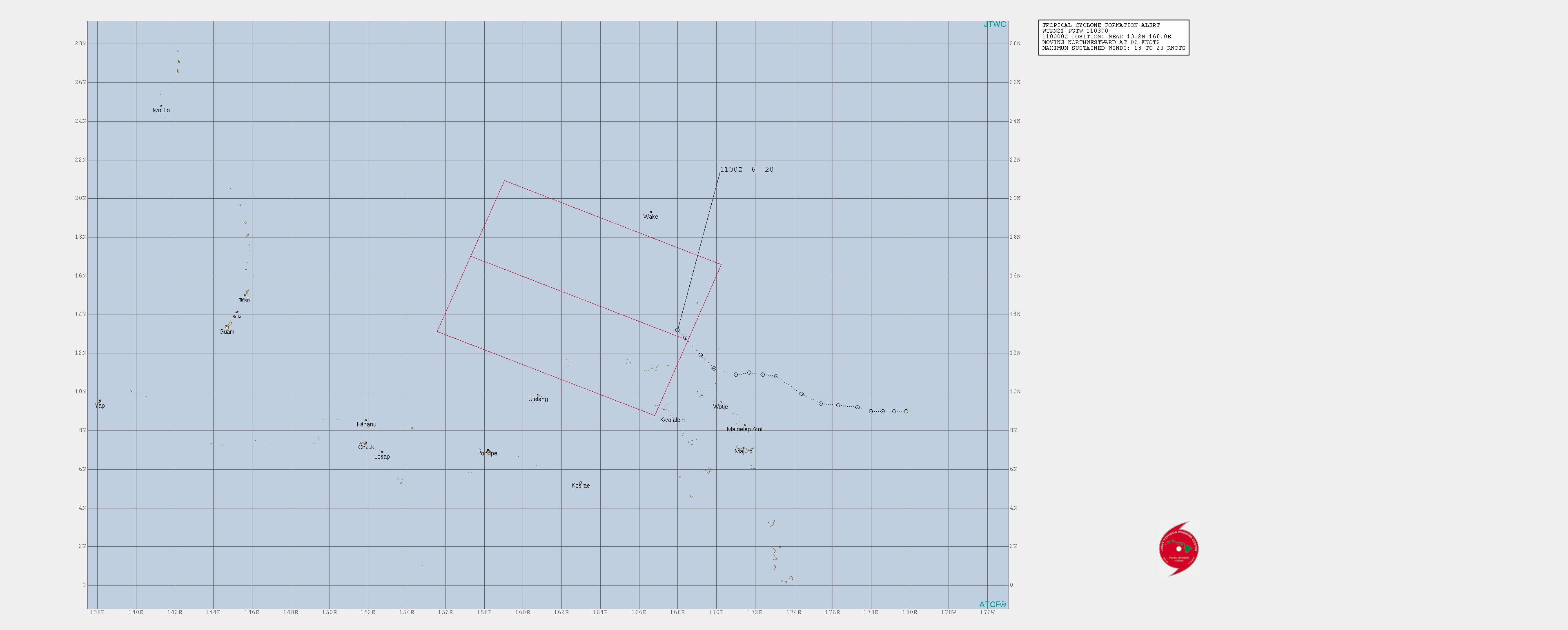
This article was imported from Wikipedia and is available under the Creative Commons Attribution-ShareAlike 4.0 License. Content has been adapted to SurfDoc format. Original contributors can be found on the article history page.
Ask Mako anything about 2019 Pacific typhoon season — get instant answers, deeper analysis, and related topics.
Research with MakoFree with your Surf account
Create a free account to save articles, ask Mako questions, and organize your research.
Sign up freeThis content may have been generated or modified by AI. CloudSurf Software LLC is not responsible for the accuracy, completeness, or reliability of AI-generated content. Always verify important information from primary sources.
Report