From Surf Wiki (app.surf) — the open knowledge base
2018 and 2022 FIFA World Cup bids
Football World Cup host nation bids
Football World Cup host nation bids
The bidding process for the 2018 and 2022 FIFA World Cups was the process by which the Fédération Internationale de Football Association (FIFA) selected locations for the 2018 and 2022 FIFA World Cups. The process began officially in March 2009; eleven bids from thirteen countries were received, including one which was withdrawn and one that was rejected before FIFA's executive committee voted in November 2010. Two of the remaining nine bids applied only to the 2022 World Cup, while the rest were initially applications for both. Over the course of the bidding, all non-European bids for the 2018 event were withdrawn, resulting in the exclusion of all European bids from consideration for the 2022 edition. By the time of the decision, bids for the 2018 World Cup included England, Russia, a joint bid from Belgium and Netherlands, and a joint bid from Portugal and Spain. Bids for the 2022 World Cup came from Australia, Japan, Qatar, South Korea, and the United States. Indonesia's bid was disqualified due to lack of governmental support, and Mexico withdrew its bid for financial reasons.
On 2 December 2010, Russia and Qatar were selected as the locations for the 2018 and 2022 FIFA World Cups respectively. The selection process involved several controversies. Two members of the FIFA Executive Committee had their voting rights suspended following allegations that they would accept money in exchange for votes. More allegations of vote buying arose after Qatar's win was announced. Eleven of the 22 committee members who voted on the 2018 and 2022 tournaments have been fined, suspended, banned for life or prosecuted for corruption.
Background
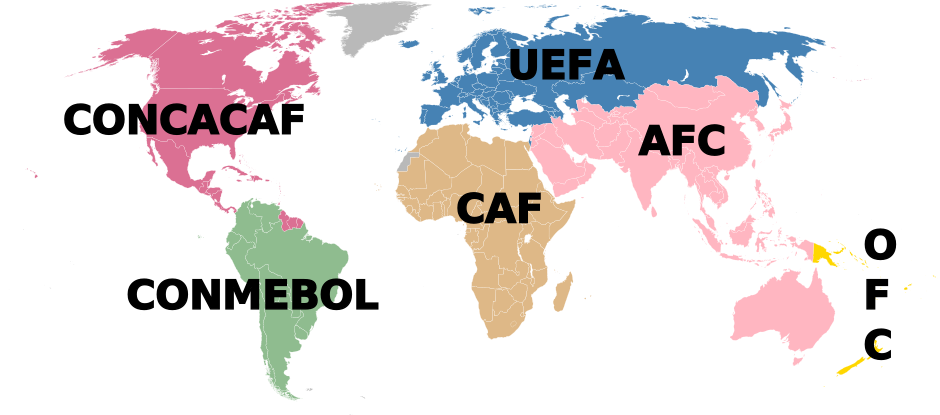
In October 2007, FIFA ended its continental rotation policy. Instead, countries that are members of the same confederation as either of the last two tournament hosts are ineligible, leaving Africa ineligible for 2018 and South America ineligible for both 2018 and 2022. Other factors in the selection process include the number of suitable stadiums, and their location across candidate nations. Voting is done using a multiple round exhaustive ballot system whereby the candidate receiving the fewest votes in each round is eliminated until a single candidate is chosen by the majority.
Rotation policy
Following the selection of the 2006 World Cup hosts, FIFA had decided on a policy for determining the hosts of future editions. The six world confederations — roughly corresponding to continents – would rotate in their turn of providing bids, for a specific edition, from within their member national associations. This system was used only for the selection of the 2010 (South Africa) and 2014 World Cup (Brazil) hosts, open only to CAF and CONMEBOL members, respectively.
In September 2007, the rotation system came under review, and a new system was proposed which renders ineligible for bidding only the last two World Cup host confederations. This proposal was adopted on 29 October 2007, in Zürich, Switzerland by FIFA's executive committee. Under this policy, a 2018 bid could have come from CONCACAF, AFC, UEFA, or OFC, as Africa and South America were ineligible. Likewise, no CONMEBOL member could make a 2022 bid, and candidates from the same confederation as the successful 2018 applicant would be disregarded in the 2022 selection procedure.
The United States, the last non-European candidate in the 2018 bidding cycle, withdrew its bid for that year; hence the 2018 tournament would have to be held in Europe. This in turn meant that CONMEBOL and UEFA were ineligible for 2022.
Voting procedure
For both the 2018 and 2022 editions of the World Cup, the FIFA Executive Committee voted to decide which candidate should host the tournament. The multiple round exhaustive ballot system was used to determine the tournament host. All eligible members of the FIFA Executive Committee had one vote. The candidate country that received the fewest votes in each round was eliminated until a single candidate was chosen by the majority. In the event of a tied vote, FIFA President Sepp Blatter would have had the deciding vote. There are twenty-four members on the committee, but two of those were suspended due to accusations of selling votes.
Schedule
| Date | Notes |
|---|---|
| 15 January 2009 | Applications formally invited |
| 2 February 2009 | Closing date for registering intention to bid |
| 16 March 2009 | Deadline to submit completed bid registration forms |
| 14 May 2010 | Deadline for submission of full details of bid |
| 19 July 2010 | Four-day individual applicant inspections begin |
| 17 September 2010 | Inspections end |
| 2 December 2010 | FIFA appointed hosts for 2018 and 2022 World Cups |
2018 bids
Eleven bids were submitted in March 2009 covering thirteen nations, with two joint bids: Belgium-Netherlands and Portugal-Spain. Mexico also submitted a bid, but withdrew theirs on 28 September 2009, while Indonesia had their bid rejected for lack of government support on 19 March 2010. However, due to the withdrawals of the five non-European bids for the 2018 World Cup, making all remaining bids for the 2018 World Cup were from European nations, and FIFA's rules dictate that countries belonging to confederations that hosted either of the two preceding tournaments are not eligible to host, all UEFA bids were forced to be for 2018 only. Four bids came from the Asian Football Confederation (AFC), four from Europe's UEFA, and one from CONCACAF. It had also been reported on the FIFA website that Egypt was entering a bid, but the president of the Egyptian Football Association denied that any more than an inquiry in principle had been made.
| [](2018-fifa-world-cup) | |||||
|---|---|---|---|---|---|
| bids | |||||
| [](2022-fifa-world-cup) | |||||
| bids | |||||
| Cancelled | |||||
| bids | |||||
| BelgiumNetherlands Belgium & Netherlands | [[File:Map of 2018 FIFA World Cup bids.svg | center | 600px | middle]] | |
| England England | |||||
| Russia **Russia** | |||||
| PortugalSpain Portugal & Spain | |||||
| Australia Australia | |||||
| Japan Japan | |||||
| Qatar **Qatar** | |||||
| South Korea South Korea | |||||
| United States United States | |||||
| Indonesia Indonesia | |||||
| Mexico Mexico |
Belgium and the Netherlands
Main article: Belgium–Netherlands 2018 FIFA World Cup bid
Alain Courtois, a Belgian Member of Parliament, announced in October 2006 that a formal bid would be made on behalf of the three Benelux countries: Belgium, the Netherlands, and Luxembourg. In June 2007 the three countries launched their campaign not as a joint bid in the manner of the Korea-Japan World Cup in 2002, but emphasising it as a common political organisation. Luxembourg would not host any matches or automatically qualify for the finals in a successful Benelux bid, but would host a FIFA congress.{{cite news
Belgium and the Netherlands registered their intention to bid jointly in March 2009. A delegation led by the presidents of the Belgian and Dutch national football associations met FIFA president Sepp Blatter on 14 November 2007, officially announcing their interest in submitting a joint bid.{{cite web |access-date = 14 November 2007 |archive-url = https://web.archive.org/web/20071115095252/http://www.fifa.com/worldfootball/releases/newsid%3D637931.html |archive-date = 15 November 2007 |url-status = dead
A factor that was against the Benelux bid was the lack of an 80,000 capacity stadium to host the final.{{cite news | archive-url = https://web.archive.org/web/20090208112652/http://news.bbc.co.uk/sport1/hi/football/internationals/7856716.stm | archive-date = 8 February 2009 | url-status = live However, the city council of Rotterdam gave permission in March 2009 for development of a new stadium with a capacity of around 80,000 seats to be completed in time for the possible World Cup in 2018. In November 2009, the venues were presented. In Belgium, matches would have been played in 7 venues: Antwerp, Bruges, Brussels, Charleroi, Genk, Ghent and Liège. In the Netherlands, only five cities would host matches: Amsterdam, Eindhoven, Enschede, Heerenveen and Rotterdam, but both Amsterdam and Rotterdam would provide two stadiums. Eindhoven would function as the 'capital city' of the World Cup.{{cite news |access-date=9 November 2009 |archive-url=https://web.archive.org/web/20091111111437/http://www.sporza.be/cm/sporza/voetbal/wk/091109_speelsteden_WK |archive-date=11 November 2009 |url-status=dead
England
Main article: England 2018 FIFA World Cup bid
On 31 October 2007, The Football Association officially announced its bid to host the event.{{cite news |archive-url=https://web.archive.org/web/20110429084709/http://www.timesonline.co.uk/tol/sport/football/international/article2779563.ece |archive-date=29 April 2011 |url-status=dead}} On 24 April 2008 England finalised a 63-page bid to host the 2018 World Cup, focusing on the development of football worldwide. On 27 January 2009, England officially submitted their bid to FIFA.{{cite news Richard Caborn led England's bid to stage the event after stepping down as Sports Minister.{{cite news
The British government backed the England 2018 bid. In November 2005, Chancellor Gordon Brown and Sport Minister Tessa Jowell first announced that they were to investigate the possibility of bidding.{{cite web That month, Adrian Bevington, the Football Association's Director of Communications, announced the support of the Government and the Treasury in the bid, but put off definite proposals.{{cite web Brown reiterated his support for a bid in March 2006, before England's 2006 World Cup campaign,{{cite web The UK government launched its official report on 12 February 2007, in which it was made clear that its support was for an England-only bid and that all games would be played at English grounds.{{cite news |archive-url=https://web.archive.org/web/20121020214923/http://www.scotsman.com/news/politics/top-stories/chancellor-s-world-cup-fever-fails-to-grip-the-scots-1-681878 |archive-date=20 October 2012 |url-status=dead }} The venues selected on 16 December 2009 to form the bid were: London (three stadiums), Manchester (two stadiums), Birmingham, Bristol, Leeds, Liverpool, Milton Keynes, Newcastle, Nottingham, Plymouth, Sheffield and Sunderland.
FIFA officials also expressed interest in an English bid. David Will, a vice-president of FIFA, noted England's World Cup proposal as early as May 2004.{{cite news |url=http://news.bbc.co.uk/go/click/rss/0.91/public/-/sport1/hi/football/3740851.stm |archive-url=https://web.archive.org/web/20090217045513/http://news.bbc.co.uk/sport1/hi/football/3740851.stm |archive-date=17 February 2009 |url-status=live }} Franz Beckenbauer, leader of Germany's successful bid for the 2006 World Cup and a member of FIFA's executive committee, twice publicly backed an English bid to host the World Cup, in January and July 2007.{{cite news |archive-url=https://web.archive.org/web/20070214083728/http://news.bbc.co.uk/sport1/hi/football/internationals/6307237.stm |archive-date=14 February 2007 |url-status=live}} |archive-url=https://web.archive.org/web/20080223110839/http://news.bbc.co.uk/sport2/hi/football/6921154.stm |archive-date=23 February 2008 |url-status=live }} FIFA President Sepp Blatter said he would welcome a 2018 bid from "the homeland of football."{{cite news | archive-url=https://web.archive.org/web/20051201063432/http://news.bbc.co.uk/sport1/hi/football/internationals/4208814.stm | archive-date=1 December 2005 | url-status=live }} Blatter met David Cameron on two occasions to discuss the bid while paying visits to England. The British Prime Minister showed much support for the bid and was hopeful that the "home of football" would host the tournament.{{cite news
In an interview the leader of Russia's bid, Alexei Sorokin, criticised England's bid citing London's high crime rate, alcohol consumption among young people and English fans "inciting ethnic hatred." England filed a complaint, though the complaint was withdrawn following Russia's apology.
Portugal and Spain
Main article: Portugal–Spain 2018 FIFA World Cup bid
The President of the Portuguese Football Federation (FPF), Gilberto Madail, first proposed a joint bid with Spain in November 2007.{{cite news |archive-url=https://web.archive.org/web/20080226173847/http://www.telegraph.co.uk/sport/main.jhtml?view=DETAILS&grid=A1YourView&xml=%2Fsport%2F2007%2F11%2F27%2Fsfnwcp127.xml |archive-date=26 February 2008 |url-status=dead |archive-url=https://web.archive.org/web/20080514025206/http://www.marca.com/edicion/marca/futbol/seleccion/es/desarrollo/1090960.html |archive-date=14 May 2008 |url-status=live }} However, the president of the Royal Spanish Football Federation (RFEF), Angel Villar, announced in July 2008 that it was Spain's intention to submit an individual World Cup bid, and that positive contacts had already taken place with the government, through the secretary of sports, Jaime Lissavetzky. No specifications were made then regarding a joint bid with Portugal.{{cite news |url=http://www.elpais.com/articulo/deportes/Villar/confirma/contactos/Lissavetzky/organizar/Mundial/2018/elpepudep/20080716elpepudep_10/Tes
On 23 December 2008, Angel Villar restated "We need to present a strong, consistent and winning bid for the 2018 World Cup." He further confessed "Personally, I think it should be with Portugal."{{cite news |archive-url=https://web.archive.org/web/20081225231228/http://www.marca.com/edicion/marca/futbol/seleccion/es/desarrollo/1194477.html |archive-date=25 December 2008 |url-status=live}} Spanish sports newspaper Marca advanced some details about the potential bid: Spain would lead a twelve-stadium project with eight of the venues, and the opening and final games would be held in Lisbon and Madrid, respectively. Spain has previously hosted the Euro 1964 and the 1982 World Cup, while Portugal organised the Euro 2004.
Both nations would eventually be awarded the 2030 FIFA World Cup hosting rights in conjunction with Morocco, as well as centennial hosts Uruguay, Argentina and Paraguay.
Russia
Main article: Russia 2018 FIFA World Cup bid
Russia announced its intent to bid in early 2009, and submitted its request to FIFA in time. The bid committee also included RFU CEO Alexey Sorokin and Alexander Djordjadze as the Director of Bid Planning and Operations.
Fourteen cities were included in the proposal, which divided them into five different clusters: one in the north, centered on Saint Petersburg, a central cluster, centered on Moscow, a southern cluster, centered on Sochi, and the Volga River cluster. Only one city beyond the Ural Mountains was cited, Yekaterinburg. The other cities were: Kaliningrad in the north cluster, Rostov-on-Don and Krasnodar in the south cluster and Yaroslavl, Nizhny Novgorod, Kazan, Saransk, Samara and Volgograd in the Volga River cluster. At the time of bidding, Russia did not have a stadium with 80,000 capacity, but the bid called for the expansion of Luzhniki Stadium in Moscow, already a UEFA Elite stadium, from a capacity of slightly over 78,000 to over 89,000. Russia hoped to have five stadiums fit to host World Cup matches ready by 2013 – two in Moscow and one stadium each in Saint Petersburg, Kazan and Sochi, which at the time was due to host the 2014 Winter Olympics.
2022 bids
Australia
Main article: Australia 2022 FIFA World Cup bid
In September 2007, the Football Federation Australia confirmed that Australia would bid for the 2018 World Cup finals.{{cite news Previously, in late May 2006, the Victorian sports minister, Justin Madden, said that he wanted his state to drive a bid to stage the 2018 World Cup. Frank Lowy, the FFA chairman, stated that they aimed to use 16 stadiums for the bid.{{cite news |url-status=dead |archive-url=https://web.archive.org/web/20090205172915/http://www.news.com.au/dailytelegraph/story/0%2C22049%2C23259207-5006068%2C00.html |archive-date=5 February 2009 |access-date=13 May 2013 Then Australian Prime Minister Kevin Rudd announced the Federal Government's support for the bid,{{cite news and in December 2008, Federal minister for sport Kate Ellis announced that the federal government would give the FFA $45.6 million to fund its World Cup bid preparation.{{cite news |access-date = 12 December 2008 |archive-url = https://web.archive.org/web/20090206034706/http://www.theaustralian.news.com.au/story/0,25197,24778844-12377,00.html |archive-date = 6 February 2009 |url-status = dead Rudd met with Sepp Blatter to discuss the Commonwealth Government's support of the bid in Zürich in July 2009.
At the 2008 FIFA Congress, held in Sydney, FIFA president Sepp Blatter suggested that Australia concentrate on hosting the 2022 tournament,{{cite news |access-date=30 May 2008 |archive-url=https://web.archive.org/web/20080531132531/http://www.fifa.com/aboutfifa/federation/bodies/news/newsid%3D783630.html |archive-date=31 May 2008 |url-status=dead
Australia's largest stadiums are currently used by other major Australian sports whose domestic seasons overlap with the World Cup. The Australian Football League and National Rugby League claimed that loss of access to these major venues for eight weeks would severely disrupt their seasons and impact the viability of their clubs. The AFL in particular had previously advised it would not relinquish Etihad Stadium in Melbourne for the entire period required. On 9 May 2010 the AFL, NRL, and FFA announced a Memorandum of Understanding guaranteeing that the AFL and NRL seasons would continue, should the bid be successful. Compensation for the rival football codes would be awarded as a result of any disruptions caused by hosting the World Cup. AFL CEO Andrew Demetriou came out in support of the bid, despite initially not supporting the bid. Franz Beckenbauer indicated that the issue of factional disputes between the FFA, NRL and, AFL were not considered by the FIFA Executive Committee. Although initially Australia seemed to be a popular contender to host the tournament, the final Australian World Cup bid received only one vote astonishing Franz Beckenbauer and experts alike.
Japan
Main article: Japan 2022 FIFA World Cup bid
Japan bid to become the first Asian country to host the World Cup twice; however, the fact that they were co-hosts so recently in 2002 was expected to work against them in their bid.{{cite news | archive-url = https://web.archive.org/web/20090202011223/http://news.bbc.co.uk/sport1/hi/football/internationals/7863406.stm | archive-date = 2 February 2009 | url-status = live
Japan also pledged that if it had been granted the rights to host the 2022 World Cup games, it would develop technology enabling it to provide a live international telecast of the event in 3D, which would allow 400 stadiums in 208 countries to provide 360 million people with real-time 3D coverage of the games projected on giant screens, captured in 360 degrees by 200 HD cameras. Furthermore, Japan will broadcast the games in holographic format if the technology to do so is available by that time. Beyond allowing the world's spectators to view the games on flat screens projecting 3D imaging, holographic projection would project the games onto stadium fields, creating a greater illusion of actually being in the presence of the players. Microphones embedded below the playing surface would record all sounds, such as ball kicks, in order to add to the sense of realism.
The Olympic bid was unsuccessful, coming third in the bidding process that concluded in October 2009. The vice-president of the Japan Football Association, Junji Ogura, had previously admitted that if Tokyo were to fail in its bid, its chances of hosting either the 2018 or 2022 World Cup would not be very good.{{cite news | access-date =5 December 2010 | archive-url = https://web.archive.org/web/20121114080408/http://www.reuters.com/article/2009/01/23/soccer-world-japan-idUSSP35460420090123 | archive-date = 14 November 2012 | url-status = live
Qatar
Main article: Qatar 2022 FIFA World Cup bid
Qatar made a bid for only the 2022 World Cup. Qatar was attempting to become the first Arab country to host the World Cup. Failed bids from other Arab countries include Morocco (1994, 1998, 2006 and 2010), Egypt and a Libya-Tunisia joint bid withdrew in the 2010 World Cup bidding process. Sheikh Mohammed bin Hamad bin Khalifa Al-Thani, son of the former Emir of Qatar, was the chairman of the bid committee.{{cite news |url-status=dead |archive-url=https://web.archive.org/web/20090602051207/http://www.dubaichronicle.com/life/sport-life/qatar-2022-announces-bid-committee-leadership-7121 |archive-date=2 June 2009 Qatar planned to promote the bid as an Arab unity bid and hoped to draw on support from the entire Arab world and were positioning this as an opportunity to bridge the gap between the Arab and Western worlds.{{cite news | access-date = 5 December 2010 | archive-date = 27 April 2011 | archive-url = https://web.archive.org/web/20110427083100/http://soccernet.espn.go.com/news/story?id=647154&sec=worldcup2010&&cc=5739 | url-status = dead
Some concerns with Qatar's bid deal with the extreme temperatures. The World Cup is always held in the European off-season in June and July and during this period the average daytime high in most of Qatar is in excess of 40 °C (104 °F), with the average daily low temperatures not dropping below 30 °C (86 °F). Sheikh Mohammed bin Hamad bin Khalifa al-Thani, the 2022 Qatar bid chairman, responded saying "the event has to be organised in June or July. We will have to take the help of technology to counter the harsh weather. We have already set in motion the process. A stadium with controlled temperature is the answer to the problem. We have other plans up our sleeves as well."{{cite news |url-status=dead |archive-url=https://web.archive.org/web/20090329073540/http://www.qatar-tribune.com/data/20090325/content.asp?section=exclusive1_1 |archive-date=29 March 2009
President of FIFA Sepp Blatter endorsed the idea of having a World Cup in the Middle East, saying in April 2010, "The Arabic world deserves a World Cup. They have 22 countries and have not had any opportunity to organise the tournament." Blatter also praised Qatar's progress, "When I was first in Qatar there were 400,000 people here and now there are 1.6 million. In terms of infrastructure, when you are able to organise the Asian Games (in 2006) with more than 30 events for men and women, then that is not in question." Qatar's bid to host the 2022 World Cup received a huge boost on 28 July 2010 when Asian Football Confederation (AFC) President Mohammed Bin Hammam threw his weight behind his country's campaign. Speaking in Singapore, Bin Hammam said: "I have one vote and, frankly speaking, I will vote for Qatar but if Qatar is not in the running I will vote for another Asian country." Qatar has already hosted the AFC Asian Cup in 1988, FIFA U-20 World Cup 1995 and the 2011 AFC Asian Cup.
The bid was overshadowed by reports claiming Qatar executed Project Merciless, a covert operation designed to secure Qatar as the host of the 2022 World Cup. The project that targeted high FIFA officials, contenders for hosting the world cup as well as those criticizing Qatar's bid, included espionage, surveillance, hacking and influence operations.
South Korea
Main article: South Korea 2022 FIFA World Cup bid
South Korea bid only for the 2022 World Cup. They were bidding to become the first Asian country to host the World Cup twice; however, the fact that they were co-hosts so recently in 2002 was expected to work against them in their bid. Han Seung-joo, a former South Korean Minister of Foreign Affairs, was appointed as the Chairman of the Bidding Committee in August 2009. He met with FIFA President Sepp Blatter in Zürich, Switzerland. In January 2010, President Lee Myung-bak visited the headquarters of FIFA in Zürich, Switzerland to meet Sepp Blatter in support of the South Korean bid.
Although South Korea did not have an 80,000 capacity stadium, it planned to upgrade an existing venue to meet that capacity. There are three grounds which can seat over 60,000 people—Seoul Olympic Stadium, Seoul World Cup Stadium and Daegu Stadium. Another 70,000 seat stadium is scheduled to be built in Incheon as the main stadium for the 2014 Asian Games. Other venues meet hosting requirements as they were built for the 2002 World Cup. The 12 cities selected to hold the finals were South Korea to win the bid were selected in March 2010 and were Busan, Cheonan, Daegu, Daejeon, Goyang, Gwangju, Incheon (2 venues), Jeonju, Seogwipo, Seoul (2 venues), Suwon and Ulsan.
United States
Main article: United States 2022 FIFA World Cup bid
U.S. Soccer first said in February 2007 that it would bid for the 2018 World Cup.{{cite news |archive-url=https://web.archive.org/web/20110504074346/http://voices.washingtonpost.com/soccerinsider/2009/02/usa_in_18_or_22.html |archive-date=4 May 2011 |url-status=dead }} The vice president of FIFA, Jack Warner, who is also the president of CONCACAF, originally said he would try to bring the World Cup back to the CONCACAF region.{{cite news | archive-url=https://web.archive.org/web/20080113042625/http://news.bbc.co.uk/sport2/hi/football/internationals/6939170.stm | archive-date=13 January 2008 | url-status=live }} However, Warner also stated that he preferred the USSF change their plans to make a bid for the 2022 FIFA World Cup.
In April 2009, the bid committee identified 70 stadiums in 50 communities as possible venues for the tournament, with 58 confirming their interest.{{cite news | archive-url = https://web.archive.org/web/20100216123218/http://soccer.teamusa.org/news/2009/04/08/2018-or-2022-fifa-world-cup-bid-committee-contacts-70-us-venues/11583 | archive-date = 16 February 2010 |url-status = dead }} The list of stadiums was trimmed two months later to 45 in 37 cities,{{Cite press release |access-date=18 June 2009 |archive-url=https://web.archive.org/web/20090619071040/http://www.ussoccer.com/articles/viewArticle.jsp_14876672.html |archive-date=19 June 2009 |url-status=dead
In October 2010, the United States withdrew from the 2018 bid process, to focus solely on the 2022 competition.
The US would later be awarded the 2026 FIFA World Cup in a joint bid with Canada and Mexico, defeating a bid by Morocco.
Cancelled bids
Two countries had to cancel bids for the 2018 or 2022 FIFA World Cups before individual evaluations began. Mexico cancelled its bid for both cups, while Indonesia was only bidding for the 2022 World Cup.
Indonesia
Main article: Indonesia 2022 FIFA World Cup bid
In January 2009 the Football Association of Indonesia (PSSI) confirmed their intention to bid for the 2022 FIFA World Cup, with government support.{{cite news |access-date=11 February 2009 |url-status=dead |archive-url=https://web.archive.org/web/20130424191616/http://www.thejakartapost.com/news/2009/02/10/indonesia-upbeat-host-green039-world-cup.html/ |archive-date=24 April 2013 This campaign included a $1 billion plan to upgrade supporting infrastructure beside stadiums to meet FIFA's requirements. The funds to construct stadiums were to come from regional governments.{{cite news |access-date = 6 September 2009 |archive-url = https://web.archive.org/web/20090918231601/http://bola.vivanews.com/news/read/28455-anggaran_infrastruktur_rp_10_triliun |archive-date = 18 September 2009 |url-status = dead |access-date = 5 September 2009 |archive-url = https://web.archive.org/web/20090818140133/http://www.thejakartapost.com/news/2009/01/28/indonesia-joins-race-host-2018-2022-world-cup.html |archive-date = 18 August 2009 |url-status = dead
In the campaign presentation, PSSI president Nurdin Halid said he believed Indonesia stood a chance to win FIFA's approval to host the 2022 World Cup, despite the relatively poor infrastructure, coupled with the low quality of the national squad compared to other candidates. He said Indonesia had proposed a "Green World Cup 2022", hoping to capitalise on the current green and global warming movement worldwide: "Our deforestation rate has contributed much to world pollution. By hosting the World Cup, we wish to build infrastructure and facilities that are environmentally friendly so we can give more to the planet."
The bid was launched at a moment when there were strong pressures from Indonesian football fans for Halid to step down from his position as chairman of PSSI. There was no official support from the government of Indonesia until 9 February 2010, the deadline for the country's government to file a letter of support for the bid. Secretary General of PSSI Nugraha Besoes did not deny that Indonesia could be disqualified from the bidding process because the Indonesian government did not support the bid.{{cite news
Mexico
Former Mexican Football Federation President, Alberto de la Torre, announced their intention to bid for the cup in 2005, but was ineligible because of the rotation policy at that time.
Selection
Eligible voters
;FIFA President
- Switzerland Sepp Blatter (banned in 2015 for eight years by FIFA Ethics Committee, amid a sweeping corruption investigation led by the U.S. in the 2015 FIFA corruption case)
;Senior Vice President
- Argentina Julio Grondona (died on 30 July 2014; indicted on 6 April 2020 by the U.S. Department of Justice) ;Vice Presidents
- Cameroon Issa Hayatou
- South Korea Chung Mong-joon
- Trinidad and Tobago Jack Warner (indicted for corruption in 2015 FIFA corruption case)
- Spain Angel Maria Villar
- France Michel Platini (banned in 2015 for eight years by the European Court of Human Rights for ethics violations, later reduced to four years)
- England Geoff Thompson
;Members
- Belgium Michel D'Hooghe
- Brazil Ricardo Teixeira (indicted on 3 December 2015 by the U.S. Department of Justice)
- Qatar Mohamed Bin Hammam (banned in 2011 for life from all football activities for ethics violations)
- Turkey Şenes Erzik
- United States Chuck Blazer (plead guilty to corruption charges in 2015 FIFA corruption case)
- Thailand Worawi Makudi (banned in 2015 for five years for forgery and falsification)
- Paraguay Nicolas Leoz (indicted for corruption in 2015 FIFA corruption case)
- Japan Junji Ogura
- Cyprus Marios Lefkaritis
- Ivory Coast Jacques Anouma
- Germany Franz Beckenbauer
- Guatemala Rafael Salguero (indicted on 3 December 2015 by the U.S. Department of Justice)
- Egypt Hany Abo Rida
- Russia Vitaly Mutko
;Prevented from voting
- TAH Reynald Temarii
- NGR Amos Adamu
Voting rounds

On 2 December 2010, FIFA president Sepp Blatter announced the winning bids at FIFA's headquarters in Zürich. Russia was chosen to host the 2018 World Cup, and Qatar was chosen to host the 2022 World Cup. This made Russia the first Eastern European country to host the World Cup, while Qatar would be the first Middle Eastern country to host the World Cup. Blatter noted that the committee had decided to "go to new lands" and reflected a desire to "develop football" by bringing it to more countries.
In each round a majority of twelve votes was needed. If no bid received 12 votes in a round, the bid with the fewest votes in that round was eliminated, and accordingly each remaining bid should receive no fewer votes in subsequent rounds than in preceding rounds. Multiple bids received fewer votes in voting round 2 compared to voting round 1 (Netherlands/Belgium, Qatar and Japan), at least 2 voting members in each of the 2018 and 2022 votes changed their votes between voting rounds despite their initial bid not being eliminated in voting round 1. The actual votes cast were as follows:
| Country | Vote | 1 | 2 | Total Votes | 22 | 22 |
|---|---|---|---|---|---|---|
| **Russia** | 9 | **13** | ||||
| Spain/Portugal | 7 | 7 | ||||
| Netherlands/Belgium | 4 | 2 | ||||
| England | 2 | – |
| Country | Vote | 1 | 2 | 3 | 4 | Total Votes | 22 | 22 | 22 | 22 |
|---|---|---|---|---|---|---|---|---|---|---|
| **Qatar** | 11 | 10 | 11 | **14** | ||||||
| United States | 3 | 5 | 6 | 8 | ||||||
| South Korea | 4 | 5 | 5 | – | ||||||
| Japan | 3 | 2 | – | – | ||||||
| Australia | 1 | – | – | – |
Allegations of vote-buying
Shortly after the voting in December 2010, ESPN published allegations linking Qatar's successful bid to Football Dreams, a youth development program that channeled money from the Qatari government to football programs in 15 countries in sub-Saharan Africa, Latin America and Southeast Asia—six of which had representatives on the FIFA executive committee. In February 2011, Blatter admitted that the Spanish and Qatari bid teams did try to trade votes, "but it didn't work".
In May 2011, the former England 2018 bid chief Lord Treisman told a House of Commons select committee that four FIFA committee members approached him asking for various things in exchange for votes. Among the accused were FIFA Vice President Jack Warner, who allegedly asked for £2.5 million to be used for projects, and Nicolás Leoz, who allegedly asked to be knighted. The Sunday Times further reported that month that Issa Hayatou and Jacques Anouma were given $1.5 million in exchange for their votes in favor of Qatar. On 30 May 2011, FIFA President Sepp Blatter rejected the evidence in a press conference, while Jack Warner, who had been suspended that day for a separate ethics violations pending an investigation, leaked an email from FIFA General Secretary Jérôme Valcke which suggested that Qatar had "bought" the rights to host the 2022 FIFA World Cup. Valcke subsequently issued a statement denying he had suggested it was bribery, saying instead that the country had "used its financial muscle to lobby for support". Qatar officials denied any impropriety. Theo Zwanziger, President of the German Football Association, also called on FIFA to re-examine the awarding of the Cup to Qatar.
In July 2012, FIFA appointed former U.S. Attorney Michael J. Garcia to investigate allegations of vote-buying in the selection process. He submitted the report in September 2014, which FIFA at the time declined to release in full. Instead, FIFA released a summary that Garcia described as "materially incomplete," leading Garcia to resign in protest. FIFA ultimately published the report in 2017, after German tabloid Bild announced they would publish a leaked copy. The report detailed dozens of allegations but didn't provide hard evidence for vote-buying. In May 2015, as members gathered in Zürich for the 65th FIFA Congress, U.S. federal prosecutors disclosed cases of corruption leading to the arrest of seven. More than 40 individuals were indicted, including 2018 and 2022 voters Luis Bedoya, Chuck Blazer, Nicolás Leoz, Rafael Salguero, Ricardo Teixeira, and Jack Warner. The resulting cases led FIFA to suspend many members, including Issa Hayatou, and the end of Sepp Blatter's presidency of the organization.
In April 2020, the United States Department of Justice unsealed further indictments against voters Nicolás Leoz, Ricardo Teixeira, Julio Grondona of Argentina, and Jack Warner. The indictments spelled out how shell corporations and sham consulting contracts were used to pay voters between $1–5 million for their support. Other voters who had previously pleaded guilty to accepting bribes, including Rafael Salguero of Guatemala, aided in the indictments, which when included with previous cases, mean that more than half of the voters were accused of wrongdoing related to their votes. Voter Franz Beckenbauer has also been accused by Swiss prosecutors of embezzlement and money laundering related to voting in the 2006 FIFA World Cup host selection, while Ángel María Villar was arrested in July 2017 for embezzlement, after previously being fined for failure to cooperate with investigations into vote-buying in the 2018 and 2022 host selection.
Reactions
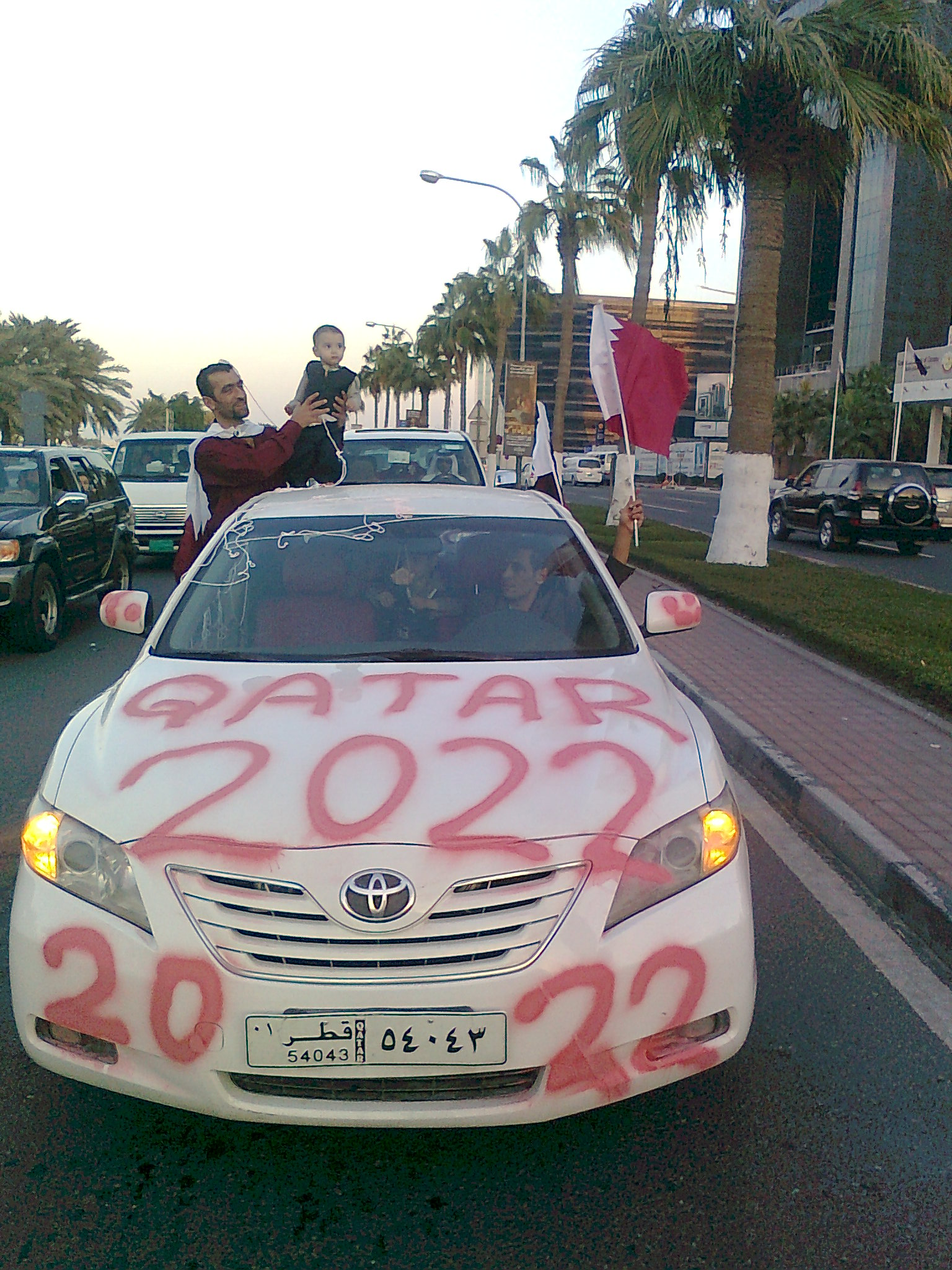
In reaction to the announcement there were celebrations on the streets of Russia and Qatar. The Qatar Stock Exchange responded strongly with increased participation in trading following the announcement.
Iranian President Mahmoud Ahmadinejad told his Qatari counterpart that hosting the tournament "is a big athletic event which can promote football in the Persian Gulf area and Middle East region." He also said Iran was ready to help Qatar in hosting the event, while saying he hoped its neighbours "could achieve a reasonable share to attend the games." al-Thani "underlined [a] necessity of cooperation between regional countries to use and take advantage of the sport opportunity." He also added that Qatar's initiative would motivate its neighbours to "promote and develop their football."
Roger Burden, who had been acting chairman of England's Football Association, withdrew his application for the permanent post days after the vote, saying he could not trust FIFA members due to their actions. England's bid executive Andy Anson said "I think it has to [change] because otherwise why would Australia, the United States, Holland, Belgium, England ever bother bidding again?"
There was also a backlash from the media in the losing countries; the majority of British newspapers alleged that the World Cup had been "sold" to Russia, and the Spanish El Mundo, Dutch Algemeen Dagblad, and the Japanese Nikkei made comments about the financial power of Russia and Qatar's commodity and energy reserves. American newspapers the Seattle Times and Wall Street Journal alleged collusion and corruption.
References
References
- (29 October 2007). "Fifa abandons World Cup rotation". BBC News.
- (25 September 2007). "New rotation proposal". BBC Sport.
- Hall, Matthew. (18 September 2005). "Australia can host World Cup". The Sydney Morning Herald.
- (2010-10-15). "England withdraw bid for 2022 Cup".
- Middleton, Dave. (2010-10-15). "Europe certain to host 2018 World Cup as US withdraws from running". The Guardian.
- (2 December 2010). "Russia, Qatar win race to host World Cups as FIFA spreads its vision". CNN.
- (14 May 2010). "FIFA receives bidding documents for 2018 and 2022 FIFA World Cups". FIFA.com.
- Dunbar, Graham. (3 December 2009). "Bid teams focus on 2018, 2022 WCup hosting prize". USA Today.
- "Rotation ends in 2018". Fédération Internationale de Football Association.
- (3 February 2009). "Egypt deny bid for 2022 World Cup". BBC News.
- (16 October 2006). "Benelux trio to apply to host 2018 World Cup". [[ESPN]].
- (27 June 2007). "Benelux countries launch 2018 World Cup bid". ESPN.
- (3 February 2009). "Twelve nations bid for World Cup". BBC News.
- (September 2010). "World Cup 2018".
- (24 April 2008). "England plans its 2018 World Cup bid". [[Yahoo!]].
- (24 October 2008). "Board confirmed for 2018". [[The Football Association]].
- Pearce, Edward. (16 May 2010). "Geoff Thompson Replaces Lord Triesman As England 2018 Bid Chief". Goal.com.
- (3 May 2006). "The World Cup and Economics 2006". [[Goldman Sachs]] research report.
- (6 December 2009). "Milton Keynes part of England's 2018 World Cup bid". BBC Sport.
- (23 December 2010). "Spain-Portugal Confirm 2018 World Cup Bid". Goal.
- (20 December 2008). "Candidatura ibérica ao Mundial 2018 prevê abertura em Lisboa e final em Madrid". [[Público (Portugal).
- link
- (2024-12-12). "World Cup 2030: Spain, Portugal and Morocco to co-host Fifa tournament".
- (20 January 2009). "Russia enters race to host 2018". BBC Sport.
- (October 2009). "Bid committee". Russia 2018–2022 Bid.
- (October 2009). "Host cities". Russia 2018–2022 Bid.
- (April 2009). "Russia ready to spend $10 bln on World Cup 2018 preparations".
- link. (20 July 2009 .)
- (10 June 2010). "World Cup 2010: Australia pull out of World Cup 2018 bidding". The Daily Telegraph.
- (10 June 2010). "World Cup 2018 should be in Europe, says Asian Football Confederation". The Guardian.
- (14 December 2009). "AFL concerns over world cup run deep.". ABC.
- "Soccer's plan to displace NRL". The Daily Telegraph.
- (13 December 2009). "Cup bid needs to share the vision". The Sydney Morning Herald.
- Walter, Brad. (10 May 2010). "Rival codes finally shake hands on deal to play through World Cup". The Sydney Morning Herald.
- Heenan, Tom. (3 March 2014). "Not every AFL point was a goal".
- Demetriou, Andrew. (26 November 2010). "World Cup soccer 2022 debate". Herald Sun.
- Davutovic, David. (28 November 2010). "Argy-bargy no threat to World Cup bid". Herald Sun.
- (4 December 2010). "Beckenbauer astonished by Australia snub".
- (3 May 2010). "Japan drops bid to host 2018 World Cup to aim for 2022". BBC Sport.
- Heathcote, Neil. (4 May 2010). "Qatar pitches cool World Cup bid". [[BBC World News]].
- "Monthly Averages for Doha, Qatar". The Weather Channel.
- Davies Krish. (9 April 2019). "Qatar Worldcup 2022 Stadiums". OnlineQatar.
- (25 April 2010). "Blatter reaches out to Arabia". Al Jazeera.
- (28 July 2010). "Bin Hammam talks up Qatar's 2022 bid". Sports Features Communications.
- en, Seguir. (2022-11-05). ""Project Merciless": Qatar's plan to spy on top FIFA leaders and ensure the organization of the 2022 World Cup".
- Suderman, Alan. (2021-11-23). "World Cup host Qatar used ex-CIA officer to spy on FIFA, U.S. bid that competed to host 2022 tournament".
- Bucholtz, Andrew. (2022-11-02). "Report links Qatar to FIFA hacking and ex-CIA operative's firm in effort to gain 2022 World Cup 'predictive intelligence'".
- (20 August 2009). "Han Sung-Joo Appointed as the Chairman of the Bidding Committee". [[Korea Football Association]].
- link. (26 September 2009). Yahoo! News Korea
- (4 March 2010). "Korea 2022 Reveals Host Cities". World Football Insider.
- "Warner wants U.S. to bid for 2022 World Cup". [[Fox Sports (USA)]].
- (20 August 2009). "USA Bid Committee Announces List of 27 Cities Still in Contention For Inclusion in U.S. Bid to Host FIFA World Cup in 2018 or 2022". United States Soccer Federation.
- (12 January 2010). "Bid Committee announces official bid cities". The USA Bid Committee.
- (15 October 2010). "US withdraw bid to host 2018 World Cup". BBC Sport.
- "Canada, Mexico and USA selected as hosts of the 2026 FIFA World Cup".
- "United Bid Selected to Host the 2026 FIFA World Cup™".
- McKirdy, Euan. (2018-06-13). "World Cup 2026: US-Mexico-Canada bid chosen as host".
- (9 February 2010 }}{{dead link). "Indonesia's bid for 2022 World Cup in question".
- (19 March 2010). "Indonesia's bid to host the 2022 World Cup bid ends". BBC Sport.
- (12 June 2010). "Indonesia backs Australia's 2022 FIFA World Cup Bid". [[Australia 2022 FIFA World Cup bid]].
- (1 December 2010). "Q+A - Voting for the 2018 and 2022 World Cup hosts". Reuters.
- (2 December 2010). "Russia and Qatar awarded 2018 and 2022 FIFA World Cups". FIFA.com.
- Gibson, Owen. (2 December 2010). "England beaten as Russia win 2018 World Cup bid". The Guardian.
- Jackson, Jamie. (2 December 2010). "Qatar win 2022 World Cup bid". The Guardian.
- Longman, Jeré. (2 December 2010). "Russia and Qatar Win World Cup Bids". [[The New York Times]].
- (2 December 2010). "Russia and Qatar to host 2018 and 2022 FIFA World Cups, respectively". FIFA.
- Latham, Brent. (21 December 2010). "Behind Qatar's football success". ESPN.
- (7 February 2011). "Sepp Blatter hints at 2022 summer World Cup in Qatar". BBC Sport.
- (10 May 2011). "Triesman accuses four FIFA members". [[ESPN Soccernet]].
- (11 May 2011). "FIFA demands evidence of corruption". ESPN Soccernet.
- Doherty, Regan E.. (30 May 2011). "Qataris brush off allegations of buying World Cup rights". [[Reuters]].
- (1 June 2011). "German Federation asks Fifa for inquiry into Qatar 2022". [[BBC Sport]].
- Keh, Andrew. (27 June 2017). "In Long-Secret FIFA Report, More Details but No Smoking Gun". The New York Times.
- (3 December 2015). "The Soccer Officials Indicted on Corruption Charges". The New York Times.
- (2 June 2015). "Sepp Blatter Decides to Resign as FIFA President in About-Face". The New York Times.
- (6 April 2020). "Indictment Reveals Details of Alleged Bribes for 2018, 2022 FIFA World Cup Votes".
- (19 July 2019). "Franz Beckenbauer probe to be split from World Cup investigation". Deutsche Welle.
- (27 July 2017). "Ángel María Villar resigns from Uefa and Fifa positions after arrest in Spain". The Guardian.
- "Russia celebrates its selection as World Cup 2018 hosts | DW | 02.12.2010".
- [[Al Jazeera English]]. 2 December 2010. 18:00 GMT.
- (2 December 2010). "A World Cup miracle". BBC Sport.
- (12 December 2010). "Egypt Shares Gain on View Central Bank May Cut Interest Rates, Led by CIBE". Bloomberg.
- http://cms.mfa.gov.ir/cms/cms/Tehran/en/Ifrem/1898912{{dead link. (November 2016)
- [[BBC News]], 4 December 2010.
- link. (5 December 2010 , Rachael Brown, ABC News, 4 December 2010)
- (3 December 2010). "English media angry at Fifa 'fix'". BBC News.
This article was imported from Wikipedia and is available under the Creative Commons Attribution-ShareAlike 4.0 License. Content has been adapted to SurfDoc format. Original contributors can be found on the article history page.
Ask Mako anything about 2018 and 2022 FIFA World Cup bids — get instant answers, deeper analysis, and related topics.
Research with MakoFree with your Surf account
Create a free account to save articles, ask Mako questions, and organize your research.
Sign up freeThis content may have been generated or modified by AI. CloudSurf Software LLC is not responsible for the accuracy, completeness, or reliability of AI-generated content. Always verify important information from primary sources.
Report