From Surf Wiki (app.surf) — the open knowledge base
1996 United States presidential election
none
none
| Field | Value | |
|---|---|---|
| election_name | 1996 United States presidential election | |
| country | United States | |
| type | presidential | |
| previous_election | 1992 United States presidential election | |
| previous_year | 1992 | |
| election_date | November 5, 1996 | |
| next_election | 2000 United States presidential election | |
| next_year | 2000 | |
| votes_for_election | 538 members of the Electoral College | |
| needed_votes | 270 electoral | |
| turnout | 51.7% 6.4 pp | |
| image_size | x150px | |
| <!-- Bill Clinton --> | image1 | Bill Clinton.jpg |
| nominee1 | **Bill Clinton** | |
| party1 | Democratic Party (United States) | |
| home_state1 | Arkansas | |
| running_mate1 | **Al Gore** | |
| electoral_vote1 | **379** | |
| states_carried1 | **31 + DC** | |
| popular_vote1 | **47,402,357** | |
| percentage1 | **49.2%** | |
| <!-- Bob Dole --> | image2 | Ks 1996 dole (cropped).jpg |
| nominee2 | Bob Dole | |
| party2 | Republican Party (United States) | |
| home_state2 | Kansas | |
| running_mate2 | Jack Kemp | |
| electoral_vote2 | 159 | |
| states_carried2 | 19 | |
| popular_vote2 | 39,198,755 | |
| percentage2 | 40.7% | |
| image3 | RossPerotColor (cropped closein 3x4).jpg | |
| nominee3 | Ross Perot | |
| party3 | Reform Party of the United States of America | |
| home_state3 | Texas | |
| running_mate3 | Pat Choate | |
| electoral_vote3 | 0 | |
| states_carried3 | 0 | |
| popular_vote3 | 8,085,402 | |
| percentage3 | 8.4% | |
| map_image | ||
| map_size | 350px | |
| map_caption | Presidential election results map. Blue denotes states won by Clinton/Gore and red denotes those won by Dole/Kemp. Numbers indicate electoral votes cast by each state and the District of Columbia. | |
| title | President | |
| before_election | Bill Clinton | |
| before_party | Democratic Party (United States) | |
| after_election | Bill Clinton | |
| after_party | Democratic Party (United States) |
| Presidential elections were held in the United States on November 5, 1996. Incumbent Democratic president Bill Clinton and his running mate, incumbent vice president Al Gore, were elected to a second term. They defeated the Republican ticket of former Senate majority leader Bob Dole and former secretary of housing and urban development Jack Kemp and the Reform ticket of businessman Ross Perot and economist Pat Choate.
Clinton and Vice President Gore were re-nominated without incident by the Democratic Party. Numerous candidates entered the 1996 Republican primaries, with Dole considered the early frontrunner. Dole clinched the nomination after defeating challenges by publisher Steve Forbes and paleoconservative leader Pat Buchanan. Dole's running mate was Jack Kemp, a former New York congressman and football player who had served as the housing secretary under President George H. W. Bush. Ross Perot, who had won 18.9% of the popular vote as an independent candidate in 1992, ran as the candidate of the Reform Party. Perot received less media attention in 1996 and was excluded from the presidential debates.
Clinton's chances of winning were initially considered slim in the middle of his term, as his party had lost both the House of Representatives and the Senate in 1994 for the first time in decades. He was able to regain ground as the economy began to recover from the early 1990s recession with a relatively stable world stage. Clinton tied Dole to Newt Gingrich, the arch-conservative Republican speaker of the House, and expressed concern that Republicans would increase the deficit and slash spending on popular programs like Social Security and Medicare. Dole promised an across-the-board 15% reduction in federal income taxes and labeled Clinton as a "spoiled" Baby Boomer who "never grew up" and "never sacrificed." Dole's age was a persistent issue in the election, and gaffes by Dole exacerbated the issue for his campaign.
On election day, Clinton defeated Dole by a wide margin, winning 379 electors to Dole's 159 and taking 49.2% of the national popular vote to Dole's 40.7%. As in 1992, Perot's strong candidacy held both major party candidates below 50% nationwide. Notably, Clinton's strength with many southern and rural whites makes him the last Democrat to carry the states of Kentucky, Louisiana, West Virginia, Arkansas, Missouri, and Tennessee in a presidential election. He was also the last Democrat to win Arizona until 2020. This is also the last election where either major party nominee would get under 50,000,000 votes.
Background
In 1995, the Republican Party was riding high on the significant gains made in the 1994 midterm elections. In those races, the Republicans, led by whip Newt Gingrich, captured the majority of seats in the House for the first time in forty years and the majority of seats in the Senate for the first time in eight years. Gingrich became speaker of the House, while Bob Dole was elevated to Senate majority leader.
The Republicans of the 104th Congress pursued an ambitious agenda, highlighted by their Contract with America, but were often forced to compromise with Clinton, who wielded veto power. A budget impasse between Congress and the Clinton administration eventually resulted in a government shutdown. Clinton, meanwhile, was praised for signing the GOP's welfare reform, and other notable bills, but was forced to abandon his own health care plan.
Democratic Party nomination
Main article: Bill Clinton 1996 presidential campaign, 1996 Democratic Party presidential primaries, 1996 Democratic National Convention
Democratic candidates
- Bill Clinton, president of the United States
- Jimmy Griffin, former mayor of Buffalo from New York
- Lyndon LaRouche, activist from Virginia
| [](bill-clinton) | [](al-gore) | ||||
|---|---|---|---|---|---|
| ***for President*** | ***for Vice President*** | ||||
| [[File:Bill Clinton.jpg | center | 200x200px]] | [[File:Al Gore, Vice President of the United States, official portrait 1994.jpg | center | 200x200px]] |
| 42nd | |||||
| President of the United States | |||||
| (1993–2001) | 45th | ||||
| Vice President of the United States | |||||
| (1993–2001) | |||||
| **Campaign** | |||||
| [[File:Clinton Gore 96.svg | center | 200x200px]] |
Candidates gallery
File:Bill Clinton.jpg| File:Lyndon LaRouche (cropped).jpg|
With the advantage of incumbency, Bill Clinton's path to renomination by the Democratic Party was uneventful. At the 1996 Democratic National Convention, Clinton and incumbent Vice President Al Gore were renominated with token opposition. Formerly incarcerated fringe candidate Lyndon LaRouche won a few Arkansas delegates who were barred from the convention. Jimmy Griffin, former Mayor of Buffalo, New York, mounted a brief campaign but withdrew after a poor showing in the New Hampshire primary. Former Pennsylvania governor Bob Casey contemplated a challenge to Clinton, but health problems forced Casey to abandon a bid.
Clinton easily won primaries nationwide, with margins consistently higher than 80%.
Popular primaries vote:
-
Bill Clinton (inc.) – 9,730,184 (88.5%)
-
Lyndon LaRouche – 597,081 (5.4%)
-
Unpledged – 423,265 (3.8%) Convention tally:
-
Bill Clinton (inc.) – 4,277
-
Not voting – 12
Republican Party nomination
Main article: Bob Dole 1996 presidential campaign, 1996 Republican Party presidential primaries, 1996 Republican National Convention
Republican candidates:
- Lamar Alexander, former governor of Tennessee
- Pat Buchanan, conservative columnist from Virginia
- Bob Dole, U.S. senator from Kansas and Republican nominee for vice president of the United States in 1976
- Bob Dornan, U.S. representative from California
- Steve Forbes, newspaper and magazine publisher from New Jersey
- Phil Gramm, U.S. senator from Texas
- Alan Keyes, former U.S. ECOSOC ambassador from Maryland
- Richard Lugar, U.S. senator from Indiana
- Arlen Specter, U.S. senator from Pennsylvania
- Morry Taylor, CEO from Michigan
- Pete Wilson, governor of California
| [](bob-dole) | [](jack-kemp) | ||||
|---|---|---|---|---|---|
| ***for President*** | ***for Vice President*** | ||||
| [[File:Robert J. Dole signed autograph (cropped 2).jpg | center | 200x200px]] | [[File:Jack Kemp official portrait.jpg | center | 200x200px]] |
| U.S. Senator | |||||
| from Kansas | |||||
| (1969–1996) | 9th | ||||
| U.S. Secretary of Housing and Urban Development | |||||
| (1989–1993) | |||||
| **Campaign** | |||||
| [[File:Dole Kemp 1996 campaign logo.svg | center | 200x200px]] |
Withdrawn candidates
| Pat Buchanan | Steve Forbes | Lamar Alexander | Richard Lugar | Phil Gramm | |||||||||||
|---|---|---|---|---|---|---|---|---|---|---|---|---|---|---|---|
| [[File:Pat Buchanan 1985b (cropped).jpg | center | 120x120px]] | [[File:Steve Forbes, 2007.jpg | center | 120x120px]] | [[File:Lamar Alexander (TN 2).png | center | 120x120px]] | [[File:Dick Lugar official photo.jpg | center | 120x120px]] | [[File:PhilGramm (1).jpg | center | 120x120px]] | |
| White House Communications Director | |||||||||||||||
| (1985–1987) | Publisher and editor-in-chief of *Forbes* magazine | ||||||||||||||
| (1990–) | United States Secretary of Education | ||||||||||||||
| (1991–1993) | United States Senator from Indiana | ||||||||||||||
| (1977–2013) | United States Senator from Texas | ||||||||||||||
| (1985–2002) | |||||||||||||||
| Campaign | |||||||||||||||
| [[File:Pat Buchanan presidential campaign, 1996.png | center | 120x120px]] | [[File:Forbespres.gif | center | 120x120px]] | [[File:Lamar1996.jpg | center | 120x120px]] | [[File:Richard Lugar presidential campaign, 1996.png | center | 120x120px]] | [[File:Phil Gramm presidential campaign, 1996.png | center | 120x120px]] | |
| *LN: August 15* | |||||||||||||||
| **3,184,943** votes | *W: March 14* | ||||||||||||||
| **1,751,187** votes | *W: March 9* | ||||||||||||||
| **495,590** votes | *W: March 9* | ||||||||||||||
| **127,111** votes |
Candidates gallery
File:Robert J. Dole signed autograph (cropped 2).jpg||alt=Senator (then former senator) Bob Dole from Kansas File:Patrickjbuchanan.JPG| File:Steve Forbes.jpg| File:Lamar Alexander 2.jpg| File:Alan Keyes (1).jpg| File:Dick Lugar official photo.jpg| File:PhilGramm (1).jpg| File:RobertDornan.jpg| File:Arlen Specter official portrait.jpg| File:Pete Wilson meeting with Les Aspin, Feb 3, 1993 - cropped to Wilson.JPEG|
A number of Republican candidates entered the field to challenge the incumbent Democratic president, Bill Clinton.
The fragmented field of candidates debated issues such as a flat tax and other tax cut proposals, and a return to supply-side economic policies popularized by Ronald Reagan. More attention was drawn to the race by the budget stalemate in 1995 between Congress and the president, which caused temporary shutdowns and slowdowns in many areas of federal government service.
Former Secretary of Labor Lynn Martin of Illinois, who served in the United States House of Representatives from Illinois's 16th District and was the 1990 Republican U.S. Senate nominee losing to incumbent Paul Simon conducted a bid for most of 1995, but withdrew before the Iowa caucuses as polls showed her languishing far behind. She participated in a number of primary presidential debates before withdrawing. Martin's predecessor in Congress, John Anderson had made first a Republican then independent presidential bid in 1980. Also, Simon who defeated Martin for the U.S. Senate had run for president as a Democrat in 1988.
Former U.S. Army General and future Secretary of State Colin Powell was widely courted as a potential Republican nominee. However, on November 8, 1995, Powell announced that he would not seek the nomination. Former and future Defense Secretary Donald Rumsfeld formed a presidential campaign exploratory committee, but declined to formally enter the race. Former Secretary of State James A. Baker III and former Secretary of Education William Bennett both flirted with bids, and both even set up exploratory committees for a number of months, but both finally declared within days of each other that they would not run. Former Secretary of Defense and future Vice President of the United States Dick Cheney was touted by many as a possible candidate for the presidency, but he declared his intentions not to run in early 1995. Then-Texas governor and future president George W. Bush was also urged by some party leaders to seek the Republican Party nomination, but opted against doing so.
Primaries and convention
Main article: 1996 Republican Party presidential primaries
Ahead of the 1996 primary contest, Republican Leader of the United States Senate and former vice-presidential candidate Bob Dole was seen as the most likely winner. However, Steve Forbes finished first in Delaware and Arizona while paleoconservative firebrand Pat Buchanan managed early victories in Alaska and Louisiana, in addition to a strong second place in the Iowa caucuses and a surprising victory in the small but key New Hampshire primary. Buchanan's New Hampshire win alarmed the Republican "establishment" sufficiently as to provoke prominent Republicans to quickly coalesce around Dole, and Dole won every primary starting with North and South Dakota. Dole resigned his Senate seat on June 11 and the Republican National Convention formally nominated Dole on August 15, 1996, for president.
Popular primaries vote:
- Bob Dole – 8,427,601 (59.2%)
- Pat Buchanan – 3,021,935 (21.2%)
- Steve Forbes – 1,425,998 (10.0%)
- Lamar Alexander – 495,590 (3.5%)
- Alan Keyes – 449,536 (3.2%)
- Richard Lugar – 127,111 (0.9%)
- Unpledged – 123,765 (0.9%)
- Phil Gramm – 71,457 (0.5%)
- Bob Dornan – 42,141 (0.3%)
- Morry Taylor – 21,180 (0.1%)
Convention tally:
- Bob Dole – 1928
- Pat Buchanan – 43
- Phil Gramm – 2
- Alan Keyes – 1
- Robert Bork – 1
- Not voting – 15
Former Representative and Housing Secretary Jack Kemp was nominated by acclamation for vice president, the following day. This was the only Republican ticket between 1980 and 2004 that did not include a member of the Bush family.
Reform Party nomination
Main article: 1996 Reform Party presidential primaries, Ross Perot 1996 presidential campaign
| [](ross-perot) | [](pat-choate) | ||||
|---|---|---|---|---|---|
| ***for President*** | ***for Vice President*** | ||||
| [[File:RossPerotColor (cropped closein 3x4).jpg | center | 200x200px]] | [[File:Pat Choate 2006 (3x4 cropped).png | center | 200x200px]] |
| President and CEO of Perot Systems | |||||
| (1988–2009) | Economist | ||||
| **Campaign** | |||||
| [[File:Perot Choate 1996 campaign logo.svg | center | 200x200px]] |
Candidates gallery
File:RossPerotColor.jpg|Party founder Ross Perot from Texas File:Richard Lamm.jpg|Former Governor Richard Lamm of Colorado
The United States Reform Party had great difficulty in finding a candidate willing to run in the general election. Lowell Weicker, Tim Penny, David Boren and Richard Lamm were among those who toyed with the notion of seeking its presidential nomination, though all but Lamm decided against it; Lamm had himself come close to withdrawing his name from consideration. Lamm designated Ed Zschau as his vice presidential candidate.
Ultimately, the Reform Party nominated its founder Ross Perot from Texas in its first election as an official political party. Although Perot easily won the nomination, his victory at the party's national convention led to a schism as supporters of Lamm accused him of rigging the vote to prevent them from casting their ballots. This faction walked out of the national convention and eventually formed their own group, the American Reform Party, and attempted to convince Lamm to run as an Independent in the general election; Lamm declined, pointing out a promise he made before running that he would respect the Party's final decision.
Economist Pat Choate was nominated for vice president.
Minor parties and independents
Main article: Third-party and independent candidates for the 1996 United States presidential election
Parties in this section obtained ballot access in enough states to theoretically obtain the minimum number of electoral votes needed to win the election. Individuals included in this section completed one or more of the following actions: received, or formally announced their candidacy for, the presidential nomination of a third party; formally announced intention to run as an independent candidate and obtained enough ballot access to win the election; filed as a third party or non-affiliated candidate with the FEC (for other than exploratory purposes). Within each party, candidates are listed alphabetically by surname.
| Libertarian Party (US)}}; width:100px;" | Green Party (US)}}; width:100px;" | ***Harry Browne*** | ***Ralph Nader*** | ***John Hagelin*** | ***Howard Phillips*** | ||||||||
|---|---|---|---|---|---|---|---|---|---|---|---|---|---|
| [[File:HarryBrowneLPCon1998 (cropped2).jpg | center | 100x100px]] | [[File:Naderspeak (cropped 3x4).JPG | center | 100x100px]] | [[File:John S. Hagelin.jpg | center | 100x100px]] | [[File:Howard Phillips retusche.jpg | center | 100x100px]] | ||
| Investment analyst | Author and | ||||||||||||
| consumer advocate | Scientist | ||||||||||||
| and researcher | Conservative | ||||||||||||
| political activist |
Libertarian Party nomination

Libertarian candidates:
- Harry Browne, writer and investment analyst from Tennessee
- Jeffrey Diket, political activist from Louisiana
- Douglas J. Ohmen, political activist from California
- Irwin Schiff, writer and prominent figure in the tax protester movement from Nevada
- Rick Tompkins, former candidate for senator from Arizona
The Libertarian Party nominated free-market writer and investment analyst Harry Browne from Tennessee, and selected Jo Jorgensen from South Carolina as his running mate. Browne and Jorgensen drew 485,798 votes (0.5% of the popular vote).
| Presidential ballot | 1st | Harry Browne | 416 | Rick Tompkins | 74 | None | 61 | Irwin Schiff | 32 | Douglas J. Ohmen | 20 | Jeffrey Diket | 1 | Jo Jorgensen | 1 |
|---|
Green Party nomination

The Green Party of the United States drafted Ralph Nader of Connecticut as a candidate for president of the United States on the Green Party ticket. He was not formally nominated by the Green Party USA, which was, at the time, the largest national Green group; instead, he was nominated independently by various state Green parties (in some areas, he appeared on the ballot as an independent). Nader vowed to spend only $5,000 in his election campaign (to avoid having to file a financial statement with the FEC). Winona LaDuke, a Native American activist and economist from Wisconsin, was named as his running mate. In Iowa and Vermont, Anne Goeke was listed as Nader's running mate; in New Jersey it was Madelyn Hoffman and in New York it was Muriel Tillinghast.
Nader and his running mates drew 685,128 votes (0.71% of the popular vote).
Natural Law Party nomination

The Natural Law Party for a second time nominated scientist and researcher John Hagelin for president and Mike Tompkins for vice president. The party platform included preventive health care, sustainable agriculture and renewable energy technologies. During his campaigns, Hagelin favored abortion rights without public financing, campaign finance law reform, improved gun control, a flat tax, the eradication of PACs, a ban on soft money contributions, and school vouchers, and was a believer in "yogic flying."
Hagelin and Tompkins drew 113,671 votes (0.1% of the popular vote).
U.S. Taxpayers' Party nomination

The U.S. Taxpayers' Party had run its first presidential ticket in 1992, headed by Howard Phillips, who had failed to find any prominent conservative willing to take the mantle. In 1996 the situation ultimately proved the same, though Pat Buchanan for a time was widely speculated to be planning on bolting to the Taxpayers' Party should the expected Republican nominee, Senator Bob Dole, name a pro-choice running mate. When Jack Kemp, who opposed abortion, was tapped for the position Buchanan agreed to endorse the Republican ticket. Phillips again led the Taxpayers' ticket, with Herbert Titus nominated for the vice presidency.
Phillips and Titus drew 182,820 votes (0.2% of the popular vote).
General election
Campaign
Without meaningful primary opposition, Clinton was able to focus on the general election early, while Dole was forced to move to the right and spend his campaign reserves fighting off challengers. Political adviser Dick Morris urged Clinton to raise huge sums of campaign funds via soft money for an unprecedented early TV blitz of swing states promoting Clinton's agenda and record. As a result, Clinton could run a campaign through the summer defining his opponent as an aged conservative far from the mainstream before Dole was in a position to respond. Compared to the 50-year-old Clinton, then 73-year-old Dole appeared especially old and frail, as illustrated by an embarrassing fall off a stage during a campaign event in Chico, California. Dole further enhanced this contrast on September 18 when he made a reference to a no-hitter thrown the day before by Hideo Nomo of the "Brooklyn Dodgers", a team that had left Brooklyn for Los Angeles 38 years earlier. A few days later Dole would make a joke about the remark by saying, "And I'd like to congratulate the St. Louis Cardinals on winning the N.L. Central. Notice I said the St. Louis Cardinals, not the St. Louis Browns." (The Browns had left St. Louis after the 1954 season to become the Baltimore Orioles.)
Dole chose to focus on Clinton (and the many Baby Boomer members of Clinton's administration) as representing a new "corps of the elite who never grew up, never did anything real, never sacrificed, never suffered and never learned." Dole said, "My generation won [World War II], and we may need to be called to service one last time." Although his message won appeal with older voters, surveys found that his age was widely held as a liability and his frequent allusions to WWII and the Great Depression in speeches and campaign ads "unappealing" to younger voters. To prove that he was still healthy and active, Dole released all of his medical records to the public and published photographs of himself running on a treadmill. After the falling incident in California, he joked that he "was trying to do that new Democratic dance, the macarena."
The Clinton campaign avoided mentioning Dole's age directly, choosing to confront it in more subtle ways such as the slogan "Building Bridges to the Future" in contrast to the Republican candidate's frequent remarks that he was a "bridge to the past", before the social upheavals of the 1960s. Clinton, without actually calling Dole old, questioned the age of his ideas.
With respect to the issues, Dole promised a 15% across-the-board reduction in income tax rates and made former congressman and supply side advocate Jack Kemp his running mate. Bill Clinton framed the narrative against Dole early, painting him as a mere clone of House speaker Newt Gingrich, warning America that Dole would work in concert with the Republican Congress to slash popular social programs, like Medicare and Social Security, dubbed by Clinton as "Dole-Gingrich". Dole's tax-cut plan found itself under attack from the White House, who said it would "blow a hole in the deficit," which had been cut nearly in half during his opponent's term.
The televised debates featured only Dole and Clinton, locking out Perot and the other minor candidates from the discussion. Perot, who had been allowed to participate in the 1992 debates, would eventually take his case to court, seeking damages from not being in the debate, as well as citing unfair coverage from the major media outlets.
In a first for either major party in a presidential election, both the Clinton and Dole campaigns had official websites. Dole invited viewers to visit his "homepage" at the end of the first debate.
Throughout the campaign, Clinton maintained leads in the polls over Dole and Perot, generally by large margins. In October, Republican National Committee "operatives urg[ed] their party's Congressional candidates to cut loose from Bob Dole and press voters to maintain a Republican majority" and spent $4 million on advertising in targeted districts.
Presidential debates
Main article: 1996 United States presidential debates
Three debates, organized by the Commission on Presidential Debates, took place—two between the presidential candidates and one between the vice presidential candidates:
| No. | Date | Host | Location | Moderators | Participants | Viewership | |
|---|---|---|---|---|---|---|---|
| (millions) | |||||||
| P1 | Sunday, October 6, 1996 | Bushnell Center for the Performing Arts | Hartford, Connecticut | Jim Lehrer | President Bill Clinton | ||
| Senator Bob Dole | url=https://www.debates.org/index.php?page=1996-debates | title=CPD: 1996 Debates | website=www.debates.org | access-date=January 8, 2019 | archive-date=January 8, 2019 | archive-url=https://web.archive.org/web/20190108145546/https://www.debates.org/index.php?page=1996-debates | url-status=live}} |
| VP | Wednesday, October 9, 1996 | Mahaffey Theater | St. Petersburg, Florida | Jim Lehrer | Vice President Al Gore | ||
| Secretary Jack Kemp | 26.6 | ||||||
| P2 | Wednesday, October 16, 1996 | University of San Diego | San Diego, California | Jim Lehrer | President Bill Clinton | ||
| Senator Bob Dole | 36.6 |
Hartford, CT** St. Petersburg, FL** San Diego CA**
Campaign donations controversy
Main article: 1996 United States campaign finance controversy
In late September 1995, questions arose regarding the Democratic National Committee's fund-raising practices. In February the following year, China's alleged role in the campaign finance controversy first gained public attention after The Washington Post published a story stating that a U.S. Department of Justice investigation had discovered evidence that agents of China sought to direct contributions from foreign sources to the DNC before the 1996 presidential campaign. The paper wrote that intelligence information had shown the Chinese Embassy in Washington, D.C. was used for coordinating contributions to the DNC in violation of U.S. law forbidding non-American citizens from giving monetary donations to U.S. politicians and political parties. Seventeen people were eventually convicted for fraud or for funneling Asian funds into the U.S. elections.
One of the more notable events learned involved Vice President Al Gore and a fund-raising event held at Hsi Lai Temple in Hacienda Heights, California. The Temple event was organized by DNC fund-raisers John Huang and Maria Hsia. It is illegal under U.S. law for religious organizations to donate money to politicians or political groups due to their tax-exempt status. The U.S. Justice Department alleged Hsia facilitated $100,000 (~$ in ) in illegal contributions to the 1996 Clinton-Gore re-election campaign through her efforts at the Temple. Hsia was eventually convicted by a jury in March 2000. The DNC eventually returned the money donated by the Temple's monks and nuns. Twelve nuns and employees of the Temple refused to answer questions by pleading the Fifth Amendment when they were subpoenaed to testify before Congress in 1997.
Results
On election day, President Clinton won a decisive victory over Dole, marking the first time since Franklin D. Roosevelt's three re-elections in 1936, 1940, and 1944 that the Democratic nominee won re-election. In the popular vote, Clinton out-polled Dole by over 8.2 million votes. The Electoral College map did not change much from the previous election, with the Democratic incumbent winning 379 votes to the Republican ticket's 159.
Since Dole was the vice presidential nominee in the 1976 election, Dole's 1996 loss made him the only unsuccessful major party nominee for both president and vice president in the history of the United States. Although Clinton's margin of victory in the popular vote was slightly greater than that of George H. W. Bush in 1988, Dole won more states than Bush did in 1992 in part due to Clinton's relatively poor performance in areas of low population density, a precursor of the trend where future Democratic contenders for the presidency perform very well in populous metropolitan areas but vastly under-perform in rural counties. In the West, Dole managed to narrowly win Colorado and Montana (both had voted for Clinton four years earlier), while Clinton became the first Democrat to win Arizona since Harry S. Truman in 1948. In the South, Clinton won Florida, a state he had failed to win in 1992, but lost Georgia, a state that he had carried. The election helped to cement Democratic presidential control in California, Vermont, Maine, Illinois, New Jersey and Connecticut; all went on to vote Democratic in every subsequent presidential election after having voted Republican in the five prior to 1992. 1996 marked the first time that Vermont voted for a Democrat in two successive elections. Pennsylvania and Michigan both voted Democratic, and would remain in the Democratic presidential fold until 2016 and again in 2024.
Reform Party nominee Ross Perot won approximately 8% of the popular vote. His vote total was less than half of his performance in 1992. The 1996 national exit poll showed that just as in 1992, Perot drew supporters from Clinton and Dole equally. In polls directed at Perot voters as to who would be a second choice, Clinton consistently held substantial leads. Perot's best showing was in states that tended to strongly favor either Clinton (such as Maine) or Dole (particularly Montana, though the margin of victory there was much closer). Perot once again received his lowest amount of support in the South.
Although Clinton is a native of Arkansas and his running mate hailed from Tennessee, the Democratic ticket carried just four of the eleven states of the former Confederacy (and of those four only Florida and Georgia have voted Democratic in any election since). As such, Clinton's 1992 run was tied for the weakest performance in the region by a nationally successful Democratic presidential candidate up until that point. Clinton's performance both followed and preceded a substantial decline in support for the Democratic Party in the South; in the 2000 and 2004 elections, the Democrats would fail to carry even one of the former Confederate states, contributing to their defeat both times. This completed the Republican takeover of the American South, a region in which Democrats had held a near monopoly from 1880 to 1948. In 2008, the Democrats were able to win three former Confederate states (Virginia, North Carolina, and Florida), however this was still a worse performance than either of Clinton's. Since 1984, no winning presidential candidate has surpassed Bill Clinton's 8.5 percent popular vote margin, or his 220 electoral vote margin since 1988. Additionally, since 1964, no other Democratic presidential candidate has surpassed Clinton's electoral vote margin and, except Lyndon B. Johnson in that election, no Democratic presidential candidate has surpassed Clinton's 8.5 percentage popular vote margin since 1940.
The election also marked the first time in U.S. history that the winner was elected without winning the male vote, and the third time in U.S. history that a candidate won two terms as president without winning a majority of the popular vote either time (after Grover Cleveland and Woodrow Wilson, both Democrats.) Clinton also remains the last presidential candidate of either party to win at least one county in every state. Clinton maintained a consistent polling edge over Dole, and he won re-election with a substantial margin in the popular vote and the Electoral College. Dole won 40.7% of the popular vote and 159 electoral votes, while Perot won 8.4% of the popular vote. Despite Dole's defeat, the Republican Party was able to maintain majorities in both the House of Representatives and the Senate. Voter turnout was registered at 48.99% of the voting-age population (or 51.7% of the voting-eligible population), the lowest for a presidential election since 1924.
This is the most recent election in which a candidate got 70% or more of the electoral vote. As of 2024, this remains the last time that the states of Kentucky, Louisiana, West Virginia, Arkansas, Missouri, and Tennessee were carried by a Democratic presidential nominee. This was the last election where Arizona voted Democratic until 2020, and Florida, Nevada, and Ohio until 2008. Five states switched party predominance in 1996 with their presidential voting: Montana, Colorado, and Georgia were flipped by Senator Dole, while Florida and Arizona were flipped by President Clinton. Having carried Georgia in 1992 and Arizona in 1996, Clinton was the last Democrat to win those two states until 2020. This is also the most recent time a third-party candidate finished with over 5% of the vote nationwide. This is the last time a Democratic president was re-elected with a higher share of the electoral or popular vote, while also being the last time when an incumbent Democratic candidate would flip any states (Arizona, and Florida in this instance) which they failed to win in their previous election bid. Since Dole was the losing vice presidential candidate in 1976, Dole's loss makes him the only person in U.S. history to lose elections for both the vice presidency and the presidency while serving in neither office. This was the first presidential election since 1944 in which an incumbent Democratic president won a second full term in office. It is the most recent election in which the Democratic presidential nominee never served as a senator. This is also the only presidential election between 1980 and 2004 in which a Bush did not appear on the Republican ticket, the last presidential election until Hillary in 2016 to have a Clinton on the Democratic ticket, the last winning Democratic ticket that did not have Joe Biden on it, and the most recent election when the Republican nominee would win fewer than 20 states. It also has the lowest voter turnout since 1980, when the statistic began being measured across the voting-eligible population rather than the voting-age population.
Official source (popular vote): 1996 Official Presidential General Election Results
Source (popular and electoral vote): Federal Elections Commission Electoral and Popular Vote Summary unofficial Secondary source (popular vote):
Voting age population: 196,511,000
Percent of voting age population casting a vote for president: 48.99%
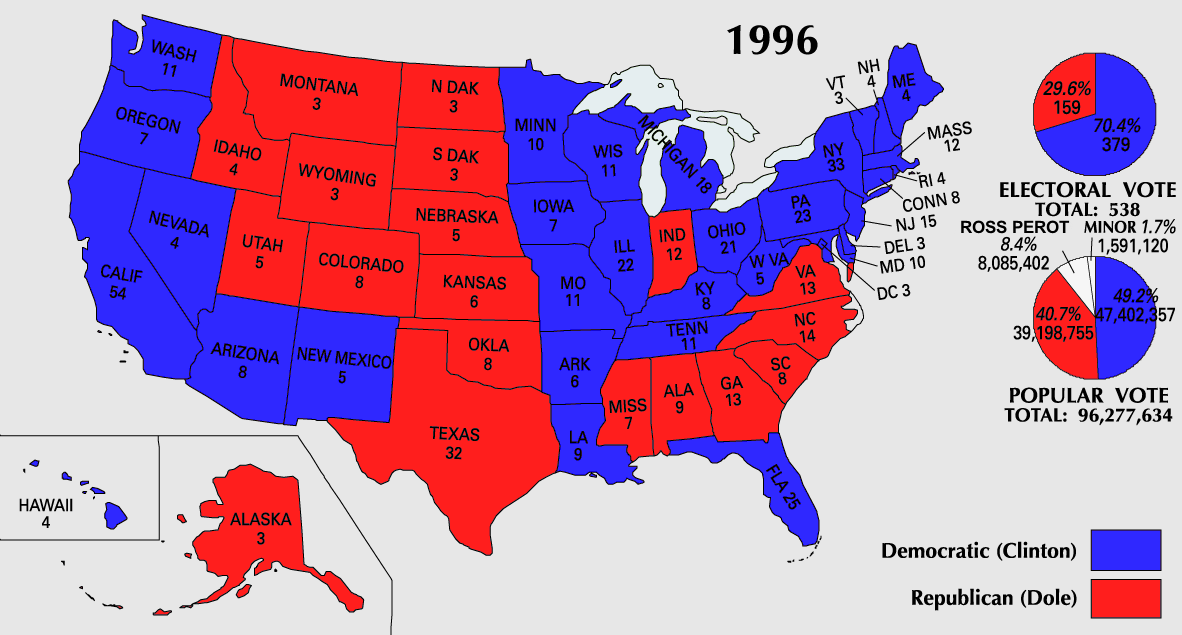
Image:1996 US presidential election by congressional district.svg|Results by congressional district, shaded according to winning candidate's percentage of the vote Image:1996 United States presidential election results map by county.svg|Results by county, shaded according to winning candidate's percentage of the vote Image:1992-1996 United States Presidential swing by county margin.svg|Change in vote margins at the county level from the 1992 election to the 1996 election
Results by state
Source:
| † | At-large results (for states that split electoral votes) |
|---|
| Bill Clinton | |||||||||||||||||||||||||||||||||||||||||||||||||||||||||
|---|---|---|---|---|---|---|---|---|---|---|---|---|---|---|---|---|---|---|---|---|---|---|---|---|---|---|---|---|---|---|---|---|---|---|---|---|---|---|---|---|---|---|---|---|---|---|---|---|---|---|---|---|---|---|---|---|---|
| Democratic | Bob Dole | ||||||||||||||||||||||||||||||||||||||||||||||||||||||||
| Republican | Ross Perot | ||||||||||||||||||||||||||||||||||||||||||||||||||||||||
| Reform | Ralph Nader | ||||||||||||||||||||||||||||||||||||||||||||||||||||||||
| Green | Harry Browne | ||||||||||||||||||||||||||||||||||||||||||||||||||||||||
| Libertarian | Others | Margin | Margin | ||||||||||||||||||||||||||||||||||||||||||||||||||||||
| Swing | State Total | State | elec­toral | ||||||||||||||||||||||||||||||||||||||||||||||||||||||
| votes | # | % | elec­toral | ||||||||||||||||||||||||||||||||||||||||||||||||||||||
| votes | # | % | elec­toral | ||||||||||||||||||||||||||||||||||||||||||||||||||||||
| votes | # | % | elec­toral | ||||||||||||||||||||||||||||||||||||||||||||||||||||||
| votes | # | % | elec­toral | ||||||||||||||||||||||||||||||||||||||||||||||||||||||
| votes | # | % | elec­toral | ||||||||||||||||||||||||||||||||||||||||||||||||||||||
| votes | # | % | elec­toral | ||||||||||||||||||||||||||||||||||||||||||||||||||||||
| votes | # | % | % | # | TOTALS: | 538 | 47,402,357 | 49.24% | 379 | 39,198,755 | 40.71% | 159 | 8,085,402 | 8.40% | – | 684,902 | 0.71% | – | 485,798 | 0.50% | – | 420,009 | 0.44% | – | 8,203,602 | 8.52% | 2.96% | 96,277,223 | US | ||||||||||||||||||||||||||||
| [Alabama](1996-united-states-presidential-election-in-alabama) | 9 | 662,165 | 43.16% | – | 769,044 | 50.12% | 9 | 92,149 | 6.01% | – | – | – | – | 5,290 | 0.34% | – | 5,701 | 0.37% | – | −106,879 | −6.96% | −0.19% | 1,534,349 | AL | |||||||||||||||||||||||||||||||||
| [Alaska](1996-united-states-presidential-election-in-alaska) | 3 | 80,380 | 33.27% | – | 122,746 | 50.80% | 3 | 26,333 | 10.90% | – | 7,597 | 3.14% | – | 2,276 | 0.94% | – | 2,288 | 0.95% | – | −42,366 | −17.53% | −8.36% | 241,620 | AK | |||||||||||||||||||||||||||||||||
| [Arizona](1996-united-states-presidential-election-in-arizona) | 8 | 653,288 | 46.52% | 8 | 622,073 | 44.29% | – | 112,072 | 7.98% | – | 2,062 | 0.15% | – | 14,358 | 1.02% | – | 552 | 0.04% | – | 31,215 | 2.23% | 4.18% | 1,404,405 | AZ | |||||||||||||||||||||||||||||||||
| [Arkansas](1996-united-states-presidential-election-in-arkansas) | 6 | 475,171 | 53.74% | 6 | 325,416 | 36.80% | – | 69,884 | 7.90% | – | 3,649 | 0.41% | – | 3,076 | 0.35% | – | 7,066 | 0.80% | – | 149,755 | 16.94% | −0.79% | 884,262 | AR | |||||||||||||||||||||||||||||||||
| [California](1996-united-states-presidential-election-in-california) | 54 | 5,119,835 | 51.10% | 54 | 3,828,380 | 38.21% | – | 697,847 | 6.96% | – | 237,016 | 2.37% | – | 73,600 | 0.73% | – | 62,806 | 0.63% | – | 1,291,455 | 12.89% | −0.51% | 10,019,484 | CA | |||||||||||||||||||||||||||||||||
| [Colorado](1996-united-states-presidential-election-in-colorado) | 8 | 671,152 | 44.43% | – | 691,848 | 45.80% | 8 | 99,629 | 6.59% | – | 25,070 | 1.66% | – | 12,392 | 0.82% | – | 10,613 | 0.70% | – | −20,696 | −1.37% | −5.63% | 1,510,704 | CO | |||||||||||||||||||||||||||||||||
| [Connecticut](1996-united-states-presidential-election-in-connecticut) | 8 | 735,740 | 52.83% | 8 | 483,109 | 34.69% | – | 139,523 | 10.02% | – | 24,321 | 1.75% | – | 5,788 | 0.42% | – | 4,133 | 0.30% | – | 252,631 | 18.14% | 11.71% | 1,392,614 | CT | |||||||||||||||||||||||||||||||||
| [Delaware](1996-united-states-presidential-election-in-delaware) | 3 | 140,355 | 51.80% | 3 | 99,062 | 36.58% | – | 28,719 | 10.60% | – | 18 | 0.01% | – | 2,052 | 0.76% | – | 639 | 0.24% | – | 41,293 | 15.22% | 7.03% | 270,845 | DE | |||||||||||||||||||||||||||||||||
| [D.C.](1996-united-states-presidential-election-in-the-district-of-columbia) | 3 | 158,220 | 85.19% | 3 | 17,339 | 9.34% | – | 3,611 | 1.94% | – | 4,780 | 2.57% | – | 588 | 0.32% | – | 1,188 | 0.64% | – | 140,881 | 75.85% | 0.23% | 185,726 | DC | |||||||||||||||||||||||||||||||||
| [Florida](1996-united-states-presidential-election-in-florida) | 25 | 2,546,870 | 48.02% | 25 | 2,244,536 | 42.32% | – | 483,870 | 9.12% | – | 4,101 | 0.08% | – | 23,965 | 0.45% | – | 452 | 0.01% | – | 302,334 | 5.70% | 7.59% | 5,303,794 | FL | |||||||||||||||||||||||||||||||||
| [Georgia](1996-united-states-presidential-election-in-georgia) | 13 | 1,053,849 | 45.84% | – | 1,080,843 | 47.01% | 13 | 146,337 | 6.37% | – | – | – | – | 17,870 | 0.78% | – | 172 | 0.01% | – | −26,994 | −1.17% | −1.76% | 2,299,071 | GA | |||||||||||||||||||||||||||||||||
| [Hawaii](1996-united-states-presidential-election-in-hawaii) | 4 | 205,012 | 56.93% | 4 | 113,943 | 31.64% | – | 27,358 | 7.60% | – | 10,386 | 2.88% | – | 2,493 | 0.69% | – | 928 | 0.26% | – | 91,069 | 25.29% | 13.90% | 360,120 | HI | |||||||||||||||||||||||||||||||||
| [Idaho](1996-united-states-presidential-election-in-idaho) | 4 | 165,443 | 33.65% | – | 256,595 | 52.18% | 4 | 62,518 | 12.71% | – | – | – | – | 3,325 | 0.68% | – | 3,838 | 0.78% | – | −91,152 | −18.53% | −4.92% | 491,719 | ID | |||||||||||||||||||||||||||||||||
| [Illinois](1996-united-states-presidential-election-in-illinois) | 22 | 2,341,744 | 54.32% | 22 | 1,587,021 | 36.81% | – | 346,408 | 8.03% | – | 1,447 | 0.03% | – | 22,548 | 0.52% | – | 12,223 | 0.29% | – | 754,723 | 17.51% | 3.27% | 4,311,391 | IL | |||||||||||||||||||||||||||||||||
| [Indiana](1996-united-states-presidential-election-in-indiana) | 12 | 887,424 | 41.55% | – | 1,006,693 | 47.13% | 12 | 224,299 | 10.50% | – | 1,121 | 0.05% | – | 15,632 | 0.73% | – | 673 | 0.03% | – | −119,269 | −5.58% | 0.54% | 2,135,842 | IN | |||||||||||||||||||||||||||||||||
| [Iowa](1996-united-states-presidential-election-in-iowa) | 7 | 620,258 | 50.26% | 7 | 492,644 | 39.92% | – | 105,159 | 8.52% | – | 6,550 | 0.53% | – | 2,315 | 0.19% | – | 7,149 | 0.58% | – | 127,614 | 10.34% | 4.32% | 1,234,075 | IA | |||||||||||||||||||||||||||||||||
| [Kansas](1996-united-states-presidential-election-in-kansas) | 6 | 387,659 | 36.08% | – | 583,245 | 54.29% | 6 | 92,639 | 8.62% | – | 914 | 0.09% | – | 4,557 | 0.42% | – | 5,286 | 0.49% | – | −195,586 | −18.21% | −13.07% | 1,074,300 | KS | |||||||||||||||||||||||||||||||||
| [Kentucky](1996-united-states-presidential-election-in-kentucky) | 8 | 636,614 | 45.84% | 8 | 623,283 | 44.88% | – | 120,396 | 8.67% | – | 701 | 0.05% | – | 4,009 | 0.29% | – | 3,705 | 0.27% | – | 13,331 | 0.96% | −2.25% | 1,388,708 | KY | |||||||||||||||||||||||||||||||||
| [Louisiana](1996-united-states-presidential-election-in-louisiana) | 9 | 927,837 | 52.01% | 9 | 712,586 | 39.94% | – | 123,293 | 6.91% | – | 4,719 | 0.26% | – | 7,499 | 0.42% | – | 8,025 | 0.45% | – | 215,251 | 12.07% | 7.46% | 1,783,959 | LA | |||||||||||||||||||||||||||||||||
| [Maine](1996-united-states-presidential-election-in-maine)† | 2 | 312,788 | 51.62% | 2 | 186,378 | 30.76% | – | 85,970 | 14.19% | – | 15,279 | 2.52% | – | 2,996 | 0.49% | – | 2,486 | 0.41% | – | 126,410 | 20.86% | 12.48% | 605,897 | ME | |||||||||||||||||||||||||||||||||
| *Maine-1* | *1* | *165,053* | *52.1%* | *1* | *100,851* | *31.8%* | – | *39,845* | *12.6%* | – | – | – | – | – | – | – | *11,372* | *3.6%* | – | *64,202* | *20.3%* | *12.19%* | *317,121* | *ME1* | |||||||||||||||||||||||||||||||||
| *Maine-2* | *1* | *147,735* | *51.2%* | *1* | *85,527* | *29.6%* | – | *46,125* | *16.0%* | – | – | – | – | – | – | – | *9,389* | *3.3%* | – | *62,208* | *21.5%* | *12.70%* | *288,776* | *ME2* | |||||||||||||||||||||||||||||||||
| [Maryland](1996-united-states-presidential-election-in-maryland) | 10 | 966,207 | 54.25% | 10 | 681,530 | 38.27% | – | 115,812 | 6.50% | – | 2,606 | 0.15% | – | 8,765 | 0.49% | – | 5,950 | 0.33% | – | 284,677 | 15.98% | 1.80% | 1,780,870 | MD | |||||||||||||||||||||||||||||||||
| [Massachusetts](1996-united-states-presidential-election-in-massachusetts) | 12 | 1,571,763 | 61.47% | 12 | 718,107 | 28.08% | – | 227,217 | 8.89% | – | 4,565 | 0.18% | – | 20,426 | 0.80% | – | 14,708 | 0.58% | – | 853,656 | 33.39% | 14.87% | 2,556,786 | MA | |||||||||||||||||||||||||||||||||
| [Michigan](1996-united-states-presidential-election-in-michigan) | 18 | 1,989,653 | 51.69% | 18 | 1,481,212 | 38.48% | – | 336,670 | 8.75% | – | 2,322 | 0.06% | – | 27,670 | 0.72% | – | 11,317 | 0.29% | – | 508,441 | 13.21% | 5.82% | 3,848,844 | MI | |||||||||||||||||||||||||||||||||
| [Minnesota](1996-united-states-presidential-election-in-minnesota) | 10 | 1,120,438 | 51.10% | 10 | 766,476 | 34.96% | – | 257,704 | 11.75% | – | 24,908 | 1.14% | – | 8,271 | 0.38% | – | 14,843 | 0.68% | – | 353,962 | 16.14% | 4.51% | 2,192,640 | MN | |||||||||||||||||||||||||||||||||
| [Mississippi](1996-united-states-presidential-election-in-mississippi) | 7 | 394,022 | 44.08% | – | 439,838 | 49.21% | 7 | 52,222 | 5.84% | – | – | – | – | 2,809 | 0.31% | – | 4,966 | 0.56% | – | −45,816 | −5.13% | 3.78% | 893,857 | MS | |||||||||||||||||||||||||||||||||
| [Missouri](1996-united-states-presidential-election-in-missouri) | 11 | 1,025,935 | 47.54% | 11 | 890,016 | 41.24% | – | 217,188 | 10.06% | – | 534 | 0.02% | – | 10,522 | 0.49% | – | 13,870 | 0.64% | – | 135,919 | 6.30% | −3.85% | 2,158,065 | MO | |||||||||||||||||||||||||||||||||
| [Montana](1996-united-states-presidential-election-in-montana) | 3 | 167,922 | 41.23% | – | 179,652 | 44.11% | 3 | 55,229 | 13.56% | – | – | – | – | 2,526 | 0.62% | – | 1,932 | 0.47% | – | −11,730 | −2.88% | −5.39% | 407,261 | MT | |||||||||||||||||||||||||||||||||
| [Nebraska](1996-united-states-presidential-election-in-nebraska)† | 2 | 236,761 | 34.95% | – | 363,467 | 53.65% | 2 | 71,278 | 10.52% | – | – | – | – | 2,792 | 0.41% | – | 3,117 | 0.46% | – | −126,706 | −18.70% | −1.52% | 677,415 | NE | |||||||||||||||||||||||||||||||||
| *Nebraska-1* | *1* | *87,713* | *38.1%* | – | *114,560* | *49.7%* | *1* | *25,973* | *11.3%* | – | – | – | – | – | – | – | *2,074* | *0.9%* | – | *-28,847* | *-11.7%* | *-1.10%* | *230,330* | *NE1* | |||||||||||||||||||||||||||||||||
| *Nebraska-2* | *1* | *84,666* | *38.0%* | – | *116,892* | *52.5%* | *1* | *18,935* | *8.5%* | – | – | – | – | – | – | – | *2,164* | *1.0%* | – | *-32,226* | *-14.5%* | *0.60%* | *222,660* | *NE2* | |||||||||||||||||||||||||||||||||
| *Nebraska-3* | *1* | *64,382* | *28.7%* | – | *132,015* | *58.8%* | *1* | *26,370* | *11.8%* | – | – | – | – | – | – | – | *1,658* | *0.7%* | – | *-67,633* | *-30.1%* | *-3.90%* | *224,425* | *NE3* | |||||||||||||||||||||||||||||||||
| [Nevada](1996-united-states-presidential-election-in-nevada) | 4 | 203,974 | 43.93% | 4 | 199,244 | 42.91% | – | 43,986 | 9.47% | – | 4,730 | 1.02% | – | 4,460 | 0.96% | – | 7,885 | 1.70% | – | 4,730 | 1.02% | −1.61% | 464,279 | NV | |||||||||||||||||||||||||||||||||
| [New Hampshire](1996-united-states-presidential-election-in-new-hampshire) | 4 | 246,214 | 49.32% | 4 | 196,532 | 39.37% | – | 48,390 | 9.69% | – | – | – | – | 4,237 | 0.85% | – | 3,802 | 0.76% | – | 49,682 | 9.95% | 8.73% | 499,175 | NH | |||||||||||||||||||||||||||||||||
| [New Jersey](1996-united-states-presidential-election-in-new-jersey) | 15 | 1,652,329 | 53.72% | 15 | 1,103,078 | 35.86% | – | 262,134 | 8.52% | – | 32,465 | 1.06% | – | 14,763 | 0.48% | – | 11,038 | 0.36% | – | 549,251 | 17.86% | 15.49% | 3,075,807 | NJ | |||||||||||||||||||||||||||||||||
| [New Mexico](1996-united-states-presidential-election-in-new-mexico) | 5 | 273,495 | 49.18% | 5 | 232,751 | 41.86% | – | 32,257 | 5.80% | – | 13,218 | 2.38% | – | 2,996 | 0.54% | – | 1,357 | 0.24% | – | 40,744 | 7.32% | −1.24% | 556,074 | NM | |||||||||||||||||||||||||||||||||
| [New York](1996-united-states-presidential-election-in-new-york) | 33 | 3,756,177 | 59.47% | 33 | 1,933,492 | 30.61% | – | 503,458 | 7.97% | – | 75,956 | 1.20% | – | 12,220 | 0.19% | – | 34,826 | 0.55% | – | 1,822,685 | 28.86% | 13.01% | 6,316,129 | NY | |||||||||||||||||||||||||||||||||
| [North Carolina](1996-united-states-presidential-election-in-north-carolina) | 14 | 1,107,849 | 44.04% | – | 1,225,938 | 48.73% | 14 | 168,059 | 6.68% | – | 2,108 | 0.08% | – | 8,740 | 0.35% | – | 3,113 | 0.12% | – | −118,089 | −4.69% | −3.90% | 2,515,807 | NC | |||||||||||||||||||||||||||||||||
| [North Dakota](1996-united-states-presidential-election-in-north-dakota) | 3 | 106,905 | 40.13% | – | 125,050 | 46.94% | 3 | 32,515 | 12.20% | – | – | – | – | 847 | 0.32% | – | 1,094 | 0.41% | – | −18,145 | −6.81% | 5.23% | 266,411 | ND | |||||||||||||||||||||||||||||||||
| [Ohio](1996-united-states-presidential-election-in-ohio) | 21 | 2,148,222 | 47.38% | 21 | 1,859,883 | 41.02% | – | 483,207 | 10.66% | – | 2,962 | 0.07% | – | 12,851 | 0.28% | – | 27,309 | 0.60% | – | 288,339 | 6.36% | 4.53% | 4,534,434 | OH | |||||||||||||||||||||||||||||||||
| [Oklahoma](1996-united-states-presidential-election-in-oklahoma) | 8 | 488,105 | 40.45% | – | 582,315 | 48.26% | 8 | 130,788 | 10.84% | – | – | – | – | 5,505 | 0.46% | – | – | – | – | −94,210 | −7.81% | 0.82% | 1,206,713 | OK | |||||||||||||||||||||||||||||||||
| [Oregon](1996-united-states-presidential-election-in-oregon) | 7 | 649,641 | 47.15% | 7 | 538,152 | 39.06% | – | 121,221 | 8.80% | – | 49,415 | 3.59% | – | 8,903 | 0.65% | – | 10,428 | 0.76% | – | 111,489 | 8.09% | −1.86% | 1,377,760 | OR | |||||||||||||||||||||||||||||||||
| [Pennsylvania](1996-united-states-presidential-election-in-pennsylvania) | 23 | 2,215,819 | 49.17% | 23 | 1,801,169 | 39.97% | – | 430,984 | 9.56% | – | 3,086 | 0.07% | – | 28,000 | 0.62% | – | 27,060 | 0.60% | – | 414,650 | 9.20% | 0.18% | 4,506,118 | PA | |||||||||||||||||||||||||||||||||
| [Rhode Island](1996-united-states-presidential-election-in-rhode-island) | 4 | 233,050 | 59.71% | 4 | 104,683 | 26.82% | – | 43,723 | 11.20% | – | 6,040 | 1.55% | – | 1,109 | 0.28% | – | 1,679 | 0.43% | – | 128,367 | 32.89% | 14.87% | 390,284 | RI | |||||||||||||||||||||||||||||||||
| [South Carolina](1996-united-states-presidential-election-in-south-carolina) | 8 | 506,283 | 43.96% | – | 573,458 | 49.79% | 8 | 64,386 | 5.59% | – | – | – | – | 4,271 | 0.37% | – | 3,291 | 0.29% | – | −67,175 | −5.83% | 2.31% | 1,151,689 | SC | |||||||||||||||||||||||||||||||||
| [South Dakota](1996-united-states-presidential-election-in-south-dakota) | 3 | 139,333 | 43.03% | – | 150,543 | 46.49% | 3 | 31,250 | 9.65% | – | – | – | – | 1,472 | 0.45% | – | 1,228 | 0.38% | – | −11,210 | −3.46% | 0.06% | 323,826 | SD | |||||||||||||||||||||||||||||||||
| [Tennessee](1996-united-states-presidential-election-in-tennessee) | 11 | 909,146 | 48.00% | 11 | 863,530 | 45.59% | – | 105,918 | 5.59% | – | 6,427 | 0.34% | – | 5,020 | 0.27% | – | 4,064 | 0.21% | – | 45,616 | 2.41% | −2.24% | 1,894,105 | TN | |||||||||||||||||||||||||||||||||
| [Texas](1996-united-states-presidential-election-in-texas) | 32 | 2,459,683 | 43.83% | – | 2,736,167 | 48.76% | 32 | 378,537 | 6.75% | – | 4,810 | 0.09% | – | 20,256 | 0.36% | – | 12,191 | 0.22% | – | −276,484 | −4.93% | −1.45% | 5,611,644 | TX | |||||||||||||||||||||||||||||||||
| [Utah](1996-united-states-presidential-election-in-utah) | 5 | 221,633 | 33.30% | – | 361,911 | 54.37% | 5 | 66,461 | 9.98% | – | 4,615 | 0.69% | – | 4,129 | 0.62% | – | 6,880 | 1.03% | – | −140,278 | −21.07% | −2.26% | 665,629 | UT | |||||||||||||||||||||||||||||||||
| [Vermont](1996-united-states-presidential-election-in-vermont) | 3 | 137,894 | 53.35% | 3 | 80,352 | 31.09% | – | 31,024 | 12.00% | – | 5,585 | 2.16% | – | 1,183 | 0.46% | – | 2,411 | 0.93% | – | 57,542 | 22.26% | 6.56% | 258,449 | VT | |||||||||||||||||||||||||||||||||
| [Virginia](1996-united-states-presidential-election-in-virginia) | 13 | 1,091,060 | 45.15% | – | 1,138,350 | 47.10% | 13 | 159,861 | 6.62% | – | – | – | – | 9,174 | 0.38% | – | 18,197 | 0.75% | – | −47,290 | −1.95% | 2.43% | 2,416,642 | VA | |||||||||||||||||||||||||||||||||
| [Washington](1996-united-states-presidential-election-in-washington-state) | 11 | 1,123,323 | 49.84% | 11 | 840,712 | 37.30% | – | 201,003 | 8.92% | – | 60,322 | 2.68% | – | 12,522 | 0.56% | – | 15,955 | 0.71% | – | 282,611 | 12.54% | 1.10% | 2,253,837 | WA | |||||||||||||||||||||||||||||||||
| [West Virginia](1996-united-states-presidential-election-in-west-virginia) | 5 | 327,812 | 51.51% | 5 | 233,946 | 36.76% | – | 71,639 | 11.26% | – | – | – | – | 3,062 | 0.48% | – | – | – | – | 93,866 | 14.75% | 1.73% | 636,459 | WV | |||||||||||||||||||||||||||||||||
| [Wisconsin](1996-united-states-presidential-election-in-wisconsin) | 11 | 1,071,971 | 48.81% | 11 | 845,029 | 38.48% | – | 227,339 | 10.35% | – | 28,723 | 1.31% | – | 7,929 | 0.36% | – | 15,178 | 0.69% | – | 226,942 | 10.33% | 5.98% | 2,196,169 | WI | |||||||||||||||||||||||||||||||||
| [Wyoming](1996-united-states-presidential-election-in-wyoming) | 3 | 77,934 | 36.84% | – | 105,388 | 49.81% | 3 | 25,928 | 12.25% | – | – | – | – | 1,739 | 0.82% | – | 582 | 0.28% | – | −27,454 | −12.97% | −7.39% | 211,571 | WY |
†Maine and Nebraska each allow for their electoral votes to be split between candidates. In both states, two electoral votes are awarded to the winner of the statewide race and one electoral vote is awarded to the winner of each congressional district.
States that flipped from Democratic to Republican
- Colorado
- Georgia
- Montana
States that flipped from Republican to Democratic
- Arizona
- Florida
Close states
State where the margin of victory was under 1% (8 electoral votes):
- Kentucky, 0.96% (13,331 votes)
States where the margin of victory was under 5% (109 electoral votes):
- Nevada, 1.02% (4,730 votes)
- Georgia, 1.17% (26,994 votes)
- Colorado, 1.37% (20,696 votes)
- Virginia, 1.96% (47,290 votes)
- Arizona, 2.22% (31,215 votes)
- Tennessee, 2.41% (45,616 votes)
- Montana, 2.88% (11,730 votes)
- South Dakota, 3.46% (11,210 votes)
- North Carolina, 4.69% (118,089 votes)
- Texas, 4.93% (276,484 votes)
States where the margin of victory was between 5% and 10% (143 electoral votes):
- Mississippi, 5.13% (45,816 votes)
- Indiana, 5.58% (119,269 votes)
- Florida, 5.70% (302,334 votes)
- South Carolina, 6.04% (69,407 votes)
- Missouri, 6.30% (135,919 votes)
- Ohio, 6.36% (288,339 votes)
- North Dakota, 6.81% (18,145 votes)
- Alabama, 6.96% (106,879 votes)
- New Mexico, 7.32% (40,744 votes)
- Oklahoma, 7.81% (94,210 votes)
- Oregon, 8.09% (111,489 votes)
- Pennsylvania, 9.20% (414,650 votes) (tipping point state)
- New Hampshire, 9.95% (49,682 votes)
Statistics
Counties with highest percent of vote (Democratic)
- Starr County, Texas 86.94%
- Bronx County, New York 85.80%
- Macon County, Alabama 85.55%
- Washington, D.C. 85.19%
- Duval County, Texas 84.94%
Counties with highest percent of vote (Republican)
- Ochiltree County, Texas 79.20%
- Russell County, Kansas 78.98%
- Glasscock County, Texas 78.93%
- Hayes County, Nebraska 77.02%
- Sioux County, Iowa 77.00%
Counties with highest percent of vote (other)
- Mineral County, Montana 23.72%
- Grant County, North Dakota 21.55%
- Shoshone County, Idaho 21.55%
- Sanders County, Montana 21.24%
- Billings County, North Dakota 21.10%
Voter demographics
| The presidential vote in social groups (percentages) | Social group | Clinton | Dole | Perot | Others | % of | ||||||||||||
|---|---|---|---|---|---|---|---|---|---|---|---|---|---|---|---|---|---|---|
| total vote | Party and ideology | Gender and marital status | Race | Religion | White Religious Right | Age | First time voters | Sexual orientation | Education | Family income | Region | Community size | ||||||
| Total vote | 49 | 41 | 8 | 2 | 100 | |||||||||||||
| Conservative Republicans | 6 | 88 | 5 | 1 | 21 | |||||||||||||
| Moderate Republicans | 20 | 72 | 7 | 1 | 13 | |||||||||||||
| Liberal Republicans | 44 | 46 | 9 | 1 | 2 | |||||||||||||
| Conservative independents | 19 | 60 | 19 | 2 | 7 | |||||||||||||
| Moderate independents | 50 | 30 | 17 | 3 | 15 | |||||||||||||
| Liberal independents | 58 | 15 | 18 | 9 | 4 | |||||||||||||
| Conservative Democrats | 69 | 23 | 7 | 1 | 6 | |||||||||||||
| Moderate Democrats | 84 | 10 | 5 | 1 | 20 | |||||||||||||
| Liberal Democrats | 89 | 5 | 4 | 2 | 13 | |||||||||||||
| Married men | 40 | 48 | 10 | 2 | 32 | |||||||||||||
| Married women | 48 | 43 | 7 | 2 | 33 | |||||||||||||
| Unmarried men | 49 | 36 | 12 | 3 | 15 | |||||||||||||
| Unmarried women | 62 | 28 | 7 | 3 | 20 | |||||||||||||
| White | 43 | 46 | 9 | 2 | 83 | |||||||||||||
| Black | 84 | 11 | 4 | 1 | 10 | |||||||||||||
| Hispanic | 72 | 21 | 6 | 1 | 5 | |||||||||||||
| Asian | 43 | 48 | 8 | 1 | 1 | |||||||||||||
| Protestant | 41 | 50 | 8 | 1 | 38 | |||||||||||||
| Catholic | 53 | 37 | 9 | 1 | 29 | |||||||||||||
| Other Christian | 45 | 41 | 12 | 2 | 16 | |||||||||||||
| Jewish | 78 | 16 | 3 | 3 | 3 | |||||||||||||
| Other | 60 | 23 | 11 | 6 | 6 | |||||||||||||
| None | 59 | 23 | 13 | 5 | 7 | |||||||||||||
| White Religious Right | 26 | 65 | 8 | 1 | 17 | |||||||||||||
| Everyone else | 54 | 35 | 9 | 2 | 83 | |||||||||||||
| 18–29 years old | 53 | 34 | 10 | 3 | 16 | |||||||||||||
| 30–44 years old | 48 | 41 | 9 | 2 | 33 | |||||||||||||
| 45–59 years old | 48 | 41 | 9 | 2 | 26 | |||||||||||||
| 60 and older | 48 | 44 | 7 | 1 | 25 | |||||||||||||
| First time voter | 54 | 34 | 11 | 1 | 9 | |||||||||||||
| Everyone else | 48 | 42 | 8 | 2 | 91 | |||||||||||||
| Gay, lesbian, or bisexual | 66 | 23 | 7 | 4 | 5 | |||||||||||||
| Heterosexual | 47 | 43 | 8 | 2 | 95 | |||||||||||||
| Not a high school graduate | 59 | 28 | 11 | 2 | 6 | |||||||||||||
| High school graduate | 51 | 35 | 13 | 1 | 24 | |||||||||||||
| Some college education | 48 | 40 | 10 | 2 | 27 | |||||||||||||
| College graduate | 44 | 46 | 8 | 2 | 26 | |||||||||||||
| Postgraduate education | 52 | 40 | 5 | 3 | 17 | |||||||||||||
| Under $15,000 | 59 | 28 | 11 | 2 | 11 | |||||||||||||
| $15,000–30,000 | 51 | 38 | 9 | 2 | 23 | |||||||||||||
| $30,000–50,000 | 48 | 40 | 10 | 2 | 27 | |||||||||||||
| $50,000–75,000 | 47 | 45 | 7 | 1 | 21 | |||||||||||||
| $75,000–100,000 | 44 | 48 | 7 | 1 | 9 | |||||||||||||
| Over $100,000 | 38 | 54 | 6 | 2 | 9 | |||||||||||||
| East | 55 | 34 | 9 | 2 | 23 | |||||||||||||
| Midwest | 48 | 41 | 10 | 1 | 26 | |||||||||||||
| South | 46 | 46 | 7 | 1 | 30 | |||||||||||||
| West | 48 | 40 | 8 | 4 | 20 | |||||||||||||
| Population over 500,000 | 68 | 25 | 5 | 2 | 10 | |||||||||||||
| Population 50,000 to 500,000 | 50 | 39 | 8 | 3 | 21 | |||||||||||||
| Suburbs | 47 | 42 | 8 | 3 | 39 | |||||||||||||
| Rural areas, towns | 45 | 44 | 10 | 1 | 30 |
Source: Voter News Service exit poll, reported in The New York Times, November 10, 1996, 28.
Polling controversy
The polling in the election was criticized by Everett Carll Ladd, who argued that "polls had overestimated Clinton's lead during the campaign and had thereby dampened interest in the election." Others such as Warren J. Mitofsky rebutted Ladd's view; in an analysis in Public Opinion Quarterly, Mitofsky wrote that "1996 was not the best but was far from the worst year for the polls", with accuracy surpassing the polling in 1948 and in 1980. Because Clinton won the election by a comfortable margin, there was no major reaction towards the impreciseness of the polls.
Notes
References
References
- "National General Election VEP Turnout Rates, 1789-Present". [[CQ Press]].
- (May 1, 1995). "Anyone left? The search for a Clinton challenger in 1996.". TheFreeLibrary.com.
- Newton-Small, Jay. (November 24, 2009). "Can a Pro-Life Dem Bridge the Health-Care Divide?".
- (2010). "Guide to U.S. Elections". [[CQ Press]].
- (2010). "Guide to U.S. Elections". [[CQ Press]].
- (February 19, 1995). "New Hampshire Republican Forum".
- Washington watch. (June 6, 1994). "Republicans Prepare to Run in 1996 – Arab American Institute". Aaiusa.org.
- Shogan, Robert. (January 4, 1995). "Cheney Rules Out Run for White House". Los Angeles Times.
- Julie Hirschfeld Davis (January 26, 2012), [https://www.bloomberg.com/news/2012-01-26/-stop-newt-republicans-confront-base-unwilling-to-take-orders.html "'Stop-Newt' Republicans Confront New Base"] {{Webarchive. link. (December 2, 2013 ''[[Bloomberg Television). Bloomberg News]]''
- (2010). "Guide to U.S. Elections". [[CQ Press]].
- Balz, Dan. (1996-08-16). "DOLE VOWS BRIGHTER ECONOMY, STRESSES VALUES". The Washington Post.
- Hardy, Thomas. (September 20, 1996). "Dole Makes Strong Rebound After Fall". Chicago Tribune.
- Lewis, Matt. (September 25, 2008). "McCain and Obama Can Learn A Lot From Past Debaters".
- Berke, Richard L.. (October 7, 1996). "Clinton And Dole, Face To Face, Spar Over Medicare And Taxes". The New York Times.
- (June 14, 1997). "09/02/96 Medicare, Taxes, and Bob Dole: A Talk with the President". Business Week.
- (February 18, 2016). "An Oral History of The First Presidential Campaign Websites in 1996". The Wall Street Journal.
- Clyme, Adam. (October 23, 1996). "G.O.P. Pushes Congress Strategy That Shuns Dole". The New York Times.
- Romano, Andrew. (August 16, 2016). "Down Ticket #3: Republicans want to keep Congress by sacrificing Trump. Good luck with that.". Yahoo! News.
- "CPD: 1996 Debates".
- (February 13, 1997). "Chinese Embassy Role In Contributions Probed". The Washington Post.
- (March 3, 2000). "For both Gore and GOP, a guilty verdict to watch".
- (June 9, 1998). "A Look at the 94 Who Aren't Talking". The Washington Post.
- "United States Presidential Election Results".
- (November 6, 1996). "Clinton takes Arizona, nation". Arizona Daily Wildcat.
- Holmes, Steven A.. (November 5, 1992). "The 1992 Elections: Disappointment – News Analysis An Eccentric but No Joke; Perot's Strong Showing Raises Questions On What Might Have Been, and Might Be". The New York Times.
- (November 1996). "AllPolitics – Presidential Election Exit Poll Results". CNN.
- (November 4, 1996). "AllPolitics – Tracking Poll". CNN.
- Sullivan, Robert David; [http://www.americamagazine.org/content/unconventional-wisdom/how-red-and-blue-map-evolved-over-past-century 'How the Red and Blue Map Evolved Over the Past Century'] {{Webarchive. link. (November 16, 2016 ; ''America Magazine'' in ''The National Catholic Review''; June 29, 2016)
- "Voter Turnout in Presidential Elections {{!}} The American Presidency Project".
- (May 1997). "FEDERAL ELECTIONS 96 Election Results for the U.S. President, the U.S. Senate and the U.S. House of Representatives". [[Federal Election Commission]].
- "'96 Presidential and Congressional Election Statistics". Official website of the Office of the Clerk of the House of Representatives.
- Matthews, Dylan. (August 9, 2012). "The effect of veep picks, in two charts". The Washington Post.
- (1996). "November 12, 1996". Cerro Gordo County.
- Fernandez, Sonia. (February 22, 2000). "Nader '55 to run for president". Daily Princetonian Publishing Company, Inc.
- "Electors of President and Vice President". Cattaraugus County, New York State.
- link. (July 9, 2019 , Uselectionatlas.org.)
- (1999). "The Political Reference Almanac, 1999–2000". Keynote Publishing Company.
- Connelly, Marjorie. (November 10, 1996). "Portrait of the Electorate". [[The New York Times]].
- (1998). "Review: Was 1996 a Worse Year for Polls Than 1948?". The Public Opinion Quarterly.
This article was imported from Wikipedia and is available under the Creative Commons Attribution-ShareAlike 4.0 License. Content has been adapted to SurfDoc format. Original contributors can be found on the article history page.
Ask Mako anything about 1996 United States presidential election — get instant answers, deeper analysis, and related topics.
Research with MakoFree with your Surf account
Create a free account to save articles, ask Mako questions, and organize your research.
Sign up freeThis content may have been generated or modified by AI. CloudSurf Software LLC is not responsible for the accuracy, completeness, or reliability of AI-generated content. Always verify important information from primary sources.
Report