From Surf Wiki (app.surf) — the open knowledge base
Yellowstone National Park
National park in the western United States
National park in the western United States
| Field | Value | |
|---|---|---|
| name | Yellowstone National Park | |
| iucn_category | II | |
| iucn_ref | ||
| photo | Grand Canyon of yellowstone.jpg | |
| photo_caption | Grand Canyon of the Yellowstone | |
| photo_width | 250px | |
| photo_alt | Lower Yellowstone Falls | |
| nearest_town | West Yellowstone, Montana | |
| location | {{plainlist | |
| map | Wyoming#USA | |
| map_caption | Location of Yellowstone National Park | |
| relief | 1 | |
| elevation | 8104 ft | |
| coordinates | ||
| coords_ref | ||
| established | ||
| area_acre | 2219791 | |
| area_ref | ||
| visitation_num | 4,744,353 | |
| visitation_year | 2024 | |
| visitation_ref | ||
| governing_body | U.S. National Park Service | |
| website | ||
| mapframe | yes | |
| mapframe-zoom | 7 | |
| mapframe-wikidata | yes | |
| embedded1 | {{designation list | embed = yes |
| designation1 | WHS | |
| designation1_type | Natural | |
| designation1_criteria | vii, viii, ix, x | |
| designation1_number | [28](https://whc.unesco.org/en/list/28) | |
| designation1_date | 1978 (2nd session) | |
| designation1_free1name | Region | |
| designation1_free1value | The Americas | |
| designation1_free3name | Endangered | |
| designation1_free3value | 1995–2003 |
- Country: United States
- States: Wyoming, Montana, Idaho
- County:
- WY: Park, Teton
- MT: Gallatin, Park
- ID: Fremont | mapframe-zoom = 7 | mapframe-wikidata = yes
Yellowstone National Park is a national park of the United States located in the northwest corner of the state of Wyoming, with small portions extending into Montana and Idaho. It was established by the 42nd U.S. Congress through the Yellowstone National Park Protection Act and signed into law by President Ulysses S. Grant on March 1, 1872. Yellowstone was the first national park in the US, and is also widely understood to be the first national park in the world. The park is known for its wildlife and its many geothermal features, especially the Old Faithful geyser, one of its most popular. While it represents many types of biomes, subalpine forest is the most abundant. It is part of the South Central Rockies forests ecoregion.
While Native Americans have lived in the Yellowstone region for at least 11,000 years, aside from visits by mountain men during the early-to-mid-19th century, organized exploration did not begin until the late 1860s. Management and control of the park originally fell under the jurisdiction of the U.S. Department of the Interior, the first secretary of the interior to supervise the park being Columbus Delano. However, the U.S. Army was eventually commissioned to oversee the management of Yellowstone for 30 years between 1886 and 1916. In 1917, the administration of the park was transferred to the National Park Service, which had been created the previous year. Hundreds of structures have been built and are protected for their architectural and historical significance, and researchers have examined more than one thousand indigenous archaeological sites.
Yellowstone National Park spans an area of 3468.4 sqmi, with lakes, canyons, rivers, and mountain ranges. Yellowstone Lake is one of the largest high-elevation lakes in North America and covers part of the Yellowstone Caldera, the largest super volcano on the continent. The caldera is considered a dormant volcano. It has erupted with tremendous force twice in the last two million years. Well over half of the world's geysers and hydrothermal features are in Yellowstone, fueled by this ongoing volcanism. Lava flows and rocks from volcanic eruptions cover most of the land area of Yellowstone. The park is the centerpiece of the Greater Yellowstone Ecosystem, the largest remaining nearly intact ecosystem in the Earth's northern temperate zone. In 1978, Yellowstone was named a UNESCO World Heritage Site.
Hundreds of species of mammals, birds, fish, reptiles, and amphibians have been documented, including several that are either endangered or threatened. The vast forests and grasslands also include unique species of plants. Yellowstone Park is the largest and most famous megafauna location in the contiguous United States. The park is inhabited by grizzly bears, cougars, wolves, and free-ranging herds of bison and elk. The Yellowstone Park bison herd is the oldest and largest public bison herd in the United States. Forest fires occur in the park each year; in the large forest fires of 1988, over one-third of the park was burnt. Yellowstone has numerous recreational opportunities, including hiking, camping, boating, fishing, and sightseeing. Paved roads provide close access to the major geothermal areas as well as some of the lakes and waterfalls. During the winter, visitors often access the park by way of guided tours that use either snow coaches or snowmobiles.
History
The park is roughly bisected by the Yellowstone River, from which it takes its name. Near the end of the 18th century, French trappers named the river Roche Jaune, likely a translation of the Hidatsa name Mi tsi a-da-zi ("Yellow Stone River"). Later, American trappers rendered the French name in English as "Yellow Stone". Although it is commonly believed that the river was named for the yellow rocks seen in the Grand Canyon of the Yellowstone, the Native American name source is unclear.
The human history of the park began at least 11,000 years ago when Native Americans began to hunt and fish in the region. During the construction of the post office in Gardiner, Montana, in the 1950s, an obsidian point of Clovis origin was found that dated from approximately 11,000 years ago. These Paleo-Indians, of the Clovis culture, used the region's abundant obsidian to make cutting tools and weapons. Arrowheads sourced from the Obsidian Cliffs have been found as far away as the Mississippi Valley and Ohio, indicating that a regular obsidian trade existed between local tribes and tribes farther east. More recently, Native American tribes including the Bannock, Shoshone, Nez Perce, Blackfeet, Crow, Salish, and Kootenai continued to visit in Yellowstone until the 1870s, some resided there, and, under treaty rights, a few were hunting there as late as 1889.
When the Lewis and Clark Expedition entered present-day Montana in 1805 they encountered the Nez Perce, Crow, and Shoshone tribes who described to them the Yellowstone region to the south, but they chose not to investigate. In 1806, John Colter, a member of the Lewis and Clark Expedition, left to join a group of fur trappers. After splitting up with the other trappers in 1807, Colter passed through a portion of what later became the park, during the winter of 1807–1808. He observed at least one geothermal area in the northeastern section of the park, near Tower Fall. After surviving wounds he suffered in a battle with members of the Crow and Blackfoot tribes in 1809, Colter described a place of "fire and brimstone" that most people dismissed as delirium; the supposedly mystical place was nicknamed "Colter's Hell". Over the next 40 years, numerous reports from mountain men and trappers told of boiling mud, steaming rivers, and petrified trees, yet most of these reports were believed to be a myth.
After an 1856 exploration, mountain man Jim Bridger reported observing boiling springs, spouting water, and a mountain of glass and yellow rock. These reports were largely ignored because Bridger was a known "spinner of yarns". In 1859, a U.S. Army Surveyor named Captain William F. Raynolds embarked on a two-year survey of the southern central Rockies. After wintering in Wyoming, in May 1860, Raynolds and his party—which included geologist Ferdinand V. Hayden and guide Jim Bridger—attempted to cross the Continental Divide over Two Ocean Plateau from the Wind River drainage in northwest Wyoming. Heavy spring snows prevented their passage but had they been able to traverse the divide, the party would have been the first organized survey to enter the Yellowstone region. The American Civil War hampered further organized explorations until the late 1860s.

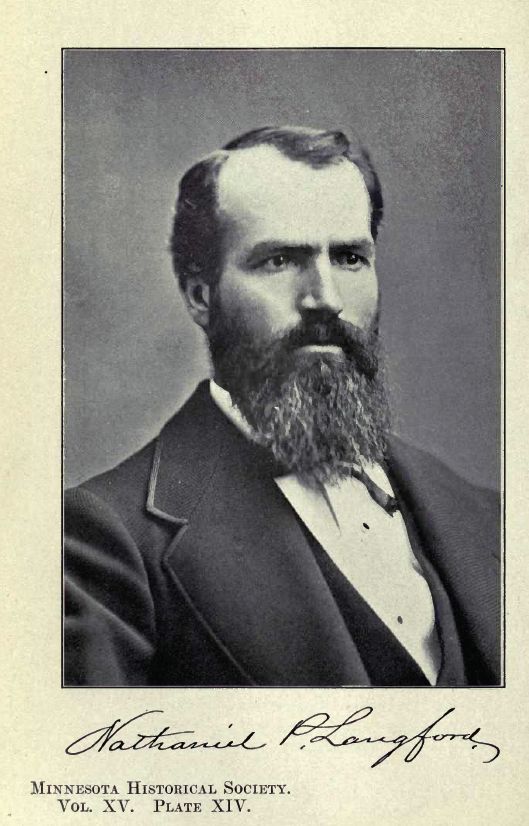
The first detailed expedition to the Yellowstone area was the Cook–Folsom–Peterson Expedition of 1869, which consisted of three privately funded explorers. The Folsom party followed the Yellowstone River to Yellowstone Lake. The members of the Folsom party kept a journal and based on the information it reported, a party of Montana residents organized the Washburn–Langford–Doane Expedition in 1870. It was headed by the surveyor-general of Montana Henry Washburn, and included Nathaniel P. Langford (who later became known as "National Park" Langford) and a U.S. Army detachment commanded by Lt. Gustavus Doane. The expedition spent about a month exploring the region, collecting specimens, and naming sites of interest.
A Montana writer and lawyer named Cornelius Hedges, who had been a member of the Washburn expedition, proposed that the region should be set aside and protected as a national park. He wrote detailed articles about his observations for the Helena Herald newspaper between 1870 and 1871. Hedges essentially restated comments made in October 1865 by acting Montana Territorial Governor Thomas Francis Meagher, who had previously commented that the region should be protected. Others made similar suggestions. An 1871 letter to Ferdinand V. Hayden from Jay Cooke, a businessman who wanted to bring tourists to the region, encouraged him to mention it in his official report of the survey. Cooke wrote that his friend, Congressman William D. Kelley had also suggested "Congress pass a bill reserving the Great Geyser Basin as a public park forever".
Park creation

In 1871, eleven years after his failed first effort, Ferdinand V. Hayden was finally able to explore the region. With government sponsorship, he returned with a second, larger expedition, the Hayden Geological Survey of 1871. He compiled a comprehensive report, including large-format photographs by William Henry Jackson and paintings by Thomas Moran. The report helped to convince the U.S. Congress to withdraw this region from public auction. On March 1, 1872, President Ulysses S. Grant signed The Act of Dedication, the law which created Yellowstone National Park.
Hayden, while not the only person to have thought of creating a park in the region, was its first and most enthusiastic advocate. He believed in "setting aside the area as a pleasure ground for the benefit and enjoyment of the people" and warned that there were those who would come and "make merchandise of these beautiful specimens". Worrying the area could face the same fate as Niagara Falls, he concluded the site should "be as free as the air or Water". In his report to the Committee on Public Lands, he concluded that if the bill failed to become law, "vandals who are now waiting to enter into this wonder-land, will in a single season despoil, beyond recovery, these remarkable curiosities, which have required all the cunning skill of nature thousands of years to prepare".
Hayden and his 1871 party recognized Yellowstone as a unique place that should be available for further research. He also was encouraged to preserve it for others to see and experience it. In 1873, Congress authorized and funded a survey to find a wagon route to the park from the south which was completed by the Jones Expedition of 1873. The park was not set aside strictly for ecological purposes. Hayden imagined something akin to the scenic resorts and baths in England, Germany, and Switzerland.
THE ACT OF DEDICATION
AN ACT to set apart a certain tract of land lying near the headwaters of the Yellowstone River as a public park. Be it enacted by the Senate and House of Representatives of the United States of America in Congress assembled, That the tract of land in the Territories of Montana and Wyoming ... is hereby reserved and withdrawn from settlement, occupancy, or sale under the laws of the United States, and dedicated and set apart as a public park or pleasuring ground for the benefit and enjoyment of the people; and all persons who shall locate, or settle upon, or occupy the same or any part thereof, except as hereinafter provided, shall be considered trespassers and removed there from ...
Approved March 1, 1872.
Signed by:
- ULYSSES S. GRANT, President of the United States.
- SCHUYLER COLFAX, Vice-President of the United States and President of the Senate.
- JAMES G. BLAINE, Speaker of the House.
There was considerable local opposition to Yellowstone National Park during its early years. Some locals feared the regional economy would be unable to thrive if there remained strict federal prohibitions against resource development or settlement within park boundaries. Local entrepreneurs advocated reducing the size of the park so that mining, hunting, and logging activities could be developed. To this end, numerous bills were introduced into Congress by Montana representatives who sought to remove the federal land-use restrictions.
Nathaniel Langford was appointed as the park's first superintendent in 1872 by the Secretary of Interior Columbus Delano, the first overseer and controller of the park. Langford served for five years but was denied a salary, funding, and staff. Langford lacked the means to improve the land or properly protect the park, and without formal policy or regulations, had few legal methods of enforcement. This left Yellowstone vulnerable to poachers, vandals, and others seeking to exploit its resources. He addressed the practical problems park administrators faced in the 1872 Report to the Secretary of the Interior and correctly predicted that Yellowstone would become a major international attraction deserving the continuing stewardship of the government. In 1874, both Langford and Delano advocated the creation of a federal agency to protect the vast park, but Congress refused. In 1875, Colonel William Ludlow, who had previously explored areas of Montana under the command of George Armstrong Custer, was assigned to organize and lead an expedition to Montana and the newly established Yellowstone Park. Observations about the lawlessness and exploitation of park resources were included in Ludlow's Report of a Reconnaissance to the Yellowstone National Park. The report included letters and attachments by other expedition members, including naturalist and mineralogist George Bird Grinnell.

Grinnell documented the poaching of buffalo, deer, elk, and antelope for hides: "It is estimated that during the winter of 1874–1875, not less than 3,000 buffalo and mule deer suffer even more severely than the elk, and the antelope nearly as much."
As a result, Langford was forced to step down in 1877. Having traveled through Yellowstone and witnessed land management problems, Philetus Norris volunteered for the position following Langford's exit. Congress finally saw fit to implement a salary for the position and provide minimal funding to operate the park. Norris used these funds to expand access to the park, building numerous crude roads and facilities.
In 1880, Harry Yount was appointed as a gamekeeper to control poaching and vandalism in the park. Yount had previously spent decades exploring the mountain country of present-day Wyoming, including the Grand Tetons, after joining F V. Hayden's Geological Survey in 1873. Yount is the first national park ranger, and Yount's Peak, at the head of the Yellowstone River, was named in his honor. These measures proved insufficient, as neither Norris nor the three superintendents who followed were given sufficient manpower or resources.
During the 1870s and 1880s, Native American tribes were effectively excluded from the national park. Under a half-dozen tribes had made seasonal use of the Yellowstone area — the only year-round residents were small bands of Eastern Shoshone known as "Sheepeaters". They left the area under the assurances of a treaty negotiated in 1868, under which the Sheepeaters ceded their lands but retained the right to hunt in Yellowstone. The United States never ratified the treaty and refused to recognize the claims of the Sheepeaters or any other tribe that had used Yellowstone.
The Nez Perce band associated with Chief Joseph, numbering about 750 people, passed through Yellowstone National Park in thirteen days in late August 1877. They were being pursued by the U.S. Army and entered the national park about two weeks after the Battle of the Big Hole. Some of the Nez Perce were friendly to the tourists and other people they encountered in the park; some were not. Nine park visitors were briefly taken captive. Despite Joseph and other chiefs ordering that no one should be harmed, at least two people were killed and several wounded. One of the areas where encounters occurred was in Lower Geyser Basin and east along a branch of the Firehole River to Mary Mountain and beyond. That stream was named Nez Perce Creek in memory of their trail through the area. A group of Bannocks entered the park in 1878, alarming park Superintendent Philetus Norris. In the aftermath of the Sheepeater Indian War of 1879, Norris built a fort to prevent Native Americans from entering the national park.
The Northern Pacific Railroad built a train station in Livingston, Montana, as a gateway terminus to connect to the northern entrance area in 1883, which helped to increase visitation from 300 in 1872 to 5,000 in 1883. The spur line was completed in fall of that year from Livingston to Cinnabar for stage connection to Mammoth, then in 1902 extended to Gardiner station, where passengers also switched to stagecoach. Visitors in these early years faced poor and dusty roads as well as limited services; automobiles were first admitted in phases in 1915. By 1901 a Chicago, Burlington & Quincy connection opened via Cody and in 1908 a Union Pacific Railroad connection to West Yellowstone, followed by a 1927 Milwaukee Road connection to Gallatin Gateway near Bozeman, also motorcoaching visitors via West Yellowstone. Rail visitation fell off considerably by World War II and ceased regular service in favor of the automobile around the 1960s, though special excursions occasionally continued into the early 1980s.

Ongoing poaching and destruction of natural resources continued unabated until the U.S. Army arrived at Mammoth Hot Springs in 1886 and built Camp Sheridan. Over the next 22 years, as the army constructed permanent structures, Camp Sheridan was renamed Fort Yellowstone. On May 7, 1894, the Boone and Crockett Club, acting through the personality of George G. Vest, Arnold Hague, William Hallett Phillips, W. A. Wadsworth, Archibald Rogers, Theodore Roosevelt, and George Bird Grinnell were successful in carrying through the Park Protection Act, which saved the park. The Lacey Act of 1900 provided legal support for the officials prosecuting poachers. With the funding and manpower necessary to keep a diligent watch, the army developed its own policies and regulations that permitted public access while protecting park wildlife and natural resources. When the National Park Service was created in 1916, many of the management principles developed by the army were adopted by the new agency. The army turned control over to the National Park Service on October 31, 1918.
In 1898, the naturalist John Muir described the park as follows:
Automobiles and further development

By 1915, 1,000 automobiles per year were entering the park, resulting in conflicts with horses and horse-drawn transportation. Horse travel on roads was eventually prohibited.
The Civilian Conservation Corps (CCC), a New Deal relief agency for young men, played a major role between 1933 and 1942 in developing Yellowstone facilities. CCC projects included reforestation, campground development of many of the park's trails and campgrounds, trail construction, fire hazard reduction, and fire-fighting work. The CCC built the majority of the early visitor centers, campgrounds, and the current system of park roads.
During World War II, tourist travel fell sharply, staffing was cut, and many facilities fell into disrepair. By the 1950s, visitation increased tremendously in Yellowstone and other national parks. To accommodate the increased visitation, park officials implemented Mission 66, an effort to modernize and expand park service facilities. Planned to be completed by 1966, in honor of the 50th anniversary of the founding of the National Park Service, Mission 66 construction diverged from the traditional log cabin style with design features of a modern style. During the late 1980s, most construction styles in Yellowstone reverted to the more traditional designs. After the enormous forest fires of 1988 damaged much of Grant Village, structures there were rebuilt in the traditional style. The visitor center at Canyon Village, which opened in 2006, incorporates a more traditional design as well.
The 1959 Hebgen Lake earthquake just west of Yellowstone at Hebgen Lake damaged roads and some structures in the park. In the northwest section of the park, new geysers were found, and many existing hot springs became turbid. It was the most powerful earthquake to hit the region in recorded history.
In 1963, after several years of public controversy regarding the forced reduction of the elk population in Yellowstone, the United States Secretary of the Interior Stewart Udall appointed an advisory board to collect scientific data to inform future wildlife management of the national parks. In a paper known as the Leopold Report, the committee observed that culling programs at other national parks had been ineffective, and recommended the management of Yellowstone's elk population.
The wildfires during the summer of 1988 were the largest in the history of the park. Approximately 793880 acre or 36% of the parkland was impacted by the fires, leading to a systematic re-evaluation of fire management policies. The fire season of 1988 was considered normal until a combination of drought and heat by mid-July contributed to an extreme fire danger. On "Black Saturday", August 20, 1988, strong winds expanded the fires rapidly, and more than 150000 acre burned.
On October 1, 2013, Yellowstone National Park closed due to the 2013 United States federal government shutdown.
Research and recognition
The expansive cultural history of the park has been documented by the 1,000 archeological sites that have been discovered. The park has 1,106 historic structures and features, and of these Obsidian Cliff and five buildings have been designated National Historic Landmarks. Yellowstone was designated an International Biosphere Reserve on October 26, 1976, and a UN World Heritage Site on September 8, 1978. The park was placed on the List of World Heritage in Danger from 1995 to 2003 due to the effects of tourism, infection of wildlife, and issues with invasive species. In 2010, Yellowstone National Park was honored with its own quarter under the America the Beautiful Quarters Program.
Justin Farrell explores three moral sensibilities that motivated activists in dealing with Yellowstone. First came the utilitarian vision of maximum exploitation of natural resources, a characteristic of developers in the late 19th century. Second was the spiritual vision of nature inspired by Romanticism and the transcendentalists in the mid-19th century. The twentieth century saw the biocentric moral vision that focuses on the health of the ecosystem as theorized by Aldo Leopold, which led to the expansion of federally protected areas and the surrounding ecosystems.
The Heritage and Research Center is located at Gardiner, Montana, near the north entrance to the park. The center is home to the Yellowstone National Park's museum collection, archives, research library, historian, archeology lab, and herbarium. The Yellowstone National Park Archives maintain collections of historical records of Yellowstone and the National Park Service. The collection includes the administrative records of Yellowstone, as well as resource management records, records from major projects, and donated manuscripts and personal papers. The archives are affiliated with the National Archives and Records Administration.
Geography

.jpg)
Yellowstone National Park occupies a roughly square parcel of volcanic complex that jogs slightly beyond the northwestern corner of Wyoming. Approximately 96 percent of the total land area of Yellowstone National Park is located within the state of Wyoming. Another three percent is within Montana, with the remaining one percent in Idaho. Montana's portion of Yellowstone contains multiple trails, facilities and swimming holes, while the Idaho portion of the park is completely undeveloped. The irregular eastern boundary of the national park follows the height of land along the Absaroka Range.
The park is 63 mi north to south, and 54 mi west to east by air. Yellowstone is 2219789 acre in area, larger than either of the states of Rhode Island or Delaware. Rivers and lakes cover five percent of the land area, with the largest water body being Yellowstone Lake at 87040 acre. Yellowstone Lake is up to 400 ft deep and has 110 mi of shoreline. At an elevation of 7733 ft above sea level, Yellowstone Lake is the largest high-elevation lake in North America. Forests comprise 80 percent of the land area of the park; most of the rest is grassland.
The Continental Divide of North America runs diagonally through the southwestern part of the park. The divide is a topographic feature that separates the Pacific Ocean and Atlantic Ocean water drainages. About one-third of the park lies on the west side of the divide. The origins of the Yellowstone and Snake Rivers are near each other but on opposite sides of the divide. As a result, the waters of the Snake River flow to the Pacific Ocean, while those of the Yellowstone find their way to the Gulf of Mexico.
The park sits on the Yellowstone Plateau, at an average elevation of 8000 ft above sea level. The plateau is bounded on nearly all sides by mountain ranges of the Middle Rocky Mountains, which range from 9000 to in elevation. The highest point in the park is atop Eagle Peak (11358 ft) and the lowest is along Reese Creek (5282 ft). Nearby mountain ranges include the Gallatin Range to the northwest, the Beartooth Mountains in the north, the Absaroka Range to the east, the Teton Range to the south, and the Madison Range to the west. The most prominent summit on the Yellowstone Plateau is Mount Washburn at 10243 ft.
Yellowstone National Park has one of the world's largest petrified forests, trees which were long ago buried by ash and soil, and were gradually replaced by mineral materials. This ash and other volcanic debris are believed to have come from the park area itself as the central part of Yellowstone is the massive caldera of a supervolcano. The park contains 290 waterfalls of at least 15 ft, the highest being the Lower Falls of the Yellowstone River at 308 ft.
Three deep canyons are located in the park, cut through the volcanic tuff of the Yellowstone Plateau by rivers over the last 640,000 years. The Lewis River flows through Lewis Canyon in the south, and the Yellowstone River has carved two colorful canyons, the Grand Canyon of the Yellowstone and the Black Canyon of the Yellowstone in its journey north.
Geology
Main article: Geothermal areas of Yellowstone, Yellowstone Caldera, Yellowstone hotspot
Volcanism

Yellowstone is at the northeastern end of the Snake River Plain, a great bow-shaped arc through the mountains that extends roughly 400 mi from the park to the Idaho-Oregon border.
The volcanism of Yellowstone is believed to be linked to the somewhat older volcanism of the Snake River Plain. Yellowstone is thus the active part of a hotspot that the North American Plate has moved over in a southwest direction over time. The origin of this hotspot volcanism is disputed.
The Yellowstone Caldera is the largest volcanic system in North America, and worldwide it is only rivaled by the Lake Toba Caldera on Sumatra. It has been termed a supervolcano because the caldera was formed by exceptionally large explosive eruptions. The magma chamber that lies under Yellowstone is estimated to be a single connected chamber, about 37 mi long, 18 mi wide, and 3 to deep. The current caldera was created by a cataclysmic eruption that occurred 640,000 years ago, which released more than 240 mi3 of ash, rock and pyroclastic materials. This eruption was more than 1,000 times larger than the 1980 eruption of Mount St. Helens. It produced a caldera nearly 5/8 mi deep and 45 by in area and deposited the Lava Creek Tuff, a welded tuff geologic formation. The most violent known eruption, which occurred 2.1 million years ago, ejected 588 mi3 of volcanic material and created the rock formation known as the Huckleberry Ridge Tuff and the Island Park Caldera. A smaller eruption ejected 67 mi3 of material 1.3 million years ago, forming the Henry's Fork Caldera and depositing the Mesa Falls Tuff.
Each of the three climactic eruptions released vast amounts of ash that blanketed much of central North America, falling many hundreds of miles away. The amount of ash and gases released into the atmosphere probably caused significant impacts on world weather patterns and led to the extinction of some species, primarily in North America.
.jpg)
A subsequent caldera-forming eruption occurred about 160,000 years ago. It formed the relatively small caldera that contains the West Thumb of Yellowstone Lake. Since the last supereruption, a series of smaller eruptive cycles between 640,000 and 70,000 years ago, has nearly filled in the Yellowstone Caldera with 80 different eruptions of rhyolitic lavas such as those that can be seen at Obsidian Cliffs and basaltic lavas which can be viewed at Sheepeater Cliff. Lava strata are most easily seen at the Grand Canyon of the Yellowstone, where the Yellowstone River continues to carve into the ancient lava flows. The canyon is a typical V-shaped valley, indicative of river-type erosion rather than erosion caused by glaciation.
Each eruption is part of an eruptive cycle that climaxes with the partial collapse of the roof of the volcano's partially emptied magma chamber. This creates a collapsed depression, called a caldera, and releases vast amounts of volcanic material, usually through fissures that ring the caldera. The time between the last three cataclysmic eruptions in the Yellowstone area has ranged from 600,000 to 800,000 years; however, the small number of such climactic eruptions cannot be used to make an accurate prediction for future volcanic events.
Geysers and the hydrothermal system
The most famous geyser in the park, and perhaps the world, is Old Faithful geyser, located in Upper Geyser Basin. Castle Geyser, Lion Geyser, Beehive Geyser, Grand Geyser (the world's tallest predictable geyser), Giant Geyser (the world's most voluminous geyser), Riverside Geyser and numerous other geysers are in the same basin. The park contains the tallest active geyser in the world—Steamboat Geyser in the Norris Geyser Basin. A study that was completed in 2011 found that at least 1,283 geysers have erupted in Yellowstone. Of these, an average of 465 are active in a given year. Yellowstone contains at least 10,000 geothermal features altogether, including geysers, hot springs, mudpots, and fumaroles. Over half of the world's geysers and hydrothermal features are concentrated in Yellowstone.
In May 2001, the U.S. Geological Survey, Yellowstone National Park, and the University of Utah created the Yellowstone Volcano Observatory (YVO), a partnership for long-term monitoring of the geological processes of the Yellowstone Plateau volcanic field, for disseminating information concerning the potential hazards of this geologically active region.
In 2003, changes at the Norris Geyser Basin resulted in the temporary closure of some trails in the basin. New fumaroles were observed, and several geysers showed enhanced activity and increasing water temperatures. Several geysers became so hot that they were transformed into purely steaming features; the water had become superheated and they could no longer erupt normally. This coincided with the release of reports of a multiple year United States Geological Survey research project which mapped the bottom of Yellowstone Lake and identified a structural dome that had uplifted at some time in the past. Research indicated that these uplifts posed no immediate threat of a volcanic eruption, since they may have developed long ago, and there had been no temperature increase found near the uplifts. Most recently, in July 2024, a hydrothermal explosion occurred in Biscuit Basin.
On March 10, 2004, a biologist discovered 5 dead bison which apparently had inhaled toxic geothermal gases trapped in the Norris Geyser Basin by a seasonal atmospheric inversion. This was closely followed by an upsurge in earthquake activity in April 2004. In 2006, it was reported that the Mallard Lake Dome and the Sour Creek Dome—areas that have long been known to show significant changes in their ground movement—had risen at a rate of 1.5 to per year from mid–2004 through 2006. As of late 2007, the uplift has continued at a reduced rate. These events inspired a great deal of media attention and speculation about the geologic future of the region. Experts responded to the conjecture by informing the public that there was no increased risk of a volcanic eruption in the near future. These changes demonstrate the dynamic nature of the Yellowstone hydrothermal system.
Earthquakes

Yellowstone experiences thousands of small earthquakes every year, virtually all of which are undetectable to people. About 2/3 of the earthquakes occur in an area between Hegben Lake and the Yellowstone Caldera along a buried fracture zone left from the 2.1 mya eruption.
There have been six earthquakes with at least magnitude 6 or greater in historical times, including the 7.2‑magnitude Hebgen Lake earthquake which occurred just outside the northwest boundary of the park in 1959. This quake triggered a huge landslide, which caused a partial dam collapse on Hebgen Lake; immediately downstream, the sediment from the landslide dammed the river and created a new lake, known as Earthquake Lake. Twenty-eight people were killed, and property damage was extensive in the immediate region. The earthquake caused some geysers in the northwestern section of the park to erupt, large cracks in the ground formed and emitted steam, and some hot springs that normally have clear water turned muddy. The stress created in the fracture zone by this quake is theorized to be responsible for the current quake activity in the northwestern section of Yellowstone. A 6.1‑magnitude earthquake struck inside the park on June 30, 1975, but the damage was minimal.
For three months in 1985, 3,000 minor earthquakes were detected in the northwestern section of the park, during what has been referred to as an earthquake swarm, and has been attributed to minor subsidence of the Yellowstone caldera. Beginning on April 30, 2007, 16 small earthquakes with magnitudes up to 2.7 occurred in the Yellowstone Caldera for several days. These swarms of earthquakes are common, and there have been 70 such swarms between 1983 and 2008. In December 2008, over 250 earthquakes were measured over four days under Yellowstone Lake, the largest measuring a magnitude of 3.9. In January 2010, more than 250 earthquakes were detected over two days. Seismic activity in Yellowstone National Park continues and is reported hourly by the Earthquake Hazards Program of the U.S. Geological Survey.
On March 30, 2014, a magnitude 4.8 earthquake struck near the middle of Yellowstone near the Norris Basin at 6:34 am; reports indicated no damage. This was the largest earthquake to hit the park since February 22, 1980.
Biology and ecology
Main article: Greater Yellowstone Ecosystem, Ecology of the Rocky Mountains

Yellowstone National Park is the centerpiece of the 20 e6acre Greater Yellowstone Ecosystem, a region that includes Grand Teton National Park, adjacent National Forests and expansive wilderness areas in those forests. The ecosystem is the largest remaining continuous stretch of mostly undeveloped pristine land in the contiguous United States, considered the world's largest intact ecosystem in the northern temperate zone. With the successful wolf reintroduction program, which began in the 1990s, much of the original faunal and floral species known to inhabit the region when the first explorers entered the area can be found there. The site is home to a key field observation site for the National Ecological Observatory Network.
Flora
Over 69,000 species of trees and other vascular plants are native to the park. Another 170 species are considered to be exotic species and are non-native. Of the eight conifer tree species documented, lodgepole pine forests cover 80% of the total forested areas. Other conifers, such as subalpine fir, Engelmann spruce, Rocky Mountain Douglas-fir and whitebark pine, are found in scattered groves throughout the park. As of 2007, the whitebark pine is threatened by a fungus known as white pine blister rust; however, this is mostly confined to forests well to the north and west. In Yellowstone, about seven percent of the whitebark pine species have been impacted with the fungus, compared to nearly complete infestations in northwestern Montana. Quaking Aspen and willows are the most common species of deciduous trees. The aspen forests have declined significantly since the early 20th century, but scientists at Oregon State University attribute the recent recovery of the aspen to the reintroduction of wolves which has changed the grazing habits of local elk.
There are dozens of species of flowering plants that have been identified, most of which bloom between May and September. The Yellowstone sand verbena is a rare flowering plant found only in Yellowstone. It is closely related to species usually found in much warmer climates, making the sand verbena an enigma. The estimated 8,000 examples of this rare flowering plant all make their home in the sandy soils on the shores of Yellowstone Lake, well above the waterline.

In Yellowstone's hot waters, bacteria form mats of bizarre shapes consisting of trillions of organisms. These bacteria are some of the most primitive life forms on earth. Flies and other arthropods live on the mats, even in the middle of the bitterly cold winters. Initially, scientists thought that microbes there gained sustenance only from sulfur. In 2005 researchers from the University of Colorado at Boulder discovered that the sustenance for at least some of the diverse hyperthermophilic species is molecular hydrogen.
Thermus aquaticus is a bacterium found in the Yellowstone hot springs that produces an important enzyme (Taq polymerase) that is easily replicated in the lab and is useful in replicating DNA as part of the polymerase chain reaction (PCR) process. The retrieval of these bacteria can be achieved with no impact on the ecosystem. Other bacteria in the Yellowstone hot springs may also prove useful to scientists who are searching for cures for various diseases. In 2016, researchers from Uppsala University reported the discovery of a class of thermophiles, Hadesarchaea, in Yellowstone's Culex Basin. These organisms are capable of converting carbon monoxide and water to carbon dioxide and hydrogen.
Non-native plants sometimes threaten native species by occupying nutrient resources. Though exotic species are most commonly found in areas with the greatest human visitation, such as near roads and at major tourist areas, they have also spread into the backcountry. Generally, most exotic species are controlled by pulling the plants out of the soil or by spraying, both of which are time-consuming and expensive.
Fauna
Main article: Animals of Yellowstone, Birds of Yellowstone National Park, History of wolves in Yellowstone, Yellowstone Park Bison Herd, Small mammals of Yellowstone National Park, Fishes of Yellowstone National Park, Amphibians and reptiles of Yellowstone National Park
Yellowstone is widely considered to be the finest megafauna wildlife habitat in the lower 48 states. There are almost 60 species of mammals in the park, including the Rocky Mountain wolf, coyote, the Canadian lynx, cougars, and black and grizzly bears. Other large mammals include the bison (often referred to as buffalo), elk, moose, mule deer, white-tailed deer, mountain goat, pronghorn, and bighorn sheep.
.jpg)
The Yellowstone Park bison herd is the largest public herd of American bison in the United States. Bison once numbered between 30 and 60 million individuals throughout North America, and Yellowstone remains one of their last strongholds. Their populations had increased from less than 50 in the park in 1902 to 4,000 by 2003. The Yellowstone Park bison herd reached a peak in 2005 with 4,900 animals. Despite a summer estimated population of 4,700 in 2007, the number dropped to 3,000 in 2008 after a harsh winter and controversial brucellosis management strategies which sent hundreds to slaughter.
The Yellowstone Park bison herd is believed to be one of only four free-roaming and genetically pure herds on public lands in North America. The other three herds are the Henry Mountains bison herd of Utah, at Wind Cave National Park in South Dakota, and in Elk Island National Park in Alberta.
The relatively large bison populations are a concern for ranchers, who fear that the species can transmit bovine diseases to their domesticated cousins. About half of Yellowstone's bison have been exposed to brucellosis, a bacterial disease that came to North America with European cattle that may cause cattle to miscarry. The disease has little effect on park bison, and no reported cases of transmission from wild bison to domestic livestock have been filed. Elk also carry the disease and are believed to have transmitted the infection to horses and cattle.
To combat the perceived threat of brucellosis transmission to cattle, national park personnel regularly corral bison herds back into the park when they venture outside of the area's borders. During the winter of 1996–1997, the bison herd was so large that 1,079 bison that had exited the park were either shot or sent to slaughter. Animal rights activists argue that this is a cruel practice and that the possibility for disease transmission is not as great as some ranchers maintain. Ecologists point out that the bison are merely traveling to seasonal grazing areas that lie within the Greater Yellowstone Ecosystem that have been converted to cattle grazing, some of which are within National Forests and are leased to private ranchers. APHIS has stated that with vaccinations and other means, brucellosis can be eliminated from the bison and elk herds throughout Yellowstone.
Starting in 1914, to protect elk populations, the U.S. Congress appropriated funds to be used for "destroying wolves, prairie dogs, and other animals injurious to agriculture and animal husbandry" on public lands. Park Service hunters carried out these orders, and by 1926 they had killed 136 wolves. Gradually, wolves were virtually eliminated from Yellowstone. Further exterminations continued until the National Park Service ended the practice in 1935. With the passing of the Endangered Species Act in 1973, the wolf was one of the first mammal species listed. After the wolves were extirpated from Yellowstone, the coyote then became the park's top canine predator. Since the coyote is not able to bring down large animals, this lack of an apex predator resulted in a marked increase in lame and sick megafauna.
By the 1990s, the Federal government had reversed its views on wolves. In a controversial decision by the U.S. Fish and Wildlife Service (which oversees threatened and endangered species), northwestern wolves imported from Canada were reintroduced into the park. Reintroduction efforts have been successful, with populations remaining relatively stable. A survey conducted in 2005 reported that there were 13 wolf packs, totaling 118 individuals in Yellowstone and 326 in the entire ecosystem. These park figures were lower than those reported in 2004, but may be attributable to wolf migration to other nearby areas as suggested by the substantial increase in the Montana population during that interval. Almost all the wolves documented were descended from the 66 wolves reintroduced in 1995–96. The recovery of populations throughout the states of Wyoming, Montana, and Idaho has been so successful that on February 27, 2008, the U.S. Fish and Wildlife Service removed the Northern Rocky Mountain wolf population from the endangered species list. As of January 2023, there are at least 108 wolves in the park in 10 packs. Wolves in Yellowstone sit at the core of a larger population connected throughout the Greater Yellowstone Ecosystem.
Black bears are common in the park and were a park symbol due to visitor interaction with the bears starting in 1910. Feeding and close contact with bears has not been permitted since the 1960s to reduce their desire for human foods. Yellowstone is one of the few places in the United States where black bears can be seen coexisting with grizzly bears. Black bear observations occur most often in the park's northern ranges, and in the Bechler area which is in the park's southwestern corner.
, an estimated 700 grizzly bears were living in the Greater Yellowstone Ecosystem, with about 150 grizzlies living wholly or partially within Yellowstone National Park. The grizzly was initially listed as a threatened species in the contiguous United States on July 28, 1975, by the Fish and Wildlife Service. The grizzly bear was taken off the endangered species list in 2007. Opponents of delisting the grizzly expressed concerns that states might once again allow hunting and that better conservation measures were needed to ensure a sustainable population. A federal district judge overturned the delisting ruling in 2009, reinstating the grizzly. The grizzly was once again removed from the list in 2017. Hunting is prohibited within Yellowstone National Park while hunters may transport the carcass through the park with a permit.

Population figures for elk are more than 30,000—the largest population of any large mammal species in Yellowstone. The northern herd has decreased enormously since the mid‑1990s; this has been attributed to wolf predation and causal effects such as elk using more forested regions to evade predation, consequently making it harder for researchers to accurately count them. The northern herd migrates west into southwestern Montana in the winter. The southern herd migrates southward, and the majority of this elk winter on the National Elk Refuge, immediately southeast of Grand Teton National Park. The southern herd migration is the largest mammalian migration remaining in the U.S. outside of Alaska.
In 2003 the tracks of one female lynx and her cub were spotted and followed for over 2 mi. Fecal material and other evidence obtained were tested and confirmed to be those of a lynx. No visual confirmation was made, however. Lynx have not been seen in Yellowstone since 1998, though DNA taken from hair samples obtained in 2001 confirmed that lynx were at least transient to the park. Other less commonly seen mammals include the cougar and wolverine. The cougar has an estimated population of only 25 individuals park-wide. Accurate population figures for the wolverine are not known. These uncommon and rare mammals provide insight into the health of protected lands such as Yellowstone and help managers make determinations as to how best to preserve habitats.
Eighteen species of fish live in Yellowstone, including the core range of the Yellowstone cutthroat trout—a fish highly sought by anglers. The Yellowstone cutthroat trout has faced several threats since the 1980s, including the suspected illegal introduction into Yellowstone Lake of lake trout, an invasive species which consume the smaller cutthroat trout. Although lake trout were established in Shoshone and Lewis lakes (on the Snake River drainage) after U.S. government stocking operations in 1890, it was never officially introduced into the Yellowstone River drainage. The cutthroat trout has also faced an ongoing drought, as well as the accidental introduction of a parasite—whirling disease—which causes a terminal nervous system disease in younger fish. Since 2001, all native sport fish species caught in Yellowstone waterways are subject to catch and release regulations.
Yellowstone is also home to seven species of reptiles: the painted turtle, rubber boa, prairie rattlesnake, bullsnake, sagebrush lizard, valley garter snake and wandering garter snake. Four species of amphibians are present: the boreal chorus frog, tiger salamander, western toad and Columbia spotted frog.
Three hundred eleven species of birds have been reported, almost half of which nest in Yellowstone. In 1999, twenty-six pairs of nesting bald eagle were documented. Extremely rare sightings of whooping cranes have been recorded; however, only three examples of this species are known to live in the Rocky Mountains out of 385 known worldwide. Other birds, considered species of special concern because of their rarity in Yellowstone, include the common loon, harlequin duck, osprey, peregrine falcon and the trumpeter swan.
Forest fires

As wildfire is a natural part of most ecosystems, plants indigenous to Yellowstone have adapted in a variety of ways. Douglas-fir have a thick bark that protects the inner section of the tree from most fires. Lodgepole pines—the most common tree species in the park—generally have cones that are only opened by the heat of a fire. Their seeds are held in place by a tough resin, and fire assists in melting the resin, allowing the seeds to disperse. Fire clears out dead and downed wood, providing fewer obstacles for lodgepole pines to flourish. subalpine fir, Engelmann spruce, whitebark pine, and other species tend to grow in colder and moister areas, where the fire is less likely to occur. Aspen trees sprout new growth from their roots, and even if a severe fire kills the tree above ground, the roots often survive unharmed because they are insulated from the heat by soil. The National Park Service estimates that in natural conditions, grasslands in Yellowstone burned an average of every 20 to 25 years, while forests in the park would experience fire about every 300 years.
About thirty-five natural forest fires are ignited each year by lightning, while another six to ten are started by people—in most cases by accident. Yellowstone National Park has three fire lookout towers, each staffed by trained firefighters. The easiest one to reach is atop Mount Washburn, which has interpretive exhibits and an observation deck open to the public. The park also monitors fire from the air and relies on visitor reports of smoke and flames. Fire towers are staffed almost continuously from late June to mid-September—the primary fire season. Fires burn with the greatest intensity in the late afternoon and evening. Few fires burn more than 100 acre, and the vast majority of fires reach only a little over an acre (0.5 ha) before they burn themselves out. Fire management focuses on monitoring dead and down wood quantities, soil, and tree moisture, and the weather, to determine those areas most vulnerable to fire should one ignite. The current policy is to suppress all human-caused fires and to evaluate natural fires, examining the benefit or detriment they may pose to the ecosystem. If a fire is considered to be an immediate threat to people and structures, or will burn out of control, then fire suppression is performed.

To minimize the chances of out-of-control fires and threats to people and structures, park employees do more than just monitor the potential for fire. Controlled burns are prescribed fires that are deliberately started to remove dead timber under conditions that allow firefighters an opportunity to carefully control where and how much wood is consumed. Natural fires are sometimes considered prescribed fires if they are left to burn. In Yellowstone, unlike some other parks, there have been very few fires deliberately started by employees as prescribed burns. However, over the last 30 years, over 300 natural fires have been allowed to burn naturally. In addition, firefighters remove dead and down wood and other hazards from areas where they will be a potential fire threat to lives and property, reducing the chances of fire danger in these areas. Fire monitors also regulate fire through educational services to the public and have been known to temporarily ban campfires from campgrounds during periods of high fire danger. The common notion in early United States land management policies was that all forest fires were bad. The fire was seen as a purely destructive force and there was little understanding that it was an integral part of the ecosystem. Consequently, until the 1970s, when a better understanding of wildfire was developed, all fires were suppressed. This led to an increase in dead and dying forests, which would later provide the fuel load for fires that would be much harder, and in some cases, impossible to control. The latest Fire Management Plan (2014) allows natural fires to burn if they posed no immediate threat to lives and property.

The spring season of 1988 was wet, but by summer, drought began moving in throughout the northern Rockies, creating the driest year on record to that point. Grasses and plants which grew well in the early summer from the abundant spring moisture produced plenty of grass, which soon turned to dry tinder. The National Park Service began firefighting efforts to keep the fires under control, but the extreme drought made suppression difficult. Between July 15 and 21, 1988, fires quickly spread from 8500 acre throughout the entire Yellowstone region, which included areas outside the park, to 99000 acre on the park land alone. By the end of the month, the fires were out of control. Large fires burned together, and on August 20, 1988, the single worst day of the fires, more than 150000 acre were consumed. Seven large fires were responsible for 95% of the 793000 acre that were burned over the next couple of months. The cost of 25,000 firefighters and U.S. military forces participating in the suppression efforts was 120 million dollars. By the time winter brought snow that helped extinguish the last flames, the fires had destroyed 67 structures and caused several million dollars in damage. Though no civilians died, two personnel associated with the firefighting efforts were killed.
Contrary to media reports and speculation at the time, the fires killed very few park animals—surveys indicated that only about 345 elk (of an estimated 40,000–50,000), 36 deer, 12 moose, 6 black bears, and 9 bison had perished. Changes in fire management policies were implemented by land management agencies throughout the United States, based on knowledge gained from the 1988 fires and the evaluation of scientists and experts from various fields. By 1992, Yellowstone had adopted a new fire management plan which observed stricter guidelines for the management of natural fires.
Climate and weather


Yellowstone's climate is greatly influenced by altitude, with lower elevations generally found to be warmer year-round. The record high temperature was 99 °F in 2002, while the coldest temperature recorded is -66 °F in 1933. During the summer months of June to early September, daytime highs are normally in the 70 to range, while nighttime lows can go to below freezing (0 °C), especially at higher altitudes. Summer afternoons are frequently accompanied by thunderstorms. Spring and fall temperatures range between 30 and with nights in the teens to single digits (−5 to −20 °C). Winter in Yellowstone is accompanied by high temperatures usually between 0 and and nighttime temperatures below 0 °F for most of the winter.
Precipitation in Yellowstone is highly variable and ranges from 15 in annually near Mammoth Hot Springs to 80 in in the southwestern sections of the park. The precipitation of Yellowstone is greatly influenced by the moisture channel formed by the Snake River Plain to the west that was, in turn, formed by Yellowstone itself. Snow is possible in any month of the year, but most common between November and April, with averages of 150 in annually around Yellowstone Lake, to twice that amount at higher elevations.
The climate at Yellowstone Lake is classified as subarctic (Dfc), according to Köppen-Geiger climate classification, while at the park headquarters, the classification is humid continental (Dfb).
Tornadoes in Yellowstone are rare. However, on July 21, 1987, the most powerful tornado recorded in Wyoming touched down in the Teton Wilderness of Bridger-Teton National Forest and hit Yellowstone National Park. Called the Teton–Yellowstone tornado, it was classified as an F4, with wind speeds estimated at between 207 and. The tornado left a path of destruction 1 to wide, and 24 mi long, and leveled 15000 acre of mature pine forest.
In June 2022, the park closed entrances and evacuated visitors after experiencing record-level rainfall and flooding that caused multiple road and bridge failures, power outages, and mudslides. A combination of heavy rain and rapid snow melt resulted in the Yellowstone River rising to a new record height at 13.88 ft, breaking a previous record of 11.5 ft set in 1918. Flooding on the Lamar River reached 16.7 ft, beating a 1996 record of 12.15 ft. Damage from the flooding includes washed out roads and bridges, and damage to infrastructure systems including electricity, water and wastewater systems. It was initially forecast that the park would not be able to reopen the north entrance by Gardiner, MT, or the northeast entrance near Cooke City, MT, during the 2022 season. The park partially reopened Wednesday, June 22, after a 9-day closure. The north entrance was opened on October 30, two days ahead of schedule. The northeast entrance was opened on October 15. To limit the nearly one million visitors per month that visit in the summer, the park temporarily restricted entry to cars based on license plates.
|Jan record high F = 48 |Feb record high F = 49 |Mar record high F = 60 |Apr record high F = 73 |May record high F = 78 |Jun record high F = 84 |Jul record high F = 92 |Aug record high F = 91 |Sep record high F = 89 |Oct record high F = 76 |Nov record high F = 63 |Dec record high F = 52
|Jan avg record high F = 37.2 |Feb avg record high F = 40.7 |Mar avg record high F = 49.9 |Apr avg record high F = 56.3 |May avg record high F = 66.6 |Jun avg record high F = 75.6 |Jul avg record high F = 81.2 |Aug avg record high F = 81.1 |Sep avg record high F = 76.4 |Oct avg record high F = 64.6 |Nov avg record high F = 49.0 |Dec avg record high F = 37.3 |year avg record high F = 82.7
|Jan avg record low F = -21.2 |Feb avg record low F = -23.2 |Mar avg record low F = -13.4 |Apr avg record low F = -0.6 |May avg record low F = 12.2 |Jun avg record low F = 25.0 |Jul avg record low F = 31.7 |Aug avg record low F = 29.4 |Sep avg record low F = 21.5 |Oct avg record low F = 6.8 |Nov avg record low F = -7.1 |Dec avg record low F = -14.6 |year avg record low F = -28.1
|Jan record low F = -51 |Feb record low F = -56 |Mar record low F = -43 |Apr record low F = -29 |May record low F = -10 |Jun record low F = 14 |Jul record low F = 20 |Aug record low F = 13 |Sep record low F = -5 |Oct record low F = -17 |Nov record low F = -30 |Dec record low F = -48
Retrieved on August 19, 2022. Retrieved on August 19, 2022
|Jan record high F = 55 |Feb record high F = 56 |Mar record high F = 66 |Apr record high F = 78 |May record high F = 86 |Jun record high F = 92 |Jul record high F = 99 |Aug record high F = 97 |Sep record high F = 92 |Oct record high F = 81 |Nov record high F = 66 |Dec record high F = 57 |year record high F =
|Jan avg record high F = 44.6 |Feb avg record high F = 47.8 |Mar avg record high F = 57.1 |Apr avg record high F = 68.0 |May avg record high F = 76.9 |Jun avg record high F = 85.2 |Jul avg record high F = 91.2 |Aug avg record high F = 90.5 |Sep avg record high F = 85.4 |Oct avg record high F = 73.0 |Nov avg record high F = 56.8 |Dec avg record high F = 44.8 |year avg record high F = 92.3
|Jan avg record low F = -9.5 |Feb avg record low F = -8.7 |Mar avg record low F = 0.8 |Apr avg record low F = 12.1 |May avg record low F = 22.6 |Jun avg record low F = 32.2 |Jul avg record low F = 40.0 |Aug avg record low F = 36.9 |Sep avg record low F = 27.7 |Oct avg record low F = 12.6 |Nov avg record low F = -0.2 |Dec avg record low F = -9.1 |year avg record low F = -18.0
|Jan record low F = -36 |Feb record low F = -35 |Mar record low F = -24 |Apr record low F = -6 |May record low F = 6 |Jun record low F = 20 |Jul record low F = 21 |Aug record low F = 24 |Sep record low F = 0 |Oct record low F = -8 |Nov record low F = -27 |Dec record low F = -35 |year record low F =
|Jan record high F = 55 |Feb record high F = 62 |Mar record high F = 63 |Apr record high F = 76 |May record high F = 82 |Jun record high F = 89 |Jul record high F = 94 |Aug record high F = 98 |Sep record high F = 87 |Oct record high F = 79 |Nov record high F = 63 |Dec record high F = 58
|Jan avg record high F = 42.1 |Feb avg record high F = 44.8 |Mar avg record high F = 52.4 |Apr avg record high F = 60.2 |May avg record high F = 70.7 |Jun avg record high F = 79.8 |Jul avg record high F = 85.0 |Aug avg record high F = 84.6 |Sep avg record high F = 79.4 |Oct avg record high F = 67.2 |Nov avg record high F = 52.5 |Dec avg record high F = 40.7 |year avg record high F = 86.4
|Jan avg record low F = -26.5 |Feb avg record low F = -27.5 |Mar avg record low F = -17.9 |Apr avg record low F = -1.5 |May avg record low F = 14.7 |Jun avg record low F = 25.1 |Jul avg record low F = 30.1 |Aug avg record low F = 26.9 |Sep avg record low F = 18.0 |Oct avg record low F = 3.4 |Nov avg record low F = -17.3 |Dec avg record low F = -27.1 |year avg record low F = -34.2
|Jan record low F = -45 |Feb record low F = -49 |Mar record low F = -41 |Apr record low F = -28 |May record low F = 3 |Jun record low F = 16 |Jul record low F = 21 |Aug record low F = 14 |Sep record low F = -2 |Oct record low F = -27 |Nov record low F = -32 |Dec record low F = -47
|Jan snow depth inch = 34.6 |Feb snow depth inch = 38.8 |Mar snow depth inch = 40.1 |Apr snow depth inch = 28.7 |May snow depth inch = 7.2 |Jun snow depth inch = 0.1 |Jul snow depth inch = 0.0 |Aug snow depth inch = 0.0 |Sep snow depth inch = 0.5 |Oct snow depth inch = 4.5 |Nov snow depth inch = 12.9 |Dec snow depth inch = 27.3 |year snow depth inch = 43.3
Recreation
Main article: Trails of Yellowstone National Park, Angling in Yellowstone National Park
Yellowstone ranks among the most popular national parks in the United States. Since the mid-1960s, at least 2 million tourists have visited the park almost every year. Average annual visitation increased to 3.5 million during the ten years from 2007 to 2016, with a record of 4,257,177 recreational visitors in 2016. This number was surpassed in 2023 with 4.5 million people visiting the park. July is the busiest month. At peak summer levels, 3,700 employees work for Yellowstone National Park concessionaires. Concessionaires manage nine hotels and lodges, with a total of 2,238 hotel rooms and cabins available. They also oversee gas stations, stores, and most of the campgrounds. Another 800 employees work either permanently or seasonally for the National Park Service.
Park service roads lead to major features; however, road reconstruction has produced temporary road closures. Yellowstone is in the midst of a long-term road reconstruction effort, which is hampered by a short repair season. In the winter, all roads aside from the one which enters from Gardiner, Montana, and extends to Cooke City, Montana, are closed to wheeled vehicles. Park roads are closed to wheeled vehicles from early November to mid-April, but some park roads remain closed until mid-May. The park has 310 mi of paved roads accessible from five different entrances. There is no public transportation available inside the park, but several tour companies can be contacted for guided (including self-guided) motorized transport. In the winter, concessionaires operate guided snowmobile and snow coach tours, though their numbers and access are based on quotas established by the National Park Service. Facilities in the Old Faithful, Canyon and Mammoth Hot Springs areas of the park are very busy during the summer months. Traffic jams created by road construction or by people observing wildlife can result in long delays.
Yellowstone National Park provides a range of recreational opportunities, but they also come with inherent risks. From 2007 to 2023, a total of 74 deaths were recorded within the park. Driving is the leading cause of fatalities, accounting for over 45%, often occurring on roads and highways that traverse Yellowstone's challenging terrain. Water-related activities, including fishing, swimming, and boating on Yellowstone Lake and the park’s rivers and streams, contribute to 16% of fatalities. Hiking, climbing, and walking make up 38%, with incidents frequently occurring on the trails of Yellowstone National Park or near Yellowstone's geothermal areas.
The National Park Service maintains nine visitor centers and museums and is responsible for the maintenance of historical structures and many of the other 2,000 buildings. These structures include National Historical Landmarks, such as the Old Faithful Inn built from 1903 to 1904 and the entire Fort Yellowstone – Mammoth Hot Springs Historic District. A historical and educational tour is available at Fort Yellowstone, which details the history of the National Park Service and the development of the park. Campfire programs, guided walks, and other interpretive presentations normally available at numerous locations in the summer, and on a limited basis during other seasons were suspended in 2021 as a response to COVID-19.
Camping is available at a dozen campgrounds with more than 2,000 campsites. Camping is also available in surrounding National Forests, as well as in Grand Teton National Park to the south. Backcountry campsites are accessible only by foot or by horseback and require a permit. There are 1100 mi of hiking trails available. The park is not considered to be a good destination for mountaineering because of the predominance of unstable volcanic rock. Visitors with pets are required to keep them on a leash at all times and are limited to areas near roadways and in "front country" zones such as drive-in campgrounds. Around thermal features, wooden and paved trails have been constructed to ensure visitor safety, and most of these areas are handicapped accessible. The National Park Service maintains a year-round clinic at Mammoth Hot Springs and provides emergency services throughout the year.
Hunting is not permitted, though it is allowed in the surrounding national forests during the open season. Fishing is a popular activity, and a Yellowstone Park fishing license is required to fish in park waters. Many park waters are fly fishing only and all native fish species are catch and release only. Boating is prohibited on rivers and creeks except for a 5 mi stretch of the Lewis River between Lewis and Shoshone lakes, and it is open to non-motorized use only. Yellowstone Lake has a marina at Bridge Bay while there is a boat ramp at the Lewis lake campground.
.jpg)
In the early history of the park, visitors were allowed and sometimes even encouraged to feed the bears. Visitors welcomed the chance to get their pictures taken with the bears, who had learned to beg for food. This led to numerous injuries to humans each year. In 1970, park officials changed their policy and started a vigorous program to educate the public on the dangers of close contact with bears, and to try to eliminate opportunities for bears to find food in campgrounds and trash collection areas. Although it has become more difficult to observe bears in recent years, the number of human injuries and deaths has taken a significant drop and visitors are in less danger. The eighth recorded bear-related death in the park's history occurred in August 2015.
Other protected lands in the region include Caribou-Targhee, Gallatin, Custer, Shoshone and Bridger-Teton National Forests. The National Park Service's John D. Rockefeller, Jr. Memorial Parkway is to the south and leads to Grand Teton National Park. The famed Beartooth Highway provides access from the northeast and has spectacular high-altitude scenery. Nearby communities include West Yellowstone, Montana; Cody, Wyoming; Red Lodge, Montana; Ashton, Idaho; and Gardiner, Montana. The closest air transport is available by way of Bozeman, Montana; Billings, Montana; Jackson, Wyoming; Cody, Wyoming, or Idaho Falls, Idaho. Salt Lake City, 320 mi to the south, is the closest large metropolitan area.
Legal jurisdiction
Main article: Zone of Death (Yellowstone)

The entire park is within the jurisdiction of the United States District Court for the District of Wyoming, making it the only federal court district that includes portions of more than one state (Idaho, Montana, and Wyoming). Law professor Brian C. Kalt has argued that it may be impossible to impanel a jury in compliance with the Vicinage Clause of the Sixth Amendment for a crime committed solely in the unpopulated Idaho portion of the park (and that it would be difficult to do so for a crime committed solely in the lightly populated Montana portion). One defendant, who was accused of a wildlife-related crime in the Montana portion of the park, attempted to raise this argument but eventually pleaded guilty, with the plea deal including his specific agreement not to raise the issue in his appeal.
Education
, resident park employees living in the Mammoth, Wyoming area around the outer edge of the park may send their children to school in Gardiner Public Schools of Gardiner, Montana. The former Mammoth School has a preschool and a community center. Some families have one parent in Bozeman, Montana with the children attending school in Bozeman instead of in the Mammoth/Gardiner area. Not as many children live in locations in the interior of the park. Several families of park employees living in interior parts of the park have one parent in a city such as Cody, Wyoming or West Yellowstone, Montana so the children can go to school in those cities.
Circa the 1880s there were education programs for dependent children in the Mammoth area, involving a person hired to teach via money from parents or a soldier providing such services. Some residents chose to send their children to schools in locations towards the east of the country or in Bozeman. In 1921 the Mammoth School, created by the Park Service, opened. By 2008 more and more Yellowstone employees only were in Yellowstone during park season, and fewer employees had dependent children. Additionally, the interstate agreement to send Wyoming money to Montana was made circa that year. For those two reasons, in 2008 the Mammoth School closed.
Notable deaths
- In 1970, a nine-year-old boy, Andrew Clark Hecht, accidentally fell into Crested Pool spring and died. The Andrew Clark Hecht Memorial Public Safety Achievement Award was created in his memory, and is annually given to the individual or group who contributes the most in public safety. The recipient also receives $1,000 USD.
- A 63-year-old hiker from Billings, Montana, was fatally attacked by a grizzly bear on August 6, 2015, near the Elephant Back Loop Trail; park officials later euthanized the bear, citing public safety concerns.
- Death of Colin Scott (2016) – a 23-year-old American man from Portland, Oregon, died after falling into a thermal hot spring in the Norris Geyser Basin
References
References
- "Yellowstone in United States of America". IUCN.
- {{cite gnis
- {{NPS area. (2011)
- "Annual Park Ranking Report for Recreation Visits in: 2023". National Park Service.
- "Yellowstone National Park". UNESCO World Heritage Centre.
- "Yellowstone, the First National Park".
- "An Act to set apart a certain tract of Land lying near the Head-waters of the Yellowstone River as a Public Park".
- "U.S. Statutes at Large, Vol. 17, Chap. 24, pp. 32–33. "An Act to set apart a certain Tract of Land lying near the Headwaters of the Yellowstone River as a public Park." [S. 392]".
- (September 8, 2021). "Act Establishing Yellowstone National Park (1872)".
- (August 17, 2000). "Biosphere Reserve Information – United States – Yellowstone". [[UNESCO]].
- (December 22, 2015). "Park Facts". National Park Service.
- "Yellowstone, History and Culture". National Park Service.
- "eRecords of the National Park Service [NPS]".
- "Questions About Yellowstone Volcanic History". United States Geological Survey, Yellowstone Volcano Observatory.
- Bryan, T. Scott. (2008). "The Geysers of Yellowstone". University Press of Colorado.
- (April 15, 2013). "Detecting geyser activity with infrasound". Journal of Volcanology and Geothermal Research.
- "Yellowstone National Park".
- Schullery, Paul. "The Greater Yellowstone Ecosystem". U.S. Geological Survey.
- Rediscovering Yellowstone. [https://enduringworld.org/rediscovering-yellowstone/ Enduring World] {{Webarchive. link. (October 30, 2016 . Retrieved July 16, 2020.)
- "Yellowstone: A Brief History of the Park". U.S. Department of the Interior.
- (2006). "Homeland: An archaeologist's view of Yellowstone Country's past". Cayuse Press.
- Janeski, Joel C.. (1987). "Indians in Yellowstone National Park". University of Utah Press.
- (December 2018). "Human Influences on the Northern Yellowstone Range". Rangelands.
- Janetski, Joel C.. (1987). "Indians in Yellowstone National Park". University of Utah Press.
- Haines, Aubrey L.. (2000). "The Lewis and Clark Era (1805–1814)". U.S. Department of the Interior.
- Haines, Aubrey L.. (2000). "The Fur Trade Era (1818–42)". U.S. Department of the Interior.
- Baldwin, Kenneth H.. (1976). "Enchanted Enclosure-Historic Roads in the National Park System-Chapter 2 – The Raynolds Expedition of 1860". Historical Division, Office of the Chief Of Engineers, United States Army.
- Haines, Aubrey L.. (1975). "The Exploring Era (1851–63)". U.S. Department of the Interior.
- Haines, Aubrey L.. (2000). "The Folsom Party (1869)". U.S. Department of the Interior.
- Langford, Nathaniel P.. (1905). "The Discovery of Yellowstone Park—Diary of the Washburn Expedition to the Yellowstone and Firehole Rivers in the Year 1870". [[Frank Jay Haynes]].
- Haines, Aubrey L.. (2000). "Cornelius Hedges". U.S. Department of the Interior.
- Nelson, Megan Kate. (November 22, 2022). "Kevin Costner's Yellowstone Doc for Fox Has a Lot of Wrong Ideas About History".
- "The Grand Canyon of the Yellowstone". University of Virginia.
- (July 25, 2006). "History & Culture". National Park Service.
- (2003). "Yellowstone and the Great West: Journals, Letters, and Images from the 1871 Hayden Expedition". U of Nebraska Press.
- (2003). "Yellowstone and the Great West: Journals, Letters, and Images from the 1871 Hayden Expedition". U of Nebraska Press.
- Chittenden, Hiram Martin. (1915). "The Yellowstone National Park-Historical and Descriptive". Stewart and Kidd Co.
- Jones, William A.. (2017). "Report Upon the Reconnaissance of Northwestern Wyoming, Including Yellowstone National Park, Made in the Summer of 1873". U.S. Government Printing Office.
- Wheeler, Olin Dunbar. (2010). "Enlarge Image Nathaniel Pitt Langford: The Vigilante, the Explorer, the Expounder and First Superintendent of the Yellowstone Park". Nabu Press.
- Dilsaver, Lary M.. (May 2005). "The Political Geography of National Parks". The Pacific Historical Review.
- Wuerthner, 11-15-07, George. (November 15, 2007). "NREPA: Local Interests and Conservation History". NewWest.
- Chittenden, Hiram Martin. (1904). "Yellowstone National Park: Historical and Descriptive". The Robert Clarke Company.
- "Report of the Superintendent of the Yellowstone National Park to the Secretary of the Interior for the year 1872".
- Walker, Paul K.. (March 2022). "Number 3-Engineer Historical Studies-Captain William Ludlow's Report of Reconnaissance from Carrol Montana Territory on Upper Missouri to the Yellowstone National Park and Return in the Summer of 1875.". publications.usace.army.mil.
- Punke, Michael. (2007). "Last Stand: George Bird Grinnell, the Battle to Save the Buffalo, and the Birth of the New West". Smithsonian Books.
- "Yellowstone National Park's First 130 Years". National Park Service.
- Rydell, Kiki Leigh. (July 5, 2006). "The Administrations of Nathaniel Langford and Philetus Norris". Yellowstone National Park.
- Griske, Michael. (2005). "The Diaries of John Hunton". Heritage Books.
- "Yellowstone National Park's First 130 Years". National Park Service.
- Griske, [[op. cit.]], p. 122
- Merchant, Carolyn. (2002). "The Columbia Guide to American Environmental History". Columbia University Press.
- Duncan, Dayton. (2009). "The National Parks: America's Best Idea". Alred A. Knopf.
- Chittenden, Hiram Martin. (1895). "The Yellowstone National Park: historical and descriptive". The R. Clarke Company.
- {{cite gnis. 1592026. Nez Perce Creek
- "Yellowstone National Park's First 130 Years". National Park Service.
- Culpin, Marcy Shivers. (May 22, 2002). "National Register of Historic Places Nomination Form: North Entrance Road Historic District". [[National Park Service]].
- Rydell, Kiki Leigh. (July 5, 2006). "The United States Army Takes Control of Yellowstone National Park 1886–1906". Yellowstone National Park.
- Grinnell, George Bird. (1910). "The History of the Boone and Crockett Club". Forest and Stream Publishing Company.
- Rydell, Kiki Leigh. (July 5, 2006). "The National Park Service in Yellowstone National Park 1917–1929". Yellowstone National Park.
- Muir, John. (April 1898). "The Yellowstone National Park".
- (June 7, 2016). "Engineering Eden". Crown/Archetype.
- "Yellowstone National Park's First 130 Years". National Park Service.
- Matthew A. Redinger, "The Civilian Conservation Corps and the Development of Glacier and Yellowstone Parks, 1933–1942", ''Pacific Northwest Forum'', 1991, Vol. 4 Issue 2, pp. 3–17
- Rydell, Kiki Leigh. (July 5, 2006). "Mission 66 in Yellowstone National Park 1941–1965". Yellowstone National Park.
- Allaback, Sarah. (2000). "Mission 66 Visitor Centers". U.S. Department of the Interior.
- (August 22, 2006). "Canyon Area NPS Visitor Facilities". U.S. Department of the Interior.
- (January 24, 2007). "Largest Earthquake in Montana". U.S. Geological Survey.
- Leopold, A. Starker. (1963). "The Goal of Park Management in the United States". National Park Service.
- (July 26, 2006). "Wildland Fire in Yellowstone". National Park Service.
- (September 30, 2013). "Government shutdown closes Yellowstone National Park, impacts economy". Bozeman Daily Chronicle.
- Patry, Marc. (March 11–13, 2003). "The State of Conservation of World Heritage Forests". Proceedings of the 2nd World Heritage Forest Meeting.
- "Yellowstone Quarter Introduced". United States Mint.
- Justin Farrell, ''The Battle for Yellowstone: Morality and the Sacred Roots of Environmental Conflict'' (Princeton UP, 2015).
- "Heritage and Research Center". National Park Service.
- "Yellowstone National Park Archives". National Park Service.
- "Affiliated Archives". National Archives.
- (2003). "National Geographic Yellowstone Lake". National Geographic Maps.
- (2008). "National Geographic Tower/Canyon". National Geographic Maps.
- (2003). "National Geographic Mammoth Hot Springs". National Geographic Maps.
- (2012). "National Geographic Old Faithful". National Geographic Maps.
- (March 12, 2001). "The Snake River Plain". U.S. Geological Survey.
- (2011). "Slab Fragmentation, Edge Flow and the Origin of the Yellowstone Hotspot Track". Earth and Planetary Science Letters.
- (2018). "Anomalous mantle transition zone beneath the Yellowstone hotspot track". Nature Geoscience.
- Oskin, Becky. (April 17, 2013). "Yellowstone's Volcano Bigger Than Thought". [[LiveScience]].
- (August 27, 2001). "The Quaternary and Pliocene Yellowstone Plateau Volcanic Field of Wyoming, Idaho, and Montana". U.S. Geological Survey.
- (January 19, 2006). "Tracking Changes in Yellowstone's Restless Volcanic System". U.S. Geological Survey.
- (February 2, 2007). "Volcanic History of the Yellowstone Plateau Volcanic Field". U.S. Geological Survey.
- Bindeman, Ilya N.. (June 2006). "The Secrets of Supervolcanoes". Scientific American.
- (February 2, 2007). "Questions About Future Volcanic Activity". U.S. Geological Survey.
- (October 8–10, 2012). "How many geysers are found in Yellowstone?".
- Lundquist, Laura. (August 2, 2013). "Dormant Yellowstone geyser erupts". The Bozeman Daily Chronicle.
- (2014). "Provisional Maps of Thermal Areas in Yellowstone National Park, based on Satellite Thermal Infrared Imaging and Field Observations". U.S. Department of the Interior, U.S. Geological Survey.
- (April 23, 2007). "Yellowstone National Park". UNESCO World Heritage Centre.
- (February 2, 2007). "Information about the Yellowstone Volcano Observatory". U.S. Geological Survey.
- (March 16, 2005). "Notable Changes in Thermal Activity at Norris Geyser Basin Provide Opportunity to Study Hydrothermal System". U.S. Geological Survey.
- "Frequently asked questions about recent findings at Yellowstone Lake". U.S. Geological Survey.
- (July 24, 2024). "Surprise Yellowstone geyser eruption highlights little known hazard at popular park".
- (February 2, 2007). "Archive of Stories About the Yellowstone Volcanic System". U.S. Geological Survey.
- (December 19, 2008). "Earthquake Swarms at Yellowstone Continue". Inland Park News.
- Smith, Robert B.. (November 8, 2007). "Yellowstone rising: Volcano inflating with molten rock at record rate". EurekAlert! (American Association for the Advancement of Science).
- Lowenstern, Jake. (June 2005). "Truth, fiction and everything in between at Yellowstone". Geotimes.
- (August 15, 2006). "Monitoring Super-Volcanoes: Geophysical and Geochemical Signals at Yellowstone and Other Large Caldera Systems". Philosophical Transactions: Mathematical, Physical and Engineering Sciences.
- [https://earthquake.usgs.gov/earthquakes/eventpage/iscgem882673/executive "M 7.2 – Hebgen Lake, Wyoming Earthquake"] {{Webarchive. link. (November 28, 2018 . ''earthquake.usgs.gov''. United States Geological Survey via the International Seismological Centre. Retrieved November 28, 2018.)
- (May 6, 2007). "More Than A Dozen Earthquakes Shake Yellowstone". KUTV News.
- "Archive of Yellowstone Updates for 2008". Yellowstone Volcanic Observatory.
- (January 18, 2010). "Yellowstone hit by swarm of earthquakes". [[The Denver Post]].
- "Latest Earthquakes – US " Yellowstone Region". United States Geological Survey.
- (March 30, 2014). "4.8 Magnitude Earthquake Hits Yellowstone National Park". Liberty Voice.
- Rappaport Clark, Jamie. (March 21, 2020). "We Were Wrong About Wolves, Here's Why".
- Farquhar, Brodie. (June 30, 2021). "Wolf Reintroduction Changes Ecosystem in Yellowstone".
- (April 30, 2020). "Yellowstone National Park NEON — Open Data to Understand our Ecosystems".
- Kendall, Katherine. "Whitebark Pine". U.S. Geological Survey.
- "Presence Of Wolves Allows Aspen Recovery in Yellowstone".
- (February 2004). "Where Are the Bloomin' Wildflowers?". National Park Service.
- (July 20, 2006). "Yellowstone Sand Verbena". National Park Service.
- (January 24, 2005). "Microbes in Colorful Yellowstone Hot Springs Fueled By Hydrogen, CU-Boulder Researchers Say". University of Colorado at Boulder.
- (April 27, 2004). "The Yellowstone Thermophiles Conservation Project". World Foundation for Environment and Development.
- (February 16, 2016). "Genomic inference of the metabolism of cosmopolitan subsurface Archaea, Hadesarchaea". Nature Microbiology.
- Atherton, Matt. (February 15, 2016). "God of the underworld microbes Hadesarchaea discovered living on toxic gas deep below Yellowstone hot springs".
- (February 1, 2006). "Exotic Vegetation Management in Yellowstone National Park". National Park Service.
- (August 9, 2006). "Frequently Asked Questions About Bison". National Park Service.
- Prettyman, Brett. (January 10, 2008). "Moving Bison". [[Salt Lake Tribune]].
- "Brucellosis and Yellowstone Bison". Animal and Plant Health Inspection Service.
- "Defenders of Wildlife".
- (2006). "Rocky Mountain Wolf Recovery 2005 Interagency Annual Report". U.S. Fish and Wildlife Service, Nez Perce Tribe, National Park Service, Montana Fish, Wildlife & Parks, Idaho Fish and Game, and USDA Wildlife Services.
- (February 27, 2008). "Final Rule Designating the Northern Rocky Mountain Population of Gray Wolf as a Distinct Population Segment and Removing This Distinct Population Segment From the Federal List of Endangered and Threatened Wildlife". U.S. Fish and Wildlife Service.
- "Gray Wolf - Yellowstone National Park".
- (March 31, 2014). "Black Bears". National Park Service.
- (April 3, 2014). "Black Bear Information Continued". National Park Service.
- Frank T. van Manen, Mark A. Haroldson, and Bryn E. Karabensh (2018). [https://prd-wret.s3-us-west-2.amazonaws.com/assets/palladium/production/s3fs-public/atoms/files/2017_AnnualReport_Final_tagged_Secured_v3.pdf "Yellowstone Grizzly Bear Investigations 2017: Annual Report of the Interagency Grizzly Bear Study Team"] {{Webarchive. link. (December 18, 2018 ({{usurped)
- [https://web.archive.org/web/20150331235250/http://www.nps.gov/yell/learn/nature/grizzlybear.htm "Grizzly Bears"]. ''nps.gov''. National Park Service. April 2, 2018. {{usurped
- [https://www.nps.gov/yell/learn/nature/bearesa.htm "Grizzly Bears & the Endangered Species Act"]. ''nps.gov''. National Park Service. October 5, 2018. {{usurped
- Mott, Maryann. (July 2, 2004). "Bald Eagle, Grizzly: U.S. Icons Endangered No More?". National Geographic News.
- (September 25, 2018). "Hunt of Yellowstone Grizzly Bears Canceled as a Result of Judge's Ruling". The New York Times.
- "Transporting Carcasses Through Yellowstone". National Park Service.
- (January 16, 2007). "2006–2007 Winter Count of Northern Yellowstone Elk". National Park Service.
- Potter, Tiffany. (April 13, 2004). "Reproduction of Canada Lynx Discovered in Yellowstone". National Park Service.
- (July 26, 2006). "Mountain Lions". National Park Service.
- Marquis, Amy Leinbach. (Summer 2006). "Out of Sight, Out of Mind". National Parks.
- (April 4, 2007). "Fishing in Yellowstone National Park". National Park Service.
- (1995). "The Yellowstone Lake Crisis: Confronting a Lake Trout Invasion". National Park Service.
- Kendall, W. C.. (1915). "The Fishes of the Yellowstone National Park". Department of Commerce, Bureau of Fisheries.
- "Vital Habitats: Wetlands and Wildlife". National Park Service.
- (July 26, 2006). "Threatened and Endangered Species". National Park Service.
- (July 28, 2006). "Species of Special Concern". National Park Service.
- (October 25, 2006). "Fire Ecology". National Park Service.
- (September 20, 2013). "Yellowstone National Park: Mount Washburn". Cruz Bay Publishing, Inc.
- (October 25, 2006). "Yellowstone Lookouts". National Park Service.
- (October 25, 2006). "Fire Facts". National Park Service.
- (October 25, 2006). "Fire Monitoring". National Park Service.
- (October 25, 2006). "Prescribed Fire". National Park Service.
- (April 17, 2014). "Yellowstone National Park, 2014 Fire Management Plan". National Park Service.
- (February 2022). "The Greater Yellowstone Fires of 1988-Questions and Answers". Greater Yellowstone Coordinating Committee.
- (December 20, 2006). "Weather". National Park Service.
- (March 14, 2007). "Severe Weather". Wyoming Climate Office.
- (June 14, 2022). "Yellowstone National Park damaged by record flooding, dangerous rockslides: What we know".
- (June 14, 2022). "Yellowstone closed after historic floods; some areas cut off".
- writers, Nicole Pollack and Joshua Wolfson Star-Tribune staff. "All Yellowstone entrances closed due to flooding, 'extremely hazardous conditions'". KPVI.
- "Yellowstone flood could close parts of the park all summer". The Washington Post.
- (October 28, 2022). "UPDATE: North Entrance to Yellowstone National Park now open, ahead of schedule".
- Bikales, James. (October 14, 2022). "Yellowstone to reopen northeast entrance 4 months after record floods". Washington Post.
- Weitz, Olivia. (June 22, 2022). "Yellowstone National Park partially reopens after floods". NPR.
- "NOWData – NOAA Online Weather Data". [[National Oceanic and Atmospheric Administration]].
- "Summary of Monthly Normals 1991–2020". [[National Oceanic and Atmospheric Administration]].
- "U.S. Climate Normals Quick Access – Station: Old Faithful, WY". National Oceanic and Atmospheric Administration.
- "NOAA Online Weather Data – NWS Riverton". National Weather Service.
- (August 10, 2006). "Historical Annual Visitation Statistics". U.S. Department of the Interior.
- {{NPS visitation
- (March 27, 2024). "Top 10 most visited national parks".
- (August 4, 2010). "Cool Yellowstone becoming hotter vacation spot". CNN Travel.
- Dolan, Jack. (2025-01-30). "As Trump cuts federal jobs, even national parks are on the chopping block". Los Angeles Times.
- (April 9, 2007). "Road Construction Delays and Closures". National Park Service.
- (April 22, 2007). "Operating Hours & Seasons". National Park Service.
- "Winter Services in Yellowstone". National Park Service.
- "Deaths in Yellowstone National Park [2024]".
- (March 2022). "Ranger Programs". nps.gov.
- (August 17, 2006). "Hiking in the Park". National Park Service.
- (July 12, 2006). "Regulations Regarding Pets". National Park Service.
- (March 6, 2007). "Information Every Visitor Needs to Know". National Park Service.
- (April 4, 2007). "Fishing in Yellowstone National Park". National Park Service.
- (February 2021). "2021 Yellowstone National Park Fishing Regulations". nps.gov.
- (September 18, 2006). "Boating in Yellowstone National Park". National Park Service.
- [http://www.nps.gov/archive/yell/yellowstoneindepth/episode3transcript.htm National Park Service] {{webarchive. link. (February 5, 2011)
- (January 5, 2015). "Bear Inflicted Human Injuries and Fatalities in Yellowstone". U.S. National Park Service.
- (January 4, 2007). "Directions". National Park Service.
- Brian C. Kalt, The Perfect Crime, 93 {{smallcaps. Geo. L.J. 675 (2005).
- Morton, Tom. (August 26, 2007). "The perfect place for the perfect crime".
- ''United States v. Belderrain'', 309 F. App'x 259 (10th Cir. 2009).
- Brian C. Kalt, Tabloid Constitutionalism, 96 {{smallcaps. Geo. L.J. 1971 (2008).
- Weber, Liz. (2022-03-16). "'Location for education': Yellowstone's school shows unique park history". npshistory.com (not an NPS official website).
- Whittlesey, Lee H.. (1995). "Death in Yellowstone". Robert Rinehart Publishers.
- "National Park Service Director Lauds Safety Day". National Park Service.
- (June 2025). "Identity of Victim in Grizzly Attack Released - Yellowstone National Park (U.S. National Park Service)".
- Perkins, Lucy. (2015-08-13). "Female Grizzly Bear In Yellowstone Put To Death After Killing Hiker". NPR.
- Messa, Cole. (November 2, 2023). "The complicated history of Ferdinand Hayden and the founding of Yellowstone National Park". Alaska Beacon.
This article was imported from Wikipedia and is available under the Creative Commons Attribution-ShareAlike 4.0 License. Content has been adapted to SurfDoc format. Original contributors can be found on the article history page.
Ask Mako anything about Yellowstone National Park — get instant answers, deeper analysis, and related topics.
Research with MakoFree with your Surf account
Create a free account to save articles, ask Mako questions, and organize your research.
Sign up freeThis content may have been generated or modified by AI. CloudSurf Software LLC is not responsible for the accuracy, completeness, or reliability of AI-generated content. Always verify important information from primary sources.
Report