From Surf Wiki (app.surf) — the open knowledge base
Washington University in St. Louis
Research university in Missouri, US
Research university in Missouri, US
| Field | Value | |
|---|---|---|
| name | Washington University in St. Louis | |
| image_name | WashU St. Louis seal.svg | |
| image_size | 150 | |
| former_name | {{Plainlist | |
| motto | *Per veritatem vis* (Latin) | |
| mottoeng | "Strength through truth" | |
| established | ||
| type | Private research university | |
| accreditation | HLC | |
| academic_affiliations | ||
| endowment | $13.4 billion (2025) | |
| chancellor | Andrew D. Martin | |
| provost | Mark D. West | |
| administrative_staff | 17,979 (2024) | |
| faculty | 4,551 (2024) | |
| students | 16,399 (fall 2024) | |
| undergrad | 8,243 (fall 2024) | |
| postgrad | 7,289 (fall 2024) | |
| city | St. Louis postal address | |
| state | Missouri | |
| country | United States | |
| coor | ||
| campus | Suburban | |
| campus_size | 355 acre | |
| colors | Red and green | |
| free_label2 | Newspaper | |
| free2 | *Student Life* | |
| sporting_affiliations | ||
| nickname | Bears | |
| mascot | Bear | |
| website | ||
| logo_size | 200 |
- Eliot Seminary (1853–1854)
- Washington Institute (1854–1856)
- Washington University (1856–1976)
Washington University in St. Louis (WashU) is a private research university in the St. Louis metropolitan area, Missouri, United States. Founded in 1853 by a group of civic leaders and named for George Washington, the university spans 355 acres across its Danforth and Medical campuses. It comprises 10 schools and offers more than 150 undergraduate, 80 master's and professional, and 50 doctoral degree programs. , Washington University enrolled 16,399 students representing all 50 U.S. states and more than 110 countries.
Established due to a concern of a lack of institutions of higher learning in the Midwest, the university held its first classes in 1854 in downtown St. Louis. In 1905, Washington University relocated to a new campus northwest of Forest Park, which allowed for expansion and new facilities to support its growing academic programs and student body. Construction of the first building, Busch Hall, began in 1900, followed by Brookings Hall, Ridgley, and Cupples. These buildings were not occupied until 1905 in order to accommodate the 1904 Summer Olympics and St. Louis World's Fair. By 1964, more than two-thirds of incoming students came from outside the St. Louis area. In 2021, the university adopted a need-blind undergraduate-admissions policy.
Washington University joined the Association of American Universities in 1923. The university received over 32,750 applications for the Class of 2028 and admitted 12 percent. It supports more than 400 undergraduate student organizations. The university's athletic teams, the Washington University Bears, compete in NCAA Division III as founding members of the University Athletic Association and as a member of the College Conference of Illinois and Wisconsin. Its mascot is the Bear, and its official colors are red and green. The Bears have won 26 NCAA Division III championships.
Governance of the university is overseen by a Board of Trustees, which ensures its alignment with educational, financial, and social objectives. , the university is led by Chancellor Andrew D. Martin and Provost Mark D. West. The university's endowment of $12.0 billion is among the fifteen largest in the United States. The university's motto is Per veritatem vis, which translates to "Strength through truth". It is accredited by the Higher Learning Commission. Washington University has been the venue for four presidential debates and one vice-presidential debate.
, 26 Nobel laureates, 11 Pulitzer Prize winners, 4 United States Poets Laureate, and 6 MacArthur Fellows have been affiliated with the university as faculty or alumni. A top producer of Fulbright scholars, Washington University alumni also include 18 university presidents, 21 members of the United States Congress, and 30 Rhodes Scholars.
History
Main article: History of Washington University in St. Louis
19th century
Founding and early years
Washington University was founded in 1853 by 17 St. Louis business, religious, and political leaders concerned by the lack of institutions of higher learning in the Midwest. State Senator Wayman Crow and Unitarian minister William Greenleaf Eliot led the effort. Crow secured the university charter, and Eliot was named president of the board of trustees, with Crow serving as vice president. Joseph Gibson Hoyt became the university's inaugural chancellor.
Unlike most American institutions, Washington University initially lacked a financial endowment and did not have the backing of a religious organization, wealthy patron, or government support.
Originally called Eliot Seminary, the name faced opposition from Eliot himself, who favored a nonsectarian identity for the institution. To address this, Eliot appointed a subcommittee consisting of himself and Samuel Treat to recommend a new name. The subcommittee proposed Washington Institute, in honor of George Washington, the nation's first president, as the charter had been granted on his birthday, February 22. The board unanimously approved the proposal. In 1856, the board officially amended the name to Washington University.
Growth and expansion
Chartered as a university, it initially functioned primarily as a night school and did not have buildings, faculty, or established course offerings. Classes began on October 22, 1854, in the Benton Schoolhouse, a facility loaned by the public school board, which also covered utility costs and installed gas lighting for evening instruction. Tuition was offered free of charge. By the end of the first year, 270 students had enrolled, with ages ranging from 8 years old to 46 years old. The university hired four teachers from the public school system, two of whom later became the university's first full-time faculty members. In 1856, the university completed the first building on the three-acre site that it had purchased on Seventeenth Street and Washington Avenue. Washington University remained located in downtown St. Louis for its first fifty years. [[File:Washington University Academic Hall and Smith Academy.jpg|thumb|Smith Academy (1856)|left]] In 1856, Eliot and other trustees established a preparatory academic department for boys. Admission was granted to boys aged ten and older who passed an exam in reading, writing, geography, and basic arithmetic. In 1859, a preparatory female department was established. In recognition of Eliot's leadership, the university insisted on naming it the Mary Institute, in honor of his daughter. In 1879, the academic department for boys was named Smith Academy.
Washington University's law school (originally known as The St. Louis Law School) was the first undergraduate division of the university to admit women. In 1869, Lemma Barkeloo and Phoebe Couzins enrolled. Barkeloo passed the Missouri bar exam in her first year and did not complete the program, while Couzins earned her LL.B. in 1871. However, it wasn’t until 1886 that women were regularly admitted again to the law school.
In 1871, Eliot was named the third chancellor of Washington University. [[File:The manual training school, comprising a full statement of its aims, methods, and results, with figured drawings of shop exercises in woods and metals (1906) (14596307140).jpg|thumb|Washington University Manual Training School (1906)|alt=Washington University Manual Training School]]In 1879, the St. Louis Manual Training School of Washington University became the first manual training school established in the United States. Students' time was divided equally between manual training and schoolwork.
Facing declining enrollment in the 1870s, the university sought to strengthen ties with local preparatory schools, and, by 1880, graduates from select high schools could enter by certificate rather than examination. The college also introduced the Bachelor of Philosophy (Ph.B) degree as a more flexible alternative to the traditional Bachelor of Arts, with the Ph.B. placing greater emphasis on science, history, and English. Lectures and written exams replaced traditional oral recitations, and completing a senior thesis became a requirement for graduation for the Ph.B degree. Admitting women had a greater impact on enrollment than any academic reforms. After a unanimous faculty vote, the first woman enrolled in the undergraduate college in 1870; by the 1890s, women were the main drivers of the college's enrollment growth.
During Eliot's chancellorship, student organizations at Washington University rose and fell quickly due to a lack of institutional support. Athletics were especially unstable, with clubs like baseball and rowing repeatedly forming and disbanding, though individual sports gained steadier traction with the building of gyms and hiring of instructors. A major shift occurred in 1890 when the Washington University Athletic Association (established in 1884) embraced intercollegiate football.
In 1890, the number of prescribed courses for the Bachelor of Arts degree was 40 of 45. By the end of 1892, Washington University had reduced the number of prescribed courses to 8 out of 38. This shift in policy also led to the abolition of alternative degrees like the Ph.B. and contributed to the creation of many new courses.
Washington University's decision to purchase a tract of land for a new campus was driven by the rapid growth of St. Louis and the decreasing availability of suitable locations. The land was acquired for , with financing arranged through a loan and the sale of University stock, backed by private guarantees. The university then enlisted Olmsted, Olmsted & Eliot to design the campus, beginning with two landscape plans in 1895 and marking the beginning of the architects' broader influence. In 1897, the university formally announced plans in its catalog to move the Undergraduate Department to a new site northwest of Forest Park. Olmsted's praise of the site led the board to agree to buy the land without conditions. Olmsted also recommended acquiring additional land along Skinker Boulevard, which was completed in 1899 with help from Robert Brookings, and advised that future construction emphasize aesthetics. Their proposals included holding an architectural competition and grouping buildings in quadrangles, with the main building facing east from the ridge.
Medical College affiliation
In 1890, the St. Louis Medical College proposed establishing a physiological laboratory in partnership with Washington University. Although the university initially declined, the medical college renewed its efforts to affiliate. A joint committee formed in early 1891, and by April, the college formally became the "Medical Department of Washington University".[[File:The Missouri Medical College and adjoining St. John's Hospital. - DPLA - 8ad07d731d2f6194651247a00a424cae.jpg|thumb|220x220px|Missouri Medical College, established in 1840, affiliated with Washington University in 1899.]]
In 1892, the Missouri Dental College, with a curriculum closely aligned with the St. Louis Medical College, also affiliated with Washington University.
In 1899, the Missouri Medical College, established in 1840 as the oldest medical school west of the Mississippi in conjunction with Kemper College, merged with the St. Louis Medical College. Historian Historian Ralph E. Morrow later wrote that this affiliation completed the foundation of Washington University's health programs. The merger doubled medical school enrollment. It also provided greater access to hospital beds for clinical work and expanded physical facilities, including the conversion of a Missouri Medical College building into Washington University's first hospital.
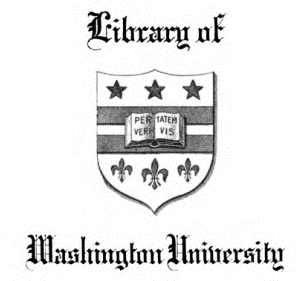
University seal
In 1896, Holmes Smith, professor of Drawing and History of Art, designed what became the basis for the university seal. The seal is made up of elements from the Washington family coat of arms, an open book representing a university, and the symbol of Louis IX, after whom the city is named. In 1915, the university adopted its motto, Per veritatem vis, which translates to "Strength through truth".[[File:1904 World's Fair Administration Building (Brookings Hall, Washington University) seen from the southeast with the Italian Pavilion in the foreground.jpg|thumb|[[Brookings Hall]] during the [[1904 World's Fair]]|alt=Brookings Hall during the 1904 World's Fair]]
_on_the_grounds_of_the_1904_World's_Fair.jpg)

20th century
Campus building and academic foundation
The cornerstone of the first building on its new Hilltop Campus, Busch Hall was laid on October 20, 1900. Construction of additional buildings, including Brookings Hall, Ridgley, and Cupples began shortly thereafter. Washington University postponed occupying these buildings until 1905 to accommodate the 1904 World's Fair and the 1904 Summer Olympics. Robert S. Brookings, president of the board, leased the first five University buildings to the Fair. The generated from the lease was then used to fund the construction of four additional buildings, which were also used by the Fair.
By 1905, the number of course offerings in the college had tripled.
In 1909, the college implemented curricular changes that included a distribution requirement and a limit on how much concentration was allowed in a single field of study.
The School of Medicine formalized partnerships with Barnes Hospital in 1911 and St. Louis Children's Hospital in 1912. These agreements required hospital staffs to consist entirely of University faculty, while granting the university access to patients for clinical instruction and research. In return, Washington University pledged to construct and maintain modern medical facilities and laboratories adjacent to the hospitals. In 1915, the university completed a new medical complex on Kingshighway Boulevard. Three years later, Aphrodite Jannopoulo, Carol Skinner Cole, and Faye Cashatt became the first women to enroll as medical students.
In 1922, Arthur Holly Compton, head of the Department of Physics, conducted a series of experiments in the basement of Eads Hall that demonstrated the particle concept of electromagnetic radiation. Compton's discovery, known as the "Compton Effect," earned him the Nobel Prize in Physics in 1927.
In 1923, Washington University became a member of the Association of American Universities.
Desegregation and Social Change
Compton, after 22 years at the University of Chicago, returned to Washington University in 1946 to become its ninth chancellor. He reestablished the Washington University football team and emphasized a "strictly amateur" athletic policy with no athletic scholarships. Under Compton, the university saw enrollment growth, driven by World War II veterans using the G.I. Bill, which covered college costs for military personnel. In spring 1946, enrollment increased by 39 percent to 9,159 students; by fall 1947, enrollment had reached 13,204 students.
Before the board fully responded, the initiative for desegregation was taken up by individual deans and departments. In June 1947, the medical school sought retroactive approval for admitting an African-American student to a postgraduate course in ophthalmology, which the board granted. That same year, President Harry S. Truman's Commission on Higher Education recommended repealing segregation laws in higher education. Although the first African-American student did not begin undergraduate medical studies until 1951, by then, the medical school had already appointed African Americans to its part-time clinical faculty and named Ernest S. Sims as the first African American to hold a full-time academic appointment in the university.
Similarly, the School of Social Work began admitting African-American students in December 1947. The graduate school followed suit a few months later. In 1949, a group of students formed the Student Committee for the Admission of Negroes (SCAN). In May 1949, SCAN conducted a poll in which nearly one-third of the student body participated, with 77 percent expressing support for ending segregation. By the winter of 1949, racial tests for admission were abolished in all postbaccalaureate programs on the Hilltop Campus. The dentistry school followed in early 1950. On May 9, 1952, racial tests for admissions to undergraduate programs were abolished.
On March 5, 1958, the Board of Directors approved HOK's plans for four residence halls and a food service building. Work on the South 40, named for its location south of the Hilltop Campus and its size of 40 acre, site commenced before July 4, 1958. The project was completed in four phases. Each wave of construction expanded residential capacity: The first group of dormitories accommodated nearly 600 students, the second added another 600, and subsequent phases continued to increase housing availability on campus. With additional on-campus housing, the university, which had been predominantly attended by commuter students, began attracting a greater number of applicants from across the nation. By 1964, over two-thirds of incoming students came from outside the St. Louis area.
Activism and identity
In the late 1960s, Black students established the Association of Black Collegians (ABC). The group (later the Association of Black Students) supported Black students, addressed issues related to campus policing, and advocated for more inclusive representation in the academic curriculum. On December 5, 1968, Elbert Walton, an MBA student, had an incident with campus police. Around 10:30 a.m., officers stopped him, and he reportedly refused to show his ID. The police then took him to the ground, handcuffed him, and placed him in a police car. Walton was later taken to the police station, where he sat in a chair while still handcuffed. When ABC learned about Walton's arrest, the group organized a sit-in at the police office, later expanding their occupation to the basement of Brookings Hall. After arrests and negotiations, the university expanded diversity efforts, including the establishment of the department of African and African-American Studies.
In May 1970, Washington University experienced student unrest in response to the U.S. invasion of Cambodia and the Kent State shooting. On the evening of May 4, a large meeting in Brookings Quadrangle led to a march of 1,200 to 1,500 students toward the AFROTC building. The building was subsequently damaged by a rock-throwing crowd and set on fire in the early hours of May 5. County firemen extinguished the fire after initial attempts by the Clayton Fire Department were hindered by protestors.
In 1971, the board of trustees appointed Chancellor William Henry Danforth. According to The New York Times, under Chancellor Danforth, Washington University transformed from a commuter school into a world-renowned institution. During his 24-year chancellorship, he established 70 new endowed professorships, constructed dozens of buildings, secured a $1.72 billion endowment, and tripled the number of student scholarships.
To better distinguish itself in national media, the university's board of trustees added the phrase "in St. Louis" in 1976.
Institutional development and expansion
In 1995, Mark S. Wrighton, the former provost at MIT, was elected the university's 14th chancellor. During Chancellor Wrighton's tenure, undergraduate applications to Washington University more than doubled, and the university has added more than 190 endowed professorships, revamped its Arts & Sciences curriculum, and completed more than 30 new buildings. The university has also built more than 50 new buildings and increased its endowment by more than $5 billion.
21st century

The Hilltop Campus was renamed the Danforth Campus in 2006 to honor former chancellor William H. Danforth.
In 2014, a study ranked Washington University first in the country for income inequality with approximately 22 percent of its students coming from the top one percent of earners, and about 6 percent from the bottom sixty percent of earners. In response to criticism, the university committed to increase the percentage of Pell-eligible students on campus from 6 percent to 13 percent by 2020. The university achieved that goal three years early, and , 19.9 percent of undergraduate students were eligible for Pell Grants, representing a 300 percent increase since 2012.
In June 2019, Andrew D. Martin, the former dean of the College of Literature, Science, and the Arts at the University of Michigan, was elected the university's 15th chancellor. At his inauguration, Martin announced the "WashU Pledge", a program that offers free tuition to full-time students from Missouri and southern Illinois whose families either earn $75,000 or less per year or qualify for Pell Grants (federal money that helps low-income students pay for college and doesn’t need to be repaid). In 2021, the university launched a $1 billion plan called Gateway to Success. $800 million for need-blind admission (meaning students are accepted without looking at their financial needs) and to cover all their financial need. Another $200 million was set aside to help graduate and professional students pay for school. Under Martin's leadership, the School of Continuing & Professional Studies was redesigned to make college more accessible for more people. He also expanded the WashU Pledge and started the Heartland Initiative to help talented students from the region succeed and stay after graduation.
In 2024, Washington University purchased the 16-acre campus of neighboring Fontbonne University, which is set to close in 2025, for $39 million.
U.S. presidential and vice-presidential debates
, Washington University has been the venue for four presidential debates and one vice-presidential debate: the inaugural 1992 presidential debate on October 11, 1992, the third 2000 Presidential debate on October 17, the second 2004 Presidential debate on October 8, the sole 2008 Vice Presidential debate between Joe Biden and Sarah Palin on October 2, and the second 2016 Presidential debate on October 9. A 1996 debate was scheduled but canceled when the number of debates was reduced to two.
Organization and administration
From 1983 to 1987, the "Alliance for Washington University" campaign raised more than . From 1998 to 2004, the "Campaign for Washington University" raised more than .
On June 1, 2019, Andrew D. Martin was appointed the 15th chancellor of Washington University after Chancellor Mark S Wrighton announced his plans to retire. The chancellor is responsible for overseeing the university's day-to-day operations, including managing staff, implementing the board's policies and decisions, ensuring compliance, and leading strategic initiatives. The chancellor also provides vision and leadership across academics, research, fundraising, and administration.
In 2025, Mark D. West, former dean of University of Michigan Law School, was appointed Provost.
Washington University is a member of the Association of American Universities, American Association of Colleges and Universities, Universities Research Association, American Council of Learned Societies Research University Consortium, and is accredited by the Higher Learning Commission.
Finances, costs, and financial aid
As of June 30, 2024, Washington University has an endowment of $12.0 billion, ranking it among the top 15 university endowments in the United States. Its total assets (including its campus) are valued at $20.48 billion. In Fiscal Year 2024, it had an operating budget of $5.23 billion of which 11 percent came from endowment spending. Of its $5.23 billion operating budget, it had expenses of $5.08 billion. Of the $5.08 billion, $3.026 billion went to instruction, $892.7 million to research, $489.8 million to academic support, $296.4 to institutional support, $165.1 million to auxiliary enterprises, $161.3 million to student services, and $51.6 million to other deductions.
For the 2025–2026 academic year, Washington University charged a tuition fee of $68,240 per student, with a total estimated on-campus cost of attendance of $92,932. Washington University practices need-blind admissions and meets 100 percent of admitted students' demonstrated needs. Of the 1,823 first-year students enrolled in , 929 applied for need-based financial aid, and 796 were determined to have financial need. Among those 796 students, 100 percent of demonstrated need was met on average (excluding any aid awarded beyond calculated need). It does not offer any athletic scholarships.
Campuses
Danforth
Main article: Danforth Campus
In 1899, the university held a national design competition for a new campus. The Philadelphia firm Cope & Stewardson, known for their work at the University of Pennsylvania, Bryn Mawr College, and Princeton University, won with a design based on Collegiate Gothic quadrangles inspired by the universities of Oxford and Cambridge.
The university's 169-acre Danforth Campus is bordered by the Forest Park section of St. Louis and Clayton and University City, Missouri. A large portion of the Danforth Campus is recognized as the Washington University Hilltop Campus Historic District, which is a National Historic Landmark.
Medical
Main article: Washington University Medical Campus
Washington University Medical Center comprises 186 acre spread over 18 city blocks, located along the eastern edge of Forest Park within the Central West End neighborhood of St. Louis. The campus is home to the Washington University School of Medicine and its partners, Barnes-Jewish Hospital and St. Louis Children's Hospital.
In 2019, Washington University was awarded a $7.6 million grant from the National Cancer Institute to establish the Implementation Science Center for Cancer Control to address disparities in cancer care in parts of Missouri and Illinois. In 2022, Washington University's Institute of Clinical and Translational Sciences was awarded a five-year $61 million grant from the National Center for Advancing Translational Sciences of the National Institutes of Health, to advance precision medicine, health equity, and diversity initiatives.
Academics
In 2023, Washington University was one of 10 universities picked to join the Kessler Scholars Collaborative, which provides support for selected first-generation and Pell-Grant eligible STEM students. The program aims to recruit 20 fully funded Kessler scholars per year and provide additional opportunities to close the wealth gap.
Admissions
For the class of 2028 (entering fall 2024), Washington University in St. Louis received over 32,750 applications and admitted 12 percent of applicants. Of those admitted, 86 percent who reported their rank were in the top 10 percent of their high-school class. Additionally, 25 percent of enrolled students were Pell Grant-eligible, and 18 percent were first-generation college students.
The middle 50 percent of admitted students who submitted standardized test scores scored between 33 and 35 on the ACT (out of a maximum score of 36), and between 1500 and 1570 on the SAT (out of a maximum score of 1600). National averages for these tests are approximately 19.4 for the ACT and 1050 for the SAT. For comparison, admitted students scored in the 98th to 99th national percentile, indicating that these students outperformed 98 to 99 percent of recent test takers.
The student-faculty ratio is 7:1.
Libraries
Main article: Washington University Libraries

Washington University holds a copy of the Southwick Broadside, one of the few surviving printed broadsides of the Declaration of Independence. Donated to the university in 2015, it is now part of the university's Special Collections.
Rankings and reputation
Washington University is ranked 20th in the nation in the 2026 U.S. News & World Report National Universities ranking and 26th by The Wall Street Journal in their rankings. In 2025, the university was ranked 26th in the world by the Academic Ranking of World Universities.
| Social Work | 2 |
|---|
In 2025, Washington University in St. Louis was included in Forbes' 2025 New Ivies: 20 Great Colleges Employers Love, which highlights universities known for their academic rigor and producing graduates who are highly sought after by employers, with many graduates considered by employers to be outpacing their Ivy League peers.
In the 2016 edition of The Hidden Ivies: 63 of America's Top Liberal Arts Colleges and Universities, a guidebook by educational consultants Howard and Matthew Greene, included Washington University in St. Louis among the institutions they described as offering an Ivy League-level education in terms of academic rigor, intellectual atmosphere, and campus experience.
Washington University is among the top institutions producing recipients of various competitive postgraduate fellowships, including the Fulbright program, Harry S. Truman Scholarship, and Rhodes Scholarship.
Research
| School of Public Health | 2025 |
|---|
According to the National Science Foundation's Higher Education Research and Development Survey for fiscal year , Washington University ranks 27th among U.S. institutions in total research and development (R&D) expenditures. In that year, Washington University reported $1.169 billion in R&D spending, reflecting an 11.7 percent increase from the previous year. In 2022, Washington University developed a nasal vaccine aimed at addressing COVID-19; it was licensed for use in India to Indian vaccine maker Bharat Biotech and the technology was licensed to bio-tech company Ocugen. Bharat named their licensed version of the vaccine iNCOVACC. In 2025, Washington University's vaccine was approved for clinical trials in the United States.
In 2019, Washington University School of Medicine took over Folding@Home, a distributed computing project, from Stanford University. The project, which taps into the idle power of personal computers owned by volunteers to simulate protein folding, reached a speed of 1.5 exaFLOPS in 2020—seven times faster than the world's top supercomputer, Summit, and more powerful than the top 100 supercomputers in the world, combined. This speed fuels research into diseases like Alzheimer's, cancer, COVID-19, and Ebola.
Washington University hosts NASA's Planetary Data System Geosciences Node, supporting unmanned Mars missions, with Professor Raymond Arvidson serving as deputy principal investigator for the Mars Exploration Rovers and co-investigator for the Phoenix lander's robotic arm.
Beyond STEM, Washington University students have digitized the works of 16th-century poet Edmund Spenser. Led by English professor Joseph Loewenstein and supported by a $150,000 grant from the National Endowment for the Humanities, the project marks the first major update to Spenser's collected works since Oxford University Press's edition nearly a century ago. The new edition, produced in collaboration with scholars at four other universities, will include both a comprehensive print publication and a digital archive.
Colleges and schools
Across its schools, it offers more than 150 undergraduate, 80 master's and professional, and 50 doctoral degree programs.
- The College of Arts & Sciences is home to the university's largest undergraduate program, providing students selection of courses across more than 50 disciplines, including anthropology, chemistry, English, the performing arts and women, gender and sexuality studies.
- The George Warren Brown School was founded in 1925. The school was endowed by Bettie Bofinger Brown and named for her husband, George Warren Brown, a St. Louis philanthropist and co-founder of the Brown Shoe Company. In 1948, it became the first school at Washington University to admit black students.
- The James McKelvey School of Engineering was named on January 31, 2019, when the School of Engineering & Applied Science was renamed in honor of trustee and alumnus Jim McKelvey Jr., co-founder of Square, following his substantial donation.
- The Olin Business School, originally established as the School of Commerce and Finance in 1917, was named after John M. Olin in the 1980s. In 2002, an Executive MBA program was established in Shanghai, in cooperation with Fudan University.
- The Sam Fox School of Design & Visual Arts was founded in 2006, merging the existing academic units of Architecture and Art with the university's museum. The school comprises the College of Architecture, Graduate School of Architecture & Urban Design, College of Art, Graduate School of Art and the Mildred Lane Kemper Art Museum. It was the first art museum west of the Mississippi. Steinberg Hall, completed in 1960, was the first commissioned project by Pritzker Prize-winning architect Fumihiko Maki.
- The School of Continuing & Professional Studies (CAPS) was established in June 2023, when Washington University renamed University College. CAPS was established to focus on adult learners with a focus on rapidly growing and high paying fields like data analytics, education, healthcare, and management. The pre-nursing program was developed in partnership with Goldfarb School of Nursing at Barnes-Jewish College.
- The School of Public Health was established in 2025.
- The Washington University School of Law (established in 1867) is the oldest continuously operating law school west of the Mississippi River. Washington University School of Law offers joint-degree programs with the Olin Business School, the Graduate School of Arts and Sciences, the School of Medicine, and the School of Social Work. Since 1997, Anheuser-Busch Hall has been home to the School of Law.
- The Washington University School of Medicine was established in 1891. In 2024, it ranked second in the United States for National Institutes of Health (the government agency responsible for biomedical and public-health research) funding. File:SeigleHall.jpg|Seigle Hall (2008), shared by the School of Law and the College of Arts and Sciences File:George Warren Brown School of Social Work.jpg|George Warren Brown School of Social Work, built in 1948. File:Olin Business School.jpg|Simon Hall (2019) is a part of the Olin Business School. File:Steinberg Hall.jpg|Steinburg Hall (completed in 1960) is part of the Sam Fox School of Design & Visual Arts. File:Washington University School of Medicine2.jpg|Washington University School of Medicine was established in 1891.
Campus life
Main article: Washington University in St. Louis student life
Student body
| Race and ethnicity | Total | Economic diversity | |||
|---|---|---|---|---|---|
| White | {{bartable | 44 | % | 2 | background:gray}} |
| Asian | {{bartable | 20 | % | 2 | background:purple}} |
| Hispanic | {{bartable | 12 | % | 2 | background:green}} |
| Black | {{bartable | 9 | % | 2 | background:mediumblue}} |
| Other | {{bartable | 8 | % | 2 | background:brown}} |
| Foreign national | {{bartable | 7 | % | 2 | background:orange}} |
| Low-income | {{bartable | 16 | % | 2 | background:red}} |
In 2024, Washington University enrolled 16,399 students who came from all 50 U.S. states and more than 110 countries. This includes 8,243 undergraduate students and 7,289 graduate students.
Of the 1,848 first year students enrolled in fall 2024, 37 percent were white/Caucasian, 26 percent were Asian, 12 percent were Latino/Hispanic, 8 percent were black/African-American, 11 percent were international, and 5 percent did not identify; 53 percent were female and 47 percent were male.
Student organizations
Washington University has over 400 undergraduate student organizations on campus. Most receive funding by the Washington University Student Union, which, as of Fiscal Year has an annual budget of $4.2 million. The Student Union sponsors major campus programs including WILD and distributes free copies of The New York Times, USA Today, and the St. Louis Post-Dispatch through The Collegiate Readership Program.
Washington University has 26 recognized chapters of fraternities and sororities. In 2020, nearly half of Washington University's fraternity and sorority members canceled their memberships following student-led criticism that historically white fraternities and sororities contributed to racism and sexism on campus. Two sororities folded completely, and others lost more than 80 percent of their membership. The university has since faced ongoing calls from students to remove fraternities and sororities from campus.
Residences
The Village is a residential area on the Danforth Campus for undergraduate students in their third year or beyond. It includes two suite-style buildings, Lopata House and Village House, that contain multiple four-person single suites, each with two shared bathrooms.
Student media
Washington University is home to seven student-run media organizations: The Hatchet, Law Review, Washington University Political Review, Student Life, Spires, KWUR 90.3FM, and WUTV. Student Life was founded in January 1878 and is published twice weekly by Washington University Student Media, Inc., an independent nonprofit incorporated in 1999. KWUR (90.3 FM) serves as the students' official radio station. In 2003, KWUR won the critic's choice from the Riverfront Times for the Best Radio Station in St. Louis. WUTV is the university's closed-circuit television channel. It was founded in 1976.
Transportation
Since 2006, the university began offering free MetroLink (St. Louis's light rail commuter train system) passes to all full-time students, benefits-eligible faculty and staff, and full-time employees of qualified service providers. The Blue Line and the Red Line are on the Danforth Campus along Forest Park Parkway. The Red Line provides access to the St. Louis Lambert International Airport, University of Missouri–St. Louis and the Delmar Loop. The Blue Line provides access to the suburbs of Clayton, Brentwood, and Richmond Heights. Both provide access to the Gateway Arch (U.S. National Historic Landmark in downtown St. Louis) and access to the village of Fairview, Illinois.
The Washington University shuttle system includes a Campus Circulator (which provides free transportation around Danforth Campus for faculty, staff, students and guests) and seven neighborhood routes that go to locations outside of Danforth Campus. In 2025, the Shopper Shuttle was introduced as a pilot program. The Shopper Shuttle provides transportation to Saint Louis Galleria (a shopping mall), Target, and Walmart.
Traditions
Every semester, Washington University hosts WILD, a concert in the Quad that features popular musical acts. Other traditions include Thurtene Carnival (a student-run carnival), Vertigo (a dance party put on by the Engineering School Council), and Residential Community Olympics (an annual competition between residential colleges featuring different sports and activities). Students also use the Underpass panels, a series of displays along the walls of the underpass connecting the South 40 to the main Danforth Campus, to advertise events.
A superstition among students warns that stepping on the university seal at Brookings Hall will prevent one from graduating on time.
Athletics
Main article: Washington University Bears
Washington University was a founding member of the University Athletic Association of NCAA Division III and previously was a founding member of the Missouri Valley Conference. It is also a member of the College Conference of Illinois and Wisconsin.[[File:Francis Field 1904.jpg|alt=Francis Olympic Field during the 1904 St. Louis Olympics|thumb|[[Francis Olympic Field]] during the [[1904 St. Louis Olympics]]]]
The Bears have won 28 NCAA Division III championships—ten in volleyball (1989, 1991–1996, 2003, 2007, 2009), five in women's basketball (1998–2001, 2010), two in men's basketball (2008, 2009), two in women's cross country (2011, 2018), two in women's outdoor track and field (2017, 2024), three in women's soccer (2016, 2024, 2025), one in men's tennis (2008), one in womens's tennis (2025) one in women's indoor track and field (2017), and one in men's indoor track and field (2022) – and 267 conference titles. Its mascot is the Bear, and its official colors are red and green.[[File:238038658 c62059dc1f b.jpg|thumb|Gates at Francis Olympic Field|alt=Gates at Francis Olympic Field]]
Washington University hosts more than 40 club sports.
Francis Olympic Field
Francis Olympic Field, formerly known as Francis Field, is home to Washington University's football, soccer, and track-and-field teams. It served as a venue for the 1904 Summer Olympics, the first Games held outside of Europe. In 2019, the stadium was renamed Francis Olympic Field to commemorate its Olympic heritage and St. Louis's role as host city. The Olympic flame has passed through the field three times, during torch relays for the 1984 Los Angeles, 1996 Atlanta, and 2004 Athens Summer Olympics.
Notable people
Main article: List of Nobel laureates affiliated with Washington University in St. Louis as alumni or faculty, Category: Washington University in St. Louis people
Washington University has more than 166,000 living alumni and 22,530 employees . Of these 22,530 employees, 4,551 are faculty and 17,979 are administrative staff.
, 26 Nobel laureates, 11 Pulitzer Prize winners, 4 United States Poets Laureate, and 6 MacArthur Fellows have been affiliated with the university as faculty or alumni. Its alumni and faculty have also received numerous prestigious awards and honors, including the Nobel Prize, National Book Award, National Book Critics Circle Award, National Medal of Science, National Medal of Arts, Guggenheim Fellowship, Fulbright Fellowship, Putnam Fellowship, MacArthur Fellowship, along with memberships in the National Academy of Sciences, National Academy of Engineering, Royal Society of London, American Institute of Architects, American Institute for Medical and Biological Engineering, American Academy of Arts and Letters, American Association for the Advancement of Science, American Law Institute, American Philosophical Society, National Academy of Medicine, and the American Academy of Arts and Sciences.
Washington University alumni also include 17 university presidents, 21 members of the United States Congress, 30 Rhodes Scholars, 20 Truman Scholars, 7 Marshall Scholars and 2 Churchill Scholars.
Alumni
In the sciences, alumni include Nobel laureates such as Earl Sutherland, Edwin Krebs and Daniel Nathans, all in physiology or medicine. Other notable scientists include J. C. R. Licklider (pioneer in the development of computing and the Internet), Julian W. Hill (discoverer of nylon), Clyde Cowan (co-discoverer of the neutrino) and Bob Behnken (NASA astronaut and former Chief of the Astronaut Office).
In politics and public service, alumni include William H. Webster (the only person to serve as director of both the FBI and CIA), Rochelle Walensky (Director of the Centers for Disease Control and Prevention), and Clark Clifford (political advisor to presidents Truman, Kennedy, Johnson, and Carter). Others include Jim Talent (former U.S. senator from Missouri), Alan J. Dixon (former U.S. senator from Illinois), Alexander M. Dockery (Governor of Missouri), Siniša Mali (finance minister of Serbia), Jonathan Mann (first director of the World Health Organization's Global Program on AIDS), and Phoebe Couzins (first female U.S. Marshal in the U.S.).
In business and entrepreneurship, alumni include Avram Glazer (executive co-chairman of Manchester United), Jim McKelvey (co-founder of Square Inc), Arnold W. Donald (president and chief executive officer of Carnival Corporation), and Charles Nagel (founder of the U.S. Chamber of Commerce).
In the arts, media and performing arts, alumni include Harold Ramis (Ghostbusters, Groundhog Day and Animal House), Peter Sarsgaard (award-winning actor), Robert Guillaume (Emmy-winning actor in Benson, first African American to play the title role in Phantom of the Opera, and voice of Rafiki in Disney's The Lion King), Dave Garroway (founding host of NBC's Today), and Steven Sater (Tony Award, Grammy Award, and Laurence Olivier Award-winning American poet and playwright). Literary and cultural figures include Fannie Hurst (prolific novelist), Dan Simmons (Hugo Award winner), and A.E. Hotchner (playwright and novelist).
In architecture, George Hellmuth, Gyo Obata, and George Kassabaum founded HOK, one of the world's largest architectural firms.
Higher-education leaders include Abram L. Sachar (founding president of Brandeis University) and Thomas Lamb Eliot (founder of Reed College). Alumni also include the former presidents of Johns Hopkins, Clemson, Wake Forest, Morehouse, Florida A&M University, Hong Kong University of Science and Technology, University of Louisville, San Francisco State University, and University of California.
Notable individuals who attended but did not graduate include Tennessee Williams (a renowned playwright who left after a prize dispute), Robert Culp (I Spy, Everybody Loves Raymond), and Marilyn vos Savant (IQ-record holder who pursued family business interests).
File:Robertbehnkenv2.jpg|Bob Behnken File:Robert Guillaume 1977.JPG|Robert Guillaume File:Jim Studio Headshow.jpeg|Jim McKelvey File:HaroldRamisOct2009.jpg|Harold Ramis File:Peter Sarsgaard (31957641966) (cropped).jpg|Peter Sarsgaard File:Rochelle Walensky, CDC Director (cropped).jpg|Rochelle Walensky File:William H Webster.jpg|William H. Webster File:Tennessee Williams NYWTS.jpg|Tennessee Williams
Faculty
Notable faculty at Washington University have included Roger Nash Baldwin (American Civil Liberties Union cofounder and Washington University's first instructor in sociology), Gerty Cori (the first woman Nobel laureate in Physiology/Medicine), Rita Levi-Montalcini (Nobel laureate, co-discover of nerve growth factor), Peter Mutharika (President of Malawi), William Inge (Playwright, Pulitzer Prize for drama in 1953), Arthur Oncken Lovejoy (founded the American Association of University Professors), Mona Van Duyn (Pulitzer Prize winner, National Book Award winner and first woman U.S. Poet Laureate), Howard Nemorov (U.S. Poet Laureate, National Medal of Arts recipient, Bollingen Prize winner), Joseph W. Kennedy (co-discoverer of the element plutonium), Barbara A. Schaal (first woman VP of National Academy of Sciences), Henry Smith Pritchett (Head of the Carnegie Foundation for the Advancement of Teaching), Virginia E. Johnson (co-author of Human Sexual Response), and Thomas Eagleton (United States senator from Missouri). File:Roger Nash Baldwin.jpg|Roger Nash Baldwin File:Gerty Theresa Cori.jpg|Gerty Cori File:Thomas Eagleton official portrait.jpg|Thomas Eagleton File:Williaminge (cropped and cleaned).jpg|William Inge File:Joseph W. Kennedy Los Alamos identity badge photo.jpg|Joseph W. Kennedy File:Rita Levi-Montalcini (1986) (cropped).jpg|Rita Levi-Montalcini File:Arthur Peter Mutharika 2014 (cropped).jpg|Peter Mutharika File:Mona Van Duyn.jpg|Mona Van Duyn
Notes
References
Sources
References
- "About the Endowment".
- "IPEDS-Washington University in St Louis".
- WOF. (February 13, 2025). "William Greenleaf Eliot".
- "Campus History".
- "Our History - MICDS". Mary Institute and Saint Louis Country Day School.
- "The Vocational Age Emerges, 1876-1926". American Vocational Journal.
- "Manual Training School, Washington University".
- "History and Traditions". Washington University in St. Louis.
- "Washington University Hilltop Campus, 1899-1951".
- O'Connor, Candace. "A Glorious World's Fair Transforms a University Campus".
- "Frederic Aldin Hall".
- (August 18, 2022). "Compton Centennial Celebration".
- "Arthur Holly Compton".
- (November 20, 2024). "AAU Member Universities By Year of Entry {{!}} Association of American Universities (AAU)".
- Allison, Samuel K.. (1965). "Arthur Holly Compton 1892–1962". National Academy of Sciences.
- "Arthur Holly Compton".
- "Ethan A.H. Shepley".
- Early, Rosalind. (August 6, 2018). "A tradition of activism: The 1968 Brookings occupation".
- Sargeant, Davis. (September 1, 2011). "Civil Rights and Washington University: a complex history".
- Ross, Gloria S.. (September 17, 2020). "William Danforth Dies At 94. He Led Wash U To Financial Stability, Established St. Louis As Plant Science Hub".
- (September 17, 2020). "William Danforth dies at 94; grew Washington University into world-class institution".
- Seelye, Katharine Q.. (October 6, 2020). "William Danforth, Who Led Washington University, Dies at 94". The New York Times.
- Seelye, Katherine. (October 6, 2020). "William Danforth, Who Led Washington University, Dies at 94".
- "Origin of the 'Washington' Name". WashU Libraries.
- (April 10, 1995). "MIT Provost Mark Wrighton to head Washington University".
- "Mark S. Wrighton".
- (April 2, 2019). "Mark Wrighton Talks Legacy As Wash U Chancellor, Future At Better Together".
- (October 29, 2009). "Leading US Education University Promotes New International Programs".
- Lipka, Sara. (November 4, 2005). "Washington U. Partners With 15 Asian Universities".
- Epstein, David. "Coming to America".
- (March 21, 2022). "Washington University in St. Louis: McDonnell International Scholars Academy names new partner".
- Rim, Dennis. (April 1, 2013). "The ever-so-changing campus".
- (February 23, 2006). "Washington University Names Campus in Honor of Danforths".
- (September 8, 2014). "The Most Economically Diverse Top Colleges". The New York Times.
- (January 18, 2017). "Some Colleges Have More Students From the Top 1 Percent Than the Bottom 60. Find Yours.". The New York Times.
- Patel, Vimal. (February 26, 2015). "A Distinction Washington U. Wants to Lose: Least Economically Diverse".
- Zagier, Alan Scher. (April 28, 2011). "At top colleges, diversity not just black-white".
- Schienvar. (January 22, 2015). "University announces plan to increase Pell-eligible numbers".
- Leonhardt, David. (January 15, 2015). "The Least Economically Diverse Top College, Seeking to Change". The New York Times.
- "Our Progress {{!}} Equity, Diversity & Inclusion {{!}} Washington University in St. Louis".
- Bernhard, Blythe. (July 14, 2018). "From a student apartment to the chancellor's house, Wash U's new leader comes home".
- (October 4, 2019). "Washington University unveils tuition-free aid program".
- Hanshaw, Annelise. (February 26, 2024). "Wash U. prioritizes need-based aid after years of low socioeconomic diversity".
- Burt, Chris. (October 5, 2021). "Windfall at WashU! Endowment gains lead to $1 billion in financial aid to students".
- Bernhard, Blythe. (October 5, 2021). "Washington University to boost student financial aid by $1 billion".
- (February 19, 2025). "Meet Andrew Martin Of Washington University {{!}} St. Louis Magazine".
- Salter, Jim. (March 11, 2024). "Fontbonne University in Missouri to close due to budget problems and declining enrollment".
- Lloyd, Gloria. (September 12, 2024). "What WashU paid for Fontbonne campus".
- McDermott, Kevin. (September 24, 2015). "The 4 times Washington U. has hosted presidential or vice-presidential debates".
- (October 2, 2008). "Vice Presidential Candidates Debate".
- Rosenbaum, Jason. (September 9, 2024). "How did a St. Louis school become a mainstay of the presidential debate circuit?".
- Camia, Catalina. (April 1, 2015). "Ready for debates? 16 sites eager to be 2016 hosts".
- "Charter".
- "Home".
- Duenke, Ken. (September 8, 2006). "Campus named for Danforths".
- Winter, Greg. (December 22, 2003). "A Mighty Fund-Raising Effort Helps Lift a College's Ranking". The New York Times.
- "Milestones of the Campaign". Washington University Magazine.
- Dwyer, Joe. (July 14, 2018). "Andrew Martin named chancellor of Washington University".
- "Chancellor Roles and Responsibilities".
- Charnosky, Christine. (June 30, 2025). "Former Michigan Law Dean Appointed Provost of Washington University".
- Rizvic, Veneta. (June 30, 2025). "Legal scholar and former Michigan Law dean to lead WashU academics".
- "Current Member List".
- "Member Universities".
- "ACLS Research University Consortium".
- "Washington University in St. Louis".
- "Database of Accredited Postsecondary Institutions and Programs".
- "Endowment Facts".
- Cuccinello, Hayley. (April 1, 2025). "Federal funding cuts are raising questions about university endowments. Here's what some are worth and how they work".
- "Washington University Consolidated Financial Statements".
- "University Facts".
- "Cost of Attendance - Undergraduate Admissions".
- Nietzel, Michael T.. (October 5, 2021). "Washington University Is Going Need-Blind In Admissions".
- Jaschik, Scott. (October 10, 2021). "WashU Goes Need Blind in Admissions".
- "Washington University in St. Louis Common Data Set 2023-2024".
- Tatman, Sandra L.. "Cope & Stewardson (fl. 1885-1912)".
- Ihnen, Alex. (October 31, 2014). "Washington University Set for Major Transformation of Danforth Campus".
- "Washington University Hilltop Campus Historic District - National Historic Landmark".
- "Washington University Medical Campus".
- (October 20, 2019). "Washington University Receives $7.6 Million Grant from National Cancer Institute".
- Barr, Diana. (May 13, 2022). "Washington University researchers receive $61M federal grant for biomedical research".
- "Defying the odds: From a start amid the pandemic, more than 100 first-generation students this spring reach college graduation with comprehensive support from the Kessler Scholars Program".
- Donadel, Alcino. (May 25, 2023). "This program dedicated to boosting first-gen success rates is tripling down".
- Nietzel, Michael T.. (April 12, 2022). "The Kessler Scholars Program Expands To Ten More Leading Colleges And Universities".
- Kelliher, Rebecca. (April 13, 2022). "Washington University in St. Louis To Launch Scholars Program for First-Gen STEM Students".
- Keaggy, Diane Toroian. (August 28, 2024). "WashU enrolls more limited-income, first-generation students; share of Black students decreases".
- "Class of 2028 Profile". WashU Undergraduate Admissions.
- "Average ACT Test Scores by State".
- "What is a Good Score?".
- "ACT National Ranks & Score Percentiles".
- "SAT User Percentiles - College Board Research".
- "College Navigator - Washington University in St Louis". Institute of Education Sciences.
- "Library Statistics and Figures: The Nation's Largest Libraries: A Listing by Volumes Held". American Library Association.
- "List of ARL Members".
- "Libraries".
- "Celebrating Research".
- (July 2, 2018). "Rare copy of Declaration of Independence on display at Wash U".
- Henderson, Jane. "Made in 1776: Rare copy of the Declaration of Independence goes on view at Washington U.".
- "Washington University in St. Louis". [[U.S. News & World Report]].
- "2026 Best U.S. Colleges - WSJ / College Pulse Rankings". [[The Wall Street Journal]].
- "2025 Academic Ranking of World Universities".
- "Best Audiology Programs".
- "Best Biological Sciences Programs".
- "2025 Best Business Schools".
- "Best Chemistry Programs".
- "Best Computer Science Schools".
- "Best Earth Science Programs".
- "Best Economics Schools".
- "2025 Best Engineering Schools".
- "Best English Programs".
- "Best History Programs".
- "2025 Best Law Schools".
- "Best Mathematics Programs".
- "2023-2024 Best Medical Schools: Research". U.S. News & World Report.
- Kayser, Alexis. (2023-01-31). "13 medical schools boycott US News rankings: Who, why and what's next - Becker's Hospital Review {{!}} Healthcare News & Analysis". [[Becker's Hospital Review]].
- "Best Occupational Therapy Programs".
- "Best Physical Therapy Programs".
- "Best Political Science Programs".
- "Best Psychology Schools".
- "Best Public Health Schools".
- "Best Schools for Social Work".
- "Washington University in St. Louis (WashU) – Rankings, Admissions, Campus Life & More.".
- Whitford, Emma. "The New Ivies 2025: 20 Great Colleges Employers Love".
- (2016). "The Hidden Ivies, 63 of America's Top Liberal Arts Colleges and Universities". Cliff Street Books.
- "Top Producing Institutions".
- "Scholar Listing {{!}} The Harry S. Truman Scholarship Foundation".
- "Carnegie Classifications Institution Lookup". Center for Postsecondary Education.
- "Carnegie Classifications".
- Gibbons, Michael T.. (25 November 2024). "Higher Education R&D Expenditures Increased 11.2%, Exceeded $108 Billion in FY 2023 {{!}} NSF - National Science Foundation".
- Ghosal, Aniruddha. (September 6, 2022). "India and China clear needle-free COVID-19 vaccines".
- Kinsaul, Russell. (February 7, 2025). "Nasal COVID vaccine developed at WashU approved for clinical trials".
- "Bharat Biotech launches iNCOVACC®: World's 1st intranasal COVID vaccine for Primary series and Heterologous booster".
- (May 21, 2020). "Using Crowdsourced Computing to Fight the Coronavirus – Communications of the ACM".
- Strait, Julia Evangelou. (February 26, 2019). "Computational biology project aims to better understand protein folding". Washington University in St. Louis.
- Patrizio, Andy. (April 1, 2020). "Thousands of PCs break exaFLOP barrier".
- (April 8, 2020). "Folding@home stats report".
- (September 15, 2013). "Alzheimer's Disease".
- (December 18, 2024). "Cancer".
- (January 3, 2022). "COVID-19".
- "Ebola Virus".
- Lutz, Diana. (April 16, 2007). "Undergraduate paves way for NASA Mars mission".
- McGinn, Susan Killenberg. (January 7, 2008). "Digitizing the works of a 16th-century poet".
- (June 1, 2009). "National Endowment for the Humanities Awards and Offers, June 2009".
- "Academics".
- "College of Arts & Sciences". Washington University in St. Louis: Office of the University Registrar.
- (July 26, 2024). "Brown School Eras".
- Gauen, Claire. (February 17, 2025). "A century of impact".
- Traube, Dorian. (July 27, 2023). "Dean's Welcome".
- Field, Andy. (January 31, 2019). "Wash U Receives Donation From Square Co-Founder And Renames School Of Engineering".
- Barker, Jacob. (January 31, 2019). "Wash U renaming engineering school after Square co-founder Jim McKelvey".
- "Our History".
- "Washington University-Fudan University EMBA {{!}} Global Perspective Local Insights".
- Gillet, Kit. (March 26, 2013). "In China, Executives Flock Back to School for Unfinished Business". The New York Times.
- Otten, Liam. (January 20, 2005). "Sam Fox School of Design and Visual Arts created".
- Launius, John. (February 17, 2020). "The Life and Times of Missouri's Charles Parsons: Between Art and War". Arcadia Publishing.
- "Washington University Steinberg Auditorium".
- Gieseke, Drew. (August 16, 2023). "WashU looks to the future for adult learners with new School of Continuing & Professional Studies".
- Frantz, Doug. "Training a New Generation of Leaders in the Business of Health".
- Parker, Deb. (2025-09-09). "Building momentum: School of Public Health marks milestones".
- Owens, Dennis. (1976). "American Law Schools in Their Second Century". Journal of Legal Education.
- "Dual Degree Programs". Washington University in St. Louis: Office of the University Registrar.
- (August 14, 2012). "Washington University School of Law's Anheuser-Busch Hall".
- "About WashU Medicine".
- Simpson, Maddy. (December 12, 2024). "WashU ranks No. 2 in nation for NIH funding".
- "Washington University in St. Louis".
- "Our Students - Undergraduate Admissions". WashU Undergraduate Admissions.
- "Student Groups". WashU Campus Life.
- (March 30, 2023). "SU passes general budget of $4.2 million".
- Jamula. (February 25, 2025). "SU Treasury joint session with SU Senate approves general budget and significantly increases funding for WILD".
- Stohr, Grace. (September 6, 2018). "SU Collegiate Readership Program provides access to New York Times subscription".
- "Sororities & Fraternities".
- Delaney, Ryan. (March 18, 2021). "As Wash U Students Reckon With Greek System, Some Want It Gone For Good".
- (August 24, 2017). "Home, sweet home: Helpful facts about the South 40".
- "South 40 Residential Communities".
- "Upper Division Housing".
- "The Village".
- Niemeyer, Kelly Wiese. (January 29, 2021). "Who Knew WashU?".
- Schoenherr, Neil. (September 10, 2003). "Student Life alumni celebrate 125 years of publishing".
- "About Student Life". Student Life.
- Cliburn, Erik. (May 28, 2024). "Giving Voice to Increased Representation in Music".
- "Best Radio Station 2003".
- Keaggy, Diane Toroian. (March 21, 2024). "Student-run KWUR amplifies diverse music, student sounds".
- (March 3, 2006). "WUSTL to provide free Metro passes".
- Niemeyer, Kelly Wiese. (May 6, 2025). "Register for parking permits, Metro passes soon".
- "Metro Transit {{!}} Parking & Transportation".
- "MetroLink".
- "WashU Campus Shuttle System".
- "Campus Circulator".
- Konstorum, Mary. (February 13, 2025). "Shop 'til you drop: WashU pilots new Shopper Shuttle".
- Keaggy, Diane Toroian. (May 1, 2023). "Celebrating 50 years of WILD, one of WashU's largest campus traditions".
- (April 17, 2016). "Thurtene Carnival is a highlight of spring". [[St. Louis Post-Dispatch]].
- (December 1, 2022). "Vertigo returns to McKelvey Engineering".
- "Congress of the South 40".
- Coulter, Sharon. (September 23, 2020). "The Artists' Way: St. Louis Muralists Take Over Washington University Underpass".
- Humphrey, Thomas. (February 18, 2019). "The dark side of the Underpass".
- Early, Rosalind. (August 6, 2018). "50 things every first-year WashU student must do".
- (December 20, 2023). "UNIVERSITY ATHLETIC ASSOCIATION".
- "This is The Valley".
- Eisner, Matt. (October 18, 2024). "Football to join North Coast Athletic Conference for 2026 season".
- "National Championships".
- Ciorba, David. (April 3, 2025). "The WashU Bear deserves a name".
- "University Facts". Washington University in St. Louis.
- (October 27, 1907). "Washington Stadium is now called Francis Field". St. Louis Post-Dispatch.
- (September 17, 2019). "WASHINGTON UNIVERSITY'S FRANCIS FIELD TO BE RENAMED FRANCIS OLYMPIC FIELD".
- "Francis Field Stadium". International Olympic Committee.
- Rooney, Sonya. "Awards and Learned Society Memberships earned by WashU faculty, students, and trustees". WashU Libraries.
- "U.S. Rhodes Scholarships Number of Winners by Institution U.S. Rhodes Scholars 1904 – 2023". The Rhodes Trust.
- Keaggy, Diane Toroian. (December 13, 2021). "Senior Kuziez named Marshall Scholar".
- "Churchill Scholarship".
- (March 10, 1974). "Dr. Earl W. Sutherland Jr. Dies; 1971 Nobel Laureate in Medicine". The New York Times.
- (January 29, 2010). "Edwin G. Krebs (1918–2009)". Science.
- (March 12, 2019). "Daniel Nathans - Profiles in Science".
- "J. C. R. Licklider".
- Stout, David. (February 1, 1996). "Julian W. Hill, Nylon's Discoverer, Dies at 91". [[The New York Times]].
- Reines, Frederick. (August 1, 1974). "Clyde L. Cowan Jr". Physics Today.
- Tonnessen, Heather. (August 30, 2016). "Robert L. Behnken (Colonel, USAF, RET., PH.D.) NASA Astronaut".
- Evans, Ben. (May 24, 2020). "Meet the Crew: Hurley, Behnken Primed for Historic U.S. Return to Space".
- Hutchinson, Daphne. (April 8, 2024). "Former FBI and CIA Director William Webster: Answering the call of his country".
- LeMieux, Julianna. (December 9, 2020). "Five Things to Know about the New CDC Director, Rochelle Walensky".
- Berger, Marilyn. (October 11, 1998). "Clark Clifford, a Major Adviser To Four Presidents, Is Dead at 91".
- "Jim Talent".
- Martin, Douglas. (July 8, 2014). "Alan J. Dixon, 86, Is Dead; U.S. Senator Who Championed Illinois". The New York Times.
- (February 11, 2025). "Governor Alexander Dockery is Born: February 11, 1845".
- Ralev, Radomir. (May 30, 2018). "Serbia's new finance minister vows to cut debt, keep fiscal stability".
- Hilts, Philip J.. (September 4, 1998). "Jonathan Mann, AIDS Pioneer, Is Dead at 51". The New York Times.
- (December 7, 1913). "PHOEBE COUZINS DIES AT 72; First Woman Lawyer in United States Succumbs in Poverty.". The New York Times.
- Gregory, Ross. (May 5, 2021). "Avram Glazer: who is the Man Utd co-owner and what has he said about European Super League plot?".
- "Arnold Donald's Biography".
- Ragan, Cooper. "Nagel, Charles".
- "Harold Ramis". St. Louis Walk of Fame.
- Cardenas, Felipe. (March 10, 2021). "Q&A: Peter Sarsgaard on his love of soccer, St. Louis and Socrates (the player)". The New York Times.
- Lowman, Rob. (April 12, 2009). "Peter Sarsgaard on soccer, acting and family".
- Brown, Stacy M.. (October 27, 2017). "Robert Guillaume Remembered as a True Legend".
- (October 25, 2019). "Dave Garroway".
- (July 18, 1969). "Comebacks: Peace, Old Tiger".
- Wadler, Joyce. (December 14, 2006). "Storming Broadway From Atop a Fortress". The New York Times.
- Atlas, Nava. (July 14, 2018). "Fannie Hurst, Author of Imitation of Life".
- White, Claire E.. "A Conversation With Dan Simmons".
- Weber, Bruce. (February 15, 2020). "A. E. Hotchner, Writer and Friend of the Famous, Dies at 102". The New York Times.
- (November 16, 1999). "George Hellmuth; 'Sold' Architect Firm's Ideas".
- Lyons, Richard D.. (July 25, 1993). "Dr. Abram L. Sachar, Historian And 1st Brandeis U. President, 94". The New York Times.
- Hernandez, Romel. (June 1, 2014). "The Minister Who Shaped a College—And a City".
- Altman, Lawrence K.. (November 18, 1999). "Daniel Nathans, 71, Pioneer in DNA Research". The New York Times.
- Trotter, Stephanie. (August 1, 2022). "Tiger Town Legends".
- (January 22, 2005). "Hatch named next president of Wake Forest University".
- "Walter E. Massey's Biography".
- Brown, Danielle J.. (December 31, 2019). "Dr. Larry Robinson On The Science of a University".
- Guttenplan, D.D.. (October 16, 2011). "First, Catch Your Faculty: A Recipe for Excellence". The New York Times.
- Nietzel, Michael T.. (November 30, 2022). "University Of Louisville Names Kim Schatzel As Its New President".
- (April 3, 2013). "Honorary Member: Edward S. Holden".
- Schvey, Henry I.. (2021). "Blue Song: St. Louis in the Life and Work of Tennessee Williams". University of Missouri Press.
- Coleman, Nancy. (August 23, 2021). "Staging 'The Glass Menagerie' on the Fire Escapes That Inspired It". The New York Times.
- Grimes, William. (March 25, 2010). "Robert Culp, Star in 'I Spy,' Dies at 79". The New York Times.
- (September 29, 1985). "Meet the World's Smartest Person".
- Pearson, Richard. (August 27, 1981). "Roger Baldwin, a Founder of ACLU, Dies". The Washington Post.
- (May 15, 2017). "Looking back: Roger Nash Baldwin, Unitarian co-founder of ACLU".
- "The Nobel Prize {{!}} Women who changed science {{!}} Gerty Cori".
- "The Nobel Prize {{!}} Women who changed science {{!}} Rita Levi-Montalcini".
- Cambria, Nancy. (June 2, 2014). "New president of Malawi taught at Washington University law school for nearly 40 years".
- Preston, Dick. (May 5, 2020). "Beyond the Trivia - William Inge".
- (December 17, 2024). "William Inge".
- (June 28, 2016). "Arthur O. Lovejoy". Johns Hopkins University.
- "Mona Van Duyn".
- "Mona Van Duyn".
- "Howard Nemerov".
- Pearson, Richard. (July 7, 1991). "HOWARD NEMEROV, PULITZER-WINNING POET, DIES AT 71". The Washington Post.
- "Joseph W. Kennedy - Nuclear Museum".
- Evangelou Strait, Julia. (June 8, 2009). "Washington U. scientist Barbara Schaal named to presidential panel".
- Redmon, Michael. (August 6, 2014). "Henry Smith Pritchett Head of the Carnegie Foundation Benefited the City in Many Ways".
- Fox, Margalit. (July 25, 2013). "Virginia Johnson, Widely Published Collaborator in Sex Research, Dies at 88". The New York Times.
- Clymer, Adam. (March 5, 2007). "Thomas F. Eagleton, 77, a Running Mate for 18 Days, Dies". The New York Times.
- Hodgson, Godfrey. (March 6, 2007). "Thomas Eagleton". The Guardian.
This article was imported from Wikipedia and is available under the Creative Commons Attribution-ShareAlike 4.0 License. Content has been adapted to SurfDoc format. Original contributors can be found on the article history page.
Ask Mako anything about Washington University in St. Louis — get instant answers, deeper analysis, and related topics.
Research with MakoFree with your Surf account
Create a free account to save articles, ask Mako questions, and organize your research.
Sign up freeThis content may have been generated or modified by AI. CloudSurf Software LLC is not responsible for the accuracy, completeness, or reliability of AI-generated content. Always verify important information from primary sources.
Report