From Surf Wiki (app.surf) — the open knowledge base
United States Department of Education
U.S. federal government department
U.S. federal government department
| Field | Value |
|---|---|
| agency_name | United States |
| Department of Education | |
| type | Department |
| seal | Seal of the United States Department of Education.svg |
| seal_width | 175px |
| seal_caption | Seal of the United States Department of Education |
| logo | Flag of the United States Department of Education.svgborder |
| logo_width | 175px |
| logo_caption | Flag of the United States Department of Education |
| picture | Lyndon_Baines_Johnson_Building.jpgborder |
| picture_caption | Lyndon Baines Johnson Department of Education Building, Department Headquarters |
| formed | |
| preceding1 | Department of Health, Education, and Welfare |
| preceding2 | United States Office of Education |
| jurisdiction | Federal government of the United States |
| headquarters | Lyndon Baines Johnson Department of Education Building, 400 Maryland Avenue, Southwest, Washington, D.C., U.S. 20202 |
| coordinates | |
| employees | 4,200 (2025) |
| budget | $238.04 billion (2024) |
| chief1_name | Linda McMahon |
| chief1_position | Secretary |
| chief2_name | *Vacant* |
| chief2_position | Deputy Secretary |
| keydocument1 | Department of Education Organization Act |
| website |
Department of Education
The United States Department of Education is a cabinet-level department of the United States government, originating in 1980. The department began operating on May 4, 1980, having been created after the Department of Health, Education, and Welfare was split into the Department of Education and the Department of Health and Human Services by the Department of Education Organization Act, which President Jimmy Carter signed into law on October 17, 1979. An earlier iteration was formed in 1867 but was quickly demoted to the Office of Education a year later. Since its official renaming, the department's official abbreviation is ED ("DOE" refers to the United States Department of Energy) but its name is also abbreviated informally as "DoEd".
The Department of Education is administered by the United States secretary of education. In 2021 it had more than 4,000 employees – the smallest staff of the Cabinet agencies – and a 2024 budget of $268 billion, up from $14 billion when it was established in 1979. In 2025, the department's budget was about four percent of the total US federal spending.
During Donald Trump's second term, the Department of Government Efficiency announced it would shrink the Department of Education's workforce by half, There are limits to how much can be done by executive action as significant parts of it are statutorily defined by Congress and signed into law by previous presidents.
Purpose and functions
The department identifies four key functions:
- Establishing policies on federal financial aid for education and distributing as well as monitoring those funds.
- Collecting data on America's schools and disseminating research.
- Focusing national attention on key issues in education and making recommendations for education reform.
- Prohibiting discrimination and ensuring equal access to education.
The Department of Education is a member of the United States Interagency Council on Homelessness and works with federal partners to ensure proper education for homeless and runaway youth in the United States.
History
Early history
In 1867, President Andrew Johnson signed legislation to create a Department of Education. It was seen as a way to collect information and statistics about the nation's schools and provide advice to schools in the same way the Department of Agriculture helped farmers. The department was originally proposed by Henry Barnard and leaders of the National Teachers Association, renamed the National Education Association. Barnard served as the first United States Commissioner of Education. He resigned when the office was reconfigured as a bureau in the Department of Interior, known as the United States Office of Education due to concerns it would have too much control over local schools.
Over the years, the office remained relatively small, operating under different titles and housed in various agencies, including the United States Department of the Interior and the former United States Department of Health Education and Welfare (HEW), now the United States Department of Health and Human Services (HHS). In 1920, an unsuccessful attempt at creating a Department of Education, headed by a secretary of education, came with the Smith–Towner Bill.
In 1939, the organization, then a bureau, was transferred to the Federal Security Agency, where it was renamed as the Office of Education. After World War II, President Dwight D. Eisenhower promulgated "Reorganization Plan No. 1 of 1953". The Federal Security Agency was abolished and most of its functions were transferred to the newly formed HEW.
Promotion to department
In 1979, President Carter advocated for creating a cabinet-level Department of Education. Carter's plan was to transfer most of the Department of Health, Education, and Welfare's education-related functions to the Department of Education. Carter also planned to transfer the education-related functions of the departments of Defense, Justice, Housing and Urban Development, and Agriculture, as well as a few other federal entities. Among the federal education-related programs that were not proposed to be transferred were Headstart, the Department of Agriculture's school lunch and nutrition programs, the Department of the Interior's Native Americans' education programs, and the Department of Labor's education and training programs.
Upgrading Education to cabinet-level status in 1979 was opposed by many in the Republican Party, who saw the department as unconstitutional, arguing that the Constitution does not mention education, and deemed it an unnecessary and illegal federal bureaucratic intrusion into local affairs. However, others saw the department as constitutional under the Commerce Clause, and that the funding role of the department is constitutional under the Taxing and Spending Clause. The National Education Association supported the bill, while the American Federation of Teachers opposed it.
In 1979, the Office of Education had 3,000 employees and an annual budget of $12 billion. Congress appropriated to the Department of Education an annual budget of $14 billion and 17,000 employees when establishing the Department of Education. During the 1980 presidential campaign, Gov. Reagan called for the total elimination of the U.S. Department of Education, severe curtailment of bilingual education, and massive cutbacks in the federal role in education. Once in office, President Reagan significantly reduced its budget, but in 1988, perhaps to reduce conflict with Congress, he decided to change his mind and ask for an increase from $18.4 billion to $20.3 billion.
Late twentieth century
The 1980 Republican Party platform called for the elimination of the Department of Education created under Carter, and President Ronald Reagan promised during the 1980 presidential election to eliminate it as a cabinet post, but he was not able to do so with a Democratic House of Representatives. In the 1982 State of the Union Address, he pledged: "The budget plan I submit to you on Feb. 8 will realize major savings by dismantling the Department of Education."
In 1984, the GOP dropped the call for elimination from its platform. With the election of President George H. W. Bush in 1988, the gap between Republicans and Democrats narrowed, with the eight goals of Clinton's Goals 2000 drawing heavily on those established previously by Bush and receiving substantial Republican support in Congress.
In 1994, after the Newt Gingrich–led "revolution" took control of both houses of Congress, federal control of and spending on education soared. That trend continued unabated despite the fact that the Republican Party made abolition of the department a cornerstone of its 1996 platform and campaign promises, calling it an inappropriate federal intrusion into local, state, and family affairs. The GOP platform read: "The Federal government has no constitutional authority to be involved in school curricula or to control jobs in the market place. This is why we will abolish the Department of Education, end federal meddling in our schools, and promote family choice at all levels of learning."
In 2000, the Republican Liberty Caucus passed a resolution to seek to abolish the Department of Education.
Twenty-first century
The George W. Bush administration made reform of federal education a key priority of the president's first term. In 2008 and 2012, presidential candidate Ron Paul campaigned in part on an opposition to the department.[[File:Department of Education - NCLB door.jpeg|thumb|right|upright=1.05|A construction project to repair and update the building façade at the Department of Education headquarters in 2002 installed structures at all of the entrances to protect employees and visitors from falling debris. ED redesigned these protective structures to promote the [[No Child Left Behind Act]]. The structures were temporary and were removed in 2008. Source: U.S. Department of Education]]
Under President George W. Bush, the department primarily focused on elementary and secondary education, expanding its reach through the No Child Left Behind Act. The department's budget increased by $14 billion between 2002 and 2004, from $46 billion to $60 billion.
In March 2007, President George W. Bush signed into law , which designates the ED Headquarters building as the Lyndon Baines Johnson Department of Education Building.
In December 2015, President Barack Obama signed the Every Student Succeeds Act, reauthorizing the Elementary Secondary Education Act and replacing the No Child Left Behind Act.
In 2022, extra costs resulted in a nominal departmental expenditure of $639 billion. These costs (total spending $540 billion compared with $170 billion in 2021) included pandemic costs but were mostly from the Office of Federal Student Aid and related to student loan forgiveness However, as a result of the SCOTUS ruling Biden v. Nebraska, the planned loan forgiveness never took place and, because no payments were actually made, a balancing entry was introduced in the following year's federal budget.
The department's 2023 budget was $274 billion, which included funding for children with disabilities (IDEA), pandemic recovery, early childhood education, Pell Grants, Title I, and work assistance, among other programs.
Second Trump administration
On January 20, 2025, President Donald Trump signed Executive Order 14148, eliminating several White House initiatives focused on educational equity housed within the Department:
- White House Initiative on Advancing Educational Equity, Excellence, and Economic Opportunity for Native Americans and Strengthening Tribal Colleges and Universities
- White House Initiative on Advancing Educational Equity, Excellence, and Economic Opportunity for Black Americans
- White House Initiative on Advancing Educational Equity, Excellence, and Economic Opportunity for Hispanics
- White House Initiative on Advancing Educational Equity, Excellence, and Economic Opportunity Through Hispanic-Serving Institutions.
In March 2025, Trump signed an executive order which would begin the dismantling of the Department of Education, seeking to fulfill decades of conservative ambition to eliminate the agency, but raising new questions for public schools and parents. The Office of Educational Technology was eliminated at this time. The White House earlier said the agency would continue to oversee "critical functions" like student loans. In April 2025, Linda McMahon announced that the Department of Education would resume garnishment of the wages of student debtors whose loans are in default.
Republican attempts to close the agency date back to the 1980s. Partisanship over the department has been rife since the start, from progressive-leaning teachers' unions who organized against President George W. Bush's "No Child Left Behind" policies to conservative Republican presidential candidates in 2016 who ran against the Common Core standards elevated by President Barack Obama's "Race to the Top" program. Efforts to close the department gained critical momentum during the coronavirus pandemic when a parental rights movement grew out of a backlash to school shutdowns. There was also opposition to progressive policies that promoted certain education standards and inclusive policies for LGBTQ students which, it was contended, undermined parental rights.
Project 2025, a Heritage Foundation policy plan, deals heavily with the closure of the Department of Education, mass privatization of public schools, and ending subsidized and free school lunches. Project 2025 also seeks to create a conservative school curriculum for all public schools. The plan also includes provisions for the layoffs of millions of public employed teachers. Trump's second term policies have been compared to Project 2025.
Multiple polls in February and March 2025 showed that roughly two-thirds of Americans oppose the idea. It is broadly opposed by educators who believe the federal government has historically played an important role in American education. The position of the National Education Association (NEA), representing 2.8 million American teachers, was that stripping the department of its resources and mission would negatively impact the millions of students in low-income communities who need educational services and support.
On March 3, 2025, Linda McMahon was sworn in as the nation's 13th Secretary of Education. Trump emphasized that McMahon's primary objective would be to close the Department of Education, stating, "I want her to put herself out of a job." McMahon echoed Trump's comments, stating that the department was not needed when asked directly if the United States needed the department.
On March 11, 2025, seven weeks after Donald Trump's second term began, the Department of Government Efficiency announced it would fire nearly half the Department of Education's workforce. Trump signed an order on March 20 aimed at closing the department to the maximum extent allowed by law; the department cannot be entirely closed without the approval of Congress, which created it. U.S. district judge Myong Joun in Boston blocked the mass layoff and the dismantle attempt on May 22, 2025. Though the Trump administration appealed, a federal appeals court declined on June 4 to lift Joun's ruling. On July 14, the Supreme Court allowed the mass layoffs to proceed in a 6-3 decision.
2025 workforce reduction and reorganization
25-1495, 25-1500 (1st Cir.) 24A1203 (SCOTUS) On March 11, 2025, the Department of Education announced a major workforce reduction, eliminating nearly half of its employees—reducing staff from approximately 4,100 to about 2,100. The move, described by Secretary of Education Linda McMahon as part of a broad modernization effort, included a reorganization of Federal Student Aid (FSA) and the Office for Civil Rights (OCR). Remaining staff were placed on paid administrative leave beginning March 21, with separation or retirement packages scheduled by June 9. The Department stated the restructuring was necessary to streamline operations, reduce federal oversight in education, and shift key responsibilities to other federal agencies.
On March 20, 2025, Trump signed an executive order directing the secretary of education to "facilitate the closure of the Department of Education and return authority over education to the States and local communities". However, the department cannot be closed without the approval of Congress, which created it. NBC News said, "Given their narrow majority, Republicans would need Democratic support to do that, which would make it unlikely for such a bill to pass."
In November 2025, McMahon argued on social media that other federal agencies or state governments could take on the grantmaking and informational work that was currently performed by the Education Department.
Layoffs
In February 2025, US Department of Education offered its staff incentives to resign or retire early. In March 2025, the department announced a plan to reduce its workforce by half.
Impacts
Based on a preliminary review of the layoffs that were ordered, the majority of cuts were seen in the Federal Student Aid office which oversees financial aid disbursement and student loans, and the Office for Civil Rights, which protects students and teachers from discrimination. While current Education Secretary McMahon has claimed that congressionally appropriated monies such as financial aid will not be affected by the plan to downsize or close the department, staff turnover could create multiple problems for those receiving aid.
The Trump administration has promised that formula funding for schools, funding such as Title 1 for high poverty schools and the Rural Education Achievement Program (REAP), which are protected by law, would be preserved. However, nearly all statisticians and data experts who work with the program would be affected by the layoffs and downsizing of the department, as the department was downsized from over 100 people to just three workers.
The department oversees the lending of tens of billions of dollars in loans to students and parents and oversees the collections process of the roughly $1.6 trillion in outstanding loans for over 40 million borrowers as of March 2025. If the department were to be closed, it has been theorized by experts that other federal entities such as the Treasury Department would be left taking over the responsibilities of managing the loans. On March 21, 2025 it was announced by Trump that the management of the entire federal student loan portfolio and the other "special needs" programs overseen by the department would be moved to other departments. Trump specified that the Small Business Administration would take over responsibility for student loans and the Health and Human Services office would take on the special needs and nutrition programs.
Responses
In a joint letter, senators Elizabeth Warren, Bernie Sanders, and a group of Democratic senators spoke out against the mass layoffs that were seen in March 2025 and urged Education Secretary McMahon to reinstate employees that were laid off. Representative Bobby Scott, the ranking member on the House Committee on Education and the Workforce, raised claims that the dismantling of the department would "exacerbate existing disparities, reduce accountability, and put low-income students, students of color, students with disabilities, rural students, and English as a Second Language students at risk".
Derrick Johnson, the president and CEO of the NAACP, criticized Trump's attempt to close the department while raising allegations that Trump was dismantling the basic functions of democracy.
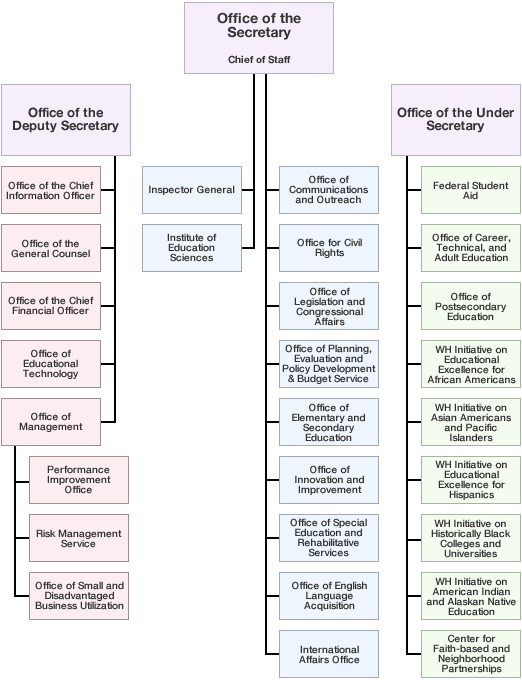
Organization
| Program | Secretary of Education | Deputy Secretary of Education | Under Secretary of Education | Associated federal organizations | Federally aided organizations |
|---|---|---|---|---|---|
| Office of Communications and Outreach | |||||
| Office of the General Counsel | |||||
| Office of Inspector General | |||||
| Office of Legislation and Congressional Affairs | |||||
| Office for Civil Rights | |||||
| Institute of Education Sciences | |||||
| Office of Innovation and Improvement | |||||
| Office of Finance and Operations | |||||
| Office of Management | |||||
| Office of the Chief Information Officer | |||||
| Office of Planning, Evaluation and Policy Development | |||||
| Center for Faith | |||||
| Risk Management Service | |||||
| Office of Elementary and Secondary Education | |||||
| Office of English Language Acquisition | |||||
| Office of Special Education and Rehabilitative Services | |||||
| Office of Innovation and Improvement | |||||
| Office of Postsecondary Education | |||||
| Office of Career, Technical, and Adult Education | |||||
| Office of Federal Student Aid | |||||
| President's advisory board on Tribal Colleges and Universities | |||||
| President's advisory board on Historically Black Colleges and Universities | |||||
| [Advisory Councils and Committees](http://www.ed.gov/about/bdscomm/list/com.html) | |||||
| National Assessment Governing Board (NAGB) | |||||
| National Advisory Council on Indian Education | |||||
| Federal Interagency Committee on Education | |||||
| Advisory Commission on Accessible Instructional Materials in Postsecondary Education for Students with Disabilities | |||||
| National Board for Education Sciences | |||||
| National Board of the Fund for the Improvement of Postsecondary Education | |||||
| Gallaudet University | |||||
| Howard University | |||||
| National Technical Institute for the Deaf |
Budget
| Budget of the Department of Education for [FY 2024](2024-united-states-federal-budget), showing its largest components |
|---|
For 2024, the US Department of Education's budget was approximately $268 billion with $79,052,238 in discretionary spending. The department currently holds and maintains approximately $1.7 trillion in federal student loan debt.
References
References
- "An Overview of the U.S. Department of Education-- Pg 5". US Department of Education.
- "Department of Education (ED) {{!}} Spending Profile (FY 2024)".
- {{USStatute. 96. 88. 93. 668. 1979. 10. 17. S. 210
- Kosar, Kevin R.. (15 April 2011). "Department of Education Organization Act, 1979".
- (2024-07-06). "Thirty-ninth congress. Session II. Chapter 157, 158, 159. Year 1867. An Act to establish a Department of Education.".
- "EdFacts Acronym List".
- (2021-06-15). "Federal Role in Education".
- "What does the Department of Education do?". USA Facts.
- (2025-03-20). "Improving Education Outcomes by Empowering Parents, States, and Communities".
- Hurley, Lawrence. (14 July 2025). "Supreme Court allows Trump administration to implement widespread Education Department layoffs". NBC News.
- "An Overview of the U.S. Department of Education: How Does ED Serve Students? {{!}} U.S. Department of Education".
- "Department of Education | Member Agency". Usich.gov.
- Warren, Donald R. . (1999). "Historical dictionary of American education". Greenwood Press.
- Kosar, Kevin R.. (19 February 2011). "Act to Establish a Federal Department of Education, 1867".
- link. (21 December 2016 from [http://memory.loc.gov/ammem/amlaw/ "A Century of Lawmaking for a New Nation: U. S. Congressional Documents and Debates, 1774–1875"] {{Webarchive). link. (6 April 2012 . [[Library of Congress]], [[Law Library of Congress]]. Retrieved April 25, 2012.)
- (September 2010). "The Department's History". United States Department of Education.
- (April 1920). "The Smith-Towner Bill". [[Elementary School Journal]].
- [http://www.trumanlibrary.org/oralhist/ewing3.htm "Oral History Interview with Oscar R. Ewing."] {{Webarchive. link. (21 August 2016 Oral History Interviews. Truman Presidential Library. May 1, 1969; [https://www.fda.gov/opacom/laws/reorg.htm Reorganization Plan No. 1 of 1953. Title 5: Appendix: Reorganization Plans.] {{Webarchive). link. (12 May 2009 Transmitted to the U.S. Senate and U.S. House of Representatives, March 12, 1953.)
- (February 9, 1979). "Department of Education Outlined".
- (July 12, 1979). "House Narrowly Passes Department of Education Bill". The Spokesman-Review.
- Hechinger, Fred M. (September 3, 1979). "Federal Education Branch Is Foundering, Leaderless".
- (October 18, 1979). ["Education Department Created"](https://news.google.com/newspapers?id=0sZUAAAAIBAJ&pg=1984,3959160&dq=department+of+education&hl=en }}{{Dead link).
- Clabaugh, Gary K.. (Summer 2004). "The educational legacy of Ronald Reagan". [[Pi Lambda Theta]].
- (January 9, 1988). "Reagan Asks Increase for Education in '89 Budget". The New York Times.
- (Fall 1996). "Online Backgrounders: The Department of Education". PBS.
- "Republican Party Platform of 1984 {{!}} The American Presidency Project".
- Stedman, James B.. (June 3, 1994). "Goals 2000: Overview and Analysis. CRS Report for Congress". Congressional Research Service.
- Rep. Kildee, Dale E. [D-MI-9. (1994-03-31). "H.R.1804 - 103rd Congress (1993-1994): Goals 2000: Educate America Act".
- (2007). "Education".
- Stossel, John. (2007-12-10). "Ron Paul Unplugged". ABC News.
- (April 11, 2002). "Paige Fields Team to Leave No Child Behind". United States Department of Education.
- (2004-02-11). "Elimination Lost: What happened to abolishing the Department of Education?". Cato Institute.
- (2017-10-13). "The Every Student Succeeds Act: Strengthening the Focus on Educational Leadership". Educational Administration Quarterly.
- (2007-03-23). "President Bush Signs H.R. 584, Designates U.S. Department of Education as the Lyndon Baines Johnson Federal Building". [[whitehouse.gov]].
- (January 14, 2025). "Every Student Succeeds Act (ESSA)".
- Kim, Donald. (2016-01-06). "ESSA & NCLB – Some Comparisons".
- "Outlays by agency".
- (8 November 2023). "Monthly Budget Review: Summary for Fiscal Year 2023". Congressional Budget Office.
- Arrojas, Matthew. (January 27, 2025). "Trump Executive Order Ends Educational Equity Initiatives {{!}} BestColleges".
- Sharma, Kéah. "An Archive of Former Office of Education Technology (OET) Resources".
- Liptak, Kevin. (March 20, 2025). "Trump signs executive order to begin dismantling Education Department, raising questions for students and parents".
- Blackburn, Piper Hudspeth. (2025-04-21). "Education Department to resume collecting student loans in default {{!}} CNN Politics".
- Dan Bauman, and Brock Read, "A Brief History of GOP Attempts to Kill the Education Dept" ''Chronicle of Higher Education'' (June 21, 2018)
- "Project 2025 and education: A lot of bad ideas, some more actionable than others".
- (July 9, 2024). "Trump is trying to distance himself from Project 2025. Its architects helped shape his RNC platform".
- (September 3, 2024). "House Republican Agendas and Project 2025 Would Increase Poverty and Hardship, Drive Up the Uninsured Rate, and Disinvest From People, Communities, and the Economy | Center on Budget and Policy Priorities".
- (March 12, 2025). "Trump wants to dismantle the Department of Education. Here's what the agency does. - CBS News".
- Walker, Tim. "How Project 2025 Would Devastate Public Education | NEA".
- Shah, Sarah Butrymowicz, Ariel Gilreath, Meredith Kolodner, Jackie Mader, Neal Morton, Caroline Preston, Javeria Salman, Christina A. Samuels, Olivia Sanchez, Nirvi. (August 13, 2024). "What education could look like under Trump and Vance".
- [https://slate.com/news-and-politics/2025/02/department-of-education-trump-abolish-eliminate.html “Back to the States” — Trump’s Department of Education plans go against our country’s long history of federal support for schools], in Slate
- Schermele, Zachary. "Senate confirms Trump pick Linda McMahon to lead the Department of Education".
- (5 February 2025). "Trump's Education Secretary's job is to 'end the job'". The Economic Times.
- Bender, Michael C.. (2025-03-07). "Asked if U.S. Needs Education Department, Its Head Says 'No'". The New York Times.
- Cochran, Lexi Lonas. (2025-03-11). "Department of Education lays off nearly half of workforce". The Hill.
- (2025-03-11). "U.S. Department of Education Initiates Reduction in Force".
- Bender, Michael C.. (March 20, 2025). "Trump signs an order aimed at eliminating the education dept.". [[The New York Times]].
- Bender, Michael C.. (March 19, 2025). "Trump is said to sign an executive order on Thursday aimed at dismantling the Education Department". [[The New York Times]].
- (2025-03-19). "Trump orders a plan to dismantle the Education Department while keeping some core functions".
- Raymond, Nate. (2025-05-22). "Judge Blocks Trump Administration Plan To Gut Education Department".
- Cole, Devan. (2025-06-04). "Federal appeals court refuses to lift ruling halting mass layoffs at Department of Education".
- "Supreme Court allows Trump to implement Education Department layoffs".
- (July 14, 2025). "ON APPLICATION FOR STAY".
- U.S. Department of Education. "Department of Education Initiates Workforce Reduction as Part of Agency Reorganization." March 11, 2025. https://www.ed.gov/about/news/press-release/us-department-of-education-initiates-reduction-force
- U.S. Department of Education. "Department of Education Announces Paid Administrative Leave for Affected Employees." March 21, 2025. https://www.ed.gov/about/news/press-release/us-department-of-education-announces-paid-leave-employees
- (2025-03-20). "Trump signs executive order to dismantle US Department of Education". The Guardian.
- (March 20, 2025). "Improving Education Outcomes by Empowering Parents, States, and Communities".
- (4 February 2025). "White House preparing executive order to abolish the Education Department". NBC News.
- Binkley, Collin. (November 19, 2025). "Trump Is Dismantling The Education Department. Here’s What That Will Unleash.".
- "Ahead of layoffs, Education Department offers employees $25K to quit or retire by Monday". USA Today.
- "Education Department prepares to lay off roughly half its staff". NBC News.
- Schermele, Zachary. (March 13, 2025). "Education Dept. cuts are here. What happens now to student loans, FAFSA and IEPs?".
- Mehta, Jonaki. (March 21, 2025). "How the Education Department cuts could hurt low-income and rural schools". NPR.
- Lieber, Ron. (2025-03-20). "What Happens to Student Loans if the Education Dept. Closes?". The New York Times.
- Turner, Cory. (21 March 2025). "Trump says Education Department will no longer oversee student loans, 'special needs'". NPR.
- Hunnicutt, Trevor. (March 21, 2025). "Trump says Education Dept. to transfer student loan, nutrition programs to other agencies".
- Jones III, Arthur. (March 20, 2025). "Warren warns of 'dire consequences' of Education Department firings for student loans".
- Irwin, Lauren. (March 20, 2025). "NAACP president: Trump 'deliberately dismantling the basic functions of our democracy'".
- "The National Assessment Governing Board". NAGB.
- "Department of Education Fiscal Year 2024 Congressional Action (in thousands of dollars)". US Department of Education.
- "Student Loan Debt Statistics". EducationData.org.
This article was imported from Wikipedia and is available under the Creative Commons Attribution-ShareAlike 4.0 License. Content has been adapted to SurfDoc format. Original contributors can be found on the article history page.
Ask Mako anything about United States Department of Education — get instant answers, deeper analysis, and related topics.
Research with MakoFree with your Surf account
Create a free account to save articles, ask Mako questions, and organize your research.
Sign up freeThis content may have been generated or modified by AI. CloudSurf Software LLC is not responsible for the accuracy, completeness, or reliability of AI-generated content. Always verify important information from primary sources.
Report