From Surf Wiki (app.surf) — the open knowledge base
Tottenham Hotspur F.C.
Association football club in England
Association football club in England
| Field | Value | |||
|---|---|---|---|---|
| nickname | The Lilywhites | |||
| short name | Spurs | |||
| ground | Tottenham Hotspur Stadium | |||
| capacity | 62,850 | |||
| clubname | Tottenham Hotspur | |||
| image | [[File:Tottenham Hotspur.svg | frameless | upright=0.5 | class=skin-invert]] |
| fullname | Tottenham Hotspur Football Club | |||
| founded | , as Hotspur F.C. | |||
| owner | ENIC International Ltd. (86.58%) | |||
| chairman | Peter Charrington (non-executive) | |||
| mgrtitle | Head coach | |||
| manager | Thomas Frank | |||
| league | ||||
| season | ||||
| position | ||||
| pattern_la1 | _tottenham2526h | |||
| pattern_b1 | _tottenham2526h | |||
| pattern_ra1 | _tottenham2526h | |||
| pattern_sh1 | _tottenham2526h | |||
| pattern_so1 | _tottenham2526hl | |||
| leftarm1 | FFFFFF | |||
| body1 | FFFFFF | |||
| rightarm1 | FFFFFF | |||
| shorts1 | FFFFFF | |||
| socks1 | FFFFFF | |||
| pattern_la2 | _tottenham2526a | |||
| pattern_b2 | _tottenham2526a | |||
| pattern_ra2 | _tottenham2526a | |||
| pattern_sh2 | _tottenham2526a | |||
| pattern_so2 | _tottenham2526al | |||
| leftarm2 | 000000 | |||
| body2 | 000000 | |||
| rightarm2 | 000000 | |||
| shorts2 | 000000 | |||
| socks2 | 000000 | |||
| pattern_la3 | _tottenham2526t | |||
| pattern_b3 | _tottenham2526t | |||
| pattern_ra3 | _tottenham2526t | |||
| pattern_sh3 | _tottenham2526t | |||
| pattern_so3 | _tottenham2526tl | |||
| leftarm3 | fff800 | |||
| body3 | fff800 | |||
| rightarm3 | fff800 | |||
| shorts3 | fff800 | |||
| socks3 | fff800 | |||
| website | ||||
| current | 2025–26 Tottenham Hotspur F.C. season |
Tottenham Hotspur Football Club, commonly referred to as simply Tottenham (, , , ) or Spurs, is a professional football club based in Tottenham, North London, England. It competes in the Premier League, the top tier of English football. The team have played their home matches in the Tottenham Hotspur Stadium since 2019, replacing their former home of White Hart Lane, which had been demolished to make way for the new stadium on the same site.
Founded in 1882, Tottenham Hotspur's emblem is a cockerel standing upon a football, with the Latin motto Audere est Facere ("to dare is to do"). The team have traditionally worn white shirts and navy blue shorts as their home kit since the 1898–99 season. Their training ground is on Hotspur Way in Bulls Cross, Enfield. After its inception, Tottenham won the FA Cup for the first time in 1901, the only non-League club to do so since the formation of the Football League in 1888. Tottenham was the first club in the 20th century to achieve the League and FA Cup Double, winning both competitions in the 1960–61 season. After successfully defending the FA Cup in 1962, in 1963 they became the first British club to win a UEFA club competition – the European Cup Winners' Cup. They were also the inaugural winners of the UEFA Cup in 1972, becoming the first British club to win two different major European trophies. They collected at least one major trophy in each of the six decades from the 1950s to 2000s, an achievement matched only by Manchester United.
In domestic football, Spurs have won two league titles, eight FA Cups, four League Cups, and seven FA Community Shields. In European football, they have won one European Cup Winners' Cup and three UEFA Cup/Europa League titles. Tottenham were also runners-up in the 2018–19 UEFA Champions League. They have a long-standing rivalry with nearby club Arsenal, with whom they contest the North London derby, as well as a contested rivalry with Chelsea. Tottenham is owned by ENIC Group, which purchased the club in 2001. The club was estimated to be worth £2.6 billion ($3.2 billion) in 2024, and it was the ninth-highest-earning football club in the world, with an annual revenue for season 2024–25 of €672.6M (£585.56M), as ranked by accountancy firm Deloitte
History
Main article: History of Tottenham Hotspur F.C.
Formation and early years (1882–1908)
Originally named Hotspur Football Club, the club was formed on 5 September 1882 by a group of schoolboys led by Bobby Buckle. They were members of the Hotspur Cricket Club and the football club was formed to play sports during the winter months. A year later the boys sought help with the club from John Ripsher, the Bible class teacher at All Hallows Church, who became the first president of the club and its treasurer. Ripsher helped and supported the boys through the club's formative years, reorganised and found premises for the club. In April 1884 the club was renamed "Tottenham Hotspur Football Club" to avoid confusion with another London club named Hotspur, whose post had been mistakenly delivered to North London. Nicknames for the club include "Spurs" and "the Lilywhites".
Initially, the north London side played games between themselves and friendly matches against other local clubs. The first recorded match took place on 30 September 1882 against a local team named the Radicals, which Hotspur lost 2–0. The team entered their first cup competition in the London Association Cup, and won 5–2 in their first competitive match on 17 October 1885 against a company's works team called St Albans. The club's fixtures began to attract the interest of the local community and attendances at its home matches increased. In 1892, they played for the first time in a league, the short-lived Southern Alliance.

The club turned professional on 20 December 1895 and, in the summer of 1896, was admitted to Division One of the Southern League (the third tier at the time). On 2 March 1898, the club also became a limited company, the Tottenham Hotspur Football and Athletic Company. Soon after, Frank Brettell became the first ever manager of Spurs, and he signed John Cameron, who took over as player-manager when Brettell left a year later. Cameron would have a significant impact on Spurs, helping the club win its first trophy, the Southern League title in the 1899–1900 season. The following year Spurs won the 1901 FA Cup by beating Sheffield United 3–1 in a replay of the final, after the first game ended in a 2–2 draw. In doing so they became the only non-League club to achieve the feat since the formation of The Football League in 1888.
Early decades in the Football League (1908–1958)
In 1908, the club was elected into the Football League Second Division and won promotion to the First Division in their first season, finishing runners-up. In 1912, Peter McWilliam became manager; Tottenham finished bottom of the league at the end of the 1914–15 season when football was suspended due to the First World War. Spurs were relegated to the Second Division on the resumption of league football after the war, but quickly returned to the First Division as Second Division champions of the 1919–20 season.
On 23 April 1921, McWilliam guided Spurs to their second FA Cup win, beating Wolverhampton Wanderers 1–0 in the final. After coming second to Liverpool in the league in 1922, they would finish mid-table in the next five seasons, being relegated in the 1927–28 season after McWilliam left. For most of the 1930s and 1940s, Spurs languished in the Second Division, apart from a brief return to the top flight in the 1933–34 and 1934–35 seasons.
Former Spurs player Arthur Rowe became manager in 1949. Rowe developed a style of play, known as "push and run", that proved to be successful in his early years as manager. He took the team back to the First Division after finishing top of the Second Division in the 1949–50 season. In his second season in charge, Tottenham won their first ever top-tier league championship title when they finished top of the First Division for the 1950–51 season. Rowe resigned in April 1955 due to a stress-induced illness from managing the club. Before he left, he signed one of Spurs' most celebrated players, Danny Blanchflower, who won the FWA Footballer of the Year twice while at Tottenham.
Bill Nicholson and the glory years (1958–1974)
Bill Nicholson took over as manager in October 1958. He became the club's most successful manager, guiding the team to major trophy success three seasons in a row in the early 1960s: the Double in 1961, the FA Cup in 1962 and the Cup Winners' Cup in 1963. Nicholson signed Dave Mackay and John White in 1959, two influential players of the Double-winning team, and Jimmy Greaves in 1961, the most prolific goal-scorer in the history of the top tier of English football.
The 1960–61 season started with a run of 11 wins, followed by a draw and another four wins, at that time the best ever start by any club in the top flight of English football. The title was won on 17 April 1961 when they beat the eventual runner-up Sheffield Wednesday at home 2–1, with three more games still to play. The Double was achieved when Spurs won 2–0 against Leicester City in the final of the 1960–61 FA Cup. It was the first Double of the 20th century, and the first since Aston Villa achieved the feat in 1897. The next year Spurs won their consecutive FA Cup after beating Burnley in the 1962 FA Cup final.
On 15 May 1963, Tottenham became the first British team to win a European trophy by winning the 1962–63 European Cup Winners' Cup when they beat Atlético Madrid 5–1 in the final. Spurs also became the first British team to win two different European trophies when they won the 1971–72 UEFA Cup with a rebuilt team that included Martin Chivers, Pat Jennings, and Steve Perryman. They had also won the FA Cup in 1967, two League Cups (in 1971 and 1973), as well as a second place league finish (1962–63) and runners-up in the 1973–74 UEFA Cup. In total, Nicholson won eight major trophies in his 16 years at the club as manager.
Burkinshaw to Venables (1974–1992)
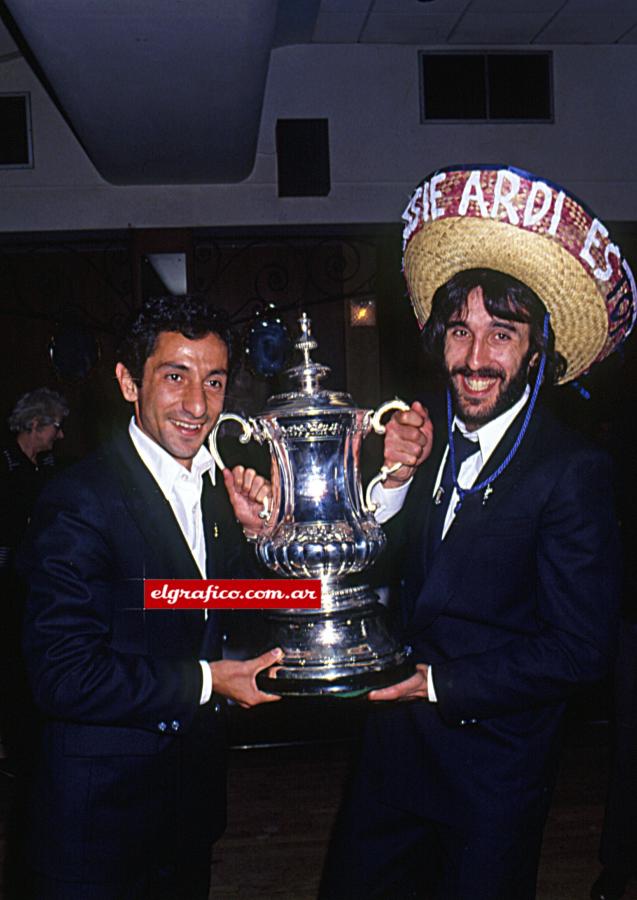
Spurs went into a period of decline after the successes of the early 1970s, and Nicholson resigned after a poor start to the 1974–75 season. The team was then relegated at the end of the 1976–77 season with Keith Burkinshaw as manager. Burkinshaw quickly returned the club to the top flight, building a team that included Glenn Hoddle as well as two Argentinians, Osvaldo Ardiles and Ricardo Villa, which was unusual as players from outside the British Isles were rare at that time. The team that Burkinshaw rebuilt went on to win the FA Cup in 1981 and 1982 and the UEFA Cup in 1984.
The 1980s was a period of change that began with a new phase of redevelopment at White Hart Lane, as well as a change of directors. Irving Scholar took over the club and moved it in a more commercial direction, the beginning of the transformation of English football clubs into commercial enterprises. Debt at the club would again lead to a change in the boardroom, and Terry Venables teamed up with businessman Alan Sugar in June 1991 to take control of Tottenham Hotspur plc. Venables, who had become manager in 1987, signed players such as Paul Gascoigne and Gary Lineker. Under Venables, Spurs won the 1990–91 FA Cup, making them the first club to win eight FA Cups.
Premier League football (1992–present)
Tottenham was one of the five clubs that pushed for the founding of the Premier League, created with the approval of The Football Association, replacing the Football League First Division as the highest division of English football. In February 2001, Sugar sold his shareholding in Spurs to ENIC Sports plc, run by Joe Lewis and Daniel Levy, and stepped down as chairman. Lewis and Levy would eventually own 85% of the club, with Levy responsible for the running of the club. Despite a succession of managers and players such as Teddy Sheringham, Jürgen Klinsmann and David Ginola, for a long period in the Premier League until the late 2000s, Spurs finished mid-table most seasons with few trophies won. They won the League Cup in 1999 under George Graham, and again in 2008 under Juande Ramos. Performance improved under Harry Redknapp with players such as Gareth Bale and Luka Modrić, and the club finished in the top five in the early 2010s.
After Redknapp left, Mauricio Pochettino was appointed head coach, who was in the role between 2014 and 2019. Under Pochettino, with new stars such as academy graduate Harry Kane and Korean import Son Heung-min, Tottenham solidified their position as part of an emerging group of clubs known as the Big Six. Spurs finished second in the 2016–17 season, their highest league finish since the 1962–63 season, and advanced to the UEFA Champions League final in 2019, the club's first, where they ultimately lost to Liverpool 2–0. The club's home games during the last few seasons of Pochettino's tenure were played at Wembley Stadium while the new Tottenham Hotspur Stadium was constructed.
Pochettino was dismissed after a poor start to the 2019–20 season and was replaced by José Mourinho, who was head coach from November 2019 to April 2021. His successor, Nuno Espírito Santo, lasted just four months. The next manager, Antonio Conte, guided Spurs to fourth during the 2021–22 season and back to a Champions League place. After exiting both the Champions League and FA Cup, he departed the club by mutual agreement in March 2023. In February 2023, Harry Kane displaced Jimmy Greaves as the club's all-time record goalscorer before leaving Spurs at the end of the season for Bayern Munich.
Ange Postecoglou took over as head coach on 1 July 2023 and the club qualified for the 2024–25 UEFA Europa League after a fifth-place finish in the Premier League. The next season, the club ended their 17-year trophy drought by winning the 2025 Europa League final with a 1–0 victory over Manchester United. They did, however, finish only 17th in the Premier League, their worst league campaign in the Premier League era, which resulted in Postecoglou's sacking. Thomas Frank was brought in as a replacement.
On 4 September 2025, the club announced Daniel Levy had stepped down as executive chairman and was succeeded by Peter Charrington, who holds the role in a non-executive capacity.
Stadiums
Early grounds
Spurs played their early matches on public land at the Park Lane end of Tottenham Marshes, where they had to mark out and prepare their own pitch. Occasionally fights broke out on the marshes in disputes with other teams over the use of the ground. The first Spurs game reported by the local press took place on Tottenham Marshes on 6 October 1883 against Brownlow Rovers, which Spurs won 9–0. It was at this ground that, in 1887, Spurs first played the team that would later become their arch rivals, Arsenal (then known as Royal Arsenal), leading 2–1 until the match was called off due to poor light after the away team arrived late.
As they played on public parkland, the club could not charge admission fees and, while the number of spectators grew to a few thousand, it yielded no gate receipts. In 1888, the club rented a pitch between numbers 69 and 75 Northumberland Park at a cost of £17 per annum, where spectators were charged 3d a game, raised to 6d for cup ties. The first game at the Park was played on 13 October 1888, a reserve match that yielded gate receipts of 17 shillings. The first stand with just over 100 seats and changing rooms underneath was built at the ground for the 1894–95 season at a cost of £60. However, the stand was blown down a few weeks later and had to be repaired. In April 1898, 14,000 fans turned up to watch Spurs play Woolwich Arsenal. Spectators climbed on the roof of the refreshment stand for a better view of the match. The stand collapsed, causing a few injuries. As Northumberland Park could no longer cope with the larger crowds, Spurs looked for a larger ground and moved to the White Hart Lane site in 1899.
White Hart Lane
Main article: White Hart Lane
The White Hart Lane ground was built on an unused plant nursery owned by the Charrington Brewery and located behind a public house named the White Hart on Tottenham High Road (the road White Hart Lane actually lies a few hundred yards north of the main entrance). The ground was initially leased from Charringtons, and the stands they used at Northumberland Park were moved here, giving shelter for 2,500 spectators. Notts County were the first visitors to 'the Lane' in a friendly watched by 5,000 people and yielding £115 in receipts; Spurs won 4–1. Queens Park Rangers became the first competitive visitors to the ground and 11,000 people saw them lose 1–0 to Tottenham. In 1905, Tottenham raised enough money to buy the freehold to the land, as well as land at the northern (Paxton Road) end.

After Spurs were admitted to the Football League, the club started to build a new stadium, with stands designed by Archibald Leitch being constructed over the next two and a half decades. The West Stand was added in 1909, the East Stand was also covered this year and extended further two years later. The profits from the 1921 FA Cup win were used to build a covered terrace at the Paxton Road end and the Park Lane end was built at a cost of over £3,000 some two years later. This increased the stadium's capacity to around 58,000, with room for 40,000 under cover. The East Stand (Worcester Avenue) was finished in 1934 and this increased capacity to around 80,000 spectators and cost £60,000.
Starting in the early 1980s, the stadium underwent another major phase of redevelopment. The West Stand was replaced by an expensive new structure in 1982, and the East Stand was renovated in 1988. In 1992, following the Taylor Report's recommendation that Premier League clubs eliminate standing areas, the lower terraces of the south and east stand were converted to seating, with the North Stand becoming all-seater the following season. The South Stand redevelopment was completed in March 1995 and included the first giant Sony Jumbotron TV screen for live game coverage and away match screenings. In the 1997–98 season the Paxton Road stand received a new upper tier and a second Jumbotron screen. Minor amendments to the seating configuration were made in 2006, bringing the capacity of the stadium to 36,310.
By the turn of the millennium, the capacity of White Hart Lane had become lower than other major Premier League clubs. Talks began over the future of the ground with a number of schemes considered, such as increasing the stadium capacity through redevelopment of the current site, or using the 2012 London Olympic Stadium in Stratford. Eventually the club settled on the Northumberland Development Project, whereby a new stadium would be built on a larger piece of land that incorporated the existing site. In 2016, the northeast corner of the stadium was removed to facilitate the construction of the new stadium. As this reduced the stadium capacity below that required for European games, Tottenham Hotspur played every European home game in 2016–17 at Wembley Stadium. Domestic fixtures of the 2016–17 season continued to be played at the Lane, but demolition of the rest of the stadium started the day after the last game of the season, and White Hart Lane was completely demolished by the end of July 2017.
Tottenham Hotspur Stadium
Main article: Tottenham Hotspur Stadium
In October 2008, the club announced a plan to build a new stadium immediately to the north of the existing White Hart Lane stadium, with the southern half of the new stadium's pitch overlapping the northern part of the Lane. This proposal would become the Northumberland Development Project. The club submitted a planning application in October 2009 but, following critical reactions to the plan, it was withdrawn in favour of a substantially revised planning application for the stadium and other associated developments. The new plan was resubmitted and approved by Haringey Council in September 2010, and an agreement for the Northumberland Development Project was signed on 20 September 2011.
After a long delay over the compulsory purchase order of local businesses located on land to the north of the stadium and a legal challenge against the order, resolved in early 2015, planning application for another new design was approved by Haringey Council on 17 December 2015. Construction started in 2016, and the new stadium was scheduled to open during the 2018–19 season. While it was under construction, all Tottenham home games in the 2017–18 season as well as all but five in 2018–19 were played at Wembley Stadium. After two successful test events, Tottenham Hotspur officially moved into the new ground on 3 April 2019 with a Premier League match against Crystal Palace which Spurs won 2–0. The new stadium is called Tottenham Hotspur Stadium while a naming-rights agreement is reached.
Training grounds

An early training ground used by Tottenham was located at Brookfield Lane in Cheshunt, Hertfordshire. The club bought the 11-acre ground used by Cheshunt F.C. in 1952 for £35,000. It had three pitches, including a small stadium with a small stand used for matches by the junior team. The ground was later sold for over £4 million, and the club moved the training ground to the Spurs Lodge on Luxborough Lane, Chigwell in Essex, opened in September 1996 by soon-to-be Prime Minister Tony Blair. The training ground and press centre in Chigwell were used until 2014.
In 2007, Tottenham bought a site at Bulls Cross in Enfield, a few miles south of their former ground in Cheshunt. A new training ground was constructed at the site for £45 million, which opened in 2012. The 77-acre site has 15 grass pitches and one-and-a-half artificial pitches, as well as a covered artificial pitch in the main building. The main building on Hotspur Way also has hydrotherapy and swimming pools, gyms, medical facilities, dining and rest areas for players as well as classrooms for academy and schoolboy players. A 45-bedroom players lodge with catering, treatment, rest and rehabilitation facilities was later added at Myddleton Farm next to the training site in 2018. The lodge is mainly used by Tottenham's first team and Academy players, but it has also been used by national football teams – the first visitors to use the facilities at the site were the Brazilian team in preparation for the 2018 FIFA World Cup.
Crest


Since the 1921 FA Cup Final, the Tottenham Hotspur crest has featured a cockerel. Harry Hotspur, after whom the club is named, was said to have been given the nickname Hotspur as he dug in his spurs to make his horse go faster as he charged in battles, and spurs are also associated with fighting cocks. The club used spurs as a symbol in 1900, which then evolved into a fighting cock. A former player named William James Scott made a bronze cast of a cockerel standing on a football at a cost of £35 (), and this 9 ft figure was then placed on top of the West Stand at the end of the 1909–10 season. Since then the cockerel and ball emblem has become a part of the club's identity. The club badge on the shirt used in 1921 featured a cockerel within a shield, but it was changed to a cockerel sitting on a ball in the late 1960s.
Between 1956 and 2006 Spurs used a faux heraldic shield featuring a number of local landmarks and associations. The castle is Bruce Castle, 400 yards from the ground and the trees are the Seven Sisters. The arms featured the Latin motto Audere Est Facere (to dare is to do).
In 1983, to overcome unauthorised "pirate" merchandising, the club's badge was altered by adding the two red heraldic lions to flank the shield (which came from the arms of the Northumberland family, of which Harry Hotspur was a member), as well as the motto scroll. This device appeared on Spurs' playing kits for three seasons 1996–99.
In 2006, in order to rebrand and modernise the club's image, the club badge and coat of arms were replaced by a professionally designed logo/emblem. This revamp displayed a sleeker and more elegant cockerel standing on an old-time football. The club claimed that they dropped their club name and would be using the rebranded logo only on playing kits. In November 2013, Tottenham forced non-league club Fleet Spurs to change their badge because its new design was "too similar" to the Tottenham crest.
In 2017, Spurs added a shield around the cockerel logo on the shirts similar to the 1950s badge, but with the cockerel of modern design. The shield was however removed the following season.
Kit
The first Tottenham kit recorded in 1883 included a navy blue shirt with a letter H on a scarlet shield on the left breast, and white breeches. In 1884 or 1885, the club changed to a "quartered" kit similar to Blackburn Rovers after watching them win in the 1884 FA Cup Final. After they moved to Northumberland Park in 1888, they returned to the navy blue shirts for the 1889–90 season. Their kit changed again to red shirt and blue shorts in 1890, and for a time the team were known as 'the Tottenham Reds'. Five years later in 1895, the year they became a professional club, they switched to a chocolate and gold striped kit.
In the 1898–99 season, their final year at Northumberland Park, the club switched colours to white shirts and blue shorts, same colour choice as that for Preston North End. White and navy blue have remained as the club's basic colours ever since, with the white shirts giving the team the nickname "The Lilywhites". In 1921, the year they won the FA Cup, the cockerel badge was added to the shirt for the final. A club crest has featured on the shirt since, and Spurs became the first major club to have its club crest on the players shirt on every match apart from the war years. In 1939 numbers first appeared on shirt backs.
In the early days, the team played in kits sold by local outfitters. An early supplier of Spurs' jerseys recorded was a firm on Seven Sisters Road, HR Brookes. In the 1920s, Bukta produced the jerseys for the club. From the mid-1930s onwards, Umbro was the supplier for forty years. In 1959, the V-neck shirt replaced the collared shirts of the past, and then in 1963, the crew neck shirt appeared (the style has fluctuated since). In 1961, Bill Nicholson sent Spurs players out to play in white instead of navy shorts for their European campaign, starting a tradition which continues to this day in European competitions.
In 1977, a deal was signed with Admiral to supply the team their kits. Although Umbro kits in generic colours had been sold to football fans since 1959, it was with the Admiral deal that the market for replica shirts started to take off. Admiral changed the plain colours of earlier strips to shirts with more elaborate designs, which included manufacturer's logos, stripes down the arms and trims on the edges. Admiral was replaced by Le Coq Sportif in the summer of 1980. In 1985, Spurs entered into a business partnership with Hummel, who then supplied the strips. However, the attempt by Tottenham to expand the business side of the club failed, and in 1991, they returned to Umbro. In 1991, the club was the first to wear long-cut shorts, an innovation at a time when football kits all featured shorts cut well above the knee. Umbro was followed by Pony in 1995, Adidas in 1999, Kappa in 2002, and a five-year deal with Puma in 2006. In March 2011, Under Armour announced a five-year deal to supply Spurs with shirts and other apparel from the start of 2012–13, with the home, away and the third kits revealed in July and August 2012. The shirts incorporate technology that can monitor the players' heart rate and temperature and send the biometric data to the coaching staff. In June 2017, it was announced that Nike would be their new kits supplier, with the 2017–18 kit released on 30 June, featuring the Spurs' crest encased in a shield, paying homage to Spurs' 1960–61 season, where they became the first post-war-club to win both the Football League First Division and the FA Cup. In October 2018, Nike agreed a 15-year deal reportedly worth £30 million a year with the club to supply their kits until 2033.
Shirt sponsorship in English football was first adopted by the non-league club Kettering Town F.C. in 1976 despite it being banned by the FA. The ban was soon lifted and the practice spread to the major clubs when sponsored shirts were allowed on non-televised games in 1979, and then on televised games from 1983. In December 1983, after the club was floated on the London Stock Exchange, Holsten became the first commercial sponsor logo to appear on a Spurs shirt. When Thomson was chosen as kit sponsor in 2002 some Tottenham fans were unhappy as the shirt-front logo was red, the colour of their closest rivals, Arsenal. In 2006, Tottenham secured a £34 million sponsorship deal with internet casino group Mansion.com. In July 2010, Spurs announced a two-year shirt sponsorship contract with software infrastructure company Autonomy said to be worth £20 million. A month later they unveiled a £5 million deal with leading specialist bank and asset management firm Investec as shirt sponsor for the Champions League and domestic cup competitions for the next two years. Since 2014, AIA has been the main shirt sponsor, initially in a deal worth over £16 million annually, increased to a reported £40 to £45 million per year in 2019 in an eight-year deal that lasts until 2027. In 2023, Tottenham provisionally agreed a three-year shirt sponsorship deal with South Africa Tourism (SAT) starting in 2023/24 and ending in the 2026/27 season.
| {{Football kit box | align = | pattern_la = | pattern_b = | pattern_ra = | leftarm = 000066 | body = 000066 | rightarm = 000066 | shorts = ffffff | socks = 000066 | title = 1883–84: First kit | {{Football kit box | align = | pattern_la = | pattern_b = _whitehalf | pattern_ra = | pattern_bl = _whitehalf | leftarm = 00CCFF | body = 00CCFF | rightarm = FFFFFF | shorts = FFFFFF | socks = 000066 | title = 1884–86 | {{Football kit box | align = | pattern_la = _blue_stripes4 | pattern_b = _bluestripes4 | pattern_ra = _blue_stripes4 | pattern_bl = | leftarm = ffffff | body = ffffff | rightarm = FFFFFF | shorts = 000066 | socks = 000066 | title = 1889–90 | {{Football kit box | align = | pattern_la = | pattern_b = | pattern_ra = | leftarm = FF0000 | body = FF0000 | rightarm = FF0000 | shorts = 000066 | socks = 000066 | title = 1890–96 | {{Football kit box | align = | pattern_la = _goldstripes | pattern_b = _goldstripes_thin | pattern_ra = _goldstripes | leftarm = 663300 | body = 663300 | rightarm = 663300 | shorts = 000066 | socks = 000066 | title = 1896–98 |
|---|
Kit suppliers and shirt sponsors
| Period | Kit manufacturer | Shirt sponsor (chest) | Shirt sponsor (sleeve) |
|---|---|---|---|
| 1907–1911 | HR Brookes | None | None |
| 1921–1930 | Bukta | ||
| 1935–1977 | Umbro | ||
| 1977–1980 | Admiral | ||
| 1980–1983 | Le Coq Sportif | ||
| 1983–1985 | Holsten | ||
| 1985–1991 | Hummel | ||
| 1991–1995 | Umbro | ||
| 1995–1999 | Pony | Hewlett-Packard | |
| 1999–2002 | Adidas | Holsten | |
| 2002–2006 | Kappa | Thomson Holidays | |
| 2006–2010 | Puma | Mansion.com Casino & Poker | |
| 2010–2011 | Autonomy Corporation | ||
| 2011–2012 | Aurasma | ||
| 2012–2013 | Under Armour | ||
| 2013–2014 | HP | ||
| 2014–2017 | AIA | ||
| 2017–2021 | Nike | ||
| 2021–2024 | Cinch | ||
| 2024–present | Kraken |
Finances and ownership
Tottenham Hotspur F.C. became a limited company, the Tottenham Hotspur Football and Athletic Company Ltd, on 2 March 1898 so as to raise funds for the club and limit the personal liability of its members. 8,000 shares were issued at £1 each, although only 1,558 shares were taken up in the first year. 4,892 shares were sold in total by 1905. A few families held significant shares; they included the Wale family, who had association with the club since the 1930s, as well as the Richardson and the Bearman families. From 1943 to 1984, members of these families were chairmen of Tottenham Hotspur F.C. after Charles Robert who had been chairman since 1898 died.
In the early 1980s, cost overruns in the construction of a new West Stand together with the cost of rebuilding the team in previous years led to accumulating debts. In November 1982, a fan of the club Irving Scholar bought 25% of Tottenham for £600,000, and together with Paul Bobroff gained control of the club. In order to bring in funds, Scholar floated Tottenham Hotspur plc, which wholly owns the football club, on the London Stock Exchange in 1983, the first European sports club to be listed in a stock market, and became the first sports company to go public. The share issue was successful with 3.8 million shares quickly sold. However, ill-judged business decisions under Scholar led to financial difficulties, and in February 2001, he sold the major part of his shareholding to ENIC International Ltd.
The majority shareholder, ENIC International Ltd, is an investment company established by the British billionaire Joe Lewis. Daniel Levy, Lewis's partner at ENIC, was Executive Chairman of the club. They first acquired 29.9% share of the club in 1991, of which 27% was bought from Sugar for £22 million. Shareholding by ENIC increased over the decade through the purchase of the remaining 12% holding of Alan Sugar in 2007 for £25 million, and the 9.9% stake belonging to Stelios Haji-Ioannou through Hodram Inc. in 2009. On 21 August 2009 the club reported that they had issued a further 30 million shares to fund the initial development costs of the new stadium project, and that 27.8 million of these new shares had been purchased by ENIC. The Annual Report for 2010 indicated that ENIC had acquired 76% of all Ordinary Shares and also held 97% of all convertible redeemable preference shares, equivalent to a holding of 85% of share capital. The remaining shares are held by over 30,000 individuals. Between 2001 and 2011 shares in Tottenham Hotspur F.C. were listed on the Alternative Investment Market (AIM index). Following an announcement at the 2011 AGM, in January 2012 Tottenham Hotspur confirmed that the club had delisted its shares from the stock market, taking it into private ownership.
Lewis' shares are owned by the Lewis Family Trusts. In October 2022, Lewis ceased to be a person with significant control of the club, following a reorganisation of the Trusts. The club continues to be owned by ENIC, which is controlled by the Lewis trusts and Levy, and, in the summer of 2022, ENIC intended to inject up to £150 million into the club by the issuing of new shares. Only £100 million of shares were subscribed for and this took ENIC's shareholding up to 86.58%.
In September 2025, Tottenham Hotspur reaffirmed its ownership status, stating that the club is not for sale. ENIC Sports & Developments Holdings Ltd, Tottenham’s majority owner, “unequivocally rejected” two preliminary takeover approaches from PCP International Finance Limited (led by Amanda Staveley) and a consortium fronted by Roger Kennedy and Wing-Fai Ng via Firehawk Holdings. The offer period ends on 5 October 2025 under the UK's Takeover Code, allowing either bidder to submit a formal offer or withdraw.
On 9 October 2025, ENIC injected a further £100 million into the club to provide additional resources and further strengthen the financial position. The investment was by way of fresh capital and did not affect the shareholding. A source was reported as describing this as "initial additional funding" and said that "more money will be available".
Support
Main article: Tottenham Hotspur F.C. supporters
Tottenham has a large fan base in the United Kingdom, drawn largely from North London and the Home counties. The attendance figures for its home matches, however, have fluctuated over the years. Five times between 1950 and 1962, Tottenham had the highest average attendance in England. Tottenham was 9th in average attendances for the 2008–09 Premier League season, and 11th for all Premier League seasons between 1992–93 and 2010–11. In the 2017–18 season when Tottenham used Wembley as its home ground, it had the second-highest attendance in the Premier League. It also holds the record for attendance in the Premier League, with 83,222 attending the North London derby on 10 February 2018. Historical supporters of the club have included such figures as philosopher A. J. Ayer. There are many official supporters' clubs located around the world, while an independent supporters club, the Tottenham Hotspur Supporters' Trust, is recognised by the club as the representative body for Spurs supporters.
Historically, the club had a significant Jewish following from the Jewish communities in east and north London, with around a third of its supporters estimated to be Jewish in the 1930s. Due to this early support, all three chairmen of the club since 1984 have been Jewish businessmen with prior history of supporting the club. In response to the abusive chants, Tottenham supporters, Jewish and non-Jewish alike, began to chant back the insults and adopt the "Yids" or "Yid Army" identity starting from around the late 1970s or early 1980s. Some fans view adopting "Yid" as a badge of pride, helping defuse its power as an insult. The use of "Yid" as a self-identification, however, has been controversial; some argued that the word is offensive and its use by Spurs fans "legitimis[es] references to Jews in football", and that such racist abuse should be stamped out in football. Both the World Jewish Congress and the Board of Deputies of British Jews have denounced the use of the word by fans. Others, such as former Prime Minister David Cameron, argued that its use by the Spurs fans is not motivated by hate as it is not used pejoratively, and therefore cannot be considered hate speech. Attempts to prosecute Tottenham fans who chanted the words have failed, as the Crown Prosecution Service considered that the words as used by Tottenham fans could not be judged legally "threatening, abusive or insulting".
Fan culture
There are a number of songs associated with the club and frequently sung by Spurs fans, such as "Glory Glory Tottenham Hotspur". The song originated in 1961 after Spurs completed the Double in 1960–61, and entered the European Cup for the first time. Their first opponents were Górnik Zabrze, the Polish champions, and after a hard-fought match Spurs suffered a 4–2 reverse. Tottenham's tough tackling prompted the Polish press to write that "they were no angels". These comments incensed a group of three fans and for the return match at White Hart Lane they dressed as angels wearing white sheets fashioned into togas, sandals, false beards and carrying placards bearing biblical-type slogans. The angels were allowed on the perimeter of the pitch and their fervour whipped up the home fans who responded with a rendition of "Glory Glory Hallelujah", which is still sung on terraces at White Hart Lane and other football grounds. The Lilywhites also responded to the atmosphere to win the tie 8–1. Then manager of Spurs, Bill Nicholson, wrote in his autobiography:
There had been a number of incidents of hooliganism involving Spurs fans, particularly in the 1970s and 1980s. Significant events include the rioting by Spurs fans in Rotterdam at the 1974 UEFA Cup final against Feyenoord, and again during the 1983–84 UEFA Cup matches against Feyenoord in Rotterdam and Anderlecht in Brussels. Although fan violence has since abated, the occasional incidence of hooliganism continues to be reported.
Rivalries
Main article: North London derby, Chelsea F.C.–Tottenham Hotspur F.C. rivalry
Tottenham supporters have rivalries with several clubs, mainly within the London area. The fiercest of these is with north London rivals Arsenal. The rivalry began in 1913 when Arsenal moved from the Manor Ground, Plumstead to Arsenal Stadium, Highbury, and this rivalry intensified in 1919 when Arsenal were unexpectedly promoted to the First Division, taking a place that Tottenham believed should have been theirs.
Tottenham also share rivalries with fellow London clubs Chelsea and West Ham United. and began when Spurs beat Chelsea in the 1967 FA Cup final, the first ever all-London final. West Ham fans view Tottenham as a bitter rival, although the animosity is not reciprocated to the same extent by Tottenham fans.
Honours
Sources: Tottenham Hotspur – History
Domestic
Leagues
- First Division (Tier 1)
- Second Division (Tier 2)
Cups
- FA Cup
- League Cup
- FA Charity Shield / FA Community Shield
- Winners (7, incl. 3 shared): 1921, 1951, 1961, 1962, 1967 (shared), 1981 (shared), 1991 (shared)
- Sheriff of London Charity Shield
- Winners (1): 1902
European
Statistics and records

Main article: List of Tottenham Hotspur F.C. records and statistics
Steve Perryman holds the appearance record for Spurs, having played 854 games for the club between 1969 and 1986, of which 655 were league matches. Harry Kane holds the club goal scoring record with 280 goals scored.
Tottenham's record league win is 9–0 against Bristol Rovers in the Second Division on 22 October 1977. The club's record cup victory came on 3 February 1960 with a 13–2 win over Crewe Alexandra in the FA Cup. Spurs' biggest top-flight victory came against Wigan Athletic on 22 November 2009, when they won 9–1 with Jermain Defoe scoring five goals. The club's record defeat is an 8–0 loss to 1. FC Köln in the Intertoto Cup on 22 July 1995.
The record home attendance at White Hart Lane is 75,038 for a cup tie on 5 March 1938 against Sunderland. The highest attendance at the Tottenham Hotspur Stadium is 62,027 for a Premier League match against Arsenal on 12 May 2022. The highest recorded home attendances were at their temporary home, Wembley Stadium, due to its higher capacity – 85,512 spectators were present on 2 November 2016 for the 2016–17 UEFA Champions League game against Bayer Leverkusen, while 83,222 attended the North London derby against Arsenal on 10 February 2018, the highest attendance recorded for any Premier League game.
In the UEFA rankings, the club slipped from 21st in 2023 with a UEFA club coefficient of 80.00 to 34th in the 2023–24 season with a club coefficient of 54.00 thanks to its absence from UEFA football that season. The victory in the 2025 UEFA Europa League boosted its ranking for 2024–25 to 27th with a coefficient of 70.25.
Players
Current squad
Out on loan
Academy
Main article: Tottenham Hotspur F.C. Under-21s and Academy
Following the implementation of the Premier League Elite Player Performance Plan, Tottenham Hotspur runs a Category One Academy, designed to develop players from the age of eight to 21 years. It has more than 200 players. The Under–21s are the Development Squad and the Under–18s are the youth teams of Tottenham Hotspur. The Under–21 players play in Premier League 2 and compete in the EFL Trophy. The Academy's Under–18s take part in the U18 Premier League (South). The following current Under–21 or Under–18 players have played in a competitive first-team match for Tottenham Hotspur.
Management and support staff
| Role | Name | ||||||
|---|---|---|---|---|---|---|---|
| Head coach | Thomas Frank | ||||||
| Assistant coach | Justin Cochrane | ||||||
| Andreas Georgson | |||||||
| John Heitinga | |||||||
| Assistant coach | |||||||
| Head of performance | Chris Haslam | ||||||
| First team coach analyst | Joe Newton | ||||||
| First team goalkeeping coach | Fabian Otte | ||||||
| First team assistant goalkeeping coach | Dean Brill | ||||||
| First team individual development coach | nowrap | Cameron Campbell | |||||
| First team academy transition coach | Stuart Lewis | ||||||
| Club ambassadors | Michael Dawson | ||||||
| Ledley King | |||||||
| Gary Mabbutt | |||||||
| Sporting Director | Fabio Paratici | ||||||
| Johan Lange | |||||||
| Director of football operations (from February 2026) | Rafi Moersen | ||||||
| Performance Director (from February 2026) | Dan Lewindon | ||||||
| Head of football insights and strategy | Frederik Leth | ||||||
| Head of methodology | Zaheer Shah | ||||||
| Head performance analyst | Ross Johnston | ||||||
| Lead scouting insights analyst | Joe Bucknall | ||||||
| Lead recruitment analyst | Nick Benett | ||||||
| Recruitment analyst | Alex Troughton | ||||||
| Recruitment analyst | Simon Cozens | ||||||
| Lead player development and methodology analyst | Alex Vinall | ||||||
| Head of training centre operations | url=https://www.nytimes.com/athletic/6447533/2025/06/25/spurs-scott-munn-vinai-venkatesham-fabio-paratici/ | title=Tottenham Hotspur and another summer of change at the top. Is there more to come? | publisher=The Athletic | last=Pitt-Brooke | first=Jack | date=25 June 2025 | access-date=6 September 2025}} |
| Academy director | Simon Davies | ||||||
| Head of loans and pathways | Andy Scoulding | ||||||
| Head of academy football development | Gary Broadhurst | ||||||
| Head of recruitment | Rob Mackenzie | ||||||
| Chief scout | Alex Fraser | ||||||
| Scout | Giuseppe Di Credico | ||||||
| Scout | João Ferreira | ||||||
| Scout | Max Legath | ||||||
| Scout | Sebastian Taghizadeh | ||||||
| Strength and conditioning coach | Tom Perryman | ||||||
| Head of medical | Nick Stubbings | ||||||
| Head of sports science | Michael Cooper | ||||||
| Head physiotherapist | Stuart Campbell | ||||||
| Head of kit and equipment | Steve Dukes |
Directors
| Role | Name | |
|---|---|---|
| Non-executive chairman | Peter Charrington | |
| Chief executive officer | Vinai Venkatesham | |
| Operations and finance director | Matthew Collecott | |
| Non-executive director | Jonathan Turner | |
| Non-executive director | Eric Hinson |
Administration and Senior Management
| Role | Name |
|---|---|
| Head of football administration and governance | Rebecca Caplehorn |
| Chief marketing officer (from January 2026) | Adam Gardiner |
| Chief revenue officer | Ryan Norys |
| Commercial director (from January 2026) | Alex Scotcher |
| Chief communications officer | Kate Miller |
| Director of legal | Katie Reed |
Managers and players
Managers and head coaches in club's history
Main article: List of Tottenham Hotspur F.C. managers
:Listed according to when they became managers for Tottenham Hotspur: ::(A)* – Acting ::(C)* – Caretaker ::(I)* – Interim ::*(FTC)* – First team coach
- 1898 ENG Frank Brettell
- 1899 SCO John Cameron
- 1907 ENG Fred Kirkham
- 1912 SCO Peter McWilliam
- 1927 ENG Billy Minter
- 1930 ENG Percy Smith
- 1935 ENG Wally Hardinge (C)
- 1935 ENG Jack Tresadern
- 1938 SCO Peter McWilliam
- 1942 ENG Arthur Turner
- 1946 ENG Joe Hulme
- 1949 ENG Arthur Rowe
- 1955 ENG Jimmy Anderson
- 1958 ENG Bill Nicholson
- 1974 NIR Terry Neill
- 1976 ENG Keith Burkinshaw
- 1984 ENG Peter Shreeves
- 1986 ENG David Pleat
- 1987 ENG Trevor Hartley (C)
- 1987 ENG Doug Livermore (C)
- 1987 ENG Terry Venables
- 1991 ENG Peter Shreeves
- 1992 ENG Doug Livermore
- ENG Ray Clemence (FTC)
- 1993 ARG Osvaldo Ardiles
- 1994 ENG Steve Perryman (C)
- 1994 ENG Gerry Francis
- 1997 IRL Chris Hughton (C)
- 1997 SUI Christian Gross
- 1998 ENG David Pleat (C)
- 1998 SCO George Graham
- 2001 ENG David Pleat (C)
- 2001 ENG Glenn Hoddle
- 2003 ENG David Pleat (C)
- 2004 FRA Jacques Santini
- 2004 NLD Martin Jol
- 2007 ENG Clive Allen (C)
- 2007 ESP Juande Ramos
- 2008 ENG Harry Redknapp
- 2012 POR André Villas-Boas
- 2013 ENG Tim Sherwood
- 2014 ARG Mauricio Pochettino
- 2019 POR José Mourinho
- 2021 ENG Ryan Mason (I)
- 2021 POR Nuno Espírito Santo
- 2021 ITA Antonio Conte
- 2023 ITA Cristian Stellini (A)
- 2023 ENG Ryan Mason (A)
- 2023 AUS Ange Postecoglou
- 2025 DEN Thomas Frank
Club hall of fame
Main article: List of Tottenham Hotspur F.C. players
The following players are noted as "greats" for their contributions to the club or have been inducted into the club's Hall of Fame: The most recent additions to the club's Hall of Fame are Steve Perryman and Jimmy Greaves on 20 April 2016.
- Argentina Osvaldo Ardiles
- Argentina Ricardo Villa
- England Clive Allen
- England Les Allen
- England Paul Allen
- England Darren Anderton
- England Peter Baker
- England Phil Beal
- England Bobby Buckle
- England Keith Burkinshaw
- England Martin Chivers
- England Tommy Clay
- England Ray Clemence
- England Ralph Coates
- England Garth Crooks
- England Jimmy Dimmock
- England Ted Ditchburn
- England Terry Dyson
- England Paul Gascoigne
- England Jimmy Greaves
- England Arthur Grimsdell
- England Willie Hall
- England Ron Henry
- England Glenn Hoddle
- England Jack Jull
- England Cyril Knowles
- England Gary Lineker
- England Gary Mabbutt
- England Paul Miller
- England Billy Minter
- England Tom Morris
- England Alan Mullery
- England Bill Nicholson
- England Maurice Norman
- England Steve Perryman
- England Martin Peters
- England John Pratt
- England Graham Roberts
- England Teddy Sheringham
- England Bobby Smith
- England Chris Waddle
- England Fanny Walden
- England Vivian Woodward
- France David Ginola
- Germany Steffen Freund
- Germany Jürgen Klinsmann
- Ireland Chris Hughton
- Northern Ireland Danny Blanchflower
- Northern Ireland Pat Jennings
- Scotland Steve Archibald
- Scotland Bill Brown
- Scotland John Cameron
- Scotland Alan Gilzean
- Scotland Dave Mackay
- Scotland John White
- Wales Ronnie Burgess
- Wales Mike England
- Wales Cliff Jones
- Wales Terry Medwin
- Wales Taffy O'Callaghan
Player of the Year
:As voted by members and season ticket holders (calendar year until 2005–06 season)
- 1987 ENG Gary Mabbutt
- 1988 ENG Chris Waddle
- 1989 NOR Erik Thorstvedt
- 1990 ENG Paul Gascoigne
- 1991 ENG Paul Allen
- 1992 ENG Gary Lineker
- 1993 ENG Darren Anderton
- 1994 GER Jürgen Klinsmann
- 1995 ENG Teddy Sheringham
- 1996 ENG Sol Campbell
- 1997 ENG Sol Campbell
- 1998 FRA David Ginola
- 1999 IRL Stephen Carr
- 2000 IRL Stephen Carr
- 2001 SCO Neil Sullivan
- 2002 WAL Simon Davies
- 2003 IRL Robbie Keane
- 2004 ENG Jermain Defoe
- 2005–06 IRL Robbie Keane
- 2006–07 BUL Dimitar Berbatov
- 2007–08 IRL Robbie Keane
- 2008–09 ENG Aaron Lennon
- 2009–10 ENG Michael Dawson
- 2010–11 CRO Luka Modrić
- 2011–12 ENG Scott Parker
- 2012–13 WAL Gareth Bale
- 2013–14 DEN Christian Eriksen
- 2014–15 ENG Harry Kane
- 2015–16 BEL Toby Alderweireld
- 2016–17 DEN Christian Eriksen
- 2017–18 BEL Jan Vertonghen
- 2018–19 KOR Son Heung-min
- 2019–20 KOR Son Heung-min
- 2020–21 ENG Harry Kane
- 2021–22 KOR Son Heung-min
- 2022–23 ENG Harry Kane
- 2023–24 NED Micky van de Ven
- 2024–25 SWE Lucas Bergvall
Tottenham Hotspur Women
Main article: Tottenham Hotspur F.C. Women
Tottenham's women's team was founded in 1985 as Broxbourne Ladies. They started using the Tottenham Hotspur name for the 1991–92 season and played in the London and South East Women's Regional Football League (then fourth tier of the game). They won promotion after topping the league in 2007–08. In the 2016–17 season they won the FA Women's Premier League Southern Division and a subsequent playoff, gaining promotion to the FA Women's Super League 2.
On 1 May 2019, Tottenham Hotspur Ladies won promotion to the FA Women's Super League with a 1–1 draw at Aston Villa, which confirmed they would finish second in the Championship. Tottenham Hotspur Ladies changed their name to Tottenham Hotspur Women in the 2019–20 season.
Tottenham Hotspur Women announced the signing of Cho So-hyun on 29 January 2021. With her Korean men's counterpart Son Heung-min already at the club it gave Spurs the rare distinction of having both the men's and women's Korean National Team captains at one club.
Formula racing
Main article: Tottenham Hotspur (Superleague Formula team)

Tottenham Hotspur competed in Superleague Formula for three seasons from 2008 to 2010. Duncan Tappy was the main driver in the first season racing 10 times with 3 podium finishes. In 2010 Tottenham won the trophy with driver Craig Dolby.
Through its partnership with F1, the club has also introduced kart racing. The attraction, named F1 Drive, is located underneath the south stands. Three track layouts are available, suiting everyone from beginners to elite karters.
Affiliated clubs
- Brazil Internacional
- USA San Jose Earthquakes
- Hong Kong South China AA
- South Africa Supersport United
- India Kickstart FC
Notes
References
Bibliography
References
- "Local: Information for local residents and businesses". Tottenham Hotspur F.C..
- Wells, John C.. (2008). "Longman Pronunciation Dictionary". Longman.
- (2011). "Cambridge English Pronouncing Dictionary". [[Cambridge University Press]].
- Pitt-Brooke, Jack. (21 February 2025). "Tottenham are asking not to be called Tottenham". The New York Times.
- (23 October 2004). "Tottenham legend Nicholson dies". BBC Sport.
- Delaney, Miguel. (11 March 2017). "Christian Eriksen says Tottenham are determined to end their nine-year silverware drought". [[The Independent]].
- "Manchester United football club honours". AFS Enterprises.
- (22 January 2026). "Deloitte Football Money League 2026".
- (24 September 2007). "John Ripsher".
- Spencer, Nicholas. (24 September 2007). "Why Tottenham Hotspur owe it all to a pauper". The Telegraph.
- "History: Year by year". Tottenham Hotspur Football Club.
- (17 July 2015). "Tottenham Hotspur Club History & Football Trophies".
- Nilsson, Leonard Jägerskiöld. (2018). "World Football Club Crests: The Design, Meaning and Symbolism of World Football's Most Famous Club Badges". Bloomsbury Publishing.
- (8 November 2004). "Potted History". Tottenham Hotspur Football Club.
- "Tottenham Hotspur – Complete History".
- Holmes, Logan. (27 April 2013). "Tottenham Won Their First FA Cup Final on 27th April 1901". Spurs HQ.
- (19 July 2016). "Peter McWilliam: The Tottenham Boss Who Created Legends". A Halftime Report.
- Drury, Reg. (11 November 1993). "Obituary: Arthur Rowe". The Independent.
- Scott Murray. (21 January 2011). "The Joy of Six: Newly promoted success stories". [[The Guardian]].
- Stokkermans, Karel. (17 June 2018). "English Energy and Nordic Nonsense".
- Harris, Tim. (10 November 2009). "Players: 250 Men, Women and Animals Who Created Modern Sport". Vintage Digital.
- (10 February 2016). "Danny Blanchflower – Captain, leader, All-Time Great". Tottenham Hotspur Football Club.
- Wilson, Jeremy. (28 February 2017). "Special report: Jimmy Greaves pays tribute to Cristiano Ronaldo as Portuguese closes in on his magical mark". The Telegraph.
- Smith, Adam. (14 December 2017). "Manchester City smash all-time Football League record with win at Swansea". Sky Sports.
- (10 May 2001). "1961 – Spurs' double year". BBC Sport.
- "The Cup Final 1962". British Pathé.
- (15 May 2013). "It was 50 years ago today – our historic win in Europe...". Tottenham Hotspur Football Club.
- (19 April 2017). "Kinnear, Robertson, England and Mullery: 1967 FA Cup Heroes on Playing Chelsea at Wembley". Tottenham Hotspur Football Club.
- (25 October 2014). "The Bill Nicholson years – glory, glory – 1960–1974". Tottenham Hotspur Football Club.
- Viner, Brian. (1 June 2006). "Ricky Villa: 'I recognise I am a little part of English football history'". The Independent.
- (1 June 2018). "Top 50 FA Cup goals: 'And still Ricky Villa!'". BBC Sport.
- Parry, Richard. (22 October 2015). "Anderlecht vs Tottenham: Remembering Spurs' 1984 Uefa Cup winners". London Evening Standard.
- (11 October 2012). "100 Owners: Number 81 – Irving Scholar (Tottenham Hotspur & Nottingham Forest)". Twohundredpercent.
- Taylor, Matthew. (18 October 2013). "The Association Game: A History of British Football". Routledge.
- (14 June 1993). "Football: Turbulent times at Tottenham Hotspur". The Independent.
- (31 July 2007). "Profile: Sir Alan Sugar". BBC.
- Horrie, Chris. (31 July 1999). "They saw an open goal, and directors scored a million". The Independent.
- (27 May 2017). "FA Cup winners list: Full record of finals and results from history". The Daily Telegraph.
- Rodrigues, Jason. (2 February 2012). "Premier League football at 20: 1992, the start of a whole new ball game". The Guardian.
- Hughes, Simon. (16 February 2001). "The crestfallen cockerels". The Daily Telegraph.
- Ruthven, Hunter. (22 April 2016). "Tottenham Hotspur share sales see football club valued at £426m". Real Business.
- Bains, Raj. (27 April 2017). "Daniel Levy has divided Tottenham fans, but now he's overseeing something special at Spurs". FourFourTwo.
- (28 May 2014). "Mauricio Pochettino: Tottenham appoint Southampton boss". BBC.
- Wilson, Jeremy. (5 May 2010). "Manchester City v Tottenham Hotspur: Harry Redknapp secures place in the history books". The Daily Telegraph.
- Bysouth, Alex. (21 May 2017). "Hull City 1–7 Tottenham Hotspur". BBC Sport.
- Johnston, Neil. (9 May 2019). "Ajax 2–3 Tottenham (3–3 on aggregate – Spurs win on away goals) Lucas Moura scores dramatic winner". BBC Sport.
- (1 June 2019). "Liverpool beat Spurs 2–0 to win Champions League final in Madrid". BBC Sport.
- Thomas, Lyall. (28 April 2017). "Tottenham confirm move to Wembley for 2017/18 season". Sky Sports.
- (20 November 2019). "Tottenham Hotspur: José Mourinho named new manager of Spurs". The Guardian.
- (19 April 2021). "Exclusive: Mourinho tenure comes to an end as chairman Daniel Levy takes drastic action over club's disappointing second half to the season". The Telegraph.
- (1 November 2021). "Nuno Espirito Santo: Tottenham sack manager with Antonio Conte contender to replace him". BBC Sport.
- (27 May 2022). "Antonio Conte agrees to stay as Spurs manager after crunch meeting". The Guardian.
- "Conte's furious news conference after final Spurs game". BBC Sport.
- (26 March 2023). "Antonio Conte departs Tottenham after breakdown in relations with club". The Guardian.
- (5 February 2023). "Harry Kane: Tottenham striker overtakes Jimmy Greaves as Spurs' all-time top scorer". BBC Sport.
- (6 June 2023). "Tottenham confirm Ange Postecoglou as manager on four-year contract". The Guardian.
- (May 18, 2024). "Spurs beat Blades 3-0 to finish fifth and qualify for Europa League".
- Close, David. (May 21, 2025). "Tottenham Hotspur wins first trophy in 17 years by beating Manchester United 1-0 in Europa League final".
- (16 May 2025). "Tottenham are 17th with a positive goal difference. Is this unique?".
- Dean, Sam. (12 June 2025). "Thomas Frank and the 20-year bond that will determine Tottenham's future". The Telegraph.
- "Daniel Levy steps down as executive chair of Tottenham Hotspur".
- Holmes, Logan. "A Month in the Illustrious History of Spurs: November". topspurs.com.
- . ["Tottenham hotspur FC"](https://www.tottenhamhotspur.com/the-club/history/white-hart-lane/).
- Cloake, Martin. (13 May 2017). "White Hart Lane has seen Diego Maradona and Johan Cruyff, but after 118 years Tottenham have outgrown it". The Independent.
- "History of White Hart Lane". Tottenham Hotspur Football Club Official Website.
- (3 August 2004). "Spurs v Notts County 1899". Tottenham Hotspur Football Club.
- (7 July 2004). "Stadium History". Tottenham Hotspur Football Club.
- (June 2001). "Proposed New East Stand Redevelopment for Tottenham Hotspur Football Club". Spurs Since 1882.
- Ley, John. (1 October 2010). "Tottenham interested in making London 2012 Olympic Stadium their new ground". The Daily Telegraph.
- (28 May 2016). "Tottenham Hotspur to play Champions League matches at Wembley". The Guardian.
- Molloy, Mark. (15 May 2017). "Tottenham waste no time as White Hart Lane demolition work begins". The Telegraph.
- Jones, Adam. (31 July 2017). "Historic update on Spurs new stadium site as last visual remnants of White Hart Lane disappear". Football London.
- (30 October 2008). "Tottenham reveal new ground plan". BBC Sport.
- "Stadium Plans". Tottenham Hotspur Football Club.
- (20 September 2011). "Tottenham sign planning agreement to build new stadium". BBC.
- Collomosse, Tom. (3 June 2014). "Tottenham baffled by Government's delay to stadium go-ahead". London Evening Standard.
- Morby, Aaron. (12 July 2014). "Pickles gives final nod to £400m Spurs stadium plan". Construction Enquirer.
- Riach, James. (13 March 2015). "Spurs' new stadium can proceed after Archway owners opt not to appeal". The Guardian.
- (17 December 2015). "Stadium Update". Tottenham Hotspur Football Club.
- (14 May 2017). "Tottenham's new stadium: the changing face of White Hart Lane – in pictures". The Guardian.
- (15 January 2015). "Tottenham Hotspur stadium dispute firm in court challenge".
- Aarons, Ed. (26 October 2018). "Tottenham confirm they will not play in new stadium until 2019". The Guardian.
- Thomas, Lyall. (28 April 2017). "Tottenham confirm move to Wembley for 2017/18 season". Sky Sports.
- Rosser, Jack. (3 April 2019). "Tottenham stadium opening ceremony Live: Spurs officially unveil 62,062 capacity venue". Evening Standard.
- Burrows, Ben. (17 March 2019). "Tottenham new stadium: Spurs confirm Crystal Palace as first fixture at new home". The Independent.
- Collomosse, Tom. (27 February 2018). "New Tottenham stadium will be called the 'Tottenham Hotspur Stadium' if club starts season without naming-rights deal". London Evening Standard.
- "Cheshunt FC Club History". Cheshunt F.C..
- (2012). "Spurs Ground – Cheshunt". BBC.
- Randall, Jeff. (10 November 1991). "How they won their Spurs". The Sunday Times Magazine.
- Binns, Daniel. (24 February 2014). "CHIGWELL: Questions raised over Spurs training ground move". East London & West Sussex Guardian.
- O'Brien, Zoie. (24 February 2014). "Tottenham Hotspur Football Club has confirmed that it is leaving Spurs Lodge this month". East London & West Sussex Guardian.
- Collomosse, Tom. (2 December 2014). "Tottenham await green light on multi-million pound 'player lodge'".
- "Hotspur Way". Tottenham Hotspur F.C..
- "Tottenham Hotspur FC Training Centre Enfield". KSS.
- Hytner, David. (18 October 2018). "Tottenham reaping rewards of Pochettino's vision, on and off the pitch". The Guardian.
- Peat, Charlie. (27 January 2015). "Tottenham Hotspur's 45-room players' lodge plans approved". Enfield Independent.
- (29 May 2018). "Inside Tottenham Hotspur's training ground hotel being used for the first time by Brazil's World Cup squad". talkSport.
- Donald Insall Associates. (September 2015). "Northumberland Development Project". Haringey Council.
- "The Stadium Tour Experience". Vision Sports Publishing Ltd..
- James Dart. (31 August 2005). "The most unlikely football bet to come off". The Guardian.
- (19 January 2006). "Tottenham unveil new club badge". BBC.
- (25 January 2006). "Tottenham Hotspur unveils modernised club badge". Campaign.
- (14 November 2013). "Tottenham Hotspur force Fleet Spurs badge redesign". BBC News.
- "Nike Tottenham Hotspur 17–18 Home Kit Released".
- "Historical Kits – Tottenham Hotspur". Historic Football Kits.
- (3 March 2016). "Tottenham Hotspur". Premier Skill English.
- (7 February 2017). "Tottenham Hotspur: the Hummel years". Museum of Jerseys.
- (14 November 2016). "Tottenham Hotspur Kit History 5 – 1983 -1995". India Spurs.
- (15 April 2002). "Spurs sign new kit deal". BBC.
- (10 February 2006). "Spurs sign new kit deal with Puma". BBC.
- (3 March 2011). "Tottenham Hotspur sign kit deal with Under Armour". BBC.
- (8 March 2011). "Under Armour Gets Premier League Presence With Tottenham Apparel Contract". Bloomberg L.P..
- (12 July 2012). "New Tottenham Kit 2012/2013– Under Armour Spurs Jerseys 12/13 Home Away THFC". Football Kit News.
- Leather, Jack. (29 August 2012). "Tottenham use Fifa 13 computer game to launch new third kit". Metro.
- (30 June 2017). "A New Era Dawns: Nike Football Outfits Tottenham Hotspur For 2017–18".
- Georgiou, Stephan. (29 October 2018). "Tottenham Hotspur reveal details of bumper 15-year Nike deal". SportsPro.
- Rushden, Max. (25 July 2019). "Kit sponsors can offer fond memories but betting logos would not be missed". The Guardian.
- (12 December 2014). "From Sportswear to Leisurewear: The Evolution of English Football League Shirt Design in the Replica Kit Era". Sports in History.
- Witzig, Richard. (2006). "The Global Art of Soccer". CusiBoy.
- (12 April 2002). "Spurs fans see red over logo". BBC.
- Curtis, Adrian. (16 May 2006). "Jol to benefit from £34m shirt deal". The Independent.
- Ley, John. (8 July 2010). "Tottenham announce £20m shirt sponsorship deal with Autonomy". The Daily Telegraph.
- (17 August 2010). "Tottenham Hotspur name Investec as second shirt sponsor". BBC.
- "Sponsorship Tottenham Hotspur". Investec.
- (13 February 2014). "AIA to Become Tottenham Hotspur's New Principal Partner". Tottenham Hotspur Football Club.
- Collomosse, Tom. (25 May 2017). "Tottenham extend AIA kit deal to 2022 as Spurs seal increase on original £16m-a-year agreement". Evening Standard.
- (25 July 2019). "Tottenham Hotspur announce new £320m shirt deal". BBC.
- Ducker, James. (25 July 2019). "Tottenham chairman Daniel Levy says club will spend to improve squad after sealing £360m shirt sponsorship deal".
- "SA Tourism to meet Ramaphosa over Tottenham deal". BBC Sport.
- (8 July 2010). "Sponsorship and 2010/2011 Kit Update". Tottenham Hotspur Football Club.
- (16 August 2010). "Tottenham Hotspur announces new shirt sponsorship with Investec". Tottenham Hotspur Football Club.
- (8 July 2013). "Club Announce HP as Principal Partner". Tottenham Hotspur Football Club.
- (15 August 2013). "Tottenham Hotspur announces AIA as Cup Shirt Partner". Tottenham Hotspur Football Club.
- (30 June 2017). "Tottenham Hotspur Announces Multi-Year Partnership with Nike". Tottenham Hotspur Football Club.
- "cinch becomes Club's Official Sleeve Partner".
- (16 July 2024). "Tottenham Hotspur partners with Crypto Platform Kraken". Tottenham Hotspur Official Website.
- S. Morrow. (30 September 2003). "The People's Game?: Football, Finance and Society". [[Springer Nature]].
- Lipton, Martin. (2017). "White Hart Lane: The Spurs Glory Years 1899–2017". Weidenfeld & Nicolson.
- (2005). "Smith & Keenan's Company Law with Scottish Supplement". Pearson/Longman.
- Bose, Mihir. (18 November 2000). "Inside Sport: Sugar ready to sell as Spurs debts climb". [[The Daily Telegraph]].
- Bond, David. (28 February 2001). "New dawn at Spurs as Sugar's era ends". London Evening Standard.
- (7 June 2007). "ENIC Agree to Buy Sugar Shares". Football365.
- (7 June 2007). "Sugar sells Spurs stake for £25m". BBC.
- (9 August 2009). "Stock Exchange Announcement – Placing of new shares to raise £15 million". Tottenham Hotspur Football Club.
- (10 November 2010). "2010 Annual Report".
- Prosser, David. (17 November 2011). "David Prosser: Spurs shareholders' interests relegated". The Independent.
- (7 March 2012). "Tottenham Hotspur delists shares from stock exchange". BBC News.
- (18 October 2022). "Billionaire Tottenham owner Joe Lewis ceases to be 'a person with significant control' of the club". Evening Standard.
- (2023-07-26). "UK billionaire whose family trust owns Tottenham soccer club pleads not guilty to insider trading". AP News.
- (10 February 2023). "Financial results – year end 30 June, 2022". Tottenham Hotspur.
- (8 September 2025). "Tottenham Hotspur is not for sale, says board after rejecting takeover interest". Financial Times.
- (8 September 2025). "Tottenham Hotspur confirms club not for sale". AP News.
- (8 September 2025). "Tottenham rejects takeover approaches; confirms club is not for sale". CBS Sports.
- (9 October 2025). "Spurs owners inject £100m into club". BBC Sport.
- "Historical Attendances 1950s". European Football Statistics.
- "Historical Attendances 1960s". European Football Statistics.
- "Statistics". FA Premier League Official Website.
- "Premier League 2017/2018 » Attendance » Home matches". Worldfootball.net.
- "Clubs of the English Premier League ranked by average attendance in the 2017/18 season". Statista.
- Olver, Tom. (10 February 2018). "Harry Kane talismanic as Tottenham sink Arsenal in front of record-breaking Wembley crowd". Metro.
- Siobhan Chapman, ''Key Thinkers in Linguistics and the Philosophy of Language'', Edinburgh University Press, 2005, p. 22.
- "Notable Spurs supporters". Spurs' famous fans.
- "Find Your Nearest Supporters' Club". Tottenham Hotspur Football Club.
- "Tottenham Hotspur Supporters' Trust". THST.
- "An interview with THST". ShelfsideSpurs.
- (6 October 2016). "Spurs and the Jews: the how, the why and the when". The Jewish Chronicle.
- Kessel, Anna. (28 October 2007). "Alive and unchecked – a wave of anti-Jewish hate". The Guardian.
- Baddiel, David. (17 October 2002). "So you think we've kicked racism out of English football". The Independent.
- (January 2006). "Emancipation Through Muscles: Jews and Sports in Europe". U of Nebraska Press.
- (18 March 2007). "Aaronovitch yiddos". [[The Times]].
- (16 September 2013). "Let's forget opposition supporters. Even as a term of endearment, "Yid Army" is offensive". Jewish News.
- Baddiel, David. (17 October 2002). "So you think we've kicked racism out of English football?". The Independent.
- Aarons, Ed. (4 January 2019). "World Jewish Congress condemns Tottenham fans' use of 'Yids' nickname". The Guardian.
- Sanderson, David. (18 September 2013). "Spurs' Yid Army is not motivated by hate, says Cameron". [[The Times]].
- (7 March 2014). "Tottenham Hotspur fans arrested for chanting 'Yid' have charges dropped". Press Association.
- Cloake, Martin. "The Glory Glory Nights:The Official Story of Tottenham Hotspur in Europe".
- "Spurs V Quarabag-Back in Time". Tottenham Hotspur Football Club.
- Chaudhary, Vivek. (19 June 2000). "England told: more rioting and you're out". The Guardian.
- Edwards, Richard. (12 March 2007). "10 fans knifed in Chelsea battle". London Evening Standard.
- Gadelrab, Róisín. (13 August 2010). "Hooligans 'put up their hoods and attacked pub'". The Camden Review.
- "Rivalry uncovered! The results of the largest ever survey into club rivalries". The Football Fans Census.
- Mannion, Damian. (25 November 2016). "London derbies ranked on ferocity of rivalry, including Tottenham v Arsenal and West Ham v Chelsea". talkSport.
- Zeqiri, Daniel. (19 October 2018). "West Ham vs Tottenham Hotspur and other rivalries only one side really cares about". The Telegraph.
- "Haringley Multi-Sport Summer Coaching Programme". Tottenham Hotspur Football Club.
- "Promoting literacy through the power of sport". National Literacy Trust – 11 June 2008.
- (4 February 2007). "Tottenham Hotspur Foundation receives strong political backing". Tottenham Hotspur Football Club.
- (27 March 2007). "Tottenham Hotspur teams up with SOS Children". SOS Children's Villages.
- "The Intelligentgiving.com Premiership Giving League 2007". Intelligentgiving.com.
- (26 March 2007). "Chelsea FC 'near bottom' of charitable donations league".
- (4 June 2025). "Foundation supporting more young entrepreneurs to launch their own businesses". Tottenham Hotspur FC.
- (14 February 2012). "Spurs given green light to drop affordable homes". insidehousing.co.uk.
- Conn, David. (30 October 2013). "Tottenham's new stadium masterplan: the fury amid the regeneration". The Guardian.
- Nicholson, Paul. (9 December 2016). "Spurs new stadium provides 3,500 jobs boost and will pump £293m into economy". Inside World Football.
- "Project Update". Tottenham Hotspur Football Club.
- "Tottenham is the next chapter of london's regeneration story and boasts". Haringey Council.
- (19 October 2016). "Tottenham Hotspur and Newlon's affordable housing scheme recognised in national awards". Tottenham Hotspur.
- (4 April 2019). "Tottenham Hotspur Stadium will provide major economic boost for Haringey". Haringey Council.
- (12 May 2016). "Tottenham Hotspur and Highgate want to open London school". BBC News.
- "About LAE".
- "LAE Tottenham named Sunday Times Sixth Form College of the Year".
- (8 October 2020). "London Academy of Excellence Tottenham URN: 144753".
- "Case study: Tottenham Hotspur {{pipe}} 10:10". 1010global.org.
- "How green are Premier League clubs & what are they doing to help?". BBC Sport.
- "Passionate About Our Planet".
- (6 Sep 2021). "Sky and Tottenham Hotspur to make Premier League fixture against Chelsea the world's first net zero carbon major football match, ahead of COP26". Sky.
- "Game Zero: Tottenham 0-3 Chelsea achieves net-zero carbon emissions, according to Sky study".
- (30 May 2022). "Club and stadium secure prestigious awards". THFC.
- "Sustainability in Sport Award".
- (11 May 2023). "Tottenham Hotspur announced as Premier League's greenest club for fourth year running". THFC.
- "First Team Honours". Tottenham Hotspur Football Club.
- Up until 1992, the top division of English football was the Football League First Division; since then, it has been the FA Premier League. At the same time, the Second Division was renamed the First Division, and the Third Division was renamed the Second Division.
- "Anglo-Italian League Cup". [[Rec.Sport.Soccer Statistics Foundation]].
- (14 October 2009). "Three Amigos lined up for Grecians fundraiser". [[The Herald (Plymouth).
- "Steve Perryman". Daily Mirror.
- "22 October 1977: Spurs 9–0 Bristol Rovers". Tottenham Hotspur Football Club.
- Cone, James. (22 November 2009). "Defoe gets five goals as Tottenham defeats Wigan 9–1". Bloomberg.
- "3 February 1960: Spurs 13–2 Crewe Alexandra". Tottenham Hotspur Football Club.
- Fletcher, Paul. (22 November 2009). "Tottenham 9–1 Wigan". BBC Sport.
- "UEFA.com – Tottenham". UEFA.
- (15 May 2017). "White Hart Lane – Final Statistics". Tottenham Hotspur Football Club.
- McNulty, Phil. (12 May 2022). "Tottenham 3-0 Arsenal: 'Antonio Conte belongs in Champions League and Spurs must keep him'". BBC Sport.
- (2 November 2016). "Tottenham Hotspur 0 – 1 Bayer 04 Leverkusen". BBC Sport.
- (30 June 2024). "UEFA rankings". UEFA.com.
- (30 June 2024). "UEFA rankings". UEFA.com.
- (30 June 2024). "UEFA rankings". UEFA.com.
- "Men's First Team: Players". Tottenham Hotspur F.C..
- (3 September 2025). "Squad confirmed for League Phase of the Champions League".
- (13 August 2025). "Thomas Frank names Cristian Romero as captain". Tottenham Hotspur F.C..
- "About the Academy". Tottenham Hotspur FC.
- (12 June 2025). "Club announcement – Thomas Frank Joins as Head Coach". Tottenham Hotspur F.C..
- (7 July 2025). "Coaching update". Tottenham Hotspur F.C..
- (15 January 2026). "Coaching Staff Update – John Heitinga". Tottenham Hotspur F.C..
- (15 January 2026). "Moersen appointed as Director of Football Operations". Tottenham Hotspur FC.
- Pitt-Brooke, Jack. (25 June 2025). "Tottenham Hotspur and another summer of change at the top. Is there more to come?". The Athletic.
- (2 November 2023). "Tottenham appoint Rob Mackenzie as chief scout as new technical director Johan Lange begins work". The Standard.
- (1 July 2022). "Kit man 'Dukesy' gives thanks after latest auction proves a success". Tottenham Hotspur.
- "Club Directors". Tottenham Hotspur Football Club.
- (4 September 2025). "Tottenham Hotspur announces departure of Executive Chairman Daniel Levy". Tottenham Hotspur FC.
- (11 April 2025). "Tottenham Hotspur appoints Vinai Venkatesham as Chief Executive Officer". Tottenham Hotspur FC.
- (18 June 2025). "Tottenham: Daniel Levy explains Vinai Venkatesham arrival as vision outlined for Spurs to hit 'another level'". The Standard.
- (9 September 2025). "Adam Gardiner appointed Chief Marketing Officer". Tottenham Hotspur FC.
- White, Stewart. (4 December 2025). "Spurs appoint new Commercial Director to lead stadium naming rights search". SIG.
- (12 September 2025). "Kate Miller appointed Chief Communications Officer". Tottenham Hotspur FC.
- "Leaders Under 40". Leaders Sports Awards.
- "Manager list". Tottenham Hotspur F.C..
- "Great Players". Tottenham Hotspur Football Club.
- (20 November 2014). "Hall of Fame – 41 Legends". Tottenham Hotspur Football Club.
- (28 August 2015). "Roberts and Miller set for Hall of Fame". Tottenham Hotspur Football Club.
- (21 April 2016). "Legends Salute Hall of Fame Duo". Tottenham Hotspur Football Club.
- (26 May 2023). "Tottenham Hotspur Player of the Year".
- "Spurs Ladies all set for Women's Super League 29 May 2017 – News". Tottenham Hotspur Football Club Official Website.
- (1 May 2019). "Aston Villa Ladies 1–1 Tottenham Ladies". BBC Sport.
- (26 April 2019). "Tottenham Hotspur Ladies to change name next season to Women". [[BBC Sport]].
- (29 January 2021). "South Korea captain Cho So-hyun joins Tottenham Women". AP.
- (28 February 2023). "Tottenham's 15-year deal with Formula 1 has provoked a fever-dream style throwback to the last time the two sports combined.". Talksport.
- (28 February 2023). "Tottenham Hotspur announces 15-year partnership with Formula 1". Tottenham Hotspur F.C..
- "F1 Drive – London, the official F1 karting experience". Tottenham Hotspur Stadium.
- (24 January 2024). "F1 Drive: All to know about Formula 1's first karting experience". Autosport.
- (28 August 2009). "Tottenham Hotspur Football Club and Sport Club Internacional (Inter) Announce Strategic Partnership". Tottenham Hotspur Football Club.
- (9 October 2008). "Club launches partnership with San Jose Earthquakes". Tottenham Hotspur Football Club.
- (3 November 2009). "Tottenham Hotspur launch partnership with South China". Tottenham Hotspur Football Club.
- (15 September 2007). "Supersport United/Tottenham Hotspur Academy Partnership". Tottenham Hotspur Football Club.
- Tottenham Hotspur (@Spurs_India). (28 November 2023). "Tottenham Hotspur's Global Football Development team are proud to announce a new partnership with Kickstart FC to support the development of local players and coaches in Bangalore #SpursInIndia".
This article was imported from Wikipedia and is available under the Creative Commons Attribution-ShareAlike 4.0 License. Content has been adapted to SurfDoc format. Original contributors can be found on the article history page.
Ask Mako anything about Tottenham Hotspur F.C. — get instant answers, deeper analysis, and related topics.
Research with MakoFree with your Surf account
Create a free account to save articles, ask Mako questions, and organize your research.
Sign up freeThis content may have been generated or modified by AI. CloudSurf Software LLC is not responsible for the accuracy, completeness, or reliability of AI-generated content. Always verify important information from primary sources.
Report
Social responsibility
The club through its Community Programme has, since 2006, been working with Haringey Council and the Metropolitan Housing Trust and the local community on developing sports facilities and social programmes which have also been financially supported by Barclays Spaces for Sport and the Football Foundation. The Tottenham Hotspur Foundation received high-level political support from the prime minister when it was launched at 10 Downing Street in February 2007.
In March 2007 the club announced a partnership with the charity SOS Children's Villages UK, whereby player fines would go towards this charity's children's village in Rustenburg, South Africa to support of a variety of community development projects in and around Rustenburg. In the financial year 2006–07, Tottenham topped a league of Premier League charitable donations when viewed both in overall terms and as a percentage of turnover by giving £4,545,889, including a one-off contribution of £4.5 million over four years, to set up the Tottenham Hotspur Foundation. In recent years, the foundation has, in conjunction with its partners, run business creation "bootcamps" and provided funding to young entrepreneurs to help with the launch of their start-ups.
In contrast, they have successfully sought the reduction of section 106 planning obligations connected to the redevelopment of the stadium in the Northumberland Development Project. Initially the development would incorporate 50% affordable housing, but this requirement was later waived, and a payment of £16 million for community infrastructure was reduced to £500,000. This is controversial in an area which has suffered high levels of deprivation as Spurs had bought up properties for redevelopment, removing existing jobs and businesses for property development but not creating enough new jobs for the area. The club however argued that the project, when completed, would support 3,500 jobs and inject an estimated £293 million into the local economy annually, and that it would serve as the catalyst for a wider 20-year regeneration programme for the Tottenham area. In other developments in Tottenham, the club has built 256 affordable homes and a 400-pupil primary school.
London Academy of Excellence
As part of the development of Tottenham Hotspur Stadium, the club built an elite educational facility to sit alongside its club offices. The London Academy of Excellence Tottenham (LAET) is a state-funded Sixth Form, sponsored by the Club and Highgate School – the principle academic sponsors who deliver expert teaching. LAET was named the Sunday Times Sixth Form College of the Year, 2020 by Parent Power, The Sunday Times School Guide. In 2022, LAET achieved an "Outstanding" Ofsted rating across all areas.
Environmental sustainability
Spurs are one of the high-profile participants in the 10:10 project, which they joined in 2009. In a year, the carbon emissions were reduced by 14%, an estimated 400 tonnes of carbon. The club further said it is dedicated to minimising the environmental impact of its activities across all operations, setting targets to reduce its carbon emissions by 50% by 2030 and become net-zero by 2040.
In September 2021, the club partnered with Sky Sports to host the world's first net-zero carbon top-level football game. The initiative won in the Sustainability category at the 2022 Football Business Awards. In 2023, the club was ranked No. 1 in the Premier League's Sustainability Rankings for the fourth year in a row.