From Surf Wiki (app.surf) — the open knowledge base
Thioridazine
First generation antipsychotic medication
First generation antipsychotic medication
| Field | Value | |||
|---|---|---|---|---|
| verifiedrevid | 470608946 | |||
| IUPAC_name | 10-{2-[(RS)-1-Methylpiperidin-2-yl]ethyl}- | |||
| 2-methylsulfanylphenothiazine | ||||
| image | Thioridazine.svg | |||
| image_class | skin-invert-image | |||
| width | 200px | |||
| image2 | Thioridazine ball-and-stick model from xtal 1975.png | |||
| image_class2 | bg-transparent | |||
| width2 | 250px | |||
| Drugs.com | ||||
| MedlinePlus | a682119 | |||
| DailyMedID | Thioridazine | |||
| licence_US | Thioridazine | |||
| pregnancy_AU | C | |||
| pregnancy_US | N | |||
| legal_AU | ||||
| legal_BR | C1 | |||
| legal_BR_comment | ||||
| legal_CA | ||||
| legal_DE | ||||
| legal_NZ | ||||
| legal_UK | ||||
| legal_US | ||||
| legal_UN | ||||
| legal_status | Withdrawn by the manufacturer worldwide; generic formulations are still available by prescription | |||
| routes_of_administration | Oral | |||
| class | Typical antipsychotic | |||
| bioavailability | Incomplete | |||
| metabolism | Hepatic (at least partly mediated by CYP2D6) | |||
| elimination_half-life | 21–24 hours | |||
| excretion | Feces | |||
| CAS_number_Ref | ||||
| CAS_number | 50-52-2 | |||
| ATC_prefix | N05 | |||
| ATC_suffix | AC02 | |||
| PubChem | 5452 | |||
| PubChemSubstance | 148555 | |||
| IUPHAR_ligand | 100 | |||
| DrugBank_Ref | ||||
| DrugBank | DB00679 | |||
| ChemSpiderID_Ref | ||||
| ChemSpiderID | 5253 | |||
| UNII_Ref | ||||
| UNII | N3D6TG58NI | |||
| KEGG | D00373 | |||
| ChEBI_Ref | ||||
| ChEBI | 9566 | |||
| ChEMBL_Ref | ||||
| ChEMBL | 479 | |||
| C | 21 | H=26 | N=2 | S=2 |
| SMILES | S(c2cc1N(c3c(Sc1cc2)cccc3)CCC4N(C)CCCC4)C | |||
| StdInChI_Ref | ||||
| StdInChI | 1S/C21H26N2S2/c1-22-13-6-5-7-16(22)12-14-23-18-8-3-4-9-20(18)25-21-11-10-17(24-2)15-19(21)23/h3-4,8-11,15-16H,5-7,12-14H2,1-2H3 | |||
| StdInChIKey_Ref | ||||
| StdInChIKey | KLBQZWRITKRQQV-UHFFFAOYSA-N |
2-methylsulfanylphenothiazine
| Drugs.com =
| elimination_half-life = 21–24 hours
Thioridazine (sold under the brand names Mellaril or Melleril) is a first-generation antipsychotic drug belonging to the phenothiazine drug group and was previously widely used in the treatment of schizophrenia and psychosis. The branded product was withdrawn worldwide in 2005 because it caused severe cardiac arrhythmias. However, generic versions are still available in the United States.
Indications
Its primary use in medicine is for the treatment of schizophrenia. It was also tried with some success as a treatment for various psychiatric symptoms seen in people with dementia, but chronic use of thioridazine and other anti-psychotics in people with dementia is not recommended.
Side effects
Thioridazine prolongs the QTc interval in a dose-dependent manner. It produces significantly less extrapyramidal side effects than most first-generation antipsychotics, likely due to its potent anticholinergic effect. Its use, along with the use of other typical antipsychotics, has been associated with degenerative retinopathies (specifically retinitis pigmentosa). It has a higher propensity for causing anticholinergic side effects coupled with a lower propensity for causing extrapyramidal side effects and sedation than chlorpromazine, but also has a higher incidence of hypotension and cardiotoxicity. It is also known to possess a relatively high liability for causing orthostatic hypotension compared to other antipsychotics. Similarly to other first-generation antipsychotics it has a relatively high liability for causing prolactin elevation. It is moderate risk for causing weight gain. As with all antipsychotics thioridazine has been linked to cases of tardive dyskinesia (an often permanent neurological disorder characterised by slow, repetitive, purposeless and involuntary movements, most often of the facial muscles, that is usually brought on by years of continued treatment with antipsychotics, especially the first-generation (or typical) antipsychotics such as thioridazine) and neuroleptic malignant syndrome (a potentially fatal complication of antipsychotic treatment). Blood dyscrasias such as agranulocytosis, leukopenia and neutropenia are possible with thioridazine treatment. Thioridazine is also associated with abnormal retinal pigmentation after many years of use. Thioridazine has been correlated to rare instances of clinically apparent acute cholestatic liver injury.
Pharmacology
Thioridazine has the following binding profile:
| Biologic Protein | Binding affinity (Ki[nM]) | Binding affinity of Mesoridazine (Ki [nM]) | Binding affinity of Sulforidazine (Ki [nM]) | Notes |
|---|---|---|---|---|
| SERT | 1259 | ND | ND | |
| NET | 842 | ND | ND | |
| DAT | 1684 | ND | ND | |
| 5-HT1A | 144.35 | 500 (HB) | ND | |
| 5-HT1B | 109 | ND | ND | |
| 5-HT1D | 579 | ND | ND | |
| 5-HT1E | 194 | ND | ND | |
| 5-HT2A | 27.67 | 4.76 (HB) | ND | The ratio of 5-HT2A to D2 receptor binding is believed to dictate whether or not most antipsychotics are atypical or typical. In thioridazine's case its ratio of 5-HT2A to D2 receptor binding is below the level that's believed to be required for atypicality despite its relatively low extrapyramidal side effect liability in practice. |
| 5-HT2C | 53 | 157 | ND | Believed to play a role in the weight gain-promoting effects of antipsychotics. |
| 5-HT3 | 10000 | ND | ND | |
| 5-HT5A | 364 | ND | ND | |
| 5-HT6 | 57.05 | 380 | ND | |
| 5-HT7 | 99 | 73 (RC) | ND | |
| α1A | 3.15 | 2 (HB) | ND | Likely the receptor responsible for the orthostatic hypotension known to occur in individuals on thioridazine. |
| α1B | 2.4 | ND | ND | |
| α2A | 134.15 | 1612.9 (HB) | ND | |
| α2B | 341.65 | ND | ND | |
| α2C | 74.9 | ND | ND | |
| β1 | 10000 | ND | ND | |
| β2 | 10000 | ND | ND | |
| M1 | 12.8 | 10 | ND | This receptor is believed to be the chief receptor responsible for the anticholinergic side effects of thioridazine (e.g. dry mouth, constipation, blurred vision, etc.). Likely plays a role in thioridazine's low extrapyramidal side effect liability as anticholinergic drugs such as benzatropine are routinely given to treat extrapyramidal side effects resulting from antipsychotic treatment. |
| M2 | 286.33 | 15 | ND | |
| M3 | 29 | 90 | ND | |
| M4 | 310.33 | 19 | ND | |
| M5 | 12.67 | 60 | ND | |
| D1 | 94.5 | ND | ND | |
| D2 | 0.4 | 4.3 | 0.25 | Believed to be the receptor responsible for the therapeutic effects of antipsychotics. |
| D3 | 1.5 | 2.6 | 0.7 | |
| D4 | 1.5 | 9.1 | ND | |
| D5 | 258 | ND | ND | |
| hERG | 191 | ND | ND | Likely involved in thioridazine's cardiac effects. |
| H1 | 16.5 | 1.81 (HB) | ND | Likely responsible for the sedating effects of thioridazine. |
| H2 | 136 | ND | ND | Regulates the release of hydrochloric acid into the stomach. |
| H4 | 2400 | ND | ND |
Note: The Binding affinities given are towards cloned human receptors unless otherwise specified
Acronyms used
HB – Human brain receptor
RC – Cloned rat receptor
ND – No data
Metabolism
Thioridazine is a racemic compound with two enantiomers, both of which are metabolized, according to Eap et al., by CYP2D6 into (S)- and (R)-thioridazine-2-sulfoxide, better known as mesoridazine, and into (S)- and (R)-thioridazine-5-sulfoxide. Mesoridazine is in turn metabolized into sulforidazine. Thioridazine is an inhibitor of CYP1A2 and CYP3A4.
History
Thioridazine was first synthesized in 1958 by Swiss pharmaceutical company Sandoz. It quickly entered widespread clinical use, as there were few alternatives for treating schizophrenia. In 2005, thioridazine was voluntarily discontinued by its manufacturer, Novartis, worldwide because it caused severe cardiac arrhythmias. However, generics remain on the market in some countries. Generic forms of thioridazine however remain on the market in a few countries, usually with restrictions. For example, in the US it is restricted to patients who have taken at least 2 other antipsychotics that either failed or caused serious side effects.
Antimicrobial activity
Thioridazine is known to kill extensively drug-resistant tuberculosis and to make methicillin-resistant Staphylococcus aureus sensitive to β-lactam antibiotics. A possible mechanism of action for the drug's antibiotic activity is via the inhibition of bacterial secretion pumps. The β-lactam antibiotic resistance is due to the secretion β-lactamase, a protein that destroys antibiotics. If the bacteria cannot secrete the β-lactamase, then the antibiotic will be effective. Phenothiazines more broadly have also been used in combination with other drugs to treat infections caused by pathogenic free living amoeba (PFLA).
Synthesis
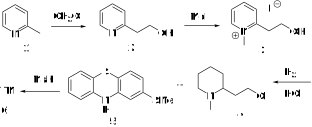
Note: Same sidechain used for mesoridazine and sulforidazine.
The alkylation of 2-Picoline [109-06-8] (1) with formaldehyde gives 2-Pyridineethanol [103-74-2] (2). Forming the quat salt with methyl iodide [74-88-4] leads to 2-(2-hydroxyethyl)-1-methyl-pyridinium iodide [56622-15-2] (3). Catalytic hydrogenation in the presence of hydrochloric acid leads to 2-(2-Chloroethyl)-1-Methylpiperidine [50846-01-0] (4). Alkylation of 2-Methylthiophenothiazine [7643-08-5] (5) in the presence of sodium hydride base completed the synthesis of Thioridazine (6).
References
References
- (2023-03-31). "RDC Nº 784 - Listas de Substâncias Entorpecentes, Psicotrópicas, Precursoras e Outras sob Controle Especial". [[Diário Oficial da União]].
- (August 1984). "Blood levels of haloperidol and thioridazine during maintenance neuroleptic treatment of schizophrenic outpatients". Journal of Clinical Psychopharmacology.
- (March 2012). "SHARED CARE PROTOCOL Thioridazine". NHS Lothian Joint Formulary.
- (2011). "Goodman & Gilman's The Pharmacological Basis of Therapeutics". McGraw-Hill.
- (2001). "Thioridazine for dementia". The Cochrane Database of Systematic Reviews.
- (March 2013). "Withdrawal versus continuation of chronic antipsychotic drugs for behavioural and psychological symptoms in older people with dementia". The Cochrane Database of Systematic Reviews.
- (September 2010). "THIORIDAZINE HYDROCHLORIDE tablet, film coated [Mutual Pharmaceutical]". Mutual Pharmaceutical.
- (July 2007). "Thioridazine for schizophrenia". The Cochrane Database of Systematic Reviews.
- (November 1994). "The Australian multicentre double-blind comparative study of remoxipride and thioridazine in schizophrenia". Acta Psychiatrica Scandinavica.
- (July 2002). "Pathogenesis of degenerative retinopathies induced by thioridazine and other antipsychotics: a dopamine hypothesis". Documenta Ophthalmologica. Advances in Ophthalmology.
- (18 August 2010). "Martindale: The Complete Drug Reference". The Pharmaceutical Press.
- "Selected adverse effects of antipsychotic medications for schizophrenia". Wolters Kluwer Health.
- (December 1963). "Retinal Pigmentation in a Patient Receiving Thioridazine". Archives of Ophthalmology.
- (2012). "LiverTox: Clinical and Research Information on Drug-Induced Liver Injury". National Institute of Diabetes and Digestive and Kidney Diseases.
- (12 January 2011). "PDSP Ki Database". University of North Carolina at Chapel Hill and the United States National Institute of Mental Health.
- "Mesoridazine". National Center for Biotechnology Information.
- (March 1996). "Plasma levels of the enantiomers of thioridazine, thioridazine 2-sulfoxide, thioridazine 2-sulfone, and thioridazine 5-sulfoxide in poor and extensive metabolizers of dextromethorphan and mephenytoin". Clinical Pharmacology and Therapeutics.
- "Sulforidazine". National Center for Biotechnology Information.
- (2001). "Effects of phenothiazine neuroleptics on the rate of caffeine demethylation and hydroxylation in the rat liver". Polish Journal of Pharmacology.
- (1989). "Analytical profiles of drug substances". Academic Press.
- (November 2012). "Outcome of patients after market withdrawal of thioridazine: a retrospective analysis in a nationwide cohort". Pharmacoepidemiology and Drug Safety.
- (2005). "WHO Pharmaceuticals Newsletter 2005, No. 04: REGULATORY MATTERS: Thioridazine - Sale discontinued in Canada". World Health Organization.
- (June 2007). "Withdrawal of thioridazine". Australian Prescriber.
- "Thioridazine: MedlinePlus Drug Information".
- (June 2010). "Thioridazine cures extensively drug-resistant tuberculosis (XDR-TB) and the need for global trials is now!". International Journal of Antimicrobial Agents.
- (May 2012). "Why thioridazine in combination with antibiotics cures extensively drug-resistant Mycobacterium tuberculosis infections". International Journal of Antimicrobial Agents.
- (November 2007). "Thioridazine: resurrection as an antimicrobial agent?". British Journal of Clinical Pharmacology.
- (May 2013). "Thioridazine induces major changes in global gene expression and cell wall composition in methicillin-resistant Staphylococcus aureus USA300". PLOS ONE.
- (November 2003). "Successful treatment of Balamuthia amoebic encephalitis: presentation of 2 cases". Clinical Infectious Diseases.
- (1958). "Synthesen auf dem Phenothiazin-Gebiet. 2. Mitteilung. N-substituierte Mercaptophenothiazin-Derivate". Helvetica Chimica Acta.
- "Phenothiazine derivatives substituted by a monovalent sulfur function in 3-position".
- (August 1946). "The synthesis of some substituted 8-aminoquinolines". Journal of the American Chemical Society.
- (2020). "Synthesis of the enantiomers of thioridazine.". SynOpen.
This article was imported from Wikipedia and is available under the Creative Commons Attribution-ShareAlike 4.0 License. Content has been adapted to SurfDoc format. Original contributors can be found on the article history page.
Ask Mako anything about Thioridazine — get instant answers, deeper analysis, and related topics.
Research with MakoFree with your Surf account
Create a free account to save articles, ask Mako questions, and organize your research.
Sign up freeThis content may have been generated or modified by AI. CloudSurf Software LLC is not responsible for the accuracy, completeness, or reliability of AI-generated content. Always verify important information from primary sources.
Report