From Surf Wiki (app.surf) — the open knowledge base
5-HT5A receptor
Protein-coding gene in the species Homo sapiens
Protein-coding gene in the species Homo sapiens
5-Hydroxytryptamine (serotonin) receptor 5A, also known as HTR5A, is a protein that in humans is encoded by the HTR5A gene. Agonists and antagonists for 5-HT receptors, as well as serotonin uptake inhibitors, present promnesic (memory-promoting) and/or anti-amnesic effects under different conditions, and 5-HT receptors are also associated with neural changes.
Function
The gene described in this record is a member of 5-hydroxytryptamine receptor family and encodes a multi-pass membrane protein that functions as a receptor for 5-hydroxytryptamine and couples to G proteins, negatively influencing cAMP levels via Gi and Go. This protein has been shown to function in part through the regulation of intracellular Ca2+ mobilization. The 5-HT5A receptor has been shown to be functional in a native expression system.
Rodents have been shown to possess two functional 5-HT5 receptor subtypes, 5-HT5A and 5-HT5B, however while humans possess a gene coding for the 5-HT5B subtype, its coding sequence is interrupted by stop codons, making the gene non-functional, and so only the 5-HT5A subtype is expressed in human brain.
It also appears to serve as a presynaptic serotonin autoreceptor.
Clinical significance
The neurotransmitter serotonin (5-hydroxytryptamine, 5-HT) has been implicated in a wide range of psychiatric conditions and also has vasoconstrictive and vasodilatory effects.
Selective ligands
Few highly selective ligands are commercially available for the 5-HT5A receptor, though the field has expanded considerably in recent years. When selective activation of this receptor is desired in scientific research, the non-selective serotonin receptor agonist 5-Carboxamidotryptamine can be used in conjunction with selective antagonists for its other targets (principally 5-HT1A, 5-HT1B, 5-HT1D, and 5-HT7). Research in this area is ongoing.
Agonists
- LSD:(+)-lysergic acid.
- Lisuride partial agonist.
- 5-CT full agonist.
- Methylergometrine full agonist.
- Valerenic acid a component of valerian, has been shown to act as a 5HT5A partial agonist.
- Olanzapine an atypical antipsychotic.
- Psilocin
- Aripiprazole - an atypical antipsychotic
- Mirtazapine - an atypical antidepressant
- UCSF648 - selective 5-HT5A partial agonist
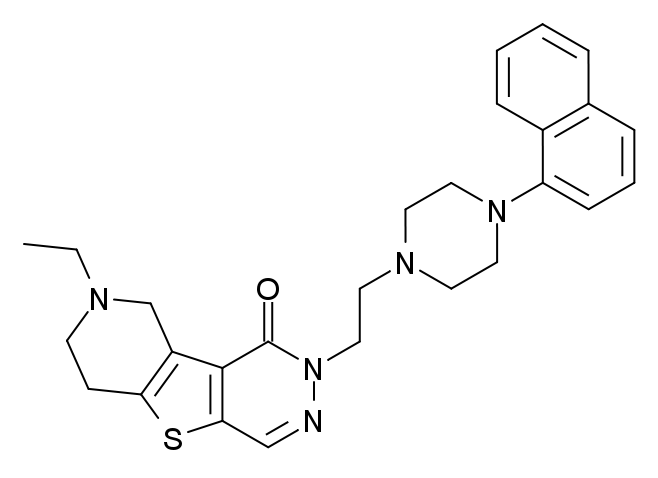
- Another ligand that has been recently disclosed is shown below, claimed be a selective 5-HT5A agonist with Ki = 124 nM.
Antagonists
- ASP5736
- AS-2030680
- AS-2674723
- MS112 selective potent antangonist.
- Latrepirdine (non-selective).
- Risperidone (non-selective), moderate 206 nM affinity.
- SB-699,551
References
References
- "Entrez Gene: HTR5A 5-hydroxytryptamine (serotonin) receptor 5A".
- (December 1994). "Cloning and characterisation of the human 5-HT5A serotonin receptor". FEBS Letters.
- (November 1998). "The human 5-ht5A receptor couples to Gi/Go proteins and inhibits adenylate cyclase in HEK 293 cells". European Journal of Pharmacology.
- (April 2012). "The native serotonin 5-HT(5A) receptor: electrophysiological characterization in rodent cortex and 5-HT(1A)-mediated compensatory plasticity in the knock-out mouse". The Journal of Neuroscience.
- (March 1993). "Mouse 5-hydroxytryptamine5A and 5-hydroxytryptamine5B receptors define a new family of serotonin receptors: cloning, functional expression, and chromosomal localization". Molecular Pharmacology.
- (February 2004). "5-HT5 receptors". Current Drug Targets. CNS and Neurological Disorders.
- (September 2006). "SB-699551-A (3-cyclopentyl-N-[2-(dimethylamino)ethyl]-N-[(4'-{[(2-phenylethyl)amino]methyl}-4-biphenylyl)methyl]propanamide dihydrochloride), a novel 5-ht5A receptor-selective antagonist, enhances 5-HT neuronal function: Evidence for an autoreceptor role for the 5-ht5A receptor in guinea pig brain". Neuropharmacology.
- (2010). "Medicinal chemistry of 5-HT5A receptor ligands: a receptor subtype with unique therapeutical potential". Curr Top Med Chem.
- (Oct 2024). "Uncovering the unique characteristics of different groups of 5-HT5AR ligands with reference to their interaction with the target protein". Pharmacol Rep.
- (2002). "In the search for selective ligands of 5-HT5, 5-HT6 and 5-HT7 serotonin receptors". Polish Journal of Pharmacology.
- (January 2008). "Cyclic guanidines as dual 5-HT5A/5-HT7 receptor ligands: optimising brain penetration". Bioorganic & Medicinal Chemistry Letters.
- The RBI Handbook of Receptor Classification and Signal Transduction, page 114 (1995){{ISBN. 0-9640548-1-7
- (July 2022). "Inactive and active state structures template selective tools for the human 5-HT5A receptor". Nature Structural & Molecular Biology.
- (August 2005). "Valerian extract and valerenic acid are partial agonists of the 5-HT5a receptor in vitro". Brain Research. Molecular Brain Research.
- [[Bryan Roth. Roth BL]], Driscol J. "PDSP Ki Database". Psychoactive Drug Screening Program (PDSP). University of North Carolina at Chapel Hill and the United States National Institute of Mental Health. Retrieved 14 August 2017.
- (February 2010). "Psychedelics and the human receptorome". PLOS ONE.
- "Use of 5-HT5-ligands in the treatment of neurodegenerative and neuropsychiatric disturbances".
- (March 2015). "Novel 5-HT5A receptor antagonists ameliorate scopolamine-induced working memory deficit in mice and reference memory impairment in aged rats". Journal of Pharmacological Sciences.
- (October 2014). "ASP5736, a novel 5-HT5A receptor antagonist, ameliorates positive symptoms and cognitive impairment in animal models of schizophrenia". European Neuropsychopharmacology.
- (October 2008). "Evaluation of Dimebon in cellular model of Huntington's disease". Molecular Neurodegeneration.
This article was imported from Wikipedia and is available under the Creative Commons Attribution-ShareAlike 4.0 License. Content has been adapted to SurfDoc format. Original contributors can be found on the article history page.
Ask Mako anything about 5-HT5A receptor — get instant answers, deeper analysis, and related topics.
Research with MakoFree with your Surf account
Create a free account to save articles, ask Mako questions, and organize your research.
Sign up freeThis content may have been generated or modified by AI. CloudSurf Software LLC is not responsible for the accuracy, completeness, or reliability of AI-generated content. Always verify important information from primary sources.
Report