From Surf Wiki (app.surf) — the open knowledge base
Sydney Airport
International airport serving Sydney, New South Wales, Australia
International airport serving Sydney, New South Wales, Australia
| Field | Value | |
|---|---|---|
| name | Sydney Airport | |
| nativename | Sydney–Kingsford Smith | |
| image | Sydney Airport logo.svg | |
| image-width | 150 | |
| image2 | Sydney Airport (Kingsford Smith) - aerial view (cropped).jpg | |
| image2-width | 250 | |
| IATA | SYD | |
| ICAO | YSSY | |
| WMO | 94767 | |
| type | Public | |
| owner-oper | Sydney Airport Corporation | |
| city-served | Greater Sydney | |
| location | Mascot, New South Wales, Australia | |
| opened | ||
| hub | {{ubl | class=nowrap |
| operating_base | {{ubl | class=nowrap |
| elevation-f | 21 | |
| coordinates | ||
| website | ||
| mapframe | yes | |
| pushpin_label | **SYD**/YSSY | |
| metric-rwy | yes | |
| r1-number | 07/25 | |
| r1-length-m | 2,530 | |
| r1-surface | Asphalt | |
| r2-number | 16L/34R | |
| r2-length-m | 2,438 | |
| r2-surface | Asphalt | |
| r3-number | 16R/34L | |
| r3-length-m | 3,963 | |
| r3-surface | Asphalt | |
| stat1-header | Passengers (2024) | |
| stat1-data | 41,400,000 | |
| stat3-header | Airfreight in tonnes (2012) | |
| stat3-data | 444,419 | |
| stat2-header | Aircraft movements (2023) | |
| stat2-data | 295,767 | |
| stat4-header | Economic impacts (2012) | |
| stat4-data | $13.2 billion | |
| footnotes | Source: AIP | |
| Passenger and aircraft movements from the Bureau of Infrastructure, Transport and Regional Economics |
the main airport serving Sydney, Australia
| image-width = 150 | image2-width = 250 | owner-oper = Sydney Airport Corporation | city-served = Greater Sydney | Qantas | Virgin Australia}} | Jetstar | Rex Airlines}} | elevation-f = 21 | metric-rwy = yes | r1-number = 07/25 | r1-length-m = 2,530 | r1-surface = Asphalt | r2-number = 16L/34R | r2-length-m = 2,438 | r2-surface = Asphalt | r3-number = 16R/34L | r3-length-m = 3,963 | r3-surface = Asphalt | stat-year = | stat1-header = Passengers (2024) | stat1-data = 41,400,000 | stat3-header = Airfreight in tonnes (2012) | stat3-data = 444,419 | stat2-header = Aircraft movements (2023) | stat2-data = 295,767 | stat4-header = Economic impacts (2012) | stat4-data = $13.2 billion Passenger and aircraft movements from the Bureau of Infrastructure, Transport and Regional Economics
Sydney Kingsford Smith Airport — colloquially Kingsford Smith Airport, Sydney Airport or Mascot Airport — is an international airport located in Mascot, New South Wales, Australia, 8 km south of the Sydney CBD. It is the primary airport serving Sydney and its metropolitan area, and is the main hub for Qantas, the flagship airline of Australia, as well as a hub for Virgin Australia and an operating base for Jetstar.
Situated next to Botany Bay on 907 hectares (2,241 acres) of land with three runways, Sydney Airport is one of the world's longest continuously operated commercial airports and is the busiest airport in Australia, handling 41.4 million passengers and 348,904 aircraft movements in 2024 and 2017, respectively. Currently, 46 domestic and 43 international destinations are served to Sydney directly, having been the 48th busiest airport in the world in 2022. In 2018, the airport was rated in the top five worldwide for airports handling 40–50 million passengers annually and was overall voted the 20th best airport in the world at the Skytrax World Airport Awards.
The airport is owned by Sydney Airport Corporation Limited.
History
1911–1930: Early history
The land used for the airport had been a bullock paddock, with a lot of the area around Mascot being swampy. Flights had been taking off from at least 1911 from these fields, with aviators using other Sydney locations like Anderson Park and Neutral Bay for a few years prior.
Nigel Love, who had been a pilot in the First World War, was interested in establishing the nation's first aircraft manufacturing company. This idea would require him to establish a factory and an aerodrome close to the city. A Sydney real estate office informed him about a parcel of land owned by the Kensington Race Club, which was being held in reserve as a safeguard in case the club lost its government-leased site at Randwick. It had been used by a local abattoir which was closing down, to graze sheep and cattle. This land appealed to Love as the surface was perfectly flat and was covered with a pasture of buffalo grass. The grass had been grazed so evenly by the sheep and cattle that it required little to make it serviceable for aircraft. In addition, the approaches on all four sides had no obstructions, it was bounded by Ascot Racecourse, gardens, a river, and Botany Bay.
Love established the airfield at Mascot as a private concern, leasing 200 acre from the Kensington Race Club for three years. It initially had a small canvas structure but was later equipped with an imported Richards hangar. The first flight from Mascot was in November 1919 when Love carried freelance movie photographer Billy Marshall up in an Avro. Sydney Airport was declared an aerodrome and officially opened in January 1920. The official opening flight took place on 9 January 1920, also performed by Love.
In 1921, the Commonwealth Government purchased 161 acre in Mascot for the purpose of creating a public airfield. In 1923, when Love's three-year lease expired, the Mascot land was compulsorily acquired by the Commonwealth Government from the racing club. The first regular flights began in 1924.
1930–1950


In 1933, the first gravel runways were built. On 14 August 1936, the airport was renamed Sydney (Kingsford Smith) Airport in honour of pioneering Australian aviator Sir Charles Kingsford Smith. In 1940, the Department of Civil Aviation constructed an administrative and terminal building in the eastern part of the aerodrome, with a control tower cab at the top floor. The building is now part of Terminal 3 since 1999, but the control tower cab has already been removed.
By 1949, the airport had three runways – the 1085 m 11/29, the 1190 m 16/34, and the 1787 m 04/22. The Sydenham to Botany railway line crossed runway 04/22 approximately 150 m from the northern end and was protected by special safe working facilities.
In the late 1940s (c. 1947–1949), a temporary overseas passenger (i.e. international) terminal was constructed. The original 1940 terminal then became the terminal building for the Trans Australia Airlines (TAA), the government-owned domestic airline, and the building also became known as the TAA terminal building. The temporary overseas passenger terminal was later replaced by a newer one in 1954, located just north of the 1940 terminal building.
1950–1990: Modernisation and upgrades
During the year 1950, the airport handled at least 793,956 passengers and was ranked among the busiest airports in the world.
Between 1947 and 1953, the Cooks River was diverted away around the western side of the airport and other small streams were filled. This allowed the construction of two new paved runways to replace the three gravel runways. The first paved runway to be constructed was 07/25, completed in 1953–1954. Subsequently, the next paved runway to be constructed was 16/34 (now 16R/34L) which replaced the parallel gravel runway 16/34. Both runways were constructed south of the gravel runways. At the same time, on 2 November 1953, a new air traffic control tower with an integrated fire station was constructed northeast of where the two runways intersect, replacing the control tower on the 1940 terminal building. The tower was demolished in 2005.[[File:DC8, Sydney, 1972.jpg|thumb|[[KLM]] [[Douglas DC-8]] at Gate 2 of the International Terminal in 1972]]
The new runway 16R/34L was later extended southwards into Botany Bay over General Holmes Drive in 1968 to accommodate long-haul international jets, and then extended again to its current length in 1972. Sydney Airport’s main runway is one of the longest commercial runways in the world at just under 4km. It was extended to this length in the late 1970s so it could double as a designated emergency landing site for the NASA Space Shuttle until 1986. Since then, the east–west 07/25 runway was 8300 ft long; and the north–south 16/34 runway was one of the longest runways in the Southern Hemisphere.
Up to the early 1960s, the majority of Sydneysiders referred to the airport as Mascot. Jet aircraft started to arrive in July 1959, with the introduction of Qantas' Boeing 707-138. By the 1960s, the need for a new international terminal had become apparent. In the late 1940s and early 1950s, a terminal block for both international and domestic flights was proposed to be at the southeast portion of the airport near General Holmes Drive, but the proposal never eventuated. Work commenced on the construction of the new terminal in late 1966. Much of the new terminal was designed by Paynter and Dixon Industries with Costain appointed lead contractor. The new terminal was officially opened on 3 May 1970, by Queen Elizabeth II. The first Boeing 747 "Jumbo Jet" at the airport, Pan Am's Clipper Flying Cloud (N734PA), arrived on 4 October 1970.[[File:SydneyAirport-oldATCtower.jpg|thumb|Sydney Airport's ATC tower no. 4, known commonly today as the "old ATC tower", was in operation between 1972 and 1996]]Meanwhile, the 1940 TAA domestic terminal was expanded and modernised in 1962, with departures separated from arrivals along with other upgrades. The terminal was replaced by a new TAA terminal in 1974, constructed on the site of the old international terminal building after the new international terminal opened four years prior. The new terminal was located directly north and adjacent to the original TAA terminal. The 1940 terminal was then taken over by East-West Airlines.
Upgrades and expansion of the Ansett terminal (now Terminal 2) also began in 1974.
1990–2010
Since the international terminal's original completion, it has undergone a few expansions. The international terminal was first expanded in 1992 with the construction of Pier C in the south.
The limitations of having only two runways that crossed each other had become apparent and governments grappled with Sydney's airport capacity for decades. Eventually, the controversial decision to build a third runway was made. The third runway was parallel to the existing runway 16/34, entirely on reclaimed land from Botany Bay. A proposed new airport on the outskirts of Sydney was shelved in 2004, before being re-examined in 2009–2012 following reports that Kingsford Smith airport will not be able to cope by 2030. The "third runway", which the Commonwealth government commenced development of in 1989 and completed in 1994, remained controversial because of increased aircraft movements, especially over inner suburbs. In 1995 the No Aircraft Noise party was formed to contest the 1995 New South Wales state election. The party did not win a seat in parliament but came close in the electorate of Marrickville. It also contested the 1996 Australian federal election.
In 1995, the Australian Parliament passed the Sydney Airport Curfew Act 1995, which limits the operating hours of the airport. This was done in an effort to reduce airport noise over residential areas and thereby curb complaints. The curfew prevents aircraft from taking off or landing between the hours of 11 pm and 6 am. A limited number of scheduled and approved take-offs and landings are permitted respectively in the "shoulder periods" of 11 pm to midnight and 5 am to 6 am. The Act does not stop all aircraft movements overnight but limits noise by restricting the types of aircraft that can operate, the runways they can use and the number of flights allowed. During extreme weather, flights are often delayed and it is often the case that people on late flights are unable to travel on a given day. , fines for violating curfew have been levied against four airlines, with a maximum fine of A$550,000 applicable. In addition to the curfew, Sydney Airport also has a cap of 80 aircraft movements per hour which cannot be exceeded, leading to increased delays during peak hours.
In 1998, the Federal Government agreed to separate Sydney Airport from the Federal Airports Corporation and to incorporate it as Sydney Airport Corporation. David Mortimer was appointed as Chair and Tony Stuart as CEO. Its mandate was to successfully redevelop the airport as the gateway for the Sydney 2000 Olympics, support the growth of new airlines such as Virgin and Emirates, and prepare it for a successful $3 billion-plus privatisation. In 2001 Sydney Airport was awarded World's Best Airport. In preparation for privatisation the airport argued successfully for a new regulatory regime.
All three terminals were upgraded prior to the 2000 Summer Olympics which was to be held in Sydney.
In 2002, the Commonwealth Government sold Sydney Airport Corporation (SAC), to Southern Cross Airports Corporation Holdings for $5.4 billion. 83 percent of SAC is owned by MAp Airports International Limited, a subsidiary of Macquarie Group, Sydney Airport Intervest GmbH owns 12 percent and Ontario Teachers' Australia Trust owns 5 percent. SACL holds a 99-year lease on the airport which remains Crown land and as such is categorised as a Leased Federal Airport.
In 2005, a planned expansion of the airport was announced, including the construction of a multi-level car park, and the expansion of both international and domestic terminals. The expansion was planned to stretch over twenty years (2005–25). These expansions—and other plans and policies by Macquarie Bank for airport operations were seen as controversial, as they were performed without the legal oversight of local councils, which usually act as the local planning authority for such developments. , some of the proposed development has been scaled back.

The international terminal underwent a renovation that was completed in mid-2010. The upgrade includes a new baggage system, an extra 7300 m2 of space for shops and passenger waiting areas, expansion of the transit zone, and other improvements.
In March 2010, the Australian Competition & Consumer Commission released a report sharply critical of price gouging at Sydney airport, ranking it fifth out of five airports. The report noted Sydney Airport recorded the highest average prices at $13.63 per passenger, compared to the lowest at $7.96 at Melbourne Airport, while the price of short-term parking had almost doubled in the 2008–09 financial year, from $28 to $50 for four hours. This amounts to the highest profit margins on aeronautical services and very high profit margins on car parking fees. The report also accused the airport of abusing its monopoly power.
Since 2011: Modern history
In December 2011, Sydney Airport announced a proposal to divide the airport into two airline-alliance-based precincts; integrating international, domestic, and regional services under one roof by 2019. The current domestic Terminal 2 and Terminal 3 would be used by Qantas, Jetstar, and members of the Oneworld airline alliance while today's international Terminal 1 would be used by Virgin Australia and its international partners. Other international airlines would continue to operate from T1. In September 2012, Sydney Airport Managing Director and CEO Kerrie Mather announced the airport had abandoned the proposal to create alliance-based terminals in favour of terminals "based around specific airline requirements and (passenger) transfer flows". She stated the plan was to minimise the number of passengers transferring between terminals.

In June 2013, the airport released a draft version of its 2033 Master Plan, which proposes operating domestic and international flights from the same terminals using 'swing gates', along with upgrading Terminal 3 (currently the Qantas domestic terminal) to accommodate the Airbus A380. On 17 February 2014, the Australian Government approved the Master Plan, which outlines the airport's plans to cater to the forecast demand of 74 million passengers in 2033. The plan includes Sydney Airport's first-ever integrated ground transport plan.
On 27 August 2018, the Sydney Airport Master Plan 2039 was announced. The Sydney Airport Masterplan 2039 is a strategic plan that outlines the long-term vision for the development of Sydney Airport. The airport expects international travellers passing through its terminals to double over the next two decades and underpin an expected 50 per cent increase in passenger numbers by 2039. The plan aims to minimise traffic congestion on ground transportation.
Operations
Runways

Control towers
Main article: Sydney Airport Air Traffic Control Tower
The present Sydney Airport control tower (No. 5) is the fifth air traffic control tower at the airport. It is also heritage-listed since 2016. The tower occupies a central position in the airport, located northeast to where General Holmes Drive goes under the main Runway 16R/34L. It began construction in 1993 in conjunction with the construction of parallel Runway 16L/34R, and was commissioned on 6 January 1996.
The control tower replaces the fourth control tower (No. 4) built in 1972, located at the mouth of Cooks River and south of General Holmes Drive. , the control tower complex remains standing and is used by Airservices Australia as its Traffic Control Unit to manage planes within a 100 km radius from Sydney. However, the Traffic Control Unit was slated to be moved to Melbourne and the control tower complex was slated for demolition.
Terminals
Sydney Airport has three passenger terminals. The International Terminal (Terminal 1) is separated from the other two domestic terminals (Terminals 2 & 3) by runway 16R/34L; therefore, connecting passengers need to allow for longer transfer times ranging from 30 minutes to an hour or more.
The existing terminal numbering system (Terminals 1 to 3) was adopted on 24 September 2002.
Terminal 1


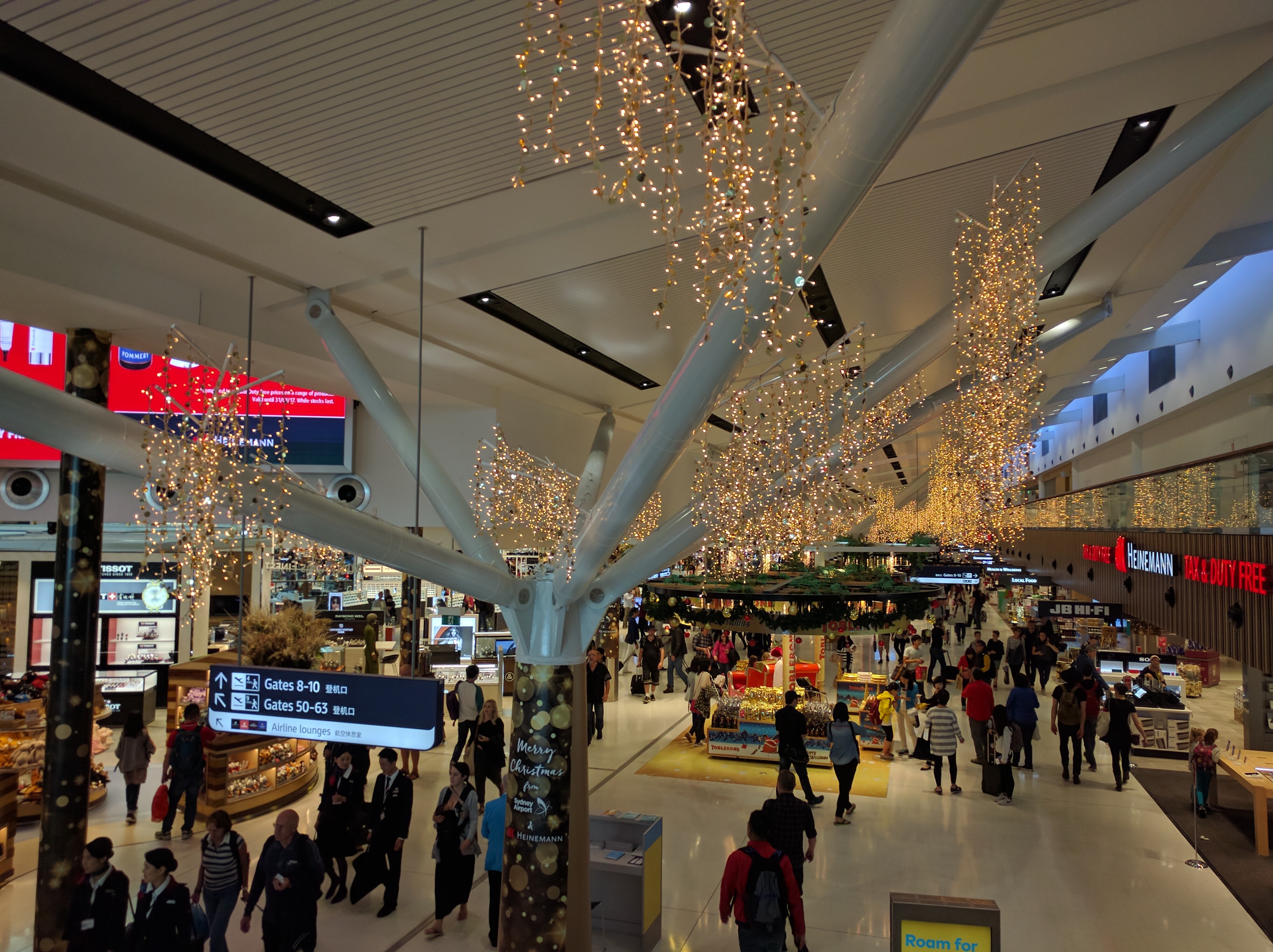
Terminal 1 is also known as the International Terminal and serves all international flights. It is located in the airport's northwestern sector. It was opened on 3 May 1970, replacing the old Overseas Passenger Terminal (which was located where Terminal 3 stands now), and has been greatly expanded since then. The first extension in 1992 opened Pier C to the south with nine new gates, increasing the number of gates from 17 to 26. The original piers that opened in 1970 also became known as Pier B. The second extension was undertaken between 1997 and 2000 before the 2000 Summer Olympics, including ten new aircraft parking positions and new integrated baggage handling system. A third $500 million redevelopment was completed in 2010, by which the shopping complex was expanded, outbound customs operations were centralised and the floor space of the terminal increased to 254000 m2. Further renovations began in 2015 with a reconfiguration and decluttering of outbound and inbound duty-free areas, an extension of the airside dining areas, and the installation of Australian Border Force outbound immigration SmartGates. These works were completed in 2016.
The terminal has 25 gates served by aerobridges, thirteen of which are in Pier B (numbered 8–10, 24–25 and 30–37), and twelve in Pier C (numbered 50–51, 53–61 and 63). Prior to the 2010 upgrade, there also used to be gates 20, 22 and 23 in Pier B. Pier B is used by Qantas, all Oneworld members, and all SkyTeam members. Pier C is used by Virgin Australia and its partners as well as all Star Alliance members. There are also a number of remote bays which are heavily utilised during peak periods and for parking idle aircraft during the day. , there is currently no Pier A, but Pier A would be the name for a northern expansion if it were to happen in the future.
The terminal building is split into three levels, one each for arrivals, departures, and airline offices. The departure level has 20 rows of check-in desks each with 10 single desks making a total of 200 check-in desks. The terminal hosts eight airline lounges: two for Qantas, and one each for The House, Air New Zealand, Singapore Airlines, Emirates, American Express, and SkyTeam.
Terminal 2


Terminal 2, located in the airport's northeastern section, is a domestic terminal and the former home of Ansett Australia's domestic operations. It features 20 parking bays served by aerobridges and several remote bays for regional aircraft. It serves Jetstar, Link Airways, and Virgin Australia. Virgin Australia has a lounge for its customers in the terminal which features a dedicated entrance from the passenger drop-off area as well as its own security screening.
The terminal was first opened in 1939–1940 as the terminal building for Australian National Airways (ANA). It was expanded in July 1952. The ANA terminal was included in the sale of ANA to Ansett in 1957. It was upgraded and modernised in 1974–1975 with a new baggage handling system, moving walkways, air-conditioned departure lounges and aerobridges. It also had a covered bridge from the domestic car park to the terminal.
During the 1990s, the terminal was upgraded and redevelopment twice. The first redevelopment was announced in 1989, and included a new western concourse, new boarding lounges at the existing concourse and new aircraft-parking positions. This was to create additional gates for other airlines, required as part of the new 30-year lease for the terminal that Ansett had signed with the federal government. The second redevelopment completed before the 2000 Summer Olympic Games for .
After Ansett's collapse in 2002, Ansett's administrators sold the terminal lease to the airport for , and the terminal became open to all airline operators, including Qantas's regional carriers (QantasLink) and Virgin Blue (now Virgin Australia). QantasLink moved from Terminal 2 to Terminal 3 in 2013.
Terminal 3

Terminal 3 is a domestic terminal serving Qantas and QantasLink flights, which moved from Terminal 2 to Terminal 3 on 16 August 2013. The terminal is also temporarily home to all Rex Airlines and FlyPelican departures while upgrade works are being completed at T2 (Rex and Pelican arrivals are still at T2). It was initially home to Trans Australia Airlines (TAA, later named Australian Airlines), with Australian Airlines signing a 30 year lease for the terminal with the federal government in 1989. Since the merger of Australian Airlines and Qantas in 1994, the terminal exclusively serves under the Qantas brand. In 2015, Qantas sold its lease of Terminal 3, which was due to continue until 2019, back to Sydney Airport for $535 million. This means Sydney Airport resumes operational responsibility of the terminal, including the lucrative retail areas. Qantas would retain priority usage for the check-in and baggage facilities and departure gates until mid-2025.
The TAA terminal was built in 1974, occupying the site of the former Overseas Passenger Terminal. The current terminal building is largely the result of extensions designed by Hassell and completed in 1999. This included the construction of a 60 m roof span above a new column-free check-in hall and resulted in extending the terminal footprint to 80000 m2. Since the opening of the terminal in 1974, the original airport terminal building built in 1940 was incorporated into the southwest portion of the newer terminal and is currently near gates 17 to 19 of Terminal 3 ().
The terminal is located in the northeastern section adjacent to Terminal 2, with which it shares an underground train station. There are 14 parking bays served by aerobridges, including two served by dual aerobridges. Terminal 3 features a large Qantas Club lounge, along with a dedicated Business Class and Chairman's lounge. Terminal 3 also has a 'Heritage Collection' located adjacent to gate 13, dedicated to Qantas and including many collections from the airline's 90-plus years of service. It also has a view of the airport's apron and is used commonly by plane-spotters.
Former Express Terminal
Sydney Airport previously had a fourth passenger terminal, east of Terminal 2. This was known as Domestic Express or simply Express Terminal. Construction of the terminal and adjacent aircraft parking aprons was completed in "a record 56 days", and operations began on 5 June 2000 with an official opening on 18 July that year. It was used by Hazelton Airlines (later Rex Airlines) and low-cost carriers Virgin Blue and the now-defunct Impulse Airlines (until May 2001). Following Ansett's collapse and the airport's purchase of the Ansett terminal in 2002, the airlines at the Express Terminal began moving to the former Ansett terminal (Terminal 2). Virgin Blue was last to use the Express Terminal and moved to Terminal 2 on 12 December 2002. The former express terminal is now used as an office building.
Freight terminals
The airport is a major hub for freight transport to and from Australia, handling approximately 45 percent of the national cargo traffic. Therefore, it is equipped with extensive freight facilities including seven dedicated cargo terminals operated by several handlers.
Airlines and destinations
Passenger
| Air Canada | Toronto–Pearson, Vancouver | Air China | Beijing–Capital | Air India | Delhi | Air New Zealand | Auckland, Christchurch, Queenstown, Wellington | Air Niugini | Port Moresby | AirAsia X | Kuala Lumpur–International | Aircalin | Nouméa | All Nippon Airways | Tokyo–Haneda | American Airlines | Los Angeles | Asiana Airlines | Seoul–Incheon | Batik Air Malaysia | Denpasar, Kuala Lumpur–International | Beijing Capital Airlines | Qingdao | British Airways | London–Heathrow, Singapore | Cathay Pacific | Hong Kong | Cebu Pacific | Manila | China Airlines | Taipei–Taoyuan | China Eastern Airlines | Auckland, Hangzhou, Jinan, Nanjing, Shanghai–Pudong, Wuhan, Xi'an | China Southern Airlines | Guangzhou, Shenzhen Seasonal: Beijing–Daxing | Delta Air Lines | Los Angeles | Emirates | Christchurch, Dubai–International | Etihad Airways | Abu Dhabi | Fiji Airways | Nadi | FlyPelican | Newcastle | Garuda Indonesia | Denpasar, Jakarta–Soekarno-Hatta | Hainan Airlines | Haikou | Hawaiian Airlines | Honolulu | Hong Kong Airlines | Hong Kong | Japan Airlines | Tokyo–Haneda | Jetstar | Adelaide, Auckland, Avalon, Ayers Rock, Ballina, Brisbane, Busselton, Cairns, Darwin, Denpasar, Gold Coast, Hamilton, Hervey Bay, Hobart, Ho Chi Minh City, Launceston, Melbourne, Nadi, Osaka–Kansai, Perth, Phuket, Port Vila, Proserpine, Queenstown, Rarotonga, Seoul–Incheon, Sunshine Coast, Townsville | Juneyao Air | Shanghai–Pudong | Korean Air | Seoul–Incheon | LATAM Chile | Santiago de Chile | Malaysia Airlines | Kuala Lumpur–International | Philippine Airlines | Manila | Qantas | Adelaide, Alice Springs, Apia–Faleolo (begins 16 June 2026), Auckland, Ayers Rock, Bangkok–Suvarnabhumi, Bengaluru, Brisbane, Cairns, Christchurch, Dallas/Fort Worth, Darwin, Denpasar, Gold Coast, Hamilton Island, Hobart, Hong Kong, Honolulu, Jakarta–Soekarno-Hatta, Johannesburg–O.R. Tambo, London–Heathrow, Los Angeles, Manila, Melbourne, Nadi, New York–JFK, Norfolk Island, Nouméa, Nuku'alofa, Paris–Charles de Gaulle, Perth, Port Moresby (resumes 30 March 2026), Queenstown, San Francisco, Santiago de Chile, Singapore, Sunshine Coast, Tokyo–Haneda, Vancouver, Wellington Seasonal: Broome, Canberra, Rome–Fiumicino, Sapporo–Chitose | QantasLink | Albury, Armidale, Ballina, Bendigo, Broken Hill, Canberra, Coffs Harbour, Dubbo, Griffith, Hobart, Launceston, Merimbula, Mildura, Moree, Orange, Port Macquarie, Tamworth, Toowoomba, Townsville, Wagga Wagga Seasonal: Cooma | Qatar Airways | Doha | Rex Airlines | Albury, Broken Hill, Coffs Harbour, Dubbo, Griffith, Merimbula, Moruya, Narrandera, Orange, Parkes, Port Macquarie, Wagga Wagga | Scoot | Singapore | Sichuan Airlines | Chengdu–Tianfu | Singapore Airlines | Singapore | SmartLynx Australia | Lord Howe Island | SriLankan Airlines | Colombo–Bandaranaike | T'way Air | Seoul–Incheon | Thai Airways International | Bangkok–Suvarnabhumi | Tianjin Airlines | Chongqing, Tianjin, Zhengzhou | Turkish Airlines | Istanbul, Kuala Lumpur–International | United Airlines | Los Angeles, San Francisco Seasonal: Houston–Intercontinental | VietJet Air | Ho Chi Minh City | Vietnam Airlines | Hanoi, Ho Chi Minh City | Virgin Australia | Adelaide, Ballina, Brisbane, Cairns, Canberra, Denpasar, Doha, Gold Coast, Hamilton Island, Hobart, Launceston, Melbourne, Nadi, Perth, Queenstown, Sunshine Coast Seasonal: Darwin (resumes 22 June 2026) | XiamenAir | Xiamen

Qantas also operates dedicated "flightseeing" services over Antarctica from Sydney. These flights, using a Boeing 787 Dreamliner, depart Sydney from Terminal 3, and provide a guided aerial tour of Antarctica before returning to Australia. These flights are about thirteen hours in total.
Cargo
|ASL Airlines Australia | Auckland, Christchurch | Atlas Air | Auckland, Avalon, Bangkok–Suvarnabhumi, Chongqing, Honolulu, Melbourne, Shanghai–Pudong | Cathay Cargo | Hong Kong, Melbourne | China Southern Cargo | Auckland, Guangzhou | DHL Aviation | Honolulu, Los Angeles, Melbourne, Singapore | Emirates SkyCargo | Hong Kong | FedEx Express | Guangzhou, Honolulu, Oakland, Singapore | MASkargo | Kuala Lumpur–International | Qantas Freight | Auckland, Bangkok–Suvarnabhumi, Brisbane, Chicago–O'Hare, Chongqing, Christchurch, Gold Coast, Hong Kong, Honolulu, Jakarta–Soekarno–Hatta, Melbourne, Shanghai–Pudong | Singapore Airlines Cargo | Auckland, Singapore | Tasman Cargo Airlines | Auckland, Hong Kong | Team Global Express | Brisbane | UPS Airlines | Honolulu, Seoul–Incheon, Shanghai–Pudong, Singapore
Traffic and statistics
Total
| Year | Domestic | International | Total | Change |
|---|---|---|---|---|
| 1986 | 6,813,214 | 3,086,337 | 9,899,551 | 8.2% |
| 1987 | 7,263,516 | 3,569,509 | 10,833,025 | 9.4% |
| 1988 | 8,147,928 | 4,106,460 | 12,254,388 | 13.1% |
| 1989 | 6,130,660 | 4,026,296 | 10,156,956 | -17.1% |
| 1990 | 7,531,145 | 4,264,091 | 11,795,236 | 16.1% |
| 1991 | 9,865,363 | 4,220,272 | 14,085,635 | 19.4% |
| 1992 | 10,452,632 | 4,505,656 | 14,958,288 | 6.2% |
| 1993 | 11,089,393 | 4,778,015 | 15,867,408 | 6.1% |
| 1994 | 12,343,096 | 5,358,494 | 17,701,590 | 11.6% |
| 1995 | 13,213,552 | 5,838,494 | 19,052,003 | 7.6% |
| 1996 | 13,901,680 | 6,477,744 | 20,379,424 | 7.0% |
| 1997 | 14,070,134 | 6,840,696 | 20,910,830 | 2.6% |
| 1998 | 14,275,077 | 6,933,551 | 21,208,628 | 1.4% |
| 1999 | 14,877,901 | 7,388,153 | 22,266,054 | 5.0% |
| 2000 | 16,240,310 | 8,237,223 | 24,477,533 | 9.9% |
| 2001 | 16,563,296 | 8,228,973 | 24,792,269 | 1.3% |
| 2002 | 15,187,908 | 8,006,775 | 23,194,683 | -6.4% |
| 2003 | 16,548,322 | 7,929,841 | 24,478,163 | 5.5% |
| 2004 | 18,246,249 | 8,951,825 | 27,198,074 | 11.1% |
| 2005 | 18,940,167 | 9,515,983 | 28,456,150 | 4.6% |
| 2006 | 20,119,000 | 9,865,970 | 29,984,970 | 5.4% |
| 2007 | 21,469,055 | 10,378,240 | 31,847,295 | 6.2% |
| 2008 | 22,345,905 | 10,552,900 | 32,898,805 | 3.3% |
| 2009 | 22,362,772 | 10,635,270 | 32,998,042 | 0.3% |
| 2010 | 24,194,804 | 11,455,537 | 35,650,341 | 8.0% |
| 2011 | 23,925,351 | 11,748,582 | 35,673,933 | 0.1% |
| 2012 | 24,638,877 | 12,369,193 | 37,008,070 | 3.7% |
| 2013 | 25,216,661 | 12,933,885 | 38,150,546 | 3.1% |
| 2014 | 25,417,107 | 13,315,835 | 38,732,942 | 1.5% |
| 2015 | 25,897,619 | 13,911,228 | 39,808,847 | 2.8% |
| 2016 | 26,905,944 | 15,111,977 | 42,017,921 | 5.5% |
| 2017 | 27,291,874 | 16,038,186 | 43,330,060 | 3.1% |
| 2018 | 27,667,273 | 16,762,485 | 44,429,758 | 2.5% |
| 2019 | 27,538,404 | 16,890,441 | 44,428,845 | 0.0% |
| 2020 | 7,444,780 | 3,782,912 | 11,227,692 | -74.7% |
| 2021 | 7,171,759 | 729,529 | 7,901,288 | -29.6% |
| 2022 | 20,872,921 | 8,110,953 | 28,983,874 | 266.8% |
| 2023 | 24,110,000 | 14,540,000 | 38,650,000 | 33.5% |
| 2024 | 25,090,000 | 16,300,000 | 41,390,000 | 7.1% |
Domestic
Sydney Airport handled 25.094 million domestic passengers in the financial year ending 30 June 2025, an increase of 1.5% compared to the year prior.
| Rank | Airport | Passengers | % Change | |||
|---|---|---|---|---|---|---|
| 1 | ||||||
| 2 | ||||||
| 3 | ||||||
| 4 | ||||||
| 5 | ||||||
| 6 | ||||||
| 7 | ||||||
| 8 | ||||||
| 9 | ||||||
| 10 | ||||||
| 11 | ||||||
| 12 | ||||||
| 13 | ||||||
| 14 | ||||||
| 15 |
International

Sydney Airport handled 16.403 million international passengers in the year ending 31 December 2024.
| Rank | Airport | Passengers handled | % change | Airlines | ||||
|---|---|---|---|---|---|---|---|---|
| 1 | ||||||||
| 2 | ||||||||
| 3 | ||||||||
| 4 | ||||||||
| 5 | ||||||||
| 6 | ||||||||
| 7 | ||||||||
| 8 | ||||||||
| 9 | ||||||||
| 10 | ||||||||
| 11 | ||||||||
| 12 | ||||||||
| 13 | ||||||||
| 14 | ||||||||
| 15 |
Freight
In 2019, Sydney Airport handled 521,014 tonnes of international air freight and 23,260 tonnes of international air mail.
Ground transport
Road
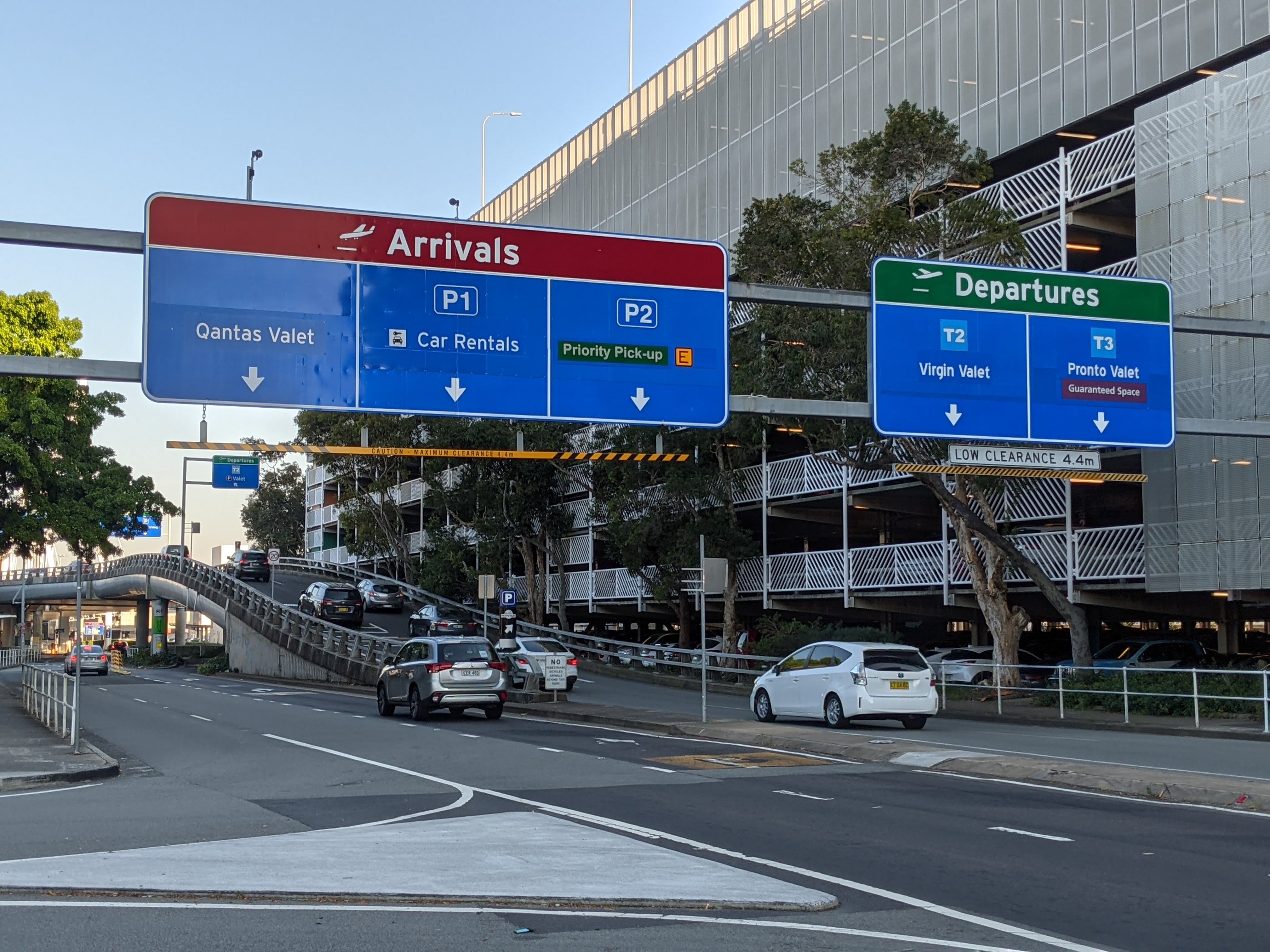
Sydney Airport has road connections in all directions. Southern Cross Drive (M1), a motorway, is the fastest toll-free link to the city centre. The M5 South Western Motorway (including the M5 East Freeway) links the airport with the south-western suburbs of Sydney. A ring road runs around the airport consisting of Airport Drive, Qantas Drive, General Holmes Drive, M5 East Freeway and Marsh Street. General Holmes Drive features a tunnel under the main north–south runway and three taxiways as well as providing access to an aircraft viewing area. Inside the airport a part-ring road – Ross Smith Avenue (named after Ross MacPherson Smith) – connects the Domestic Terminal with the control tower, the general aviation area, car-rental company storage yards, long-term car park, heliport, various retail operations and a hotel. A perimeter road runs inside the secured area for authorised vehicles only.
Since 2024, Sydney Gateway, a major road interchange now connects between the WestConnex M8 Motorway and Sydney Airport's terminals. The project provides a motorway-grade road directly from the terminals to Sydney's CBD, Parramatta and the south-western suburbs. Construction began in 2021 and was completed in mid 2024.
The airport runs several official car parks—Domestic Short Term, Domestic Remote Long Term, and International Short/Long Term.
The International Terminal is located beside a wide pedestrian and bicycle path. It links Mascot and Sydney City in the north-east with Tempe (via a foot bridge over Alexandra Canal) and Botany Bay to the south-west. All terminals offer bicycle racks and are also easily accessible by foot from nearby areas.
Public transport
Rail
The airport is accessible via Sydney Trains T8 Airport & South Line, providing regular service to the Sydney CBD and the southwestern suburbs, using the Airport Link tunnel. The International Airport station is located below the International terminal, while the Domestic Airport station is located under the car park between the domestic terminals (Terminal 2 and Terminal 3). While the stations are part of the Sydney Trains suburban network, they are privately owned and operated by the Airport Link Company and their use is subject to a surcharge. The trains that service the airport are regular suburban trains. Unlike airport trains at some other airports, these do not have special provisions for customers with luggage, do not operate express to the airport, and may have all seats occupied by commuters before the trains arrive at the airport.
The airport station surcharge may be avoided by passengers alighting at nearby stations and walking to either the International Terminal (from Wolli Creek station, about 1.6 km) or the Domestic Terminal (from Mascot station, about 1.8 km).
Bus
Transdev John Holland operates route 350 from the domestic terminal to Bondi Junction railway station while Transit Systems operates route 420 from Mascot railway station to Westfield Burwood via both International and Domestic terminals, as well as Banksia and Rockdale railway stations.
Accidents and incidents
-
On 10 September 1920, Arthur Herbert Tattle of Wellington, New Zealand, was killed on the runway at Mascot when he was struck on the crown of his head by a plane taking off. He had come to see two friends take off on the plane and was standing on the runway in the flight path with a camera looking down at the viewfinder when he failed to notice the speed of the fast approaching plane, its height or the shouted warning from the pilot. He was driven to South Sydney Hospital where he died soon after from "a concussion of the brain". An inquiry into the incident returned a finding of "accidental death" and was reported to be the first inquest in New South Wales resulting from an aeroplane accident.
-
On 19 July 1945 a Consolidated C-87 Liberator Express operated by the Royal Air Force (RAF) bound for Manus Island failed to gain altitude after taking off from Sydney's now non-existent runway 22, struck trees and crashed into Muddy Creek, north of Brighton-Le-Sands. The aircraft exploded on impact, killing all 12 passengers and crew on board. All the victims were service personnel, five from the RAF, one from the Royal New Zealand Air Force and six from the Royal Navy.
-
On 18 June 1950, a Douglas DC-3 of Ansett Airways taxiing for take-off from runway 22 for a night-time passenger flight to Brisbane, hit and partially derailed a coal train travelling on the railway line that crossed the runway. Only the co-pilot was injured.
-
On 30 November 1961, Ansett-ANA Flight 325, a Vickers Viscount, crashed into Botany Bay shortly after take-off. The starboard (right) wing failed after the aircraft flew into a thunderstorm. All 15 people on board were killed.
-
On 1 December 1969, a Boeing 707-320B of Pan Am registered N892PA and operating as Flight 812 overran the runway during take-off due to bird strikes. The accident investigation established that the aircraft struck a flock of seagulls, with a minimum of 11 individual bird strikes to the leading edges of the wings and engines 1, 2, and 3 (the two engines on the left wing and the inboard engine on the right wing). In particular, blade 14 of number 2 engine (the inboard engine on the left wing) was damaged by a single bird carcass and lost power before the decision to abandon the take-off (which occurred at or near V1 or takeoff decision speed). The aircraft came to rest 560 ft beyond the end of runway 16 (now runway 16R). During the crash, number 2 engine hit the ground and was damaged. The nose and left main landing gears failed and the aircraft came to rest supported by engines 1 and 2, the nose, and the remainder of the main landing gear. There were no injuries or fatalities amongst the 125 passengers and 11 crew. The accident investigation concluded that the overrun was not inevitable. The aircraft was destroyed in a 2011 accident.
-
On 22 February 1970, a teenage boy from Randwick climbed into the wheel well of a Douglas DC-8 of Japan Air Lines operating as Flight 772. As the plane was taking off bound for Tokyo, he fell to his death with a photographer accidentally capturing the incident.
-
On 29 January 1971, a Boeing 727 of Trans Australia Airlines (registered VH-TJA) and taking off as Flight 592, struck the tail of a taxiing Douglas DC-8 of Canadian Pacific Air Lines (registered CF-CPQ) that had just landed as Flight 301. The DC-8 crew misinterpreted instructions on which exit to use after landing and backtracked along the runway instead of turning off it onto a taxiway; and the tower controller cleared the 727 for take-off in the mistaken belief that the runway was clear. The 727 crew saw the DC-8 during the take-off roll then proceeded with the take-off rather than take evasive measures. The 727 was damaged in the inboard right wing and the fuselage and lost pressure in one of its hydraulic systems but managed to return and land safely; a building on the ground was struck by parts of the 727's starboard landing gear doors that fell off as it approached to land. The upper eight-and-a-half feet (about 2.6m) of the DC-8's tail fin and a corresponding proportion of the rudder were torn off.
-
On 4 April 1979, a hijacker attempted to take over a Boeing 747SP of Pan Am registered as N530PA and operating as Flight 816 parked at the airport. He managed to get past the immigration and security screening. He then grabbed a female hostage and made some demands. Police were able to fatally shoot him; he later died of his injuries.
-
On 21 February 1980, a Beechcraft Super King Air registered VH-AAV and operating Advance Airlines Flight 4210 took off from Sydney Airport and suffered an engine failure. The pilot flew the aircraft back to the airport and attempted to land but crashed into the sea wall surrounding runway 16/34 (now 16R/34L). All 13 people on board died in the accident.
-
On 12 April 1989, a British Airways Concorde operating a charter from Christchurch to Sydney experienced vibrations near the top of climb while flying supersonic. The crew continued to Sydney believing they had experienced an engine surge. On landing, it was discovered that parts of the rudder had disintegrated in flight. The UK Air Accidents Investigation Branch investigated the incident and found it was a result of poor maintenance practices weakening the structure.
-
On 24 April 1994, a Douglas DC-3 registered VH-EDC of South Pacific Airmotive had an engine malfunction shortly after take-off on a charter flight to Norfolk Island. The engine was feathered but airspeed decayed and it was found to be impossible to maintain height. A successful ditching was carried out into Botany Bay. All four crew and 21 passengers - pupils and teachers of Scots College and journalists, travelling to participate in Anzac Day commemorations on Norfolk Island - safely evacuated the aircraft. The investigation revealed that the aircraft was overloaded and the propeller was not fully feathered.
-
On 19 October 1994, Ansett Australia Flight 881, a Boeing 747-300 registered VH-INH operating from Sydney to Osaka, returned and landed at Sydney without the nose wheel extended. Approximately one hour after departure the crew shut down the number one engine because of an oil leak. They returned the aircraft to Sydney where the approach proceeded normally until the landing gear was extended. The landing gear warning horn began to sound because the nose landing gear had not extended. The flight crew unsuccessfully attempted to establish the reason for the warning. Believing the gear to be down, the crew elected to complete the landing, with the result that the aircraft was landed with the nose gear retracted. There was no fire and the pilot in command decided not to initiate an emergency evacuation. All passengers and crew were evacuated safely.
-
On 14 August 2023, a Malaysia Airlines Airbus A330-300 operating Flight MH122 from Sydney to Kuala Lumpur was forced to return to Sydney. An extremist onboard the plane was shouting at crew and passengers and also made threats. After landing the plane parked on one of the runways of Sydney airport, thereby blocking traffic. Police later boarded the plane and arrested the man.
-
On 8 November 2024, a Boeing 737-800 operating Qantas Airways Flight 520 to Brisbane suffered an engine failure during take-off. Immediately following the incident, a large grass fire ignited adjacent to runway 34R, believed to be a result of components ejected from the engine. This triggered an emergency response, disrupting multiple flights. The aircraft returned and landed on runway 34L and taxied to the gate after being inspected by fire services. As of March 2025, the incident remained under investigation by the Australian Transport Safety Bureau.
Second airport
Main article: Western Sydney International Airport
The local, state and federal governments have investigated the viability of building a second major airport in Sydney since the 1940s. Significant passenger growth at Sydney Airport indicates the potential need for a second airport – for example, total passenger numbers increased from less than 10 million in 1985–86 to over 25 million in 2000–01 and over 40 million in 2015–16. This growth is expected to continue, with Sydney region passenger demand forecast to reach 87 million passengers by 2035.
On 15 April 2014, the Federal Government announced that Badgerys Creek would be Sydney's second international airport, to be known as Western Sydney Airport. Press releases suggest that the airport will not be subject to curfews and will open in phases, initially with a single airport runway and terminal. It would be linked to Sydney Airport by local roads and motorways, and by extensions to the existing suburban rail network. In May 2017, the Federal Government announced it would build (pay for) the second Sydney Airport after the Sydney Airport Group declined the government's offer to build the second airport.
The new airport started construction in 2018 and will be completed in late 2026.
Notes
References
References
- http://www.bitre.gov.au/publications/ongoing/airport_traffic_data.aspxtraffic {{Dead link. (June 2018)
- "Monthly Airport Traffic Data Dec 2023". Department of Infrastructure, Transport, Regional Development, Communications and the Arts.
- "Sydney airport – Economic and social impacts". Ecquants.
- {{AIP AU. YSSY
- "SYD Airport Master Plan 2039 (pgs. 20,59,62)".
- "Sydney Airport heritage".
- "Sydney Airport Annual Traffic Performance 2024".
- "Movements at Australian Airports Financial Year 2017".
- "Skytrax World Airport Awards 2019".
- Steve Creedy. (24 November 2009). "Bullock paddock grew to nation's busiest air hub". News Corp.
- (17 April 2011). "100 years of Sydney Airport flying".
- "Sydney Airport Environment Strategy 2013–2018 - Chapter 1 Introduction". Sydney Airport.
- (9 January 1920). "Aerial joy riding. Tests at Mascot". [[Evening News (Sydney).
- ''[[Sydney Morning Herald]]'' 9 August 1938 p.12
- "Control Towers Part 1 (1937-1946)".
- "Sydney Control Building and Tower".
- Pollard, Neville. (1988). "Offal, Oil and Overseas Trade: The Story of the Sydenham to Botany Railway Line". Australian Railway Historical Society NSW Division.
- Stewart Smith. (April 2001). "Options for Sydney's Second Airport - Briefing Paper No 4/2001". NSW Parliamentary Library Research Service.
- (28 September 1949). "Advertising - Commonwealth Government Department of Civil Aviation". Sydney Morning Herald.
- (8 February 2006). "Sydney ( Mascot ) Airport aerial 1954".
- (20 August 1951). "Sydney's Busy Airport". Warialda Standard and Northern Districts' Advertiser.
- "Sydney Airport 1947–1975".
- (16 February 1953). "Mascot Prepares For The Jet Era". Sydney Morning Herald.
- (December 2017). "Bankstown Air Traffic Control Tower No. 2 - Heritage Management Plan".
- "Control Towers Part 2 (post-1946)".
- (c. 2009). "Unloved Modern Air Traffic Control Towers in Australia". Lovell Chen Architects & Heritage Consultants.
- (22 August 1963). "The Parliamentary Standing Committee on Public Works - Report relating to the proposed Southern Extension of the 16/34 Runway at Sydney Kingsford Smith Airport".
- "SYD 100 fun facts".
- ''[[Aviation Week & Space Technology. Aviation Daily]]'' 27 July 1971
- Steve Meacham. (8 November 2019). "World's oldest airports: Sydney Airport celebrates 100 years in 2019". Sydney Morning Herald.
- "VH-EBB. Boeing 707-138. c/n 17697-39.".
- (4 January 1949). "£3,500,000 Plan for Sydney Airport". Townsville Daily Bulletin.
- (14 May 1953). "Mascot Drome's Really Big Now". Daily Mirror.
- (26 April 1970). "Paynter and Dixon". [[The Sun-Herald]].
- Kingsford Smith Airport ''[[Australian Transport]]'' April 1968 page 43
- (6 September 2021). "1962: TAA Terminal opens at Sydney Airport". Fab Sydney Flashbacks.
- "A view of the new TAA terminal at Mascot Airport, Sydney, 29 June, 1962".
- (13 September 2021). "1974: TAA build another new terminal at Sydney Airport". Fab Sydney Flashbacks.
- (24 June 2019). "1974: Ansett Terminal Upgrade Advertisement". Fab Sydney Flashbacks.
- Parliamentary Standing Committee on Public Works. (1997-06-19). "Report relating to the proposed Sydney Airport: International Terminal - Olympic Upgrading". [[Parliament of Australia]].
- "1995 Election (various)". ABC Australia.
- "Airport Curfews – General Information".
- Creedy, Steve. (6 May 2009). "Jetstar fined for airport curfew breach".
- "Sydney Airport Runway Movement Cap Report for December quarter 2010".
- "Ownership".
- [http://www.infrastructure.gov.au/aviation/airport/index.aspx Leased Federal Airports, Australian Government Department of Infrastructure and Regional Development] {{Webarchive. link. (6 October 2014 (accessed 4 September 2014))
- "Wayback Machine".
- ''[[Sydney Morning Herald]].'' 21 April 2006 issue
- "International Terminal – Expansion and Upgrade".
- (20 December 2016). "Badgerys Creek Airport: Questions raised about Sydney Airport Group". ABC News.
- (12 March 2010). "ACCC slams price gouging at Sydney Airport". The Sydney Morning Herald.
- "New Vision To Integrate International, Domestic and Regional Services".
- (2012). "Integrated Terminals Central to Sydney Airport Vision". PPS Publications Ltd..
- McKenny, Leesha. (4 June 2013). "Airport says the sky's the limit". The Sydney Morning Herald.
- "Sydney Airport Master Plan".
- (18 February 2014). "Sydney Airport Master Plan Approved".
- (18 February 2014). "Master Plan 2014". sydneyairport.com.au.
- "Master Plan 2039 - Overview".
- (29 August 2018). "Sydney Airport releases 2039 draft master plan".
- {{cite AHD. 106116. Sydney Airport Air Traffic Control Tower
- (19 August 1972). "The 'mix' master's burden". The Bulletin.
- (26 April 2021). "Sydney skies would be controlled by Melbourne under plan to relocate air traffic controller jobs". ABC News.
- "Airport Services Overview".
- (27 November 1997). "Airport faces the big test". Australian Financial Review.
- (27 July 2000). "Upgraded Sydney Airport to boost jobs, economy". Sydney Airport Media.
- "Master Plan 2039".
- "T1 improvements program".
- "T1 Departures Map".
- (2002). "T1 Map".
- "Terminal 1, Pier A".
- "Airline Lounges". Sydney Airport.
- "Airline Lounges at Sydney Airport Domestic Terminal 2".
- (April 1940). "Airport Building A.N.A's Offices and Hangars". Decoration and Glass - Journal of Architecture.
- (1952). "New Australian National Airways Terminal". Clarke & Hunter.
- (1 December 1989). "Ansett plans $100M Sydney Terminal work". Australian Financial Review.
- (3 May 2002). "Ansett Sydney terminal sold". The Age.
- Nickell, Alena. (16 August 2013). "Terminal take off for country passengers". St George & Sutherland Shire Leader.
- "QantasLink Terminal Change". [[Qantas]].
- "Rex Passenger Information".
- (18 August 2015). "Qantas Sells Syd Airport lease for $535m". SBS News.
- Flynn, David. (18 August 2015). "Qantas sells Sydney Airport terminal lease for $535 million". Australian Business Traveller.
- "Qantas Domestic Terminal". Achitravel.
- "Sydney International airport, 1996-2015".
- "T3 Departures Map".
- (2 October 2002). "Virgin Blue fires new salvo at SACL". The Australian Financial Review.
- "Express Terminal".
- (6 March 2001). "Sydney Airport's Express Terminal celebrates 1 millionth passenger".
- "Impulse Airlines at Sydney Airport - Submission". Commonwealth of Australia.
- "T2 domestic terminal".
- [https://www.sydneyairport.com.au/corporate/about/reports-and-publications/fact-sheets sydneyairport.com - Facts and figures] {{Webarchive. link. (18 June 2019 retrieved 18 June 2019)
- "Toronto, ON, Canada YTO".
- "Vancouver, BC, Canada YVR".
- (10 January 2023). "Air China resumes Sydney, Melbourne flights to Beijing". Executive Traveller.
- "Auckland, New Zealand AKL".
- "Christchurch, New Zealand CHC".
- "Wellington, New Zealand WLG".
- "Pt. Moresby, Papua New Guinea POM".
- "AirAsia X Resumes Sydney Service From Sep 2022". Aeroroutes.
- "Seoul, Korea Republic Of SEL".
- Clark, Jamie. "Batik Air to Resume Sydney Services". Aviation Source.
- "Beijing Capital Resumes Qingdao – Sydney Service From late-April 2023".
- "Hong Kong (SAR) China HKG".
- "CEBU PACIFIC MOVES SYDNEY SERVICE RESUMPTION TO JULY 2022". aeroroutes.
- "Taipei, Chinese Taipei TPE".
- "China Eastern Expands Oceania Network in NW23".
- Nelson, Jake. (7 November 2023). "China Eastern adds first trans-tasman route".
- "7月18日起,东航将恢复南京-悉尼远程洲际航线".
- "China Eastern NW22 International / Regional Operations – 16OCT22". Aeroroutes.
- "东航7月国际及地区航班计划出炉".
- "8月2日起,每周三班,东航恢复西安-悉尼国际航线".
- "China Southern Resumes Shenzhen – Sydney Service From mid-June 2023".
- "China Southern Schedules Beijing – Australia Seasonal Service in NW24".
- "Emirates delays returning to Christchurch".
- Downes, Siobhan. (5 May 2022). "All the international airlines and routes that are coming back to New Zealand". Stuff.
- "Dubai, United Arab Emirates DXB".
- "Abu Dhabi, United Arab Emirates AUH".
- "Hong Kong (SAR) China HKG".
- Flynn, David. (12 February 2025). "Hong Kong Airlines launches daily Sydney flights". Executive Traveller.
- "JAL files additional S20 Tokyo Haneda International routes".
- (16 November 2024). "Jetstar launches route from Sydney to Margaret River". Australian Aviation.
- "Jetstar launches trans-Tasman flights from Dunedin, Hamilton". www.stuff.co.nz.
- "Qantas / Jetstar Adjusts Hamilton Island / Proserpine Service in 4Q25".
- (22 February 2021). "Jetstar launch new flight route Sydney to Hervey Bay for $59". [[News Corp Australia]].
- "Vietnam Just a bargain away with Jetstar to offer direct flights".
- "Qantas NW25 Americas Service Changes – 06MAY25".
- (15 November 2023). "Jetstar Resumes Sydney - Osaka Service from April 2024". AeroRoutes.
- Harada, Mark. (21 June 2024). "Approved! Qantas plans to fly daily to Vanuatu; Jetstar plans four weekly flights".
- Jim Liu. (8 February 2017). "Jetstar adds Sydney – Proserpine route from April 2017".
- "Jetstar takes over Sydney direct service".
- (8 April 2022). "Qantas and jetstar expand Sydney gateway with new direct flights to India and Korea".
- "JUNEYAO AIRLINES PLANS MELBOURNE / SYDNEY LATE-DEC 2024 LAUNCH".
- "Seoul, Korea Republic Of SEL".
- "LATAM announces launch date for non-stop Santiago-Sydney service".
- "Qantas Adds Auckland – Apia Service From June 2026". AeroRoutes.
- (25 May 2021). "Qantas adds seven routes, increases widebody flying".
- (14 September 2022). "Qantas takes off on historic new route to India". [[Nine Entertainment]].
- Flynn, David. (17 November 2022). "Qantas will restart Hong Kong flights in January 2023". Executive Traveller.
- (21 January 2019). "QANTAS SAYS 'BULA' TO FIJI WITH DIRECT FLIGHTS FROM SYDNEY".
- Fox, Alison. "Qantas Will Resume Flights From NYC to Sydney After 3-year Pause". Dotdash Meredith.
- (18 August 2022). "Qantas connects Australia to Tonga with direct flights". Business Travel Media.
- (29 October 2023). "Qantas Says Bonjour with Direct Flights from Perth to Paris".
- "Qantas to restart Sydney-Port Moresby flights". executivetraveller.
- "Qantas San Francisco changes". Aeroroutes.
- Ashton, Chris. (21 April 2022). "Qantas delays restart of flights to Tokyo". Business Travel Media.
- Flynn, David. "Qantas to launch non-stop flights to Rome". Business Travel Media.
- "Qantas launches direct flights to Sapporo". executivetraveller.
- "Qantas adds Sydney – Ballina service from late-March 2020 | Routes".
- (19 March 2020). "Qantas group network changes". Qantas.
- "New Qantas service to fly from Bendigo to Sydney six days a week Local News".
- "BROKEN HILL BOUND – FLYING KANGAROO TO LAUNCH NEW FLIGHTS TO ICONIC AUSSIE OUTBACK TOWN".
- "QantasLink launches Sydney-Launceston flights, brings back Sydney-Hobart".
- "Qantas adds Sydney – Merimbula service from late-Dec 2020".
- "REGIONAL VICTORIA THE WINNER AS QANTASLINK LAUNCHES MORE FLIGHTS".
- (14 February 2020). "Qantas spreads its wings to Orange".
- "Flying Kangaroo Sets Sights On The Snowfields For The Ski Season".
- "Singapore, Singapore SIN".
- "Sichuan Airlines Adds Chengdu – Sydney Service From late-Oct 2023".
- "Singapore, Singapore SIN".
- Sia, Stephen. (1 November 2024). "NSW Government Media Release – Lord Howe Island Air Service".
- "SriLankan Airlines August 2020 operations as of 31JUL20".
- (17 October 2022). "T'way Air to open Incheon-Sydney route in December".
- "Bangkok, Thailand BKK".
- "天津航空冬春航季,邀您悦享万里河山,连通世界精彩".
- "开航|11月5日起,天津航空复航天津=郑州=悉尼航线,每周1班".
- Liu, Jim. (14 October 2024). "Turkish Airlines Begins Sydney Service in late-Nov 2024".
- "United NS20 Long-Haul operation changes as of 29May20". Airlineroute.
- (16 January 2023). "United Removes Houston - Sydney Schedule in NS23". AeroRoutes.
- "Ho Chi Minh City, Viet Nam SGN".
- (14 February 2023). "Vietjet opens HCM City - Sydney route". Vietnam+.
- "Hanoi, Viet Nam HAN".
- "Ho Chi Minh City, Viet Nam SGN".
- "Virgin Australia Begins Doha Service From June 2025".
- "Virgin Australia to relaunch direct Sydney-Darwin flights". Australian Aviation.
- "Qantas Antarctic Sightseeing Flights".
- https://www.ch-aviation.com/news/159040-asl-airlines-australia-launches-trans-tasman-ops
- "Atlas Air Schedule".
- [https://www.cathaypacificcargo.com/en-us/manageyourshipment/checkflightschedule.aspx cathaypacificcargo.com - Check Flight Schedule] retrieved 17 December 2022
- "China Southern launches cargo route linking GBA with New Zealand & Australia".
- [https://www.skycargo.com/network/air/ skycargo.com - Network] retrieved 17 December 2022
- "FedEx Express Launches Sydney-Singapore Flight To Support Australian Business Growth".
- [https://www.maskargo.com/fleet-network maskargo.com - Fleet & Network] retrieved 17 December 2022
- [https://freight.qantas.com/freight-planning/flight-schedule.html freight.qantas.com - Freighter schedule] retrieved 17 December 2022
- [https://www.siacargo.com/network.asp siacargo.com - Network] retrieved 17 December 2022
- [https://www.afr.com/companies/transport/scott-morrison-emerges-to-fight-early-morning-sydney-airport-noise-20231114-p5ejw9 Scott Morrison emerges to fight early morning Sydney Airport noise] ''[[Australian Financial Review]]'' 15 November 2023
- [https://www.aircargo.ups.com/en-us/airports aircargo.ups.com - Airports] retrieved 17 December 2022
- "Airport Traffic Data 1985 to 2022".
- "Sydney Airport Annual Traffic Performance Q4 2024".
- (4 September 2025). "Airport traffic data June 2025".
- (2 October 2025). "Domestic airlines year ending June 2025".
- (5 November 2025). "International Airline Activity—Time Series". BITRE.
- "Airport Traffic Data 1985 to 2019".
- (14 July 2019). "A step forward for Sydney Gateway". Transport for NSW.
- Rabe, Tom. (2 November 2020). "Timeline blowout for Sydney's multibillion-dollar Gateway road project". [[Nine Entertainment]].
- (17 December 2010). "Sydney Airport Carparks". Sydney Airport Corporation Limited.
- "Sydney Airport Link". [[Airport Link Company]].
- "Sydney Airport". [[RailCorp]].
- O'Sullivan, Matt. (2025-11-15). "State reaps $800m from extra charge on airport train passengers over decade".
- (2019-09-07). "Sydney International Airport By Foot - A Walk In The Park".
- (2019-08-24). "Sydney Domestic Airport By Foot... A Step-By-Step Guide".
- [https://transportnsw.info/documents/timetables/31-350-Sydney-Airport-Domestic-to-Bondi-Junction-20211205.pdf Route 350 timetable] {{Webarchive. link. (4 December 2021 [[Transport for NSW]])
- [https://transportnsw.info/documents/timetables/74-420-Mascot-Station-to-Burwood-20211205.pdf Route 420 timetable] {{Webarchive. link. (4 December 2021 Transport for NSW)
- (11 September 1920). "AIRPLANE ACCIDENT.". Sydney Morning Herald.
- (15 September 1920). "Struck by an Aeroplane". Herald.
- Pearcy, Arthur. (1996). "Lend lease aircraft in World War II". Motorbooks International Publishers & Wholesalers.
- Livingstone, Bob. (1998). "Under the Southern Cross: the B-24 Liberator in the South Pacific". Turner Publishing Company.
- "Crash of a C-87 Liberator Express 1 mile west of Mascot Airfield on 19 July 1945".
- Hobbins, Peter, "Tragedy at Mascot; Sydney's forgotten aviation disaster," ''History'' (Magazine of the Royal Australian Historical Society), September 2019, No.141, pp.18-21
- (1992). "Air Crash, Volume 2". Aerospace Publications.
- "Accident description: VH-TVC, 30 November 1961". Flight Safety Foundation.
- "N892PA Boeing 707-321B".
- Air Safety Investigation Branch. (1970). "Accident Investigation Report – Boeing 707-321B Aircraft N892PA at Sydney (Kingsford-Smith) Airport, on 1st December 1969". [[Department of Civil Aviation (Australia).
- "The heartbreaking story behind photo of boy falling from plane above Sydney".
- [https://news.google.com/newspapers?nid=MDQ-9Oe3GGUC&dat=19700223&printsec=frontpage&hl=en "Death dive from Sydney airliner"], ''The Age'' (Melbourne), 23 February 1970, p. 1.
- "DC8-62 Aircraft JA-8031, Sydney (Kingsford Smith) Airport, on 22 February 1970".
- Air Safety Investigation Branch. (August 1971). "Canadian Pacific Airlines DC8-63 aircraft CF-CPQ and Trans-Australia Airlines Boeing 727 aircraft VH-TJA at Sydney (Kingsford Smith) Airport New South Wales on 29 January, 1971". Department of Civil Aviation.
- "ASN Aircraft accident Boeing 747SP-21 N530PA Sydney-Kingsford Smith Airport, NSW (SYD)".
- "13 die in Sydney crash," ''Sydney Morning Herald'', 22 February 1980, p.1: Air Safety Investigation Branch, ''Advance Airlines of Australia Beech Super King Air 200 VH-AAV Sydney (Kingsford Smith) Airport, New South Wales 21 February 1980'', Australian Government Publishing Service, Canberra, 1981
- (16 November 1989). "Report No: 6/1989. Report on the accident to Concorde 102, G-BOAF, over the Tasman Sea, about 140nm east of Sydney, Australia on 12 April 1989". [[Air Accidents Investigation Branch]].
- "Accident description:VH-EDC 24 April 1994".
- (5 March 1996). "Investigation Report, No. 9401043, Douglas Aircraft Co Inc DC3C-S1C3G, VH-EDC, Botany Bay, NSW, 24 April 1994". [[Department of Transport (1993–96).
- Pavlich, Chris. (16 January 2009). "My own brush with death". The Daily Telegraph.
- "Aircraft accident Boeing 747-312 VH-INH Sydney-Kingsford Smith Airport, NS (SYD)".
- Doherty, Ben. (2023-08-15). "Sydney airport emergency: man accused of making bomb threat on flight refuses to leave police cell to face court". The Guardian.
- (14 August 2023). "Runway Operations Halted as AFP Reacts to Sydney Airport Situation".
- (14 August 2023). "Man arrested following Airport emergency {{!}} 7NEWS".
- Aidone, David. (8 November 2024). "Passengers recount 'disturbing' experience after engine fails on Qantas plane leaving Sydney". [[SBS News]].
- "Engine failure or malfunction involving Boeing 737, VH-VYH, at Sydney Airport, New South Wales, on 8 November 2024".
- Joshua Boscaini. (12 November 2024). "Firefighters locate metal pieces at Sydney Airport near site of Qantas flight engine failure and grassfire". [[Australian Broadcasting Corporation]].
- "Second Sydney Airport – A Chronology".
- (2 March 2012). "No airport cap or curfew change: Albanese". news.smh.com.au.
- Truss, Warren. "Western Sydney Airport to Deliver Jobs and Infrastructure". Ministry for Inreastructure and Regional Development.
- O'Sullivan, Matt. (16 April 2014). "Sydney Airport looks west". Brisbane Times.
- Saulwick, Jacob. (16 April 2014). "Federal government plans for airport rail line but will not build it". Brisbane Times.
- (4 May 2017). "Badgerys Creek airport to be built by Federal Government as Sydney Airport declines first option". ABC News.
- Journalist, Infrastructure. (2023-09-06). "Western Sydney International Airport progress: an airport for the future".
This article was imported from Wikipedia and is available under the Creative Commons Attribution-ShareAlike 4.0 License. Content has been adapted to SurfDoc format. Original contributors can be found on the article history page.
Ask Mako anything about Sydney Airport — get instant answers, deeper analysis, and related topics.
Research with MakoFree with your Surf account
Create a free account to save articles, ask Mako questions, and organize your research.
Sign up freeThis content may have been generated or modified by AI. CloudSurf Software LLC is not responsible for the accuracy, completeness, or reliability of AI-generated content. Always verify important information from primary sources.
Report