From Surf Wiki (app.surf) — the open knowledge base
Steaming
Cooking technique
Cooking technique
Steaming is a method of cooking using steam. This is often done with a food steamer, a kitchen appliance made specifically to cook food with steam, but food can also be steamed in a wok. In the American Southwest, steam pits used for cooking have been found dating back about 5,000 years. Steaming is considered a healthy cooking technique that can be used for many kinds of foods.
Compared to full immersion in boiling water, steaming can be faster and more energy-efficient because it requires less water and takes advantage of the excellent thermodynamic heat transfer properties of steam.
History
Some of the world's earliest examples of steam cooking were found in China's Yellow River Valley; early steam cookers made of stoneware have been found dating back as far as 5,000 BCE. And also in Gunma Prefecture, Japan, created during the Stone Age. Some of the earliest examples of steam cooking have been found in Italy and Sardinia, created during the Bronze Age, and in Cochise County, Arizona, where steam pits were used for cooking about 10,000 years ago. From the eighth century CE, thin cypress strips were used to make steamers; today, their slatted bases are constructed from bamboo. The classic steamer has a chimney in the center, which distributes the steam among the tiers.
While steaming has not caught up in the west for assorted dishes, the technique has been heavily popularized worldwide by Chinese and East Asian cuisine. The two main classic steamers feature the ancient bamboo steamer as well as the modern metal (aluminium or stainless steel) steamer, with the difference being that the bamboo lid takes longer to heat up but absorbs excess moisture and allows heat to condense again over the delicate food. Other developments were the creation of microwaveable silicone steamers and plastic-hybrid steamers.
Method
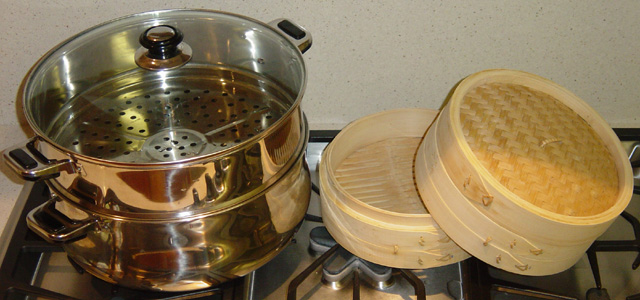
Steaming works by boiling water continuously, causing it to vaporize into steam; the steam then carries heat to the nearby food, thus cooking the food. The food is kept separate from the boiling water but has direct contact with the steam, resulting in a moist texture to the food. This differs from double boiling, in which food is not directly exposed to steam, or pressure cooking, which uses a sealed vessel but is capable of pressure steaming or submerging.
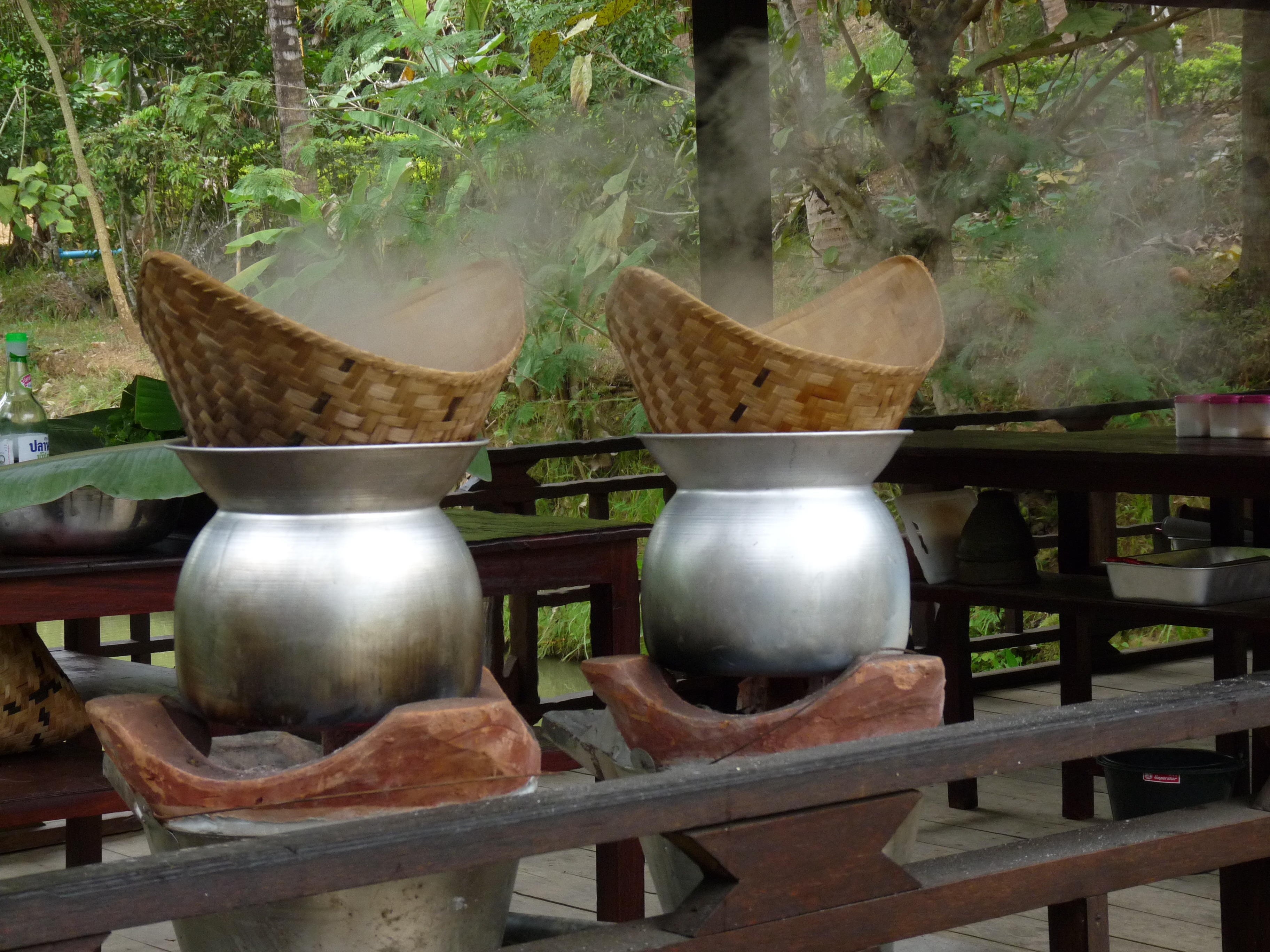
Such cooking is most often done by placing the food in a food steamer, typically a circular container made of metal, wood, or bamboo. The steamer usually has a lid that is placed on top of the container during cooking to allow the steam to cook through the food. When a steamer is unavailable, food can be steamed inside a wok, supported over boiling water in the bottom of the wok by a metal frame. Some modern home microwave ovens include a structure to cook food with steam vapor produced in a separate water container, providing a similar result to being cooked on a stove. There are also specialized steam ovens available. File:Steam glutinous rice with simple japanese hearth,Katori-city,Japan.JPG|A simple hearth with a metal pan holding two wooden steaming vessels and a wooden lid used in Japan File:Steaming frozen food 1.jpg|A makeshift steaming vessel with lid removed; a frozen dish is placed on a metal frame in a single handled wok with water.
Steamed foods
In Japan, glutinous rice is steamed to prepare mochi rice cakes. Traditional Japanese sweets or wagashi making involves steaming rice or wheat dough for making mochigashi and manju.

In Western cooking, steaming is most often used to cook vegetablesit is rarely used to cook meats. However, steamed clams are prepared by steaming. With Chinese cuisine, vegetables are usually stir fried or blanched and seldom steamed. Seafood and meat dishes are steamed. For example: Steamed whole fish, steamed crab, steamed pork spare ribs, steamed ground pork or beef, steamed chicken and steamed goose.
Rice can be steamed too, although in Chinese cooking this is simply referred to as "cooking" rather than "steaming". In Thailand steaming is the definition of minimalist cooking. Wheat foods are steamed as well. Examples include buns and Chinese steamed cakes. Similarly, in Mexican and Central American cuisine, tamales are made by steaming a dough made from nixtamalized maize (called masa) in wrappers made from corn husks or banana leaves; the dough can be stuffed or left plain.
Steamed meat dishes (except fish and some dim sum) are less common in Chinese restaurants than in traditional home cooking, because meats usually require longer cooking times to steam than to stir fry. Commercially sold frozen foods (such as dim sum) formerly had instructions to reheat by steaming, until the rise in popularity of home microwave ovens, which have considerably shorter cooking times.
Chinese dishes
Staple foods
- Mantou, steamed buns
- Wotou, Chinese cornbread
Dim sum
- Siu mai, meat dumplings
- Har gao, shrimp dumplings
- Baozi, filled buns
- Lion's head meatballs
- Steamed meatballs
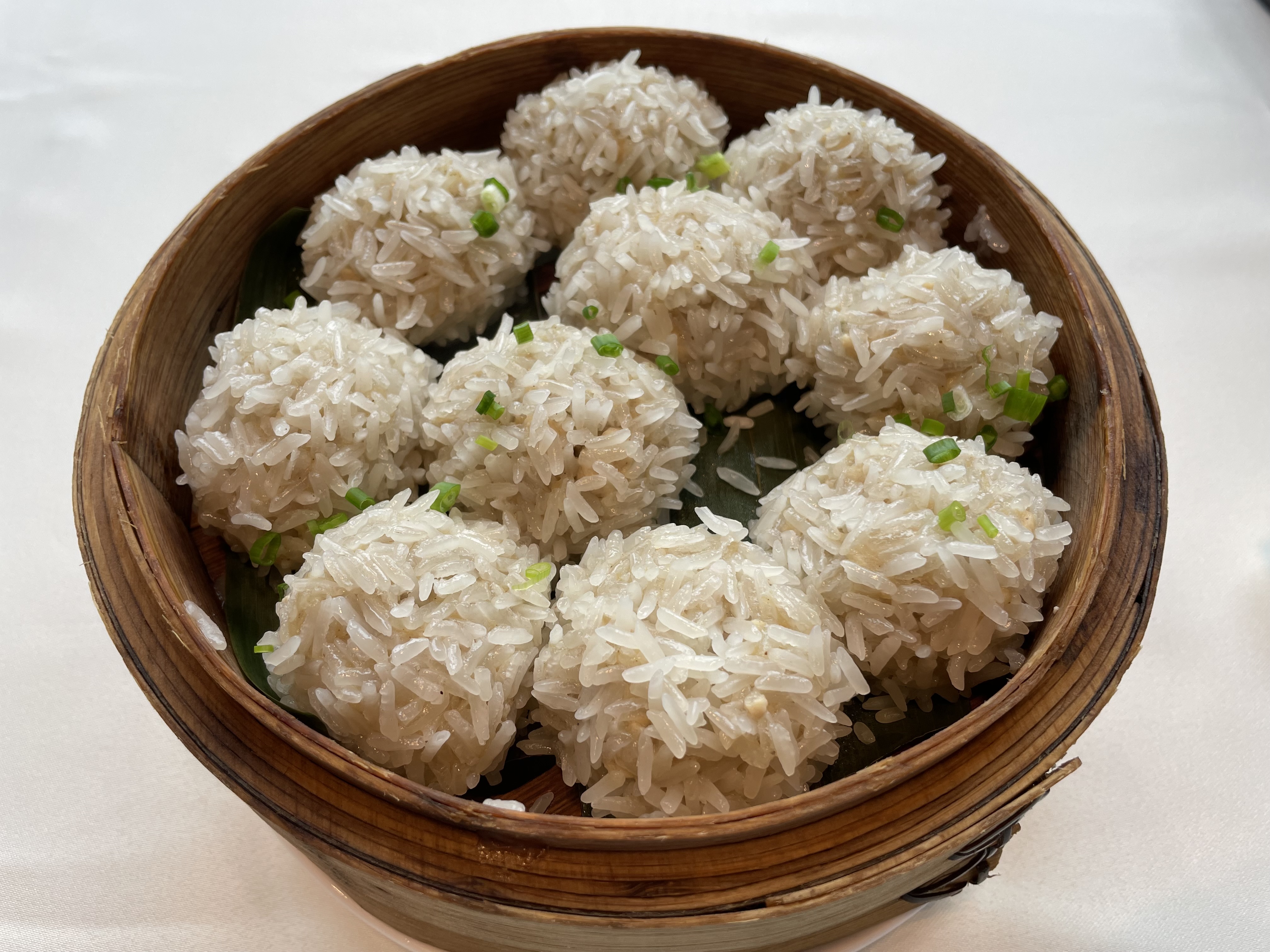
- Pearl meatballs, pork meatballs covered in sticky rice
Rice
- Steamed rice with crab, Fujian cuisine called 蠘飯 (蟳飯)
- Fenzhengrou (粉蒸肉): Steamed pork with rice flour
Seafood
- Fish: Chinese perch, grouper, Japanese black porgy
- Crab: Chinese mitten crab, Shanghai cuisine for the autumn
Soup
- Weitang: Steamed pork rib soup, Jiangxi cuisine
- Buddha Jumps Over the Wall: Fujian cuisine
- Winter Melon Soup: Using a hollowed out and sculpted gourd as a vessel
- Qi Guoji Steamed Chicken Soup: Chicken soup cook in a double steamer, Yunnan cuisine
Sweets
- Double skin milk, said to be made in the 1850s in Daliang in Foshan, Guangdong
- Guilinggao: also known as Turtle Jelly, a jelly-like Chinese medicine, also sold as a dessert
Others
- Chinese steamed eggs similar to custard with local variety of ingredients and vessels.
File:Dim sum.jpg|Variety of dim sum File:Buddha soup2.jpg|Buddha Jumps Over the Wall, or Buddha's Temptation File:Wintermelonsoup.jpg|A small bowl of winter melon soup File:Qi Guoji.jpg|Steamed silkie soup File:Guilinggao.jpg|Turtle jelly
Japanese dishes
-
Glutinous rice. Instead of boiling, glutinous rice is steamed to eat. as it is called, receipts with ingredients and vessel chestnuts (kuri okowa) or wild herbs (sansai okowa) are popular. :*Red rice: served at festive occasions with azuki bean and color agent added to enhance red color. :*Mochi: prepared with steamed rice and kneaded.
-
Chawanmushi: savory egg custard
-
Odamaki-mushi: udon in a cup of chawan-mushi. Osaka specialty.
There are recipes where sauce is added to the main ingredients, aiming to control smell or aroma, or keep moisture to the ingredients.
- Awayukimushi: egg meringue over fish or seafood and keep moisture as well as retain aroma.
- Kaburamushi: grated or shredded turnip covers crabs and fish to keep moisture.
- Sakamushi: add sake to steam sea bream and clams which will reduce fishy smell.
Recipes named after the container.
- Dobin-mushi: matsutake and fish in a pot together with dashi soup.
- Yugama: yuzu citrus is hollowed out into a cup to hold and add zest to the food. :*Sea bream milt steamed in yugama Sweets: steaming is an important process in Japanese sweets making such as manjū, yōkan, uirō, karukan or suama.
File:Chawanmushi by nyaa birdies perch in Yugashima, Shizuoka.jpg|Chawanmushi (foreground) File:Kohaku manju - white bun - march 2014.jpg|Manjū File:Kagami mochi by tamakisono.jpg|Mochi as offering to the deities
Korean dishes
- Gyeran-jjim, a custardy dish
Benefits
Overcooking or burning food is easily avoided when steaming it. Individuals preferring to avoid additional fat intake may prefer steaming to methods which require cooking oil.
A 2007 USDA comparison between steaming and boiling vegetables shows the most affected nutrients are folic acid and vitamin C. When compared to raw consumption, steaming reduces folic acid by 15%, and boiling reduces it by 35%. Steaming reduces vitamin C by 15%, and boiling reduces it by 25%.
Steaming, compared to boiling, showed 42% higher amount of glucosinolates in broccoli cooked for medium firmness. Phenolic compounds with antioxidant properties have been found to retain significantly better through steaming than through boiling or microwaving. Steaming compared to boiling retained β-carotene in carrots. The effect of cooking food may increase or decrease the nutrients.
References
References
- Chen, Cheng-Yih. (1995). "Early Chinese Work in Natural Science". Hong Kong University Press.
- (2001). "Transition from the Palaeolithic to the Jomon Period". The Quaternary Research (Daiyonki-Kenkyu).
- "どんな料 りょうり- 4 理があったのだろうか?".
- (October 7, 2015). "Functional analysis of the Nuragic vascular repertoire.". L’Istituto Italiano di Preistoria e Protostoria.
- Johnson, Rich. (March 1999). "Ancient Steam Pit Cooking". Horizon Publishers.
- (May 20, 2019). "Steaming, the quintessential cooking method in Chinese and modern cuisine". [[Lee Kum Kee.
- Vaculin, Kendra. (2020-06-22). "The Best Steamer Basket for Every Kitchen". [[Epicurious]].
- The Australian Women's Weekly. "Steaming fish in Thai-style". [[Bauer Media Group.
- (25 April 2022). "Steamed Dishes — www.hospemag.me - world's largest hospitality career emag".
- (1998). "[[Kōjien]]". [[Iwanami Shoten]].
- Hiro, Sachiya. (2013-12-27). "本日「いいかげん」日和: そのまんま楽しく生きる一日一話 (Honjitsu iikagen-biyori: sonomanma tanoshiku ikiru ichinichi ichiwa". PHP Kenkyūjo.
- (25 July 1998). "四季日本の料理 秋". [[Kōdansha]].
- (December 1997). "楽しむ釣り魚料理 (Tanoshimu tsurizakana ryōri)". Seitōsha.
- Nutrient Data Laboratory. (December 2007). "USDA Table of Nutrient Retention Factors, Release 6". USDA.
- (September 2014). "Evaluation of Different Cooking Conditions on Broccoli (Brassica oleracea var. italica) to Improve the Nutritional Value and Consumer Acceptance.". Plant Foods for Human Nutrition.
- (November 2003). "Phenolic compound contents in edible parts of broccoli inflorescences after domestic cooking". Journal of the Science of Food and Agriculture.
- (November 2014). "Sensory and health properties of steamed and boiled carrots (Daucus carota ssp. sativus)". International Journal of Food Sciences and Nutrition.
- Sushma Subramanian. (March 31, 2009). "Fact or Fiction: Raw veggies are healthier than cooked ones". Scientific American.
This article was imported from Wikipedia and is available under the Creative Commons Attribution-ShareAlike 4.0 License. Content has been adapted to SurfDoc format. Original contributors can be found on the article history page.
Ask Mako anything about Steaming — get instant answers, deeper analysis, and related topics.
Research with MakoFree with your Surf account
Create a free account to save articles, ask Mako questions, and organize your research.
Sign up freeThis content may have been generated or modified by AI. CloudSurf Software LLC is not responsible for the accuracy, completeness, or reliability of AI-generated content. Always verify important information from primary sources.
Report