From Surf Wiki (app.surf) — the open knowledge base
South African rand
Currency of South Africa

Currency of South Africa
| Field | Value |
|---|---|
| currency_name_in_local | {{collapsible list |
| titlestyle | background:transparent; text-align:left; padding-left:2.5em; |
| liststyle | text-align:center; white-space:nowrap; |
| image_title_1 | south African coins |
| iso_code | ZAR |
| using_countries | ZAFA Common Monetary Area member. |
| NAMA Common Monetary Area member, used alongside Namibian dollar | |
| LSOA Common Monetary Area member, used alongside Lesotho loti | |
| EswatiniA Common Monetary Area member, used alongside Swazi lilangeni | |
| unofficial_users | AGO |
| MWI | |
| ZAM | |
| ZWEAlongside Zimbabwean ZiG. | |
| pegged_by | Namibia Namibian dollar |
| Lesotho Lesotho loti | |
| Eswatini Swazi lilangeni | |
| (at par) | |
| inflation_rate | 2.7% (South Africa only) |
| inflation_method | CPI |
| inflation_source_date | [StatsSA ](https://www.statssa.gov.za/?cat=33), Dec 2024 |
| subunit_ratio_1 | |
| subunit_name_1 | Cent |
| symbol | R |
| plural | rand |
| symbol_subunit_1 | c |
| used_coins | 10c, 20c, 50c, R1, R2, R5 |
| rarely_used_coins | 1 cent, 2 cents (discontinued 2002) and 5 cents (discontinued 2012) |
| coin_article | Coins of the South African rand |
| used_banknotes | R10, R20, R50, R100, R200 |
| issuing_authority | South African Reserve Bank |
| issuing_authority_website | |
| printer | South African Bank Note Company |
| mint | South African Mint |
| mint_website | |
| footnotes |
| 10 other official names: | af | nr | xh | zu | ss | nso | st | tn | ts | ve NAMA Common Monetary Area member, used alongside Namibian dollar LSOA Common Monetary Area member, used alongside Lesotho loti EswatiniA Common Monetary Area member, used alongside Swazi lilangeni MWI ZAM ZWEAlongside Zimbabwean ZiG. Lesotho Lesotho loti Eswatini Swazi lilangeni (at par)
The South African rand, or simply the rand, (sign: R; code: ZAR) is the official currency of South Africa. It is subdivided into 100 cents (sign: "c"), and a comma separates the rand and cents.
The South African rand is legal tender in the Common Monetary Area member states of Namibia, Lesotho, and Eswatini, with these three countries also having national currencies (the dollar, the loti, and the lilangeni respectively) pegged with the rand at parity and still widely accepted as substitutes. The rand was also legal tender in Botswana until 1976, when the pula replaced the rand at par.
The rand is legal tender in Zimbabwe as part of its multiple currency system, which also includes other currencies such as the euro, the pound sterling, the US dollar, and the Zimbabwean ZiG.
Etymology
The rand takes its name from the Witwatersrand ("white waters' ridge" in English, being the Afrikaans and Dutch word for 'ridge'), the ridge upon which Johannesburg is built and where most of South Africa's gold deposits were found. In English, Afrikaans and Dutch, the singular and plural forms of the unit ("rand") are the same: one rand, ten rand, and two million rand.
History
The rand was introduced in the Union of South Africa in 1961, three months before the country declared itself a republic. A Decimal Coinage Commission had been set up in 1956 to consider a move away from the denominations of pounds, shillings, and pence; it submitted its recommendations on 8 August 1958. It replaced the South African pound as legal tender, at the rate of 2 rand to 1 pound, or 10 shillings to the rand. The government introduced a mascot, Decimal Dan, "the rand-cent man" (known in Afrikaans as Daan Desimaal).A General's Story: from an Era of War and Peace , Jannie Geldenhuys, Jonathan Ball, 1995, page 32 This was accompanied by a radio jingle to inform the public about the new currency. Although pronounced in the Afrikaans style as in the jingles when introduced, the contemporary pronunciation in South African English is .
Brief exchange rate history
1961–2000
One rand was worth US$1.40 (R0.72 per dollar) from the time of its inception in 1961 until late 1971, and the U.S. dollar became stronger than the South African currency for the first time on 15 March 1982. Its value thereafter fluctuated as various exchange rate dispensations were implemented by the South African authorities. By the early 1980s, high inflation, mounting political pressure, and sanctions placed against the country due to international opposition to the apartheid system had started to erode its value. The currency broke above parity with the dollar for the first time in March 1982. It continued to trade between R1 and R1.30 to the dollar until June 1984, when the currency's depreciation gained momentum. By February 1985, the currency was trading at over R2 per dollar. In July of that year, authorities suspended all foreign exchange trading for three days in an attempt to halt the currency's depreciation.
By the time that State President P. W. Botha made his Rubicon speech on 15 August 1985, it had weakened to R2.40 per dollar. The currency recovered somewhat between 1986 and 1988, trading near the R2 level usually and breaking beneath it sporadically. The recovery was short-lived; by the end of 1989, the rand was trading at more than R2.50 per dollar.
As it became clear in the early 1990s that the country was destined for Black majority rule and one reform after the other was announced, uncertainty about the country's future hastened the depreciation until the level of R3 to the dollar was breached in November 1992. A host of local and international events influenced the currency after that, most notably the 1994 general election, which had it weaken to over R3.60 to the dollar; the election of Tito Mboweni as the governor of the South African Reserve Bank; and the inauguration of President Thabo Mbeki in 1999, which had it quickly slide to over R6 to the dollar. The controversial land reform programme that was initiated in Zimbabwe, followed by the September 11 attacks, propelled it to its weakest historical level of R13.84 to the dollar in December 2001.
2001–2011
This sudden depreciation in 2001 led to a formal investigation and a dramatic recovery. By the end of 2002, the currency was trading under R9 for the dollar again, and by the end of 2004, it was trading under R5.70. The currency softened somewhat in 2005, trading around R6.35 to the dollar at the end of the year. At the start of 2006, however, the currency resumed its rally and, on 19 January 2006, was trading under R6 to the dollar again. However, the rand weakened significantly during the second and third quarters of 2006 (i.e., April through September).
In sterling terms, it fell from around 9.5% to just over 7%, losing some 25% of its international trade-weighted value in six months. In late 2007, the rand rallied modestly to just over 8%, only to experience a precipitous slide during the first quarter of 2008.
This downward slide could be attributed to a range of factors: South Africa's worsening current account deficit, which widened to a 36‑year high of 7.3% of gross domestic product (GDP) in 2007; inflation at a five-year high of just under 9%; escalating global risk aversion as investors' concerns over the spreading impact of the subprime crisis grew; and a general flight to "safe havens," away from the perceived risks of emerging markets. The rand depreciation was exacerbated by the Eskom electricity crisis, which arose from the utility's inability to meet the country's rapidly growing energy demands.
2012–present
A stalled mining industry in late 2012 led to new lows in early 2013.{{cite web
From 9 to 13 December 2015, over four days, the rand dropped over 10% due to what some suspected was President Jacob Zuma's surprise announcement that he would be replacing the Finance Minister Nhlanhla Nene with the little-known David van Rooyen. The rapid decline in value stemmed from when Zuma backtracked and announced that the better-known previous Minister of Finance, Pravin Gordhan, would instead be appointed to the post. Zuma's surprise sacking of Nene damaged international confidence in the rand, and the exchange rate was volatile throughout much of January 2016 and reached an all-time low of R17.9169 to the US dollar on 9 January 2016 before rebounding to R16.57 later the same day.
The January drop in value was also partly caused by Japanese retail investors cutting their losses in the currency to look for higher-yield investments elsewhere and due to concerns over the impact of the economic slowdown in China, South Africa's largest export market. By mid-January, economists were speculating that the rand could expect to see further volatility for the rest of 2016. By 29 April, it reached its highest performance over the previous five months, exchanging at a rate of R14.16 to the United States dollar.
Following the United Kingdom voting to leave the European Union, the rand dropped in value over 8% against the US$ on 24 June 2016, the currency's largest single-day decline since the 2008 economic crash. This was partly due to a general global financial retreat from currencies seen as risky to the US dollar and partly due to concerns over how British withdrawal from the EU would impact the South African economy and trade relations.
In April 2017, a Reuters poll estimated that the rand would remain relatively stable for the rest of the year, as two polls found that analysts had already factored in a possible downgrade to "junk" status. At the time, Moody's rated South Africa two notches above junk status.{{cite web
In October 2022, the rand sank to its lowest point in two years, reaching R18.46 to the US dollar on 25 October 2022. The rand has never suffered from much inflation compared to other African currencies, with the same value as other currencies such as the Euro, US dollar and Renminbi since 2016. The rand began appreciating in value in 2024 compared to the USD, and it remained stable.
Coins
Main article: Coins of the South African rand

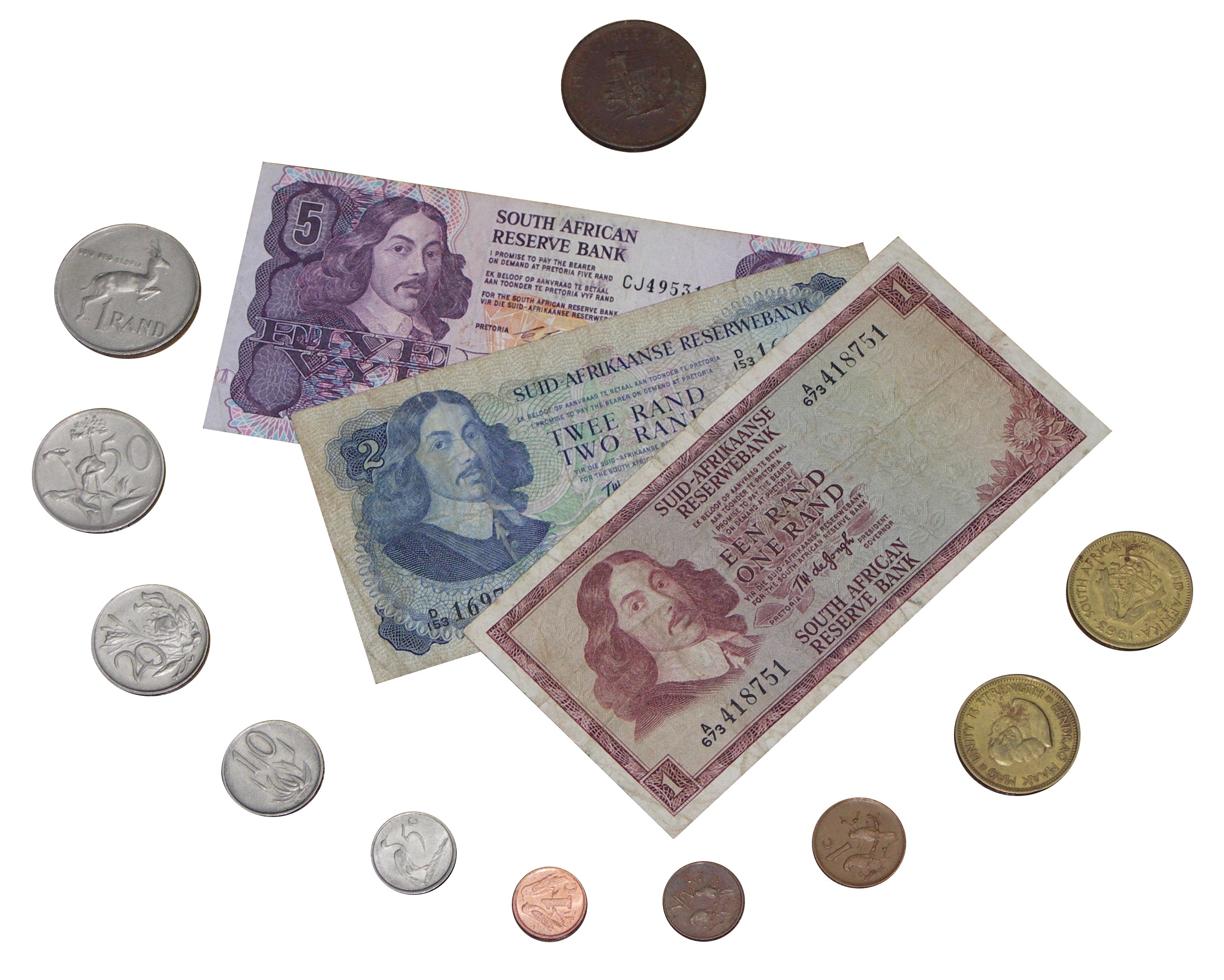
Coins were introduced in 1961 in denominations of , 1, , 5, 10, 20, and 50 cents. In 1965, the introduction of 2-cent coins replaced the cent coins. The cent coin was last struck for circulation in 1973. The 1 rand coin for circulation was introduced in 1967, followed by 2 rand coins in 1989 and 5 rand coins in 1994. Production of the 1- and 2-cent coins was discontinued in 2002, followed by 5-cent coins in 2012, primarily due to inflation having devalued them, but they remain legal tender. Shops normally round the total purchase price of goods to the nearest 10 cents.
To curb counterfeiting, a new 5-rand coin was released in August 2004. Security features introduced on the coin include a bimetal design (similar to the €1 and €2 coins, the Thai ฿10 coin, the pre-2018 Philippine ₱10 coin, the British £2 coin, and the Canadian $2 coin), a specially serrated security groove along the rim, and microlettering.
On 3 May 2023, the South African Reserve Bank announced that a new series of coins would be released. These will have the same denominations as the previous series. The 10c will feature an image of the Cape Honey Bee, the 20c the Bitter Aloe, the 50c the Knysna Turaco, the R1 the Springbok, the R2 the King Protea, and the R5 the Southern Right Whale.
Banknotes
The first series of rand banknotes was introduced in 1961 in denominations of 1, 2, 10, and 20 rand, with similar designs and colours to the preceding pound notes to ease the transition. They bore the image of what was believed at the time to be Jan van Riebeeck, the first VOC administrator of Cape Town. It was later discovered that the original portrait was not, in fact, Van Riebeeck at all, but a portrait of Bartholomew Vermuyden had been mistaken for Van Riebeeck.
In 1966, a second series of banknotes with designs that moved away from the previous pound notes was released. Notes with 1, 5, and 10 rand denominations were produced with predominantly one colour per note. A smaller 1 rand note with the same design was introduced in 1973, and a 2 rand note was introduced in 1974. The 20 rand denomination from the first series was discontinued. This series continued the practice of offering both an English and an Afrikaans version of each note.
The 1978 series started with denominations of 2, 5, 10, and 20 rand, with a 50 rand introduced in 1984. This series had only one language variant for each denomination of note. The 2, 10, and 50 rand had Afrikaans first, while the 5 and 20 rand had English first. A coin replaced the one-rand note.
.png)
During the 1990s, the banknotes were redesigned to feature images of the Big Five wildlife species. 10, 20, and 50 rand notes were introduced in 1992 & 1993, retaining the colour scheme of the previous issue. Coins were introduced for the 2 and 5 rand, replacing the notes of the previous series, mainly because of the severe wear and tear experienced with low-denomination notes in circulation. In 1994, 100 and 200 rand notes were introduced.
The 2005 series has the same principal design but with additional security features, such as colour-shifting ink on the 50 rand and higher and the EURion constellation. The obverses of all denominations were printed in English, while two other official languages were printed on the reverse, thus using all 11 official languages of South Africa.
In 2010, the South African Reserve Bank and commercial banks withdrew all 1994 series 200-rand banknotes due to relatively high-quality counterfeit notes in circulation.{{cite web |access-date=2010-05-25}}
In 2011, the South African Reserve Bank issued defective 100 rand banknotes that lacked fluorescent printing visible under UV light. In June, the printing of this denomination was moved from the South African Bank Note Company to Crane Currency's Swedish division (Tumba Bruk), which reportedly produced 80 million 100 rand notes. The South African Reserve Bank shredded 3.6 million 100-rand banknotes printed by Crane Currency because they had the same serial numbers as a batch printed by the South African Bank Note Company. In addition, the notes printed in Sweden were not the correct colour and were 1 mm short.
On 11 February 2012, President Jacob Zuma announced that the country would be issuing a new set of banknotes bearing Nelson Mandela's image. They were entered into circulation on 6 November 2012. These contained the same denominations of 10, 20, 50, 100, and 200 rand.
In 2013, the 2012 series was updated with the addition of the EURion constellation to all five denominations. They were entered into circulation on 6 November 2013.
On 18 July 2018, a special commemorative series of banknotes was released in commemoration of the 100th anniversary of Nelson Mandela's birth. This series includes notes of all denominations: 10, 20, 50, 100, and 200 rand. These notes will circulate alongside the existing notes. The notes depict the standard face of Nelson Mandela on the obverse. Still, instead of the Big Five animals on the reverse, they show a younger Mandela with different iconic scenes relating to his legacy. These scenes comprise the rolling hills of the Eastern Cape, featuring Mandela's humble birthplace of Mvezo (10 rand); the home of Mandela in Soweto, where he defined his political life alongside other struggle icons (20 rand); the site where Mandela was captured near Howick, following 17 months in hiding, where a monument to him has been erected (50 rand); the place of Mandela's 27-year imprisonment at Robben Island, showing a pile of quarried limestone (100 rand); and the statue of Mandela at the Union Buildings in remembrance of when he was inaugurated there in 1994 (200 rand).
On 3 May 2023, the South African Reserve Bank announced that a new series of banknotes would retain the image of Nelson Mandela on the obverse while showing the Big 5 in a family depiction on the reverse. This series contains the same denominations of 10, 20, 50, 100, and 200 rand.
First series
| Banknotes of the South African rand (1961 First Issue) | Image | Value | Obverse | Reverse | Colour | Language | Size (mm) |
|---|---|---|---|---|---|---|---|
| 1 rand | Jan van Riebeeck | Lion from coat of arms | Brown | Afrikaans/English, English/Afrikaans | 136×78 | ||
| 2 rand | Blue | 149×84 | |||||
| 10 rand | Jan van Riebeeck's sailing ship | Green | 170×96 | ||||
| 20 rand | Gold mine | Purple | 176×103 |
Second series
| Banknotes of the South African rand (1966 Second Issue) | Image | Value | Obverse | Reverse | Colour | Language | Size (mm) |
|---|---|---|---|---|---|---|---|
| 1 rand | Jan van Riebeeck and protea | Farming and agriculture | Brown | Afrikaans/English, English/Afrikaans | 128×64 | ||
| 120×57 | |||||||
| 2 rand | Jan van Riebeeck, Cape Dutch architecture and vines | Gariep Dam, pylon and maize cob | Blue | 127×63 | |||
| 5 rand | Jan van Riebeeck, Voortrekker Monument and Great Trek | Mining | Purple | 134×70 | |||
| 10 rand | Jan van Riebeeck, Union Buildings and springbok | Jan van Riebeeck's three ships | Green | 140×76 |
Third series
| Banknotes of the South African rand (1978 Third Issue) | Image | Value | Obverse | Reverse | Colour | Language | Size (mm) |
|---|---|---|---|---|---|---|---|
| 2 rand | Jan van Riebeeck and pylon | Sasol coal to oil refinery | Blue | Afrikaans and English | 120×57 | ||
| 5 rand | Jan van Riebeeck and diamonds | Mining and Johannesburg city centre | Purple | 127×63 | |||
| 10 rand | Jan van Riebeeck and protea | Agriculture | Green | 133×70 | |||
| 20 rand | Jan van Riebeeck, Cape Dutch architecture and vines | Jan van Riebeeck's three ships and Coat of Arms of South Africa | Brown | 140×77 | |||
| 50 rand | Jan van Riebeeck and lion | Fauna and flora | Red | 147×83 |
Fourth series
| Banknotes of the South African rand (1992 Fourth Issue "Big Five") | Image | Value | Obverse | Reverse | Colour | Language | Size (mm) |
|---|---|---|---|---|---|---|---|
| 10 rand | Rhinoceros | Agriculture | Green | Afrikaans and English | 128×70 | ||
| 20 rand | Elephants | Mining | Brown | English and Afrikaans | 134×70 | ||
| 50 rand | Lions | Manufacturing | Red | Afrikaans and English | 140×70 | ||
| 100 rand | Cape buffaloes | Tourism | Blue | English and Afrikaans | 146×70 | ||
| 200 rand | Leopards | Transport and communication | Orange | Afrikaans and English | 152×70 |
Fifth series
| Banknotes of the South African rand (2005 Fifth Issue "English & Other Official Languages") | Image | Value | Obverse | Reverse | Colour | Language | Size (mm) |
|---|---|---|---|---|---|---|---|
| 10 rand | Rhinoceros | Agriculture | Green | English, Afrikaans, Swati | 128×70 | ||
| 20 rand | Elephants | Mining | Brown | English, Southern Ndebele, Tswana | 134×70 | ||
| 50 rand | Lions | Manufacturing | Red | English, Venda, Xhosa | 140×70 | ||
| 100 rand | Cape buffaloes | Tourism | Blue | English, Northern Sotho, Tsonga | 146×70 | ||
| 200 rand | Leopards | Transport and communication | Orange | English, Sotho, Zulu | 152×70 |
Sixth series
| Banknotes of the South African rand (2012 Sixth Issue "Nelson Mandela") | Image | Value | Obverse | Reverse | Colour | Language | Size (mm) |
|---|---|---|---|---|---|---|---|
| 10 rand | Nelson Mandela | Rhinoceros | Green | English, Afrikaans, Swati | 128×70 | ||
| 20 rand | Elephant | Brown | English, Southern Ndebele, Tswana | 134×70 | |||
| 50 rand | Lion | Red | English, Venda, Xhosa | 140×70 | |||
| 100 rand | Cape buffalo | Blue | English, Northern Sotho, Tsonga | 146×70 | |||
| 200 rand | Leopard | Orange | English, Sotho, Zulu | 152×70 |
Seventh series
| Banknotes of the South African rand (2018 Seventh Issue "Nelson Mandela Centenary") | Image | Value | Obverse | Reverse | Colour | Language | Size (mm) |
|---|---|---|---|---|---|---|---|
| 10 rand | Nelson Mandela | Young Mandela and his birthplace of Mvezo | Green | English, Afrikaans, Swati | 128×70 | ||
| 20 rand | Young Mandela and his home in Soweto | Brown | English, Southern Ndebele, Tswana | 134×70 | |||
| 50 rand | Young Mandela and the site of his capture near Howick | Red | English, Venda, Xhosa | 140×70 | |||
| 100 rand | Young Mandela and his place of imprisonment at Robben Island | Blue | English, Northern Sotho, Tsonga | 146×70 | |||
| 200 rand | Young Mandela and his statue at the Union Buildings | Orange | English, Sotho, Zulu | 152×70 |
Eighth series
| Banknotes of the South African rand (2023 Eighth Issue "Big 5 Families") | Image | Value | Obverse | Reverse | Colour | Language | Size (mm) |
|---|---|---|---|---|---|---|---|
| 10 rand | Nelson Mandela | Rhinoceros | Green | English, Afrikaans, Swati | 128×70 | ||
| 20 rand | Elephant | Brown | English, Tswana, Ndebele | 134×70 | |||
| 50 rand | Lion | Purple | English, Xhosa, Venda | 140×70 | |||
| 100 rand | Cape buffalo | Blue | English, Sepedi, Tsonga | 146×70 | |||
| 200 rand | Leopard | Orange | English, Zulu, Sotho | 152×70 |
Exchange rate
Note
References
References
- "Summary of Acts Related to Decimal Comma".
- (2012-09-12). "From Van Riebeeck to Madiba". [[News24 (website).
- (29 November 2001). "The Reserve Bank and the Rand: Some historic reflections". Resbank.co.za.
- (10 January 1961). "'Decimal Dan' Sings: Catchy Tune Teaches New Currency". The Spokesman-Review.
- {{YouTube. GQ41bGOQajA
- Elwyn Jenkins. (2007). "Falling Into Place: The Story of Modern South African Place Names". New Africa Books.
- "Exchange Rates Between the UniteDDV South African rand". Measuring Worth.
- "U.S. Dollar to South African Rand Spot Exchange Rates for 1975 to 2020 from the Bank of England".
- (2012-11-06). "Nelson Mandela banknotes issued in South Africa". BBC News.
- Paul Vecchiatto Michael Cohen. (11 January 2016). "Zuma Begins Fightback as South Africa's Rand Gets Hammered". Bloomberg.
- (11 January 2016). "Africa Hit by China's Woes". Wall Street Journal.
- Candice Zachariahs. (11 January 2016). "Why the rand will face more manic Mondays after plunging 9%". Fin24.
- Candice Zachariahs. (11 January 2016). "Rand sinks most in 7 years as traders fret over China, liquidity". Fin24.
- "NOTICIAS - Prensa Latina". Prensa-latina.cu.
- "Rand slumps more than 8% against dollar {{!}} IOL".
- "Brexit vote shocker sends global markets into tailspin".
- Kuo, Lily. (24 June 2016). "Brexit will be terrible for Africa's largest economies".
- Kumwenda-Mtambo, Olivia. (9 October 2017). "South Africa's rand recovers after hitting a 6-month low".
- (25 October 2022). "Rand nears weakest point in two years as load shedding continues". The Citizen.
- (21 December 2023). "Most Stable Currencies in Africa | FXOpen".
- October 2019, Linda Kallis-10. "Allan Gray | Making sense of the rand".
- Sunday, Chinomso. (6 March 2025). "Rand Strengthens While Markets React to Trump's Policies".
- (4 March 2025). "South African rand stable as markets digest Trump tariffs". Reuters.
- "One Cent (1c)". [[South African Mint]].
- "Two Cent (2c)". [[South African Mint]].
- (2011-11-24). "5 cent coin to be discontinued". South African Government Information.
- "South African currency". [[South African Reserve Bank]].
- (28 July 2004). "South Africa's new R5 coin". SouthAfrica.info.
- (3 May 2023). "The South African Reserve Bank (SARB) released the upgraded Mandela banknotes and fourth decimal coin series on 3 May 2023.". South African Reserve Bank.
- (3 May 2023). "Coins". South African Reserve Bank.
- (8 January 2015). "So whose face was on old SA money?".
- "Portrait of a Man, thought to be Bartholomeus Vermuyden (1616/17-1650), Dirck Craey, 1650". Rijksmuseum.
- (2010-12-05). "South Africa faulty 100-rand notes reported | Africa". BanknoteNews.com.
- (2012-05-20). "South Africa shreds 3.6 million defective 100-rand notes | Africa". BanknoteNews.com.
- (11 February 2012). "Nelson Mandela banknotes to be issued by South Africa". BBC.
- "Announcement of the Introduction of a New Note Series". Resbank.co.za.
- (6 November 2012). "Nelson Mandela banknotes issued in South Africa". BBC News.
- (6 November 2013). "South Africa new banknotes with Omron rings reported". BankNote News.
- (11 February 2018). "New bank notes to honour Nelson Mandela's centenary". BusinessTech.
- (13 June 2018). "This is what South Africa's new Mandela bank notes look like". BusinessTech.
- (13 July 2018). "PICS: New Nelson Mandela banknotes launched". IOL.
- (14 July 2018). "#Madiba100 commemorative notes and coin have a new look and feel". IOL.
- Wirz, Heinz. ''Dr Heinz Wirz on the Bank Notes of South Africa. Volume II - The South African rand (7th ed.)''.
- "My Currency Collection: South Africa Currency 1 Rand banknote 1965 Jan van Riebeeck".
- "My Currency Collection: South African Currency 2 Rand banknote 1965 Jan van Riebeeck".
- "My Currency Collection: South Africa Currency 10 Rand banknote 1961 Jan van Riebeeck".
- "My Currency Collection: South African Currency 20 Rand banknote 1962 Jan van Riebeeck".
- "My Currency Collection: South Africa Currency 1 Rand banknote 1967 Jan van Riebeeck".
- "My Currency Collection: South African Currency 5 Rand banknote 1967 Jan van Riebeeck".
- "My Currency Collection: South Africa Currency 10 Rand banknote 1967 Jan van Riebeeck".
- "My Currency Collection: South African Currency 2 Rand banknote 1978 Jan van Riebeeck".
- "My Currency Collection: South Africa Currency 5 Rand banknote 1978 Jan van Riebeeck".
- "My Currency Collection: South African Currency 10 Rand banknote 1978 Jan van Riebeeck".
- "My Currency Collection: South Africa Currency 20 Rand banknote 1990 Jan van Riebeeck".
- "My Currency Collection: South African Currency 50 Rand banknote 1984 Jan van Riebeeck".
- "Banknotes". Where's My Moola.
- "My Currency Collection: South Africa Currency 10 Rand banknote 1999 White Rhinoceros".
- "My Currency Collection: South African Currency 20 Rand banknote 1993 African Savanna Elephant".
- "My Currency Collection: South Africa Currency 50 Rand banknote 1992 Transvaal Lion".
- "My Currency Collection: South African Currency 100 Rand banknote 1999 Cape Buffalo".
- "My Currency Collection: South Africa Currency 200 Rand banknote 1994 African leopard".
- "My Currency Collection: South African Currency 10 Rand banknote 2005 White Rhino".
- "My Currency Collection: South Africa Currency 20 Rand banknote 2005 African Bush Elephant".
- "My Currency Collection: South African Currency 50 Rand banknote 2005 Transvaal Lion".
- "My Currency Collection: South Africa Currency 100 Rand banknote 2005 African Buffalo".
- "My Currency Collection: South African Currency 200 Rand banknote 2005 African Leopard".
- "My Currency Collection: South Africa Currency 10 Rand banknote 2012 President Nelson Mandela".
- "My Currency Collection: South African Currency 20 Rand banknote 2012 President Nelson Mandela".
- "My Currency Collection: South Africa Currency 50 Rand banknote 2012 President Nelson Mandela".
- "My Currency Collection: South African Currency 100 Rand banknote 2012 President Nelson Mandela".
- "My Currency Collection: South Africa Currency 200 Rand banknote 2013 President Nelson Mandela".
- "My Currency Collection: South African Currency 10 Rand Commemorative banknote 2018 Nelson Mandela Centenary".
- "My Currency Collection: South Africa Currency 20 Rand Commemorative banknote 2018 Nelson Mandela Centenary".
- "My Currency Collection: South African Currency 50 Rand Commemorative banknote 2018 Nelson Mandela Centenary".
- "My Currency Collection: South Africa Currency 100 Rand Commemorative banknote 2018 Nelson Mandela Centenary".
- "My Currency Collection: South African Currency 200 Rand Commemorative banknote 2018 Nelson Mandela Centenary".
- "Banknotes". South African Reserve Bank.
This article was imported from Wikipedia and is available under the Creative Commons Attribution-ShareAlike 4.0 License. Content has been adapted to SurfDoc format. Original contributors can be found on the article history page.
Ask Mako anything about South African rand — get instant answers, deeper analysis, and related topics.
Research with MakoFree with your Surf account
Create a free account to save articles, ask Mako questions, and organize your research.
Sign up freeThis content may have been generated or modified by AI. CloudSurf Software LLC is not responsible for the accuracy, completeness, or reliability of AI-generated content. Always verify important information from primary sources.
Report