From Surf Wiki (app.surf) — the open knowledge base
1994 South African general election
First South African election held under nonracial, universal suffrage

First South African election held under nonracial, universal suffrage
| Field | Value |
|---|---|
| country | South Africa |
| flag_year | 1994 |
| type | parliamentary |
| previous_election | 1989 South African general election |
| previous_year | 1989 |
| election_date | 26–29 April 1994 |
| next_election | 1999 South African general election |
| next_year | 1999 |
| elected_members | List of National Assembly members of the 22nd Parliament of South Africa |
| seats_for_election | All 400 seats in the National Assembly |
| majority_seats | 201 |
| image_size | 130x130px |
| image1 | |
| leader1 | Nelson Mandela |
| party1 | African National Congress |
| last_election1 | *Banned party* |
| seats1 | **252** |
| seat_change1 | *New party* |
| popular_vote1 | **12,237,655** |
| percentage1 | **62.65%** |
| swing1 | *New party* |
| image2 | |
| leader2 | F. W. de Klerk |
| party2 | NP |
| last_election2 | 48.19%, 94 seats |
| seats2 | 82 |
| seat_change2 | 12 |
| popular_vote2 | 3,983,690 |
| percentage2 | 20.39% |
| swing2 | 27.80pp |
| image3 | |
| leader3 | Mangosuthu Buthelezi |
| party3 | Inkatha Freedom Party |
| last_election3 | *Did not exist* |
| seats3 | 43 |
| seat_change3 | *New party* |
| popular_vote3 | 2,058,294 |
| percentage3 | 10.54% |
| swing3 | *New party* |
| image4 | |
| leader4 | Constand Viljoen |
| party4 | Freedom Front (South Africa) |
| last_election4 | *Did not exist* |
| seats4 | 9 |
| seat_change4 | *New party* |
| popular_vote4 | 424,555 |
| percentage4 | 2.17% |
| swing4 | *New party* |
| image5 | |
| leader5 | Zach de Beer |
| party5 | DP |
| last_election5 | 20.00%, 33 seats |
| seats5 | 7 |
| seat_change5 | 26 |
| popular_vote5 | 338,426 |
| percentage5 | 1.73% |
| swing5 | 18.27pp |
| image6 | |
| leader6 | Clarence Makwetu |
| party6 | Pan Africanist Congress of Azania |
| last_election6 | *Banned party* |
| seats6 | 5 |
| seat_change6 | *New party* |
| popular_vote6 | 243,478 |
| percentage6 | 1.25% |
| swing6 | *New party* |
| map_image | 1994 South African general election.svg |
| map_size | 402px |
| title | State President |
| before_election | F. W. de Klerk |
| before_party | NP |
| posttitle | Elected President |
| after_election | Nelson Mandela |
| after_party | African National Congress |
General elections were held in South Africa between 26 and 29 April 1994. The elections were the first in South Africa in which citizens of all races could vote, bringing an end to the herrenvolk democracy that had existed since the 1950s and marking the country's first election under universal suffrage. The election was conducted under the direction of the Independent Electoral Commission (IEC), and marked the culmination of the four-year process that ended apartheid.
Millions queued in lines over a four-day voting period. Altogether, 19,726,579 votes were counted, and 193,081 were rejected as invalid. As widely expected, the African National Congress (ANC), whose slate incorporated the labour confederation COSATU and the South African Communist Party (SACP), won a landslide victory, taking 62 percent of the vote, just short of the supermajority required to unilaterally amend the Interim Constitution.
As required by that document, the ANC formed a Government of National Unity with the National Party (NP) and the Inkatha Freedom Party (IFP), the two other parties that won more than 20 seats in the National Assembly. The governing NP polled just over 20%, and was thus eligible for a post of Vice President to incumbent president De Klerk. The new National Assembly's first act was to elect Nelson Mandela as President, making him the country's first black chief executive. He then appointed the Cabinet of Nelson Mandela. The date 27 April is now a public holiday in South Africa, Freedom Day.
Background
Apartheid
In 1948, the newly elected National Party government in South Africa began to institute apartheid, an institutionalized system of racial segregation that placed sociopolitical dominance in the hands of the European-descended white minority. Under the Population Registration Act, 1950, all South Africans were categorised by the government as White, Black, Coloured (mixed) or Indian. Suffrage was reserved for Whites, interracial sexual relationships were forbidden and over 80% of the country's land was reserved for the white minority. Members of the Black majority were stripped of citizenship under the Bantu Homelands Citizenship Act, 1970, and were instead made citizens of one of the country's "bantustans", territories reserved for various black ethnic groups. The South African government faced international condemnation against the backdrop of the decolonisation of Africa, and by the 1980s, the state was struggling with major internal political violence, a war of independence in Namibia and intervention in Angola and a failing economy burdened by international sanctions and the heavy costs of national security, effectively forcing the government to move towards political reform.
In 1983, P. W. Botha's government approved a new constitution, which implemented a Tricameral Parliament, with additional houses representing the Coloured and Indian populations. However, Blacks remained unrepresented in parliament, with political representation only existing under the bantustan system. Anti-apartheid groups opposed to the Tricameral Parliament instead reorganized under the umbrella of the United Democratic Front. The 1984 election to the non-white houses of parliament also faced widespread boycotts from Indian and Coloured voters. In 1985, the government introduced a sweeping state of emergency in response to growing civil unrest, which included sweeping restrictions on freedom of movement, freedom of speech and freedom of the press, particularly for non-White South Africans. In 1989, F. W. de Klerk was elected State President of South Africa, succeeding Botha. On 2 February 1990, de Klerk made a speech at the opening of Parliament in Cape Town, in which he unexpectedly announced his intention to unban anti-apartheid groups such as the ANC, SACP and the Pan Africanist Congress of Azania (PAC), to release political prisoners such as ANC leader Nelson Mandela and requested a process of negotiation with the anti-apartheid opposition. On 11 February, Mandela was released from Victor Verster Prison in Cape Town, after 27 years of incarceration.
Political transition
Formal negotiations between the ANC and the government were initially scheduled to begin on 11 April 1990. However on 26 March, police opened fire on protestors in the township of Sebokeng, killing 11 people. Consequently, the ANC cancelled the talks, and negotiations were only rescheduled for 2–4 May following an emergency meeting between Mandela and de Klerk. The "talks about talks" were held at the Groote Schuur presidential estate, and were intended to discuss terms before more substantive constitutional negotiations could begin. The parties jointly agreed to aim to end political violence, and to establish a joint working group. On 6 August, the government and ANC issued a further joint declaration, known as the Pretoria Minute, in which the ANC and its armed wing, uMkhonto weSizwe (MK) agreed to the suspension of armed activities, in exchange for the government lifting of the State of Emergency (then only active in Natal Province), further release of political prisoners from September 1990, and a review of certain provisions of the Internal Security Act. On 14 September 1991, 24 organisations signed the National Peace Accord, which included a code of conduct for political parties and security forces, and structures for the resolution of political conflict, such as the Goldstone Commission.
On 30 November 1991, 19 organisations announced that the first meeting of the Convention for a Democratic South Africa (CODESA) would be held in Johannesburg on 20 and 21 December 1991, in order to discuss constitutional arrangements. The CODESA 1 plenary session saw all participating groups, except for the Inkatha Freedom Party (IFP) and the government of the Bophuthatswana homeland, agree to a declaration of intent on establishing a united South Africa with common citizenship for all racial groups, and to promote peaceful political participation so that constitutional change could be advanced. Working groups were established with the aim of forming a constitution-making body, deciding the future of the bantustans, and establishing an interim government within a set time frame. CODESA 1 was not attended by the PAC, Conservative Party (CP) or Azanian People's Organisation (AZAPO). Around the same time, de Klerk's National Party government faced a series of whites-only by-election losses, leading his government to hold a referendum on 17 March 1992 on the continuation of the negotiation process. The NP and Democratic Party campaigned for a "Yes" vote, while the CP supported the "No" vote. The referendum produced a landslide victory for the government, with 68.3% of voters voting "Yes" for the process to end the apartheid system.
The second session, CODESA 2, convened at the Kempton Park World Trade Centre on 25 May 1992. The session collapsed following a deadlock on constitutional issues between the ANC and NP. In response to the failure of negotiations, the ANC announced a campaign of "rolling mass action", encompassing public protests and strikes in order to pressure the government to meet its demands. On 23 June, the ANC announced the suspension of talks after alleging government complicity in a 17 June massacre against residents of the township of Boipatong by supporters of the Inkatha Freedom Party. On 7 September, ANC supporters, marching against the government of Oupa Gqozo in the homeland of Ciskei, were opened fire on by the Ciskei Defence Force in the homeland's capital, Bhisho, killing 29 people. Despite the massacre often being cited as the impetus for a return to negotiations, the aftermath saw an escalation of political violence in Ciskei.
While negotiations between the ANC and NP had been suspended, unofficial talks were continued from June 1992 without authorization between Cyril Ramaphosa of the ANC and Roelf Meyer of the NP. The talks culminated in the official Record of Understanding between the ANC and the government on the 26 September, recognizing agreements reached between the two in meetings. On 1-2 April 1993, a new multilateral conference, the Multiparty Negotiating Process, was first attended at Kempton Park by 26 different organizations. The only significant absent groups were AZAPO and some Afrikaner nationalist organizations.
In October 1992, the IFP initiated the formation of the Concerned South Africans Group (COSAG) alongside the bantustan governments of Bophuthatswana and Ciskei and the white pro-apartheid Conservative Party, in protest at its alleged sidelining during the negotiation process, and in order to ensure its representation among factions other than the national government and the anti-apartheid opposition. In June 1993, the IFP walked out from the MPNF in protest at the mechanism being used to determine the upcoming election date. Bophuthatswana and Ciskei continued participation until withdrawing in October, upon which COSAG was replaced with the Freedom Alliance, incorporating additional far-right elements. On 17 November 1993, an MPNF plenary meeting endorsed an interim constitution, under which non-racial elections were due to be held on 27 April 1994.
Political violence
Prior to the political transition, South Africa suffered from serious internal political violence, which intensified following the government's announcement of the negotiation process in 1990. Political violence was perpetrated by various actors, including the state, anti-apartheid groups, bantustan authorities, Zulu supporters of the Inkatha Freedom Party and pro-apartheid white supremacist groups.
Conduct
After initially announcing a boycott due to constitutional disagreements, the Inkatha Freedom Party (IFP) reversed its decision on 19 April, days before the election. It was added to the already-printed ballot papers by means of a sticker. In rural areas with limited infrastructure, people queued "for days" in order to vote.
The Afrikaner nationalist and pro-apartheid Conservative Party, the official opposition in the outgoing National Assembly, did not contest the elections. The similarly aligned Herstigte Nasionale Party, which had run in the white-only elections in 1989 also chose not to run.
Results
National Assembly
The 400 members of the National Assembly were chosen from party lists in proportion to each party's share of the national ballot.
Senate
The 90 members of the Senate were chosen, 10 from each province, by the newly elected provincial legislatures. Each province's Senate seats were allocated in proportion to the parties' representation in the provincial legislature.
| Party | Sum of votes in the Provincial elections | Seats in the Senate | Votes | % | EC | FS | G | KZN | M | NW | NC | NP | WC | *Total* | Total | 10 | 10 | 10 | 10 | 10 | 10 | 10 | 10 | 10 | *90* | |
|---|---|---|---|---|---|---|---|---|---|---|---|---|---|---|---|---|---|---|---|---|---|---|---|---|---|---|
| African National Congress}} | African National Congress | 12,137,307 | 62.29 | 9 | 8 | 6 | 3 | 8 | 8 | 5 | 10 | 3 | *60* | |||||||||||||
| National Party (South Africa)}} | National Party | 3,492,467 | 17.92 | 1 | 1 | 2 | 1 | 1 | 1 | 4 | 6 | *17* | ||||||||||||||
| Inkatha Freedom Party}} | Inkatha Freedom Party | 2,047,083 | 10.51 | 5 | *5* | |||||||||||||||||||||
| Freedom Front}} | Freedom Front | 639,643 | 3.28 | 1 | 1 | 1 | 1 | 1 | *5* | |||||||||||||||||
| Democratic Party (South Africa)}} | Democratic Party | 538,655 | 2.76 | 1 | 1 | 1 | *3* | |||||||||||||||||||
| Source: Constitution of South Africa |
In 1997, on the adoption of the final Constitution, the Senate became the National Council of Provinces; its political makeup remained the same, but members were divided into permanent and special delegates, as described in the following table.
| Party | Delegate type | EC | FS | G | KZN | M | NW | NC | NP | WC | *Total* | Total | 10 | 10 | 10 | 10 | 10 | 10 | 10 | 10 | 10 | *90* | |
|---|---|---|---|---|---|---|---|---|---|---|---|---|---|---|---|---|---|---|---|---|---|---|---|
| African National Congress}} rowspan=2 | African National Congress | Permanent | 5 | 4 | 3 | 1 | 4 | 4 | 3 | 6 | 2 | *32* | *60* | ||||||||||
| Special | 4 | 4 | 3 | 2 | 4 | 4 | 2 | 4 | 1 | *28* | |||||||||||||
| National Party (South Africa)}} rowspan=2 | National Party | Permanent | 1 | 1 | 1 | 1 | 1 | 1 | 2 | 3 | *11* | *17* | |||||||||||
| Special | 1 | 2 | 3 | *6* | |||||||||||||||||||
| Inkatha Freedom Party}} rowspan=2 | Inkatha Freedom Party | Permanent | 3 | *3* | *5* | ||||||||||||||||||
| Special | 2 | *2* | |||||||||||||||||||||
| Freedom Front}} | Freedom Front | Permanent | 1 | 1 | 1 | 1 | 1 | *5* | |||||||||||||||
| Democratic Party (South Africa)}} | Democratic Party | Permanent | 1 | 1 | 1 | *3* | |||||||||||||||||
| Source: Constitution of South Africa |
Provincial legislature results
Members of the provincial legislatures were elected from party lists in proportion to each party's share of the provincial ballot.
| Party | Votes | % | EC | FS | G | KZN | M | NW | NC | NP | WC | *Total* |
|---|---|---|---|---|---|---|---|---|---|---|---|---|
| 12,137,307 | 62.29 | **48** | **24** | **50** | 26 | **25** | **26** | **15** | **38** | 14 | ***266*** | |
| 3,492,467 | 17.92 | 6 | 4 | 21 | 9 | 3 | 3 | 12 | 1 | **23** | *82* | |
| 2,047,083 | 10.51 | 0 | 0 | 3 | **41** | 0 | 0 | 0 | 0 | 0 | *44* | |
| 639,643 | 3.28 | 0 | 2 | 5 | 0 | 2 | 1 | 2 | 1 | 1 | *14* | |
| 538,655 | 2.76 | 1 | 0 | 5 | 2 | 0 | 0 | 1 | 0 | 3 | *12* | |
| 271,793 | 1.39 | 1 | 0 | 1 | 1 | 0 | 0 | 0 | 0 | 0 | *3* | |
| 117,825 | 0.60 | 0 | 0 | 1 | 1 | 0 | 0 | 0 | 0 | 1 | *3* | |
| 51,773 | 0.27 | 0 | 0 | 0 | 0 | 0 | 0 | 0 | 0 | 0 | *0* | |
| 48,951 | 0.25 | 0 | 0 | 0 | 1 | 0 | 0 | 0 | 0 | 0 | *1* | |
| 34,233 | 0.18 | 0 | 0 | 0 | 0 | 0 | 0 | 0 | 0 | 0 | *0* | |
| 21,877 | 0.11 | 0 | 0 | 0 | 0 | 0 | 0 | 0 | 0 | 0 | *0* | |
| 16,762 | 0.09 | 0 | 0 | 0 | 0 | 0 | 0 | 0 | 0 | 0 | *0* | |
| 16,279 | 0.08 | 0 | 0 | 0 | 0 | 0 | 0 | 0 | 0 | 0 | *0* | |
| 10,123 | 0.05 | 0 | 0 | 0 | 0 | 0 | 0 | 0 | 0 | 0 | *0* | |
| 8,238 | 0.04 | 0 | 0 | 0 | 0 | 0 | 0 | 0 | 0 | 0 | *0* | |
| 7,279 | 0.04 | 0 | 0 | 0 | 0 | 0 | 0 | 0 | 0 | 0 | *0* | |
| 6,337 | 0.03 | 0 | 0 | 0 | 0 | 0 | 0 | 0 | 0 | 0 | *0* | |
| 5,481 | 0.03 | 0 | 0 | 0 | 0 | 0 | 0 | 0 | 0 | 0 | *0* | |
| 5,423 | 0.03 | 0 | 0 | 0 | 0 | 0 | 0 | 0 | 0 | 0 | *0* | |
| 2,641 | 0.01 | 0 | 0 | 0 | 0 | 0 | 0 | 0 | 0 | 0 | *0* | |
| 2,611 | 0.01 | 0 | 0 | 0 | 0 | 0 | 0 | 0 | 0 | 0 | *0* | |
| 2,028 | 0.01 | 0 | 0 | 0 | 0 | 0 | 0 | 0 | 0 | 0 | *0* | |
| 921 | 0.00 | 0 | 0 | 0 | 0 | 0 | 0 | 0 | 0 | 0 | *0* | |
| Total | 19,485,730 | 100.00 | 56 | 30 | 86 | 81 | 30 | 30 | 30 | 40 | 42 | *425* |
| Valid votes | 19,485,730 | 99.25 | ||||||||||
| Invalid/blank votes | 147,841 | 0.75 | ||||||||||
| Total votes | 19,633,571 | 100.00 |
Eastern Cape
Free State
Gauteng
KwaZulu/Natal
Mpumalanga
North-West
Northern Cape
Limpopo
Western Cape
Legacy
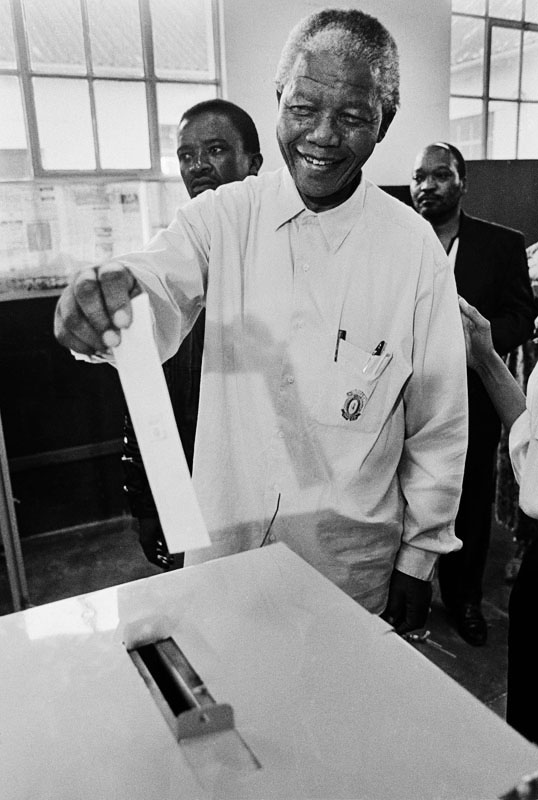
Following the elections, 27 April subsequently became a national public holiday, Freedom Day.
In a Sunday Independent article on the 20th anniversary of the election, Steven Friedman, who headed the IEC's information analysis department during the election, stated that the lack of a voters roll made verifying the results of the election difficult, and there were widespread accusations of cheating. Friedman characterised the election as a "technical disaster but a political triumph", and intimated that the final results were as a result of a negotiated compromise, rather than being an accurate count of the votes cast, stating that it was impossible to produce an accurate result under the circumstances that the election was held. He wrote that he believed that the result of the election, which gave KwaZulu-Natal to the IFP; gave the National Party 20% of the vote share, and a Deputy President position; and held the ANC back from the two-thirds majority with the ability to unilaterally write the final constitution, helped prevent a civil war.
References
References
- [http://archive.ipu.org/parline-e/reports/arc/2291_94.htm South Africa: Parliamentary Chamber: National Assembly: Elections held in 1994] Inter-Parliamentary Union
- "apartheid".
- "Milestones in the History of U.S. Foreign Relations - The End of Apartheid".
- "Tricameral Parliament Description 2".
- "United Democratic Front (UDF)".
- (2015-07-21). "State of Emergency - 1985".
- "F. W. de Klerk's speech at the opening of Parliament 2 February 1990".
- O'Carroll, Sinead. (2015-02-02). "On this day 25 years ago, the speech that changed South Africa forever".
- Adams, Cydney. (2016-02-11). "Feb. 11th, 1990: Nelson Mandela released from prison".
- "Minutes and Accords between the ANC and the South African Government, May 1990 – February 1991". African National Congress.
- Simpson, Thula. (2009). "Toyi-Toyi-ing to Freedom: The Endgame in the ANCs Armed Struggle, 1989-1990". Journal of Southern African Studies.
- "The National Peace Accord and its Structures".
- "1991".
- "Convention for a Democratic South Africa (CODESA)".
- "THE CONVENTION FOR A DEMOCRATIC SOUTH AFRICA - CODESA 1 and CODESA 2 (1991-1992)".
- Traydon, Robert J.. "The 'often overlooked' sledgehammer that ended apartheid".
- "The Convention for a Democratic South Africa (CODESA): CODESA 2".
- "Events leading to the breakdown of CODESA and the launch of the Rolling Mass Action Campaign".
- Keller, Bill. (1992-06-04). "Mandela, Stunned by Massacre, Pulls Out of Talks on Black Rule".
- Evans, Laura. (2023). "The Bhisho March and Massacre of September 1992: The 'Leipzig Option' and the Meanings of Mass Action in the South African Transition". South African Historical Journal.
- (1998). "Truth and Reconciliation Commission Final Report".
- O'Malley, Padraig. (June 1996). "Ramaphosa and Meyer in Belfast – The South African Experience: How the New South Africa was Negotiated". [[John W. McCormack Graduate School of Policy and Global Studies]].
- (25 November 1992). "Record of Understanding 26 September 1992".
- "THE MULTIPARTY NEGOTIATING PROCESS (1993)".
- "The story of the MPNP".
- Corder, Hugh. (1994). "Towards a South African Constitution". The Modern Law Review.
- (3 February 1992). "Political Violence: 1990". Human Rights and Labour Law Yearbook 1991.
- (2014-04-27). "The bargain that saved us in 1994".
- (1994-04-20). "BUTHELEZI ENDS BOYCOTT OF S. AFRICAN VOTE". Washington Post.
- ''[[s:Constitution of the Republic of South Africa, 1996. Constitution of the Republic of South Africa, 1996]]'', [[s:Constitution of the Republic of South Africa, 1996/Schedule 6. Schedule 6: "Transitional Arrangements"]], item 7.
- "S Africa marks democracy anniversary".
This article was imported from Wikipedia and is available under the Creative Commons Attribution-ShareAlike 4.0 License. Content has been adapted to SurfDoc format. Original contributors can be found on the article history page.
Ask Mako anything about 1994 South African general election — get instant answers, deeper analysis, and related topics.
Research with MakoFree with your Surf account
Create a free account to save articles, ask Mako questions, and organize your research.
Sign up freeThis content may have been generated or modified by AI. CloudSurf Software LLC is not responsible for the accuracy, completeness, or reliability of AI-generated content. Always verify important information from primary sources.
Report