From Surf Wiki (app.surf) — the open knowledge base
South African Navy
Branch of the South African National Defence Force

Branch of the South African National Defence Force
| Field | Value | |||
|---|---|---|---|---|
| unit_name | South African Navy | |||
| native_name | ||||
| image | Emblem of the South African Navy.svg | |||
| image_size | 200px | |||
| start_date | 1st April | |||
| country | South Africa | |||
| type | Navy | |||
| role | Naval warfare | |||
| size | {{plainlist | |||
| command_structure | ||||
| garrison | Saldanha Bay, Simon's Town, Western Cape, South Africa | |||
| colors | Green and white | |||
| equipment | See list | |||
| equipment_label | Fleet | |||
| battle_honours | ||||
| website | http://www.navy.mil.za | |||
| commander1 | President Cyril Ramaphosa | |||
| commander1_label | Commander-in-chief | |||
| commander2 | General Rudzani Maphwanya | |||
| commander2_label | Chief of the SANDF | |||
| commander3 | Vice Admiral Monde Lobese | |||
| commander3_label | Chief of the Navy | |||
| commander4 | Senior Chief Warrant Officer Matee Molefe | |||
| commander4_label | Master at Arms of the Navy | |||
| notable_commanders | Admiral Hugo Biermann, | |||
| <!-- Insignia --> | identification_symbol | [[File:Naval Ensign of South Africa.svg | 150px | border]] |
| identification_symbol_label | Ensign | |||
| identification_symbol_2 | [[File:Flag of South Africa.svg | 150px]] | ||
| identification_symbol_2_label | Jack |
- 6,816 active personnel
- 1,071 reserve personnel Vice Admiral Refiloe Johannes Mudimu
The South African Navy (SA Navy) is the naval warfare branch of the South African National Defence Force.
The Navy is primarily engaged in maintaining a conventional military deterrent, participating in counter-piracy operations, fishery protection, search and rescue, and upholding maritime law enforcement for the benefit of South Africa and its international partners.
Today the South African Navy is one of the most capable naval forces in the African region, operating a mixed force of sophisticated warships, submarines, patrol craft, and auxiliary vessels, with over 7,000 personnel; including a marine force.
With formerly deep historical and political connections to the United Kingdom, the first emergence of a naval organisation was the creation of the South African Division of the British Royal Naval Volunteer Reserve in 1913, before becoming an nominally independent naval service for the Union of South Africa in 1922.
In its history, South African naval vessels and personnel have participated in the First and Second World Wars, as well as the South African Border War. In the apartheid post-war era, the South African Navy was extensively aligned with NATO and other Western nations against the Soviet Bloc.
History
Beginnings
Officially, the South African Navy can trace its origins back to the creation of the South African Naval Service on 1 April 1922. Unofficially, however, the Navy has an unbroken association with the Natal Naval Volunteers, formed in Durban on 30 April 1885, and the Cape Naval Volunteers, formed in Cape Town in 1905. On 1 July 1913, following the creation of the Union of South Africa in 1910, the South African Division of the Royal Navy Volunteer Reserve (RNVR[SA]) was established, although with complete organisational and operational control being directed by the Royal Navy.
First World War
Interwar
On 1 April 1922, the South African Naval Service (SANS) was formed and, alongside the RNVR (SA), tasked with the protection of territorial waters, minesweeping and hydrography. In the same year, the SANS commissioned the small hydrographic survey ship HMSAS (His/Her Majesty's South African Ship) Protea, two minesweeping converted trawlers HMSAS Immortelle and HMSAS Sonneblom, and the training ship General Botha (the former 19th century cruiser HMS Thames) – all formerly in Royal Navy service. As a result of the Great Depression in 1929, coupled with lack of government investment, the SANS by 1939 had been forced to return all vessels to the Royal Navy. At the outbreak of the Second World War, the service had only three officers and three ratings in its ranks.
Second World War
The British declaration of war against Germany on 3 September 1939 threw South Africa into a constitutional dilemma due to her status as an autonomous Dominion within the Commonwealth. Prime Minister J.B.M. Hertzog and other anti-British factions of the coalition United Party called for strict neutrality, whilst the more anglophile Deputy Prime Minister Jan Smuts advocated that South Africa was constitutionality, and morally, obliged to support Britain and fight fascism. Two days later, after a close parliamentary vote of 80 to 67 in favour of Smuts, South Africa followed Britain and declared war on Germany.
During October 1939, Rear-Admiral Guy Halifax, a retired Royal Navy officer living in South Africa, was appointed Director of the South African Naval Service, later renamed Seaward Defence Force (SDF) in January 1940. Overseeing a large industrial program of converting civilian whalers and fishing trawlers into military vessels, despite being highly primitive, over 80 such craft would go on to be the backbone of the South African naval forces.
In South African waters, the SDF, in partnership with the Royal Navy, ensured maritime control around the strategic Cape Sea route and was primarily involved in coastal patrol, mine clearance, and significant anti-submarine operations between 1942 and 1945 due to a sustained U-boat offensive, with over 100 merchant ships being sunk off the South African coast.[[File:The Royal Navy during the Second World War A4606.jpg|thumb|Members of the South African Royal Naval Volunteer Reserve serving on board during the Second World War]]South African naval vessels similarly contributed to the Mediterranean theatre, and later the Far East. From 1941, South Africa assisted in escorting convoys along the North African coast, including the resupply and eventual evacuation of Tobruk, embarked on mine clearance operations, successfully engaged enemy submarines and undertook harbour salvage tasks. In 1942, a unified national naval service emerged following the successful amalgamation of the SDF and RNVR(SA), creating the South African Naval Forces (SANF). As the war came to its end, South Africa received its first purpose-built warships, three frigates from the Royal Navy. Deployed to the Far East under British command, South Africa later contributed to operations to liberate Japanese held territory.
In total, over 10,000 service personnel volunteered for service in the SANF, and its predecessors, with 324 losing their lives and 26 battle honours gained.
Post war
A year after the end of hostilities, on 1 May 1946 South African Naval Forces were reconstituted as part of the Union Defence Force before undertaking its final name change in July 1951, when the SANF officially became known as the South African Navy. The year 1948 was a turning point, not only for South Africa as a country following the National Party's electoral victory, but also the direction of the Navy. British influence became increasingly diminished and curtailed across the service. In 1952, the previously used ship prefix of HMSAS (His/Her Majesty's South African Ship) changed to just SAS (South African Ship), in 1957, the Royal Navy transferred control of Simon's Town naval base to the SA Navy after 70 years of occupancy and later, in 1959, the St Edward's Crown, which had featured in the Navy cap badge and other insignia, was replaced by the Lion of Nassau from South Africa's coat of arms.
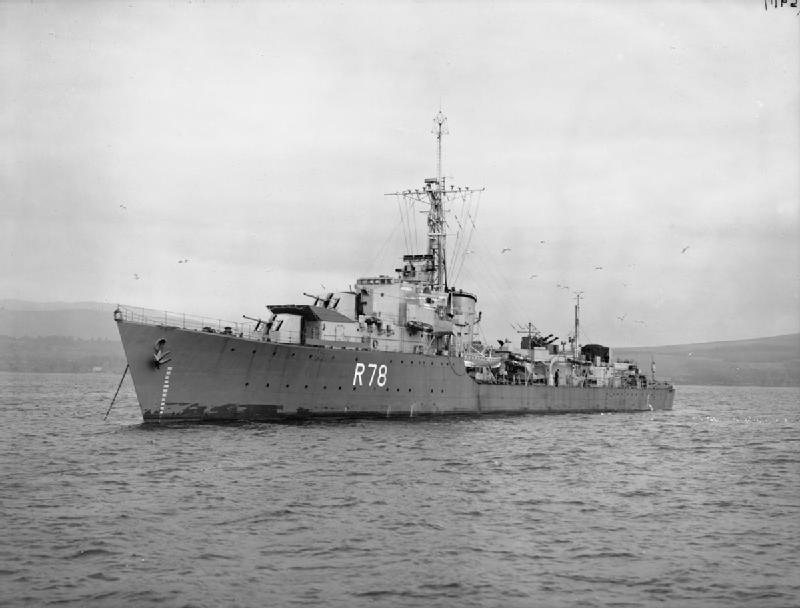
In the immediate post-war years the South African Navy underwent significant levels of qualitative, and quantitative, expansion as the Royal Navy disposed of its surplus war materiel. In 1947, two surplus s, were acquired from the United Kingdom, (ex Rosamund) and (ex HMS Pelorus), as well as the HMS Rockrose which was converted into the hydrographic survey ship . In 1950, South Africa further expanded her naval capability and purchased the first of two former British W-class destroyers, , in 1952 , and later, the Type 15 anti-submarine frigate (formerly HMS Wrangler).
By the early 1960s, the South African Navy was fast reaching its highpoint of international inclusion and is generally considered to be the golden age of a well balanced, modern, and effective service optimised for conventional naval engagement alongside friendly Western international partners.
From 1962 to 1964, the South African Navy received three British-built Type 12M frigates which formed the President-class : , and respectively. These were first rate, ocean going fast fleet anti-submarine escorts that propelled the South African Navy into the age of a modern warship operator on equal footing with the West. The order of three from France in 1968—to operate submarines for the first time—again catapulted the service further. The early 1970s would see the South African Navy operating at the height of its blue-water power projection ability with the first of the Daphné-class submarines, , being commissioned in 1970, with and entering service the following year.
The second half of the 1970s however saw South Africa facing severe amounts of international isolation and criticism. In 1973 the UN labelled the policy of apartheid a "Crime against Humanity", magnified further by the brutal state repression and subsequent mass incarcerations and deaths following the Soweto uprising in 1976 and the death of prominent anti-apartheid activist Steve Biko in 1977. The following year a UN arms embargo, loosely in place since 1962, became mandatory. The ensuing international economic disinvestment from South Africa was stepped up, placing huge strains on the economy. Coupled with these severe problems, the cornerstones of the country's regional foreign policy faced collapse and complete transformation with the end of Portuguese rule in Angola and Mozambique in 1975, and the negotiated settlement in Ian Smith's Rhodesia to the end of white minority rule in 1979. As South Africa became increasingly involved in the Border War in South West Africa (modern day Namibia) and Angola, the Navy began to readjust its previous international outlook and organisation. The then Minister of Defence, P. W. Botha successfully sought military connections with Israel and nine "Reshef"— in South African service—missile strike craft were ordered in 1974. Following the Soweto uprising and subsequent mandatory arms embargo, South Africa had been forced to accept the cancellation of another significant naval procurement of two new Type-69A light frigates and two s from France.
In 1987, South Africa commissioned the locally designed and built Fleet Replenishment ship . Constructed in Durban, it remains the largest and most sophisticated warship to ever have built in South Africa. Three years earlier, the Navy's other support ship, , had undergone a refit that greatly increased her amphibious capabilities. A real boost for the Navy's influence, Tafelberg could deploy a company strength landing force, six landing craft, two medium helicopters and be equipped with a small hospital. Throughout the decade, the South African Navy continued to participate in the Border War and coastal protection. For 23 years (1976–1989) the South African Navy maintained determined sea control around Southern Africa and provided valuable support to land operations. By the end of the 1980s, as white minority rule was coming to a negotiated end, the Navy had lost all of its major surface warships, had a drastically reduced anti-submarine/anti-aircraft capability across the board, and almost complete international isolation. As South Africa disentangled itself from external and internal security operations, the South African Defence Force underwent severe budgetary cuts. The Navy endured a reduction of personnel by 23%, the disbandment of the Marines, the closure of two Naval Commands (Naval Command East and Naval Command West), two Naval Bases at Cape Town and Walvis Bay, and the termination of the relatively advanced program to domestically build replacement submarines. A positive for the Navy during this period however was the acquisition of the multipurpose sealift/replenishment ship , a former Soviet-built Arctic supply vessel, in September 1992 as a replacement for the 35-year-old Tafelberg.
Despite the austere cutbacks, the Navy was leading the way for a South Africa that was slowly being welcomed back into the international community, even before the landmark elections of 1994. In 1990, the survey vessel became the first South African naval vessel to visit Europe since 1972, and in the same year and two , and , sailed for Taiwan in what would be the first time South African vessels had been in the Far East since 1945. Other international visits in the following years included Zaire, Kenya, Bangladesh, Turkey, France, Portugal, and Uruguay. As the "Rainbow nation" was lauded following the ANC victory in the first free democratic elections in 1994, one of the starkest symbols of this new era was the explosion of foreign warships and dignitaries visiting South African ports, often from countries that did not have a previous connection, such as Russia, Poland and Japan. In 1994, 21 foreign vessels from eight countries called at South African ports, with 26 visits from 12 countries in 1995, and 27 from ten countries in 1996. In 1997 the navy celebrated 75 years, with 15 countries sending ships for the festivities.
The acute need to re-equip the navy, including the wider Armed Forces after the lifting of apartheid-era sanctions, was addressed by the Strategic Defence Package of 1999. Better known as the infamous "Arms Deal", the acquisitions in the package, and those persons involved, have been repeatedly subject to substantive allegations of corruption, fraud and bribery. A total of R30 billion (US$4.8 billion in 1999) was pledged to the purchase of modern military equipment. For the navy, its share led to a total transformation from a "brown-water" force of ageing missile patrol craft and short-range submarines, to a force with significant "green-water" combat capability once again. In 2001, with an initial request of five vessels, later reduced to four, the German Meko A200SAN general purpose frigate design was procured, along with four British Super Lynx naval helicopters, and three German Type 209/1400 diesel-powered submarines. Also under construction from 1991 were three locally built T-Craft inshore patrol boats. As South Africa approached the millennium, and beyond, the ANC government gradually returned the Navy to a level of maritime power last seen in the 1960s and 1970s, and successfully reintegrated the service back into maritime operations with regional and international partners.
South African Navy
Surface fleet
Commissioned into service from 2006, at a total cost of R9.65 billion, the four Meko A200SANs, the in South African service, became "easily the most powerful surface combatants in sub-Saharan Africa, and...restored South African naval pre-eminence." Constructed with principles of stealthy design, the class has a 50% smaller radar signature of similar vessel size, 75% less infrared emissions, 20% lower life-cycle cost, 25% lower displacement and 30% fewer crew members. Specifically designed to conduct sustained operations in the sea conditions found off the South African coast, the four frigates are able to undertake a range of tasks from maritime law enforcement, to civil support, and military operations such as area denial, gunfire support and intelligence collection. The embarked SuperLynx helicopters significantly improve and extend surveillance, as well as all-round operational capabilities. With a return to operating general-purpose, multi-mission warships, the Valour class have been hailed as modern, impressive and major regional anti-surface, anti-air, and anti-submarine platforms. , , , and possess two four-cell launchers for eight Exocet surface to surface missiles, 16 to 32-cell domestically built Umkhonto VLS missiles for air defence, a single OTO Melara 76 mm main gun, a twin Denel 35 mm Dual Purpose Gun, two Oerlikon 20 mm cannon, and two 12.7 mm remotely operated guns. However, as of 2024, budget cuts have resulted in only one of the four frigates being operational.
As the SA Navy has a strength of only four primary surface warships, in an effort to improve asset availability in more routine littoral patrol operations and ease the stress on sophisticated, but ill-suited, warships, three previously decommissioned were modernised and recommissioned as offshore patrol vessels (OPVs) between 2012 and 2014 – , and . As of February 2023, only Makhanda remains in service. From June 2022, the Patrol Flotilla was strengthened by the commissioning SAS King Sekhukhune I*,* the first of three Multi-Mission Inshore Patrol Vessels (MMIPVs) being constructed by Damen Shipyards Cape Town.
Primarily, the Patrol Flotilla undertake the more traditional naval task of patrolling South Africa's exclusive economic zone and upholding maritime law enforcement. Ordinary tasks include anti-smuggling, monitoring against illegal immigration, search and rescue, fishery inspection, and routine border protection. With the ability to operate far out into the Cape and handle the often rough seas, the Flotilla is also expected to complement the navies combat ability, particularly when undertaking anti-piracy patrols in the Mozambique Channel.
Reflecting their new policing role, the Warriors' old Skerpioen missile launchers and the rear 76 mm gun was removed. In replacement, the craft have gained the capacity to support a small rigid-hulled inflatable boat (RHIB) and a limited contingent of Naval Infantry for boarding suspect vessels, as well as maintaining their original 20 mm cannon and 12.7 mm heavy machine guns.
As of 2020, four River-class coastal mine countermeasures vessels remain in commission with the SA Navy, although two are in reduced operational use. They are believed to have lost their mine-hunting capabilities due to the retirement of the antiquated PAP104 autonomous underwater vehicles (AUVs). Whilst still maintaining a decompression chamber for operational diving, the River class are now deployed on general coastal defence duties, and are equipped with a single Oerlikon 20 mm cannon, two 12.7 mm machine guns, and a RHIB.
Alongside the Warrior and River classes are the more modern , with three entering service from 1992. Constructed with twin-hulled catamarans of glass-reinforced plastic sandwich construction, three have also been built for Israel in 1997. The T Craft, with their far lighter construction and smaller size, undertake maritime security patrols considerably closer to the shore and inspect various inlets and bays. SAS Tobie, SAS Tern, and SAS Tekwane are equipped with a single 12.7 mm Browning machine gun and have the capacity to embark a RHIB with a small complement of Naval Infantry to inspect vessels.
Submarine fleet
Between 2004 and 2008, three German built Type 209/1400 submarines were delivered as a like for like replacement for the obsolescent submarines. The represents a significant upgrade of the navy's sub-surface force due to considerable advancement in underwater performance and endurance.[[File:SAS Queen Modjadji.jpg|thumb|right|South African submarines and , accompanies the [[United States Navy]] (center), into False Bay in Simon's Town, South Africa on 4 November 2009.]] As of 2020, South Africa is one of only three states on the African continent, along with Algeria and Egypt, that currently operate submarine assets, and the only state in the sub-Saharan region. At the same time, this capability was at risk of eroding. As of 2019, two of the submarines were reported to be in need of "urgent and complete" refits. The recommended approach was to move to a contracting phase in 2020. The Armscor annual report to parliament indicated that should the refits not take place, the submarine capability would not available after FY2022/23. As of March 2021, the contracting phase had still not been initiated and no dates had been announced for any upgrades of the submarines.
In August 2021 it was reported that Charlotte Maxeke was being refitted at the Armscor Dockyard. Funding in the amount of R189 million had reportedly been made available to ensure the completion of the refit during the 2023/24 financial year. Funding for the refit of Queen Modjadji was not available, though the reported focus of the Navy was to prioritise essential maintenance and repair of SAS Manthatisi (which had been last refitted during 2013/14) to ensure "expedited operational availability." As of 2024, none of the submarines are seaworthy.
Highly sophisticated vessels, the Heroine class' utility, aside from traditional anti-ship engagement and area denial, is its intelligence collection via special forces deployment. A series of modifications have been made to the class so as to undertake these clandestine operations.
Currently fitted only with regular torpedo tubes, the Heroines do have optional UGM-84 Harpoon integration capacity for further anti-ship potential, however, as of 2020, this has not been utilised. Similarly, whilst currently not able to deploy any land attack armaments, Germany is developing a medium-range missile, the IDAS, for their own Type 209s which would primarily be targeted against air threats, but also small surface vessels and coastal land targets.
Auxiliary fleet
With the retirement of in 2004, is the sole fleet replenishment ship with the primary role of supporting combat vessels at sea. Drakensberg is also modified to carry two RHIBs, as well as two landing craft utility (LCU) for limited amphibious use. Since the end of minority rule, Drakensberg has undertaken numerous humanitarian and anti-piracy operations, consistently shown the 'rainbow flag' on global voyages of goodwill, and reintegrated South Africa back into international naval exercises.
The SA Navy continues to operate the specialist hydrographic survey vessel , which was commissioned in 1972.
Marines
Main article: South Africa Marine Corps
The South Africa Marine Corps was first established as a sub-branch of the Navy in 1951 until 1955 and then reformed in 1979 until 1990, both times with the primary purpose of protecting the country's harbours. The Marines also acted as regular infantry during the war until 1988, as well as performing counter-insurgency operations inside South Africa. The Marines had an amphibious landing capability by operating from and SAS Drakensberg, with an elite company, named the Marine Amphibious Company (MAC), being formed to ensure beach-head capability for landing large task forces, along with a small elite reconnaissance detachment between 1983 and 1989. The Marines were disbanded on 18 January 1990, following a major restructuring of the Navy at the end of the South African Border War.
In 2005, the decision was taken to create a Naval Rapid Deployment Force so that South Africa could commit more to peacekeeping operations across the continent, particularly in the Great Lakes region. In 2006, this force became the Maritime Reaction Squadron. The Maritime Reaction Squadron provides an amphibious, diving and small boat capability to the Navy, deploying infantry-trained South African Navy personnel in various peacekeeping roles within the African continent, as well as assisting in boarding operations at sea, and humanitarian and disaster relief.
The squadron consists of the following components:
- Operational Boat Division (OBD) with 10 Namacurra-class harbour patrol boats and six Lima-class utility landing craft
- Reaction Force Division (RFD) consisting of one naval infantry company with a command and support element
- Operational Diving Division (ODD) consisting of four operational diving teams of 17 divers.
Current deployments
Deploying at least a single Valour-class frigate or one Heroine-class submarine, along with aircraft from the South African Air Force, the SA Navy often undertakes exercises with others, such as the United States Navy (Exercise Shared Accord/Southern Accord), NATO naval battlegroups (Exercise Amazolo), the French Navy (the annual Exercise Oxide), the German Navy (the biennial Exercise Good Hope), the Royal Navy (ad hoc exercises when visiting South African waters), the Indian Navy (the biennial Exercise IBSAMAR), and the navies of Uruguay and Brazil (Exercises Atlasur and IBSAMAR).
For the 2010 FIFA World Cup, the navy provided air and sea security by deploying three frigates as guard ships off the cities of Durban, Port Elizabeth and Cape Town.
Operation Copper
Since 2011, one of the SA Navy's major and long-standing focuses has been that of the anti-piracy initiative, Operation Copper. After increased pirate activity in the Mozambique Channel (a crucial import/export sea lane for South Africa), and subsequent requests for help from fellow Southern African Development Community (SADC) members (Mozambique and Tanzania), the navy has routinely deployed assets in an effort to provide maritime security in the region.
Since the operation first began, every Valour-class frigate has been deployed to the region on rotation, with the refurbished Warrior-class OPVs also being utilised. In 2012, the replenishment ship SAS Drakensberg was likewise deployed to the region, and alongside European warships, successfully captured seven Somail pirates. Elements of the Navy's Maritime Reaction Squadron (MRS) are routinely embarked on deployed warships so as to give the ability to board suspect vessels.
Gaps in deployment have previously occurred as a result of mechanical issues, as well as the South African Air Force withdrawing C-47TP maritime patrol aircraft in 2016 from Mozambique due to maintenance problems and lack of sufficient aircrew. In 2018 the SA Navy notably deployed two warships simultaneously for Operation Copper, and were independent of foreign support.
Piracy, and other maritime crime, has fallen substantially in the Mozambique Channel since the SADC operation began in 2011. Due to the success of the operation, expenditure for the future 2021/22 deployment is estimated to be R38.9 million, down from R154 million the previous year.
Operation Copper's mandate could be subject to official change as a result of increasing Islamist violence in the Cabo Delgado province of Mozambique. On 9 August 2021, the SADC formally announced the deployment of troops into the troubled province. Alongside regional partners such as Botswana, Tanzania and Zimbabwe, the South African government has informed parliament that it intends to deploy 1,495 personnel to Mozambique. SAS Makhanda, a modernised Warrior-class patrol OPV, has reportedly been seen in Pemba, the capital of Cabo Delgado province.
Operation Corona
For the continued safeguarding of South Africa's borders, Operation Corona aims to combat illegal fishing, poaching, and smuggling within its territorial waters. The SA Navy plans to carry out five maritime patrols in line with Operation Corona, with 84 days of surface and 22 days of subsurface patrols allocated for the financial year 2020/21. Deploying to known hotspot areas, the SA Navy works alongside other Government departments such as the SA Police Service and Department of Environment, Forestry and Fisheries, in an effort to deter rather than arrest.
Relationship with Russian and Chinese Navies
In February 2023, the South African Navy planned to engage in joint exercises with the Chinese and Russian navies that were to be held in waters off South Africa. The exercises, which were highly controversial given Russia's invasion of Ukraine, followed on a January 2023 visit by the Russian foreign minister Sergei Lavrov to Pretoria for meetings with his South African counterpart. Although the exercises were similar to exercises held in previous years, some suggested that they signalled a significant shift in South African policy toward more overt military engagement with China and Russia. The exercise began on 18 February and involved the frigate and the tanker Kama from the Russian Navy along with the destroyer , the frigate and the support ship from the Chinese Navy. Several vessels from the South African Navy were expected to participate including the frigate as well as the patrol vessel King Sekhukhune I and the hydrographic survey vessel .
In April of the same year, the Chinese surveillance ship Yuan Wang 5 docked at Cape Town, overlapping with the presence of the Iranian Navy vessels, and Dena.
In September 2024 it was reported that the Russian training ship Smolnyy had docked in Cape Town for a port visit.
Command, control & organisation
The command structure is depicted below. The Chief of the Navy, based at Navy Headquarters at the Navy Office (SAS Immortelle) located in Pretoria, is head of the South African Navy. All operational forces, including ships and submarines, fall under the control of the Flag Officer Fleet who is based in Simon's Town.

| Chief of the SA Navy | ||||
|---|---|---|---|---|
| Vice Adm M. Lobese | ||||
| url=https://www.defenceweb.co.za/featured/senior-sandf-appointments-and-promotions/ | title=Senior SANDF appointments and promotions | publisher=DefenceWeb | date=February 2, 2023 | accessdate=February 2, 2023}} |
| **Director Maritime Plans** | ||||
| R Adm (JG) W van Niekerk | ||||
| **Inspector General (SA Navy)** | ||||
| R Adm (JG) Kwaedi Mabula | ||||
| **Naval Budget Manager** | ||||
| Mrs R. Mamaguvhi | ||||
| **Director Naval Reserves** | ||||
| R Adm (JG) R. Ndabambi |
Fleet Command
Main article: Fleet Command (SA Navy)
Fleet Command includes all vessels and units of the Navy other than Naval Headquarters, Pretoria. Fleet Command is based in Simon's Town under control of Flag Officer Fleet.
Four directorates are responsible for the day to day control of Fleet Command:
- Director Fleet Force Preparations (DFPP) is responsible for the day-to-day running of the ships and submarines and for ensuring their operational readiness. The Maritime Reaction Squadron and NavComCens also report to DFFP
- Director Fleet Human Resources (DFHR) is responsible for all training and manning and also controls the training units.
- Director Fleet Quality Assurance (DFQA) is responsible for the output of Fleet Command and monitoring quality assurance throughout Fleet Command
- Director Fleet Logistics (DFL) is responsible for all Logistics units as well as for the maintenance of the fleet.
Naval bases

The Navy operates the following Naval Bases:
- Naval Base Simon's Town – the largest and main naval base currently used by the South African Navy. Constructed by the Dutch East India Company in 1743, and later developed by the Royal Navy, the base was transferred to South Africa in 1957 as part of the Simon's Town Agreement and expanded in 1975. Simon's Town is the homeport of the frigate and submarine flotillas, as well as housing training facilities.
- Naval Base Durban – constructed during the Second World War to better serve the deployment of naval vessels off the eastern coast of Africa, particularly after the Japanese declaration of war in 1941. In 2002 Durban was downgraded to a Naval Station with much of the infrastructure being taken over by the Army and later abandoned. In 2012, the decision was taken to renovate and expand the facilities. However, it was announced in 2020 that due to budget constraints, the reclassification of Durban as a fully operational Naval Base would be delayed. The station is currently home to the fleet's offshore patrol flotilla and will continue to be so after the delivery of replacement offshore/inshore vessels.
- Naval Station Port Elizabeth – provides support to the fleet and host to visiting ships, however no major vessels are based here.
Training units
- – located on the West Coast and provides training and development for ratings.
- – located in the Greater Cape Town area. Historically provided practical training for apprentices, but now offers training to both ratings and officers.
- SAS Simonsberg – located in Simon's Town and provides training in gunnery, anti-submarine warfare, communications, diving and seamanship. Simonsberg also includes:
- Maritime Warfare Training Centre.
- Submarine Training Centre, East Yard.
- Nuclear, Biological, Chemical, Damage Control Training Centre.
- Military Training Centre, West Yard.
- South African Naval College – located in Gordon's Bay, the establishment provides training for naval officers.
Personnel
As of the end of the financial year 2018/19, there were approximately 6,816 active uniformed members of the SA Navy, just short of the 7,071 target. In addition, there are a further 1,071 civilian staff that further support the Navy.
In 2006, the old Naval Reserve Units that were modelled on the Royal Naval Reserve system were closed down. A new Navy Reserve system was created consisting of roughly 1,000 reserve posts. These posts are pooled and members are drawn from them as needed to augment full-time units and ships' companies.
Uniforms
From 1922 to the 1940s the SA Navy was effectively an extension of the Royal Navy, and therefore wore the same uniforms and similar insignia. As British influence was gradually curtailed, in 1959 the British Crown in the SA Navy cap badge was replaced with the Lion of Nassau from the crest of the country's coat of arms. A black beret later replaced the peaked cap in working uniforms.
In 2000 the new Coat of Arms was unveiled and the Chief of the Navy tasked Fleet Command to look at revising the Navy uniforms to reflect the new coat of arms. This saw new rank insignia for non-commissioned officers being implemented as well as the introduction of a side cap.
Ranks
Main article: South African military ranks#Navy
Due to historical influence, the rank system is based on that of the Royal Navy.
Commissioned officer ranks
The rank insignia of commissioned officers.
Other ranks
The rank insignia of non-commissioned officers and enlisted personnel.
Naval ensign
Main article: South African Naval Ensign
|File:Naval Ensign of the United Kingdom.svg|1922–1946 |File:Naval Ensign of South Africa (1946-1951).svg|1946–1951 |File:Naval Ensign of South Africa (1951–1952).svg|1951–1952 |File:Naval Ensign of South Africa (1952–1959).svg|1952–1959 |File:Naval Ensign of South Africa (1959–1981).svg|1959–1981 |File:Naval Ensign of South Africa (1981–1994).svg|1981–1994 |File:Flag of South Africa.svg|27 April 1994 – 11 November 1994 |File:Naval Ensign of South Africa.svg|1994–present
Naval jack
|File:Blue Ensign of South Africa (1910–1928).svg|1922–1928 |File:Flag of South Africa (1928–1994, 1-2, dark colors).svg|1928–1981 |File:Flag of South Africa (1928–1994).svg|1981–1994 |File:Flag of South Africa.svg|1994–present
Ships and weapons
Current fleet
Main article: List of active South African Navy ships
The South African Navy operates about 60 commissioned vessels, including 4 frigates, 3 submarines, 9 inshore patrol vessels, 1 missile boat, 4 minesweepers, 26 harbour patrol boats, 1 combat support ship, 1 hydrographic survey vessel, 5 tugs, 6 landing craft utility, and additionally an unknown number of RHIBs and training craft.
Naval Combat Force
The Naval Combat Force forms the blue-water backbone of the South African Navy and consists of:
4 × Valour-class stealth guided-missile frigates
The Valour-class frigates (SAS Amatola, SAS Isandlwana, SAS Spioenkop, and SAS Mendi) are based on the German MEKO A200 design and were built to a modern stealth standard that reduces their radar cross-section and infrared signature, making them harder to detect by enemy radar and sensors. Designed as general-purpose warships, they provide anti-surface, anti-air, and anti-submarine warfare capabilities. Acquired under Project Sitron in the early 2000s, five were originally planned but only four approved due to budget limits. Before the MEKO was selected, the Navy considered acquiring five Spanish-built Álvaro de Bazán-class (Bazan 59B) destroyers—today in service with the Spanish Navy and as the Hobart-class in the Royal Australian Navy—but these were deemed larger and more costly, with funds redirected to submarine procurement. Each frigate embarks a Westland Super Lynx 300 Mk64 helicopter, with a planned programme to equip the frigates with UAVs to supplement these helicopters.
3 × Heroine-class diesel-electric attack submarines
The Heroine-class submarines (SAS Manthatisi, SAS Charlotte Maxeke, and SAS Queen Modjadji) are based on the German Type 209/1400 design and entered service in the mid-2000s under Project Wills, as replacements for the three ageing Daphné-class submarines that had served since the 1970s. These submarines give the Navy a modern undersea warfare capability, ensuring a credible deterrent and extending South Africa's maritime reach beneath the surface.
Naval Patrol Force
The Navy operates a mix of offshore and inshore patrol vessels (OPVs and IPVs), responsible for safeguarding South Africa's extensive Exclusive Economic Zone, supporting combat operations, and providing assistance to civilian agencies.
- 1 × Warrior-class missile strike craft (8 retired; 1 remains in commission, with the final commissioned vessel "SAS Makhanda" set for retirement once a new MMIPV enters service).
- 3 × Warrior-class Multi-Mission Inshore Patrol Vessels (MMIPV).
- 3 × Xena-class Riverine Patrol Boats (RPB).
- 3 × T-class inshore patrol vessels.
- 26 × Namacurra-class harbour patrol craft.
Mine Countermeasures and Littoral Warfare
The Navy operates a dedicated minesweeping and littoral warfare force:
- 4 × River-class minesweepers.
- 6 × Lima-class landing craft utility.
- Large numbers of RHIBs and smaller vessels.
Naval Support Force
The Support Force provides logistical and auxiliary capacity for fleet operations:
- 1 × Drakensberg-class combat support ship.
- 1 × Protea-class hydrographic survey vessel (to be replaced by the new vessel "SAS Nelson Mandela", currently awaiting delivery).
- At least 5 tugs of varying classes, with additional units planned.
Aviation
Although the Navy does not directly operate aircraft, 22 Squadron of the South African Air Force provides aviation support to the fleet:
- 1 × Atlas Oryx medium utility helicopter (deployed on SAS Drakensberg).
- 4 × Westland Super Lynx 300 Mk64 ASW and ASuW helicopter (deployed on the Valour-class frigates).
These aircraft perform surface and anti-submarine warfare, maritime surveillance, logistics, and search-and-rescue (SAR) missions. A programme is underway to introduce unmanned aerial vehicles (UAVs) to supplement shipborne helicopters. Historically, the SAAF also operated the Westland Wasp in the anti-submarine role until its retirement.
Decommissioned fleet
Main article: List of decommissioned ships of the South African Navy
Alongside its current fleet, the South African Navy has retired several major combat units over the years. These include:
- 3 × Daphné-class diesel-electric attack submarines (SAS Maria van Riebeeck, SAS Emily Hobhouse, and SAS Johanna van der Merwe) — commissioned in the early 1970s and decommissioned by the early 2000s, replaced by the Heroine-class.
- 3 × President-class Type 12 frigates (SAS President Kruger, SAS President Steyn, and SAS President Pretorius) — acquired from the Royal Navy in the 1950s–60s, they formed the backbone of the Navy until their retirement in the 1980s.
- 2 × W-class destroyers (SAS Jan van Riebeeck and SAS Simon van der Stel) — transferred from the Royal Navy in the 1950s, serving as the Navy's largest surface combatants of the era before being phased out.
- 8 × Warrior-class missile strike craft — fast attack craft introduced from the late 1970s; once central to coastal defence. Only one remains active today, with two in reserve and the remainder retired or sunk as targets.
These vessels represented the Navy's most powerful assets of their time, forming the foundation of South Africa's surface and subsurface warfare capability before the transition to the modern Valour and Heroine-class fleet.
Naval weapons systems
| Browning M1919, FN MAG or Vektor SS-77 | [7.62mm](7-62mm-nato) General purpose machine gun | Browning Arms Company, FN Herstal or Denel Land Systems | [[File:FN MAG white background.jpg | 160x160px]] | South Africa |
|---|
Gallery
File:Spioenkop F147.jpg File:South African Navy frigate SAS Amatola (F 145).jpg File:SAS Mendi F148.jpg File:South African soldiers aboard an Indian Navy ship.jpg File:US Navy 110210-N-5085J-517 The Oliver Hazard Perry-class frigate USS Stephen W. Groves (FFG 29) participates in exercises with the South African na.jpg File:SAS Queen Modjadji.jpg File:Namacurra-class harbour patrol boat.jpg File:SAS Isandlwana F146 V&A Waterfront 1.jpg File:Oryx no. 1230.jpg
Notes
References
References
- Wingrin, Dean. (2 February 2018). "New Master-At-Arms for the Navy". Defenceweb.
- "Role of the SA Navy".
- (2008-11-04). "Fact file: The SA Navy's mandate".
- Potgieter, T. D.. (2000). "Maritime defence and the South African Navy to the cancellation of the Simon's Town agreement". Scientia Militaria: South African Journal of Military Studies.
- Heitman, Helmoed-Römer.. (1985). "South African war machine". Galago.
- "South Africa Act {{!}} South Africa [1909]".
- "History of the SA Navy".
- Stevenson, D.. (2005). "1914-1918 : the history of the First World War". Penguin.
- Steyn, Richard. (2015). "Jan Smuts: unafraid of greatness". Jonathan Ball Publishers.
- Wessels, Andre. (30 July 2009). "The South African Navy and its Predecessors, 1910–2010: A Century of Interaction with Commonwealth Navies".
- (2012-09-14). "SMS Wolf – German Raider".
- Schmalenbach, Paul. (1979). "German raiders : a history of auxiliary cruisers of the German Navy, 1895-1945". Naval Institute Press.
- Colledge, J. J.. (1987–1989). "Ships of the Royal Navy". Naval Institute Press.
- (1997). "South Africa: a country study". Federal Research Division, [[Library of Congress]].
- Wessels, Andre. (December 1994). "The first two years of war: the development of the Union Defence Forces". Journal for Contemporary History.
- Wessels, Andre. (June 1996). "South Africa and the war against Japan 1941–1945". Journal for Contemporary History.
- "Book 4: Industrialisation, Rural Change and Nationalism – Chapter 3 – Afrikaner Nationalism in the 1930s and 1940s by Albert Grundlingh {{!}} South African History Online".
- (1980). "Militaria: periodical for military history". Director General Personnel.
- "South African Navy – Unlikely Ambassadors".
- Baker, Deane-Peter. (2012). "The South African Navy and African Maritime Security". Naval War College Review.
- Du Toit, Allan. (1992). "South Africaʼs fighting ships: past and present". Ashanti Pub.
- English, John I.. (2008). "Obdurate to Daring : British fleet destroyers 1941–1945". World Ship Society.
- Bennett, Chris. (2006). "Three frigates: President Class frigates bring the SA Navy to maturity". Just Done Productions Pub.
- (2008-12-15). "SAS Assegaai to be preserved as museum".
- "1973 UN Convention on Apartheid as a Crime Against Humanity".
- "The Soweto Uprising".
- Mangcu, Xolela. (2013). "Biko: a life.". I.B. Tauris.
- "Security Council Resolution 418".
- (15 June 1986). "Modern African wars".
- (January 1980). "Report Of The Special Committee On The Situation With Regard To The Implementation Of The Declaration On The Granting Of Independence To Colonial Countries And Peoples.". United Nations General Assembly.
- Wessels, Andre. (December 2006). "The South African Navy during the years of conflict in southern Africa, 1966-1989". Journal for Contemporary History.
- Steenkamp, Willem. (2006). "Borderstrike! : South Africa into Angola 1975-1980". Just Done Productions.
- Bennett, Chris. (2011). "South African naval events : day-by-day, 1488 to 2009". Naval Heritage Trust.
- (2004). "Jane's fighting ships, 2004-2005". Jane's Information Group.
- Williams, Rocky. (2004). "National defence reform and the African Union". SIPRI Yearbook: Armaments, Disarmament and International Security. Stockholm International Peace Research Institute.
- Feinstein, Andrew. (2007-01-10). "Bright hopes betrayed". The Guardian.
- Hill, Liezel. "SA navy to have all new corvettes and submarines by 2007".
- "South Africa Boosts Naval Capabilities: But can it afford an expansion? {{!}} Manohar Parrikar Institute for Defence Studies and Analyses".
- (2010-02-08). "Fact file: Valour-class small guided-missile frigates".
- (10 August 2024). "Why South Africa's army is floundering in Congo". The Economist.
- (2014-07-17). "Revamped strike craft ready for counter-piracy duty".
- (2013-05-10). "Navy commences upgrade of fourth strike craft".
- "Navies versus Coast Guards: Defining the Roles of African Maritime Security Forces".
- (2012-10-30). "Southern African Shipyards refurbishing Navy strike craft".
- (2010-02-09). "Fact file: River-class inshore patrol vessel/minehunter - defenceWeb".
- "Patrol Forces".
- (2010-02-09). "Fact file: Heroine-class diesel-electric submarine".
- (22 October 2019). "SA Navy frigate and submarine midlife upgrades on hold". defencewebco.za.
- (1 March 2021). "Midlife upgrades for SAN platforms on hold pending funding – Armscor". defencewebco.za.
- Martin, Guy. (20 August 2021). "Refit of SA Navy frigates and submarines stalled by lack of funding".
- "IDAS Missile System – Naval Technology".
- "SANDF gets rid of surplus".
- Gerber, Jan. "Terrorism: Insurgency in Mozambique can spread to neighbours, Military Intelligence warns".
- (2010-02-15). "Fact file: Hecla (Protea)-class hydrographic vessel".
- Manganyi, Calvin. (January 2012). "South African Journal of Military Studies – Resurrection of the marine capability in the South African Navy: the Maritime Reaction Squadron". Scientia Militaria: South African Journal of Military Studies.
- Pitta, Robert.. (1993). "South African Special Forces". Osprey.
- "Maritime Protection Squadron".
- (2009-11-26). "Exercise Xena testing Maritime Reaction Squadron".
- Africa, U. S. Army. "STAND-TO!".
- (2020-09-18). "No Exercise Oxide this year".
- "Exercise Good Hope V concludes".
- (2014-04-07). "Royal Navy in exercise with SA sub".
- "'Exercise IBSAMAR' between India, South Africa, Brazil begins tomorrow". The Economic Times.
- (2010-03-10). "Navy ready to defend World Cup".
- mozambique. (10 May 2020). "Maritime patrol mission in the Mozambique Channel: Operation Copper extension for another year to cost South Africa R154 million".
- (2014-03-24). "Operation Copper still up and running".
- (2015-03-19). "SAAF no longer part of Op Copper in Mozambique".
- (2018-08-10). "SA Navy two platform deployment returns from Op Copper duty".
- (2021-03-19). "Ramaphosa authorises extension of SA's continental military deployments".
- (2021-05-11). "SA in "conversation" with Mozambique on Op Copper".
- "SADC mission in Mozambique launched".
- (2020-06-23). "Five maritime patrols this year under Operation Corona".
- "Annual Performance Plan (APP) 2018/19". South African Department of Defence.
- (14 February 2023). "Russian frigate docks in South Africa ahead of joint naval drills with China and Russia".
- (26 January 2023). "Russia, South Africa and a 'redesigned global order': The Kremlin's hearts and minds machine is steaming ahead".
- (17 February 2023). "Why is South Africa's navy joining exercises with Russia and China?".
- (17 February 2023). "Russia, China and South Africa began naval maneuvers".
- Ryabchiy, Kate. (16 February 2023). "South Africa's naval drills with Russia, China "tantamount to joining war against Ukraine"".
- (5 April 2023). "Controversial Chinese "Spy Ship" Calls at Durban".
- Bartlett, Kate. (5 September 2024). "Docking of Russian naval ship in South Africa sparks controversy".
- (2018-06-05). "Navy, Defence acknowledges it is in danger of sinking".
- (2019-07-15). "SA Navy falling behind other African states".
- "South Africa Military Spending/Defense Budget 1960-2020".
- "South Africa – ratio of military expenditure to gross domestic product (GDP) 2008-2018".
- South African Rand to Pound Sterling Exchange Rate: 01/10/2020
- "Annual Performance Plan (APP) 2020". South Africa Department of Defence.
- "Annual Performance Plan (APP) 2020". South Africa Department of Defence.
- "Inflation rate: South Africa".
- "South Africa – gross domestic product (GDP) growth rate 2021".
- "Annual Performance Plan (APP) 2020". South Africa Department of Defence.
- (2019-09-16). "Defence budget sinks Navy".
- (2019-09-19). "SA Navy in danger of losing frigate and submarine capabilities due to declining budget".
- "Annual Performance Plan (APP) 2018/19". South Africa Department of Defence.
- ISSAfrica.org. (2014-11-28). "Avoiding the siren's song: will Operation Phakisa deliver prosperity?".
- (2016-05-19). "SA at sea over illegal fishing in its waters".
- (2020-06-09). "Project Biro on schedule, with delivery for mid-2021".
- (2022-02-16). "First Project Biro vessel to be handed over next month".
- "Sea Around Us {{!}} Fisheries, Ecosystems and Biodiversity".
- Waters, Conrad. (2010). "Seaforth world naval review 2011". Seaforth.
- (2021-06-18). "DoD updates cabinet on major acquisition projects".
- (2020-05-27). "Sandock Austral Shipyards making progress with Project Hotel".
- "VARD 9 105".
- "First survey motor boat for South African Navy launched".
- (2020-08-25). "Paramount Maritime launches survey motor boat for SA Navy".
- (2020-09-03). "SA Navy projects under threat from budget cuts".
- (2021-08-20). "Refit of SA Navy frigates and submarines stalled by lack of funding".
- (2008). "South Africa's Navy: A Navy of the People and for the People". SA Navy.
- Mudimu, J.. (18 May 2007). "Presentation on the Transformation of the SA Navy".
- (April 2019). "Organigram of the SA Navy". Navy, RSA Department of Defence.
- (February 2, 2023). "Senior SANDF appointments and promotions". DefenceWeb.
- (27 May 2020). "New SANDF two-stars named". Defenceweb.
- (23 March 2018). "New director: maritime strategy for SA Navy". Defenceweb.
- (October 29, 2021). "More generals and admirals for the SA national defence force". DefenceWeb.
- (18 February 2021). "SANDF adds to its one-star numbers". DefenceWeb.
- (17 February 2021). "PROMULGATION: APPOINTMENTS AND/OR PROMOTIONS OF BRIG GENS/R ADM (JG) FOR THE FINANCIAL YEAR 2020/21". Dept of Defence.
- Adriaanse, Dominic. (28 March 2018). "Hard to say goodbye, says outgoing Naval College chief". Independent Newspapers.
- (2012-03-16). "Plans for Salisbury Island elaborated".
- "PORT ELIZABETH".
- "SAS Saldanha Home Page".
- "Annual Performance Plan (APP) 2018/19". South Africa Department of Defence.
- "Annual Performance Plan (APP) 2018/19". South Africa Department of Defence.
- "Vision & Mission".
- Engelbrecht, Leon. (2010-02-08). "Fact file: Valour-class small guided missile frigates".
- Engelbrecht, Leon. (2010-02-08). "Fact file: Valour-class small guided missile frigates".
- Engelbrecht, Leon. (2010-02-09). "Fact file: Heroine-class diesel-electric submarine".
- Helfrich, Kim. (2020-11-23). "SAS Galeshewe decommissioned".
- (2024-03-04). "SA Navy blesses third inshore patrol vessel amid CNavy warning on ship capacity {{!}} defenceWeb".
- (2017-04-28). "More details emerge on SA Navy's new riverine patrol boats - defenceWeb".
- Engelbrecht, Leon. (2010-02-09). "Fact file: T-class Inshore Patrol Vessel".
- Engelbrecht, Leon. (2010-02-09). "Fact file: Namacurra-class harbour patrol boats".
- Engelbrecht, Leon. (2010-02-09). "Fact file: River-class inshore patrol vessel/minehunter".
- (2008-11-07). "MRS takes shape - defenceWeb".
- (2016-09-06). "Nautic delivering boarding boats to SA Navy - defenceWeb".
- (2013-04-29). "New small boats demonstrated to the SA Navy - defenceWeb".
- Martin, Guy. (2023-11-10). "SA Navy looking to replace SAS Drakensberg".
- Engelbrecht, Leon. (2010-02-15). "Fact file: Hecla (Protea)-class hydrographic vessel".
- (2025-09-26). "Still no delivery date known for SAS Nelson Mandela - defenceWeb".
- Martin, Guy. (2016-04-22). "Navy accepts new tugs into the fleet".
- "Maritime Aircraft". South African Navy.
- "Maritime Aircraft". South African Navy.
- Engelbrecht, Leon. "Fact file: Valour-class frigates – defenceWeb". defenceweb.co.za.
- "FRIGATES".
- (2022-05-17). "Reutech supplying weapons and radars for Biro, Hotel {{!}} defenceWeb".
This article was imported from Wikipedia and is available under the Creative Commons Attribution-ShareAlike 4.0 License. Content has been adapted to SurfDoc format. Original contributors can be found on the article history page.
Ask Mako anything about South African Navy — get instant answers, deeper analysis, and related topics.
Research with MakoFree with your Surf account
Create a free account to save articles, ask Mako questions, and organize your research.
Sign up freeThis content may have been generated or modified by AI. CloudSurf Software LLC is not responsible for the accuracy, completeness, or reliability of AI-generated content. Always verify important information from primary sources.
Report