From Surf Wiki (app.surf) — the open knowledge base
Simone de Beauvoir
French philosopher, social theorist and activist (1908–1986)
French philosopher, social theorist and activist (1908–1986)
| Field | Value | ||||||
|---|---|---|---|---|---|---|---|
| name | Simone de Beauvoir | ||||||
| image | Simone De Beauvoir (cropped).jpg | ||||||
| caption | Beauvoir in 1967 | ||||||
| birth_name | Simone Lucie Ernestine Marie Bertrand de Beauvoir | ||||||
| birth_date | |||||||
| birth_place | Paris, France | ||||||
| death_date | |||||||
| death_place | Paris, France | ||||||
| resting_place | Montparnasse Cemetery, Paris | ||||||
| education | {{plainlist | ||||||
| occupation | |||||||
| notable_works | *The Second Sex* (1949) | ||||||
| partner | {{plainlist | ||||||
| module | {{Infobox philosopher | embed=yes | |||||
| era | [20th-century philosophy](20th-century-philosophy) | ||||||
| region | Western philosophy | ||||||
| school_tradition | {{ublist | Continental philosophy | Existentialism | Existential phenomenology | French feminism | Western Marxism{{cite web | |
| last1 | Bergoffen | ||||||
| first1 | Debra | ||||||
| last2 | Burke | ||||||
| first2 | Megan | ||||||
| date | 2004-08-17 | ||||||
| title | Simone de Beauvoir | ||||||
| url | https://plato.stanford.edu/entries/beauvoir | ||||||
| website | Stanford Encyclopedia of Philosophy | ||||||
| publisher | Stanford University | ||||||
| main_interests | |||||||
| notable_ideas | |||||||
| academic_advisors | Léon Brunschvicg | ||||||
| signature | Simone de Beauvoir signature.svg |
- University of Paris (BA, MA)
- ENS (audit student)
- Jean-Paul Sartre (1929–1980; his death)
- Nelson Algren (1947–1964)
- Claude Lanzmann (1952–1959) last1= Bergoffen| first1= Debra| last2= Burke| first2= Megan| date= 2004-08-17| title= Simone de Beauvoir| url= https://plato.stanford.edu/entries/beauvoir| website= Stanford Encyclopedia of Philosophy| publisher= Stanford University| access-date=
Simone Lucie Ernestine Marie Bertrand de Beauvoir (, ; ; 9 January 1908 – 14 April 1986) was a French existentialist philosopher, writer, social theorist, and feminist activist. Though she did not consider herself a philosopher, nor was she considered one at the time of her death, she had a significant influence on both feminist existentialism and feminist theory.
Beauvoir wrote novels, essays, short stories, biographies, autobiographies, and monographs on philosophy, politics, and social issues. She was best known for her "trailblazing work in feminist philosophy", The Second Sex (1949), a detailed analysis of women's oppression and a foundational tract of contemporary feminism. She was also known for her novels, the most famous of which were She Came to Stay (1943) and The Mandarins (1954).
Her most enduring contribution to literature is her memoirs, notably the first volume, Mémoires d'une jeune fille rangée (1958). She received the 1954 Prix Goncourt, the 1975 Jerusalem Prize, and the 1978 Austrian State Prize for European Literature. She was also nominated for the Nobel Prize in Literature in 1961, 1969 and 1973. However, Beauvoir generated controversy when she briefly lost her teaching job after being accused of sexually abusing some of her students.
Personal life
Early years
Beauvoir was born on 9 January 1908, into a bourgeois Parisian family in the 6th arrondissement. Her parents were Georges Bertrand de Beauvoir, a lawyer who once aspired to be an actor, and Françoise Beauvoir (née Brasseur), a wealthy banker's daughter and devout Catholic. Simone had a sister, Hélène, who was born two years later, on 6 June 1910. Beauvoir was intellectually precocious, fueled by her father's encouragement; he reportedly would boast,
Writing of her youth in Memoirs of a Dutiful Daughter, she said:
Education
Beauvoir pursued post-secondary education after completing her high school years at . After passing baccalaureate exams in mathematics and philosophy at the age of seventeen in 1925, she studied mathematics at the Institut Catholique de Paris and literature/languages at the .
Although not officially enrolled, she sat in on courses at the École Normale Supérieure in preparation for the agrégation in philosophy, a highly competitive postgraduate examination that serves as a national ranking of students. It was while studying for it that she met École Normale students Jean-Paul Sartre, Paul Nizan, and René Maheu (who gave her the lasting nickname "Castor", or "Beaver"). She studied philosophy at the Sorbonne and after completing her degree in 1928, wrote her Diplôme d'études supérieures spécialisées (roughly equivalent to an M.A. thesis) on Leibniz for Léon Brunschvicg in 1929 (the topic was "Le concept chez Leibniz" ["The Concept in Leibniz"]). In 1929, the jury for the agrégation narrowly awarded Sartre first place and gave second to Beauvoir. She was 21 years old which made her the youngest person to ever pass the exam. Additionally, Beauvoir finished an exam for the certificate of "General Philosophy and Logic" second to Simone Weil. Her success as the eighth woman to pass the agrégation solidified her economic independence.
Religious upbringing
Beauvoir was raised Catholic and educated in convent schools. She was deeply religious and intended to become a nun. At age 14, Beauvoir began to question her faith and would go on to abandon religion in her teens. She remained an atheist for the rest of her life. To explain her atheist beliefs, Beauvoir stated,
Middle years

The family struggled to remain bourgeois after they lost much of their fortune shortly after World War I and Françoise's insistence that her daughters attend a prestigious convent school. Because of her family's straitened circumstances, she could no longer rely on her dowry. This put her marriage opportunities at risk. She took this as an opportunity to work towards earning her own living. She worked with Maurice Merleau-Ponty and Claude Lévi-Strauss, when all three completed their practice teaching requirements at the same secondary school. From 1929 through 1943, Beauvoir taught at the lycée level until she could support herself solely on the earnings of her writings. She taught at the (Marseille), the , and the Lycée Molière (Paris) (1936–39).
During the trial of Robert Brasillach in 1945, Beauvoir was among a small number of prominent intellectuals advocating for his execution for the 'intellectual crimes' of supporting Fascism and the genocide of Jewish people. She defended this decision in her 1946 essay "An Eye for an Eye".
Jean-Paul Sartre
Beauvoir and Jean-Paul Sartre met during her college years. Intrigued by her determination as an educator, he intended to make their relationship romantic. However, she had no interest in doing so. She later changed her mind, and in October 1929, Jean-Paul Sartre and Beauvoir became a couple for the next 51 years, until his death in 1980. After they were confronted by her father, Sartre asked her to marry him on a provisional basis. One day while they were sitting on a bench outside the Louvre, he said, "Let's sign a two-year lease". Though Beauvoir wrote, "Marriage was impossible. I had no dowry", scholars point out that her ideal relationships described in The Second Sex and elsewhere bore little resemblance to the marriage standards of the day.
I think marriage is a very alienating institution, for men as well as for women. I think it's a very dangerous institution—dangerous for men, who find themselves trapped, saddled with a wife and children to support; dangerous for women, who aren't financially independent and end up by depending on men who can throw them out when they are 40; and very dangerous for children, because their parents vent all their frustrations and mutual hatred on them. The very words 'conjugal rights' are dreadful. Any institution which solders one person to another, obliging people to sleep together who no longer want to is a bad one.
Instead, she and Sartre entered into a lifelong "soul partnership", which was sexual but not exclusive, nor did it involve living together. She chose never to marry and never had children. This gave her the time to advance her education and engage in political causes, write and teach, and take lovers. Beauvoir's prominent open relationships at times overshadowed her academic reputation. A scholar who was lecturing with her chastised their "distinguished [Harvard] audience [because] every question asked about Sartre concerned his work, while all those asked about Beauvoir concerned her personal life."
Sartre and Beauvoir always read each other's work. Debate continues about the extent to which they influenced each other in their existentialist works, such as Sartre's Being and Nothingness and Beauvoir's She Came to Stay and "Phenomenology and Intent". However, recent studies of Beauvoir's work focus on influences other than Sartre, including Hegel and Leibniz. The Neo-Hegelian revival led by Alexandre Kojève and Jean Hyppolite in the 1930s inspired a whole generation of French thinkers, including Sartre, to discover Hegel's Phenomenology of Spirit. However, Beauvoir, reading Hegel in German during the war, produced an original critique of his dialectic of consciousness.
Allegations of sexual abuse
Beauvoir was bisexual, and her relationships with young women were controversial. French author Bianca Lamblin (originally Bianca Bienenfeld) wrote in her book Mémoires d'une jeune fille dérangée (Memoirs of a deranged young girl, published in English under the title A Disgraceful Affair) that, while a student at Lycée Molière, she was sexually exploited by her teacher Beauvoir, who was in her 30s. Beauvoir groomed the 16-year-old girl before introducing her to Sartre. The three had a sexually exploitative relationship over the course of three years. Bianca wrote her Mémoires in response to the posthumous 1990 publication of Jean-Paul Sartre's Lettres au Castor et à quelques autres: 1926-1963 (Letters to Castor and other friends), in which she noted that she was referred to by the pseudonym Louise Védrine. Bianca, upon learning that she was given a pseudonym, stated she felt "nauseated and disgusted when [she] discovered the true personality of the woman [she] had loved all [her] life".
In 1943, Beauvoir was suspended again from her teaching position when she was accused of seducing her 17-year-old lycée pupil Natalie Sorokine in 1939. Sorokine's parents laid formal charges against Beauvoir for debauching a minor (the age of consent in France at the time was 13 until 1945, when it became 15) and Beauvoir's licence to teach in France was revoked, although it was subsequently reinstated.
Beauvoir described in La Force de l'âge (The Prime of Life) a relationship of simple friendship with Sorokine (in the book referred to as "Lise Oblanoff"). However, both Sorokine and Lamblin—along with Olga Kosakiewicz—stated later that their relationships with Beauvoir had damaged them psychologically.
Later years
Nelson Algren
She lived with Claude Lanzmann from 1952 to 1959, but perhaps her most famous lover was American author Nelson Algren. Beauvoir met Algren in Chicago in 1947, while she was on a four-month "exploration" trip of the United States using various means of transport: automobile, train, and Greyhound. She kept a detailed diary of the trip, which was published in France in 1948 with the title America Day by Day. She wrote to him across the Atlantic as "my beloved husband." Algren won the National Book Award for The Man with the Golden Arm in 1950, and in 1954, Beauvoir won France's most prestigious literary prize for The Mandarins, in which Algren is the character Lewis Brogan. Algren vociferously objected to their intimacy becoming public. Years after they separated, she was buried wearing his gift of a silver ring.

When Beauvoir visited Algren in Chicago, Art Shay took well-known nude and portrait photos of Beauvoir. Shay also wrote a play based on Algren, Beauvoir, and Sartre's triangular relationship. The play was stage read in 1999 in Chicago.
Autobiographical and travel writing
Beauvoir also wrote a four-volume autobiography, consisting of Memoirs of a Dutiful Daughter, The Prime of Life, Force of Circumstance (sometimes published in two volumes in English translation: After the War and Hard Times), and All Said and Done. In 1964 Beauvoir published a novella-length autobiography, A Very Easy Death, covering the time she spent visiting her aging mother, who was dying of cancer. The novella brings up questions of ethical concerns with truth-telling in doctor-patient relationships.
Beauvoir wrote popular travel diaries about time spent in the United States and China and published essays and fiction rigorously, especially throughout the 1950s and 1960s. Her 1955 travels in China were the basis of her 1957 travelogue The Long March, in which she praised the efforts of the Chinese communists to emancipate women.
Short stories
She published several volumes of short stories, including The Woman Destroyed, which, like some of her other later work, deals with ageing.
When Things of the Spirit Come First, a set of short stories Beauvoir had written decades previously but had not considered worth publishing, was released in 1980.
Political activism
In the 1970s, Beauvoir became active in France's women's liberation movement. She wrote and signed the Manifesto of the 343 in 1971, a manifesto that included a list of famous women who claimed to have had an abortion, then illegal in France. Signatories were diverse as Catherine Deneuve, Delphine Seyrig, and Beauvoir's sister Hélène. In 1974, abortion was legalized in France.
When asked in a 1975 interview with Betty Friedan if she would support a minimum wage for women who do housework, Beauvoir answered: "No, we don’t believe that any woman should have this choice. No woman should be authorized to stay at home and raise her children. Society should be different. Women should not have that choice, precisely because if there is such a choice, too many women will make that one. It is a way of forcing women in a certain direction", further stating that motherhood "should be a choice, and not a result of conditioning”.
In about 1976, Beauvoir and Sylvie Le Bon made a trip to New York City in the United States to visit Kate Millett on her farm.
In 1977, Beauvoir signed a petition along with other French intellectuals that supported the freeing of three arrested paedophiles. The petition explicitly addresses the 'Affaire de Versailles', where three adult men, Dejager (age 45), Gallien (age 43), and Burckhardt (age 39) had sexual relations with minors of both sexes aged 12–13.
She contributed the piece "Feminism - Alive, Well, and in Constant Danger" to the 1984 anthology Sisterhood Is Global: The International Women's Movement Anthology, edited by Robin Morgan.
Jean-Paul Sartre's death
In 1981, she wrote La Cérémonie des adieux (A Farewell to Sartre), a painful account of Sartre's last years. In the opening of Adieux, Beauvoir notes that it is the only major published work of hers which Sartre did not read before its publication.
After Sartre died in 1980, Beauvoir published his letters to her with edits to spare the feelings of people in their circle who were still living. After Beauvoir's death, Sartre's adopted daughter and literary heir Arlette Elkaïm would not let many of Sartre's letters be published in unedited form. Most of Sartre's letters available today have Beauvoir's edits, which include a few omissions but mostly the use of pseudonyms. Beauvoir's adopted daughter and literary heir Sylvie Le Bon, unlike Elkaïm, published Beauvoir's unedited letters to both Sartre and Algren.
Sylvie Le Bon-de Beauvoir
Sylvie Le Bon-de Beauvoir and Simone de Beauvoir met in the 1960s, when Beauvoir was in her fifties, and Sylvie was a teenager. In 1980, Beauvoir, 72, legally adopted Sylvie, who was in her late thirties, by which point they had already been in an intimate relationship for decades. Although Beauvoir rejected the institution of marriage her entire life, this adoption was like a marriage for her. Some scholars argue that this adoption was not to secure a literary heir for Beauvoir but as a form of resistance to the bio-heteronormative family unit.
Death
Beauvoir died of pneumonia on 14 April 1986 in Paris, aged 78. She is buried next to Sartre at the Montparnasse Cemetery in Paris. She was honoured as a figure at the forefront of the struggle for women's rights around the time of her death.
''The Second Sex''
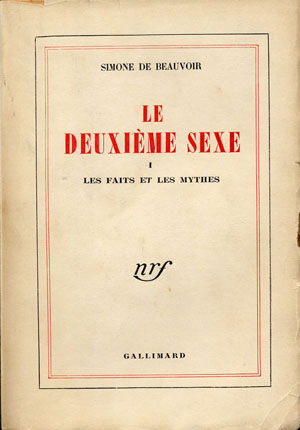
Beauvoir defines women as the "second sex" because women are defined as inferior to men. She pointed out that Aristotle argued women are "female by virtue of a certain lack of qualities", while Thomas Aquinas referred to women as "imperfect men" and the "incidental" being. She quotes "In itself, homosexuality is as limiting as heterosexuality: the ideal should be to be capable of loving a woman or a man; either, a human being, without feeling fear, restraint, or obligation."
Beauvoir asserted that women are as capable of choice as men, and thus can choose to elevate themselves, moving beyond the "immanence" to which they were previously resigned and reaching "transcendence", a position in which one takes responsibility for oneself and the world, where one chooses one's freedom.
Chapters of The Second Sex were originally published in Les Temps modernes, in June 1949. The second volume came a few months after the first in France. It was published soon after in America due to the quick translation by Howard Parshley, as prompted by Blanche Knopf, wife of publisher Alfred A. Knopf. Because Parshley had only a basic familiarity with the French language and a minimal understanding of philosophy (he was a professor of biology at Smith College), much of Beauvoir's book was mistranslated or inappropriately cut, distorting her intended message. For years, Knopf prevented the introduction of a more accurate retranslation of Beauvoir's work, declining all proposals despite the efforts of existentialist scholars.
Only in 2009 was there a second translation, to mark the 60th anniversary of the original publication. Constance Borde and Sheila Malovany-Chevallier produced the first integral translation in 2010, reinstating a third of the original work.
In the chapter "Woman: Myth and Reality" of The Second Sex, Beauvoir argued that men had made women the "Other" in society by the application of a false aura of "mystery" around them. She argued that men used this as an excuse not to understand women or their problems and not to help them, and that this stereotyping was always done in societies by the group higher in the hierarchy to the group lower in the hierarchy. She wrote that a similar kind of oppression by hierarchy also happened in other categories of identity, such as race, class, and religion, but she claimed that it was nowhere more true than with gender in which men stereotyped women and used it as an excuse to organize society into a patriarchy.
Despite her contributions to the feminist movement, especially the French women's liberation movement, and her beliefs in women's economic independence and equal education, Beauvoir was initially reluctant to call herself a feminist. However, after observing the resurgence of the feminist movement in the late 1960s and early 1970s, Beauvoir stated she no longer believed a socialist revolution to be enough to bring about women's liberation. She publicly declared herself a feminist in 1972 in an interview with Le Nouvel Observateur.
In 2018, the manuscript pages of Le Deuxième Sexe were published.
Other notable works
''She Came to Stay''
Main article: She Came to Stay
Beauvoir published her first novel She Came to Stay in 1943. It has been assumed that it is inspired by her and Sartre's sexual relationship with Olga Kosakiewicz and Wanda Kosakiewicz. Olga was one of her students in the Rouen secondary school where Beauvoir taught during the early 1930s. She grew fond of Olga. Sartre tried to pursue Olga but she rejected him, so he began a relationship with her sister, Wanda. Upon his death, Sartre was still supporting Wanda. He also supported Olga for years, until she met and married Jacques-Laurent Bost, a lover of Beauvoir. However, the main thrust of the novel is philosophical, a scene in which to situate Beauvoir's abiding philosophical pre-occupation – the relationship between the self and the other.
In the novel, set just before the outbreak of World War II, Beauvoir creates one character from the complex relationships of Olga and Wanda. The fictionalised versions of Beauvoir and Sartre have a ménage à trois with the young woman. The novel also delves into Beauvoir and Sartre's complex relationship and how it was affected by the ménage à trois.
She Came to Stay was followed by many others, including The Blood of Others, which explores the nature of individual responsibility, telling a love story between two young French students participating in the Resistance in World War II.
Existentialist ethics
Main article: Pyrrhus and Cineas, The Ethics of Ambiguity
Beauvoir wrote her first philosophical essay on existentialist ethics titled Pyrrhus et Cinéas (1944). The characters Pyrrhus and Cineas have a socratic dialogue to discuss questions such as 'What are the criteria of ethical action?' and 'Can violence ever be justified?'.
She continued her exploration of existentialism through her second essay The Ethics of Ambiguity (1947).

''Les Temps Modernes''
Main article: Les Temps modernes
Beauvoir, Sartre, and Maurice Merleau-Ponty co-founded Les Temps Modernes, a political journal that featured varied ideologies such as communists, Catholics, Gaullists, and socialists. Sartre wrote the purpose of Les Temps Modernes in the Preface of the first issue published on the 1st of October in 1945.
Beauvoir used Les Temps Modernes to promote her own work and explore her ideas on a small scale before fashioning essays and books. Beauvoir remained an editor until her death. However, Sartre and Merleau-Ponty had a longstanding feud, which led Merleau-Ponty to leave Les Temps modernes. Beauvoir sided with Sartre and ceased to associate with Merleau-Ponty. In Beauvoir's later years, she hosted the journal's editorial meetings in her flat and contributed more than Sartre, whom she often had to force to offer his opinions.
''The Mandarins''
Main article: The Mandarins
Published in 1954, The Mandarins won France's highest literary prize, the Prix Goncourt. It is a roman à clef set after the end of World War II and follows the personal lives of philosophers and friends among Sartre's and Beauvoir's intimate circle, including her relationship with American writer Nelson Algren, to whom the book is dedicated.
Algren was outraged by the frank way Beauvoir described their sexual experiences in both The Mandarins and her autobiographies. Algren vented his outrage when reviewing American translations of Beauvoir's work. Much material bearing on this episode in Beauvoir's life, including her love letters to Algren, entered the public domain only after her death.
''Les Inséparables''
Beauvoir's early novel Les Inséparables, long suppressed, was published in French in 2020 and two different English translations in 2021, by Sandra Smith in the US and Lauren Elkin in the UK. Written in 1954, the book describes her first love, a classmate named Elisabeth Lacoin ("Zaza") who died before age 22 of viral encephalitis, and had as a teenager a "passionate and tragic" relationship with Beauvoir. According to Sylvie Le Bon-de Beauvoir, Beauvoir never forgave Madame Lacoin for what happened, believing that Elisabeth-Zaza was murdered by the oppressive socio-cultural environment in which she had been raised. Disapproved by Sartre, the novel was deemed "too intimate" to be published during Beauvoir's lifetime.
Legacy
Beauvoir's The Second Sex is considered a foundational work in the history of feminism. Beauvoir had denied being a feminist multiple times, but ultimately admitted that she was one after The Second Sex became crucial in the world of feminism. The work has had a profound influence, opening the way for second-wave feminism in the United States, Canada, Australia, and around the world. Although Beauvoir has been quoted as saying, "There is a certain unreasonable demand that I find a little stupid because it would enclose me, immobilize me completely in a sort of feminist concrete block," her works on feminism have paved the way for all future feminists. The founders of the second-wave read The Second Sex in translation, including Kate Millett, Shulamith Firestone, Juliet Mitchell, Ann Oakley and Germaine Greer. All acknowledged their profound debt to Beauvoir, including visiting her in France, consulting with her at crucial moments, and dedicating works to her. Betty Friedan, whose 1963 book The Feminine Mystique is often regarded as the opening salvo of second-wave feminism in the United States, later said that reading The Second Sex in the early 1950s "led me to whatever original analysis of women's existence I have been able to contribute to the Women's movement and its unique politics. I looked to Simone de Beauvoir for a philosophical and intellectual authority."
At one point in the early 1970s, Beauvoir also aligned herself with the French League for Women's Rights as a means to campaign and fight against sexism in French society. Beauvoir's influence goes beyond just her impact on second-wave founders, and extends to numerous aspects of feminism, including literary criticism, history, philosophy, theology, criticism of scientific discourse, and psychotherapy. When Beauvoir first became involved with the feminism movement, one of her objectives was legalizing abortion. Donna Haraway wrote that, "despite important differences, all the modern feminist meanings of gender have roots in Simone de Beauvoir's claim that 'one is not born a woman [one becomes one].'" This "most famous feminist sentence ever written" is echoed in the title of Monique Wittig's 1981 essay One Is Not Born a Woman. Judith Butler took the concept a step further, arguing that Beauvoir's choice of the verb to become suggests that gender is a process, constantly being renewed in an ongoing interaction between the surrounding culture and individual choice.
In Paris, Place Jean-Paul-Sartre-et-Simone-de-Beauvoir is a square where Beauvoir's legacy lives on. It is one of the few squares in Paris to be officially named after a couple. The pair lived close to the square at 42 rue Bonaparte.
In 2019, Time created 89 new covers to celebrate women of the year starting from 1920; it chose Beauvoir for 1949.
Prizes
- Prix Goncourt, 1954
- Jerusalem Prize, 1975
- Austrian State Prize for European Literature, 1978
Works
Novels
- L'Invitée ("She Came to Stay", 1943)
- Le Sang des autres ("The Blood of Others", 1945)
- Tous les hommes sont mortels ("All Men Are Mortal", 1946)
- Les Mandarins ("The Mandarins", 1954)
- Les Belles Images ("Beautiful Images", 1966)
- Malentendu à Moscou ("Misunderstanding in Moscow", 2013; posthumously published)
- Les Inséparables ("Inseparables", 2020; posthumously published)
Short stories
- L'Amérique au jour le jour ("America Day by Day", 1948)
- La Femme rompue ("The Woman Destroyed", 1967)
- Quand prime le spirituel ("When Things of the Spirit Come First", 1979)
Essays
- Pyrrhus et Cinéas ("Pyrrhus and Cineas", 1944)
- Pour une morale de l'ambiguïté ("The Ethics of Ambiguity", 1947)
- Le Deuxième Sexe ("The Second Sex", 1949)
- Privilèges ("Privileges", 1955)
- Faut-il brûler Sade? ("Must We Burn Sade?")
- La Pensée de droite, aujourd'hui ("Right-Wing Thought Today")
- Merleau-Ponty et le pseudo-sartrisme ("Merleau-Ponty and Pseudo-Sartrism")
- La Longue Marche: essai sur la Chine ("The Long March: An Essay on China", 1957)
- La Vieillesse ("The Coming of Age", 1970)
Theatre
- Les Bouches inutiles ("Who Shall Die?", 1945)
Autobiographies
- Mémoires d'une jeune fille rangée ("Memoirs of a Dutiful Daughter", 1958)
- La Force de l'âge ("The Prime of Life", 1960)
- La Force des choses ("Force of Circumstance", 1963)
- Une mort très douce ("A Very Easy Death", 1964)
- Tout compte fait ("All Said and Done", 1972)
- La Cérémonie des adieux ("Adieux: A Farewell to Sartre", 1981)
Posthumous publications
- Lettres à Sartre, tome I: 1930–1939 (1990)
- Lettres à Sartre, tome II: 1940–1963 (1990)
- Journal de guerre, septembre 1939–janvier 1941 ("Wartime Diary", 1990)
- Lettres à Nelson Algren ("A Transatlantic Love Affair: Letters to Nelson Algren", 1997)
- Correspondance croisée avec Jacques-Laurent Bost (2004)
- Philosophical Writings (2004)
- Diary of a Philosophy Student, 1926–27 (2006)
- Cahiers de jeunesse, 1926–1930 (2008)
References
References
- O'Brien, Wendy, and Lester Embree (eds), ''The Existential Phenomenology of Simone de Beauvoir'', Springer, 2013, p. 40.
- {{cite LPD. 3
- {{cite EPD. 18
- Pardina, María Teresa López. (1994). "Simone de Beauvoir as Philosopher". Simone de Beauvoir Studies.
- (2021). "Simone de Beauvoir". Metaphysics Research Lab, Stanford University.
- Cohen, Patricia. (1998-09-26). "Beauvoir Emerges From Sartre's Shadow; Some Even Dare to Call Her a . . . Philosopher". The New York Times.
- Bergoffen, Debra. (16 August 2010). "Simone de Beauvoir". Stanford University.
- (2023). "The Stanford Encyclopedia of Philosophy". Metaphysics Research Lab, Stanford University.
- "Mémoires d'une jeune fille rangée - Simone de Beauvoir".
- Norwich, John Julius. (1985–1993). "Oxford illustrated encyclopedia". Oxford University Press.
- [https://www.nobelprize.org/nomination/archive/show_people.php?id=12602 Nomination archive – Simone Lucie Ernestine Marie B de Beauvoir] nobelprize.org
- Rodgers, Nigel. "Philosophers Behaving Badly".
- (9 January 2020). "UPI Almanac for Thursday, Jan. 9, 2020". [[United Press International]].
- Freely, Maureen. (6 June 1999). "Still the second sex". [[The Guardian]].
- (8 January 2008). "Lisa Appignanesi's top 10 books by and about Simone de Beauvoir". The Guardian.
- Hollander, Anne. (11 June 1990). "The Open Marriage of True Minds".
- Mussett, Shannon. "Beauvoir, Simone de {{!}} Internet Encyclopedia of Philosophy".
- Moorehead, Caroline. (1974-06-02). "A talk with Simone de Beauvoir".
- Bair, p. 60
- ''Memoirs of a Dutiful Daughter'', Book One
- (22 November 2022). "Paris: sur les traces de Simone de Beauvoir".
- Margaret A. Simons (ed.), ''Feminist Interpretations of Simone de Beauvoir'', Penn State Press, 1 November 2010, p. 3.
- Menand, Louis. (19 September 2005). "Stand by Your Man".
- (9 July 2020). "Simone de Beauvoir".
- Thurman, Judith. (28 May 2010). "Introduction to Simone de Beauvoir's 'The Second Sex'". The New York Times.
- Bertrand de Beauvoir, Simone. (1974). "All Said and Done". G. P. Putnam's & Sons.
- (14 July 2016). "Simone de Beauvoir: Equality in Unity".
- (January 2008). "The Oxford Encyclopedia Women in World History". Oxford University Press.
- Kelly Oliver (ed.), ''French Feminism Reader'', Rowman & Littlefield Publishers, 2000, p. 1; ''Bulletin 2006 de l'Association amicale des anciens et anciennes élèves du lycée Molière'', 2006, p. 22.
- David Newcastle, [https://tikhanovlibrary.com/the-rise-and-fall-of-pierre-drieu-la-rochelle/ ''The Rise and Fall of Pierre Drieu la Rochlle''], Gilles, Tikhanov Library, 2024, preface
- [https://academic.oup.com/book/11006/chapter-abstract/159332034?redirectedFrom=fulltext “An Eye for an Eye”: The Question of Revenge] Sonia Kirks
- Seymour-Jones 2008, back cover.
- Bair, p. 155-7
- (November 1999). "Reciprocity and Friendship in Beauvoir's Thought". Hypatia.
- Moorehead, Caroline. (2 June 1974). "A talk with Simone de Beauvoir". The New York Times.
- Appignanesi, Lisa. (10 June 2005). "Our relationship was the greatest achievement of my life". The Guardian.
- Schneir, Miriam. (1994). "Feminism in Our Time". Vintage Books.
- Beauvoir, ''The Prime of Life,'' p. 363.
- Thurman, Judith. Introduction to ''The Second Sex'', 2009.
- Kirkpatrick, Kate. (22 August 2019). "Becoming Beauvoir: A Life". Bloomsbury Academic.
- Ursula Tidd, ''Simone de Beauvoir'', Psychology Press, p. 19.
- Nancy Bauer, ''Simone de Beauvoir: Philosophy, and Feminism'', Columbia University Press, 2012, p. 86.
- Nigel Rodgers. (2004). "Philosophers Behaving Badly". [[Peter Owen Publishers]].
- ''Mémoires d'une jeune fille dérangée'' (1994, LGF – Livre de Poche; {{ISBN. 978-2-253-13593-7/2006, Balland; {{ISBN. 978-2-7158-0994-9).
- (14 April 1996). "The Odd Couple".
- (14 July 2023). "Jean-Paul Sartre, Simone de Beauvoir: Bianca, leur jouet sexuel". [[Gala (magazine).
- ''Tête-à-tête: Simone de Beauvoir and Jean-Paul Sartre'', Hazel Rowley, HarperCollins, 2005, pp. 130–135, {{ISBN. 0-06-052059-0; {{ISBN. 978-0-06-052059-5.
- "Légifrance - Publications officielles - Journal officiel - JORF n° 0155 du 03/07/1945 (accès protégé)".
- "The Age(s) of Consent: Gay Activism and the Sexuality of Minors in France and Quebec (1970-1980)".
- ''Intellectuals: From Marx and Tolstoy to Sartre and Chomsky'', Paul Johnson, Harper Perennial, 1988, pp. 238–38, {{ISBN. 978-0-06-125317-1.
- de Beauvoir, Simone. "La Force de l'âge". Gallimard.
- Evans, Christine Anne. (10 September 1995). ""La Charmante Vermine": Simone de Beauvoir and the Women in Her Life". Simone de Beauvoir Studies.
- Menand, Louis. (26 September 2005). "Stand By Your Man". Condé Nast.
- De Beauvoir, Simone. (1999). "America Day by Day". University of California Press.
- Drew, Bettina. (27 September 1998). "Simone de Beauvoir's Love Letters to Nelson Algren". Chicago Tribune.
- Le Bon-de Beauvoir, Sylvie. (1997). "Preface: A Transatlantic Love Affair". The New York Times.
- Willms, Janice. (1997-12-18). "A Very Easy Death".
- de Beauvoir, "America Day by Day", Carol Cosman (Translator) and Douglas Brinkley (Foreword), Berkeley: University of California Press, 1999. {{ISBN. 9780520210677.
- Crean, Jeffrey. (2024). "The Fear of Chinese Power: an International History". [[Bloomsbury Academic]].
- "Sex, Society, and the Female Dilemma". Interview with Betty Friedan, ''The Saturday Review'' (pp. 12-21), June 14, 1975.
- Betty Friedan, 1998, “It changed my life: Writings on the woman’s movement”, p. 397-398. ISBN 9780674468856
- Appignanesi 2005, p. 160.
- "''Sexual Morality and the Law''", Chapter 16 of ''Politics, Philosophy, Culture: Interviews and Other Writings 1977-1984''. Edited by Lawrence D. Krizman. New York/London: 1990, Routledge, {{ISBN. 0-415-90149-9, p. 275.
- Henley, Jon. (23 February 2001). "Calls for legal child sex rebound on luminaries of May 68". The Guardian.
- (26 January 1977). "À Propos d'un Procès". Le Monde.fr.
- Andraca, Robin. (January 2, 2020). "Matzneff : les signataires d'une pétition pro-pédophilie de 1977 ont-ils émis des regrets ?". [[Libération]].
- "Table of Contents: Sisterhood is global". Catalog.vsc.edu.
- Beauvoir, Simone. (2013). "Adieux: A Farewell to Sartre". Knopf Doubleday Publishing Group.
- Latchford, Frances J.. (2020). "Heterodox Love and the Girl Maverick: Simone de Beauvoir, Sylvie le Bon, and Their Confounding Family Romance". Adoption & Culture.
- "Encyclopędia Britannica's Guide to Women's History".
- Traub, Courtney. (2019-05-22). "Montparnasse Cemetery in Paris: Walking Paths & Famous Graves".
- Bergoffen, Debra. (2018-07-10). "Simone de Beauvoir". Oxford Handbooks Online.
- Beauvoir, ''The Second Sex'', 267.
- Mikkola, Mari. (3 January 2018). "The Stanford Encyclopedia of Philosophy". Metaphysics Research Lab, Stanford University.
- Bergoffen, Debra. (2015). "The Stanford Encyclopedia of Philosophy". Metaphysics Research Lab, Stanford University.
- Beauvoir, Simone de. "Simone de Beauvoir The Second Sex, Woman as Other 1949".
- Beauvoir, Simone. "The Second Sex".
- Beauvoir, Simone de. (2 March 2015). "The second sex". Vintage Books.
- Appignanesi 2005, p. 82
- Appignanesi 2005, p. 89
- Moi, Toril "While We Wait: The English Translation of 'The Second Sex'" in ''Signs'' 27(4) (Summer, 2002), pp. 1005–35.
- "Review: The Second Sex, by Simone de Beauvoir".
- Beauvoir, Simone de. "Woman: Myth and Reality".
** in Jacobus, Lee A. (ed.). ''A World of Ideas''. Boston: Bedford/St. Martins, 2006. 780–95.
** in Prince, Althea, and Susan Silva Wayne. ''Feminisms and Womanisms: A Women's Studies Reader''. Women's Press, Toronto 2004 p. 59–65. - Fallaize, Elizabeth. (1998). "Simone de Beauvoir: A critical reader". Routledge.
- (29 June 2018). "Revisiting Simone de Beauvoir's ''The Second Sex'' as a Work in Progress". The New York Times.
- "Beauvoir, Simone de {{!}} Internet Encyclopedia of Philosophy".
- "Beauvoir, Simone de {{!}} Internet Encyclopedia of Philosophy".
- {{Wikisource link. The Brothers Karamazov/Book XI/Chapter 4. Part IV Book XI Chapter 4
- Poirier, Agnès. (2019-05-25). "Les Temps Modernes: Paris mourns passing of the intellectual left's bible". [[The Observer]].
- "littérature engagée".
- (10 July 2003). "Simone de Beauvoir, l'engagée".
- (17 September 1998). "More than ever, and for ever". London Review of Books.
- (1 September 1998). "A Transatlantic Love Affair: Letters to Nelson Algren".
- Emre, Merve. (23 August 2021). "Simone de Beauvoir's Lost Novel of Early Love".
- Beauvoir, Simone de. (2020). "Les inséparables". [[L'Herne]].
- (1979). "Simone de Beauvoir: An Interview". Feminist Studies.
- Fallaize, Elizabeth. (2007). "Simone de Beauvoir: A Critical Reader". Routledge.
- (14 June 1975). "Sex, Society, and the Female Dilemma: A Dialogue between Simone de Beauvoir and Betty Friedan".
- Mann, Bonnie. (20 July 2017). "On ne naît pas femme : on le devient: The Life of a Sentence". Oxford University Press.
- (2003). "Feminist Theory Reader: Local and Global Perspectives". Psychology Press.
- Bell, Vikki. (25 October 1999). "Performativity & Belonging". SAGE Publications.
- (March 5, 2020). "100 Women of the Year".
This article was imported from Wikipedia and is available under the Creative Commons Attribution-ShareAlike 4.0 License. Content has been adapted to SurfDoc format. Original contributors can be found on the article history page.
Ask Mako anything about Simone de Beauvoir — get instant answers, deeper analysis, and related topics.
Research with MakoFree with your Surf account
Create a free account to save articles, ask Mako questions, and organize your research.
Sign up freeThis content may have been generated or modified by AI. CloudSurf Software LLC is not responsible for the accuracy, completeness, or reliability of AI-generated content. Always verify important information from primary sources.
Report