From Surf Wiki (app.surf) — the open knowledge base
6th arrondissement of Paris
Municipal arrondissement in Île-de-France, France
Municipal arrondissement in Île-de-France, France
| Field | Value | ||
|---|---|---|---|
| type | arrmun | ||
| name | 6th arrondissement of Paris | ||
| INSEE | 75106 | ||
| commune | Paris | ||
| population | |||
| population_as_of | |||
| population_footnotes | |||
| nbcomm | seat= | area = 2.154 | |
| image_map | Paris 6e arr jms.gif | ||
| map_caption | Location within Paris | ||
| image_skyline | Les Deux Magots, Paris 25 May 2014.jpg | ||
| image_caption | Terrace of café Les Deux Magots, opened in 1885 on Boulevard Saint-Germain | ||
| image_shield | Blason ville fr Paris VI.svg | ||
| logo | [[File:Logo Arrondissement de Paris - Mairie 06 - Luxembourg.svg | 150px | Logo]] |
| mayor | Jean-Pierre Lecoq | ||
| party | LR | ||
| term | 2020–2026 | ||
| coordinates |
The 6th arrondissement of Paris (VIe arrondissement) is one of the 20 arrondissements of the capital city of France. In spoken French, it is referred to as le sixième.
The arrondissement, called Luxembourg in a reference to the seat of the Senate and its garden, is situated on the Rive Gauche of the River Seine. It includes educational institutions such as the École nationale supérieure des Beaux-Arts, the École des hautes études en sciences sociales and the Institut de France, as well as Parisian monuments such as the Odéon-Théâtre de l'Europe, the Pont des Arts, which links the 1st and 6th arrondissements over the Seine, Saint-Germain Abbey and Saint-Sulpice Church.
This central arrondissement, which includes the historic districts of Saint-Germain-des-Prés (surrounding the abbey founded in the 6th century) and Luxembourg (surrounding the Palace and its Gardens), has played a major role throughout Parisian history. It is well known for its café culture and the revolutionary existentialism intellectualism of the authors that lived there, including Jean-Paul Sartre, Simone de Beauvoir, Gertrude Stein, Paul Éluard, Boris Vian, Albert Camus and Françoise Sagan.
With its cityscape, intellectual tradition, history, architecture and central location, the arrondissement has long been home to French intelligentsia. It is a major locale for art galleries and fashion stores and is one of Paris's most expensive areas and one of France's richest districts in terms of average income. It is part of what is called Paris Ouest (Paris West) alongside the 7th, 8th and 16th arrondissements, as well as the Neuilly-sur-Seine inner suburb.
History
The current 6th arrondissement, dominated by the Abbey of Saint-Germain-des-Prés—founded in the 6th century—was the heart of the Catholic Church's power in Paris for centuries, hosting many religious institutions.
In 1612, Queen Marie de Médicis bought an estate in the district and commissioned architect Salomon de Brosse to transform it into the outstanding Luxembourg Palace surrounded by extensive royal gardens. The new Luxembourg Palace turned the neighbourhood into a fashionable district for French nobility.
In the aftermath of the French Revolution, architect Jean-François Chalgrin was commissioned to redesign the Luxembourg Palace in 1800 to make it the seat of the newly established Sénat conservateur. Nowadays, the grounds around the Luxembourg Palace, known as the Senate Garden (Jardin du Sénat), are open to the public; they have become a prized Parisian garden across from the 5th arrondissement's Panthéon.
Since the 1950s, the arrondissement, with its many higher education institutions, cafés (Café de Flore, Les Deux Magots, La Palette, Café Procope) and publishing houses (Gallimard, Julliard, Grasset) has been the home of much of the major post-war intellectual and literary movements and some of most influential in history such as surrealism, existentialism and modern feminism.
Geography
The land area of the arrondissement is 2.154 km2, or 532 acres).
Quarters

- Quartier Monnaie (21)
- Quartier Odéon (22)
- Quartier Notre-Dame-des-Champs (23)
- Quartier Saint-Germain-des-Prés (24)
Places of interest
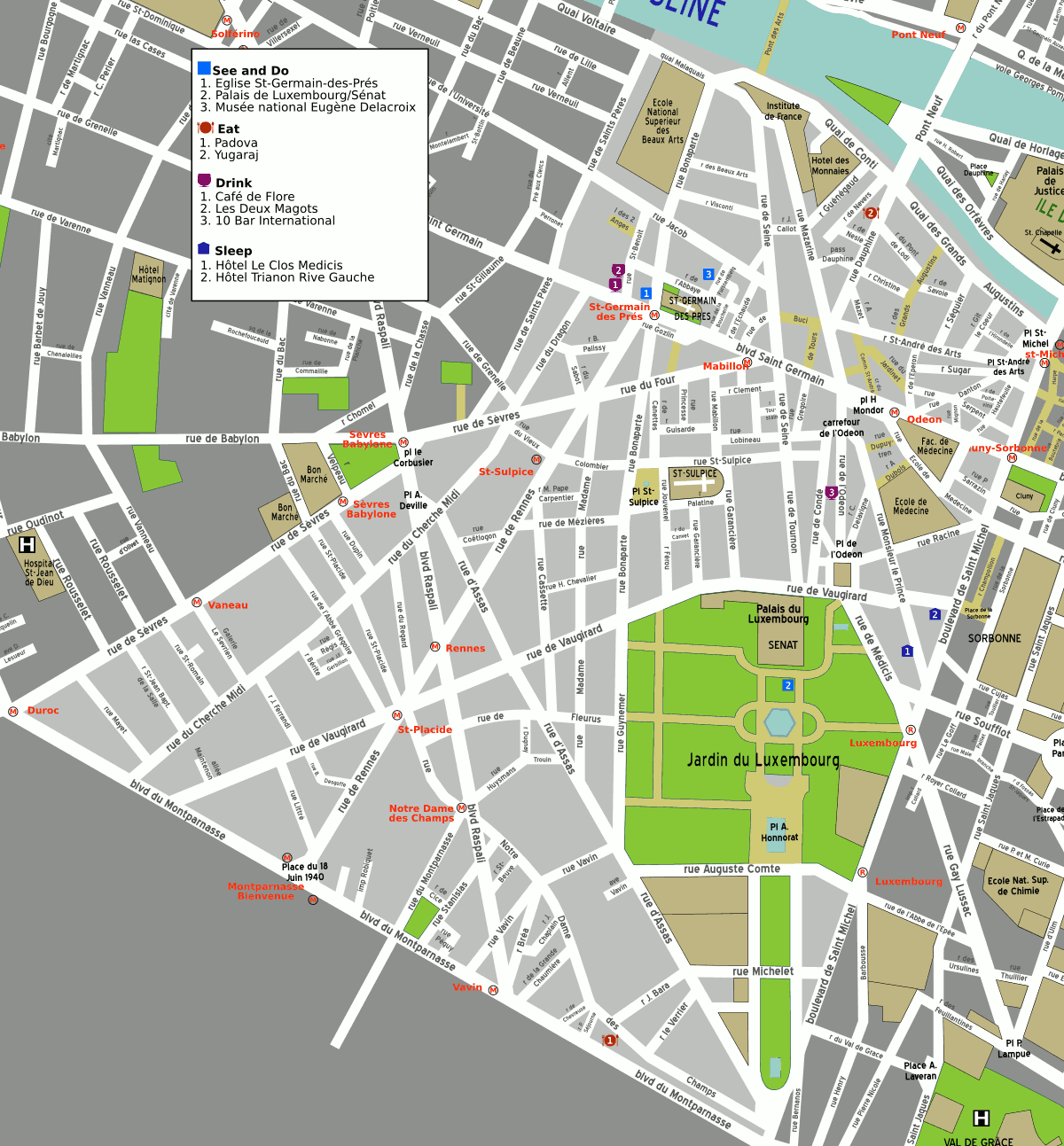
- Académie Française
- Café de Flore
- Café Procope
- Hôtel de Chimay
- Hôtel Lutetia
- Institut de France
- Jardin du Luxembourg
- Latin Quarter (partial)
- Les Deux Magots
- Medici Fountain
- Notre-Dame-des-Champs, Paris
- Odéon-Théâtre de l'Europe
- Polidor
- Pont des Arts
- Pont Neuf
- Pont Saint-Michel
- Saint-Germain-des-Prés (church)
- Saint-Germain-des-Prés (quarter)
- Saint-Sulpice church
- Senate (Luxembourg Palace)
- Théâtre du Vieux-Colombier
Museums
- Fondation Jean Dubuffet
- Maison d'Auguste Comte
- Monnaie de Paris
- Musée – Librairie du Compagnonnage
- Musée d'Anatomie Delmas-Orfila-Rouvière
- Musée de Minéralogie
- Musée Edouard Branly
- Musée Hébert
- Musée Zadkine
Colleges and universities
- Paris Cité University (Saints-Pères campus)
- Pantheon-Assas University (main campus)
- Catholic University of Paris (main campus)
- St. John's University (New York City) (Paris campus)
- Lycée Stanislas
- École des hautes études en sciences sociales
- École nationale des ponts et chaussées
- École nationale supérieure des Beaux-Arts (PSL University)
- École nationale supérieure des mines de Paris (PSL University)
- Lycée Fénelon
- Lycée Montaigne
- Lycée Saint-Louis
Churches and chapels
- Saint-Joseph-des-Carmes
- Saint-Germain-des-Prés (abbey)
- Saint-Sulpice church
- Saint Vincent de Paul Chapel
Landmarks
- Arcade du Pont-Neuf
- Cherche-Midi prison
- Couvent des Cordeliers
- Comédie-Française
- Hôtel de Bourbon-Condé
- Hôtel de Condé
Main streets and squares
- Place du 18-Juin-1940
- Rue de l'Abbaye
- Rue de l'Ancienne Comédie
- Rue André-Mazet
- Rue d'Assas
- Rue Auguste Comte
- Rue de Beaux Arts
- Rue Bonaparte
- named after Napoleon
- Rue Bréa
- named after General Jean Baptiste Fidèle Bréa (1790–1848)
- Rue de Buci
- named after Simon de Buci, President of the Parlement of Paris, who had purchased the Gate Saint-Germain (now demolished) in 1350
- Rue des Canettes
- Rue Cassette
- Rue du Cherche-Midi
- Rue Christine
- named after Christine of France, Duchess of Savoy (1606–1663)
- Rue de Condé
- named after the former Hôtel de Condé, of which forecourt faced the street
- Quai de Conti
- Rue Danton
- Passage Dauphine
- Rue Dauphine
- named after King Louis XIII (1601–1643), Dauphin of France from 1601 to 1610
- Rue du Dragon
- Rue Duguay-Trouin
- Rue Dupin
- Rue de l'École de Médecine
- Rue de Fleurus
- Rue du Four
- Place de Furstemberg
- Rue de Furstemberg
- Rue Garancière
- Quai des Grands-Augustins
- Rue des Grands Augustins
- Rue Grégoire de Tours
- named after Saint Gregory of Tours, Bishop of Tours (538–594)
- Rue Guisarde
- Rue Guynemer
- Rue Hautefeuille
- Place Henri Mondor
- Rue Jacques Callot
- named after Jacques Callot (1592–1635), engraver
- Rue du Jardinet
- Rue Jacob
- Rue Lobineau
- Rue Mabillon
- Rue Madame
- named after Marie Joséphine of Savoy (1753–1810), styled Madame
- Quai Malaquais
- Rue Mayet
- Rue Mazarine
- Rue de Médicis
- Rue de Mézières
- Rue Mignon
- Rue Monsieur-le-Prince
- Boulevard du Montparnasse
- Rue de Nesle
- Rue de Nevers
- Rue Notre-Dame des Champs
- Carrefour de l'Odéon
- Rue de l'Odéon
- Rue Palatine
- named after Anne Henriette of Bavaria, Princess Palatine (1648–1723)
- Rue Pierre Sarrazin
- Rue des Poitevins
- Rue du Pont de Lodi
- named after Bonaparte's victory on May 10, 1796, at the Battle of Lodi
- Rue Princesse
- named after Catherine de Lorraine, Princess de Dombes (1552–1596)
- Rue des Quatre Vents
- Place du Québec
- Boulevard Raspail
- named after François Vincent Raspail (1794–1878) French chemist and politician
- Rue de Rennes
- Rue Saint-André-des-Arts
- Rue Saint-Benoît
- Boulevard Saint-Germain (partial)
- Rue Saint-Jean-Baptiste de la Salle
- Boulevard Saint-Michel (partial)
- Place Saint-Michel (partial)
- Place Saint-Sulpice
- Rue Saint-Sulpice
- Rue des Saints Pères
- Rue de Savoie
- Rue de Seine
- Rue de Sèvres
- Rue Stanislas
- named after the nearby collège Stanislas, founded under Louis XVIII, and named after one of his first names
- Rue de Tournon
- named after Cardinal François de Tournon (1489–1562)
- Rue de Vaugirard (partial)
- Rue Vavin
- named after the 19th-century politician Alexis Vavin
- Rue Visconti
- named after Louis Visconti (1791–1853), designer of Napoleon's tomb
Gallery
File:Hôtel Lutetia, Paris 6e 3.jpg|Palace Hôtel Lutetia File:Immeuble boulevard Saint-Germain, rue Saint-Jacques, Paris 5e.jpg|Corner between Boulevard Saint-Germain and Rue Saint-Jacques File:P1110475 Paris VI rue de Tournon rwk.JPG|Rue Tournon
Demography
The arrondissement attained its peak population in 1911 when the population density reached nearly 50,000 inhabitants per km2. In 2009, the population was 43,143 inhabitants while the arrondissement provided 43,691 jobs.
Economy
Toei Animation Europe has its head office in the arrondissement. The company, which opened in 2004, serves France, Germany, Italy, Spain, and the United Kingdom.
Real estate
The 6th and 7th arrondissements are the most expensive districts of Paris, the most expensive parts of the 6th arrondissement being Saint-Germain-des-Prés quarter, the riverside districts and the areas nearby the Luxembourg Garden.
Historical population
| Year | ||
|---|---|---|
| (of French censuses) | Population | Density |
| (inh. per km2) | ||
| 1872 | 90,288 | 41,994 |
| 1911 (peak of population) | 102,993 | 47,815 |
| 1954 | 88,200 | 41,023 |
| 1962 | 80,262 | 37,262 |
| 1968 | 70,891 | 32,911 |
| 1975 | 56,331 | 26,152 |
| 1982 | 48,905 | 22,704 |
| 1990 | 47,891 | 22,234 |
| 1999 | 44,919 | 20,854 |
| 2009 | 43,143 | 20,067 |
Immigration
| EU-15 = 6.1 | non-EU-15 = 8.7
Notable people
- Raymond Aron (1905–1983), historian and philosopher
- Heinz Berggruen (1914–2007), art collector
- Catherine Deneuve (b. 1943), actress
- Maurice Françon (1913–1996), engineer and physicist
- Ina Garten (b. 1948), American chef and author
References
References
- (2018). "Rue de Sèvres. Hermès store. Paris". Paris Digest.
- "[http://corp.toei-anim.co.jp/english/outline/affiliated_companies.php#taeu AFFILIATED COMPANIES] {{Webarchive. link. (2015-10-19 ". [[Toei Animation]]. Retrieved on November 17, 2011. "37 rue du Four 75006 Paris France".)
This article was imported from Wikipedia and is available under the Creative Commons Attribution-ShareAlike 4.0 License. Content has been adapted to SurfDoc format. Original contributors can be found on the article history page.
Ask Mako anything about 6th arrondissement of Paris — get instant answers, deeper analysis, and related topics.
Research with MakoFree with your Surf account
Create a free account to save articles, ask Mako questions, and organize your research.
Sign up freeThis content may have been generated or modified by AI. CloudSurf Software LLC is not responsible for the accuracy, completeness, or reliability of AI-generated content. Always verify important information from primary sources.
Report