From Surf Wiki (app.surf) — the open knowledge base
Rose Bowl Game
Annual American college gridiron football postseason game

Annual American college gridiron football postseason game
| Field | Value | |
|---|---|---|
| name | Rose Bowl Game | |
| full_name | Rose Bowl Game presented by Prudential | |
| nickname | The Granddaddy of Them All | |
| logo | Rose Bowl Game logo.svg | |
| stadium | Rose Bowl | |
| location | Pasadena, California | |
| previous_stadiums | Tournament Park | |
| (1902, 1916–1922) | ||
| temporary_venue | Duke Stadium, Durham, North Carolina (1942) | |
| AT&T Stadium, Arlington, Texas (2021) | ||
| years | 1902, 1916–present | |
| website | ||
| champ_affiliation | {{ubl | |
| conference_tie-ins | Big Ten (1947–present) | |
| previous_tie-ins | Pac-12 (1917–2023) | |
| payout | 35 million/conference () | |
| sponsors | {{ubl | |
| former_names | {{ubl | |
| prev_matchup_year | 2026 | |
| prev_matchup_season | 2025 | |
| prev_matchup_teams | Alabama vs. Indiana (Indiana 38–3) | |
| prev_matchup_score | ||
| next_matchup_year |
(1902, 1916–1922) AT&T Stadium, Arlington, Texas (2021) |CFP (2014–present) |BCS (1998–2013) | conference_tie-ins = Big Ten (1947–present) | previous_tie-ins =Pac-12 (1917–2023) |Pasadena Tournament of Roses Association (1902, 1916–1998) |AT&T (1999–2002) |Sony/PlayStation 2 (2003) |Citi (2004–2010) |Vizio (2011–2014) |Northwestern Mutual (2015–2020) |Capital One (2021–2022) |Prudential Financial (2023–present) |Tournament East–West football game (1902, 1916–1922) |Rose Bowl (1923–1998) |Rose Bowl presented by AT&T (1999–2002) |Rose Bowl presented by PlayStation 2 (2003) |Rose Bowl presented by Citi (2004–2010) |Rose Bowl presented by Vizio (2011–2014) |Rose Bowl Game presented by Northwestern Mutual (2015–2020) |Rose Bowl Game presented by Capital One (2021) |Rose Bowl Game presented by Capital One Venture X (2022)
The Rose Bowl Game is an annual American college football bowl game, traditionally played on January 1 (New Year's Day) at the Rose Bowl in Pasadena, California. When New Year's Day falls on a Sunday, the game is played on Monday, January 2.
Nicknamed "The Granddaddy of Them All" by broadcaster Keith Jackson, it was the first postseason football game ever established. The Rose Bowl Game was first played in 1902 as the Tournament East–West football game, and has been played annually since 1916. Since 1945, it has been the highest attended college football bowl game. The game is a part of the Pasadena Tournament of Roses Association's "America's New Year Celebration", which also includes the historic Rose Parade. Winners of the game receive the Leishman Trophy, named for former Tournament of Roses presidents, William L. Leishman and Lathrop K. Leishman who played an important part in the history of this game.
Starting in 1917, the Rose Bowl Game selected a team from the predecessor of the Pac-12 Conference each year along with a team from the eastern half of the country. In 1947, the Rose Bowl Game began its traditional matchup of the conference champions from the Big Ten Conference and the predecessor of the Pac-12 Conference, which continued to 2023, with some exceptions.
In 1998, the Rose Bowl Game joined with several other bowls to create the Bowl Championship Series to produce an undisputed national champion in college football. This marked the first time the Rose Bowl agreed to release the Big Ten or Pac-12 champion to play in a national championship game if they were ranked #1 or #2. The Rose Bowl Game served as the national championship game in 2002 and 2006. The Rose Bowl stadium and the Pasadena Tournament of Roses Association hosted the BCS National Championship Game in 2010 and 2014, in addition to the regular Rose Bowl Game.
In 2014, the Rose Bowl, along with the other "New Year's Six" bowls, became a part of the College Football Playoff. As part of the four team playoff from 2014 to 2023, the Rose Bowl served as a semifinal game in 2015, 2018, and 2021. When not serving as a semifinal, the Rose Bowl featured the best available teams from the Big Ten and Pac-12 conferences.
With the expansion of the College Football Playoff to twelve teams in the 2024–25 season, the Rose Bowl will serve as either a quarterfinal or semifinal each year. It served as a quarterfinal in 2025 and will do so again in 2026. When serving as a quarterfinal, the Rose Bowl will host the Big Ten champion, if seeded in the top four. When serving as a semifinal, the game will be played one week after New Year's Day, and, if the Big Ten champion is one of the top two seeds, the team will be assigned to the Rose Bowl.
History
Originally titled the "Tournament East–West football game", the first Rose Bowl was played on January 1, 1902, starting the tradition of New Year's Day bowl games. The football game was added in 1902 to help fund the cost of the Rose Parade. The inaugural game featured Fielding H. Yost's dominating 1901 Michigan team, representing the East, which crushed a previously 3–1–2 team from Stanford University, representing the West, by a score of 49–0 after Stanford quit in the third quarter. Michigan finished the season 11–0 and was crowned the national champion. Yost had been Stanford's coach the previous year. The game was so lopsided that for the next thirteen years, the Tournament of Roses officials ran chariot races, ostrich races, and other various events instead of football. But, on New Year's Day 1916, football returned to stay as the State College of Washington (now Washington State University) defeated Brown University in the first of what was thereafter an annual tradition.
Tournament Park and Rose Bowl stadium
Before the Rose Bowl was built, games were played in Pasadena's Tournament Park, approximately 3 mi southeast of the current Rose Bowl stadium, near the campus of Caltech. Tournament Park was found to be unsuitable for the increasingly large crowds gathering to watch the game and a new, permanent home for the game was commissioned.
The Rose Bowl stadium, designed after the Yale Bowl in New Haven, hosted its first "Rose Bowl" game on January 1, 1923. The name of the stadium was alternatively "Tournament of Roses Stadium" or "Tournament of Roses Bowl", until the name "Rose Bowl" was settled on before the 1923 game.
The stadium seating has been reconfigured several times since its original construction in 1922. For many years, the Rose Bowl stadium had the largest football stadium capacity in the United States, eventually being surpassed by Michigan Stadium in 1998. The maximum stated seating capacity was 104,594 from 1972 to 1997. Capacity was lowered after the 1998 game; the 2006 game, which was also the BCS championship game, attracted a crowd of 93,986; and there were 94,118 spectators at the 2011 game between TCU and Wisconsin. As of 2012, the Rose Bowl is number seven on the list of American football stadiums by capacity with a current official seating capacity of 92,542 and is still the largest stadium that hosts post-season bowl games. The Rose Bowl is also the only CFP bowl game that is held in a non-NFL stadium.
Team selection 1916–1946
In the game's early years, except during World War I, the Rose Bowl always pitted a team—not necessarily the conference champion—from the Pacific Coast Conference (PCC), the predecessor of the current Pac-12 Conference, against an opponent from the Eastern U.S. During the last two years of World War I, teams from military bases met in the Rose Bowl. During its history, a number of notable matchups have been made with the top football teams and top coaches of the time. These include the 1925 game, with Knute Rockne's Notre Dame and their Four Horsemen against "Pop" Warner's Stanford; the 1926 edition was the Alabama Crimson Tide's win over Washington, and 1940 featured Howard Jones' USC Trojans against Bob Neyland's Tennessee Volunteers. During this period, there were ten games in which undefeated teams were matched.
World War II – 1942 venue change to Durham, North Carolina
After the Japanese attack on Pearl Harbor on December 7, 1941, and a series of attacks on West Coast shipping beginning on December 18, there were concerns about a possible Japanese attack on the West Coast. The Rose Parade, with a million watchers, and the Rose Bowl, with 90,000 spectators, were presumed to be ideal targets for the Japanese. Lieutenant General John L. DeWitt recommended that the Rose Parade and Rose Bowl festivities be cancelled. The Rose Bowl committee originally planned to cancel the game. On December 16, Duke University invited the game and Oregon State to Duke's home stadium in Durham, North Carolina. After the 1942 Allied victory in the Battle of Midway and the end of the Japanese offensives in the Pacific Theater during 1942, it was deemed that a large portion of the West Coast was no longer vulnerable to attack, and the Rose Bowl Game continued on in the Rose Bowl stadium. The Tournament of Roses parade itself still was not held in 1943 because of the war.
Big Nine–PCC agreement
During World War II, many college football schools had dropped some conference opponents and instead played football against local military base teams. Many colleges could not even field teams because of the draft and manpower requirements. After the war was over, demobilization and the G.I. Bill enabled returning servicemen to attend college. The 1946 season was the first true post-war college football season with travel restrictions lifted and civilian college opponents returning to schedules.
The Big Nine and PCC were of the same accord when it came to treating players as amateurs, as compared to the semi-professional status that the Southern Universities proposed. Also, the Big Nine and PCC both had the same attitudes towards desegregation and allowing African-Americans to play football. Many other universities were still segregated. None of the Southeastern Conference schools had an African American athlete until 1966. The Cotton Bowl, Orange Bowl, and Sugar Bowl would not be integrated until 1948, 1955, and 1956 respectively.
The Big Nine agreed in 1946, after eight years of negotiating over payments, rules, and ticket allocations, to a five-year exclusive deal with the Rose Bowl to send the conference champion to meet the PCC champion. UCLA, USC, Minnesota and Illinois all voted against it. The 1947 Rose Bowl, with UCLA meeting Illinois, was the first game under this agreement.
Big Ten–AAWU/Pac-8/10/12 agreement
When the PCC dissolved prior to the 1959 season following a pay-for-play scandal in 1958, there was no official agreement in force. The Tournament of Roses selected from the former members of PCC and invited Washington, the first champion of the newly formed Athletic Association of Western Universities (AAWU), to play Big Ten champion Wisconsin in the 1960 Rose Bowl. The Big Ten authorized its members to accept any Rose Bowl invitation at their discretion.
The AAWU signed an agreement with the Rose Bowl that remained in force from the 1961 Rose Bowl until the advent of the BCS era in 1998. In 1962, after Minnesota changed its vote against pursuing a new agreement (resolving a 5–5 voting deadlock which had prevented any new negotiations for years), a Big Ten agreement was finalized, which went into effect with the 1963 Rose Bowl and lasted until the BCS era.
While the Big Ten supplied the "East" representative and the PCC, AAWU, or Pac-8/10 supplied the "West" representative from the 1947 Rose Bowl to the BCS era, an "exclusive" Rose Bowl agreement did not exist throughout this period. In particular, the Big Ten was not part of any agreement for at least the 1961 and 1962 games. In particular, the 1961 Big Ten champion Ohio State, declined the invitation to play in the 1962 game without penalty.
The AAWU used "Big Five", "Big Six", and "Pacific-8" as unofficial nicknames (each reflecting the number of conference members). It officially adopted the "Pacific-8" name for the 1968 season. The name changed to "Pacific-10" with the arrival of Arizona and Arizona State in 1978, its last official name change prior to the formation of the BCS in 1998. The Big Ten Conference retained the same name throughout this period, even though it had eleven members by the start of the BCS era because of the addition of Penn State in 1990.
Both conferences had a "no repeat" rule in force for a number of years. Under this rule, any team that had appeared in the Rose Bowl game the previous season could not go, even if they were the conference champion. The notable exception was Minnesota playing in the 1961 and 1962 games during the period when the conference agreements were in a state of flux. Second-ranked Ohio State did not participate because its faculty council voted it down, The PCC's rule went into effect following California's third straight defeat in 1951 and ended with conference's disbandment in the summer of 1959; it affected the 1955 and 1958 games. The Big Ten abolished their rule in 1972; it had recently affected the 1966 game. Southern California played in four consecutive Rose Bowl games from 1967 to 1970; Ohio State played in four straight from 1973 to 1976.
Both conferences also had "exclusive agreements" with the Rose Bowl game, in the sense that member schools were not allowed to play in any other bowl game. Both conferences abolished this rule before the 1975 NCAA Division I football season. As a result, Michigan and USC were allowed to play in the 1976 Orange Bowl and the 1975 Liberty Bowl, respectively.
Bowl Championship Series
As of the 1998 season, with the creation of the Bowl Championship Series (BCS), team selection for the Rose Bowl was tied to the other three BCS bowls, although in any given year the Rose Bowl still attempted, if possible, to maintain the traditional Pac-10 (Pac-12 after the addition of Utah and Colorado in 2011) versus Big Ten format (though if the champion from either or both conference was ranked BCS #1 or #2, they were allowed into the national championship game and were replaced by another team, typically from the same conference as the team being replaced). Twice in this era, the Rose Bowl had served as the BCS championship game.
The 2002 game served as the BCS championship game between the BCS No. 1–ranked Miami, then a member of the Big East Conference, and the BCS No. 2–ranked Nebraska, then a member of the Big 12 Conference. The Nebraska selection as the BCS No. 2 team was controversial because Oregon was ranked No. 2 in both the AP and Coaches Polls, while Nebraska was ranked No. 4 in both polls and did not play in its conference championship game (No. 3 Colorado, who would play Oregon in that year's Fiesta Bowl, did and won the Big 12's automatic bid to the BCS). This prevented a West Coast team playing in the Rose Bowl for the first time, and it also marked the first matchup since 1946 not to feature the traditional pairing of Pac-10 vs. Big Ten teams.
The 2006 Rose Bowl game featured offensive powerhouses Texas, riding a 19-game winning streak, and USC, which entered the game with a 34-game winning streak and two Heisman Trophy winners. Texas won 41–38. The game had a television viewership of 35.6 million, the highest for college football contest since the 1987 Fiesta Bowl between Penn State and Miami.
On two other occasions during the BCS era, Rose Bowl participation had expanded beyond the Big Ten and Pac-10. The 2003 Rose Bowl couldn't select Big Ten co-champion and automatic qualifier Ohio State, who finished No. 2 in the BCS and thus received a bid to the Fiesta Bowl to play for the national championship. The Rose Bowl was poised to select Big Ten co-champion Iowa as an at-large in order to preserve the traditional Big Ten/Pac-10 match up. However, the Orange Bowl, which selected ahead of the Rose Bowl that year, chose the Hawkeyes. As a result, the Rose Bowl featured the first appearance by Oklahoma, who faced Pac-10 Champion Washington State. The 2005 game featured Texas of the Big 12 Conference, selected, amid some controversy, over California of the Pac-10, marking the second time a West Coast team did not make the Rose Bowl. The controversy was the result of the BCS computer rankings which elevated Texas over California. Texas went on to defeat Michigan in the 2005 game, featuring a four-touchdown performance by Vince Young, foreshadowing his 467-yard performance a year later in the 2006 defeat of USC that won the National Title for Texas.
The 2004 game is also noteworthy. In this game, USC defeated Michigan, 28–14, thus earning the top ranking in the AP Poll and a share of the national championship with BCS champion LSU. USC, despite being No. 1 in the AP poll, did not qualify for the BCS championship game because of their standing in the BCS system.
The second BCS-era Rose Bowl arrangement ran from 2004 through 2014. The Big Ten and Pac-12 (the new name of the Pac-10) retained their bids, but a provision was inserted mandating that the first time that either conference could not fill their bid (because a school from the Big Ten or Pac-12 qualifies for the BCS National Championship Game), and if a non-BCS conference school qualified, the Rose Bowl was required to take that school. As a result, Texas Christian University (TCU) became the first team from a non-automatic qualifying conference to play in the Rose Bowl in the BCS era. The 2010 TCU Horned Frogs finished their second consecutive regular season at 12–0, were back-to-back champions of the Mountain West Conference, and ranked No. 3 in the final BCS Poll. TCU defeated No. 5 Wisconsin 21–19 in the 2011 Rose Bowl. TCU's appearance satisfied the 'first time' clause of the agreement.
The 100th Rose Bowl Game featured a traditional pairing of Big Ten champion versus Pac-12 champion, with Michigan State playing against Stanford on January 1, 2014. Michigan State won the game, 24–20.
The Bowl Championship Series format ended with the 2014 BCS National Championship Game, played at the Rose Bowl Stadium on January 6.
College Football Playoff
The BCS was replaced by the College Football Playoff (CFP) in 2014, seeding four teams into two national semifinal games, leading to a championship game. As part of the arrangement, the Rose Bowl game was selected as a semifinal playoff game every three years. In years when the Rose Bowl is not part of the playoff, it takes the Pac-12 and Big Ten champions, unless one or both teams qualify for the playoff, in which case they are replaced by an alternate team from the same conference.
The first game under the new arrangement was played on January 1, 2015, and was known as the College Football Playoff semifinal at the Rose Bowl Game presented by Northwestern Mutual. It featured the Oregon Ducks of the Pac-12 Conference and the Florida State Seminoles, the first Atlantic Coast Conference (ACC) team to participate in the Rose Bowl. Oregon defeated Florida State, 59–20, ending the Seminoles' 29-game winning streak, which dated back to the end of the 2012 season. As a result, Oregon advanced to the 2015 CFP National Championship played on January 12. The 59 points were a new Rose Bowl Game scoring record for a team.
The 2016 Rose Bowl featured Pac-12 champions Stanford against Big Ten West Division champions Iowa. Stanford defeated Iowa, 45–16, scoring 35 points in the first half, the most points ever scored in the first half of a Rose Bowl. The 2017 Rose Bowl featured Penn State of the Big Ten and USC of the Pac-12. Penn State set a record for the most points score by a losing team in a Rose Bowl, as USC won, 52–49.
In the 2018 Rose Bowl, the Georgia Bulldogs (12–1) defeated the Oklahoma Sooners (12–1), 54–48, in double overtime in a semifinal playoff game to advance to the 2018 CFP National Championship game. It was the first Rose Bowl game to go into overtime. The 2024 Rose Bowl, also a semifinal playoff game, became the second Rose Bowl game requiring overtime, as Michigan (13–0) defeated Alabama (12–1), 27–20.
COVID-19 — 2021 venue change to Arlington, Texas
Main article: 2021 Rose Bowl
In early December 2020, it was announced that the 2021 Rose Bowl, a CFP semifinal game, would be contested behind closed doors without fans, due to California Governor Gavin Newsom's orders in response to the COVID-19 pandemic in California. This was met with criticism, including from Notre Dame head coach Brian Kelly, who wanted players' families to be allowed to attend. On December 19, it was reported that a request by the Tournament of Roses to the State of California, requesting a special exemption to allow some fans to attend, was denied. Later that day, the CFP announced that the semifinal game would be moved from Pasadena to AT&T Stadium in Arlington, Texas. It was not immediately clear if the game would still be called the Rose Bowl. A press release from the Pasadena Tournament of Roses stated: :"It is not yet determined if the CFP semifinal in Dallas will be called the CFP Semifinal at the Rose Bowl Game presented by Capital One. The name is a part of the Master License Agreement and is co-owned by the Pasadena Tournament of Roses and the City of Pasadena."
On December 30, the City of Pasadena and the Tournament of Roses announced that the game in Arlington could use the Rose Bowl name. The only prior instance of the game being played outside of Pasadena was the 1942 edition.
Conference tie-ins
From 1947 to 2024, the Rose Bowl Game traditionally hosted conference champions from the Big Ten and Pac-12, or the champions of their predecessors. Starting in 2002, the Rose Bowl Game occasionally deviated from its traditional matchups for use in "national championship" systems. In 2002 and 2006 (the games following the 2001 and 2005 seasons), under the Bowl Championship Series (BCS) system, the Rose Bowl was designated as its championship game, and hosted the top two teams determined by the BCS system. In 2010, TCU of the Mountain West was selected to fill Oregon's spot in the Bowl, to maintain the traditional "East v. West" matchup. As of the 2014 season, the Rose Bowl became part of the College Football Playoff (CFP) as one of the New Year's Six bowls—the top six major bowl games in the national championship system—hosting one of the semifinal games every three years. During non-CFP years, the Rose Bowl reverted to its traditional Pac-12/Big Ten matchup, unless the champions from those conferences were selected to play in the CFP.
Beginning in the 2024 season, when the CFP expanded to 12 teams, the Rose Bowl Game is designated to host a quarterfinal or semifinal, along with the other New Year's Six bowls on a rotating basis. When the Rose Bowl hosts a quarterfinal, the CFP selection committee will assign the Big Ten champion to the bowl if it is one of the top four conference champions in the final poll. Once every three years, the Rose Bowl will be played as a semifinal game one week after New Year's Day. If the Big Ten champion is one of the top two seeds, they will be assigned to the Rose Bowl. During the 2024 and 2025 seasons, the Pac-12 champion cannot qualify for the playoff as one of the top four seeds due to the conference only having two teams; as such, the Rose Bowl cannot be guaranteed a Pac-12 team.
Sponsorship and broadcasting rights
Sponsorship
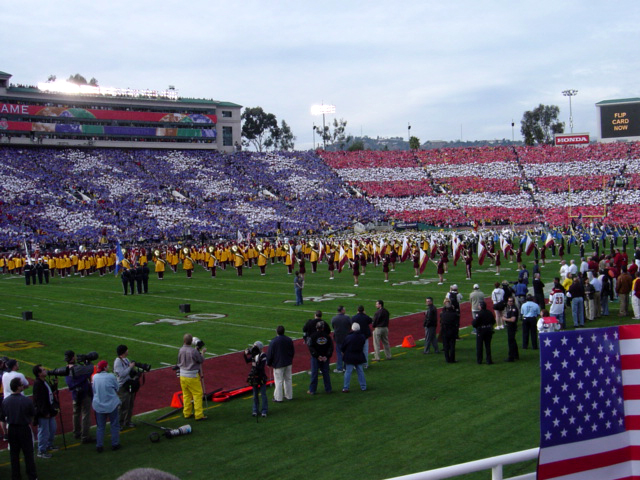
For many years the Rose Bowl eschewed sponsorship, but in 1999, it became "The Rose Bowl Game presented by AT&T." Unlike the other bowl games, the sponsor was not added to the title of the game, but instead as a presenter. In 2002 it was branded The Rose Bowl Game presented by PlayStation 2. From 2003 to 2010, after the agreement with Sony expired, the game was presented by Citi.
In June 2010, Citi decided to end sponsorship of the Rose Bowl games, including the National Championship game. In October 2010, HDTV maker Vizio signed a 4-year contract to be the official sponsor of the Rose Bowl games through 2014. After Vizio declined to renew sponsorship in 2014, financial services giant Northwestern Mutual became the new presenting sponsor. From 2015 to 2020, the game was sponsored by Northwestern Mutual and officially known as the Rose Bowl Game presented by Northwestern Mutual.
The 2021 edition, sponsored by Capital One, was officially known as the Rose Bowl Game presented by Capital One. As the sponsor of the 2021 Orange Bowl, Capital One became the first company to sponsor two New Year's Six bowls. Capital One continued their sponsorship of the game, with the 2022 edition officially being named the Rose Bowl Game presented by Capital One Venture X after the company's travel rewards credit card.
Prudential Financial became the new sponsor of the Rose Bowl in 2023 and will continue until the 2026 game.
Broadcasters
Main article: List of Rose Bowl Game broadcasters
The Rose Bowl was first televised in 1947 on W6XYZ, an experimental station in Los Angeles that would eventually become KTLA. The 1952 game was the first nationally televised bowl game and the first nationally televised college game of any sport. From 1952 to 1988, the Rose Bowl was televised by NBC at 2 p.m. PST, and in most years was the only New Year's Day bowl airing at that time. The 1956 Rose Bowl has the highest TV rating of all college bowl games, watched by 41.1% of all people in the US with TV sets. The 1962 game was the first college football game broadcast in color. Television ratings for the Rose Bowl declined as the number of bowl games increased. The other bowl games also provided more compelling match-ups, with higher-ranked teams. In 1988, NBC gave up the broadcast rights, as the television share dropped in 1987 below 20.
From 1989 to 2010, the game was broadcast on ABC, usually at 2p.m. PST. The first 9-year contract in 1988 started at about $11 million, which is what NBC had been paying. The 2002 Rose Bowl was the first broadcast not set at the traditional 2:00pm West Coast time. The visual of the afternoon sun setting on the San Gabriel Mountains on New Year's Day is recognized as an important part of the tradition of the game.
The 2005 edition was the first one broadcast in HDTV. Beginning in 2007, Fox had the broadcast rights to the other Bowl Championship Series games, but the Rose Bowl, which negotiated its own television contract independent of the BCS, had agreed to keep the game on ABC. Beginning with the 2010 season, ESPN (majority-owned by ABC's parent company, The Walt Disney Company) now broadcasts all the BCS/CFP games, including the Rose Bowl game. The game is also broadcast nationally by ESPN Radio and by ESPN International for Latin America. In 2013, ESPN Deportes provided the first Spanish language telecast in the U.S. of the Rose Bowl Game.
The Rose Bowl game contract with ESPN was extended on June 28, 2012, to 2026, for a reported $80 million per year.
The start time of the 2026 Rose Bowl was moved to 1p.m. local time, from the traditional start time of 2p.m. local time, to avoid impacting the start time of the Sugar Bowl; the change was expected to persist for future games.
Game results
Winners appear in boldface while italics denote a tie game.
All rankings are taken from the AP poll (inaugurated in 1936, prior to the 1937 Rose Bowl) before each game was played.
| Rose Bowl Game}};" | Rose Bowl Game}};" colspan=2 | Rose Bowl Game}};" colspan=2 | Rose Bowl Game}};" colspan=1 | Rose Bowl Game}};" colspan=1 | |||||
|---|---|---|---|---|---|---|---|---|---|
| January 1, 1902 | Stanford | 0 | Michigan | 49 | |||||
| January 1, 1916 | Washington State | 14 | Brown | 0 | |||||
| January 1, 1917 | Oregon | 14 | Penn | 0 | |||||
| January 1, 1918 | Mare Island – USMC | 19 | Camp Lewis – US Army | 7 | |||||
| January 1, 1919 | Mare Island – USMC | 0 | Great Lakes – US Navy | 17 | |||||
| January 1, 1920 | Oregon | 6 | Harvard | 7 | |||||
| January 1, 1921 | California | 28 | Ohio State | 0 | |||||
| January 2, 1922 | California | 0 | Washington & Jefferson | 0 | |||||
| January 1, 1923 | USC | 14 | Penn State | 3 | |||||
| January 1, 1924 | Washington | 14 | Navy | 14 | |||||
| January 1, 1925 | Stanford | 10 | Notre Dame | 27 | |||||
| January 1, 1926 | Washington | 19 | Alabama | 20 | |||||
| January 1, 1927 | Stanford | 7 | Alabama | 7 | |||||
| January 2, 1928 | Stanford | 7 | Pittsburgh | 6 | |||||
| January 1, 1929 | California | 7 | Georgia Tech | 8 | |||||
| January 1, 1930 | USC | 47 | Pittsburgh | 14 | |||||
| January 1, 1931 | Washington State | 0 | Alabama | 24 | |||||
| January 1, 1932 | USC | 21 | Tulane | 12 | |||||
| January 2, 1933 | USC | 35 | Pittsburgh | 0 | |||||
| January 1, 1934 | Stanford | 0 | Columbia | 7 | |||||
| January 1, 1935 | Stanford | 13 | Alabama | 29 | |||||
| January 1, 1936 | Stanford | 7 | SMU | 0 | |||||
| January 1, 1937 | #5 Washington | 0 | #3 Pittsburgh | 21 | |||||
| January 1, 1938 | #2 California | 13 | #4 Alabama | 0 | |||||
| January 2, 1939 | #7 USC | 7 | #3 Duke | 3 | |||||
| January 1, 1940 | #3 USC | 14 | #2 Tennessee | 0 | |||||
| January 1, 1941 | #2 Stanford | 21 | #7 Nebraska | 13 | |||||
| January 1, 1942 | #12 Oregon State | 20 | #2 Duke | 16 | |||||
| January 1, 1943 | #13 UCLA | 0 | #2 Georgia | 9 | |||||
| January 1, 1944 | USC | 29 | #12 Washington | 0 | |||||
| January 1, 1945 | #7 USC | 25 | #12 Tennessee | 0 | |||||
| January 1, 1946 | #11 USC | 14 | #3 Alabama | 34 | |||||
| January 1, 1947 | #4 UCLA | 14 | #5 Illinois | 45 | |||||
| January 1, 1948 | #8 USC | 0 | #2 Michigan | 49 | |||||
| January 1, 1949 | #4 California | 14 | #7 Northwestern | 20 | |||||
| January 2, 1950 | #3 California | 14 | #6 Ohio State | 17 | |||||
| January 1, 1951 | #5 California | 6 | #9 Michigan | 14 | |||||
| January 1, 1952 | #7 Stanford | 7 | #4 Illinois | 40 | |||||
| January 1, 1953 | #5 USC | 7 | #11 Wisconsin | 0 | |||||
| January 1, 1954 | #5 UCLA | 20 | #3 Michigan State | 28 | |||||
| January 1, 1955 | #17 USC | 7 | #1 Ohio State | 20 | |||||
| January 2, 1956 | #4 UCLA | 14 | #2 Michigan State | 17 | |||||
| January 1, 1957 | #10 Oregon State | 19 | #3 Iowa | 35 | |||||
| January 1, 1958 | Oregon | 7 | #2 Ohio State | 10 | |||||
| January 1, 1959 | #16 California | 12 | #2 Iowa | 38 | |||||
| January 1, 1960 | #8 Washington | 44 | #6 Wisconsin | 8 | |||||
| January 2, 1961 | #6 Washington | 17 | #1 Minnesota | 7 | |||||
| January 1, 1962 | #16 UCLA | 3 | #6 Minnesota | 21 | |||||
| January 1, 1963 | #1 USC | 42 | #2 Wisconsin | 37 | |||||
| January 1, 1964 | Washington | 7 | #3 Illinois | 17 | |||||
| January 1, 1965 | #8 Oregon State | 7 | #4 Michigan | 34 | |||||
| January 1, 1966 | #5 UCLA | 14 | #1 Michigan State | 12 | |||||
| January 2, 1967 | USC | 13 | #7 Purdue | 14 | |||||
| January 1, 1968 | #1 USC | 14 | #4 Indiana | 3 | |||||
| January 1, 1969 | #2 USC | 16 | #1 Ohio State | 27 | |||||
| January 1, 1970 | #5 USC | 10 | #7 Michigan | 3 | |||||
| January 1, 1971 | #12 Stanford | 27 | #2 Ohio State | 17 | |||||
| January 1, 1972 | #16 Stanford | 13 | #4 Michigan | 12 | |||||
| January 1, 1973 | #1 USC | 42 | #3 Ohio State | 17 | |||||
| January 1, 1974 | #7 USC | 21 | #4 Ohio State | 42 | |||||
| January 1, 1975 | #5 USC | 18 | #3 Ohio State | 17 | |||||
| January 1, 1976 | #11 UCLA | 23 | #1 Ohio State | 10 | |||||
| January 1, 1977 | #3 USC | 14 | #2 Michigan | 6 | |||||
| January 2, 1978 | #13 Washington | 27 | #4 Michigan | 20 | |||||
| January 1, 1979 | #3 USC | 17 | #5 Michigan | 10 | |||||
| January 1, 1980 | #3 USC | 17 | #1 Ohio State | 16 | |||||
| January 1, 1981 | #16 Washington | 6 | #5 Michigan | 23 | |||||
| January 1, 1982 | #12 Washington | 28 | #13 Iowa | 0 | |||||
| January 1, 1983 | #5 UCLA | 24 | #19 Michigan | 14 | |||||
| January 2, 1984 | UCLA | 45 | #4 Illinois | 9 | |||||
| January 1, 1985 | #18 USC | 20 | #6 Ohio State | 17 | |||||
| January 1, 1986 | #13 UCLA | 45 | #4 Iowa | 28 | |||||
| January 1, 1987 | #7 Arizona State | 22 | #4 Michigan | 15 | |||||
| January 1, 1988 | #16 USC | 17 | #8 Michigan State | 20 | |||||
| January 2, 1989 | #5 USC | 14 | #11 Michigan | 22 | |||||
| January 1, 1990 | #12 USC | 17 | #3 Michigan | 10 | |||||
| January 1, 1991 | #8 Washington | 46 | #17 Iowa | 34 | |||||
| January 1, 1992 | #2 Washington | 34 | #4 Michigan | 14 | |||||
| January 1, 1993 | #9 Washington | 31 | #7 Michigan | 38 | |||||
| January 1, 1994 | #14 UCLA | 16 | #9 Wisconsin | 21 | |||||
| January 2, 1995 | #12 Oregon | 20 | #2 Penn State | 38 | |||||
| January 1, 1996 | #17 USC | 41 | #3 Northwestern | 32 | |||||
| January 1, 1997 | #2 Arizona State | 17 | #4 Ohio State | 20 | |||||
| January 1, 1998 | #8 Washington State | 16 | #1 Michigan | 21 | |||||
| January 1, 1999 | #6 UCLA | 31 | #9 Wisconsin | 38 | |||||
| January 1, 2000 | #22 Stanford | 9 | #4 Wisconsin | 17 | |||||
| January 1, 2001 | #4 Washington | 34 | #14 Purdue | 24 | |||||
| January 3, 2002 | #4 Nebraska | 14 | #1 Miami (FL) | 37 | |||||
| January 1, 2003 | #7 Washington State | 14 | #8 Oklahoma | 34 | |||||
| January 1, 2004 | #1 USC | 28 | #4 Michigan | 14 | |||||
| January 1, 2005 | #6 Texas | 38 | #13 Michigan | 37 | |||||
| January 4, 2006 | #1 USC | 38 | #2 Texas | 41 | |||||
| January 1, 2007 | #8 USC | 32 | #3 Michigan | 18 | |||||
| January 1, 2008 | #6 USC | 49 | #13 Illinois | 17 | |||||
| January 1, 2009 | #5 USC | 38 | #6 Penn State | 24 | |||||
| January 1, 2010 | #7 Oregon | 17 | #8 Ohio State | 26 | |||||
| January 1, 2011 | #3 TCU | 21 | #4 Wisconsin | 19 | |||||
| January 2, 2012 | #6 Oregon | 45 | #9 Wisconsin | 38 | |||||
| January 1, 2013 | #8 Stanford | 20 | #23 Wisconsin | 14 | |||||
| January 1, 2014 | #5 Stanford | 20 | #4 Michigan State | 24 | |||||
| January 1, 2015 | #3 Oregon | 59 | #2 Florida State | 20 | |||||
| January 1, 2016 | #5 Stanford | 45 | #6 Iowa | 16 | |||||
| January 2, 2017 | #9 USC | 52 | #5 Penn State | 49 | |||||
| January 1, 2018 | #2 Oklahoma | 48 (2OT) | #3 Georgia | 54 | |||||
| January 1, 2019 | #9 Washington | 23 | #5 Ohio State | 28 | |||||
| January 1, 2020 | #7 Oregon | 28 | #11 Wisconsin | 27 | |||||
| January 1, 2021 | #1 Alabama | 31 | #4 Notre Dame | 14 | |||||
| January 1, 2022 | #10 Utah | 45 | #7 Ohio State | 48 | |||||
| January 2, 2023 | #7 Utah | 21 | #9 Penn State | 35 | |||||
| January 1, 2024 | #5 Alabama | 20 (OT) | #1 Michigan | 27 | |||||
| January 1, 2025 | #1 Oregon | 21 | #6 Ohio State | 41 | |||||
| January 1, 2026 | #11 Alabama | 3 | #1 Indiana | 38 |
EDITORS: Above table uses AP poll rankings for all games.
Source:
: Denotes BCS National Championship Game : Denotes College Football Playoff quarterfinal game : Denotes College Football Playoff semifinal game
Appearances and win–loss records
The below tables list results by teams competing as members of the Big Ten Conference, Pac-12 Conference, and all other participants. Included in Pac-12 results are teams who competed as a member of the Pacific Coast Conference, Pacific-8 Conference, or Pacific-10 Conference—predecessors of the Pac-12. One team, Oregon, has appearances both as a member of the Pac-12 (or its predecessors) and as a member of the Big Ten.
Updated through the January 2026 edition (112 games, 224 total appearances).
| Rose Bowl Game}};" | Rose Bowl Game}};" | Rose Bowl Game}};" | Rose Bowl Game}};" | Rose Bowl Game}};" | Rose Bowl Game}};" | Rose Bowl Game}};" | Big Ten Conference | B1G | 77 | 37 | 40 | 0 | 2026 | Pac-12 Conference | Pac | 101 | 52 | 46 | 3 | 2023 | |||||||||||||||||||
|---|---|---|---|---|---|---|---|---|---|---|---|---|---|---|---|---|---|---|---|---|---|---|---|---|---|---|---|---|---|---|---|---|---|---|---|---|---|---|---|
| USC | Pac | 34 | 25 | 9 | 2017 | ||||||||||||||||||||||||||||||||||
| Ohio State | B1G | 17 | 10 | 7 | 2025 | ||||||||||||||||||||||||||||||||||
| Michigan | B1G | 21 | 9 | 12 | 2024 | ||||||||||||||||||||||||||||||||||
| Washington | Pac | 15 | 7 | 7 | 1 | 2019 | |||||||||||||||||||||||||||||||||
| Stanford | Pac | 14 | 7 | 6 | 1 | 2016 | |||||||||||||||||||||||||||||||||
| UCLA | Pac | 12 | 5 | 7 | 1999 | ||||||||||||||||||||||||||||||||||
| Wisconsin | B1G | 10 | 3 | 7 | 2020 | ||||||||||||||||||||||||||||||||||
| Oregon | Pac | 8 | 4 | 4 | 2020 | ||||||||||||||||||||||||||||||||||
| B1G | 1 | 0 | 1 | 2025 | |||||||||||||||||||||||||||||||||||
| California | Pac | 8 | 2 | 5 | 1 | 1959 | |||||||||||||||||||||||||||||||||
| Iowa | B1G | 6 | 2 | 4 | 2016 | ||||||||||||||||||||||||||||||||||
| Michigan State | B1G | 5 | 4 | 1 | 2014 | ||||||||||||||||||||||||||||||||||
| Illinois | B1G | 5 | 3 | 2 | 2008 | ||||||||||||||||||||||||||||||||||
| Penn State | B1G | 4 | 2 | 2 | 2023 | ||||||||||||||||||||||||||||||||||
| Oregon State | Pac | 3 | 1 | 2 | 1965 | ||||||||||||||||||||||||||||||||||
| Washington State | Pac | 3 | 0 | 3 | 2003 | ||||||||||||||||||||||||||||||||||
| Arizona State | Pac | 2 | 1 | 1 | 1997 | ||||||||||||||||||||||||||||||||||
| Minnesota | B1G | 2 | 1 | 1 | 1962 | ||||||||||||||||||||||||||||||||||
| Northwestern | B1G | 2 | 1 | 1 | 1996 | ||||||||||||||||||||||||||||||||||
| Purdue | B1G | 2 | 1 | 1 | 2001 | ||||||||||||||||||||||||||||||||||
| Utah | Pac | 2 | 0 | 2 | 2023 | ||||||||||||||||||||||||||||||||||
| Indiana | B1G | 2 | 1 | 1 | 2026 |
| Rose Bowl Game}};" | Rose Bowl Game}};" | Rose Bowl Game}};" | Rose Bowl Game}};" | Rose Bowl Game}};" | Rose Bowl Game}};" | Other teams | 46 | 20 | 23 | 3 | 2026 | |||||||||||
|---|---|---|---|---|---|---|---|---|---|---|---|---|---|---|---|---|---|---|---|---|---|---|
| Alabama | 9 | 5 | 3 | 1 | 2026 | |||||||||||||||||
| Military teams | 4 | 2 | 2 | 1919 | ||||||||||||||||||
| Pittsburgh | 4 | 1 | 3 | 1937 | ||||||||||||||||||
| Texas | 2 | 2 | 0 | 2006 | ||||||||||||||||||
| Georgia | 2 | 2 | 0 | 2018 | ||||||||||||||||||
| Notre Dame | 2 | 1 | 1 | 2021 | ||||||||||||||||||
| Oklahoma | 2 | 1 | 1 | 2018 | ||||||||||||||||||
| Duke | 2 | 0 | 2 | 1942 | ||||||||||||||||||
| Nebraska | 2 | 0 | 2 | 2002 | ||||||||||||||||||
| Tennessee | 2 | 0 | 2 | 1945 | ||||||||||||||||||
| Columbia | 1 | 1 | 0 | 1934 | ||||||||||||||||||
| Georgia Tech | 1 | 1 | 0 | 1929 | ||||||||||||||||||
| Harvard | 1 | 1 | 0 | 1920 | ||||||||||||||||||
| Miami (FL) | 1 | 1 | 0 | 2002 | ||||||||||||||||||
| TCU | 1 | 1 | 0 | 2011 | ||||||||||||||||||
| Washington State | 1 | 1 | 0 | 1916 | ||||||||||||||||||
| Navy | 1 | 0 | 0 | 1 | 1924 | |||||||||||||||||
| Washington & Jefferson | 1 | 0 | 0 | 1 | 1922 | |||||||||||||||||
| Stanford | 1 | 0 | 1 | 1902 | ||||||||||||||||||
| Brown | 1 | 0 | 1 | 1916 | ||||||||||||||||||
| Florida State | 1 | 0 | 1 | 2015 | ||||||||||||||||||
| Penn State | 1 | 0 | 1 | 1923 | ||||||||||||||||||
| Penn | 1 | 0 | 1 | 1917 | ||||||||||||||||||
| SMU | 1 | 0 | 1 | 1936 | ||||||||||||||||||
| Tulane | 1 | 0 | 1 | 1932 |
Some teams who are members of the Pac-12 and Big Ten made appearances while not members; thus, the following results are included in the "Other teams" table:
- Penn State's January 1923 loss predates their joining of the Big Ten
- Nebraska's January 1941 and January 2002 losses predates their joining of the Big Ten
- Stanford's January 1902 loss predates formation of the Pacific Coast Conference, predecessor of the Pac-12
- Washington State's January 1916 win predates formation of the Pacific Coast Conference, predecessor of the Pac-12
Current Big Ten teams Maryland and Rutgers have never appeared in the Rose Bowl. Nebraska has appeared twice but never as a member of the Big Ten. In 2024, as part of a dissolution of the Pac-12, the Big Ten gained four teams that have represented the Pac-12 and its predecessors in the Rose Bowl numerous times: Oregon, UCLA, USC, and Washington. Oregon subsequently appeared in the 2025 game, a CFP quarterfinal, facing Ohio State in an all-Big Ten matchup.
Frequent participants
Among Pac-8/10/12 and Big Ten schools, the record for longest drought since a team's last Rose Bowl appearance is held by California (1959), followed by Minnesota (1962), and Oregon State (1965).
Among Pac-8/10/12 and Big Ten schools who have played in at least one Rose Bowl, the record for the longest period since a win is held by Nebraska, who has never won, followed by Washington State (1916), Cal (1939), Oregon State (1942), Northwestern (1949), and Iowa (1959). As of 2016, head coaches Howard Jones (5–0) and John Robinson (4–0) lead the list of undefeated Rose Bowl records.
Archie Griffin of Ohio State and Brian Cushing of USC are the only players to ever start in four Rose Bowl games. Head coach Woody Hayes led Ohio State to the Rose Bowl from 1973 to 1976, while USC head coach Pete Carroll led the Trojans to the Rose Bowl from 2006 to 2009.

The current members of the Pac-12 or the Big Ten to have not appeared in the Rose Bowl are Maryland and Rutgers, who both joined the Big Ten in 2014. Former Pac-12 members Arizona (who joined the then-Pac-10 in 1978) and Colorado (who joined the Pac-12 in 2011) have never appeared in the Rose Bowl, both having left the Pac-12 in 2024. Former Pac-12 member California appeared in the Rose Bowl only as a member of a predecessor league to the Pac-12. Similar to Cal, Nebraska played in the 1941 and 2002 games, but was not a member of the Big Ten Conference at these times. Idaho and Montana, who were members of the Pacific Coast Conference from 1922 until 1958 and 1950 respectively, never finished near the top in the PCC football standings. Former Big Ten member Chicago withdrew from the league prior to the bowl arrangement being set.
USC has played the most Big Ten schools in the Rose Bowl. As of 2024, the only Big Ten opponents remaining for the Trojans are Iowa, Minnesota, and the schools that have never represented the conference in the Rose Bowl: Maryland, Nebraska, Rutgers, Oregon, UCLA, and Washington. Ohio State and Michigan are tied for playing the most current or former Pac-12 schools in the Rose Bowl. The Buckeyes have not played Oregon State or Washington State in the game, while Michigan has never played Oregon or Utah. Neither team has faced Arizona or Colorado, as these teams have never appeared in the game.
Common matchups
The most frequent Rose Bowl matchup is USC–Michigan, occurring for the eighth time in 2007, with USC holding a 6–2 advantage (including rare meetings outside the Rose Bowl, USC leads this series 6–5). The next most frequent matchup is USC–Ohio State, occurring for the seventh time in 1985, with USC holding a 4–3 advantage.
Matchups that have occurred more than once:
| # of Times | West / Pac-12 | East / Big Ten | Record | Years played |
|---|---|---|---|---|
| 8 | USC | Michigan | USC, 6–2 | 1948, 1970, 1977, 1979, 1989, 1990, 2004, 2007 |
| 7 | USC | Ohio State | USC, 4–3 | 1955, 1969, 1973, 1974, 1975, 1980, 1985 |
| 4 | Washington | Michigan | Tied, 2–2 | 1978, 1981, 1992, 1993 |
| 3 | Oregon | Ohio State | Ohio State, 3–0 | 1958, 2010, 2025 |
| 3 | USC | Penn State | USC, 3–0 | 1923, 2009, 2017 |
| 3 | UCLA | Michigan State | Michigan State, 2–1 | 1954, 1956, 1966 |
| 2 | Stanford | Michigan | Tied, 1–1 | 1902, 1972 |
| 2 | California | Ohio State | Tied, 1–1 | 1921, 1950 |
| 2 | Stanford | Alabama | Alabama, 1–0–1 | 1927, 1935 |
| 2 | USC | Pittsburgh | USC, 2–0 | 1930, 1933 |
| 2 | USC | Tennessee | USC, 2–0 | 1940, 1945 |
| 2 | UCLA | Illinois | Tied, 1–1 | 1947, 1984 |
| 2 | USC | Wisconsin | USC, 2–0 | 1953, 1963 |
| 2 | Washington | Iowa | Washington, 2–0 | 1982, 1991 |
| 2 | UCLA | Wisconsin | Wisconsin, 2–0 | 1994, 1999 |
| 2 | Stanford | Wisconsin | Tied, 1–1 | 2000, 2013 |
| 2 | Oregon | Wisconsin | Oregon, 2–0 | 2012, 2020 |
Top-ranked teams
No. 1 ranked teams at the end of the regular season that have played in the Rose Bowl game are listed below:
- 1955: No. 1 Ohio State defeated No. 17 USC, 20–7
- 1961: No. 6 Washington defeated No. 1 Minnesota, 17–7
- 1963: No. 1 USC defeated No. 2 Wisconsin, 42–37
- 1966: No. 5 UCLA defeated No. 1 Michigan State, 14–12
- 1968: No. 1 USC defeated No. 4 Indiana, 14–3
- 1969: No. 1 Ohio State defeated No. 2 USC, 27–16
- 1973: No. 1 USC defeated No. 3 Ohio State, 42-17
- 1976: No. 11 UCLA defeated No. 1 Ohio State, 23-10
- 1980: No. 3 USC defeated No. 1 Ohio State, 17–16
- 1998: No. 1 Michigan defeated No. 8 Washington State, 21–16
- 2002 (BCS National Championship Game): No. 1 Miami defeated No. 4 Nebraska, 37–14
- 2004: No. 1 USC defeated No. 4 Michigan, 28–14
- 2006 (BCS National Championship Game): No. 2 Texas defeated No. 1 USC, 41–38
- 2021 (CFP Semifinal Game): No. 1 Alabama defeated No. 4 Notre Dame, 31–14
- 2024 (CFP Semifinal Game): No. 1 Michigan defeated No. 4 Alabama, 27–20 (OT)
- 2025 (CFP Quarterfinal Game): No. 6 Ohio State defeated No. 1 Oregon 41–21
- 2026 (CFP Quarterfinal Game): No. 1 Indiana defeated No. 11 Alabama 38–3
Twice in a season
Six post-season rematches of regular-season games have taken place in the Rose Bowl. In three of those instances, the same team won both the regular season game and the Rose Bowl Game. UCLA won three of those five Rose Bowl games, including both instances in which a different team lost the regular season game but won the Rose Bowl Game.
- 1956 Iowa 14, Oregon State 13
- 1957 Rose Bowl rematch: Iowa 35, Oregon State 19
- 1965 Michigan State 13, UCLA 3
- 1966 Rose Bowl rematch: UCLA 14, Michigan State 12
- 1975 Ohio State 41, UCLA 20
- 1976 Rose Bowl rematch: UCLA 23, Ohio State 10
- 1982 UCLA 31, Michigan 27
- 1983 Rose Bowl rematch: UCLA 24, Michigan 14
- 1987 Michigan State 27, USC 13
- 1988 Rose Bowl rematch: Michigan State 20, USC 17
- 2024 Oregon 32, Ohio State 31
- 2025 Rose Bowl rematch: Ohio State 41, Oregon 21
Game arrangements
Beginning with the 1947 Rose Bowl, the Pacific Coast representative was the home team, and the Big Nine representative was the visitor. This arrangement would alternate each year. The stadium seating started with the Big Nine representatives in the end zone, but eventually was set with the Big Ten fans and team on the West (press box) side, and Pacific-10 fans and team on the East side. The home team wears their darkest home jerseys, and the visiting team wears the white visiting jerseys. There have been exceptions to the uniform arrangement: UCLA wore their home jerseys, light blue, in the 1962, 1966, and 1976 Rose Bowl games, with the Big Ten opponent also wearing their home uniforms.
From 1947 through 2001, the Big Ten team was the home team in even-numbered years (concluding seasons that took place in odd-numbered years), and the Pac-10 team was the home team in odd-numbered years (concluding seasons that took place in even-numbered years). In 2003, Washington State was the home team but faced a non-Big Ten or Pac-10 school (Oklahoma of the Big 12) due to BCS selections that season. In 2005, Michigan served as the home team as a result of playing a Big 12 school, Texas, rather than a Pac-10 opponent.
Beginning with the 2002 Rose Bowl, Nebraska was home, with team and fans on the East sideline. From 2006 through 2013, the home team had been the team with the highest BCS season ending ranking. For the 2005 Rose Bowl, the Michigan team was on the East sideline; Texas was the visiting team and was on the West sideline. For the 2006 Rose Bowl, USC was the home team and Texas was the visiting team on the West sideline. Traditionally, the Big Ten (or its BCS replacement) is on the West side (press box) and the Pac-12 team is on the East side.
During the BCS era, the institution with the higher BCS ranking performed the national anthem, and performed first at halftime. With the exception of BCS championship years, the National Anthem was performed by the band. In BCS Championship years, a performer was invited to sing the Anthem, the last being LeAnn Rimes in 2006. The Rose Bowl does not have other performers (including notable recording artists) during the halftime show besides the school marching bands. As part of the television contract, a portion of each band's halftime performance is shown on television. Each school and each conference are allocated television spots to advertise. For the 100th game on January 1, 2014, Merry Clayton, Lisa Fischer, Judith Hill and Darlene Love sang the national anthem in honor of the song's 200th anniversary. This was the first, and so far only time in Rose Bowl history that the anthem was performed by singers rather than by a marching band. Today, the institution with the higher ranking by the CFP selection committee performs the national anthem and performs first at halftime.
The coin toss was traditionally presented by the grand marshal of the Rose Parade or the president of the Pasadena Tournament of Roses Association (if the grand marshal was unable to attend the game).
Player of the Game award
The Rose Bowl's most valuable player is presented the Player of the Game award. The Helms Athletic Foundation created the honor, which was first awarded in the 1940s. Helms executive director Bill Schroeder polled a Helms Hall Board composed of sportswriters to make the selection. The modern award selection continues to be made in collaboration with the national media covering the game.
Player of the Game honors were also awarded retroactively back to the 1902 Rose Bowl.
Occasionally, the award has been shared by two players. Four players have been named the Player of the Game of more than one Rose Bowl: Bob Schloredt, Washington (1960, 1961), Charles White, USC (1979, 1980), Ron Dayne, Wisconsin (1999, 2000), and Vince Young, Texas (2005, 2006).
Player of the Game awards, 1902, 1916–2004
| Rose Bowl Game | border=2 | color=white}};" | Game | Rose Bowl Game | border=2 | color=white}};" | Player of the Game | Rose Bowl Game | border=2 | color=white}};" | Team | Rose Bowl Game | border=2 | color=white}};" | Position |
|---|---|---|---|---|---|---|---|---|---|---|---|---|---|---|---|
| 1902 | Neil Snow | Michigan | FB | ||||||||||||
| 1916 | Carl Dietz | Washington State | FB | ||||||||||||
| 1917 | John Beckett | Oregon | T | ||||||||||||
| 1918 | Hollis Huntington | Mare Island | FB | ||||||||||||
| 1919 | George Halas | Great Lakes | E | ||||||||||||
| 1920 | Edward Casey | Harvard | HB | ||||||||||||
| 1921 | Harold Muller | California | E | ||||||||||||
| 1922 | Russell Stein | Washington & Jefferson | T | ||||||||||||
| 1923 | Leo Calland | USC | G | ||||||||||||
| 1924 | Ira McKee | Navy | QB | ||||||||||||
| 1925 | Elmer Layden | Notre Dame | FB | ||||||||||||
| Ernie Nevers | Stanford | FB | |||||||||||||
| 1926 | Johnny Mack Brown | Alabama | HB | ||||||||||||
| George "Wildcat" Wilson | Washington | HB | |||||||||||||
| 1927 | Fred Pickhard | Alabama | T | ||||||||||||
| 1928 | Clifford "Biff" Hoffman | Stanford | FB | ||||||||||||
| 1929 | Benjamin Lom | California | HB | ||||||||||||
| 1930 | Russell Saunders | USC | QB | ||||||||||||
| 1931 | John "Monk" Campbell | Alabama | QB | ||||||||||||
| 1932 | Erny Pinckert | USC | HB | ||||||||||||
| 1933 | Homer Griffith | USC | QB | ||||||||||||
| 1934 | Cliff Montgomery | Columbia | QB | ||||||||||||
| 1935 | Millard "Dixie" Howell | Alabama | HB | ||||||||||||
| 1936 | James "Monk" Moscrip | Stanford | E | ||||||||||||
| Keith Topping | E | ||||||||||||||
| 1937 | Bill Daddio | Pittsburgh | E | ||||||||||||
| 1938 | Victor Bottari | California | HB | ||||||||||||
| 1939 | Doyle Nave | USC | QB | ||||||||||||
| Al Krueger | E | ||||||||||||||
| 1940 | Ambrose Schindler | QB | |||||||||||||
| 1941 | Peter Kmetovic | Stanford | HB | ||||||||||||
| 1942 | Donald Durdan | Oregon State | HB | ||||||||||||
| 1943 | Charles Trippi | Georgia | HB | ||||||||||||
| 1944 | Norman Verry | USC | G | ||||||||||||
| 1945 | Jim Hardy | QB | |||||||||||||
| 1946 | Harry Gilmer | Alabama | HB | ||||||||||||
| 1947 | Claude "Buddy" Young | Illinois | HB | ||||||||||||
| Julius Rykovich | HB | ||||||||||||||
| 1948 | Bob Chappuis | Michigan | HB | ||||||||||||
| 1949 | Frank Aschenbrenner | Northwestern | HB | ||||||||||||
| 1950 | Fred "Curly" Morrison | Ohio State | FB | ||||||||||||
| 1951 | Don Dufek | Michigan | FB | ||||||||||||
| 1952 | William Tate | Illinois | HB | ||||||||||||
| 1953 | Rudy Bukich | USC | QB | ||||||||||||
| 1954 | Billy Wells | Michigan State | HB | ||||||||||||
| 1955 | Dave Leggett | Ohio State | QB | ||||||||||||
| 1956 | Walter Kowalczyk | Michigan State | HB | ||||||||||||
| 1957 | Kenneth Ploen | Iowa | QB | ||||||||||||
| 1958 | Jack Crabtree | Oregon | QB | ||||||||||||
| 1959 | Bob Jeter | Iowa | HB | ||||||||||||
| 1960 | Bob Schloredt | Washington | QB | ||||||||||||
| George Fleming | HB | ||||||||||||||
| 1961 | Bob Schloredt | QB | |||||||||||||
| 1962 | Sandy Stephens | Minnesota | QB | ||||||||||||
| 1963 | Pete Beathard | USC | QB | ||||||||||||
| Ron Vander Kelen | Wisconsin | QB | |||||||||||||
| 1964 | Jim Grabowski | Illinois | FB | ||||||||||||
| 1965 | Mel Anthony | Michigan | FB | ||||||||||||
| 1966 | Bob Stiles | UCLA | DB | ||||||||||||
| 1967 | John Charles | Purdue | DB | ||||||||||||
| 1968 | O. J. Simpson | USC | TB | ||||||||||||
| 1969 | Rex Kern | Ohio State | QB | ||||||||||||
| 1970 | Bob Chandler | USC | FL | ||||||||||||
| 1971 | Jim Plunkett | Stanford | QB | ||||||||||||
| 1972 | Don Bunce | QB | |||||||||||||
| 1973 | Sam Cunningham | USC | FB | ||||||||||||
| 1974 | Cornelius Greene | Ohio State | QB | ||||||||||||
| 1975 | Pat Haden | USC | QB | ||||||||||||
| John McKay Jr. | SE | ||||||||||||||
| 1976 | John Sciarra | UCLA | QB | ||||||||||||
| 1977 | Vince Evans | USC | QB | ||||||||||||
| 1978 | Warren Moon | Washington | QB | ||||||||||||
| 1979 | Charles White | USC | TB | ||||||||||||
| Rick Leach | Michigan | QB | |||||||||||||
| 1980 | Charles White | USC | TB | ||||||||||||
| 1981 | Butch Woolfolk | Michigan | RB | ||||||||||||
| 1982 | Jacque Robinson | Washington | RB | ||||||||||||
| 1983 | Don Rogers | UCLA | FS | ||||||||||||
| Tom Ramsey | QB | ||||||||||||||
| 1984 | Rick Neuheisel | QB | |||||||||||||
| 1985 | Tim Green | USC | QB | ||||||||||||
| Jack Del Rio | LB | ||||||||||||||
| 1986 | Eric Ball | UCLA | TB | ||||||||||||
| 1987 | Jeff Van Raaphorst | Arizona State | QB | ||||||||||||
| 1988 | Percy Snow | Michigan State | LB | ||||||||||||
| 1989 | Leroy Hoard | Michigan | FB | ||||||||||||
| 1990 | Ricky Ervins | USC | TB | ||||||||||||
| 1991 | Mark Brunell | Washington | QB | ||||||||||||
| 1992 | Steve Emtman | DT | |||||||||||||
| Billy Joe Hobert | QB | ||||||||||||||
| 1993 | Tyrone Wheatley | Michigan | RB | ||||||||||||
| 1994 | Brent Moss | Wisconsin | RB | ||||||||||||
| 1995 | Danny O'Neil | Oregon | QB | ||||||||||||
| Ki-Jana Carter | Penn State | RB | |||||||||||||
| 1996 | Keyshawn Johnson | USC | WR | ||||||||||||
| 1997 | Joe Germaine | Ohio State | QB | ||||||||||||
| 1998 | Brian Griese | Michigan | QB | ||||||||||||
| 1999 | Ron Dayne | Wisconsin | RB | ||||||||||||
| 2000 | |||||||||||||||
| 2001 | Marques Tuiasosopo | Washington | QB | ||||||||||||
| 2002 | Ken Dorsey | Miami | QB | ||||||||||||
| Andre Johnson | WR | ||||||||||||||
| 2003 | Nate Hybl | Oklahoma | QB | ||||||||||||
| 2004 | Matt Leinart | USC | QB |
Player of the Game awards, 2005–present
Beginning with the 2005 Rose Bowl, Player of the Game awards have been given to both an offensive and defensive player.
| Rose Bowl Game | border=2 | color=white}};" | Game | Rose Bowl Game | border=2 | color=white}};" | PotG — Offense | Rose Bowl Game | border=2 | color=white}};" | Team | Rose Bowl Game | border=2 | color=white}};" | Position | Rose Bowl Game | border=2 | color=white}};" | PotG — Defense | Rose Bowl Game | border=2 | color=white}};" | Team | Rose Bowl Game | border=2 | color=white}};" | Position |
|---|---|---|---|---|---|---|---|---|---|---|---|---|---|---|---|---|---|---|---|---|---|---|---|---|---|---|---|
| 2005 | Vince Young | Texas | QB | LaMarr Woodley | Michigan | LB | |||||||||||||||||||||
| 2006 | Michael Huff | Texas | S | ||||||||||||||||||||||||
| 2007 | Dwayne Jarrett | USC | WR | Brian Cushing | USC | OLB | |||||||||||||||||||||
| 2008 | John David Booty | QB | Rey Maualuga | LB | |||||||||||||||||||||||
| 2009 | Mark Sanchez | QB | Kaluka Maiava | LB | |||||||||||||||||||||||
| 2010 | Terrelle Pryor | Ohio State | QB | Kenny Rowe | Oregon | DE | |||||||||||||||||||||
| 2011 | Andy Dalton | TCU | QB | Tank Carder | TCU | LB | |||||||||||||||||||||
| 2012 | Lavasier Tuinei | Oregon | WR | Kiko Alonso | Oregon | LB | |||||||||||||||||||||
| 2013 | Stepfan Taylor | Stanford | RB | Stanford | DB | ||||||||||||||||||||||
| 2014 | Connor Cook | Michigan State | QB | Kyler Elsworth | Michigan State | LB | |||||||||||||||||||||
| 2015 | Marcus Mariota | Oregon | QB | Tony Washington | Oregon | LB | |||||||||||||||||||||
| 2016 | Christian McCaffrey | Stanford | RB | Aziz Shittu | Stanford | DE | |||||||||||||||||||||
| 2017 | Sam Darnold | USC | QB | Stevie Tu'ikolovatu | USC | DT | |||||||||||||||||||||
| 2018 | Sony Michel | Georgia | RB | Roquan Smith | Georgia | LB | |||||||||||||||||||||
| 2019 | Dwayne Haskins | Ohio State | QB | Brendon White | Ohio State | S | |||||||||||||||||||||
| 2020 | Justin Herbert | Oregon | QB | Brady Breeze | Oregon | S | |||||||||||||||||||||
| 2021 | DeVonta Smith | Alabama | WR | Patrick Surtain II | Alabama | CB | |||||||||||||||||||||
| 2022 | Jaxon Smith-Njigba | Ohio State | WR | Tommy Eichenberg | Ohio State | LB | |||||||||||||||||||||
| 2023 | Sean Clifford | Penn State | QB | Ji'Ayir Brown | Penn State | S | |||||||||||||||||||||
| 2024 | J. J. McCarthy | Michigan | QB | Mason Graham | Michigan | DT | |||||||||||||||||||||
| 2025 | Jeremiah Smith | Ohio State | WR | Cody Simon | Ohio State | LB | |||||||||||||||||||||
| 2026 | Pat Coogan | Indiana | C | D'Angelo Ponds | Indiana | CB |
Source:
Game records
| Rose Bowl Game | border=2 | color=white}};" | Team | Rose Bowl Game | border=2 | color=white}};" | Performance vs. opponent | Rose Bowl Game | border=2 | color=white}};" | Year | Rose Bowl Game | border=2 | color=white}};" | Individual | Rose Bowl Game | border=2 | color=white}};" | Performance, team vs. opponent | Rose Bowl Game | border=2 | color=white}};" | Year | Rose Bowl Game | border=2 | color=white}};" | Long plays | Rose Bowl Game | border=2 | color=white}};" | Performance, team vs. opponent | Rose Bowl Game | border=2 | color=white}};" | Year |
|---|---|---|---|---|---|---|---|---|---|---|---|---|---|---|---|---|---|---|---|---|---|---|---|---|---|---|---|---|---|---|---|---|---|---|---|
| Most points scored | 59, Oregon vs. Florida State (20) | 2015 | |||||||||||||||||||||||||||||||||
| Most points scored (losing team) | 49, Penn State vs. USC (52) | 2017 | |||||||||||||||||||||||||||||||||
| Most points scored (both teams) | 102, Georgia (54) vs. Oklahoma (48) | 2018 | |||||||||||||||||||||||||||||||||
| Most points scored in a half | 41 (second half), Oregon vs. Florida State | 2015 | |||||||||||||||||||||||||||||||||
| Most points scored in a half (both teams) | 56, shared by: | 2012 | |||||||||||||||||||||||||||||||||
| 2022 | |||||||||||||||||||||||||||||||||||
| Fewest points allowed | 0, Washington vs. Iowa (tied with 17 others) | 1982 | |||||||||||||||||||||||||||||||||
| Largest margin of victory | 49, shared by: | ||||||||||||||||||||||||||||||||||
| Michigan (49) vs. Stanford (0) | |||||||||||||||||||||||||||||||||||
| Michigan (49) vs. USC (0) | |||||||||||||||||||||||||||||||||||
| 1902 | |||||||||||||||||||||||||||||||||||
| 1948 | |||||||||||||||||||||||||||||||||||
| First downs | 33, USC vs Penn State | 2017 | |||||||||||||||||||||||||||||||||
| Rushing yards | 503, Michigan vs. Stanford | 1902 | |||||||||||||||||||||||||||||||||
| Passing yards | 573, Ohio State vs. Utah | 2022 | |||||||||||||||||||||||||||||||||
| Total yards | 683, Ohio State vs. Utah | 2022 | |||||||||||||||||||||||||||||||||
| Total offense | 583, C. J. Stroud, Ohio State vs Utah | 2022 | |||||||||||||||||||||||||||||||||
| Touchdowns | 6, C. J. Stroud, Ohio State vs Utah | 2022 | |||||||||||||||||||||||||||||||||
| Rushing yards | 247, Charles White, USC vs. Ohio State (39 attempts, 1 TD) | 1980 | |||||||||||||||||||||||||||||||||
| Rushing TDs | 5, Neil Snow, Michigan vs. Stanford | 1902 | |||||||||||||||||||||||||||||||||
| Passing yards | 573, C. J. Stroud, Ohio State vs Utah (37-46-1, 6 TD) | 2022 | |||||||||||||||||||||||||||||||||
| Passing TDs | 6, C. J. Stroud, Ohio State vs Utah | 2022 | |||||||||||||||||||||||||||||||||
| Receptions | 15, Jaxon Smith-Njigba, Ohio State vs Utah | 2022 | |||||||||||||||||||||||||||||||||
| Receiving yards | 347, Jaxon Smith-Njigba, Ohio State vs Utah | 2022 | |||||||||||||||||||||||||||||||||
| Receiving TDs | 3, Marvin Harrison Jr., Ohio State vs Utah (tied with 3 others) | 2022 | |||||||||||||||||||||||||||||||||
| All-purpose Yards | 368, Christian McCaffrey, Stanford vs. Iowa | 2016 | |||||||||||||||||||||||||||||||||
| Tackles | 17, John Boyett, Oregon vs. Wisconsin (tied with 1 other) | 2012 | |||||||||||||||||||||||||||||||||
| Sacks | 3, Kenny Rowe, Oregon vs. Ohio State (tied with 3 others) | 2010 | |||||||||||||||||||||||||||||||||
| Interceptions | 3, Bill Paulman, Stanford vs. SMU (tied with 1 other) | 1936 | |||||||||||||||||||||||||||||||||
| Touchdown run | 91, De'Anthony Thomas, Oregon vs. Wisconsin | 2012 | |||||||||||||||||||||||||||||||||
| Touchdown pass | 88, Sean Clifford to KeAndre Lambert-Smith, Penn State vs. Utah | 2023 | |||||||||||||||||||||||||||||||||
| Kickoff return | 103, Al Hoisch, UCLA vs. Illinois (TD) | 1947 | |||||||||||||||||||||||||||||||||
| Punt return | 86, Aramis Dandoy, USC vs. Ohio State (TD) | 1955 | |||||||||||||||||||||||||||||||||
| Interception return | 78, Elmer Layden, Notre Dame vs. Stanford (TD) | 1925 | |||||||||||||||||||||||||||||||||
| Fumble return | 58, Tony Washington, Oregon vs. Florida State (TD) | 2015 | |||||||||||||||||||||||||||||||||
| Punt | 73, Don Bracken, Michigan vs. Washington | 1981 | |||||||||||||||||||||||||||||||||
| Field goal | 55, Rodrigo Blankenship, Georgia vs. Oklahoma | 2018 |
Note: When there is a tie, the most recent one will be listed.
Rose Bowl Hall of Fame
Inductees (by year)
- 1989 – C.W. "Bump" Elliott, Michigan; W.W. "Woody" Hayes, Ohio State; Howard Jones, USC; Jim Plunkett, Stanford
- 1990 – Archie Griffin, Ohio State; Bob Reynolds, Stanford; Neil Snow, Michigan; Wallace Wade, Brown, Alabama, & Duke; Charles White, USC
- 1991 – Rex Kern, Ohio State; John McKay, USC; Ernie Nevers, Stanford; Roy Riegels, California; Bob Schloredt, Washington; John Sciarra, UCLA; Russell Stein, Washington & Jefferson; Charley Trippi, Georgia; Ron Vander Kelen, Wisconsin; George Wilson, Washington
- 1992 – Frank Albert, Stanford; Bob Chappuis, Michigan; Sam Cunningham, USC; Bill Daddio, Pittsburgh; Bob Griese, Purdue; Hollis Huntington, Oregon & Mare Island Marines; Shy Huntington, Oregon; Elmer Layden, Notre Dame; Jim Owens, Washington
- 1993 – Frank Aschenbrenner, Northwestern; Dixie Howell, Alabama; Don Hutson, Alabama; Curly Morrison, Ohio State; Brick Muller, California; Julius Rykovich, Illinois; Bo Schembechler, Michigan; O. J. Simpson, USC; Bob Stiles, UCLA; Buddy Young, Illinois
- 1994 – Vic Bottari, California; Jim Hardy, USC; Don James, Washington; Bob Jeter, Iowa; Lay Leishman, Tournament of Roses; Pat Richter, Wisconsin; Henry Russell "Red" Sanders, UCLA
- 1995 – Gary Beban, UCLA; Dick Butkus, Illinois; Harry Gilmer, Alabama; Pat Haden, USC; Al Krueger, USC; Doyle Nave, USC; Ted Shipkey, Stanford
- 1996 – Eric Ball, UCLA; Pete Beathard, USC; John Ferraro, USC; Stan Hahn, Tournament of Roses; John Ralston, Stanford; Bill Tate, Illinois
- 1997 – Terry Donahue, UCLA; Jim Grabowski, Illinois; Warren Moon, Washington; Erny Pinckert, USC; Ken Ploen, Iowa; Sandy Stephens, Minnesota
- 1998 – Jack Crabtree, Oregon; Don Durdan, Oregon State; J.K. McKay, USC; Rick Neuheisel, UCLA; Bill Nicholas, Tournament of Roses; Butch Woolfolk, Michigan
- 1999 – Al Hoisch, UCLA; Keith Jackson, ABC Sports; Dave Kaiser, Michigan State
- 2000 – Johnny Mack Brown, Alabama; Marv Goux, USC
- 2001 – No inductees
- 2002 – Ambrose "Amblin' Amby" Schindler, USC; Mel Anthony, Michigan
- 2003 – Harriman Cronk, Tournament of Roses; Danny O'Neil, Oregon; John Robinson, USC
- 2004 – Alan Ameche, Wisconsin; Rudy Bukich, USC; Wayne Duke, Big Ten; Jim Stivers, Tournament of Roses
- 2005 – Richard N. Frank, Lawry's Restaurants (Beef Bowl); Curt Gowdy, Sports Broadcaster
- 2006 – Steve Emtman, Washington; Rube Samuelsen, Sports Journalist; Jeff Van Raaphorst, Arizona State
- 2007 – Pete Johnson, Ohio State; Tom Ramsey, UCLA; Dennis Swanson, Television Executive
- 2008 – Keyshawn Johnson, USC; Virgil "Virg" Lubberden, USC (administrator); Chuck Ortmann, Michigan
- 2009 – Barry Alvarez, Wisconsin; Tom Hansen, Pacific-10 Conference; John Hicks, Ohio State
- 2010 – Brad Budde, USC; Hayden Fry, Iowa; Leroy Keyes, Purdue
- 2011 – Ron Dayne, Wisconsin; Dick Enberg, NBC; George Fleming, Washington
- 2012 – John Cooper, Arizona State and Ohio State; Brian Griese, Michigan; and Ron Yary, USC
- 2013 – Lloyd Carr, Michigan; Orlando Pace, Ohio State; Lynn Swann, USC
- 2014 – Knute Rockne, Notre Dame; Dick Vermeil, UCLA and Ki-Jana Carter, Penn State
- 2015 – Mark Brunell, Washington; Jim Muldoon (Pac-10); Fritz Pollard, Brown; and Tyrone Wheatley, Michigan
- 2016 – Bobby Bell, Minnesota; Ricky Ervins, USC; Tommy Prothro, UCLA and Art Spander, UCLA
- 2017 – Mack Brown, Texas; Cade McNown, UCLA; Charles Woodson, Michigan; and Dr. Charles West, Washington & Jefferson
- 2018 – George Halas, Great Lakes Navy; Randall McDaniel, Arizona State; Pop Warner, Stanford; Vince Young, Texas
- 2019 – Eddie Casey, Harvard; Cornelius Greene, Ohio State; Matt Leinart, USC; Jacque Robinson, University of Washington
- 2020 – None
- 2021 – Anthony Davis, USC; Jim Delany, Big Ten Conference; Ron Simpkins, Michigan
- 2022 – Hugo Bezdek, Oregon and Penn State; Darryl Dunn, Rose Bowl Stadium; Vince Evans, USC; Lorenzo White, Michigan State
- 2023 – Cliff Montgomery, Columbia; Kirk Herbstreit, ESPN and Ohio State; Lincoln Kennedy, Washington.
- 2024 – Reggie Bush, USC; Mark Dantonio, Michigan State; LaMichael James, Oregon
- 2025 – Montee Ball, (Wisconsin) and Bob Stoops (Oklahoma)
All-Century Class
The Rose Bowl Game All-Century Class was announced on December 28, 2013.
They are:
- 1900s–1910s: George Halas (Great Lakes Navy)
- 1920s: Ernie Nevers (Stanford)
- 1930s: Don Hutson (Alabama) and Howard Jones (USC)
- 1940s: Charley Trippi (Georgia)
- 1950s: Woody Hayes (Ohio State)
- 1960s: John McKay (USC)
- 1970s: Archie Griffin (Ohio State)
- 1980s: Bo Schembechler (Michigan)
- 1990s: Ron Dayne (Wisconsin)
- 2000s: Vince Young (Texas)
- 2010s: Montee Ball (Wisconsin)
In addition to being named as All-Century representatives for their respective decades, John McKay and Archie Griffin were named the 100th Rose Bowl Game All-Century Coach and Player respectively.
The finalists:
- 1900–1919: Paddy Driscoll (Great Lakes Navy, 1919), Neil Snow (Michigan, 1902) and George Halas (Great Lakes Navy, 1919)
- 1920–1929: Ernie Nevers (Stanford, 1925), Elmer Layden (Notre Dame, 1925) and Johnny Mack Brown (Alabama, 1926)
- 1930–1939: Millard "Dixie" Howell (Alabama, 1935), Don Hutson (Alabama, 1935) and Howard Jones (USC, 1930, 1932–33, 1939–40)
- 1940–1949: Bob Chappuis (Michigan, 1948), Harry Gilmer (Alabama, 1946) and Charley Trippi (Georgia, 1943)
- 1950–1959: Alan Ameche (Wisconsin, 1953), Bob Jeter (Iowa, 1959) and Woody Hayes (Ohio State, 1954, 1957, 1968, 1970, 1972–1975)
- 1960–1969: Ron Vander Kelen (Wisconsin, 1963), O. J. Simpson (USC, 1968–69) and John McKay (USC, 1963, 1967–70, 1973–1975)
- 1970–1979: Jim Plunkett (Stanford, 1971), Charles White (USC, 1979–1980) and Archie Griffin (Ohio State, 1973–1976)
- 1980–1989: Don James (Washington, 1978, 1981–82, 1991–93), John Robinson (USC, 1977, 1979–80, 1996) and Bo Schembechler (Michigan, 1970, 1972, 1977–79, 1981, 1983, 1987, 1989–90)
- 1990–1999: Barry Alvarez (Wisconsin, 1994, 1999, 2000 and 2013), Keyshawn Johnson (USC, 1996) and Ron Dayne (Wisconsin, 1999 and 2000)
- 2000–2009: Matt Leinart (USC, 2004 and 2006), Vince Young (Texas, 2005–06) and Brian Cushing (USC, 2006–09)
- 2010–2012: Terrelle Pryor (Ohio State, 2010), Tank Carder (TCU, 2011) and Montee Ball (Wisconsin, 2011–13)
Notes
Books
- America's New Year Celebration. The Rose Parade & Rose Bowl Game. Albion Publishing Group, Santa Barbara, California. 1999.
- Samuelsen, Rube. The Rose Bowl Game. Doubleday Company and Inc. 1951.
- Big Ten Conference football media guide. (PDF copy available at http://bigten.cstv.com .)
- Pacific-10 Conference football media guide. (PDF copy available at http://www.pac-10.org .)
- Malcolm, Moran, and Keith Jackson (foreword). The Rose Bowl: 100th: The History of the Granddaddy of Them All. Whitman Publishing, LLC, January 6, 2013. .
References
Bibliography
- Gruver, Edward (2002), Nitschke. Lanham:Taylor Trade Publishing.
References
- Heyen, Billy. (December 20, 2020). "Why the Rose Bowl is moving from Pasadena to Texas for College Football Playoff".
- Media Guide, Tournament of Roses Association, December 2015
- Carter Williams, [https://www.ksl.com/article/50320215/how-the-rose-bowl-became-the-granddaddy-of-them-all How the Rose Bowl became 'The Granddaddy of Them All'] ''KSL.com'', December 31, 2021
- NCAA Division 1 football records book. NCAA, 2007 Edition, pages 296–302 Major Bowl Game Attendance
- "About the 12-Team College Football Playoff Format".
- Cohen, Rich. (2013). "Monsters: The 1985 Chicago Bears and the Wild Heart of Football". Farrar, Straus and Giroux.
- Mary L. Grady, [http://www.pnwlocalnews.com/east_king/mir/news/103769139.html Mercer Island High School Marching Band to march in 2012 Tournament of Roses Parade] {{Webarchive. link. (October 4, 2010 , ''Mercer Island Reporter'', September 24, 2010)
- Bowl Games: College Football's Greatest Tradition, by Robert Ours, 2004, pgs. 3-4
- "Win the Victory: Early Days of Football at Washington State {{!}} Exhibits – Manuscripts, Archives & Special Collections".
- "Huge Flagstaff For Pasadena. Enormous Steel Pole 122 and ½ Feet Long Will Stand in Rose Bowl". ''Los Angeles Times'', December 10, 1922. Monday afternoon at 2 o'clock the new flagstaff of the Tournament of Roses stadium, now called the Rose Bowl, will be put in place with suitable ceremony under auspices of the Pasadena Lions Club, donor of the pole.
- "Michigan Stadium Story".
- link. (January 20, 2008 – Michigan Stadium)
- [http://www.tournamentofroses.com/roseparade/paradefaqs.asp Tournament of Roses Parade FAQs] {{webarchive. link. (August 14, 2007 . In 2006, attendance was 93,986.)
- "Rose Bowl Stadium - America's Stadium".
- (2000). "The Way We Really Were: The Golden State in the Second Great War". University of Illinois Press.
- "ROSE BOWL GAME CALLED OFF", ''San Antonio Light'', December 14, 1941, pB-1
- "Forbidding Crowds". ''Los Angeles Times'', December 16, 1941
- Zimmerman, Paul "Duke Likely to Play Beavers in Durham. Blue Devils Invite Foes Rose Bowl, Shrine Grid Games Halted as Other Sports Events in Balance". ''Los Angeles Times'', December 15, 1941.
- "Rose Bowl Timeline". Pasadena Tournament of Roses.
- Zimmerman, Paul "Scene of Rose Bowl Shifted to Durham, N.C." ''Los Angeles Times'', December 16, 1941. Perpetuation of the annual Rose Bowl intersectional football classic was assured yesterday when the Tournament of Roses officials and Oregon State College accepted the hospitality of Duke University.
- [[Gene Sherman (reporter). Gene Sherman]] "Rose Parade Goes to War. Spirit of Bond Drive Insures Return of Great Floral Pageant". ''Los Angeles Times'', January 2, 1943. Quote:Once again yesterday war's ugly shadow stretched long across Colorado St. and there was no Tournament of Roses on New Year's Day in Pasadena.
- [https://web.archive.org/web/20081206114001/http://www.time.com/time/magazine/article/0,9171,850785,00.html R.I.P.] Time Magazine, December 6, 1943
- Michael Oriard ''King Football: Sport and Spectacle in the Golden Age of Radio & Newsreels, Movies & Magazines, The Weekly & The Daily Press''. Published 2004 UNC Press. {{ISBN. 0-8078-5545-6 Chapter 3: Who cares about reform?
- football, gridiron. (2008). In ''Encyclopædia Britannica''. Retrieved January 28, 2008, from Encyclopædia Britannica Online: [http://www.britannica.com/eb/article-234274 www.britannica.com/eb/article-234274] {{Webarchive. link. (November 18, 2008 . Football in the United States – The racial transformation of American football. [[Encyclopædia Britannica]])
- Big Ten Football media guide (2007 Edition) page 5
- Samuelsen, Rube. The Rose Bowl Game. United States: Doubleday, 1951. pg 212
- "Rose Bowl History Big Ten Tamed the West from 1948–59". ''[[Seattle Post-Intelligencer]]'', December 30, 1997
- The Big Ten Records Book. United States: The Bureau, 1984. pg 290
- (November 29, 1961). "Buckeyes finally lose, 28-25 in bowl debate". Toledo Blade.
- (November 29, 1961). "Ohio State's rejection of Rose Bowl bid trip triggers sharp comments". Youngstown Vindicator.
- (November 29, 1961). "Ohio State rejects chance to play in Rose Bowl game". Spokesman-Review.
- Stevenson, Jack. (December 3, 1961). "Minnesota accepts bid, plays Uclans in Rose tilt". Youngstown Vindicator.
- [https://nypost.com/2006/01/06/rose-bowl-sets-record/ Rose Bowl sets record] {{Webarchive. link. (September 18, 2016 – Michael Starr, New York Post, January 6, 2006)
- (July 27, 2009). "BCS changes open Rose Bowl bids to outsiders".
- (December 3, 2020). "CFP's Rose Bowl won't have fans; Fiesta, too".
- Wolken, Dan. (December 18, 2020). "Opinion: Notre Dame's Brian Kelly is right. It's time for college football to stop worshiping the Rose Bowl.".
- Thamel, Pete. (December 18, 2020). "Notre Dame's Brian Kelly rips Rose Bowl, CFP brass for lack of flexibility – 'I'm not sure we'll play'".
- Russo, Ralph D.. (December 19, 2020). "Rose Bowl denied exemption to allow fans for College Football Playoff, AP sources say".
- (December 19, 2020). "Statement From Bill Hancock, Executive Director, College Football Playoff".
- Russo, Ralph D.. (December 19, 2020). "CFP semifinal moved from Rose Bowl to AT&T Stadium in Texas".
- (December 19, 2020). "CFP Semifinal at the Rose Bowl Stadium to be Relocated to At&T Stadium in Dallas on January 1, 2021". Pasadena Tournament of Roses.
- (December 30, 2020). "It's Official: The Rose Bowl Game in Texas Will Still Be the Rose Bowl Game".
- "About the 12-Team College Football Playoff Format".
- rEvolution. (May 15, 2007). "2004 Rose Bowl - World's Largest American Flag".
- link. (January 9, 2022 . New York Times, January 1, 1999)
- [https://www.espn.com/los-angeles/ncf/news/story?id=5311290 Report: Citi out as Rose Bowl sponsor], ''ESPN.com'', June 22, 2010
- Phillips, Amy - [https://espnpressroom.com/us/press-releases/2010/10/vizio-rose-bowl/ VIZIO to Serve as New Presenting Sponsor of the Rose Bowl Game] {{Webarchive. link. (January 9, 2022 , ESPN, October 20, 2010)
- [http://sportsillustrated.cnn.com/2010/football/ncaa/10/19/rose-bowl-sponsor.ap/index.html Vizio to sponsor Rose Bowl] {{Webarchive. link. (October 23, 2010 ,'sportsillustrated.com', October 19, 2010)
- "Northwestern Mutual lands Rose Bowl deal". L.A. Biz.
- Myerberg, Paul. (May 13, 2014). "Northwestern Mutual to sponsor Rose Bowl". [[USA Today]].
- "Sponsors & Partners".
- Brooks, Amanda. (December 17, 2020). "Capital One Becomes Presenting Sponsor of the 107th Rose Bowl Game".
- (November 23, 2021). "The 108th Rose Bowl Game on New Year's Day will be presented by Capital One Venture X".
- (August 30, 2023). "Prudential Signs New Multi-Year Agreement with Disney Advertising as Presenting Sponsor of Historic Rose Bowl Game Through 2025-26".
- (July 6, 2014). "Rose Bowl 2015: Football on television will never work, they said in 1947". The Pasadena-Star News.
- (December 8, 2014). "The First Telecast of a UCLA Football Game". Bruins Nation.
- Gruver, 2002 pg. 48
- (July 1, 1988). "ABC-TV to smell the Roses". Idahonian.
- Harvey, Randy – [https://www.latimes.com/archives/la-xpm-1988-12-29-sp-1455-story.html Bucking Tradition: Rose Bowl, Planted in the Past, No Longer the Flower of Football.] ''Los Angeles Times'', December 29, 1988, Of the 10 highest-rated college bowl games of all time, 9 are Rose Bowls. At the top of the list is the 1956 game between UCLA and Michigan State, which was watched by 41.1% of all people in the United States who had television sets at the time.
- Lapointe, Joe - [https://www.nytimes.com/2002/01/04/sports/on-college-football-the-rose-bowl-loses-some-of-its-luster-but-mystique-lingers.html ON COLLEGE FOOTBALL; The Rose Bowl Loses Some of Its Luster, but Mystique Lingers] {{Webarchive. link. (May 27, 2015 . New York Times, January 4, 2002)
- Witz, Billy - [https://www.nytimes.com/2021/01/01/sports/ncaafootball/rose-bowl-move-pasadena.html In Pasadena, Moving the Rose Bowl Makes For Unusual Rancor - The New York Times (nytimes.com)] {{Webarchive. link. (January 2, 2021 . New York Times, January 1, 2021)
- Mandel, Stewart - [https://www.nytimes.com/athletic/4229144/2020/12/14/cfp-may-relocate-from-rose-bowl-due-to-california-restrictions-sources/ CFP may relocate from Rose Bowl due to California restrictions: Sources] . The Athletic, December 14, 2020. ''This is “The Granddaddy of Them All” for a reason. The Big Ten may have 14 teams and the Big 12 may have 10, but the Rose Bowl on New Year’s Day has always made sense. Every CFP decision has been made around the Rose Bowl’s reluctance to part with its coveted 5 p.m. ET time slot - and that stunning sunset over the San Gabriel Mountains – so embedded in the sport is the game.'' - Matt Fortuna - staff writer
- [https://variety.com/2008/scene/markets-festivals/disney-makes-125-million-bcs-bid-1117995756/ Disney makes $125 million BCS bid] . Variety, November 12, 2008
- Reid Cherner & Tom Weir, [http://blogs.usatoday.com/gameon/2009/06/rose-bowl-headed-to-espn.html "Rose Bowl headed to ESPN"] {{webarchive. link. (June 15, 2009 , ''USA today'', June 12, 2009)
- (December 4, 2012). "BCS National Championship and Bowl Games on ESPN Deportes". ESPN.
- [https://archive.today/20130204174322/http://www.tournamentofroses.com/TheRoseBowlGame/News.aspx?http://www.tournamentofroses.com/News/tabid/1666/Article/157855/espn-reaches-long-term-extension-with-pasadena-tournament-of-roses-big-ten-and.aspx ESPN REACHES LONG-TERM EXTENSION WITH PASADENA TOURNAMENT OF ROSES, BIG TEN AND PAC-12], Tournament of Roses Association, June 28, 2012
- Sam Farmer, [https://www.latimes.com/sports/college/football/la-sp-rose-bowl-espn-20120717,0,369178.story ESPN agrees to pay $80 million a year to broadcast Rose Bowl] {{Webarchive. link. (August 5, 2012 , ''Los Angeles Times'', July 16, 2012)
- (April 22, 2025). "CFP Moves Rose Bowl Kickoff Time Up One Hour: What Does It Mean for the Famous Sunset?". [[The Athletic]].
- (2020). "Rose Bowl". NCAA.
- Moran, Malcolm. (1989-08-27). "COLLEGE FOOTBALL '89; Defining the 80s? No Easy Task". The New York Times.
- Rittenberg, Adam. (December 26, 2012). "Alvarez savors return to Rose Bowl". [[ESPN]].
- "Rose Bowl".
- [http://www.tournamentofroses.com/News/NewsDetail/tabid/132/article/201837/CELEBRATED-SINGERS-MERRY-CLAYTON-LISA-FISCHER-JUDITH-HILL-AND-DARLENE-LOVE-TO-SING-NATIONAL-ANTHEM-AT-HISTORIC-100TH-ROSE-BOWL-GAME.aspx Celebrated Singers Merry Clayton, Lisa Fischer, Judith Hill and Darlene Love to Sing National Anthem at Historic 100th Rose Bowl Game] {{Webarchive. link. (December 30, 2013 , Tournament of Roses Association, December 8, 2013)
- (November 1, 2021). "Rose Bowl Player of the Game Award". Pasadena Tournament of Roses.
- (December 20, 1964). "Board to Honor 'Player of Game'". Los Angeles Times.
- "Rose Bowl Most Valuable Player Award (MVP)". Los Angeles Almanac.
- (January 4, 2002). "Rose Bowl Champions, MVPs". Los Angeles Times.
- "Rose Bowl (Tournament of Roses) Most Valuable Player Award (MVP)".
- (January 1, 2024). "Reports: Michigan QB J.J. MCcarthy is the 2024 Rose Bowl Offensive MVP. Michigan NT Mason Graham Defensive MVP.".
- "Rose Bowl Game Hall of Fame".
- [http://www.tournamentofroses.com/News/NewsDetail/tabid/132/article/201856/KNUTE-ROCKNE-DICK-VERMEIL-AND-KI-JANA-CARTER-TO-BE-INDUCTED-INTO-THE-ROSE-BOWL-HALL-OF-FAME.aspx Knute Rockne, Dick Vermeil and Ki-Jana Carter to be Inducted into the Rose Bowl Hall of Fame] {{Webarchive. link. (August 27, 2014 , Tournament of Roses Association, August 26, 2014)
- (September 24, 2015). "Mark Brunell, Fritz Pollard, Tyrone Wheatley and Jim Muldoon to be Inducted into the Rose Bowl Hall of Fame presented by Northwestern Mutual".
- [https://www.tournamentofroses.com/news/bobby-bell-ricky-ervins-tommy-prothro-and-art-spander-be-inducted-rose-bowl-hall-fame-class Bobby Bell, Ricky Ervins, Tommy Prothro, and journalist Art Spander to be Inducted into the Rose Bowl Hall of Fame Class of 2016] {{Webarchive. link. (August 27, 2016 , Tournament of Roses, August 24, 2016)
- (September 17, 2019). "Eddie Casey, Cornelius Greene, Matt Leinart and Jacque Robinson to be Inducted into the Rose Bowl Hall of Fame Class of 2019". Tournament of Roses.
- "Kirk Herbstreit, Lincoln Kennedy and Cliff Montgomery to be Inducted into the Rose Bowl Hall of Fame Class of 2023". Pasadena Tournament of Roses.
- (December 28, 2013). "McKay, Griffin top Rose Bowl 'All-Century Class'". NCAA.
- (September 22, 2013). "FIRST GROUP OF FINALISTS UNVEILED FOR ROSE BOWL GAME ALL-CENTURY CLASS".
- (September 29, 2013). "BROWN, LAYDEN AND NEVERS REPRESENT THE 1920S FINALISTS FOR ROSE BOWL GAME ALL-CENTURY CLASS".
- (October 7, 2013). "TWO CRIMSON TIDE AND ONE TROJAN HIGHLIGHT THE 1930s FINALISTS FOR ROSE BOWL GAME ALL-CENTURY CLASS".
- (October 13, 2013). "1940s FINALISTS FOR ROSE BOWL GAME ALL-CENTURY CLASS INCLUDE CHAPPUIS, GILMER AND TRIPPI".
- (October 20, 2013). "BIG TEN CONFERENCE LEGENDS DOMINATE 1950S GROUP OF FINALISTS FOR ROSE BOWL GAME ALL-CENTURY CLASS".
- (October 27, 2013). "TWO TROJANS AND A BADGER HEADLINE 1960S GROUP OF FINALISTS FOR ROSE BOWL GAME ALL-CENTURY CLASS".
- (November 3, 2013). "CURRENT ROSE BOWL HALL OF FAMERS HEADLINE THE 1970S FINALISTS FOR THE ROSE BOWL GAME ALL-CENTURY CLASS PASADENA, Calif. – Archie Griffin, Jim Plunkett and Charles White have been nominated as finalists for the Rose Bowl Game All-Century Class as repres".
- (November 10, 2013). "HEAD COACHES DOMINATE HALL OF FAME FINALISTS FROM 1980S FOR THE ROSE BOWL GAME ALL-CENTURY CLASS".
- (November 17, 2013). "1990 ROSE BOWL GAME ALL-CENTURY CLASS NOMINEES INCLUDE ALVAREZ, DAYNE AND JOHNSON".
- (November 24, 2013). "COLLEGE FOOTBALL SENSATIONS HIGHLIGHT NOMINEES FOR ROSE BOWL GAME ALL-CENTURY CLASS OF 2000".
- (December 1, 2013). "BIG NAMES OF RECENT GAMES ROUND OUT NOMINEES FOR ALL-CENTURY CLASS CONSIDERATION".
This article was imported from Wikipedia and is available under the Creative Commons Attribution-ShareAlike 4.0 License. Content has been adapted to SurfDoc format. Original contributors can be found on the article history page.
Ask Mako anything about Rose Bowl Game — get instant answers, deeper analysis, and related topics.
Research with MakoFree with your Surf account
Create a free account to save articles, ask Mako questions, and organize your research.
Sign up freeThis content may have been generated or modified by AI. CloudSurf Software LLC is not responsible for the accuracy, completeness, or reliability of AI-generated content. Always verify important information from primary sources.
Report