From Surf Wiki (app.surf) — the open knowledge base
Port of Los Angeles
Harbor in Los Angeles, California
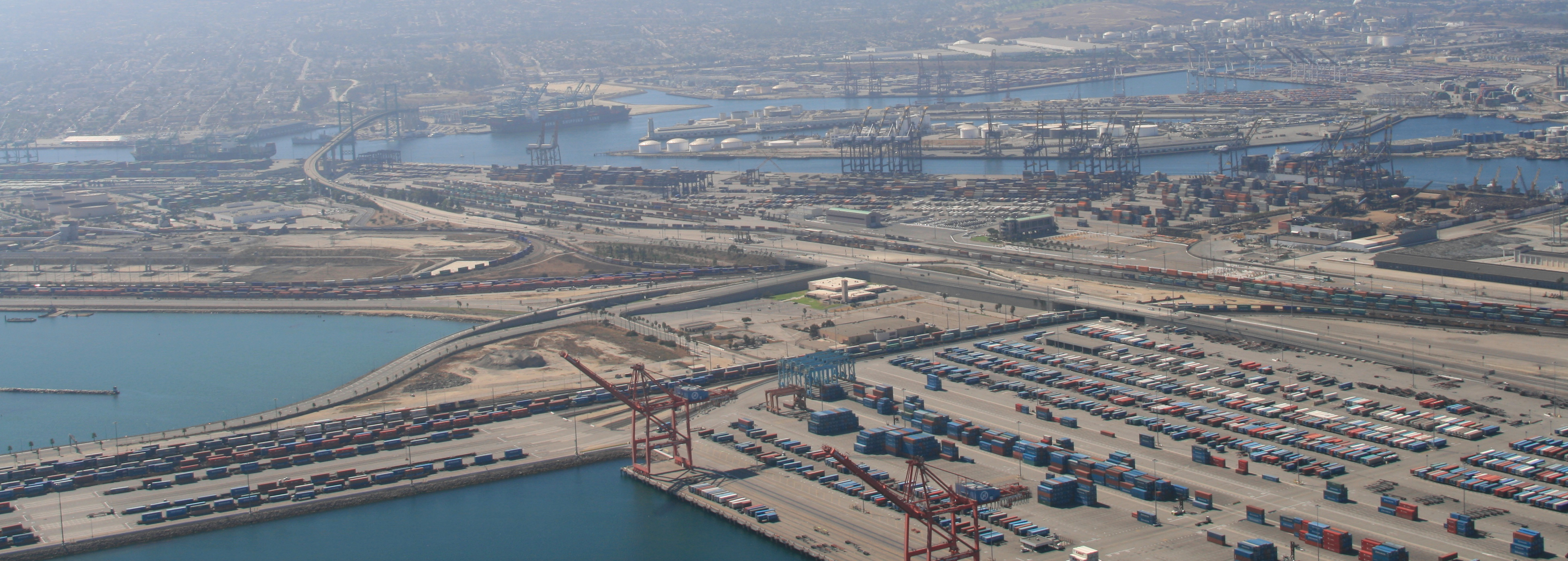
Harbor in Los Angeles, California
| Field | Value |
|---|---|
| name | Port of Los Angeles |
| image | Port of Los Angeles (2501768235).jpg |
| image_caption | Port of Los Angeles in 2008 |
| logo | Port of Los Angeles logo.svg |
| country | United States |
| location | San Pedro, Los Angeles, California |
| coordinates | |
| locode | US LAX |
| opened | |
| sizewater | 3200 acre |
| sizeland | 4300 acre |
| size | 7500 acre |
| draft_depth | 53 ft |
| leadershiptitle | Executive director |
| leader | Gene Seroka |
| blankdetailstitle1 | Commissioners |
| blankdetails1 | |
| arrivals | 1,807 (2024) |
| cargotonnage | 216 million metric revenue tons (2024) |
| containervolume | (2024) |
| cargovalue | (2024) |
| passengertraffic | 1,112,893 (2024) |
| revenue | (2024) |
| website |
the Port of Los Angeles
The Port of Los Angeles is a seaport managed by the Los Angeles Harbor Department, a unit of the City of Los Angeles. It occupies 7500 acre of land and water with 43 mi of waterfront and adjoins the separate Port of Long Beach. Promoted as "America's Port", the port is located in San Pedro Bay in the San Pedro and Wilmington neighborhoods of Los Angeles, approximately 20 mi south of downtown.
The port has 25 cargo terminals, 82 container cranes, 8 container terminals, and 113 mi of on-dock rail. The port's top imports were furniture, automobile parts, apparel, footwear, and electronics. In 2019, the port's top exports were wastepaper, pet and animal feed, scrap metal and soybeans. In 2020, the port's top three trading partners were China (including Hong Kong), Japan, and Vietnam. In 2022, the port, together with the adjoining Port of Long Beach, were considered amongst the world's least efficient ports by the World Bank and IHS Markit citing union protectionism and a lack of automation.
History
Image:LA-Harbor-1899.jpg|The L.A. Harbor, 1899 Image:LA-Harbor-1913.jpg|Port of Los Angeles, 1913

.jpg)

In 1542, Juan Rodriquez Cabrillo discovered the "Bay of Smokes." The south-facing San Pedro Bay was originally a shallow mudflat, too soft to support a wharf. Visiting ships had two choices: stay far out at anchor and have their goods and passengers ferried to shore, or beach themselves. That sticky process is described in Two Years Before the Mast by Richard Henry Dana Jr., who was a crew member on an 1834 voyage that visited San Pedro Bay. Phineas Banning greatly improved shipping when he dredged the channel to Wilmington in 1871 to a depth of 10 ft. The port handled 50,000 tons of shipping that year. Banning owned a stagecoach line with routes connecting San Pedro to Salt Lake City, Utah, and Yuma, Arizona, and in 1868 he built a railroad to connect San Pedro Bay to Los Angeles, the first in the area.
After Banning's death in 1885, his sons pursued their interests in promoting the port, which handled 500,000 tons of shipping in that year. The Southern Pacific Railroad and Collis P. Huntington wanted to create Port Los Angeles at Santa Monica and built the Long Wharf there in 1893. However, the Los Angeles Times publisher Harrison Gray Otis and U.S. Senator Stephen White pushed for federal support of the Port of Los Angeles at San Pedro Bay. The Free Harbor Fight was settled when San Pedro was endorsed in 1897 by a commission headed by Rear Admiral John C. Walker (who later went on to become the chair of the Isthmian Canal Commission in 1904). With U.S. government support, breakwater construction began in 1899, and the area was annexed to Los Angeles in 1909. The Los Angeles Board of Harbor Commissioners was founded in 1907.
In 1912 the Southern Pacific Railroad completed its first major wharf at the port. During the 1920s, the port surpassed San Francisco as the West Coast's busiest seaport. In the early 1930s, a massive expansion of the port was undertaken with the construction of a breakwater three miles out and over two miles in length. In addition to the construction of this outer breakwater, an inner breakwater was built off Terminal Island with docks for seagoing ships and smaller docks built at Long Beach. It was this improved harbor that hosted the sailing events for the 1932 Summer Olympics.
During World War II, the port was primarily used for shipbuilding, employing more than 90,000 people. In 1959, Matson Navigation Company's Hawaiian Merchant delivered 20 containers to the port, beginning the port's shift to containerization. The opening of the Vincent Thomas Bridge in 1963 greatly improved access to Terminal Island and allowed increased traffic and further expansion of the port. In 1985, the port handled one million containers in a year for the first time. During the 2002 West Coast port labor lockout, the port had a large backlog of ships waiting to be unloaded at any given time. In 2000, the Pier 400 Dredging and Landfill Program, the largest such project in America, was completed. By 2013, more than half a million containers were moving through the Port every month.
Port district
The port district is an independent, self-supporting department of the government of the City of Los Angeles. The port is under the control of a five-member Board of Harbor Commissioners appointed by the mayor and approved by the city council, and is administered by an executive director. The port maintains an AA bond rating, the highest rating attainable for self-funded ports.
, the port had about a dozen pilots, including two chiefs. Pilots have specialized knowledge of the harbor and San Pedro Bay. They meet the ships waiting to enter the harbor and provide advice as the vessel is steered through the congested waterway to the dock.
For public safety protection inside the port and of its businesses, the Port of Los Angeles utilizes the Los Angeles Port Police for police service, the Los Angeles Fire Department (LAFD) to provide fire and EMS services, the U.S. Coast Guard for waterway security, Homeland Security to protect federal land at the port, the Los Angeles County Lifeguards to provide lifeguard services for open waters outside of the harbor, while Los Angeles City Recreation & Parks Department lifeguards patrol the inner Cabrillo Beach.
Shipping
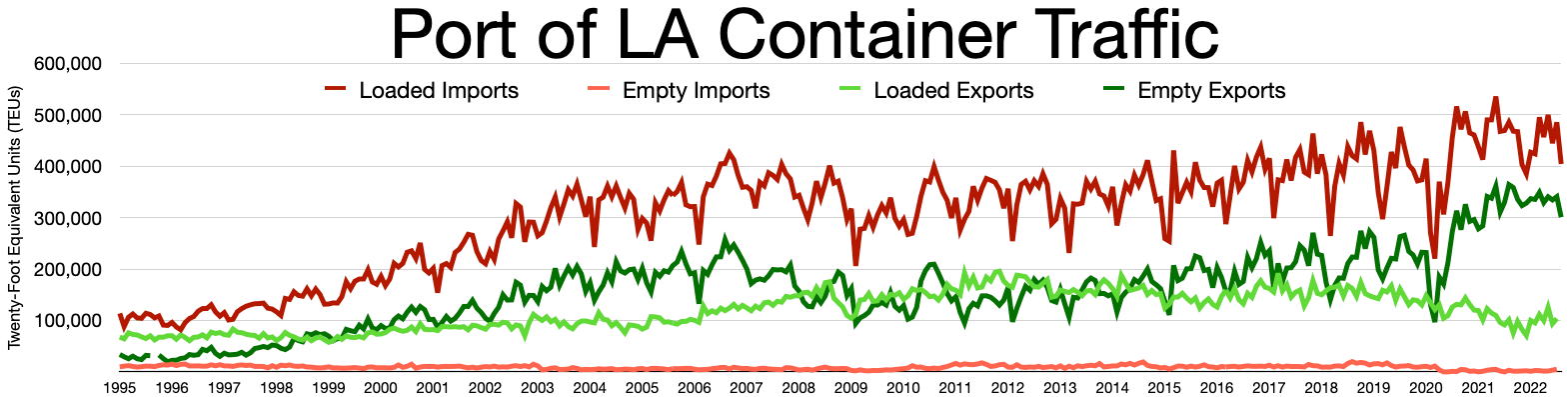
]] The port's container volume was in calendar year 2019, a 5.5% increase over 2016's record-breaking year of 8.8 million TEU. It's the most cargo moved annually by a Western Hemisphere port. The port is the busiest port in the United States by container volume, the 19th-busiest container port in the world, and the 10th-busiest worldwide when combined with the neighboring Port of Long Beach. The port is also the number-one freight gateway in the United States when ranked by the value of shipments passing through it. The port's top trading partners in 2019 were:
- China/Hong Kong ($128 billion)
- Japan ($89 billion)
- Vietnam ($21 billion)
- South Korea ($15 billion)
- Taiwan ($15 billion)
The most-imported types of goods in the 2019 calendar year were, in order: furniture (579,405), automobile parts (340,546), apparel (312,655), and electronic products (209,622).
The port is served by the Pacific Harbor Line (PHL) railroad. From the PHL, intermodal railroad cars go north to Los Angeles via the Alameda Corridor.
In 2011, no American port could handle ships of the PS-class Emma Mærsk and the future Maersk Triple E class size, the latter of which needs cranes reaching 23 rows. In 2012, the port and the U.S. Army Corps of Engineers deepened the port's main navigational channel to 53 feet, which is deep enough to accommodate the draft of the world's biggest container ships. However, Maersk had no plans in 2014 to bring those ships to America. In 2024 the port received 3 cranes capable of servicing ships up to 18,000 TEU.
Los Angeles and Long Beach ports were some of the least efficient in the world, according to a 2022 ranking by the World Bank and IHS Markit.
Cruise ship terminal
The World Cruise Center, located in San Pedro, Los Angeles, beneath the Vincent Thomas Bridge, has three passenger ship berths.
Public access investments
The LA Waterfront is a visitor-serving destination in the city of Los Angeles, funded and maintained by the Port of Los Angeles. In 2009, the Los Angeles Harbor Commission approved the San Pedro Waterfront and Wilmington Waterfront development programs, under the LA Waterfront umbrella. The LA Waterfront consists of a series of waterfront development and community enhancement projects covering more than 400 acres of existing Port of Los Angeles property in both San Pedro and Wilmington. With miles of public promenade and walking paths, acres of open space and scenic views, the LA Waterfront attracts thousands of visitors annually. Remodel and reconstruction was approved by the Los Angeles City Council. Development is set to be completed in 2020. Construction is expected to begin in 2017 at a partial project cost of $90 million, paid by the developer. The San Pedro Public Market is expected to open in 2020, with demolition beginning as early as November 2016.
The Waterfront Red Car is a currently non-operational heritage trolley line for public transit along the waterfront in San Pedro. Prior to its closure in 2015, it used vintage and restored Pacific Electric Red Cars to connect the World Cruise Center, Downtown San Pedro, Ports O' Call Village, and the San Pedro Marina.
Environment
Oceangoing ships visiting ports are a large source of nitrogen oxides in Southern California. Heavy-duty diesel trucks, that are also part of the freight-moving port complexes, emit exhaust with nitrogen oxides and particulate matter. The California Air Resources Board is working on reducing these sources of pollution that produce the nation's most polluted air smog and kill more than 3,500 Southern Californians each year. In 2021, the South Coast Air Quality Management District required warehouses in the port which do not cut emissions of carbon and pollutants to pay fees.
The port installed the first Alternative Maritime Power (AMP) berth in 2004 and can provide up to 40 MW of grid power to two cruise ships simultaneously at both 6.6 kV and 11 kV, as well as three container terminals, reducing pollution from ship engines.
In an effort to buffer the nearby community of Wilmington from the port, in June 2011 the Wilmington Waterfront Park was opened.
In 2024, the nonprofit political organization Environment California sued the Port of Los Angeles for alleged violations of the federal Clean Water Act, claiming the port had violated the act more that 2,000 in just the previous 5 years. In April 2025, the Port of Los Angeles settled the lawsuit, agreeing to pay $1.3 million to the Rose Foundation For Communities & The Environment for projects to restore the Los Angeles Harbor and San Pedro Bay, plus a $130,000 civil penalty to the U.S. Treasury.
Clean Air Action Program
The $2.8 million San Pedro Bay Ports Clean Air Action Program (CAAP) initiative was implemented by the Board of Harbor Commissioners in October 2002 for terminal and ship operations programs targeted at reducing polluting emissions from vessels and cargo handling equipment . To accelerate implementation of emission reductions through the use of new and cleaner-burning equipment, the port has allocated more than $52 million in additional funding for the CAAP through 2008.
As of May 2016, the Port of Los Angeles has already surpassed its initial 2023 emission goals 8 years ahead of predicted time frame. The dramatic success to reduce emissions has seen a decrease in diesel particulate matter reduce 72%, sulfur oxides by 93%, and nitrogen oxide by 22% so far. The CAAP program was updated to 3.0 after this environmental successes of the initiatives. With the recent ramification of environment goals the updates will look to reduce the emissions through efficient supply chain optimization. There has also been recent developments to increase port technologies advancement to promote the development of efficient and green port technologies. The CAAP also looks to be the lead role caretaker of fostering and improving the wildlife and ecosystem of the port.
References
References
- {{cite gnis
- Lopez, Ricardo. (June 11, 2014). "Gene Seroka named Port of Los Angeles executive director". [[Los Angeles Times]].
- "Board Members | Commission | Port of Los Angeles".
- "Port of Los Angeles Facts & Figures".
- "Facts and Figures {{!}} Statistics {{!}} Port of Los Angeles".
- Port of Los Angeles. (2020). "The Port of Los Angeles – Info About the Port".
- Sowinski, L., Portrait of a Port, World Trade Magazine, February 2007, p. 32
- Estrada, Gilbert. (2014-01-24). "Brief History of the Ports of Los Angeles and Long Beach".
- [https://books.google.com/books?id=iigDAAAAMBAJ&dq=Popular+Science+1932+plane&pg=PA30 "Big Harbor Three Miles At Sea"] ''Popular Science'', December 1931, illustration of harbor and port improvements
- [https://www.la84foundation.org/6oic/OfficialReports/1932/1932s.pdf 1932 Summer Olympics official report.] pp. 76, 78, 585.
- Cuevas, Antonio. (2007-12-09). "Seaport's Legacy Drives Its Future". Los Angeles Times.
- Chinn, Kay. (15 October 2013). "L.A. Port Numbers Down From Last Year". Los Angeles Business Journal.
- (13 August 2014). "Fitch Rates Port of Los Angeles Harbor, CA's Rev Bonds 'AA'; Outlook Stable". Fitch Ratings.
- (June 11, 2016). "How one of L.A.'s highest-paying jobs went to the boss' son". [[Los Angeles Times]].
- (2009). "Top 25 U.S. Freight Gateways, Ranked by Value of Shipments: 2008". U.S. Department of Transportation.
- (22 February 2011). "Bigger, cleaner, slower – the new giants of the seas".
- (22 February 2011). "Bigger, cleaner, slower — the new giants of the seas".
- (2013-12-02). "APM Rotterdam retrofitting cranes for more EEE calls".
- (23 July 2009). "ABS Record: ''Emma Maersk''". American Bureau of Shipping.
- (21 February 2011). "Largest container ship will be 16% larger and 20% less CO2and 35% more fuel efficient". Next Big Future.
- (2014). "Ports of Long Beach, Los Angeles invest millions to accommodate ships". Press-Telegram.
- (20 November 2024). "APM Terminals Pier 400 boosts efficiency with new cranes".
- Baertlein, Lisa. (2021-10-20). "California ports, key to U.S. supply chain, among world's least efficient, ranking shows". Reuters.
- Hsu, Andrea. (September 11, 2022). "Before the holiday season, workers at America's busiest ports are fighting the robots". NPR.org.
- "Cruise Passenger and Ferry Terminals". The Port of Los Angeles.
- "Visit the LA Waterfront at the Port of Los Angeles".
- (2015-02-11). "Public Access Investment Plan".
- "Attractions | LA Waterfront".
- "SanPedro.com: POLA Waterfront Red Car Line - with map".
- "RailwayPreservation.com: Port of LA Waterfront Red Car Line".
- Barboza, Tony. (2020-01-03). "Port ships are becoming L.A.'s biggest polluters. Will California force a cleanup?". [[Los Angeles Times]].
- Wright, Pam. (2016-08-11). "Thousands Die Each Year In Southern California From Air Pollution, Study Says".
- (2021-08-18). "New rule requires Southern California warehouses to clean up or pay up".
- (May 7, 2021). "South Coast AQMD Governing Board Adopts Warehouse Indirect Source Rule".
- Philips, Peter. [http://www.pmmonlinenews.com/2011/03/los-angeles-port-now-providing-shore.html Los Angeles Port Now Providing Shore-Side Power to Three Cruise Lines] ''Pacific Maritime'', 1 March 2011. Accessed: 1 October 2011.
- "Wilmington Waterfront Park". Port of Los Angeles.
- Landers, Jay. (July 2011). "Los Angeles creates park to provide buffer between port, community". Civil Engineering Magazine.
- Udasin, Sharon. (July 23, 2024). "California environmentalists sue Port of Los Angeles, alleging clean water violations". [[The Hill (newspaper).
- Deehan, Laura. (April 16, 2025). "Environment California settles Clean Water Act lawsuit over Port of Los Angeles pollution". Environment California.
- (2 May 2016). "02 May Port of Los Angeles: Global Model for Sustainability & Environmental Initiatives".
This article was imported from Wikipedia and is available under the Creative Commons Attribution-ShareAlike 4.0 License. Content has been adapted to SurfDoc format. Original contributors can be found on the article history page.
Ask Mako anything about Port of Los Angeles — get instant answers, deeper analysis, and related topics.
Research with MakoFree with your Surf account
Create a free account to save articles, ask Mako questions, and organize your research.
Sign up freeThis content may have been generated or modified by AI. CloudSurf Software LLC is not responsible for the accuracy, completeness, or reliability of AI-generated content. Always verify important information from primary sources.
Report