From Surf Wiki (app.surf) — the open knowledge base
Northeast India
Group of Indian states
Group of Indian states
| Field | Value | |
|---|---|---|
| <!-- See Template:Infobox settlement for additional fields and descriptions --> | name | Northeast India |
| other_name | North Eastern Region (NER) | |
| native_name_lang | mni | |
| image_skyline | {{multiple image | |
| border | infobox | |
| total_width | 300 | |
| perrow | 2/2/2/2 | |
| image1 | Tawang Gate.jpg | |
| image2 | Majuli Island.jpg | |
| image3 | Loktak Lake Boat people Moirang Manipur India.jpg | |
| image4 | Living root bridges, Nongriat village, Meghalaya2.jpg | |
| image5 | Embossed Figures Kawtchhuah Ropui Vangchhia Mapuia Hnamte (1).JPG | |
| image6 | Mokokchung.jpg | |
| image7 | Unakoti 3.jpg | |
| image8 | Temi tea garden.jpg | |
| image_caption | **From top, left to right**: Sela Pass, Majuli, Manipur, Living root bridge, Mizoram, Mokokchung, The Rock Wall, Temi Tea Garden | |
| image_map | Northeast India.svg | |
| map_caption | States in Northeast India | |
| map_alt | Northeast india map.png | |
| coordinates | ||
| subdivision_type | Country | |
| subdivision_name | India | |
| subdivision_type1 | States | |
| subdivision_name1 | {{UBL | |
| subdivision_type2 | Largest city | |
| subdivision_name2 | Guwahati | |
| subdivision_type3 | Major cities ([2011 Census of India](2011-census-of-india)) | |
| subdivision_name3 | {{plainlist | |
| <!-- ALL fields with measurements have automatic unit conversion --> | unit_pref | Metric |
| area_total_km2 | 262,184 | |
| population_total | 45,772,188 | |
| population_as_of | [2011](2011-census-of-india) | |
| population_density_km2 | 173 | |
| timezone1 | Indian Standard Time | |
| utc_offset1 | +5:30 | |
| blank_name_sec1 | Scheduled languages | |
| blank_info_sec1 | * Assamese | |
| * Bengali<ref name | scheduledlanguages/ | |
| * Bodo<ref name | scheduledlanguages / | |
| * Meitei (Manipuri)<ref name | scheduledlanguages/ | |
| * Nepali<ref name | scheduledlanguages/ | |
| blank_name_sec2 | State/Regional official languages | |
| blank_info_sec2 | ||
| * Assamese (of Assam)<ref name | langoff | |
| * Bengali (of Tripura<ref name | langoff/ and Barak Valley) | |
| * Bodo (of Bodoland)<ref name | langoff/ | |
| * Kokborok (Tripuri) (of Tripura)<ref name | langoff/ | |
| * Mizo (of Mizoram)<ref name | langoff/ | |
| * Meitei (Manipuri) (of Manipur<ref name | langoff/ and Assam | |
| * Nepali (of Sikkim)<ref name | "auto" | |
| * English (of Arunachal Pradesh, Meghalaya and Nagaland)<ref name | langoff/ | |
| * Sikkimese (of Sikkim)<ref name | "auto"/ | |
| population_density_sq_mi | auto | |
| population_est | 51670000 | |
| pop_est_as_of | 2022 | |
| pop_est_footnotes | ||
| image_map1 | Northeast india.png |
the North Eastern Region (NER) of India
| Flag of Arunachal Pradesh.svg Arunachal Pradesh | Flag of Assam, India.svg Assam | Flag of the Government of Manipur.svg Manipur | Banner of Meghalaya.png Meghalaya | Mizoram Flag(INDIA).png Mizoram | Government Banner of Nagaland.svg Nagaland | Emblem of Tripura.svg Tripura | Flag of the Government of Sikkim.svg Sikkim
- Agartala
- Imphal
- Dimapur
- Shillong
- Aizawl
- Silchar
- Dibrugarh
- Jorhat
- Nagaon
- Bengali
- Bodo
- Meitei (Manipuri)
- Nepali
- Assamese (of Assam)
- Bengali (of Tripura and Barak Valley)
- Bodo (of Bodoland)
- Kokborok (Tripuri) (of Tripura)
- Mizo (of Mizoram)
- Meitei (Manipuri) (of Manipur and Assam
- Nepali (of Sikkim)
- English (of Arunachal Pradesh, Meghalaya and Nagaland)
- Sikkimese (of Sikkim)
Northeast India, officially the North Eastern Region (NER), is the easternmost region of India representing both a geographic and political administrative division of the country. It comprises eight states: Arunachal Pradesh, Assam, Manipur, Meghalaya, Mizoram, Nagaland, and Tripura (commonly known as the "Seven Sisters"), and the "Brother" state of Sikkim. North-east India is one of the most linguistically diverse regions in the world.
The region has India's international border of 5,182 kilometres (3,220 mi) with five neighbouring countries: China to the north, Myanmar to the east, Bangladesh to the southwest, Nepal to the west, and Bhutan to the northwest. It comprises an area of 262184 km2, almost 8 per cent of that of India and has a population of 45,772,188, almost 4 per cent that of India. The Siliguri Corridor connects the region to other parts of India.
Northeast is very rich in mineral wealth; India's first oil well was dug in Northeast India in 1865, in Digboi in Assam. The region houses one of the notable ophiolites in the world.
The region has been highly strategic and it witnessed one of the fiercest battles in the Second World War, the Battle of Imphal and Kohima (1944) where the Japanese Forces and the Allied Forces were engaged in a pitched battle that saw thousands of casualties on both sides.
The states of North Eastern Region are officially recognised under the North Eastern Council (NEC), constituted in 1971 as the acting agency for the development of the north eastern states.Sikkim became a member of the North Eastern Council in 2002. India's Look-East connectivity projects connect Northeast India to East Asia and ASEAN.
History
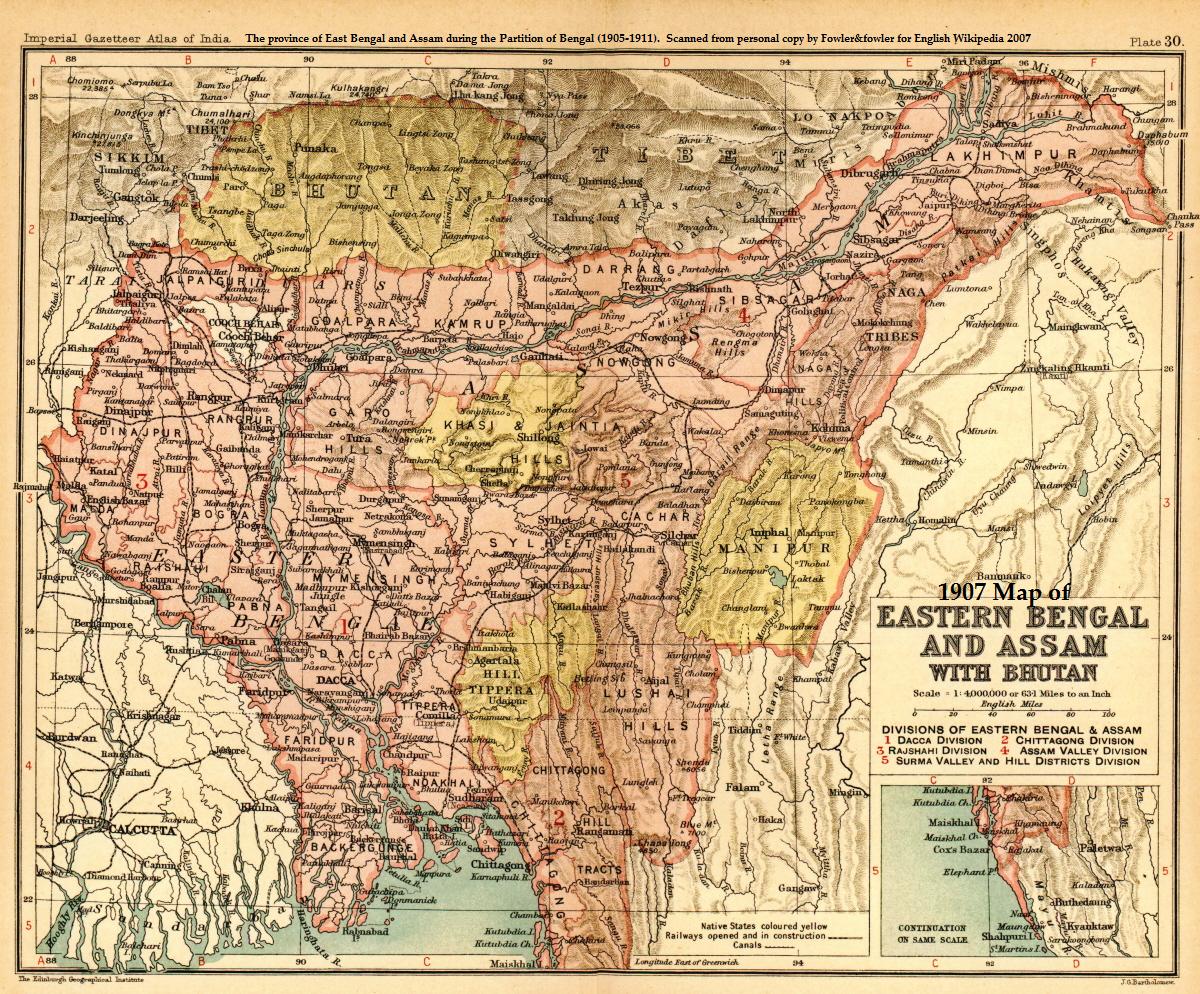
The earliest settlers may have been Austroasiatic speakers from Southeast Asia, followed by Tibeto-Burman speakers from China, and by 500 BCE Indo-Aryan speakers from the Gangetic Plains as well as Kra–Dai speakers from southern Yunnan and Shan State. Due to the biodiversity and crop diversity of the region, archaeological researchers believe that early settlers of Northeast India had domesticated several important plants. Historians believe that the 100 BCE writings of Chinese explorer Zhang Qian indicate an early trade route via Northeast India. The Periplus of the Erythraean Sea mentions a people called Sêsatai in the region, who produced malabathron (cinnamon-like aromatic leaves, dried and used as a flavouring agent), so prized in the old world. Ptolemy's Geographia (2nd century CE) calls the region Kirrhadia, apparently after the Kirata population.
In the early historical period (most of the first millennium CE), Kamarupa straddled most of present-day Northeast India. Xuanzang, a travelling Chinese Buddhist monk, visited Kamarupa in the 7th century CE. He described the people as "short in stature and black-looking", whose speech differed a little from mid-India and who were of simple but violent disposition. He wrote that the people in Kamarupa knew of Sichuan, which lay to the kingdom's east beyond a treacherous mountain.
The northeastern states were established during the British Raj of the 19th and early 20th centuries, when they became relatively isolated from traditional trading partners such as Bhutan and Myanmar. Many of the peoples in present-day Mizoram, Meghalaya and Nagaland converted to Christianity under the influence of British (Welsh) missionaries.
Formation of North Eastern states
Since the Moamoria disturbances, the Ahom dynasty was on the decline. The British appeared on the scene in the guise of saviours. In the early 19th century, both the Ahom and the Manipur kingdoms fell to a Burmese invasion. The ensuing First Anglo-Burmese War resulted in the entire region coming under British control. In the colonial period (1826–1947), North East India was made a part of Bengal Province from 1839 to 1873, after which Colonial Assam became its own province, but which included Sylhet.
After Indian Independence from British Rule in 1947, the Northeastern region of British India consisted of Assam and the princely states of Tripura Kingdom and Manipur Kingdom. Subsequently, Manipur and Tripura were made Union Territories of India in 1956 and in 1972 attained fully-fledged statehood. Later, Nagaland attained statehood in 1963, Meghalaya in 1972. Arunachal Pradesh and Mizoram became full-fledged states on 20 February 1987, being carved out of the large territory of Assam. Sikkim was integrated as the eighth North Eastern Council state in 2002.
The city of Shillong served as the capital of the Assam province created during British Rule. It remained the capital of undivided Assam until the formation of the state of Meghalaya in 1972. The capital of Assam was shifted to Dispur, a part of Guwahati, and Shillong was designated as the capital of Meghalaya.
| State | Historic name | Capital(s) | Statehood | ||||||||||||
|---|---|---|---|---|---|---|---|---|---|---|---|---|---|---|---|
| Arunachal Pradesh | North-East Frontier Agency | Itanagar | 1987 (earlier a Union Territory of India, constituted in 1971) | ||||||||||||
| Assam | *Kamarupa* | Shillong (till 1969), Dispur | 1947 | ||||||||||||
| Manipur | url=http://kanglaonline.com/2012/04/ancient-name-of-manipur/ | title=Ancient name of Manipur | date=9 April 2012 | access-date=5 June 2017 | archive-date=18 November 2017 | archive-url=https://web.archive.org/web/20171118223036/http://kanglaonline.com/2012/04/ancient-name-of-manipur/ | url-status=live }} | Imphal | url=http://meglaw.gov.in/acts/The_North_Eastern_Areas_(Reorganisation_Act)_1971.pdf | title=The North Eastern Areas (Re-organisation Act) 1971 | website=meglaw.gov.in | access-date=5 December 2017 | archive-date=6 December 2017 | archive-url=https://web.archive.org/web/20171206005945/http://meglaw.gov.in/acts/The_North_Eastern_Areas_(Reorganisation_Act)_1971.pdf | url-status=live }} |
| Meghalaya | Khasi hills, Jaintia hills and Garo hills | Shillong | 1971 | ||||||||||||
| Tripura | *Tipperah* | Agartala | 1971 (earlier a Union Territory of India, constituted in 1956) | ||||||||||||
| Mizoram | Lushai Hills | Aizawl | url=https://rajbhavan.mizoram.gov.in/page/history-of-mizoram | title=History of Mizoram | access-date=5 June 2017 | archive-date=29 August 2017 | archive-url=https://web.archive.org/web/20170829162210/https://rajbhavan.mizoram.gov.in/page/history-of-mizoram | url-status=live }} | |||||||
| Nagaland | Naga Hills District | Kohima | 1963 | ||||||||||||
| Sikkim | Sukhim | Gangtok | 1975 |
World War II
Main article: Battle of Kohima, Battle of Imphal
Initially, the Japanese had invaded British territories in Southeast Asia, including Burma (now Myanmar), with the intention of creating a fortified perimeter around Japan. The British had neglected the defence of Burma, and by early 1942, the Japanese had captured Rangoon and pushed Allied forces back towards India through a gruelling retreat.
In response to the Japanese advance, the British formed the South East Asia Command (SEAC) under Admiral Lord Louis Mountbatten in November 1943. This command brought new energy to the war effort in the region and emphasised the importance of standing firm and fighting on despite logistical challenges, such as during the monsoon season.
The Japanese launched an offensive in March 1944 aimed at capturing Imphal and Kohima, key locations in northeast India. Capturing these areas would have allowed the Japanese to disrupt Allied supply lines to China and launch air attacks against India.
However, the Allied forces, under the leadership of Field Marshal William Slim, held firm. They adopted aggressive tactics, including the creation of defensive "boxes" and the use of jungle warfare techniques. Despite being surrounded, the defenders at Kohima held out against intense Japanese attacks until reinforcements arrived.
The battles of Imphal and Kohima resulted in a decisive defeat for the Japanese. They suffered heavy casualties and were forced to retreat, marking a turning point in the Burma Campaign. The Allied victory paved the way for subsequent offensives to clear Japanese forces from Burma and ultimately led to the re-conquest of the region.
Sino-Indian War (1962)
Main article: Sino-Indian War
Arunachal Pradesh, a state in the Northeastern tip of India, is claimed by China as South Tibet. Sino-Indian relations degraded, resulting in the Sino-Indian War of 1962. The cause of the escalation into war is still disputed by both Chinese and Indian sources. During the war in 1962, the PRC (China) captured much of the NEFA (North-East Frontier Agency) created by India in 1954. But on 21 November 1962, China declared a unilateral ceasefire, and withdrew its troops 20 km behind the McMahon Line. China returned Indian prisoners of war in 1963.
Seven Sister States
The Seven Sister States is a popular term for the contiguous states of Arunachal Pradesh, Assam, Meghalaya, Manipur, Mizoram, Nagaland and Tripura prior to inclusion of the state of Sikkim into the North Eastern Region of India. The sobriquet 'Land of the Seven Sisters' was coined to coincide with the inauguration of the new states in January 1972 by Jyoti Prasad Saikia, a journalist in Tripura, in the course of a radio talk show. He later compiled a book on the interdependence and commonness of the Seven Sister States. It has been primarily because of this publication that the nickname has caught on.
Geography
The Northeast region can be physiographically categorised into the Eastern Himalaya, the Patkai and the Brahmaputra and the Barak valley plains. Northeast India (at the confluence of Indo-Malayan, Indo-Chinese, and Indian biogeographical realms) has a predominantly humid sub-tropical climate with hot, humid summers, severe monsoons, and mild winters. Along with the west coast of India, this region has some of the Indian subcontinent's last remaining rainforests, which support diverse flora and fauna and several crop species. Reserves of petroleum and natural gas in the region are estimated to constitute a fifth of India's total potential.
The region is covered by the mighty Brahmaputra-Barak river systems and their tributaries. Geographically, apart from the Brahmaputra, Barak and Imphal valleys and some flatlands in between the hills of Meghalaya and Tripura, the remaining two-thirds of the area is hilly terrain interspersed with valleys and plains; the altitude varies from almost sea-level to over 7000 m above MSL. The region's high rainfall, averaging around 10000 mm and above creates problems of the ecosystem, high seismic activity, and floods. The states of Arunachal Pradesh and Sikkim have a montane climate with cold, snowy winters and mild summers.
File:Gangtok ropeway.jpg| File:View of the ridgetop city of Aizawl, state capital of Mizoram.jpg| File:Aerial view of Shillong Meghalaya India.jpg| File:Neer Mahal.jpg| File:The Dzukou Valley.JPG| File:2007-sela-pass-1.jpg| File:Salna Bari, Bhalukpong.jpg| File:2 Loktak lake Manipur India.jpg| File:Majuli Island.jpg| File:Nohkalikai Falls.JPG|
Topography
Highest peaks
Main article: List of Indian states and territories by highest point
Kangchenjunga, the third highest mountain peak in the world rising to an altitude of 8586 m, lies in-between the state Sikkim and adjacent country Nepal.
| Peak | State | Range/Region | Height (m) | Height (ft) | Coordinates |
|---|---|---|---|---|---|
| Kangchenjunga (shared with Nepal) | Sikkim | Eastern Himalaya | 8,586 | 28,169 | |
| Kangto (shared with China) | Arunachal Pradesh | Eastern Himalaya | 7,090 | 23,261 | |
| Mount Saramati (shared with Myanmar) | Nagaland | Naga Hills section of the Purvanchal Range | 3,841 | 12,602 | |
| Mount Tempü (also known as Mount Iso) | Manipur | Naga Hills section of the Purvanchal Range | 2,994 | 9,823 | |
| Phawngpui | Mizoram | Lushai Hills section of the Purvanchal Range | 2,165 | 7,103 | |
| Shillong Peak | Meghalaya | Khasi Hills section of the Shillong Plateau | 1,965 | 6,447 | |
| *Unnamed peak* | Assam | Cachar Hills section of the Karbi Anglong Plateau | 1,960 | 6,430 | |
| Betlingchhip (also known as Sibrai-khung) | Tripura | Jampui Hills section of the Purvanchal Range | 930 | 3,051 |
Brahmaputra river basin
Tributaries of the Brahmaputra River in Northeast India:
- Beki River
- Bhogdoi River
- Dhansiri River
- Dibang River
- Dihing River
- Kameng River
- Kolong
- Kopili River
- Lohit River
- Manas River
- Sankosh River
- Subansiri River
- Teesta River
Climate
Northeast India has a subtropical climate that is influenced by its relief and influences from the southwest and northeast monsoons. The Himalayas to the north, the Meghalaya plateau to the south and the hills of Nagaland, Mizoram and Manipur to the east influences the climate. Since monsoon winds originating from the Bay of Bengal move northeast, these mountains force the moist winds upwards, causing them to cool adiabatically and condense into clouds, releasing heavy precipitation on these slopes. It is the rainiest region in the country, with most places receiving an average annual precipitation over 2000 mm, which is mostly concentrated in summer during the monsoon. Cherrapunji, located on the Meghalaya plateau is one of the rainiest place in the world with an annual precipitation of 11777 mm. Temperatures are moderate in the Brahmaputra and Barak valley river plains which decreases with altitude in the hilly areas. At the highest altitudes, there is permanent snow cover. In general, the region has 3 seasons: Winter, Summer, and rainy season in which the rainy season coincides with the summer months much like the rest of India. Winter is from early November until mid March while summer is from mid-April to mid-October.
Under the Köppen climate classification, the region is divided into 3 broad types: A (tropical climates), C (warm temperate mesothermal climates), and D (snow microthermal climates). The tropical climates are located in parts of Manipur, Tripura, Mizoram, and the Cachar plains south of 25˚N and are classified as tropical monsoon (Am). Much of Assam, Nagaland, northern parts of Meghalaya and Manipur and parts of Arunachal Pradesh fall within the warm temperature mesothermal climates (type C) where the mean temperatures in coldest months range from -3 to. The entire Brahmaputra valley has a humid subtropical climate (Cfa/Cwa) with hot summers.
Temperature
Temperatures vary by altitude with the warmest places being in the Brahmaputra and Barak River plains and the coldest at the highest altitudes. It is also influenced by proximity to the sea with the valleys and western areas being close to the sea, which moderates temperatures. Generally, temperatures in the hilly and mountainous areas are lower than the plains which lie at a lower altitude. Summer temperatures tend to be more uniform than winter temperatures due to high cloud cover and humidity.
In the Brahmaputra and Barak valley river plains, mean winter temperatures vary between 16 and while mean summer temperatures are around 28 C. The highest summer temperatures occur in the West Tripura plain with Agartala, the capital of Tripura having mean maximum summer temperatures ranging between 33 and in April. The highest temperatures in summer occur before the arrival of monsoons and thus eastern areas have the highest temperatures in June and July where the monsoon arrives later than western areas. In the Cachar Plain, located south of the Brahmaputra plain, temperatures are higher than the Brahmaputra plain although the temperature range is smaller owing to higher cloud cover and the monsoons that moderate night temperatures year round.
In the mountainous areas of Arunachal Pradesh, the Himalayan ranges in the northern border with India and China experience the lowest temperatures with heavy snow during winter and temperatures that drop below freezing. Areas with altitudes exceeding 2000 m receive snowfall during winters and have cool summers. Below 2000 m above sea level, winter temperatures reach up to 15 C during the day with nights dropping to zero while summers are cool, with a mean maximum of 25 C and a mean minimum of 15 C. In the hilly areas of Meghalaya, Nagaland, Manipur and Mizoram, winters are cold while summers are cool.
The plains in Manipur has colder winter minimums than what is warranted by its elevation owing to its geographic location which prevents winds that bring hot temperatures and humidity from coming into the Manipur plain, alongside being surrounded by hills on all sides. This creates temperature inversions during winter nights when cold air descends from the hills into the valleys below. For example, in Imphal, winter daytime temperatures hover around 21 C but nighttime temperatures drop to 3 C.
Rainfall
No part of Northeast India receives less than 1000 mm of rainfall a year. Areas in the Brahmputra valley receive 2000 mm of rainfall a year while mountainous areas receive 2000 to a year. The southwest monsoon is responsible for bringing 90% of the annual rainfall to the region. April to late October are the months where most of the rainfall in Northeast India occurs with June and July being the rainiest months. In most parts of the region, the average date of onset of the monsoons is 1 June. Southern areas are the first to receive the monsoon (May or June) with the Brahmaputra valley and the mountainous north receiving later (later May or June). In the hilly parts of Mizoram, the closer proximity to the Bay of Bengal causes it to experience early monsoons with June being the wettest season.
High-risk seismic zone
The North Eastern Region of India is a mega-earthquake prone zone caused by active fault planes beneath formed by the convergence of three tectonic plates viz. India Plate, Eurasian Plate and Burma Plate. Historically the region has suffered from two great earthquakes (M 8.0) – 1897 Assam earthquake and 1950 Assam-Tibet earthquake – and about 20 large earthquakes (8.0 M 7.0) since 1897. The 1950 Assam-Tibet earthquake is still the largest earthquake in India.
Wildlife
Flora
WWF has identified the entire Eastern Himalayas as a priority Global 200 ecoregion. Conservation International has upscaled the Eastern Himalaya hotspot to include all the eight states of Northeast India, along with the neighbouring countries of Bhutan, southern China and Myanmar.
The region has been identified by the Indian Council of Agricultural Research as a center of rice germplasm. The National Bureau of Plant Genetic Resources (NBPGR), India, has highlighted the region as being rich in wild relatives of crop plants. It is the center of origin of citrus fruits. Two primitive variety of maize, Sikkim Primitive 1 and 2, have been reported from Sikkim (Dhawan, 1964). Although jhum cultivation, a traditional system of agriculture, is often cited as a reason for the loss of forest cover of the region, this primary agricultural economic activity practised by local tribes supported the cultivation of 35 varieties of crops. The region is rich in medicinal plants and many other rare and endangered taxa. Its high endemism in both higher plants, vertebrates, and avian diversity has qualified it as a biodiversity hotspot.
The following figures highlight the biodiversity significance of the region:
- 51 forest types are found in the region, broadly classified into six major types – tropical moist deciduous forests, tropical semi-evergreen forests, tropical wet evergreen forests, subtropical forests, temperate forests, and alpine forests.
- Out of the nine important vegetation types of India, six are found in the North Eastern Region.
- These forests harbour 8,000 out of 15,000 species of flowering plants. In floral species richness, the highest diversity is reported from the states of Arunachal Pradesh (5000 species) and Sikkim (4500 species) among the North Eastern states.
- According to the Indian Red Data Book, published by the Botanical Survey of India, 10 per cent of the flowering plants in the country are endangered. Of the 1500 endangered floral species, 800 are reported from Northeast India.
- Most of the North Eastern states have more than 60% of their area under forest cover, a minimum suggested coverage for the hill states in the country in order to protect from erosion.
- Northeast India is a part of Indo-Burma hotspot. This hotspot is the second largest in the world, next only to the Mediterranean Basin, with an area 2206000 km2 among the 25 identified.
Fauna
The International Council for Bird Preservation, UK identified the Assam plains and the Eastern Himalaya as an Endemic Bird Area (EBA). The EBA has an area of 220,000 km2 following the Himalayan range in the countries of Bangladesh, Bhutan, China, Nepal, Myanmar and the Indian states of Sikkim, North Bengal, Assam, Nagaland, Manipur, Meghalaya and Mizoram. Because of a southward occurrence of this mountain range in comparison to other Himalayan ranges, this region has a distinctly different climate, with warmer mean temperatures and fewer days with frost, and much higher rainfall. This has resulted in the occurrence of a rich array of restricted-range bird species. More than two critically endangered species, three endangered species, and 14 vulnerable species of birds are in this EBA. Stattersfield et al. (1998) identified 22 restricted range species, out of which 19 are confined to this region and the remaining three are present in other endemic and secondary areas. Eleven of the 22 restricted-range species found in this region are considered as threatened (Birdlife International 2001), a number greater than in any other EBA of India.
Northeast India is very rich in faunal diversity. There are as many as 15 species of non-human primates and most important of them are hoolock gibbon, stumptied macaque, pigtailed macaque, golden langur, hanuman langur and rhesus monkey. The most important and endangered species is one-horned rhinoceros. The forests of the region are also the habitats of elephant, royal Bengal tiger, leopard, golden cat, fishing cat, marbled cat, Bengal fox etc. the Gangetic dolphin in the Brahmaputra is also an endangered species. The other endangered species are otter, mugger crocodile, tortoise and some fishes.
WWF has identified the following priority ecoregions in North-East India: : Brahmaputra Valley semi-evergreen forests : Eastern Himalayan broadleaf forests : Eastern Himalayan subalpine conifer forests : Northeast India–Myanmar pine forests
National parks
| National park | Location | State | Area (km2) | Importance | Vegetation | ||||||||
|---|---|---|---|---|---|---|---|---|---|---|---|---|---|
| Namdapha National Park | Changlang district | Arunachal Pradesh | 1,985 | Largest protected area in Eastern Himalaya | Tropical and subtropical moist broadleaf forests, montane forests | ||||||||
| Manas National Park | Baksa district | Assam | 950 | UNESCO World Heritage Site | Tropical and subtropical moist broadleaf forests | ||||||||
| Kaziranga National Park | Golaghat and Nagaon districts | Assam | 882 | UNESCO World Heritage Site | Brahmaputra Valley semi-evergreen forests, Terai–Duar savanna and grasslands | ||||||||
| Khangchendzonga National Park | North Sikkim district | Sikkim | 850 | UNESCO Mixed World Heritage Site and highest altitude wildlife protected area in India | Sub-tropical to Alpine, Krummholz (stunted forest) | ||||||||
| Mouling National Park | Upper Siang, West Siang and East Siang districts | Arunachal Pradesh | 483 | Tropical to Temperate forests | |||||||||
| Dibru-Saikhowa National Park | Dibrugarh and Tinsukia districts | Assam | 350 | Brahmaputra Valley semi-evergreen forests | |||||||||
| Balphakram National Park | South Garo Hills district | Meghalaya | 220 | Sub-tropical evergreen deciduous forests | |||||||||
| Intangki National Park | Peren district | Nagaland | 202 | Temperate evergreen forests | |||||||||
| Nameri National Park | Sonitpur district | Assam | 200 | Brahmaputra Valley semi-evergreen forests | |||||||||
| Murlen National Park | Champhai district | Mizoram | 100 | title=A note on non-human primates of Murlen National Park, Mizoram, India | url=http://faunaofindia.nic.in/PDFVolumes/records/106/01/0111-0114.pdf | journal=Zoological Survey of India | volume=106 (Part-1) | pages=111–114 | access-date=10 September 2017 | archive-date=21 July 2017 | archive-url=https://web.archive.org/web/20170721194453/http://faunaofindia.nic.in/PDFVolumes/records/106/01/0111-0114.pdf | url-status=live }} | |
| Orang National Park | Darrang and Sonitpur | Assam | 79 | url=http://orangtigerreserve.gov.in/forestTypes.php | title=Orang Tiger Reserve | access-date=10 September 2017 | archive-date=10 September 2017 | archive-url=https://web.archive.org/web/20170910173941/http://orangtigerreserve.gov.in/forestTypes.php | url-status=live }} | ||||
| Phawngpui National Park | Lawngtlai district | Mizoram | 50 | url=https://forest.mizoram.gov.in/page/forest-types | title=Forest types of Mizoram | access-date=10 September 2017 | archive-date=10 September 2017 | archive-url=https://web.archive.org/web/20170910220611/https://forest.mizoram.gov.in/page/forest-types | url-status=live }} | ||||
| Nokrek National Park | West Garo Hills district | Meghalaya | 48 | Tropical and subtropical moist broadleaf forests | |||||||||
| Sirohi National Park | Ukhrul district | Manipur | 41 | Mizoram–Manipur–Kachin rain forests | |||||||||
| Keibul Lamjao National Park | Bishnupur district | Manipur | 40 | World's only floating National park | *Phumdi* (floating marshes) | ||||||||
| Bison (Rajbari) National Park | South Tripura district | Tripura | 32 | Tropical semi-evergreen and moist deciduous forests | |||||||||
| Clouded Leopard National Park | Sepahijala district | Tripura | 5 | Tropical and subtropical moist broadleaf forests |
State symbols
Main article: List of symbols of Indian states and territories
| colspan="2" | **Arunachal Pradesh** | colspan="2" | **Assam** | colspan="2" | **Manipur** | colspan="2" | **Meghalaya** | colspan="2" | **Mizoram** | colspan="2" | **Nagaland** | colspan="2" | **Sikkim** | colspan="2" | **Tripura** | ||||||||||
|---|---|---|---|---|---|---|---|---|---|---|---|---|---|---|---|---|---|---|---|---|---|---|---|---|---|
| **Animal** | Mithun (*Bos frontalis*) | ||||||||||||||||||||||||
| **Bird** | Hornbill (*Buceros bicornis*) | ||||||||||||||||||||||||
| **Flower** | Foxtail orchid (*Rhynchostylis retusa*) | ||||||||||||||||||||||||
| **Tree** | Hollong (*Dipterocarpus macrocarpus*) | ||||||||||||||||||||||||
| **Animal** | Himalayan serow (*Capricornis thar*) | ||||||||||||||||||||||||
| **Bird** | Mrs. Hume's pheasant (*Syrmaticus humiae*) | ||||||||||||||||||||||||
| **Flower** | Red Vanda (*Renanthera imschootiana*) | ||||||||||||||||||||||||
| **Tree** | Indian rose chestnut (*Mesua ferrea*) |
Demographics
Main article: 2011 Census of India
The total population of Northeast India is 46 million with 68 per cent of that living in Assam alone. Assam also has a higher population density of 397 persons per km2 than the national average of 382 persons per km2. The literacy rates in the states of the Northeastern region, except those in Arunachal Pradesh and Assam, are higher than the national average of 74 per cent. As per 2011 census, Meghalaya recorded the highest population growth of 27.8 per cent among all the states of the region, higher than the national average at 17.64 per cent; while Nagaland recorded the lowest in the entire country with a negative 0.5 per cent.
Guwahati in Assam is the largest metropolis in Northeast India and is referred to as the gateway to the Northeast by many.
| State | Population | Males | females | Sex ratio | Literacy % | Rural population | Urban population | Area (km2) | Density (/km2) |
|---|---|---|---|---|---|---|---|---|---|
| Arunachal Pradesh | 1,383,727 | 713,912 | 669,815 | 938 | 65.38 | 870,087 | 227,881 | 83,743 | 17 |
| Assam | 31,205,576 | 15,939,443 | 15,266,133 | 958 | 72.19 | 23,216,288 | 3,439,240 | 78,438 | 397 |
| Manipur | 2,570,390 | 1,290,171 | 1,280,219 | 992 | 79.21 | 1,590,820 | 575,968 | 22,327 | 122 |
| Meghalaya | 2,966,889 | 1,491,832 | 1,475,057 | 989 | 74.43 | 1,864,711 | 454,111 | 22,429 | 132 |
| Mizoram | 1,097,206 | 555,339 | 541,867 | 976 | 91.33 | 447,567 | 441,006 | 21,081 | 52 |
| Nagaland | 1,978,502 | 1,024,649 | 953,853 | 931 | 79.55 | 1,647,249 | 342,787 | 16,579 | 119 |
| Sikkim | 610,577 | 323,070 | 287,507 | 890 | 81.42 | 480,981 | 59,870 | 7,096 | 86 |
| Tripura | 3,673,917 | 2,087,059 | 2,086,858 | 960 | 91.58 | 2,639,134 | 1,534,783 | 10,486 | 350 |
Largest cities by population
Main article: List of cities in India by population, List of cities in Assam by population
According to the 2011 census, the largest cities in Northeast India are
| Rank | City | Type | State | Population | Rank | City | Type | State | Population |
|---|---|---|---|---|---|---|---|---|---|
| 1 | Guwahati | City | Assam | 968,549 | 9 | Jorhat | UA | Assam | 153,889 |
| 2 | Agartala | City | Tripura | 622,613 | 10 | Nagaon | UA | Assam | 147,496 |
| 3 | Imphal | UA | Manipur | 414,288 | 11 | Bongaigaon | UA | Assam | 139,650 |
| 4 | Dimapur | City | Nagaland | 379,769 | 12 | Tinsukia | UA | Assam | 126,389 |
| 5 | Shillong | UA | Meghalaya | 354,325 | 13 | Tezpur | UA | Assam | 102,505 |
| 6 | Aizawl | City | Mizoram | 291,822 | 14 | Kohima | UA | Nagaland | 100,000 |
| 7 | Silchar | City | Assam | 389,136 | 15 | Gangtok | City | Sikkim | 98,658 |
| 8 | Dibrugarh | UA | Assam | 154,296 | 16 | Itanagar | City | Arunachal Pradesh | 95,650 |
Languages
Northeast India constitutes a single linguistic region within the Indian national context, with about 220 languages in multiple language families (Indo-European, Sino-Tibetan, Kra–Dai, Austroasiatic, as well as some creole languages) that share a number of features that set them apart from most other areas of the Indian subcontinent (such as alveolar consonants rather than the more typical dental/retroflex distinction). Assamese, an Indo-Aryan language spoken mostly in the Brahmaputra Valley, developed as a lingua franca for many speech communities. Assamese-based pidgin/creoles have developed in Nagaland (Nagamese) and Arunachal (Nefamese), though Nefamese has been replaced by Hindi in recent times. Bengali language is another Indo-Aryan language spoken in South Assam in the Barak Valley and Tripura, being the majority and official language in both the regions. The Austro-Asiatic family is represented by the Khasi, Jaintia and War languages of Meghalaya. A small number of Tai–Kadai languages (Ahom, Tai Phake, Khamti, etc.) are also spoken.
Sino-Tibetan is represented by a number of languages that differ significantly from each other, some of which are: Boro, Rabha, Karbi, Mising, Tiwa, Deori, Hmar (including Biate, Chorei, Halam, Hrangkhawl, Kaipeng, Molsom, Ranglong, Saihriem, Sakachep, Thangachep, Thiek), Zeme Naga, Rengma Naga and, Kuki (Thadou language) (Assam); Garo, Rabha, Hmar (including Biate, Sakachep) (Meghalaya); Ao, Angami, Sema, Lotha, Konyak, Chakhesang, Chang, Khiamniungan, Phom, Pochury, Rengma, Sangtam, Tikhir, Yimkhiung, Zeliang, Kuki (Thadou), and Hmar (including Sakachep/Khelma) etc. (Nagaland); Mizo languages such as Lusei (including Hualngo), Hmar (including Chorei, Darlawng, Darngawn, Kaipeng, Khawlhring, Molsom, Ngente, Sakachep, Zote), Lai (including Hakha, Falam, Khualsim, Zanniet, Sim), Mara languages, Ralte/Galte, Zomi/Paihte, Kuki/Thahdo, etc. (Mizoram); Hrusso, Tanee, Niyshi, Adi, Abor, Nocte, Apatani, Mishmi etc. (Arunachal). Kokborok is the dominant among the tribal people of Tripura and one of the official languages of the state, while Garo, Hmar (including Bong, Bongcher, Chorei, Dab, Darlawng, Hmarchaphang, Hrangkhawl, Langkai, Kaipeng, Koloi, Korbong, Molsom, Ranglong, Rupini, Saihmar, Sakachep, Thangachep)), Lusei (including Rokhum), etc. are also spoken. Meitei is the official language in Manipur, the dominant language of the Imphal Valley; while "Naga" languages such as Poumai, Mao, Maram, Rongmei (Kabui),Tangkhul, Zeme, Liangmei, Inpui, Thangal Naga and Mizo languages such as Kuki/Thado, Lusei, Zomi languages (including Paite, Simte, Vaiphei, Zou, Mate, Thangkhal, Tedim-Chin), Gangte and Hmar languages (including Biete, Hrangkhawl, Thiek, Zote) predominate in individual hill areas of the state.
Among other Indo-Aryan languages, Chakma is spoken in Mizoram and Hajong in Assam and Meghalaya. Nepali, an Indo-Aryan language, is dominant in Sikkim, besides the Sino-Tibetan languages Limbu, Bhutia, Lepcha, Rai, Tamang, Sherpa, etc. Bengali was made the official language of Colonial Assam from 1836 to 1873.
Official languages
| State | url=http://www.mcrg.ac.in/Core/Northeast_Report.pdf | title=Report on North East India | access-date=29 May 2017 | archive-date=24 February 2020 | archive-url=https://web.archive.org/web/20200224230343/http://www.mcrg.ac.in/Core/Northeast_Report.pdf | url-status=live }} |
|---|---|---|---|---|---|---|
| Arunachal Pradesh | English | |||||
| Assam | Assamese, Bodo, Meitei (Manipuri), Bengali | |||||
| Manipur | Meitei | |||||
| Meghalaya | English | |||||
| Mizoram | Mizo, English | |||||
| Nagaland | English | |||||
| Sikkim | Sikkimese, Lepcha, Nepali, English | |||||
| Tripura | Bengali, Kokborok, English |
Etymology of state names
| Name of state | Origin | Literal meaning |
|---|---|---|
| Arunachal Pradesh | Sanskrit | *Land of the dawn-lit mountains* |
| Assam | native name | Both Assam and *Ahom* are from *asam*, *acam*, a corruption of *Shan/Shyam* as used for the Ahoms. |
| Manipur | Sanskrit | *Land abundant with jewels*, adopted in the 18th century |
| Meghalaya | Sanskrit | *Abode of the clouds*, coined by Shiba P. Chatterjee |
| Mizoram | Mizo language | *Land of the Mizo people*; *Ram* means land |
| Nagaland | English | *Land of the Naga people* |
| Sikkim | Limbu language | *New House* – Derived from the word *"Sukhim"*, "Su" meaning new and "Khim" meaning house |
| Tripura | Kokborok | Sanskrit version of native names: Tipra, Tuipura, Twipra etc. It literally means *Land near the Water* – Derived from the word *"TWIPRA"*, "Twi" meaning water and "Bupra" meaning near, as Tripura is slightly near the Bay of Bengal. |
Religions
Hinduism is the majority religion in the North Eastern states of Assam, Tripura, Manipur, Sikkim and the faith of a sizeable minority in Arunachal Pradesh, while Christianity is the majority religion in Meghalaya, Nagaland and Mizoram and the plurality faith of Manipur and Arunachal Pradesh. A significant community of the state of Arunachal Pradesh follows the indigenous religion of Donyi-Polo. Islam has a significant presence in Assam and about 93% of all North East Muslims are concentrated in that state alone. Meanwhile, about 30% of India's Christian population is concentrated in the North Eastern region. There is a significant presence of Buddhism in Sikkim, Arunachal Pradesh and Mizoram.
| State | Hinduism | Islam | Christianity | Buddhism | Jainism | Sikhism | Other Religions | Religion Not Stated | Populat. | % | Populat. | % | Populat. | % | Populat. | % | Populat. | % | Populat. | % | Populat. | % | Populat. |
|---|---|---|---|---|---|---|---|---|---|---|---|---|---|---|---|---|---|---|---|---|---|---|---|
| Arunachal Pradesh | 401,876 | 29.04 | 27,045 | ~2.0 | 418,732 | 30.26 | 162,815 | 11.7 | 771 | 0.06 | 3,287 | 0.24 | 362,553 | 26.20 | 6,648 | 0.48 | |||||||
| Assam | 19,180,759 | 61.47 | 10,679,345 | 34.2 | 1,165,867 | 3.74 | 54,993 | 0.18 | 25,949 | 0.08 | 20,672 | 0.07 | 27,118 | 0.09 | 50,873 | 0.16 | |||||||
| Manipur | 1,181,876 | 41.39 | 239,836 | 8.40 | 1,179,043 | 41.29 | 7,084 | 0.25 | 1,692 | 0.06 | 1,527 | 0.05 | 233,767 | 8.19 | 10,969 | 0.38 | |||||||
| Meghalaya | 342,078 | 11.52 | 130,399 | 4.4 | 2,213,027 | 74.59 | 9,864 | 0.33 | 627 | 0.2 | 3,045 | 0.1 | 258,271 | 8.7 | 9,578 | 0.35 | |||||||
| Mizoram | 30,136 | 2.75 | 14,832 | 1.35 | 956,331 | 87.16 | 93,411 | 8.51 | 376 | 0.03 | 286 | 0.03 | 808 | 0.07 | 1,026 | 0.09 | |||||||
| Nagaland | 173,054 | 8.75 | 48,963 | 2.47 | 1,739,651 | 87.92 | 6,759 | 0.34 | 2,655 | 0.13 | 1,890 | 0.01 | 3,214 | 0.16 | 2,316 | 012 | |||||||
| Sikkim | 352,662 | 57.76 | 9,867 | 1.6 | 60,522 | 9.91 | 167,216 | 27.39 | 314 | 0.05 | 1,868 | 0.31 | 16,300 | 2.67 | 1,828 | 0.30 | |||||||
| Tripura | 3,063,903 | 83.4 | 316,042 | 8.64 | 159,882 | 4.35 | 125,385 | 3.41 | 860 | 0.03 | 1,070 | 0.03 | 1,514 | 0.04 | 5,261 | 0.14 | |||||||
| **Total** | **24,726,344** | **54.02** | **11,466,329** | **25.05** | **7,893,055** | **17.24** | **627,527** | **1.37** | **33,244** | **0.07** | **33,645** | **0.07** | **903,545** | **1.97** | **88,499** | **0.19** |
Ethnic groups
Northeast India has over 200 ethnic groups and an equal number of dialects in which Bodo form the largest tribal ethnic group. The hills states in the region like Arunachal Pradesh, Meghalaya, Mizoram, and Nagaland are predominantly inhabited by tribal people with a degree of diversity even within the tribal groups. The region's population results from ancient and continuous flows of migrations from Tibet, Indo-Gangetic India, the Himalayas, present Bangladesh, and Myanmar.
Majority communities
These ethnic groups form significant majorities in the states/regions of Northeast India:
- Assamese people - (48.38% and 55.65%), largest ethnicity in Assam overall and Brahmaputra Valley region of Assam
- Tani people - (40.32%), largest ethnicity in Arunachal Pradesh
- Bodo people - (30.47%), largest ethnicity in Bodoland region of Assam
- Bengali people - (63.48% and 80.84%), largest ethnicity in Tripura state and Barak Valley region of Assam
- Meitei people - (53.3%), largest ethnicity in Manipur
- Tripuri people - largest ethnicity in Tripura Tribal Areas Autonomous District Council of Tripura
- Mizo people - (73.14%), largest ethnicity in Mizoram
- Khasi people - (46.24%), largest ethnicity in Meghalaya
- Naga people - (88.24%), largest ethnicity in Nagaland
- Nepali people - (62.6%), largest ethnicity in Sikkim
- Sikkimese people - native ethnicity of Sikkim
Minority communities
These ethnic groups form minorities in the states of Northeast India:
- Bhojpuri
- Bishnupriya
- Biate
- Bodo
- Chakma
- Deori
- Dimasa
- Garo
- Hajong
- Hmar
- Karbi
- Kami (caste)
- Khampti
- Koch Rajbongshi
- Kom
- Lepcha
- Limbu
- Lotha Naga
- Miji
- Miyas
- Mara
- Mishmi
- Nyishi
- Nepali
- Paite
- Pnar
- Purvottar maithili
- Rabha
- Ranglong (Langrong)
- Rai
- Singpho
- Sylheti
- Tamang
- Tiwa
- Tripuri
- Kuki people (Kuki: Thadou, Baite, Mate, Khongsai, Haokip, Doungel, Hangmi, Touthang, Kipgen, Hangmi, Neisel, Chongloi, Hangsing, Guite, etc.)
File:British India map of Northeast India and Myanmar, Bengal Assam Meghalaya Arunachal Pradesh Nagaland Manipur Mizoram Tripura regions 1891.jpg| File:Танцор племени нага.JPG| File:Naga Girl.jpg|An Ao Naga girl in her traditional attire in Nagaland File:SHAD SUK MYNSIEM.jpg| File:Aka Tribe.jpg| File:Mizo school girls.jpg| File:Fruit sellers in Senapati, Manipur, India..JPG| File:Sister of the King of Sikkim in traditional royal dress, 30214u.tif| File:Tripuri woman in traditional attire.jpg| File:Assamese Bihu.jpg|Asamiya youth in Bihu attire.


Culture
Cuisines
Main article: Indian cuisine
| State | Staple diet | Popular dishes |
|---|---|---|
| Arunachal Pradesh | Rice, fish, meat, leaf vegetables | Thukpa, momo, *apong* (rice beer) |
| Assam | Rice, fish, meat, leaf vegetable | Assam tea, Pitha (rice cakes), *Khar* (alkali), *Khar-Matidail*, *Ou-tenga-Maasor-Jul*, *Pura-Maas*, *Alu-Pitika*, *Pani-Tenga*, *Kharoli*, *Khorisa* (bamboo shoot), *Xukan Maasor Xukoti*, *Pointa-Bhaat*, *Tupula-Bhaat*, *Sunga-Sawul* (rice cooked in bamboo), *Kharikat Diya Maas*, *Kharikat Dia-Mangxo*, *Pati-Hanhor-Mangxo-Jul* (duck stew), *Lai-Xak-Gahori-Mangxo* (pork with mustard greens), *Kumol Sawul-Doi Jolpaan*, Tamul (betel nut) – paan, rice beer (Judima, Rohi, Xaj Pani, Apong, etc.) |
| Manipur | Rice, fish, local vegetables | *Eromba*, *u-morok*, *singju*, *ngari* (fermented fish), *kangshoi* |
| Meghalaya | Rice, spiced meat, fish | ***Khasi** dishes – Thungtap, Dohjem, Thungrumbai, Jadoh*, *ki kpu*, **Garo** dishes – *kappa, brenga, so•tepa, wa•tepa, pura, minil*, *na•kam* (dried fish), bamboo shoot |
| Mizoram | Rice, fish, meat | *Bai*, *bekang* (fermented soya beans), *sa-um* (fermented pork), *sawhchiar* |
| Nagaland | Rice, meat, stewed or steamed vegetables | fermented bamboo shoot, smoked pork and beef, *axone*, *galho*, *bhut jolokia* |
| Sikkim | Rice, meat, dairy products | Thukpa, momo, sha Phaley, gundruk, sinki, sel roti |
| Tripura | Rice, meat, vegetables | Maidul (rice ball), Awang bangwi, Awang sokrang, Chakhūi, Gudok, Mosodeng, Awandru, Mūkhūi, Hangjak, Yikjak, Wahan mosodeng, Muiya (bamboo shoot), Berma Bwtwi (fermented fish) |
File:Naga thali.JPG| File:Bhangui.PNG| File:Paknam.JPG| File:Tripuri cusine.jpg| File:Smoked freshwater fish.JPG| File:Food in Lachung, North Sikkim.JPG| File:Assamese dish.JPG| File:Red Rice With Pork pieces.jpg|
Arts
The Manipuri Raas Leela dance (from Manipur) and the Sattriya (from Assam) have been included in the elite category of the "Classical Dances of India", as officially recognised by both the Sangeet Natak Akademi and the Ministry of Culture (India). Besides these, all tribes in Northeast India have their own folk dances associated with their religion and festivals. The tribal heritage in the region is rich with the practice of hunting, land cultivation and indigenous crafts. The rich culture is vibrant and visible with the traditional attires of each community.
All states in Northeast India share the handicrafts of bamboo and cane, wood carving, making traditional weapons and musical instruments, pottery and handloom weaving. Traditional tribal attires are made of thick fabrics primarily with cotton. Assam silk is a famous industry in the region.
| State | Traditional Performing Arts | Traditional Visual Arts | Traditional Crafts | ||||||||
|---|---|---|---|---|---|---|---|---|---|---|---|
| Arunachal Pradesh | url=http://www.webindia123.com/arunachal/arts/dance.htm | title=Arunachal Pradesh | access-date=6 June 2017 | archive-date=3 June 2017 | archive-url=https://web.archive.org/web/20170603113355/http://www.webindia123.com/arunachal/arts/dance.htm | url-status=live }} | Cane and bamboo, cotton and wool weaving, wood carving, blacksmithy (hand tools, weapons, ornaments, dishes, sacred bells and smoking pipes) | ||||
| Assam | Sattriya, *Bagurumba*, Bihu dance, Bhaona (For more see Music of Assam) | Hastividyarnava (For more see Painting of Assam and Fine Arts of Assam) | Cane and bamboo, bell metal and brass, silk, toys, and mask making, pottery and terracotta, jewellery, musical instruments making, boat making, paints. | ||||||||
| Manipur | Manipuri dance (Ras Lila), *Kartal Cholom*, *Manjira Cholom*, *Khubak Eshei*, *Pung Cholom*, *Lai-Haraoba* | last=Bihar | first=Ghata | date=30 May 2023 | title=Northeast India craft forms – biharghata.in | url=https://www.bihargatha.in/2023/05/top-5-craft-forms-from-land-of-north.html | url-status=live | archive-url=https://web.archive.org/web/20170428100905/http://www.nelive.in/north-east/art-culture/top-5-craft-forms-land-north-east | archive-date=28 April 2017 | access-date=7 June 2017}} | |
| Meghalaya | url=http://www.north-east-india.com/meghalaya/music-dance-meghalaya.html | title=Popular dances of Meghalaya | access-date=7 June 2017 | archive-date=27 May 2017 | archive-url=https://web.archive.org/web/20170527105606/http://www.north-east-india.com/meghalaya/music-dance-meghalaya.html | url-status=live }} (For more see Music of Meghalaya) | Making hand tools and weapons, musical instruments (drums), cane and bamboo work, weaving traditional attires, jewellery making (gold, coral, glass), wall engravings, wood carving | ||||
| Mizoram | *Cheraw*, *Khual Lam*, *Chheih Lam*, *Chai Lam*, *Rallu Lam*, *Sarlamkai/Solakia*, *Par Lam*, *Sakei Lu Lam* (For more see Music of Mizoram), Bizhu Dance | Traditional hand tools, weapons and textile work, bamboo and cane handicrafts | |||||||||
| Nagaland | Zeliang dance, war dance, *Nruirolians* (cock dance) (For more see Music of Nagaland) | Cane and bamboo crafts, traditional hand tools, weapons and textile work, wood carving, pottery, ornaments for traditional attire, musical instruments (drum and trumpet) | |||||||||
| Sikkim | url=http://www.bharatonline.com/sikkim/culture/folk-dance.html | title=Sikkim dances | access-date=7 June 2017 | archive-date=16 June 2017 | archive-url=https://web.archive.org/web/20170616203742/http://www.bharatonline.com/sikkim/culture/folk-dance.html | url-status=live }} (See also Music of Sikkim) | *Thangka* (showcasing Buddhist teachings on cotton canvas using vegetable dyes) | Handmade paper, carpet making, woollen textile, wood carving | |||
| Tripura | Tripuri dances, Mamita dance, Goria dance, Lebang dance, Mosak sulmani dance, Hojagiri dance, Bizhu dance, Wangala, Hai-hak dance, Sangrai dance, Owa dance | Rock curbings of different gods and goddesses | Cane and bamboo, Traditional cotton textiles, weaving and handloom, *moluwa /sitalpati*(mat making), wood carving, string and wind musical instruments |
File:Satriya dance at Rabindra Bhawan.JPG| File:Bihu dance of Assam.jpg|Assamese youths performing Bihu dance. File:Nyokum festival Nyishi.JPG| File:Jagoi Manipuri dance 2.jpg| File:Bodo dance.jpg| File:Wangala Dance.1.JPG| File:Angami 1863b.jpg| File:Traditional dance.jpg|
Music
Northeast India is a hub of different genres of music; each community has its own rich heritage of folk music. Talented musicians and singers are plentifully found in this part of the country. The Assamese singer-composer Bhupen Hazarika achieved national and international fame with his remarkable creations. Another famous singer from Assam, Pratima Barua Pandey is a well-known folk singer. Zubeen Garg, Papon, Anurag Saikia are some other notable singers, musicians from the state of Assam. Tangkhul Naga folk blue singer like Rewben Mashangva, who comes from Ukhrul, is an acclaimed Folk singer whose music is inspired by the like of Bob Dylan and Bob Marley. Another famous folk singing band from Nagaland popularly known as Tetseo Sisters is one to be noted for their original music genre. However, younger generation has started pursuing western music more and more nowadays. The northeast region has seen a significant increase in musical innovation in the 21st century.
Literature
Many of the Northeast Indian indigenous communities have an ancient heritage of folktales which tell the tale of their origin, rituals, beliefs and so on. These tales are transmitted from one generation to another in oral form. They are remarkable instances of tribal wisdom and imagination. However, Assam, Tripura and Manipur have some ancient written texts. These states were mentioned in the great Hindu epic Mahabharata. The Saptakanda Ramayana in Assamese by Madhava Kandali is considered the first translation of the Sanskrit Ramayana into a modern Indo-Aryan Language. Karbi Ramayana bears witness to the old heritage of written literature in Assam.
Two writers from the Northeast, viz., Birendra Kumar Bhattacharya and Mamoni Raisom Goswami, have been awarded Jnanpith, the highest literary award in India. Hence, Birendra Kumar Bhattacharya was the first Assamese writer and from the Northeast India to receive Jnanpith Award for his Assamese novel Mrityunjay (1979). Mamoni Raisom Goswami was awarded the Jnanpith Award in the year 2000. Nagen Saikia is the first writer from Assam and the Northeast India, to have been conferred the Sahitya Akademi Fellowship by the Sahitya Akademi. Some of the notable writers of Northeast Literature are--(from Assam) Lakshminath Bezbaroa, Homen Borgohain, Birendra Kumar Bhattacharya, Harekrishna Deka, Rongbong Terang, Nilmani Phukan, Indira Goswami, Hiren Bhattacharyya, Mitra Phukan, Jahnavi Barua, Dhruba Hazarika, Rita Chowdhury; (from Arunachal Pradesh) Mamang Dai; (from Manipur) Robin S Ngangom, Ratan Thiyam; (from Meghalaya) Paul Lyngdoh; (from Nagaland) Temsula Ao, Easterine Kire; (from Sikkim) Rajendra Bhandari.
Temsula Ao is the first writer from Northeast India to be awarded the Sahitya Akademi Award (2013) in the Indian English Literature category for her collection of short stories, Laburnum for My Head, and Padma Shri (2007). Easterine Kire is the first English novelist hailed from Nagaland. She received The Hindu Literary Prize (2015) for her novel When the River Sleeps. Indira Goswami, alias Mamoni Roisom Goswami, is an acclaimed Assamese writer whose novels include Moth-Eaten Howda of the Tusker, Pages Stained with Blood, The Shadow of Kamakhya and The Blue-Necked God. Mamang Dai won the Sahitya Akademi Award (2017) for her novel The Black Hill.
Festivals
Indigenous festivals in the northeast include the Ojiale festival of the Wancho people, Chhekar festival of the Sherdukpen people, Longte Yullo festival of Nishis, Solung festival of Adis, Losar festival of Monpas, Reh festival of Idu Mishmis and Dree festival of Apatani. Mamita Tripurabda(Tring festival), Buisu, Hangrai, Hojagiri, Kharchi and Garia festivals of Tripura, In Manipur popular festivals include Ningol Chakouba and the Manipur boat racing festival or the Heikru Hidongba, Chasok Tangnam festival of Limbu people.
{{Anchor|Sports}}Sport
Northeast India is notable for playing sports that are not very popular in the rest of India. These sports include football and a growing presence of baseball in Manipur. The region's history of warfare against invaders and hilly terrain contribute to a culture that supports physical fitness, with several successful female athletes having been produced such as Mary Kom and Mirabai Chanu.
Administration and political disputes
International border management
- McMahon Line and China–India border crossings patrolled by Indo-Tibetan Border Police and Special Frontier Force with China along Sikkim and Arunachal Pradesh
- India-Bangladesh border and crossings patrolled by Border Security Force along Assam, Meghalaya, Tripura and Mizoram
- India–Myanmar border, crossings patrolled by Assam Rifles and Indian Army along Arunachal Pradesh, Nagaland, Manipur and Mizoram
- India-Bhutan borders patrolled by Sashastra Seema Bal along Sikkim, Assam and Arunachal Pradesh
- India-Nepal border patrolled by Sashastra Seema Bal along Sikkim
Pan-state development authorities
- Ministry for Development of North Eastern Region (DoNER)
- North Eastern Council
States and sub-divisions
Main article: Administrative divisions of India, List of districts in India
| State | Code | Capital | Districts | Sub-division Type | Number of Subdivisions |
|---|---|---|---|---|---|
| Arunachal Pradesh | IN-AR | Itanagar | 20 | Circle | 149 |
| Assam | IN-AS | Dispur | 35 | Sub-division | 78 |
| Manipur | IN-MN | Imphal | 16 | Sub-division | 38 |
| Meghalaya | IN-ML | Shillong | 12 | Community Development Block | 39 |
| Mizoram | IN-MZ | Aizawl | 11 | Community Development Block | 22 |
| Nagaland | IN-NL | Kohima | 16 | Circle | 33 |
| Sikkim | IN-SK | Gangtok | 6 | Sub-division | 9 |
| Tripura | IN-TR | Agartala | 8 | Sub-division | 23 |
| State | Autonomous division | Establishment |
|---|---|---|
| Assam | Bodoland Territorial Area Districts | February 2003 |
| Dima Hasao district | February 1970 | |
| Karbi Anglong district | February 1970 | |
| Mising Autonomous Council | 1995 | |
| Rabha Hasong Autonomous Council | 1995 | |
| Manipur | Churachandpur Autonomous District Council | 1971 |
| Chandel Autonomous District Council | 1971 | |
| Senapati Autonomous District Council | 1971 | |
| Sadar Hills Autonomous District Council | 1971 | |
| Tamenglong Autonomous District Council | 1971 | |
| Ukhrul Autonomous District Council | 1971 | |
| Meghalaya | Garo Hills Autonomous District Council | |
| Jaintia Hills Autonomous District Council | July 2012 | |
| Khasi Hills Autonomous District Council | ||
| Mizoram | Chakma Autonomous District Council | April 1972 |
| Lai Autonomous District Council | April 1972 | |
| Mara Autonomous District Council | May 1971 | |
| Tripura | Tripura Tribal Areas Autonomous District Council | January 1982 |
Government
The northeastern states, having 3.8% of India's total population, are allotted 25 out of a total of 543 seats in the Lok Sabha. This is 4.6% of the total number of seats.
| State | Chief Minister | Governor | High Court | Chief Justice |
|---|---|---|---|---|
| Arunachal Pradesh | Pema Khandu | Kaivalya Trivikram Parnaik | Guwahati High Court (Itanagar Bench) | Sandeep Mehta, Chief Justice |
| Assam | Himanta Biswa Sarma | Gulab Chand Kataria | Guwahati High Court | Sandeep Mehta, Chief Justice |
| Manipur | President's rule | Ajay Kumar Bhalla | Manipur High Court | Justice Siddharth Mridul |
| Meghalaya | Conrad Sangma | Phagu Chauhan | Meghalaya High Court | Justice Sanjib Banerjee |
| Mizoram | Lalduhoma | Kambhampati Hari Babu | Guwahati High Court (Aizawl Bench) | Sandeep Mehta, Chief Justice |
| Nagaland | Neiphiu Rio | La Ganesan | Guwahati High Court (Kohima Bench) | Sandeep Mehta, Chief Justice |
| Sikkim | Prem Singh Tamang | Ganga Prasad | Sikkim High Court | Justice Satish K. Agnihotri |
| Tripura | Manik Saha | Indrasena Reddy | Tripura High Court | Justice T. A. Gaur |
20th century separatist unrest
Main article: Insurgency in Northeast India
In 1947, Indian independence and partition resulted in the North East becoming a landlocked region. This exacerbated the isolation that has been recognised, but not studied. East Pakistan controlled access to the Indian Ocean. The mountainous terrain has hampered the construction of road and railways connections in the region.
Several militant groups have formed an alliance to fight against the governments of India, Bhutan, and Myanmar, and now use the term "Western Southeast Asia" (WESEA) to refer to the region. The separatist groups include the Kangleipak Communist Party (KCP), Kanglei Yawol Kanna Lup (KYKL), People's Revolutionary Party of Kangleipak (PREPAK), People's Revolutionary Party of Kangleipak-Pro (PREPAK-Pro), Revolutionary People's Front (RPF), People's Liberation Army of Manipur (PLA), United National Liberation Front (UNLF) of Manipur, Hynniewtrep National Liberation Council (HNLC) of Meghalaya, Kamatapur Liberation Organization (KLO), which operates in Assam and North Bengal, National Democratic Front of Bodoland and ULFA of Assam, and the National Liberation Front of Tripura (NLFT).
Economy
The Ministry of Development of North Eastern Region (MDoNER) is the deciding body under Government of India for socio-economic development in the region. The North Eastern Council under MDoNER serves as the regional governing body for Northeast India. The North Eastern Development Finance Corporation Ltd. (NEDFi) is a public limited company providing assistance to micro, small, medium and large enterprises within the northeastern region (NER). Other organisations under MDoNER include North Eastern Regional Agricultural Marketing Corporation Limited (NERAMAC), Sikkim Mining Corporation Limited (SMC) and North Eastern Handlooms and Handicrafts Development Corporation (NEHHDC).
List of NE states by NSDP, 2025-26
| Rank | State | NSDP in | NSDP in | NSDP per capita | NSDP per capita in [USD] |
|---|---|---|---|---|---|
| 1 | Assam | ₹7,41,000 crore | $88 Billion | ₹2,03,251 | $2,400 |
| 2 | Tripura | ₹1,00,795 crore | $11.86 Billion | ₹1,98,379 | $2,300 |
| 3 | Meghalaya | ₹66,645 crore | $7.81 Billion | ₹1,56,326 | $1,800 |
| 4 | Sikkim | ₹57,000 crore | $6.70 Billion | ₹8,57,560 | $10,000 |
| 5 | Manipur | ₹60,112 crore | $7.02 Billion | ₹1,39,768 | $1,700 |
| 6 | Arunachal Pradesh | ₹47,823 crore | $5.7 Billion | ₹2,80,380 | $3,300 |
| 7 | Nagaland | ₹45,020 crore | $5.3 Billion | ₹1,79,379 | $2,100 |
| 8 | Mizoram | ₹36,089 crore | $4.24 Billion | ₹2,75,633 | $3,396 |
Industries
Agriculture
The economy is agrarian. Little land is available for settled agriculture. Along with settled agriculture, jhum (slash-and-burn) cultivation is still practised by a few indigenous groups of people. The inaccessible terrain and internal disturbances have made rapid industrialisation difficult in the region.
File:Jhum cultivation in Nokrek Biosphere Reserve Meghalaya India Northeast India 2004.jpg| File:Tea Garden at Indo-Bhutan Border at Darranga, Assam.jpg| File:Paddy fields manipur.jpg| File:Oilpalm Mizoram DSC6906.jpg| File:Terrace cultivation, Pfutsero, Nagaland (6328134243).jpg| File:Assamveggie.jpg|
Tourism
Living Root Bridges
Northeast India is also the home of many living root bridges. In Meghalaya, these can be found in the southern Khasi and Jaintia Hills. They are still widespread in the region, though as a practice they are fading out, with many examples having been destroyed in floods or replaced by more standard structures in recent years. Living root bridges have also been observed in the state of Nagaland, near the Indo-Myanmar border.
Newspapers and magazines
Northeast India has several newspapers in both English and regional languages. The largest circulated English daily in Assam is The Assam Tribune. In Meghalaya, The Shillong Times is the highest circulated newspaper. In Nagaland, Nagaland Post has the highest number of readers. G Plus is the only print and digital English weekly tabloid published from Guwahati. In Manipur, Imphal Free Press is a highly respected newspaper. In Arunachal Pradesh, The Arunachal Times is the highest circulated newspaper in Arunachal Pradesh.
Transportation
Air
Main article: List of airports in India
States in the North Eastern Region are well connected by air-transport conducting regular flights to all major cities in the country. The states also own several small airstrips for military and private purposes which may be accessed using Pawan Hans helicopter services. The region currently has two international airports viz. Lokapriya Gopinath Bordoloi International Airport, Bir Tikendrajit International Airport Maharaja Bir Bikram Airport conducting flights to Thailand, Myanmar, Nepal and Bhutan. While the airport in Sikkim is under-construction, Bagdogra Airport remains the closest domestic airport to the state.
| State | Airport | City | IATA Code |
|---|---|---|---|
| Arunachal Pradesh | Itanagar Airport | Itanagar | HGI |
| Assam | Dibrugarh Airport | Dibrugarh | DIB |
| Jorhat Airport | Jorhat | JRH | |
| Lokpriya Gopinath Bordoloi International Airport | Guwahati | GAU | |
| Lilabari Airport | Lakhimpur | IXI | |
| Rupsi Airport | Dhubri | RUP | |
| Silchar Airport | Silchar | IXS | |
| Tezpur Airport | Tezpur | TEZ | |
| Manipur | Bir Tikendrajit International Airport | Imphal | IMF |
| Meghalaya | Baljek Airport | Tura | VETU (ICAO) |
| Shillong Airport | Shillong | SHL | |
| Mizoram | Lengpui Airport | Aizawl | AJL |
| Nagaland | Dimapur Airport | Dimapur | DMU |
| Sikkim | Pakyong Airport | Gangtok | PYG |
| Tripura | Maharaja Bir Bikram Airport | Agartala | IXA |
Railway
Main article: Northeast Frontier Railway zone
Railway in Northeast India is delineated as Northeast Frontier Railway zone of Indian Railways. The regional network is underdeveloped. States of Manipur, Meghalaya, Mizoram and Sikkim will remain almost disconnected till March 2023 when the capital cities of Manipur, Mizoram and Nagaland are expected to get the rail links once the under construction rail projects are completed.
{{Anchor|Look East policy}}Act East Policy
Main article: Act East policy
In the 21st century, there has been recognition among policymakers and economists of the region that the main stumbling block for economic development of the Northeastern region is the disadvantageous geographical location. It was argued that globalisation propagates deterritorialisation and a borderless world which is often associated with economic integration. With 98 per cent of its borders with China, Myanmar, Bhutan, Bangladesh and Nepal, Northeast India appears to have a better scope for development in the era of globalisation. As a result, a new policy developed among intellectuals and politicians that one direction the Northeastern region must be looking to as a new way of development lies with political integration with the rest of India and economic integration with the rest of Asia and Oceania, with North, East and Southeast Asia, Micronesia and Polynesia in particular, as the policy of economic integration with the rest of India did not yield much dividends.
With the development of this new policy, the Government of India directed its Look East policy towards developing the Northeastern region. This policy is reflected in the Year End Review 2004 of the Ministry of External Affairs, which stated that: "India's Look East Policy has now been given a new dimension by the UPA Government. India is now looking towards a partnership with the Association of Southeast Asian Nations ASEAN countries, both within BIMSTEC and the India-ASEAN Summit dialogue as integrally linked to economic and security interests, particularly for India's East and North East region."
Development and connectivity projects
The northeast (NE) region of India lags behind the rest of the country in several development indicators. Although infrastructure has developed over the years, the region has to go a long way to level up the national standard. The total road network of about 377 thousand km of NE contributes about 9.94 per cent of the total roads in the country. Road density in terms of road length per thousand square kilometres. area is very poor in hilly state of Arunachal Pradesh, Mizoram, Meghalaya and Sikkim, while it is significantly high in Tripura and Assam. The road length per 100 km2 area in NE districts varies from as less as below 10 km (in Arunachal Pradesh) to more than 200 km (in Tripura). Other means of transport such as rail, air and water is insignificant in NE (except Assam); however, a few cities of these states having direct air connectivity in the region. The total railway network in the NE is 2,602 km (as on 2011), which is only about 4 per cent of the total rail network of the country. Constructions of roads build the road map for development and road is the only means of mass transport for the entire NE of India. Due to hilly terrain and varied altitudes, rail transport is mainly confined to Assam and water transport is almost non-existent.
India's road network has benefited greatly from the articulation of the National Highways Development Project (NHDP). The Ministry has formulated the Special Accelerated Road Development Programme for North East (SARDP-NE) for the development/improvement of more than 10,000 km roads in the NE states. The Ministry of Road Transport and Highways (MoRTH) has been paying special attention to the development of national highways in the region and has assigned 10 per cent of the total allocation of fund for the NE region.
Another major constraint of surface infrastructure projects in the NE states has to be linked up with parallel developments in the neighbouring countries, particularly with Bangladesh. The restoration and extension of pre-partition land and river transit routes through Bangladesh is vital for transport infrastructure in NE states. Other international cooperation, such as, revival of Ledo road (Stilwell road) connecting Ledo in Assam to northern Myanmar and extended up to Kunming in south-eastern China, Kaladan Multimodal Transit Project and Trans-Asian Railways, could open up an eastern window for the land-locked NE states of India. Various regional initiatives, such as, the Bangladesh–China–India–Myanmar (BCIM) and Bay of Bengal Initiative for Multi-Sectoral Technical and Economic Cooperation (BIMSTEC), India–Myanmar–Thailand Trilateral Highway (IMTTH) project to link the markets of South and Southeast Asia, are in very initial stages.
With an aim to highlight the North East Region as a land of opportunity, attracting global and domestic investment, and bringing together key stakeholders, investors, and policymakers on a single platform, Prime Minister Shri Narendra Modi inaugurated the Rising North East Investors Summit at Bharat Mandapam, New Delhi on 23 May 2025.
- NE road, rail, air services, water, power, and tourism projects
- Look-East connectivity projects with ASEAN and SAARC
References
Citations
Sources cited
- {{cite book |last = Lahiri |first = Nayanjot |title = Pre-Ahom Assam: Studies in the Inscriptions of Assam between the Fifth and the Thirteenth Centuries AD
References
- "Indian cities by population".
- "Languages Included in the Eighth Schedule of the Indian Constitution {{!}} Department of Official Language {{!}} Ministry of Home Affairs {{!}} GoI".
- (25 February 2024). "Manipuri language {{!}} Britannica".
- "Report of the Commissioner for linguistic minorities: 47th report (July 2008 to June 2010)". Commissioner for Linguistic Minorities, Ministry of Minority Affairs, Government of India.
- Nath, Monoj Kumar. (29 March 2021). "The Muslim Question in Assam and Northeast India". Taylor & Francis.
- Chakravarti, Sudeep. (6 January 2022). "The Eastern Gate: War and Peace in Nagaland, Manipur and India's Far East". Simon and Schuster.
- Kumāra, Braja Bihārī. (2007). "Problems of Ethnicity in the North-East India". Concept Publishing Company.
- Deb, Bimal J.. (2006). "Ethnic Issues, Secularism, and Conflict Resolution in North East Asia". Concept Publishing Company.
- Experts, Arihant. (4 June 2019). "General Knowledge 2020". Arihant Publications India limited.
- Purkayastha, Biswa Kalyan. (24 February 2024). "Assam recognises Manipuri as associate official language in four districts". Hindustan Times.
- PTI. (24 February 2024). "Assam Cabinet gives nod to recognise Manipuri as associate official language in four districts". The Hindu.
- "Legislative assembly".
- "State/UT wise Aadhaar Saturation".
- "Home ,Ministry of Development of North Eastern Region, North East India".
- "History of North-East India".
- (2012). "North East Indian Linguistics". Foundation Books.
- "Problems of border areas in Northeast India".
- (2014). "The Resource Endowment of North-East India". Springer Netherlands.
- "Indian Oil and Gas Industry".
- "Naga Hill Ophiolite".
- (1 January 1991). "The Naga Hills and Andaman ophiolite belt, their setting, nature and collisional emplacement history". Physics and Chemistry of the Earth.
- "Battles of Imphal and Kohima".
- "North Eastern Council".
- "Evaluation of NEC funded projects in Sikkim". NEC.
- (2001). "Geography of Assam". Rajesh Publications.
- Hazarika, M. 2006 "Neolithic Culture of Northeast India: A Recent Perspective on the Origins of Pottery and Agriculture". ''Ancient Asia'', 1, {{doi. 10.5334/aa.06104
- "Chang K'ien had clearly realized the existence of a trade route between Sichuan and India via Yunnan and Burma or Assam" {{harv. Lahiri. 1991
- ''Besatae'' in the Schoff translation and also sometimes used by Ptolemy, they are a people similar to Kirradai and they lived in the region between "Assam and Sichuan" {{harv. Casson. 1989
- {{harv. Casson. 1989
- "The ''Periplus of the Erythraen Sea'' (last quarter of the first century A.D) and Ptolemy's ''Geography'' (middle of the second century A.D) appear to call the land including Assam Kirrhadia after its Kirata population." {{harvcol. Sircar. 1990
- {{harv. Watters. 1905
- Baruah, Sanjib (2004), ''Between South and Southeast Asia Northeast India and Look East Policy'', Ceniseas Paper 4, Guwahati
- May, Andrew. (2015). "Welsh Missionaries and British Imperialism: The Empire of Clouds in North-east India". Manchester University Press.
- {{harv. Guha. 1977
- "Formation of Assam during British rule in India".
- "Formation of North Eastern states from Assam".
- (10 December 2002). "Integration of Sikkim in North Eastern Council". [[The Times of India]].
- "Shillong becomes the capital of Meghalaya".
- (9 April 2012). "Ancient name of Manipur".
- "The North Eastern Areas (Re-organisation Act) 1971".
- "Historical evolution of Mizoram".
- "History of Mizoram".
- Ranjan Pal. (4 October 2020). "Revisiting India's forgotten battle of WWII: Kohima–Imphal, the Stalingrad of the East".
- "Battles of Imphal and Kohima {{!}} National Army Museum".
- (14 February 2021). "Kohima: Britain's 'forgotten' battle that changed the course of WWII".
- (12 November 2020). "Remembering The Second World War in North East India".
- Guyot-Réchard, Bérénice. (2018). "When Legions Thunder Past: The Second World War and India's Northeastern Frontier". War in History.
- (31 December 2021). "China says Arunachal Pradesh part of it "since ancient times"". The Economic Times.
- [[Larry M. Wortzel]], Robin D. S. Higham (1999), ''Dictionary of Contemporary Chinese Military History''
- Saikia, J. P. (1976). "The Land of seven sisters". Directorate of Information and Public Relations, Assam.
- "Who are the Seven Sisters of India?".
- (2007). "Updated world map of the Köppen−Geiger climate classification". Hydrol. Earth Syst. Sci..
- "JetStream Max: Addition Köppen-Geiger Climate Subdivisions". National Weather Service.
- (4 January 2016). "At least eight dead as north-east India hit by 6.7 magnitude earthquake". The Guardian.
- (July 2006). "Shillong Plateau Earthquakes".
- Hedge 2000, FSI 2003.
- Saikia, Parth. (15 May 2020). "Biodiversity of Northeast India {{!}} Flora, Fauna and Hotspots".
- "Kaziranga National Park – a world heritage site, Govt. of Assam".
- "Khangchendzonga National Park".
- "A note on non-human primates of Murlen National Park, Mizoram, India". Zoological Survey of India.
- "Orang Tiger Reserve".
- "Forest types of Mizoram".
- (April 2011). "Nagaland records negative decadal growth".
- "Guwahati a gateway to the exotic North East".
- "Archived copy".
- {{harv. Moral. 1997
- "IITG – Hierarchy of North Eastern Languages".
- {{harv. Moral. 1997
- Blench, R. & Post, M. W. (2013). [https://www.academia.edu/627686/Rethinking_Sino-Tibetan_phylogeny_from_the_perspective_of_North_East_Indian_languages Rethinking Sino-Tibetan phylogeny from the perspective of Northeast Indian languages] {{Webarchive. link. (26 April 2020)
- Post, M. W. and R. Burling (2017). [https://www.academia.edu/17070971/The_Tibeto-Burman_languages_of_Northeast_India The Tibeto-Burman languages of Northeast India] {{Webarchive. link. (7 April 2018)
- "Language – India, States and Union Territories". Office of the Registrar General.
- "C-16 Population By Mother Tongue".
- Banerjee, Paula. (2008). "Women in Peace Politics". Sage.
- "Report on North East India".
- (9 September 2014). "Govt withdraws Assamese as official language from Barak valley". Business Standard India.
- "Nagaland State Profile".
- "Know Tripura {{!}} Tripura State Portal".
- "Ahoms also gave Assam and its language their name (''Ahom'' and the modern ''ɒχɒm''. 'Assam' comes from an attested earlier form ''asam'', ''acam'', probably from a Burmese corruption of the word ''Shan/Shyam'', cf. ''Siam'': Kakati 1962; 1–4)." {{harv. Masica. 1993
- A.N.M., Irshad Ali. (1992). "Bulletin of the Department of Anthropology". Department of Anthropology, Gauhati University..
- "India - C-01: Population by religious community, India - 2011".
- "Population By Religious Community".
- "North Eastern Region - Introduction". [[Ministry of Home Affairs (India)]].
- (2006). "Ethnic Issues, Secularism, and Conflict Resolution in North East Asia". Concept Publishing Company.
- van Driem, G. (2012)
- "Arunachal Pradesh".
- "Arts and crafts of North-east India".
- Bihar, Ghata. (30 May 2023). "Northeast India craft forms – biharghata.in".
- "Popular dances of Meghalaya".
- "Meghalaya handicrafts".
- "Dances in Mizoram".
- "Mizoram handicrafts".
- "Sikkim dances".
- "Culture of Sikkim – sikkimonline.in".
- "Folk dances of Sikkim". Bihar Gatha.
- Sundaresan, Eshwar. (20 October 2022). "Music a language in itself in north-east India".
- "Jnanpith {{!}} Laureates".
- (8 May 2015). "Assamese, Manipuri, Naga authors have kept alive World War II fought 70 years ago".
- "..:: SAHITYA : Fellows and Honorary Fellows ::..".
- (29 January 2019). "Press release, election of fellows of Sahitya Akademy.".
- "..:: SAHITYA : Akademi Awards ::..".
- Zahan, Syeda Ambia. (9 August 2022). "A Culture Of Sports Brings Northeast Closer To India".
- Elder, Sean. (12 June 2014). "'The Only Real Game' Explores Baseball's Long History in India's Manipur".
- Thyagarajan, Roshan. (7 August 2022). "What makes Northeast's athletes click". Deccan Herald.
- "Autonomous District Councils of Manipur".
- (22 February 2015). "Manipur District Council Act 1971".
- http://india.gov.in/my-governmentra/whos-who/chief-ministers {{Dead link. (March 2022)
- "Governors | National Portal of India".
- "Seventh Kamal Kumari Memorial Lecture.".
- (22 January 2014). "11 rebel groups call for Republic Day boycott". The Times of India.
- "NE rebels call general strike on I-Day". The Sangai Express.
- "Living Root Bridges". Cherrapunjee.
- "The Living Root Bridge Project".
- (10 October 2016). "The Living-Root Bridge: The Symbol of Benevolence". Riluk.
- (6 April 2017). "Why is Meghalaya's Botanical Architecture Disappearing?". The Living Root Bridge Project.
- "Living Root Bridges of Nagaland India – Nyahnyu Village Mon District {{!}} Guy Shachar".
- [https://www.business-standard.com/article/indian-railways/by-march-2023-manipur-mizoram-and-nagaland-to-have-rail-connectivity-120082900843_1.html By March 2023, Manipur, Mizoram and Nagaland to have rail connectivity] {{Webarchive. link. (15 September 2021 , Business Standard, 29 August 2020.)
- Sachdeva, Gulshan. Economy of the North-East: Policy, Present Conditions and Future Possibilities. New Delhi: Konark Publishers, 2000, p. 145.
- Thongkholal Haokip, ''[http://www.freewebs.com/roberthaokip/articles/India's_Northeast_Policy_Continuity_and_Change.pdf India's Northeast Policy: Continuity and Change] {{Webarchive. link. (28 April 2017 '', Man and Society – A Journal of North-East Studies, Vol. VII, Winter 2010, pp. 86–99.)
- Year End Review 2004, Ministry of External Affairs, Government of India. New Delhi.
- (2014). "Road Infrastructure in Economically Underdeveloped North-east India". Journal of Infrastructure Development.
This article was imported from Wikipedia and is available under the Creative Commons Attribution-ShareAlike 4.0 License. Content has been adapted to SurfDoc format. Original contributors can be found on the article history page.
Ask Mako anything about Northeast India — get instant answers, deeper analysis, and related topics.
Research with MakoFree with your Surf account
Create a free account to save articles, ask Mako questions, and organize your research.
Sign up freeThis content may have been generated or modified by AI. CloudSurf Software LLC is not responsible for the accuracy, completeness, or reliability of AI-generated content. Always verify important information from primary sources.
Report