From Surf Wiki (app.surf) — the open knowledge base
Mullah Omar
Supreme Leader of Afghanistan from 1996 to 2001

Supreme Leader of Afghanistan from 1996 to 2001
| Field | Value | |||||||
|---|---|---|---|---|---|---|---|---|
| honorific-prefix | {{unbulleted list center | |||||||
| {{transliteration | ps | Amir al-Mu'minin | italics | no}} | ||||
| {{transliteration | ps | Mullah | italics | no}}}} | ||||
| name | Muhammad Omar | |||||||
| native_name | ملا عمر | |||||||
| native_name_lang | ps | |||||||
| image | Mullah Omar in 1993.webp | |||||||
| caption | Mullah Omar in 1993 | |||||||
| office | Supreme Leader of Afghanistan | |||||||
| primeminister | Mohammad Rabbani | |||||||
| term_start | 27 September 1996 | |||||||
| term_end | 13 November 2001 | |||||||
| Disputed by Burhanuddin Rabbani (as President) | ||||||||
| predecessor | Burhanuddin Rabbani (as President) | |||||||
| successor | Burhanuddin Rabbani (as President) | |||||||
| deputy | Mohammad Rabbani | |||||||
| term_label1 | In exile | |||||||
| term_start1 | 13 November 2001 | |||||||
| term_end1 | 23 April 2013 | |||||||
| successor1 | Akhtar Mansour | |||||||
| deputy1 | {{plainlist | |||||||
| *Abdul Ghani Baradar<ref>{{cite news | last1 | Bezhan | first1=Frud | title=The Rise Of Mullah Yaqoob, The Taliban's New Military Chief | url=https://www.rferl.org/a/the-rise-of-mullah-yaqoob-the-taliban-new-military-chief/30805362.html | access-date=22 January 2022 | work=Radio Free Europe/Radio Liberty | date=27 August 2020}} |
| *Obaidullah Akhund<ref>{{cite news | title | 'Taleban leader held' in Pakistan | url=https://news.bbc.co.uk/2/hi/south_asia/6410389.stm | access-date=11 February 2022 | work=BBC | date=2 March 2007}} | ||
| *Akhtar Mansour<ref>{{cite news | title | Mullah Omar: Taliban choose deputy Mansour as successor | url=https://www.bbc.com/news/world-asia-33721074 | access-date=23 January 2022 | work=BBC | date=30 July 2015}} | ||
| term_label2 | In exile | |||||||
| term_start2 | 4 April 1996 | |||||||
| term_end2 | 27 September 1996 | |||||||
| predecessor2 | *Office established* | |||||||
| deputy2 | Mohammad Rabbani | |||||||
| birth_date | 1959 | |||||||
| birth_place | Kandahar, Afghanistan | |||||||
| death_date | (aged 54) | |||||||
| death_place | Zabul, Afghanistan *(disputed)* | |||||||
| resting_place | Shinkay District, Zabul Province, Afghanistan | |||||||
| blank1 | Ethnicity | |||||||
| data1 | Pashtun | |||||||
| blank2 | Tribe | |||||||
| data2 | Hotak | |||||||
| blank3 | Religion | |||||||
| data3 | Sunni Islam | |||||||
| blank4 | Maddhab | |||||||
| data4 | Hanafi | |||||||
| height | 6 ft | |||||||
| death_cause | Tuberculosis | |||||||
| spouse | At least 3 wives | |||||||
| children | At least 5 (including Mullah Yaqoob) | |||||||
| relatives | Abdul Manan Omari (stepbrother) | |||||||
| allegiance | Flag of Jihad.svg Mujahideen(1979–1992) | |||||||
| Logo of Hezb-e Islami Khalis.svg Hezb-i Islami Khalis(1979–1992) | ||||||||
| Taliban (1994–2013) | ||||||||
| serviceyears | 1979–1992 | |||||||
| 1994–2013 | ||||||||
| battles | ||||||||
| ** Battle of Arghandab<ref name | "Abdul Salam Zaeef 2010"Abdul Salam Zaeef (2010). *My Life with the Taliban*. | |||||||
| ** Battle of Jalalabad<ref name | "Borchgrave, 2001, p. 226"Arnaud de Borchgrave, "Osama bin Laden – Null and Void", UPI, 14 June 2001, quoted in Wright, *Looming Tower*, (2006), p. 226 |
| honorific-prefix = {{unbulleted list center |ps |ps}} Disputed by Burhanuddin Rabbani (as President)
- Abdul Ghani Baradar
- Obaidullah Akhund
- Akhtar Mansour Logo of Hezb-e Islami Khalis.svg Hezb-i Islami Khalis(1979–1992) Taliban (1994–2013) 1994–2013
- Soviet–Afghan War
- Battle of Arghandab
- First Afghan Civil War
- Battle of Jalalabad
- Second Afghan Civil War
- Battle of Kabul (1992–1996)
- Third Afghan Civil War
- War in Afghanistan (2001-2021) Muhammad Umar Mujahid (195923 April 2013), commonly known as Mullah Omar or Muhammad Omar, was an Afghan militant and religious leader who served as the first supreme leader of Afghanistan from 1996 to 2001. He founded the Taliban in 1994 and served as its first supreme leader until his death in 2013. During the Third Afghan Civil War, the Taliban fought the Northern Alliance and took control of most of the country, establishing its First Islamic Emirate. Shortly after al-Qaeda carried out the September 11 attacks, the Taliban government was toppled by an American invasion of Afghanistan, prompting Omar to go into hiding. Evading capture by the American-led coalition, he died from tuberculosis in 2013.
Born into a religious family in Kandahar, Afghanistan, Omar was educated at local madrasas. After Afghanistan was invaded by the Soviet Union in 1979, he joined the mujahideen to fight in the Soviet–Afghan War and was trained by Amir Sultan Tarar. Omar served as an important rebel commander during several skirmishes, losing his right eye in an explosion. The Soviets eventually withdrew from the country in 1989 and Afghanistan's Soviet-backed Democratic Republic was toppled in 1992, triggering the Second Afghan Civil War. While initially remaining quiet and focused on continuing his studies, Omar became increasingly discontent with what he perceived as fasād in the country*,* ultimately prompting him to return to fighting in the Civil War.
In 1994, Omar, along with religious students in Kandahar, formed the Taliban, which emerged victorious against other Afghan factions by 1996. Omar led the Taliban to form a Sunni Islamic theocracy headed by the Supreme Council, known as the Islamic Emirate of Afghanistan, which strictly enforced sharia. While ruling between 1996 and 2001, the Taliban were widely condemned for committing massacres against civilians, discriminating against religious and ethnic minorities, banning women from school and most employment, and destroying cultural monuments, including the Buddhas of Bamiyan, which Omar personally ordered.
After al-Qaeda, which had been given sanctuary in Afghanistan by the Taliban, carried out the September 11 attacks against the United States in 2001, American president George W. Bush demanded that the Taliban extradite al-Qaeda's leader Osama bin Laden to the United States. The Taliban, under the leadership of Mullah Omar, refused to extradite him to the U.S. without concrete evidence linking him to the attacks, and they requested proof of his involvement in 9/11. The United States, however, had enough proof of him being in Afghanistan and under the Taliban's protection, and subsequently began the Global War on Terrorism and led a multinational invasion of Afghanistan in October 2001, greatly bolstered by the anti-Taliban Northern Alliance. By December 2001, the Taliban government had been ousted by the American-led coalition; Omar fled Kandahar, went into hiding in Zabul Province, and delegated operational control of the Taliban to his deputies. Under his command, the Taliban launched an insurgency against the new Afghan government and the coalition. Although Omar was the subject of a decade-long international manhunt, he remained in hiding for the rest of his life. He died in 2013, reportedly due to tuberculosis, which was not revealed publicly until 2015. In 2021, the Taliban deposed the Afghan government and regained power following the fall of Kabul.
Omar remains a largely popular figure amongst the Taliban, who view him as a key freedom fighter who defended Afghanistan's Islamic principlesfirst against the Soviet empire and later against the Western world. Others have criticised him for his method of governance and his religious dogmatism.
Early life and education
Muhammed Omar was born between 1950 and 1962 into a poor and large Pashtun family in the village of Chah-i-Himmat in Khakrez of Kandahar, Kingdom of Afghanistan. He came from a line of Islamic scholars and teachers. At 6 ft, he was the tallest boy in his family.
His father was Mawlawi Ghulam Nabi, his grandfather Mawlawi Muhammad Rasool, and his great-grandfather Mawlawi Baz Muhammad. They were of the Tomzi clan of the Hotak tribe, which is part of the larger Ghilji tribal confederation of the Pashtuns. His father, born in Khakrez District, was a poor, landless itinerant teacher who taught the Quran to village boys and received alms from their families. He died when Omar was three years old, according to Omar's own words, or five years old, according to the Taliban biography. Thereafter Omar was raised by his uncles. One of his father's brothers, Maulawi Muzafer, married Omar's widowed mother, as was often done in rural Afghanistan.
The family moved to the village of Dehwanawark, several miles from the town of Deh Rawood, in the poor Deh Rawood District in Uruzgan Province, where the uncle was a religious teacher. According to former Afghan president Hamid Karzai, "Omar's father was a local religious leader, but the family was poor and had absolutely no political links in Kandahar or Kabul. They were essentially lower middle class Afghans and were definitely not members of the elite."
Omar studied at a religious school or madrasa run by his uncle. According to Gopal and Strick van Linschoten, all of his religious education was in Afghan hujras, which are small religious schools annexed to village mosques. He completed his primary and secondary religious education, then began higher religious studies at 18. His studies were interrupted before completion and he did not properly earn the title "Mullah." Later, he would be awarded an honorary degree by the Jamia Uloom-ul-Islamia seminary in Karachi, Pakistan, but never studied there, contrary to some reports. He was also given an honorary doctorate by Darul Uloom Haqqania in northwestern Pakistan, where numerous other senior Taliban leaders studied. Some sources have claimed that he studied there, but its leader Sami-ul-Haq said that he did not know of Omar until 1994.
Much of Omar's early and personal life remains either secret or is the subject of conflicting reports. In April 2015, during the time when his death was being kept secret, the Taliban published a biography of Omar to mark his "19th year as their supreme leader"; in fact, he had died on 23 April 2013.
Soviet–Afghan War (1979–1989)
Main article: Soviet–Afghan War, Afghan Civil War (1989–1992)
After the Soviet invasion of Afghanistan in 1979, Omar joined the mujahideen in Deh Rawood to fight the Soviets. Omar fought in the Maiwand, Zhari, Panjwai and Dand districts and was an expert in using rocket-propelled grenades against tanks. or in the 1989 Battle of Jalalabad. Omar went to a hospital in Quetta, Pakistan, for treatment to his eye wound. According to former Taliban official Abdul Hai Mutmaen (or Mutma'in), this was the only time that Omar ever went to Pakistan, and that he returned after treatment. According to Dutch journalist Bette Dam, in research published in 2019, he went to Pakistan on one other occasion during the war, to fetch weapons following a dispute within his mujahideen group. Mutmaen denies that Omar went there for weapons, but acknowledges that a few members of Omar's family claim he visited Pakistan four times during the waronce for the injury, then to register his group, and two visits to injured friends.
Soviet withdrawal and fight against the Democratic Republic
The Soviets withdrew from Afghanistan in 1989. According to Ahmed Rashid, Omar joined the mujahideen group Hezb-i Islami Khalis and fought under the command of Nek Mohammed against Mohammad Najibullah's communist regime between 1989 and 1992.
After Najibullah's government collapsed in 1992, Omar and a group of mujahideen turned their base near Haji Ibrahim Mosque in Gheshano village, in the Singesar area, into a madrassa. As well as teaching there, Omar resumed his own studies that had been interrupted by the war. He was devoted to the lectures of Sheikh Abdullah Azzam.
Forming the Taliban (1994)
Main article: Afghan Civil War (1992–1996)
After Najibullah's regime ended, the country fell into chaos as various mujahideen factions fought for control. According to one legend, Omar had a dream in 1994 in which a woman told him: "We need your help; you must rise. You must end the chaos. God will help you." Omar started his movement with fewer than 50 armed madrasa students who were simply known as the Taliban (Pashto for 'students'). His recruits came from madrasas located in Afghanistan and the Afghan refugee camps across the border with Pakistan. They fought against the rampant corruption which had emerged during the civil war period and were initially welcomed by Afghans weary of warlord rule. Sickened by the abusive raping of children by warlords (Bacha bazi) and turned against their authority in the mountainous country of Afghanistan from 1994 onwards.
Two influential anti-Soviet political leaders who were connected with Peshawar during this era were Mohammad Yunus Khalis and Mohammad Nabi Mohammadi; both exerted a considerable influence over the Taliban, particularly in the southern parts of the country, including Kandahar. Many of those who later formed the core of the Taliban, including Omar, fought under the command of factions that were loyal to Nabi Mohammadi. These factions had helped proliferate madrasas, attended by many of the Kandahar Taliban, throughout the southern regions of Afghanistan.
The practice of bacha bazi by warlords was one of the key factors in Omar mobilizing the Taliban. In early 1994, Omar led 30 men armed with 16 rifles to free two young girls who had been kidnapped and raped by a warlord, hanging him from a tank gun barrel. Another instance arose when in 1994, a few months before the Taliban took control of Kandahar, two militia commanders confronted each other over a young boy whom they both wanted to sodomize. In the ensuing fight, Omar's group freed the boy; appeals soon flooded in for Omar to intercede in other disputes. His movement gained momentum through the year and he quickly gathered recruits from Islamic schools totaling 12,000 by the year's end with some Pakistani volunteers. By November 1994, Omar's movement managed to capture the whole of the Kandahar Province and then captured the Herat Province in September 1995. Some accounts estimated that by the spring of 1995 he had already taken 12 of the 31 provinces in Afghanistan.
Islamic Emirate of Afghanistan (1996–2001)
Main article: Islamic Emirate of Afghanistan (1996–2001)
Leadership
On 4 April 1996, supporters of Omar bestowed the title Amir al-Mu'minin (أمير المؤمنين, ) on him, after he showed a cloak which was alleged to be that of Muhammad, locked in a series of chests and held inside the Shrine of the Cloak in the city of Kandahar. Legend decreed that whoever could retrieve the cloak from the chest would be the great Leader of the Muslims, or the "Amir al-Mu'minin.
In September 1996, Kabul fell to Omar and his followers. The civil war continued in the northeast corner of the country, near Tajikistan. In October 1997 the nation was named the Islamic Emirate of Afghanistan and recognized by Pakistan, Saudi Arabia and the United Arab Emirates. Described as a "reclusive, pious and frugal" leader, Omar rarely left his residence in the city of Kandahar, and he only visited Kabul twice between 1996 and 2001 during his tenure as ruler of Afghanistan. In November 2001, during a radio interview with the BBC, Omar stated: "All Taliban are moderate. There are two things: extremism ['ifraat', or doing something to excess] and conservatism ['tafreet', or doing something insufficiently]. So in that sense, we are all moderatestaking the middle path." During his tenure as Afghanistan's ruler, Omar seldom left the city of Kandahar, where he lived in a large house reportedly built for him by Osama bin Laden, the Saudi militant who was the founder of al-Qaeda.
Omar had a complicated relationship with Osama bin Laden. According to Pakistani journalist Rahimullah Yusufzai, Omar stated in the late 1990s, "We have told Osama [Bin Laden] not to use Afghan soil to carry out political activities as it creates unnecessary confusion about Taliban objectives." Bin Laden was a challenge for Omar: he was widely seen as a defender of the faith, had deep pockets, and if he were to censure the Taliban, the movement would likely end. However, Omar did not want bin Laden spreading a message of jihad. Omar summoned bin Laden to meet him in 1996 after bin Laden's declaration of jihad against the United States the same year. He asked bin Laden to stop talking about the jihad, but as a matter of Pashtun tribal custom did not outright forbid him, as it would be deeply insulting to a guest. Bin Laden chose to ignore Omar. The high stature of bin Laden and his importance in keeping the Taliban in power were further evidenced by Omar visiting bin Laden as a guest, a sign of deference and respect. After the 1998 United States embassy bombings, the US launched cruise missiles against al-Qaeda training camps and sought bin Laden. This inadvertently created more sympathy for bin Laden in Afghanistan. Omar did not hand bin Laden over, citing Pashtunwali tribal customs that require a host to protect guests, and that bin Laden was a guest of Afghanistan. Privately, Omar felt that if he bowed to the US by turning over bin Laden, the US would try to further influence Afghanistan and attempt to meddle in its religious matters. He may have also feared retaliation or withdrawal of support from the Saudi or Pakistani governments should he turn over bin Laden. In 2000, Omar ordered bin Laden to not attack the United States, after advisors warned him that bin Laden might be planning to do so. Omar suggested to the US that bin Laden be turned over to an international Islamic court, or simply exiled, but the US turned both suggestions down.
Omar was also "Head of the Supreme Council of Afghanistan". The Supreme Council was initially established at Kandahar in 1994.
According to a 2001 United Nations report, the Taliban committed systematic massacres against civilians between 1996 and 2001 while trying to consolidate control over northern and western Afghanistan. The report said that such mass killings were ordered or approved by Omar himself and that bin Laden's 055 Brigade, made up of Arab fighters, was involved in these massacres.
Demolition of the Buddhas of Bamiyan
Main article: Buddhas of Bamiyan
In July 1999, Mohammed Omar issued a decree in favor of the preservation of the Bamiyan Buddha statues. Because Afghanistan's Buddhist population no longer exists, so the statues are no longer worshiped, he added: "The government considers the Bamiyan statues as an example of a potential major source of income for Afghanistan from international visitors. The Taliban states that Bamiyan shall not be destroyed but protected."
In early 2000, local Taliban authorities asked for UN assistance to rebuild the drainage ditches atop the alcoves within which the Buddhas were set.
In March 2001, the statues were destroyed by the Taliban under an edict issued from Omar, stating: "all the statues around Afghanistan must be destroyed." This prompted an international outcry. Information and Culture Minister Qadratullah Jamal told Associated Press of a decision by 400 religious clerics from across Afghanistan declaring the Buddhist statues against the tenets of Islam. "They came out with a consensus that the statues were against Islam", said Jamal. A statement issued by the Ministry of Religious Affairs of the Taliban regime justified the destruction as being in accordance with Islamic law. The then Taliban ambassador to Pakistan Abdul Salam Zaeef held that the destruction of the Buddhas was finally ordered by Abdul Wali, the Minister for the Propagation of Virtue and the Prevention of Vice.
Omar explained why he ordered the statues to be destroyed in an interview:
Opium production
Main article: Opium production in Afghanistan
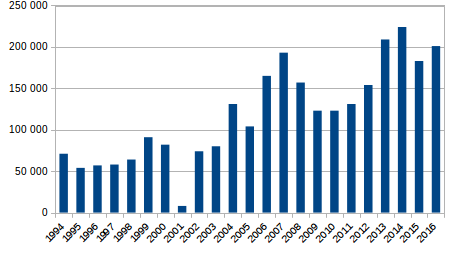
Between 1996 and 1999, the Taliban controlled 96% of Afghanistan's poppy fields and made opium its largest source of taxation. Taxes on opium exports was the primary source of income for the Taliban during its rule and subsequent insurgency after 2001. In July 2000, Taliban leader Mohammed Omar, in an effort to eradicate heroin production in Afghanistan, declared that growing poppies was un-Islamic, resulting in one of the world's most successful anti-drug campaigns. The Taliban enforced a ban on poppy farming via threats, forced eradication, and public punishment of transgressors. The result was a 99% reduction in the area of opium poppy farming in Taliban-controlled areas, roughly three-quarters of the world's supply of heroin at the time. The ban was effective only briefly due to the deposition of the Taliban in 2001.
September 11 attacks by al-Qaeda
Main article: September 11 attacks, Al-Qaeda
Following the September 11 attacks on the United States carried out by al-Qaeda, the United States under the Bush administration issued an ultimatum to Afghanistan to hand over Osama bin Laden and other high ranking al-Qaeda officials and shut down all al-Qaeda training camps within the country. In an interview with Voice of America, Omar was asked if he would give up Osama bin Laden. Omar replied, "No. We cannot do that. If we did, it means we are not Muslims, that Islam is finished. If we were afraid of attack, we could have surrendered him the last time we were threatened." Omar explained his position to high-ranking Taliban officials:
Omar was adamant that bin Laden was innocent of planning the 9/11 attacks despite the accusations directed against him. Nonetheless, high-ranking Taliban officials attempted to persuade Omar to hand bin Laden over and made offers to the United States through its contacts with Pakistan. The Taliban ambassador to Pakistan Abdul Salam Zaeef said at a news conference in Islamabad that "our position in this regard is that if the Americans have evidence, they should produce it." If they could prove their allegations, he said, "we are ready for a trial of Osama bin Laden." The Taliban foreign minister Wakil Ahmed Muttawakil also attempted to negotiate, offering the Americans the proposal of setting up a three-nation court under the supervision of the Organisation of the Islamic Conference as it was a "neutral organization" or having bin Laden tried by an Islamic council in Afghanistan. Muttawakil said "the US showed no interest in it." The Taliban Prime Minister Abdul Kabir stated that if evidence was provided, "we would be ready to hand him over to a third country". Part of the reluctance to hand bin Laden over stemmed from Omar's own miscalculations. Omar thought there was "less than a 10 percent" chance that the US would do anything beyond make threats.
The Supreme Council of the Islamic Clergy, a council of around 1,000 clerics, convened in Kabul in late September 2001 and issued a decree against the United States and its threats of militarily invading Afghanistan. They also recommended that Osama bin Laden be asked to leave Afghanistan of his own free will to "avoid the current tumult" and expressed sympathy and a conciliatory tone towards those who died in the 11 September attacks: "The ulema voice their sadness over American deaths and hope America does not attack Afghanistan." The Taliban Education Minister Amir Khan Muttaqi said that Omar had agreed to follow guidance offered by the clerics and would try to encourage bin Laden to leave Afghanistan without forcibly handing him over to the United States for prosecution, even if bin Laden refused to leave the country.
However, according to an interview with Pakistani journalist Rahimullah Yusufzai, Omar told him:
U.S. invasion of Afghanistan
On the night of 7–8 October 2001, shortly after the US-led United States invasion of Afghanistan began, Omar's house in Kandahar was bombed just after he had left, fatally injuring his 10-year-old son. His stepfather, who was also his uncle, was initially reported killed, but later reports said he was injured and treated at a hospital.
In another account of an attack that night, an MQ-1 Predator drone followed a three-vehicle convoy that left Omar's compound and drove to a compound to the southwest of Kandahar, with US commanders believing Omar was in one of the vehicles. Men disembarked from the vehicles and entered a large building in the compound. US military officers considered bombing the building, but were concerned that another building in the compound might be a mosque, which they wished to avoid hitting. Eventually it was decided to fire a Hellfire missile from the Predator at one of the vehicles, where armed guards kept gathering, in the hope that it would draw out anyone inside the possible mosque. The attackthe first missile launched by a drone in combatappeared to cause two casualties. Dozens of men, some armed, emerged from the large building and other buildings in the compound, and some got into vehicles and departed.
According to fellow Taliban fighters, Omar had secretly fled his residence in Kandahar for security purposes shortly after it was bombed and was last seen riding on the back of a motorcycle driven by his brother-in-law and right-hand man, Mullah Abdul Ghani Baradar. Senior and former Taliban officials have said that there had not been any confirmed sightings of their Amir-ul-Momineen (commander of the faithful) in Afghanistan since then.
In November 2001, he was heard over a short-wave radio ordering all Taliban troops to abandon Kabul and take to the mountains, noting, "defending the cities with front lines that can be targeted from the air will cause us terrible loss". In a November 2001 BBC Pashto interview, Omar said, "You (the BBC) and American puppet radios have created concern. But the current situation in Afghanistan is related to a bigger causethat is the destruction of America. ... This is not a matter of weapons. We are hopeful for God's help. The real matter is the extinction of America. And, God willing, it [America] will fall to the ground." Claiming that the Americans had circulated "propaganda" that Omar had gone into hiding, Foreign Minister Wakil Ahmed Muttawakil stated that he would like to "propose that Prime Minister Blair and President Bush take Kalashnikovs and come to a specified place where Omar will also appear to see who will run and who not". He stated that Omar was merely changing locations due to security reasons.
During the Battle for Kandahar in late November 2001, US Special Operations teams known as Texas 12 and Texas 17 aligned with Hamid Karzai and with General Gul Agha Sherzai, respectively, surrounded Kandahar backed by US Marines outside Lashkar Gah. On 28 November 2001, while under attack by a Russian-made BM-21 multiple rocket launcher, Texas 17 observed Omar's black American-made Chevrolet Suburban passing Kandahar Airport and travelling down highway four surrounded by a dozen sedans and six semi-trucks. Four US Navy F-18s from USS Kitty Hawk destroyed all the vehicles including the Suburban. The same day, 28 November 2001, the Taliban reported that Omar had supposedly survived an American air strike.
After the U.S. invasion (2001–2013)
Seclusion
On 5 December 2001, Omar held a meeting in Kandahar of top Taliban leaders and asked them what they wanted to do. Many were ready to stop fighting and willing to surrender. Omar handed over the Taliban leadership to his defence minister, Mullah Obaidullah, in writing. Two days later Omar left Kandahar and went into hiding in Zabul province in Afghanistan. In the following years, there was speculation about his locationwith some believing that he went to Pakistan along with other Taliban leadersand his circumstances and purported communications. But according to Bette Dam, in research published in 2019, and Borhan Osman, a senior analyst at International Crisis Group (ICG), Omar spent the rest of his life living in Zabul province. Dam said that her research relied on interviews with current and former members of the Afghan government, the Afghan intelligence agency National Directorate of Security, the Taliban, and Omar's bodyguard Jabbar Omari. She said that her findings, confirmed by Afghan officials as well as the Talibans, depicted the US intelligence failure and cast even further doubt on US claims in the Afghan war.
Omar was protected in hiding by Jabbar Omari, a former Taliban governor of Baghlan province, who was from Zabul province and, like Omar, belonged to the Hotak tribe. They spent four years living in the provincial capital Qalat at a private home owned by Abdul Samad Ustaz, Omari's former driver. Omar's wives moved to Pakistan and Omar declined when Omari offered to bring his son to visit. He had very little active involvement in the Taliban from the end of 2001. He sent a cassette tape to the rest of the Taliban leadership in Quetta in 2003, reaffirming that Obaidullah was the supreme leader and naming who should be on the leadership shura (council). The shura sent a messenger every three to seven months, when they wanted his advice on some matter. He sent at least one other cassette tape, in 2007, but stopped that practice after the messenger was briefly detained in Pakistan, and thereafter messages were just relayed person-to-person. Omar kept in touch with events in the world by listening to BBC Pashto radio. Bette Dam wrote, "Though Mullah Omar did not venture outside for fear of being caught, according to Jabbar Omari, in the four years they hid in that home, they felt relatively safe." The house was searched by the US military once, but they did not enter the concealed room where Omar was hiding.
After the US established Forward Operating Base Lagman a few hundred metres from the house in 2004, Omar relocated to a shack in a remote hamlet on the edge of a river, about 20 miles southeast of Qalat in Shinkay District, close to the Durand Line. His hideout was connected to underground irrigation channels that ran up into the hills. Soon after moving there, the US started building Forward Operating Base (FOB) Wolverine an hour's walk or about three miles away, but Omar stayed put. The FOB eventually housed about 1,000 United States troops, and sometimes other NATO troops. The pictures show a modest mud house with a small garden in which Omar "used to sit in the sun", according to a Taliban spokesman.
Jabbar Omari said that Omar grew ill in 2013, refused to visit a doctor, and died of illness on 23 April. Omari and two helpers buried him that night, with Omari videoing the burial as proof. Omari went to Quetta, returning with Omar's son Yaqoob and brother Abdul Manan Omari, who had not seen him since 2001. Yaqoob insisted that the grave be opened so that he could see his father. Omari went to Quetta and met with ten senior Taliban to describe the 12 years he spent with Omar. Obaidullah had died in 2010 and Akhtar Mansour was the operational leader of the Taliban. Four religious scholars at the meeting decided that Mansour should continue as leader, but that Omar's death and Mansour's succession should not be disclosed publicly yet, while the United States was preparing to withdraw from Afghanistan. Some at the meeting unsuccessfully argued for openness. Omar's death remained a secret for two years. The Taliban were extremely successful at keeping Omar's death hidden during these two years even from highly experienced experts on the upper echelons of the Taliban. Afghanistan and Pakistan analyst Michael Semple, for example, wrote in a December 2014 report that "Mullah Omar remains the Taliban supreme leader and the source of all authority in the movement."
Suspected activities
Some believed that Omar hid in the mountains of southern Afghanistan for over a year before he fled to neighboring Pakistan in late 2002. He continued to receive the allegiance of prominent pro-Taliban military leaders in the region, including Jalaluddin Haqqani. According to sources, he lived somewhere in Karachi for a time, where he worked as a potato trader to escape detection; a city where he had lived in already and visited for many years before the group's emergence in the 1990s. The United States offered a reward of US$10 million for information leading to his capture.
In April 2004, Omar was interviewed via phone by Pakistani journalist Mohammed Shehzad. During the interview, Omar claimed that Osama bin Laden was alive and well, and that his last contact with Bin Laden was months before the interview. Omar declared that the Taliban were "hunting Americans like pigs".
In the years following the allied invasion, numerous statements were released that were identified as coming from Omar. In June 2006, a statement regarding the death of Abu Musab al-Zarqawi in Iraq was released by Omar and in it, he hailed al-Zarqawi as a martyr and claimed the resistance movements in Afghanistan and Iraq "will not be weakened". In December 2006, Omar reportedly issued a statement expressing confidence that foreign forces will be driven out of Afghanistan.
In January 2007, it was reported that Omar made his "first exchange with a journalist since he went into hiding" in 2001 with Muhammad Hanif via email and courier. In it he promised "more Afghan War", and he also said that the more than one hundred suicide bomb attacks which occurred in Afghanistan in the last year had been carried out by bombers who acted on religious orders which they received from the Taliban"the mujahedeen do not take any action without a fatwa." In April 2007, Omar issued another statement through an intermediary in which he encouraged more suicide attacks.
In November 2009, The Washington Times claimed that Omar, assisted by Pakistan's Inter-Services Intelligence (ISI), had moved back to Karachi in October. In January 2010, Brigadier Amir Sultan Tarar, a retired officer with ISI who had previously trained Omar, said that he was ready to break with his al-Qaida allies and make peace in Afghanistan: "The moment he gets control, the first target will be the al-Qaida people."
In January 2011, The Washington Post, citing a report published by the Eclipse Group, a privately operated intelligence network that may be contracted by the CIA, stated that Omar had a heart attack on 7 January 2011. According to the report, Pakistan's ISI rushed Omar to a hospital near Karachi where he was operated on, treated, and released several days later. Pakistan's Ambassador to the US, stated that the report "had no basis whatsoever".
On 23 May 2011, TOLO News in Afghanistan quoted unnamed sources as saying that Omar had been killed by ISI two days earlier. Taliban spokesman Zabihullah Mujahid responded to the report by stating, "He is in Afghanistan safe and sound." On 20 July 2011, phone text messages which were delivered from accounts which were used by Mujahid and fellow spokesman Qari Mohammed Yousuf announced Omar's death. However, Mujahid and Yousuf quickly denied sending the messages and they claimed that their mobile phones, websites, and e-mail accounts had all been hacked, and they swore revenge on the telephone network providers. In 2012, it was revealed that an individual claiming to be Omar sent a letter to President Barack Obama in 2011, expressing slight interest in peace talks.
After Omar's confirmed death (April 2013):
On 31 May 2014, five senior Afghan detainees were released from the Guantanamo Bay detention camp in Cuba in return for the release of American prisoner of war Sergeant Bowe Bergdahla person claiming to be Omar reportedly hailed their release.
In December 2014, acting Afghan intelligence chief Rahmatullah Nabil stated that he was not sure "whether Omar is alive or dead". This statement was made after the Afghan intelligence agency published reports in which it revealed that fracturing was occurring within the Taliban movement, leading some reporters to speculate that a leadership struggle had ensued because Omar had died. Later reports which were released by Afghan intelligence in December said that Omar had been hiding in Karachi. An anonymous European intelligence official stated that "there's a consensus among all three branches of the Afghan security forces that Omar is alive. Not only do they think he's alive, they say they have a good understanding of where exactly he is in Karachi."
In April 2015, a man who claimed to be Mullah Omar issued a fatwa which decreed that pledges of allegiance to the Islamic State of Iraq and the Levant (ISIS) are forbidden by Islamic law. The man described ISIS leader Abu Bakr al-Baghdadi as a "fake caliph", and he also said that "Baghdadi just wanted to dominate what has so far been achieved by the real jihadists of Islam after three decades of jihad. A pledge of allegiance to him is 'haram'."
2015 announcement of his death
On 29 July 2015, Abdul Hassib Seddiqi, the spokesman for Afghanistan's National Directorate of Security, said "officially" that Mohammed Omar had died at a hospital in Karachi, Pakistan, in April 2013, and the office of Afghan President Ashraf Ghani confirmed that information on his death was "credible". Pakistani newspaper The Express Tribune reported that a former Taliban minister and current leadership council member, who spoke anonymously, said Omar died from tuberculosis.
The following day, the Taliban confirmed that he was dead, but denied that he died in Pakistan. Other Taliban members stated that his death occurred in Afghanistan. According to an official statement by Pakistani defence minister Khawaja Asif, "Mullah Omar neither died nor was buried in Pakistan and his sons' statements are on record to support this. Whether he died now or two years ago is another controversy which we do not wish to be a part of. He was neither in Karachi nor in Quetta."
Afghan officials report that Omar was buried in Zabul province, a province in southern Afghanistan. Atta Mohammed Haqyar, head of Zabul's provincial council, believed that Omar was buried in a cemetery in Sarkhogan area of Shinkay district in Zabul province. Several senior Taliban commanders have also been buried in Sarkhogan area. He further stated that the area had special significance for the Hotak tribe which Omar was from.
Sources close to the Taliban leadership said his deputy, Akhtar Mansoor, would replace him, although with the lesser title of Supreme Leader. It was confirmed by a senior Taliban member that Omar's death was kept a secret for two years.
Fidai Mahaz, a Taliban splinter group, claimed that Omar did not die of natural causes; rather he was killed in his hideout in Zabul province.
Many Islamist and jihadist movements expressed condolences following Omar's death, including Ajnad al-Kavkaz, Ansar Al-Furqan, Islamic Front's Ahrar al-Sham, Jaish Muhammad, Ansar al-Din Front, Turkistan Islamic Party, Jamaat Ansar al-Sunna, Jaish al Ummah, Jamaat-ul-Ahrar, Caucasus Emirate, Jaish al-Islam, Al-Nusra Front, AQAP, AQIM, and Al-Shabaab.
Conversely, the Afghan government was unsympathetic to mourning his death; security forces were ordered to prevent citizens from publicly grieving Omar. A National Directorate of Security (NDS) spokesman said that Omar was "the biggest cause of war and backwardness in the modern history of Afghanistan", adding that any ceremony for Omar would be an "insult" to victims of the Taliban. Meanwhile, thousands of Afghans nationwide took part in rallies on 4 August, denouncing Omar.
After his death, the Taliban regained control of Afghanistan as the Second Islamic Emirate following the Fall of Kabul during the Taliban offensive. During this time the location of Mullah Omar's grave was indirectly revealed. The grave is situated in the Suri district of Zabul Province.
Personal life
Despite his political rank and his high status on the Rewards for Justice most wanted list, not much was publicly known about Omar. Omar made only one public speech and always refused to meet foreigners; Before his death, only one known photo existed of him. After his death, the Taliban released a newer and clearer photo showing Omar in his youth in 1978.
Accounts of his physical appearance state that Omar was thin, strongly built and very tall, at around 6 ft. Omar was described as shy and taciturn, byfor examplethe famed Afghan poet Abdul Bari Jahani, who visited him with academics and activists at the beginning of his rule. The members of this group applauded the order and security he brought to the country, and Jahani remembers him as a "tall and handsome" man who "listened in quiet." Zaeef said "he listened, he was patient, and he did not react in anger." Conversely, a former Saudi intelligence chief said Omar was "extremely nervous, perspired, and even screamed at me." Senior Taliban leaders claimed he would "stumble over his native tongue in the interviews he occasionally gave the BBC Pashto service." He had "at least" three wives and "at least" five or six children, including Mullah Yaqoob, the current acting Defence Minister of Afghanistan.
Omar refused to and never made a pilgrimage to Mecca, despite receiving a personal invitation from King Fahd of Saudi Arabia to do so in 1998.
Writings
Omar wrote biannual essays towards the end of his life.
Notes
References
References
- "The Taliban Biography{{snd}}Documents on the Structure and Leadership of the Taliban 1996-2002". [[George Washington University]].
- (27 August 2020). "The Rise Of Mullah Yaqoob, The Taliban's New Military Chief". [[Radio Free Europe/Radio Liberty]].
- (2 March 2007). "'Taleban leader held' in Pakistan". [[BBC]].
- (30 July 2015). "Mullah Omar: Taliban choose deputy Mansour as successor". [[BBC]].
- (7 December 2001). "Man in the News; Seizing the Prophet's Mantle: Muhammad Omar". [[The New York Times]].
- (18 May 2023). "Mohammad Omar: emir of Afghanistan".
- (October 1996). "The Taliban and Their Leaders".
- (5 April 2015). "Afghan Taliban publish Mullah Omar biography".
- (2022-11-07). "Mohammad Omar Emir of Afghanistan".
- (30 July 2015). "Mullah Omar obituary".
- (29 July 2015). "How the Death of Mullah Omar Could Disrupt Progress in Afghanistan".
- (31 August 2021). "Taliban Leadership Visits Mullah Omar's Grave".
- Abdul Salam Zaeef (2010). ''My Life with the Taliban''.
- Arnaud de Borchgrave, "Osama bin Laden – Null and Void", UPI, 14 June 2001, quoted in Wright, ''Looming Tower'', (2006), p. 226
- (28 February 2022). "The Taliban Confront the Realities of Power".
- (12 October 2015). "Rare new picture of Taliban founder Mullah Omar surfaces". [[Agence France-Presse]].
- (5 April 2015). "Afghan Taliban publish Mullah Omar biography". [[BBC News]].
- Abdul Hai Mutma'in. (2019). "Taliban: A Critical History from Within". First Draft Publishing.
- Ismail Khan, "Mojaddedi Opposes Elevation of Taliban's Omar", ''Islamabad the News'', 6 April 1996, quoted in Wright, ''Looming Tower'', (2006), p. 226
- Robert Marquand. (10 October 2001). "The reclusive ruler who runs the Taliban". [[The Christian Science Monitor]].
- [[Ahmed Rashid. Rashid]], ''Taliban'', (2001)
- (23 January 2012). "Looking For Mullah Omar".
- (11 January 2001). "نص كلمة زعيم طالبان رداً على أسئلة الجزيرة نت / Naṣṣ kalimat za'īm Ṭālibān raddan 'alá as'alat al-Jazīrah Nit".
- (22 May 2002). "Seeking Mullah Omar in a land of secrets". The New York Times.
- Watson, Ivan. (6 April 2015). "Mullah Omar is still the leader of the Taliban, new biography claims". [[CNN]].
- (June 2017). "Ideology in the Afghan Taleban". Afghanistan Analysts Network.
- Rashid, Ahmed. (2010). "Taliban: The Power of Militant Islam in Afghanistan and Beyond". I.B. Tauris.
- (2012). "Pakistan: Terrorism Ground Zero". Reaktion Books.
- Mark Magnier (30 May 2009). [https://www.latimes.com/archives/la-xpm-2009-may-30-fg-madrasa30-story.html Pakistan religious schools get scrutiny], ''[[Los Angeles Times]]''.
- [[Ahmed Rashid. Rashid, Ahmed]] (2010). ''Taliban: Militant Islam, Oil and Fundamentalism in Central Asia.'' 2nd ed. (New Haven: Yale University Press). p. 91.
- (June 2017). "Ideology in the Afghan Taleban". Afghanistan Analysts Network.
- Wright, ''Looming Tower'', (2006), p. 226
- Dexter Filkins, ''The Forever War'' (New York: Vintage Books/Random House, 2009; orig. ed. 2008), p.30.
- (31 July 2015). "Mullah Mohammad Omar, Taliban leader{{snd}}obituary". [[The Daily Telegraph]].
- (2019). "The Princeton Encyclopedia of Islamic Political Thought". Princeton University Press.
- Capon, Felicity. (2 August 2015). "Why the New Taliban Leader Could Be a Disaster for Peace in Afghanistan".
- (2015). "Afghanistan after the Western Drawdown". Rowman & Littlefield.
- (2014). "Culture, Conflict, and Counterinsurgency". Stanford University Press.
- (October 2013). "Bacha Bazi: An Afghan Tragedy".
- (2007). "Inside The Taliban". National Geographic.
- Doğan, Salih. (2015-10-20). "Afghanistan after the western drawdown". Global Affairs.
- Goodson (2001) p. 107
- Tim Weiner. (7 December 2001). "Seizing the Prophet's Mantle: Muhammad Omar". The New York Times.
- Healy, Patrick. (19 December 2001). "Kandahar residents feel betrayed". [[San Francisco Chronicle]].
- Griffiths, John C. ''Afghanistan: A History of Conflict'', 1981. Second Revision, 2001.
- Malashenko, Alexey. (11 August 2015). "Where Will the New Taliban Leader Lead His People?". Russian International Affairs Council.
- Waraich, Omar. (30 July 2015). "Mullah Mohammed Omar: Co-founder and leader of the Taliban who fought the Soviets before presiding over a brutal Afghan regime".
- Robert Marquand. (10 October 2001). "The reclusive ruler who runs the Taliban". The Christian Science Monitor.
- Malkasian, Carter. (2021). "The American war in Afghanistan : a history". [[Oxford University Press]].
- (2 August 2015). "Why the New Taliban Leader Could be a Disaster for Peace in Afghanistan".
- Gargan, Edward A. (October 2001). "Taliban massacres outlined for UN". Chicago Tribune.
- Harding, Luke. (3 March 2001). "How the Buddha got his wounds". The Guardian.
- (11 June 2015). "They were destroyed by the Taliban. But now the giant Buddha statues of Bamiyan have returned with 3-D light projection".
- link. (7 July 2011 , [[Afghanistan Analysts Network]] 2 March 2011)
- Luke Harding. (3 March 2001). "How the Buddha got his wounds". The Guardian.
- Bearak, Barry. (4 March 2001). "Over World Protests, Taliban Are Destroying Ancient Buddhas". The New York Times.
- (12 March 2001). "Destruction of Giant Buddhas Confirmed".
- Zaeef p.126
- Mohammad Shehzad. (3 March 2001). "The Rediff Interview/Mullah Omar". The Rediff.
- (March 2005). "Where Have All the Flowers Gone?: Evaluation of the Taliban Crackdown Against Opium Poppy Cultivation in Afghanistan". [[Elsevier]].
- Ghiabi, Maziyar. (2019). "Drugs Politics: Managing Disorder in the Islamic Republic of Iran". [[Cambridge University Press]].
- Chouvy, Pierre-Arnaud. (2010). "Opium: uncovering the politics of the poppy". Harvard University Press.
- Lee, Jonathan. (2019). "Afghanistan: A History from 1260 to the Present". Reaktion Books.
- (2022-04-03). "Taliban Outlaw Opium Poppy Cultivation in Afghanistan". The New York Times.
- "Wanted Information leading to the location of Mullah Omar Up to $10 Million Reward". [[Rewards for Justice Program]], [[United States Department of State.
- Peter Bergen. (21 August 2015). "The man who wouldn't hand over bin Laden to the U.S.". CNN.
- John Burns & Christopher Wren. (21 September 2001). "Without Evidence, the Taliban Refuses to Turn Over bin Laden". The New York Times.
- Mujib Mashal. (October 2023). "Taliban 'offered bin Laden trial before 9/11'". Al Jazeera.
- (2011). "Bush rejects Taliban offer to hand Bin Laden over". The Guardian.
- (11 October 2001). "Refugees say Taliban leader's son killed". [[Independent Online (South Africa).
- (22 October 2001). "Omar's son dies in raid". Birmingham Post.
- Whittle, Richard. (16 September 2014). "How We Missed Mullah Omar". [[Politico]].
- [[Stephen Tanner]], ''Afghanistan: A Military History'', 2008
- (15 November 2001). "Interview with Mullah Omar{{snd}}transcript". BBC News.
- Independent Online, [https://web.archive.org/web/20090326103208/http://www.iol.co.za/index.php?sf=522&set_id=1&click_id=3&art_id=qw100499238175B221 Taliban challenges Bush and Blair to a duel], 5 November 2001
- Lambeth, Benjamin S.. (4 February 2019). "Air Power Against Terror".
- Scarborough, Rowan. (23 November 2001). "Special forces get free rein".
- Texas 17 now located six miles south of Kandahar near the Kandahar airport on 28 November 2001 0900 in the morning local spotted a Black Chevrolet Suburban driving south down Highway 4 covered by artillery fire launched from the Kandahar Airport by a Russian Made BM-21 Multiple Rocket Launcher System (MRLS) dropping artillery all around Texas 17 position. The Black SUV headed south off of Highway four towards Pakistan surrounded by 12 sedans and six heavy trucks. All vehicles were destroyed by Texas 17 and Navy F-18 Hornet Fighter aircraft including the Black Chevrolet Suburban, the same vehicle known to be used by Mullah Omar.
- (28 November 2001). "Taliban urged to fight on". CNN.
- Dam, Bette. (2019). "The Secret Life of Mullah Omar". Zomia Center.
- Emma Graham-Harrison. (10 March 2019). "Fugitive Taliban leader lived short walk from US base, book reveals". The Guardian.
- Donati, Jessica. (10 March 2019). "The Last Days of Taliban Head Mullah Omar". Wall Street Journal.
- Ben Farmer and Saleem Mehsud. (11 March 2019). "Taliban release pictures of Mullah Omar's 'hideout in Afghanistan'". Telegraph UK.
- Mushtaq Yusufzai and F. Brinley Bruton. (12 March 2019). "Taliban leader Mullah Omar hid in mud house in Afghanistan, militant group says". NBC News.
- (2020). "The Afghanistan Wars". Bloomsbury Publishing.
- (4 August 2015). "Mullah Omar worked as potato vendor to escape detection in Pakistan".
- (12 April 2004). "The Rediff Interview/Mullah Omar". [[Rediff.com]].
- (9 June 2006). "Taliban play down Zarqawi death". BBC News.
- (31 December 2006). "Mullah Omar issues Eid message". [[Al Jazeera Arabic.
- Ismail Khan. (5 January 2007). "Taliban Leader Promises More Afghan War". The New York Times.
- (21 April 2007). "Taliban's elusive leader urges more suicide raids". Reuters.
- (20 November 2009). "EXCLUSIVE: Taliban chief hides in Pakistan". [[The Washington Times]].
- Declan Walsh. (31 July 2015). "Afghan Taliban leader ready to end al-Qaida ties, says former trainer". [[The Guardian]].
- [[Agence France-Presse]], "Pakistan 'treated Taliban leader'", ''[[Japan Times]]'', 20 January 2011, p. 1.
- (23 May 2011). "Afghan Taliban say leader Mullah Omar 'safe and sound'". Reuters.
- Shalizi, Hamid, [[Reuters]], "[https://web.archive.org/web/20110723120656/http://news.yahoo.com/taliban-mullah-omar-death-report-false-phone-hacked-033522641.html Taliban say Mullah Omar death report false, phone hacked]", [[Yahoo! News]], 20 July 2011.
- (3 February 2012). "Taliban leader Mullah Omar 'sent letter to Barack Obama'". [[The Daily Telegraph]].
- (3 February 2012). "Amid peace bid, U.S. received purported letter from Taliban". Reuters.
- (1 June 2014). "Bowe Bergdahl: Chuck Hagel praises release special forces". BBC News.
- (19 November 2014). "Taliban Supreme leader Mullah Omar has possibly died". The Khaama Press News Agency.
- Rosenberg, Matthew. (28 December 2014). "Around an Invisible Leader, Taliban Power Shifts". The New York Times.
- (13 April 2015). "Taliban leader: allegiance to ISIS 'haram'".
- O'Donnell, Lynne. (30 July 2015). "Afghanistan says Taliban leader Mullah Omar died 2 years ago". [[Associated Press]].
- (29 July 2015). "Mullah Omar: Taliban leader 'died in Pakistan in 2013'". BBC News.
- Nikhil Kumar. (29 July 2015). "Mullah Omar Taliban Death".
- (29 July 2015). "Afghan intel agency: Taliban leader died two years ago".
- (30 July 2015). "Death of Mullah Omar Exposes Divisions Within Taliban". [[The New York Times]].
- Graham-Harrison, Emma. (14 September 2021). "Questions in Kabul as two top Taliban leaders 'missing from public view'".
- (30 July 2015). "Death of Mullah Omar Exposes Divisions Within Taliban". The New York Times.
- (30 July 2015). "Mullah Omar did not die in Pakistan, say Afghan Taliban". Dawn News.
- (7 August 2015). "Mullah Omar did not die in Pakistan, defence minister tells NA". The Express Tribune.
- Muhammad Zubair Khan and Andrew Marszal. (29 July 2015). "Taliban supreme leader Mullah Omar 'is dead'". Telegraph UK.
- "Search underway for Mullah Omar's grave in Zabul". Khaama Press.
- (4 August 2015). "New Taliban leader facing tension as top official quits". Yahoo News.
- (21 August 2015). "Why the Taliban murdered their own leader and the terrifying fallout now threatening the West".
- Weiss, Caleb. (31 July 2015). "Ajnad al Kavkaz sending condolences to the Taliban on the death of Mullah Omar".
- Weiss, Caleb. (31 July 2015). "Ansar al Furqan's statement of condolences on the death of "Emir al Mumineen" Mullah Omar".
- Joscelyn, Thomas. (4 August 2015). "Jihadists in Syria honor Mullah Omar, praise Taliban's radical state". Foundation for Defense of Democracies.
- Westall, Sylvia. (1 August 2015). "Syrian Islamist group Ahrar al-Sham mourns Taliban leader". Reuters.
- Weiss, Caleb. (1 August 2015). "Jaish Muhammad, a foreign led group in #Syria, sends condolences on the death of "Emir al Mumineen" Mullah Omar.".
- Weiss, Caleb. (1 August 2015). "Jabhat Ansar al Din coalition sending condolences on the death of 'Emir al Mumineen' Mullah Omar".
- Weiss, Caleb. (2 August 2015). "TIP in #Syria sending condolences on the death of "Emir al Mumineen" Mullah Omar via @VegetaMoustache".
- (3 August 2015). "New statement from Ḥizb al-Islāmī al-Turkistānī in Bilād al-Shām: "Concerning the Death of Mullā Muḥmmad 'Umar"".
- المرصد السوري. (2 August 2015). ""الحزب الإسلامي التركستاني لنصرة أهل الشام" يعزي بـ "وفاة أمير المؤمنين الملا عمر" | المرصد السورى لحقوق الإنسان".
- Weiss, Caleb. (3 August 2015). "Jamaat Ansar al Sunnah sending condolences on the death of Mullah Omar".
- Weiss, Caleb. (4 August 2015). "Jaish al Ummah sending condolences on the death of Mullah Omar via @VegetaMoustache".
- Weiss, Caleb. (4 August 2015). "TTP Jamaat ul Ahrar sending condolences on the death of 'Emir al Mumineen' Mullah Omar via @VegetaMoustache".
- Weiss, Caleb. (4 August 2015). "Audio statement from the emir of the Caucasus Emirate Abu Usman on the death of Mullah Omar via @VegetaMoustache".
- Weiss, Caleb. (4 August 2015). "Written Arabic statement of condolences on death of 'Emir al Mumineen' Mullah Omar from the Caucasus Emirate ...".
- Weiss, Caleb. (31 July 2015). "Jaish al Islam in Palestine sending condolences on the death of 'Emir al Mumineen' Mullah Omar".
- Weiss, Caleb. (31 July 2015). "Joint statement from AQIM, AQAP, and Al Nusrah (AQ in Syria) on death of "Emir al Mumineen" Mullah Omar".
- Weiss, Caleb. (31 July 2015). "Shabaab sending condolences on the death of 'Emir al Mumineen' Mullah Omar via @VegetaMoustache".
- "Kabul Unsympathetic To Mourning Mullah Omar".
- "Kabul Unsympathetic to Mourning Mullah Omar". Radiofreeeurope/Radioliberty.
- (2022-11-06). "Taliban Reveal Burial Place of Founder Mullah Omar, Nine Years After Death".
- (7 October 2001). "'Visionary' mullah who protects terror leader is mentally unstable".
- AFP. (12 October 2015). "Rare new picture surfaces of Taliban founder Mullah Omar".
- (5 March 2007). "Afghanistan: Taliban Preps for Bloody Assault".
- Mujib Mashal (6 June 2012), [https://www.aljazeera.com/indepth/features/2012/06/20126665650415526.html "The myth of Mullah Omar"], ''Al Jazeera''. Retrieved 20 April 2020.
- CNN Library (1 May 2017), [https://edition.cnn.com/2012/12/30/middleeast/mullah-mohammed-omar-fast-facts "Mullah Mohammed Omar Fast Facts"], ''CNN''. Retrieved 24 April 2020.
- (7 September 2021). "Taliban Announces Head of State, Acting Ministers". [[TOLOnews]].
- (15 October 2015). "Afghanistan: Has Taliban Leader Mullah Omar Lost His Mind?".
- Coll, Steve. (15 January 2012). "Looking for Mullah Omar".
This article was imported from Wikipedia and is available under the Creative Commons Attribution-ShareAlike 4.0 License. Content has been adapted to SurfDoc format. Original contributors can be found on the article history page.
Ask Mako anything about Mullah Omar — get instant answers, deeper analysis, and related topics.
Research with MakoFree with your Surf account
Create a free account to save articles, ask Mako questions, and organize your research.
Sign up freeThis content may have been generated or modified by AI. CloudSurf Software LLC is not responsible for the accuracy, completeness, or reliability of AI-generated content. Always verify important information from primary sources.
Report