From Surf Wiki (app.surf) — the open knowledge base
1998 United States embassy bombings
Attacks on US embassies in Africa

Attacks on US embassies in Africa
| Field | Value |
|---|---|
| title | 1998 United States embassy bombings |
| image | 1998_United_States_embassy_in_Nairobi_bombings_IDF_relief_VII.jpgborder |
| caption | U.S. embassy in Nairobi after the explosion, with the collapsed Ufundi Building. |
| map_size | 200px |
| location | Nairobi, Kenya |
| Dar es Salaam, Tanzania | |
| target | United States embassies |
| coordinates | and |
| date | |
| time | 10:30 a.m.10:40 a.m. EAT |
| timezone | UTC+3 |
| type | Truck bombs |
| fatalities | 224 |
| injuries | 4,000+ |
| perpetrators | Al-Qaeda |
| Egyptian Islamic Jihad | |
| assailants | Mohamed Rashed Daoud Al-Owhali |
| Jihad Mohammed Ali | |
| Hamden Khalif Allah Awad | |
| weapons | TNT, ammonium nitrate, pistol, stun grenade |
| motive | Islamist extremism, Anti-Americanism |
Dar es Salaam, Tanzania Egyptian Islamic Jihad Jihad Mohammed Ali Hamden Khalif Allah Awad
The 1998 United States embassy bombings were a series of attacks that occurred on August 7, 1998. More than 220 people were killed in two nearly simultaneous truck bomb explosions in two East African capital cities, one at the United States embassy in Dar es Salaam, Tanzania, and the other at the United States embassy in Nairobi, Kenya.
Fazul Abdullah Mohammed and Abdullah Ahmed Abdullah were deemed responsible with planning and orchestrating the bombings. In retaliation for the bombings, U.S. President Bill Clinton ordered Operation Infinite Reach on August 20, 1998.
Motivation and preparation
Many American sources concluded that the bombings were intended as revenge for U.S. involvement in the extradition and alleged torture of four members of Egyptian Islamic Jihad (EIJ) who had been arrested in Albania in the two months prior to the attacks for a series of murders in Egypt. Between June and July, Ahmad Isma'il 'Uthman Saleh, Ahmad Ibrahim al-Sayyid al-Naggar, Shawqi Salama Mustafa Atiya, and Mohamed Hassan Tita were all renditioned from Albania to Egypt with the co-operation of the United States; the four men were accused of participating in the assassination of Rifaat el-Mahgoub, as well as a later plot against the Khan el-Khalili market in Cairo. The following month, a communique was issued warning the United States that a "response" was being prepared to "repay" them for their interference. However, the 9/11 Commission Report claims that preparations began shortly after Osama bin Laden issued his February 1998 fatwa.
According to journalist Lawrence Wright, the Nairobi operation was named after the Kaaba in Mecca; the Dar es Salaam bombing was called Operation al-Aqsa in Jerusalem, but "neither had an obvious connection to the American embassies in Africa. Bin Laden initially said that the sites had been targeted because of the 'invasion' of Somalia; then he described an American plan to partition Sudan, which he said was hatched in the embassy in Nairobi. He also told his followers that the genocide in Rwanda had been planned inside the two American embassies." Wright concludes that bin Laden's actual goal was "to lure the United States into Afghanistan, which had long been called 'The Graveyard of Empires.'"
In the second half of 1999, Osama bin Laden spoke to a crowd of graduates from a training camp in Afghanistan about the attacks and explained the reasons for targeting the Nairobi embassy. Bin Laden said Operation Restore Hope in Somalia was directed from the Nairobi embassy and claimed the lives of 30,000 Muslims, the Southern Sudanese rebel leader John Garang was supported from there and it was the largest American Intelligence center in East Africa.
In May 1998, a villa in Nairobi was purchased by one of the bombers to enable a bomb to be built in the garage. Sheikh Ahmed Salim Swedan purchased a beige Toyota Dyna truck in Nairobi and a 1987 Nissan Atlas refrigeration truck in Dar es Salaam. Six metal bars were used to form a "cage" on the back of the Atlas to accommodate the bomb.
In June 1998, KK Mohamed rented House 213 in the Illala district of Dar es Salaam, about 4 miles from the U.S. embassy. A white Suzuki Samurai was used to haul bomb components, hidden in rice sacks, to House 213.
In both Nairobi and Dar es Salaam, Mohammed Odeh supervised construction of two very large 900 kg destructive devices. The Nairobi bomb was made of 400 to 500 cylinders of TNT (about the size of drink cans), ammonium nitrate, aluminum powder, and detonating cord. The explosives were packed into twenty specially designed wooden crates that were sealed and then placed in the bed of the trucks. Muhsin Musa Matwalli Atwah ran a wire from the bomb to a set of batteries in the back of the truck cab and then to a detonator switch beneath the dashboard. The Dar es Salaam bomb was of slightly different construction: the TNT was attached to fifteen oxygen tanks and gas canisters and was surrounded with four bags of ammonium nitrate fertilizer and some sandbags to tamp and direct the blast.
The bombings were scheduled for August 7, the eighth anniversary of the arrival of U.S. troops in Saudi Arabia during the early stages of the Persian Gulf War, likely a choice by Osama bin Laden.
When bin Laden's bodyguard asked him after the attacks whether so many victims were really necessary, he replied referring to al-Qaeda's 1996 and 1998 fatwas declaring war on America and Israel: "We warned the whole world what would happen to the friends of America. We weren't responsible for any victims from the minute we warned those countries."
Attacks and casualties
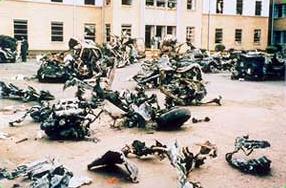
On August 7 between 10:30 a.m. and 10:40 a.m. local time (3:30–3:40 a.m. EDT), suicide bombers in trucks loaded with explosives parked outside the embassies in Dar es Salaam and Nairobi, and almost simultaneously detonated. A total of 213 people were killed in the Nairobi blast, while 11 were killed in Dar es Salaam. An estimated 4,000 in Nairobi were wounded, and another 85 in Dar es Salaam. Seismological readings analyzed after the bombs indicated energy of between 3 and of high-explosive material. Although the attacks were directed at U.S. facilities, the vast majority of casualties were local citizens of the two African countries. Twelve Americans were killed, including two Central Intelligence Agency employees in the Nairobi embassy, Tom Shah (aka Uttamlal Thomas Shah) and Molly Huckaby Hardy, and one U.S. Marine, Sergeant Jesse "Nathan" Aliganga, a Marine Security Guard at the Nairobi embassy. U.S. Army Sergeant Kenneth Ray Hobson II was one of the 12 Americans killed in the attack.
While Jihad Mohammed Ali, 24, alias 'Azzam' drove the Toyota Dyna quickly toward the Nairobi embassy along with Mohamed Rashed Daoud Al-Owhali, local security guard Benson Okuku Bwaku was warned to open the gate immediately and fired upon when he refused to comply. Al-Owhali threw a stun grenade at embassy guards before exiting the vehicle and running off. Osama bin Laden later offered the explanation that it had been Al-Owhali's intention to leap out and shoot the guards to clear a path for the truck, but that he had left his pistol in the truck and subsequently ran off. As Bwaku radioed to Marine Post One for backup, the truck detonated.
The explosion damaged the embassy building and collapsed the neighboring Ufundi Building where most victims were killed, mainly students and staff of a secretarial college housed there. The heat from the blast was channeled between the buildings towards Haile Selassie Avenue where a packed commuter bus was burned. Windows were shattered in a radius of nearly 1/2 mi. A large number of eye injuries occurred because people in buildings nearby who had heard the first explosion of the hand grenade and the shooting went to their office windows to have a look when the main blast occurred and shattered the windows.
Meanwhile, the Atlas truck that attacked the U.S. Embassy at 36 Laibon Road, Dar es Salaam was being driven by Hamden Khalif Allah Awad, known as "Ahmed the German" due to his blond hair, a former camp trainer who had arrived in the country only a few days earlier. The death toll was less than in Nairobi as the U.S. embassy was located outside the city center in the upscale Oysterbay neighborhood, and a water truck prevented the suicide bombers from getting closer to the structure.
Following the attacks, a group calling itself the "Liberation Army for Holy Sites" took credit for the bombings. U.S. investigators believe the term was a cover used by Egyptian Islamic Jihad, who had actually perpetrated the bombing.
Aftermath and international response
In response to the bombings, President Bill Clinton ordered Operation Infinite Reach, a series of cruise missile strikes on targets in Sudan and Afghanistan on August 20, 1998, announcing the planned strike in a prime-time address on U.S. television.
The United Nations Security Council passed Resolution 1189 condemning the attacks on the embassies.
Both embassies were heavily damaged and the Nairobi embassy had to be rebuilt. It is now located across the road from the United Nations Office at Nairobi for security purposes.
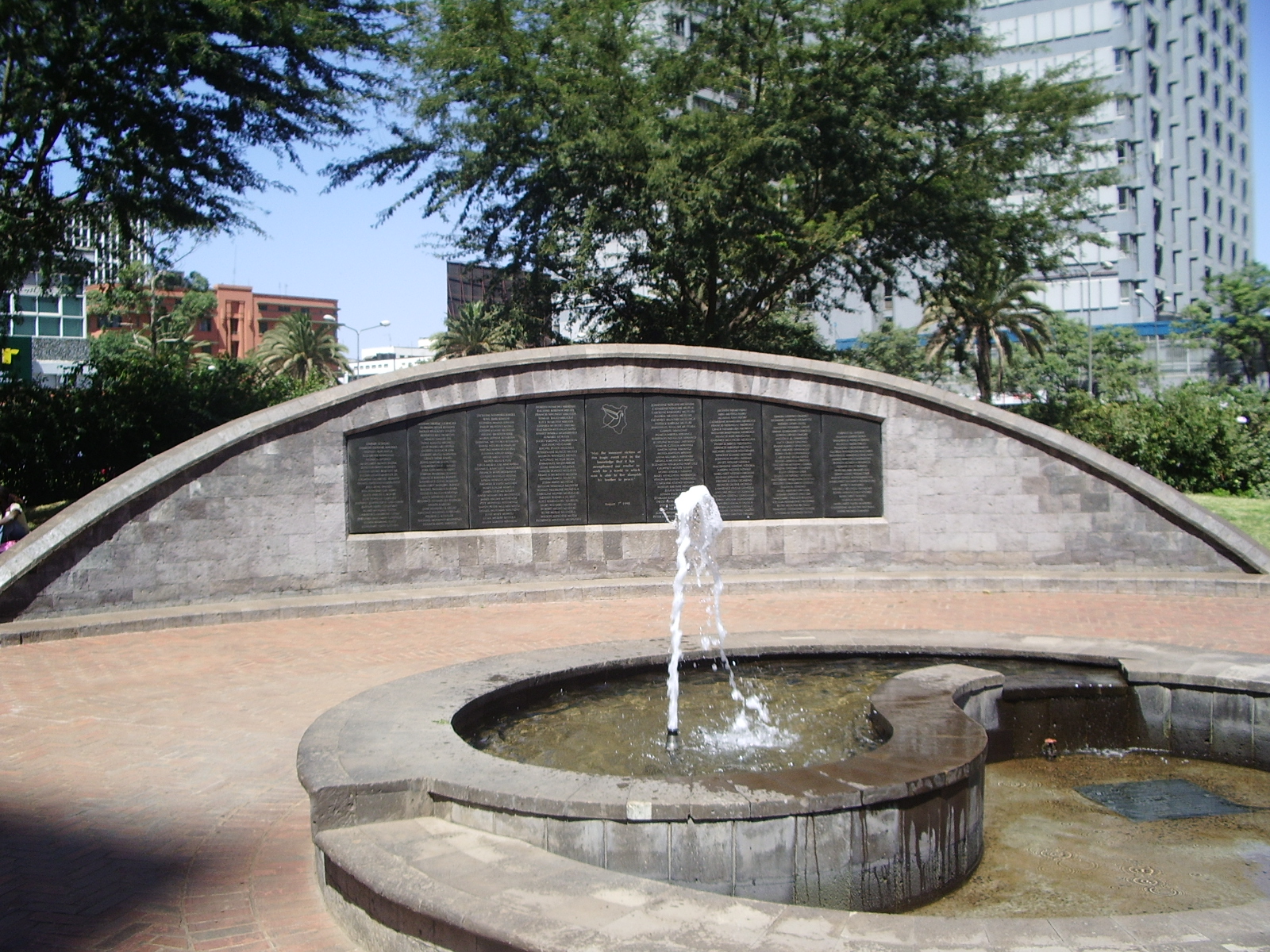
A memorial park was constructed on the former embassy site, dedicated on the third anniversary of the attack. Public protest marred the opening ceremony after it was announced that the park, including its wall inscribed with the names of the dead, would not be free to the public.
Within months following the bombings, the United States Department of State Bureau of Diplomatic Security added Kenya to its Antiterrorism Assistance Program (ATA), which was originally created in 1983. While the addition was largely a formality to reaffirm U.S. commitment to fighting terrorism in Kenya, it nonetheless sparked the beginning of an active bilateral antiterrorism campaign by the United States and Kenya. The U.S. government also rapidly and permanently increased the monetary aid to Kenya. Immediate changes included a $42 million grant targeted specifically towards Kenyan victims.
''Opati v. Republic of Sudan''
Main article: Opati v. Republic of Sudan
In 2001, James Owens and others filed a civil lawsuit against Sudan for its role in the attack under the Foreign Sovereign Immunities Act with the recently added 1996 amendments for state-sponsored terrorism. By 2014, the district court awarded the plaintiffs over $10 billion.
In October 2020, President Donald Trump announced that the United States would remove Sudan from the State Sponsors of Terrorism list, after they had agreed to pay $335million in compensation to the families of victims of the embassy bombings.
Indictment

Following the investigation, an indictment was issued. It charges the following 21 people for various alleged roles in the bombings. 20 of the cases have been resolved.
| Name | Disposition |
|---|---|
| Killed in Abbottabad, Pakistan on | |
| Killed in Kabul, Afghanistan on | |
| Killed in Kabul, Afghanistan on | |
| Fugitive | |
| Serving a life sentence without parole in the United States | |
| Killed in Tehran, Iran on August 7, 2020 | |
| Killed in Naghar Kalai, Pakistan on | |
| Serving a life sentence without parole in the United States | |
| Serving a life sentence without parole in the United States | |
| Died in 2015 while awaiting trial in the United States | |
| Died in 2008 while under house arrest in the United Kingdom | |
| Served a sentence of 25 years imprisonment in the United States | |
| Killed in Mogadishu, Somalia by Somali government troops on | |
| Killed in Pakistan in 2010 | |
| Serving a life sentence without parole in the United States | |
| Serving a life sentence without parole in the United States | |
| Killed in Afghanistan (date of death unknown) | |
| Serving a life sentence without parole in the United States | |
| Serving a life sentence without parole in the United States | |
| Killed in Pakistan on |
Notes
References
|access-date = July 29, 2017 |url-status = live |archive-url = https://web.archive.org/web/20170729015033/http://www.courthousenews.com/d-c-circuit-lightens-sudans-load-terrorism-judgments/ |archive-date = July 29, 2017
|access-date = July 29, 2017 |url-status = live |archive-url = https://web.archive.org/web/20170731063956/https://www.law360.com/articles/776043?_ga=2.27539386.701500170.1501415151-1384552593.1501415151 |archive-date = July 31, 2017
References
- "The Trail Of Evidence - Fbi Executive Summary - Hunting for bin Laden".
- "Lifting the Veil — Understanding the Roots of Islamic Militancy {{!}} Harvard International Review".
- Bennett, Brian. (June 12, 2011). "Al Qaeda operative key to 1998 U.S. embassy bombings killed in Somalia". [[Los Angeles Times]].
- (April 23, 2004). "Al-Qaida timeline: Plots and attacks – World news – Hunt for Al-Qaeda". [[NBC News]].
- "Читать онлайн 'The Black Banners' автора Soufan Ali H. - RuLit - Страница 83".
- Mayer, Jane. (2008). "The Dark Side: The Inside Story of How The War on Terror Turned into a War on American Ideals". Doubleday.
- Advocate, Victoria. (August 13, 1998 }}{{Dead link). "Bombings connect to mysterious arrests".
- Higgins, Andrew. (November 20, 2001). "A CIA-Backed Team Used Brutal Means to Crack Terror Cell". [[The Wall Street Journal]].
- [http://avalon.law.yale.edu/sept11/911Report.pdf 9/11 Commission Report] {{webarchive. link. (November 23, 2015 p. 69)
- Wright, Lawrence. (2006). "The Looming Tower: Al-Qaeda and the Road to 9/11". Alfred A. Knopf.
- (2020). "The Black Banners (Declassified): How Torture Derailed the War on Terror after 9/11". W.W. Norton & Company.
- (2002). "The Age of Sacred Terror". Random House.
- (2007). "Terrorism As Crime: From Oklahoma City to Al-Qaeda and Beyond". NYU Press.
- Hamm, Mark S.. (2007). "Terrorism as Crime: From Oklahoma City to Al-Qaeda and Beyond". NYU Press.
- Gunaratna, Rohan. (2002). "Inside Al Qaeda". Columbia University Press.
- Bergen, Peter. (2021). "The Rise and Fall of Osama bin Laden". Simon & Schuster.
- "U.S. Embassy Bombings". U.S. Department of State website.
- "Frontline: The trail of evidence - FBI executive summary". PBS.org.
- "Accountability Board Report: Nairobi-Tanzania Bombings -- Anti-US Mass Casualty Incidents".
- "Some Practical Applications of Forensic Seismology".
- (August 13, 1998). "Profiles of Americans killed in Kenya embassy bombing". [[CNN.com]].
- [[Associated Press]], "Bin Laden raid avenged secret CIA deaths", ''[[Japan Times]]'', May 30, 2011, p. 1.
- "Jesse Nathanael Aliganga".
- "Fil-Am hero guard killed in Nairobi".
- Ressa, Maria. (2003). "Seeds of Terror". Free Press.
- Katz, Samuel M.. (2002). "Relentless Pursuit: The DSS and the manhunt for the al-Qaeda terrorists". Forge/Tom Doherty.
- "www.washingtonpost.com: E. Africa Bombings Report".
- (1998-08-30). "Kenya's Blinded, Near-Blind Wait, Pray".
- "Accountability Board Report: Nairobi-Tanzania Bombings -- Dar es Salaam".
- [[National Intelligence Council. Global Briefings]], Issue 27, "Osama bin Laden tied to other Fundamentalists", September 1998.
- (1998-08-21). "U.S. FURY ON 2 CONTINENTS; Clinton's Words: 'There Will Be No Sanctuary for Terrorists'". [[The New York Times]].
- (August 13, 1998). "Security Council strongly condemns terrorist bomb attacks in Nairobi and Dar es Salaam on August 7". United Nations.
- (8 August 2001). "Fee for Kenya memorial raises ire". The Arizona Republic.
- "United States Aid to Kenya: Regional Security and Counterterrorism".
- Chung, Andrew. (June 28, 2019). "U.S. Supreme Court to mull punitive damages against Sudan over embassy bombings". [[Reuters]].
- Robinson, Kimberly Strawbridge. (May 18, 2020). "Supreme Court Revives $4.3 Billion Terror Award Against Sudan". [[Bloomberg News]].
- (20 October 2020). "Trump set to remove Sudan from state sponsors of terrorism list".
- "United States v. Osama bin Laden, et al.". (indictment). Provided by the [[Monterey Institute of International Studies]].
- Hoffman, Tod. (2014). "Al Qaeda Declares War: The African Embassy Bombings and America’s Search for Justice". University Press of New England.
- Axelrod, Tal. (2020-11-13). "Israeli agents killed Al Qaeda's No. 2 official on street in Iran: report".
- (2021-01-12). "Pompeo Says Iran Is New Base for Al Qaeda, but Offers Little Proof". [[The New York Times]].
- (2021-01-12). "Pompeo Confirms Death of Al-Qaeda's No. 2 in Tehran Last August". [[Bloomberg News.
- (May 15, 2015). "Ex-Bin Laden aide sentenced to life in embassy bombings". [[BBC News]].
- "Inmate Locator search for register number '42393-054'". [[Federal Bureau of Prisons]].
- (February 7, 2015). "Egyptian Gets 25-Year Term in 1998 Embassy Bombings; Judge Calls Plea Deal Generous". [[The New York Times]].
- Lahoud, Nelly. (4 June 2012). "Beware of Imitators: Al-Qa`ida through the Lens of its Confidential Secretary". [[Combating Terrorism Center]].
- Miller, Greg. (February 21, 2010). "Increased U.S. drone strikes in Pakistan killing few high-value militants". [[The Washington Post]].
- "Inmate Locator search for register number '42375-054'". [[Federal Bureau of Prisons]].
- "Inmate Locator search for register number '42371-054'". [[Federal Bureau of Prisons]].
- ""Martyrs in a Time of Alienation" - Complete Blogger's Cut".
- "INTELWIRE.com -- Open-source intelligence, primary source documents, analysis by J.M. Berger, co-author of ISIS: The State of Terror, author of Jihad Joe: Americans Who Got to War in the Name of Islam".
- "Recommendation for Continued Detention Under DoD Control". Department of Defense.
- "Inmate Locator search for register number '44623-054'". [[Federal Bureau of Prisons]].
- "Inmate Locator search for register number '02476-748'". [[Federal Bureau of Prisons]].
This article was imported from Wikipedia and is available under the Creative Commons Attribution-ShareAlike 4.0 License. Content has been adapted to SurfDoc format. Original contributors can be found on the article history page.
Ask Mako anything about 1998 United States embassy bombings — get instant answers, deeper analysis, and related topics.
Research with MakoFree with your Surf account
Create a free account to save articles, ask Mako questions, and organize your research.
Sign up freeThis content may have been generated or modified by AI. CloudSurf Software LLC is not responsible for the accuracy, completeness, or reliability of AI-generated content. Always verify important information from primary sources.
Report