From Surf Wiki (app.surf) — the open knowledge base
Lebanese people
none

none
| Field | Value | ||||||||||
|---|---|---|---|---|---|---|---|---|---|---|---|
| group | Lebanese people | ||||||||||
| image | [[File:Map of the Lebanese Diaspora in the World svg..svg | center | frameless | 260x260px]] | |||||||
| population | **Lebanon**: 4 million | ||||||||||
| (Lebanese diaspora) 4–14 million | |||||||||||
| region2 | Brazil | ||||||||||
| pop2 | 1,000,000 – 7,000,000 | ||||||||||
| ref2 | |||||||||||
| region3 | Argentina | ||||||||||
| pop3 | 1,200,000 – 1,500,000 | ||||||||||
| ref3 | |||||||||||
| region4 | Colombia | ||||||||||
| pop4 | 125,000 – 700,000 – 3,200,000 | ||||||||||
| ref4 | |||||||||||
| <ref>{{cite web | url | http://www.dane.gov.co/files/investigaciones/poblacion/proyepobla06_20/7Proyecciones_poblacion.pdf | title=Proyecciones nacionales y departamentales de población. 2006–2020 | trans-title=National and departmental population projections. 2006–2020 | language=es | publisher=DANE National Statistical Service, Colombia | date=September 2007 | access-date=22 September 2015 | url-status=dead | archive-url=https://web.archive.org/web/20071123051243/http://www.dane.gov.co/files/investigaciones/poblacion/proyepobla06_20/7Proyecciones_poblacion.pdf | archive-date=23 November 2007}} |
| region5 | United States | ||||||||||
| pop5 | 440,279 | ||||||||||
| ref5 | |||||||||||
| region6 | France | ||||||||||
| pop6 | 300,000 | ||||||||||
| ref6 | |||||||||||
| region7 | Canada | ||||||||||
| pop7 | 250,000 | ||||||||||
| ref7 | |||||||||||
| region8 | Australia | ||||||||||
| pop8 | 248,434 | ||||||||||
| ref8 | |||||||||||
| region9 | Venezuela | ||||||||||
| pop9 | 130,000 – 340,000 | ||||||||||
| ref9 | |||||||||||
| region10 | Saudi Arabia | ||||||||||
| pop10 | 120,000 – 300,000 | ||||||||||
| ref10 | |||||||||||
| region11 | Ivory Coast | ||||||||||
| pop11 | 100,000 | ||||||||||
| ref11 | – 300,000 | ||||||||||
| region12 | Ecuador | ||||||||||
| pop12 | 98,000 | ||||||||||
| ref12 | – 170,000 | ||||||||||
| region13 | Mexico | ||||||||||
| pop13 | 100,000 | ||||||||||
| ref13 | |||||||||||
| region14 | Dominican Republic | ||||||||||
| pop14 | 80,000 | ||||||||||
| ref14 | |||||||||||
| region15 | United Arab Emirates | ||||||||||
| pop15 | 80,000 | ||||||||||
| ref15 | |||||||||||
| region16 | Uruguay | ||||||||||
| pop16 | 70,000 | ||||||||||
| ref16 | |||||||||||
| region17 | Paraguay | ||||||||||
| pop17 | 15,500 | ||||||||||
| ref17 | – 200,000 | ||||||||||
| region18 | Senegal | ||||||||||
| pop18 | 50,000 | ||||||||||
| ref18 | |||||||||||
| region19 | Sweden | ||||||||||
| pop19 | 46,823 | ||||||||||
| ref19 | |||||||||||
| region20 | Kuwait | ||||||||||
| pop20 | 40,500 | ||||||||||
| ref20 | |||||||||||
| region21 | Guinea | ||||||||||
| pop21 | 40,000 | ||||||||||
| ref21 | |||||||||||
| region22 | Chile | ||||||||||
| pop22 | 32,000 | ||||||||||
| ref22 | |||||||||||
| region23 | Costa Rica | ||||||||||
| pop23 | 30,000 | ||||||||||
| ref23 | |||||||||||
| region24 | Greece | ||||||||||
| pop24 | 27,420 | ||||||||||
| ref24 | |||||||||||
| region25 | El Salvador | ||||||||||
| pop25 | 27,400 | ||||||||||
| region26 | Nigeria | ||||||||||
| pop26 | 25,000 – 30,000 | ||||||||||
| ref26 | |||||||||||
| region27 | Cyprus | ||||||||||
| pop27 | 25,700 | ||||||||||
| ref27 | |||||||||||
| region28 | Democratic Republic of the Congo | ||||||||||
| pop28 | 25,000 | ||||||||||
| ref28 | |||||||||||
| region29 | Guatemala | ||||||||||
| pop29 | 22,500 | ||||||||||
| ref29 | |||||||||||
| region30 | Cuba | ||||||||||
| pop30 | 20,000 | ||||||||||
| ref30 | |||||||||||
| region31 | Honduras | ||||||||||
| pop31 | 20,000 | ||||||||||
| ref31 | |||||||||||
| region32 | Haiti | ||||||||||
| pop32 | 12,000 | ||||||||||
| ref32 | |||||||||||
| region33 | Belgium | ||||||||||
| pop33 | 11,000 | ||||||||||
| ref33 | |||||||||||
| region34 | South Africa | ||||||||||
| pop34 | 5,800 – 20,000 | ||||||||||
| ref34 | |||||||||||
| region35 | Switzerland | ||||||||||
| pop35 | 10,000 | ||||||||||
| ref35 | |||||||||||
| region36 | Guadeloupe *(Overseas France)* | ||||||||||
| pop36 | 9,000 | ||||||||||
| ref36 | |||||||||||
| region37 | Republic of the Congo | ||||||||||
| pop37 | 9,000 | ||||||||||
| ref37 | |||||||||||
| region38 | Gabon | ||||||||||
| pop38 | 8,000 | ||||||||||
| ref38 | |||||||||||
| region39 | Turkey | ||||||||||
| pop39 | 7,340 | ||||||||||
| ref39 | |||||||||||
| region40 | Cameroon | ||||||||||
| pop40 | 6,000 | ||||||||||
| ref40 | |||||||||||
| region41 | Israel | ||||||||||
| pop41 | 3,500 | ||||||||||
| ref41 | |||||||||||
| region42 | Sierra Leone | ||||||||||
| pop42 | 3,000 | ||||||||||
| ref42 | |||||||||||
| region43 | Benin | ||||||||||
| pop43 | 3,000 | ||||||||||
| ref43 | |||||||||||
| region44 | Peru | ||||||||||
| pop44 | 2,400 | ||||||||||
| ref44 | |||||||||||
| region45 | Germany | ||||||||||
| pop45 | 2,350 | ||||||||||
| ref45 | |||||||||||
| region46 | Togo | ||||||||||
| pop46 | 1,600 | ||||||||||
| ref46 | |||||||||||
| region47 | Guyane *(Overseas France)* | ||||||||||
| pop47 | 1,500 | ||||||||||
| ref47 | {{Cite web | url=https://www.axl.cefan.ulaval.ca/amsudant/guyanefr2.htm#:~:text=Outre%20les%20Am%C3%A9rindiens%2C%20on%20distingue%20la%20population,autres%20ethnies%20d'immigration%20plus%20r%C3%A9cente%20 | title= Guyane française | ||||||||
| website | Axl.cefan.ulaval.ca/ | access-date=17 November 2025 | archive-date=1 October 2025 | archive-url=http://web.archive.org/web/20251001124354/https://www.axl.cefan.ulaval.ca/amsudant/guyanefr2.htm | url-status=live}} | ||||||
| region48 | Angola | ||||||||||
| pop48 | 1,500 | ||||||||||
| ref48 | |||||||||||
| region49 | Burkina Faso | ||||||||||
| pop49 | 1,300 | ||||||||||
| ref49 | |||||||||||
| region50 | Martinique *(Overseas France)* | ||||||||||
| pop50 | 1,000 | ||||||||||
| ref50 | |||||||||||
| region51 | Luxembourg | ||||||||||
| pop51 | 400 | ||||||||||
| ref51 | |||||||||||
| languages | **Spoken Vernacular** | ||||||||||
| Lebanese Arabic & Cypriot Maronite Arabic | |||||||||||
| **Diaspora** | |||||||||||
| French, English, Spanish, Portuguese | |||||||||||
| religions | Islam (**59.5% in Lebanon**):[2](2) | ||||||||||
| (Shia,[3](3) Sunni,[3](3) Alawites, Ismailis and Druze)[4](4) | |||||||||||
| related | Syrians, Palestinians and Jordanians | ||||||||||
| footnotes | Notes: |
(Lebanese diaspora) 4–14 million
Lebanese Arabic & Cypriot Maronite Arabic Diaspora French, English, Spanish, Portuguese (Shia,3 Sunni,3 Alawites, Ismailis and Druze)4
Christianity (40.5% in Lebanon; majority of diaspora):1 (Maronite, Greek Orthodox, Melkite and Protestant)
- Lebanese Christians of all denominations constitute the majority of all Lebanese worldwide, but represent only a large minority within Lebanon.
- Lebanese Muslims of all denominations represent a majority within Lebanon, but add up to only a large minority of all Lebanese worldwide.
- Shias and Sunnis account for 54% of Lebanon's population together, even split in half (27%).
- In Lebanon, the Druze quasi-Muslim sect is officially categorized as a Muslim denomination by the Lebanese government.
The Lebanese people ( / ALA-LC: ar, ) are the people inhabiting or originating from Lebanon. The term may also include those who had inhabited Mount Lebanon and the Anti-Lebanon Mountains prior to the creation of the modern Lebanese state. The major religious groups among the Lebanese people within Lebanon are Shia Muslims (27%), Sunni Muslims (27%), Maronite Christians (21%), Greek Orthodox Christians (8%), Melkite Christians (5%), Druze (5%), Protestant Christians (1%). The largest contingent of Lebanese, however, comprise a diaspora in North America, South America, Europe, Australia and Africa, which is predominantly Maronite Christian.
As the relative proportion of the various sects is politically sensitive, Lebanon has not collected official census data on ethnic background since 1932 under the French Mandate. It is therefore difficult to have an exact demographic analysis of Lebanese society. The largest concentration of people with Lebanese ancestry may be in Brazil, having an estimated population of 5.8 to 7 million. However, it may be an exaggeration given that an official survey conducted by the Brazilian Institute of Geography and Statistics (IBGE) showed that less than 1 million Brazilians claimed any Middle-Eastern origin. The Lebanese have always traveled the world, many of them settling permanently within the last two centuries.
Estimated to have lost their status as the majority in Lebanon itself, with their reduction in numbers largely as a result of their emigration, Christians still remain one of the principal religious groups in the country. Descendants of Lebanese Christians make up the majority of Lebanese people worldwide, appearing principally in the diaspora.
Identity
Main article: Lebanese nationalism, History of Lebanon, Lebanese society
The Lebanese identity is rooted in a shared history and culture. Their rich cultural heritage includes food, music, literature, and art, which is also shaped by the country's location at the crossroads of the Eastern Mediterranean. This has allowed it to be a meeting point for different cultures and traditions.
Lebanon's religious diversity is also a significant component of the national identity. The country is home to a plurality of religious communities, including Muslims, Christians, Druze, and Jews. Each community has its own distinct religious practices, traditions, and customs, which have been passed down through generations.
However, the identity has also been shaped by a long history of political and social conflict. The country has experienced a series of civil wars, foreign invasions, political crises, and economic problems, which has deepened divisions between different communities and eroded trust in the government and institutions.
Lebanon has managed to maintain a sense of national unity and identity. In the face of political and social challenges, the Lebanese people are known for their resilience and their ability to come together in times of crisis which has helped to strengthen their sense of national identity.
Among Lebanese Maronites, Aramaic still remains the liturgical language of the Maronite Church, although in an Eastern Aramaic form (the Syriac language, in which early Christianity was disseminated throughout the Middle East), is distinct from the spoken Aramaic of Lebanon, which was a Western Aramaic language. Some Lebanese Christians identify themselves as Lebanese rather than Arab, seeking to draw on "the Phoenician past to try to forge an identity separate from the prevailing Arab culture".
The conquest of Lebanon during the Arab and Islamic conquests was linked to the conquest of Bilād Al-Shām as a whole, or what is known as the Levant, being an integral part of it, the Arab Muslims swiftly took it from the Byzantine Empire during the era of Caliph Umar Ibn Al-Khattab, who ordered the division of the Levant when he conquered it, into four Ajnad, including the Jund Dimashq which includes Mount Lebanon with its corresponding western coastal plains and the eastern interior plains. Arabization and Islamization of the Levant began in the 7th century, and it took several centuries for Islam, the Arab identity, and language to spread; the Arabs of the caliphate did not attempt to spread their language or religion in the early periods of the conquest, and formed an isolated aristocracy. The Arabs of the caliphate accommodated many new tribes in isolated areas to avoid conflict with the locals; caliph Uthman ordered his governor, Muawiyah I, to settle the new tribes away from the original population. Syrians who belonged to Monophysitic denominations welcomed the peninsular Arabs as liberators.
The Abbasids in the eighth and ninth century sought to integrate the peoples under their authority, and the Arabization of the administration was one of the tools. Arabization gained momentum with the increasing numbers of Muslim converts; the ascendancy of Arabic as the formal language of the state prompted the cultural and linguistic assimilation of Syrian converts. Those who remained Christian also became Arabized; it was probably during the Abbasid period in the ninth century that Christians adopted Arabic as their first language; the first translation of the gospels into Arabic took place in this century. Many historians, such as Claude Cahen and Bernard Hamilton, proposed that the Arabization of Christians was completed before the First Crusade. By the thirteenth century, Arabic language achieved dominance in the region and its speakers became Arabs thereof.
Demographics
Main article: Demographics of Lebanon
The total Lebanese population is estimated at 8 to 18 million. Of these, the vast majority, or 4- 14 million, constitute part of the Lebanese diaspora (residing outside of Lebanon), with approximately 4.7 million citizens residing in Lebanon itself.
Lebanon
There are approximately 4.7 million Lebanese citizens in Lebanon.
In addition to this figure, there are an additional 1 million foreign workers (mainly Syrians), and about 470,000 Palestinian refugees in the nation.
Lebanon is also a home to various ethnic minorities found refuge in the country over the centuries. Prominent ethnic minorities in the country include the Armenians, the Kurds, the Turks, the Assyrians, the Iranians and some European ethnicities (Greeks, Italians, French).
There are also a small number of nomadic Dom people, an ethnic group with origins in the Indian subcontinent.
Diaspora
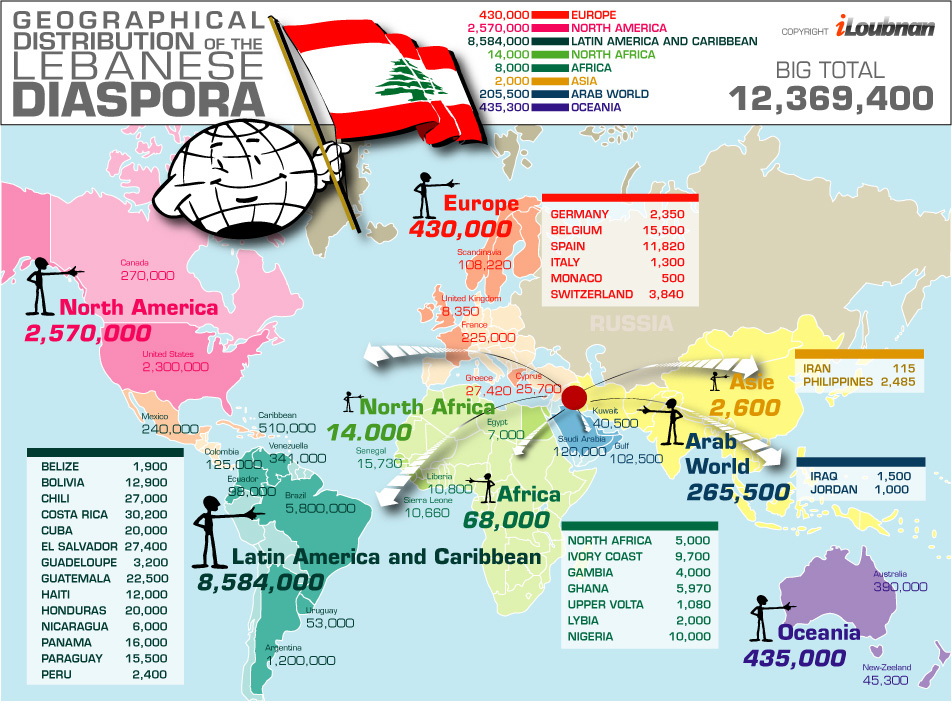
The largest number of Lebanese is to be found in Brazil, where according to the Brazilian and Lebanese governments claim, there are 7 million Brazilians of Lebanese descent. These figures, however, may be an exaggeration given that, according to a 2008 survey conducted by IBGE, in 2008, covering only the states of Amazonas, Paraíba, São Paulo, Rio Grande do Sul, Mato Grosso and Distrito Federal, 0.9% of white Brazilian respondents said they had family origins in the Middle East
Large numbers also reside elsewhere in North America, most notably in the United States (489,702) and in Canada, the people of full or partial Lebanese descent are between 190,275 (by ancestry, 2011 Census) to 250,000 based on estimates. In the rest of the Americas, significant communities are found in Argentina, Chile, Colombia and Venezuela, with almost every other Latin American country having at least a small presence.
In Africa, Senegal and the Ivory Coast are home to over 100,000 Lebanese. There are significant Lebanese populations in other countries throughout Western and Central Africa. Australia hosts over 180,000 and Canada 250,000. In the Arab world, around 400,000 Lebanese live in the Arab states of the Persian Gulf. More than 2,500 ex-SLA members remain in Israel.
Until recently, Lebanon provided no automatic right to Lebanese citizenship for emigrants who lost their citizenship upon acquiring the citizenship of their host country, nor for the descendants of emigrants born abroad. This situation disproportionately affected Christians. In 2008, the Maronite Institution of Emigrants called for the establishment of an avenue by which emigrants who lost their citizenship may regain it, or their overseas-born descendants (if they so wish) may acquire it.
On November 24, 2015, the Lebanese authorities enacted Law #41, “Reacquiring the Lebanese Citizenship”. Under this law, members of the Lebanese diaspora can apply to reacquire the Lebanese citizenship, it specifies that applications must be submitted before November 25, 2025.
In 2017, the Ministry of Foreign Affairs & Emigrants launched an initiative called "The Lebanese Nationality Program" or "Lebanity", for people of Lebanese heritage around the world to apply for Lebanese Nationality, allowing them to benefit from their business, financial, consular, personal, social and political rights as Lebanese, wherever they are. In particular, this initiative is relevant for the large Lebanese communities in different countries all over the world.
Applications are reviewed by a committee within the Ministry of Interior and Municipalities of Lebanon. If an application is denied, the applicant can appeal the decision within one month from the date they are officially notified, using the address specified in their application.
To be eligible, applicants must have their names, or the names of their paternal ancestors or male relatives on their father’s side, listed in the 1921–1924 census records (either residents or immigrants registers) and/or the 1932 immigrants registers, which are maintained by the Ministry of Interior and Municipalities.[[File:Lebanese residents as a percentage of country's total population.png|upright=1.5|thumb|center|Lebanese residents as a percentage of country's total population]]
Religion
Main article: Religion in Lebanon, Islam in Lebanon, Christianity in Lebanon, History of the Jews in Lebanon, Secularism in Lebanon
Lebanese people are very diverse in faith. The country has the most religiously diverse society in the Middle East, encompassing 17 recognized religious sects. The main two religions among the Lebanese people are Christianity (the Maronite Church, the Greek Orthodox Church, the Melkite, the Protestant Church) and Islam (Shia and Sunni). The third-largest religion is Druze. There are other non-Lebanese Christian minorities such as Armenians (Armenian Apostolic Church and Armenian Catholic Church), French-Italians (Latin Catholic Lebanese), Assyrians (Assyrian Church of the East, Syriac Catholic Church, Syriac Orthodox Church, Chaldean Catholic Church) and Copts (Coptic Orthodox Church of Alexandria), who immigrated to Lebanon over the years. No official census has been taken since 1932, reflecting the political sensitivity in Lebanon over confessional (i.e. religious) balance.
A study conducted by Statistics Lebanon, a Beirut-based research firm, cited by the United States Department of State found that of Lebanon's population of approximately 4.3 million is estimated to be: 54% Islam (Shia and Sunni, 27% each), 40.5% Christian (21% Maronite, 8% Greek Orthodox, 5% Melkite Catholics, 1% Protestant, 5.5% other minority Christian denominations like Latin Catholics, Armenian Orthodox, Armenian Catholic, Syriac Catholic, Syriac Orthodox, Chaldean Catholic, Assyrian Catholic and Coptic Orthodox) and 5.5% Druze (a minority religion, descended from Shia Islam, who do not consider themselves to be Muslim, even though under the terms of the Lebanese Constitution the Druze community is designated as a part of the Lebanese Muslim community.)
There are also very small numbers of other religions such as Judaism, Mormons, Baháʼí Faith. While Jews have been present in Lebanon since ancient times, their numbers had dwindled during the Muslim era. By the 2000s the Jewish quarter of Beirut, Wadi Abu Jamil, was virtually abandoned, and there were only around 40 Jews left in Beirut. Many well-established Lebanese Jewish diaspora communities exists, such as in Brazil, France, Switzerland, Canada and the United States.
With the diaspora included, the Christians are an absolute majority. Lebanon has a population of Mhallamis also known as Mardinli), most of whom migrated from northeast Syria and southeast Turkey are estimated to be between 75,000 and 100,000 and considered to be part of the Sunni population. These have in recent years been granted Lebanese citizenship and, coupled with several civil wars between Islamic extremists and the Lebanese military that have caused many Christians to flee the country, have re-tipped the demographic balance in favour of the Muslims and the Sunnis in particular. In addition, many thousands of Arab Bedouins in the Bekaa and in the Wadi Khaled region, who are entirely Sunnis, were granted Lebanese citizenship. Lebanon also has a Jewish population, estimated at less than 100.
Society and culture
Language
Most Lebanese people communicate in the Lebanese variety of Levantine Arabic, but Lebanon's official language is Modern Standard Arabic (MSA). French is recognized and used next to MSA on road signs and Lebanese banknotes. Lebanon's native sign language is the Lebanese dialect of Levantine Arabic Sign Language. English is the fourth language by number of users, after Levantine, MSA, and French. Lebanon's official language, Modern Standard Arabic (MSA), has no native speakers in or outside Lebanon. It is almost never used in conversations and is learned through formal instruction rather than transmission from parent to child.
The majority of Lebanese people speak Lebanese Arabic, which is grouped in a larger category called Levantine Arabic, while Modern Standard Arabic is mostly used in magazines, newspapers, and formal broadcast media. Code-switching between Arabic and French is very common.
French is a common non-native language in Lebanon, with about 50% of the population being Francophone. A law determines the cases in which the French language is to be used within government, and is often used as a prestige language for business, diplomacy and education. Almost 40% of Lebanese are considered francophone, and another 15% "partial francophone," and 70% of Lebanon's secondary schools use French as a second language of instruction. The use of Arabic by Lebanon's educated youth is declining, as they usually prefer to speak in French and, to a lesser extent, English. It is also a reaction to the negativity associated with Arabic since the September 11 attacks. In 1997, the Lebanese government committed to a policy of trilingualism in education, including French and English alongside the official Arabic language in the curriculum. L'Orient-Le Jour is a Lebanese French-language newspaper.
Syriac Aramaic is also spoken as a first language in some Lebanese communities such as Syriac Catholics, Syriac Orthodox and Assyrian Lebanese. Syriac remained both the sole vernacular language of the Maronites until the 14th century when the Mamluks conquered North Lebanon. It is It still used in liturgies by the Maronite church.
Cuisine
Lebanese cuisine has ancient roots and is part of the culinary tradition of the Eastern Mediterranean. Many dishes in Lebanese cuisine can be traced back thousands of years to eras of Phoenician, Persian, Egyptian, Neo-Babylonian, Roman, Greek, Byzantine, Arab and Ottoman rule. In the last 500 years, Lebanese cuisine has been influenced by the different foreign civilizations that held power. From 1516 to 1918, the Ottoman Turks controlled Lebanon and introduced a variety of foods that have become staples in the Lebanese diet, such as cooking with lamb. After the Ottomans were defeated in World War I (1914–1918), France took control of Lebanon until 1943, when the country achieved its independence. The French introduced foods such as flan, caramel custard, eclairs, french fries and croissants.
The Lebanese diaspora who live worldwide has introduced new ingredients, spices and culinary practices into Lebanese cuisine, keeping the cuisine innovative and renowned both beyond and within its borders. Chef and writer Tara Khattar describes her style of cookery as 'progressive Lebanese cuisine'.
Literature
In literature, Kahlil Gibran is the third best-selling poet of all time, behind Shakespeare and Laozi. He is particularly known for his book The Prophet (1923), which has been translated into over twenty different languages. Ameen Rihani was a major figure in the mahjar literary movement developed by Arab emigrants in North America, and an early theorist of Arab nationalism. Mikhail Naimy is widely recognized as among the most important figures in modern Arabic letters and among the most important spiritual writers of the 20th century. Several contemporary Lebanese writers have also achieved international success; including Elias Khoury, Amin Maalouf, Hanan al-Shaykh, and Georges Schéhadé.
Family
Family life is very important in the Lebanese culture. Family functioning is associated with the values of collectivism in the Lebanese society. One person's family functioning is indicative of their individual status and identity. The average household size in Lebanon ranges between 3.9 and 4.9. Child-rearing practices are characterized by abundant protection imposed on children by parents. Unlike Western societies, parental control does not stop at the age of 18; instead, it continues for as long as the child lives in the parents' residence or until the child marries.
Though Lebanon is a secular country, family matters such as marriage, divorce and inheritance are still handled by the religious authorities representing a person's faith. Calls for civil marriage are unanimously rejected by the religious authorities but civil marriages held in another country are recognized by Lebanese civil authorities.
Music
Music is famous in Lebanese society. While traditional folk music remains popular in Lebanon, modern music reconciling traditional styles, pop, and fusion are rapidly advancing in popularity. Radio stations feature a variety of genres and languages, including traditional, classical Arabic and Armenian Prominent traditional musicians include Fairuz, an icon during the civil war, Sabah Melhem Barakat, Wadih El Safi, Majida El Roumi, and Najwa Karam who built an international audience for the genre. Marcel Khalife, a musician who blends classical Arab music with modern sounds, boasts immense popularity for his politically charged lyrics. Distinguished pop artists include Nancy Ajram, Haifa Wehbe, Fadl Shaker, Elissa, and Mika.
According to the World Intellectual Property Organization, Lebanon's music industry is growing and could attain leading status in the region. Lebanese performers are celebrated throughout the Arab World, and with the notable exception of Egypt enjoy increasing regional popularity. Rising demand for Arabic music outside Western Asia has provided Lebanese artists with a small but significant global audience. However, widespread piracy continues to inhibit the music industry's growth.
Genetics
Y-DNA haplogroups

Canaanite origins
In a 2017 study by Haber et al., the authors concluded that modern-day Lebanese individuals "derive most of their ancestry from a Canaanite-related population". This finding "implies substantial genetic continuity in the Levant since at least the Bronze Age." Additionally, the researchers identified Eurasian ancestry in modern Lebanese genomes that was absent in Bronze Age populations. They estimated Eurasian ancestry appeared in the Levant approximately 3,750–2,170 years ago.
Autosomal DNA
In a 2020 study published in the American Journal of Human Genetics, authors showed that there is substantial genetic continuity in Lebanon and the Levant since the Bronze Age (3300–1200 BC) interrupted by three significant admixture events during the Iron Age, Hellenistic, and Ottoman period, each contributing 3%–11% of non-local ancestry to the admixed population. The admixtures were tied to the Sea Peoples of the Late Bronze Age collapse, South or Central Asians, and Ottoman Turks, respectively.
Relationship with other populations
One study by the International Institute of Anthropology in Paris, France, confirmed similarities in the Y-haplotype frequencies in Lebanese, Palestinian, and Sephardic Jewish men, identifying them as "three Near-Eastern populations sharing a common geographic origin." The study surveyed one Y-specific DNA polymorphism (p49/Taq I) in 54 Lebanese and 69 Palestinian males, and compared with the results found in 693 Jews from three distinct Jewish ethnic groups; Mizrahim, Sephardim, and Ashkenazim.
Notable individuals
Main article: List of Lebanese people (diaspora)
References
References
- [[CIA]], the World Factbook (2018). [https://www.cia.gov/the-world-factbook/countries/lebanon/] {{Webarchive. link. (11 January 2021 . Retrieved 2021.)
- (3 October 2019). "International Migration and the Lebanese Diaspora". Presses de l'Ifpo.
- (4 February 2015). "Methods of Finding Population Statistics of Lebanese Migration Throughout the World".
- "Annuario Pontificio 2017".
- "Bassil promises to ease citizenship for expatriates".
- (3 April 2007). "Country Profile: Lebanon". [[Foreign and Commonwealth Office.
- Fielding-Smith, Abigail. (5 June 2009). "From Brazil to Byblos, Lebanese diaspora pours in for vote". thenational.
- link. (20 January 2016 .)
- "Lebanese Republic".
- "Embaixada do Líbano no Brasil". Libano.org.br.
- "News – Politics – Sleiman meets Brazilian counterpart, Lebanese community". The Daily Star.
- (7 June 2007). "Argentinian President's visit to the Lebanese Parliament". [[Lebanese Parliament.
- [https://web.archive.org/web/20110706150728/http://www2.anba.com.br/noticia_diplomacia.kmf?cod=8701931 Colombia awakens to the Arab world]. Brazil-Arab New Agency, 21 July 2009. Retrieved 15 Juny 2020.
- (March 2010). "Estimación de la mortalidad, 1985–2005". [[National Administrative Department of Statistics (Colombia).
- Randa Achmawi. (21 July 2009). "Colombia awakens to the Arab world". Brazil-Arab News Agency.
- (September 2007). "Proyecciones nacionales y departamentales de población. 2006–2020". DANE National Statistical Service, Colombia.
- "The Arab Population: 2000".
- (7 October 2020). "Henry Laurens : " la France et le Liban sont comme les membres d'une famille recomposée "".
- "La France au Liban Ambassade de France à Beyrouth".
- (2 September 2020). "" Pour les Français, les Libanais ne sont pas des étrangers ", par Henry Laurens".
- "De Beyrouth à Paris : Une diaspora dynamique et intégrée".
- "Profil du recensement, recensement de la population de 2021".
- "Communauté libanaise du Québec".
- [http://www.cbc.ca/news/background/middleeast-crisis/canada-lebanon.html Canada and Lebanon, a special tie] {{Webarchive. link. (21 July 2006 , CBC News)
- "2021 People in Australia who were born in Lebanon, Census Country of birth QuickStats | Australian Bureau of Statistics".
- (2009). "Geographical Distribution of the Lebanese Diaspora". Wordpress.
- (June 2023). "Vivir "el mismo infierno dos veces": la crisis golpea a los venezolanos que emigraron a Líbano".
- (3 June 2023). "la crisis golpea a los venezolanos que emigraron a Líbano".
- "Libaneses (Seminario)".
- [https://www.infobae.com/2014/06/25/1575973-mas-10-millones-libaneses-empujan-el-crecimiento-social-y-economico-america-latina/ Más de 10 millones de libaneses empujan el crecimiento social y económico de América Latina]. Infobae, 24 de junio de 2014. Consultado el 23 de diciembre de 2019.
- "Interview with Lebanese Ambassador to Saudi Arabia".
- (February 2018). "Des investisseurs libanais à Abidjan pour investir en Afrique".
- "Côte d'Ivoire : insubmersibles Libanais – Jeune Afrique".
- (January 30, 2018). "Côte d'Ivoire – World Directory of Minorities & Indigenous Peoples".
- (2018). "Minorities in Côte d'Ivoire".
- (May 2024). "Les Libanais en Côte d'Ivoire".
- iLoubnan. (2009). "Geographical distribution of Lebanese diaspora".
- (16 October 2020). "El Guayaquil que acogió a los migrantes extranjeros".
- (February 2018). "Inmigración libanesa en México. Un caso de diversidad cultural".
- (August 2019). "En busca de las huellas árabes en México. La inmigración árabe en los siglos XIX y XX". Revista Científica Uisrael.
- (February 2018). "LA INMIGRACIÓN ÁRABE EN MÉXICO: INTEGRACIÓN NACIONAL E IDENTIDAD COMUNITARIA".
- González Hernández, Julio Amable. (11 August 2012). "Registro de Inmigrantes de El Líbano". Instituto Dominicano de Genealogía.
- (21 January 2013). "Lebanese Living in UAE Fear Deportation".
- "Les Libanais d'Uruguay".
- [https://www.infobae.com/2014/06/25/1575973-mas-10-millones-libaneses-empujan-el-crecimiento-social-y-economico-america-latina/ Más de 10 millones de libaneses empujan el crecimiento social y económico de América Latina] {{Webarchive. link. (7 May 2021 . Infobae, 24 de junio de 2014. Consultado el 23 de diciembre de 2019.)
- "The most representative ethnic groups of Senegal".
- [https://www.voanews.com/a/a-13-2007-07-10-voa46/406056.html Immigrants Boost West African Commerce], Voice of America, 10 July 2007. Retrieved 4 November 2011.
- (December 2024). "Befolkning efter födelseland och ursprungsland, 31 december 2024, totalt". Statistiska centralbyrån.
- (7 August 2020). "Le Liban meurtri, compte sur la solidarité de son importante diaspora dans le monde, dont 1,2 million de personnes en Afrique".
- Ghosh P.. (2013). "Arabs In The Andes? Chile, The Unlikely Long-Term Home Of A Large Palestinian Community". International Business Times.
- J. Códoba-Toro. (2015). "Árabes en Chile". Iberoamérica Social.
- "قنصل لبنان العام في لاغوس لـ"النشرة": اعتمدنا معايير شفافة في مسألة عودة اللبنانيين ونتمنى جدولة الرحلات قريبًا".
- "Planes and pyramids: The surreal mansions of Lebanon's Nigeria Avenue".
- (30 January 2025). "Libanais en RDC : grosse frayeur à Goma, calme relatif à Kinshasa". lorientlejour.
- (February 2010). "Les Libanais à l'heure du désastre haïtien".
- "Le Liban et la Belgique : Une vision commune".
- "Lebanese Arab in South Africa".
- "The Struggle Of The Christian Lebanese For Land Ownership In South Africa". The Marionite Research Institute.
- (4 May 2009). "Les immigrés libanais en Suisse présents dans de nombreux secteurs".
- (4 July 2016). "Les Libanais de Guadeloupe célèbrent leur riche histoire".
- (10 September 2019). "A Lebanese Community Has Been On This Island For Over 150 Years".
- (13 October 2018). "La communauté Libanaise, Une intégration réussie dans la sphère antillaise".
- (21 February 2011). "Les Libanais de Guadeloupe, une émigration ancienne et une population bien intégrée".
- (27 November 2017). "Gebran Bassil le ministre des affaires étrangères du Liban arrive en Guadeloupe".
- (27 October 2024). "9000 Libanais ont trouvé refuge au Congo fuyant les bombardements Israélien".
- (11 April 2022). "3575 Libanais ont fui au Liban pour s'installer au Congo comme immigrés".
- (24 March 2014). "Le Gabon, foyer de la plus grande communauté libanaise d'Afrique centrale".
- "Tabiiyete Göre Yabancı Nüfus". [[Turkish Statistical Institute]].
- "Au Cameroun, l'importante présence du Hezbollah suscite des interrogations".
- "These Young Israelis Were Born in Lebanon – but Don't Call Them Arabs". Haaretz.
- "At its height in the 1970s, Liberia's Lebanese community was 17,000 strong, according to BBC News Now, after Liberia's long civil war, it numbers around 3,000.".
- (27 December 2003). "La diaspora libanaise de Cotonou".
- "What is it about Lebanon and German football?".
- (9 April 2015). "La communauté libanaise au Togo désormais bien organisée, une structure légalement mise en place". savoirnews.
- "Se fosse para fazer lavagem os libaneses levariam o dinheiro para fora de angola mas estao a investir novamente em angola".
- "Joseph Hage, consul honoraire du Liban au Burkina Faso "Nous réfléchissons à fonder une coopération libanaise"".
- Owens, Jonathan. (2000). "Arabic as a Minority Language". Walter de Gruyter.
- Syria and the Palestinians: The Clash of Nationalisms – Page 113, Ghada Hashem Talhami – 2001
- (20 May 2017). "Lebanon 2017 International Religious Freedom Report". [[United States Department of State]].
- "Lebanon: A Country Study". US Library of Congress.
- "CNEWA Canada – The Maronite Catholic Church".
- (18 December 2002). "Senior Seminar: Transnational Migration and Diasporic Communities". [[Hamline University]].
- "Lebanese Culture - Fanack.com".
- (2017-04-22). "Beirut in Books {{!}} Lebanese Writers {{!}} Literature from Lebanon".
- VIBRANTlab. "How Has Art Been Affected By Lebanese Culture And Who We Are?".
- (26 February 2019). "International Center for Law and Religion Studies {{!}} @Lebanon: Country Info".
- Chamie, Joseph. (1980). "Religious Groups in Lebanon: A Descriptive Investigation". International Journal of Middle East Studies.
- "Lebanon: Its Stand in History Among the Near East Countries".
- (2022-12-23). "Identity is complex for Lebanon's Christian Palestinian camp".
- Middlemiss, Sarah. (2021-05-20). "All trends pointing to a downward spiral, searching for hope in Lebanon's compounding crises".
- (15 August 2022). "10 Conflicts to Worry About in 2022: Lebanon".
- "Instability in Lebanon".
- Human Rights Watch. (2021-12-14). "Lebanon: Events of 2021". English.
- "Poverty, Inequality and Social Protection in Lebanon".
- [http://www.stgeorgesa.org/ St. George Maronite Church] {{Webarchive. link. (18 January 2021 .)
- (10 September 2007). "In Lebanon DNA may yet heal rifts". Reuters.
- قال [[Yaqut al-Hamawi. صاحب معجم البلدان]] 1/38; «وأما الجند فيجيء في قولهم: جند قنسرين، وجند فلسطين، وجند حمص، وجند دمشق، وجند الأردن. فهي خمسة أجناد، وكلها بالشام. ولم يبلغني أنهم استعملوا ذلك في غير أرض الشام
- Kennedy, Hugh. (1992). "La Syrie de Byzance à l'Islam VIIe-VIIIe Siècles". Damascus, Institut Français du Proche Orient.
- Barker, John W.. (1966). "Justinian and the Later Roman Empire". University of Wisconsin Press.
- (2012). "Garshuni Manuscripts and Garshuni Notes in Syriac Manuscripts". Holy Spirit University of Kaslik.
- Peters, Francis Edward. (2003). "Islam: A Guide for Jews and Christians". Princeton University Press.
- al-Hassan, Ahmad Y.. (2001). "The Different Aspects of Islamic Culture". The United Nations Educational, Scientific and Cultural Organization.
- [http://www.uschamber.com/portal/lebanon/investment_overview Business Portal to Lebanon] {{webarchive. link. (4 December 2008 .)
- "Middle East :: Lebanon — The World Fact book – Central Intelligence Agency".
- "Senior Seminar: Transnational Migration and Diasporic Communities".
- (18 May 2005). "The invisible occupation of Lebanon". [[The Christian Science Monitor]].
- (1 December 2011). "Background Note: Lebanon". [[US Department of State]].
- (13 July 2014). "How the Lebanese conquered Brazil". [[Executive (magazine).
- "American FactFinder – Results". U.S. Census Bureau.
- Statistics Canada. (8 May 2013). "2011 National Household Survey: Data tables".
- (8 July 2007). "The biggest enchilada". The Telegraph.
- (2017). "The Oxford Handbook of Arab Novelistic Traditions". Oxford University Press.
- "Brazil-Arab News Agency - Colombia awakens to the Arab world". .anba.com.br.
- "Ivory Coast – The Levantine Community".
- [https://news.bbc.co.uk/2/hi/africa/6908065.stm Lebanese man shot dead in Nigeria], BBC News
- [http://weekly.ahram.org.eg/2001/525/in3.htm Lebanese nightmare in Congo] {{webarchive. link. (16 November 2008 , Al-Ahram Weekly.)
- [http://www.alertnet.org/thenews/newsdesk/IRIN/9cc784a7002d9eb73b339b4d2c840090.htm One in three Lebanese want to leave] {{Webarchive. link. (4 December 2008 , Reuters)
- [http://www.globalpolitician.com/25247-lebanon Lebanon's refugees in Israel] {{webarchive. link. (16 December 2008 , Elias Bejjani – 28 October 2008.)
- (24 July 2008). "News – Politics – Sfeir tells new Maronite group emigrants 'deserve' Lebanese nationality". The Daily Star.
- "Reacquiring Lebanese Citizenship – Consulate General of Lebanon in New York".
- "Embassy of Lebanon in the United Kingdom {{!}} Reclaim Lebanese Nationality".
- "Contemporary distribution of Lebanon's main religious groups". Central Intelligence Agency.
- "CIA World Factbook, Lebanon".
- Najem, T.. (1998). "The collapse and reconstruction of Lebanon". University of Durham Centre for Middle Eastern and Islamic Studies.
- (17 November 2010). "International Religious Freedom Report 2010 – Lebanon". US State Department.
- "Contemporary Religious distribution of Lebanon's main religions". theodora.com.
- [https://www.cia.gov/the-world-factbook/countries/lebanon/ "Lebanon"] {{Webarchive. link. (11 January 2021 . (July 2014 est.))
- Alfred B. Prados. (8 June 2006}}{{Dead link). "Lebanon". The Library of Congress.
- ''Daily Star''. ''[http://www.dailystar.com.lb/News/Politics/2013/Feb-15/206550-minority-sects-demand-greater-representation-in-parliament.ashx Minority sects demand greater representation in Parliament] {{Webarchive. link. (27 September 2018 '')
- Country Studies. [http://www.country-studies.com/lebanon/population.html "Lebanon Population"] {{Webarchive. link. (10 October 2017 . Retrieved 25 November 2006.)
- Jonas, Margaret. (2011). "The Templar Spirit: The Esoteric Inspiration, Rituals and Beliefs of the Knights Templar". Temple Lodge Publishing.
- Yazbeck Haddad, Yvonne. (2014). "The Oxford Handbook of American Islam". Oxford University Press.
- Parfitt, Tudor. (2000). "Israel and Ishmael: Studies in Muslim-Jewish Relations".
- Kirsten Schulze. "Lebanon." ''Encyclopedia of Jews in the Islamic World''. Executive Editor [[Norman A. Stillman]]. Brill Online, 2013.
- (26 September 2010). "Lebanon's Jews: Loyalty to Whom? BBC Documentary Tracks Vanished Community".
- (September 8, 1972). "Lebanese Jews Settle Alongside Syrian and Egyptian Jews". The Wisconsin Jewish Chronicle.
- International Journal of Kurdish Studies, Jan 2002 by Lokman I. Meho [http://www.findarticles.com/p/articles/mi_m0SBL/is_16/ai_n13807710 "The Kurds in Lebanon: a social and historical overview"] {{Webarchive. link. (27 March 2008)
- Al-Wer, Enam. (2006). "Sociolinguistics: An International Handbook of the Science of Language and Society". De Gruyter.
- [[ethnologue:arb. Arabic, Standard]], 24th Edition, [[Ethnologue]]
- (16 June 2010). "Campaign to save the Arabic language in Lebanon". BBC News.
- (2017). "The Handbook of Dialectology". Wiley.
- Shawish, Hesham. (24 June 2010). "Campaign to save the Arabic language in Lebanon". [[BBC News Online]].
- Mortada, Dalia. (October 5, 2015). "Is Beirut the codeswitching capital of the world?". [[Public Radio International]].
- Talhouk, Suzanne. (October 27, 2015). "Don't kill your language". [[TED (conference).
- Prof. Dr. Axel Tschentscher, LL.M.. "Article 11 of the Lebanese Constitution". Servat.unibe.ch.
- (28 May 2010). "The Story of French". Knopf Canada.
- (2008). "The Story of French". Macmillan.
- (25 June 2010). "Arabic – a dying language?". France 24.
- Esseili, Fatima. (2017). "A sociolinguistic profile of English in Lebanon". World Englishes.
- {{in lang
- Hitti, Philip. (1957). "Lebanon in History". Macmillan.
- Edelstein, Sari. (2011). "Food, Cuisine, and Cultural Competency for Culinary, Hospitality, and Nutrition Professionals". Jones & Bartlett Learning.
- DeMeester, Fabien. (2008-01-23). "Wild-type Food in Health Promotion and Disease Prevention: The Columbus Concept". Springer Science & Business Media.
- Choueiri, Ramzi N.. (2002-01-01). "The Culinary Heritage of Lebanon". Ramzi Choueiri.
- (2016-03-17). "Event Mobilities: Politics, place and performance". Routledge.
- Food, Lonely Planet. (2012-08-01). "The World's Best Street Food: Where to Find it & How to Make it". Lonely Planet.
- Kufer, Katrina. (10 December 2018). "The Food Hustle: Chef Tara Khattar Rethinks Lebanese Cuisine".
- Acocella, Joan. (31 December 2007). "Prophet Motive".
- "Called by life". The Hindu.
- Kazarian, Shahe S. "Family Functioning, Cultural Orientation, and Psychological Well-Being Among University Students in Lebanon." The Journal of Social Psychology 145.2 (2005): 141–54.
- "UNFPA Lebanon – Country Profile".
- Carter, Terry. (15 July 2008). "Lonely Planet Syria & Lebanon". Lonely Planet.
- Sheehan, Sean. (30 August 2007). "Lebanon". Marshall Cavendish Children's Books.
- McKenzie, Robert. ''Comparing Media from Around the World'', Pearson/Allyn and Bacon, 2006, p. 372 {{ISBN. 0-205-40242-9
- Kamalipour, Yahya. (15 November 2001). "Media, sex, violence, and drugs in the global village". Rowman & Littlefield Publishers, Inc..
- One source says "cult following", other says "folk hero"
- World Intellectual Property Organization. (2003). "Performance of copyright industries in selected Arab countries: Egypt, Jordan, Lebanon, Morocco, Tunisia". World Intellectual Property Organization.
- Karam, Michael. (27 October 2005). "Wines of Lebanon". Saqi Books.
- (2011). "Influences of history, geography, and religion on genetic structure: the Maronites in Lebanon". European Journal of Human Genetics.
- (3 August 2017). "Continuity and Admixture in the Last Five Millennia of Levantine History from Ancient Canaanite and Present-Day Lebanese Genome Sequences.". American Journal of Human Genetics.
- (2020). "A Genetic History of the Near East from an aDNA Time Course Sampling Eight Points in the Past 4,000 Years". American Journal of Human Genetics.
- (1 January 2003). "Y-chromosome DNA haplotypes in Jews: comparisons with Lebanese and Palestinians". Genet. Test..

This article was imported from Wikipedia and is available under the Creative Commons Attribution-ShareAlike 4.0 License. Content has been adapted to SurfDoc format. Original contributors can be found on the article history page.
Ask Mako anything about Lebanese people — get instant answers, deeper analysis, and related topics.
Research with MakoFree with your Surf account
Create a free account to save articles, ask Mako questions, and organize your research.
Sign up freeThis content may have been generated or modified by AI. CloudSurf Software LLC is not responsible for the accuracy, completeness, or reliability of AI-generated content. Always verify important information from primary sources.
Report