From Surf Wiki (app.surf) — the open knowledge base
4
Natural number
Natural number
| Field | Value | |||||||
|---|---|---|---|---|---|---|---|---|
| number | 4 | |||||||
| numeral | quaternary | |||||||
| divisor | 1, 2, 4 | |||||||
| roman | ||||||||
| greek prefix | tetra- | |||||||
| latin prefix | quadri-/quadr- | |||||||
| lang1 | Armenian | lang1 symbol=Դ | lang2=Arabic, Kurdish | |||||
| lang2 symbol | ||||||||
| lang3 | Persian, Sindhi | |||||||
| lang3 symbol | ||||||||
| lang4 | Shahmukhi, Urdu | |||||||
| lang4 symbol | ||||||||
| lang5 | Ge'ez | |||||||
| lang5 symbol | ||||||||
| lang6 | Bengali, Assamese | |||||||
| lang6 symbol | ||||||||
| lang7 | Chinese numeral | |||||||
| lang7 symbol | 四,亖,肆 | |||||||
| lang9 | Devanagari | |||||||
| lang9 symbol | ||||||||
| lang10 | Santali | |||||||
| lang10 symbol | ||||||||
| lang11 | Telugu | |||||||
| lang11 symbol | ||||||||
| lang12 | Malayalam | |||||||
| lang12 symbol | ||||||||
| lang13 | Tamil | |||||||
| lang13 symbol | ||||||||
| lang14 | Hebrew | |||||||
| lang14 symbol | ||||||||
| lang15 | Khmer | |||||||
| lang15 symbol | ||||||||
| lang16 | Thai | |||||||
| lang16 symbol | ||||||||
| lang17 | Kannada | |||||||
| lang17 symbol | ||||||||
| lang18 | Burmese | |||||||
| lang18 symbol | ||||||||
| lang19 | Babylonian numeral | lang19 symbol=𒐘 | lang20=Egyptian hieroglyph, Chinese counting rod | lang20 symbol= | lang21=Maya numerals | lang21 symbol=•••• | lang22=Morse code | lang22 symbol= |
This article is about the number. For the years, see BC 4 and 4 AD. For other uses, see 4 (disambiguation), IV (disambiguation) and [[Number Four (disambiguation)
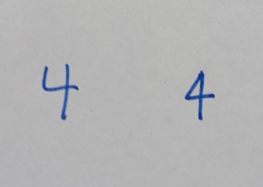
4 (four) is a number, numeral and digit. It is the natural number following 3 and preceding 5. It is a square number, the smallest semiprime and composite number, and is considered unlucky in many East Asian cultures.
Evolution of the Hindu-Arabic digit
Brahmic numerals represented 1, 2, and 3 with as many lines. 4 was simplified by joining its four lines into a cross that looks like the modern plus sign. The Shunga would add a horizontal line on top of the digit, and the Kshatrapa and Pallava evolved the digit to a point where the speed of writing was a secondary concern. The Arabs' 4 still had the early concept of the cross, but for the sake of efficiency, was made in one stroke by connecting the "western" end to the "northern" end; the "eastern" end was finished off with a curve. The Europeans dropped the finishing curve and gradually made the digit less cursive, ending up with a digit very close to the original Brahmin cross.

While the shape of the character for the digit 4 has an ascender in most modern typefaces, in typefaces with text figures the glyph usually has a descender, as, for example, in [[File:TextFigs148.svg|40px]].
On the seven-segment displays of pocket calculators and digital watches, as well as certain optical character recognition fonts, 4 is seen with an open top: [[File:Seven-segment 4.svg|x25px]].
Television stations that operate on channel 4 have occasionally made use of another variation of the "open 4", with the open portion being on the side, rather than the top. This version resembles the Canadian Aboriginal syllabics letter ᔦ. The magnetic ink character recognition "CMC-7" font also uses this variety of "4".
Mathematics
Lagrange's four-square theorem states that every positive integer can be written as the sum of at most four squares. Four is one of four all-Harshad numbers. Each natural number divisible by 4 is a difference of squares of two natural numbers, i.e. 4x=y^{2}-z^{2}.
A four-sided plane figure is a quadrilateral or quadrangle, sometimes also called a tetragon. It can be further classified as a rectangle or oblong, kite, rhombus, and square.
Four is the highest degree general polynomial equation for which there is a solution in radicals.
Four is the only square number N=n\times n where N - 1 is a prime number.
The four-color theorem states that a planar graph (or, equivalently, a flat map of two-dimensional regions such as countries) can be colored using four colors, so that adjacent vertices (or regions) are always different colors. Three colors are not, in general, sufficient to guarantee this. The largest planar complete graph has four vertices.
A solid figure with four faces as well as four vertices is a tetrahedron, which is the smallest possible number of faces and vertices a polyhedron can have. The regular tetrahedron, also called a 3-simplex, is the simplest Platonic solid. It has four regular triangles as faces that are themselves at dual positions with the vertices of another tetrahedron.
The smallest non-cyclic group has four elements; it is the Klein four-group. A alternating groups are not simple for values n ≤ 4.
There are four Hopf fibrations of hyperspheres:
\begin{align} S^0 & \hookrightarrow S^1 \to S^1, \ S^1 & \hookrightarrow S^3 \to S^2, \ S^3 & \hookrightarrow S^7 \to S^4, \ S^7 & \hookrightarrow S^{15}\to S^8. \ \end{align}
They are defined as locally trivial fibrations that map f : S^{2n-1} \rightarrow S^{n} for values of n=2,4,8 (aside from the trivial fibration mapping between two points and a circle).
In Knuth's up-arrow notation, 2+2=2\times2=2^{2}=2\uparrow\uparrow 2=2\uparrow\uparrow\uparrow2=;...; = 4, and so forth, for any number of up arrows.
There are four dimensions in the theory of Minkowski space, three of space and the one being time.
List of basic calculations
| Multiplication | 1 | 2 | 3 | 4 | 5 | 6 | 7 | 8 | 9 | 10 | 11 | 12 | 13 | 14 | 15 | 16 | 17 | 18 | 19 | 20 | 21 | 22 | 23 | 24 | 25 | 50 | 100 | 1000 |
|---|---|---|---|---|---|---|---|---|---|---|---|---|---|---|---|---|---|---|---|---|---|---|---|---|---|---|---|---|
| '*4 × *x''''' | **4** |
| Division | 1 | 2 | 3 | 4 | 5 | 6 | 7 | 8 | 9 | 10 | 11 | 12 | 13 | 14 | 15 | 16 |
|---|---|---|---|---|---|---|---|---|---|---|---|---|---|---|---|---|
| '*4 ÷ *x''''' | **4** | [2](2) | 1. | 1 | 0.8 | 0. | 0. | 0.5 | 0. | 0.4 | 0. | 0. | 0. | 0. | 0.2 | 0.25 |
| ***x* ÷ 4** | 0.25 | 0.5 | 0.75 | 1 | 1.25 | 1.5 | 1.75 | 2 | 2.25 | 2.5 | 2.75 | 3 | 3.25 | 3.5 | 3.75 | 4 |
| Exponentiation | 1 | 2 | 3 | 4 | 5 | 6 | 7 | 8 | 9 | 10 | 11 | 12 | 13 | 14 | 15 | 16 |
|---|---|---|---|---|---|---|---|---|---|---|---|---|---|---|---|---|
| **4** | 4 | [256](256) | 1024 | 4096 | 16384 | 65536 | 262144 | 1048576 | 4194304 | 16777216 | 67108864 | 268435456 | 1073741824 | 4294967296 | ||
| ***x*** | 1 | 81 | 256 | 625 | 1296 | 2401 | 4096 | 6561 | 10000 | 14641 | 20736 | 28561 | 38416 | 50625 | 65536 |
In culture
- Four is the sacred number of the Zia, an indigenous tribe located in the U.S. state of New Mexico.
- Superstition about the number four is most common in East Asian nations, where it is a homonym for "death" in many languages.
In logic and philosophy

- The symbolic meanings of the number four are linked to those of the cross and the square. "Almost from prehistoric times, the number four was employed to signify what was solid, what could be touched and felt. Its relationship to the cross (four points) made it an outstanding symbol of wholeness and universality, a symbol which drew all to itself". Where lines of latitude and longitude intersect, they divide the earth into four proportions. Throughout the world kings and chieftains have been called "lord of the four suns" or "lord of the four quarters of the earth", which is understood to refer to the extent of their powers both territorially and in terms of total control of their subjects' doings.
- The Square of Opposition, in both its Aristotelian version and its Boolean version, consists of four forms: A ("All S is R"), I ("Some S is R"), E ("No S is R"), and O ("Some S is not R").
Religion
Judaism
Four represents the four matriarchs (Sarah, Rebecca, Rachel, and Leah); the four sides of the world, the four extremes.
Christianity
Four represents the 3+1 of the Holy Trinity engendered as the one God and has a particular significance in Christian Theology because of that. In Augustinian numerology, four represents the earth and earthly affairs.
In technology
- In internet slang, "4" can replace the word "for" (as "four" and "for" are pronounced similarly). For example, typing "4u" instead of "for you".
- In Leetspeak, "4" may be used to replace the letter "A".
Other groups of four
- Approximately four weeks (4 times 7 days) to a lunar month (synodic month = 29.54 days). Thus the number four is universally an integral part of primitive sacred calendars.
- Four seasons in a year: spring, summer, autumn and winter.
References
- Wells, D. The Penguin Dictionary of Curious and Interesting Numbers London: Penguin Group. (1987): 55–58
References
- Georges Ifrah, ''The Universal History of Numbers: From Prehistory to the Invention of the Computer'' transl. David Bellos et al. London: The Harvill Press (1998): 394, Fig. 24.64
- (2019-04-22). "Seven Segment Displays (7-Segment) {{!}} Pinout, Types and Applications".
- (2017-02-02). "Battle of the MICR Fonts: Which Is Better, E13B or CMC7? - Digital Check". Digital Check.
- Spencer, Joel. (1996). "Four Squares with Few Squares". Springer US.
- Peterson, Ivars. (2002). "Mathematical Treks: From Surreal Numbers to Magic Circles". MAA.
- Bajnok, Béla. (2013-05-13). "An Invitation to Abstract Mathematics". Springer Science & Business Media.
- Bunch, Bryan. (2000). "The Kingdom of Infinite Number". W. H. Freeman & Company.
- Ben-Menahem, Ari. (2009-03-06). "Historical Encyclopedia of Natural and Mathematical Sciences". Springer Science & Business Media.
- Molitierno, Jason J.. (2016-04-19). "Applications of Combinatorial Matrix Theory to Laplacian Matrices of Graphs". CRC Press.
- (1968). "Discovering Meanings in Elementary School Mathematics". Holt, Rinehart and Winston.
- (1968). "Discovering Meanings in Elementary School Mathematics". Holt, Rinehart and Winston.
- (1999). "Geometry and the Imagination". American Mathematical Soc..
- Horne, Jeremy. (2017-05-19). "Philosophical Perceptions on Logic and Order". IGI Global.
- Shokurov, A.V.. (2002). "Encyclopedia of Mathematics". [[European Mathematical Society]].
- Hodges, Andrew. (2008-05-17). "One to Nine: The Inner Life of Numbers". W. W. Norton & Company.
- (1955). "Bulletin - State Department of Education". Department of Education.
- Lachenmeyer, Nathaniel. (2005). "13: The Story of the World's Most Notorious Superstition". Penguin Group (USA) Incorporated.
- Chevalier, Jean and Gheerbrant, Alain (1994), ''The Dictionary of Symbols''. The quote beginning "Almost from prehistoric times..." is on p. 402.
This article was imported from Wikipedia and is available under the Creative Commons Attribution-ShareAlike 4.0 License. Content has been adapted to SurfDoc format. Original contributors can be found on the article history page.
Ask Mako anything about 4 — get instant answers, deeper analysis, and related topics.
Research with MakoFree with your Surf account
Create a free account to save articles, ask Mako questions, and organize your research.
Sign up freeThis content may have been generated or modified by AI. CloudSurf Software LLC is not responsible for the accuracy, completeness, or reliability of AI-generated content. Always verify important information from primary sources.
Report