From Surf Wiki (app.surf) — the open knowledge base
KT88
Output beam tetrode
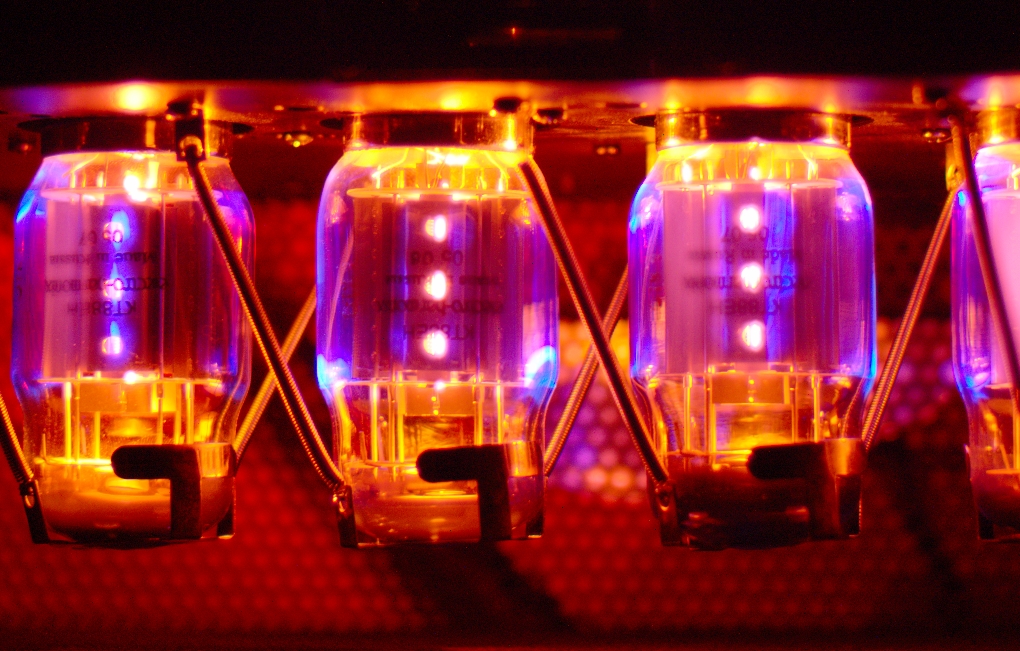
Output beam tetrode
| Field | Value |
|---|---|
| image | Kt88.jpg |
| image_size | 100px |
| caption | KT88 labeled G.E.C. made by GEC/MOV in the U.K. |
| classification | Beam-power tetrode |
| service | Class-A amplifier, (single-ended) |
| height_in | |
| diameter_in | |
| weight_lbs | |
| cathode_type | Indirectly-heated |
| heater_voltage | 6.3 |
| heater_current | 1.6A |
| max_dissipation | 42W |
| max_voltage | 800 |
| pinout | Octal base, (IO) |
| class_a_anode_voltage | 250V |
| class_a_anode_current | 140mA |
| class_a_screen_voltage | 250V |
| class_a_bias_voltage | -15V |
| class_a_anode_resistance | 12 kilohms |
| class_ab_power_output | 100W |
| class_ab_anode_voltage | 600V |
| class_ab_anode_current | 100mA |
| class_ab_screen_voltage | 350V |
| class_ab_bias_voltage | -45 (class AB2) |
| reference | Super Radiotron Tube Manual, Amalgamated Wireless Valve Co. Australia, June 1962 |
The KT88 is a beam tetrode/kinkless tetrode (hence "KT") vacuum tube for audio amplification.
class-AB amplifier, (push-pull)
Pin 1, Not used
Pin 2, Heater
Pin-3, Anode/plate
Pin-4, Screen grid, g2
Pin-5, Control grid, g1
Pin-6, Not used
Pin-7, Heater
Pin-8, Cathode-beam plates
Radio Tube Data, Eighth Ed. Ilife Books Ltd., London, 1966
Features
The KT88 fits a standard eight-pin octal socket and has similar pinout and applications as the 6L6 and EL34. Specifically designed for audio amplification, the KT88 has higher plate power and voltage ratings than the American 6550. It is one of the largest tubes in its class and can handle significantly higher plate voltages than similar tubes, up to 800 volts. A KT88 push-pull pair in class AB1 fixed bias is capable of 100 watts of output with 2.5% total harmonic distortion or up to about 50W at low distortion in hi-fi applications. The transmitting tubes TT21 and TT22 have almost identical transfer characteristics to KT88 but a different pinout, and by virtue of their anode being connected to the top cap have a higher plate voltage rating (1.25 kilovolt) and a higher power output capability of 200 watts in class AB1 push–pull.
The screen grid is sometimes tied to the anode so that it becomes effectively a triode with a lower maximum power output.
History
The KT88 was introduced by GEC in 1956 as a larger variant of the KT66. It was manufactured in the U.K. by the MOV (Marconi-Osram Valve) subsidiary of G.E.C, also labelled as IEC/Mullard, and, in the U.S., Genalex Gold Lion.

As of 2022, KT88 valves are produced by New Sensor Corporation (Genalex Gold Lion and Electro-Harmonix brands) in Saratov, Russia, JJ Electronic in Čadca, Slovakia and Hengyang Electronics (Psvane brand) at former Guiguang factory in Foshan, China.
NOS examples in good condition are extremely rare. Due to its availability and characteristics, the KT88 is popular in hi-fi production amplifiers.
Historically, it has been far more popular with high fidelity stereo manufacturers than guitar amplifier builders, given its characteristics of high-power and low-distortion. Due to these characteristics, it is regularly used to replace 6550 tubes by end users seeking a guitar amplifier tone with less distortion. Some of the amplifiers which shipped with the KT88 power tube include the Hiwatt, Marshall Major, and some Ampeg models.
Characteristics
Kt88pent.gif|Anode characteristics
References
References
- https://frank.pocnet.net/sheets/086/k/KT88.pdf ''KT88 Datasheet''
- "6550/KT88 Power Kings Part II". Vacuum Tube Valley Quarterly, 2003, Issue 19.
- "New Sensor Corporation".
- "JJ Electronic s.r.o.".
- "Changsha Hengyang Electronics Co., Ltd.".
- Fliegler, Ritchie. (1993). "Amps!: the other half of rock 'n' roll". Hal Leonard.
- Aspen Pittman. (2003). "The Tube Amp Book". Backbeat.
This article was imported from Wikipedia and is available under the Creative Commons Attribution-ShareAlike 4.0 License. Content has been adapted to SurfDoc format. Original contributors can be found on the article history page.
Ask Mako anything about KT88 — get instant answers, deeper analysis, and related topics.
Research with MakoFree with your Surf account
Create a free account to save articles, ask Mako questions, and organize your research.
Sign up freeThis content may have been generated or modified by AI. CloudSurf Software LLC is not responsible for the accuracy, completeness, or reliability of AI-generated content. Always verify important information from primary sources.
Report