From Surf Wiki (app.surf) — the open knowledge base
6L6
Vacuum tube
Vacuum tube
| Field | Value | ||||
|---|---|---|---|---|---|
| image | [[File:Tube 6L6 Sylvania.jpg | 190x502px]] | |||
| caption | A 6L6 tube manufactured by Sylvania | ||||
| classification | Beam power tetrode | ||||
| service | Class-A amplifier, class-B amplifier, class-AB amplifier, (audio amplifiers) | ||||
| height_in | 4.25 | ||||
| diameter_in | 1.438 | ||||
| weight_lbs | |||||
| cathode_type | Indirectly heated | ||||
| heater_voltage | 6.3 | ||||
| heater_current | 900 mA | ||||
| max_dissipation | 30 | ||||
| max_voltage | 500 | ||||
| Specification listed is for type 6L6-GC | |||||
| pinout | [[File:BPT Pinout.png | thumb | left | 125px | The 6L6 Pinout, metal versions had the shell connected to pin 1]] |
| class_a_anode_voltage | 350 V | ||||
| class_a_anode_current | 54 mA | ||||
| class_a_screen_voltage | 250 V | ||||
| class_a_bias_voltage | −18 V | ||||
| class_a_anode_resistance | 5 kOhms | ||||
| class_ab_power_output | 55 W | ||||
| class_ab_anode_resistance | 5.6 kOhms | ||||
| class_ab_anode_voltage | 450 V | ||||
| class_ab_anode_current | 2*54 mA | ||||
| class_ab_screen_voltage | 400 V | ||||
| class_ab_bias_voltage | −37 V | ||||
| reference | Essential Characteristics, General Electric, 1973 |
Specification listed is for type 6L6-GC
Pin 1 – n.c
Pin 2 – Heater
Pin 3 – Anode (Plate)
Pin 4 – Grid 2 (Screen)
Pin 5 – Grid 1 (control)
Pin 6 – n.c
Pin 7 – Heater
Pin 8 – Cathode & beam-forming plates
6L6 is the designator for a beam power tube introduced by Radio Corporation of America in April 1936 and marketed for application as a power amplifier for audio frequencies. The 6L6 is a beam tetrode that utilizes formation of a low potential space charge region between the anode and screen grid to return anode secondary emission electrons to the anode and offers significant performance improvements over power pentodes. The 6L6 was the first successful beam power tube marketed. In the 21st century, variants of the 6L6 are manufactured and used in some high fidelity audio amplifiers and musical instrument amplifiers.
History
In the UK, three engineers at EMI (Isaac Shoenberg, Cabot Bull and Sidney Rodda) had developed and filed patents in 1933 and 1934 on an output tetrode that utilized novel electrode structures to form electron beams to create a dense space charge region between the anode and screen grid to return anode secondary electrons to the anode. The new tube offered improved performance compared to a similar power pentode and was introduced at the Physical and Optical Societies' Exhibition in January 1935 as the Marconi N40. Around one thousand of the N40 output tetrodes were produced, but MOV (Marconi-Osram Valve) company, under the joint ownership of EMI and GEC, considered the design too difficult to manufacture due to the need for good alignment of the grid wires. As MOV had a design-share agreement with RCA of America, the design was passed to that company.
Variations
The voltage and power ratings of the 6L6 series were gradually pushed upwards by such features as thicker plates, grids of larger diameter wire, grid cooling fins, ultra-black plate coatings and low loss materials for the base. Variants of the 6L6 included the 6L6G, 6L6GX, 6L6GA, 6L6GAY, 6L6GB, 5932/6L6WGA and the 6L6GC. All variants after the original 6L6 utilized glass envelopes. A "W" in the descriptor identified the tube as designed to withstand greater vibration and impact. A "Y" in the descriptor indicated that the insulating material of the base was Micanol.
Application
The high transconductance and high plate resistance of the 6L6 requires circuit design that incorporates topologies and components that smooth out the frequency response, suppress voltage transients and prevent spurious oscillation.
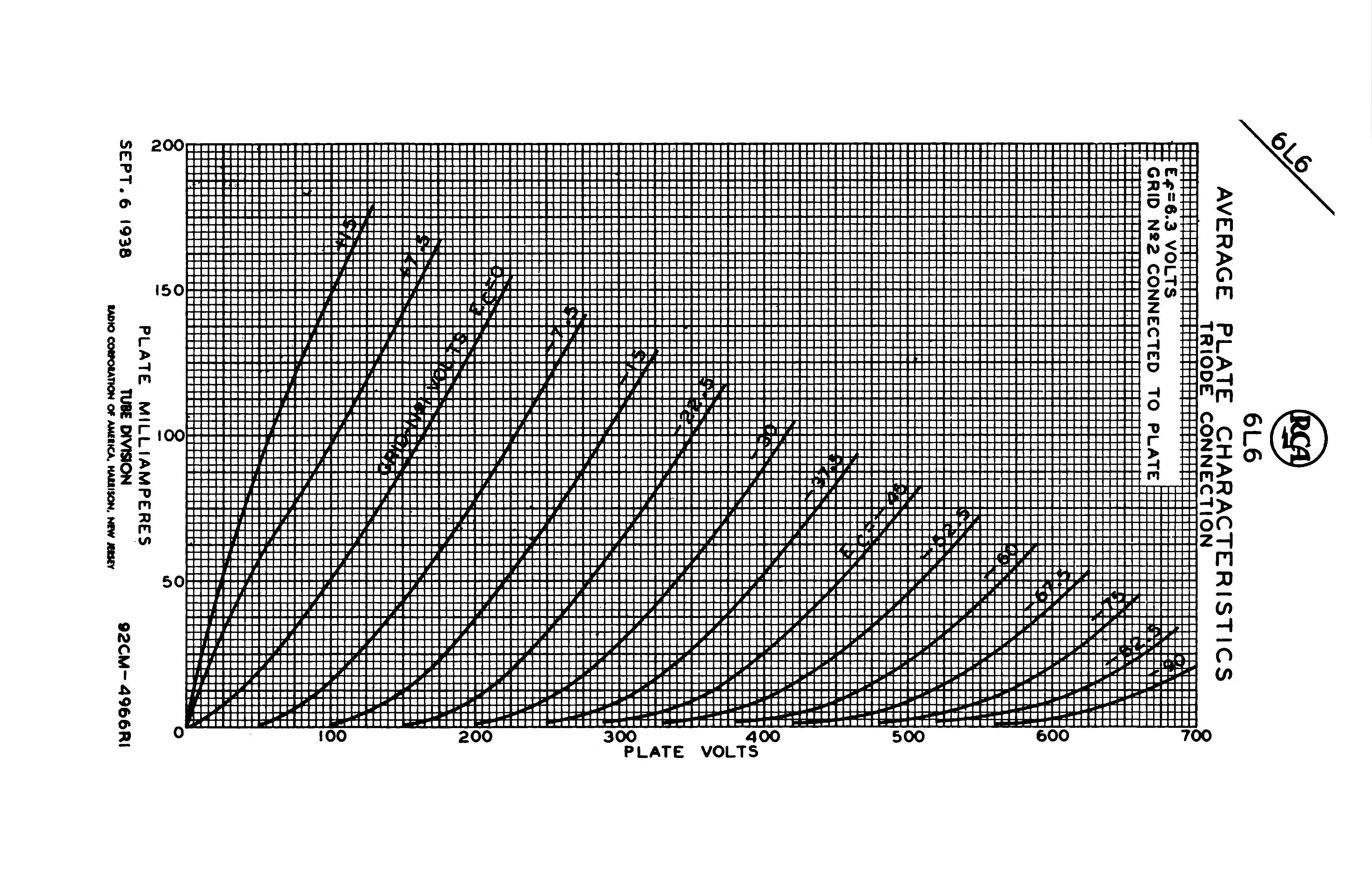
Characteristics

Improved substitute
Similar tubes
References
References
- J. F. Dreyer Jr., [https://worldradiohistory.com/Archive-Electronics/30s/Electronics-1936-04.pdf "The Beam Power Output Tube"], New York: McGraw-Hill, ''Electronics'', April 1936, pp. 18 - 21, 35
- RCA Manufacturing Co. Inc., [https://worldradiohistory.com/Archive-Electronics/30s/Electronics-1936-05.pdf "Here is the New RCA 6L6 Beam Power Amplifier"], New York: McGraw-Hill, ''Electronics'', May 1936, back cover
- Schoenberg, Rodda, Bull, [https://patents.google.com/patent/GB423932A/en?oq=gb423932a ''Improvements in and relating to thermionic valves''], GB patent 423,932, published Feb. 1935
- Schoenberg, Rodda, Bull, [https://patents.google.com/patent/US2113801A/ ''Electron discharge device and circuits therefor''], US patent 2,113,801 published Apr. 1938
- Editors, [https://worldradiohistory.com/Archive-Electronics/30s/Electronics-1935-02.pdf "New Output Tetrode"], New York: McGraw-Hill, ''Electronics'', Feb. 1935, p. 65
- K. R. Thrower, ''British Radio Valves The Classic Years: 1926-1946'', Reading, UK: Speedwell, 2009, pp. 125 - 126
- O.H. Schade, [https://worldradiohistory.com/Archive-IRE/30s/IRE-1938-02.pdf "Beam Power Tubes"] ''Proc. I.R.E.'', Vol. 26, No. 2, Feb. 1938, p. 153
- Editors, [https://worldradiohistory.com/Archive-Radio-Engineering/30s/1935/Radio-Engineering-1935-04.pdf "Metal Tubes for Receivers"], ''Radio Engineering'', April 1935, pp. 18 - 19
- Metcalf, Beggs, [https://worldradiohistory.com/Archive-Electronics/30s/Electronics-1935-05.pdf "All-metal receiving tubes, the manufacturing technique"], New York: McGraw-Hill, ''Electronics'', May 1935, pp. 149 - 151
- RCA, [https://frank.pocnet.net/sheets/021/6/6L6.pdf RCA 6L6 Beam Power Amplifier], RCA Manufacturing Co., Inc.
- Wholesale Radio Service Co., [https://worldradiohistory.com/Archive-Catalogs/Lafayette-Catalogs/Lafayette-1939-76.pdf Lafayette catalog no. 76], New York: Lafayette Radio Corp., 1939, pp. 38, 90, 96
- L. C. Hollands, [https://worldradiohistory.com/Archive-Electronics/30s/Electronics-1939-03.pdf "Circuit Design Related to Tube Performance"], New York: McGraw-Hill, ''Electronics'', Mar. 1939, pp. 18 - 20
- Editors, [https://worldradiohistory.com/Archive-Electronics/40s/Electronics-1940-01.pdf "The Electron Art" "Ultra-High Frequency Oscillation with the Beam Tube"], New York: McGraw-Hill, ''Electronics'', Jan. 1940, p. 69
This article was imported from Wikipedia and is available under the Creative Commons Attribution-ShareAlike 4.0 License. Content has been adapted to SurfDoc format. Original contributors can be found on the article history page.
Ask Mako anything about 6L6 — get instant answers, deeper analysis, and related topics.
Research with MakoFree with your Surf account
Create a free account to save articles, ask Mako questions, and organize your research.
Sign up freeThis content may have been generated or modified by AI. CloudSurf Software LLC is not responsible for the accuracy, completeness, or reliability of AI-generated content. Always verify important information from primary sources.
Report