From Surf Wiki (app.surf) — the open knowledge base
Ka (pharaoh)
Predynastic pharaoh of Upper Egypt
Predynastic pharaoh of Upper Egypt
| Field | Value | |
|---|---|---|
| name | Ka | |
| alt_name | Sekhen | |
| image | Ka vessel.JPG | |
| caption | Vessel found at Tarkhan bearing the serekh of King Ka. Petrie Museum, London | |
| reign | ||
| dynasty | Dynasty 0 | |
| predecessor | Iry-Hor | |
| successor | Scorpion II?, Narmer? | |
| horus | Sekhen | |
| *sḫn* | ||
| *Embraced by Horus / He who embraces Horus* | ||
| Alternative spellings: | ||
| horus_prefix | G5 -- | |
| burial | Chambers B7, B9, Umm el-Qa'ab | |
| monuments | Spouse=Ha |
sḫn Embraced by Horus / He who embraces Horus
Alternative spellings:
Ka, also (alternatively) Sekhen, was a Predynastic pharaoh of Upper Egypt belonging to Dynasty 0. He may have reigned . The length of his reign is unknown.
Name
The correct reading of Ka's name remains uncertain. There are vessel inscriptions which show a serekh with a typical Ka-symbol, both written upright correctly, but there are also inscriptions presenting an upright serekh with an upside-down Ka-symbol inside. The second form of that writing indicates a reading as Sekhen (meaning "to embrace someone") rather than Ka. It was also thought to be the birth name of Narmer. Because the reading of the name is so uncertain, Egyptologists and writing experts such as Ludwig David Morenz prefer a neutral reading as "King Arms". Ka's personal name may have been 'king Ap.'
Reign
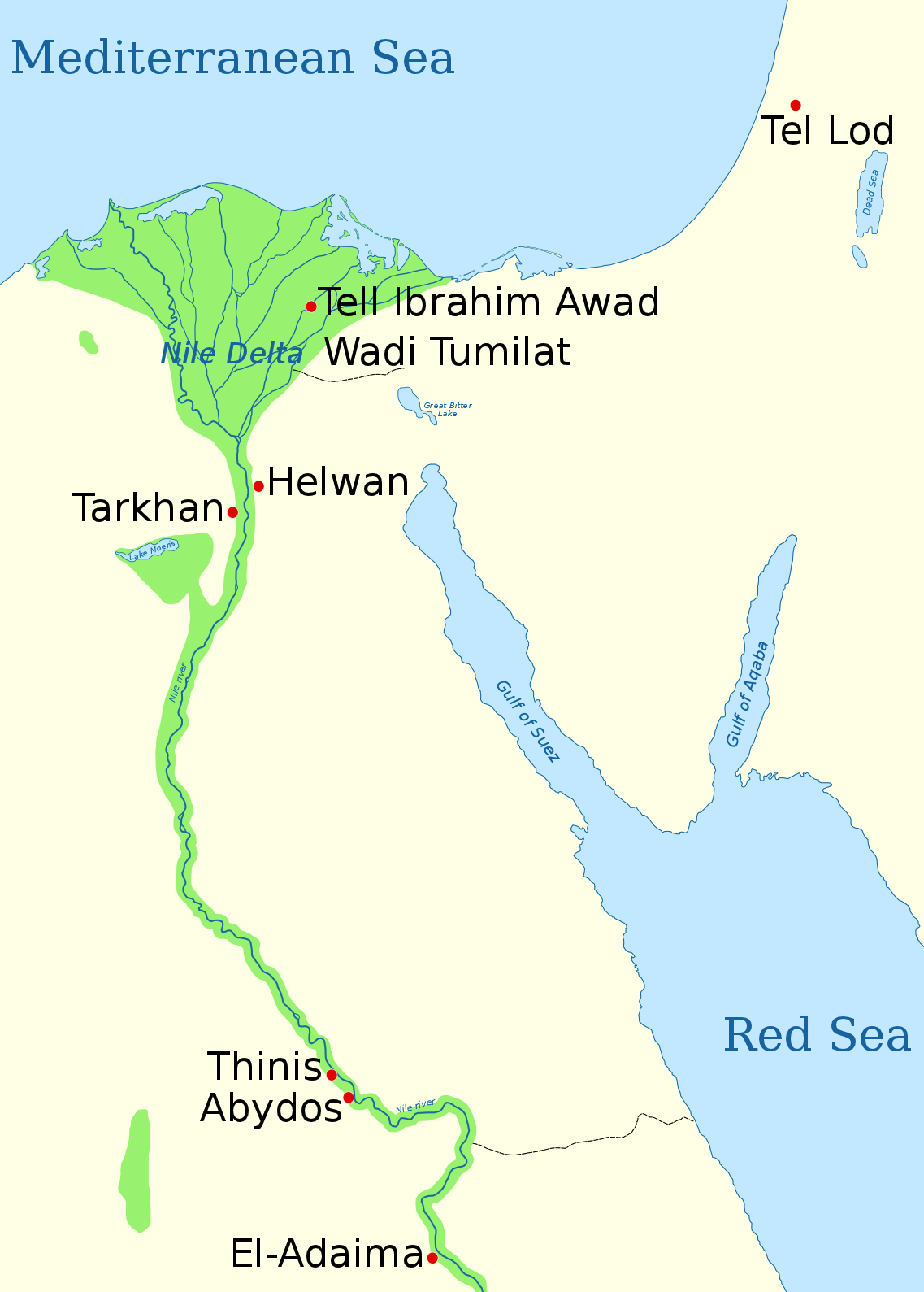
Ka ruled over Thinis in the first half of the 32nd century BC and was buried at Umm el-Qa'ab. He most likely was the immediate successor to Iry-Hor and was succeeded either by Narmer or by Scorpion II. He is the earliest known Egyptian king with a serekh inscribed on a number of artifacts. This may thus be an innovation of his reign. Ka is one of the best attested predynastic kings with Narmer and Scorpion II. Beyond Abydos, he is attested in the predynastic necropolis of Adaima in Upper Egypt and in the north in Tarkhan, Helwan, Tell Ibrahim Awad, Tell el-Farkha (Eastern Nile Delta), Wadi Tumilat and as far north as Tel Lod in the Southern Levant.
The number of artifacts bearing Ka's serekh found outside Abydos is much greater than that of his predecessor. This may be the sign of an increasing influence and perhaps conquest of larger portions of Egypt by the Thinite kings.
Tomb
Two underground chambers, B7 and B9, in the Umm el-Qa'ab necropolis of Abydos are believed to be part of the tomb of King Ka. Each chamber is 1.90 m deep, B.7 is 6.0 × 3.2 m while B.9 is slightly smaller at 5.9 × 3.1 m; the two chambers are 1.80 m apart.
Ka's tomb was first excavated by Flinders Petrie in 1902. The excavations yielded fragments of flint knife and pottery. In the southernmost chamber B7, more than forty inscriptions have been found on tall jars and cylinder vessels as well as a seal impression. The tomb of Ka (B7, B9) is close to that of Iry-Hor (B1, B2) and Narmer (B17, B18). Furthermore, it is located within a sequential order linking the older "U" cemetery with the First Dynasty tombs, thus suggesting that Ka succeeded Iry-Hor and preceded Narmer on the throne.
A cylinder jar found within the tomb, along with Ka's name, has inscribed the name "Ha, wife of the Horus Ka".
Gallery
File:Ka vase.JPG|Vessel from Ka's tomb in Abydos bearing Ka's serekh on display at the British Museum. File:King ka seal.JPG|Seal impression with Ka's serekh. Note the absence of the Horus falcon. British Museum. File:Serekh of Ka.png|Shard bearing Ka's serekh from his tomb in Abydos. File:KaSerekh2.png|Shard bearing Ka's serekh from his tomb. File:Ka Tomb.jpg|Ka's tomb in the Umm el-Qa'ab File:Names of King Ka and Queen Ha on a jar.jpg|Names of Ka and Ha on a jar.
References
Bibliography
References
- (1923). "A History of Egypt Volume I". Methuen & Co. LTD..
- Rice, Michael. (1999). "Who's Who in Ancient Egypt". Routledge.
- [[Jürgen von Beckerath]]: ''Handbuch der ägyptischen Königsnamen'', Münchner ägyptologische Studien, Heft 49, Mainz : P. von Zabern, 1999, {{ISBN. 3-8053-2591-6, [http://www.mediafire.com/view/?4xjd6j4qed3c9vl available online] {{Webarchive. link. (2015-12-22 see p. 36-37)
- Kaplony, Peter. (1982). "Kleine Beiträge zu den Inschriften der ägyptischen Frühzeit". Deutsches Archäologisches Institut, Orient-Abteilung (Hrsg.). von Zabern.
- Baumgartel, Elise Jenny. (1975). "Some remarks on the origins of the titles of the Archaic Egyptian Kings". Egypt Exploration Society.
- Morenz, Ludwig David. "Bild-Buchstaben und symbolische Zeichen".
- Petrie, W.M. Flinders. (1923). "A History of Egypt Volume I". Methuen & Co. LTD..
- Grimal, N. (1999). "BIFAO".
- Raffaele, Francesco. "Dynasty 0".
- Gilroy, Thomas. (2001). "'Forgotten' Serekhs in the [[Royal Ontario Museum]]". Ägyptologisches Seminar der Universität Göttingen.
- Barta, Winfried. (1982). "Zur Namensform und zeitlichen Einordnung des Königs Ro". GM.
This article was imported from Wikipedia and is available under the Creative Commons Attribution-ShareAlike 4.0 License. Content has been adapted to SurfDoc format. Original contributors can be found on the article history page.
Ask Mako anything about Ka (pharaoh) — get instant answers, deeper analysis, and related topics.
Research with MakoFree with your Surf account
Create a free account to save articles, ask Mako questions, and organize your research.
Sign up freeThis content may have been generated or modified by AI. CloudSurf Software LLC is not responsible for the accuracy, completeness, or reliability of AI-generated content. Always verify important information from primary sources.
Report